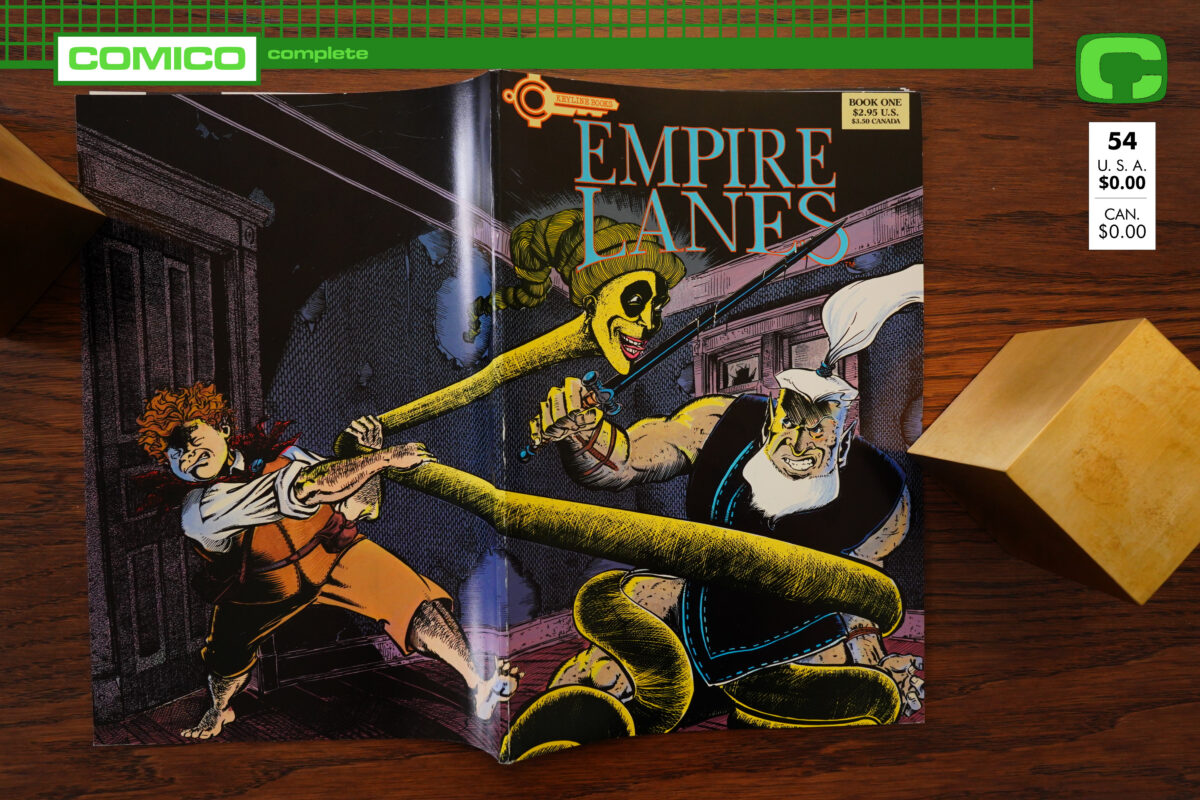
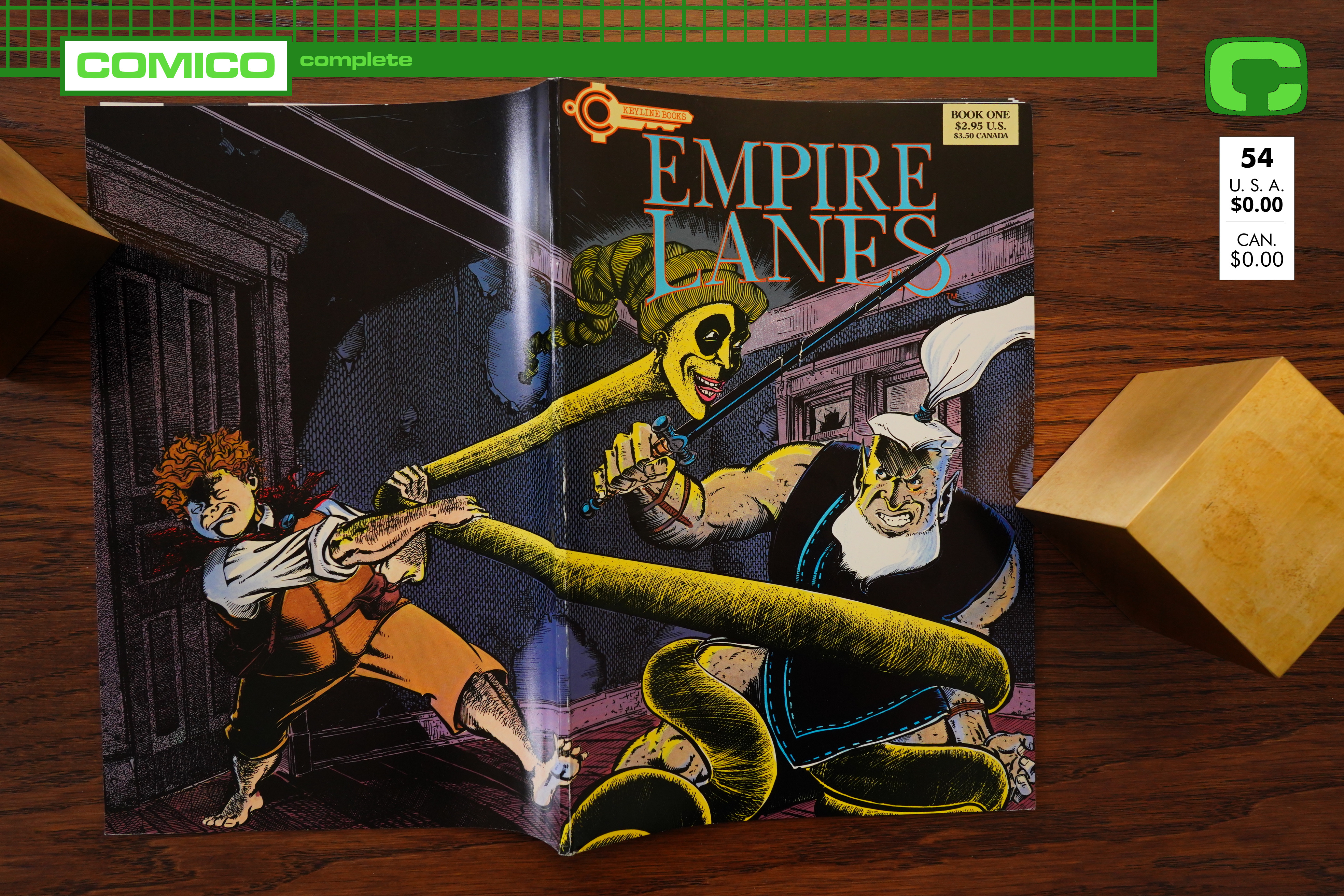
Empire Lanes (1990) #1 by Peter Gross
Here it is — not only is this the third and final Empire Lanes published by Comico, but it’s the final #1 Comico (v1) would publish, and possibly the final comic they published before they went bankrupt.
Or possibly not — perhaps an Elementals issue was the final one. In any case, that makes this a good place to put some chatter about their bankruptcy. But first: Let’s look at this comic book.
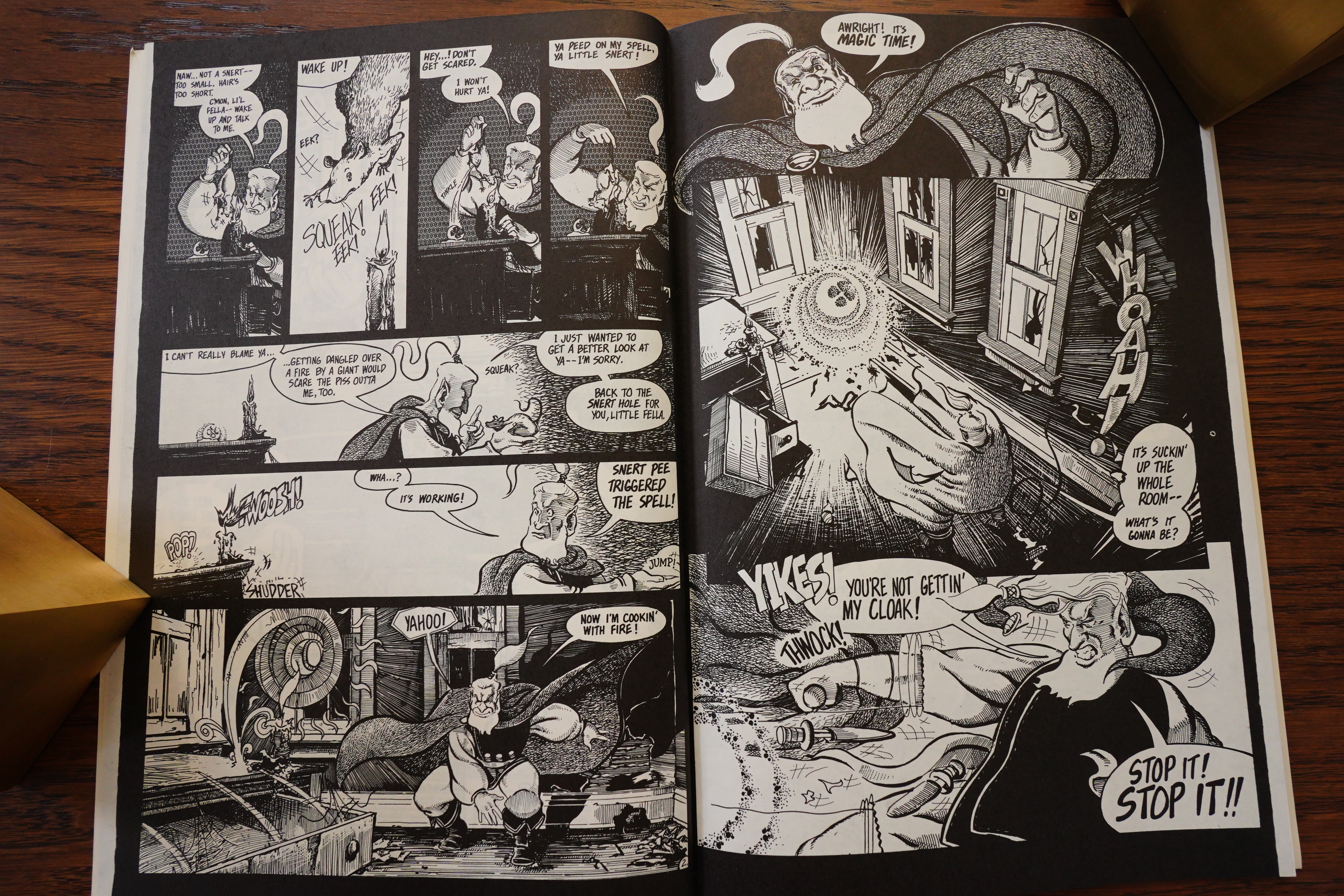
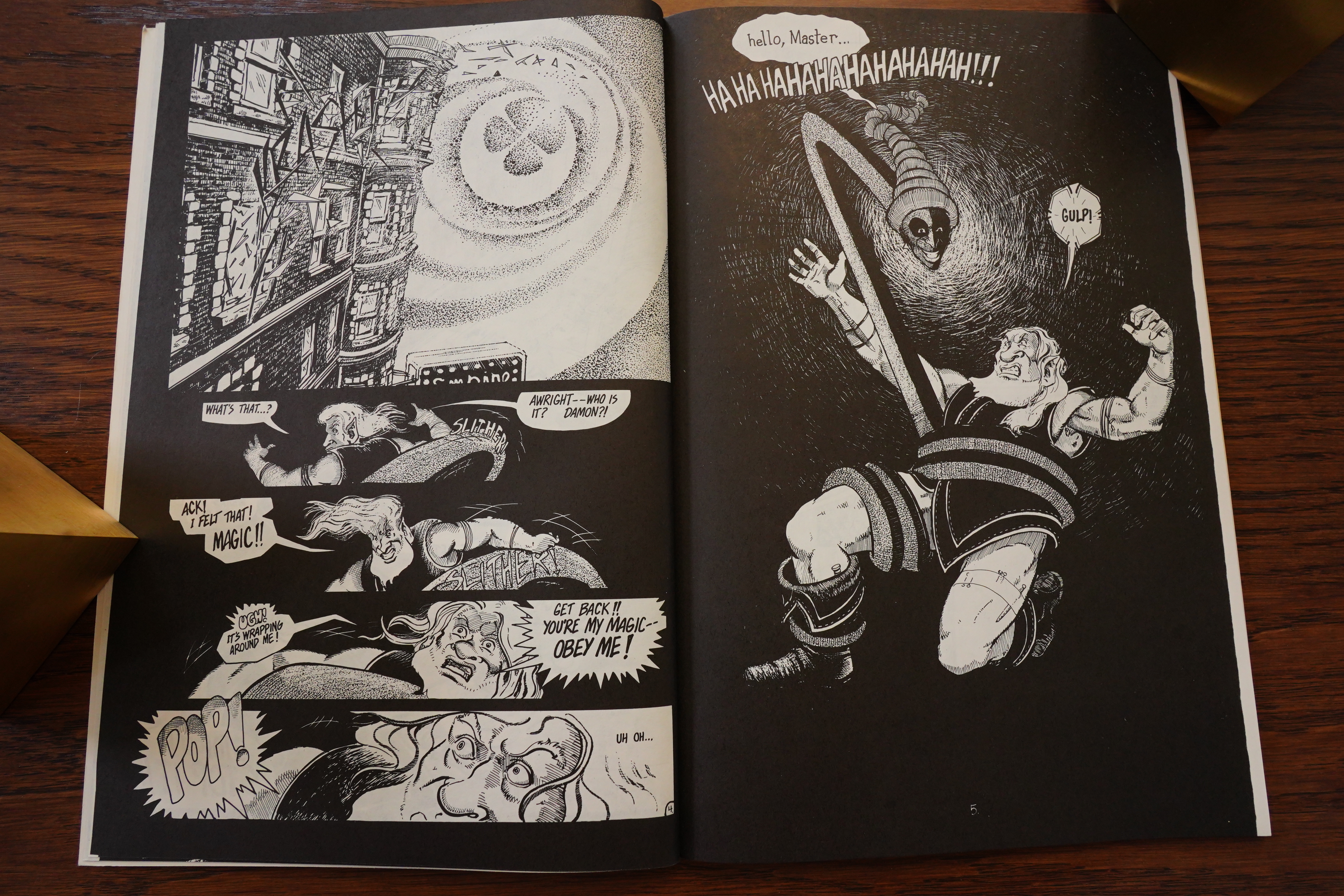
It’s a squarebound “prestige format” comic, and it starts off with a redrawn scene that originally appeared in Empire Lanes #4. This scene wasn’t included in the Empire Lanes collection — perhaps he wanted to avoid an overly cliff hangerish ending? Or just thought it made for a good opening scene? Which it does.
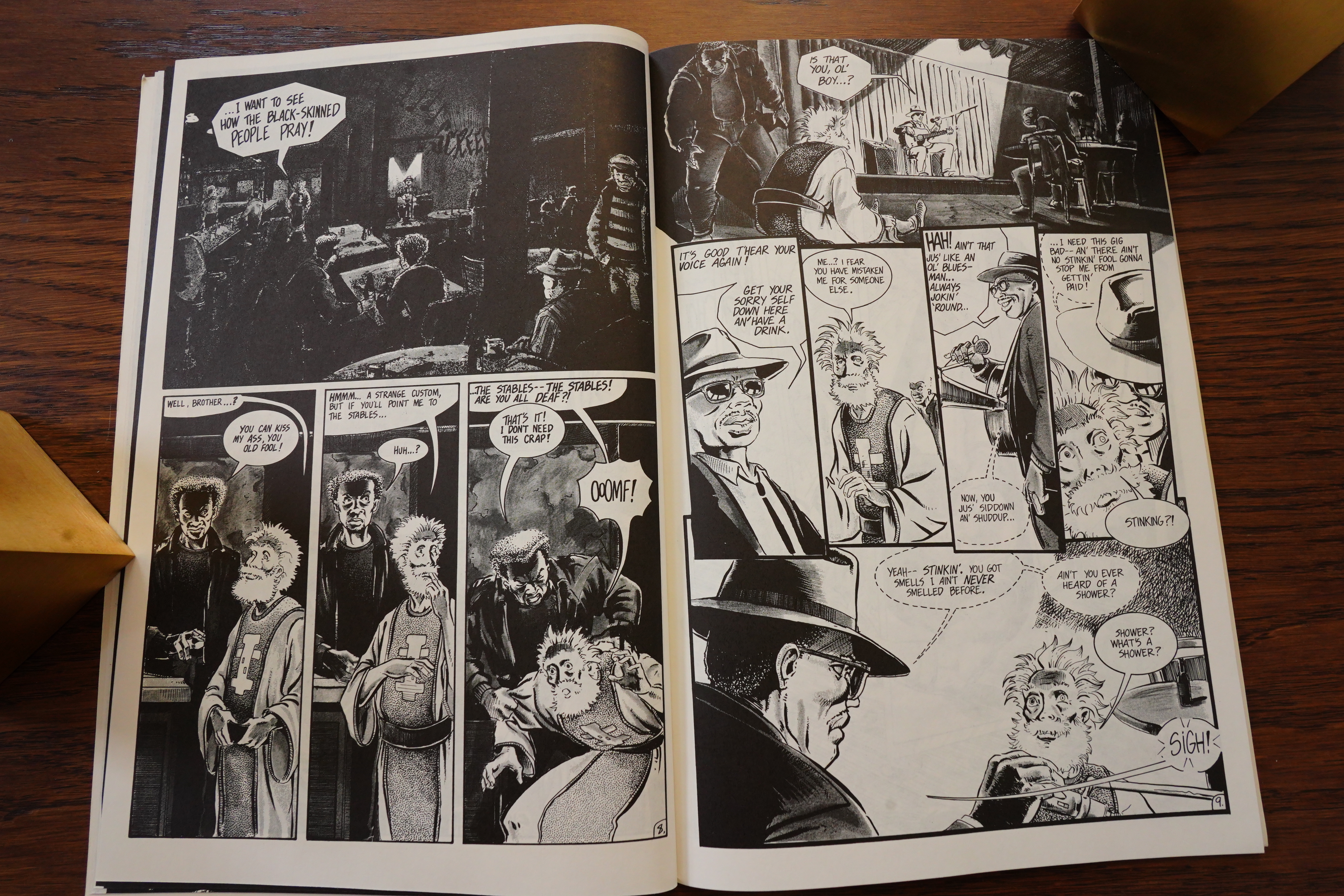
Unfortunately most of the issue takes place in a dive where the Cleric From Another Dimension gets to learn about The Blues and Life and Stuff. I’m not sure how this would read for somebody new to Empire Lanes, but I found this all rather boring.
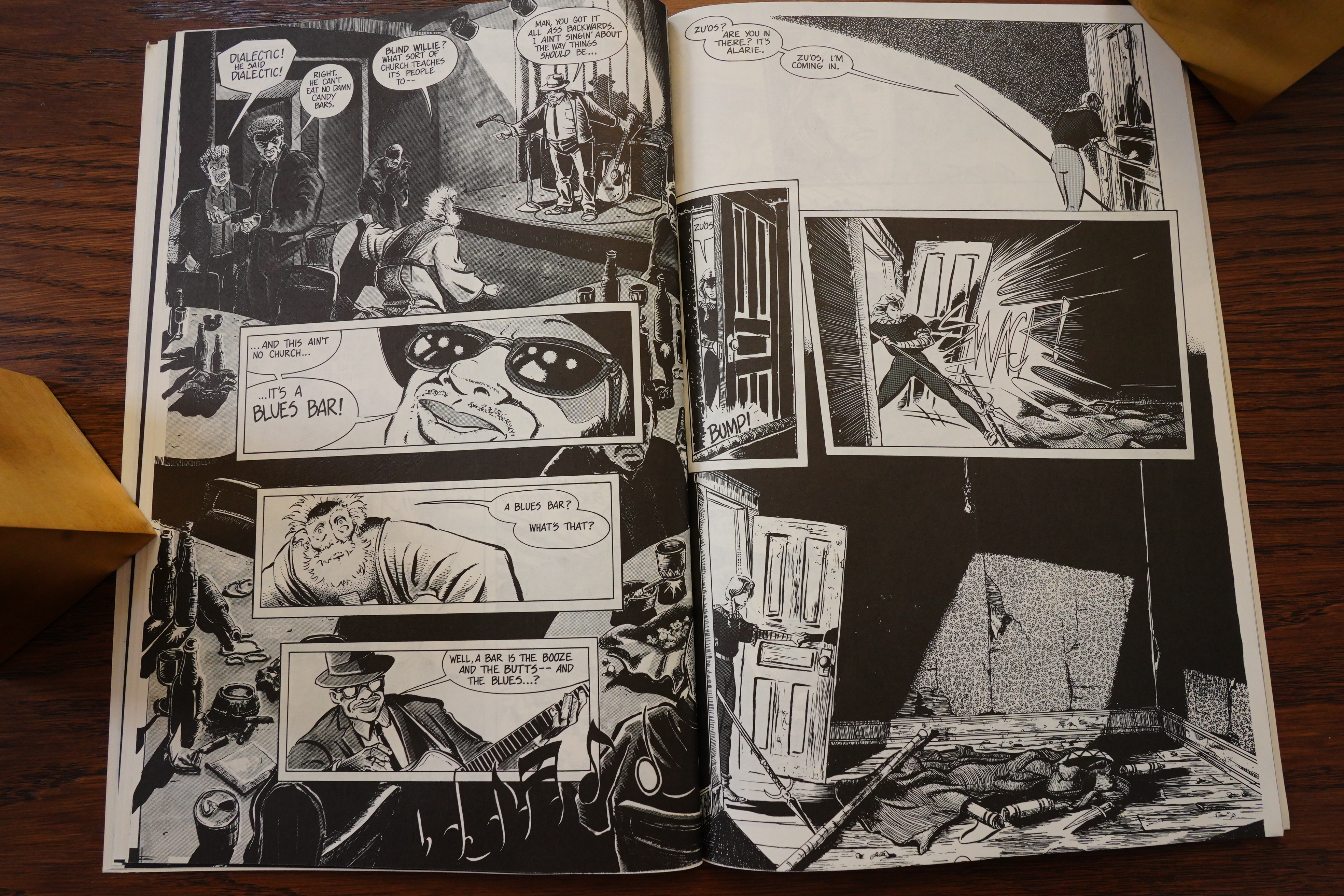
We get some pages interspersed with the fight scene between the gnome and the evil monster, and that help things move along, but…
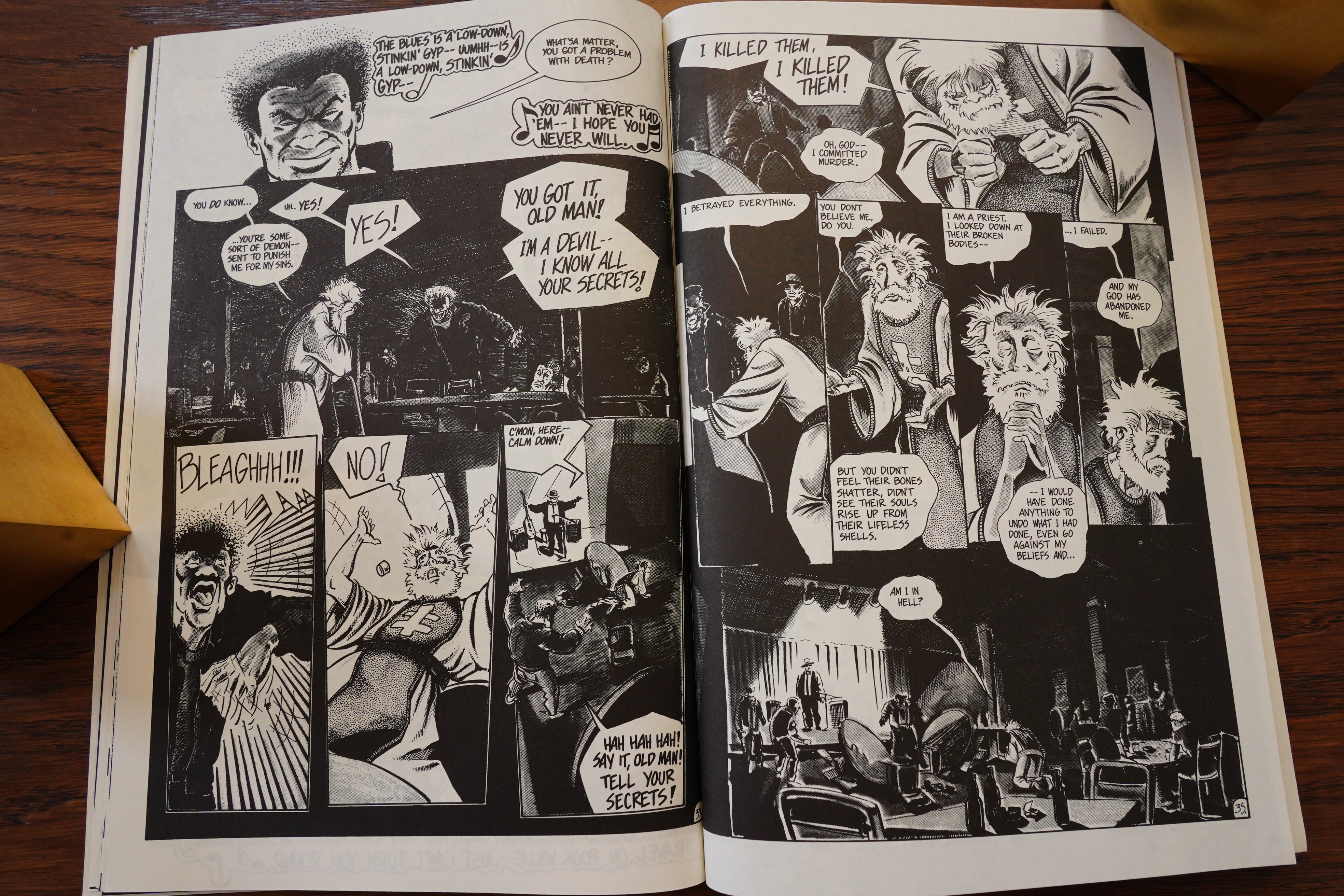
… the problem is that the cleric’s thing here just isn’t interesting. We do learn a bit more about their world, but very little — it’s mostly the cleric taking blues for hymns, and other hilarious misunderstandings. It’s a bit hackneyed.
It seems like Peter Gross abandoned the series altogether after Comico went under, and instead went to work for DC Comics. And I’m not surprised — the original Empire Lanes series had something going for it, but this issue seems aimless and down, as if Gross didn’t really know where he wanted to take the series.
There’s not a lot about this series on the internet, but here’s Gerry Giovinco:
Jenn, I wish that I could give you some insight on this publication but to be honest I’m surprised to see my name was still being listed on anything Comico related that late in the game as I had not set foot in the Comico offices since late 1987 after a dramatic falling out with my partners and some of the administrative staff. I am sad to say that, other than Rick, Phil and Dennis, I have never even met any of the others listed in these credits though I do have great respect for their work. This is the reason most of my comments in this group tend to be focused on the earlier history of the company.
But Empire Lanes works.
Every bit of it.
It all just works.
OK, let’s talk about the bankruptcy.
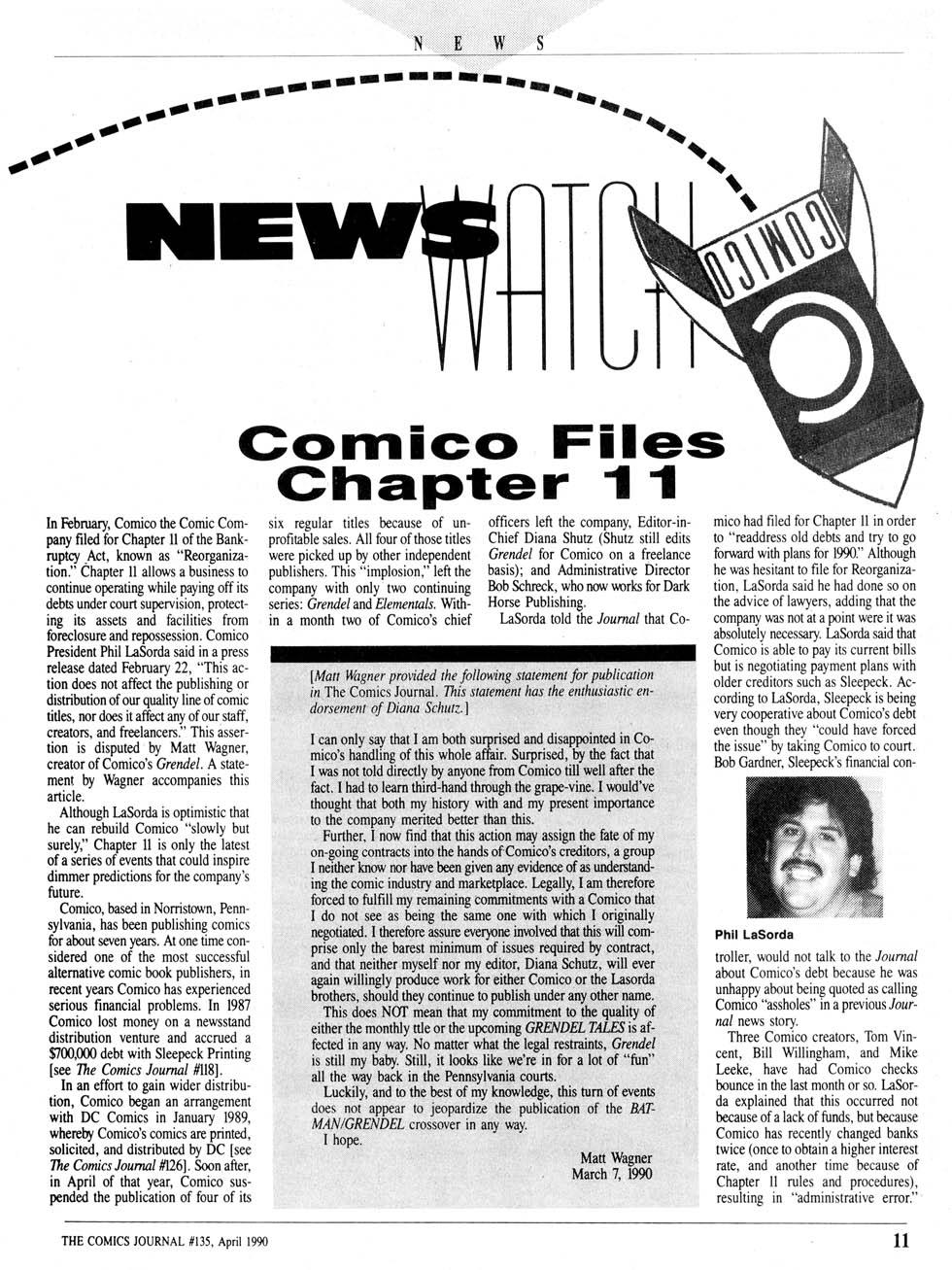
COMICO FILES BANKRUPTCY, PLANS TITLES
Comico the Comic Company has filed
bankruptcy under Chapter 11 of the
Federal Bankruptcy Act in order to be
able to pay off old debts while still
publishing new comics. At the same
time, they officially announced the ad-
dition of three new comics to their
line.
Chapter 11 allows a company to put
its financial affairs in order while
negotiating to pay off its creditors.
Comico has bad debts dating back to
1987, when the company lost a great
deal of money on a failed move into
the newsstand market. At that time,
Comico’s printer, Sleepeck Publish-
ing, was owed some $700,000. Sleep-
eck negotiated a contract with Com-
ico to receive its back debts before any
of Comico’s other creditors in the
event of a bankruptcy.
It is unknown how much money
Comico currently owes Sleepeck;
however, The Comics Journal cites
Comico publisher Phil LaSorda as
saying that Sleepeck has been very
cooperative “even though they could
have forced the issue.”
Reaction among Comico contribu-
tors to the company’s bankruptcy was
mixed. Matt Wagner, creator of Gren-
del and Mage, told The Comics Jour-
nal that he was “surprised and disap-
pointed by Comico’s handling of this
matter” in not notifying their free-
lancers immediately of the bankruptcy
and went on to state that after his cur-
rent contract was complete, he would
produce no further work for the com-
pany. LaSorda replied to Wagner’s
complaint about not being notified
promptly by stating, “. . . a source out-
side Comico apparently leaked some
information before we were legally ad-
vised to do so.”
Elementals writer and creator Bill
Willingham had a different reaction
than Wagner. He said he would con-
tinue working for the company, and
told the Journal that “I don’t have any
fears, for either the best or worse, that
the Elementals will be taken out of my
hands.”
Comico publisher Phil LaSorda
stated in a press release that “It’s
business as usual here at Comico. This
action does not affect our quality line
of comic titles, nor does it affect any
of our staff, creators or freelancers.”
Comico’s declaration of bankrupt-
cy is only the latest manifestation of
a steady stream of financial troubles
the company has had in the last several
years. The most notable example came
in April of 1989, when the company
cancelled four of the six titles it then
published. All four series were subse-
quently picked up by other publishers.
Currently the only monthly comic
the company publishes is Elementals.
They publish The Rocketeer Adventure
Magazine on an irregular basis, and
the black-and-white Empire Lanes on
a quarterly basis under their Keyline
Books imprint. Comico also publishes
Grendel and Grendel Tales, both of
which will be appearing later in the
year.
In addition, the company has an-
nounced three new titles. The Atomi-
clones by Dennis LaSorda, Robert
Loren Fleming, Paris Cullins and the
Maximum Overtime Studio is a three-
issue limited series involving futuristic
super-heroes who discover that what
they really are isn’t quite that simple.
The first issue ships in late June.
Shipping in early June is The Uni-
versal Intergalactic Discovery Com-
pany by Bruce Zick, an ongoing col-
or series that promises lots of heroic
space-spanning action.
Wizard Magazine #30, page #86:
The delay, of course, was due to Comico’s fil-
ing for bankruptcy protection in 1990—Comico
was Grendel’s first publisher-which wrapped
Grendel up in legal red tape for over two years.
Did the bankruptcy court treat Grendel as one
of the assets of Comico?
Yes, and for various political reasons,
[I wasn’t paid], mainly in an attempt to
keep me from taking the Grendel property
away from Comico, which I ended up doing
anyway. [Grendel is now published by
Dark Horse Comics.]
When you first signed with Comico, didn’t you
retain rights as creator?
I had rights as creator and bankruptcy
clauses, but all that stuff goes right out the
window in a bankruptcy case, because any
contract you sign with a publisher is a civil
contract, and bankruptcy law is a federal
law, which outweighs it.
The Comics Journal #138, page #10:
Comico Suspends Operations
Earlier this year, Comico filed for protec-
tion under Chapter 11 of the Bankruptcy Code.
The company’s operations are currently under
the supervision of a federal court in
Philadelphia. If all goes according to schedule,
Blackthorne companies. Schanes said he and
Rev were confident that they would succeed in
acquiring Comico’s name and assets from the
Philadelphia court. “We hope to get everything
finalized in a day or two,” Schanes told the Jour-
nal on Aug. 23.
“I’ve been in the comics business for 19 and
a half years,” Schanes added. “I’ve had my trials
and tribulations, my ups and downs. But that’s
a fact of life in independent publishing. It’s a
little easier to keep going year in and year out
when you’re a big corporation.”
Among the Comico projects on hold is Matt
Wagner’s Batman/Grendel crossover, a co-
publication with DC. The crossover book is
receiving major fan-press coverage, with cover
stories in Comics Interview and Amazing
Heroes; should its publication be delayed too
long, its sales may suffer.
An anonymous flyer was distributed at the
San Diego Comic Book Convention, stating,
“Ask yourself why you should support a com-
pany that has been lying to its freelance staff
and to the fan press — and to you — for the last
six months!” It listed completed jobs and money
owed to former editor-in-chief Diana Schutz and
to creators Matt Wagner, Joe Matt, Eddie Camp-
bell, Rob Walton, Patrick McEown, Bill Will-
ingham, John Estes, Bambos Georgiou, Kurt
Hathaway, and Ken Bruzenak. Comico had a
booth at the convention, which was unoccupied
much of the time.
менComico the Comic Company, currently under
Chapter 11 reorganization, suspended publishing
in July when it cancelled solicitations on its re-
maining series, including the long-running
Grendel and Elementals. The last Comico comic
to ship was Empire Lanes #1. Efforts are still
underway, however, to re-launch the line.
a plan for reorganizing the company and pay-
ing off creditors should be submitted to the court
in September. Some creators owed money by
Comico have told the Journal that they will ask
the court to be let out of their contracts and to
regain publishing rights to unpublished issues.
Andrew Rev, the Chicago entrepreneur who
has invested in Comico and is applying to the
bankruptcy court to take over the Comico name
and assets, personally paid for the printing of
one more comic, Elementals #15. DC Comics,
which has handled Comico’s printing and
distribution since 1988, has refused to solicit the
issue, citing several unauthorized cameo ap-
pearances in it by Marvel Comics characters.
Rev told the Journal that “we’re getting it
straightened out” and that he expects to receive
Marvel’s permission to use the characters.
Rev is opening a publishing office in San
Diego. It will be headed by Steve Schanes,
former head of the late Pacific Comics and
Then Comico went
bankrupt, and Matt Wagner finds to his horror that
his comic book Grendel is considered an asset of
Comico, and is frozen. For two years he’s not allowed
to publish his own comic. No justice there!
The Comics Journal #163, page #66:
PINKHAM: What happened between Eddy Current and Plas-
tic Forks? In that space you were negotiating with Comico?
McKEEVER: Yeah. It wasn’t planned by any means. If I had
planned it, I would have gone on vacation somewhere!
[laughs] But when I was done with Eddy, I did a couple of
stories for A1; I did a cover for another British publication.
So I was doing these short, six-page stories here, and I did
a portfolio for Fly In My Eye. But it was basically stretch-
ing, after a long haul on Eddy. It wasn’t as long a break as
it seemed, because that was only about a month’s worth of
time.
Afterwards, I went ahead and did book one of Plastic
Forks. It was originally supposed to come out as an eight-
or 12-issue series from Comico, and it was going to be a
standard 24-page or 32-page thing. So I did the first issue
and I did the cover for it, and that went into their files. I was
doing it ahead of time, so there were three issues in the can
before it started coming out. I sat down to do #3, and I got
a phone call from Comico. “Oh, by the way, we’ve gone
bankrupt. We’re out of business.” Which was probably
one of the worst days of my life. It was like flying high, and
then the wings fall off your plane, “Okay, we’re going
down, folks!” At that point I turned around and said,
“Okay, the contract is now null and void, and I can take this
anywhere I want.” So I went to Epic with it and I said,
“Look. Here’s an idea that I want to do. Here’s the first two
issues; I have them ready to go.” And they looked at them
and said, “Wow! They’re painted and everything!” “Yeah,
they’re ready to go — which means I’m that far ahead.”
And they said, “How did you want this to come out?”
Originally, I wanted them to come out as a five-issue, 64-
page book – but Comico had never done anything like
that before, so they basically wanted to go with what
they’ve done, tried and true, which was standard comic
book format. I said, “Well, what I’d really like to do is have
it be a five 64-page book series.” And they said, “Okay,
fine.”
Oh, so Comico was going to publish Plastic Forks… that would have been some departure for them.
Wizard Magazine #21, page #28:
At the same time that Grafik Muzik was being published, Allred completed
several other side projects, some which haven’t seen print yet. The first of these
publisher, Comico, went bankrupt.
The timeline is — in early 1990, Comico went into Chapter 11, but managed to stagger on for a bit. Then in mid 1990, they went into Chapter 7 and ceased publication.
So is this the final post in this blog series? No! Because a year later, Andrew Rev bought the burning cinders of the company. Most of the people associated with Comico managed to extract themselves and their properties, but not Bill Willingham, so Comico v2 would turn out to mostly be based on Elementals.
And some porn.
I have no idea what this stuff is like (beyond the Elementals issues I’ve already read), so that’s kinda exciting — but I’m assuming it’s going to be mostly pretty bad stuff from now on.