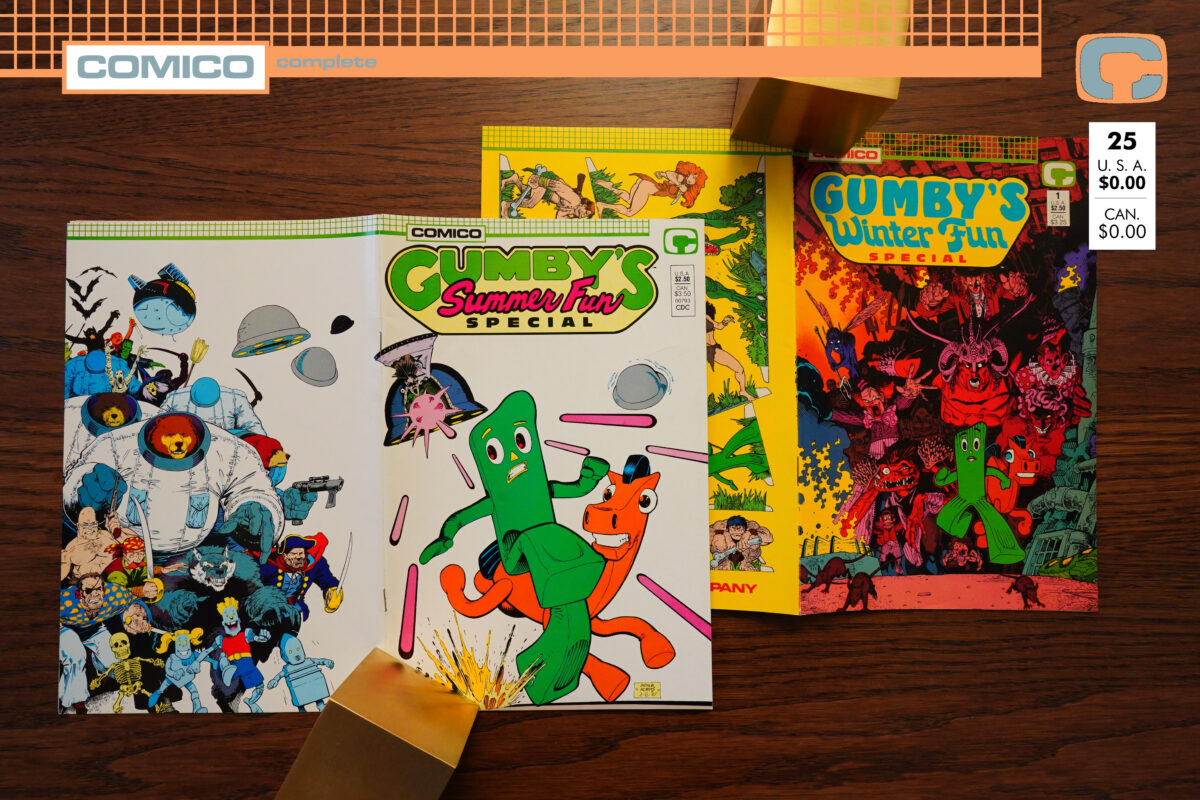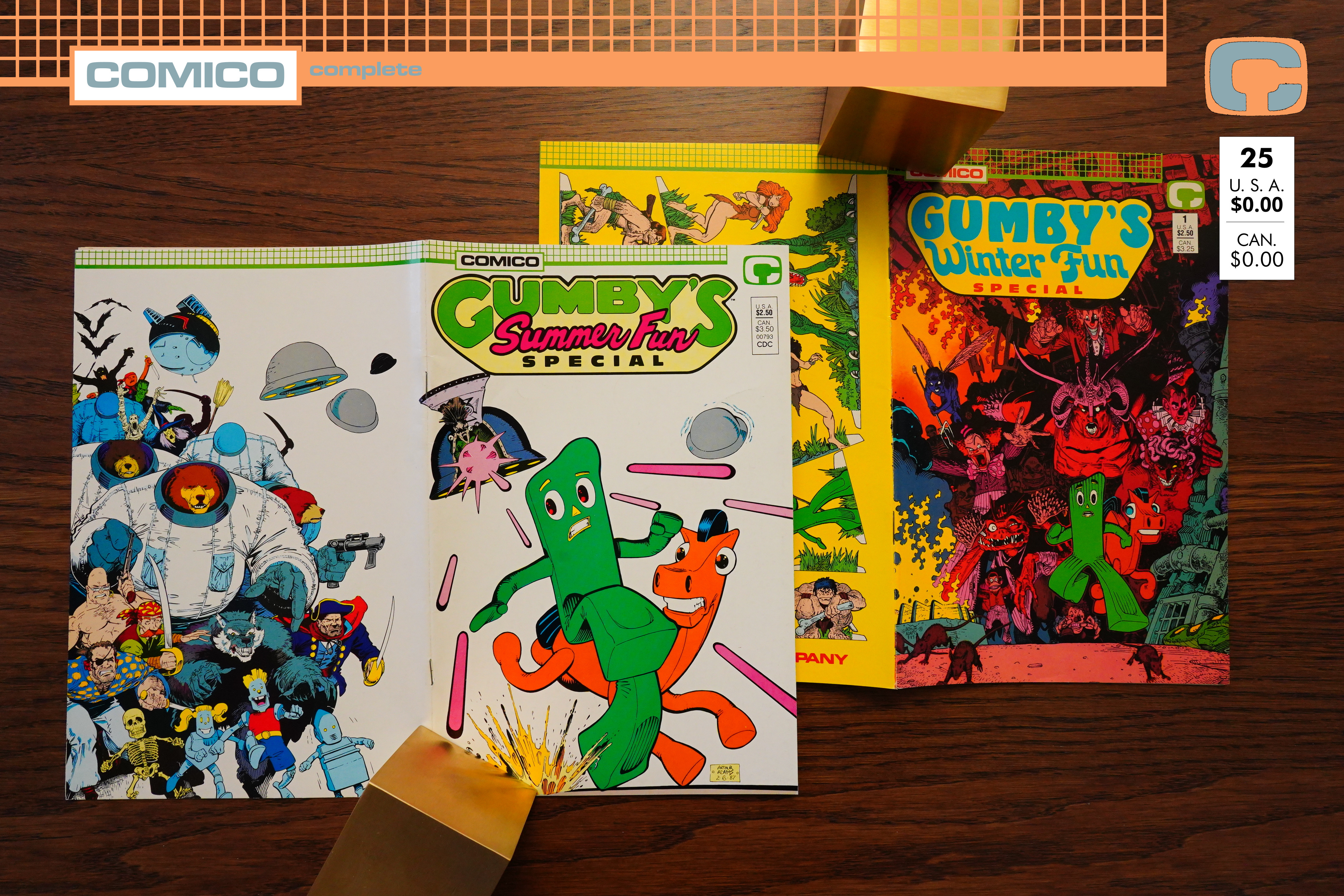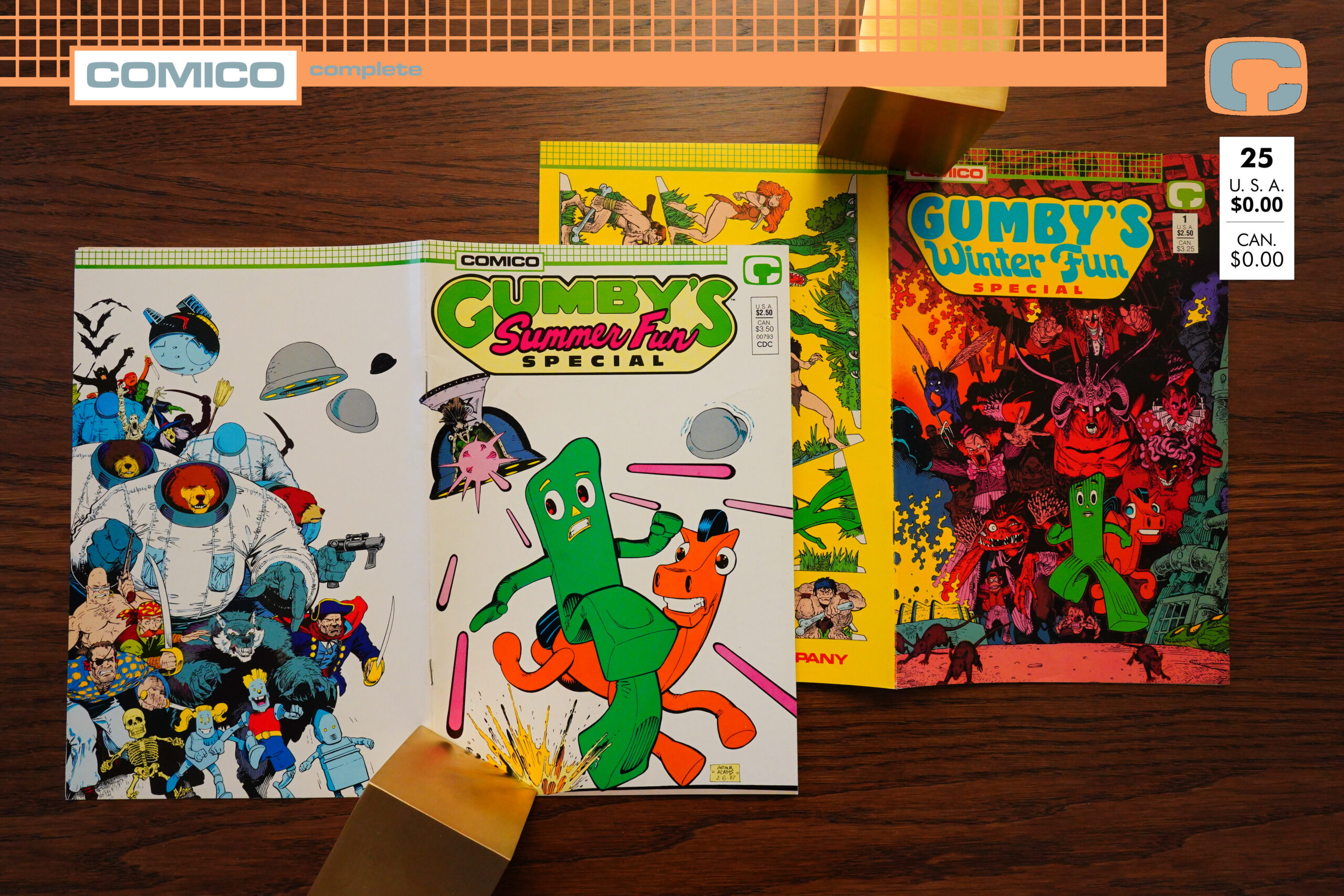
Gumby’s Summer Fun Special (1987),
Gumby’s Winter Fun Special (1988) by Arthur Adams, Bob Burden, Steve Purcell et al
Like most (or perhaps all) of Comico’s licensed comics, I’ve never actually seen what they’re adapting (or riffing) on here. I think Gumby was a claymation thing for TV? I have no idea, really.
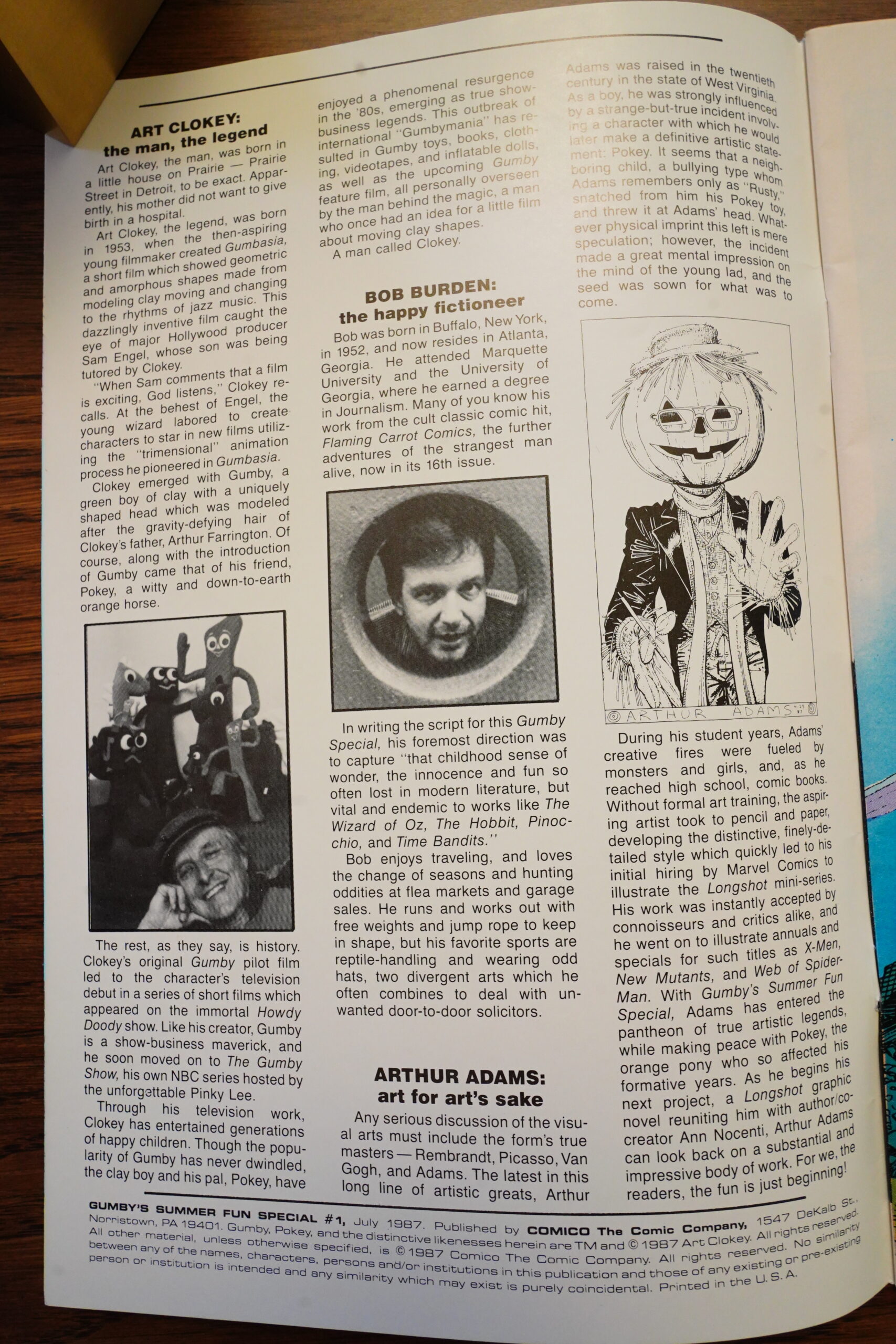
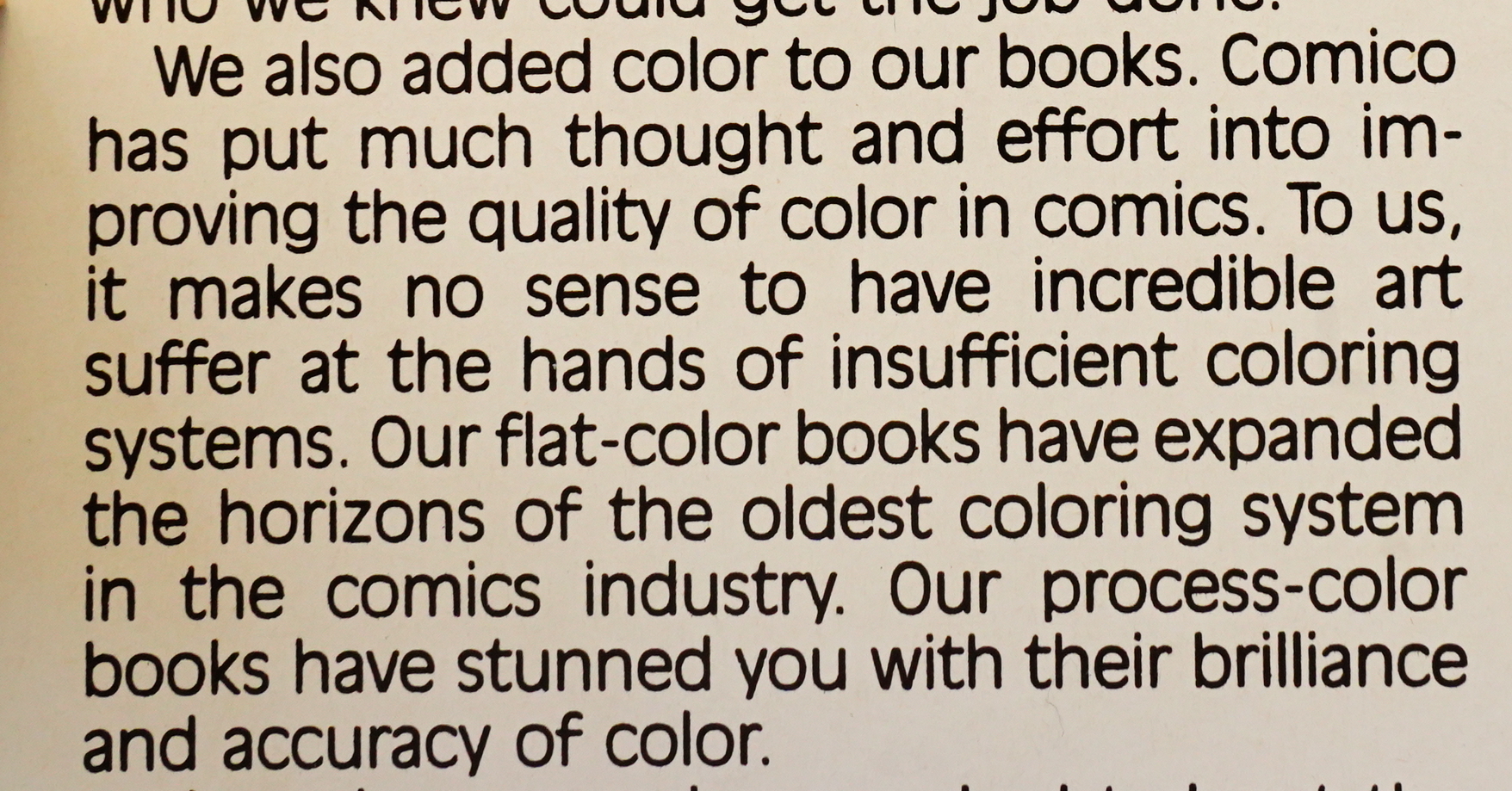
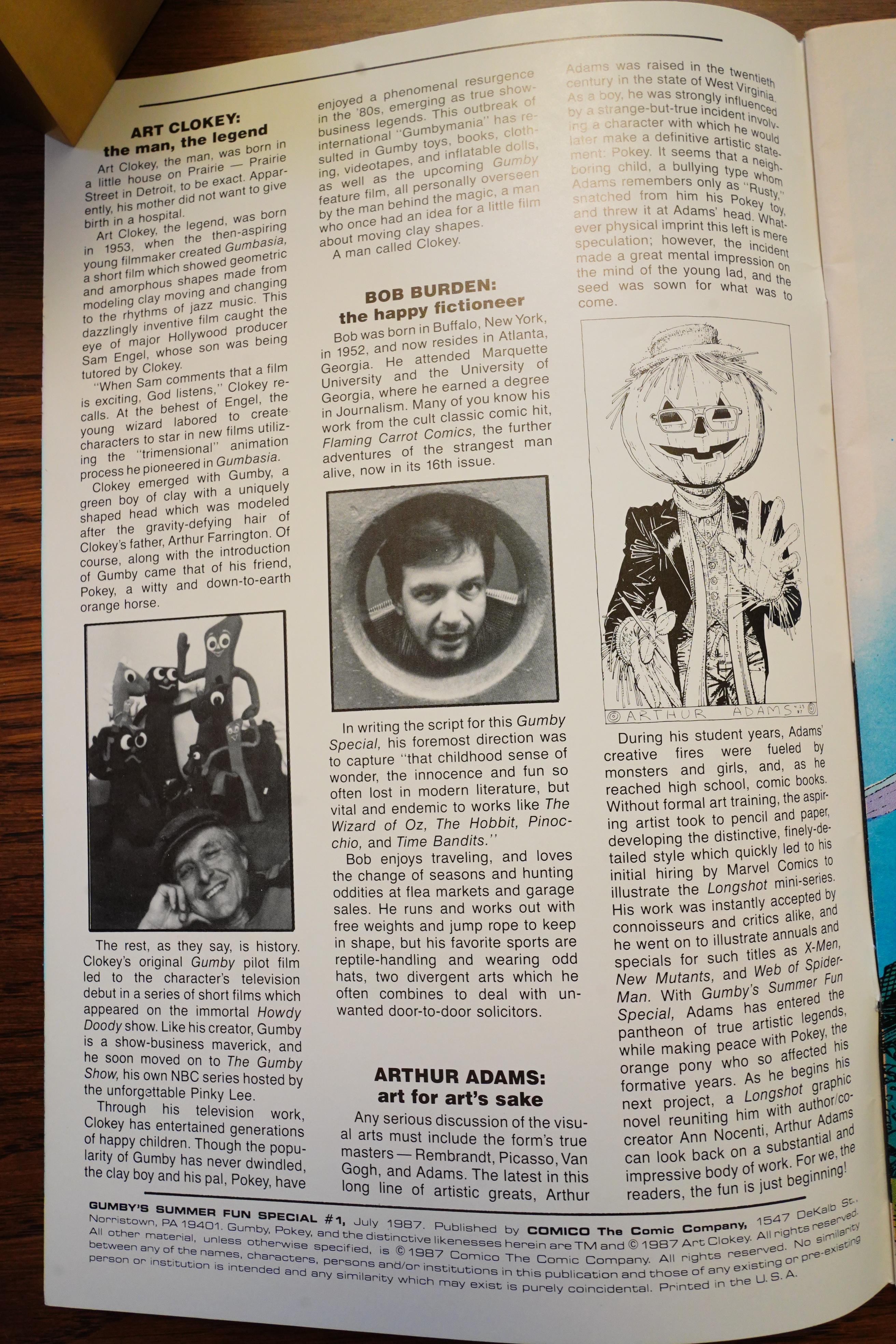
The introduction seems to confirm this, but as is often the case with these introduction, it seems to assume that you already know all of this, so it’s just recapping things for the fans. But like — no dates? Was this in the 60s? 50s? 80s? Was it claymation through and through, or something else? They mention a “trimensional” technique, which I guess could mean that it’s… claymation in front of drawn backgrounds? Or something completely different.
But instead of worrying about all that, let’s just read some comics. Each issue is 40 pages long, and the first one is written by Bob Burden.
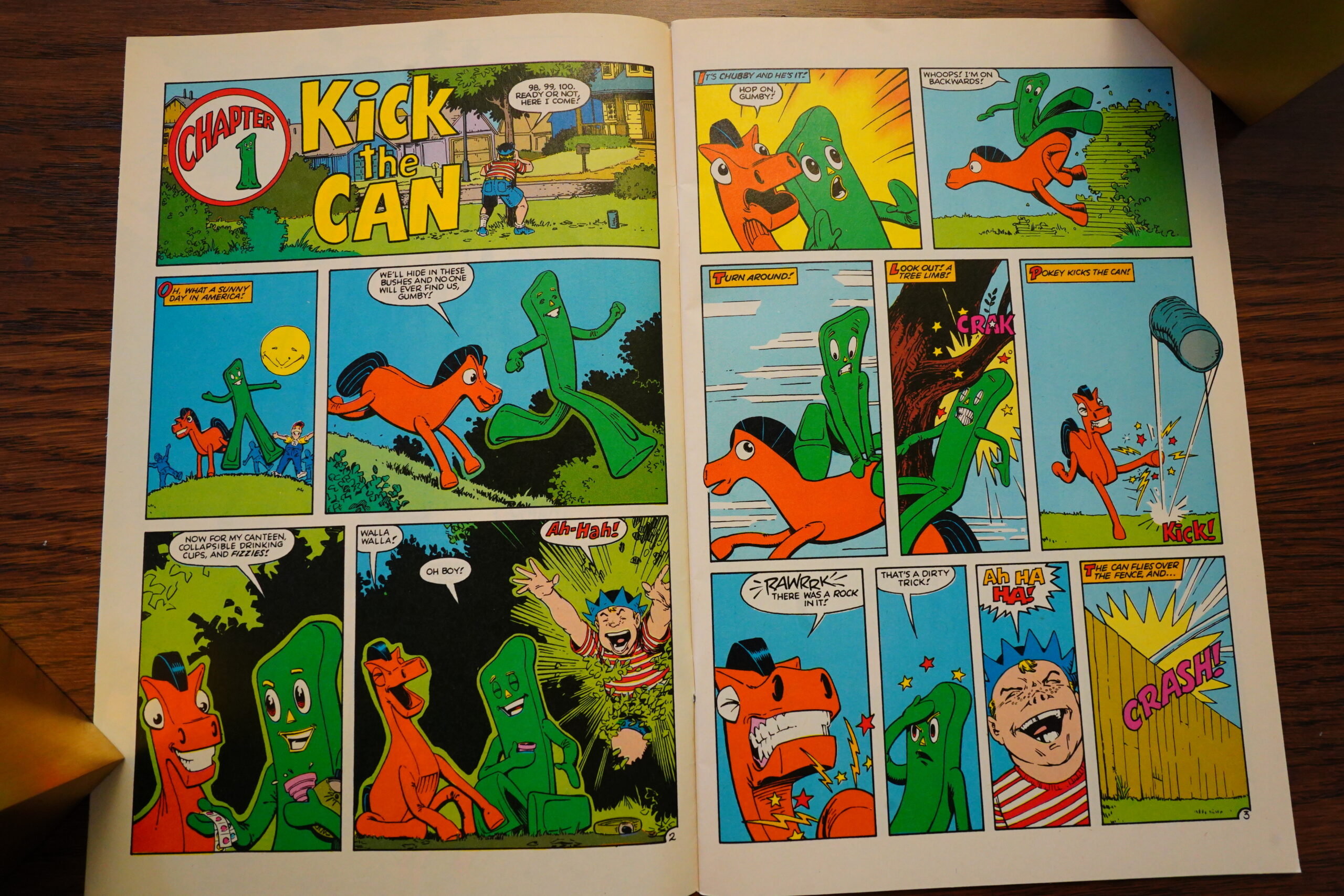
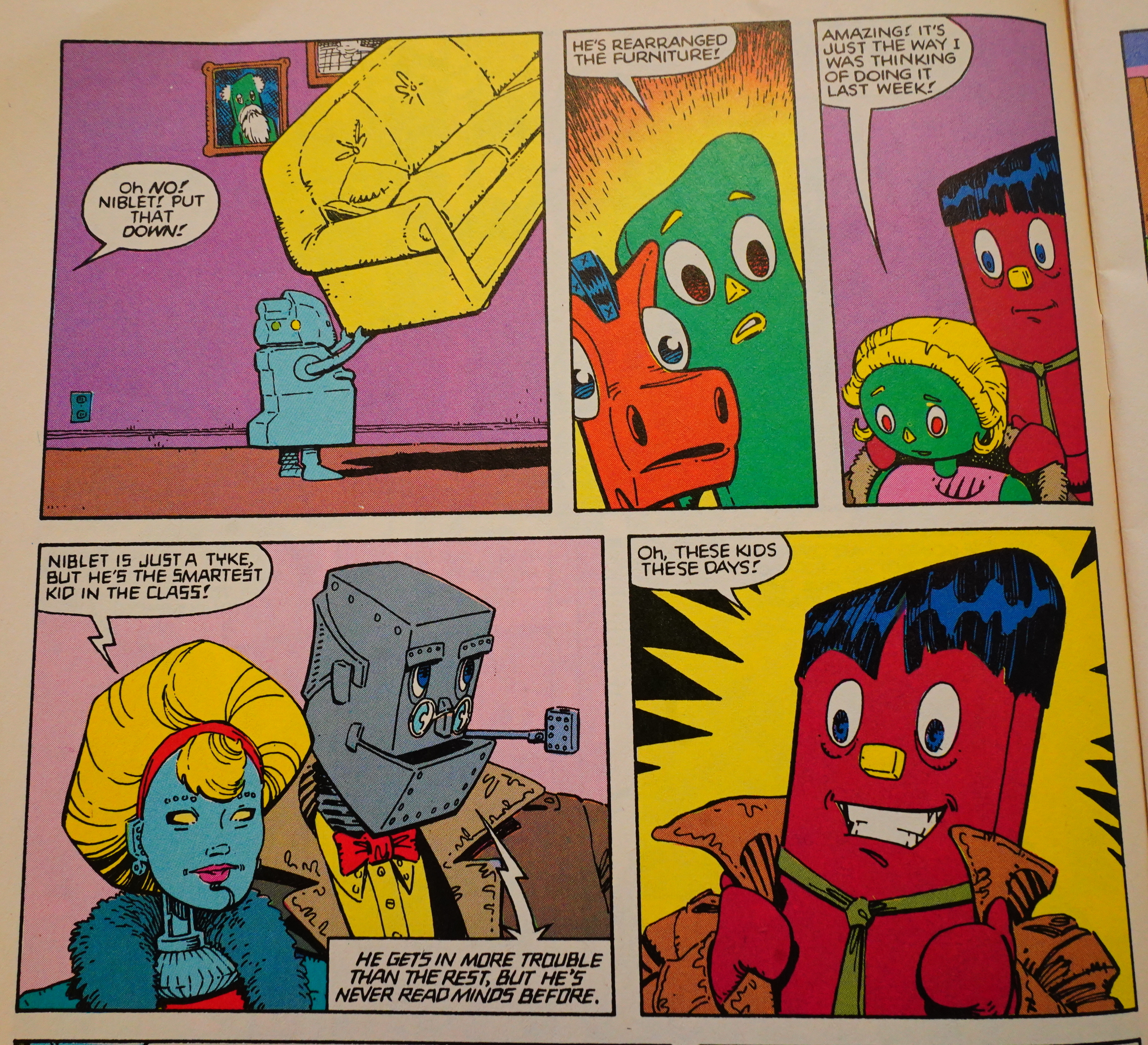
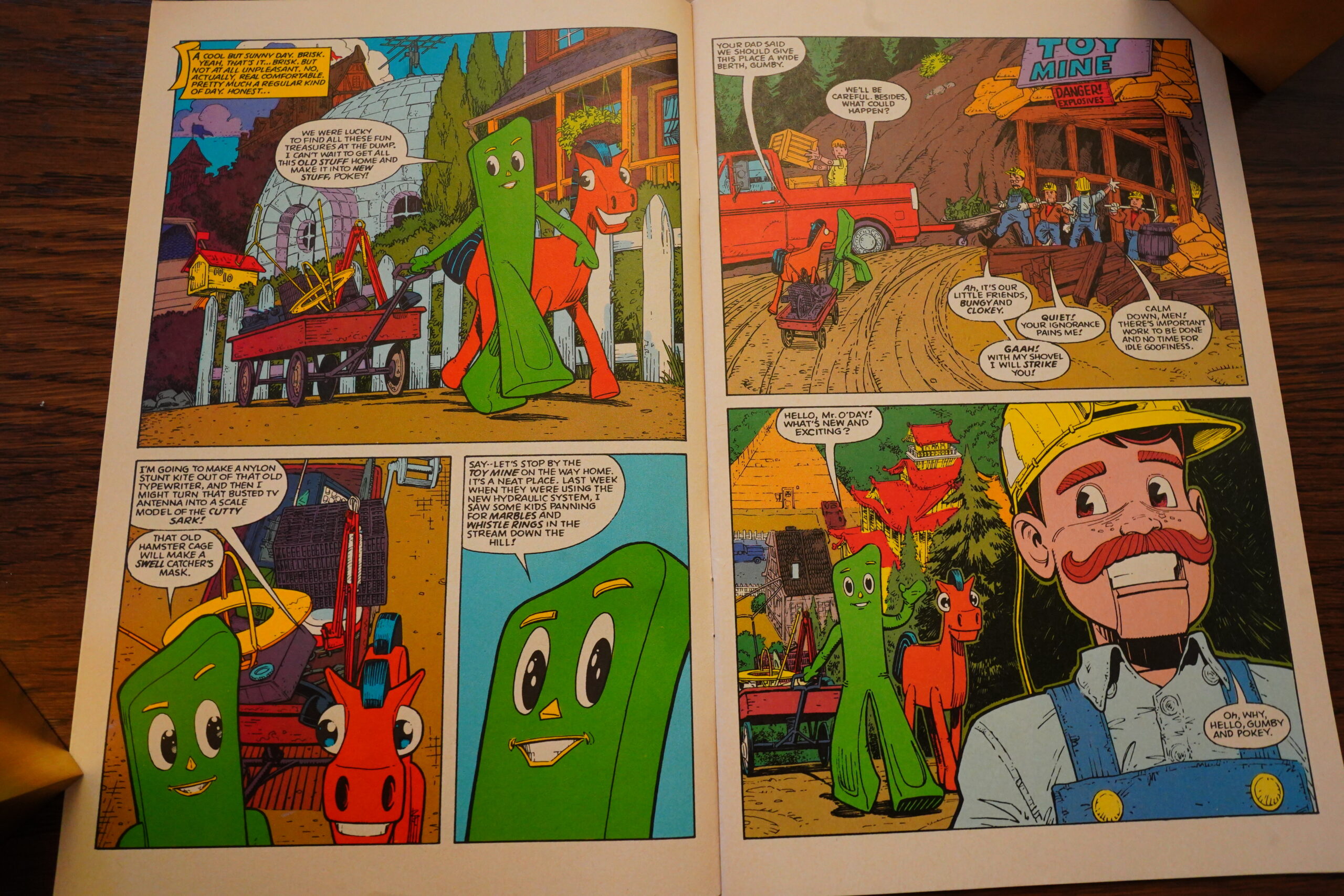
Bob Burden is most famous for Flaming Carrot Comics, and this reads (basically) like a Flaming Carrot issue. I think I’m probably the only person in the world to not be a Bob Burden fan, so…
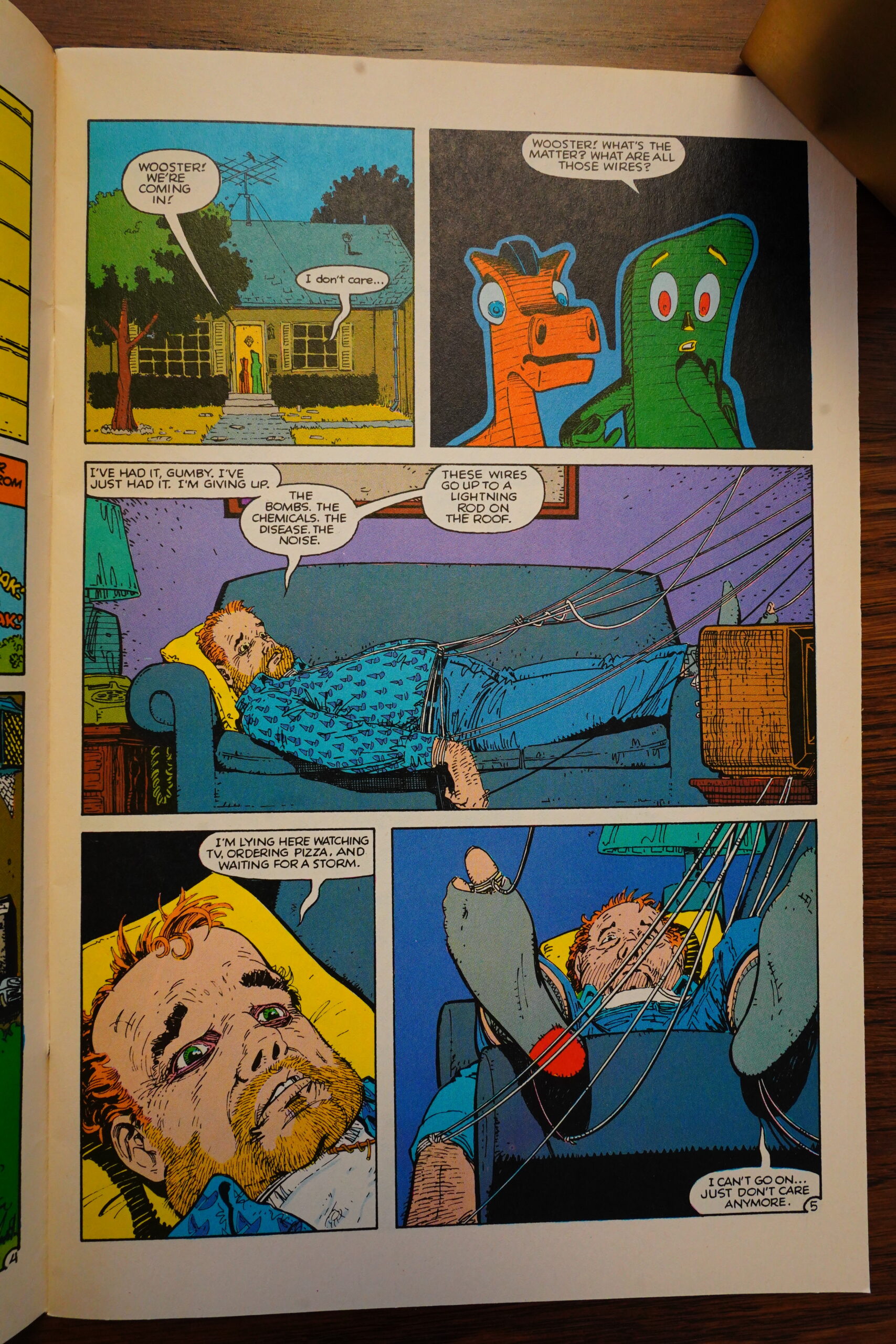
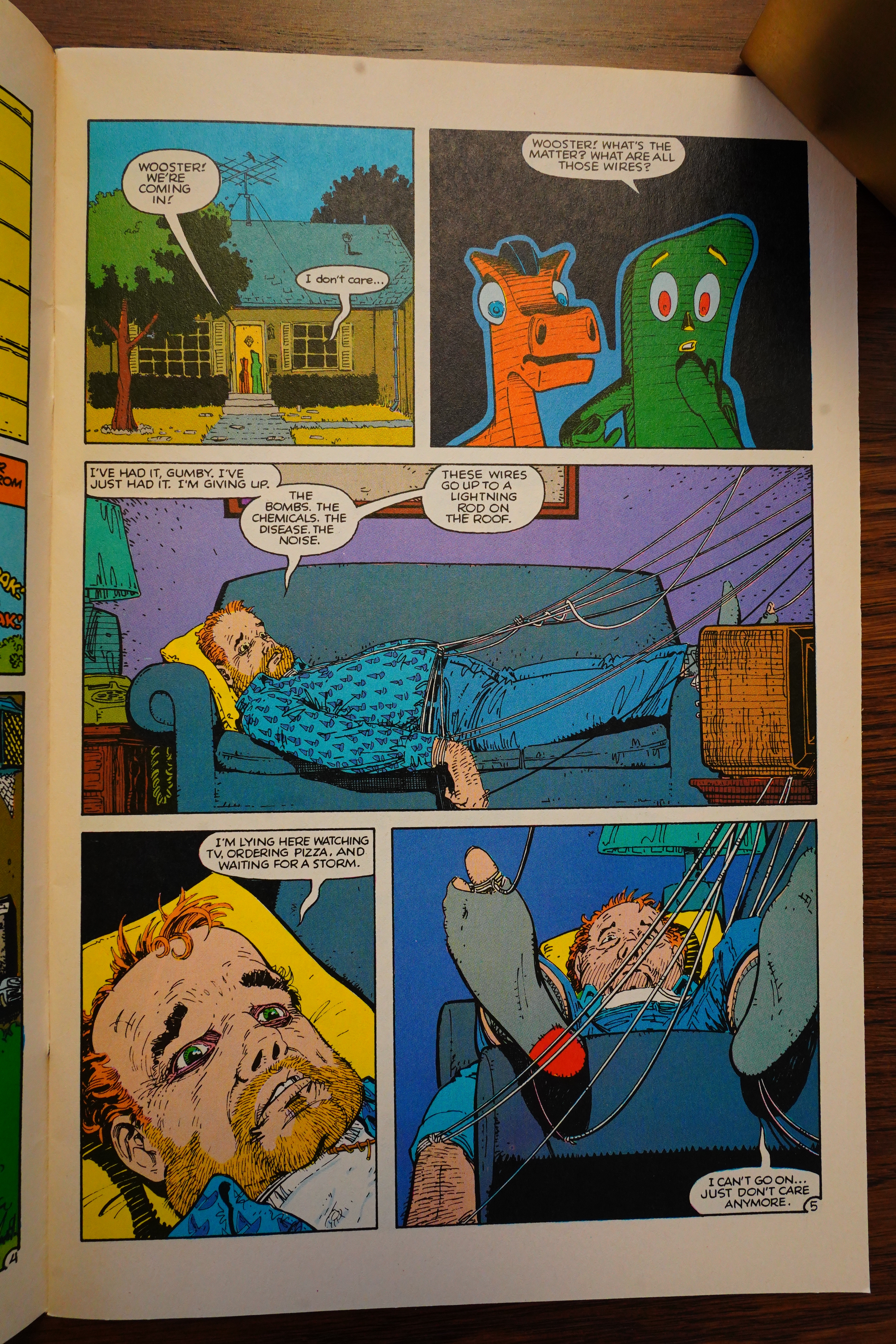
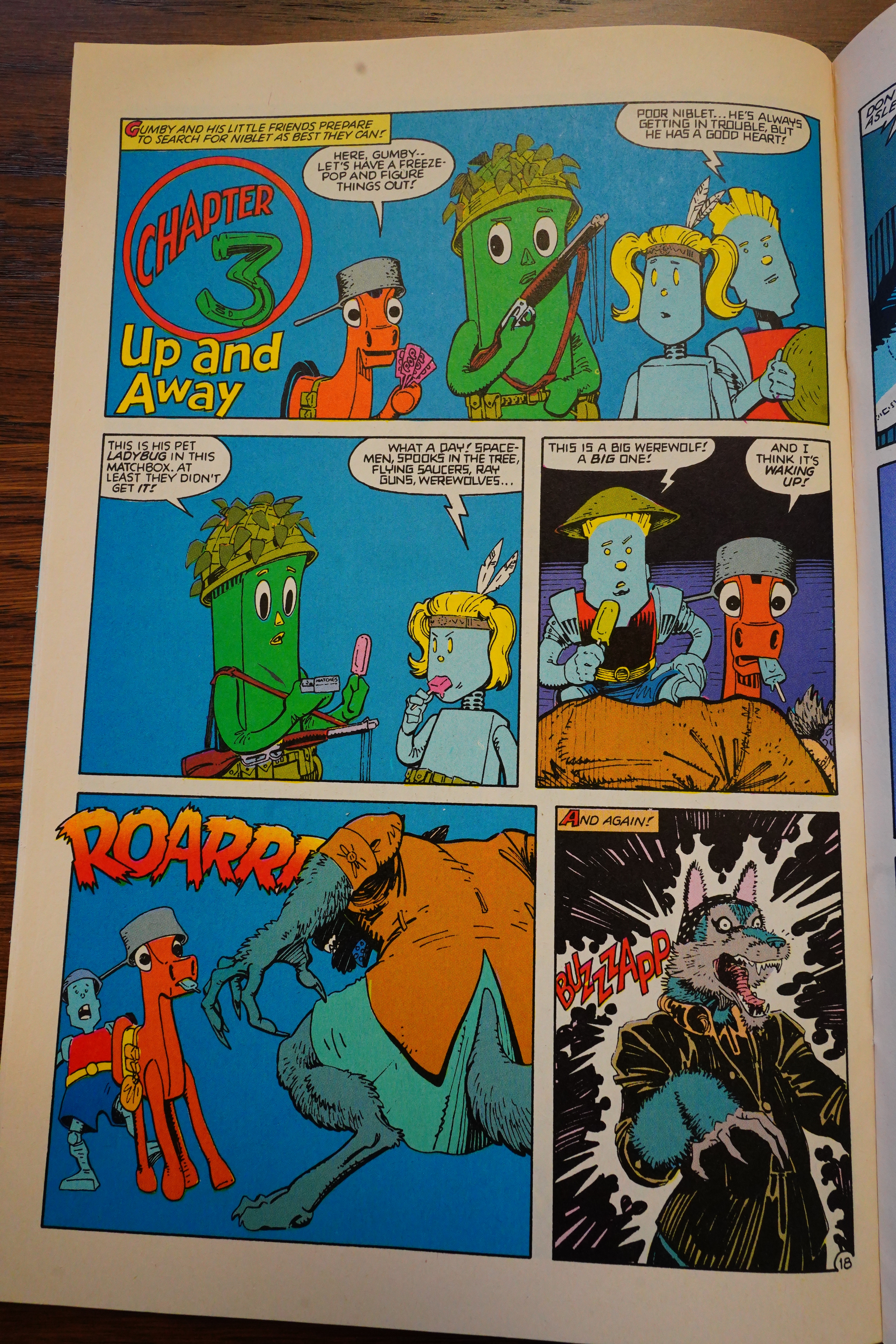
But this is just so weird. Is this what the Gumby show was like? Mixing these claymation characters with very depressed human characters? Or is this adulting up the concept a lot for added yuks?
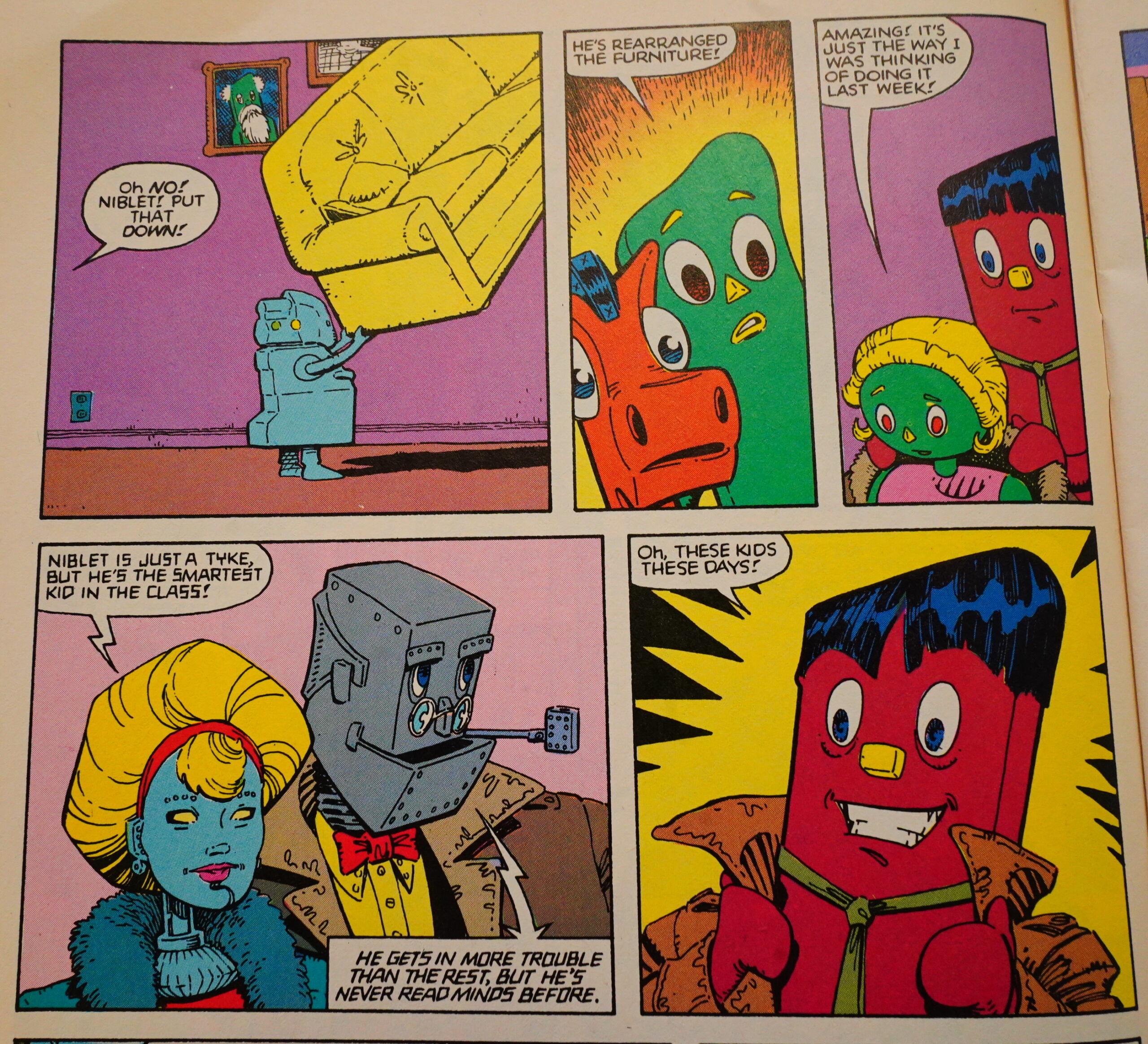
These non sequiturs are pleasantly absurd, but is it funny?
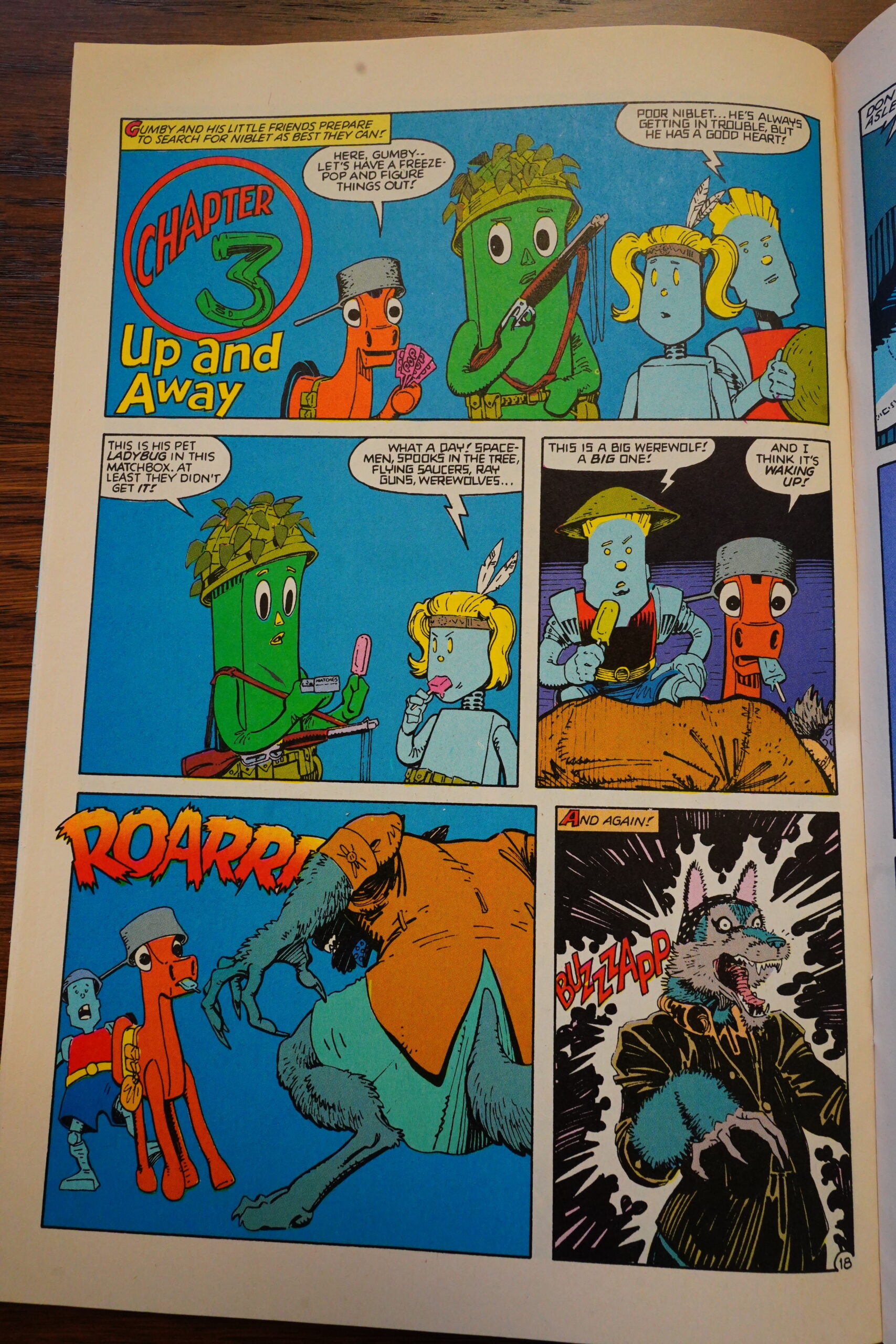
The biggest mystery of these books is why they have Arthur Adams doing the artwork. Adams was a big name at this point, wasn’t he? He’d been doing X-Men and the like, and was known for his intricate rendering and stuff, so doing Gumby doesn’t seem like the obvious choice for what to do next, does it?
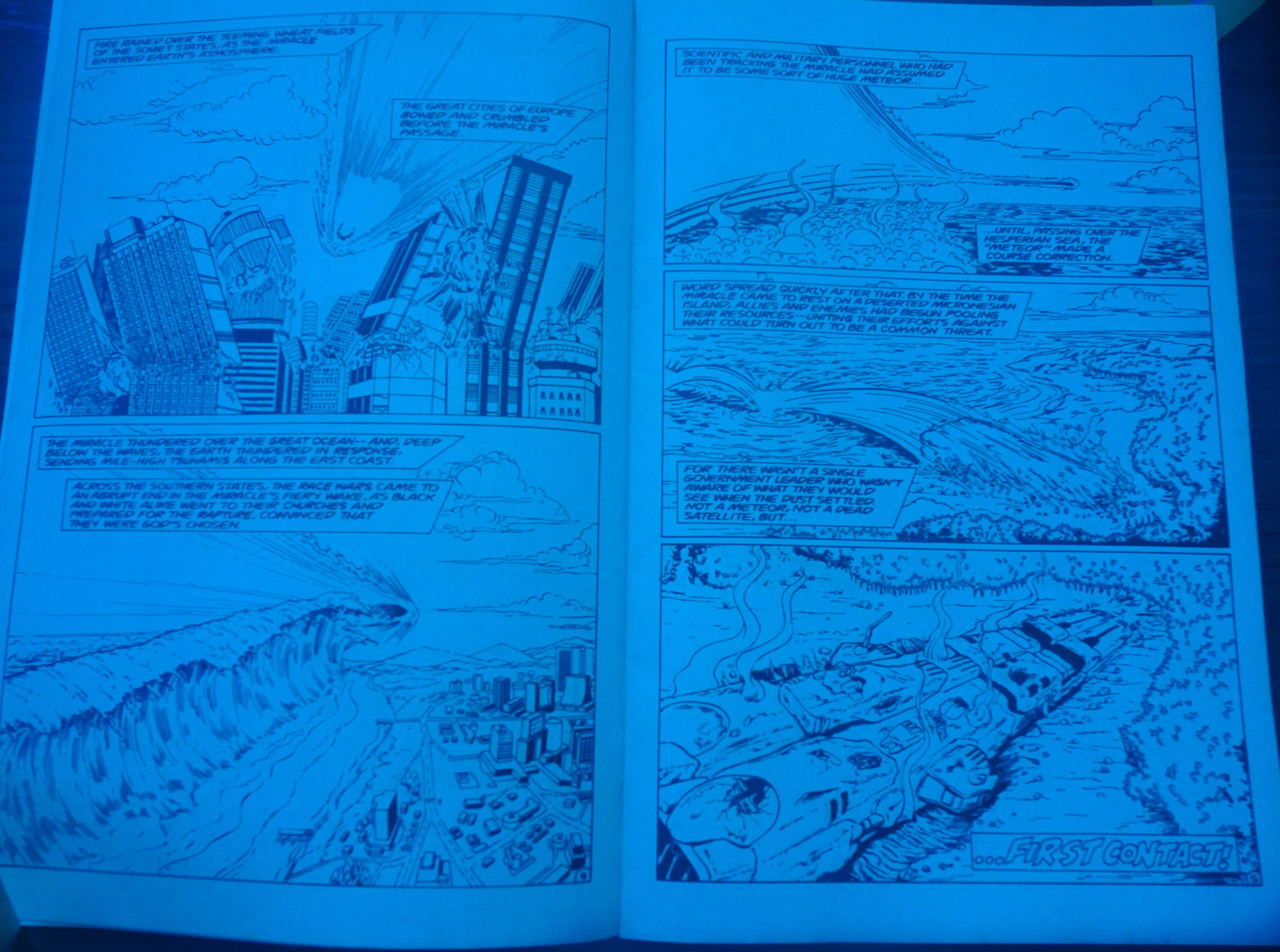
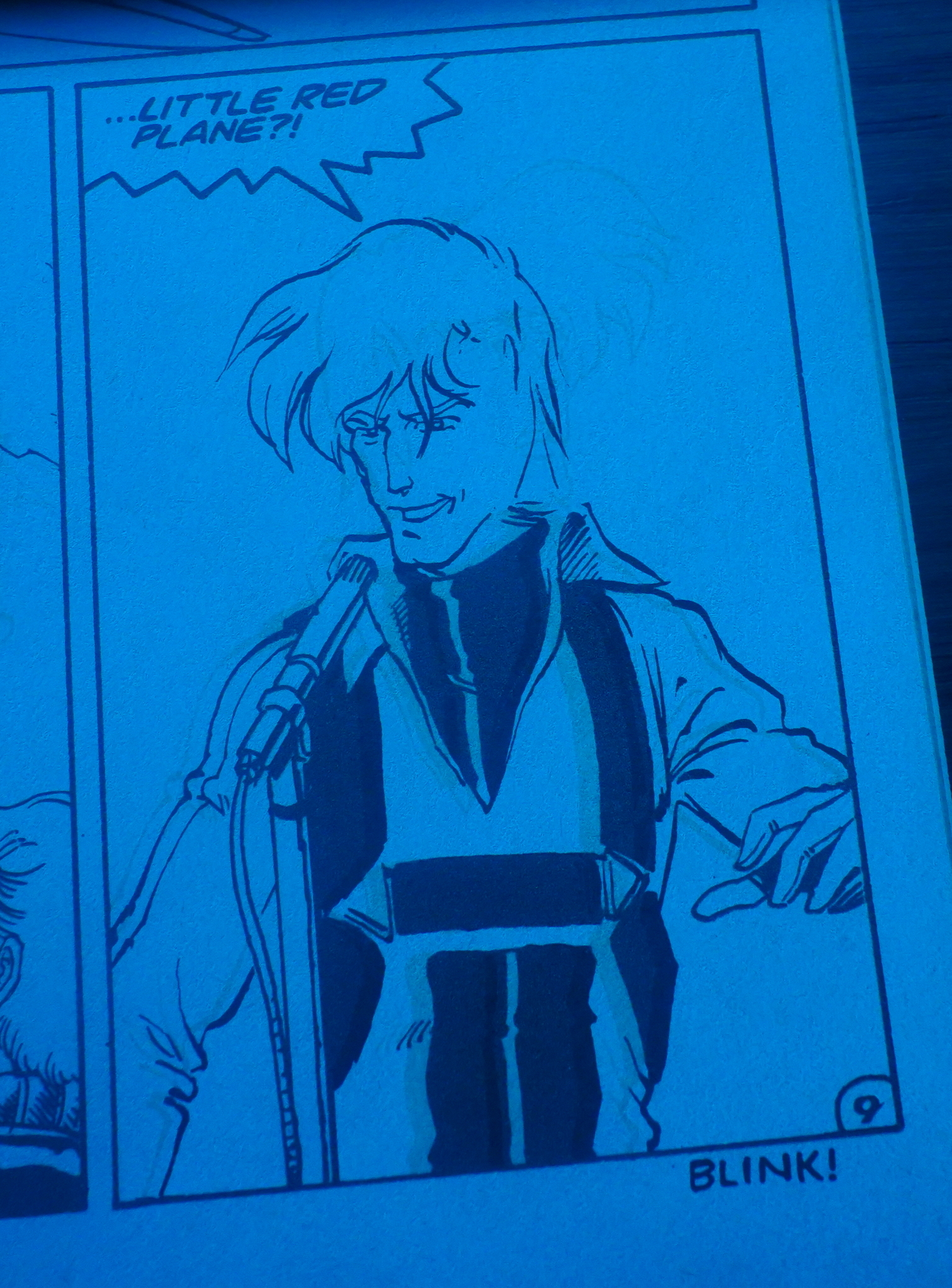
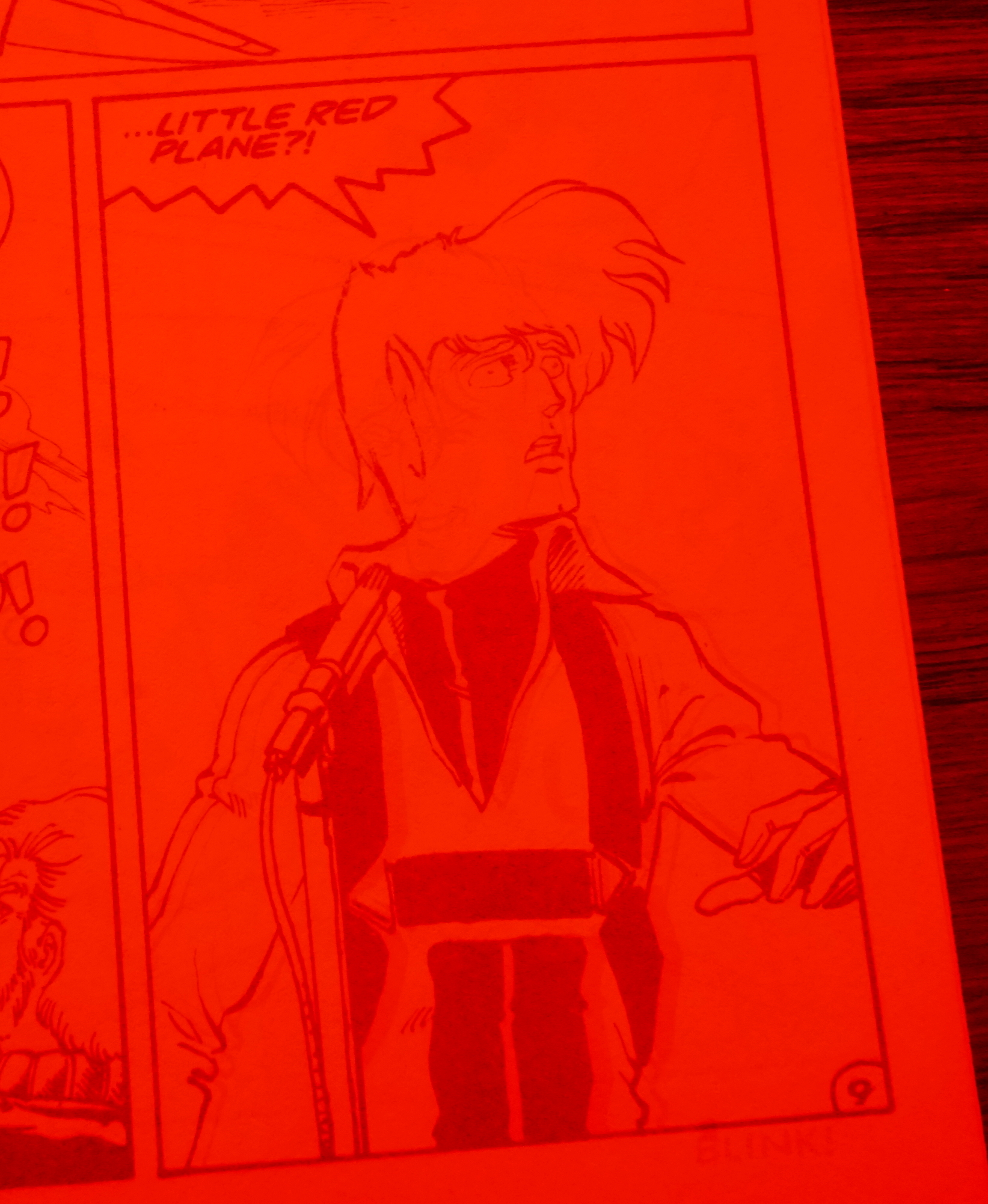
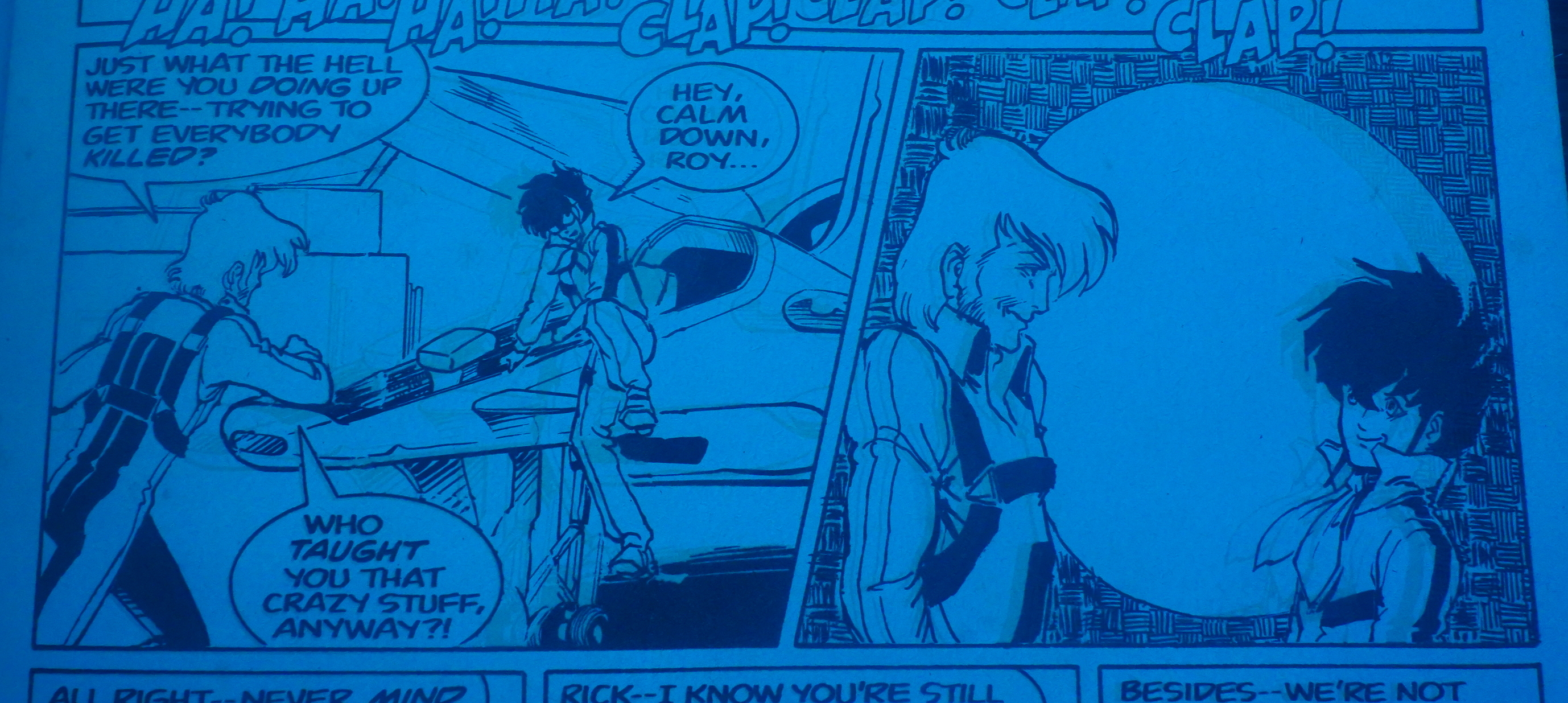
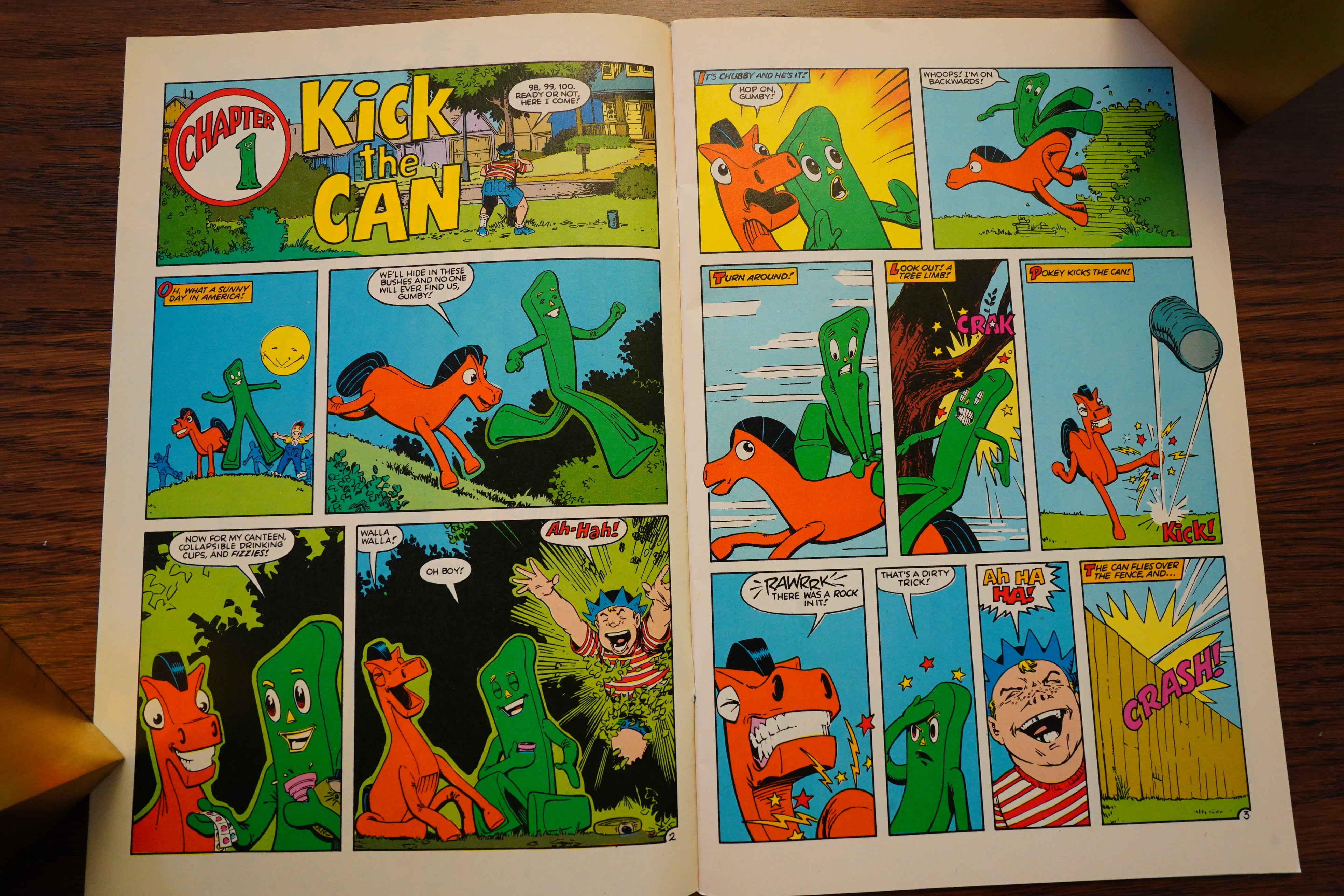
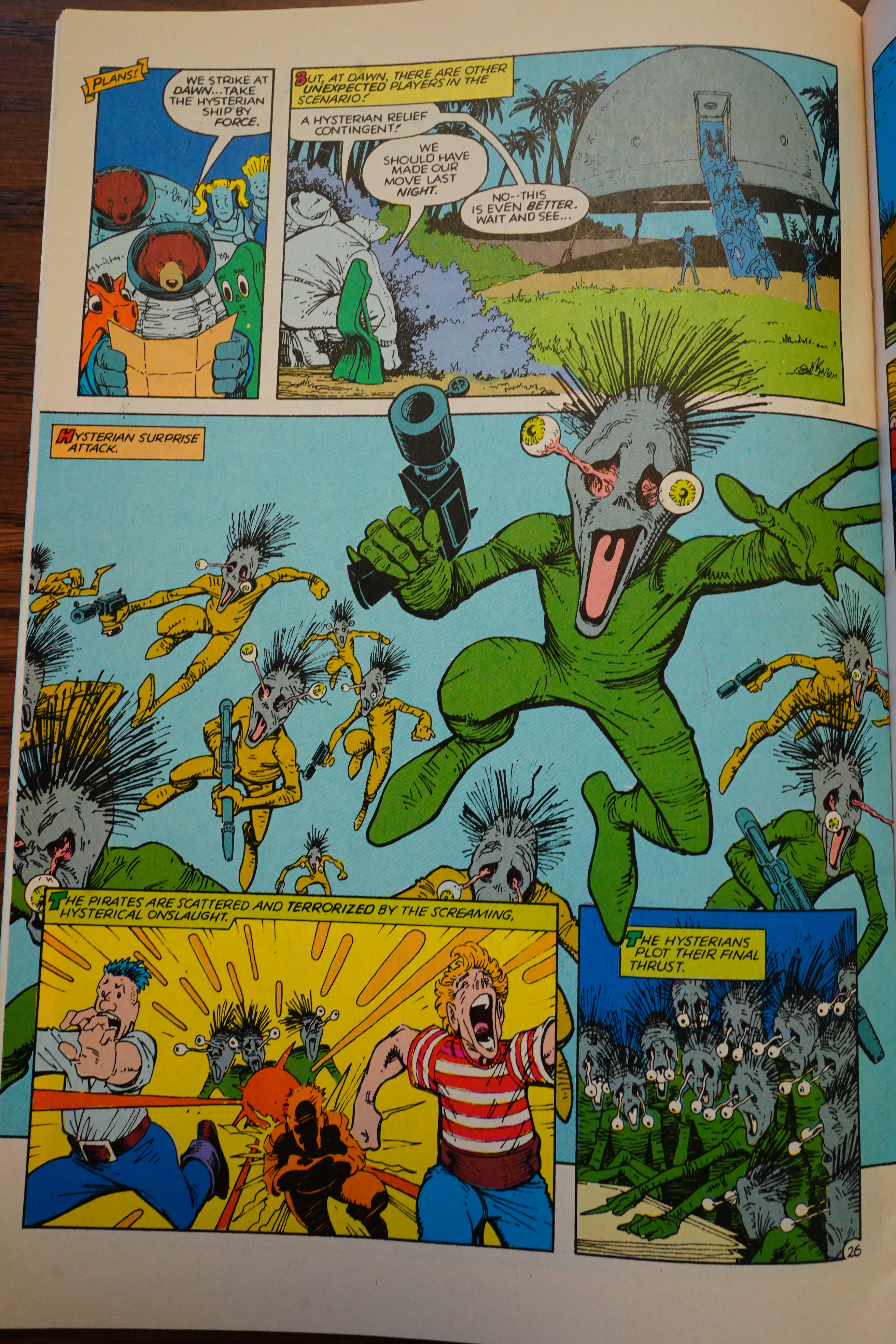
But he does the characters very well. There’s a distinct lack of backgrounds to many of the scenes, though. Which gives colourist Tom Vincent ample space to do his thing, which is to add flat and very saturated colours throughout. It’s pretty stark, but appealing, I think.
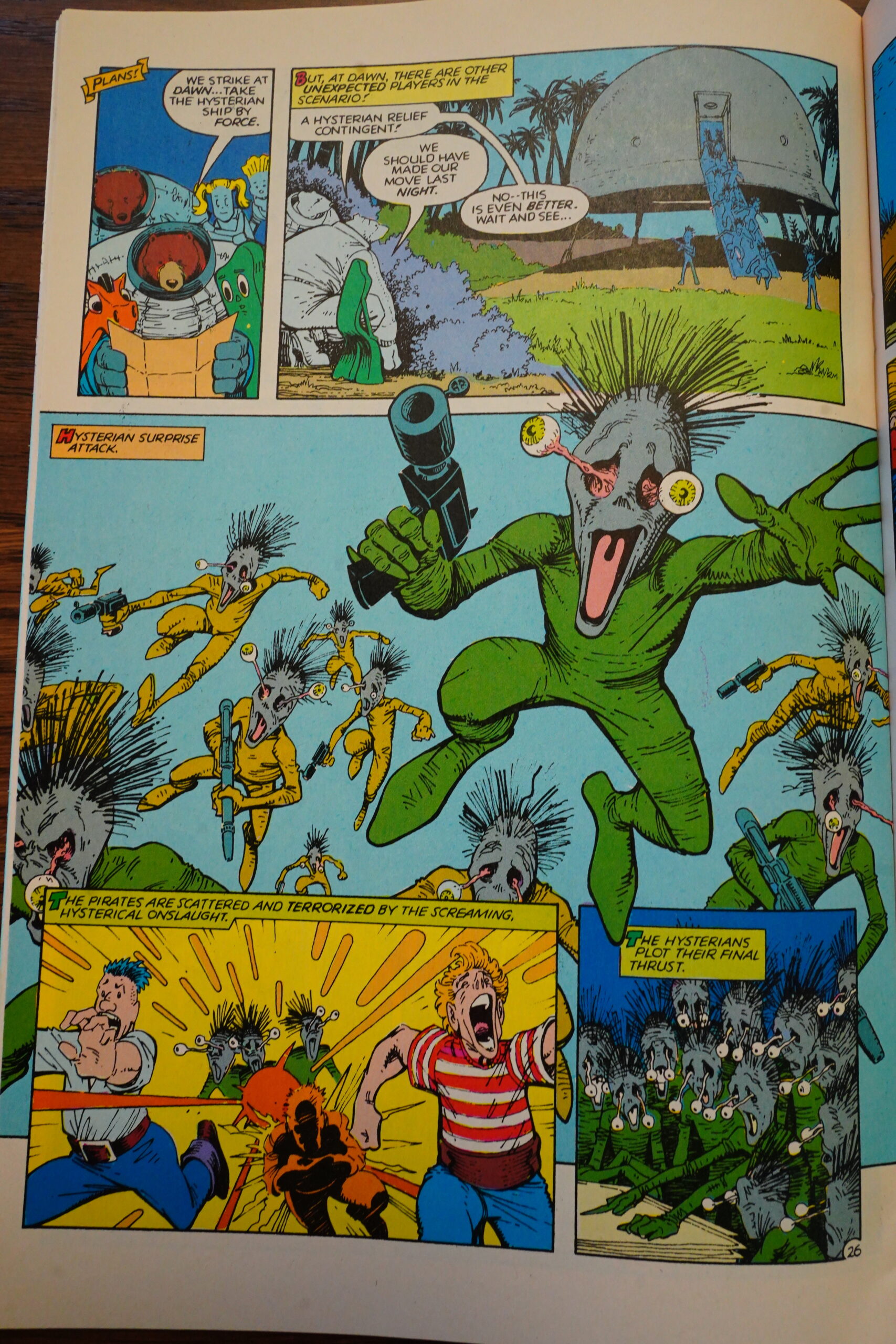
And, yeah, the plot — it’s an epic adventure that ends on a funny note.
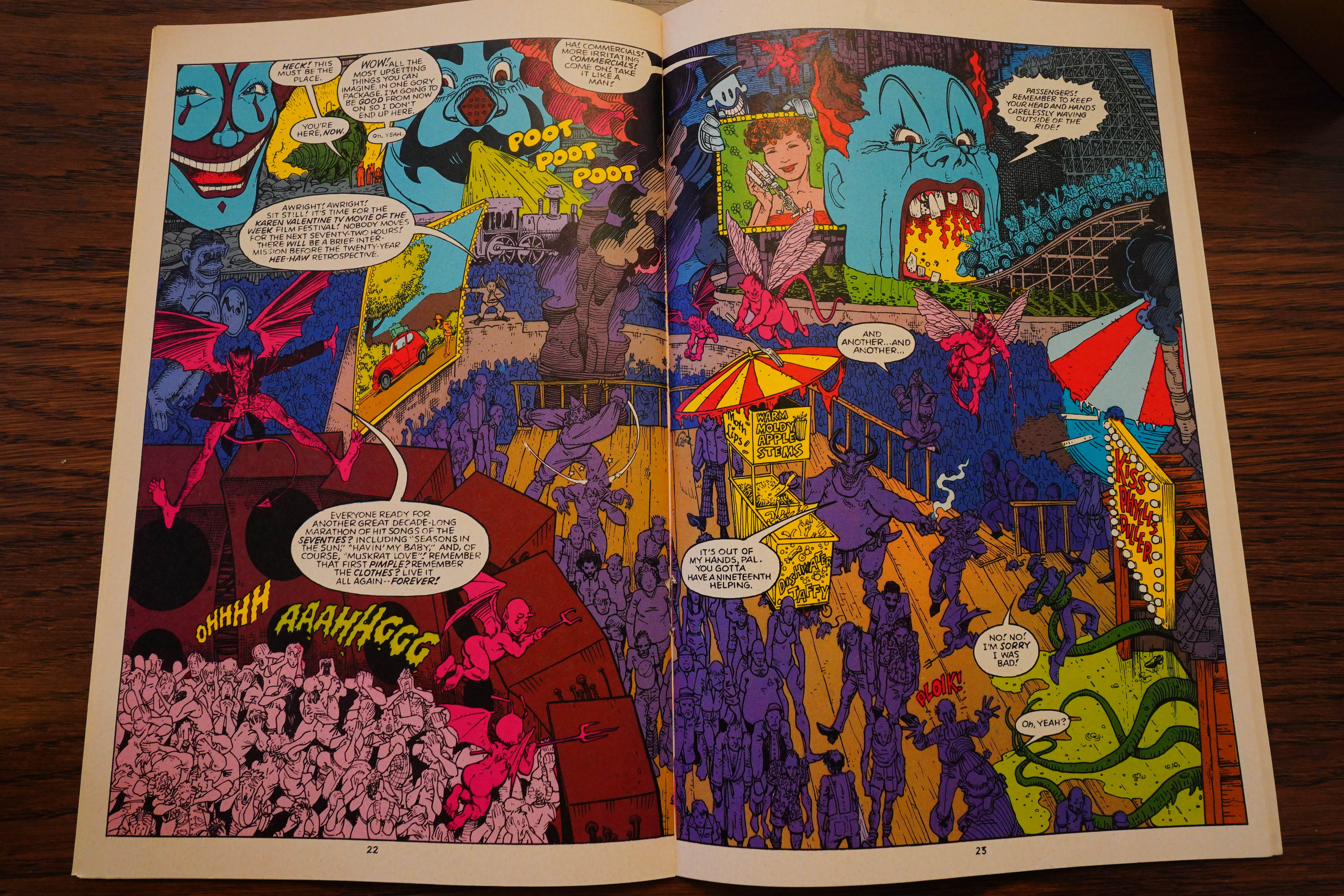
The second special is written by Steve Purcell of Sam & Max fame.
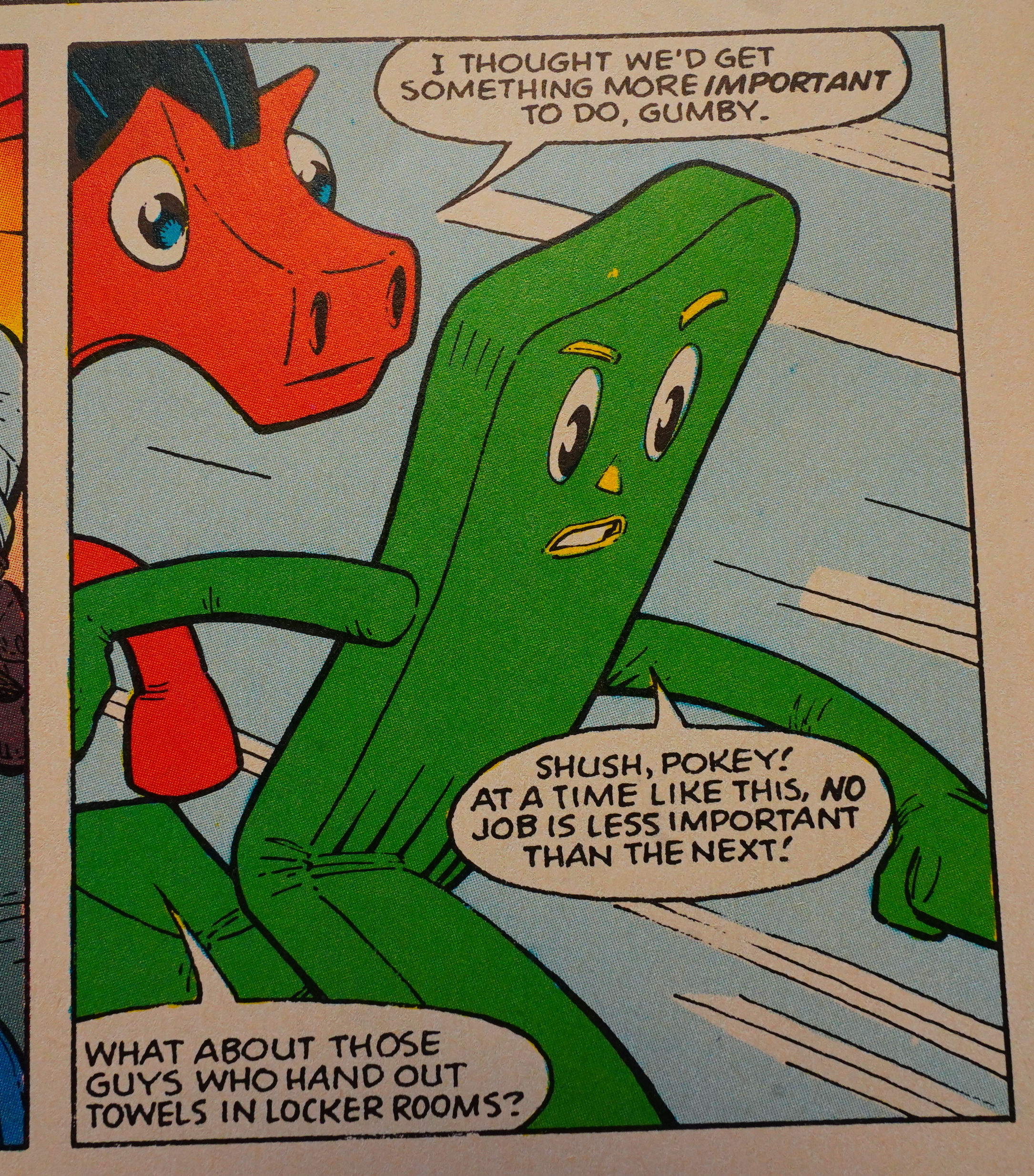
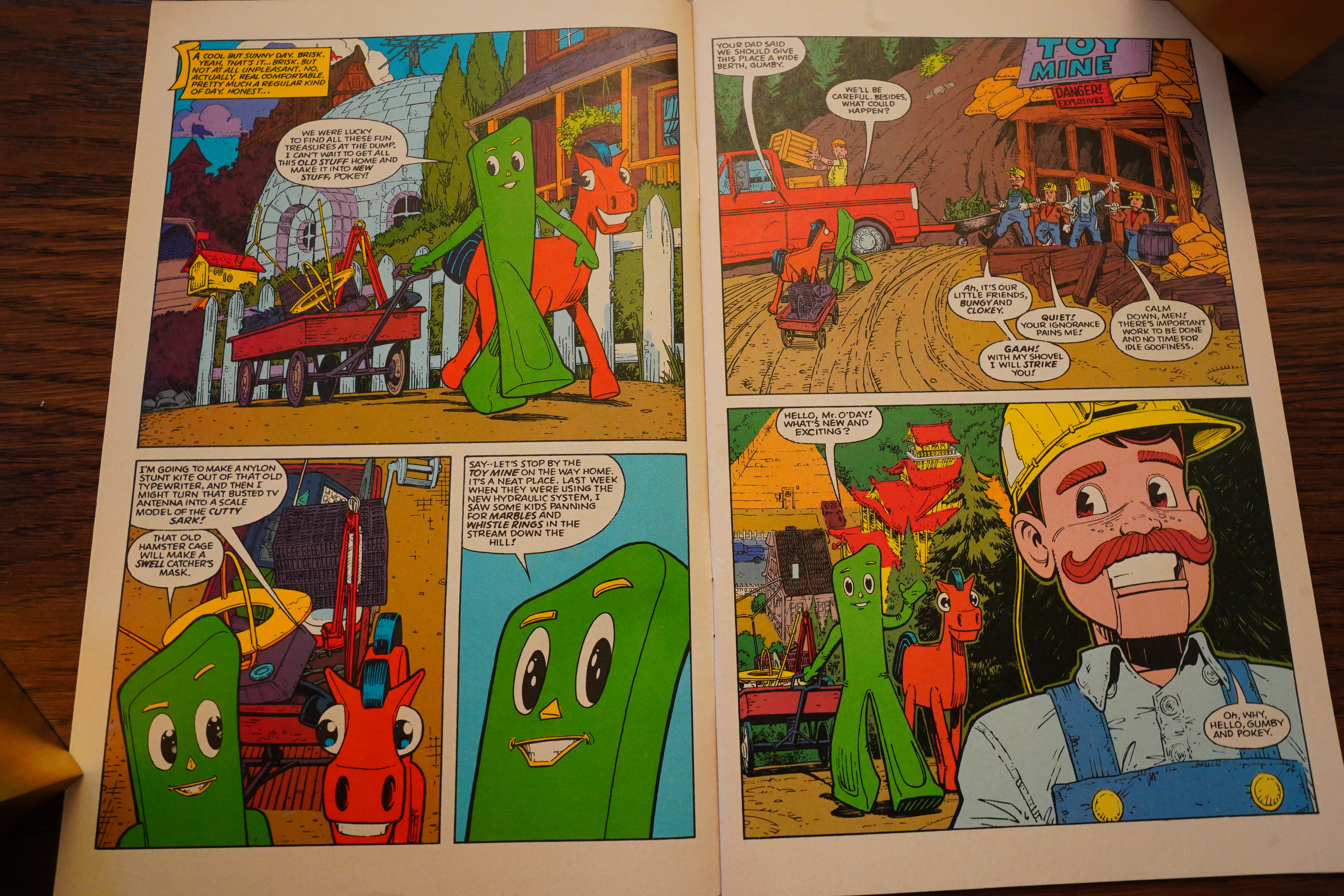
This means that the jokes tend more to actual old-fashioned jokes instead of just piling insanity upon insanity… but they’re not brilliant jokes now are they?
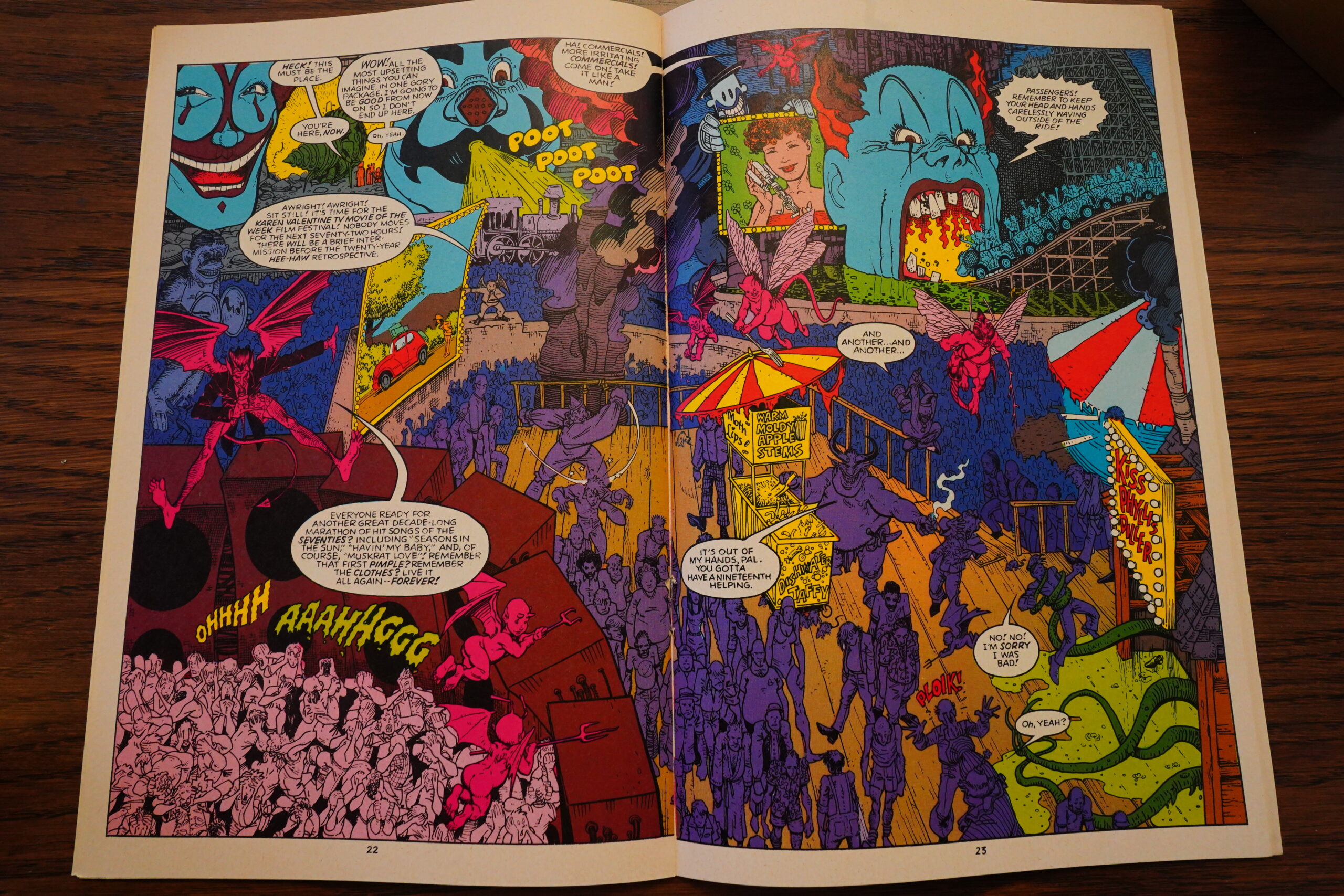
Adams spends more time rendering the second issue than the first. And the plot makes more sense, I guess? It’s fine.
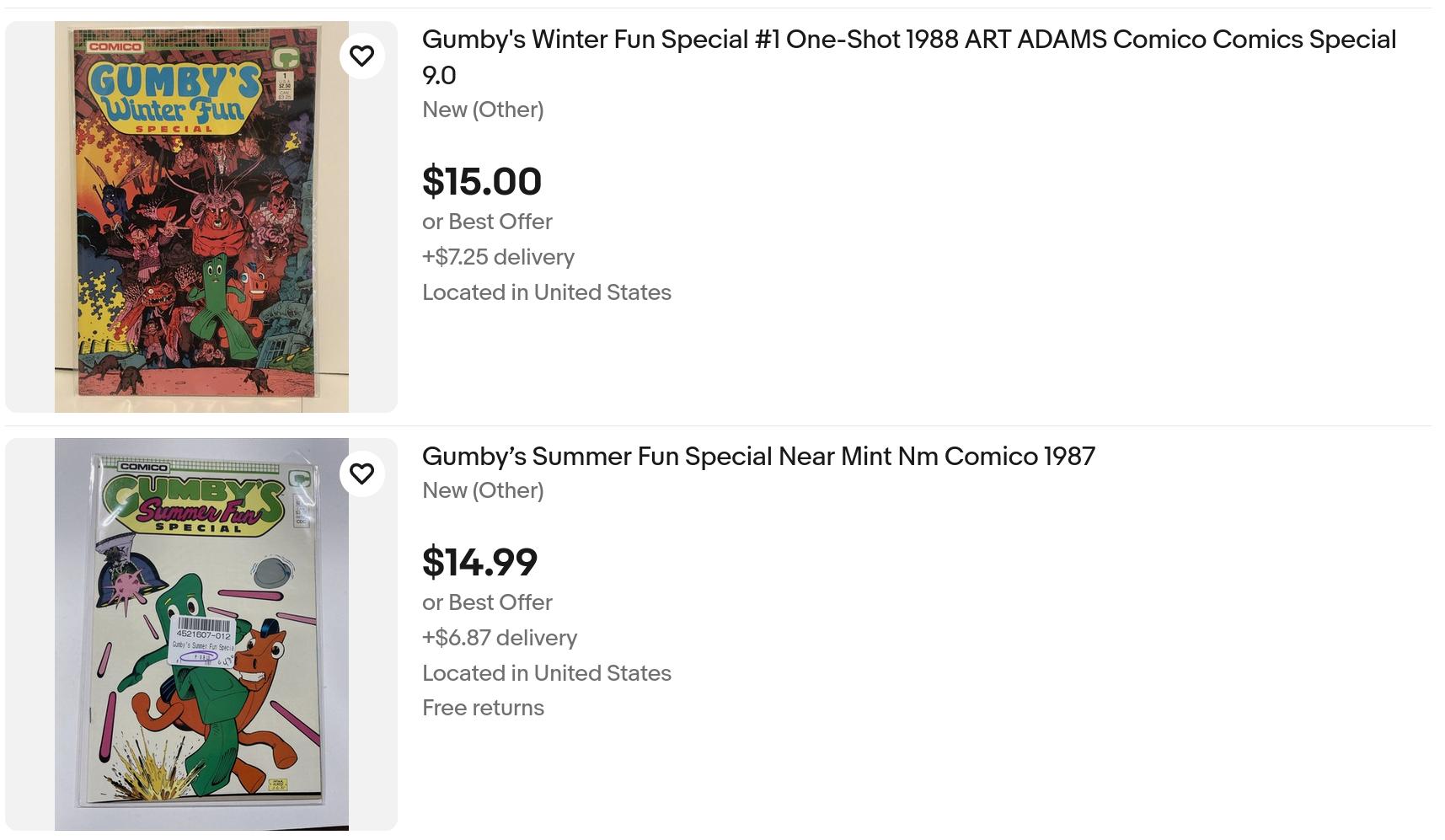
But don’t mind me: The first special won the Eisner Award for best single issue, so obviously people like it. The specials have never been reprinted or collected, though, and command much higher prices than most Comico comics:
Gerard Jones writes in Amazing Heroes #122, page #59:
GUMBY’S
SPECIAL #1. Bob Burden, writer;
Arthur Adams, artist; Comico;
$2.50.
SUMMER
There have been comics just as
much fun as this one, although not
many, and not for a long time. But
I have never read anything that so
perfectly captured what Fun is, that
came so close to Ideal Funness, that
so completely made Fun itself its
theme, its aim, its ground of being.
To analyze this comic critically
would only be to debase it, or
myself. This is a masterpiece of
unbridled playfulness and joy.
My wife thinks I’m an idiot.
There she was trying earnestly to
watch something intelligent on TV
(Masterpiece Theater or some such
shit) and there I am sitting beside
her on the couch reding this Gumby
comic book and laughing out loud.
(I realize very few of you know me
personally, but take my word for it
that I am not a man given to laugh-
ing out loud; a smirk is my idea of
an uncontrollable outburst.) ‘What
are you reading,” she asks. “A
Gumby comic book,” I answer.
“Gumby?” she scoffs, and there the
subject ends. But of course, she
doesn’t know what Art Clokey’s
endearing little clay boy can become
in the hands of the mad genius
Burden and the master penman
Adams. Someday, someday she will
read the Gumby Summer Fun
Special herself…and then she’ll
understand how it could give me one
of the brightest hours of my reading
life. (She’ll probably still mistake me
for an idiot, but then, she always
has.)
From the very beginning, Burden
and Adams turn their talents not
toward telling a story so much as
weaving a spell of summer afternoon
magic. Gumby and his pal Pokey
live in a realm of eternal sunshine,
of limitless fields of play and adven-
ture. Burden’s special gift is a
purposeful naivete, full of spontanei-
ty and surprise, that takes us to the
edge of surrealism. Adams comple-
ments him with a perfectly controll-
ed line, wild action, a wonderful
feeling for comic faces, and tons of
nifty little details (the chapter
numbers are represented by little
Gumbies in contorted positions; the
sun watching over the kids at play
wears a genial old man’s smile; the
kids run the gamut of boy-gang
clothes from the cut-felt crown of
Our Gang vintage to a super-hero
t-shirt of the present).
[…]
We all hear about stories that can be
read on two levels, but here are two
plans in such conflict that everything
begins to seem like a psychotic
dream. The result is a constant
humming tension, an eruption of
hilarity out of the smallest details,
a recovery of the magic of childhood
without a hint of maudlin sentiment-
ality. In short, fun in every panel.
[…]
Everything is beautiful. It’s
impossible, insane, goofy, surreal.
But what else can it be? It’s
childhood, restored to brilliant life
amidst the wreckage of adult ration-
ality. Burden and Adams don’t try
to make it plausible, like a lot of
sentimental conjurers of childhood
would; they’re too smart, too grown
up, for that. They make it as absurd
as it has to be, and that absurdity
brings it to life. Like old Origen said
about the Resurrection, “Because it
is absured, I believe.” We join
Gumby in his summer fun because
we have to, because it keeps us sane
and alive.
Gumby says everything that needs
to be said in his final balloon: “I
really love summer days and happy
endings and being…just being
home again!”
Hm… Gerard Jones… who’s that again…
Oh right.
Back Issue #16, page #6:
Let’s go back to 1986. How did Arthur Adams, artist of Longshot,
become the artist of Comico’s Gumby’s Summer Fun Special?
ADAMS: I’ll bet you’ve heard this story before, and probably others have,
as well . . . but why not? It’s such a timeless story.
EURY: [laughs] Pull up the kids around the campfire-here we go!
ADAMS: We-I-I-I-I, it was early on in
my career, and I was working on
issue #2 of Longshot. In the upper
right-hand corners [of the original
art pages], for whatever reason,
probably because I thought it was
funny, I started drawing Gumby
dressed as different super-heroes.
There was a Superman Gumby, and
a Batman Gumby, and a Spider-
Man Gumby . . . the way they used
to print those books, a lot of those
probably got cut right off the page.
So after doing these little drawings
of Gumby-just for fun, not for any
special love for Gumby-I would
show these pages around to various
friends, and one of those was Diana
Schutz, who at the time worked at
a comic-book store called Comics
& Comix in Berkeley. The late, lamented Comics &
Comix. At some point she moved back east and got
a job at Comico.
One of the first things she did was call me up
and say, “Hey, we can get the rights to do Gumby!
Why not do some Gumby comics?”
And I said, “Why do some Gumby comics?”
EURY: [laughs] How did Diana respond to that?
ADAMS: Well, she was pestering me to draw
Gumby, and I said, “I don’t want to draw Gumby. It
was fun doing those cute little things, but I really
don’t need to spend months doing a comic about
Gumby! That’s silly.”
So me, thinking I was so smart, I said to myself, “I’ll
try to get Diana to get a writer who I know doesn’t have
time to write this thing, because he’s working on his
own project,” and he’d told me before he was busy,
busy, busy, working all the time on this. So I said, “If you
can get Bob Burden, the creator of Flaming Carrot, to
write a Gumby comic, I’ll be happy to draw it,” rubbing
my hands together and going, [diabolical laughter].
She called back about ten minutes later and
said, “Oh, yeah, Bob would love to write it.”
EURY: [laughs] You were stuck!
ADAMS: I was stuck. [laughs] Of course, I was thinking,
“If you can get Bob to write it, why don’t you get Bob
to draw it, too? That’d be great. I’d buy that!”
EURY: Oh, so you actually tried to pass off the art
on Bob?
ADAMS: Well, not really, but a lot of [Summer Fun]
was influenced by his drawing style. Come to think of
it, he actually designed a lot of the characters in it.
EURY: Burden obviously designed the eye-popping
aliens, the Hysterians.
ADAMS: I think them, and the robot kids were
designed by him-and possibly their parents, I don’t
quite remember.
EURY: So the robot family was created specifically
for this comic.
ADAMS: I don’t think they ever appeared any-
where else.
EURY: I have to admit, I’m not exactly well versed in
Gumby lore . . .
ADAMS: Oh, there’s so much of it-who could be?
[laughter]
EURY: Thank you for rallying to my defense.
ADAMS: No one could know the whole Gumby tome.
EURY: On Summer Fun, did you do full pencils first,
then ink it, or did you do breakdowns or some halfway
method? I remember the second Special that you did
what looked to me to be full pencils, I’m guessing to
make licensor approval corrections easier, if needed.
ADAMS: Well, when I’m inking myself, for some
people they might call it full pencils, but for me
they’re loose pencils. It’s just that I’m fussy with my
own stuff, and I pretty much need to know what it’s
gonna look like when I put inks to paper.
EURY: Did the Art Clokey camp insist upon many
changes in Summer Fun? I don’t recall their doing so
for Winter Fun.
ADAMS: I don’t remember their asking for
changes. I think they were just mildly amused, if
they were even aware, that these Gumby comics
were even being done.
EURY: The weird thing is, when you look back at this
stuff, in the first one Pokey’s getting drunk with
pirates, and in the second one, Gumby and Pokey are
going to “Heck” and cavorting with demons. [laughs]
Not your average Gumby and Pokey terrain.
ADAMS: You know, at about the time those original
Gumbys were being done [for television], those guys
were famous for being under the influence of various
chemicals. I don’t know about Mr. Clokey himself,
but it’s my understanding that some of the guys
who worked on those [episodes] might have enjoyed
a little bit of an illegal substance.
EURY: Oh, really? On Gumby? Are you sure it wasn’t
some hallucinogenic reaction to all of that clay?
ADAMS: [laughs] Yeah, Plasticene, maybe it seeped
through their skin through the pores in their hands
… yeah, who knows? Now they’re malleable, with
super-powers and stuff.
EURY: Wow. So that’s the secret . . . I always wanted
those powers-I thought they were really cool.
ADAMS: But you can’t go outside on a warm day.
EURY: But can you go near a radiator?
ADAMS: No, no, you gotta keep cool. [laughter]
EURY: On Summer Fun, did Burden write full script,
do layouts, a plot, or what?
ADAMS: Oh, that’s right, you weren’t at Comico at
that point.
EURY: No, I wasn’t.
ADAMS: Well, he . . . [labored laugh] oh, God, this
was rough . . . he sent me audio cassettes.
EURY: Audio cassettes? [chuckles]
ADAMS: Yeah. First Diana calls up and says, “Well,
I have the script, but I’m not sure I should send it to
you. I think I will, but don’t worry, I’ll make copies
for myself, and I’ll fix it.” So I got a couple of audio
cassettes, and [Bob] started going, [imitating Bob
Burden] “Hullo, Art, I hope this will work out, ’cause
it’s a little late and I’m a little drunk, but I’ll give it
a go. Page one.” [laughter]
So I called Diana and went, “What the hell is this
thing?” And she said, “That’s what I thought you’d
say, but don’t worry, we’re transcribing it.”
EURY: Oh, wow. Nobody ever told me that story.
That is so weird.
ADAMS: Yeah. [laughs]
EURY: I remember, Diana wasn’t too happy with
Steve Purcell’s script to the second Special.
ADAMS: Oh, really?
EURY: Nothing to do with the content, mind you,
but its presentation. Didn’t Steve print it? I seem
to remember it being hand-written.
ADAMS: That’s not impossible. He might have done
that. For my own self, when I write scripts, they’re
hand-written, too, so I can’t complain about that.
When I first started working on the Godzilla comic for
Dark Horse, I spent one whole day trying to type the
first page of the script, and it was just impossible.
EURY: So this is why I don’t get a lot of e-mails from you
… you’re not exactly the fastest typist in town.
ADAMS: Not really, no. I can do it, so long as my e-mail
is something like, “Hey, thanks for the stuff.” [laughs] Or
maybe giving response on eBay, that’s about
the extent of my letter-writing capability.
EURY: So who came up with the to-
the-rescue space bears in the first
Gumby? What that yours?
ADAMS: No, that was all
Burden’s. That’s one of the
things on that job that I’m not
that happy with. One of the things
that Bob had in the script that
I just couldn’t quite get to
my satisfaction was that
the bears were sup-
posed to have really
tiny heads, and I just
couldn’t draw them
that way.
EURY: I don’t know . . . their
heads were pretty small. [laughs]
ADAMS: They needed to be smaller.
EURY: Do you like bears? Have you drawn bears
very often? Has anyone ever asked you a question
about bears before?
ADAMS: No. [laughs] I don’t care about bears.
They’re nice, big, cool animals, but they don’t have
a lot of expressions.
[…]
EURY: Any chance that Summer and Winter Fun
will be reprinted?
ADAMS: You know, I’m not the guy to talk to about
that. I believe there’s a fellow here in San Francisco
who I’m supposed to see in two weeks at Wonder-
Con who I think has the rights to do new Gumby
comics, but I don’t think he has the
rights to reprint the others-but I
think he’s working on it. And that
would be great. I’d like to see some-
body get the rights to reprint those,
because we could probably sell four
or five more. [Michael laughs]
EURY: Would you like to do a third
chapter, and make it a Gumby trilogy?
ADAMS: I’d like to do that at some
point, if I had the time.
EURY: If you had the time, who would
be your choice to be the writer?
ADAMS: Wow, that’s difficult . . .
EURY: You chose the writers for the first
two, so why not the third?
ADAMS: I guess I could do a short
one for Purcell and a short one for
Burden, or I could find some new,
hilarious talent . . . but right now I
have no idea.
Amazing Heroes #159, page #65:
GUMBY’S WINTER FUN
SPECIAL #1
Written by STEVE PURCELL; illustrated by
ARTHUR ADAMS; edited by MICHAEL
EURY. Published by COMICO
What could be more fun than Gumby’s
Summer Fun Special? Why, Gumby’s
Winter Fun Special! That’s right, the
little clay boy and his friend, Pokey,
are back for another go-round. When
Gumby’s Summer Fun Special hit the
stands the summer of ’87, I gave a
copy to my brother and his daughter
and I don’t know who liked it more.
Gumby’s Summer Fun Special was a
critical and financial success, and, as
we all know, there’s only one thing to
do with a success. Right! Do a sequel.
As it turns out, this is one of those
rare occasions when the follow-up is
as good or better than the original, de-
pending on what age group you belong
to. Steve Purcell is the writer this time
around and while his Gumby isn’t as
warm-hearted as Bob Burden’s (author
of the first special), it’s every bit as
wacky, and, in this reviewer’s opinion,
funnier. Purcell is the man responsible
for Sam and Max, Freelance Police
and if there’s a more peculiar comic
book experience than that floating
around, I would like it to be rounded
up and shot. (Sidenote to S&M fans:
can you spot the dog and rabbit cameo
appearance? Hint: they aren’t driving
the car with the atomic turbine).
An example of typical Purcell
dialogue:
Pokey: Mole People? Gasp! I’ve seen
movies about Mole People. I can’t say
I’m crazy about the idea of meeting
one of them. Maybe we should leave.
Gumby: They’re huge, hulking crea-
tures, Pokey, with thick drool gurgling
through their tremendous yellow fangs
…Let’s go have a look!
And they do, too. And they go to
Heck where they make you watch re-
runs of Karen Valentine movies and
they meet Santa Claus, and, other, uh,
things, and have, you know, an adven-
ture. And that’s just the tip of the ol’
clay iceberg.
You have to respect Arthur Adams
for taking the time out from his more
profitable endeavors to do this book.
It is obviously a labor of love. Adams
is one of the few artists working in
comics today who can both draw and
cartoon, and who understands the dif-
ference between the two. His sense of
timing and pace are second to none,
and the detailed renderings in the three
two-page spreads make each of them
a joy to behold.
If I had any quibble with Gumby’s
Winter Fun Special, it would be that
it doesn’t have the universal appeal
that the Summer Fun Special had. I
don’t think my 6 year-old niece would
appreciate it as much as the first,
though her father will love it, and,
more importantly, it has an infinitely
greater appeal for the 12 to 16 set.
So, chalk up another big winner for
the little clay boy. When can we expect
a Gumby’s Spring Fun Special (boing!
boing!)?
— Jeff Lang
GRADE: PRISTINE MINT
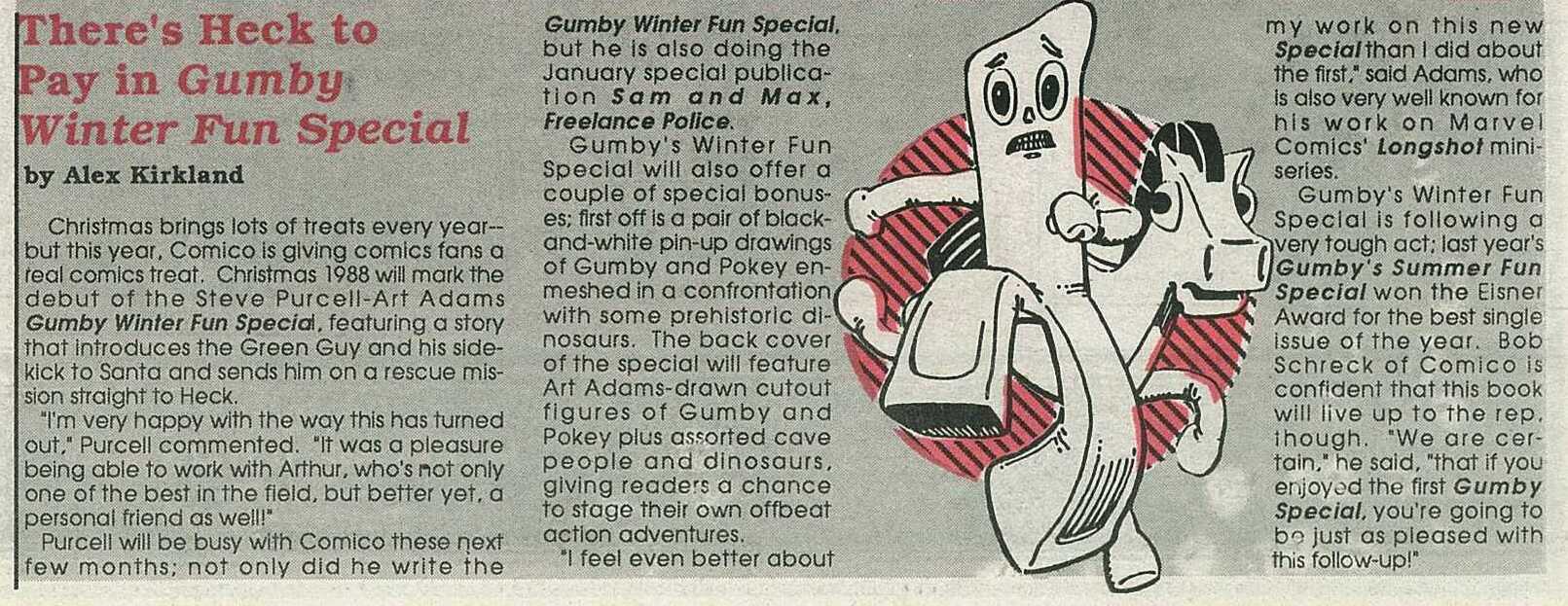
Comic Shop News #75, page #1.
Modern Masters #6, page #38:
MM: How did you get yourself into
the Gumby thing? I thought I read that
you weren’t even a big fan of Gumby
growing up or anything.
ARTHUR: When I lived in West
Virginia there was a little boy down
the street named Rusty who one day
stole my Gumby and Pokey toys that
I was playing with outside. But he was
an older kid, this Rusty, and he was
running away and I couldn’t catch
him, and I was crying because I want-
ed my Gumby and Pokey back. He
threw Gumby in a bush where I
couldn’t get it. So I have bad memo-
ries of Gumby and Pokey. [laughs]
I think on the second issue of
Longshot-for whatever reason-on
various Longshot pages I was drawing
Gumby as various super-heroes. I
don’t know why I was doing it, I
was just doing it. So there was a lit-
tle Superman Gumby and a Spider-
Man Gumby and Thor Gumby and
whatever else. Occasionally when
I visited Mignola, who lived in the
Oakland area, we went to Comics
and Comix and visited with Diana
Schutz-because she knew about
comics and she was a girl, so we
could talk to her. For whatever
reason, I brought my Longshot pages with
me-I guess because I was showing off to
Mignola and Purcell-to show folk at
Comics and Comix. Diana was there and
she saw them and got a kick out of the lit-
tle Gumbys drawn in the corners.
Years and years go by, and she finds her-
self as an editor at Comico Comics. And
when they were looking for stuff to do, she
remembers that I had drawn these weird lit-
tle Gumbys in the corners of this Longshot
job. “We can get Arthur to draw Gumby
comics! That’ll be something for Comico to
license, and it’ll get Arthur Adams working
on something for some Comico comics. I guess that’s a
good idea.” And so she calls me up and asks me if I’ll draw
this Gumby comic, and I said, “Well, I don’t know”-and
inside I’m saying, “Oh, God! I don’t want to draw Gumby!
If I draw Gumby”-I have no idea why I would think this,
but I was thinking, “Oh, if I draw this Gumby comic book,
I’ll always be ‘the Gumby guy’. I’ll never be able to get a
regular job again.” Whatever that means, in comics.
MM: You weren’t thinking, “I could be doing two X-Men
books?”
ARTHUR: No, I don’t think I was; I’ve never been that
smart about my career. I don’t know what I was thinking,
what else I could have been doing. Maybe I was there
thinking, “Hey, I’ve been drawing X-Men and I’m getting
some acclaim for that. Why would I want to draw Gumby?”
I don’t know. But I thought, “Well, I know. I’ll make it hard
for Diana. I’ll make it so there’s no way I can get it done.
I’ll ask for some writer who’ll be impossible to get. I’ll get
some guy who’s doing a creator-owned book that I know
he’s working on, that he’s writing and drawing, so there’s
no way he’s going to have time to write those things.”
I’d met Bob Burden a couple times. I was a big fan of
Flaming Carrot, and we’d had dinner or drinks or some-
thing a couple of times, and we always had a good time
hanging out. So I said, “You know what? If you can get
Bob Burden to write Gumby, I’ll draw it,” thinking, “This
is impossible, they’ll never be able to get him to write
it.” Naturally, a half-hour later she calls back and says,
“Bob would love to write it.” [sighs] So I ended up some-
how having to draw the Gumby comic book.
MM: Was it a good experience? This is something you
were working
on while on the Action Annual, right?
ARTHUR: Yeah, I took that job right at the same time,
so I was somehow working on the two books at the
same time. I’m often working on more than one thing at
the same time. I don’t really like just having one thing
going. I like being able to change.
Comic Shop News #1, page #4:
Cornico’s Gumby Summer Fun Special from
Comico deserves to be a major hit; the
story’s by Bob Burden, whose maniacal
writing has made his own Flaming
Carrot a cult favorite. The artwork’s by
Art Adams, one of the ’80’s hottest ar-
tists; the book’s pure fun from beginning
to end!
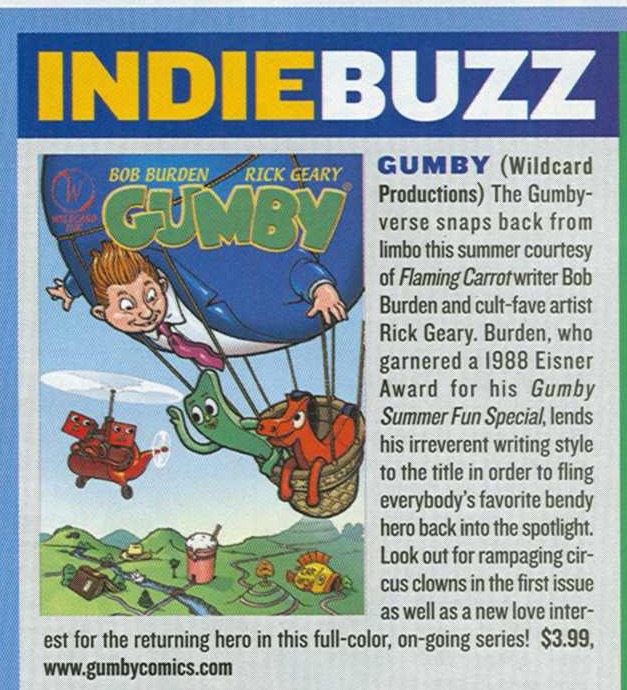
Huh, Burden wrote a Rick Geary-drawn Gumby book, too? Never heard of it, and I’m a huge Rick Geary fan.
Amazing Heroes #191, page #97:
9. Gumby Summer Fun Special by
Bob Burden and Arthur Adams (Com-
ico). Burden and Adams did the im-
possible-they created a comic book
that completely recaptures the sense
of wonder and astonishment that we
got out of reading as children. Sheer
absurdist whimsy—and a masterpiece.
That’s from the “15 Indisputable Masterpieces” list by “ACE”, which I’m going to go ahead and guess is Heidi MacDonald.
Borderline #5, page #48:
Fred the Clown v2 #1
Hotel Fred Press
By Roger Langridge
My wife doesn’t really like comics
much. She’s put up with them for as
long as she’s known me, through
richer and poorer and for better or for
worse. She realised there was no
hope for me back in 1990 when at
some ungodly hour of the night, while
she was fast asleep, I decided to
read Gumby’s Winter Fun Special
(the one where Gumby and Pokey go
to hell to rescue Santa Claus).
Halfway through the comic the tears
Click on Globe returns to contents
were streaming down my face and,
by the end of it, I had a rather
perplexed wife glaring at me
incandescently. I had been trying
desperately not to laugh too much
and subsequently was just a blob of
quivering flesh – I must have looked a
sad and pathetic case.
Now, I’d rate that particular Bob
Burden and Art Adams comic as
possibly the most surreal and
uproariously funny comic I’d ever
read, but I might be inclined to
change my mind after reading New
Zealander Langridge’s Fred the
Clown #1.
Back Issue #85, page #71:
Purcell and Adams loosely plotted the story together. “We talked
about what kinds of ideas would be in the story,” Steve recalls.
“I remember it was fun to get to imagine these fantastical double-
page spreads that I knew I wouldn’t have to draw myself. I wanted
it to be something fun that we would both enjoy working on.” Then
Steve sat down to write the script.
Diana Schutz was too busy to edit Gumby’s Winter Fun Special and
passed it off to me, her assistant-and I’m glad she did. But I recall
Diana being a bit perturbed when Steve’s script arrived-it was
hand-written, not typed, which was the professional standard.
“That’s what I would do at the time, starting with Sam &
Courtesy of Steve Purcell.
Max,” Purcell explains. “I would write it out longhand.
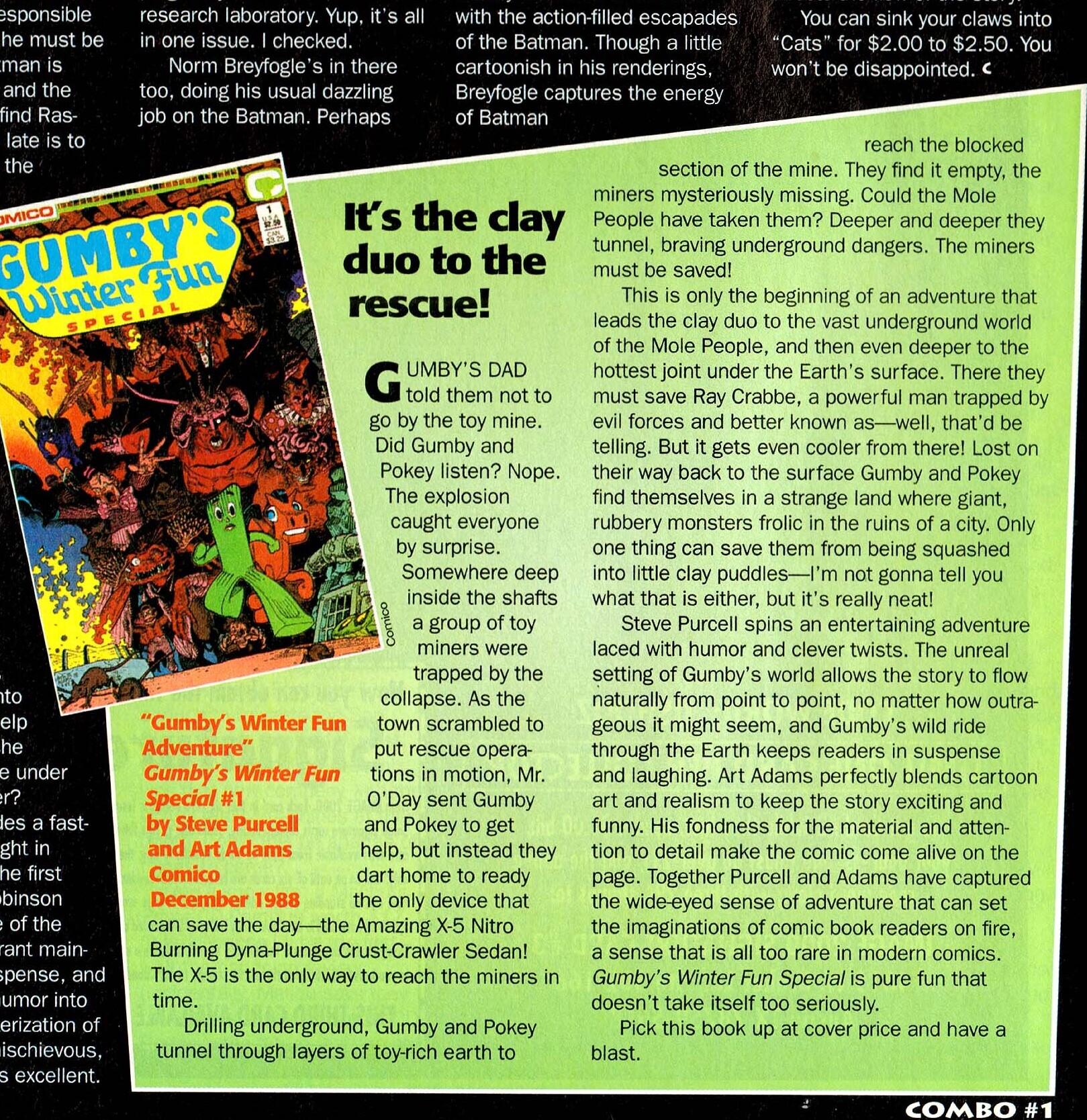
Crabbe, who’s being held captive at the Earth’s core by the Prince
of Darkness. So Gumby, Pokey, and Natasha tunnel even deeper
until they reach the fiery pits of … “Heck” (hey, this is a Gumby
comic, after all!) to save Ray Crabbe, who turns out, as Natasha
reveals, to be Santa Claus.
arrive at the Comico office. They were incredibly detailed and
It was quicker and even still I find it easier to work my
initial passes of dialogue even for an animation script
by hand instead of typing.”
The Slings and Arrows Comic Guide #2, page #296:
GUMBY’S FUN SPECIALS
Comico: 2 issues 1987-1988
Gumby’s Summer Fun Special is a lot of fun. Really. Despite
being based on the green clay US children’s character. Gumby
and Pokey, his orange horse chum, some children and a baby-
sitting werewolf get mixed up with hysterical aliens (bad
guys) and space bears (good guys), a group of nice pirates and
a crazy town where it’s permanently Hallowe’en. Bob
Burden’s script is minimal and funny, with the plot always on
the brink of coming apart at the seams The fact that he
manages to keep all the plates in the air makes for manic fun,
while Art Adams’ detailed artwork is always a joy.
The Winter Fun Special, scripted by Steve Purcell, doesn’t
have the same effortless quality that makes the first special
so good. Gumby and Pokey have an underground
adventure with Mole Men, the Devil and Santa Claus in
which the plot’s stretched thin and the lunacy is forced in
places, especially the satirical references. The joy of Gumby is
that it is simplistic, pure entertainment. Not that the Winter
Special doesn’t have some good scenes, which, coupled with
Art Adams’ intricate, carefully-balanced artwork, make it
worth seeking out.~NF
Trama #22, page #7:
T: Gumby es una de las pocas obras que todavía
no han sido editadas en castellano de cuantas
has hecho y parece poco probable que vaya a ver
la luz por sus considerables problemas de dere-
chos, ¿no?
AA: La verdad es que no sé quién tiene los dere-
chos de Gumby en este momento. Realicé dos es-
peciales (Summer Fun y Winter Fun Special) para
Comico Comics en su momento y, tras la quiebra
de la editorial, no sé cómo estarán los derechos
ahora. Tengo que enterarme de ello porque me
gustaría hacer un tercer (primavera) y un cuarto
especial (otoño), de modo que cubra todas las
estaciones y así pueda ser recopilado todo el tra-
bajo en un tomo unitario. Algo así como un
“Gumby for all seasons” [risas].
Oh, the books were reprinted, anyway?
Arthur Adams has drawn a number of comics over the years featuring American children’s characters Gumby and Pokey. And last week saw the publication for the bizarrely named Gumby’s Spring Special, collecting his Winter and Summer Specials, written by the Flaming Carrot’s Bob Burden, now published by Gumby Comics/Wildcard Ink.
But there’s a glitch.
There are stickers on the front and back of the book. Removing the Spring Specials sticker reveals that the books were printed as Gumby’s Arthur Adams’ Specials. Other stickers block out Arthur Adam’s signatures on book.
Why the reticence?
I understand that while the publisher had the rights to the books, Arthur Adams didn’t want to have anything to do with the publisher and took action to keep his name off the cover of the book at least. And the publisher took until the last second to blink.
Everybody loves these comics:
Gumby’s Summer Fun Special is but far one of the weirdest yet comical stores to ever see print. I really love how everything was wrapped up with a happy ending **NO SPOILERS** (Even Wooster, who spent most of the special in a sad funk, found happiness); If you love reading comics that are filled with non-sequitur comedy mixed in with a small dose of dark elements for good measure, then I definitely recommend this special because of the ingenious work that Burden and Adams have crafted for this special, and it’s living proof that it’s one of the most hilarious and wonderful comics to come out towards the end of the eighties.
So there you go.
Oh, I should check out a Gumby episode…
WTF! That’s pretty weird.