1988: Jezebel Jade

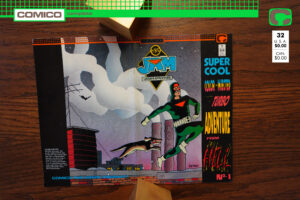
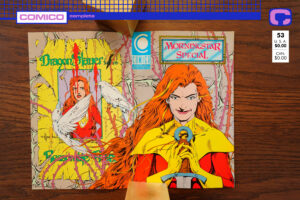
Jezebel Jade (1988) #1-3 by William Messner-Loebs and Adam Kubert

This is the second of two mini-series that Comico published because their Jonny Quest license was running out. While the first one was a mess, this one seems like a more logical series to do — it’s about the background of two Jonny Quest characters (Race and Jezebel Jade)…
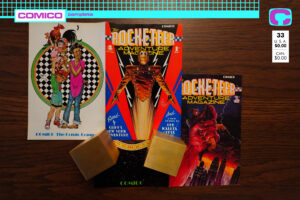
… and don’t feature the kids except in this framing sequence. (They’re reading a book Race has written about his adventures, you see.)

So that’s a classic setup for a spin-off mini-series, and it’s written by regular Jonny Quest writer William Messner-Loebs to boot.

So Race is a secret agent or something, and was much more fun back in the days, apparently.

Oh, when I said the kids don’t appear — that’s not quite right. We frequently get silhouettes of them reading the book, which is a fun touch.

The three issues tell one single story, but it does take some detours.

Kubert’s artwork is solid — it’s got that moody, slightly noir feel going on, and he’s got an attractive line.

I’m not sure the story actually makes much sense — Race’s boss appears and randomly kills a woman (that he thinks is Jezebel Jade). Just to impress this other woman?

And… they consult a feng shui guy to get the beef about the building where the Evil Main Guy lives? It rather feels like Messner-Loebs is just dropping in stuff he feels is Hong Kong appropriate to pad the pages…

All of a sudden, Jezebel Jade starts giving the agent the side eye because they’re not respectful enough of Hong Kong traditions!?

Er… what?

And then Messner-Loebs fridges dozens of people (off page) who were protecting what they thought was Jade’s box of treasures. It was really just a box of make-up that Jade had made those poor people hide for her, and…

I cannot state this strongly enough: “Wat”.

See, she used the make-up to disguise Race as a rickshaw guy from Hong Kong. Amazing, huh?

And the major bad guy is an ancient soldier from the Crusades, who has arranged to have Race kidnapped because he wants to have his immortality serum recreated, and he thinks that Race can help because… because…

Yes, nobody notices when you hoist a flag up the walls of a sky scraper — everybody does that every day. That’s totally how you transport a flag to the top of a building. They don’t have elevators. Very few people know this.

The denouement involves about two dozen characters, and I’m not sure whether Messner-Loebs wanted this to be as funny as it is.

So apart from Kubert’s artwork, this is a bit of a mess. I wonder whether Messner-Loebs had to come up with the story in a hurry because the Jonny Quest license was ending, and they absolutely had to get the series out before the end of the year?

Amazing Heroes #152, page #79:

Joe Kubert is one of the undisputed
masters of comic art and storytelling.
His school of cartooning has trained
and brought us many talented artists,
not the least of which are his own
sons. Adam Kubert is the artist on
Jezebel Jade, the new three-issue
mini-series from Comico, and here he
shows that he’s learned an incredible
amount about comics from his father.
Jezebel Jade is a spin-off from
Jonny Quest, and Jonny is the one
who introduces the story. He and
Hadji are cleaning up Race Bannon’s
room when they chance upon a
manuscript he’s written. Not realizing
it is autobiographical, they launch into
reading the story of Race’s first
encounter with Jade. On a spy mission
to Hong Kong to rescue a scientist
who may have the secret to eternal life,
Race meets the best thief in Japan,
Jade, who is disguised as a French
double agent.
The book is full of espionage and
skullduggery, with more than a few
hints of old-time movie serials thrown
in for good measure. Scripter William
Messner-Loebs manages to work
humor and warmth in amongst the
triple-crosses and crossfires, no mean
feat for any comic scripter. His
dialogue is naturalistic, and he
manages to portray accents in an
easily readable, non-stereotypical
manner.
However, two moments seem
incongruous in the story. First, Jezebel
Jade uses colored contact lenses to
disguise herself. The story is set
sometime before 1976, and it is my
understanding that colored lenses
were not able to be worn longer than
a very brief period of time prior to a
few years ago. This is, for instance,
why the actors on the V TV show
could not keep their cat-eye lenses in
for more than a few minutes.
Secondly, one of the characters does
a double-cross at the end of the story,
but absolutely no attention was called
to it. I had to reread the pages four
times to find out where a certain
character had gone before I realized
what had happened. This was sloppy,
and could have been played much
better.
Adam Kubert’s art rates nothing but
praise. His storytelling is immaculate,
his figures are strong and sure, and
his inking style no longer looks
completely like his dad’s. Adam seems
to have picked up some inking tips
from Gil Kane and Moebius of all
people, because the newer style is
much stronger than some of his past
work. Adam is going to do his father
(and comics) proud, as his near
beginning work is so strong that it
leaps ahead of what most old pros can
do. Watch this guy!
Jezebel Jade is an entirely enjoyable
espionage comic that works on every
level except the two points noted
above. While it is nothing revol-
utionary in comics, it is such solid
“good comics” that it should not be
ignored.
GRADE: MINT
-Andy Mangels

Back Issue #90, page #72:

STROUD: I may not be the best versed in the Jonny
Quest storylines, but it seems to me that Race Bannon
was portrayed kind of differently in this series. He seemed
much more flippant and in your face. Was that deliberate
or a departure?
MESSNER-LOEBS: Part of it was that it was always a
complicated thing to have Race and Jonny Quest and
Jezebel Jade or Dr. Quest and Race and Jezebel Jade where
they’re essentially having a storyline that we don’t need
to see in its entirety, because they’re involved in some
things that a kid would not find important.

My favorite item in the whole series, especially in terms
of Race and Jezebel Jade, is when they were having
some sort of conflict about something. Probably about
Dr. Zin, because Dr. Zin was always on the table
when Jezebel Jade was around, and so Dr. Quest said,
“Oh, we should really get Race in on this. Do you know
where he is?” And the response from Jonny was, “Yeah,
he’s in the library, and he’s been in there for about half
an hour with Jezebel Jade. I’ll go and get him.” Then Dr.
Quest said, “Okay, fine. Oh. Half an hour. Um, Jonny?
Knock first.” [mutual laughter]
KUBERT: That’s great.
MESSNER-LOEBS: So there was always this sort of
subtext of stuff that was going on. The other thing I
found that I had to sort of force myself to forget
when I was writing Jezebel Jade was that Doug Wildey
had given her Mae West’s voice. Back in the ’30s, in the
pre-Code days, [Mae West] was just this red-hot babe.
But for me and my generation that was just such a
cartoony parody of a voice that it has no sexual feeling
to it at all.
So ultimately, what I was getting at was that I was
trying to get Race to come across differently to Jezebel
Jade than in the way he was always coming across to Jonny.
I figured he would be more like a James Bond character.
I was trying to get a little more of that into the story.
STROUD: How did you decide on Hong Kong for a setting?
MESSNER-LOEBS: I think I was looking through National
Geographic and came upon Hong Kong. I think what
I was really thinking was that Jezebel Jade was always in
Jonny’s world and I wanted to see what her world would
be like in the sense that it would be somewhere in
China. We are never explicitly told if she’s Japanese or
Chinese or a mixture or what exactly her heritage might
be. The assumption is that she is part of that general
part of the world.
By the way, you can’t help but be pleased when you
put something into the story and it actually survives not
only being edited, but being drawn and inked. I had
a little note up on the wall that it was supposed to be
a sort of Simon Templar, someone who by that time
would be about 70 years old, and the impression was
that he was a mentor. And, of course, I couldn’t go any
further than just Simon, but to have it survive and
getting it in for all my friends who were big fans of The
Saint, well, Adam once again came through with that.
STROUD: Adam, how big a challenge was it to draw
all the details for that background? Was a lot of
research involved?
KUBERT: Yeah. We’re talking the days of having to
crack a book and going to the library, which was fine.
It was just part of the job. I definitely had to use lots
of reference for it.
MESSNER-LOEBS: I think one of the other things I
had in mind as far as using Hong Kong was the idea
that it would be reasonably accessible for you. I know I’ve got a friend who was
also an artist who laid into me with, “I don’t know why you writers are not forced
to Xerox off all the references you found for we artists to have something to work
from. Or you just make the stuff up.”
I could certainly see his point, but I could also point to artists like Adam who
think that actually doing research is part of the job.
KUBERT: It definitely is part of the job, but I tell you, these days I don’t even have
to open a book any more. Just type it in and out comes a gazillion pictures.
MESSNER-LOEBS: I know. It is so wonderful. I do my own art every now and
then, and to be able to just bring up authentic Indian moccasins without having
to go into Old Fort Wayne and taking pictures, it’s just such a relief.
KUBERT: And that also goes not just for setting, but for characters. I drew this
book for Marvel called Axis, with all these characters in there, and, of course,
I don’t know what the costumes look like or what their powers are or even who
their alter egos are. I just Google it and instantly it’s there for you to find out for
yourself. It’s really, really awesome.
STROUD: Did you two conference much during the series, and was it full script?
MESSNER-LOEBS: It would have been full script. I almost always worked in full
script unless I changed for a particular reason, but I’m sure this would have been
a full script.
It seems to me it would have been a good idea if we’d been doing a lot of
conferencing, but the reality of it is that through most of my career, where I was
doing three or four books a month, it wasn’t really very helpful. It just slows you down.
KUBERT: I was scared to call him. [mutual laughter] I mean, I was really pretty green.
I hadn’t been in the field for that long. As long as I understood what was going on,
there was no reason to talk other than to schmooze, and I wasn’t comfortable
schmoozing, to be honest. I don’t think we spoke at all on the project.
MESSNER-LOEBS: I’m pretty sure that we didn’t. I would have been terrified of
your last name. [mutual laughter]
KUBERT: Just to circle back, Diana was just the glue that kept the whole thing
together. With her involvement, I didn’t have a reason to conference. There were no
questions with the script and she was the go-to person, so it all worked perfectly.
MESSNER-LOEBS: Of course, what no one realizes is that the rational voice in the
inner storm was provided by Diana. She just set her feet and would not tolerate
any startup work, at least on Jonny Quest, until we had an entire year in the can.
The publisher, no matter what they say, as soon as you’d have two or
three months’ of stories, they’d want to publish. No matter what was agreed to,
no matter how reasonable it is to get a backlog, but all the things that happen
in comics happened, but Diana would not hear of it. She held out for an entire
year of finished scripts in my case, and that included artwork. As a result, Jonny
Ouest was never late.

Back Issue #59, page #65:

“The Jezebel Jade series was a result of Comico trying to accomplish
two things,” says Schreck. “One: put out a female lead character
that might attract a female readership, and Two: give us the chance
to work more with Adam Kubert, who is a great person and an
amazing artist.”
In the series, Jonny and Hadji discover a manuscript in Race’s
room. They start reading and discover that it’s a story of Race’s
time in the Agency with Wild Jim. Race is assigned to bring back a
kidnapped professor and heads to Hong Kong, where he finds
treachery, betrayal, Jezebel Jade, and Dr. Zin.
Since the story is being read by Jonny and Hadji, Kubert came up
with a unique way to show that. “The whole story was reading this
manuscript,” he says, “and I thought rather than just do something
with the borders, maybe rounded corners or whatever, I decided to
do something a little bit different and have a small silhouette of the
characters over each two pages of the narrative. It made it fun for
me, and a little bit more interesting.”
And when the professor appears in the story, the fact that he
resembles Adam’s father, Joe Kubert, is not accidental. “I put him in
wherever I can use him. It’s a fun thing for me.”

The Slings and Arrows Comic Guide #2, page #349:

JEZEBEL JADE
Comico: 3 issue miniseries 1988
Spinning off from Jonny Quest, this miniseries spotlights
Race Bannon and Hong Kong’s best thief, Jezebel Jade, in a
fast-moving thriller. The Quests’ old foe Dr Zin has
kidnapped an American scientist who’s working on a
formula to prolong life, and it’s up to Jade and Bannon to
rescue him. Strongly plotted by William Messner-Loebs,
with plenty of action and surprises, the illustration by
Adam Kubert is excellent. Don’t be put off if you haven’t
read Comico’s Journy Quest (although you should): this is
superior adventure material.~FP
Recommended: 1-3

Here’s an interesting article:

Then, I met Adam Kubert with my wife, Kris, at a convention. I loved his work and even my father-in-law Neal Adams used one of his Wolverine covers as inspiration and a color guide. Burning red and full of vengeance. Neal absolutely loved that cover. I told Adam that I totally loved his Jezebel Jade series. He sat back in his chair, laughed out loud and threw his hands into the air.

“I hated that series,” he screamed with humor. “It was a nightmare.” Then he paused and collected himself. “I made a terrible decision to create that border of the kids reading Race Bannon’s diary. Every single page had to have the kids in a different position on the top of the page. I used to wrack my brain to come up with new positions for them to be in. On the bed. On the floor. Jonny reading. Hadji reading. Hanging off the bed. I simply ran out of positions for them.” Then he laughed. “But it was a great series.”

The series has never been collected or reprinted.

1988: Jonny Quest Special

Jonny Quest Special (1988) #1-2 by Arthur Byron Cover, Richard Howell, John Hebert and others

This is the first of two Jonny Quest mini-series that appeared in late 1988. That wasn’t because the market suddenly demanded my Jonny Quest product, but because Comico was losing the Jonny Quest license by the end of the year, so they rushed out more books to try to eke out some more money before time was up.

At least that’s my guess — these two issues have different artists, and they feel like they were done in a hurry.

Like… what is Jonny wearing!? Mr. Howell, please!

And there’s these panels that are just… wonky.

I mean, it’s all just minor stuff, but there’s panel after panel that could perhaps have done with a little more time on the artwork.

The writer tries to give Dr. Quest some character, and originally enough, it’s not through the age-old medium of Daddy Issues, but instead Granddaddy Issues! Now that’s new!

Oh, and the story? There bare is a story here — it’s about Granddaddy Quest having discovered a time machine, so the timelines are breaking down, and you get to see alternate (and perhaps evil) versions of the crew. Then Dr. Quest figures out that the Cat Lady is the problem, and then everything returns to normal. The end. (There’s the standard ironic time travel twist at the end.)

The second issue is very, very different.

It’s set in the Soviet Union, which has been struck by a mysterious illness that makes people into grey zombie-like people with a hive mind (much commentary), and then Dr. Quest figures out that being bitten by the dog un-zombifies people (the dog has magic saliva…?) and then it’s over.

It’s very strange, and doesn’t make much sense.

WWRD — that’s something we’ve all asked ourselves.

And this is how it ends, with a gag… that I don’t get, even after flipping back a few pages (and then deciding I didn’t really care, so it’ll have to remain a mystery, unless somebody leaves a comment explaining it).

… Isn’t Boris the fat guy? Oh, is Boris the guy with the stache? I don’t know. And I guess that’s three words, even if they’re not said at once, but sequentially.

Oh, us nerds…

Amazing Heroes #154, page #59:

To this devoted fan of the regular
Jonny Quest comic book, this Special
#1 is a big disappointment! A lot
happens at breakneck speed, so much
that Jonny and the regular cast are
completely bewildered—and so is the
reader.
A dimensional warp materializes
just outside the Quest Institute, trig-
gered by the arrival of an adventurer
in a time machine and an alien cat-
girl who he picked up on his travels.
They are fleeing enemies who are
attacking them. “I never knew why.
I never cared why,” the adventurer
says. Suddenly more sets of dimen-
sional travelers start popping out in
rapid succession, both humans and
aliens, both criminals and lawmen
(maybe—they act more like trigger-
happy bounty hunters), including evil
duplicates of Jonny, Hadji, Dr. Quest,
Race, and even Bandit. Soon there is
a five-way free-for-all going on, with
rayguns blazing in all directions in the
midst of a timewarp hurricane; until
Dr. Quest orders Jonny to attack the
cat-girl, which sends everybody back
to his or her proper worlds. “Don’t
worry. I’ll explain everything,” Dr.
Quest tells Jonny, but the next panel
begins, “. . . and that’s it, son,” so the
reader never does find out what was
going on.
This Special has none of the charm
of the regular series. There the adven-
tures seem to develop naturally
because of reasonable actions by the
Quest team. Here they seem to be the
victims of a weird happenstance. The
time adventurer turns out to be Dr.
Quest’s youthful grandfather, but there
is no feeling that this relationship has
anything to do with his time machine
being drawn to the Quest Institute. It
seems to have emerged from the time-
stream there through pure coinci-
dence. There are none of the human
interest touches that are usually
present to make the Quest team such
believable and likable characters.
The only good thing about this Special
is the five-page art gallery at the end.
GRADE: FAIR – Frederick Patten

That’s the only review I can find of this series.

1988: Ginger Fox

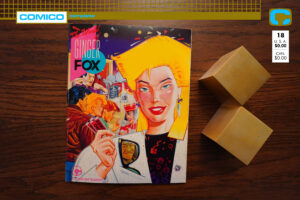
Ginger Fox (1988) #1-4 by Mike Baron & the Pander Bros

The first Ginger Fox book was a bit of a mess, but kinda interesting. And this time around, Mike Baron has the Pander Bros aboard, which might be a good thing for this type of book.

Heh… there’s a third Pander Bros, Henk, who only does plants?

I guess that must be a Henk Pander creation?

Oh, wow. The Pander Bros have developed further after the Grendel stint they did. The artwork is now more extreme and more cartoony — and… less punk, I guess?

The style leads to some absolutely bewildering body shapes. Yes, all these people have huge elbows, but the Bros sometimes forget how to link up arms to the torso.

But you gotta love that fight scene — that staggered hand motion…

Baron is know for doing quippy comics, and this is the sort of book that certainly could do with repartee, but there’s very little in the way of jokes here, really. And what there is (like the above) is pretty lame.

Oh, right, the plot: Ginger Fox runs a movie studio, and for some reason this gossip columnist has it in for her. So she kidnaps (!) her housekeeper (!) so that she can… er… get some gossip? That’s pretty far out, or… just… a very lazy plot. And then her sorta co-conspirator sorta saves the housekeeper, who then goes back to Ginger Fox, and… then that plot is rather forgotten, and they decide to kill Ginger Fox instead, because… because… It had something do to with… running the studio? Was that it?

It’s a pretty convoluted plot, anyway.

The artwork just reminds me of so many other things, like, the above guys somehow made me think of this:

By Willy Smax. But I guess it’s that kinda wild slightly jazzy thing…

But what’s going on here? Very Picasso I’m sure, but what’s the twirly thing at the eyebrow even supposed to be? His other ear? A… wart?

There’s also an AIDS subplot.

It’s really a pretty fun read — it’s quite over the top, but not in an overwhelming way. I guess the main problem is that it feels a bit under cooked — it’s mostly PLOT PLOT PLOT, and then it’s over, and the plot just isn’t all that interesting. So it feels like the book is missing something.

Wow, that’s some eye action.

And this is how the mini-series ends (except for an epilogue): “Roar!”? Wat? I think I missed something.

[Edit: Brian Nicholson notes that the pages were printed in the wrong order, and indeed:

Of course the pages are just swapped. D’oh!]

Amazing Heroes #145, page #101:

Okay, fans of sleaze, sex, and cellu-
loid-Ginger Gox, the star of Comico’s
critically-acclaimed The World of
Ginger Fox graphic novel, is back in her
own four-issue mini-series, courtesy of
Mike Baron and the Pander Bros.
While attempting to film what Baron
describes as “the ultimate horror movie,”
Ginger’s Peppertree Studios is shaken by
an ugly scandal when the calumnious
Tammy True announces that actor Lewis
Lassiter is suffering from AIDS. Lewis
must not only deal with the disease, but
also with the reactions of those he works
with.
And, of course, there’s much more
going on in Ginger Fox. Ginger’s
scummy ex-husband returns, causing
difficulties for her and her son Huck.
Ginger’s beau, Jason, is philandering.
Ousted and disgruntled, director Creigh-
ton Caw plans to regain control of “his”
movie-at any cost! There are also plenty
of phony Hollywoodians in the mini-
series who kiss each other on the cheek
and address each of their friends as
“dahling.”
Yes, Ginger Fox is pure soap opera-
and you don’t have to worry about being
interrupted by an Ivory Snow commer-
cial while enjoying it. Issue #1 bubbles
onto the stands in September.

Amazing Heroes #131, page #28:

Many Minis
Have no fear, oh lovers of the mini-
series; they have not been neglected—
not by a longshot. There are at least
four in the works from Comico. They
are:
Ginger Fox—taking up from the
recent graphic novel, in four issues by
Mike Baron, who has decided that he
will write the mini-series, and not just
supervise as he said in the recent in-
terview in AH #128, and will have not
only the artistic skills of those Pander
Brothers, but it will also be co-plotted
by said siblings. The plot within has
Ginger in the soap operatic milieu of
Hollywood making, what Mike Baron
has referred to as “the ultimate hor-
ror movie”-ooo, scary- as well as
dealing with an actor who has AIDS,
her ex-husband threatening to take
their child, and Ginger possibly being
replaced. Ah, just another quiet day
in tinsel town.
If successful, this may lead to an
regular, open-ended Fox series.

Amazing Heroes #147, page #7:

The latest exploits of Ginger Fox
will be presented this fall in a four-
issue mini-series written by MIKE
BARON and drawn by the PANDER
BROTHERS. Fox fans can expect
many of the same characters from The
World of Ginger Fox, but BOB
SCHRECK says this mini-series “is
much sleazier and action-oriented
than The World of Ginger Fox graphic
novel…The World of Ginger Fox
was about success and how you get it,
whereas this new Ginger Fox mini-
series is about the price of success and
staying on top. There was a lot of
optimism in the graphic novel. The
series is a lot darker… I really feel
that this is one of MIKE [BARON]’s
best stories to date.”

Amazing Heroes #154, page #58:

Okay, soap fans—this is the big one!
Sleaze, sex and celluloid have
returned to your local comics shop.
Yes, the irrespressible Mike Baron has
done it to us again with his lovely new
mini-series, Ginger Fox.
The series deals with Fox’s efforts
to complete the ultimate monster
movie. The problems include a star
who turns out to have AIDS; the
return of Fox’s ex-husband; the kid-
napping of Doris by an unscrupulous
gossip columnist; the ever unsubtle
Babs the bodyguard (eat your heart out
Mr. T!) and much, much more.
It constantly amazes me how much
information Mike Baron can cram into
a single issue of a comic without
making it seem cluttered and disor-
ganized. Here, he has done it again.
The art of the Pander Brothers is
also consistently amazing. For such
an angular style, the Panders show a
lot of curve—a lot of subtlety. Their
strong linework almost makes any
other artistic effects unnecessary, and
yet they do have other strengths, not
the least of which is layouts.
Between Baron’s writing and the
Pander Brothers’ art there is no seam.
This is a team effort in the same sense
that Nexus is a team effort. The art and
script complement each other almost
perfectly, in just the same way.
This is a fast-paced romp through
the sordid and the sleazy. If television
soaps moved like this they might actu-
ally be worth watching for something
other than the gorgeous casts.
Once again Mike Baron has created
a winner. The book is fun and
thought-provoking. It is a world like
no other in comics.
If, like me, you didn’t snap up the
graphic novel, “The World of Ginger
Fox,” don’t make the same mistake
here.
Ginger Fox, a “four-issue collector’s
series”—buy this book!!
GRADE: PRISTINE MINT-Sheldon Wiebe

This book sure got a lot of coverage in Amazing Heroes…

Andy Mangels writes in Amazing Heroes #149, page #48:

For those who missed the Ginger Fox
Graphic Novel, you do not have to
rush out and buy it to understand this
series! Nor do you have to buy any
cross-overs, Ginger Fox Universe
books, or spin-offs. Ginger Fox is a
nice little stand-alone package. At
least, I think it will be by the end of
the mini-series.
Although this first issue of Ginger
Fox does not complete a story per se,
it does succeed in setting up the story
in exactly the ways St. George failed.
What’s the story? “Stories” would
actually be more appropriate.
Ginger Fox is the C.E.O. of Pepper-
tree Studios in Hollywood. She’s also
a single mother, although that fact is
only slightly dealt with. As the story
opens, gossip columnist Tammy True
is threatening to reveal that big-time
movie star Lewis Lassiter is dying of
AIDS while working on the projected
hottest new movie of the decade (for
Peppertree, natch). Ginger’s violent ex-
husband comes to call, and her house-
keeper is kidnapped by Hollywood
moguls scheming to take over Pepper-
tree. A crazed director is willing to
kill Ginger to get back the only print
of his new Western in existence, and
to top things off, Ginger’s supposed
boyfriend is hanging out (really out!)
with a mysterious woman in Rome!
Whew! Does that sound about like
a year’s worth of plots and subplots
for your average comic? And these
will all be resolved in a four-issue
mini-series!
Writer Mike Baron is back in form
again after his disappointing Sonic
Disruptors and silly assembly-line
Jademan work. Here he is terse with
the dialogue, saying reams with a few
lines and innuendos. His dialogue
reads like a well-paced movie sounds:
fast, to-the-point, and meaningful.
Not to say that there aren’t any pro-
blems with Ginger Fox. Baron has
almost too many plots going on in the
series, although I am led to assume
that many of them dovetail into each
other.
His Hollywood is a little unbeliev-
able as well-that is, if Mark Evanier
and many other Hollywood writers are
to be trusted. We all know what a
fantasyland Hollywood is supposed to
be, but this seems a little too much
“fantasy” at times.
The Pander Bros. art is typical of
their work; i.e. style conscious before
anything else. These local (for me)
boys make no attempt at anatomical
correctness, storytelling, or panel
composition. Unlike Mitch O’Connell
(who did the Ginger Fox Graphic
Novel, and who is a fashion designer),
these two go for the grotesque and
unusual. If the rules in comics say to
do this, the Panders don’t.
Especially in Ginger Fox (as oppos-
ed to Grendel), this brash rule-break-
ing fails to work well. Layouts are
confusing, making some pages near-
incomprehensible, and some of the
figures look directly out of Picasso’s
worst nightmares. Seeing the Western
sequence as rendered by the Panders
is somewhat akin to seeing Marilyn
Chambers portraying the Virgin Mary.
Some things just don’t work well
together.
Mike Baron’s scripting saves the
book, and although I’ve kvetched a lot
about it, Comico could have gotten
worse artists than the Pander Bros. on
this project. At least they bring a sense
of style and flair to the book, although
they bring along with that all of their
incomprehensible storytelling faults.
Ginger Fox was an experiment as a
graphic novel, and the mini-series is
a bolder such experiment. Because I
respect (and try to support—if they’re
good) experimental books and Mike
Baron’s fast-moving script is simply
too much fun, I do suggest giving this
one a try.
Grade: Near Mint

See?

Comics Interview #51, page #16:

MARK: What about in the comics field,
do you have any plans?
JACOB: The next step for us is, basical-
ly, to propose our own concept to Comico.
ARNOLD: But right now we’ve pencil-
ed the first issue of GINGER FOX, work-
ing with Mike Baron on this four-issue
mini-series, and if you think that’s going
to look like an L.A. GRENDEL, don’t
worry.
JACOB: It’s beautiful so far.
ARNOLD: It’s a whole approach that
we’re taking based on Oriental fashion il-
lustration, and I’ve been experimenting
with these kind of cubist cartoon images
for the characters that are more of the bad
guys or the villains, those characters that
are not the main figures. So it has a real
stylistic look to it, moreso I think than
GRENDEL – more linear.

Fantasy Advertiser #110, page #13:

Ginger Fox 1-4
by Mike Baron and the Pander Brothers;
Comico.
Yay, this is the biz – now I remember
why I put up with all those sneering
comments from my peers – this is why Mike
Baron’s ‘Next Nexus’ was so weak – Mr B
has been sweating away at this masterpiece
for the last millenium. This comic reeks
of style, atmosphere and sophistication.
This series really is for the mature
reader, not because of the occasional flash
of a naked body, not because of the odd
piece of extreme violence or strong
language but because it manages to treat
these elements, and many others, in a
mature, non-gratuitous manner. As far as
originality goes, even the covers smack
of thought and fresh vitality – cliches
nowhere in sight here folks. The use of
photography on the covers provides an
excellent contrast to the cartoony style
of the Pander Brothers’ sharp internal
artwork, offsetting beautifully the
surrealistic feel of the comic.
The story follows the exploits of Ginger
Fox, film producer extraordinaire and ties
her into an intricate plot involving drug
abuse, the social stigma attached to AIDS,
the decadence of the Hollywood set and
media back-stabbing. Somewhere in the
middle of all this Ginger attempts to hold
together a relationship with her teenage
son and keep an eye on her ex-husband’s
manic, dangerous behaviour.
All the characters in this series really
leap off the page in a sharp montage of
colour and sound conveyed by some
brilliantly creative lettering and stark.
contrasting colouring. The cast of
characters simply ooze malevolent
insincerity and I found myself, in true
pantomime spirit, shouting “Look behind
you!” at every second person as yet another
character assassination took place under
the guiding hand of villainess ‘Tammy the
gossip queen’. The flow of the story is
helped along brilliantly by the electric
Pander Brothers artwork – their best since
their stint on ‘Grendel’. It suits the
zany, offbeat style of this series
perfectly, highlighting the insecurity
of life in the fast lane as the characters
plough on deeper and deeper into the
quagmire of their social scene.
Mike Baron throws in enough confusion
to keep the readers on their toes without
over-complicating and unduly slowing the
pace of the story down, and the result
is breathtaking but not without its
sensitive side seen in the portrayal of
the destruction by the press of a once
respected director, now ridiculed by the
media due to his suffering from AIDS. This
comic is brilliant, complex, sophisticated
but never pretentious – it’s good, clean
(well, more off-white really) fast paced
fun. Buy, buy, buy.
– Simon Ward

The Slings and Arrows Comic Guide #2, page #278:

GINGER FOX
Comico: Graphic Novel 1986, 4 issue miniseries 1988
What should have been a run-of-the-mill tale of Hollywood
folk was, incredibly, one of the most bizarre comics of the
1980s. Actually, the graphic novel by Mike Baron and a
young Mitch O’Connell was a largely uninteresting affair,
enlivened only by its stylish art. For the miniseries, however,
O’Connell was replaced by the Pander brothers, for whom
the description “eccentric” is an understatement of
gargantuan proportions. While the comic is ostensibly about
studio boss Ginger Fox and her tussles with murderous
actresses and unruly directors, the expressionistic, distorted
art transforms it into an insane, nightmare world. However,
whereas the Panders’ art is unrelentingly demented and
staggeringly ugly, Baron leaves no cliché untapped, with
every Hollywood stereotype present and accounted for. It’s
a rare title that manages to be outrageously camp and soul-
destroyingly banal at the same time, but Ginger Fox is that
comic.~DAR

Amazing Heroes #128, page #20:

I’m only super-
vising the course of the Ginger Fox
mini-series, which the Pander
Brothers are writing. Robotech is
over, thank God.

Heh heh.

Amazing Heroes #128, page #26:

AH: You also mentioned earlier that
you’re relinquishing the writing of
Comico’s Ginger Fox mini-series to
Arnold and Jacob Pander of Grendel
fame. What type of control, if any, are
you keeping with that project?
BARON: Well, I imagine I have final
control over the product, if I want to
exercise it. But the thing is, they’re
doing such a good job that it’s going
to come out pretty much the way they
planned it, and that’s the way I want

This guy liked it a lot:

If you ever come across this book in a back-issue bin, I’d definitely suggest picking it up – well worth the read!

RATING: 10 highly sought-after film canisters out of 10 for an out of the ordinary comic book
with extraordinary art and storytelling talent!

And this guy:

And nobody seems to remember this but me, however, the Pander Brothers had been tapped for a Max Headroom comic that never saw the light of day, but really should have, given the preview art that I’d seen. Scour the dollar bins for these.

A rare negativish review:

Needless to say, while the original TPB showed the sliminess of the Hollywood industry and Pander’s artwork really makes them look evil and slimy. Granted it’s an artistic look, which those who appreciate art, will like his unique style. While those use to a certain style for comic book characters, may not get into Pander’s artwork.

For the first issue, it’s an interesting storyline but the first issue was for the most part, OK.

OK, that’s it. The book certainly has a something jennesequa, but I don’t know what. So it’s a shame it’s never been reprinted or collected, really. It’s pretty good.

1988: The Rocketeer Adventure Magazine

The Rocketeer Adventure Magazine (1988) #1-2 by Dave Stevens, Elaine Lee, Michael Kaluta et al

When the eventual bankruptcy of Comico is brought up, this is a book that’s frequently mentioned. Not because of bad sales, of course, but because it had been announced years in advance, but was always just over the horizon. And Comico had apparently paid Dave Stevens for the book early, so it was a drain on cash flow.

As with many Comico titles, Rocketeer had been published by other companies first. It started in Pacific Presents (from Pacific Comics), and was then picked up (and collected) by Eclipse Comics. It was a major fan favourite from the get-go — Stevens’ oldee tymey Frazetta/Williamson/Wood artwork sure is good-looking, so even if Stevens seemed to be the slowest artist in comics, it had a following.

This book doesn’t really start off with an explanation of what the whole deal is with the Rocketeer, but we do have the (ex-?)girlfriend ruminating a bit about things to get us into the swing of things. I thought that was an economical way of doing things (especially since there’s just 14 pages of Rocketeer per issue, so you can’t be wasting pages)…

… but then we get even more infodumping, and this all just seems a bit redundant. And we’re running out of pages! Make something happen!

So there’s a fight, and a misunderstanding, and the (ex-?)girlfriend flies back to Los Angeles while Rocketeer stays in New York.

It’s not much of a story, and there’s no Rocketeering being done, but it’s fine. And the artwork’s great.

And you can buy a big poster!

So the main feature is just 14 pages — what are you filling up the rest of the pages with? Why, of course — several pages of text (and pics) of oldee tymey pilots. Why not?

But the main backup feature consists of short (about ten pages) stories about Bruscilla the Muscle’s childhood. It’s a classic setup: She’s telling some Galactic Girl Guides about her own escapades in the Guides, so it’s all edumacational and stuff.

And it’s very funny, and it’s just a perfect little story: Lee and Kaluta cram an entire little epic into the pages they have at their disposal. It’s like a Carl Barks ten pager, but with the “chaos” knob turned up to 11.

I’m a huge Elaine Lee fan, and I think that Starstruck is a masterpiece, and this is just so well told — despite the chaos, Lee and Kaluta’s storytelling is on point, and Kaluta’s artwork is so attractive.

So that’s a really nice comic book — it’s a very appealing package. Sure, you don’t get that many pages of Dave Stevens, but the other features are interesting and/or great, so if they’re able to publish this on a regular schedule, Comico should have a hit on their hands!

The second issue arrives, predictably enough, one year later.

And not only has Kaluta flown over to do the layouts for Rocketeer, but Stevens has gotten two screenwriters in to (co-)write the story. So I guess he’s basically just inking it now, but it still took him a year to get it done.

You can just imagine the frustration of everybody involved — the delays aren’t just for the Rocketeer material, but also the Starstruck stuff.

So what are the results of having all the helpers involved? Well, the story looks fine, but with layouts by Kaluta and pencilsish/inks by Stevens, you wouldn’t expect less.

However, the storyline (of which we get the first part here) is… kinda not there? It feels like what they set up over these 14 pages could have been done in 2.

In stark contrast, the second Galactic Girl Guide story is another epic — but they manage the amazing feat of not having the story seem cramped, and allows lots of funny slapstick while still getting the story told. Fantastic.

Yeah, there were only two issues published — Comico went bankrupt a few months after the second issue was published.

So it’s all predictable, really — Rocketeer has a spotty publishing history because Dave Stevens is slow, and Starstruck has a spotty publishing history because it’s too good and gets cancelled. Combine the two, and the only surprise is that they actually managed to publish two entire issues.

And they’re two very enjoyable issues, which isn’t surprising, either.

Amazing Heroes Preview Special #1, page #91:

1985 SUMMER PREVIEW SPECIAL

THE
ROCKETEER
ADVENTURE
MAGAZINE
Written and illustrated by DAVE
STEVENS and OTHERS
6-issue limited series; 32 full-color pages
on white paper; direct-sales distribution;
bi-monthly; price and publisher
undetermined

Although the Rocketeer graphic
album is due out late this summer
from Eclipse Comics, the big news
for Rocketeer fans is Dave
Stevens’s plans for a six-part limited
series that will debut toward the end
of the year. The book, which will be
called The Rocketeer Adventure
Magazine, will have three stories per
issue, Stevens said.
Ten pages will be devoted to the
main “Rocketeer” feature, six
pages will turn the spotlight on
members of the Rocketeer’s suppor-
ting cast, such as Peevy, the
mechanic. The other 10 pages,
according to Stevens, will be by
another artist, but will be some sort
of adventure story. “They’ll be
period pieces, but not necessarily
about the past,” he said. “They
could be about either the past or the
future-just not the present.”
Stevens also said that he has a
specific style in mind, and he is
looking for an artist with a suitably
illustrative approach-“like one of
the EC artists. Something real illus-
trative and real nice.” No one defi-
nite has been tapped to do the back-
up, yet, however.
……
In the first issue of Rocketeer
Adventure, Stevens said the Rocke-
teer won’t be in action: instead, he’ll
be racing around the Big Apple, try-
ing to find Betty. In the second
issue, though, Stevens promises to
put the Rocketeer through his high-
stepping paces. Although there will
be subplots cropping up throughout
the six issues, each issue will be a
complete adventure in itself. Ste-
vens promises that there will never-
theless be continuity and unity run-
ning through the series right up until
the climactic issue #6. For example,
Betty leaves briefly after the first
issue, but reappears later in the
series.
The frequency of the series is in-
tended to be bi-monthly, and
Stevens hopes to have the first
issue out in 1985. At this time, the
publisher has not been decided on,
although Stevens revealed that he
was negotiating with Eclipse, who
published his Rocketeer Special
earlier this year. Stevens ended by
saying that the Rocketeer Adven-
ture comic would be his “baby”
from start to end, and that he would
essentially be packaging it for
whomever ends up being the lucky
publisher. Stevens said he has a
long head-start on this particular
project, so the schedule he had in
mind should be attainable. “This is
something I’ve been wanting to do
for a long time, and I’m determined
to pull it off,” Stevens concluded.

Heh heh — Stevens announced the book in 1985, three years before the first issue was published. And it sounds like he had the first story already done by then, so it took him four years to make the second 14 page story, I guess.

Back Issue #47, page #65:

BOYD: You men did a nice script. You included a smile-inducing
take on Rondo Hatton, one of Dave’s villains from The Rocketeer
Adventure Magazine: “Cliff’s New York Adventure” (fully compiled
in 1995), an Errol Flynn-like double agent (Timothy Dalton),
and memories and cameos of stars of Hollywood’s Golden Age,
among other things. You told us Disney/Touchstone might have
been interested in sequels. Were there things you held back on in
case a sequel had been given the go-ahead?
BILSON: No, we held nothing back, and weren’t thinking about
a sequel except for the fact that the plans appear in Peevy’s
hands at the end, making a sequel possible. We also co-wrote
the New York Adventure, so Rondo being in that was based on
what we planned for the film.

So the third issue was published by Dark Horse in 1995.

Amazing Heroes #145, page #194:

This is no hoax. This is no dream. This
is not even an imaginary story. After all
these years, The Rocketeer is actually
on the schedule. The Rocketeer Adven-
ture Magazine will debut in July, and
appear quarterly after that. I am not
kidding. Each issue will feature 15 pages
of Rocketeer action and 10 of The Gal-
actic Girl Guides by Elaine Lee, Mike
Kaluta and Charles Vess. Following the
third issue, creator Dave Stevens will
take a break to do some commercial
work and get money for food and
lawsuits, and then we’ll see the next three
issues hopefully only a few months later.
And after that? Read on.
“Cliff’s New York Adventure” picks
up right where the story left off, with
Cliff flying off to New York to stop Betty
from going to Europe with that slimy
Marco, all accompanied by plenty of
shots of the Rocketeer flying against the
New York skyline, guys in tuxes, and
Betty in this dress that you must see to
believe. The story also introduces a
childhood chum of Cliff’s by the name
of Goose Gander.
This first issue will wrap up the plot
threads from the graphic album, and
answer the questions we’re all asking:
will Betty be disillusioned by Marco and
go back with Cliff? That would be
telling, but can Betty be as materialistic
as she seems?
“No.” answers Dave Stevens. “Her
good side is that she’s really in love with
Cliff, but she has certain goals that she’s
laid out in her life, goals that she won’t
sidetrack for less. Cliff represents some-
thing that she considers less than she
wants. She’s just one of these people that
has to be with people that are upwardly
mobile and powerful. She’s excited by
that world. A lot of people are. This town
is full of them. A lot of people are just
completely mesmerized by celebrities.
And she’s at a phase in her life where
it’s, unfortunately, more important.”
Stevens puts an equally down-to-earth
characterization to our dauntless hero,
Cliff Secord. “I don’t know what makes
him tick in general, he’s just one of these
guys who likes to push the envelope.
He’s very self-interested. He’s not a hero,
he’s just a guy out to make a buck. That
was his intention from the beginning, just
trying to turn a dollar and in the process,
he gets swept up.”
Issues #2 and 3 start a whole new
phase of the story. “[They’re] a complete
departure, a real dark drama in New
York with Cliff without any of the other
characters that have been in the story,
except Goose.”
But don’t expect to see the “melan-
choly” side of Cliff. “He doesn’t have
time. Things are happening so fast. It’s
kind of a film noir murder adventure.”
Although this isn’t exactly what Stevens
set out to do, it’s what the milieu of Late-
Depression New York inspired in him-
the world of flop-houses and hoods and
dark alleys. “I just decided that this is
the sort of story I should tell. Once he
goes back to sunny California the story
is completely different. [This story] is
taking him out of his element and putting
him in completely different, more des-
perate waters and just seeing if he can
stay afloat. Which he barely does. He’s
running in abject terror. From the first
to the third issue, he gets more and more
banged up, to where by issue #3 he looks
like raw meat.”

The Superhero Book, page #432:

However, Stevens’ burgeoning career as a
comic-book artist was matched by his successful
life in Hollywood’s movie world as a storyboard
artist and designer, which meant that it was four
more years before a second Rocketeer adventure
was serialized. This new tale appeared in 1988,
from new publisher Comico. Then Comico went bust
after only two issues of the comic, and it was an
astonishing six years before the final installment
crept out, published by Dark Horse Comics. The
new yarn was, if anything, even more majestically
drawn than the earlier episodes, and featured hard-
boiled gangsters and old-time carnivals and freak
shows, not to mention the Shadow (in all but
name), complete with autogyro.

So the plan was to hold off on publishing until Comico had the first three issues on hand, but I guess they had to abandon that plan.

Ah, Stevens had to wait for the guy who bought Comico after the bankruptcy to go away before he published the third issue. Which sounds fishy — it was published in 1995, and Comico didn’t totally die until 1997…

Amazing Heroes #150, page #67:

Sound the trumpets and let the
banners fly! After a waiting period
that some folks thought would just
never end, the character that brought
Dave Stevens fame, fortune, DNAgents
covers and lawsuits is finally back on
the racks, and new publisher Comico
is proud to have him.
If the first issue is any indication,
Comico’s pride is well deserved. For
my money, neither Stevens nor the
Rocketeer have ever looked better. I
should, however, warn all the action
fans in the audience that if they were
hoping to see protagonist Cliff Secord
jump into his Rocketeer suit and fly
through the dark Manhattan skies,
they’re in for a disappointment.
Secord’s only appearances in costume
this issue come on the cover and in
flashbacks. Fans of Secord’s on-again,
off-again romance with the busty.
Betty, on the other hand, are in for a
treat, for that stormy lil’ relationship
fairly dominates RAM #1. To say more
than this would give away some of the
plot, which I don’t want to do; suffice
to say the storm watch isn’t over yet.
Riding back-up shotgun is The
Galactic Girl Guides, by Elaine Lee
and Mike Kaluta. Lee and Kaluta
previously collaborated on Marvel-
Epic’s Starstruck, and the Guides
series spins off from that short-lived
book. Those who found Starstruck not
to their liking, however, need not fear,
for Kaluta’s artwork is as stunning as
ever, and the story is easier to follow
than it was at Marvel. Either Lee’s
writing has improved, or I’ve gotten
smarter in the years since then. Either
way, this first Guides installment was
a rollicking little opus highly
reminiscent of the old Little Rascals
movies, and almost outshone Stevens’
lead Rocketeer story.
In the final analysis, either story by
itself would have been worth the $1.75
price of admission; together, they
make a double-feature that no comics
fan worth his salt can afford to miss
out on.
GRADE: PRISTINE MINT – David Peattle

Amazing Heroes #157, page #188:

Remember when Rocketeer Adventure
Magazine was supposed to be quarter-
ly? The long-awaited second issue will
be out about six months after the first,
but creator Dave Stevens came closer
than you might think to making the
schedule. In fact it was a nasty freeway
run-in with a slow-moving dirt truck that
nearly totalled Stevens’ car, which real-
ly put Rocketeer off the schedule.
But the second issue will be out,
featuring the first part of “Nightmare at
Large,” in which Cliff Secord runs afoul
of death and danger in New York City.
“It’s a thrill-packed, all-action story,”
Stevens promises. The tale concludes in
the third issue, which will be a jumbo
edition. That’s right, a 25-page Rocke-
teer story and an extra-long Girl Guides
back-up. And Stevens swears on his
honor that #3 will be out three months
after #2 because “the way the story is,
we couldn’t leave people hanging that
long.”

Three months… what wishful thinking.

Scarce #17, page #32, inexpertly translated by Google Translate:

Here, then, is the long-awaited return, in widescreen and color, of the grand adventure, the story of the madcap chase that takes Cliff Secord (aka the Rocketeer) from Los Angeles to New York in his small plane to find Betty, his beautiful love, captivated by Marco, the photographer to all of Hollywood, who promises her the moon and the stars and who must fly out the very next day for a trip to Europe.A race against time, then; against time and against fate.

Secord, barely off his plane, runs into his old pal Goose (garlic?!), like him an aerobaticplane pilot.But disappointment awaits Secord at thecorner of a chic bar where the beautiful woman is holding courtamidst a glittering party.Secord appears, whom she thought wasquite rightly dead (hey, my hero!You here?!).Marco is out, but the illusion is hard to shatter…Finally, while Secord leaves disgusted, Betty boards the plane “incognito” for Los Angeles.

So, has the Rocketeer becomea loser? A candy-eater?Will he accept defeat so easily? Dave Stevens, now that his lawsuit with Marvel has ended (in his favor), has a quarterly magazine to answer these questions.Still as rare (read: lazy) and classy as ever, Stevens (he explains it in Amazing Heroes Preview Special 144)! To think it took three whole years to discover this continuation of Rodeo and Juliet’s adventures, after a lawsuit with Marvel over the Rocketeer’s name. Inked by himself, with an intro-by the master (yes, it’sthe same one again!), this episode allows usto finally see the vivacious Betty again,the one who makes the ‘band-meter’ explodein the Thunderdome and who putsthe other comic book heroines back in theirrightful place: that of the bargain-basement shop girls. It should be noted that the scriptsfor the next two issues will beco-written by Danny Bilson and PaulDemeo, who are also responsible for thescript of Rocketeer, the Movie.

On the other hand, one can be skepticalabout the quality of Mike Kaluta’s backup art, sublimely inked(we are told) by Charles Veiss. Just a nasty sequel to Starstruck? Kaluta had, however, accustomed us to much better than this pale avatar… But please, Mr. Stevens, no more than two years for the second episode!

Tsk tsk. Those French.

Speakeasy #91, page #60:

Although it’s the size of a regular 32-page
comic, this book sets about convincing you
that it’s something else. It wants you to think
that it’s the screen at your local fleapit, circa
1936, on a wet Saturday morning. You’ve paid
your nickel and settled in your seat. The
projector has started to roll and the lads at the
front are beginning to lose interest in throwing
their popcorn at the screen. Sitting in the dark,
you gaze into another world …
The 1930s of Dave Stevens’ Rocketeer
never existed, in the same way that the charm
that we attach to the old Republic movie seri-
als springs from an affection for the innocent
world-view that they seem to embody. Maybe
it was easier to believe in heroes and villains
then. Stevens plays upon the conventions of
those serials in a knowing fashion, without
disturbing the logic of the fantasy. Of course
Cliff Secord remembers the “ol’ neighbour-
hood chant” that every street gang had, in
every ‘boys gang’ movie ever made. Of course
the childhood friend that Cliff meets in New
York is called Goose – every adventure hero
has a sidekick with a silly name, and since Cliff
left Peevy in Los Angeles when he took off in
pursuit of his errant heart-throb Betty, he had
to have another one waiting for him in NY.
And then there’s this tall stranger, with a large
hooked nose, commanding manner and con-
spicuous ring, for whom Cliff is sure to start
working, whether he likes it or not ….
The ‘boys gang’ undergoes a sex
change in the second strip, which takes up the
back ten pages (Rocketeer occupies the first
14). Brucilla the Muscle: Galactic Girl Guide
takes a retrospective look at the early career of
one of the major characters from Elaine May
and Mike Kaluta’s Starstruck. This first story
is a new version of The Sorcerer’s Apprentice,
and introduces Cookie and Puddy, her two
closest pals. The entire scenario is firmly rooted
in the tradition of zany, uncontrollable, but
still cute and golden-hearted kids of the Mickey
Rooney/Judy Garland/Boys Town variety. it
works well as a second feature, having the
good sense not to try to capture the attention
intended for The Rocketeer, but still keeping
in the same vein.
Sandwiched between the entertain-
ment comes the information. Here the kids at
the front might start throwing things again.
Who wants their fantasy spoilt by boring old
history? I almost skipped the three pages of
text given over to a potted biography of George
Townson, a flier of autogiros – the precursors
of modern helicopters. But this story is every
bit as interesting as the fictions that it sits
between. It gives a glimpse of the almost
insanely reckless attitude that the early pilots
shared, willing, it seems, to try anything to
find out more about their machines and the
science of aviation. Heady stuff, adding a
depth to the imagined world of the Rocketeer
and more than a hint of the mindset that the
strip’s hero would be sure to share.
Stevens’ portrayal of women has come
in for some stick, and probably quite rightly.
Betty is a prime example of good girl art, and
the way that she is written fulfils the role of
every female in the old serials: a good-looking
catalyst, something to be kidnapped, rescued,
pursued, claimed. It would be nice to see
more use made of her character, but for now
she is quite sensibly packed off back to LA, so
that the boys can get on with the exciting stuff.
More bad guys, gunfights and ghosts from the
past are promised on the inside back cover, as
the house lights brighten, and I’ll be in my seat
the next time they start to go down.

The Comics Buyer’s Guide #918, page #4:

Subsequent installments
appeared in Pacific Comics Pre-
sents and Rocketeer Special.
Those installments were col-
lected in a graphic album, and dog
Cafe, an actual restaurant in
later chapters appeared in The
Rocketeer Adventure Magazine.
In creating the characters and
milieu of The Rocketeer, Stevens
looked back on his favorite time
in American design: the late
1930s. He doggedly researched
the period to accurately capture
the dialogue, local flavor, and
actual locales which he inte-
grated into the strip.
“If you’re going to have to
draw a series and live with it.”
said Stevens, “you need to create
a world with characters that you
can face every day. I think it’s
important to like the characters
you draw. In doing so, you hope
that your readers will want to get
to know them, too.”

Here’s a review from the webses:

Overall, like I said, this is not a bad issue but not one to come in on. Maybe with the previous issues it’s one to continue on though.

For such a long publishing history, there really aren’t that many Rocketeer pages, but IDW published a collected edition in 2009 (the year after Stevens died).