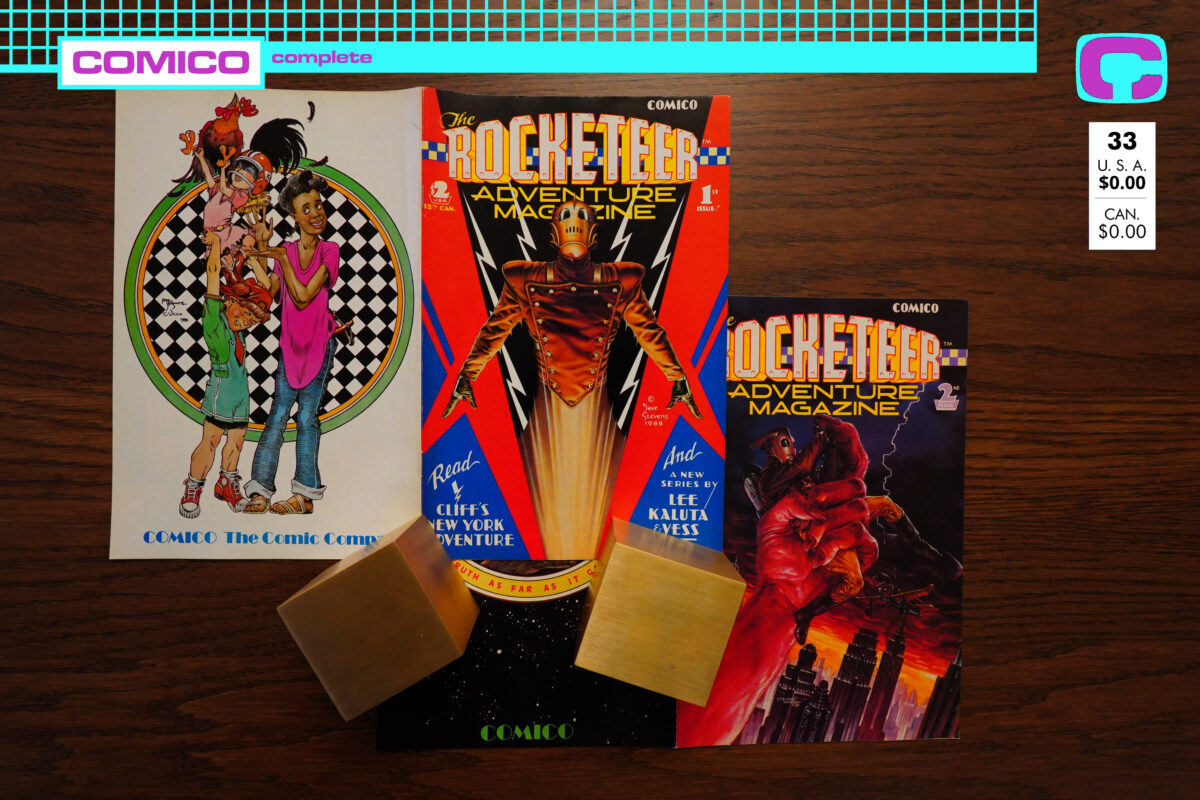
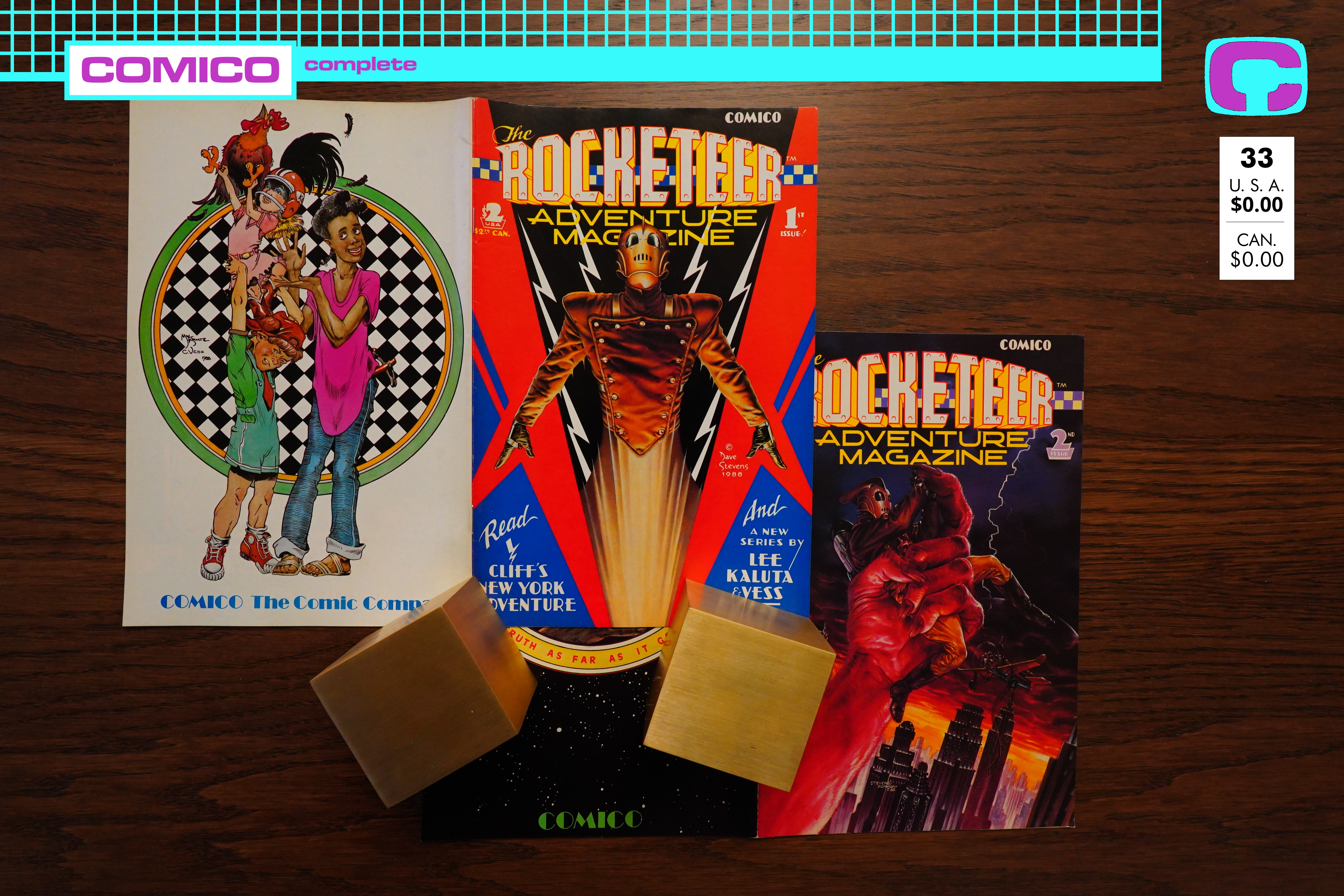
The Rocketeer Adventure Magazine (1988) #1-2 by Dave Stevens, Elaine Lee, Michael Kaluta et al
When the eventual bankruptcy of Comico is brought up, this is a book that’s frequently mentioned. Not because of bad sales, of course, but because it had been announced years in advance, but was always just over the horizon. And Comico had apparently paid Dave Stevens for the book early, so it was a drain on cash flow.
As with many Comico titles, Rocketeer had been published by other companies first. It started in Pacific Presents (from Pacific Comics), and was then picked up (and collected) by Eclipse Comics. It was a major fan favourite from the get-go — Stevens’ oldee tymey Frazetta/Williamson/Wood artwork sure is good-looking, so even if Stevens seemed to be the slowest artist in comics, it had a following.
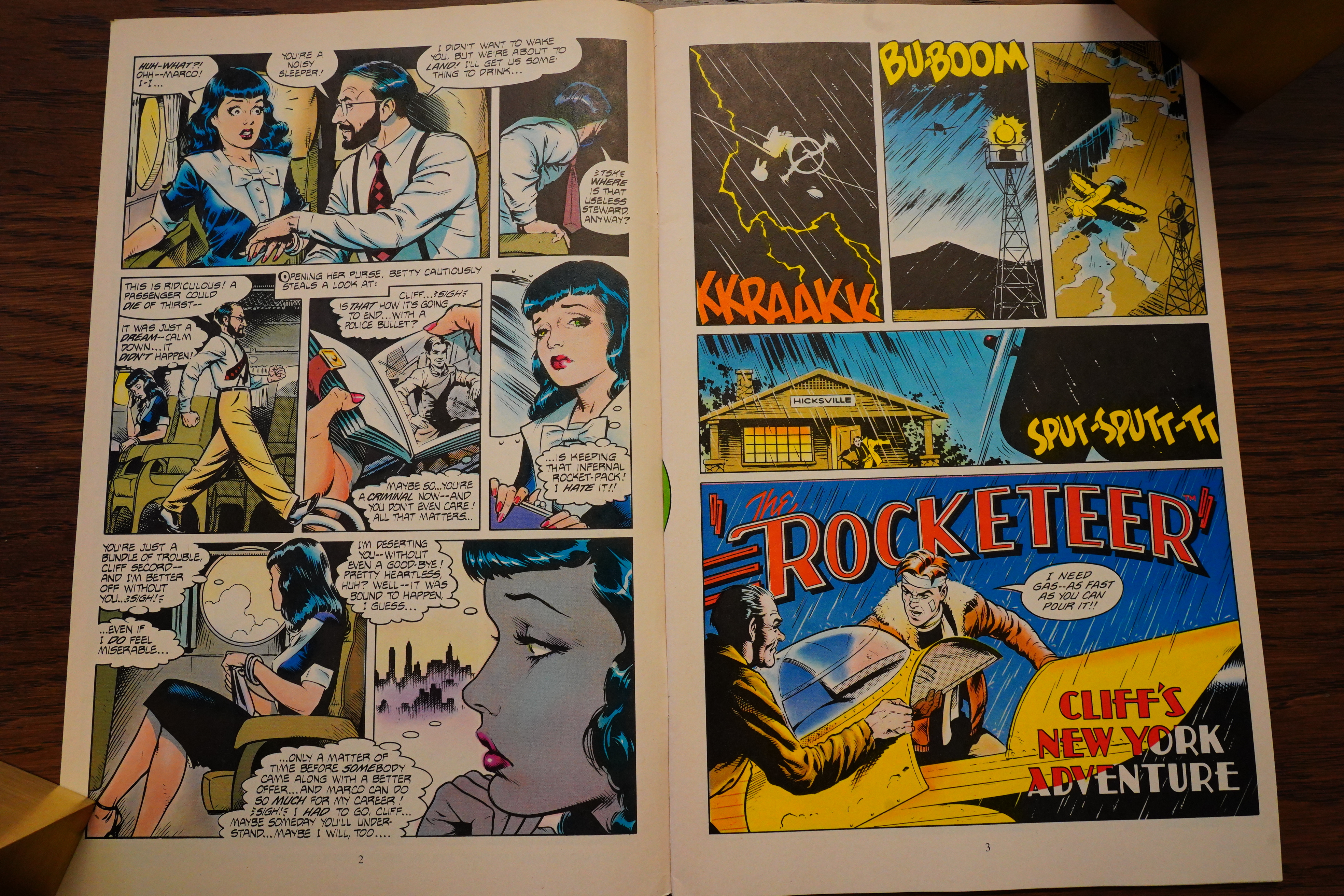
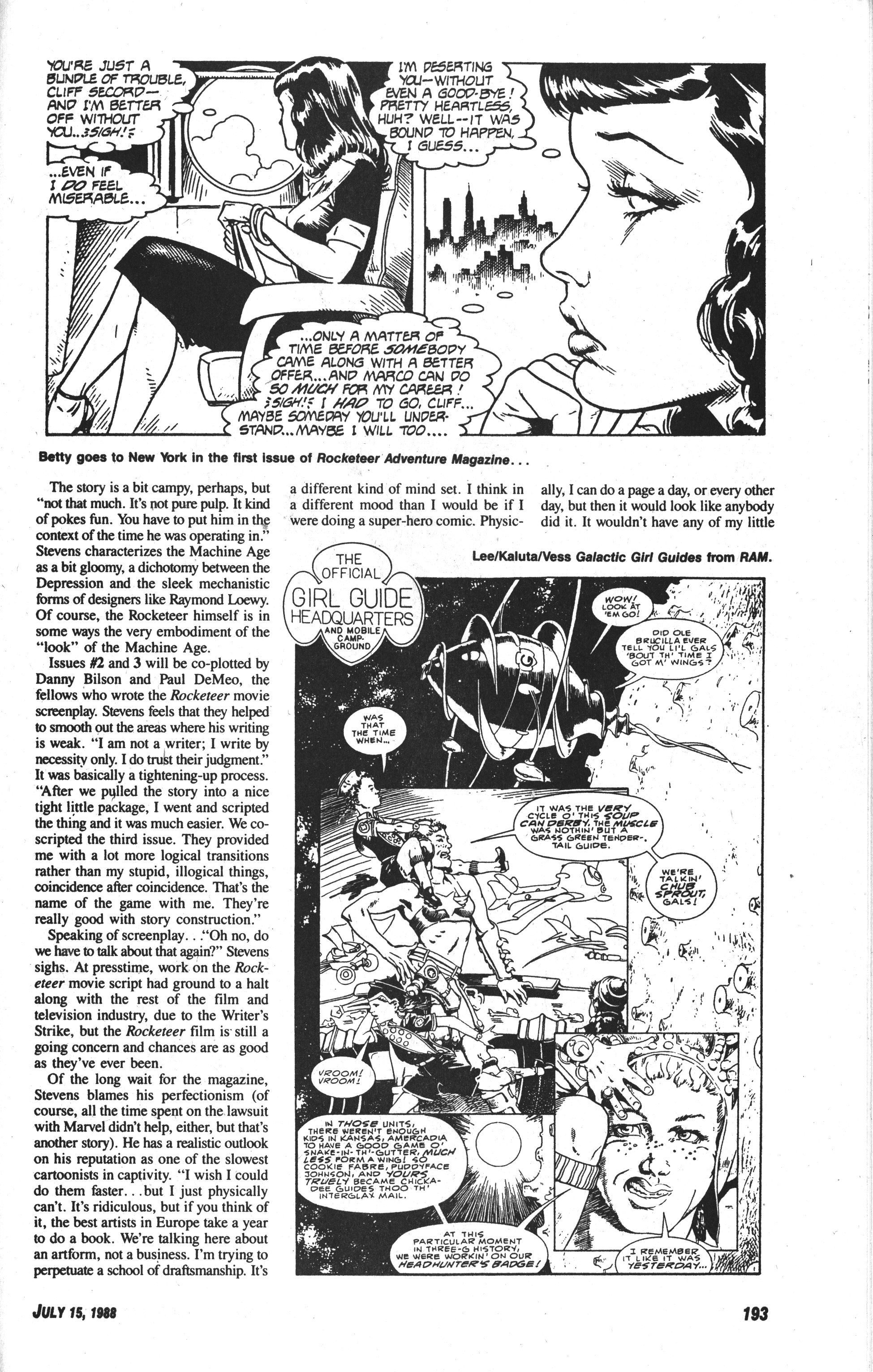
This book doesn’t really start off with an explanation of what the whole deal is with the Rocketeer, but we do have the (ex-?)girlfriend ruminating a bit about things to get us into the swing of things. I thought that was an economical way of doing things (especially since there’s just 14 pages of Rocketeer per issue, so you can’t be wasting pages)…
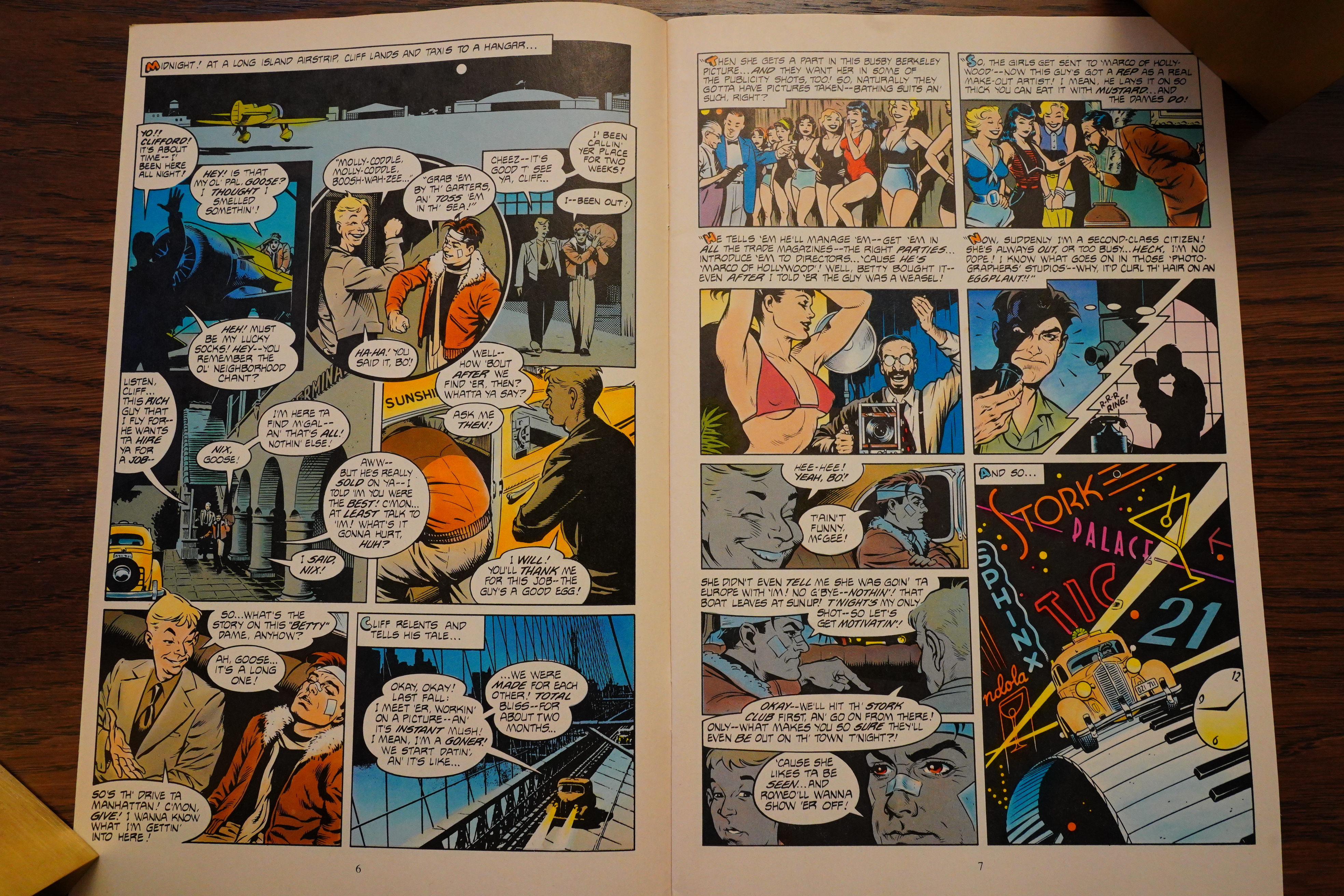
… but then we get even more infodumping, and this all just seems a bit redundant. And we’re running out of pages! Make something happen!
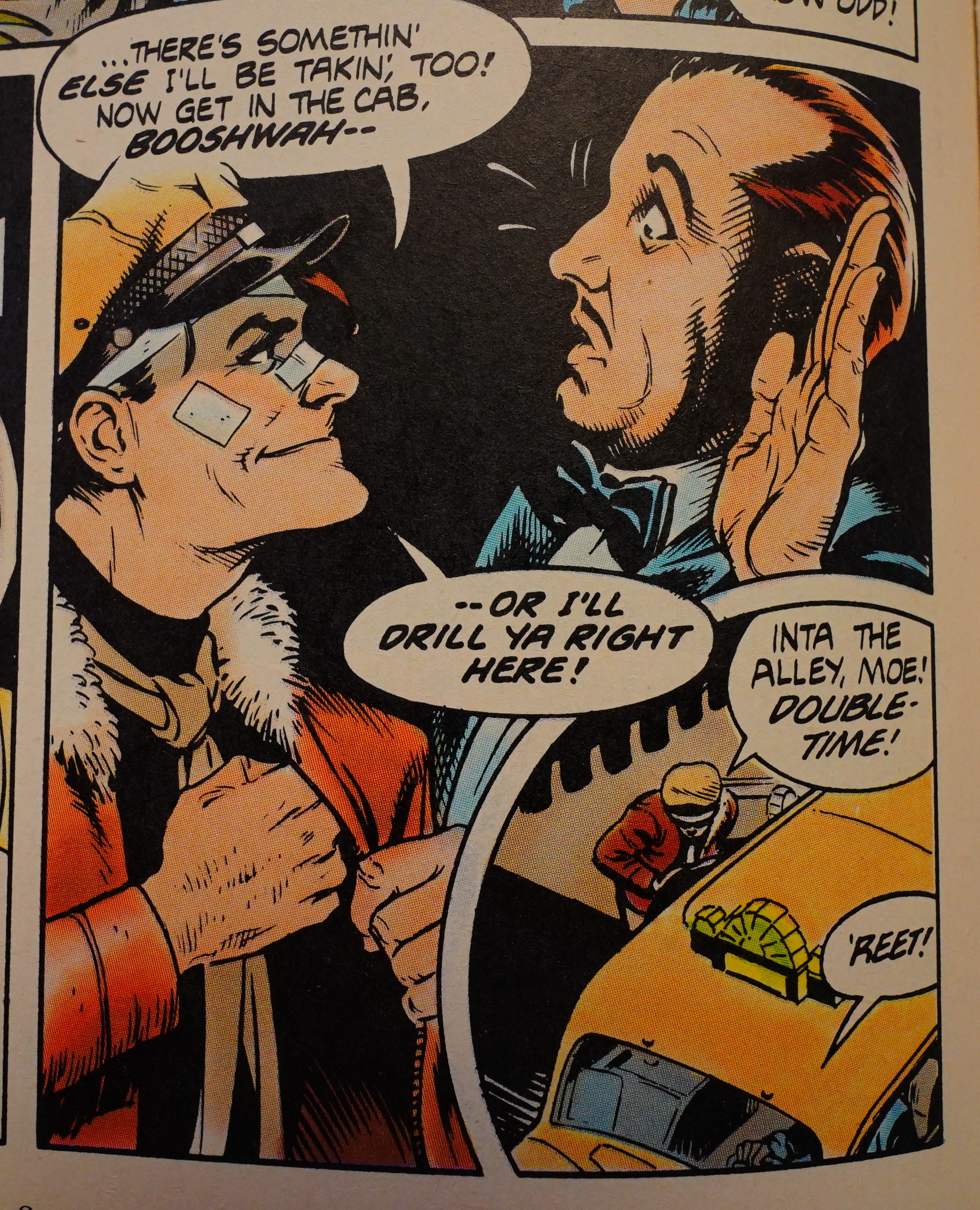
So there’s a fight, and a misunderstanding, and the (ex-?)girlfriend flies back to Los Angeles while Rocketeer stays in New York.
It’s not much of a story, and there’s no Rocketeering being done, but it’s fine. And the artwork’s great.
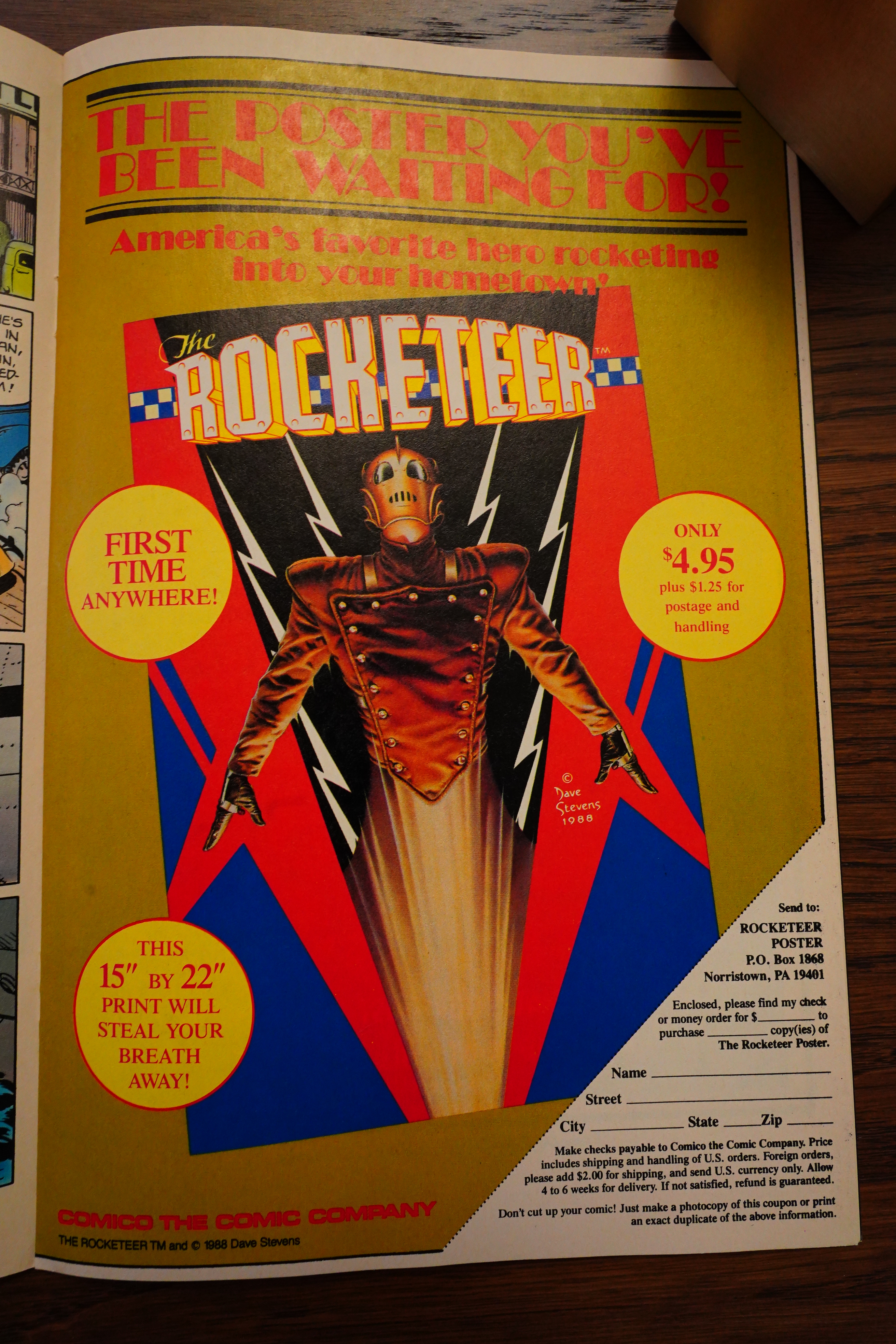
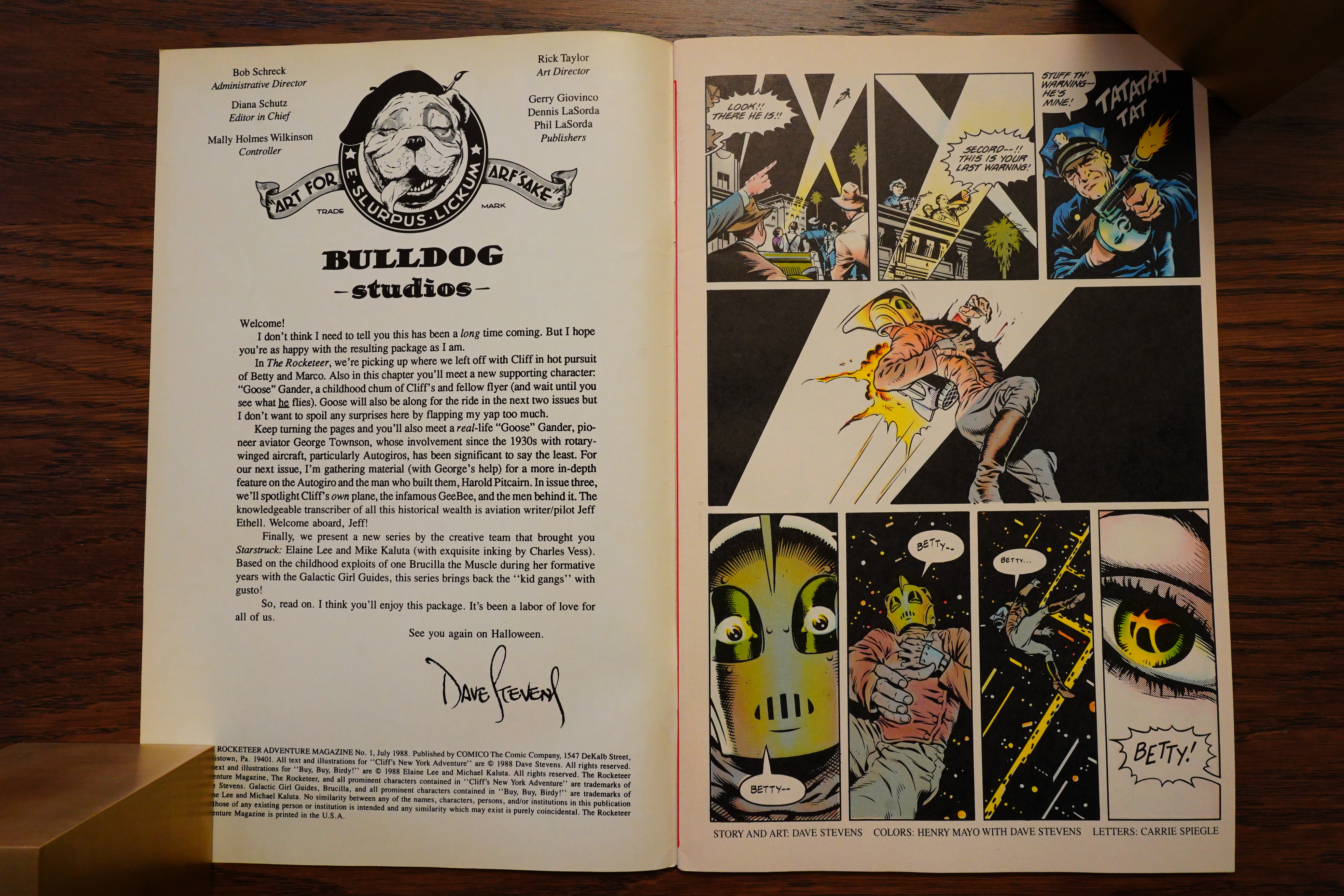
And you can buy a big poster!
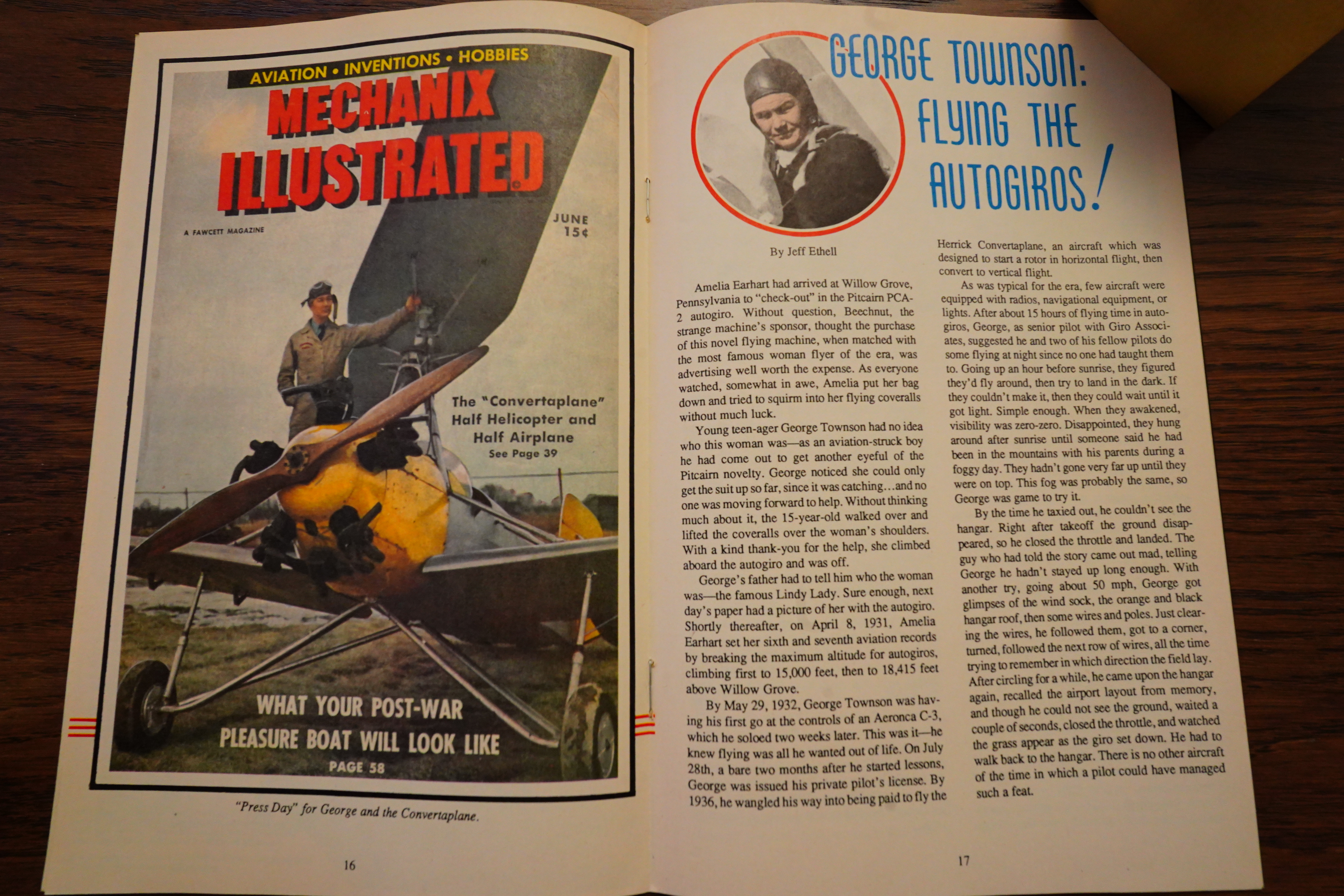
So the main feature is just 14 pages — what are you filling up the rest of the pages with? Why, of course — several pages of text (and pics) of oldee tymey pilots. Why not?
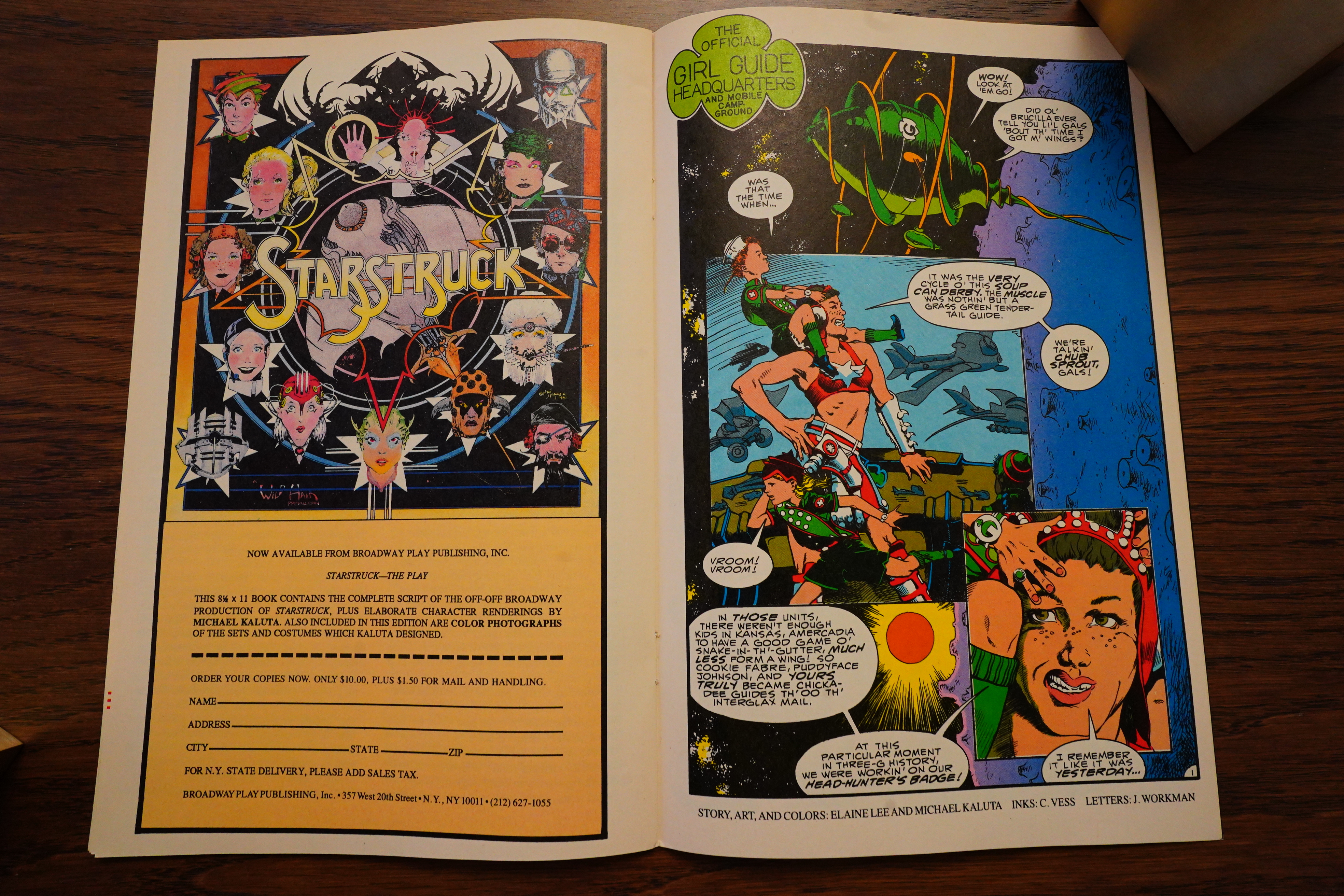
But the main backup feature consists of short (about ten pages) stories about Bruscilla the Muscle’s childhood. It’s a classic setup: She’s telling some Galactic Girl Guides about her own escapades in the Guides, so it’s all edumacational and stuff.
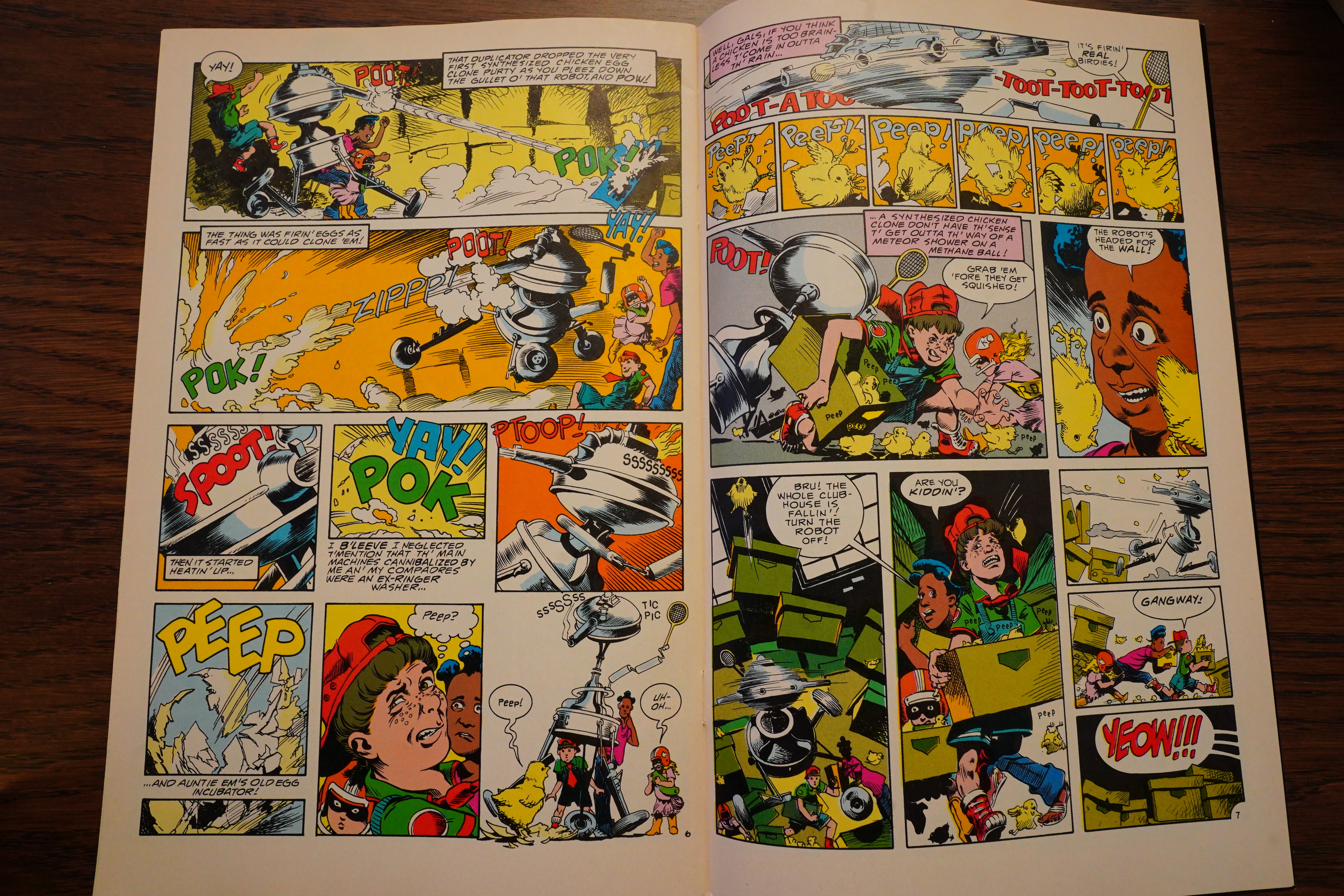
And it’s very funny, and it’s just a perfect little story: Lee and Kaluta cram an entire little epic into the pages they have at their disposal. It’s like a Carl Barks ten pager, but with the “chaos” knob turned up to 11.
I’m a huge Elaine Lee fan, and I think that Starstruck is a masterpiece, and this is just so well told — despite the chaos, Lee and Kaluta’s storytelling is on point, and Kaluta’s artwork is so attractive.
So that’s a really nice comic book — it’s a very appealing package. Sure, you don’t get that many pages of Dave Stevens, but the other features are interesting and/or great, so if they’re able to publish this on a regular schedule, Comico should have a hit on their hands!
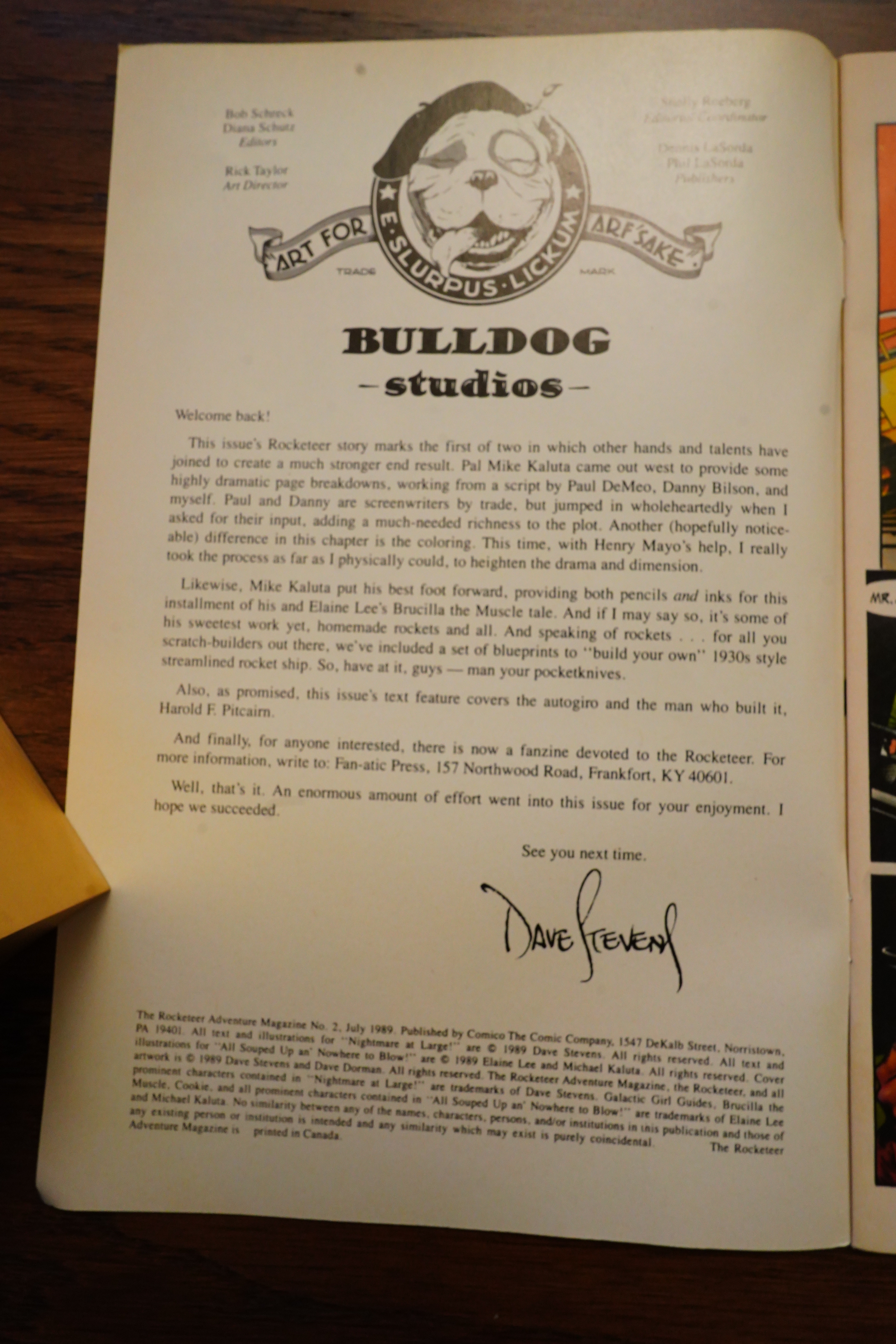
The second issue arrives, predictably enough, one year later.
And not only has Kaluta flown over to do the layouts for Rocketeer, but Stevens has gotten two screenwriters in to (co-)write the story. So I guess he’s basically just inking it now, but it still took him a year to get it done.
You can just imagine the frustration of everybody involved — the delays aren’t just for the Rocketeer material, but also the Starstruck stuff.
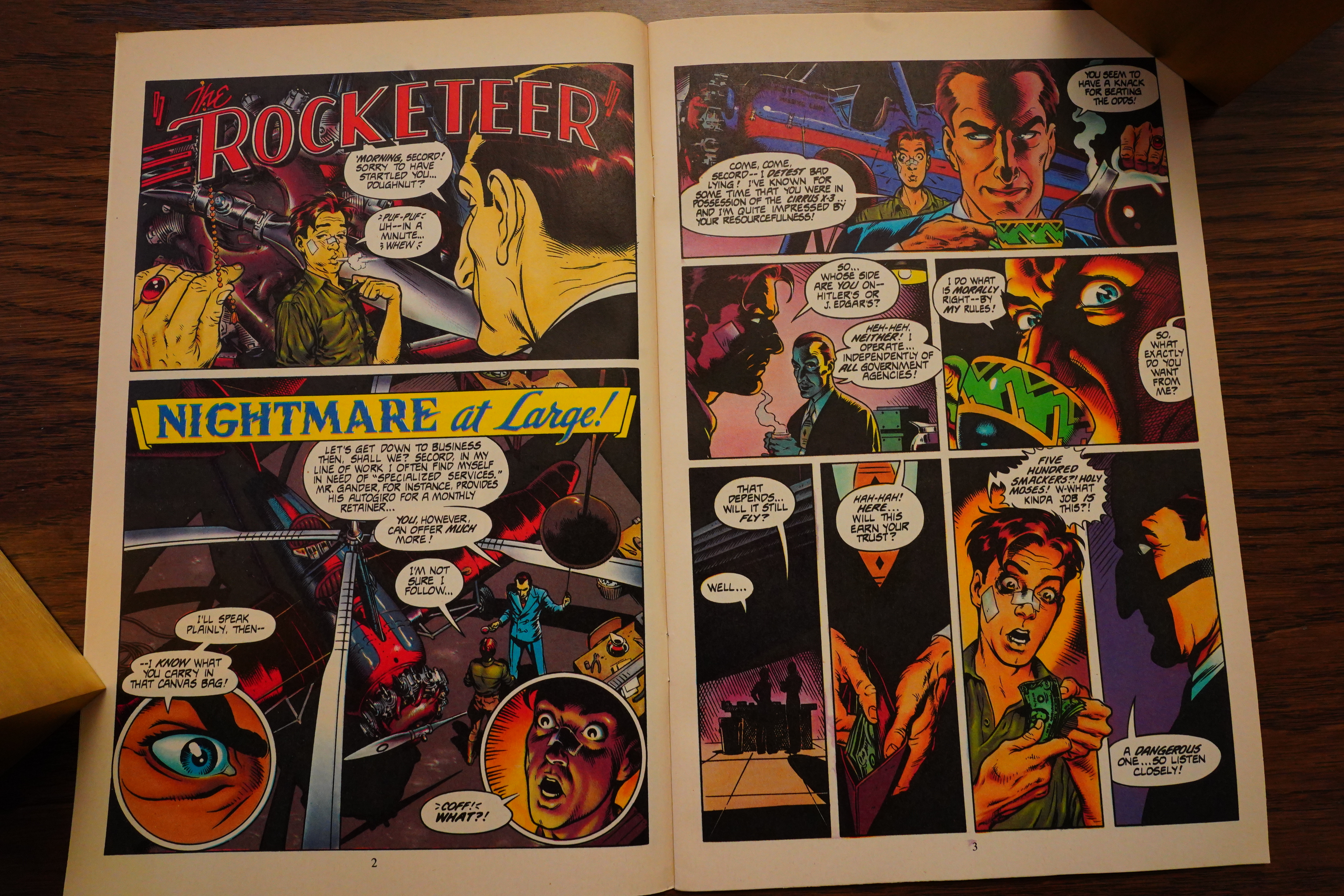
So what are the results of having all the helpers involved? Well, the story looks fine, but with layouts by Kaluta and pencilsish/inks by Stevens, you wouldn’t expect less.
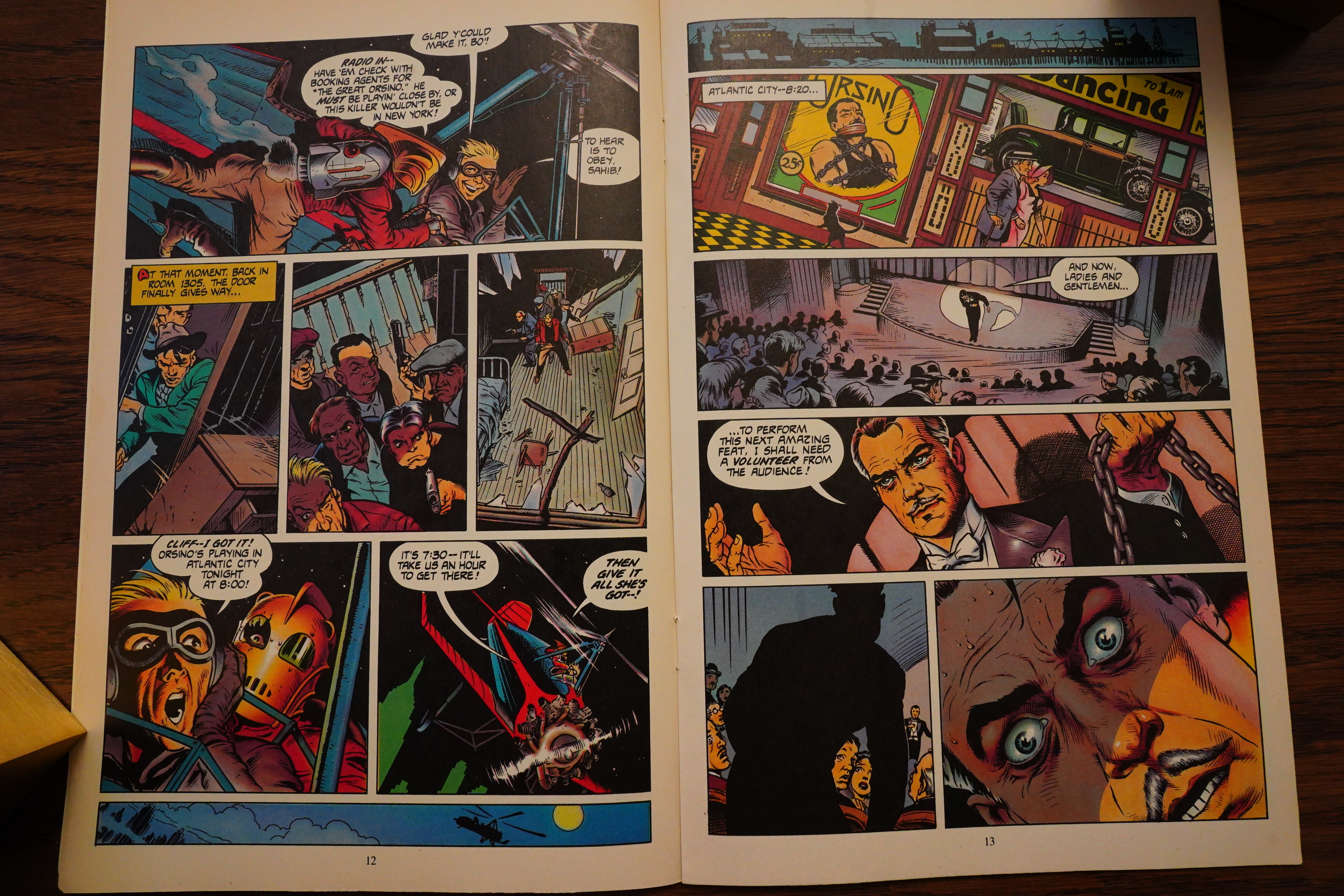
However, the storyline (of which we get the first part here) is… kinda not there? It feels like what they set up over these 14 pages could have been done in 2.
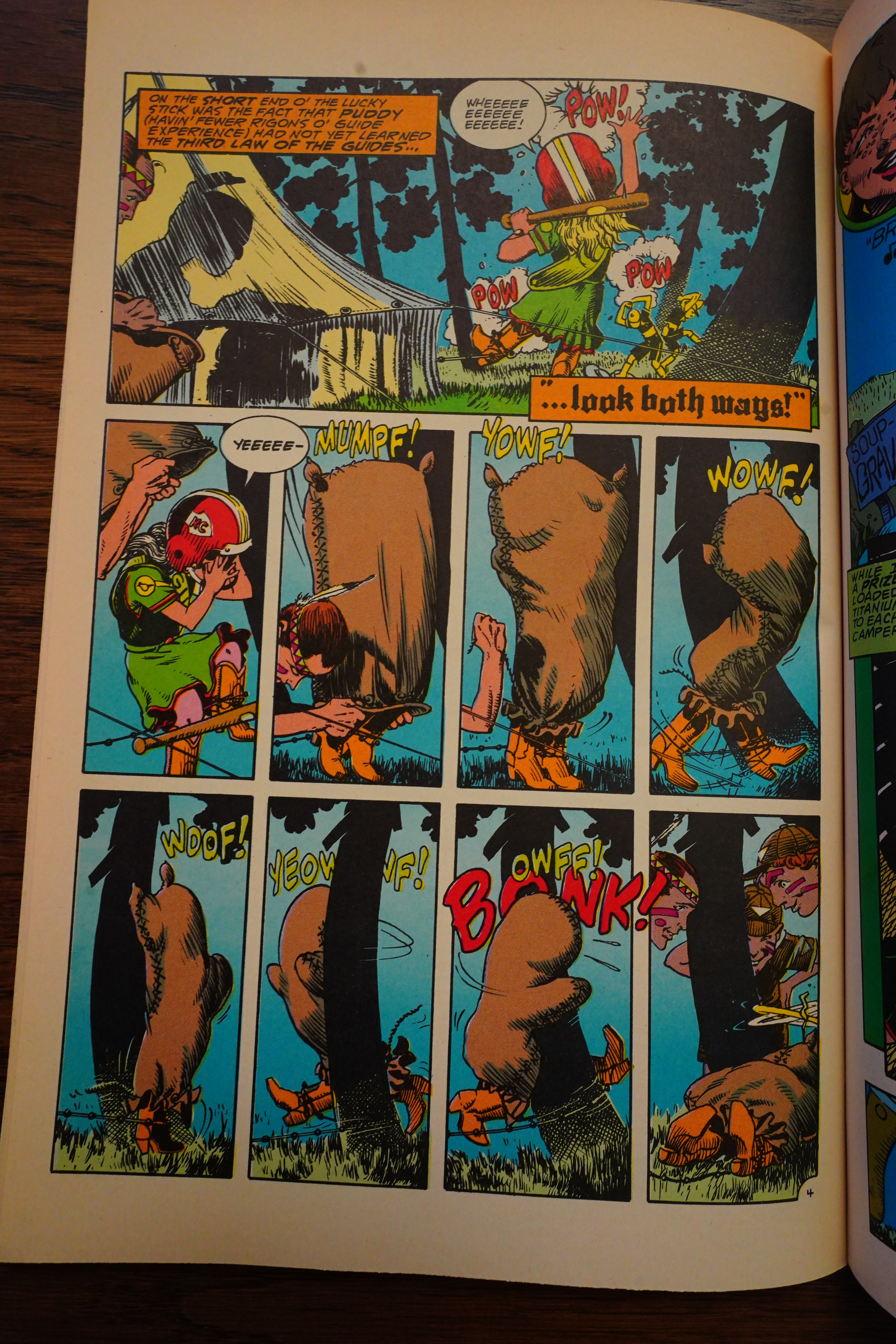
In stark contrast, the second Galactic Girl Guide story is another epic — but they manage the amazing feat of not having the story seem cramped, and allows lots of funny slapstick while still getting the story told. Fantastic.
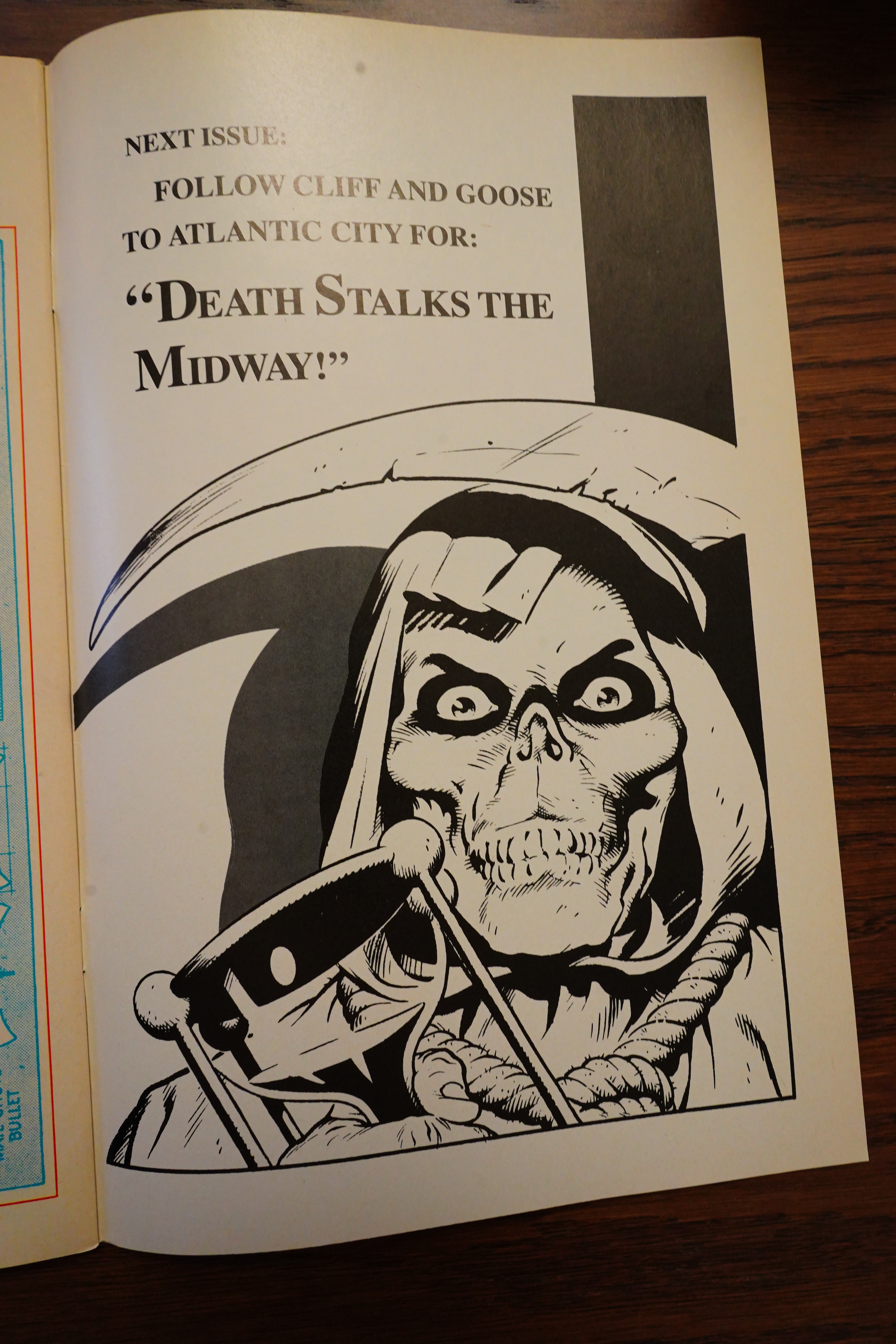
Yeah, there were only two issues published — Comico went bankrupt a few months after the second issue was published.
So it’s all predictable, really — Rocketeer has a spotty publishing history because Dave Stevens is slow, and Starstruck has a spotty publishing history because it’s too good and gets cancelled. Combine the two, and the only surprise is that they actually managed to publish two entire issues.
And they’re two very enjoyable issues, which isn’t surprising, either.
Amazing Heroes Preview Special #1, page #91:
1985 SUMMER PREVIEW SPECIAL
THE
ROCKETEER
ADVENTURE
MAGAZINE
Written and illustrated by DAVE
STEVENS and OTHERS
6-issue limited series; 32 full-color pages
on white paper; direct-sales distribution;
bi-monthly; price and publisher
undeterminedAlthough the Rocketeer graphic
album is due out late this summer
from Eclipse Comics, the big news
for Rocketeer fans is Dave
Stevens’s plans for a six-part limited
series that will debut toward the end
of the year. The book, which will be
called The Rocketeer Adventure
Magazine, will have three stories per
issue, Stevens said.
Ten pages will be devoted to the
main “Rocketeer” feature, six
pages will turn the spotlight on
members of the Rocketeer’s suppor-
ting cast, such as Peevy, the
mechanic. The other 10 pages,
according to Stevens, will be by
another artist, but will be some sort
of adventure story. “They’ll be
period pieces, but not necessarily
about the past,” he said. “They
could be about either the past or the
future-just not the present.”
Stevens also said that he has a
specific style in mind, and he is
looking for an artist with a suitably
illustrative approach-“like one of
the EC artists. Something real illus-
trative and real nice.” No one defi-
nite has been tapped to do the back-
up, yet, however.
……
In the first issue of Rocketeer
Adventure, Stevens said the Rocke-
teer won’t be in action: instead, he’ll
be racing around the Big Apple, try-
ing to find Betty. In the second
issue, though, Stevens promises to
put the Rocketeer through his high-
stepping paces. Although there will
be subplots cropping up throughout
the six issues, each issue will be a
complete adventure in itself. Ste-
vens promises that there will never-
theless be continuity and unity run-
ning through the series right up until
the climactic issue #6. For example,
Betty leaves briefly after the first
issue, but reappears later in the
series.
The frequency of the series is in-
tended to be bi-monthly, and
Stevens hopes to have the first
issue out in 1985. At this time, the
publisher has not been decided on,
although Stevens revealed that he
was negotiating with Eclipse, who
published his Rocketeer Special
earlier this year. Stevens ended by
saying that the Rocketeer Adven-
ture comic would be his “baby”
from start to end, and that he would
essentially be packaging it for
whomever ends up being the lucky
publisher. Stevens said he has a
long head-start on this particular
project, so the schedule he had in
mind should be attainable. “This is
something I’ve been wanting to do
for a long time, and I’m determined
to pull it off,” Stevens concluded.
Heh heh — Stevens announced the book in 1985, three years before the first issue was published. And it sounds like he had the first story already done by then, so it took him four years to make the second 14 page story, I guess.
Back Issue #47, page #65:
BOYD: You men did a nice script. You included a smile-inducing
take on Rondo Hatton, one of Dave’s villains from The Rocketeer
Adventure Magazine: “Cliff’s New York Adventure” (fully compiled
in 1995), an Errol Flynn-like double agent (Timothy Dalton),
and memories and cameos of stars of Hollywood’s Golden Age,
among other things. You told us Disney/Touchstone might have
been interested in sequels. Were there things you held back on in
case a sequel had been given the go-ahead?
BILSON: No, we held nothing back, and weren’t thinking about
a sequel except for the fact that the plans appear in Peevy’s
hands at the end, making a sequel possible. We also co-wrote
the New York Adventure, so Rondo being in that was based on
what we planned for the film.
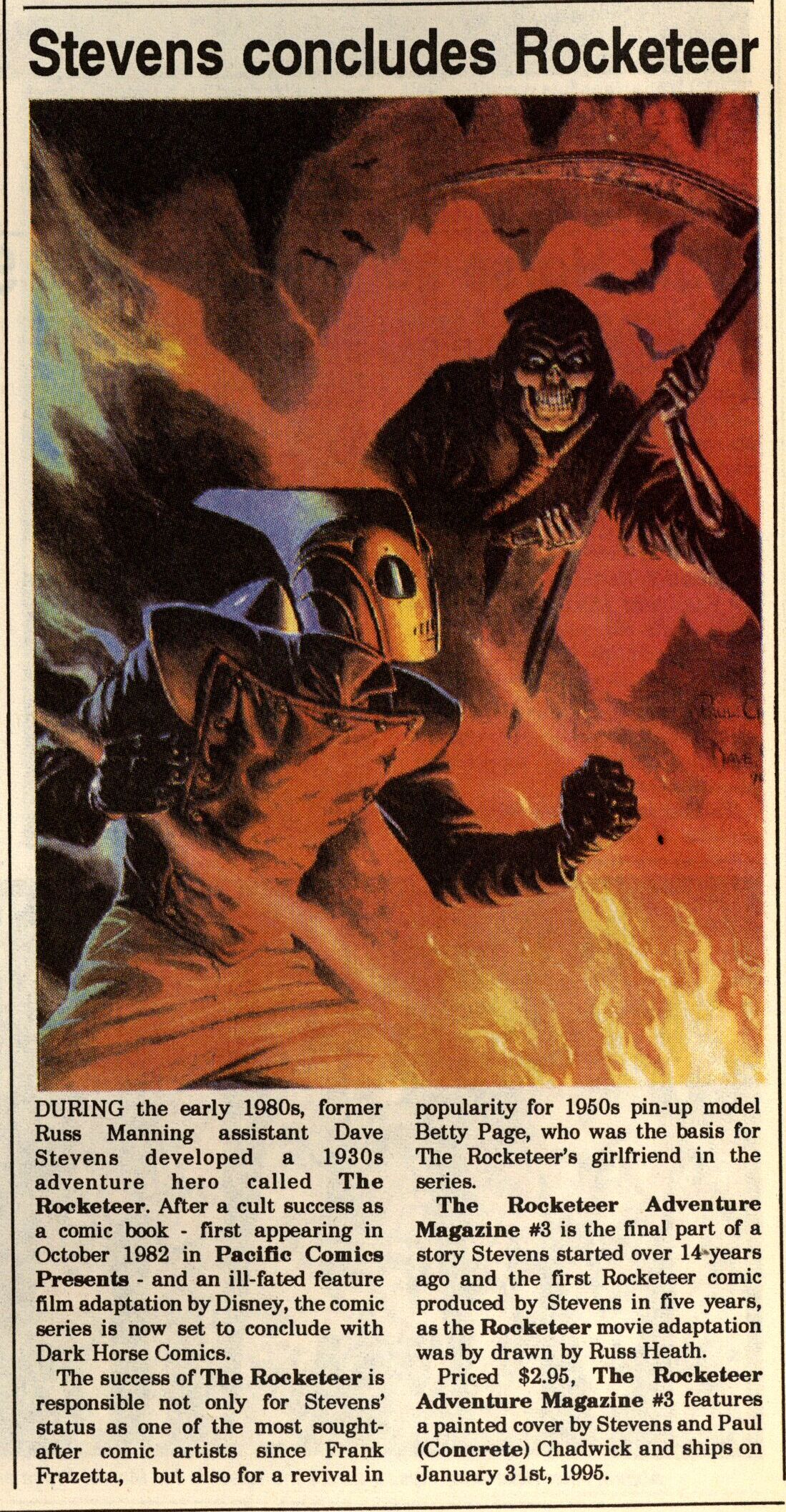
So the third issue was published by Dark Horse in 1995.
Amazing Heroes #145, page #194:
This is no hoax. This is no dream. This
is not even an imaginary story. After all
these years, The Rocketeer is actually
on the schedule. The Rocketeer Adven-
ture Magazine will debut in July, and
appear quarterly after that. I am not
kidding. Each issue will feature 15 pages
of Rocketeer action and 10 of The Gal-
actic Girl Guides by Elaine Lee, Mike
Kaluta and Charles Vess. Following the
third issue, creator Dave Stevens will
take a break to do some commercial
work and get money for food and
lawsuits, and then we’ll see the next three
issues hopefully only a few months later.
And after that? Read on.
“Cliff’s New York Adventure” picks
up right where the story left off, with
Cliff flying off to New York to stop Betty
from going to Europe with that slimy
Marco, all accompanied by plenty of
shots of the Rocketeer flying against the
New York skyline, guys in tuxes, and
Betty in this dress that you must see to
believe. The story also introduces a
childhood chum of Cliff’s by the name
of Goose Gander.
This first issue will wrap up the plot
threads from the graphic album, and
answer the questions we’re all asking:
will Betty be disillusioned by Marco and
go back with Cliff? That would be
telling, but can Betty be as materialistic
as she seems?
“No.” answers Dave Stevens. “Her
good side is that she’s really in love with
Cliff, but she has certain goals that she’s
laid out in her life, goals that she won’t
sidetrack for less. Cliff represents some-
thing that she considers less than she
wants. She’s just one of these people that
has to be with people that are upwardly
mobile and powerful. She’s excited by
that world. A lot of people are. This town
is full of them. A lot of people are just
completely mesmerized by celebrities.
And she’s at a phase in her life where
it’s, unfortunately, more important.”
Stevens puts an equally down-to-earth
characterization to our dauntless hero,
Cliff Secord. “I don’t know what makes
him tick in general, he’s just one of these
guys who likes to push the envelope.
He’s very self-interested. He’s not a hero,
he’s just a guy out to make a buck. That
was his intention from the beginning, just
trying to turn a dollar and in the process,
he gets swept up.”
Issues #2 and 3 start a whole new
phase of the story. “[They’re] a complete
departure, a real dark drama in New
York with Cliff without any of the other
characters that have been in the story,
except Goose.”
But don’t expect to see the “melan-
choly” side of Cliff. “He doesn’t have
time. Things are happening so fast. It’s
kind of a film noir murder adventure.”
Although this isn’t exactly what Stevens
set out to do, it’s what the milieu of Late-
Depression New York inspired in him-
the world of flop-houses and hoods and
dark alleys. “I just decided that this is
the sort of story I should tell. Once he
goes back to sunny California the story
is completely different. [This story] is
taking him out of his element and putting
him in completely different, more des-
perate waters and just seeing if he can
stay afloat. Which he barely does. He’s
running in abject terror. From the first
to the third issue, he gets more and more
banged up, to where by issue #3 he looks
like raw meat.”
The Superhero Book, page #432:
However, Stevens’ burgeoning career as a
comic-book artist was matched by his successful
life in Hollywood’s movie world as a storyboard
artist and designer, which meant that it was four
more years before a second Rocketeer adventure
was serialized. This new tale appeared in 1988,
from new publisher Comico. Then Comico went bust
after only two issues of the comic, and it was an
astonishing six years before the final installment
crept out, published by Dark Horse Comics. The
new yarn was, if anything, even more majestically
drawn than the earlier episodes, and featured hard-
boiled gangsters and old-time carnivals and freak
shows, not to mention the Shadow (in all but
name), complete with autogyro.
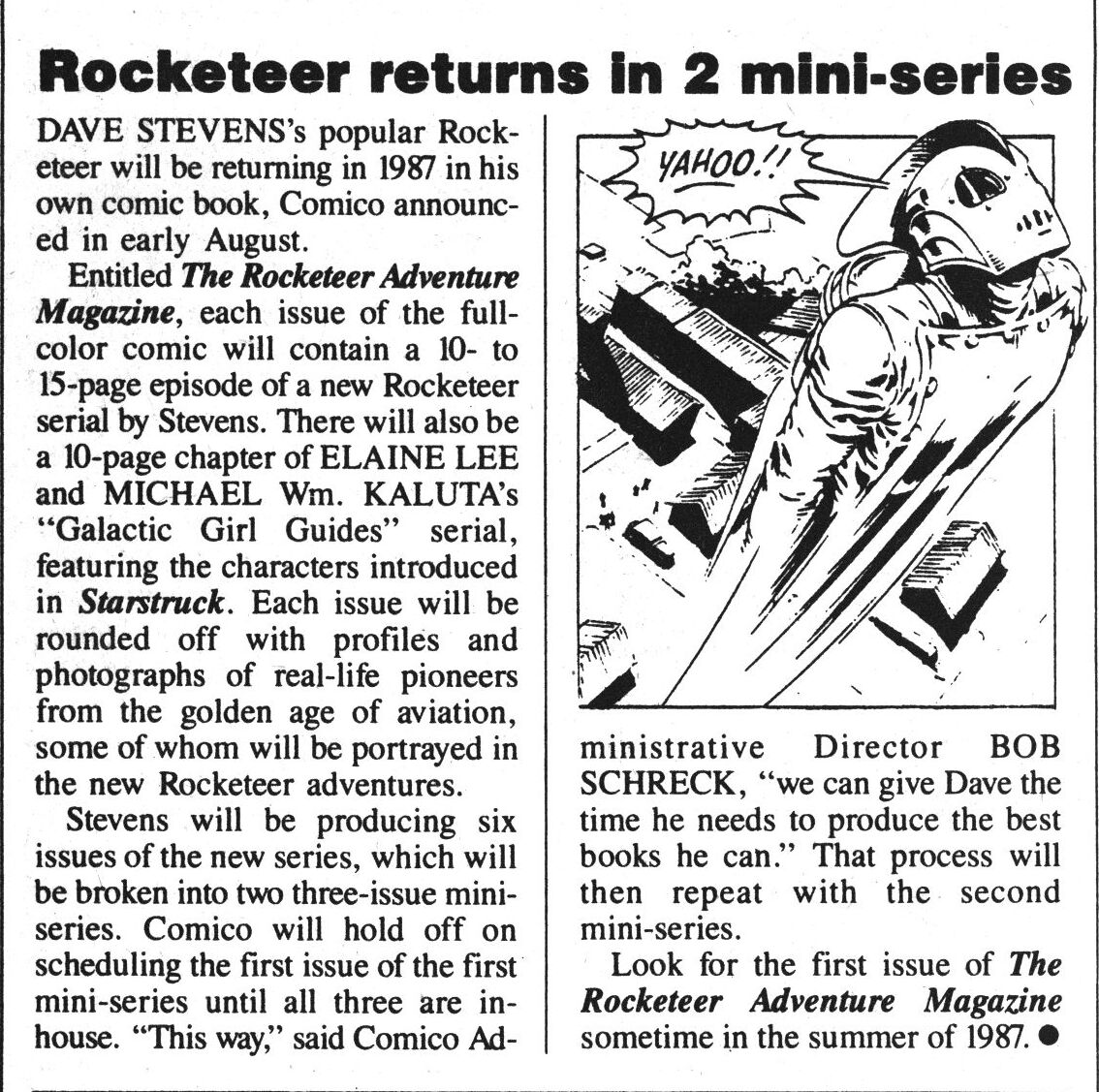
So the plan was to hold off on publishing until Comico had the first three issues on hand, but I guess they had to abandon that plan.
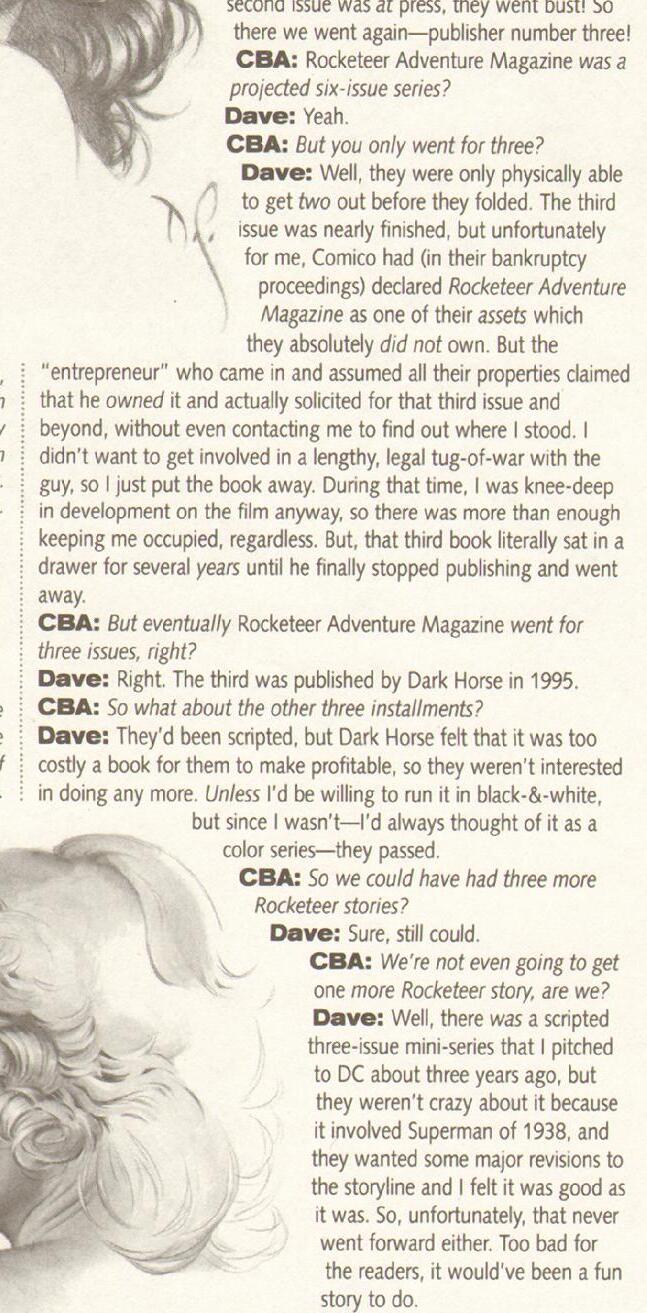
Ah, Stevens had to wait for the guy who bought Comico after the bankruptcy to go away before he published the third issue. Which sounds fishy — it was published in 1995, and Comico didn’t totally die until 1997…
Amazing Heroes #150, page #67:
Sound the trumpets and let the
banners fly! After a waiting period
that some folks thought would just
never end, the character that brought
Dave Stevens fame, fortune, DNAgents
covers and lawsuits is finally back on
the racks, and new publisher Comico
is proud to have him.
If the first issue is any indication,
Comico’s pride is well deserved. For
my money, neither Stevens nor the
Rocketeer have ever looked better. I
should, however, warn all the action
fans in the audience that if they were
hoping to see protagonist Cliff Secord
jump into his Rocketeer suit and fly
through the dark Manhattan skies,
they’re in for a disappointment.
Secord’s only appearances in costume
this issue come on the cover and in
flashbacks. Fans of Secord’s on-again,
off-again romance with the busty.
Betty, on the other hand, are in for a
treat, for that stormy lil’ relationship
fairly dominates RAM #1. To say more
than this would give away some of the
plot, which I don’t want to do; suffice
to say the storm watch isn’t over yet.
Riding back-up shotgun is The
Galactic Girl Guides, by Elaine Lee
and Mike Kaluta. Lee and Kaluta
previously collaborated on Marvel-
Epic’s Starstruck, and the Guides
series spins off from that short-lived
book. Those who found Starstruck not
to their liking, however, need not fear,
for Kaluta’s artwork is as stunning as
ever, and the story is easier to follow
than it was at Marvel. Either Lee’s
writing has improved, or I’ve gotten
smarter in the years since then. Either
way, this first Guides installment was
a rollicking little opus highly
reminiscent of the old Little Rascals
movies, and almost outshone Stevens’
lead Rocketeer story.
In the final analysis, either story by
itself would have been worth the $1.75
price of admission; together, they
make a double-feature that no comics
fan worth his salt can afford to miss
out on.
GRADE: PRISTINE MINT – David Peattle
Amazing Heroes #157, page #188:
Remember when Rocketeer Adventure
Magazine was supposed to be quarter-
ly? The long-awaited second issue will
be out about six months after the first,
but creator Dave Stevens came closer
than you might think to making the
schedule. In fact it was a nasty freeway
run-in with a slow-moving dirt truck that
nearly totalled Stevens’ car, which real-
ly put Rocketeer off the schedule.
But the second issue will be out,
featuring the first part of “Nightmare at
Large,” in which Cliff Secord runs afoul
of death and danger in New York City.
“It’s a thrill-packed, all-action story,”
Stevens promises. The tale concludes in
the third issue, which will be a jumbo
edition. That’s right, a 25-page Rocke-
teer story and an extra-long Girl Guides
back-up. And Stevens swears on his
honor that #3 will be out three months
after #2 because “the way the story is,
we couldn’t leave people hanging that
long.”
Three months… what wishful thinking.
Scarce #17, page #32, inexpertly translated by Google Translate:
Here, then, is the long-awaited return, in widescreen and color, of the grand adventure, the story of the madcap chase that takes Cliff Secord (aka the Rocketeer) from Los Angeles to New York in his small plane to find Betty, his beautiful love, captivated by Marco, the photographer to all of Hollywood, who promises her the moon and the stars and who must fly out the very next day for a trip to Europe.A race against time, then; against time and against fate.
Secord, barely off his plane, runs into his old pal Goose (garlic?!), like him an aerobaticplane pilot.But disappointment awaits Secord at thecorner of a chic bar where the beautiful woman is holding courtamidst a glittering party.Secord appears, whom she thought wasquite rightly dead (hey, my hero!You here?!).Marco is out, but the illusion is hard to shatter…Finally, while Secord leaves disgusted, Betty boards the plane “incognito” for Los Angeles.
So, has the Rocketeer becomea loser? A candy-eater?Will he accept defeat so easily? Dave Stevens, now that his lawsuit with Marvel has ended (in his favor), has a quarterly magazine to answer these questions.Still as rare (read: lazy) and classy as ever, Stevens (he explains it in Amazing Heroes Preview Special 144)! To think it took three whole years to discover this continuation of Rodeo and Juliet’s adventures, after a lawsuit with Marvel over the Rocketeer’s name. Inked by himself, with an intro-by the master (yes, it’sthe same one again!), this episode allows usto finally see the vivacious Betty again,the one who makes the ‘band-meter’ explodein the Thunderdome and who putsthe other comic book heroines back in theirrightful place: that of the bargain-basement shop girls. It should be noted that the scriptsfor the next two issues will beco-written by Danny Bilson and PaulDemeo, who are also responsible for thescript of Rocketeer, the Movie.
On the other hand, one can be skepticalabout the quality of Mike Kaluta’s backup art, sublimely inked(we are told) by Charles Veiss. Just a nasty sequel to Starstruck? Kaluta had, however, accustomed us to much better than this pale avatar… But please, Mr. Stevens, no more than two years for the second episode!
Tsk tsk. Those French.
Speakeasy #91, page #60:
Although it’s the size of a regular 32-page
comic, this book sets about convincing you
that it’s something else. It wants you to think
that it’s the screen at your local fleapit, circa
1936, on a wet Saturday morning. You’ve paid
your nickel and settled in your seat. The
projector has started to roll and the lads at the
front are beginning to lose interest in throwing
their popcorn at the screen. Sitting in the dark,
you gaze into another world …
The 1930s of Dave Stevens’ Rocketeer
never existed, in the same way that the charm
that we attach to the old Republic movie seri-
als springs from an affection for the innocent
world-view that they seem to embody. Maybe
it was easier to believe in heroes and villains
then. Stevens plays upon the conventions of
those serials in a knowing fashion, without
disturbing the logic of the fantasy. Of course
Cliff Secord remembers the “ol’ neighbour-
hood chant” that every street gang had, in
every ‘boys gang’ movie ever made. Of course
the childhood friend that Cliff meets in New
York is called Goose – every adventure hero
has a sidekick with a silly name, and since Cliff
left Peevy in Los Angeles when he took off in
pursuit of his errant heart-throb Betty, he had
to have another one waiting for him in NY.
And then there’s this tall stranger, with a large
hooked nose, commanding manner and con-
spicuous ring, for whom Cliff is sure to start
working, whether he likes it or not ….
The ‘boys gang’ undergoes a sex
change in the second strip, which takes up the
back ten pages (Rocketeer occupies the first
14). Brucilla the Muscle: Galactic Girl Guide
takes a retrospective look at the early career of
one of the major characters from Elaine May
and Mike Kaluta’s Starstruck. This first story
is a new version of The Sorcerer’s Apprentice,
and introduces Cookie and Puddy, her two
closest pals. The entire scenario is firmly rooted
in the tradition of zany, uncontrollable, but
still cute and golden-hearted kids of the Mickey
Rooney/Judy Garland/Boys Town variety. it
works well as a second feature, having the
good sense not to try to capture the attention
intended for The Rocketeer, but still keeping
in the same vein.
Sandwiched between the entertain-
ment comes the information. Here the kids at
the front might start throwing things again.
Who wants their fantasy spoilt by boring old
history? I almost skipped the three pages of
text given over to a potted biography of George
Townson, a flier of autogiros – the precursors
of modern helicopters. But this story is every
bit as interesting as the fictions that it sits
between. It gives a glimpse of the almost
insanely reckless attitude that the early pilots
shared, willing, it seems, to try anything to
find out more about their machines and the
science of aviation. Heady stuff, adding a
depth to the imagined world of the Rocketeer
and more than a hint of the mindset that the
strip’s hero would be sure to share.
Stevens’ portrayal of women has come
in for some stick, and probably quite rightly.
Betty is a prime example of good girl art, and
the way that she is written fulfils the role of
every female in the old serials: a good-looking
catalyst, something to be kidnapped, rescued,
pursued, claimed. It would be nice to see
more use made of her character, but for now
she is quite sensibly packed off back to LA, so
that the boys can get on with the exciting stuff.
More bad guys, gunfights and ghosts from the
past are promised on the inside back cover, as
the house lights brighten, and I’ll be in my seat
the next time they start to go down.
The Comics Buyer’s Guide #918, page #4:
Subsequent installments
appeared in Pacific Comics Pre-
sents and Rocketeer Special.
Those installments were col-
lected in a graphic album, and dog
Cafe, an actual restaurant in
later chapters appeared in The
Rocketeer Adventure Magazine.
In creating the characters and
milieu of The Rocketeer, Stevens
looked back on his favorite time
in American design: the late
1930s. He doggedly researched
the period to accurately capture
the dialogue, local flavor, and
actual locales which he inte-
grated into the strip.
“If you’re going to have to
draw a series and live with it.”
said Stevens, “you need to create
a world with characters that you
can face every day. I think it’s
important to like the characters
you draw. In doing so, you hope
that your readers will want to get
to know them, too.”
Here’s a review from the webses:
Overall, like I said, this is not a bad issue but not one to come in on. Maybe with the previous issues it’s one to continue on though.
For such a long publishing history, there really aren’t that many Rocketeer pages, but IDW published a collected edition in 2009 (the year after Stevens died).