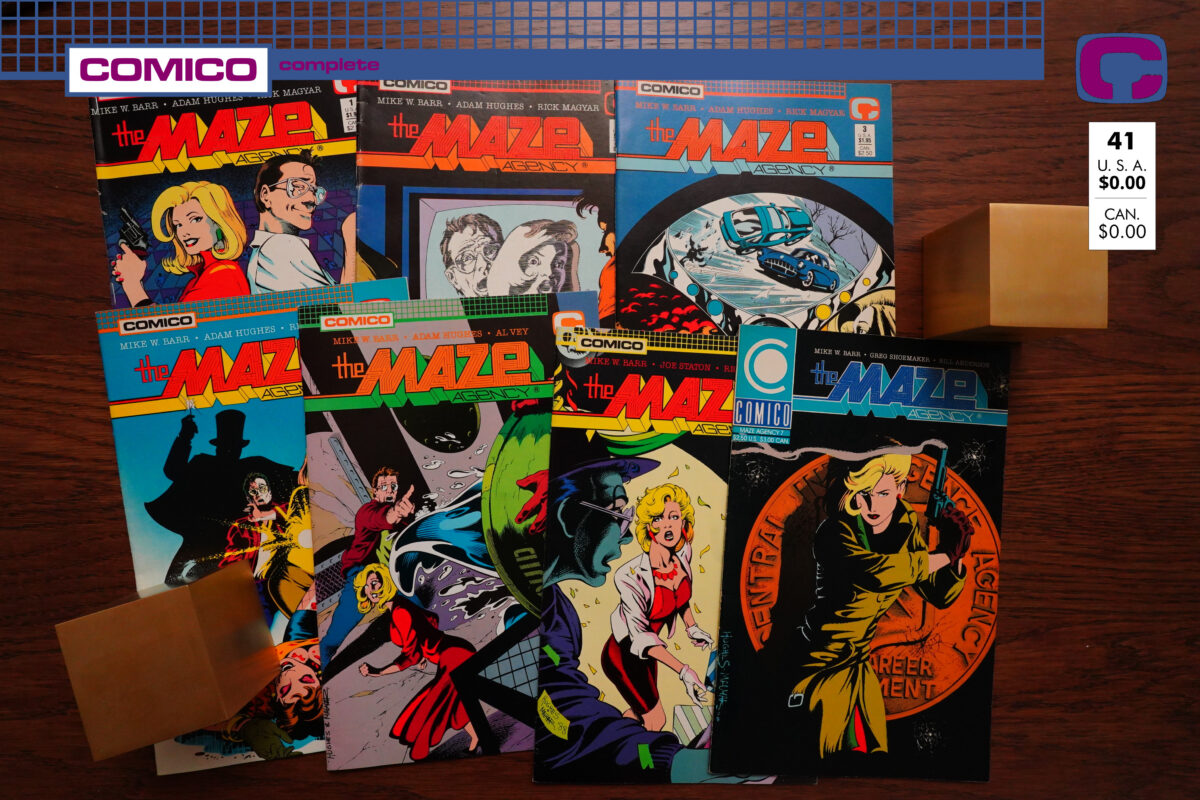
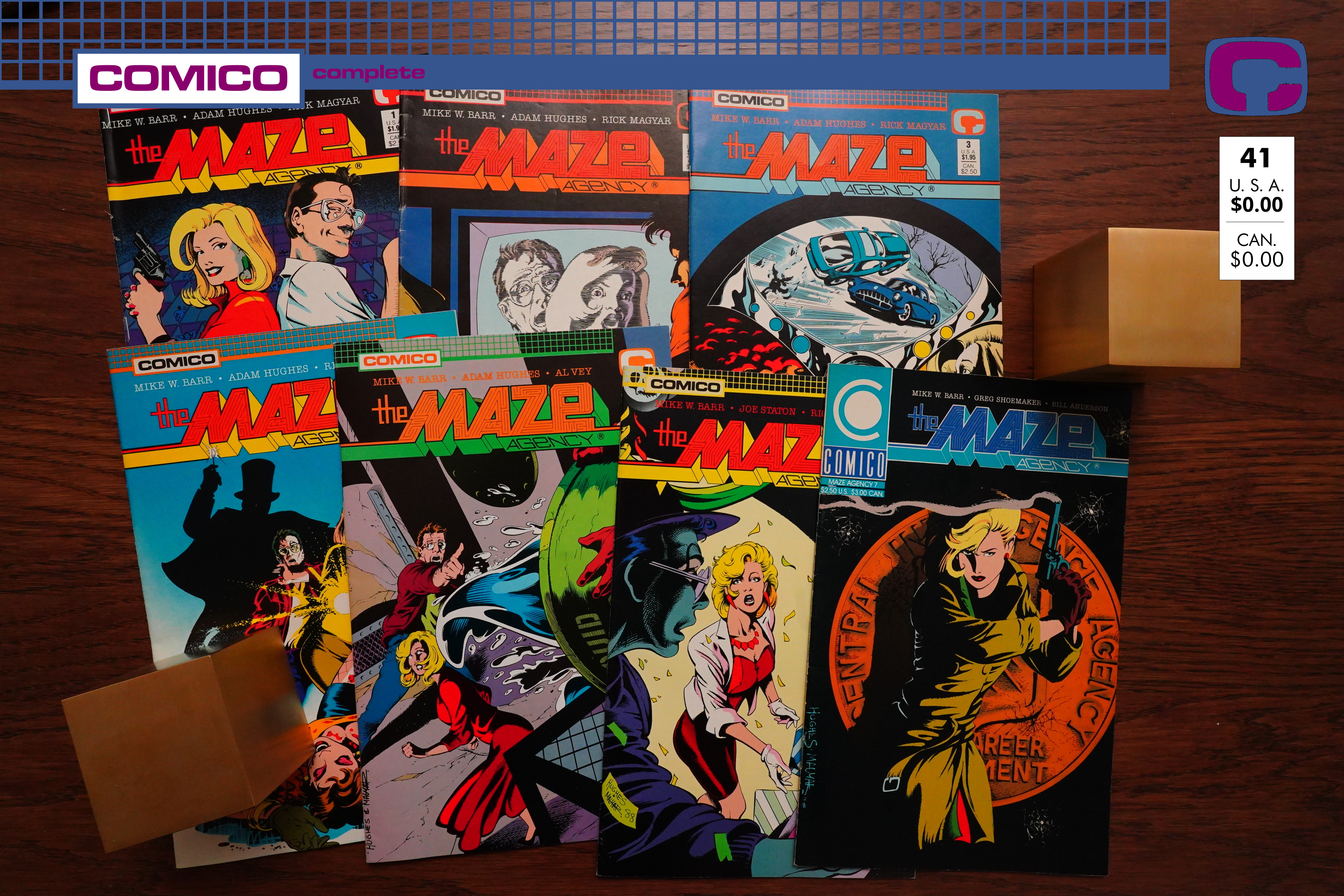
The Maze Agency (1988) #1-7 by Mike W. Barr, Adam Hughes and others
I read quite a lot of mysteries, and Barr’s name gives me good vibes without me knowing quite why, so I was looking forward to reading this series.
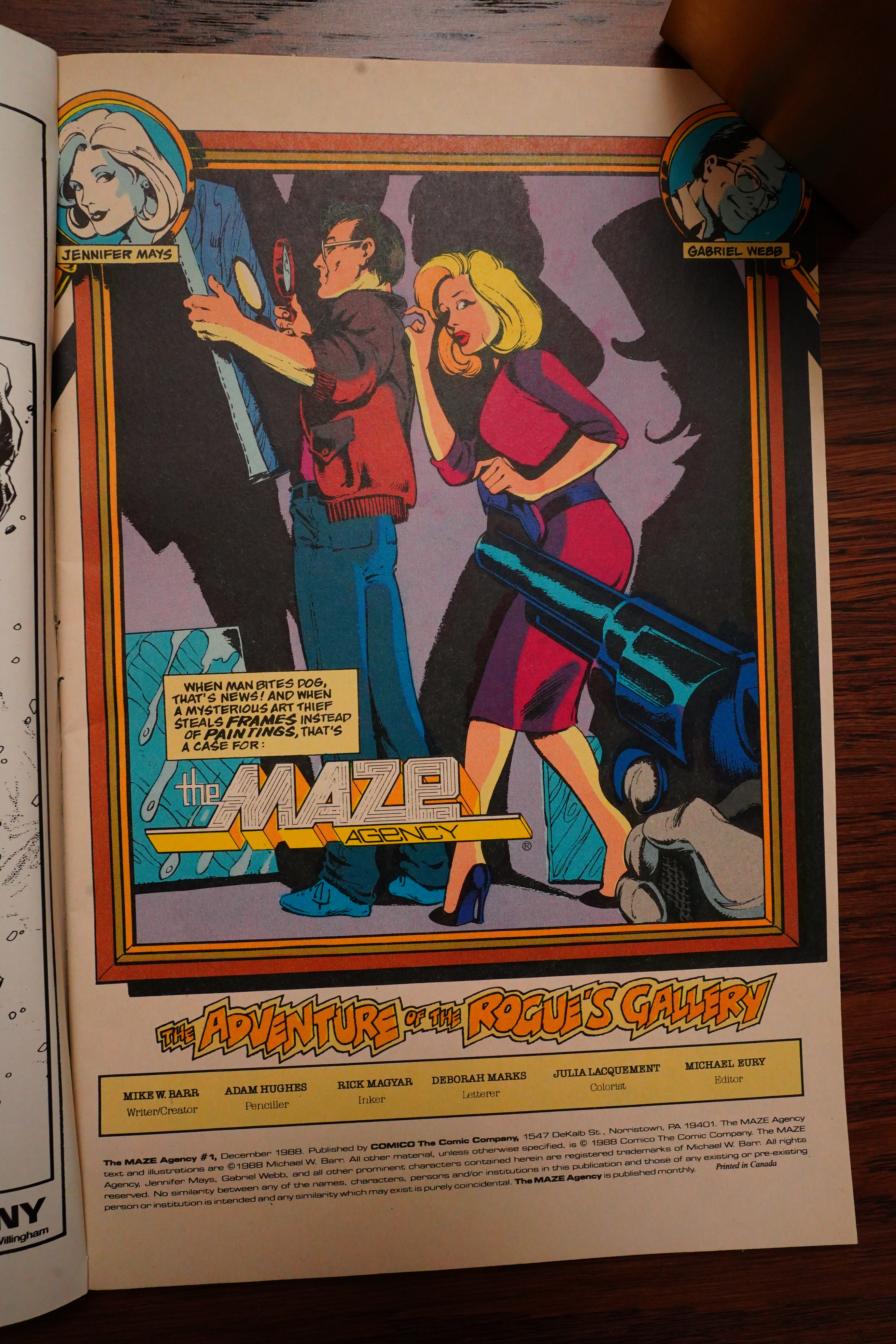
And that’s a quite high concept way of selling in the series — it’s a detective book, but they take unusual cases. So everything as usual, then.
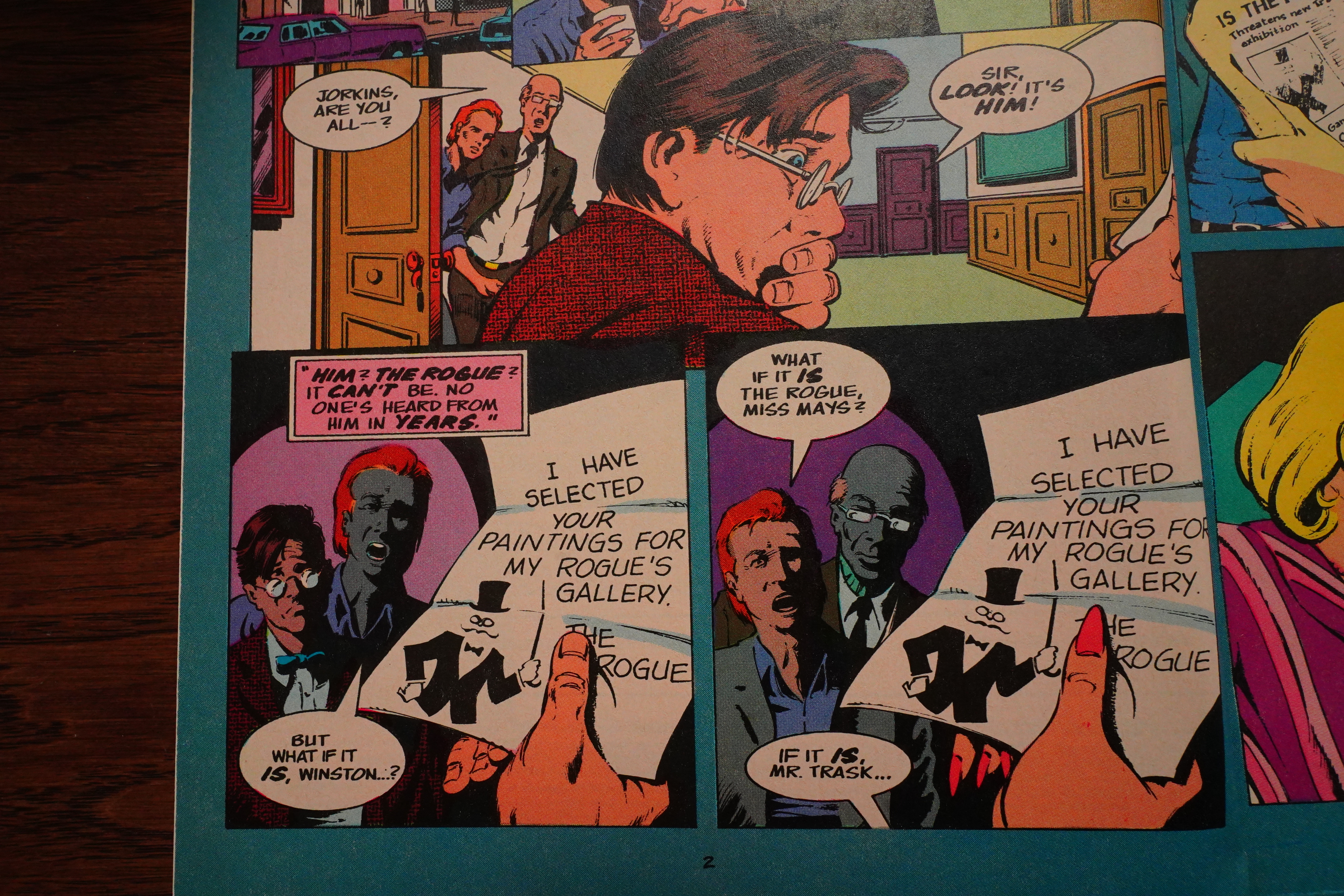
And… are they going for a very “modern” storytelling style? (Modern for 1988, that is.) That’s some aspect to aspect type storytelling, but there’s just one problem — this is the first page of the story, and we don’t know who these people are, so the reader finds themselves going “there’s probably just one character with red hair, and he did wear a blue shirt, so now he’s put on a jacket before talking to Miss Mays, so perhaps she’s the boss, but who’s that baldy? And is the guy with the brown jacket the secretary, then?” So many questions from three panels.
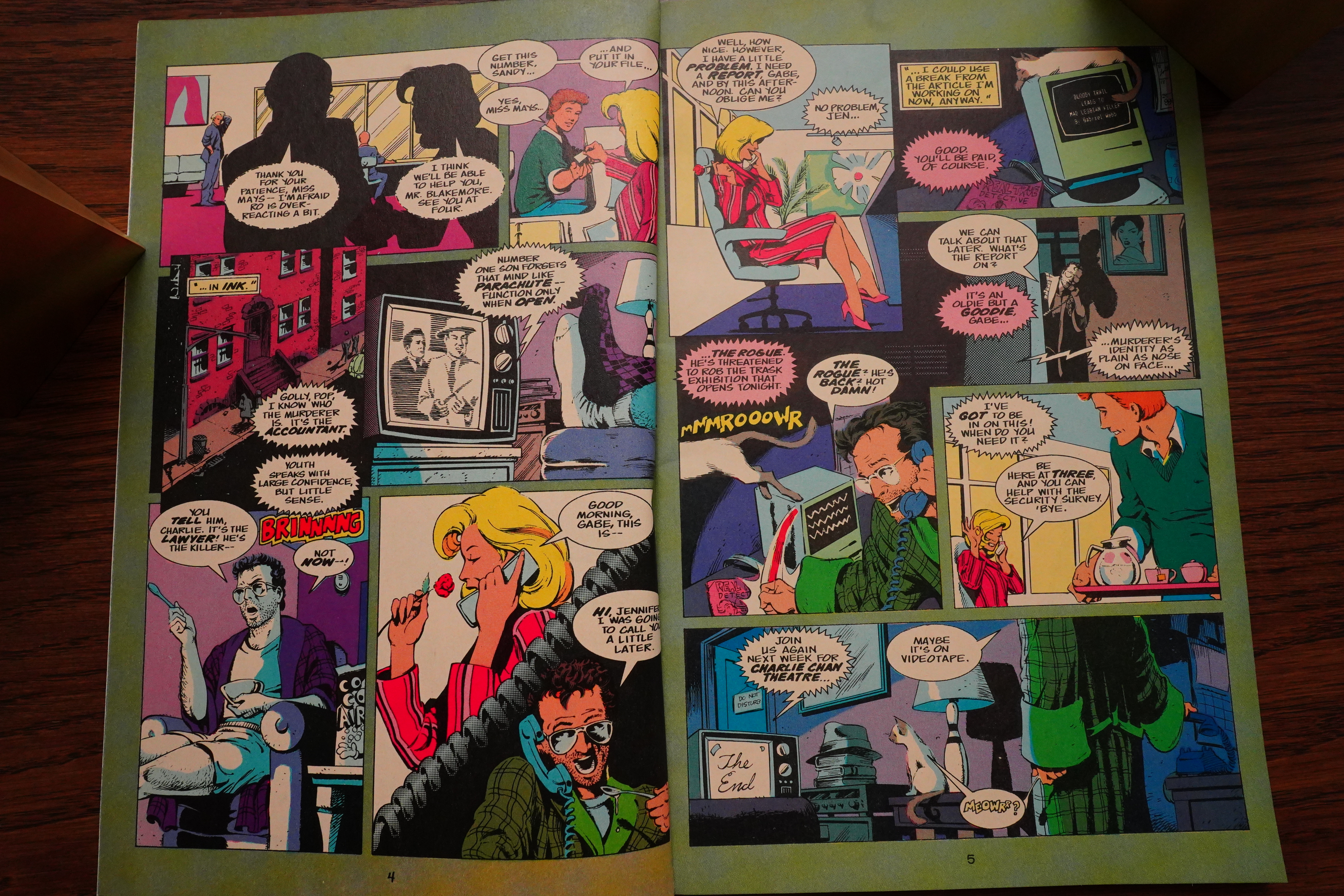
But no, not really — after those three panels we go to bog standard old fashioned comics storytelling, which is both disappointing and a relief, I guess.
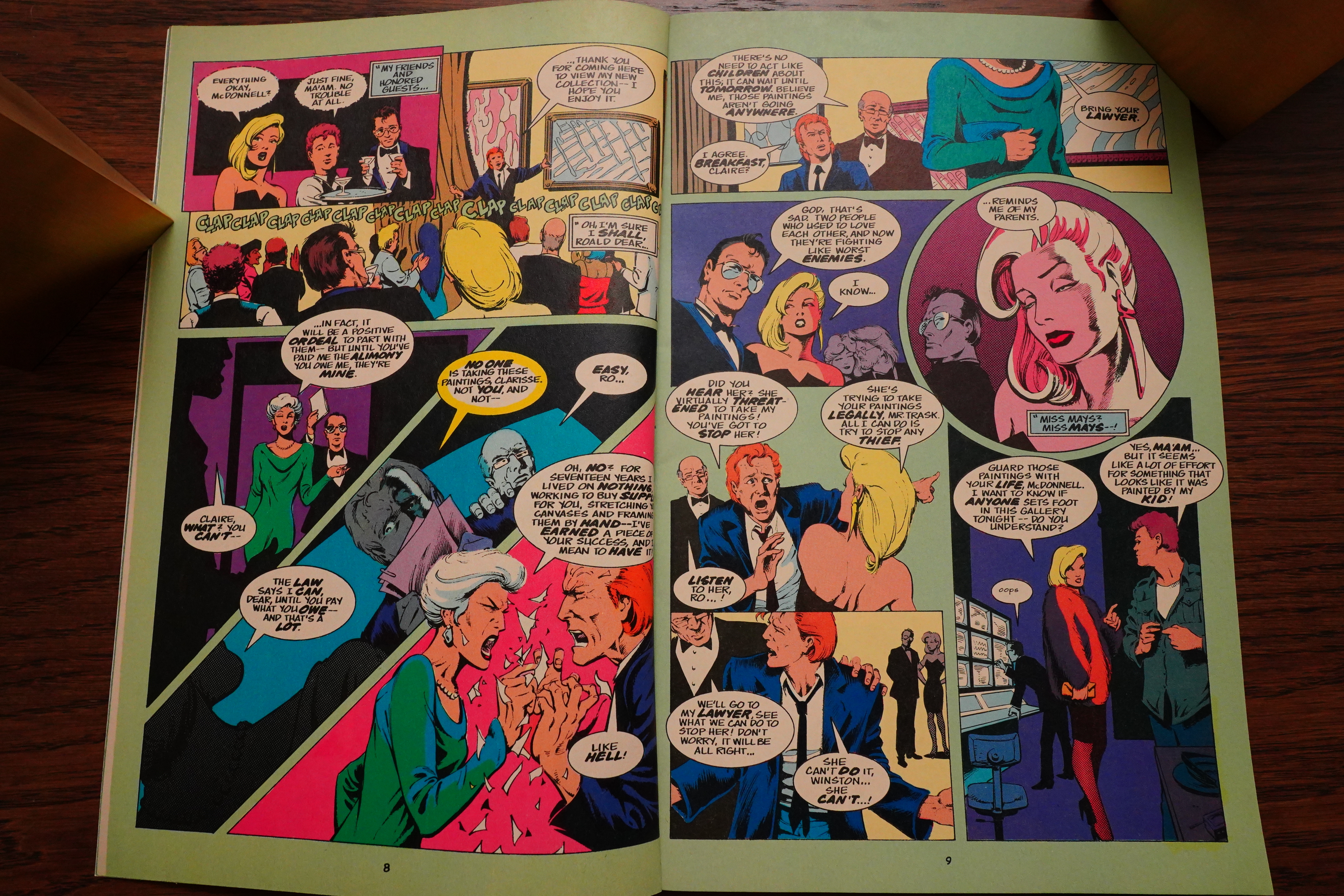
It’s a very dense story, anyway. There must be over a dozen characters to keep track of…
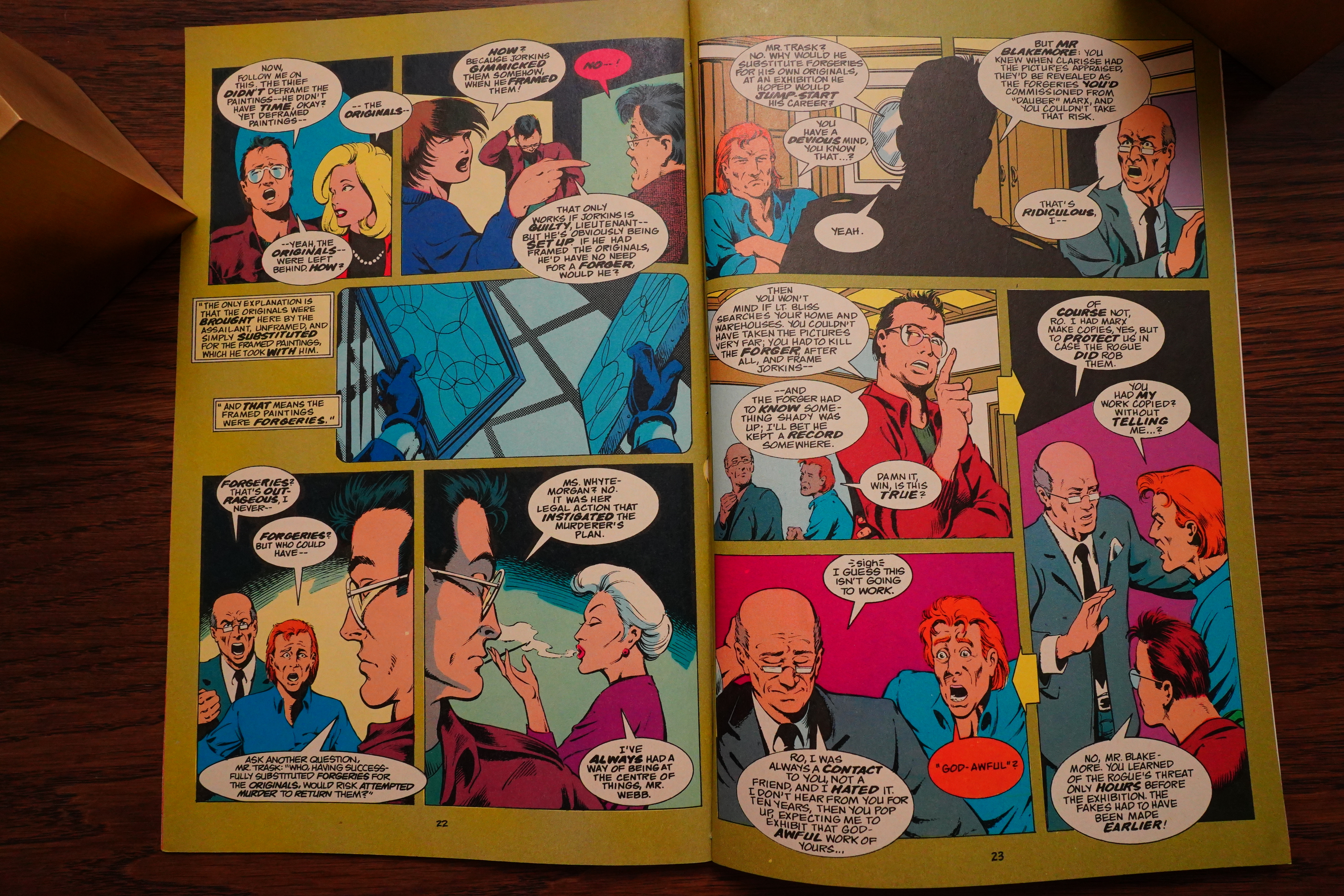
The resolution is both “well, duh” — I had the main gag figured out immediately (I’m so smart S.M.R.T), but on the other hand:
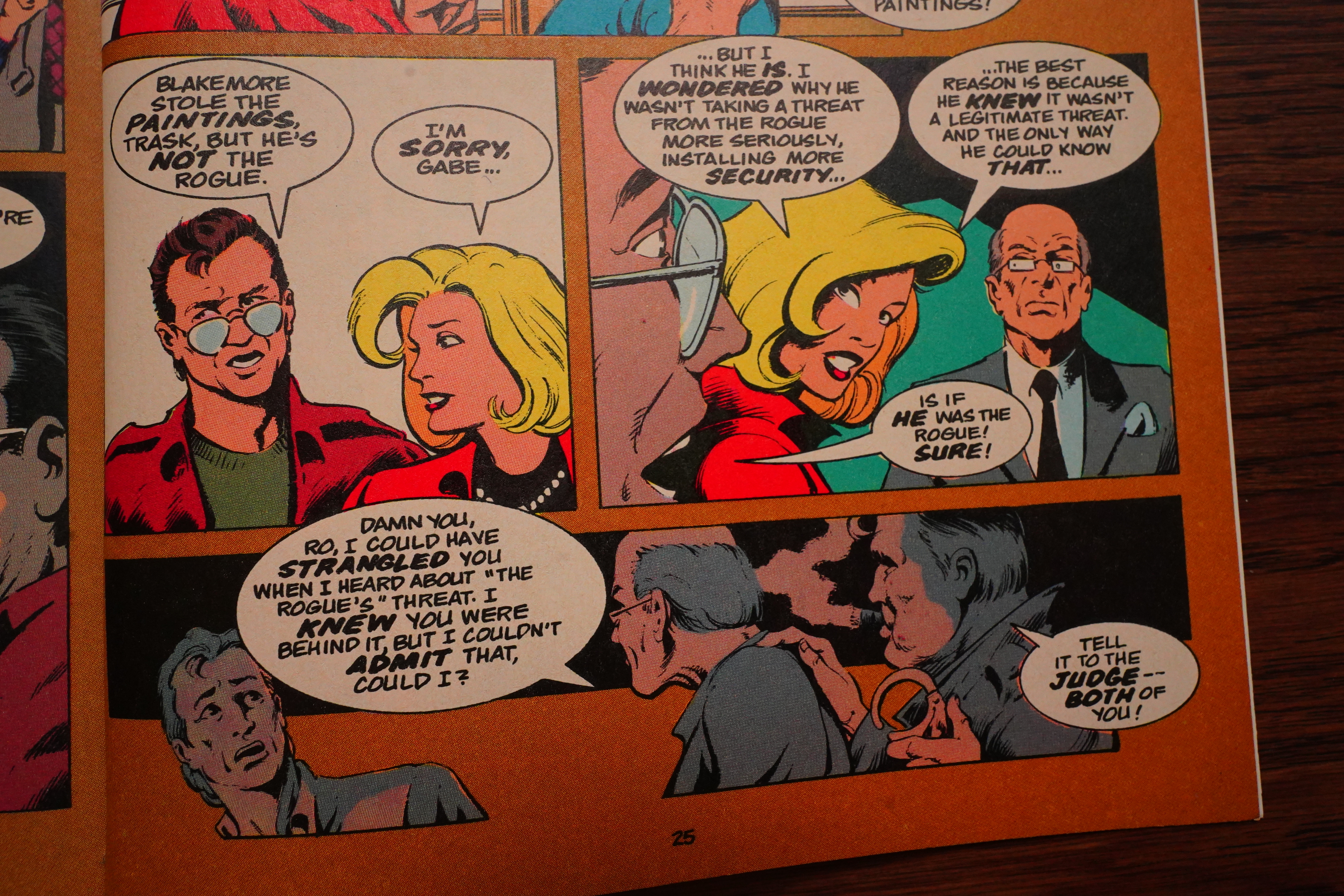
… wat? Blakemore’s not The Rogue… but Miss Mays says he is? “Sure!” But then Blakemore says that Ro is The Rogue!? Did I get their names confused? It wouldn’t be the first time. *makes confused sounds*
It’s a kinda stupidly convoluted plot, and could have done with twice as many pages and half as many characters, really.
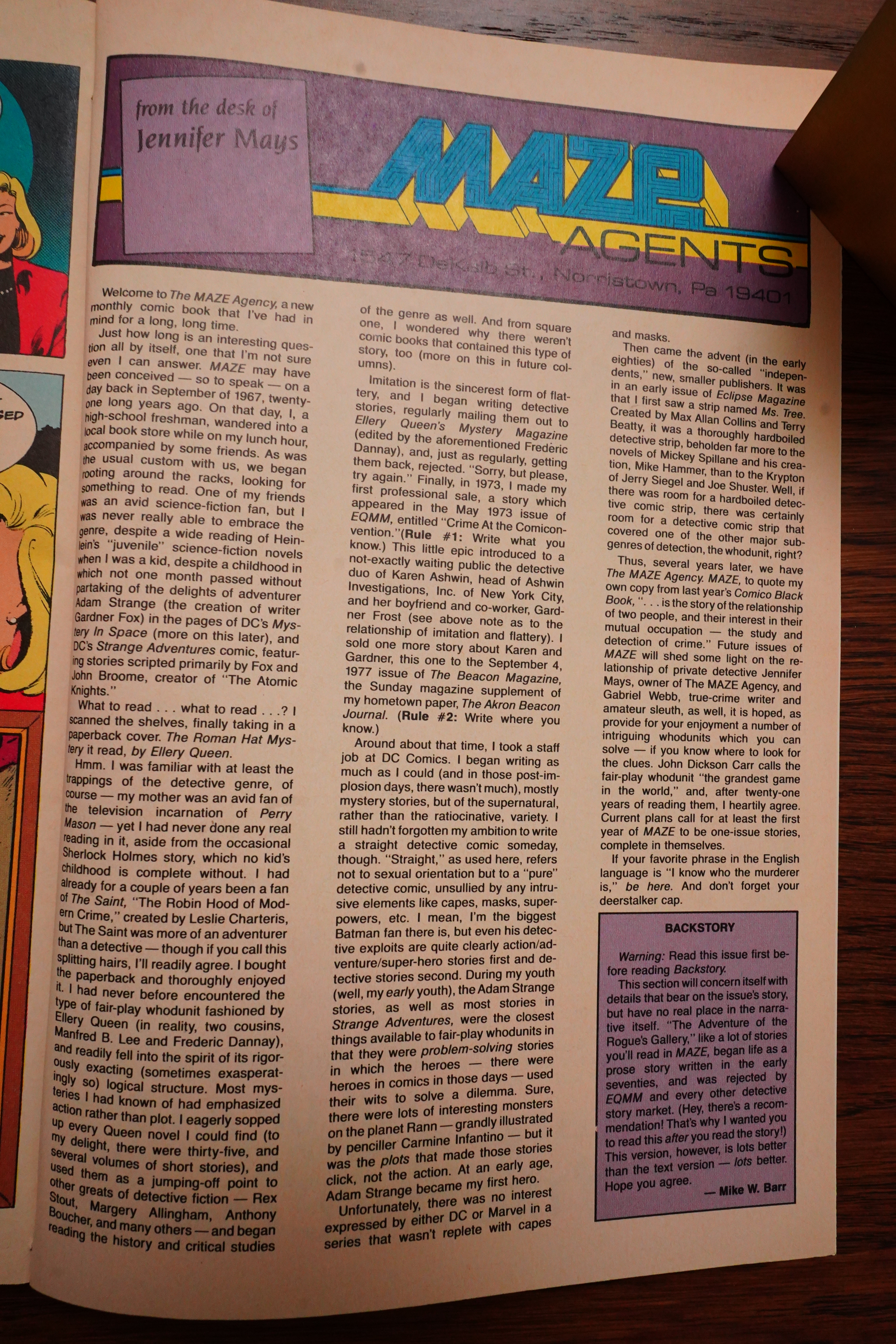
And then we get the explanation — Barr wrote this story in the early 70s, in his late teens/early twenties, and it was (justly) rejected by the Ellery Queen magazine. So is this series just going to be a dumping ground for Barr’s rejected scripts from his youth?
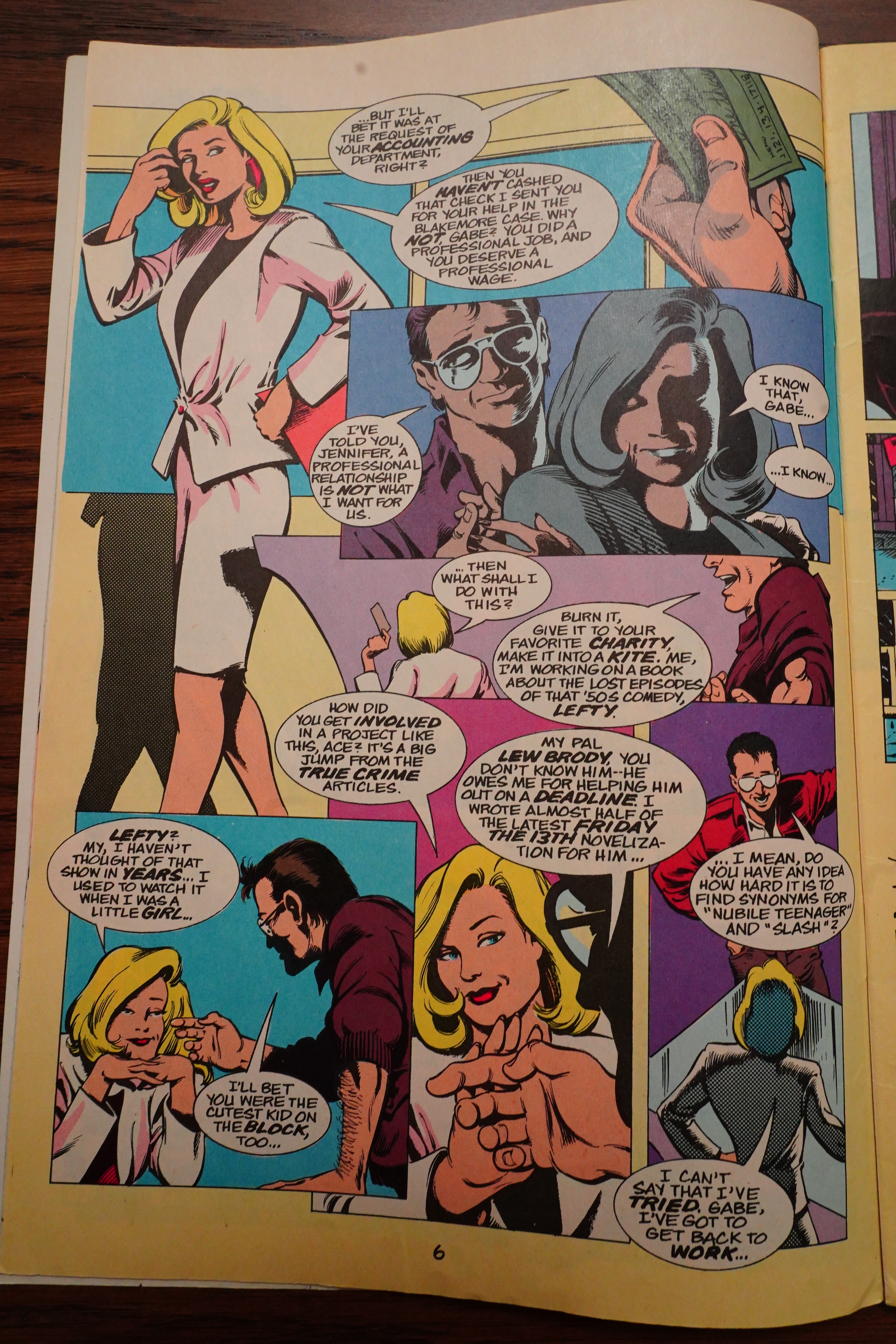
The setup is a bit odd — Miss Mays runs a (possibly large; it’s vague) detective agency (the titular Maze Agency), but she seems to handle all the cases mostly on her own. Except that she does have a helper — the guy with the glasses, who’s the self-insert character — he’s a writer who’d rather run around helping out with the detecting instead of actually writing. But he refuses to take any money, because he wants to date Miss Mays, and I guess he… can’t… date the boss?
Moonlighting says different.
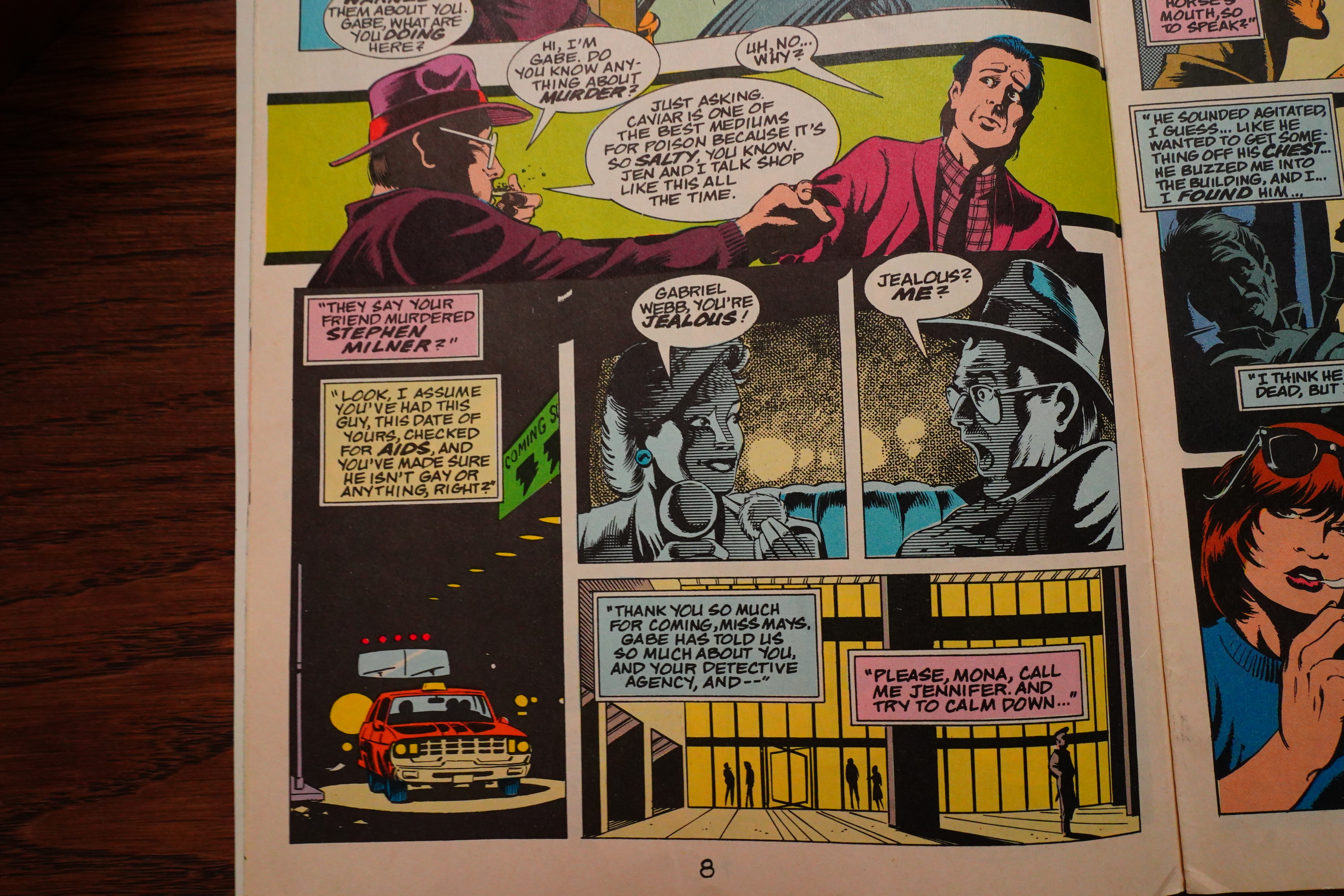
So we get lots of scenes of the writer guy asking Miss Mays out, and it could have developed into a running gag, but it doesn’t really.
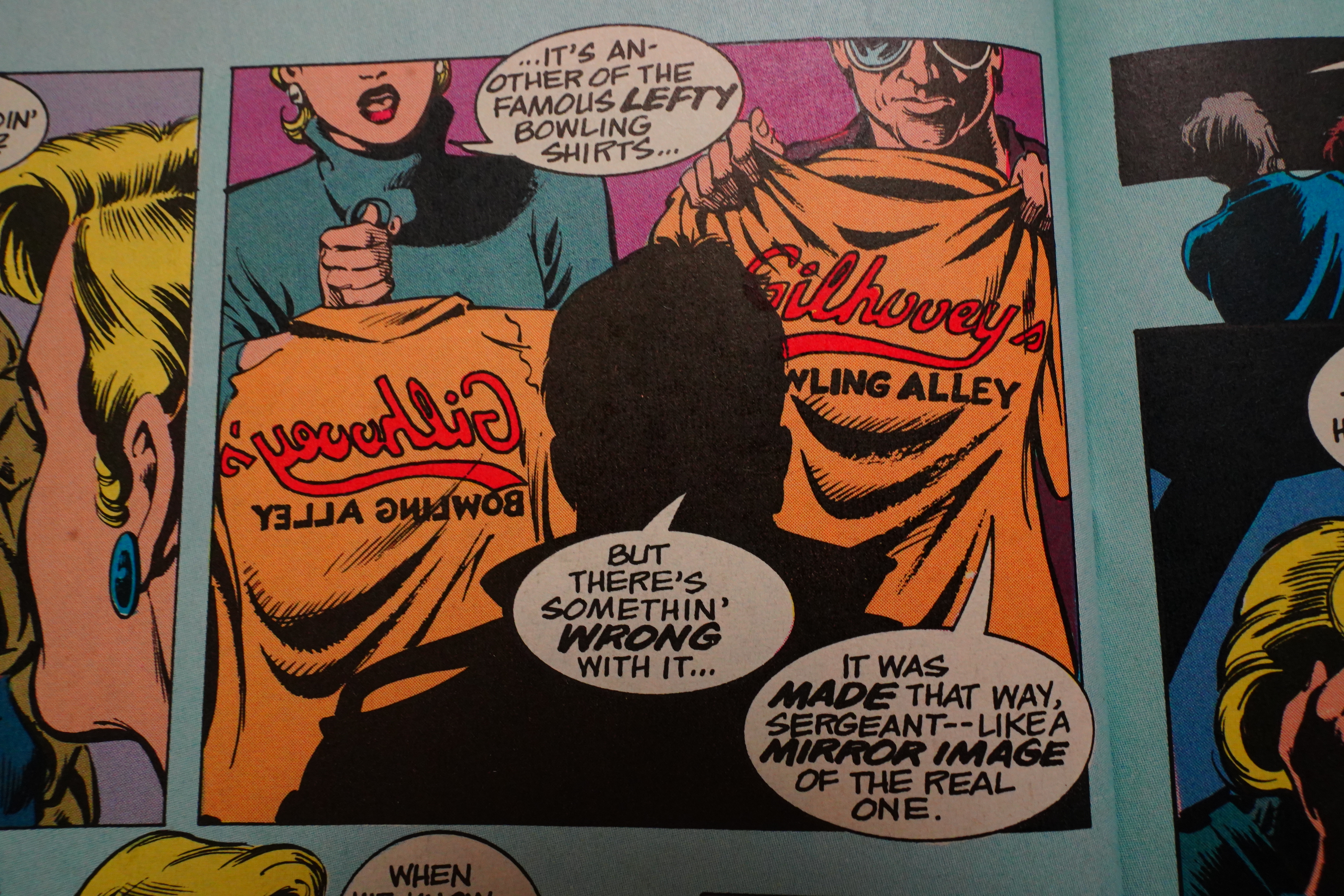
*gasp* A reversed bowling shirt! Could it be a clue!
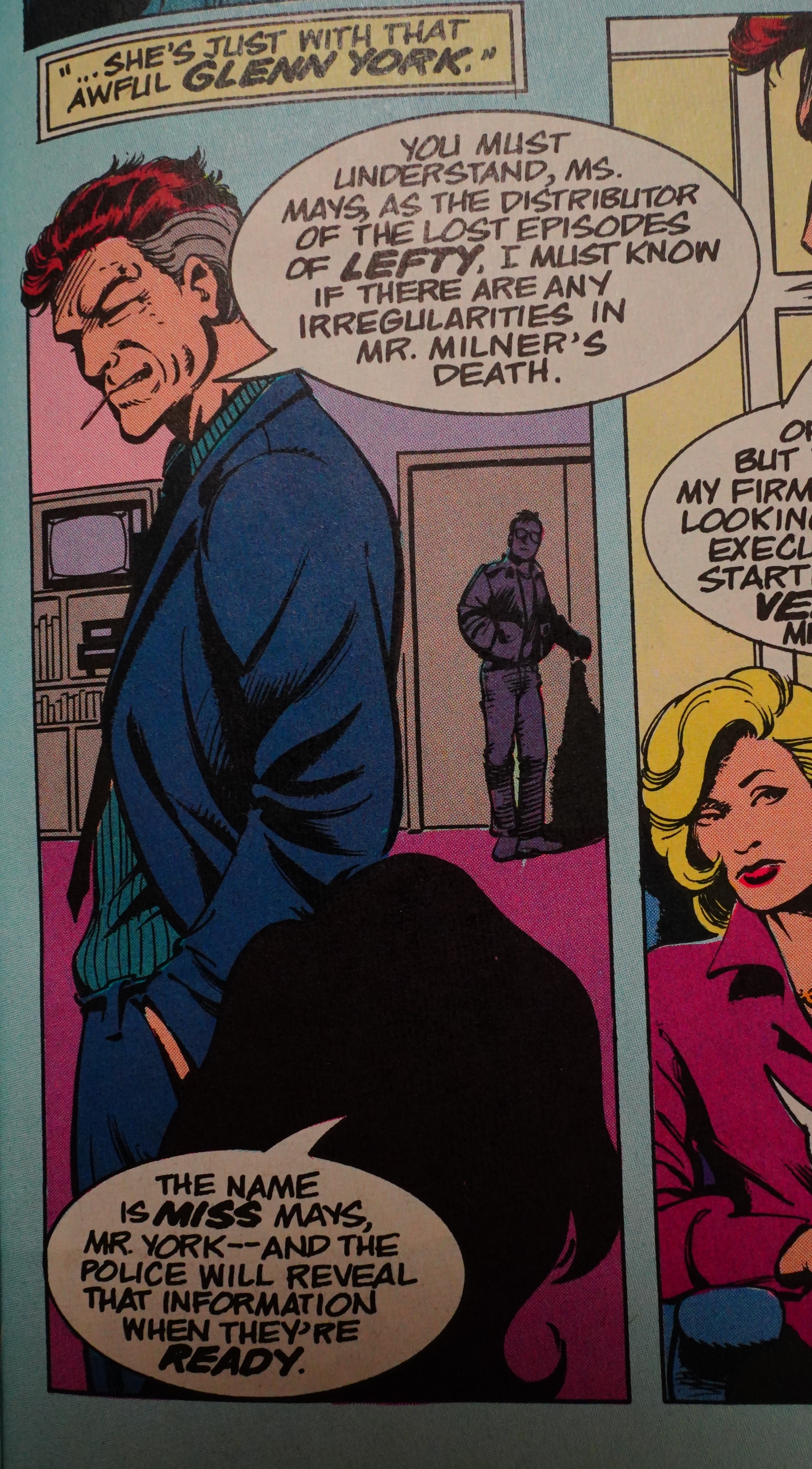
The awful Glenn York makes porn… and calls Miss Mays “Ms. Mays” and is soundly slapped down. That’ll learn him! Barr strikes against… er… woke pornographers, I guess?
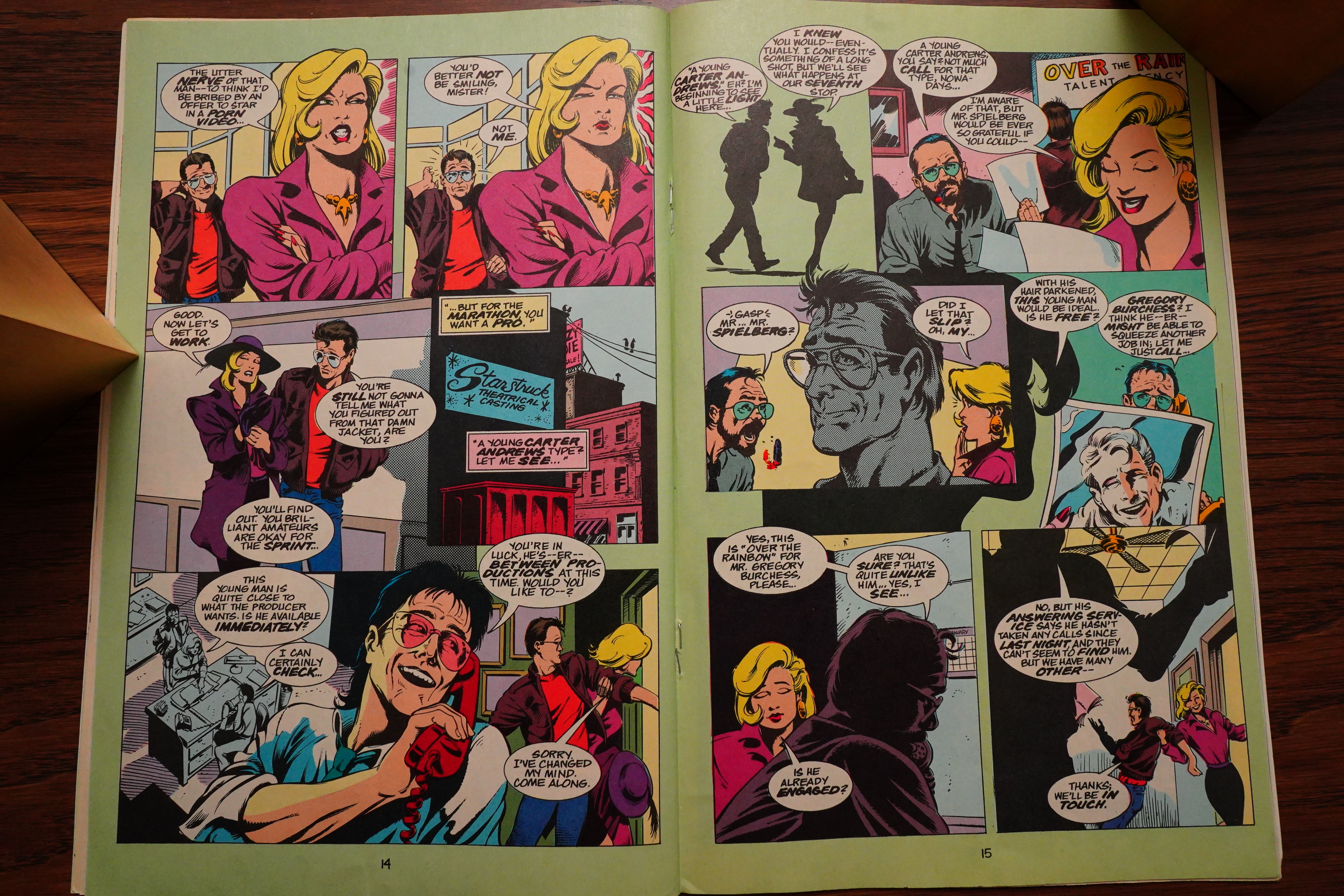
Hughes’ artwork is pretty attractive, and the storytelling mostly works. There’s some oddities in word balloon placement, but the strangest thing of all is that most of the male characters wear exactly the same shape of glasses. Did a) Hughes use himself as a model, and b) use glasses, and c) use those glasses? I tried googling him, but couldn’t find any pics of him from the 80s…
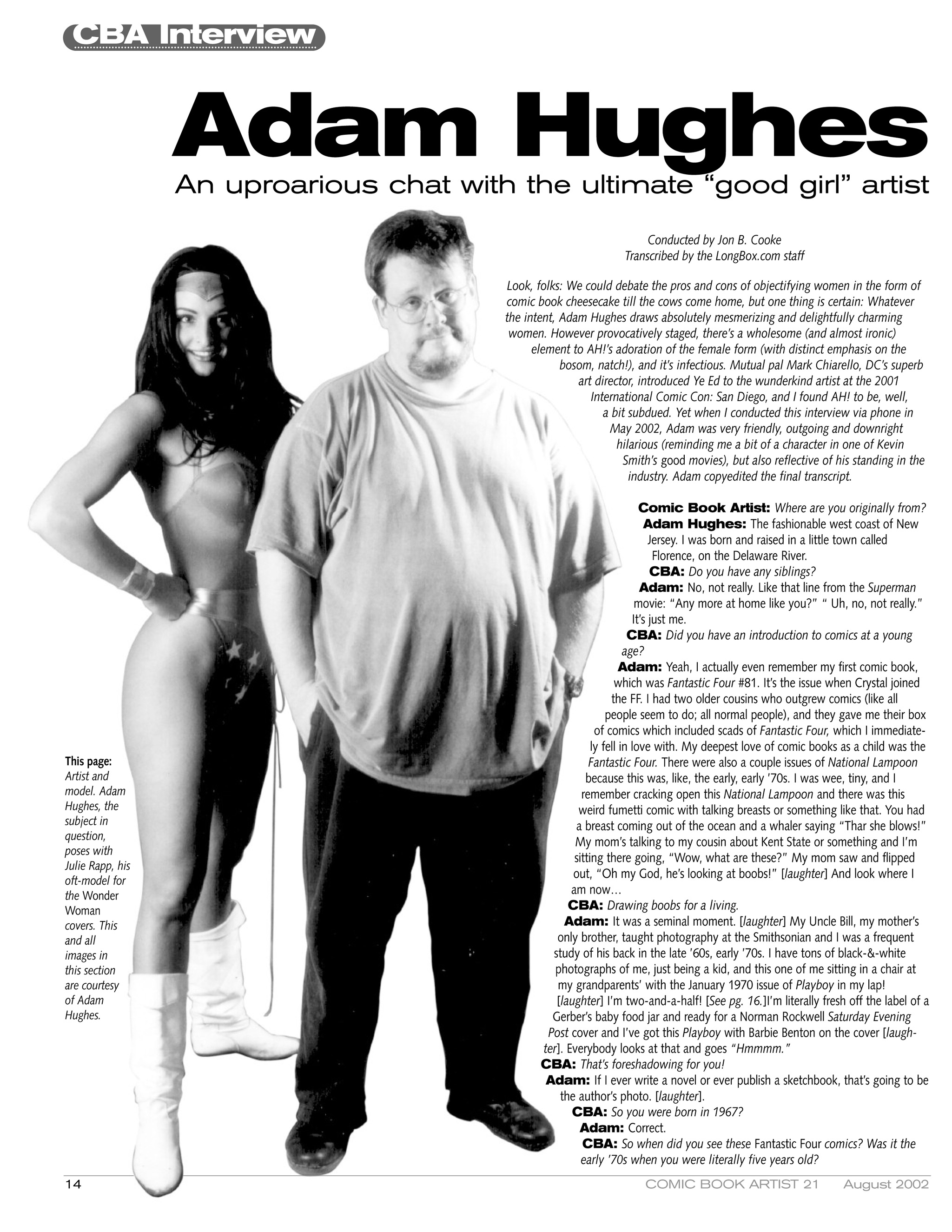
But he seems to be wearing glasses here in this 2002 shot, and aren’t those the same shape!?
The spectivation continues!
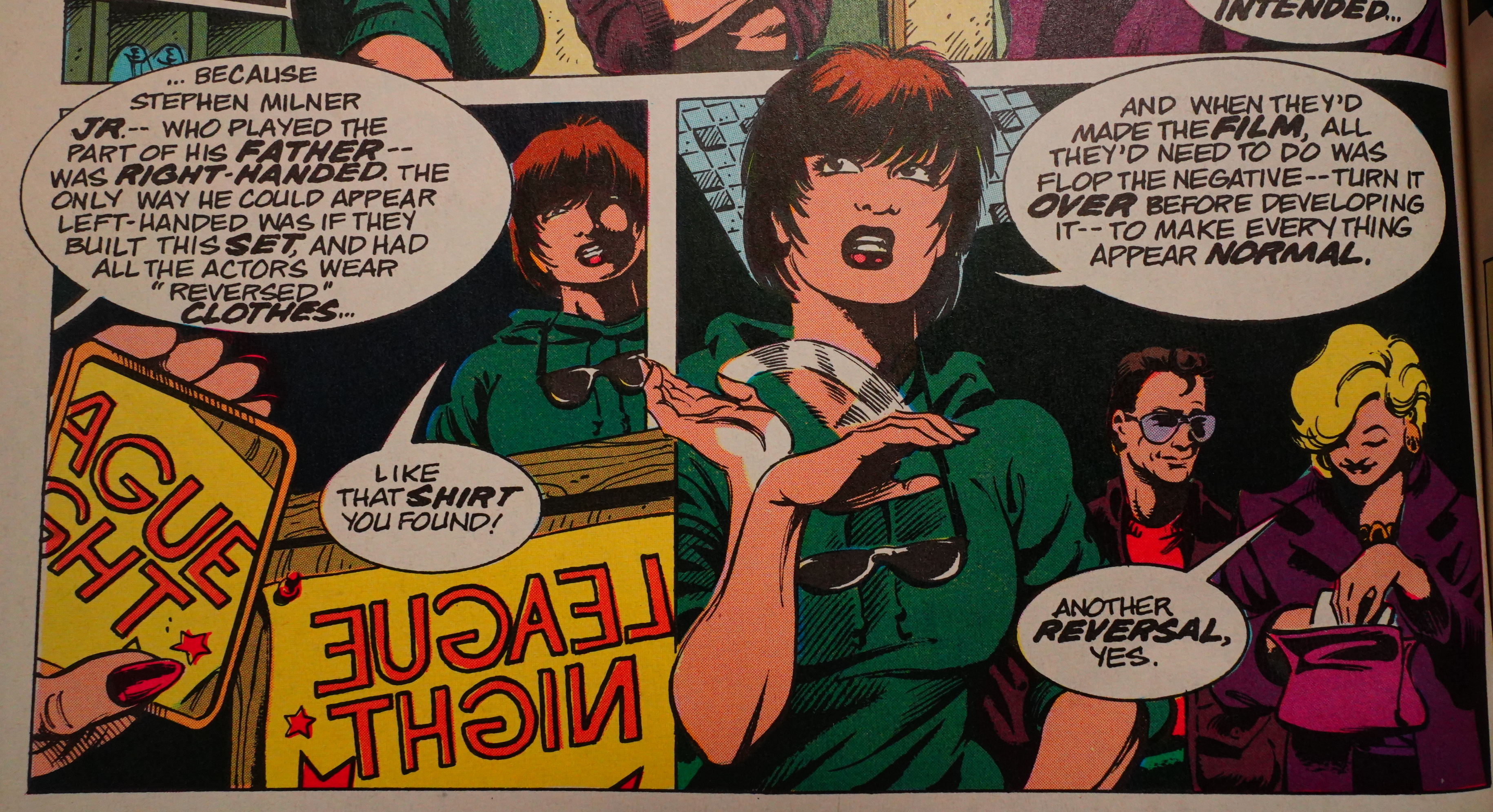
Remember that reversed t-shirt? Here’s the explanation — they wanted to film fake versions of a sitcom (or something), but the actor was right-handed instead of left-handed! And that’s something you can totally see! So they had to create a reverse image set to film on! And then flip the film! Amazing! I think you can kinda see how Barr had become a successful Batman writer…
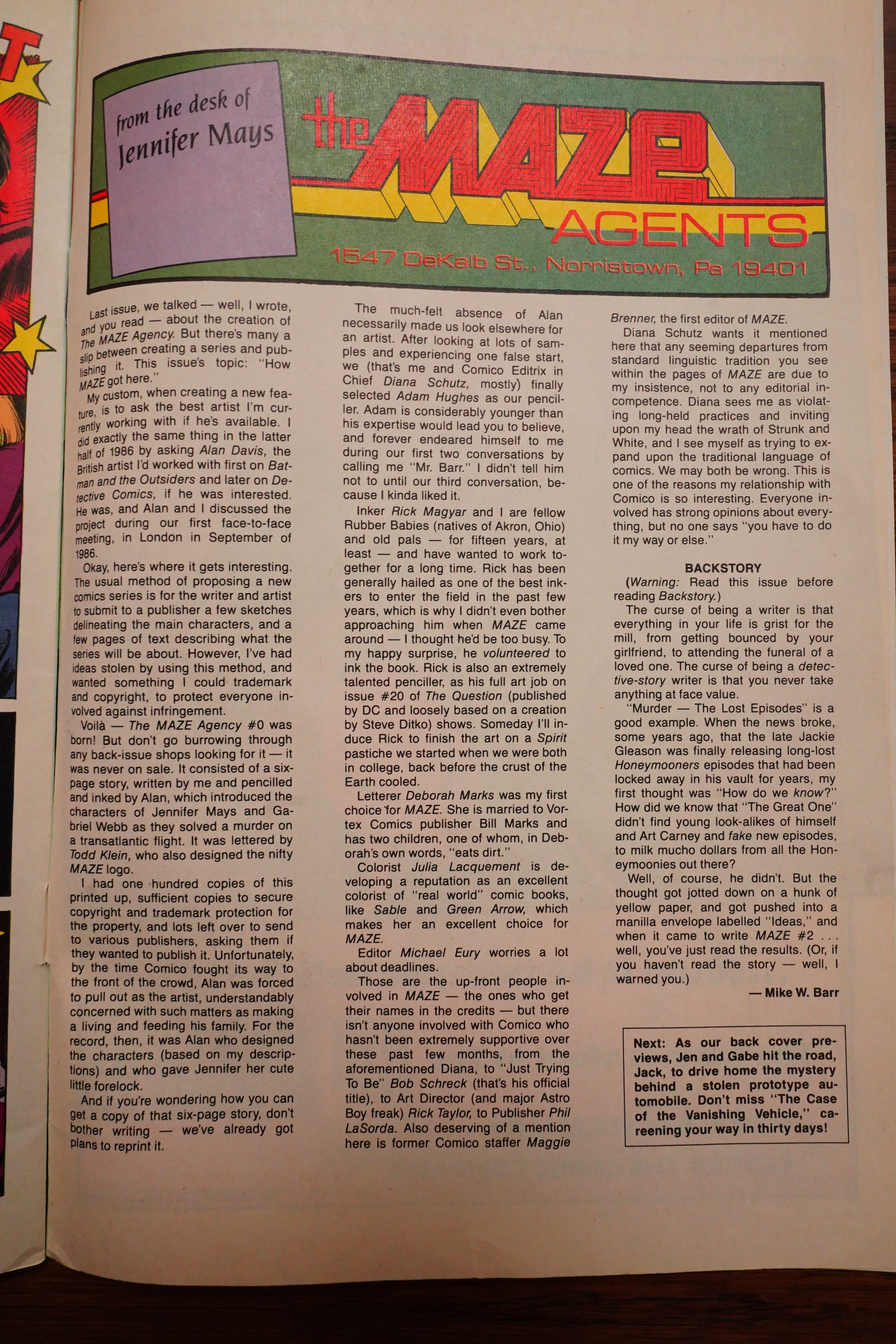
We also get the backstory for the series — Alan Davis was originally going to be the artist, but dropped out.
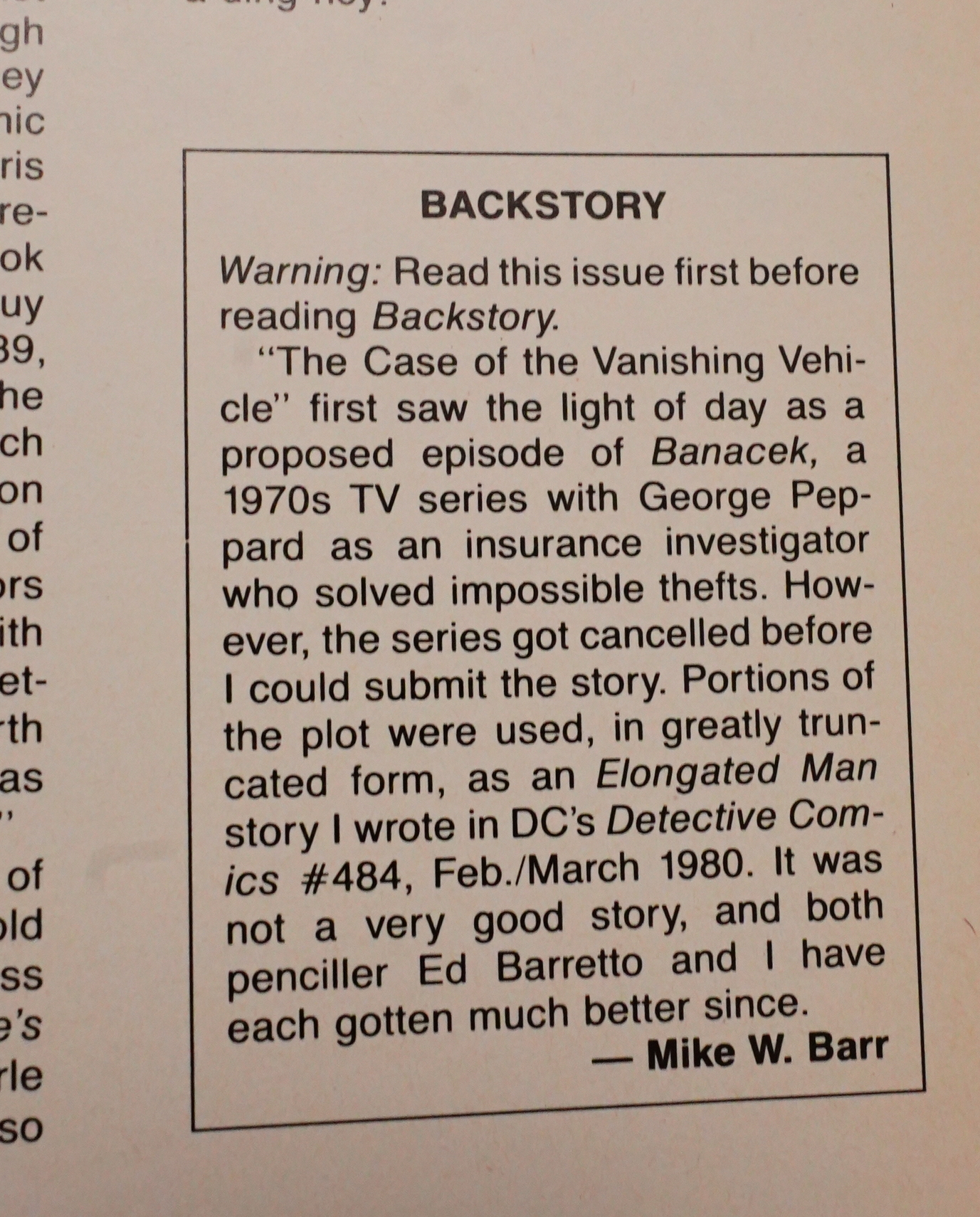
The next issue was another 70s script — Barr had apparently written a script on spec for a series called Benacek, which I’ve never heard of.
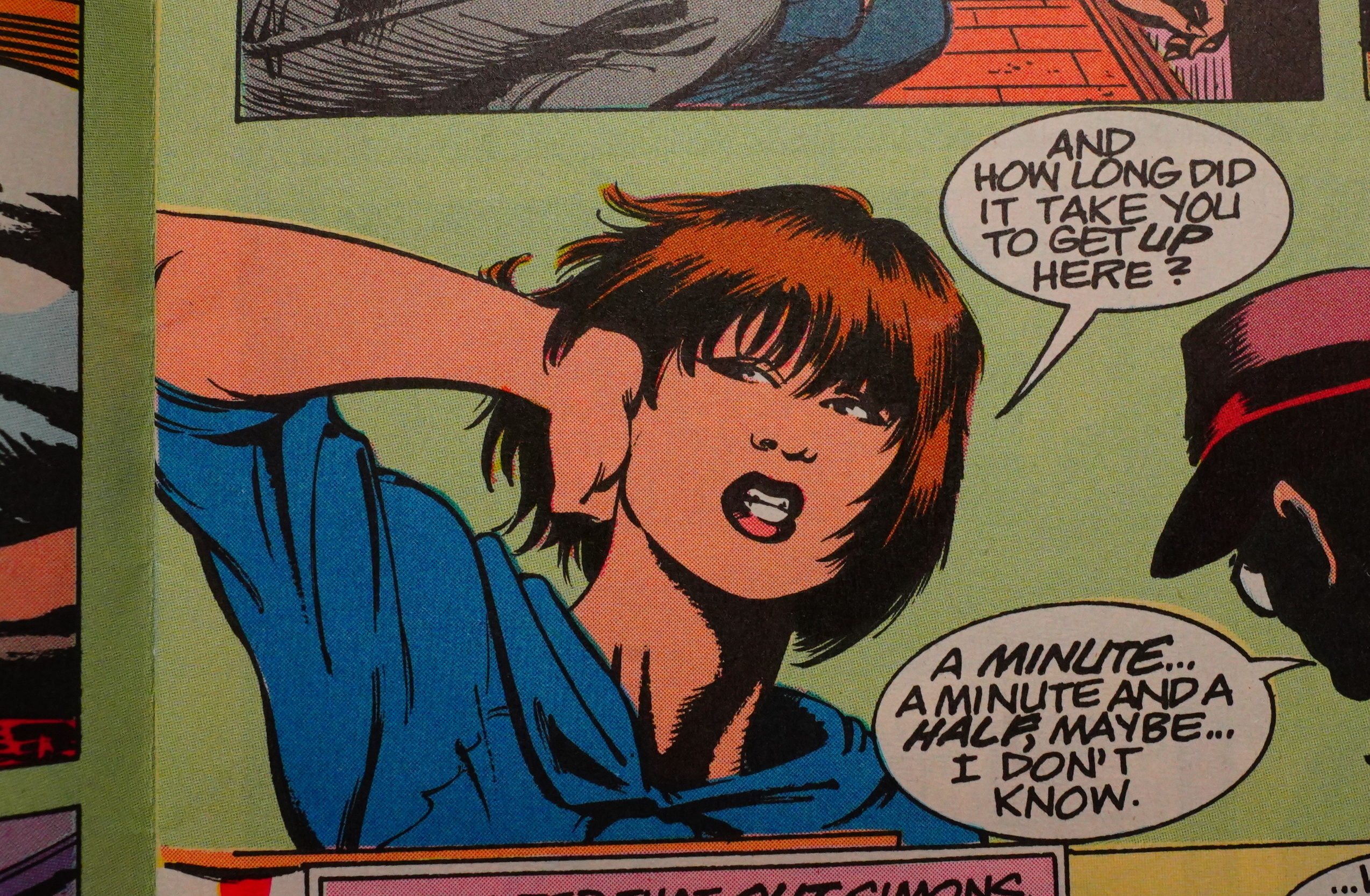
You can kinda see that Hughes was using porn and or fashion magazines as basis for some of his female characters. The woman above is supposed to be a hard-nosed police officer, and… er… it doesn’t really come off that way? But it’s a good drawing.
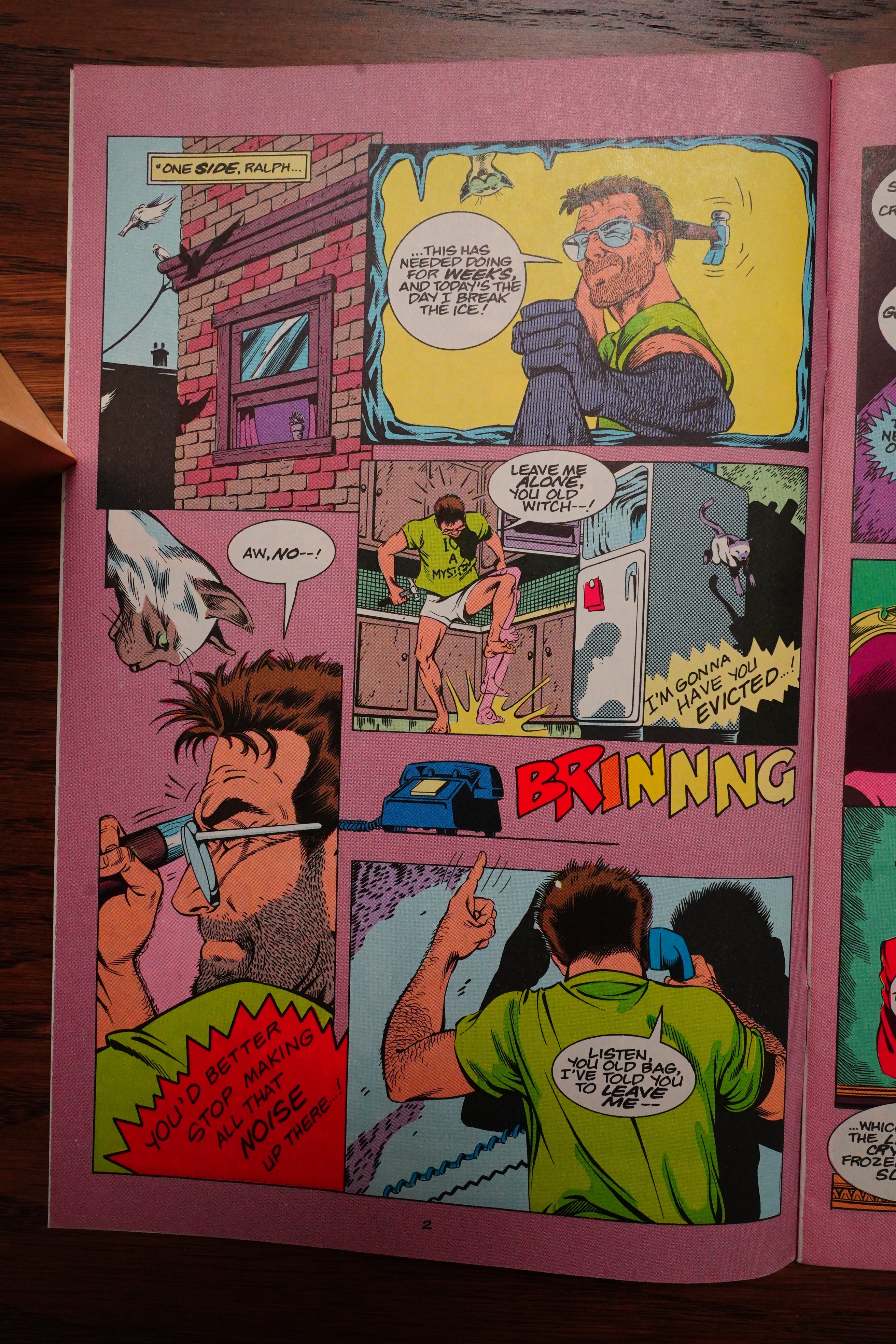
The book improves a lot as the series progresses. The actual mysteries themselves are consistently risible, but the rest of the book gets better. There’s more fun bits, like that cat there, and insights into how this character thinks defrosting is done.
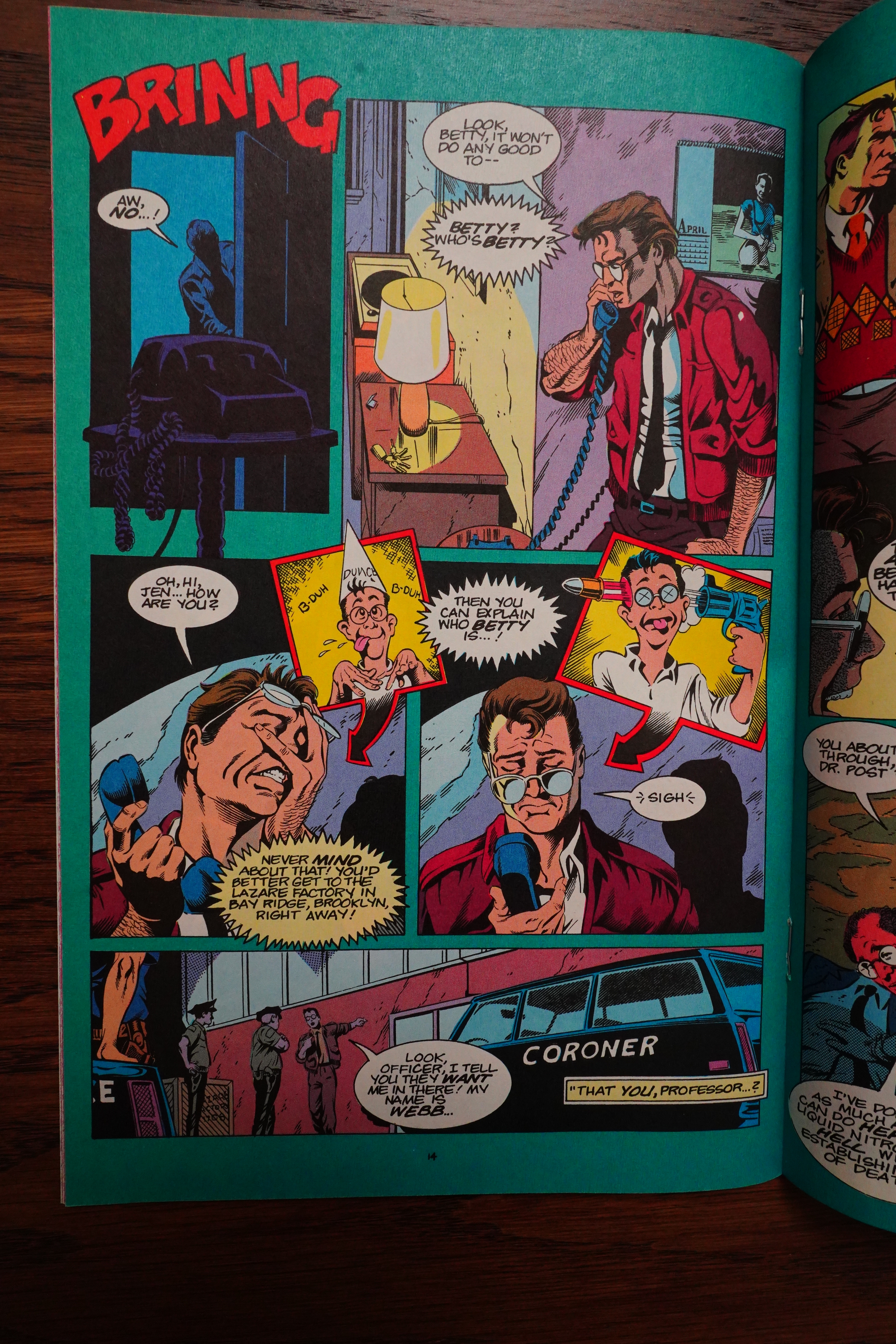
See? More fun. I wonder how much of those sight gags is from Hughes, though.
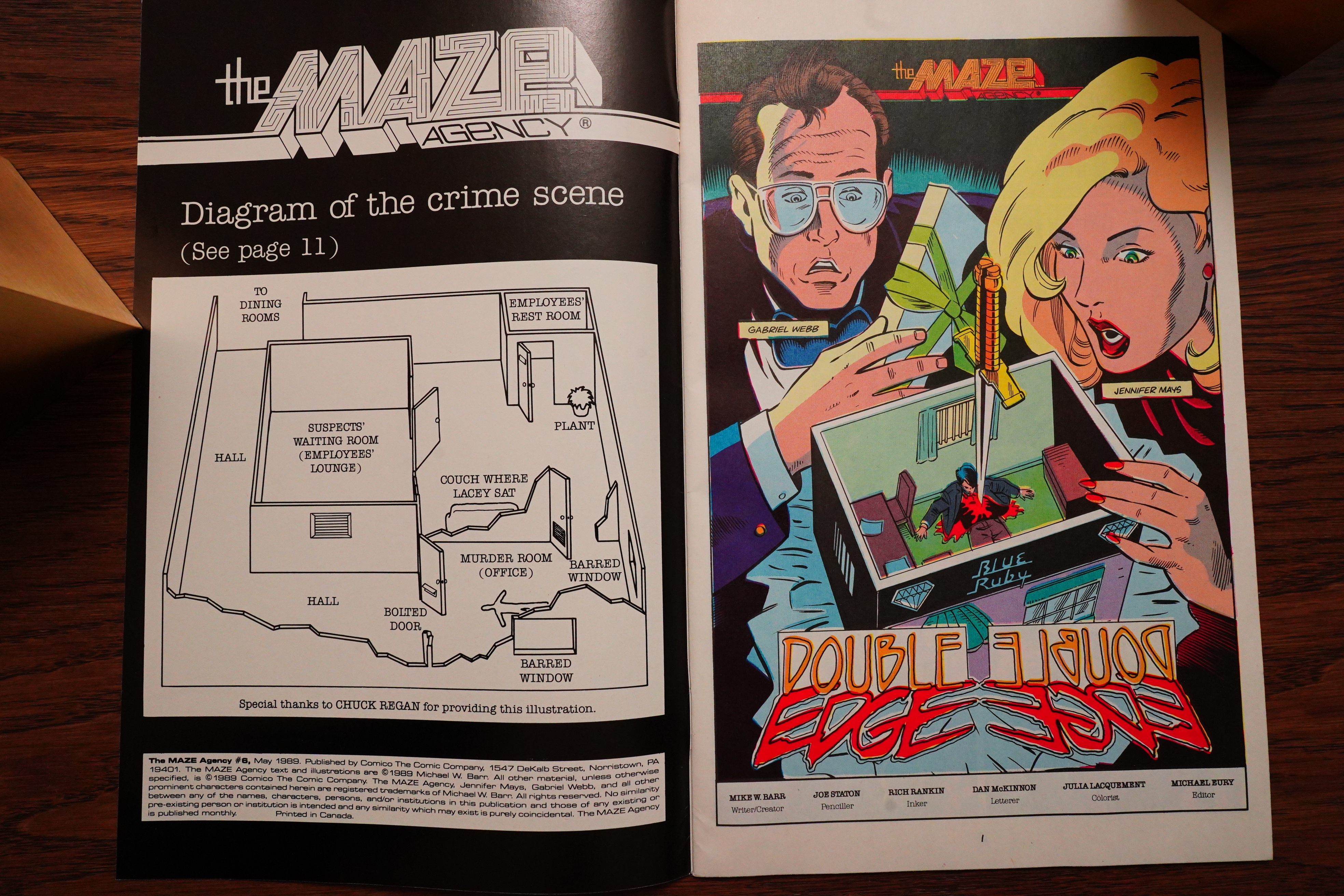
Unfortunately, he leaves by the sixth issue.
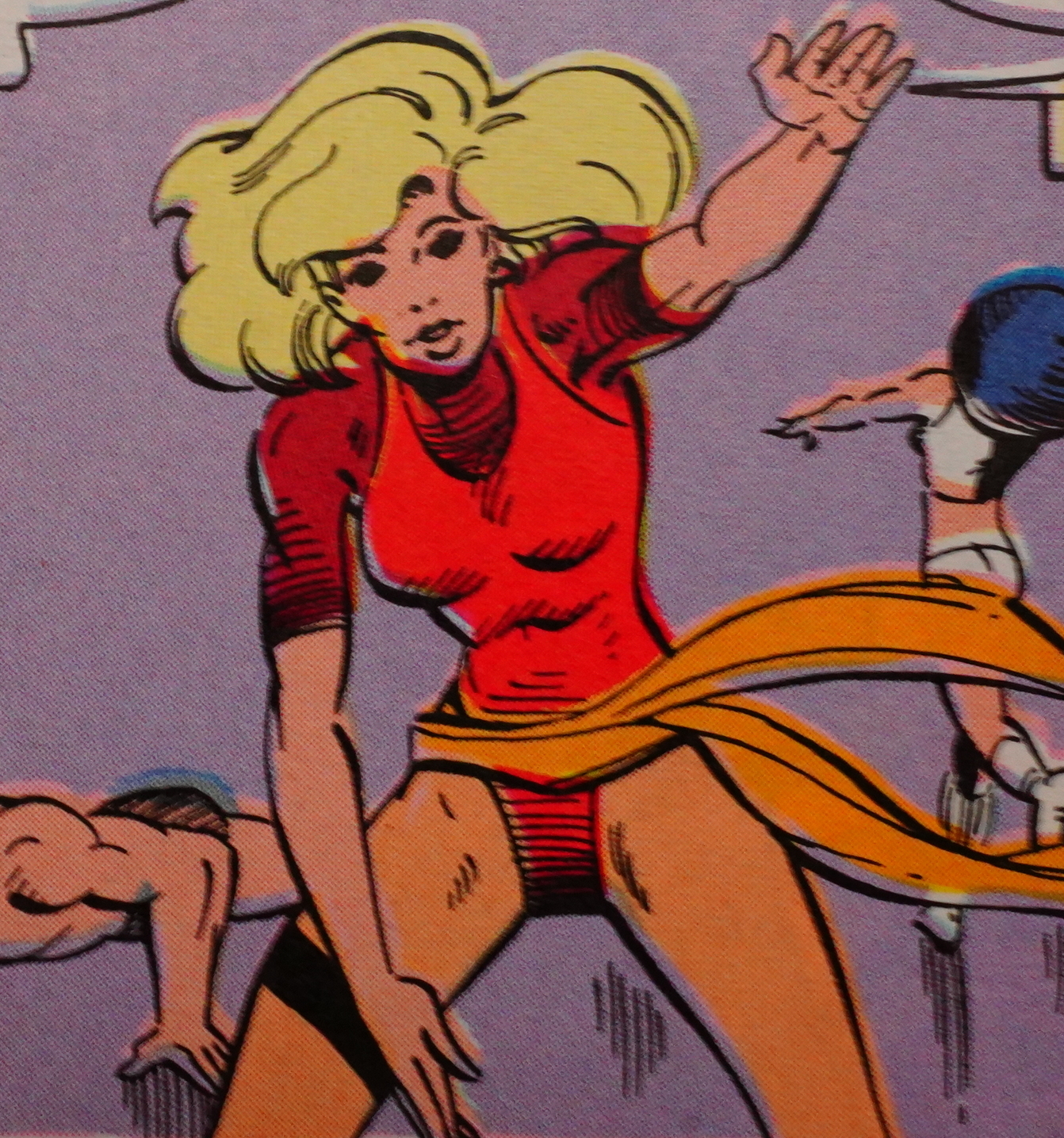
Joe Staton is more MISS MAYS SMASH.
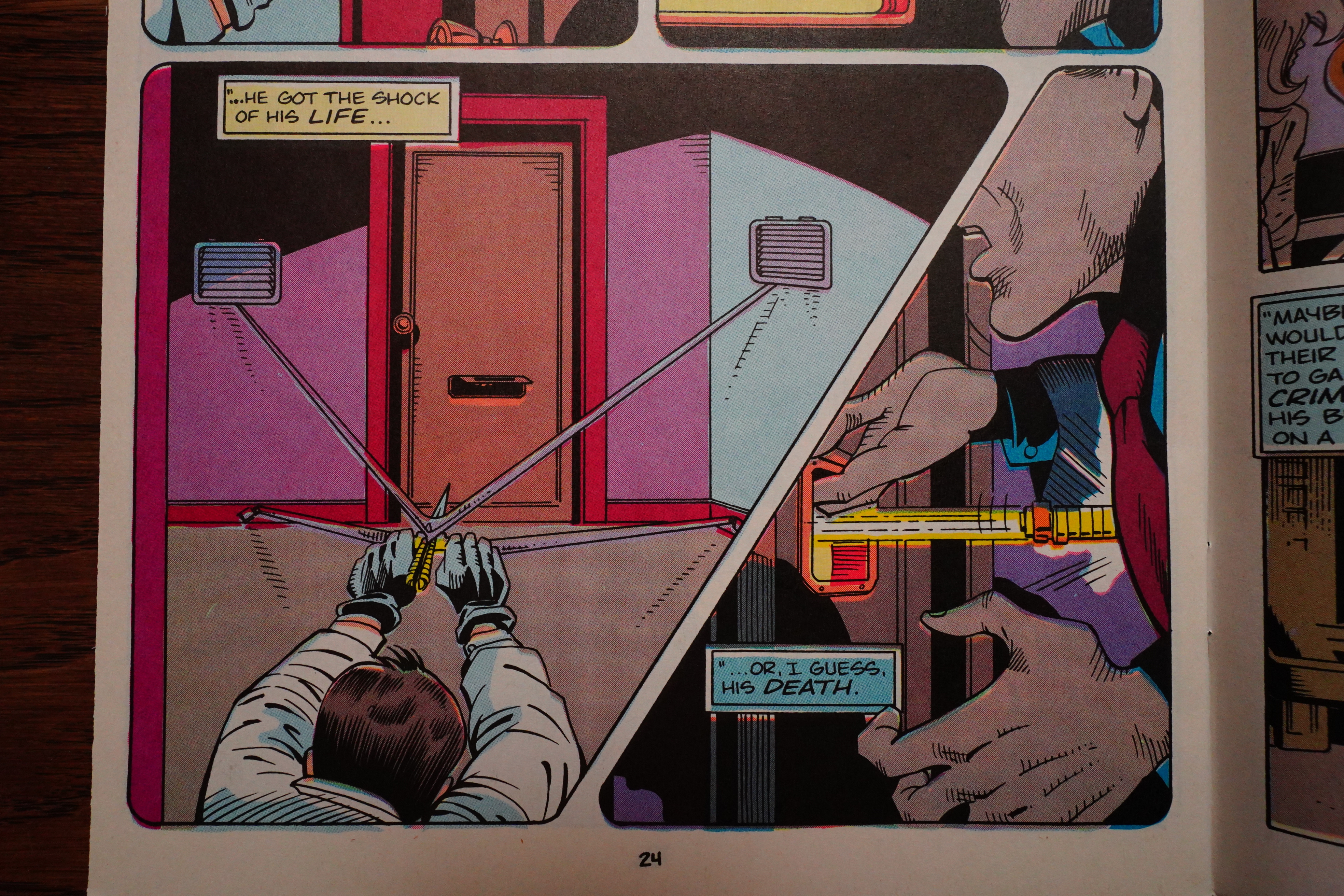
Did I mention the risible mysteries? *sigh*
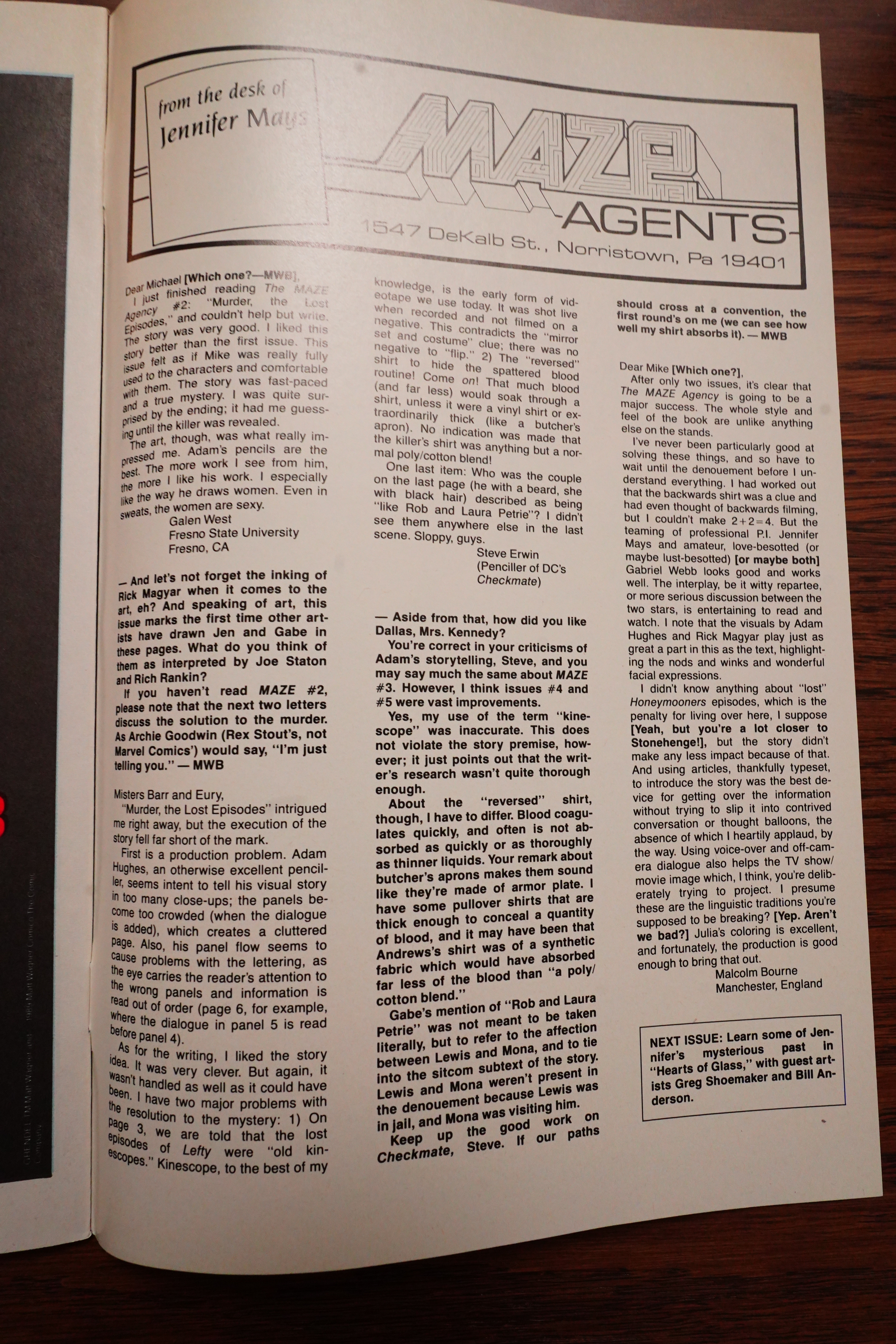
A reader writes in to say that the plot in the TV episode issue didn’t quite make sense.
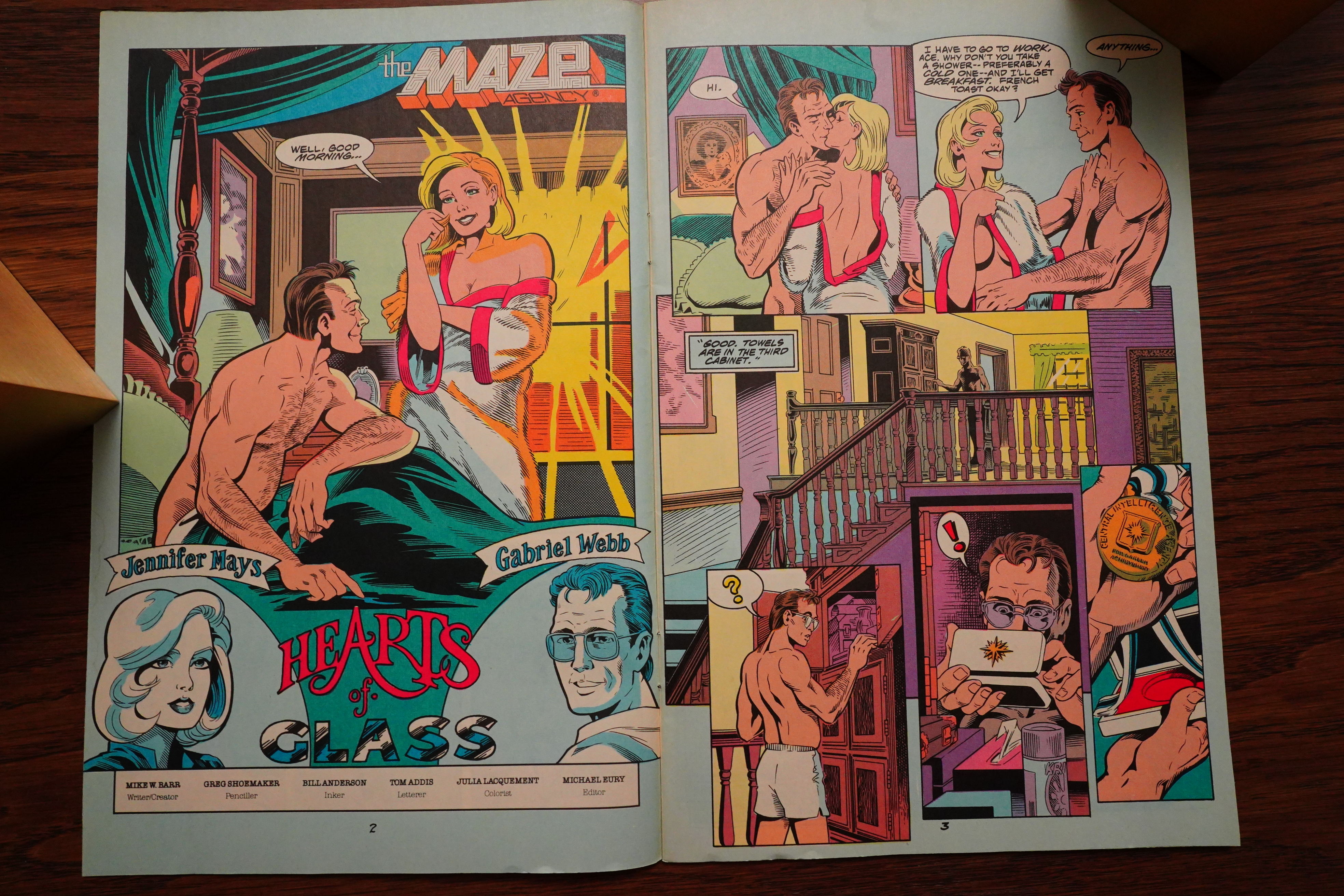
In the final issue, we get yet another artist pair…
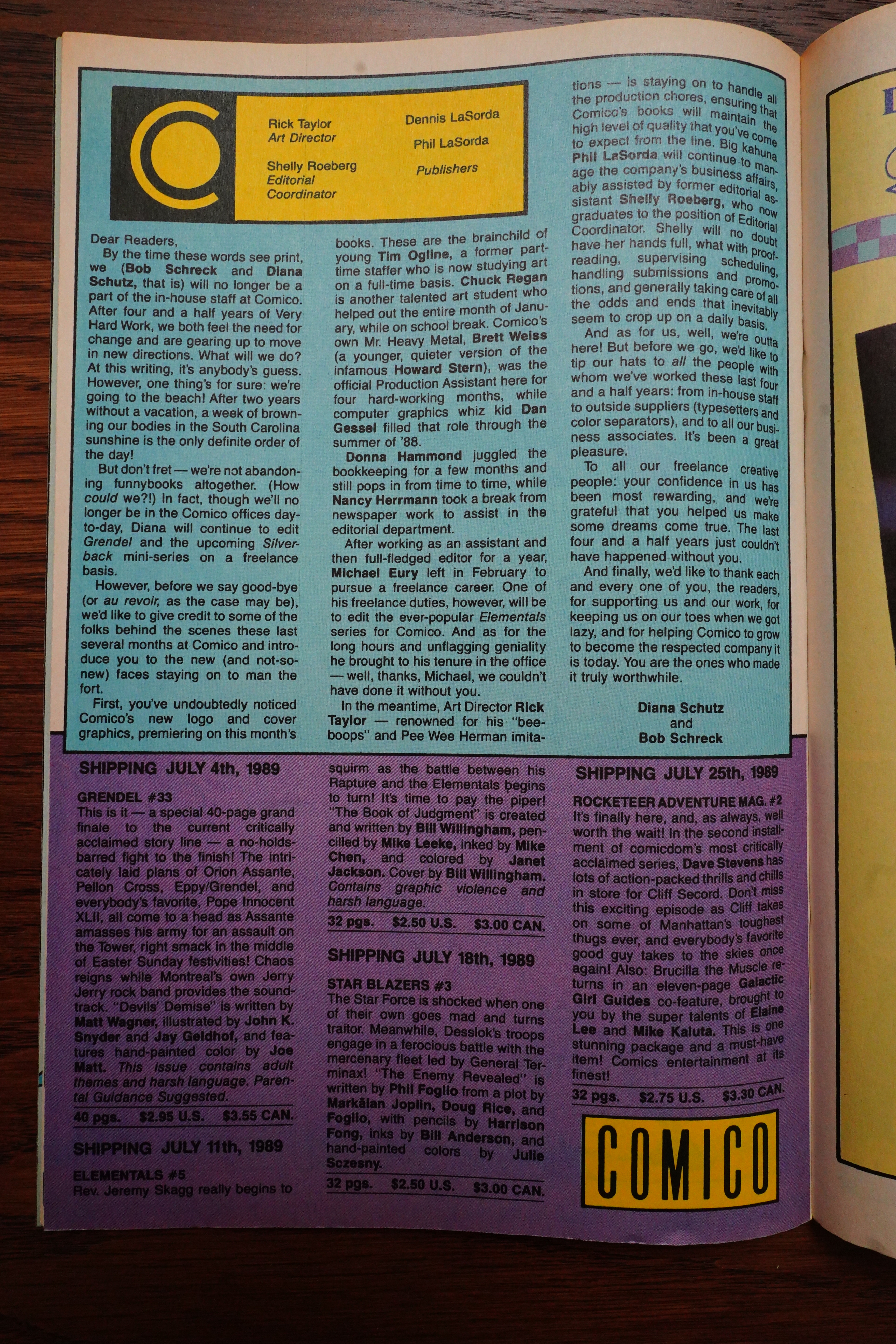
… and the editors announce that they’re leaving Comico, along with half the people who were working there. Because Comico was hobbling along towards a bankruptcy in 1990, and shedding both series and employees at an alarming rate.
One person who’s not mentioned is Gerry Giovinco — there were three co-publishers, but he was the main guy running things, is my impression. But he’s out now, and the publishers now are the two LaSorda brothers. And! There’s a new trade dress:
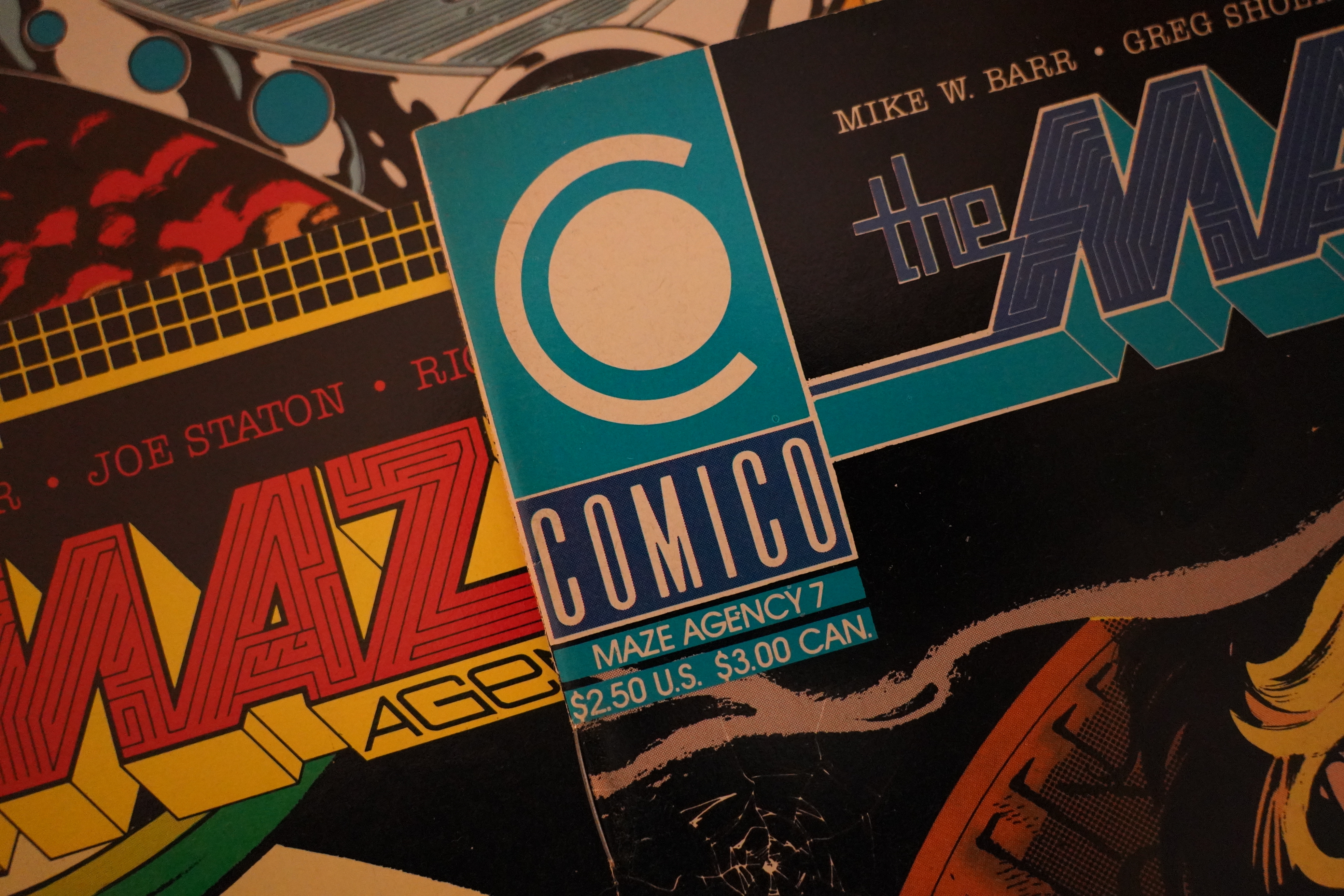
As if it were the stylish checks on the cover that was the problem.
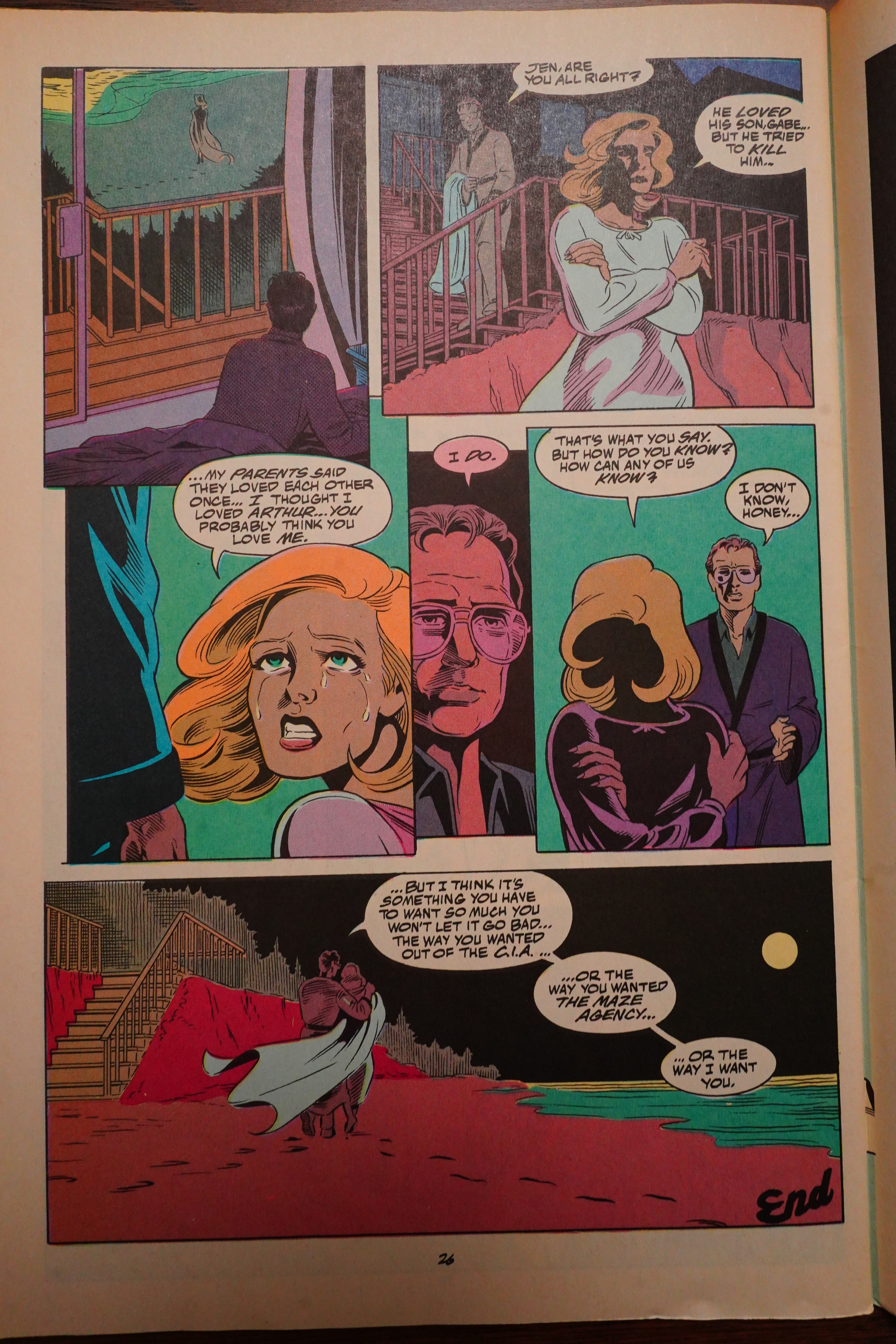
And this is how the series ends.
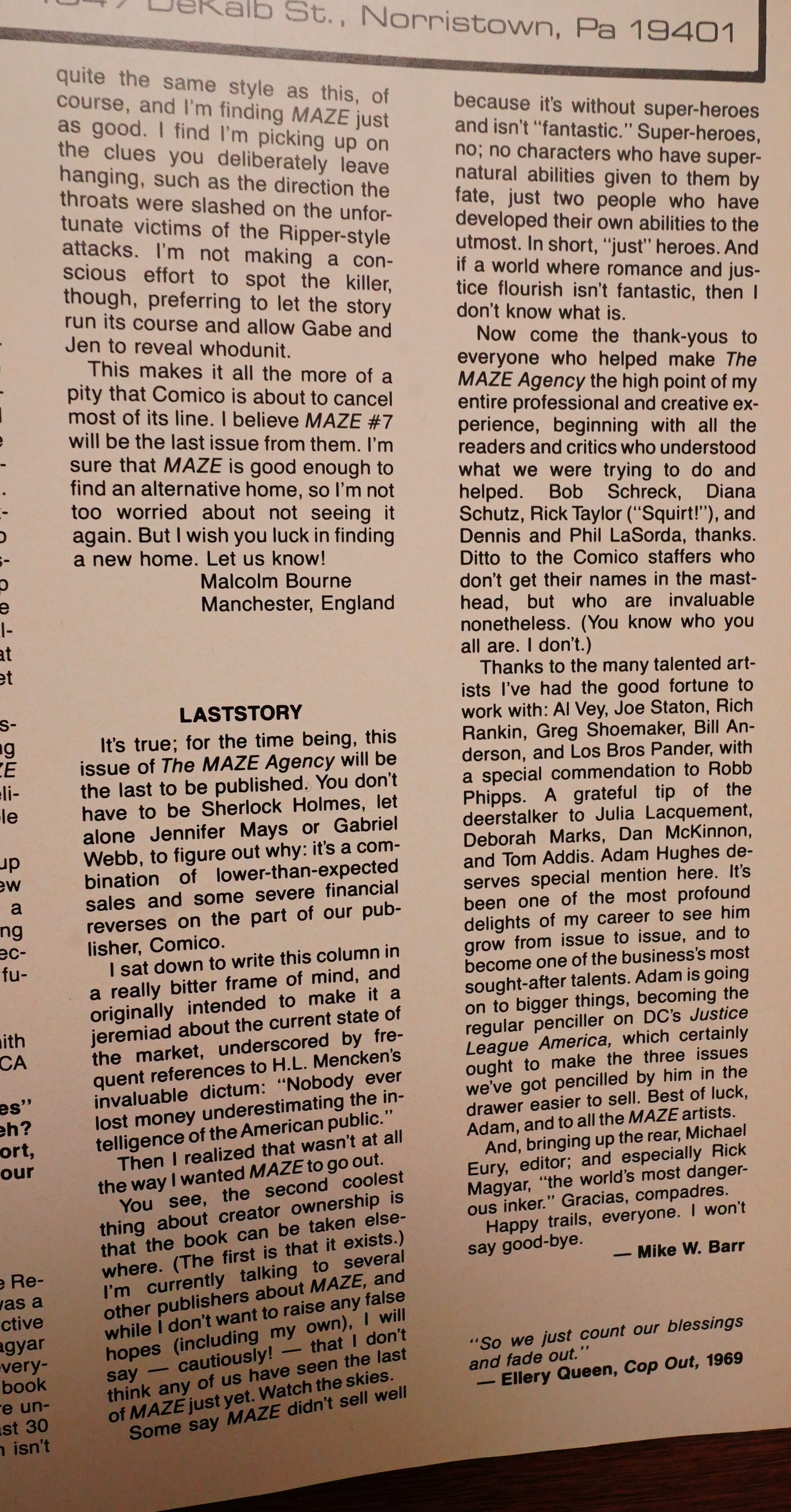
Or is it? Barr says that he’s shopping the book around…
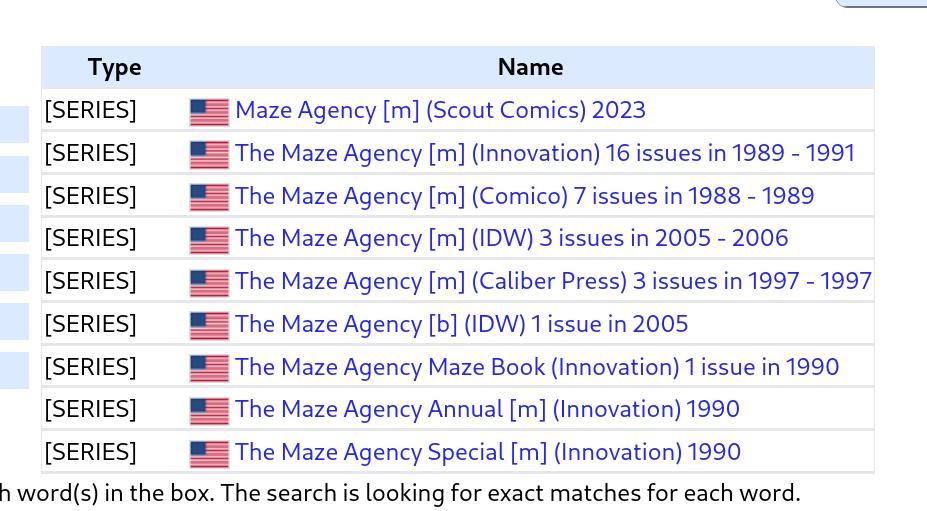
Which was successful: It continued from Innovation and Caliber, sporadically, before ending in 1997. A revival in 2023 was not successful.
The book has not been collected, but it was reprinted in some Scandinavian anthologies.
Back Issue #2, page #9:
ME: Adam Hughes, you were a
promising young artist at that time. This was your first
regular series.
ADAM HUGHES: Yep, I was wearing long pants and
ready to shave.
ME: (laughs) And yours truly, Michael Eury, a newly hired
editor at a relatively small, but cutting-edge, comic-book
publisher in the “metropolis” of Norristown, Pennsylvania.
So, do we feel ancient yet?
MWB: Yes, I have for some time. (laughs) It’s got nothing
to do with this conversation, I assure you.
ME: Mike, in case anyone reading this interview is
unfamiliar with The Maze Agency, why don’t you
define the series?
MWB: Back in 1985, ’86, I’d wanted to do a creator-
owned detective series. By “detective series,” I mean in
the sense that it would have actual mysteries, actual
whodunits, which would be solvable by the reader if the
reader was sharp enough to pay attention to the clues.
Based, of course, on my love of the classic detective stories
of Ellery Queen. Later, of course, I would pay homage to
Queen by using Ellery Queen in Maze Agency #9.
Back Issue #2, page #12:
MWB: Yes. Well, they seemed to be interested. I had
mentioned it to some editors before the story was actually
in print. I mentioned it to Archie Goodwin, who was edit-
ing the [Marvel imprint] Epic Comics at the time, and
Archie seemed very interested because he liked the work
that Alan and I had done together.
ME: Oh, Archie Goodwin should have been interested
in mysteries since he was a character in a series of
mystery novels.
MWB: That’s right, he is, yes. [The narrator of the Nero
Wolfe mystery novels by Rex Stout is named Archie
Goodwin.] Archie said, when he sold his first story to
Ellery Queen’s Mystery Magazine, he had to send a copy
of his birth certificate. (laughs) They didn’t believe that
was his real name and not a pseudonym.
ME: But the series eventually landed at Comico, but
not with Alan Davis or with Archie Goodwin. What
happened to Alan and to the other publishers you sent
The Maze Agency to?
MWB: Well, when Archie saw Maze, he immediately
passed on it. This was his right, of course, but it was very
confusing to me as every time I had seen Archie for weeks
before, he had told me how much he wanted to see the
ashcan, and how I shouldn’t talk to any other publishers
without talking to him. I told him there may not be any
physical action in the strip whatsoever, but he said that
was fine. So I don’t know what happened. Maybe it was
just as well, as the Epic Comics, with some exceptions,
were kinda the ancestors of Image Comics-lots of pretty
pictures, but not much to stick to your brain.
As to Alan’s involvement, as soon as Epic passed, so
did Alan. Alan has always been very security-minded-
which I understood completely-and he didn’t want to
take a chance on any of the independents.
As it turned out, Comico was the only publisher who
made us a serious offer. I realized, later, that I had read
most of the independents wrong. I had thought Maze
would appeal to the publishers who didn’t like super-
heroes, but what I didn’t realize was that the publishers
and readers who don’t like super-heroes don’t like any
series characters, except for reprints of newspaper strips
by guys who are long dead. They’re largely more inter-
ested in the “real world” stuff-you know, “my job sucks,
my life sucks, come look at the boils on my ass.”
So Comico was the place to go, which was okay
with me. My lawyer and I worked out a swell deal and
we were all looking forward to it.
ME: Adam, before you came on board The Maze
Agency, did you have any interest in mysteries as a
reader, or as a viewer?
AH: No.
ME: So this was uncharted territory for you. Adapting to
this material must have been a challenge.
AH: Well, for all the little giblets reading this interview
who don’t remember the 1980s, there was a big boom
going on. Anybody with two thousand dollars could
publish a black-and-white comic book, so any slob with
a pencil could get a job. (laughs) So I, fortunately, was
able to elbow my way in, in that respect. And the fact
that Comico was just across the river-I was from New
Jersey at the time-it was pretty easy to get your work
noticed back in those days. But at the time I was like all
great American teenagers. I was quite brain dead and all
I cared about was super-heroes, and I wasn’t aware that
there was a larger literary universe to explore in comics.
I had no idea there had once been western comics, or
romance comics, or horror comics. All I wanted to do
was draw people in their underwear.
ME: Who was your
primary contact at
Comico before I came
along? Did you just send
samples over the transom,
or did you actually go
meet with somebody?
AH: I went to a convention
in Philadelphia with my
samples. But I was more
interested in finishing off
my collection of Love and
Rockets and Nexus. My
girlfriend grabbed my
photocopies and took
them to Diana Schutz.
Diana gave my girlfriend
her card and said, “Have
Adam call us.” And I sort
of backed my way into it.
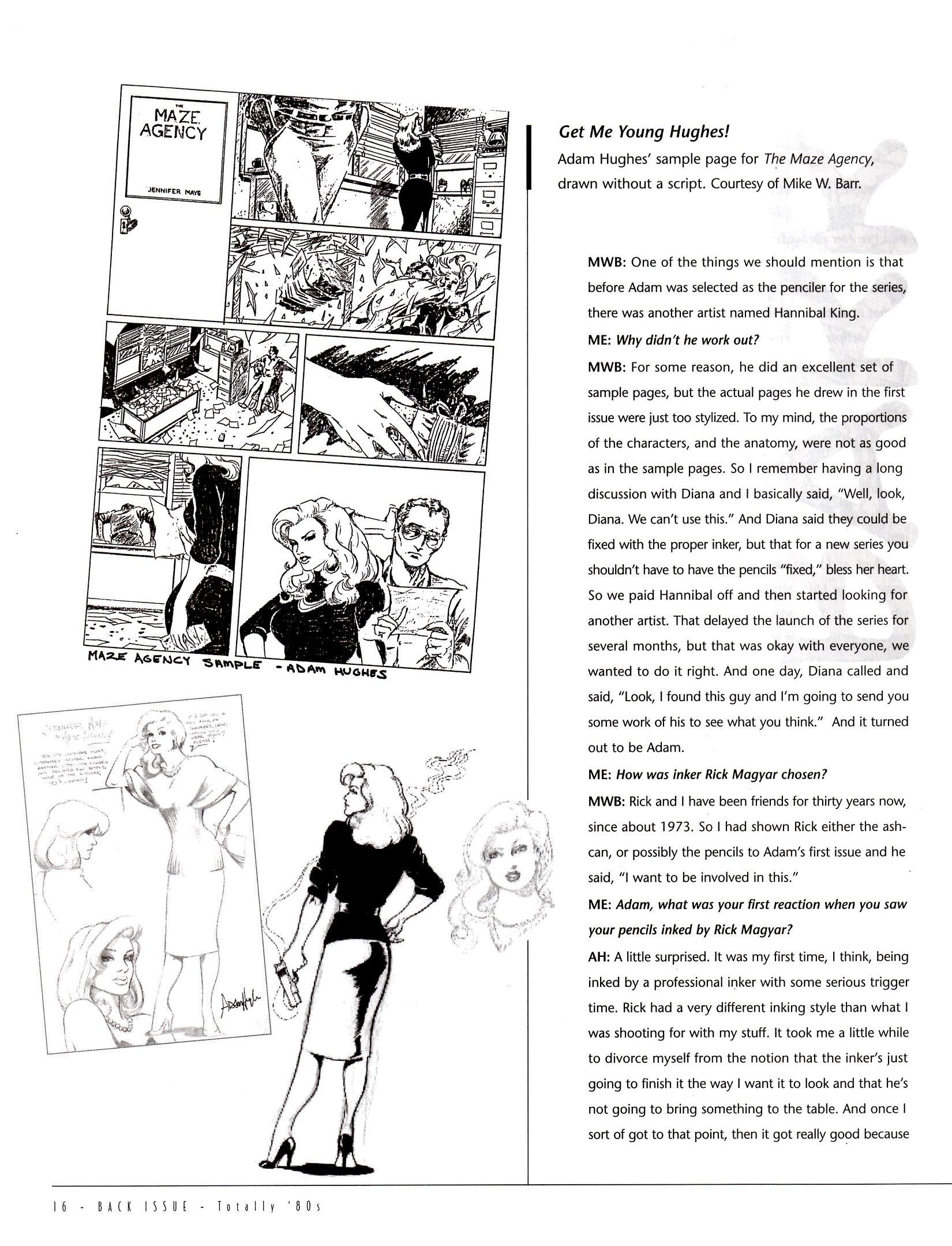
Back Issue #2, page #26:
DC sort of swooped down and said, “Look, your
future’s over here because that other thing was dead,”
even though it wasn’t. Obviously, DC saw the distribu-
tion deal as a chance for them to do away with more
competition and raid some nests.
AH: Wow!
MWB: I’m sorry?
AH: No, I was just wowing. I didn’t know that. Wow.
MWB: I just found my notes, and what actually hap-
pened was this: “Black Friday” was actually Monday,
February 27, 1989. At about 12:15 P.M., I got the call
from Diana, telling me of Comico’s financial difficulties,
and saying many artists were being told to stop work on
all titles, as the titles were being put “on hiatus.” Maze’s
“hiatus” began after the publication of #7, which was to
go on sale in June. Diana said I could leave the book with
Comico for possible resumption of publishing after a
minimum six-month interval-and contract renegoti-
ation-or I could contact other publishers. I opted for the
latter, but was later told by Phil LaSorda, one of Comico’s
founders, that Comico had not cancelled Maze, and they
were still considering publishing it. Comico was also
holding onto the unpublished artwork, still owed me
$1430, and owed the rest of the creative team, too.
Long story short, after I got a lawyer involved the
artwork was released and I was “allowed” to take Maze
to Innovation. The Comico brass got harder and harder
to find, so I’m still not sure whether I was ever paid the
$1430, let alone whether everyone else was paid. I was
just glad to get out. Natch, this ate up the good will
between me and Comico, though I remained friends
with Diana, who had nothing to do with Comico’s
legal maneuvering.
Amazing Heroes #190, page #28:
The first time around, they sent us
some of the Alan Davis Maze Agency
material and we were supposed to
come up with our own. I didn’t real-
ly have an idea what the characters
were about and I misinterpreted them.
Mike Barr, at that point, had his own.
ideas about how they were to look,
which is why I know I didn’t get the
job the first time around.
The second time around, I had a
better idea-especially since there was
a two-page script to work from. It was
from that Comico made the offer for
me to come and do the book. So I
finished up the first issue of Death-
hawk, which was my last issue of
Deathhawk, and moved on to the
Maze Agency.
AH: Were you ever a mystery fan be-
fore that?
HUGHES: No, I’ve never been a big
fan of the fair play whodunit, which
is what the Maze Agency is. I’ve
always leaned more toward hardboiled
detective work, as opposed to the kind
that Mike Barr likes. I was really com-
ing in cold and I think that hurt the
book.
There was pretty good fan response.
The people who come up to me at
shows and mention the Maze Agency
are nice about it. They seem to be very
loyal to the book. It really surprises
me sometimes how much some peo-
ple really like it because all I could
see was how the book didn’t end up
looking.
I really enjoyed working on it, but
it could’ve been a lot better if I had
been a) a little more experienced and
b) more into the genre the series was
coming from.
I always pictured the book look-
ing like The World of Ginger Fox
graphic novel by Mike Baron and
Mitch O’Connell. The Maze Agency
should’ve been that sort of late ’80s’
art-pop kind of thing. That’s going to
sound weird to a lot of people, but the
image I got of Jennifer was similar to
Ginger Fox-very fashionable, very
glitzy. I was hoping it could go a lit-
tle more like that, but it didn’t.
But I’m kind of glad for the ex-
perience because I had to spend a year
drawing real people. Nobody in the
Maze Agency could pick up a bus.
They couldn’t duke it out and destroy
New York City. I had to learn to draw
people in suits and average people. I
appreciate the experience of that
because it’s helped a bit nowadays.
Amazing Heroes #190, page #30:
AH: Getting back to Maze Agency for
a second, do you have a favorite
issue?
HUGHES: Yeah, the Ellery Queen
issue. Even though Innovation ran
them out of sequence (which is O.K.
because the Maze Agency is very
episodic), the Ellery Queen issue is
the last issue I produced. All the In-
novation Maze Agencys that came out
were Maze Agencys that I had drawn
for Comico. They were just in the
drawer. When publisher rights went
from Comico to Innovation, those
stories went with them. I never did
anything for Innovation except a cover
or two for the Maze Agency.
The Ellery Queen issue, I thought,
was the point where the art was ac-
tually getting to a point where I was
enjoying it. I was getting more com-
fortable doing establishing shots and
long shots, which I never was good
at. To this day, I’m still having trou-
ble with them, but I was doing more
of them.
A lot of the early issues of Maze
Agency are very claustrophobic; it’s
all done in close-ups and medium
shots. Never really had a sense of
where you were or what the room was
like, which was a detriment. In a
mystery story, the reader should be
presented with as many facts as possi-
ble and I really wasn’t doing it very
well.
Rick Magyar and I were getting bet-
ter every issue. Issue #9 was the last
issue that we did together and that was
our best. My favorite.
AH: I was going to ask you about
that. Were the last two Comico issues,
#6 and 7, planned to be drawn by
other people? I thought maybe Mike
Barr put your issues in the bag to help
Innovation sell the book.
HUGHES: No. In fact, the two fill-
in issues, #6 and 7, were done long
before Comico put the book on hiatus
and it passed on to Innovation. There
was no sandbagging involved.
Basically, what it was is because I’m
slow. I’m not the fastest artist in the
world, and there’s many an editor out
there who’ll chuckle at the understate-
ment in that.
I’m more concerned with making
the book look nice than I am with pro-
ducing a periodical. That might get
me less assignments in the future, but
I can’t change the way I am. I will take
more time than I need to do a book
if I need to make it look good. I was
very dissatisfied while I was drawing
the Maze Agency because I couldn’t
get my hand to do what my brain
could see.
I look at it this way: when a book
is late it bothers you, as a fan, until
it comes out. But a book has to sit in
a collection for the rest of your life.
If I spent my entire career producing
work that was, for me, medium
quality—even though I’m not the best
artist in the world, I try to give it my
best shot all the time-I don’t want
people to look back and think, “Well,
these books are medium quality, but
I remember they came out on time.”
Nobody remembers that. When it’s
a part of the history of comics, it just
depends on how good it looks or not.
I’d rather have a good piece of artwork
out there than a timely delivered thing.
It’s a horrible thing to say and I
hope no one takes that as advice.
Ah, so Hughes was still on the book — another example of Schutz’ policy of having more than half a year of issues on hand before publishing. But Hughes’ issues were eventually published by Innovation.
Amazing Heroes #154, page #26:
Equally important influences on
The MAZE Agency were the mystery
writers whose work he loved: Ellery
Queen (actually two writers, Manfred
B. Lee and Frederic Danay), John
Dickson Carr, Rex Stout, Margery
Allingham and Raymond Chandler.
Barr himself is a published mystery
writer, his first published fiction
having been in the May 1973 Ellery
Queen’s Mystery Magazine (set at a
comics convention, no less) and in a
Sept. 1977 Sunday supplement of his
hometown newspaper, The Akron
Beacon Journal.
“Of course, I have a whole closet”
full of rejected stories, but I hope to
have some more published in the
future,” Barr said. “In fact, my con-
tract with Comico allows me to use
The MAZE Agency characters in prose
stories.”
Ahem.
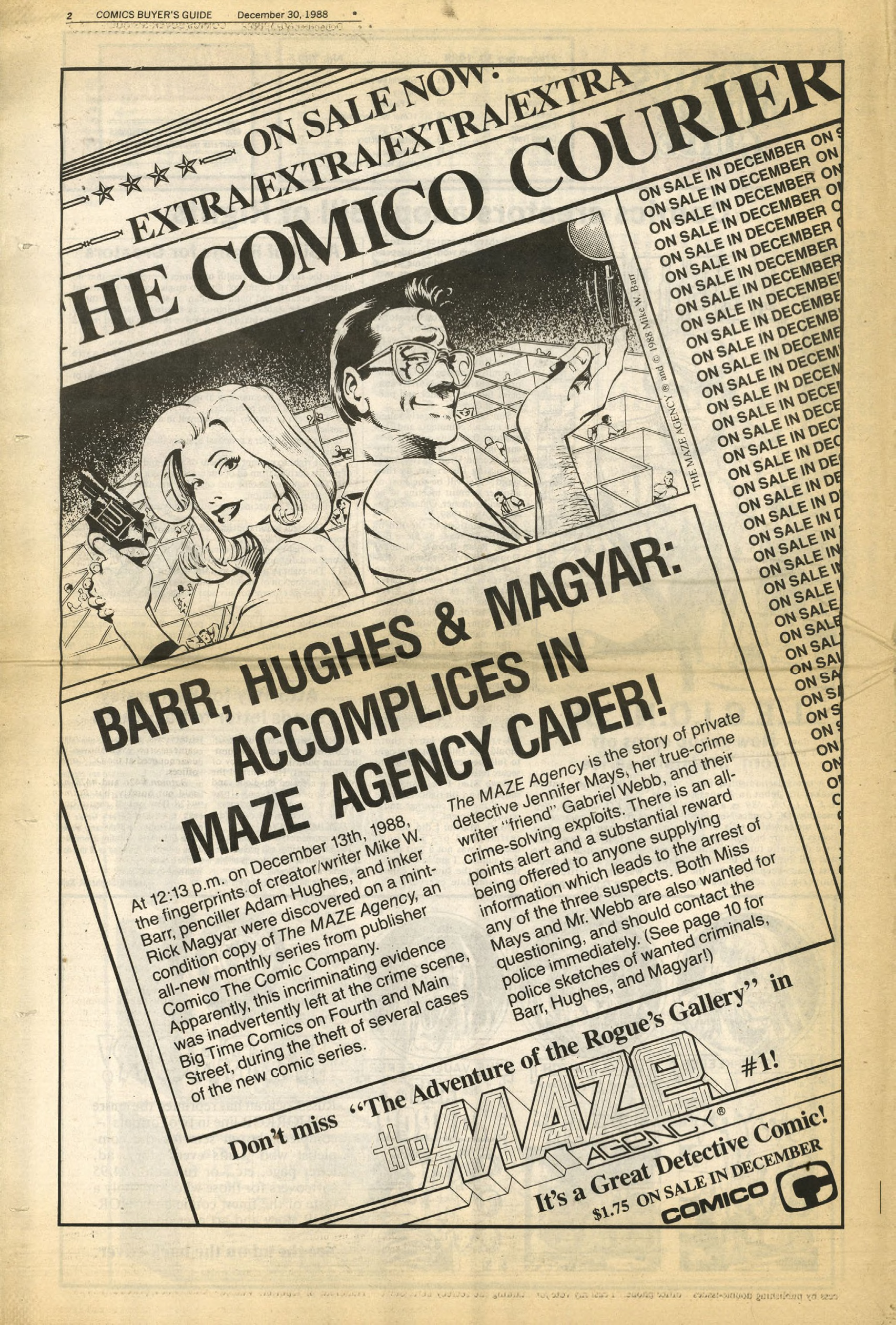
Amazing Heroes #159, page #67:
The Maze Agency is a new detective
series from the computer pen of Mike
Barr, long known for his Batman
stories. It concerns a detective agency
run by Jennifer Mays (Maze, get it?),
and her partner/boyfriend Gabriel
Webb. Jennifer is a classy, refined lady
who can hold her own against what-
sername from Murder She Wrote
anyday, and Gabe is a scruffy, bespec-
tacled guy who looks as comfortable
in mismatched socks and boxer shorts
as he does in a tuxedo. The two of
them are both good detectives; made
better when paired together to
combine wits.
In this introductory issue someone
has stolen the frames off of a set of
paintings by horrendous pop artist
Roald Trask, leaving the valuable
paintings hanging on the showroom
walls! Is it Winston Blakemore, his
agent, a cool cucumber if there ever
was one, Clarissa Whyte-Morgan, his
vengeful ex-wife, gallery manager
Jorkins who has an illicit background,
or Roald Trask himself, seeking his
last 15 minutes of fame? Think I’m
going to tell you? Naaah. Buy it and
read it for yourself.
Mike Barr is back on familiar ter-
ritory, although the detecting work of
the Maze Agency is far more subtle
and less brutal than that of a certain
darknight detective. Jennifer and Gabe
don’t swing down from roofs and beat
the information out of thugs, they go
the cerebral route. Barr has the mys-
tery formula down pat, but does not
write his stories in formulaic ways.
Given the heroes of the piece, you
would almost expect a re-run of
Moonlighting or Remington Steele,
and it would be a fallacy to say there
wasn’t a little of both in there. Here
though, Barr infuses into his charac-
ters—in one issue—as much person-
ality as we’ve seen in a whole season
of the previous shows!
Barr’s writing is crisp and clean,
fun to read and fun to figure out the
mystery behind. I got some of the
solution but not all of it, a mark for
me that the mystery is not too difficult
but not very easy either. Barr is much
better in this mode than any past
comic-detective writer that I can think
of; certainly he’s much better than
Don McGregor and his Nathaniel
Dusk or Detectives Inc.
But if Barr is crisp and clean, Adam
Hughes is more so. Hughes’s work
looked remarkably similar to Steve
Rude’s in the past; here he combines
that with Alan Davis’s style to come
up with a beautifully pleasant art style
not entirely new but not exactly ob-
vious in its influences. I was appre-
hensive about Magyar’s inking when
I first heard he’d be on this book, as
his beautiful Question inking seemed
a little rough for Hughes’s pencils, but
he pulls the job off wonderfully,
lending an edge to it that may not have
been in the pencils.
Overall, Maze Agency is extremely
well-written and excellently drawn.
Whether you like detective series or
not, this is suggested; it is so very
good. Colorist for the series is Julia
Lacquement, who has always turned
in impeccable work on her other
series, so all-around, I expect this to
be one nice-looking and (hopefully)
successful book. Good luck to all con-
cerned. The detective market is an
unknown quantity in comics, and I
hope it proves successful.
The grade? It shouldn’t be a mystery
to you by now.
GRADE: MINT — Andy Mangels
It was a great series, but in the dog-eat-dog world of indie comics it only lasted twenty or so issues. Still, in the world of comic books, no character ever truly fades away… ask Slam Bradley.
I wish this wonderful mystery series could somehow manage to catch on, but it faces the same struggles so many creator-owned titles do: not enough sales to make enough money to keep a top-flight artist, and without artistic consistency and talent, it can’t get popular enough to break the cycle, no matter how good the writing is.