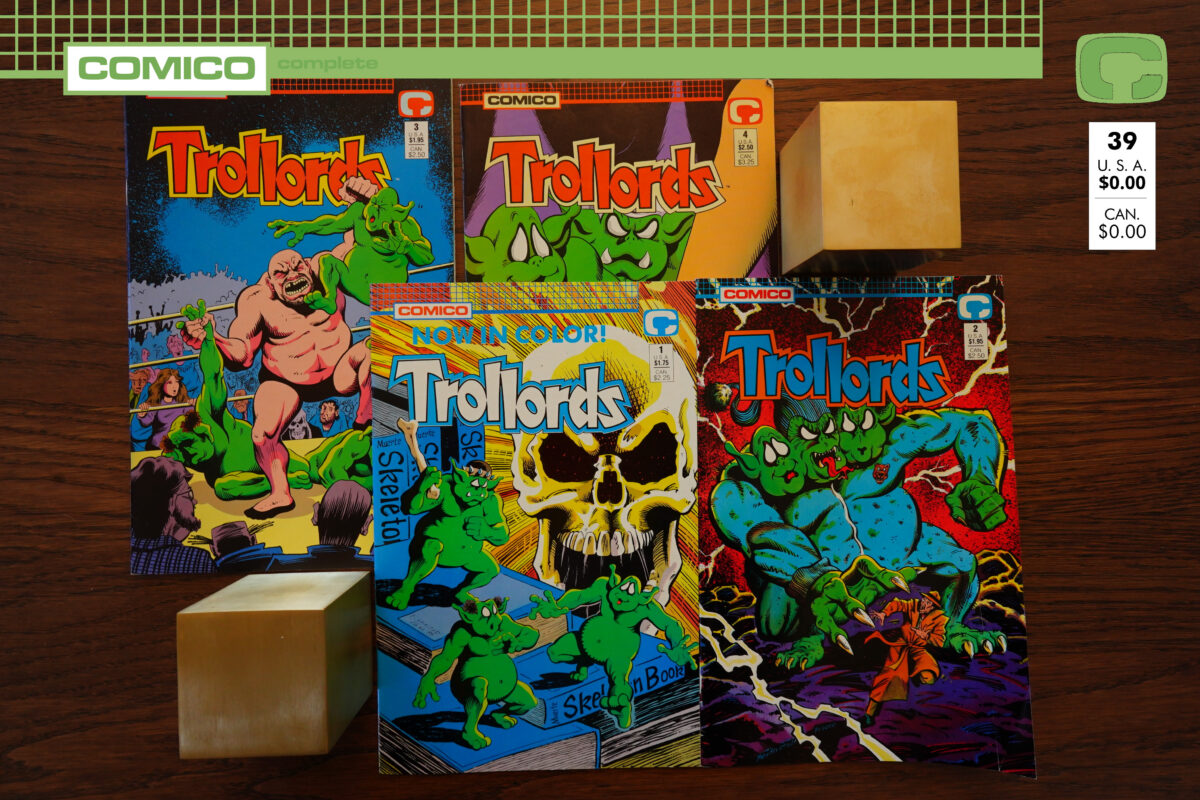
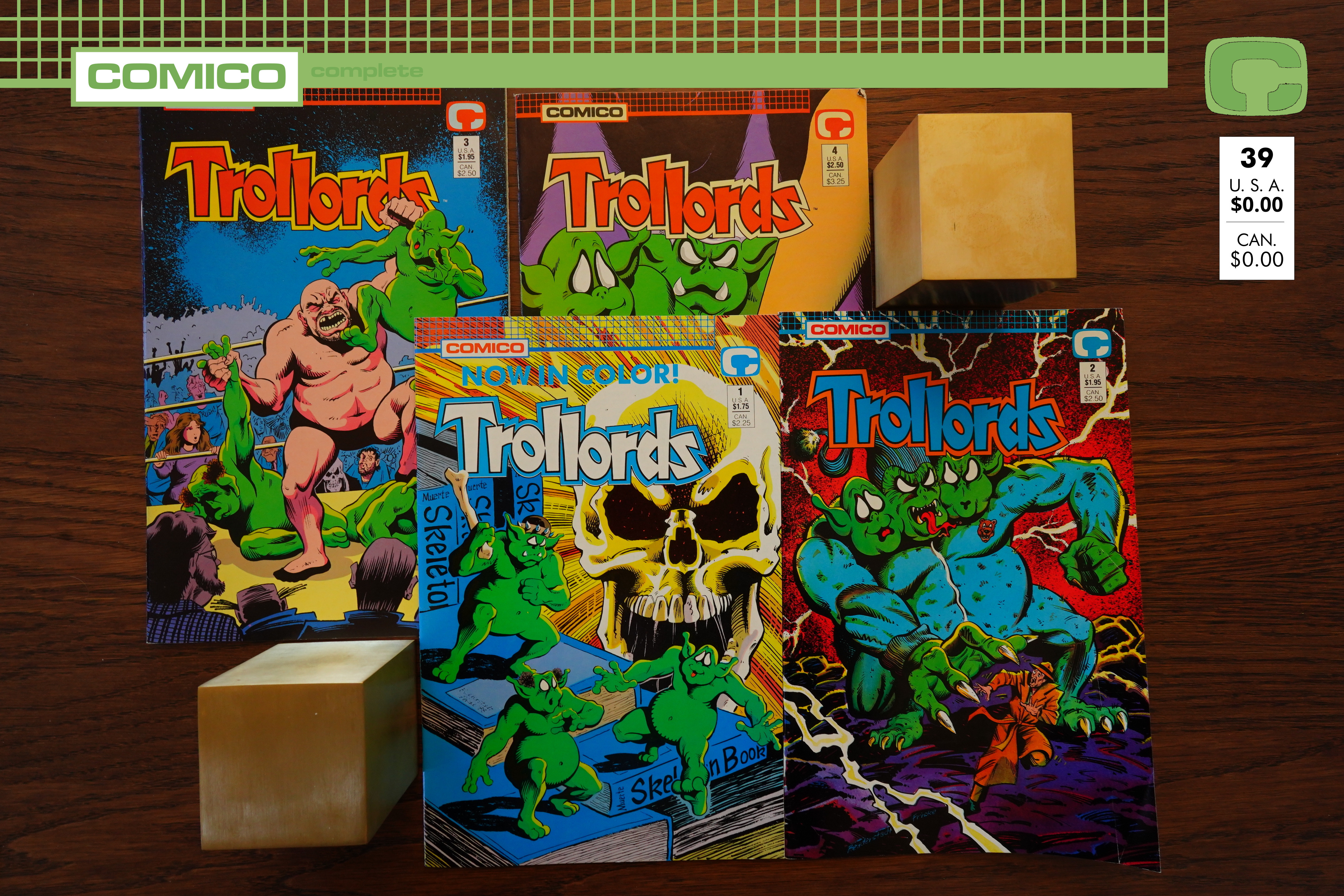
Trollords (1988) #1-4 by Scott Beaderstadt and Paul Fricke
Trollords was a title I was aware of during the 80s — it was one of those black and white boom/bust speculator books that (after Teenage Mutant Ninja Turtles paved the way) eventually led to yet another one of the American comics market melt-downs. So I saw it mentioned in a lot of news stories and articles, but I never actually read it myself.
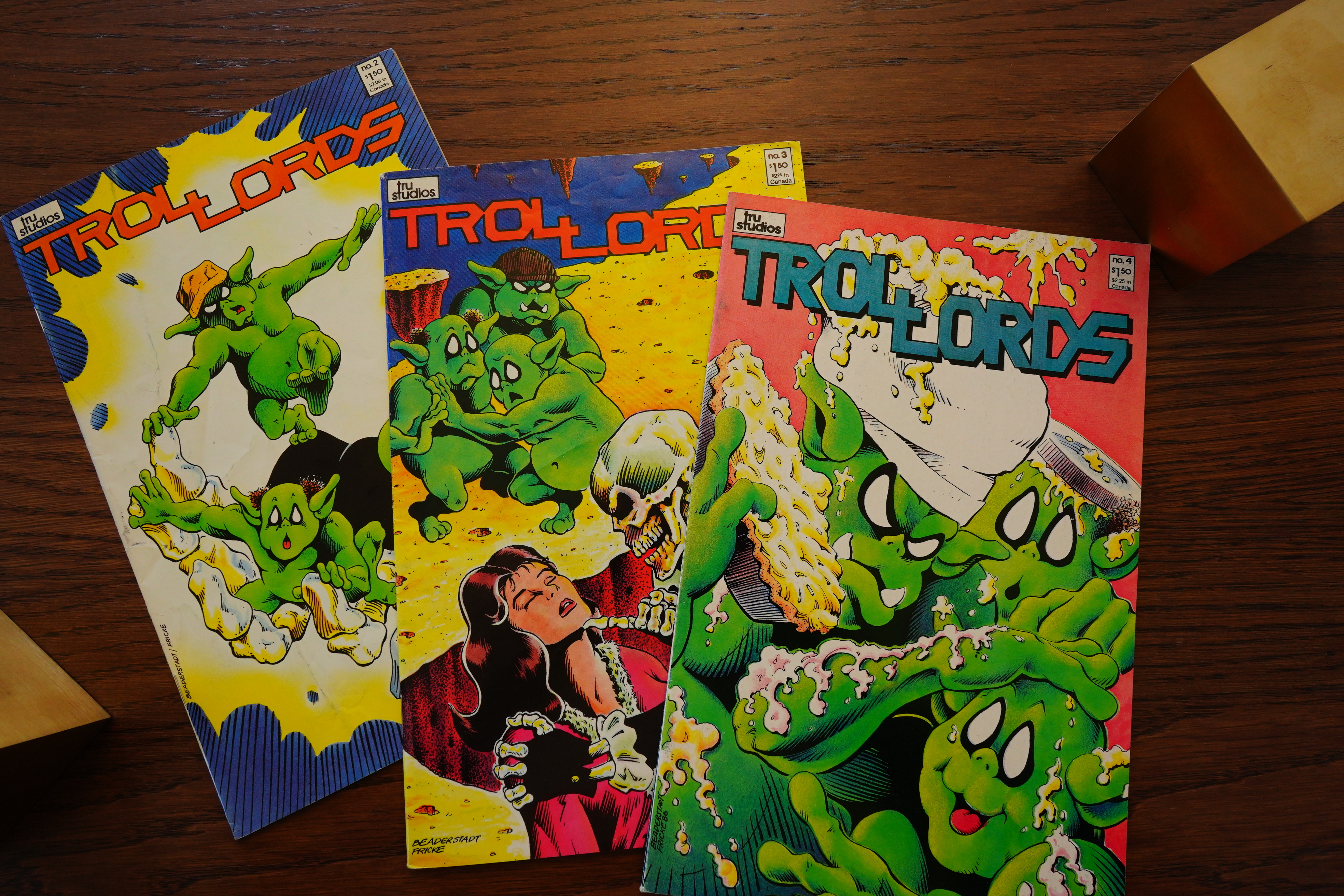
And while trying to buy the four Comico issues of the series, somebody sold me #2-4 of the original Tru Studios series. This has happened a lot during shopping for this blog series, because you buy “Trollords #2” from somebody, and they send you the wrong #2. And it’s happened so much because Comico took over so many series that had previously had runs elsewhere…
But now that I’ve got these issues, I might as well read them.
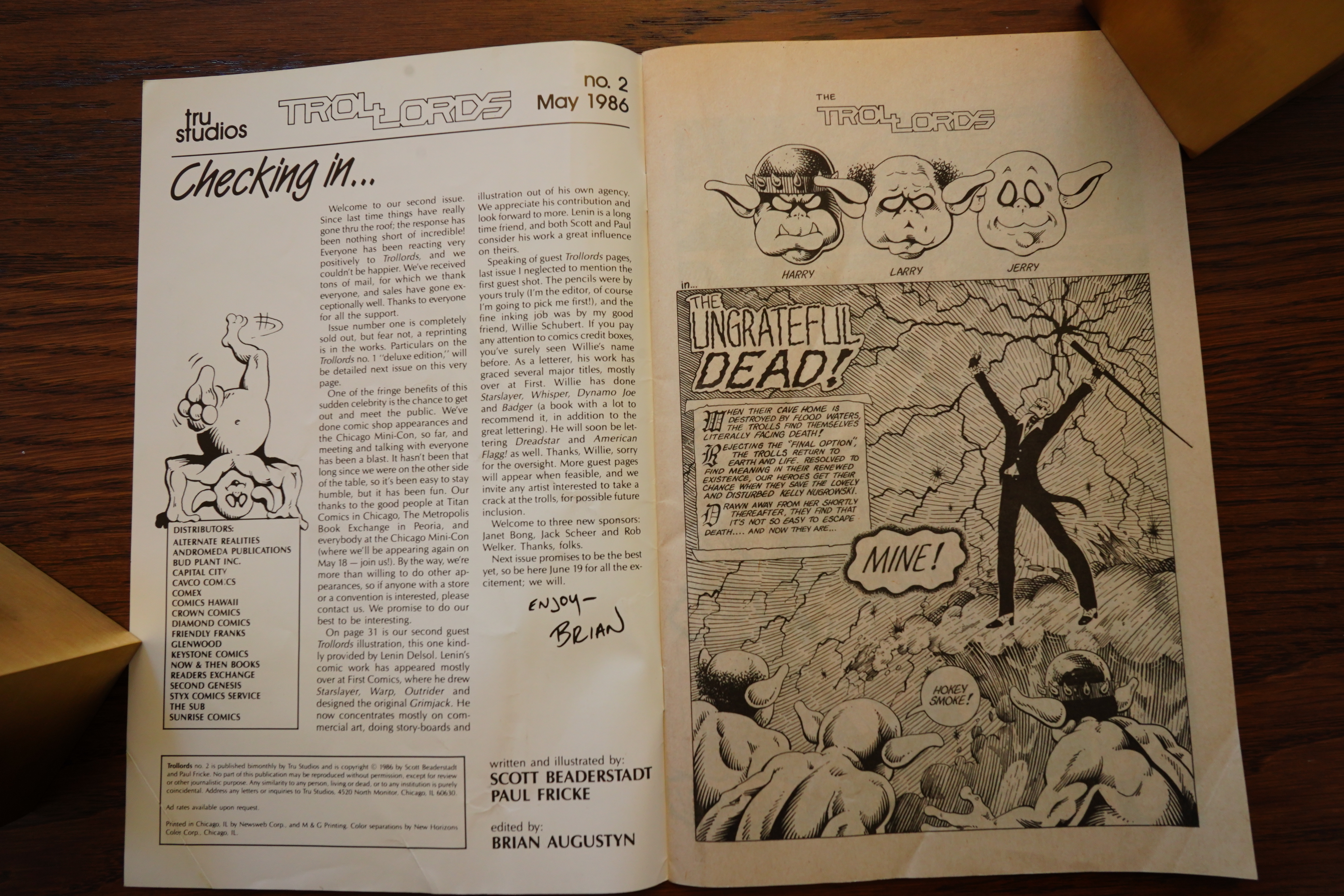
The editorial in #2 comments on #1 being an unexpected hit — it sold out and became a collector’s item. Let’s see…
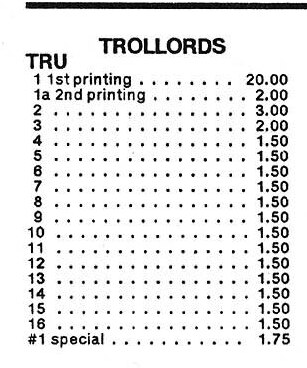
Yeah, here’s a price list from 1988.
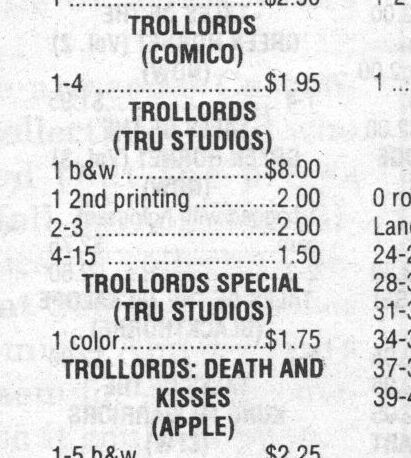
And then ten years later things are getting chilly…
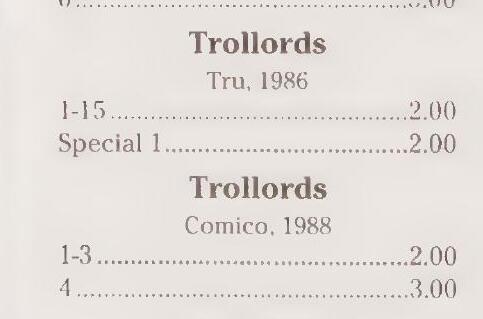
And then ten years later after that again, the demand has collapsed totally, of course.
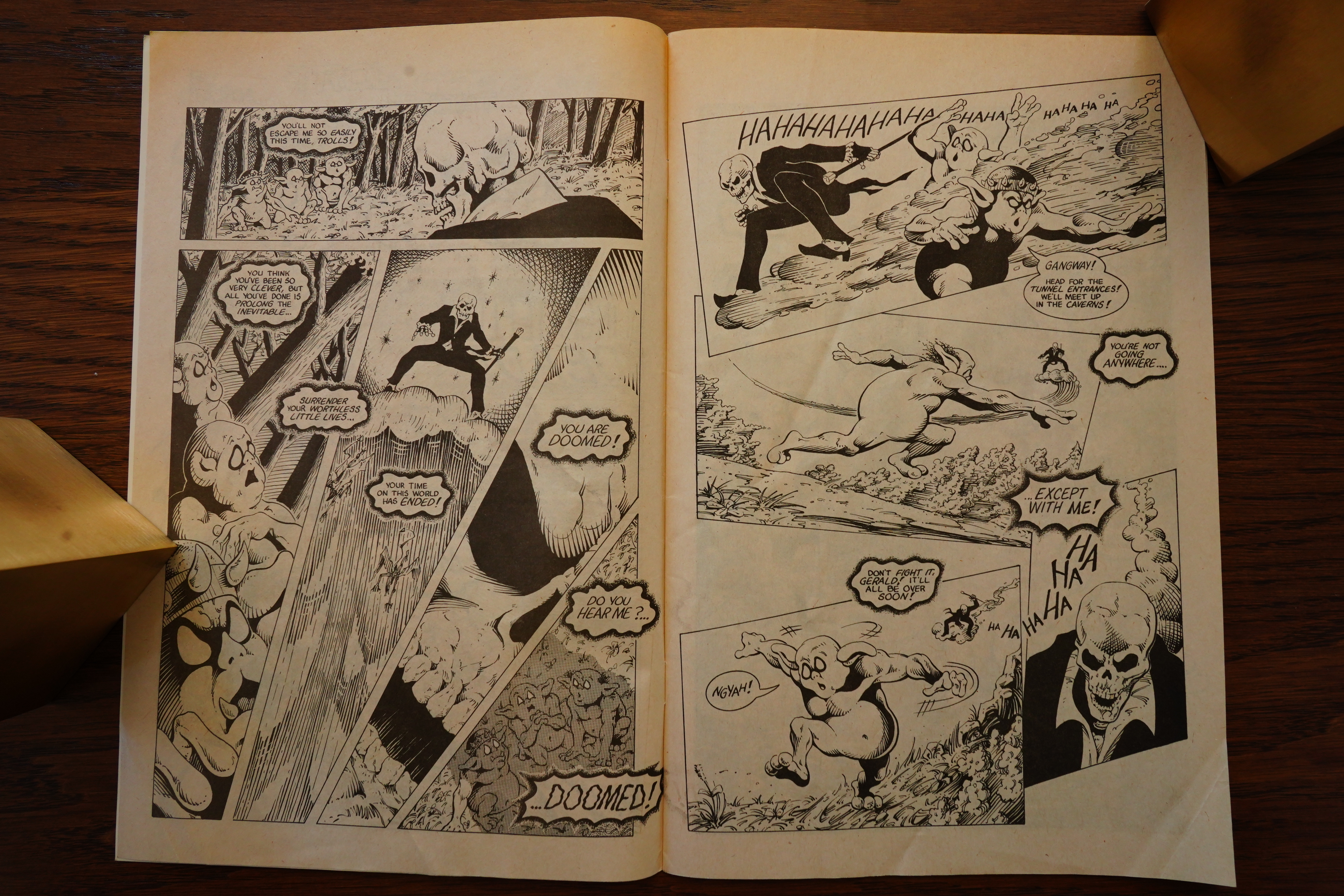
But how’s the book? It’s not bad! I had expected something really kinda crass and amateurish, but it’s pretty good.
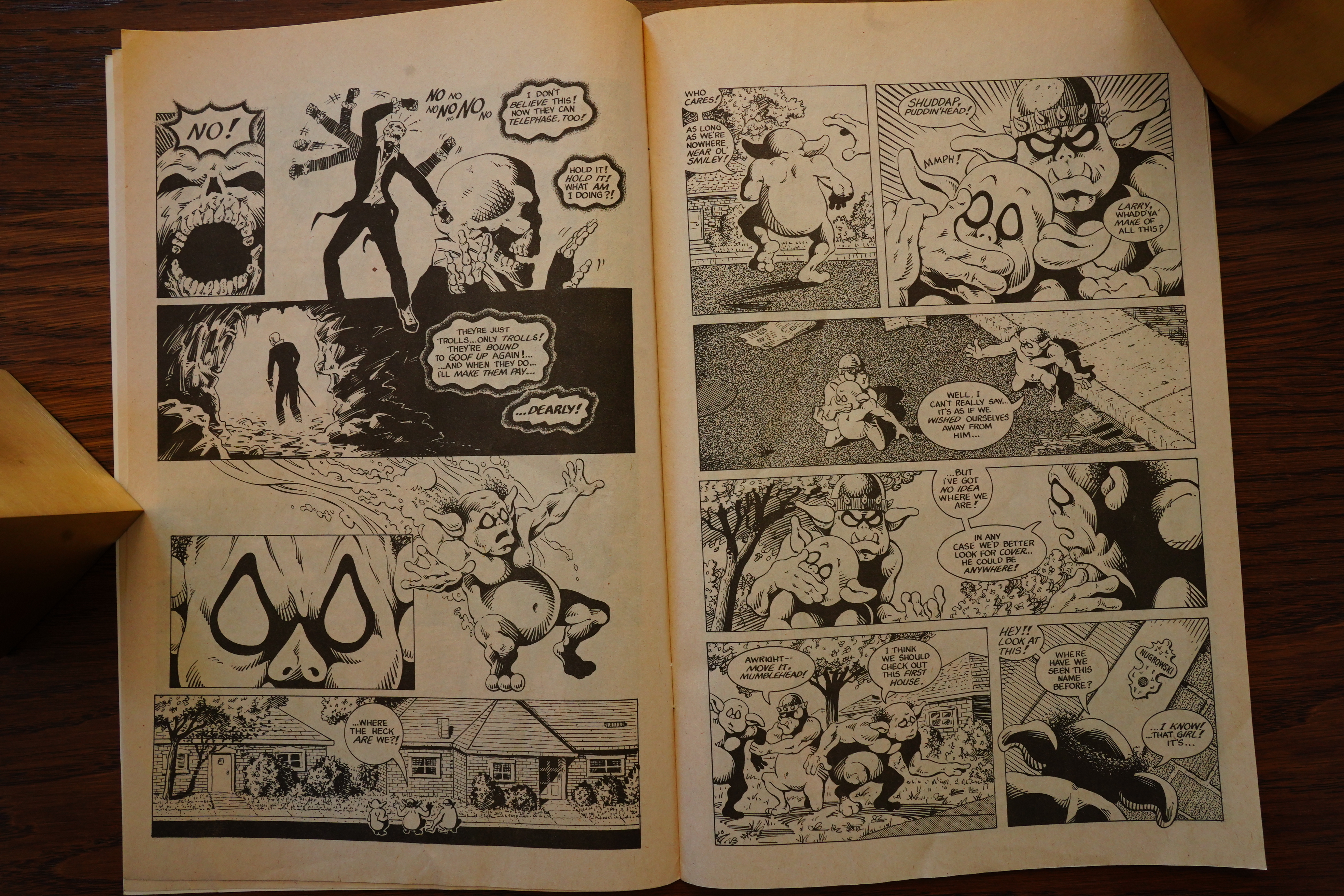
I had expected it to be just a bunch of sight gags based on the trolls not having clothes, but that doesn’t come into it at all. Instead it’s an amusing story about these trolls fighting against death (?)…
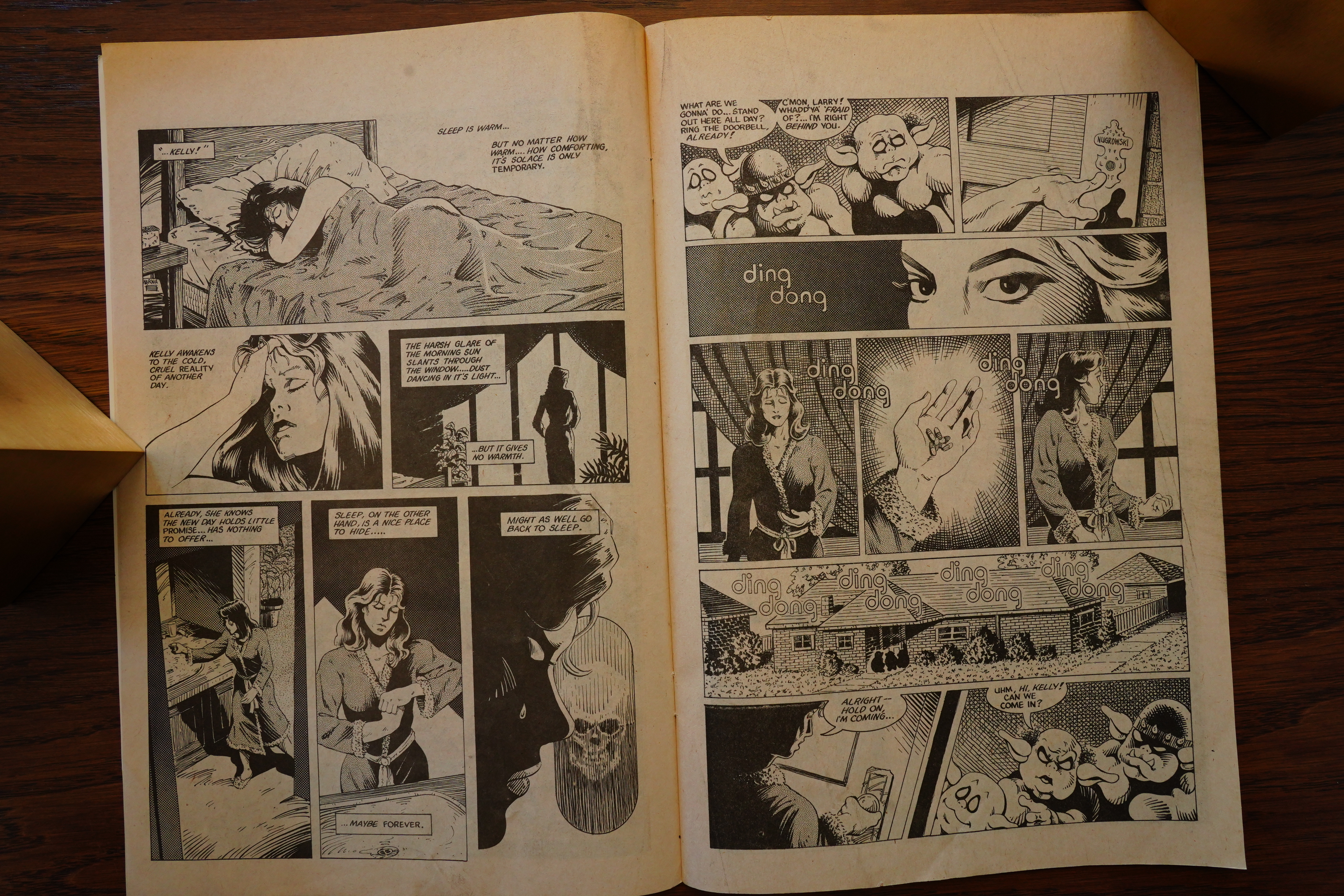
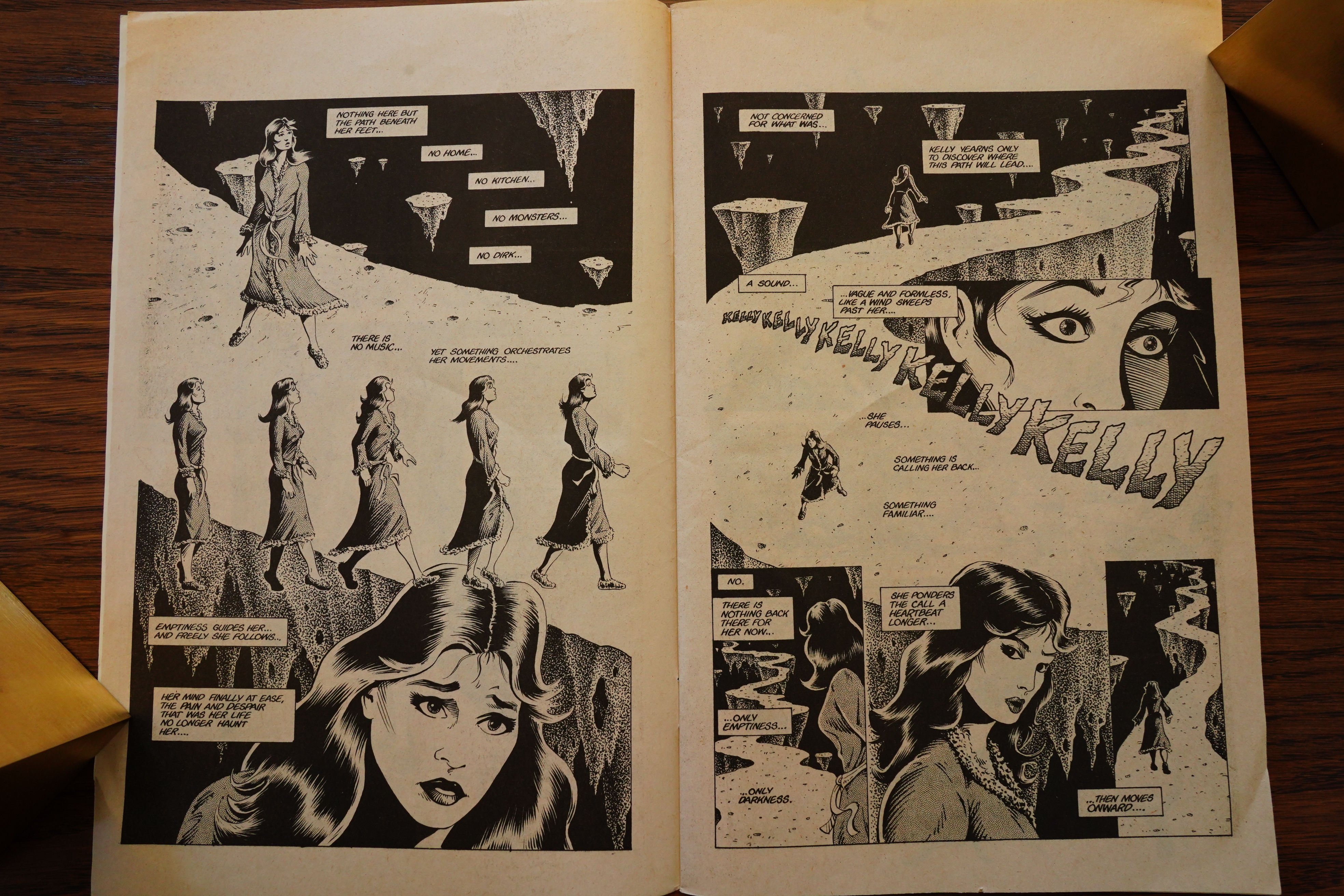
… and stopping this woman from committing suicide! Not at all what the words “Trollords” and “black and white boom” conjures up in your mind.
It’s easy to forget how influential Dave Sim was at the time — Cerebus wasn’t just successful critically, but shifted a lot of copies (especially during the boom and bust years, I guess).
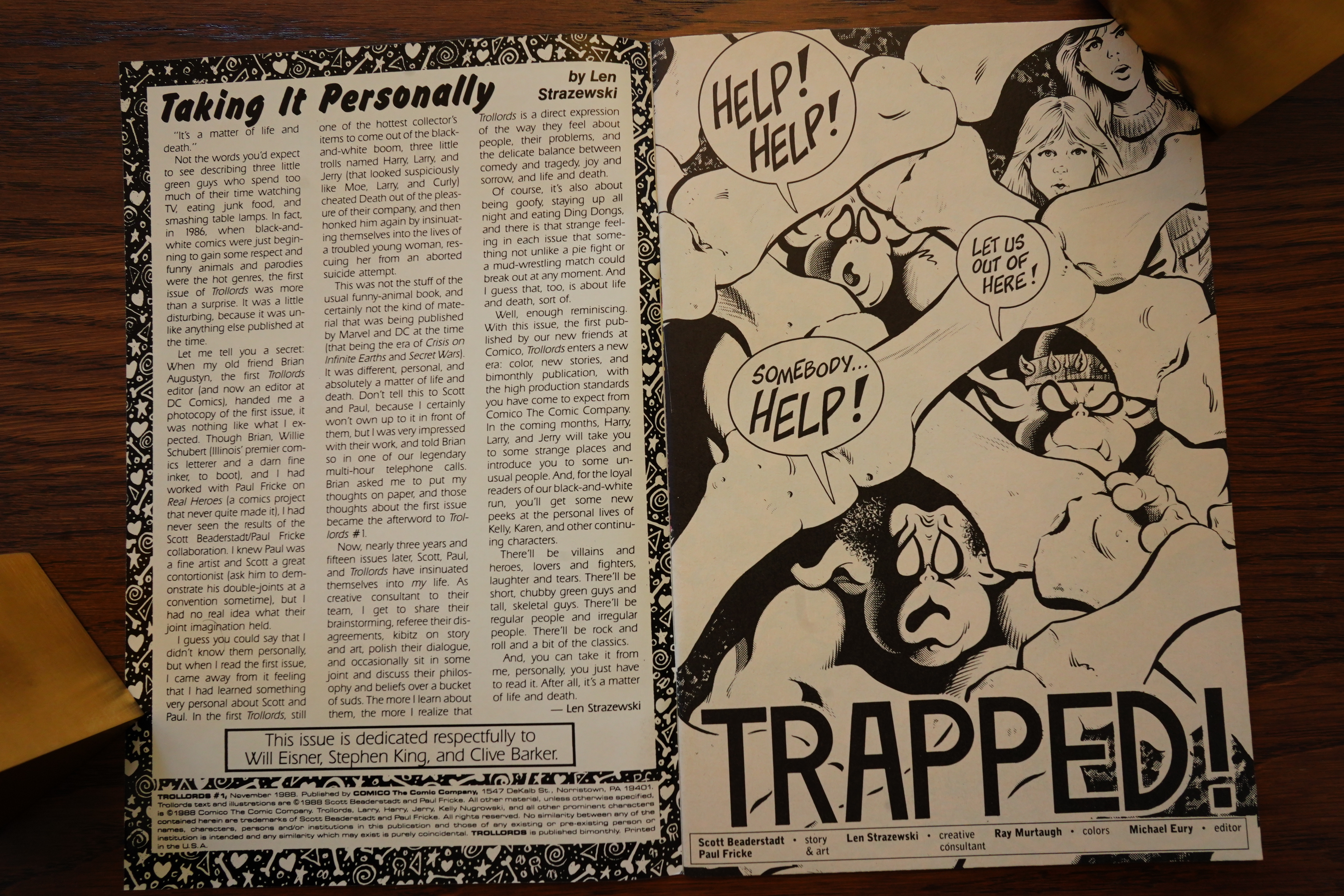
Anyway, we finally arrive at the Comico issues. And it’s not like with Fish Police, where Comico reprinted the original series in colour, but we apparently just continue whatever storyline they had going for the first fifteen Tru Studios series.
The first three pages are in black and white…
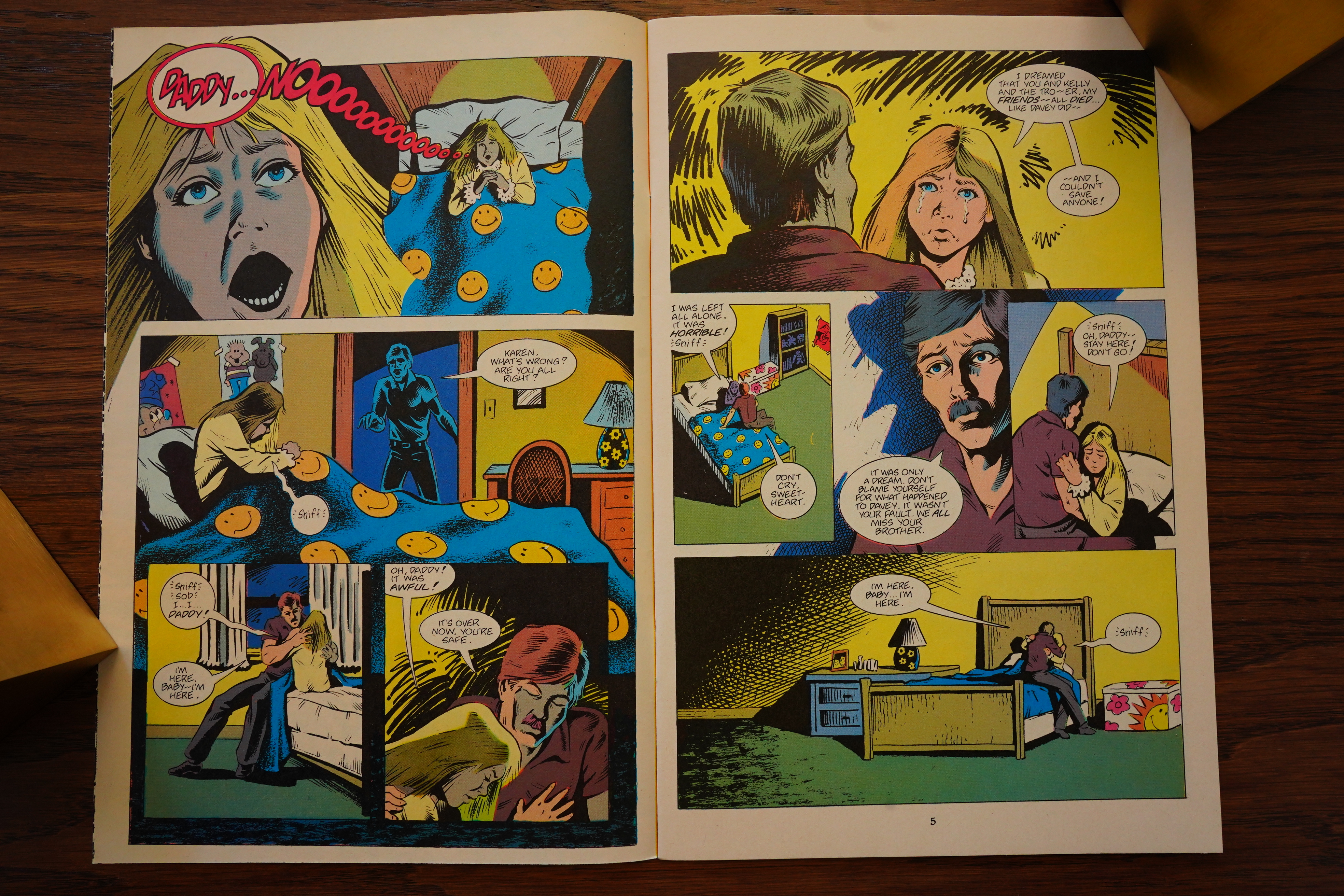
… but they turn out to be just a bad dream! Which is a nice touch.
But… who are all these characters? Once again, a Comico series starts without any explanation as to what’s going on, just dropping us into the middle of the storyline. It works better here than in many of the other series, but I’m starting to wonder whether Comico had a policy of never explaining anything to the readers. I mean, recaps are tedious, and infodumping is old-fashioned, so it makes sense. But…
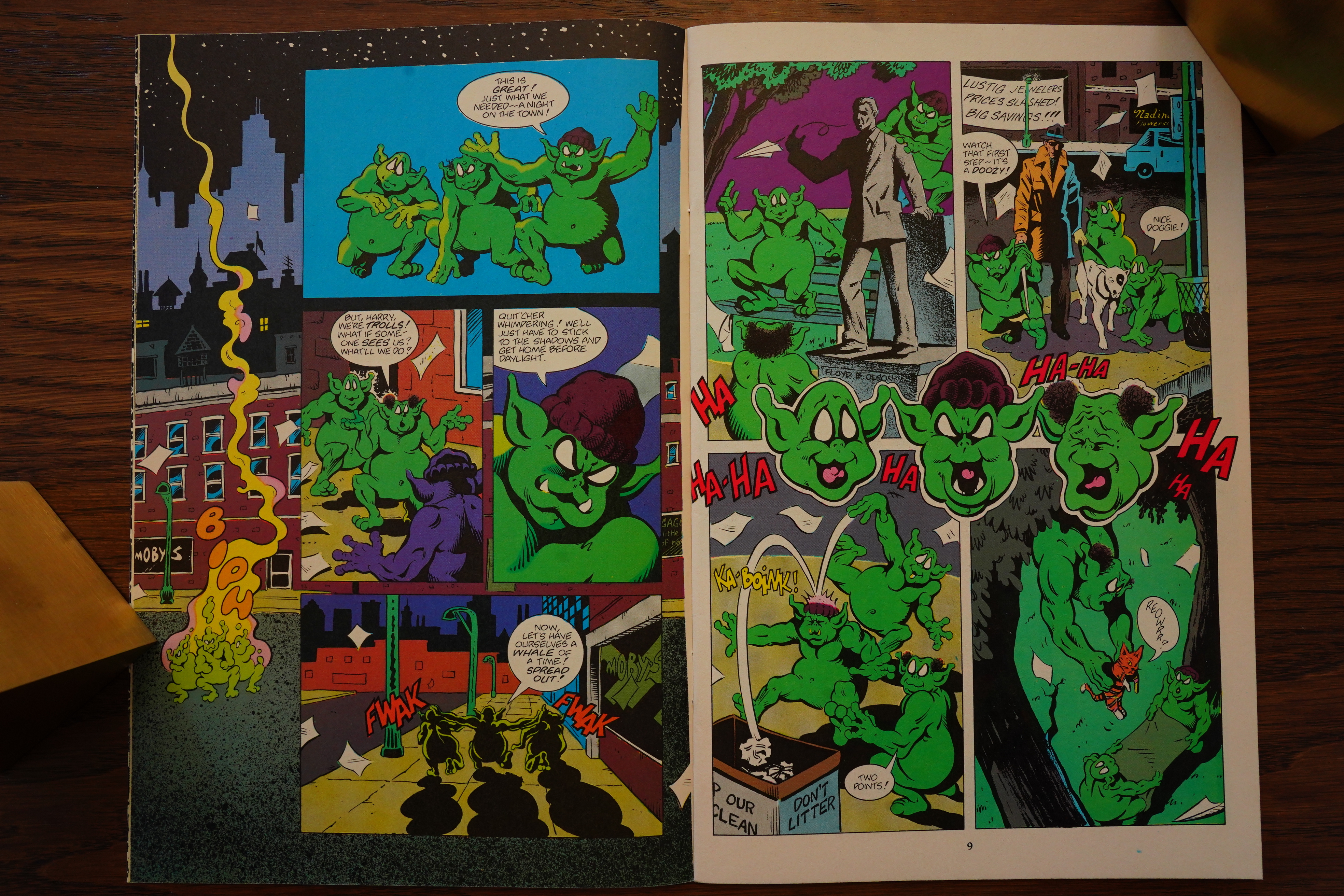
Anyway, it looks like the trolls have settled into a routine of being sort of minor do-gooders — just going around helping people? While having fun?
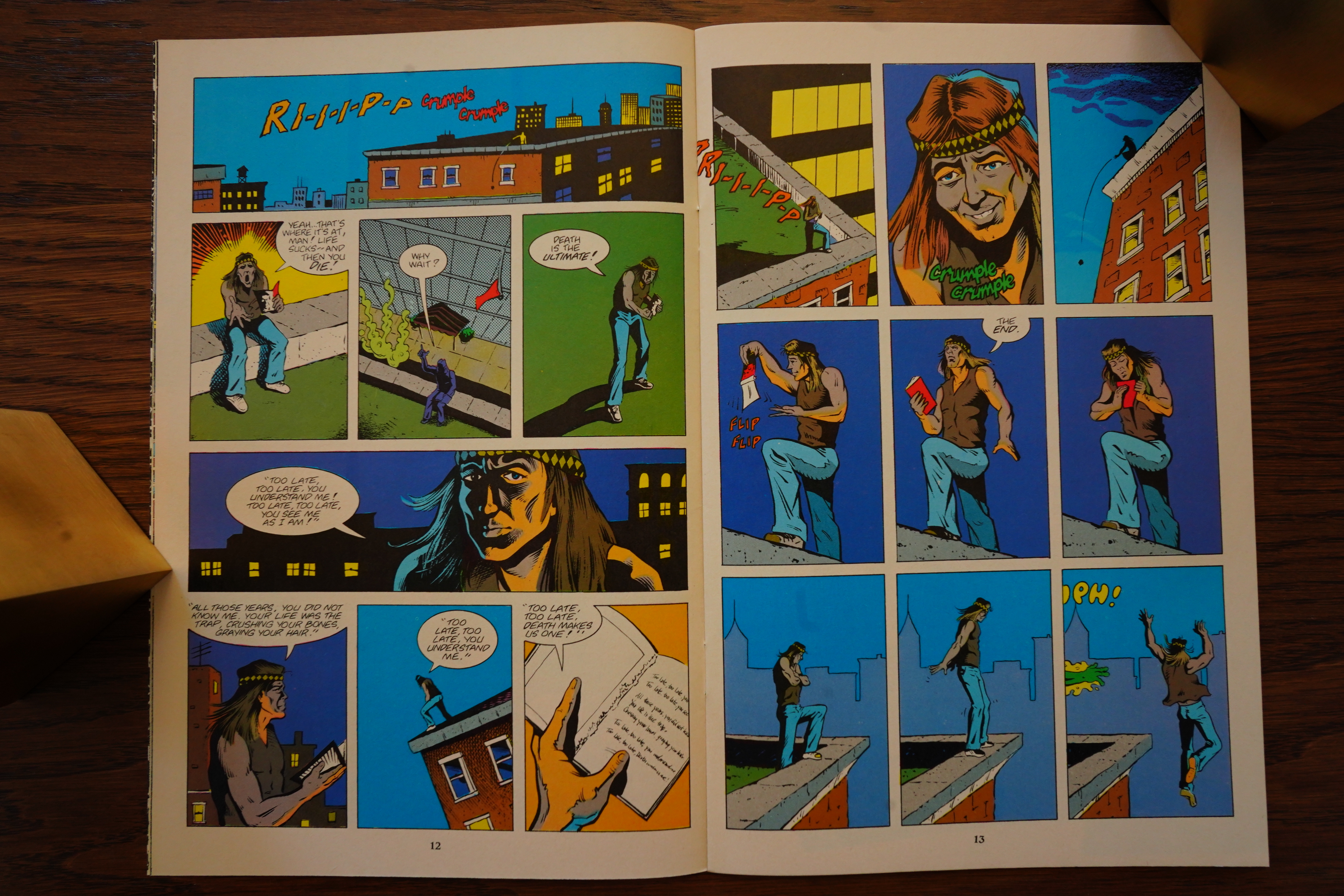
And then… like in the first #2, they stop a person from committing suicide! So it’s like a callback, I guess, but it’s still pretty weird.
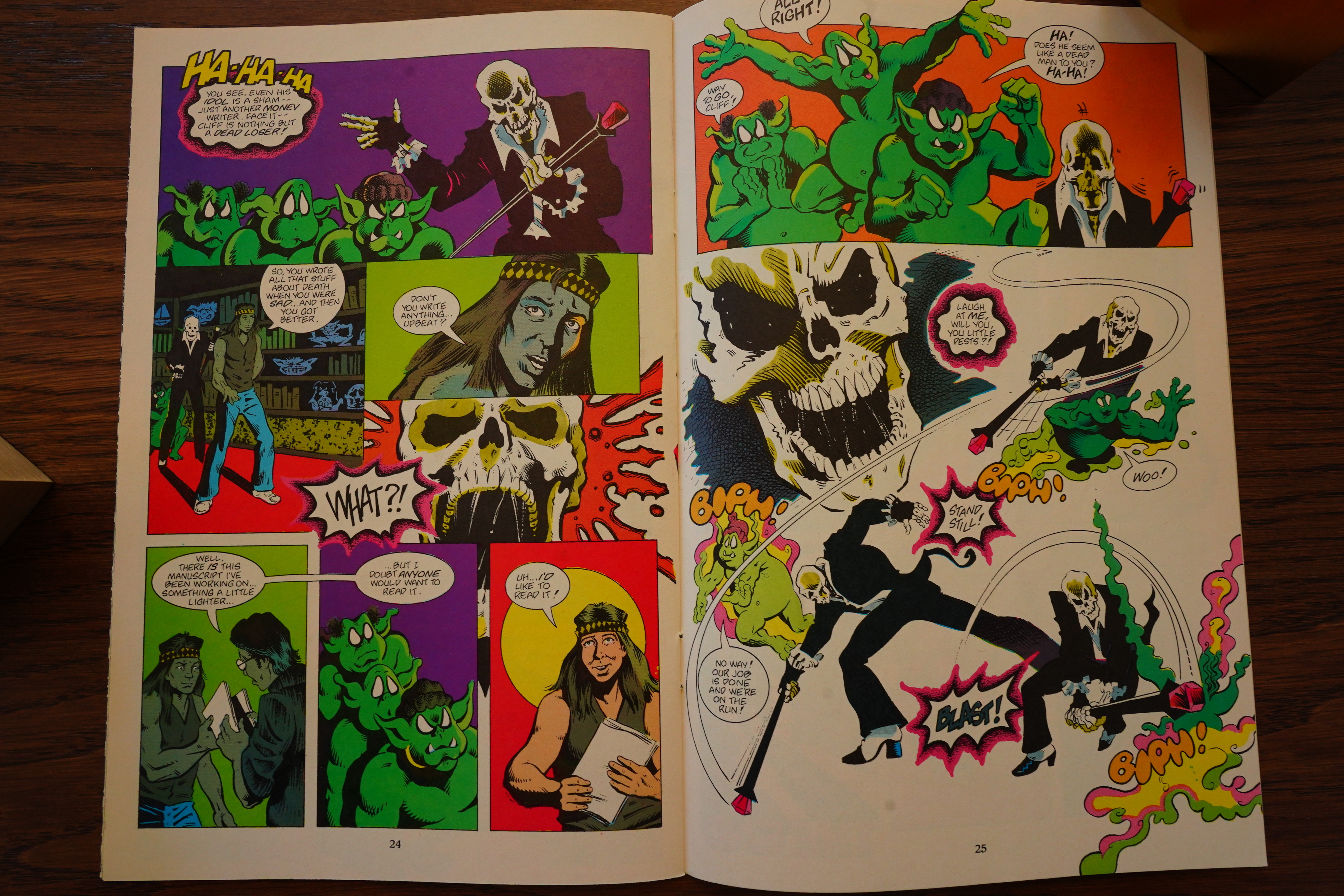
It turns out that the guy tried to kill himself because he was reading depressing books, but he convinces the author to start writing funnier stuff, and that vanquishes Death? Makes sense to me.
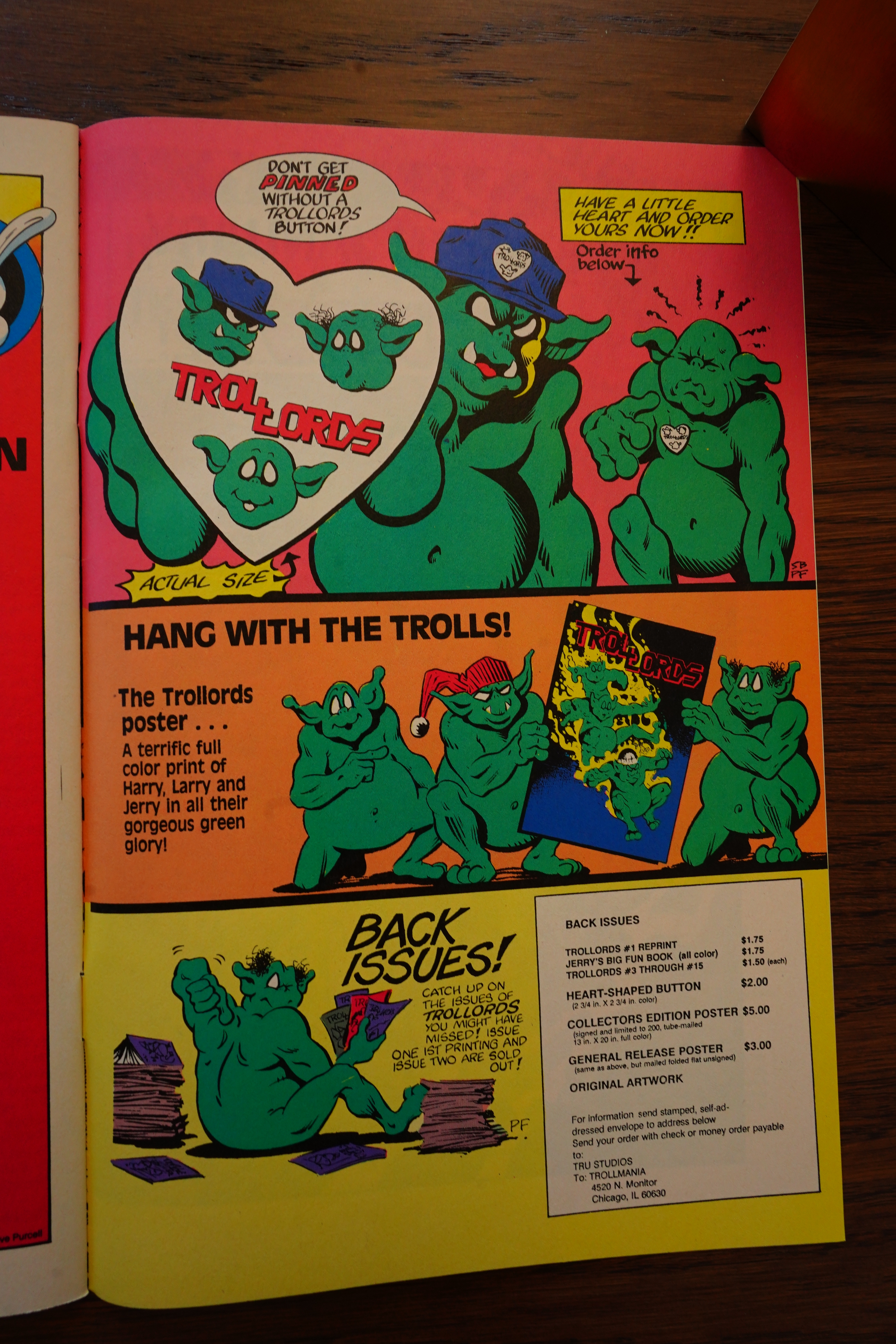
There’s merch — pins, posters, and they have almost all the back issues still in stock. So I guess people who found this non-introduction to the Trollords confusing could just send off for an almost complete set of books.
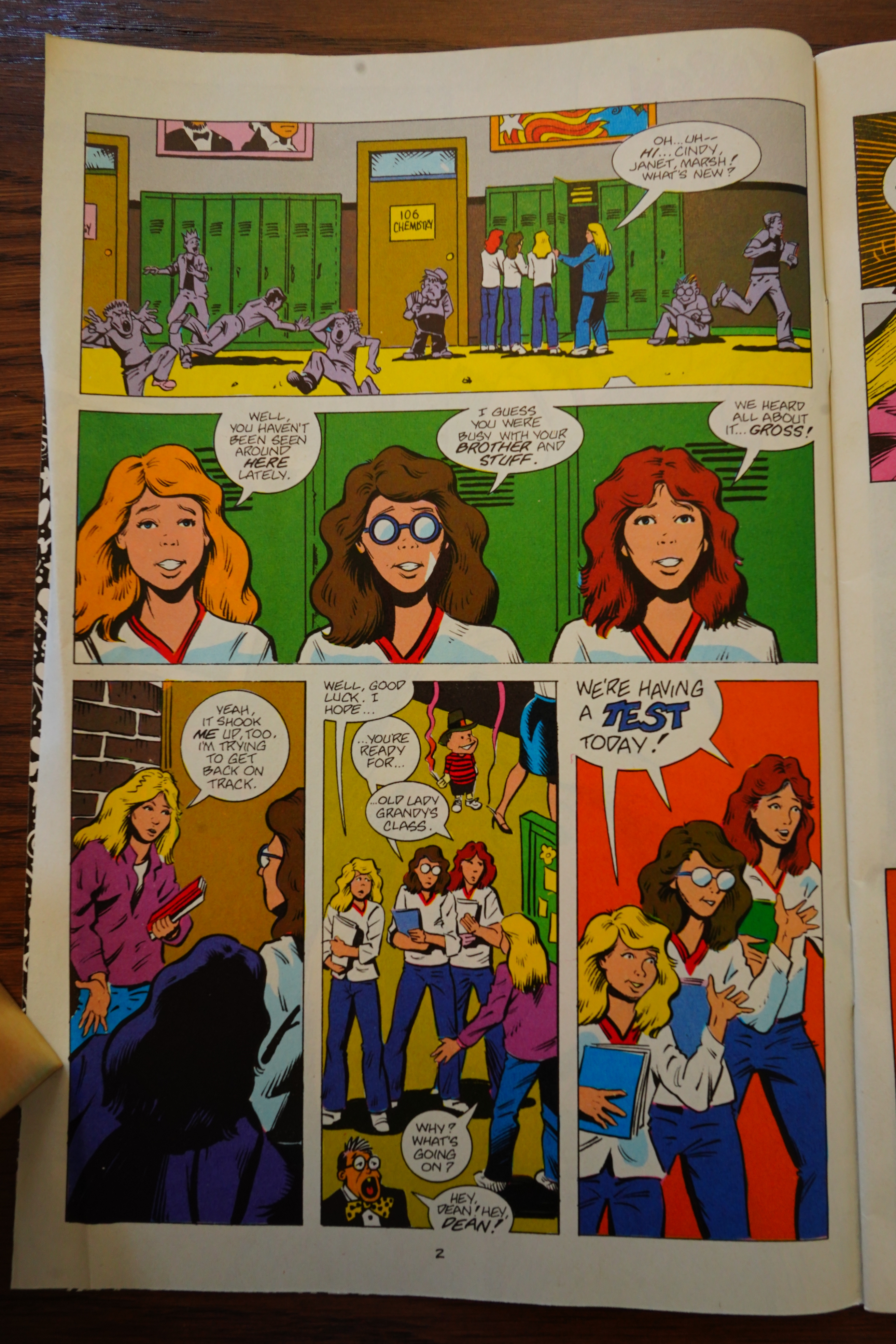
But it’s still weird — there’s not even a hint towards explaining what this is all about. “We heard all about it… gross!”
My first issue of Cerebus was #49, and if you’ve read Cerebus, you know that’s possibly the absolutely worst issue to start on. (Well, if you ignore all issues after #200 — all of those are even worse, but for very different reasons.) But I was still totally into it, and I knew immediately that there was an intriguing story behind what I was reading, and I eventually caught up. It worked great, even if nothing was explained.
Very few comics are Cerebus #49, though. While the above is a pretty good scene, I’m not really going to go back and get the previous fifteen issues to find out, and I don’t think I’m in the minority here.
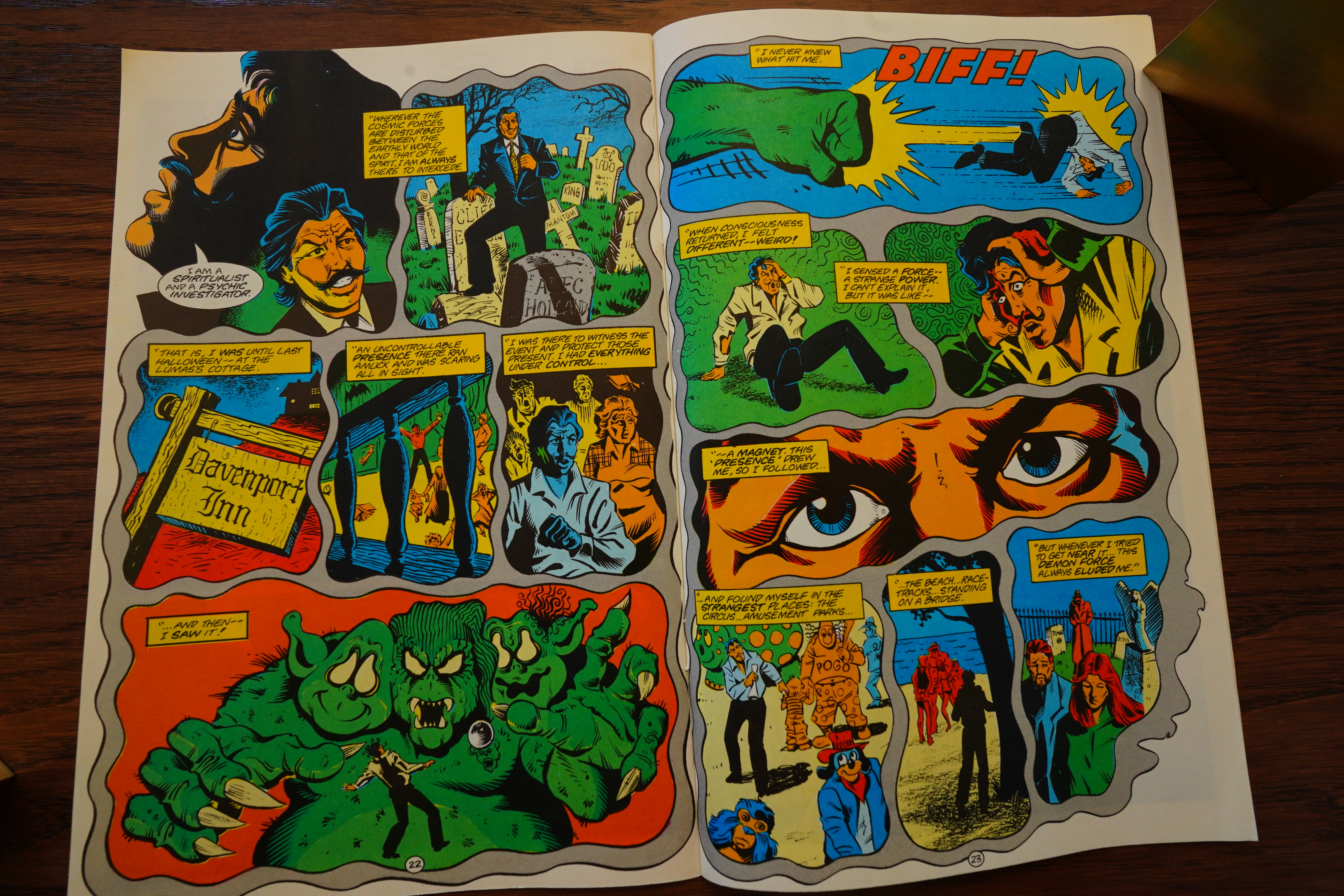
And I guess this feverish retelling of a previous encounter would be funnier if you’d read the previous encounter.
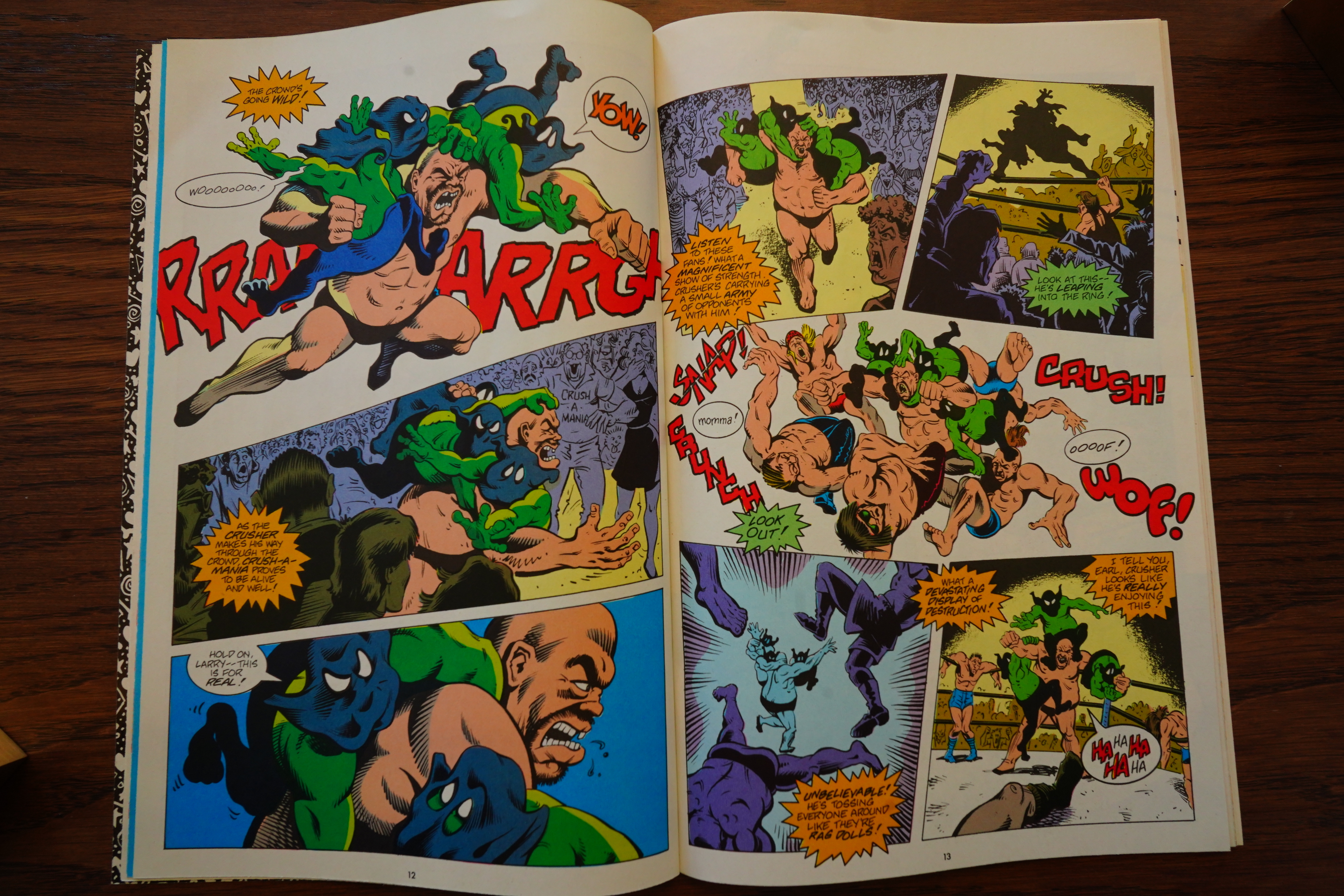
Anyway, the issues basically follow the same structure — the trolls learn of somebody needing help, and then they go out and help them. So it’s mostly one-and-done issues, but with a couple of B plots that continue throughout the series. It works well.
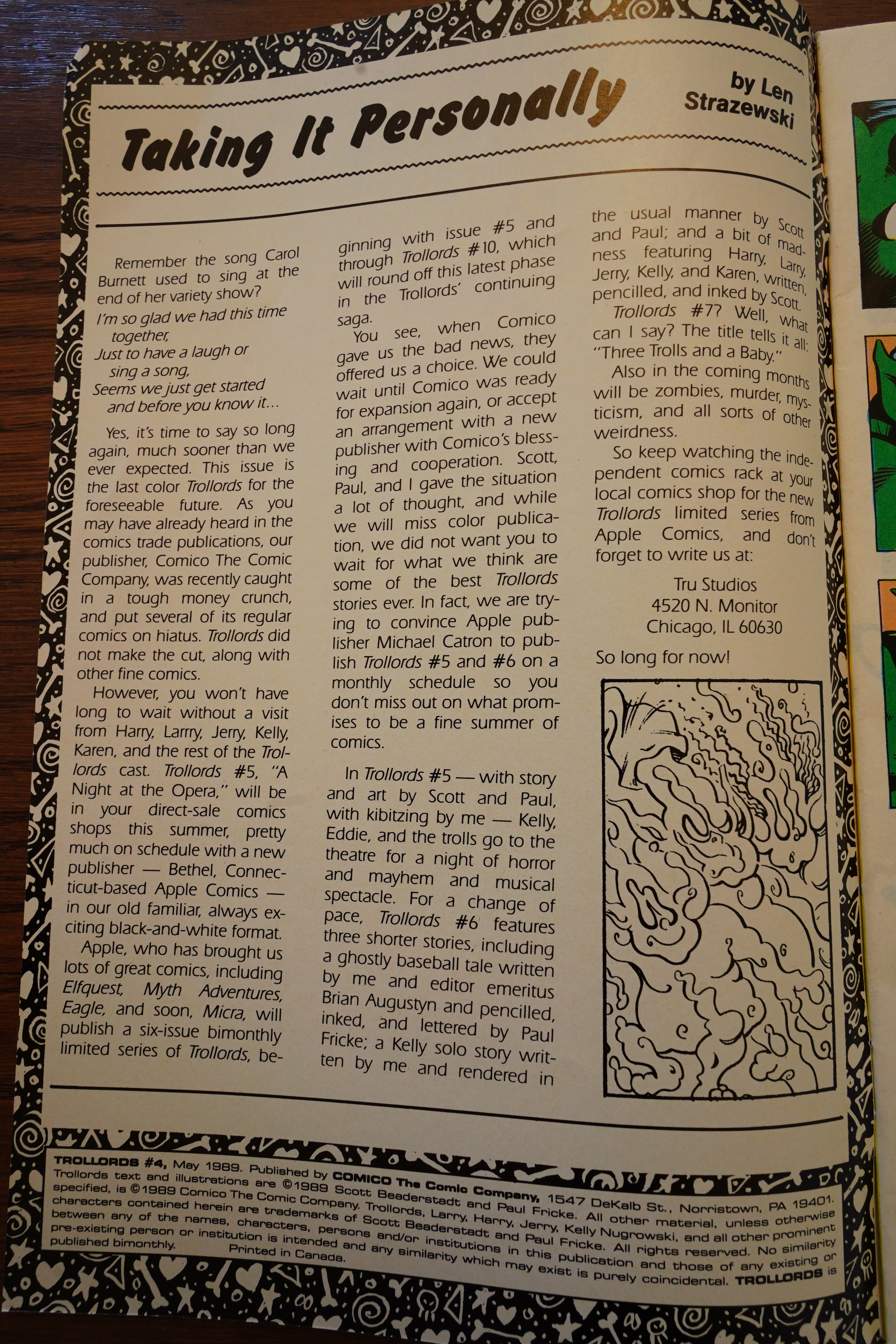
After just four issues, the book is cancelled. It’s not because sales were horrendous, but Comico was in a cash squeeze at the time and had to dump the lowest-performing books. But it looks like Comico gave the creators heads-up in time to allow them to take the book elsewhere without too much disruption. Which is nice — another example of Comico treating the creators fairly. The only people they stiffed were the printers, I think…
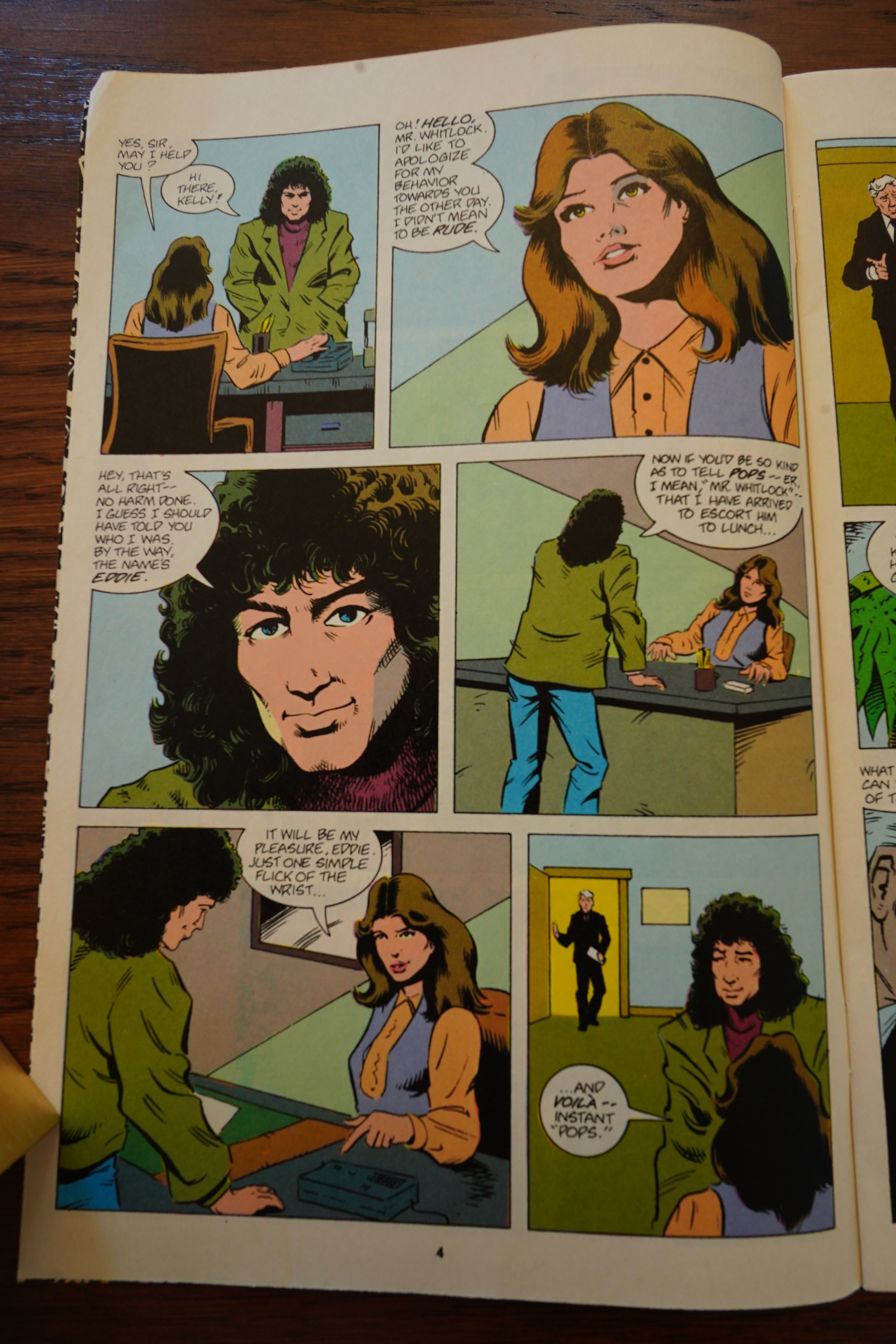
The artwork on Trollords continues to evolve — the cartoony bits get more cartoony, and the non-cartoony bits grow lusher. But sometimes not much in the way of backgrounds.
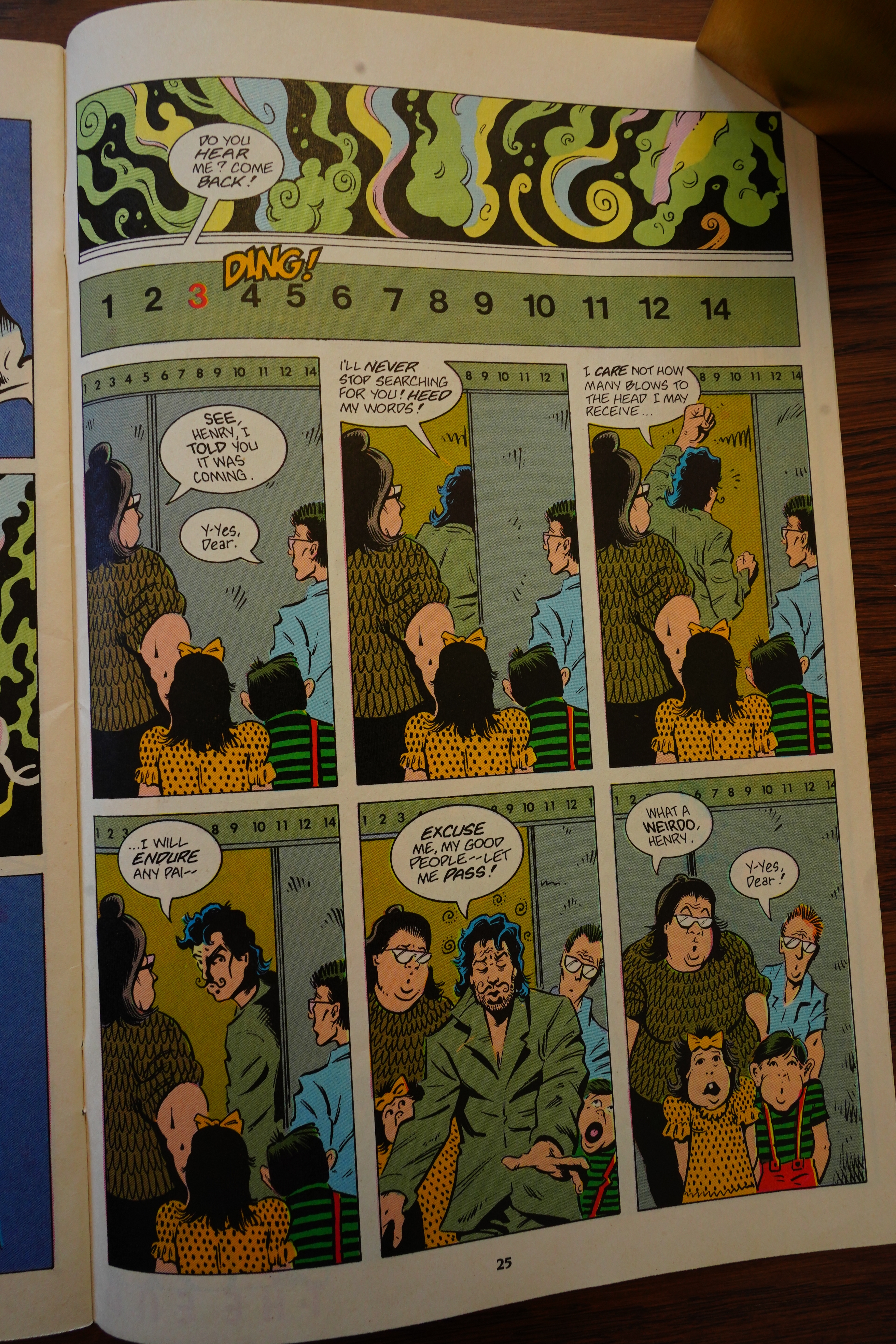
The comic timing is pretty good. And I love that final panel.
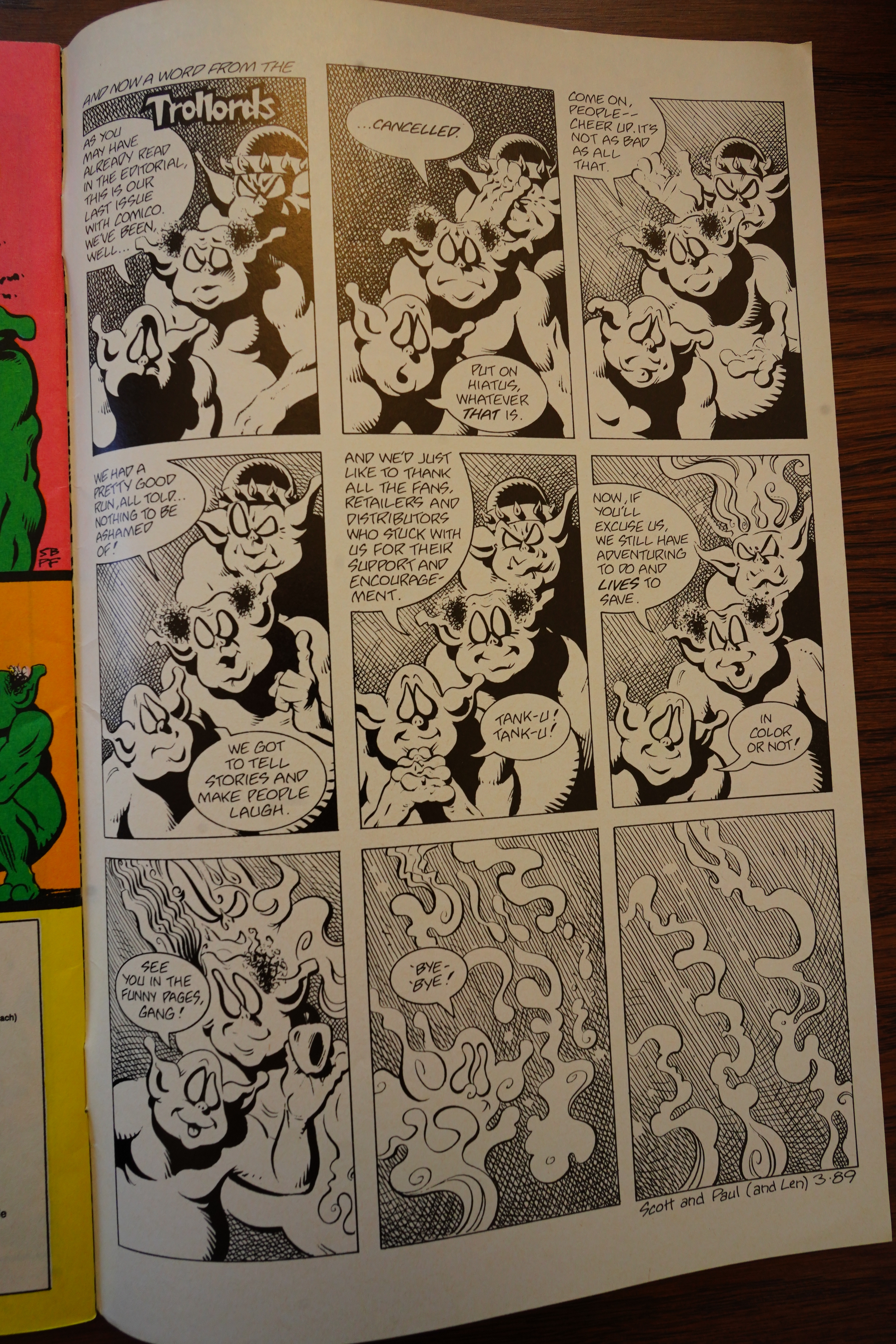
And we even get a goodbye to the Comico readers from the trolls.
It’s a much better series than I had expected. Good art, amusing gags, and an overall plot that (perhaps) was going somewhere? It’s hard to tell from these seven issues, though.
Trollords continued on with six issues from Apple, and then two issues from Caliber in the late 90s, and that’s it. The book has never been collected or reprinted, but you can pick up a complete set from ebay at about cover price, usually.
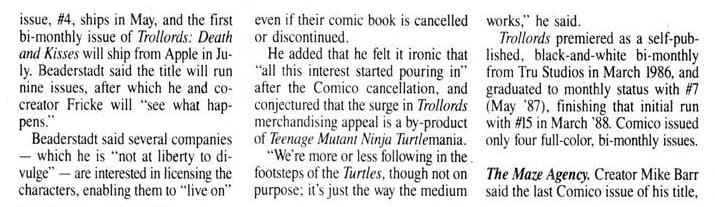
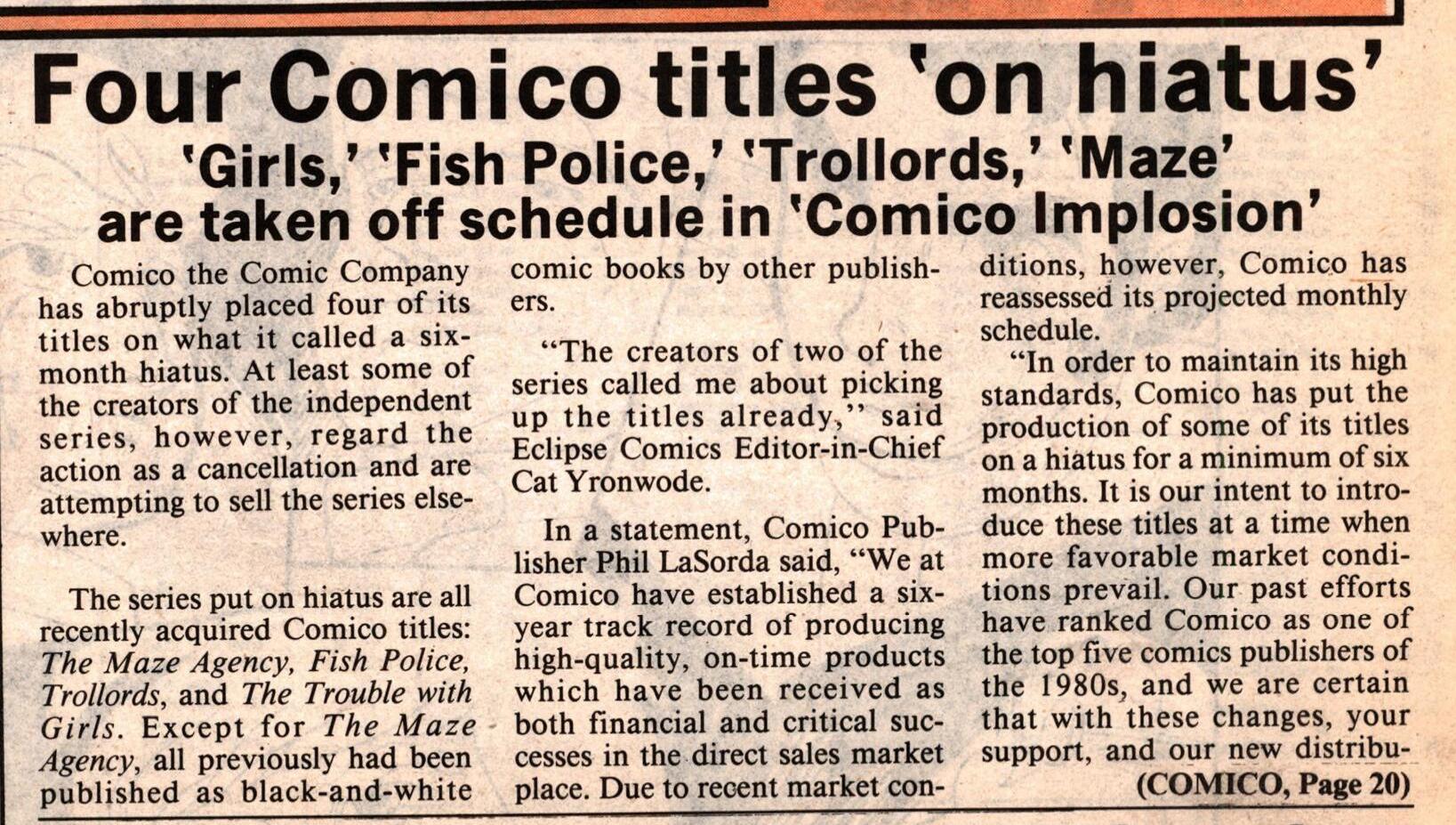
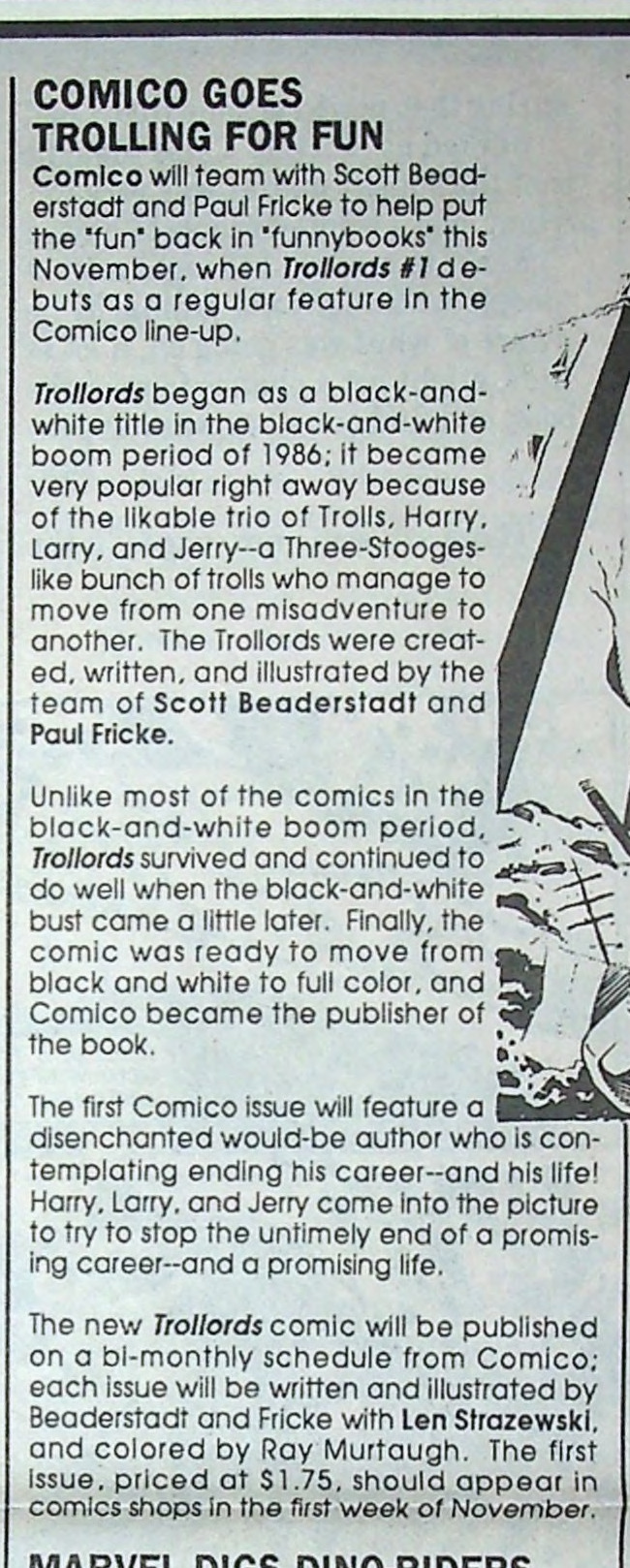
Comic Book Collector #3, page #28:
Perhaps we should point out that
no one is accusing all comic book
publishers or employees of being
careless, avaricious, and/or easily dis-
tracted. When, after two years of self-
publishing, Fricke and Beaderstadt
took their Trollords to Comico,
Fricke is quick to point out that “all
the people there were really well-
intentioned and they really wanted to
do good comics.” Still, good in-
tentions and all, Comico eventually
filed for bankruptcy, and the
Trollords floundered at Apple
Comics.
The Slings and Arrows Comic Guide #2, page #696:
TROLLORDS
Tru Studios: 15 issues, 1 Special 1986-1987
Comico: 4 issues 1988-1989
Apple: 6 issues 1989-1990
An odd, and strangely compelling for some, series,
presumably an attempt to teach responsible behaviour to
young readers, about Three Stooges-like playful monsters
who live with a realistic suicidal female character and learn
lessons about decent human interaction. It can be pious,
though it’s usually funny, but hanging around on the off-
chance of the arrival of amusing little green chaps is a dubious
hope for a cure for depression. Story and art, by Scott
Beaderstadt and Paul Fricke, improve fairly consistently
throughout the run but the late Tru Studios issues, in black
and white, are the best representatives.~GK
The Comics Journal #130, page #106:
GROTH: Tell me if I’m wrong here: I haven’t taken any
kind of statistical survey during the black-and-white boom,
but my impression was that it was less creators self-
publishing than it was a number of shlocky black-and-
white outfits smelling a buck and sprouting like weeds.
Is that your impression?
SIM: I think the first real experience I had of it, and this
is probably the stupidest perception to go by but I’m go-
ing to say it anyway, was the 1986 San Diego Con, which
was right in the middle of the whole thing: everybody
had a comic book out. I thought it was great; I was tickl-
ed to death. I couldn’t walk five feet without somebody
handing me another black-and-white comic book and I’d
get them to autograph it for me and tell them I’d save it
for the day it’s worth a million dollars and all of that stuff.
It seemed great to me. I think right on the heels of that
you end up getting people who put out 20 titles: “We’ll
basically expand our market share.” There’s nothing you
can do about those people. But certainly that was what
I think killed the first wave, all of these black-and-white
number ones coming out. All you needed was three com-
panies like Solson soliciting for 12 different number ones
and obviously everybody’s orders have to go down. I
mean, it was an amazing level. There was no way you
could keep a level that size going; it had to burst. But
for the brief moment it was there, it was a hell of a level.
GROTH: Yeah, right.
SIM: And then the problem was that it wasn’t the guys
with 10 or 11 titles that were wiped out first. If they had
two or three that were selling not too bad it kept a lot
of the shlock going, and what does that cause them to
do? Well, produce more shlock. The first things that died
were the guys doing just one book. Trollords goes to Com-
ico; Fish Police goes to Comico. That’s merger mania.
Welcome to the last half of the 20th century: one big en-
tity. That’s conventional wisdom now.
Amazing Heroes #154, page #61:
When the black-and-white boom
burst—the Trollords survived. When
no-talent hacks prospered—The
Trollords survived. Now they face
their greatest challenge—Color!
Yes, the sublime slapstick silliness
of the supernatural stooges is available
in glorious, living color.
Perhaps it’s the need we seem to
have for a certain amount of silliness
that makes this book work; perhaps
it’s the metaphysical underpinning (the
Trollord’s arch-enemy, after all, is
Death—the Ultimate Bully.
Their first color issue finds Larry,
Harry, and Jerry preventing a suicidal
Cliff Barker from committing said
self-destructive act. In so doing, they
learn he has become the ultimate
Stephen Muerte fan.
Believing Cliff’s death wish to be
related to Muerte’s books, the stooges
(sorry, Trollords), transport Barker to
Muerte’s unusual abode. Before long,
it becomes apparent that Death has a
hand in the scenario.
Because of the simplicity of the
plot, Trollords is able to set up a
situation of horror and humor with
seeming ease. The Cliff (Clive)
Barker and Stephen Muerte (King)
characters different enough from their
models to create a sense of unpre-
dictability. The Trollords do not so
much thwart Death as allow him to
thwart himself in his eagerness.
The story telling here is beautiful.
The combination of almost kaleidos-
copic layouts, serious foreshadowing,
slapstick and characterization is pro-
bably unique in comics. The storyline
is propelled forward with a minimum
of fuss. As a result, the reader is
hooked before he can even realize it.
This book is a good one. Creators
Beaderstadt and Fricke will almost
certainly benefit by the move to
COMICO and color.
Highly reommended.
—Sheldon Wiebe
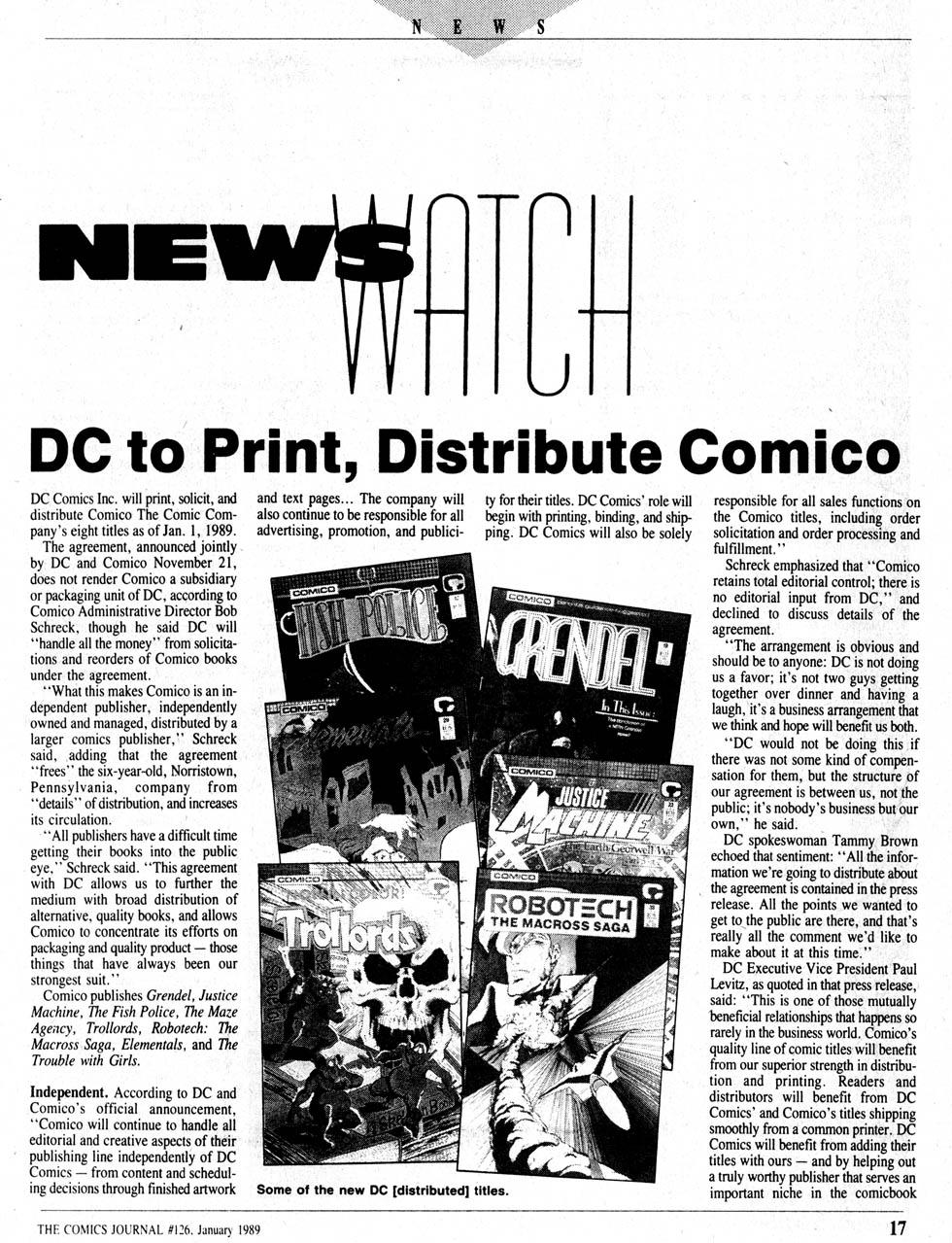
Presumably one of the reasons Comico dumped Trollords was that they had to shift “distribution” to DC (i.e., DC paid for printing because Comico didn’t have any money left) and DC nixed Trollords?
Amazing Heroes #114, page #45:
Fricke: Dave Sim said it wasn’t pro-
fessional enough and we should try
to publish it ourselves.
Bryan Augustyn: So it’s his fault.
Beaderstadt: Bill Loebs from
Journey was a real biggie, and there
were a few other people. Of course,
some people just pat you on the head
and send you on your way.
Fricke: Comico was interested in it
for a while, as were a couple of
smaller companies who have since
folded, but Comico was probably
the most interested.
Beaderstadt: We took it to Jim
Shooter and he…
Augustyn: You showed it to Archie
Goodwin at Epic, didn’t you?
AH: And they probably gave you the
corporate brush treat-
Beaderstadt: Well, before, everyone
wanted to see more, but now we had
this 24-page story which apparent-
ly was too much due to the whole
convention atmosphere, and the
most we got was just a quick initial
response.
AH: That’s a nice Catch-22 some
guys in the business like to set up
in order to keep people away.
Fricke: Finally it sank in about five
or six months later when we started
seeing a lot of stuff that was ending
up on the racks that just weren’t that
hot.
AH: That in itself can be a big push
-to see some of the crap out there,
and know you can do better yourself.
Fricke: A lot better, hopefully. So
we decided to give it a go.
AH: Well, how then did the book
finally come full circle? Obviously
with the inclusion of Brian. How did
that relationship begin?
Augustyn: Well, what I saw was the
first Trollords story that Scott men-
tioned, and they had packed an
awful lot of material in 24 pages. I
thought it needed to be reworked…
expanded, but the basic concept was
sound.
Fricke: He saw the genius…the
great potential!
Augustyn: Yeah, that too.
There’s very little talk about Trollords on the internet:
They’re well drawn, have a plot and it keeps you on your toes and it’s funny to read. What’s not to like?
That’s the only review three minutes of Googling reveals…
Now when we started, there was the black & white boom. Teenage Mutant Ninja Turtles had been in black & white, which became a self-publishing phenomenon a year or two before Megaton Man came into the market. Now everybody seemed to be scoring big with black & white comics. Adolescent Radioactive Black Belt Hamsters was selling fifty, a hundred thousand copies; Paul Fricke and Scott Beaderstadt did a thing called Trollords that was selling thirty, forty, sixty thousand. Everything in black & white seemed to be going gangbusters.
Yeah, this is how most issues of Trollords are-good comics but it’s always ‘somebody’s feeling depressed and is going to kill themselves but the guys show up and convince them not to’. I think Death only claims two or three people in any of the series, and they’re all terminally ill and have made peace with it. Very popular with other indie creators- I’ve seen pinups of them in a bunch of B&W comics from the 80’s.
I don’t think you really need a whole lot of background to get what’s going on. Death usually makes at least a brief reference to how they escaped him and keep getting in his way. Also, the whole looking and acting like the Three Stooges thing is an indicator for there’s going to be some comedy.