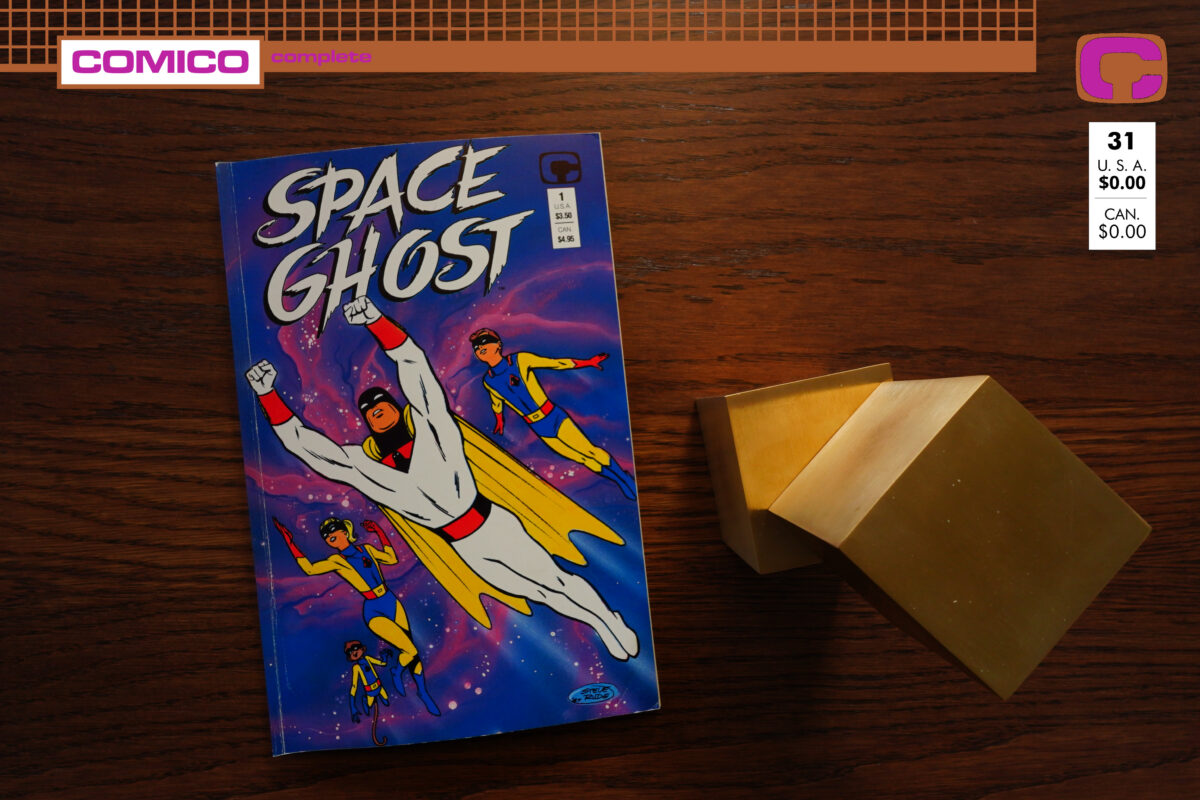
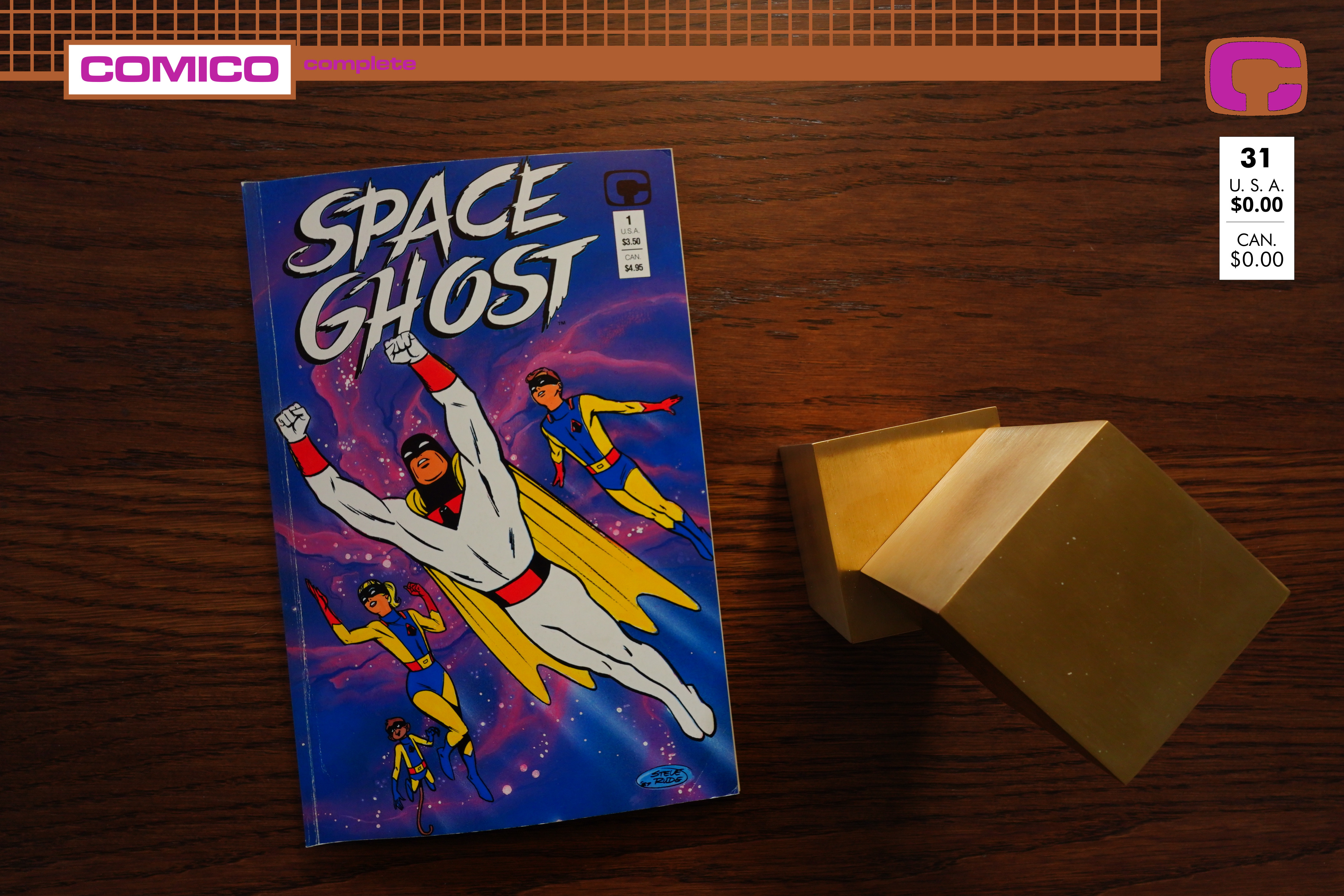
Space Ghost (1987) by Mark Evanier, Steve Rude, Willie Blyberg and Ken Steacy
So this is Comico publishing yet another licensed property, and like Jonny Quest, it’s based on a mid-60s Hanna-Barbera cartoon. Unlike the other properties, this is somebody I’ve seen mentioned before — but like the other properties, I haven’t actually seen it.
I have seen half of an episode of the bizarre 90s series Space Ghost Coast To Coast, which was a parody of a chat show (and wasn’t Evan Dorkin involved with that one?), so I wasn’t sure whether Space Ghost was something weird to begin with, or whether that show was just 90s hipsters appropriating some kids’ trash.
But let’s read the comic.
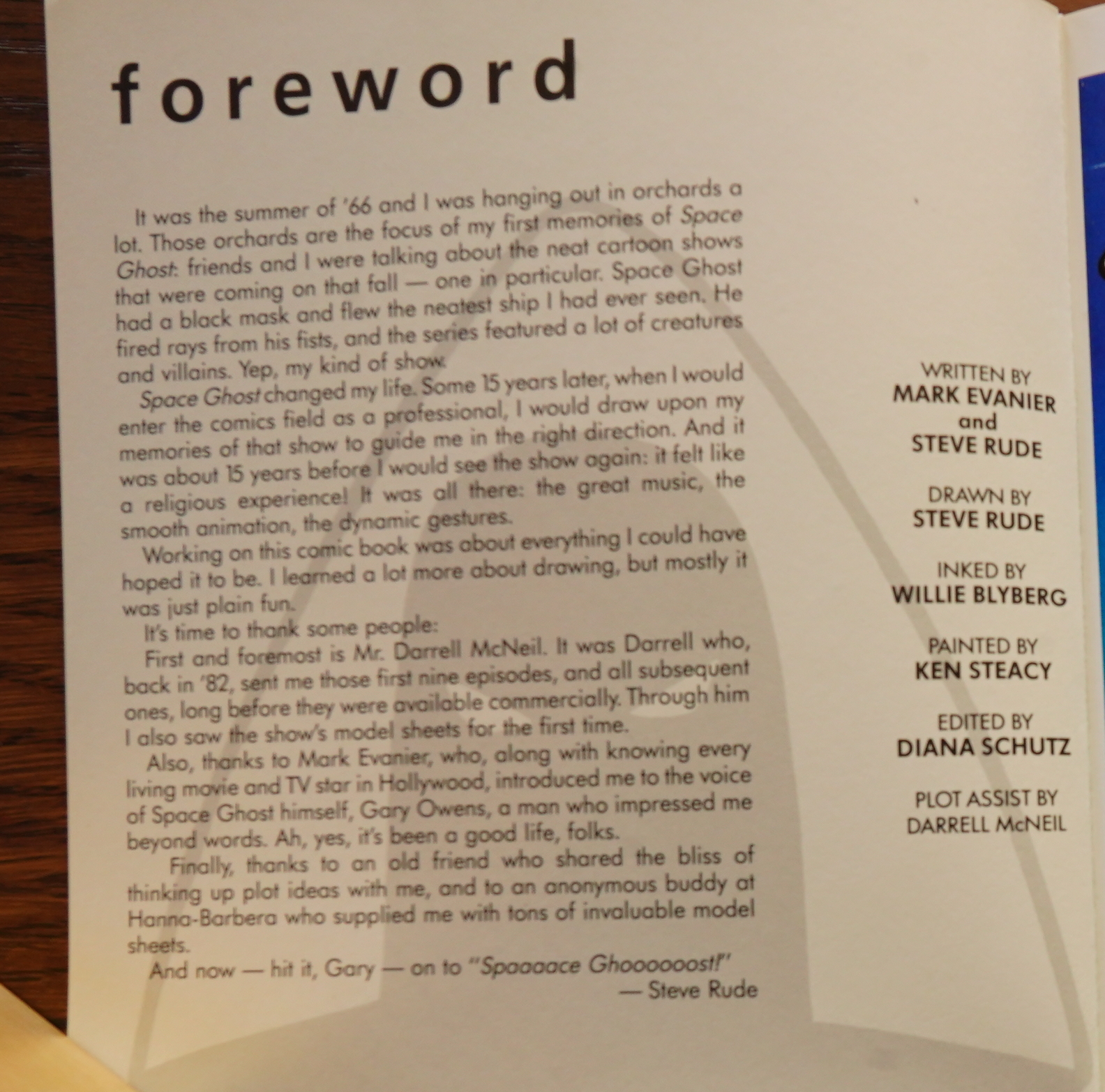
Unlike Jonny Quest, this sounds like it’s an actual labour of love for the people involved. Both Evanier and Rude were fans of the original run (which was a Saturday morning cartoon they watched as children). The writer of Jonny Quest, William Messner-Loebs, wasn’t a fan of Jonny Quest and spent a lot of the book trying to avoid writing stories that a Jonny Quest fan would enjoy (I quite liked it), but I’m guessing this is going to be more in line with the original show?
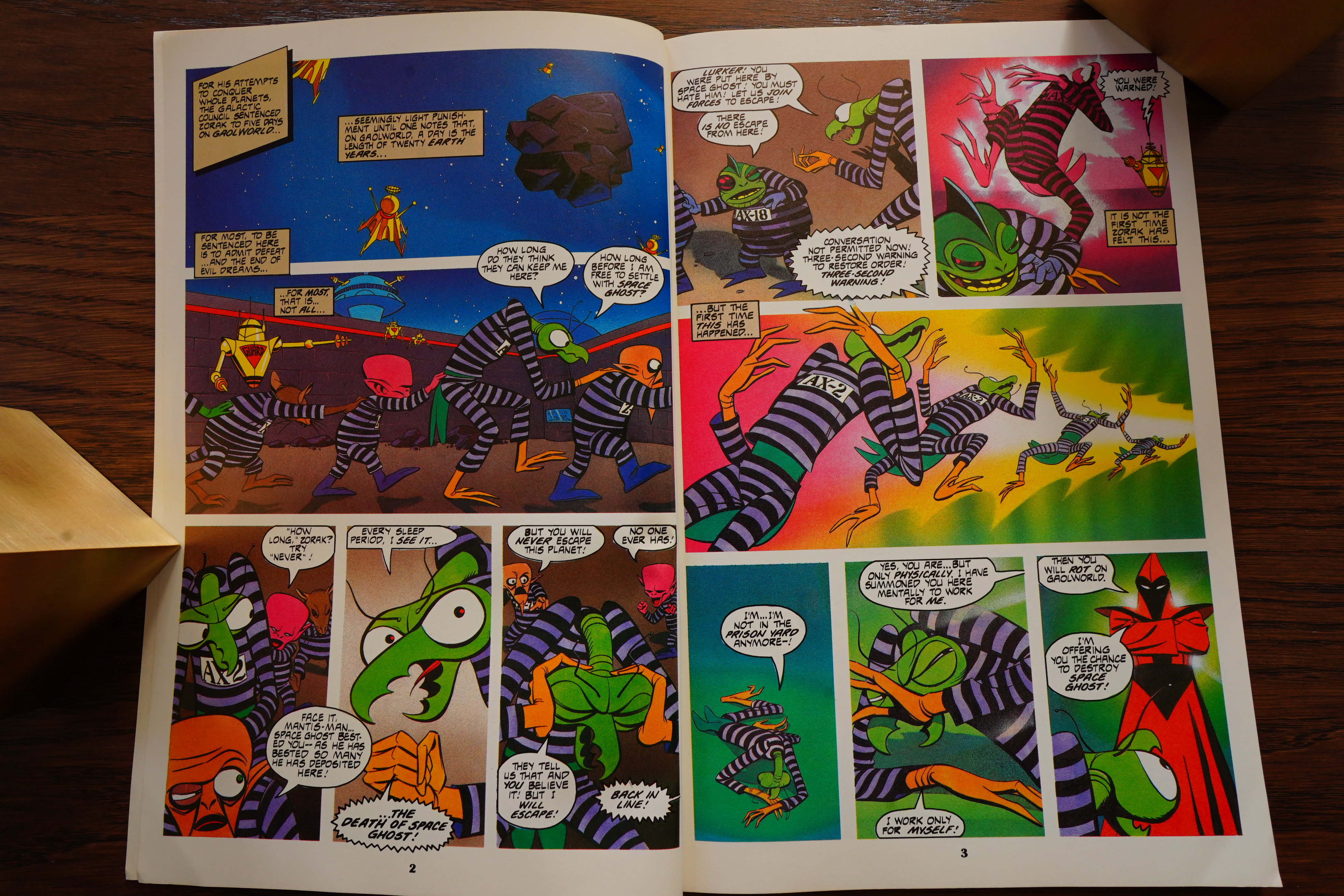
Yes, this does indeed seem more like an actual cartoon. I was wondering whether they were going to aim for a mature audience or not, but this seems like straightforward adventure. But I guess Mark Evanier isn’t really into “deconstructing” Hollywood stuff.
Comico published this book in the then-popular “prestige format”. I.e., regular comics-sized, but squarebound, and it’s 48 pages long. So it’s a more expensive book than you’d expect for a book aimed at kids.
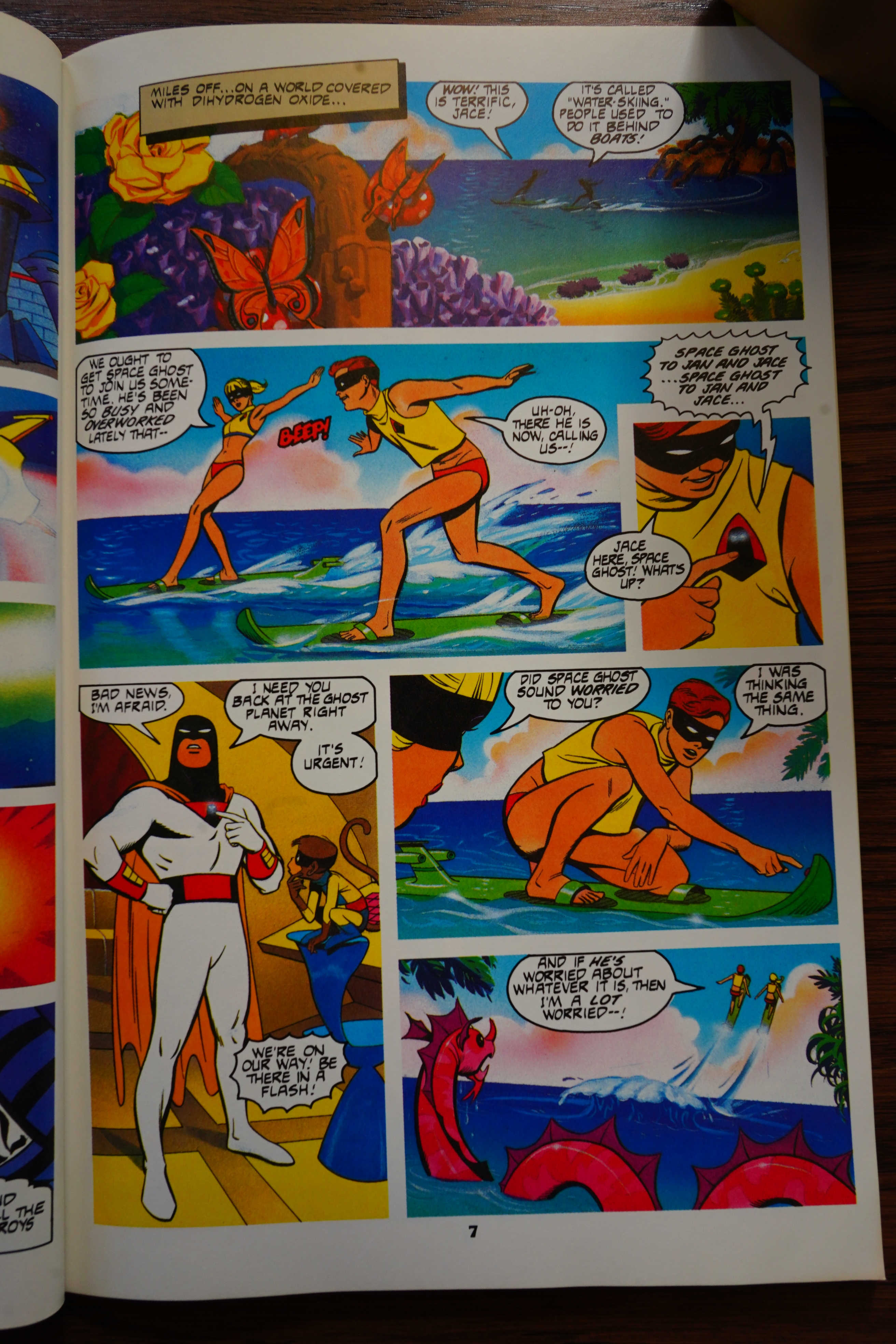
Oh, this is quite like Jonny Quest? It’s one strong guy, two kids, and an animal side-kick going on adventures? But in space.
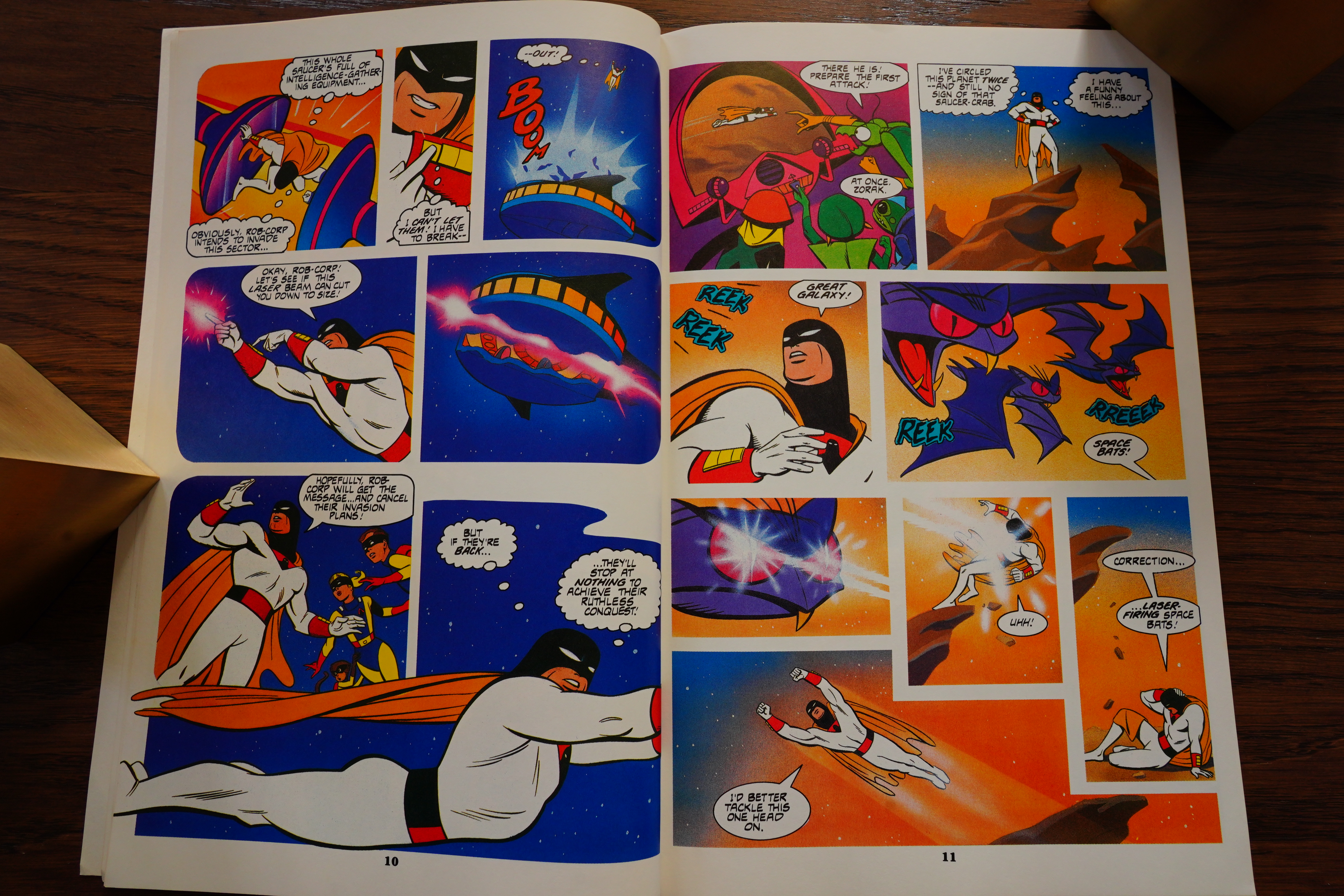
There’s something that doesn’t quite gel on these pages. The dialogue and the plot are fine, but the storytelling is just a bit choppy?
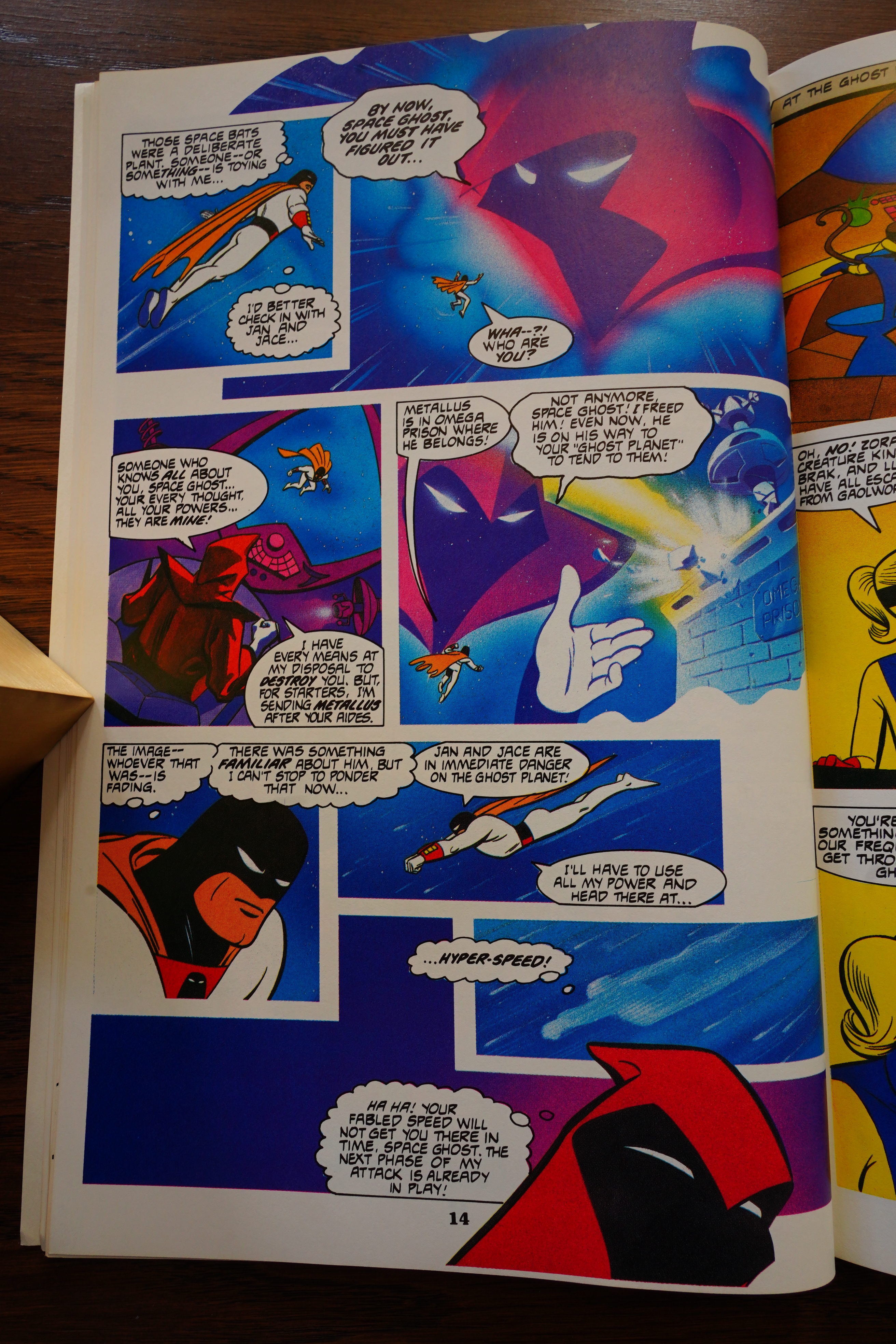
Oh, so the villain is Space Ghost from the future or something? I’m so clever at figuring out plot twists in stories for five-year-olds!
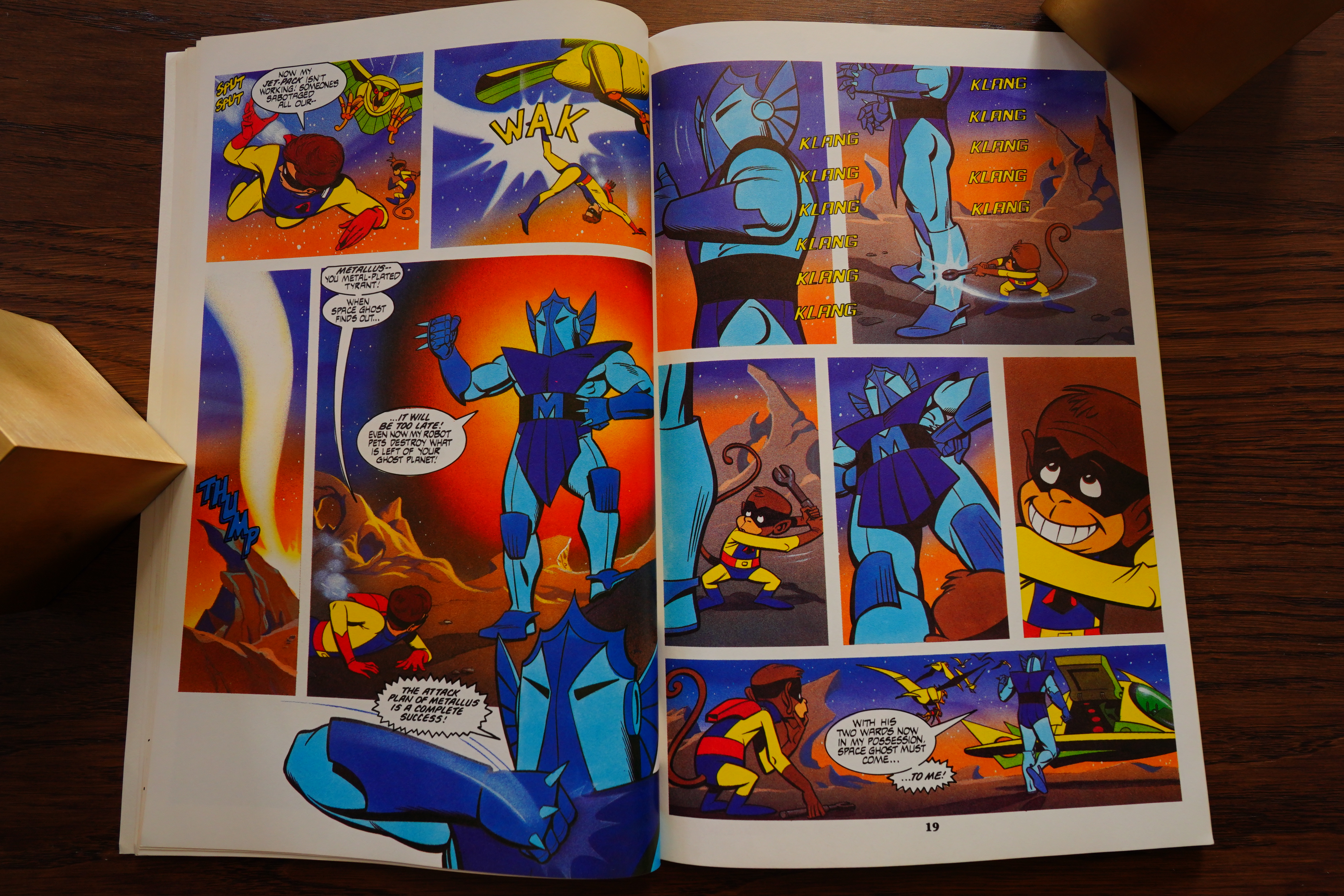
Heh heh. OK, that’s a solid joke. I love the look that little monkey has on his face in that panel. But that’s basically the only out and out jokey sequence in this book — the rest is played very straight.
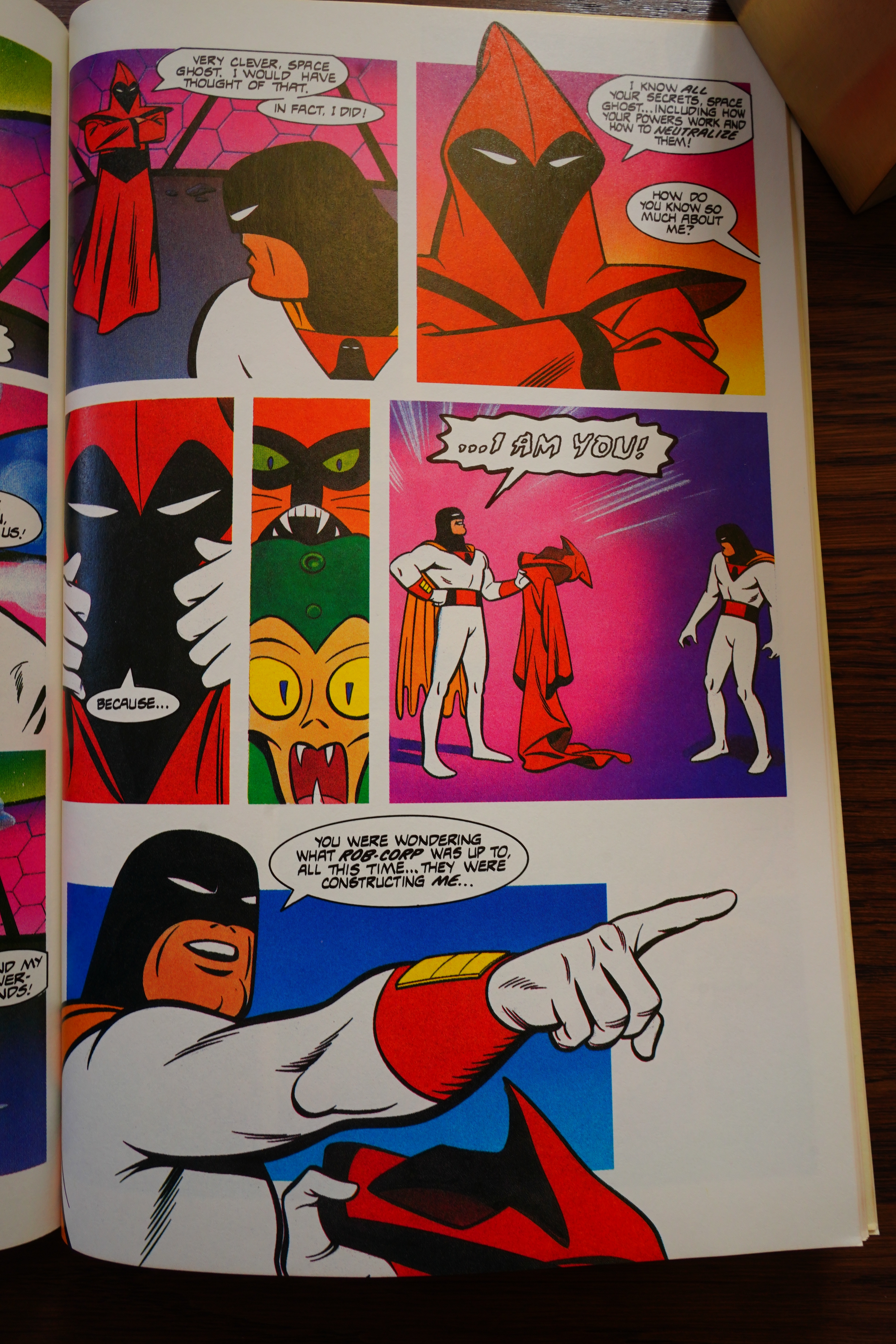
*gasp* I was right! But I was also wrong; it wasn’t Space Ghost from the future: It was an evil android Space Ghost.
Same same.
Anyway — it was an enjoyable comic to read, but not… very exciting? You have to wonder whether they were thinking of who the target audience were: Kids or forty-year-old nostalgic guys?
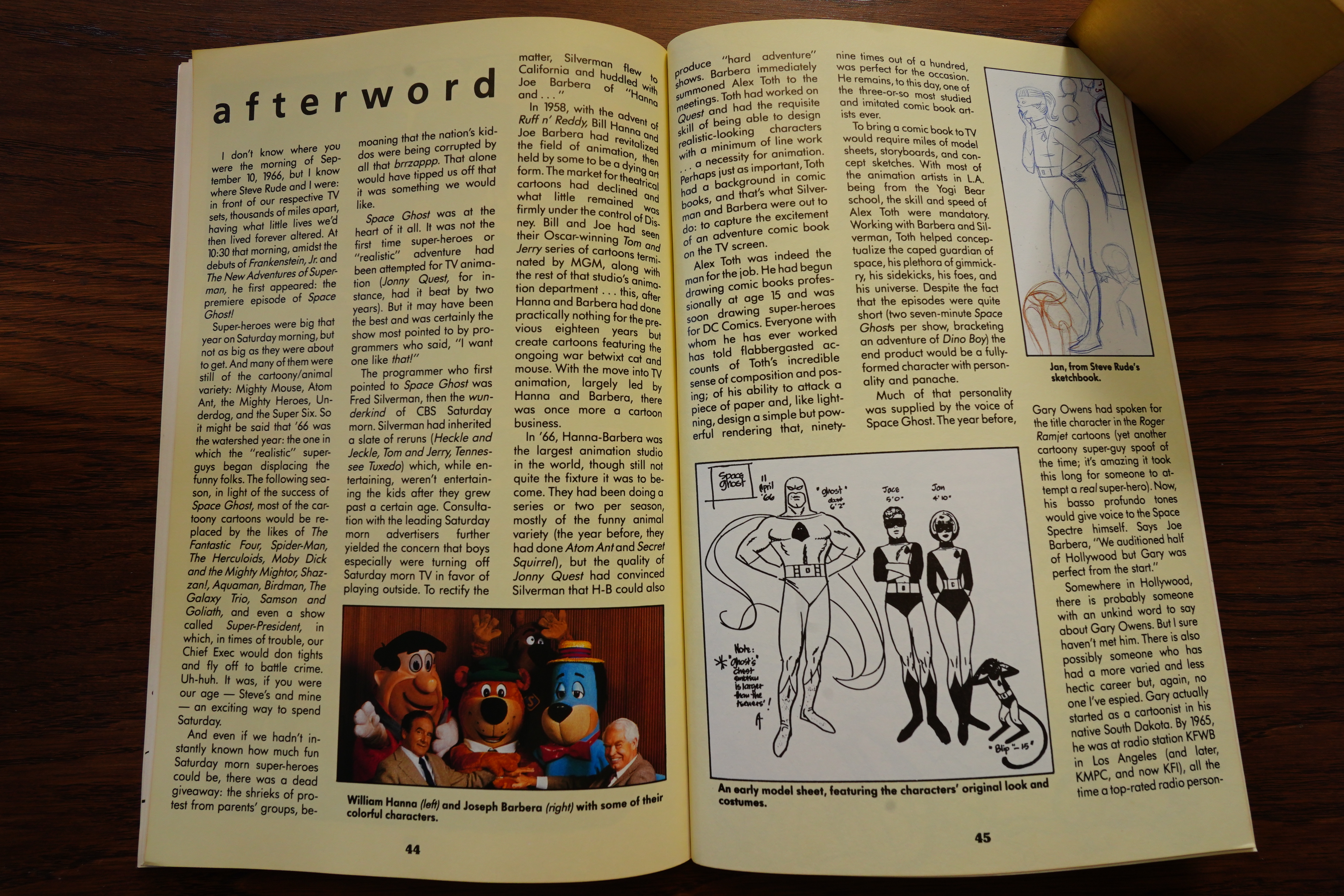
Evanier includes an overview of the original show — the character designs were by Alex Toth, which explains a lot.

I guess I should have a peek at an original episode. Right, each episode is just six to seven minutes long. Kinda parody-adjacent-sounding voiceover?
No, it seems like it’s “serious”. The animation sucks, but it’s Hanna-Barbera, so… It’s not awful as these things go? Sure, I’d have enjoyed that when I was seven, I guess?

I guess I should have a look Space Ghost Coast to Coast, too?
Well, OK, that’s weird. Guess it’s meant to be watched while high?
OK, back to this comic book:
Back Issue #30, page #71:
BOYD: What events led up to the Comico Space Ghost
one-shot in 1987? Were the company’s editors always
interested in you doing the art, or did Alex Toth’s name
ever come up?
RUDE: The Comico people and I were always close,
and when they got the licensing permission, they called.
I really doubt if Alex’s name ever came up. Even back
then he was known as the curmudgeon that might
start something but never finish it.
BOYD: Did you ever talk to Alex Toth about Space
Ghost? If so, did he ever give you any advice about the
designs or animation in general?
RUDE: The first time I ever called Alex was around ’83
or so. I hadn’t heard anything about his reputation-
I was just glad to finally have a name for the guy who
designed Space Ghost. So I called him up, told him he
was a genius, and went into how Space Ghost had
affected me. He was very gracious and flattered.
As we talked, he replied that he didn’t really like
Space Ghost-too many compromises-but remembered
a show I’d never heard of-Space Angel-much
more fondly. In hindsight, it was easy to understand,
since Space Angel didn’t have as many meddling
hands to dilute his vision.
BOYD: Mark Evanier’s Space Ghost story, “The
Sinister Spectre,” got a lot in! Anything you would’ve
added or taken out?
RUDE: By the time the story was finally worked out,
it was complete. But I remember it took Mark several
turns at the script to satisfy me. Typical me.
BOYD: Every panel looked like an animation cel. It was
truly a beautiful comic. Ken Steacy did the coloring. Were
you pleased with his work or did you wish you’d done the
coloring yourself?
RUDE: It is breathtaking to see how Ken had rendered
the coloring, which he painted directly on the original
art. No overlays or blue lines or any of that. He’s got
a technical ability to render and understand color
that was simply exceptional. When the originals
came back, they were a sight to behold. We all owe
a lot to Ken.
BOYD: You couldn’t help reading this terrific comic and
hoping for additional one-shots with Birdman, the
Herculoids, Mighty Mightor, etc. Did Comico ever
approach you and Mark about projects in that vein?
RUDE: No, I believe that Space Ghost was the only
book that was ever really discussed.
Back Issue #59, page #13:
The Comico one-shot was like the
original show in one more way:
While it gave readers plenty of non-
stop adventure, it didn’t tell them
anything new about the sentinel
of the solar system. For the most
part, Space Ghost would stay a cipher-and a nearly
blank slate ripe for parody.
Comics Interview #51, page #33:
PETER: And now you’re going to be doing
SPACE GHOST as a 48-page one-shot. Is
this motivated by a “see if you can do it
again” feeling?
DIANA: Actually, the reason to do SPACE
GHOST is Steve Rude, bottom line.
Because of our relationship with Taft Mer-
chandising, the licensor for JONNY
QUEST, we had the option to do SPACE
GHOST, and –
BOB: Wait, we negotiated a separate op-
tion for SPACE GHOST. We originally
negotiated it as a four-issue mini-series and
when we realized that Steve didn’t have the
time to do that, we went back and
renegotiated the whole thing to tailor-fit
Steve. We didn’t want to do it without him,
and we will not do it without him. We will
not put out issue #32 done by Joe Hack.
We don’t need that on our record.
DIANA: Yeah. You know, this really is go-
ing to sound like a lot of b.s., but we both
like to sleep at night. We try to maintain
honesty and integrity in order to be able to
look at ourselves in the mirror. There is no
project that is not worth doing right, and
there is no project that is worth doing
wrong. SPACE GHOST could not have
purity of vision without Steve Rude. I think
Steve has it in his heart and — this goes
back to what I said before – if you deliver
your heart into a project then that en-
thusiasm, that love, carries over to the
reader. I’m still a reader today. If I don’t
feel that enthusiasm when I’m reading a
book, why should I care?
BOB: And why should it be published if
that enthusiasm is not there? That is what
makes comics reading enjoyable. It’s not a
joke; it’s not a game; it’s what makes you
get up in the morning; and just because it’s
a licensed project, that does not mean it has
to be complete mush.
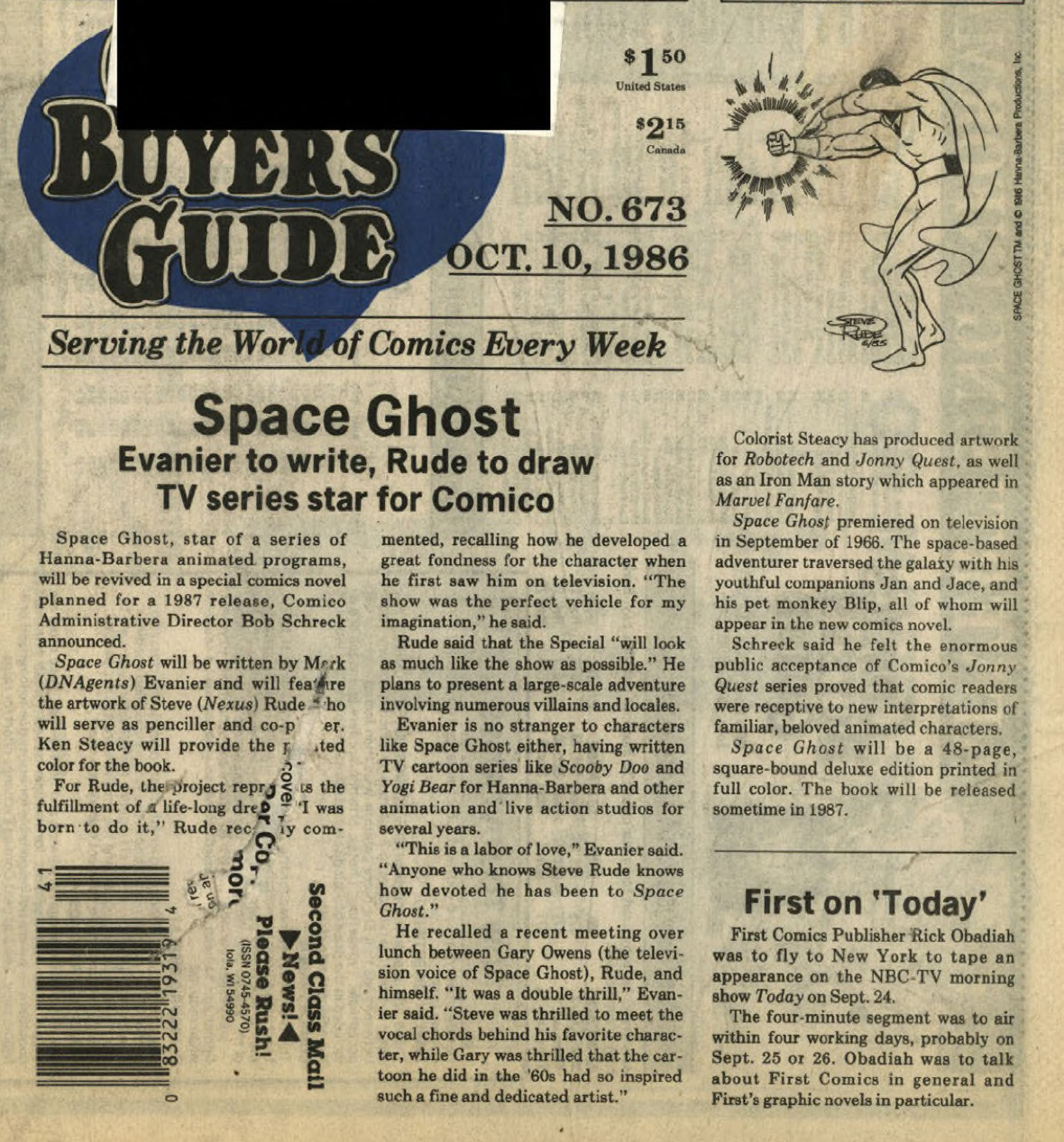
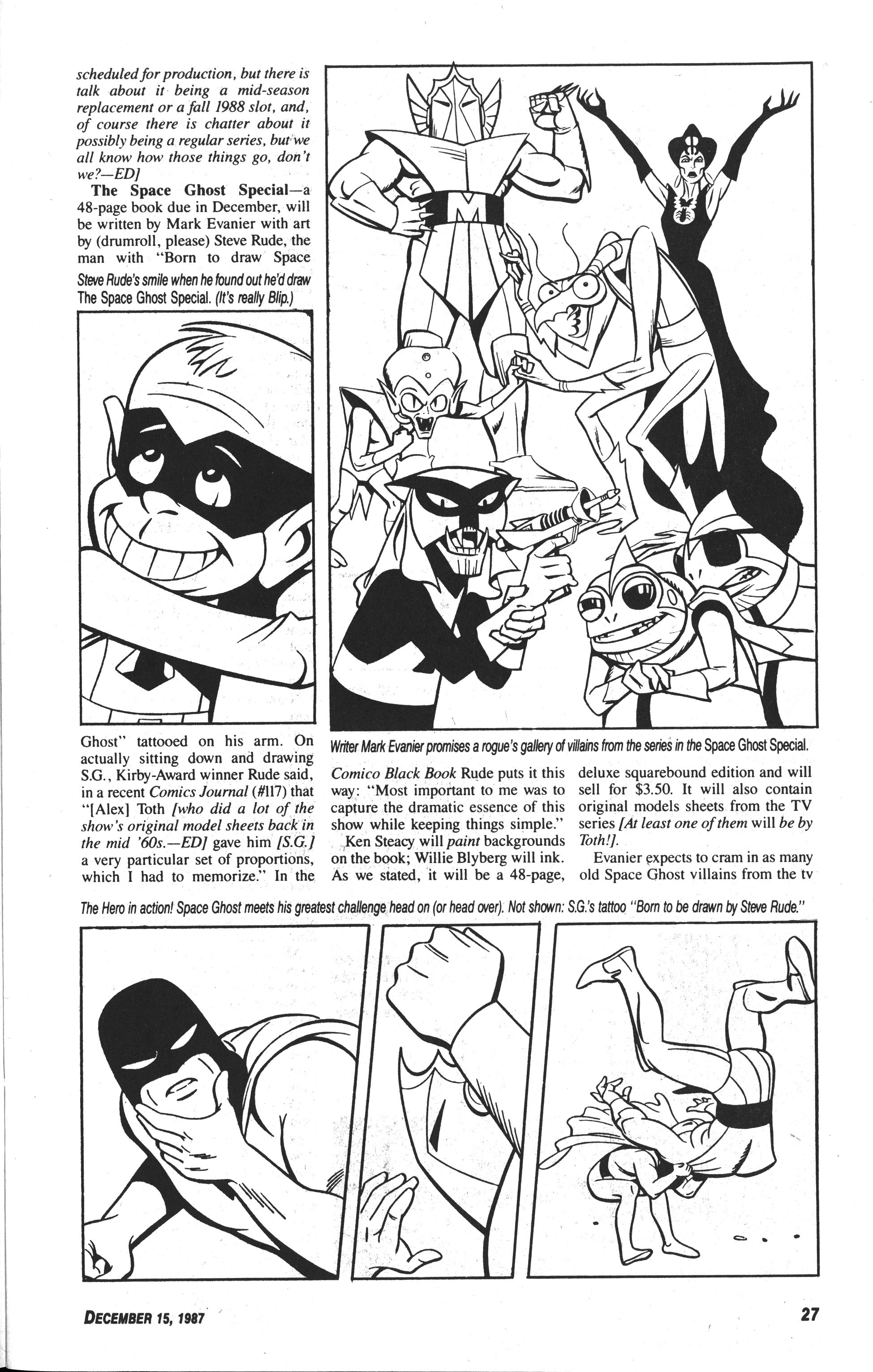
Speakeasy #81, page #19:
In Dec-
ember Comico returns to Hanna-
Barbera with the publication of
SPACE GHOST (SG), another one-
shot adaptation, by Mark Evanier
(writer) and Steve Rude (art-
ist). This time in the prestige
format.
The much acclaimed artist on
First’s NEXUS series, Steve Rude
is the driving force behind the
project, although it was Comico
who made the first move more
than three years back. “They app-
roached me about doing Space
Ghost,” recalls Rude, “back when
they were about to put out JONNY
QUEST. They wanted to use Space
Ghost as a back-up in the book.
I said I’ll think about it, but
it didn’t take off at all. A
year later I was approached ag-
ain and they told me they wanted
to do SG as a twelve issue limit-
ed series, as they were original-
ly going to do with JONNY QUEST.
I didn’t think that I’d be able
to draw the entire series so I
said no. I also didn’t feel that
anyone else who got their hands
on this after I left would do as
good a job, because nobody cares
about the character like I do.
“Then about two years ago Com-
ico approached me one last time,
and they said we want to do SG,
but we want to do it right. We
will release it as a one-off and
you can have complete control,
and we will not continue it af-
ter that one issue by you. What
could I say with such an offer
but yes.”
Rude worked out the plot, but
felt a professional writer would
be more able to bring the story
alive. To this end he chose Mark
Evanier, a seasoned scriptwriter
for both the comic and animation
industries, having adapted com-
ics into cartoons and vice versa
“I thought up the basic plot
of the story with a friend of
mine, and I more or less gave
Mark a breakdown of how I wanted
the story to work, which he
would embellish. I chose Evanier
because of his association with
Hanna-Barbera. I was told by
Mark that he was approached by
Joe Barbera at one point to run
the studio, so I figured what
better guy to script it than
him. Apart from which he knows
Gary Owens, who was the voice of
SG.”
Comics Interview #78, page #27:
PAUL: So, would you say that was a
high point for yourself personally, draw-
ing SPACE GHOST?
STEVE: As high a point as I can ever get
in my career, I think. I knew that when I
finished SPACE GHOST . . . I felt if I
were to die the next day, I had ac-
complished a major career goal.
PAUL: Now, some people might think,
“Oh, drawing SPACE GHOST, that’s a
major career goal?” But I get the feeling
that anybody who works in comics got
that first spark, that first love of it, when
they were little kids – comics or ani-
mation. And that’s what you want to do,
be true to that little kid. It’s very
important.
STEVE: It must sound silly to someone
outside the business. It’s kind of hard to
explain what it’s all about. And I’ll tell
you, working with Comico was in-
credibly fun. I’ve never felt so supported
by such a select group of peers before. It
could not have gone better!
PAUL: I knew how important that
character was to you, I saw it in the work.
How did it come about? How did
Evanier come into it?
STEVE: Well, Mark came in basically to
help clean me up on the story, basically,
with input from a few other people. He
was there to say, “Does this work?” I
didn’t know the first thing about writing,
all I knew was that this thing kind of
unfolded itself in my mind. Darrell
McNeil and I worked out the plot.
PAUL: And did you remain true to that?
Explain it for those who haven’t seen it,
what was the plot?
STEVE: Do you want me to explain the
original idea?
PAUL: That’d be nice, yeah.
STEVE: Okay. The original idea was –
Darrell and I, when we were first talking
about this a long time ago, we were just
discussing logically what had to happen
to make this thing the most colossal thing
imaginable! That, for people who know
anything about SPACE GHOST, was to
do our version of The Council of Doom
episode. For those who remember it –
you would have to have seen it when it
was on back in ’67 – it’s about all of
these villains ganging up on Space Ghost
and trying to kill him. So we were doing a
riff on that.
The Comics Journal #248, page #94:
SPURGEON: Let me ask you the Space
Ghost comic that you did for Comico in
the mid-1980s.
RUDE: Oh yeah. Wow, what great
memories I have of that.
SPURGEON: The memories you have are
great because it was just a fun book to work
on?
RUDE: Oh yeah. I learned what a hero
was because of Space Ghost.
SPURGEON: What’s interesting about
the look of the Space Ghost project is that,
while I can see Steve Rude in almost every
other project that you’ve done, you totally
submerged into that style for Space Ghost.
Did you discover anything interesting
about doing comics while working in that
style that you wouldn’t have learned work-
ing in your own style?
RUDE: I just know that Space Ghost was
designed by Alex Toth and it had to have
an Alex Toth look to it. It had to be of
that world or it wasn’t going to be Space
Ghost; it would’ve looked like the version
that other artists have drawn.
SPURGEON: The proportions in Space
Ghost are odd.
RUDE: Yeah, that’s Alex. And I love it,
you know, he was this bulky guy in this
great looking hood that kind of resem-
bled a hawk. And interestingly, the more
Alex caricatured Space Ghost – he
would draw a hawk-like structure to his
head — the cooler he looked. He became
a design rather than a regular human
head underneath a black mask. That’s the
beauty of caricature. That’s what Disney
does better than anyone.
Amazing Heroes #105, page #32:
AH: Let’s go on to the other pro-
ject you’re working on, then: Space
Ghost.
Evanier: Steve Rude is Space Ghost
freak numero uno. This is something
that has been no secret. In fact, there
are great parallels between Nexus
and Space Ghost in terms of design.
He loves that cartoon character. And
when Steve has visited Los Angeles,
I have taken him on what I call “The
Space Ghost Tour,” out to talk with
the various animators and artists
who worked on the series. Two trips
ago when he was out here, I ar-
ranged a lunch with Gary Owens,
the voice of Space Ghost and a good
friend of mine. It was an amazing
meeting because Steve was in awe
of meeting the man who was the ton-
sils behind his favorite cartoon
character of all time, who still has
that wonderful, resonant, basso pro-
fundo voice that screams “Space
Ghost!” out across the restaurant.
Gary Owens, who is a former car-
toonist, a lover of good comic
books, and a Nexus reader prior to
meeting Steve Rude, was very exci-
ted that something he did in 1964 or
1966 had inspired this young, de-
voted, talented artist. Gary asked
Steve for an original drawing and he
did this wonderful shot of Nexus and
Space Ghost together which Gary
has framed and hung in his office.
That’s one of the nice things about
the new generation of comics, when
you can thank the people who gave
you your influences as opposed to
exploiting them. Steve and I did the
Mr. Miracle book as a way to thank
Jack Kirby for all he has meant to
us, not to make money off his char-
acter, which is unfortunately the
motive of at least a few people who
have done Jack Kirby comics under
the guise of “continuing the Kirby”
tradition.”
Space Ghost is coming out from
Comico sometime next summer in
what is going to be called the “Dark
Knight format.” It is going to be
colored by Ken Steacy, a friend of
mine who is one of the most inno-
vative, brilliant colorists I’ve ever
seen. Steve is co-plotting the book
with me with technical advice from
a friend of his named Darrell Mc-
Neil who is similarly a Space Ghost
worshipper and animation freak.
This is one of those situations where
if I went to anyone in the comic book
business and said, “I’m going to do
a Space Ghost book,” they’d go,
“Oh. Rude must be drawing it.”
There is no one else.
I can’t find any contemporary reviews of the book, but here’s one from the internet:
What’s more, unlike many nostalgia trips, this one has stood the test of time. It’s an excellent issue and well worth hunting down.
The way Rude handled the action sequences—those bold silhouettes, the dynamic page layouts—it all paid homage to Toth’s design philosophy while establishing its own identity. Ken Steacy’s painted colors elevated everything further, creating this rich visual experience that made you want to gape at every panel.
As opposed to, say, Jonny Quest, Space Ghost still seems to have a large fan community on the intertubes.
OK… I guess this is as good a time as any to get some chatter about how things were going at Comico in, because:
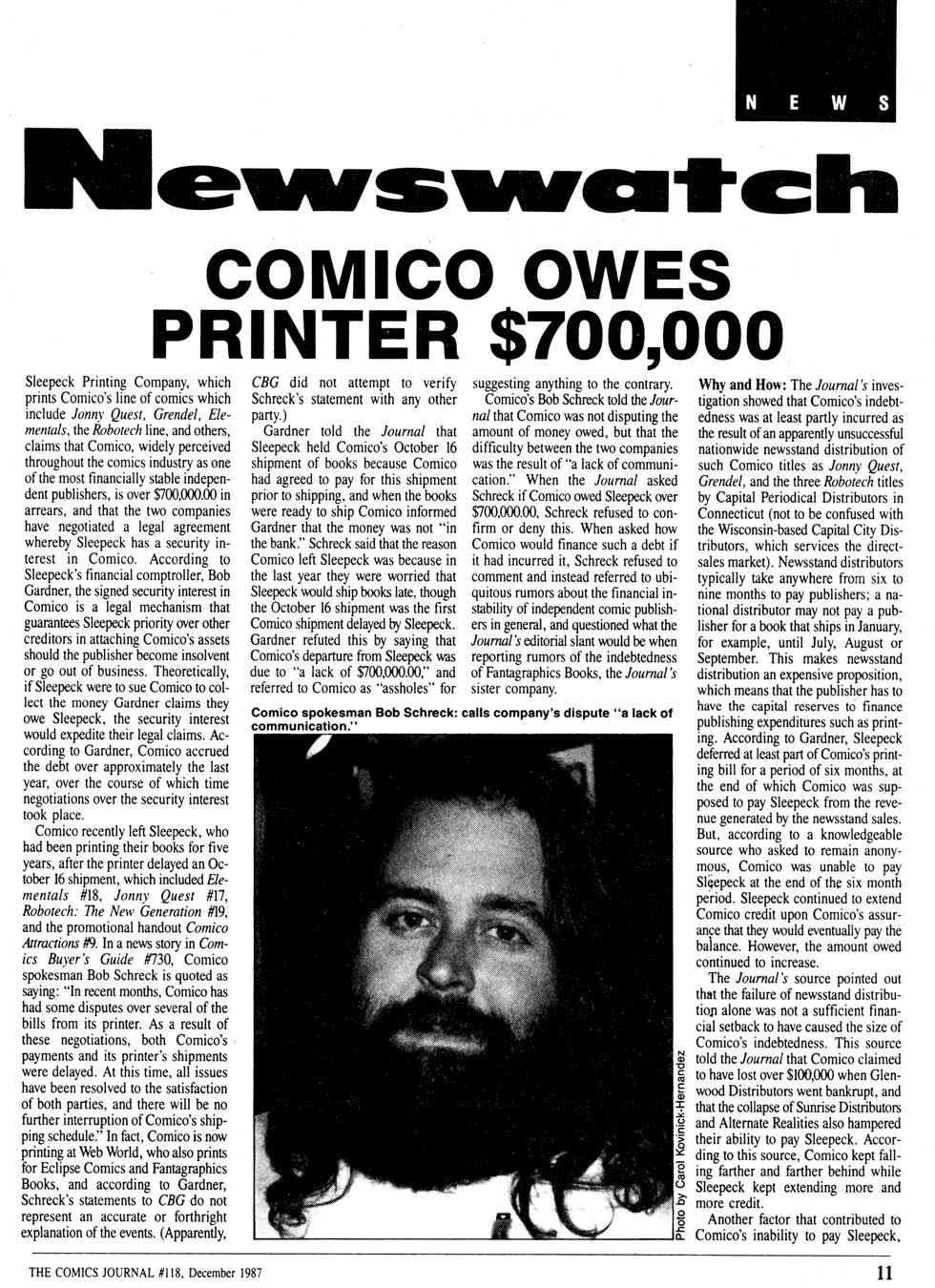
While they were pumping out books, things were not going good business wise.
For me, the greatest mystery about Comico during these years has been how they’d been financed. They started off essentially self-publishing their own (very bad) books, but then suddenly they pivoted to classy, labour intensive colour books, and pushed into newsstand distribution. Whenever you read interviews with creators working with Comico around this time, they’re nonplussed by how good Comico were treating the creators — people wouldn’t only be paid on time, but paid early: While some publishers had so bad cash flow that they couldn’t pay creators until the books were published (and the publishers had gotten money from the distributors), Comico apparently would pay upon delivery of pages, and then often sit on them for half a year before publishing. The publishers talk a lot (in interviews) about how important it is to not let schedules slip, so it makes sense to have a backlog, but… where did they get the financing?
And with newsstand publishing, you don’t get money for half a year or so, which means that (in total) Comico had to have, like, a year’s worth of cash flow on hand, which is quite a lot of money, considering how much they were publishing.
Perhaps an answer to some of the mystery was that there were three publishers, and at least one of them had an actual, well-paying job on the side (if I’m reading things correctly). So it may be the case that they’re just dumping their own money into the business.
The other thing going on was that they weren’t paying their printers.
The Comics Journal #118, page #13:
Sleepeck Printing Company, which
prints Comico’s line of comics which
include Jonny Quest, Grendel, Ele-
mentals, the Robotech line, and others,
claims that Comico, widely perceived
throughout the comics industry as one
of the most financially stable indepen-
dent publishers, is over $700,000.00 in
arrears, and that the two companies
have negotiated a legal agreement
whereby Sleepeck has a security in-
terest in Comico. According to
Sleepeck’s financial comptroller, Bob
Gardner, the signed security interest in
Comico is a legal mechanism that
guarantees Sleepeck priority over other
creditors in attaching Comico’s assets
should the publisher become insolvent
or go out of business. Theoretically,
if Sleepeck were to sue Comico to col-
lect the money Gardner claims they
owe Sleepeck, the security interest
would expedite their legal claims. Ac-
cording to Gardner, Comico accrued
the debt over approximately the last
year, over the course of which time
negotiations over the security interest
took place.
Comico recently left Sleepeck, who
had been printing their books for five
years, after the printer delayed an Oc-
tober 16 shipment, which included Ele-
mentals #18, Jonny Quest #17,
Robotech: The New Generation #19,
and the promotional handout Comico
Attractions #9. In a news story in Com-
ics Buyer’s Guide #730, Comico
spokesman Bob Schreck is quoted as
saying: “In recent months, Comico has
had some disputes over several of the
bills from its printer. As a result of
these negotiations, both Comico’s
payments and its printer’s shipments
were delayed. At this time, all issues
have been resolved to the satisfaction
of both parties, and there will be no
further interruption of Comico’s ship-
ping schedule.” In fact, Comico is now
printing at Web World, who also prints
for Eclipse Comics and Fantagraphics
Books, and according to Gardner,
Schreck’s statements to CBG do not
represent an accurate or forthright
explanation of the events. (Apparently,
COMICO OWES PRINTER $700,000
CBG did not attempt to verify
Schreck’s statement with any other
party.)
The Comics Journal #118, page #13:
The Journal’s source pointed out
that the failure of newsstand distribu-
tion alone was not a sufficient finan-
cial setback to have caused the size of
Comico’s indebtedness. This source
told the Journal that Comico claimed
to have lost over $100,000 when Glen-
wood Distributors went bankrupt, and
that the collapse of Sunrise Distributors
and Alternate Realities also hampered
their ability to pay Sleepeck. Accor-
ding to this source, Comico kept fall-
ing farther and farther behind while
Sleepeck kept extending more and
more credit.
Another factor that contributed to
Comico’s inability to pay Sleepeck,
Gardner asserted, was Comico’s habit
of paying for artwork far in advance
of publication, thus tying up capital
they did not, in reality, have. In one
instance, said Gardner, Comico paid
for artwork that would not be printed
for nearly a year. Indeed, Comico’s
creators generally report what Ken
Steacy called a “spotless record” when
it came to paying creators. “Quite often
I get them to pay me early if I really
need it,” Jonny Quest writer Bill Loebs
told the Journal. “Nobody’s talking
about having any problems,” he said.
In fact, Comico is generally per-
ceived by industry watchers as finan-
cially healthy. One sign of their eco-
nomic stability has been their will-
ingness to nurture titles like Gumby’s
Summer Adventure, The Rocketeer
Adventure Magazine, and Space Ghost.
All of these required catering to in-
dividual schedules of creators involved.
Dave Stevens, the creator of the
Rocketeer, is probably the best known
example of a slow perfectionist who re-
quires extensive amounts of time to
turn in a project. Over a year after
Comico announced the Rocketeer
comic, no issues have even been
scheduled. One source reported that
Stevens was paid an advance of
$6,000.00 for the Rocketeer from Com-
ico. Gardner was critical of such busi-
ness practices, and told the Journal that
Comico’s publishers “had no idea how
to run a business.” Gardner said that
he even flew to Comico’s Pennsylvania
offices to study their profitability and
give them business advice.
Gerry Giovinco, one of Comico’s
publishers with brothers Dennis and
Phil LaSorda, did not want to talk to
the Journal. Bob Schreck, after being
asked if Comico owed Sleepeck over
$700,000, refused to comment further.
Sleepeck’s Bob Gardner told the Jour-
nal that he believes Comico has “on-
ly a miracle chance of recovery.” he
said, “The minute they miss a pay-
ment, we’ll shut them down.” -TP-
The Comics Journal #122, page #9:
If you live anywhere near a pool of stagnant
water, you know that about this time of year you
will begin playing host to any number of
venomous insects. There are few pools quite so
stagnant as some sectors of the comics industry,
and here at the Journal we’ve certainly been see-
ing our share of irritating pests. Venomous Insect
#1 in this case is Cat Yronwode, in the 199th in-
stallment of her vanity column “Fit to Print,”
which oddly enough was found unfit to print by
both magazines it was submitted to. In her
habitual tone of semi-hysterical self-
righteousness, Yronwode attempts to spread a
number of unfounded rumors and scurrilous
distortions of fact, with the intention, she claims,
of demonstrating how awful unfounded rumors
and scurrilous distortions of fact are. In regards
to a Journal news story on Comico’s troubles
with its creditors, Yronwode haughtily proclaims,
“I don’t take much part in the gossip group which
delights in totalling the amount of money a
certain publisher owes to a certain printer, ’cause
you can read all about that said certain publisher
in a certain fanzine if you want to, not forget-
ting for a moment that said certain publisher in
the uncertain direct sales market might certainly
want to see another destabilization take place.’
First, let’s examine the story itself. To begin
with, it was neither rumor nor gossip. It began
when Journal reporters read a very suspiciously
worded press release from Comico, and decided
to investigate. They discovered that Comico owed
its printer a sum so large that the company was
in danger of being taken over by the printer,
Sleepeck. The story was confirmed on the record
by Sleepeck and was not denied by Comico. The
Journal reporter did not “total” the amount ow-
ed; the printer told him how much it was. A story
could hardly be any better documented. A
Sleepeck representative threatened the Journal
with legal action if the story were printed. After
submitting the story to its counsel, the Journal
ignored the threats and went ahead with it.
The story was significant and newsworthy on
any number of counts. Comico is one of the
largest independent comics companies. A
substantial sum of money was involved
($700,000). The development was entirely unex-
pected; Comico was thought to be one of the
most stable independent companies. If Comico
were to fold, it would have repercussions
throughout the industry. Now, why on God’s
green earth would any self-respecting news
magazine refrain from publishing such an
important, objective, eminently well-documented
news story? It would seem a lot more fishy if
the Journal didn’t run it. Indeed, one could think
of quite a few more disreputable reasons why the
editor-in-chief of Eclipse Comics would not want
a newsmagazine to run stories on the financial
instability of comics companies than why a
newsmagazine would. Could this perhaps be
what the Great Father in Washington might call
a preemptive strike? In the very same column
Yronwode refers to rumors of Eclipse’s instability.
(Of these, let us just say that we’ve heard them,
from some very interesting sources, but they are
uncorroborated and dependent on future events.)
Could she be intending to scotch any such stories
about Eclipse?
Heh heh.
Over the next year or so, Comico would shift between using different printers before they finally went bankrupt two years later. But before that, we have an exciting DC distribution agreement and other desperate measures being taken to survive.
So wherever Comico had been getting financing from, that financing had run out by now.
Space Ghost was more of a superhero show than an adventure show like Jonny Quest (as you could probably tell from the episode). Think Batman and Robin crossed with Superman and Green Lantern rather than the Quest family and Race . Jonny and Hadji are main characters- Jan and Jace are sidekicks. I’ll give you the animal sidekick thing- almost every Hanna-Barbera action show had one for comic relief or an easy plot resolution. Alex Toth had done a bunch of superheroes for DC in the 40’s and would do a few more in the 70’s and 80’s, in addition to a couple more for Hanna-Barbera (Birdman was the other big one).
I don’t know about Space Ghost having a bigger or more active fandom- it’s more that Cartoon Network used Space Ghost Coast to Coast as the basis for their Adult Swim adult animation block. Most of the original lineup was spin-offs of that show or used the same technique of putting new dialogue to old Hanna-Barbera cartoons. Plus, there haven’t been as many revivals of Space Ghost (in cartoons or comics) as Jonny Quest. Other than a similar Archie Comics one-shot, the Space Ghost comics haven’t been as well received as the Jonny Quest ones.