

The Amazon (1989) #1-3 by Steve Seagle, Tim Sale and Matthew Waddington
So what’s this, then?
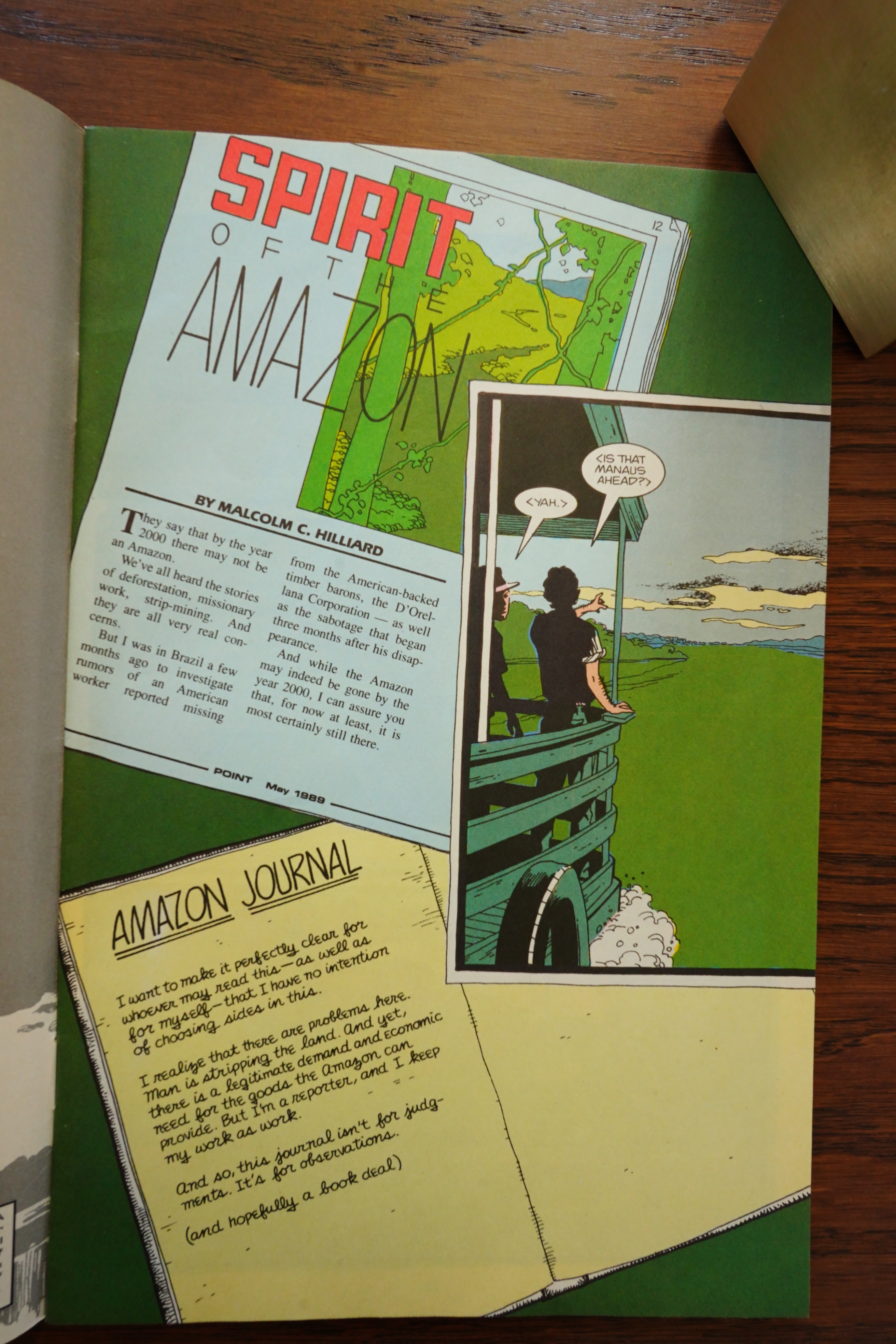
Yes, it’s about a journalist going to the Amazon to investigate something mysterious and jungleish.
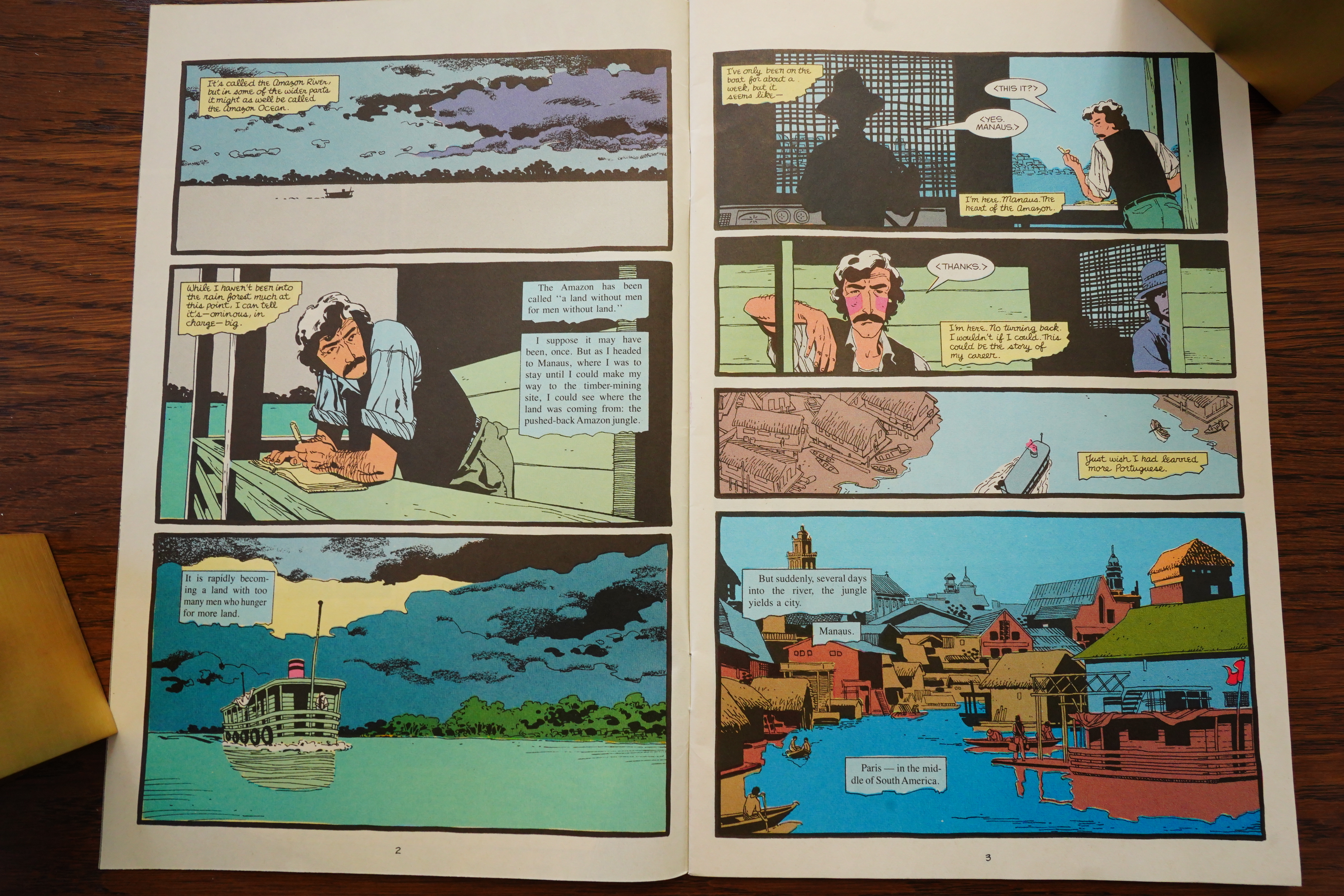
Tim Sale’s artwork is really attractive. It kinda looks inspired by European comics, and in particular Italian? It’s not that far from, say, Attilio Micheluzzi, but there’s a whole bunch of Italians working in this tradition.
And we seem to be set up with a possibly unreliable narrator — or just a triple vision into the story. You have what’s being shown in the panels, and then you have the captions with hand-written text and yellow backgrounds (excerpts from his diary), and finally the captions with blue backgrounds, which are presumably his published article about his experiences (or possibly a book).
But… the confusing thing is that what all these three “levels” show exactly the same thing. The language in the diary and in the article is identical, and they don’t diverge from what we’re being shown at all.
That’s pretty confusing!
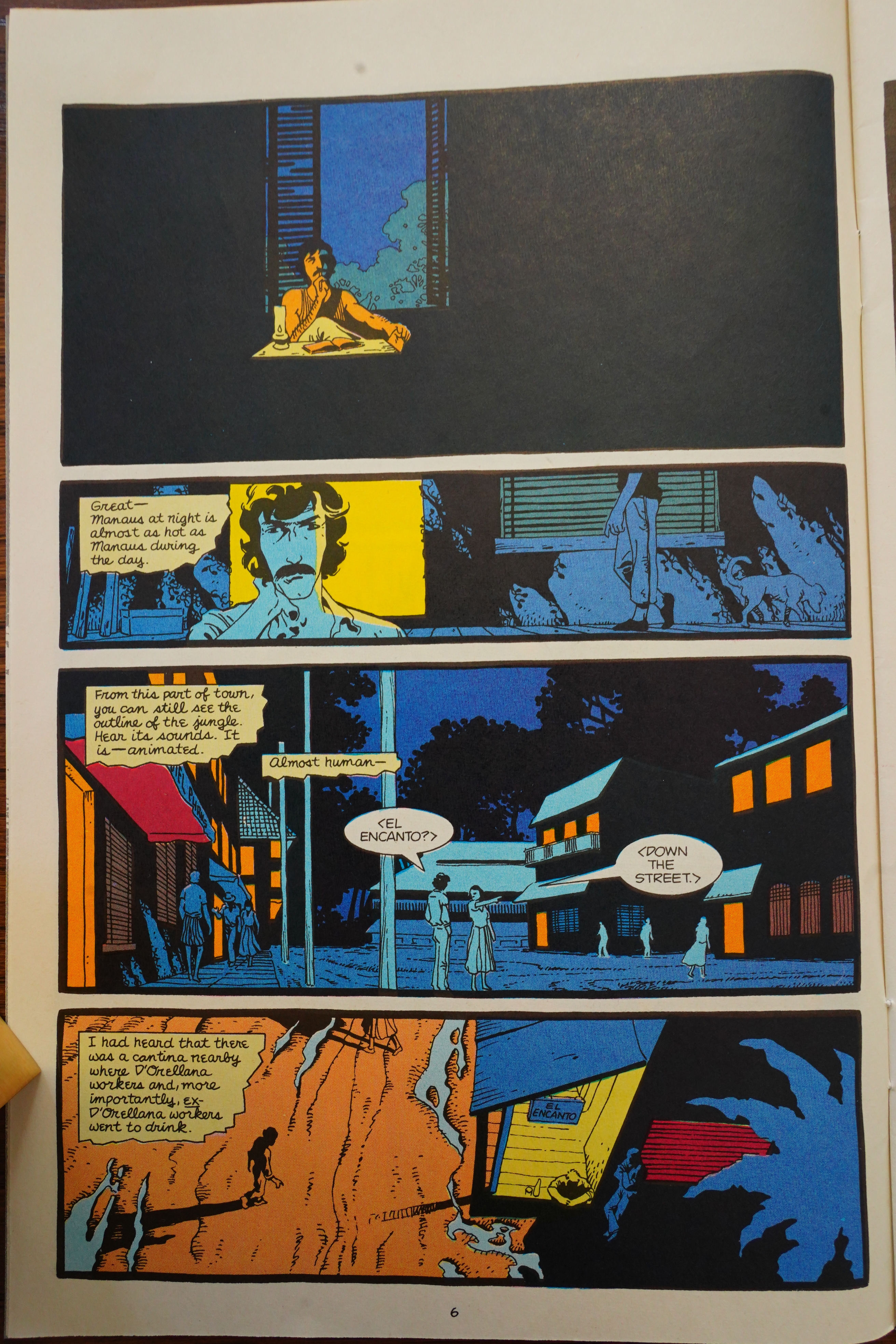
I’ve talked before about how distinctive the colouring on Comico comics is. It’s not just that they’re mostly flat, very saturated but still muted, but also how the separations are done: Comics from this era usually looked kinda sploshy (isn’t that a word) when there were areas of black ink, because they would be coloured just a bit into the black areas. So you’d see where the colour separator stopped, because if you print (say, blue) over black, it looks different than just printing black. But Comico avoids this problem by printing the colours all the way over the black areas. Sometimes leaving a pure-black outline on the edges:

It’s very nicely done — it makes a huge difference aesthetically.
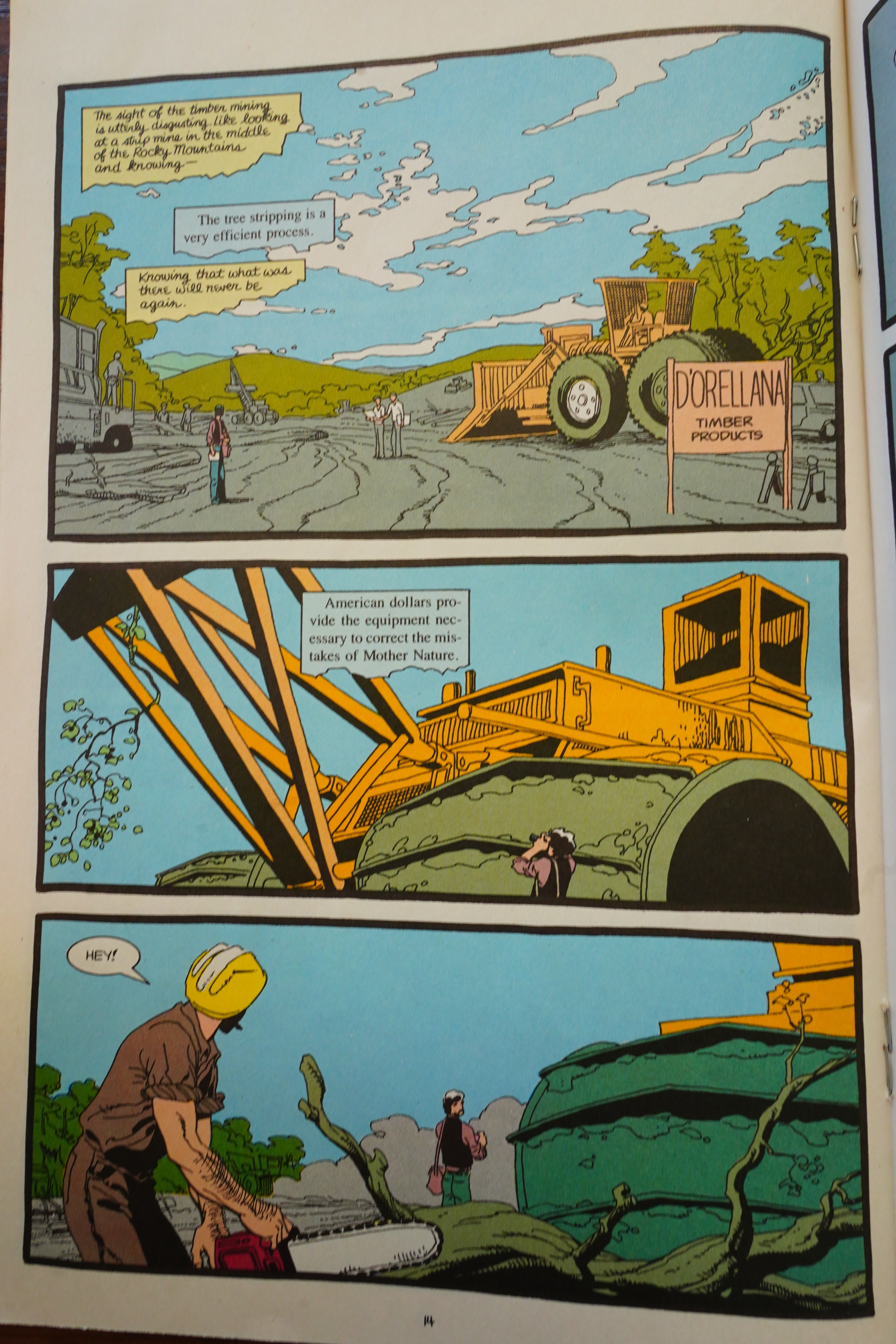
Sometimes there seems to be some tension between the diary and the published text, but it dissolves quickly and leaves you wondering what the point is.
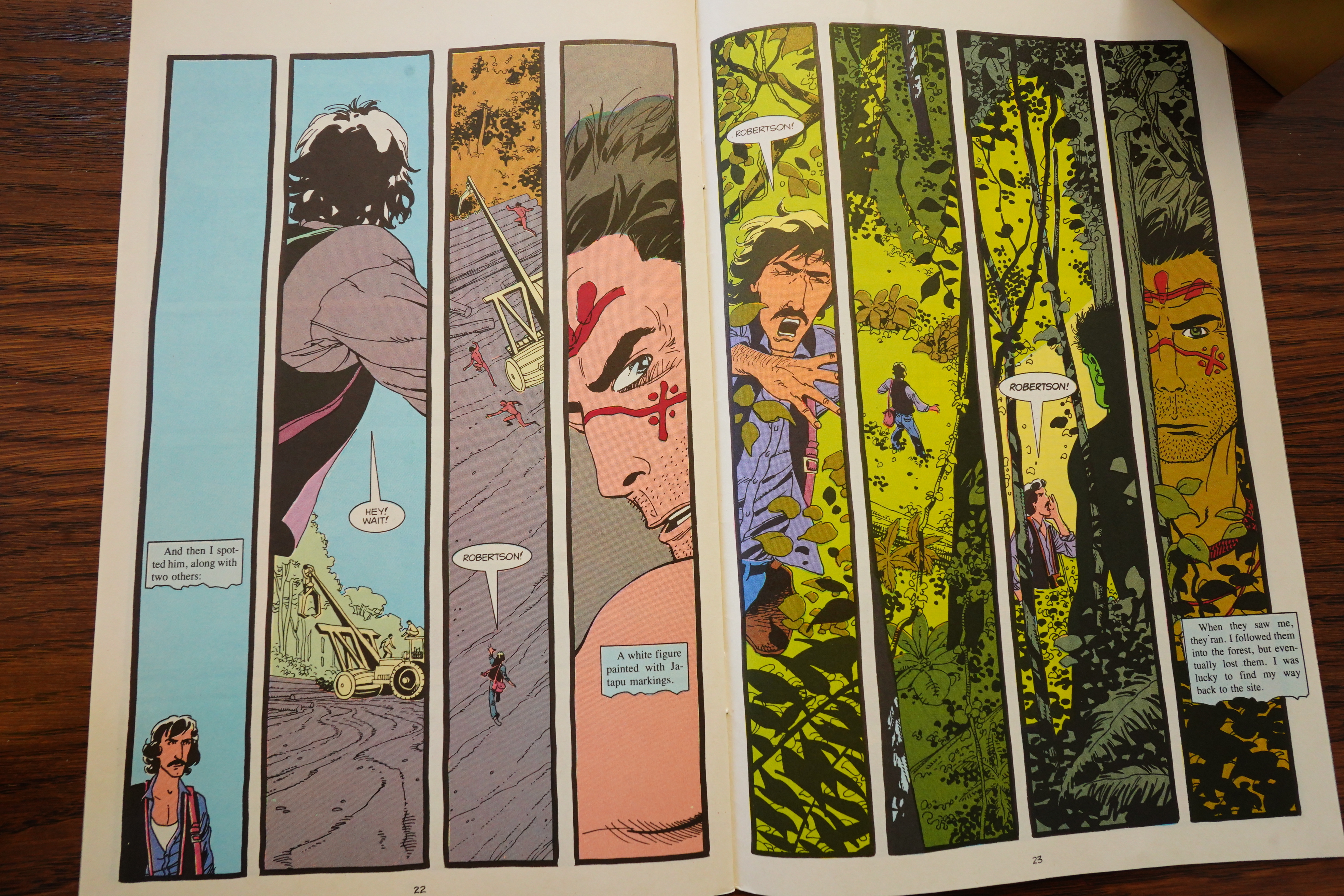
I really like the way this book is being told — Sale’s layouts are pretty traditional, but they shift efficiently as the story demands. It’s very engaging.
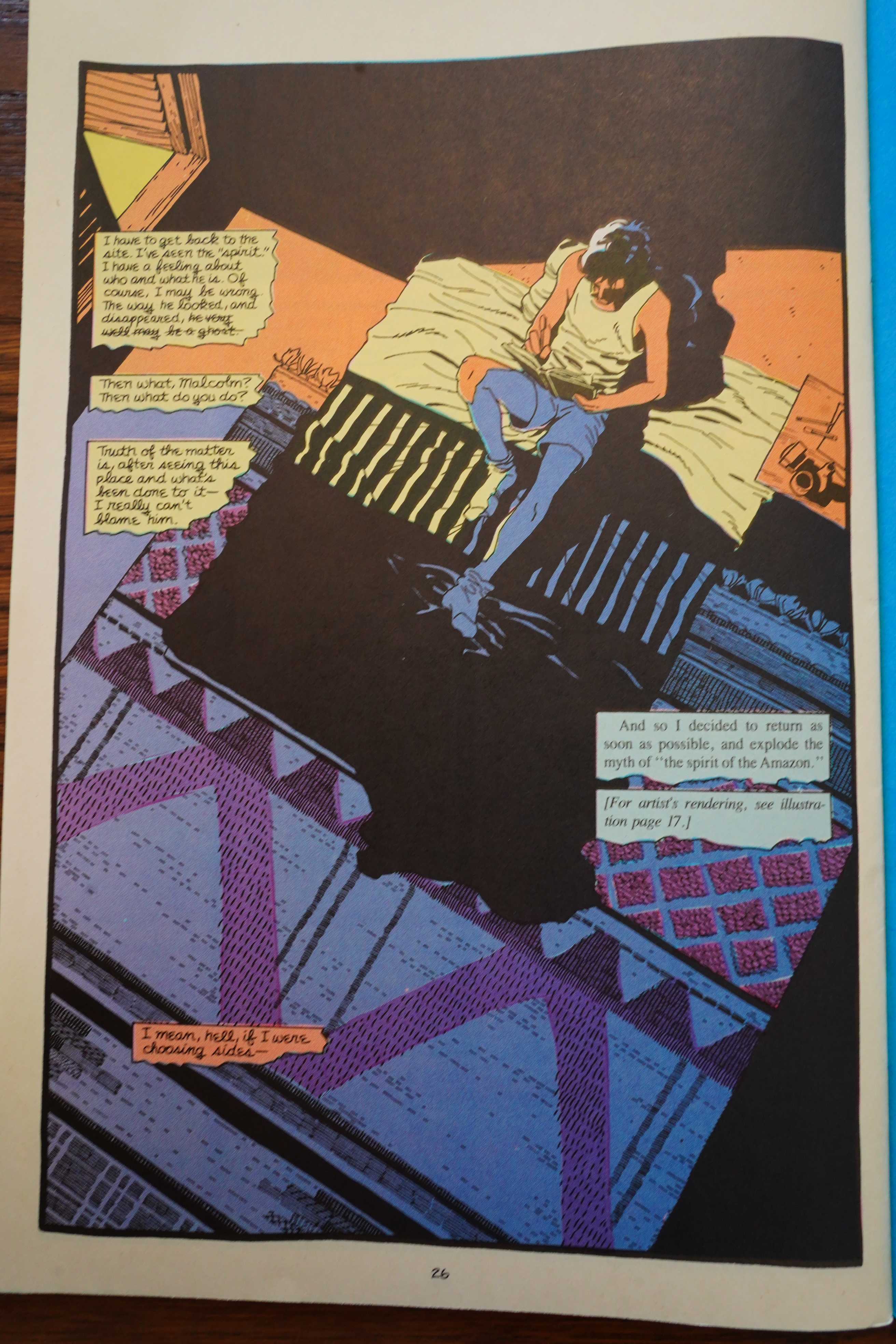
Is there some Frank Miller influence here, I wonder?
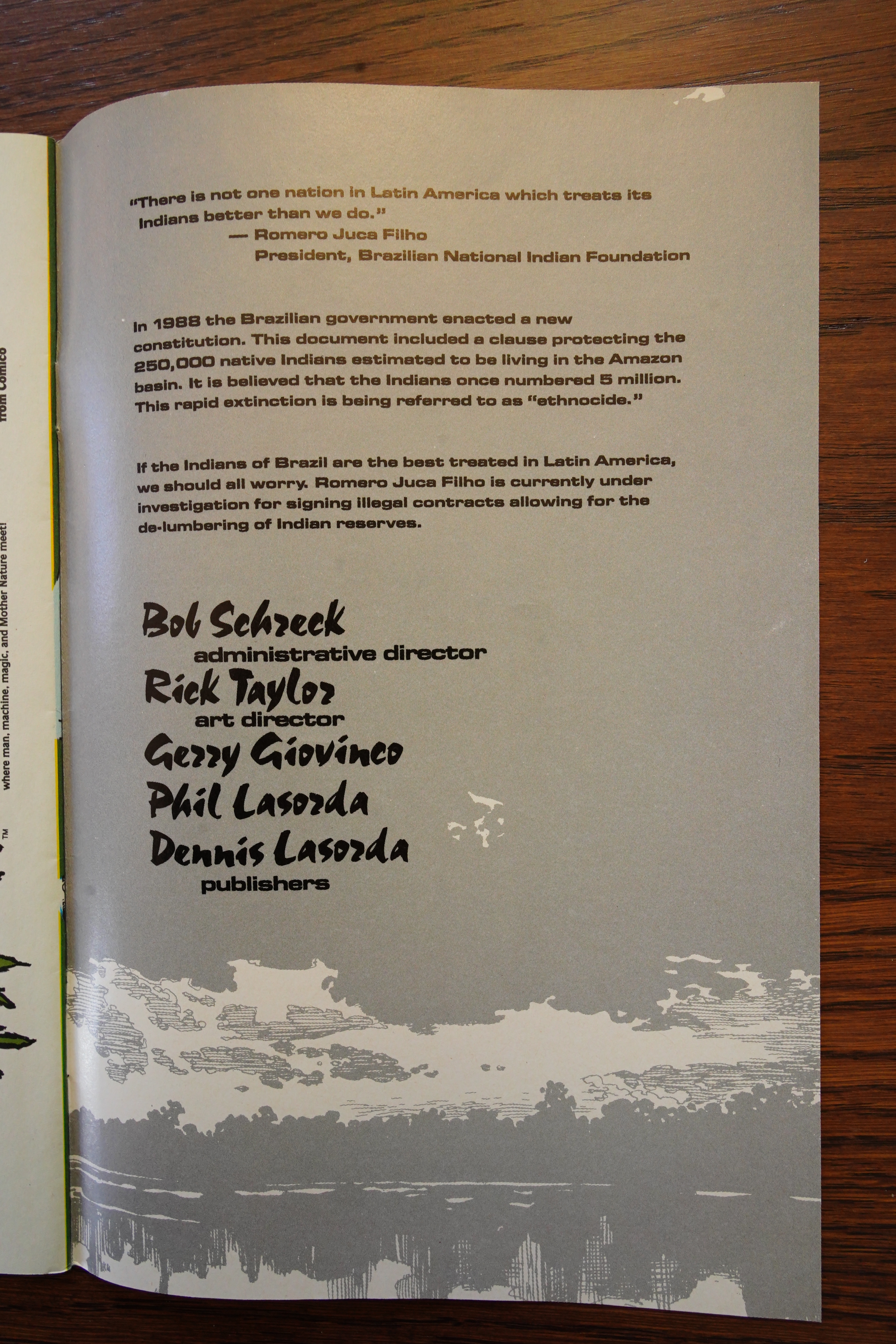
In each issue, we get some Amazonian factoids.
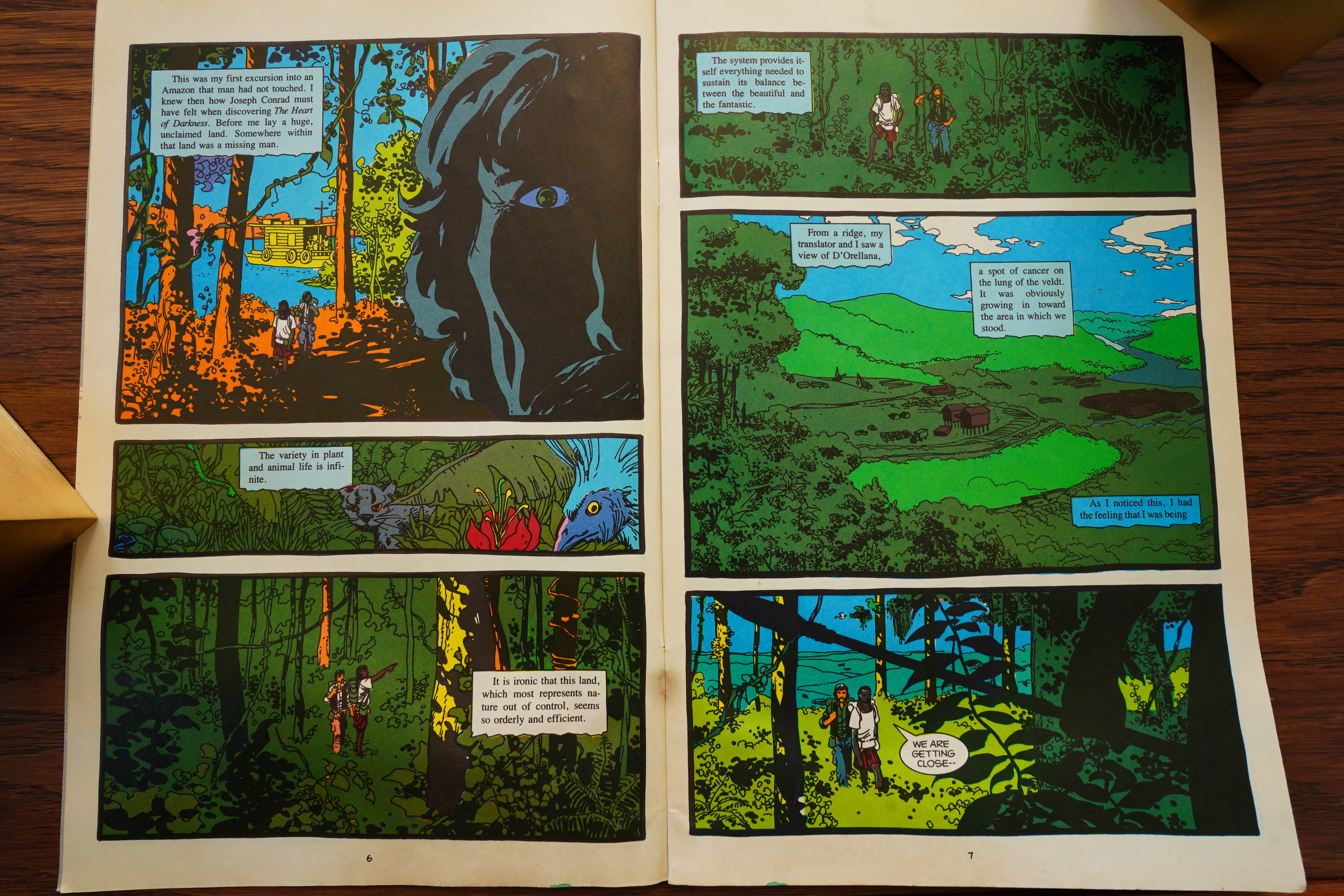
Oh, I forgot to mention the plot — it’s about a mysterious logging operation, and some sabotage happening there, and of course…
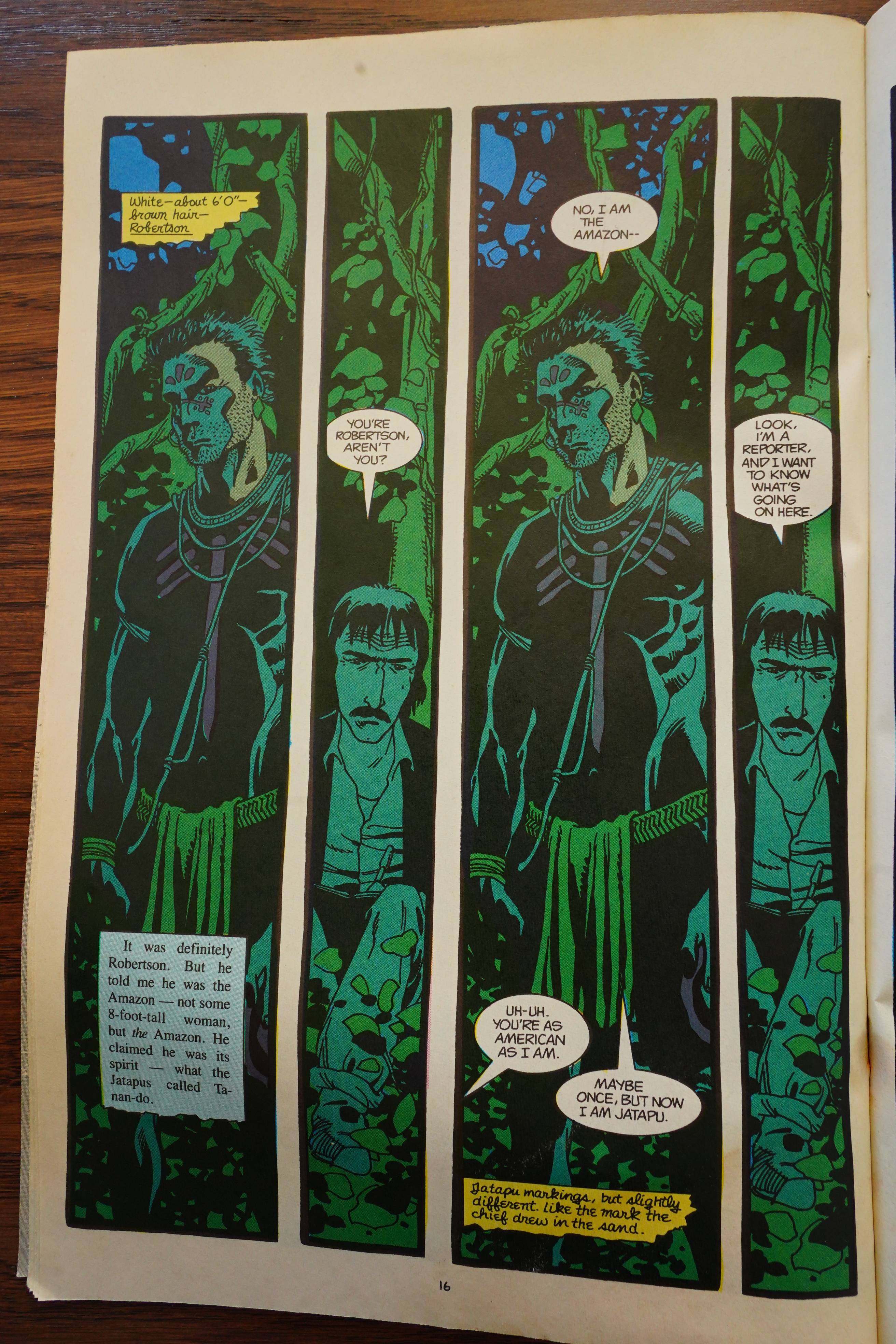
… there’s an American who’s “gone native” and is leading the rebellion. So — it’s the standard plot.
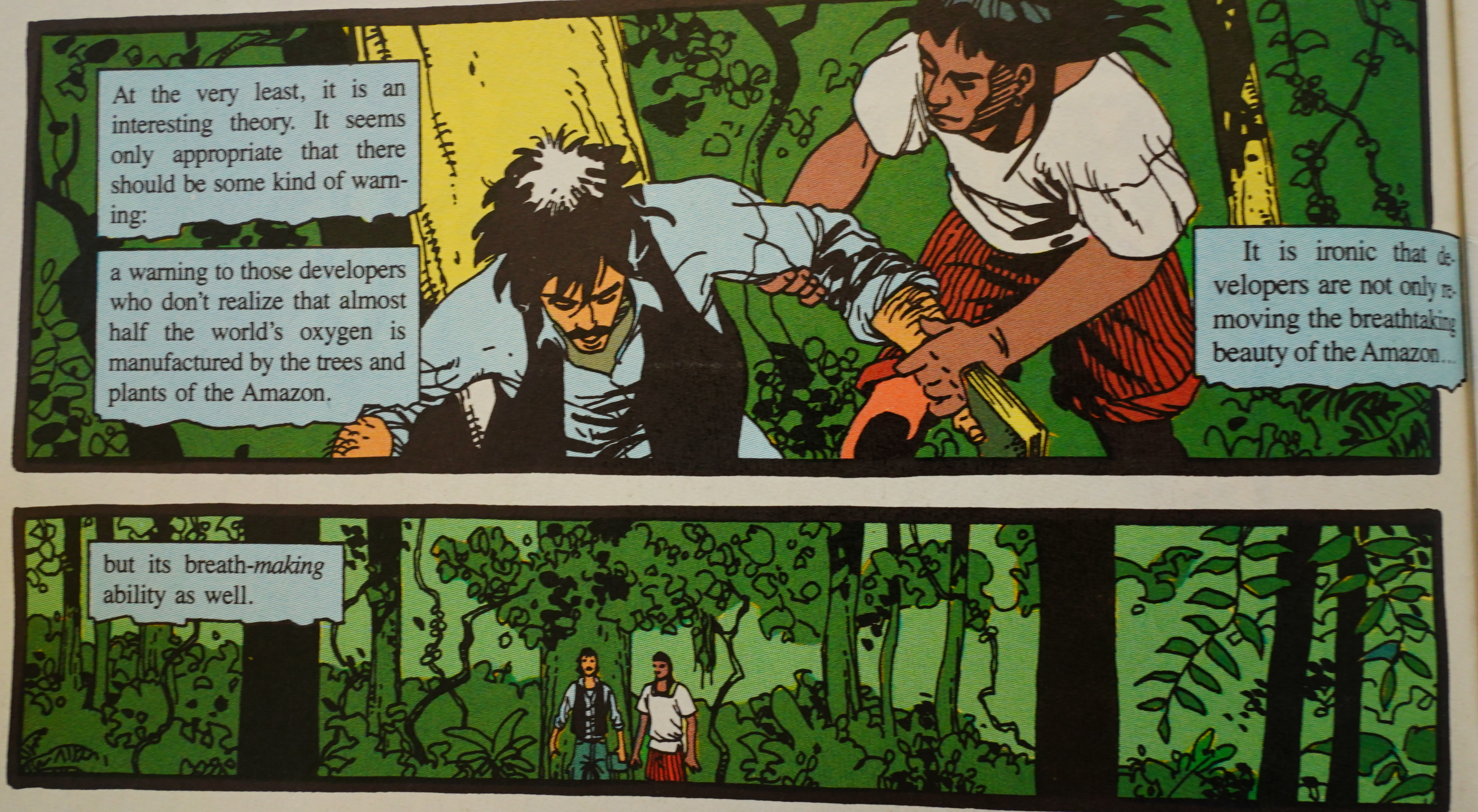
I rather like Seagle’s writing, too, but it’s a bit risible — “the breathtaking beauty of the Amazon… but its breath-making ability as well”. I guess Seagle was very proud of that one! (Of course, this is from the published article, so perhaps Seagle is taking the piss out of that kind of writing.)
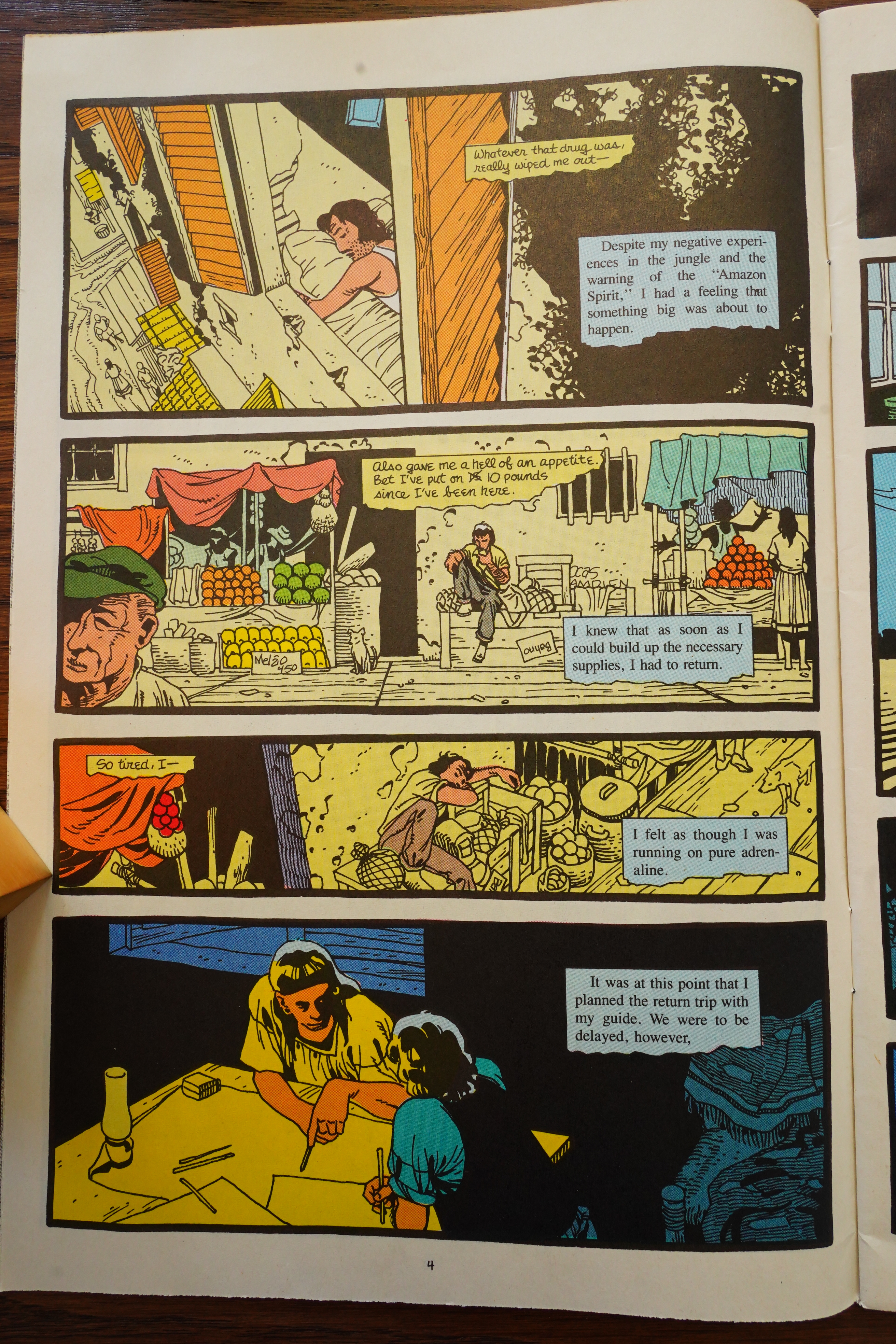
Finally! In the last issue, we get some divergence between the diary excerpts (and what’s in the panels) and the published article. So it wasn’t all for nought. But man… that took some time to pay off, and the payoff was kinda weak.
And there are extremely few differences between what we see in the panels and the diary excerpts, so it’s two levels instead of the possible three ones, which seems like a missed chance.
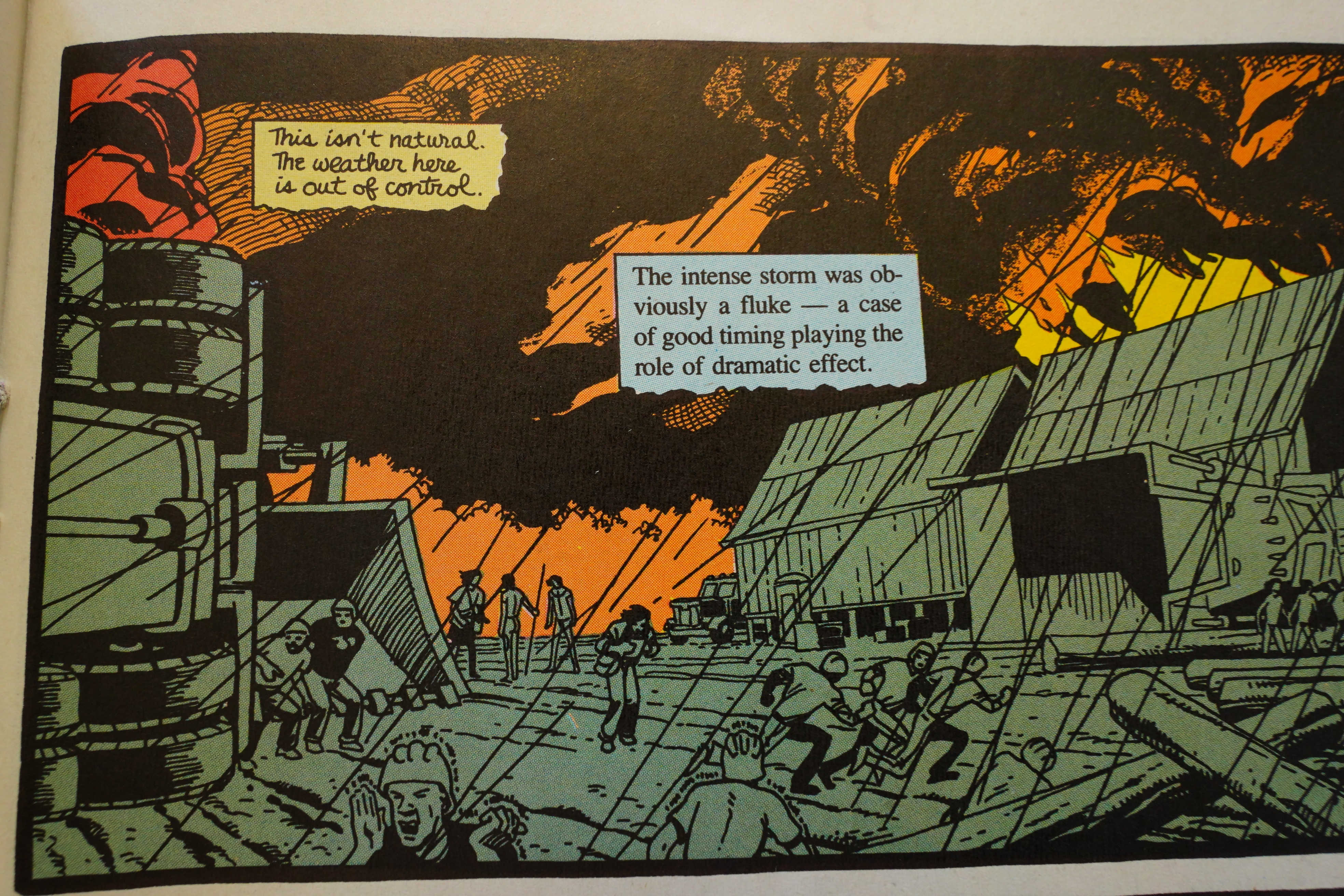
“The weather here is out of control” — yeah, weather is usually in control, is it?
So… storywise, this is a totally standard plot. The storytelling is fun — but Seagle could have done more out of the diary/article differences. And the artwork is excellent. It’s a very enjoyable read.
Amazing Heroes #157, page #21:
The Amazon, a three-issue mini-series
created by Steve (Kafka) Seagle and Tim
(Thieves’ World, Grendel) Sale, presents
the story of Malcolm C. Hilliard, “a re-
porter of questionable ethics who heads
to the Amazon to investigate the disap-
pearance of an American worker-and
gets a lot more than he bargained for,”
according to author Seagle. Is this
missing man responsible for a series of
acts of sabotage at an American-con-
trolled logging company, or is the
legendary creature known as “The
Amazon” behind it all?
The Amazon features a curious
experiment in comic-book storytelling.
Steve Seagle explains that “the key is that
the series is told from three different
points-of-view, all of which belong to the
reporter.” The story unfolds through
standard dialogue, a journal of Malcolm
Hilliard’s notes, and the article that the
journalist writes several months after
leaving the Amazon, all of which inter-
twine. However, in assessing the accu-
racy of each of those points of view,
Seagle admits that “the truth lies some-
where among the three,” with bits and
pieces of each version actually chronicl-
ing the events of Hilliard’s experience.
Steve Seagle is extremely enthused
over Tim Sale’s art in The Amazon,
stating that “Tim is taking a quantum
leap in terms of moving toward realism—
but without losing his style. His char-
acterization is wonderful, and his
research is meticulous!”
The Amazon debuts from Comico in
March.
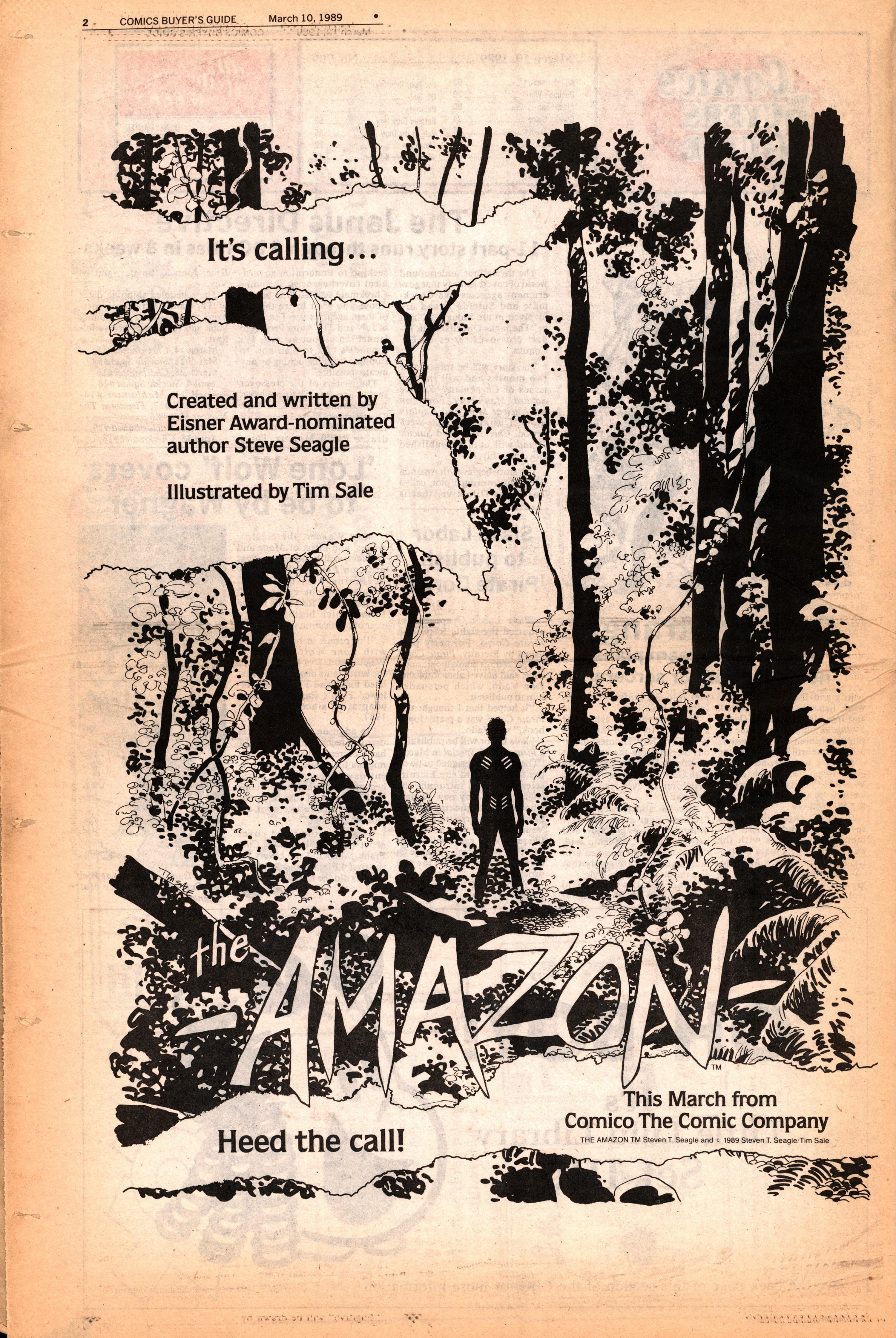
The Comics Buyer’s Guide #789, page #19:
The Amazon
Ecological mini-series
tells story three ways
Beginning in March, Comico
The Comic Company will pub-
lish The Amazon, a three-issue
mini-series created and written
by Steve Seagle and illustrated
by Tim Sale.
This monthly title has been
dubbed an “eco-series,” as it
goes beyond the literal explora-
tion of the mysterious jungle and
is its own experimental explora-
tion of the comics medium,
according to Administrative
Director Bob Schreck.
“The Amazon is the story of
Malcolm C. Hilliard, a reporter
for Point magazine, who has
been sent to the jungle to inves-
tigage the sabotaging of an
American-financed land devel-
opment firm. However, Hilliard
finds much more than he bar-
gained for. Writer Steve Seagle
has constructed the story so that
it unfolds to the reader by way of
three different writing
approaches: traditional dia-
logue, the reporter’s private
notes, and excerpts of the fin-
ished article that appear in the
magazine, each playing off the
other,” Schreck said.
Seagle received a 1988 Eisner
Award nomination for his work
on Kafka, illustrated by Ste-
phano Gaudiano and published
by Renegade Press. Joining Sea-
gle on The Amazon is Sale,
whose comics work includes
Thieves’ World from Donning
and a run as inker-artist on
Comico’s Grendel.
“What Steve brings to his
creations that makes them
unique is his challenge to his col-
laborators to bring something to
the project of their own,”
Schreck said, “which in turn
makes each project a true mar-
riage of the written word and
illustrated page. Because of this,
Comico and Seagle took extra
time in carefully choosing the
best possible artist for The Ama-
zon — namely, Tim Sale — and
the results of Tim’s pairing with
Seagle are stunning, to say the
least.”
Rob Rodi writes in The Comics Journal #134, page #34:
The appearance of an overtly
political mainstream comic book
about the Amazon jungle shouldn’t
surprise anyone. By the time any en-
vironmental issue achieves pro-
minence in our national media –
obsessed as they are with party
politics and personalities – it must
have reached a pretty alarming junc-
ture. The deforestation of the Amazon
is just such an issue. Network news
shows and news weeklies trumpet the
dire predictions to a population only
dimly aware of where Brazil lies on
a map: at the present rate of defolia-
tion, the Amazon could be gone from
the face of the Earth by the year 2000,
and with it its bountiful oxygen out-
put. The effect on the environment?
Unknown, but certainly irreparable.
Our government’s attempts to cajole,
bamboozle, bully, or just plain buy a
temporary cessation in the operations
from the Brazilians have gotten a cold
shoulder; thanks to decades of our
truly evil foreign poliy, the American
reputation in the Third World is not
the kind that inspires favors to be
granted. And so the Amazon is going,
chunk by irreplacable chunk.
Now Steve Seagle and Tim Sale
have used this as the foundation for
their mini-series, The Amazon. Their
hero, a rather fatuous reporter named
Malcolm Hilliard, has traveled to
Brazil to have a look at what’s going
on and to see if he can find a Pulitzer
Prize in it. His angle? An American
worker has disappeared from the site
of an Amazon timber-stripping opera-
tion, one that’s financed by an
American-backed corporation.
Seagle and Sale do a wonderful job
of establishing the oppressive heat and
exotic beauty of the Amazon, and of
the flourishing, panethnic culture in
the city of Manaus. They’ve also come
up with a three-tiered storytelling
device that’s extraordinarily clever:
first we watch the action occur in the
panels; simultaneously, we read the
overlying captions of Hilliard’s jour-
nal notes taken on the action; and
finally, interwoven with these are cap-
tions taken from his published story.
These three narrative layers — objec-
tive reality, perceived reality, and
reality tailored for publication – con-
tradict often and amusingly, telling us
much about Hilliard’s professional
vacuity in an efficient, artful fashion.
(Also, when the three levels of reali-
ty agree, the effect is powerful; we
know we’re witnessing something that
overwhelms interpretation.)
Eh… I guess Rodi read the press releases.
For the first issue-and-a-half, The
Amazon is close to perfect. Especial-
ly fine is Sale’s cartooning; it seems
that there is nothing he can’t draw,
from overhead panoramic views of
Manaus’s gritty splendor, to the
primeval lushness of the Amazon ter-
rain, to the twitch and play of
Hilliard’s facial muscles. It’s a spec-
tacular perfomance.
The trouble comes in the “political
correctness” of the book, which is
kind of smothering. Every couple of
years I read a new prediction that con-
ventional liberal thinking and conven-
tional conservative thinking have
become completely untenable, and
that we’re on the threshold of a new
system of values. But all that’s hap-
pened is that both conservative and
liberal ideologies have become more
entrenched and shrill than ever – and
more ridiculously untenable. At times,
The Amazon is about as embarrassing
a left-wing whine as you’ve ever seen.
It throws you back 20 years, when kids
from priviledged families decided that
any form of civilization sucked, and
that they should stop bathing, live 24
to a cabin, and grow herbs.
In The Amazon, the potential
devastation of the planet’s atmosphere
seems of secondary importance to
Seagle and Sale; they’re much more
concerned about the threat deforesta-
tion poses to the way of life of the
Amazon’s tribal peoples. The reporter
Hilliard goes on and on about the no-
ble savages he meets, how they, squat-
ting around their villages swatting
away flies, have something that we –
poor sons and daughters of the Age
of Reason! – have irretrievably lost.
This kind of hooey-flooey just gets me
in the neck. The romantic idealization
of tribalism, ignorance, archaism, and
savagery is probably the most un-
sophisticated notion ever to be em-
braced by sophisticated thinkers (from
Rousseau to Tolstoy and on). Today it’s
the favored theme of swoony-silly pop
artists like the filmmaker John Boor-
man, whose The Emerald Forest ex-
presses some of the same themes as
The Amazon. The whole edifice of
Western civilization – our triumphant
arts, our astonishing sciences, our in-
tricate legal systems, our thriving net-
works of trade – is repudiated in the
name of savagery by the kind of la-
de-dahs who would come running
from the mud-huts back to civilization
the moment they developed an
abscessed tooth, or goiter, or spent
more than a day or two hungry.
Even the idea that “it works for
them” is offensive in this case. Sure-
ly we must respect Japan’s Shinto
traditions and the Arab world’s
Islamic beliefs, to name but two,
although they may at times seem
strange and repellent to us. But to look
at people living at the subsistence
level, buffeted by disease and the
vagaries of nature, and to feel nothing
because of the cultural relativistic idea
that this is, after all, their traditional
way of life, is simply wrong. Cultural
relativism is only applicable to situa-
tions where there does in fact exist a
culture, and, if I may be so bold, a
“way of life” does not in itself con-
stitute a culture. A vital artistic tradi-
tion is evidence of a culture; an
energetic, growing intellectual and
philosophical life is evidence of a
culture; some system of commerce is
evidence of a culture. The Amazon’s
tribe – the “Jatapus” – has none of
these; Hilliard is infatuated with them
largely because they display no am-
bition; he mistakes ignorance and
hopelessness for spiritual tranquility.
He rails against the influence of the
Christian missionaries who are
eradicating the people’s tribal ways;
although I have little empathy for
organized religion, I do recognize the
service these missionaries are pro-
viding the tribal remnants of South
America. Can taking these
beleaguered people and feeding them,
cleaning them, and providing them a
sense of self be so bad? Can taking
them out of the Stone Age and in-
troducing them to many of the terms
and conditions of the 20th Century be
so heinous a crime? I might wish them
better than the moral thuggery of the
church in return, but I don’t wish them
worse off – which their tribal life cer-
tainly is.
*sound of axes being ground*
Seagle’s and Sale’s botched think-
ing is most clearly represented by
Robertson, the American worker who
has just joined the Jatapus to fight the
encroachment of technology on the
Amazon. The creators don’t even give
him the courage of his convictions; he
hasn’t left the crew because he has any
environmental axe to grind; he was
just drunk and moody, so he got fired.
(Hilliard doesn’t believe this, by the
way; he’s certain the site is a front for
a drug operation, and that Robertson
knows about it, but this is never pro-
ven. You get the feeling Hilliard is
willing to see Martians in the Amazon
if it means getting that Pulitzer.) When
Robertson tells Hilliard his story, you
get the impression he joined the tribe
after he got fired from the timber site
simply because it was the only other
job offer available. And he only
develops the compulsion to save the
Amazon when he’s taken over by
“Tanando” — the spirit of the jungle.
The first time you hear the site
workers mention “Tanando” in hush-
ed tones, you get a bad feeling, like
you’re about to tumble into some
awful Johnny Weismuller movie, and
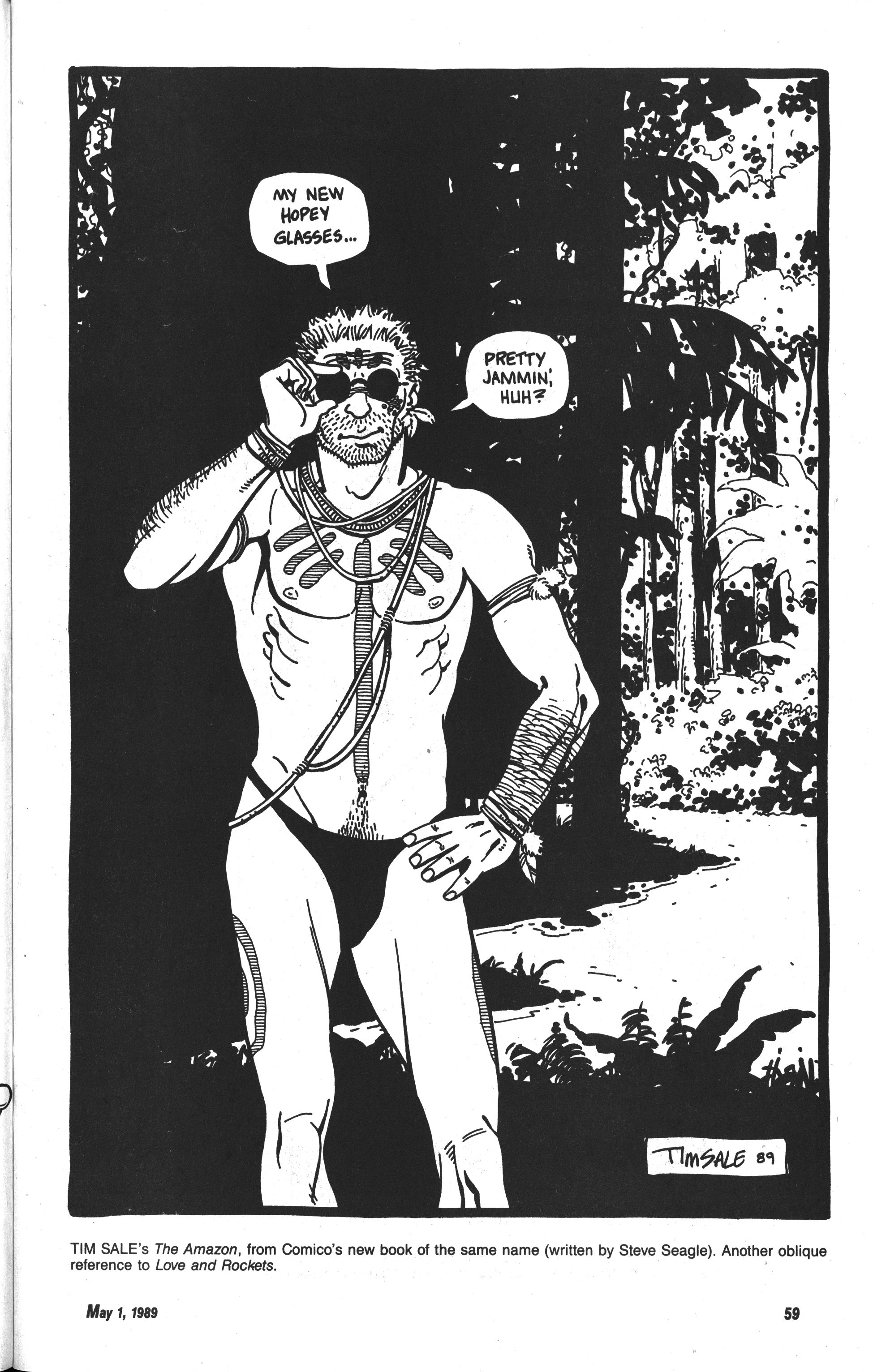
sure enough, when Robertson ap-
pears, in tribal drag, he looks like a
Hollywood hunk playing Tarzan. For
all Seagle’s and Sale’s admiration of
tribal life, they have apparently never
looked at a real South American tribe
before – they don’t look like this.
When we meet Robertson, he’s been
in the jungle with the tribe for months,
but he steps out of the flora looking
like he works out with Nautilus twice
a day. He’s the very picture of the
romantic, idealized savage who
doesn’t exist and never has; he em-
bodies civilized man’s dream of
recovering what he think’s he’s lost,
and it’s a silly dream without founda-
tion. If Seagle and Sale are really keen
on this, if they want to be part of a
better world of flamboyantly painted
men with immense pectorals engag-
ing in tribal rites, all they have to do
is go to their local gay ghetto on
Halloween. The Amazon, while it
lasts, will have a different story to tell.
Oddly, enough, they often come
close to telling it. Although you may
quarrel with their thinking, and with
the furious and inconclusive ending
to their story, you bow to their cause,
and to the majesty of what is at stake.
Sale’s artwork conveys both the
astonishing scale and the evocative
beauty of the Amazon. There are se-
quences that give you an impression
of what a blip on eternity might be –
and this is no mean achievement in a
medium so often focused on the im-
mediate. If Seagle and Sale’s primary
goal was to spread awareness of the
astonishing proportions of the impend-
ing deforestation tragedy – the enor-
mity of what may be irretrievably lost
– then they’ve succeeded. The panels
of Hilliard’s boat floating down the
Amazon river, dwarfed by it, will stay
with me for a long time. There’s a
magic in these panels, a stillness,
that’s morally urgent.
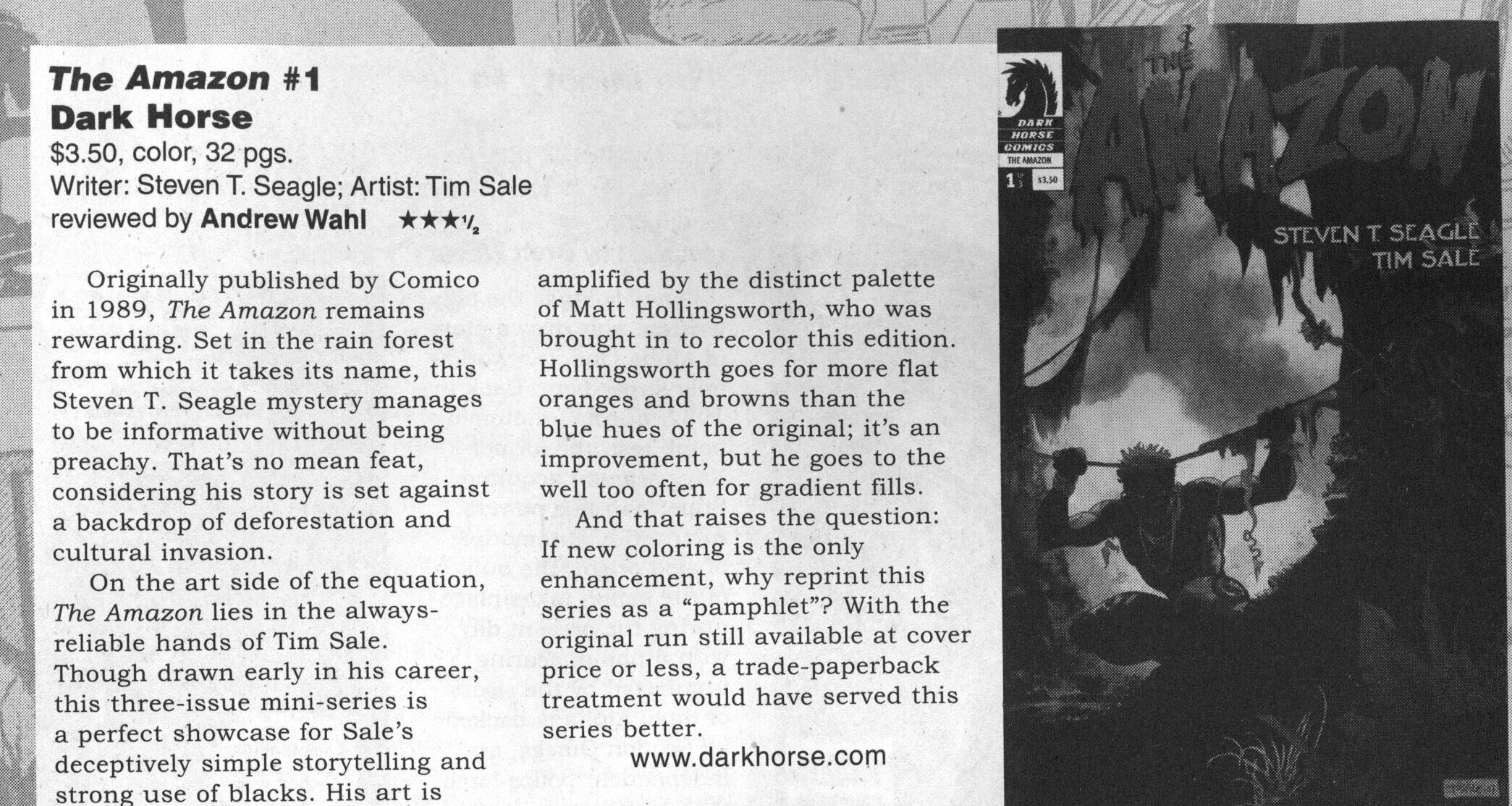
Dark Horse reprinted the series as a series, and I’m as puzzled as the writer here as to why — why not a collection instead?
The Slings and Arrows Comic Guide #2, page #30:
American journalist Malcolm Hilliard becomes obsessed
with discovering the truth about rumours concerning
missing workers and disruptions at a Brazilian logging
camp. The local tribes believe a physical manifestation of
the Amazon occurs to protect the land in times of need,
and the further Hilliard digs the more he’s forced to
question his beliefs. A remarkably assured comic début
from writer Steven Seagle, and while Tim Sale’s early art is
less adept this is a rare instance of a series managing to
wrap a forceful point in a well paced story.~FP
Recommended: 1-3
The Earth is now a planet on the verge ofdeath: pollution and human irresponsibility are destroying it, but what is more serious is thatthey are impoverishing its respiratory system. Day after day, theAmazon rainforest, the lungs of theworld, is being seriously violated, unknowingly. This problem is oneveryone’s lips, yet the destructionof the Amazon is being perpetrated relentlessly, even with the consent of the powerful.
[…]
The fusion of the three narrative levels, which interpenetrate andinteract with each other, offers the reader ahighly enjoyable “mélange” of writtendialogues.Alongside Seagle’s splendid work, Tim Sale complements the text with incisive drawings featuring simple yet complete lines that make use of special chiaroscuro techniques and original framing, all complemented by excellent coloring that enhances the artist’s work.AMAZON is further evidence of how American authors arediscovering new subjects beyond theworld of superheroes, with very positive results.ED
Amazing Heroes #166, page #61:
This three-issue mini-series is a
chronicle of an American reporter in
search of The Big Story in the Ama-
zonian region of Brazil. An American
worker has gone missing from one of
the huge lumber operations in the
Amazon, and three months later sabo-
tage directed at that company begins.
The reporter, Malcolm C. Hilliard,
thinks that the two are related, and that
there is a good story in it. (And, ac-
cording to his personal journal,
“hopefully a book deal.”)
Right from page one it is obvious
that The Amazon is no ordinary comic
book. Instead of the usual use of pan-
els of art to tell the story, this series
employs three different methods, each
one having its own flow.
The first one uses the standard
comic-book format of panels and dia-
logue to tell the story of Hilliard’s in-
vestigations in the Amazon. This tells
us, from Hilliard’s point of view at
least, what actually happened.
The second storytelling device is ex-
cerpts from Hilliard’s personal jour-
nal, which he kept during his time
working on the story. This is presented
to the reader in a handwritten script.
It gives us the reporter’s immediate
impressions, his feelings and observa-
tions at the time, unaltered by subse-
quent knowledge and unpolished by
later rewritings.
Third, we are presented with parts
of the published article that resulted
from his investigations. To distinguish
it from the journal excerpts, it is dis-
played in typeset printing. This is the
“final version” of the events that Hil-
liard observed—or, at least, the ver-
sion that he wishes to present to the
reading public.
These three threads are interwoven,
presented to the reader in alternating
and interconnected sequences that
form a greater whole, though the
whole is not always very cohesive and
thus the reader is required to try to
assemble a “reality” out of these
slightly different points of view.
This presentation thus has many
fine possibilities for telling a story in
a way that both challenges the reader
and requires the reader to participate
in the story by trying to come up with
his/her own “final version” of what
happened. It also allows insights into
who Hilliard is and what his own bias-
es and preconceptions are. For ins-
tance, at the start of his journal he says
“I have no intention of taking sides in
this.” He is referring to the situation
in the Amazon basin, where “devel-
opment” is affecting (to say the least)
the local culture and the environment.
Yet when he encounters Christian mis-
sionaries his immediate reaction is
one of revulsion, feeling that they are
destroying the local culture even more
than the lumber companies. “Sicken-
ing. Sickening. Sickening.” He writes
in his journal. And on his first en-
counter with a lumber operation, he
describes it as “horrendous.” His
journal is much more raw and emo-
tional that the finished article. Yet, in-
terestingly enough, the article makes
mostly the same points but in a more
“reasoned” and “fairer” sounding
manner.
And what of the missing American
worker? Has he gone native to help
the local tribe fight the lumber com-
pany? And is he the “Spirit of the Am-
azon” that some of the workers feel
has been summoned by the tribe (and
which provides the title for Hilliard’s
article)? Or is there a true spirit,
known as Tanando?
As the issue ends, Hilliard’s “objec-
tivity” seems to be wavering, both in
what side he feels himself to be on and
in his judgment of what is “really”
going on.
The storytelling method employed
here has great possibilities. The sub-
ject matter of the story involves impor-
tant social issues as well as an intri-
guing mystery. Perhaps this first in-
stallment has not been quite as com-
pelling as it might have been. While
definitely interested, the reader is not
drawn into the story and made to feel
a part of it. But then, perhaps this de-
tachment is a necessary part of the
three-part presentation. The reader
must remain above the fray in order
to get an overall view and thus be able
to piece things together into a mean-
ingful whole. But if such be the case,
it is a small price to pay for the re-
wards that await the reader in trying
to make his/her own sense out of the
proceedings, instead of just being pre-
sented with a finished version of them.
GRADE: VERY FINE — T.M. Maple
Comics Interview #99, page #40:
THE AMAZON, written by Steve
Seagle, for Comico. It didn’t make any
money, it didn’t sell many issues, but
more than anything else, so far, it has
made publishers, writers, editors, artists
look at my work.
JEPH: Even Frank Miller called you.
Heh:
I’d add more information about this series but I seriously can’t find it. I tried like ten different searches and nothing comes up. It’s credited in Seagle’s wiki profile but if you click the link, nothing shows up.
The long, narrow river vistas, the streets of Manaus, the crowded cantina scenes and the lonely nights in Hilliard’s hotel dive are all rendered with Sale’s trademark precision.
Seagle provides two streams of narration—Hilliard’s personal journey, and the final, published article he’s working on—that tell the story in a surprisingly coherent way, with the different voices and different points of view of the same man complimenting each other far better than I would have expected.
The story definitely feels like the first chapter in a longer story, and may read better in trade, but this first issue is far from poor. Seagle does a good job building up the main character, setting up the conflicts, and even sneaking in a bit of education regarding the Amazon without coming across overly preachy.
It seems like Image announced that they were doing a collected edition, but it never happened?
Heh:
James Cameron’s ‘Avatar’ but angry.
John Booreman’s ‘The Emerald Forest’ but colder.
Pass.