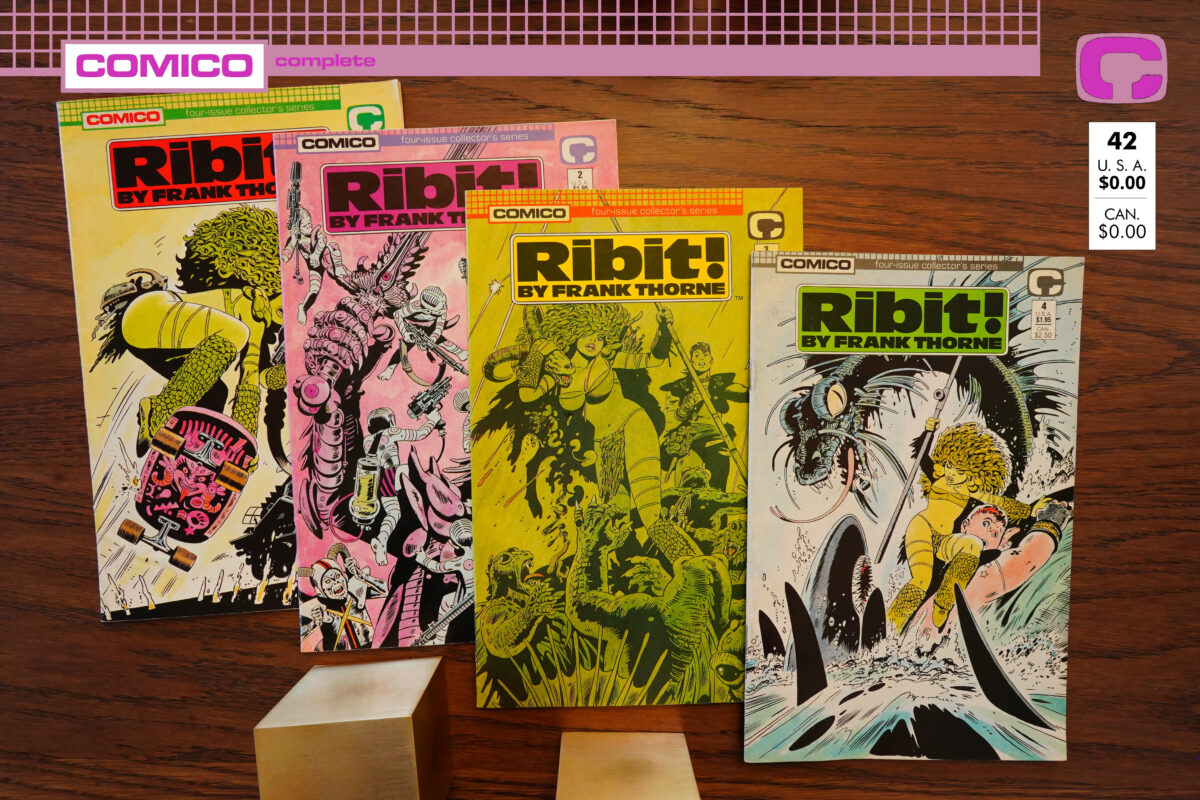
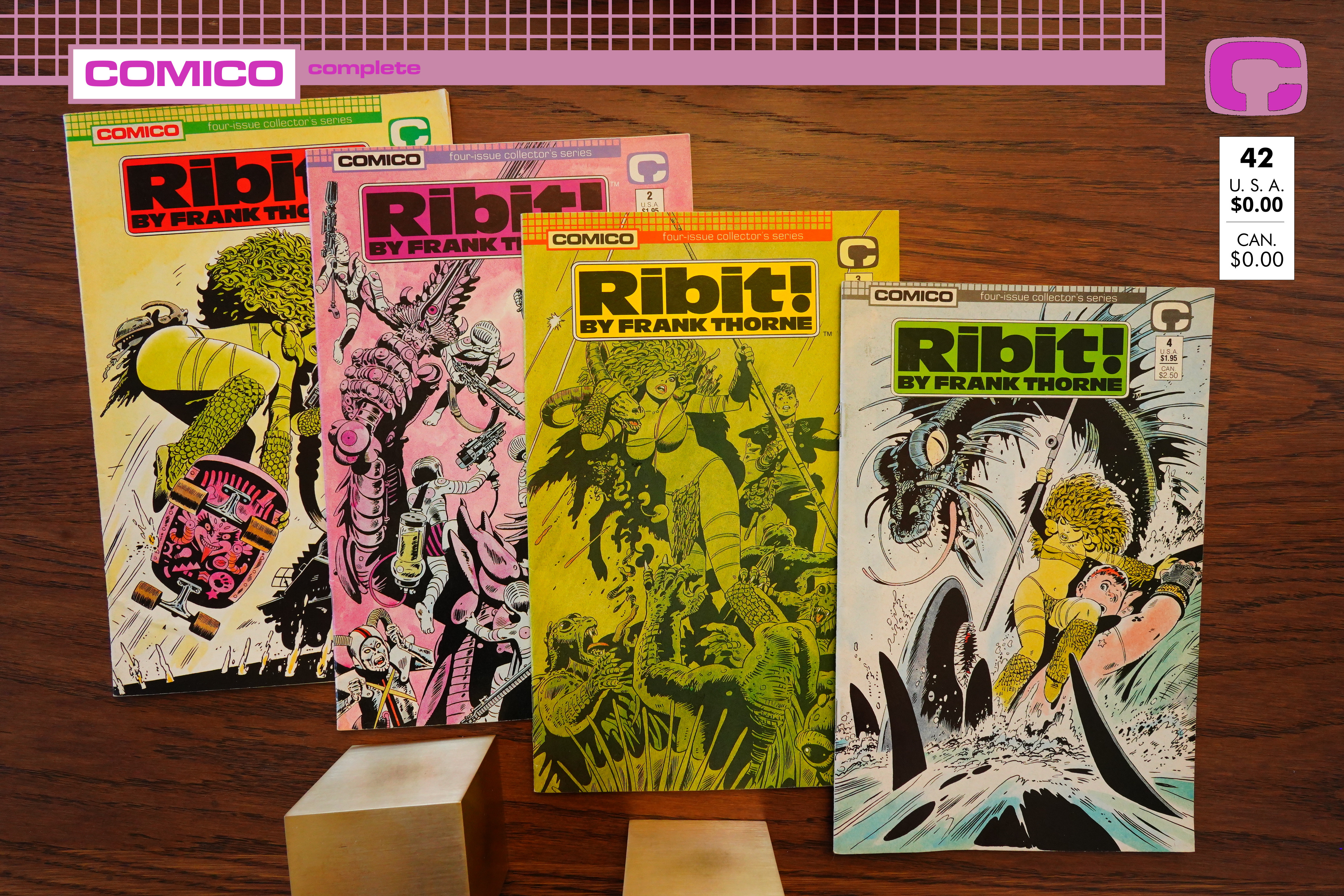
Ribit! (1989) #1-4 by Frank Thorne
Comico’s 1989 lineup seems paradoxical — Comico were bringing in more established creators than ever before, and publishing better comics than ever, but complete bankruptcy is just around the corner.
But perhaps one is the result of the other? Time and time again, creators in interviews will point out the lengths editor Diana Schutz went to keep books on schedule, having material on hand up to nine months before publication. As Comico were apparently paying for the work before Comico received it (or even beforehand), this must have been a huge drain on liquidity? And for longer series that were underway when Comico went bankrupt, this was presumably a straight-up loss, as Comico allowed the creators to take their books elsewhere and publish them there (like with The Maze Agency).
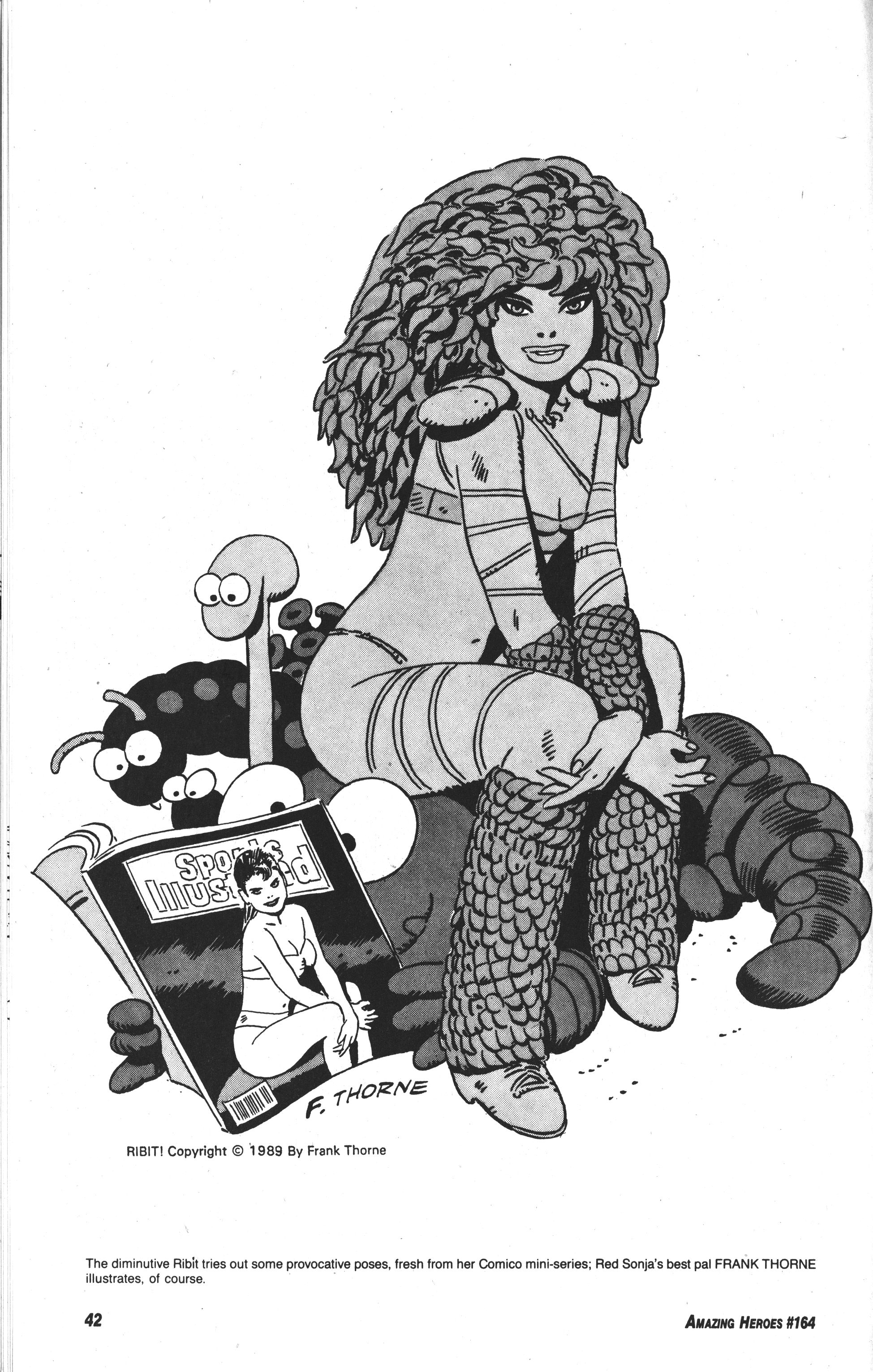
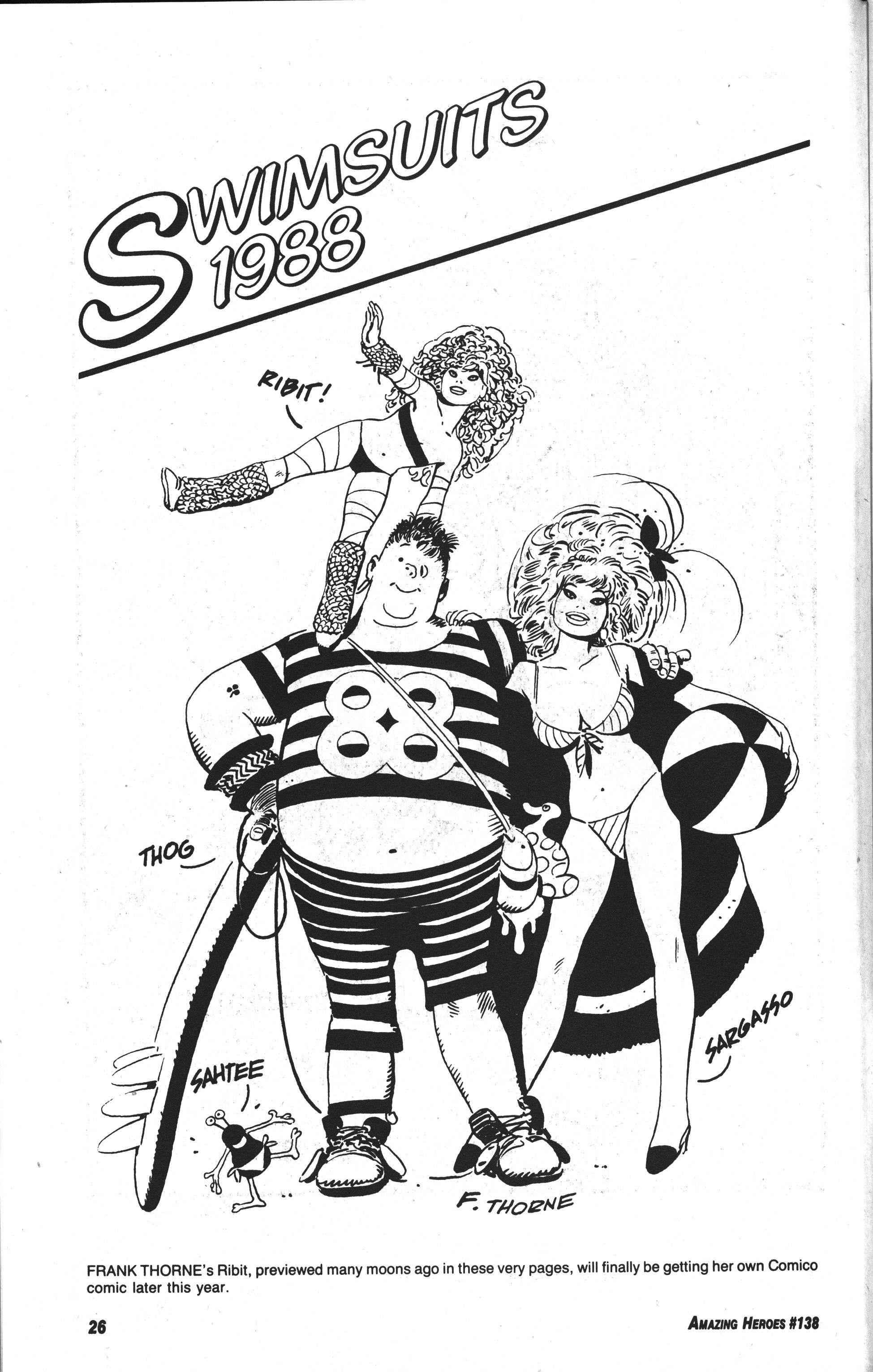
Which brings us to Ribit, a series by Frank Thorne. By 1989, I guess he wasn’t really a big name any more, but it’s a name, at least.
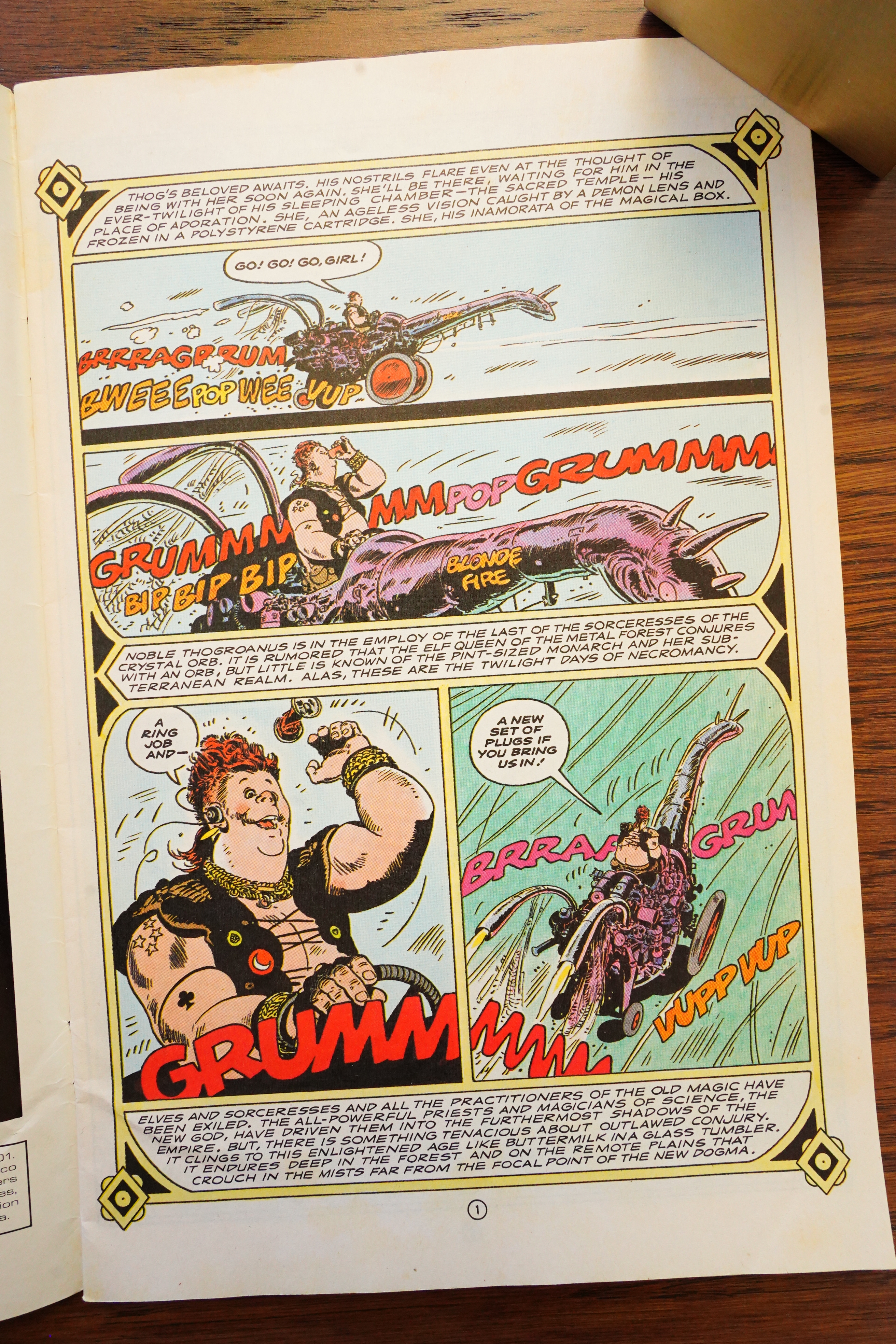
Thorne was big in the 70s, with his Red Sonja run and the Ghita of Alizarr series (was that for Warren?) as well as comics for Playboy &c. He is a very talented artist, of course, but his writing is pretty much always like the above: He has a tendency to natter on a bit, and sometimes the text makes sense, and sometimes not. You get the feeling that he has a short attention span while writing.
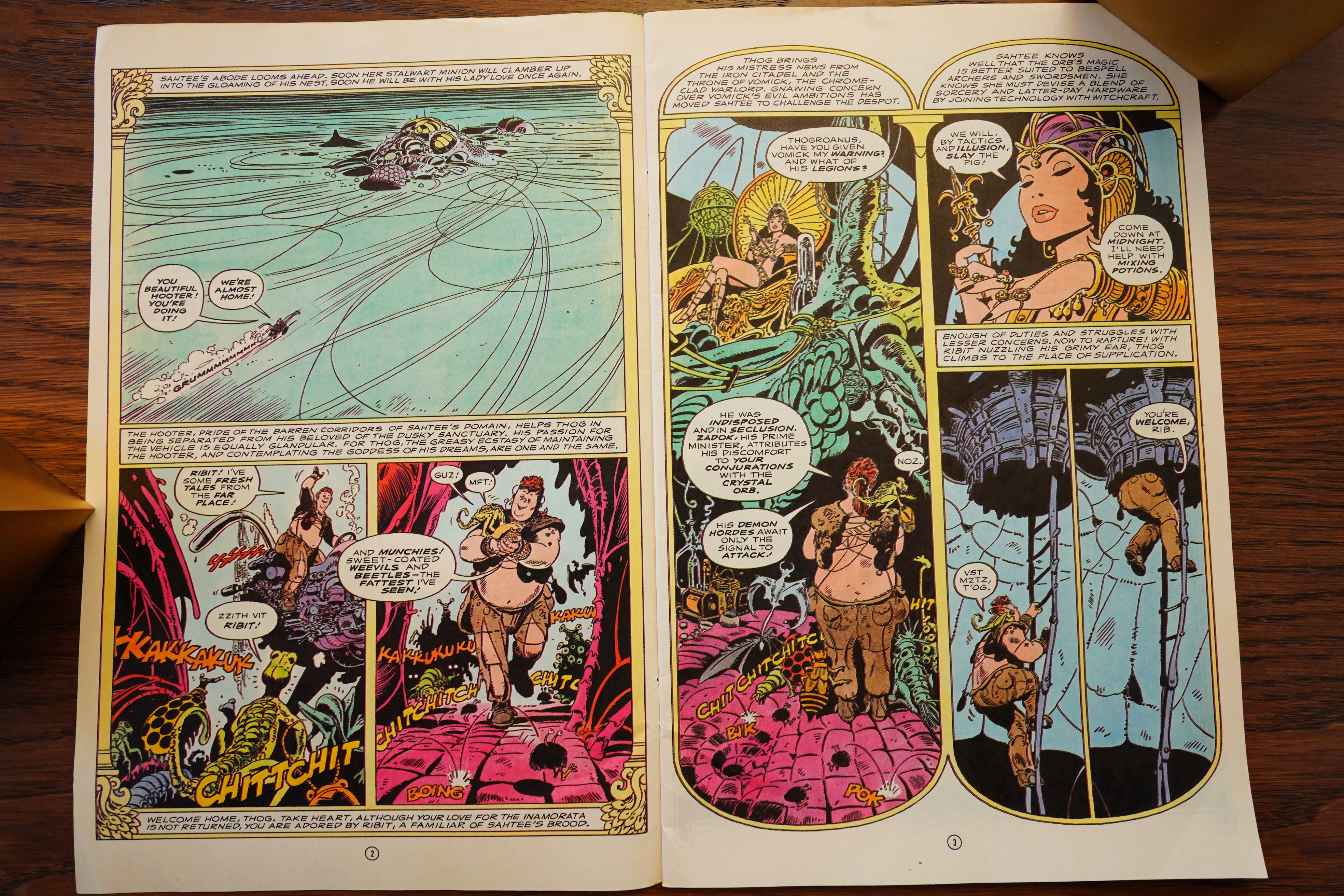
But while florid, this one makes more sense than most of the books I’ve read by him.
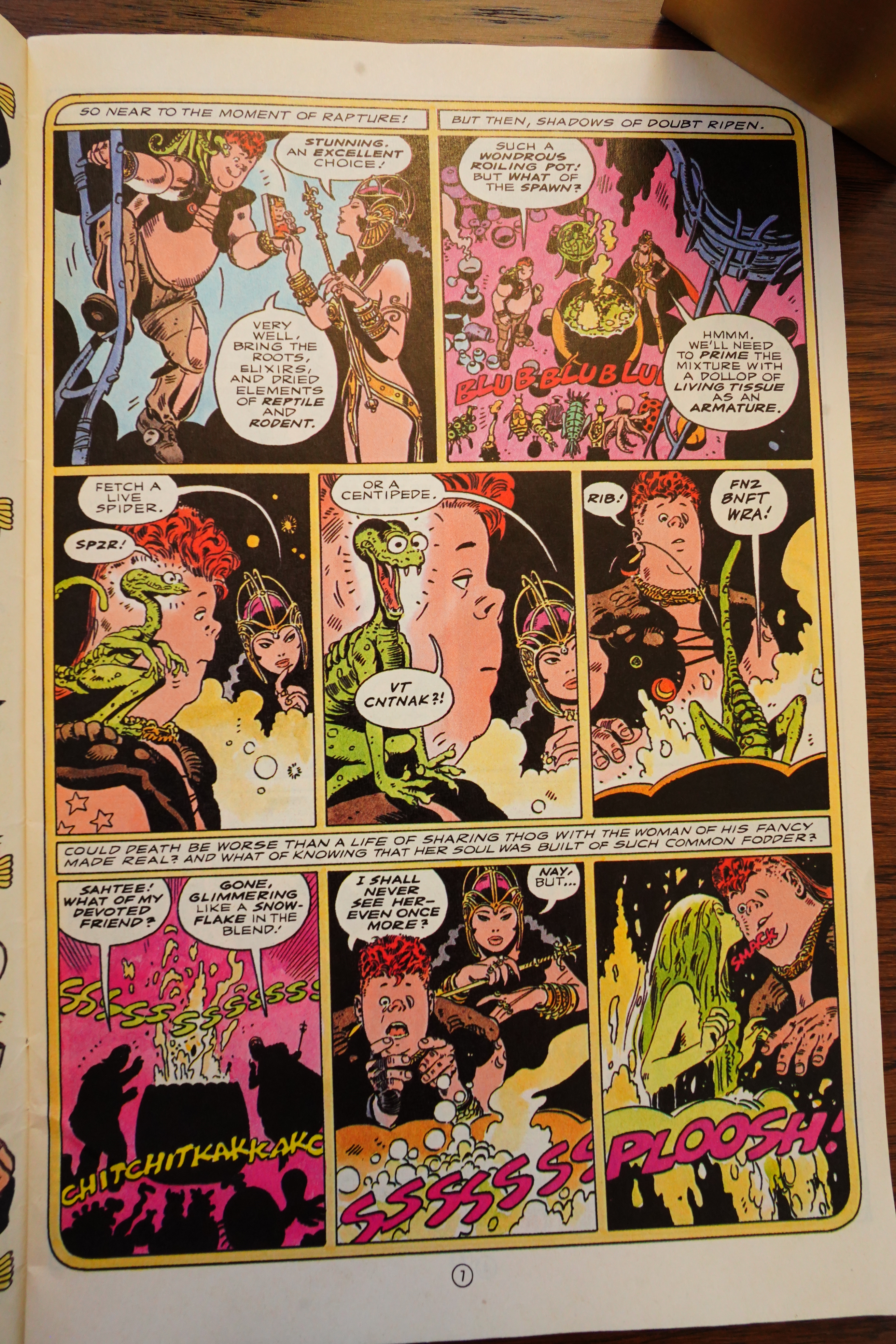
Thorne is controversial for other reasons, too — mainly because he has a tendency to draw a lot of characters that look like nude children, and mostly girls. There’s always an in-story explanation for this, like — “oh, they’re elves and/or gnomes and that’s just what they look like; of course they’re all adults”.
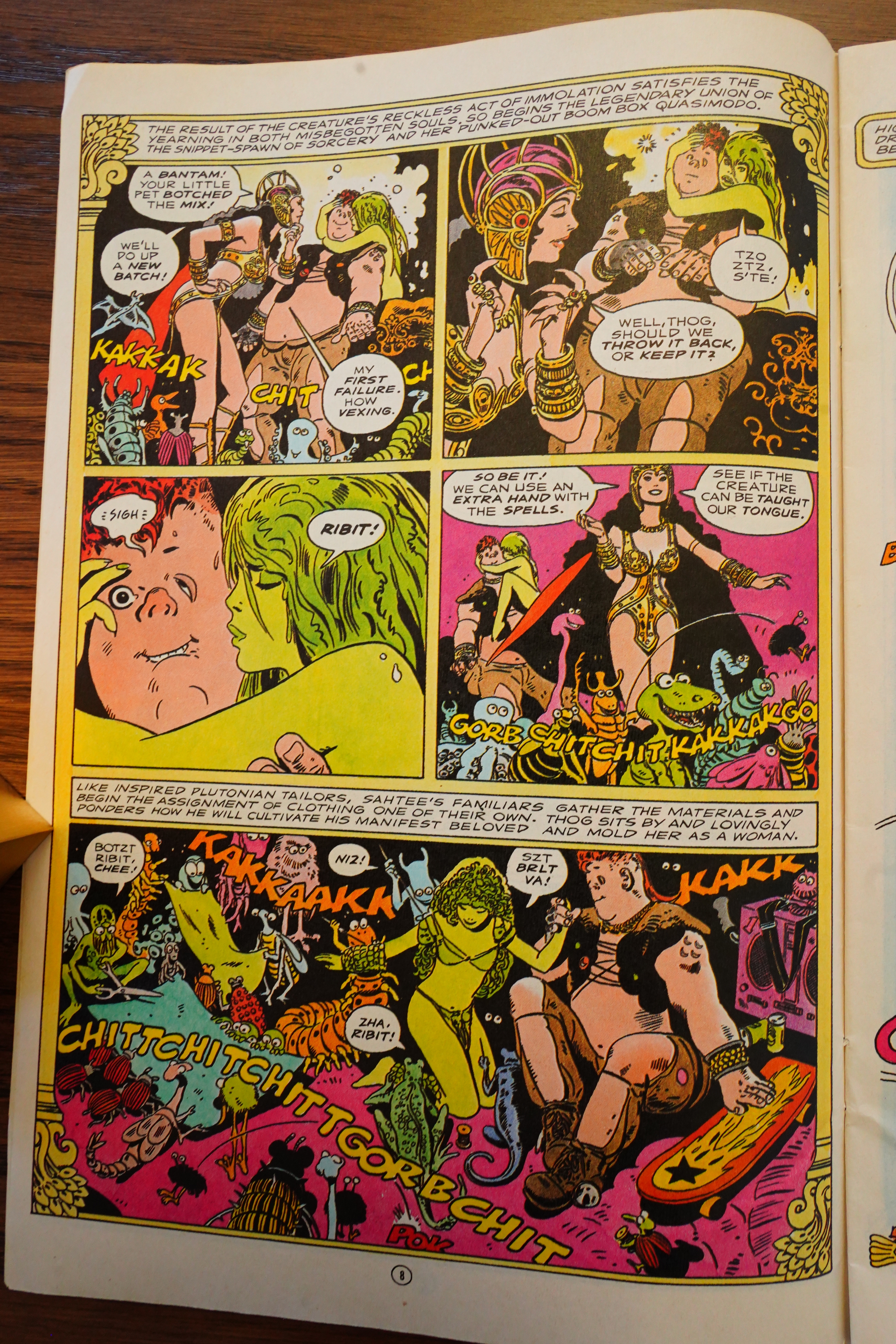
This one… is because of a botched magical potion/ritual thing, where that big lummox’ amphibian pet jumped into the pot (along with his favourite porn VHS tape), and what came out of the cauldron looked like that. Sure! Makes total sense.
Not beating the allegations.
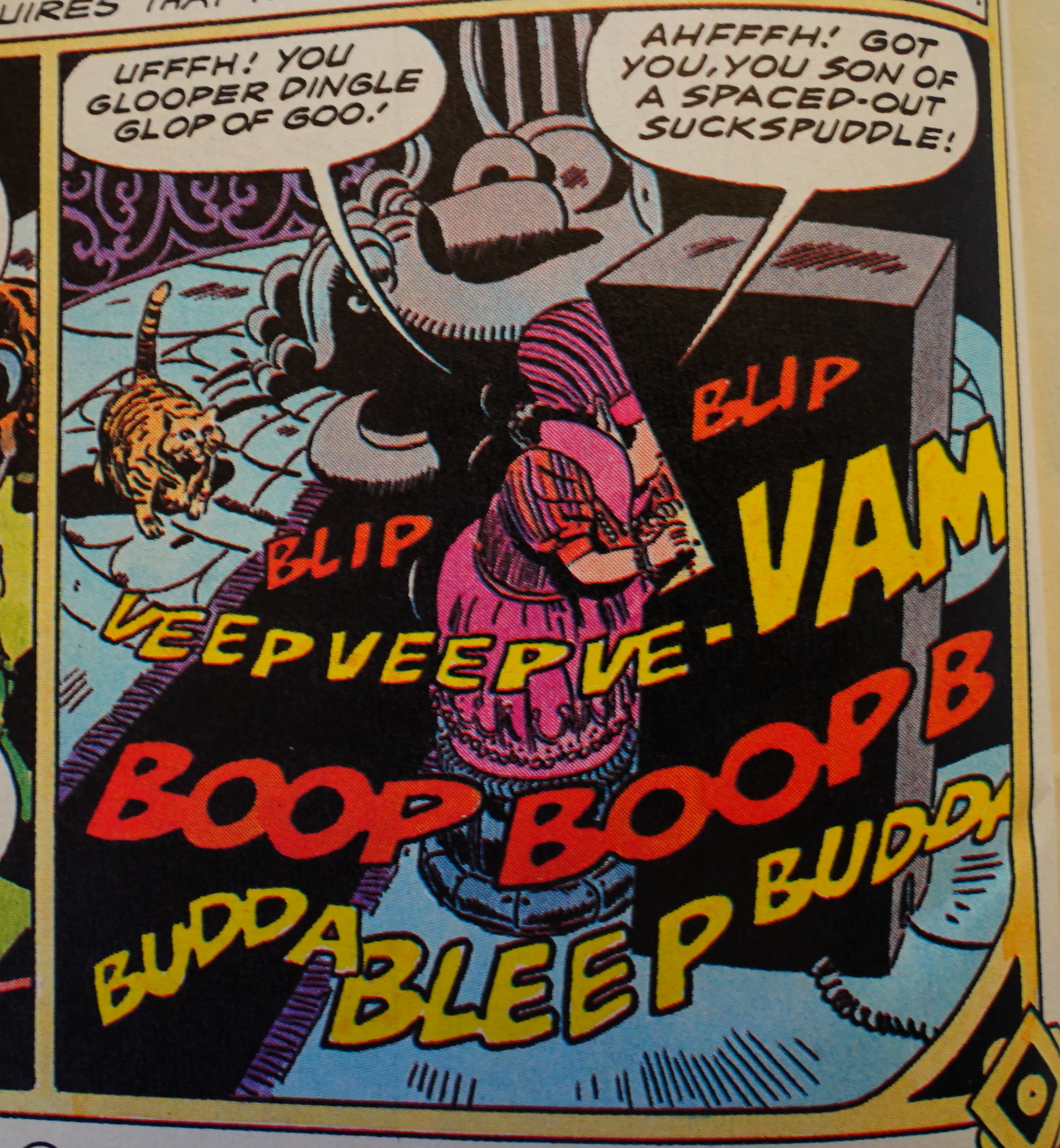
Thorne writes a very bubbly kind of book — at the drop of a hat, you get some character spouting nonsense and … playing a video game console. The world building in this book is basically “whatever”. And the characters have names like “Vomick” — guess whether that’s a villain or a hero.
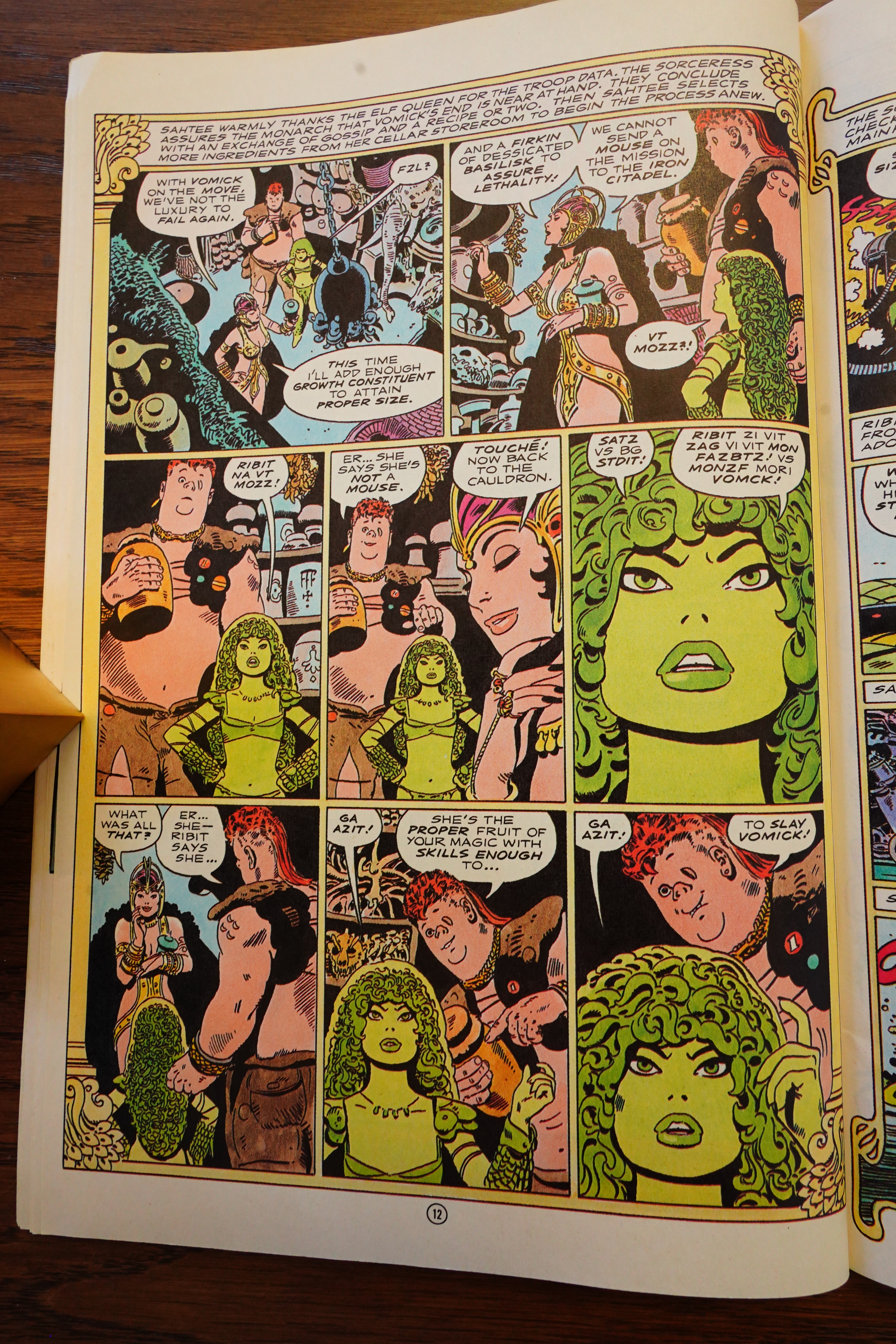
Oh no! She’s talking in funny speak! Noooooo
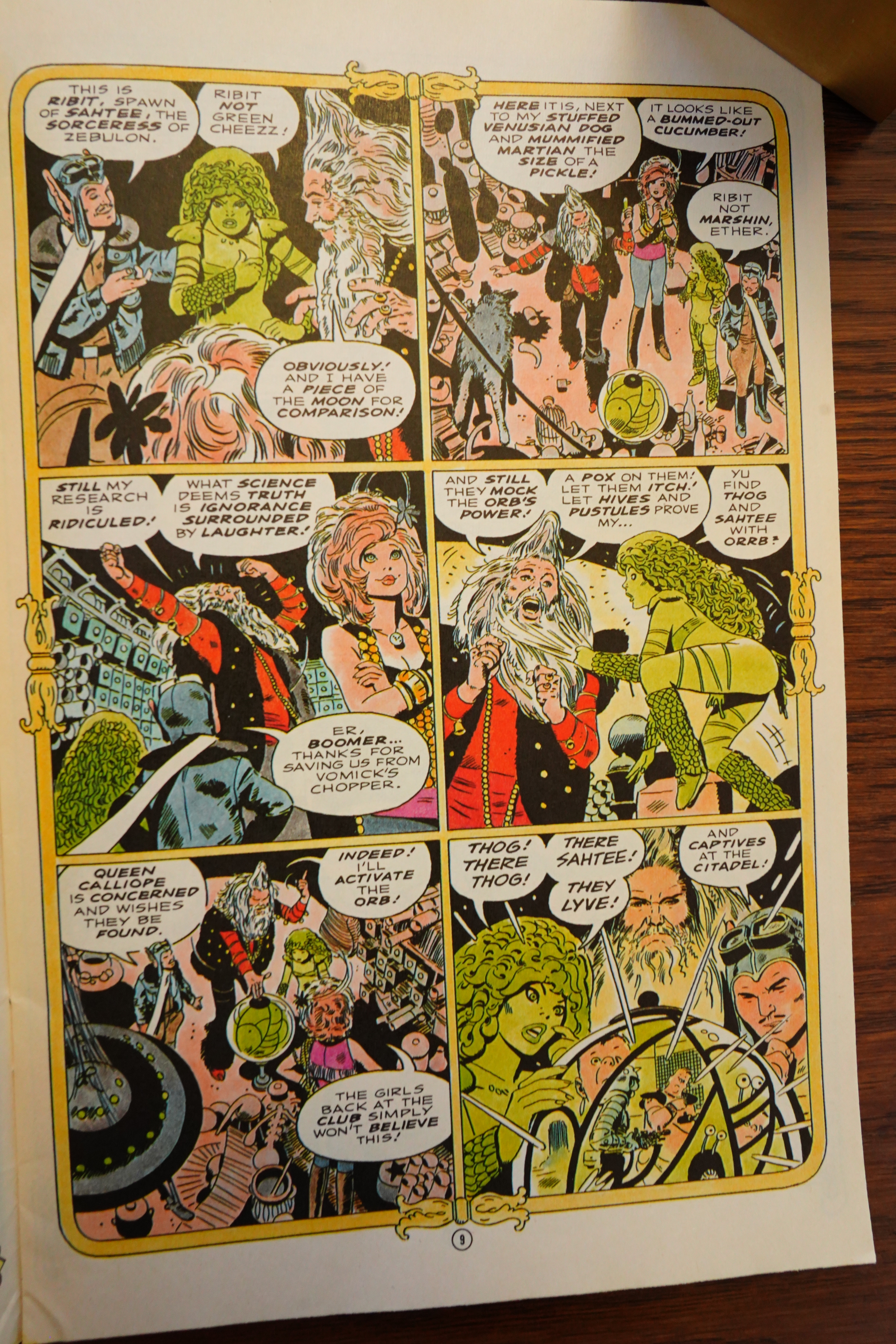
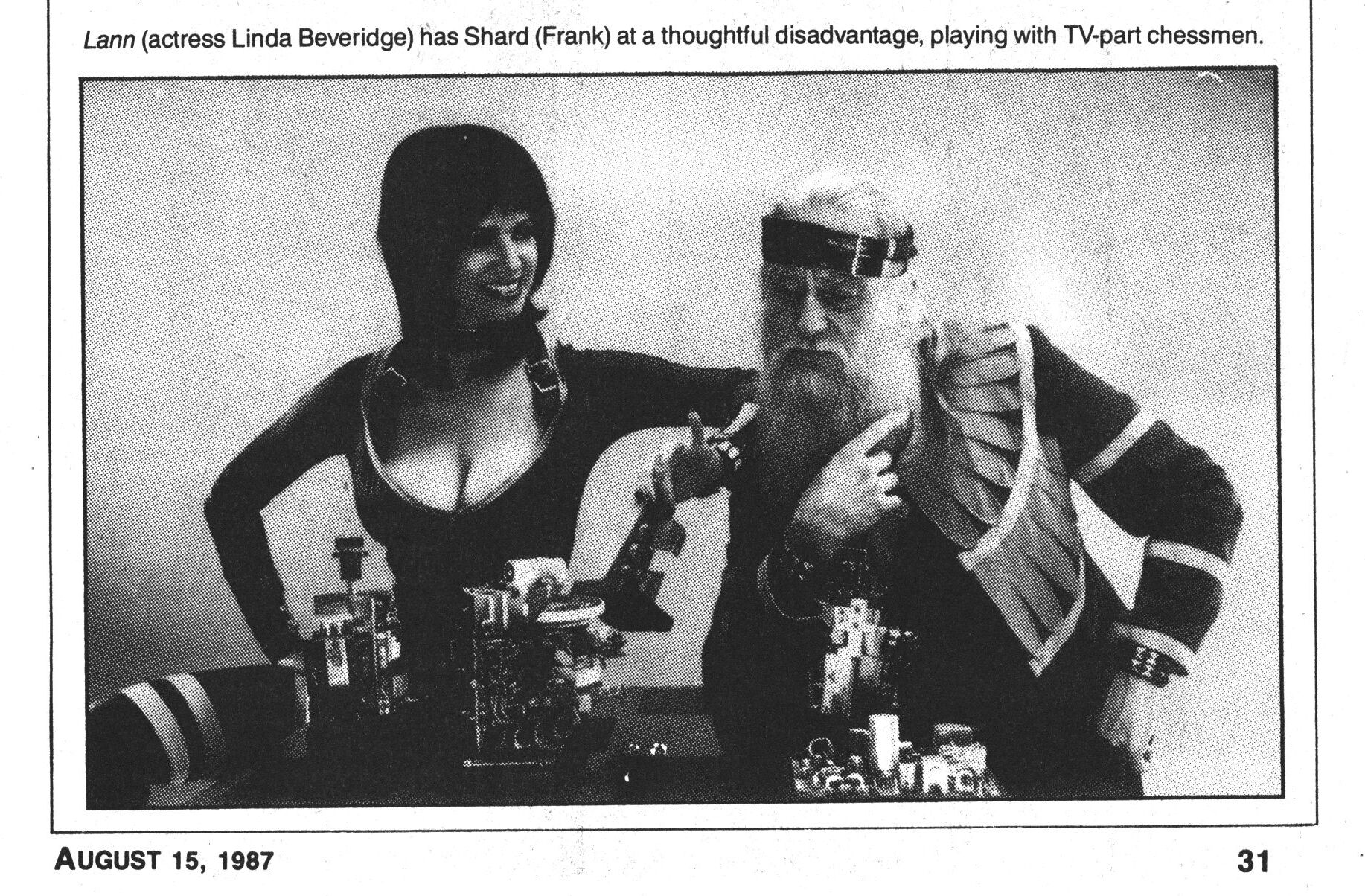
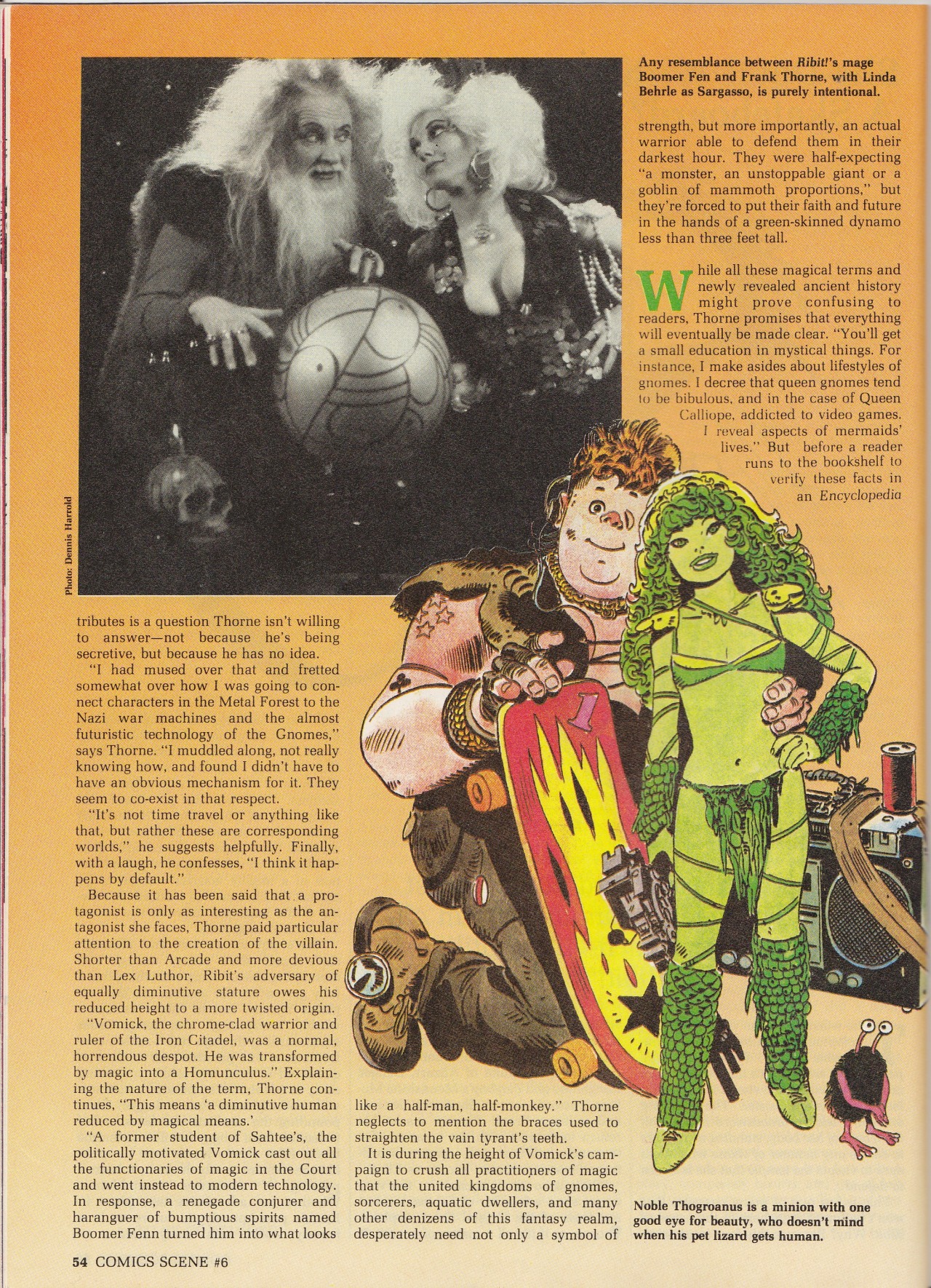
Thorne puts himself into the book (as a wizard he would portray as cosplay at conventions with a bikini-clad sidekick).
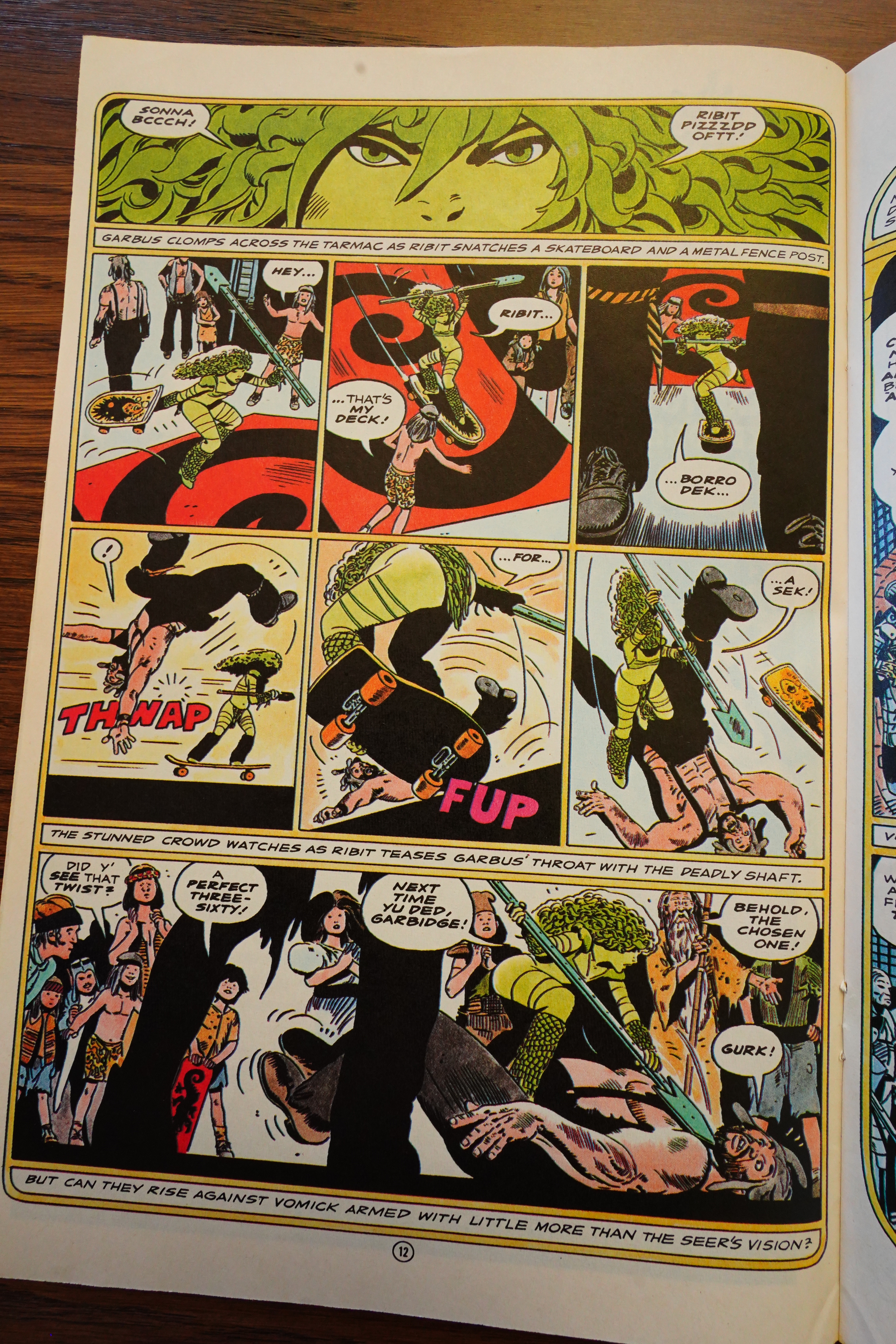
Epic skateboard fight!
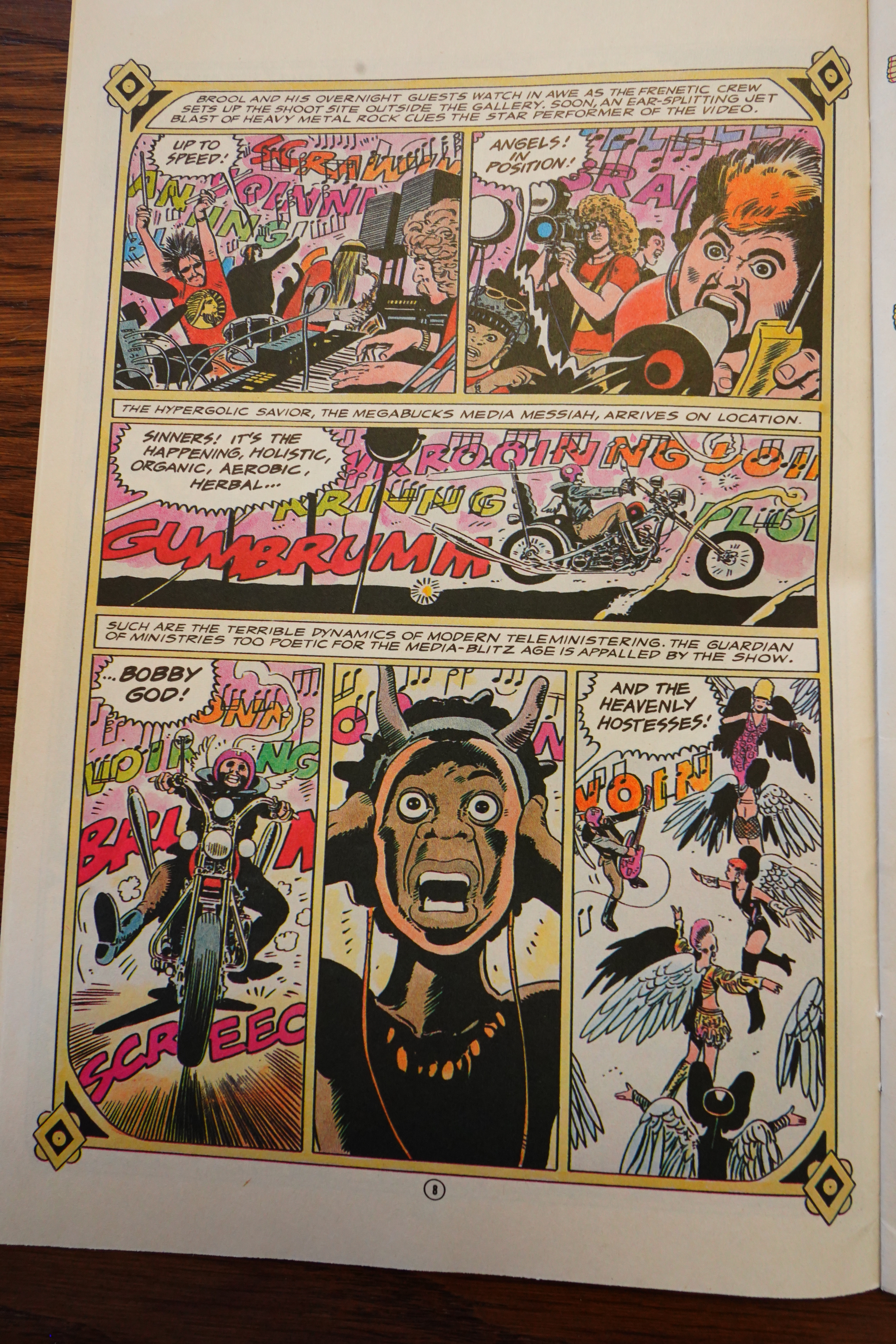
Like I said about world building… but the thing is, I think it kinda works? It’s an everything-but-the-sink-but-then-throw-the-sink-in-anyway kinda book, and if you just let it wash over you without thinking too much about it, it’s a fun read, really. The storytelling works, and the (over)writing pulls it together.
It’s a very likeable, amiable book — Thorne’s obvious enthusiasm for the project carries it along.
c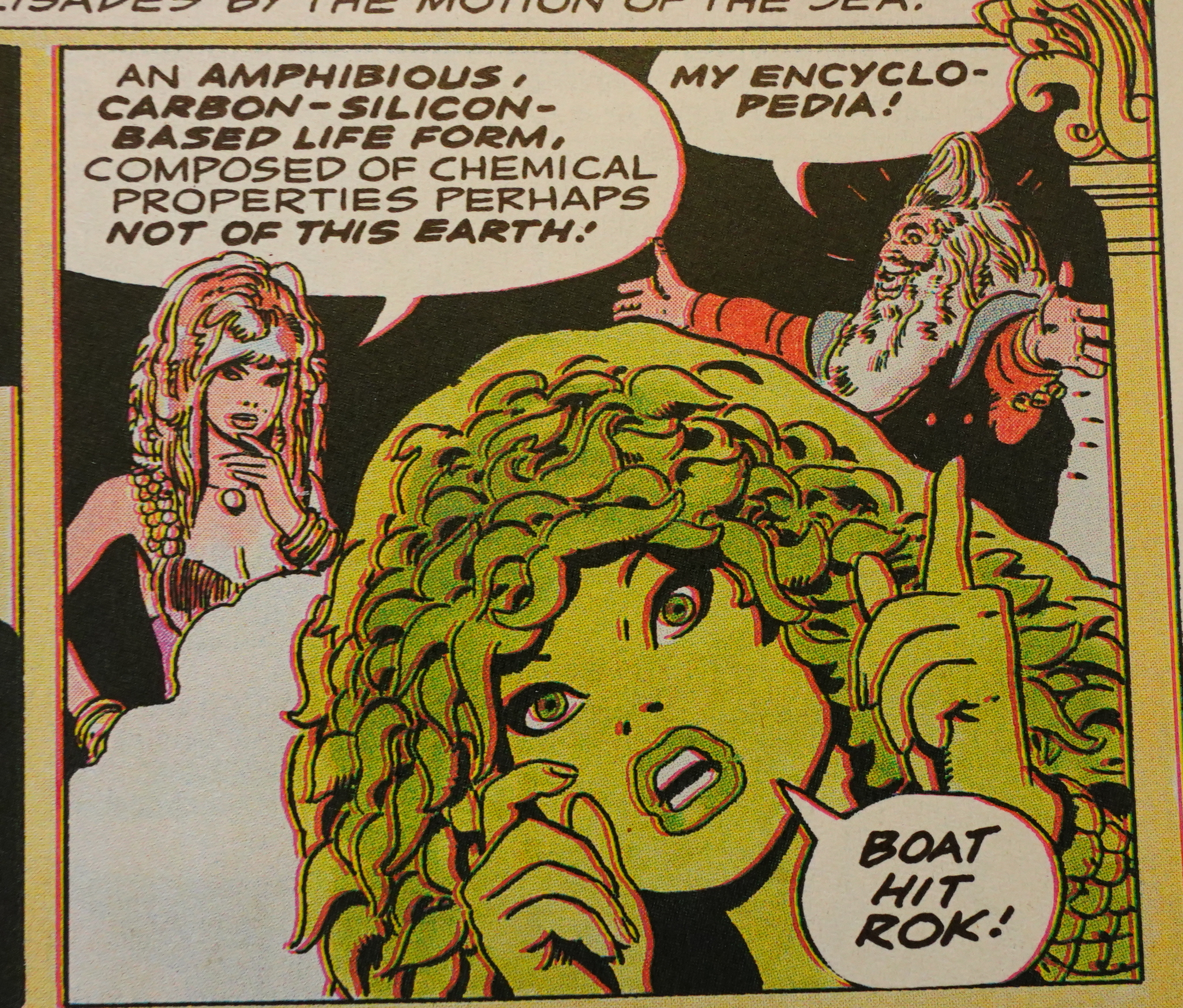
Unfortunately, the production on this book leaves a lot to be desired. Throughout the series, it’s plagued by out-of-register printing, and with artwork as busy as Thorne’s, it’s really a problem — you feel like you’re seeing double all the time. And it’s a particular shame because Thorne’s line is as attractive as it is. (It’s like… Joe Kubert mixed with Moebius?)

Thorne likes his alliteration.
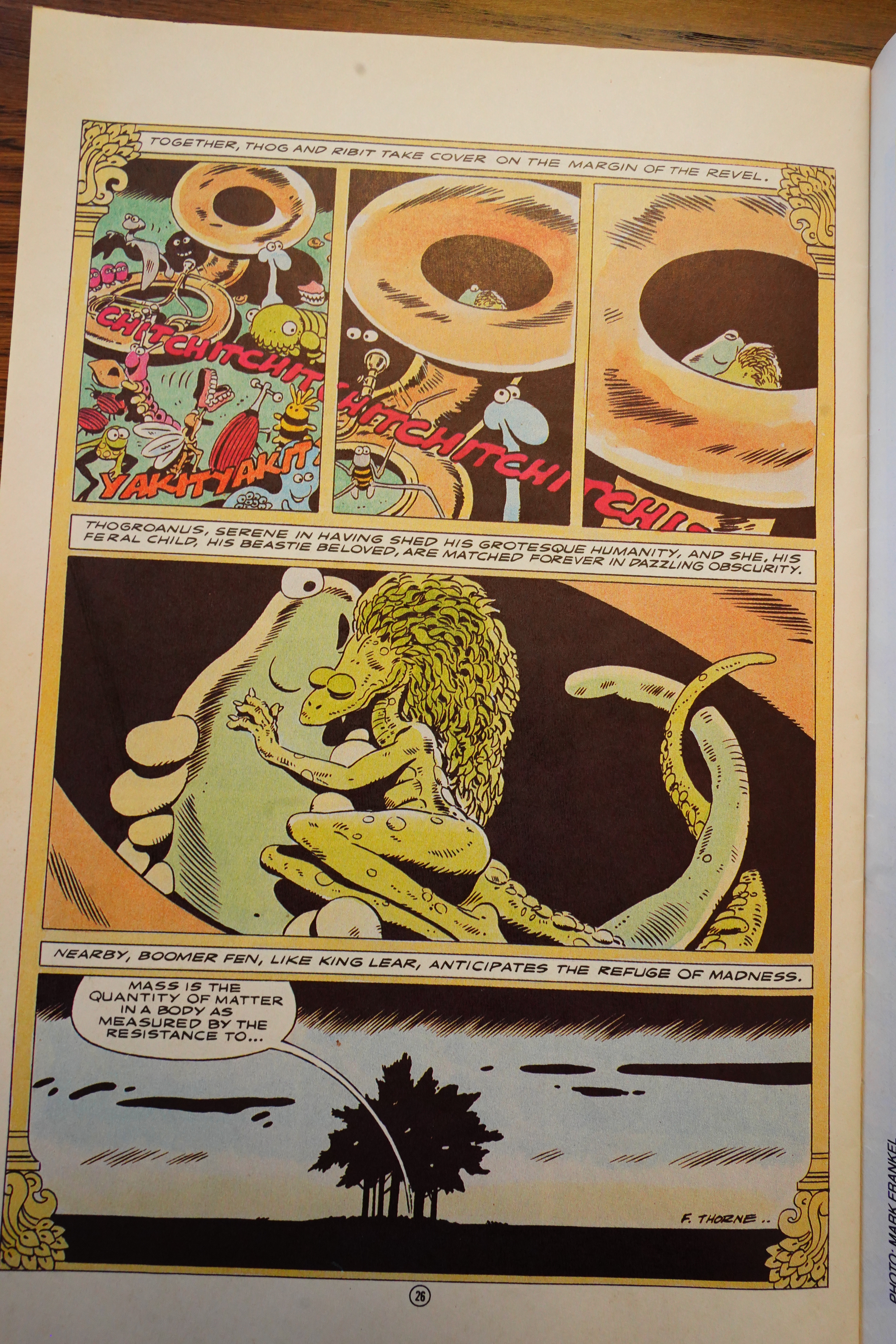
Oh, the storyline? There’s a lot of magic and fighting and vanquishing of evil wizards and the like… but it’s a love story at heart. And it ends happily, with both the lummox and Ribit being transformed into these new bodies and they live happily ever after. Or something.
I haven’t read all that much of Thorne’s work, but among those, this is hands down the best and most readable thing he’s done.
Rob Rodi writes in The Comics Journal #134, page #32:
Frank Thorne is a lot like Howard
Chaykin — he long ago chose an ar-
chetype, and Therefrom All
Descendeth. If Cody Starbuck is Iron-
wolf is the Scorpion is Reuben Flagg,
likewise Red Sonja is Ghita of Alizarr
is Lann is Ribit. Both Chaykin and
Thorne are pop manipulators of a
highly slick cast, and are fond of
mating the wheezy iconography of
genre comics with the kind of sexuali-
ty Hugh Hefner once thought would
take over the world (i.e., dirty). Your
appreciation of these cartoonists
depends, largely, on your visceral
reaction to their archetypes (in
Thorne’s case, the Warrior Woman as
Playmate of the Month), and, beyond
that, how great a sense of humor you
have about the shaggy, omnivorous,
unstoppable beast of pop culture. My
own sense of humor on that score is
fairly accommodating. There were
parts of Ribit! that had me pretty close
to giddy.
As American Flagg! was Chaykin’s
first mature work – his first to feature
any kind of political awareness and
fully-realized characters, the first to
reflect an original and idiosyncratic
sense of humor – so, too, is Ribit!
Thorne’s first really adult book. I
remember all the blood and other
viscous stuff that used to run through
his earlier works, which kind of made
my mouth twitch with the icks; I
remember Ghita of Alizarr mastur-
bating on her sword, not looking like
she was being too careful about it (I
wondered who could possibly get off
on that); I remember Lann walking
naked through a hail of body parts;
and I remember all the big ugly
demons and monsters Thorne used to
use, and generally I thought he was
creating books that really horny
fantasy-geek adolescents would create
if only they could draw like that. All
the posturing used to get to me, too
– I don’t mind fantasy comics every
now and then, but I generally like the
ones where people stand and speak in-
stead of pose and declaim.
Well, that’s Ribit! It’s a mass of stuff
you’ve already seen, from Rabelais to
Road Warrior, but there’s a benevolent
principle at work in it that may shock
you because it’s never been in
Thorne’s adventure comics before.
Suddenly everything is merry and
larky, and quite funny; it’s filled with
pratfalls and puns and a spirit of silly
playfulness. It’s set in the far future,
when magic is (again) slowly giving
way to technology, which is
represented by the evil warlord
Vomick. The world’s last magical
forces — the elf-queen Calliope, the
sorcerer Boomer Fen, and the
sorceress Sahtee – have teamed up to
beat the tar out of Vomick. But the
lines between sorcery and technology
are all kind of blurry here to begin
with; Vomick is really hot for Sahtee’s
all-powerful crystal orb, and Sahtee
herself references her mainframe
computer to see how her spells
worked. Sahtee and her oafish assis-
tant, Thog, set out to create a warrior
woman, molding her to the image of
Thog’s favorite pornographic starlet;
but one of Sahtee’s familiars, a little
lizard-thing named Ribit, jumps into
the mixture so that what comes out is
a kind of warrior pixie with green skin
who doesn’t really speak so much as
spit out syllables that sometimes you
can decipher, sometimes not. Sahtee
would like to repair the damage, but
before she can, her magical orb – and
her body – get blown to bits by
Vomick, and she has to take refuge in
the body of another familiar, which
looks a lot like a deranged Muppet.
All of this is played for as many
laughs as possible – the tone
throughout is dazzlingly daffy. The
dialogue is especially wild, from
Ribit’s warrior cries (“Sonna bccch!
Ribit pizzzdd oftt!”) to the goofy in-
vocations of the fatuous Friar Squiff
(“I exorcise thee, most vile spirit!
Vamoose from this sufferer”). Thorne
mocks the whole fantasy genre – and,
by extension, himself – by juxtapos-
ing the purple with the prosaic, even
in his narration (“And so, as her
Tristan is struck down, this mini-
Isolde explodes like a butane cigarette
lighter”). There are passages that read
like inspired screwball comedy,
especially the completely disarming
exchanges between Boomer Fen, the
inevitable wizard character (inevitably
based on Thorne himself), and
Sargasso, his been-around-the-block-
since-birth girlfriend (based, so the
back-cover photographs would in-
dicate, on Linda Behrle). They bill
and coo like two aging romantics who
have no illusions and suddenly realize
they don’t need any; it’s probably the
most adult sexual romping I’ve ever
seen in a comic, and that includes
undergrounds and alternatives. At one
point they’re lying on a beach, drunk,
and Sargasso consents to demonstrate
her ability with foreign tongues by
playing with her toes and reciting
“This Little Piggy Went to Market”
in different accents (“An’ thees leetle
peegay vent oui oui oui – all ze way
homm! Ole!”). Boomer Fen finds this
rapturous (“Sargasso – my en-
cyclopedia! My reservoir of all
knowledge!”). It’s so dizzy, you may
feel yourself transported by bliss. The
object of fantasy is to take you into
another world, and, in these panels,
Ribit! takes you to one you may never
want to leave.[…]
The only suggestion you want to
make to Thorne is that he slow down;
everything whizzes by, as if Tex Avery
were doing a seven minute spoof of
all the Tolkien books ever written.
There’s no time to savor anything. But
that’s a small complaint; this is such
a huge step forward for this gifted car-
toonists. The only aspect of the book
that doesn’t reflect a newer, wiser, bet-
ter Frank Thorne is the cartooning
itself, and that’s only because you
can’t improve on perfection. (You
could, however, improve on the terri-
ble color separations, which sabotage
Thorne’s images throughout the four
issues.) His linework is still the most
seductive in the industry; it’s thick and
fluid and unarguably sensuous. And
his evocative use of shapes and planes
is still gorgeous and sophisticated.
You can see that his style owes
something to Joe Kubert, but whereas
Kubert is lean and mean, Thorne is
rich and voluptuous – especially,
need I say it, in his depiction of
women. You may wonder how I could
have made a face at She-Hulk’s green
skin in a recent review, only to turn
THE COMICS JOURNAL #134, February 1990
around and call Ribit a genuine femme
fatale; well, the answer is obvious:
Frank Thorne’s women make John
Byrne’s look sick. They make
everybody’s look sick. When Ribit
stares out of a panel, with saucer-eyes
and pouty-pouty lips and nostrils that
are like two pricks of a pen, and spits
out something adorable like “Ribit not
taddpol!,” you may find yourself close
to swooning. She’s a masterpiece of
pop sexuality – a cross between
R2D2 and Charo. Now that Comico’s
books are being distributed by DC, I
foresee an entire nation of young boys
encountering Ribit and bursting into
spontaneous puberty. Something tells
me that’s the kind of tribute Frank
Thorne would like.
Uhm, OK…
Amazing Heroes #158, page #74:
It seems that Frank Thorne by and
large ignores most of the current
comic trends. No incredibly realistic
“torn from today’s headlines” ap-
proach. No pseudo ultraviolence. No
whining introspective characters.
Thorne approaches Ribit! as a whim-
sical adventure-fantasy. It works
splendidly.[…]
Frank Thorne seems to have at last
come up with the proper vehicle for
his formidable talent and wit. If you’re
tired of depressing, cluttered claptrap,
this book should excite your pleasure
circuits and restore your faith in an in-
cestuous medium. Tons ‘o fun.
GRADE: PRISTINE MINT-John A. Wilcox
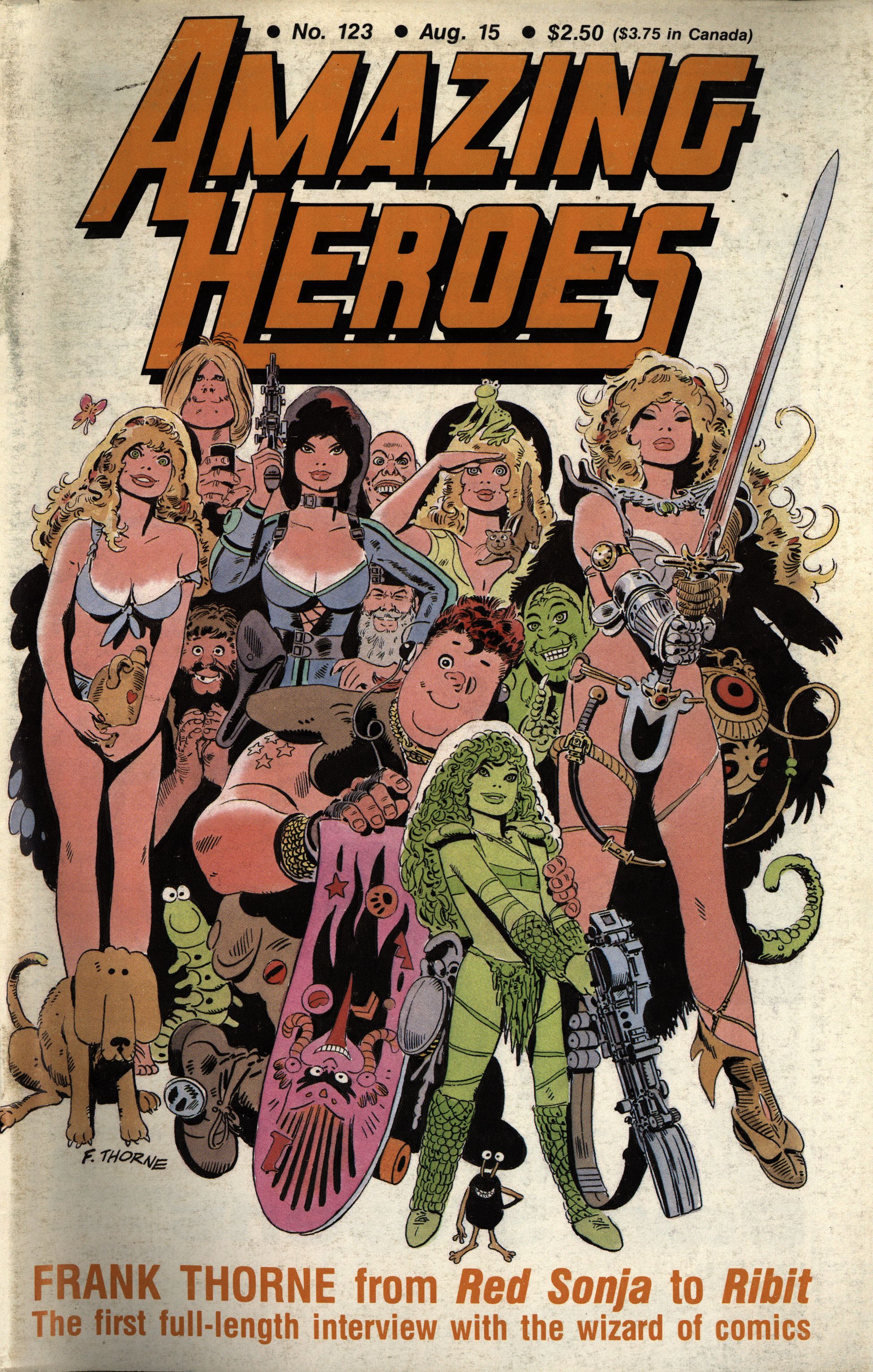
Amazing Heroes #123, page #33:
THORNE: Yeah. I’m afraid this is
going to be non-controversial
[laughs]. Anyway, Phil LaSorda was
there with Diana and Bob Schreck,
who used to hang around with the
Creation Con guys when we were
doing the Wiz and Sonja show at the
Statler Hilton in Manhattan. We did
it on the same stage that Glen Miller
band broadcasts originated.
Fabulous. I was misty-eyed, being
and old trumpet player. It was a big
hall, and we filled it. Wendy was
great as Sonja. Did you ever see her
in the role?
AH: Yeah, once.
THORNE: Ohhhh. . . She was Red
Sonja. Anyway, the chemistry was
right at the Comico meeting and, for
the record, if the new series is suc-
cessful we’ll have to credit Diana for
tagging it, because I was thinking of
calling it Dread Spawn or Green
Spawn, or maybe just Spawn. Diana
said we gotta call it Ribit!, with the
exclamation point. I’m sure it’s a
good choice, because Comico has
been doing very well. Ribit! is a
four-issue, full-color mini-series.
Twenty-six pages each. It will be
released in the spring of ’88. It’s
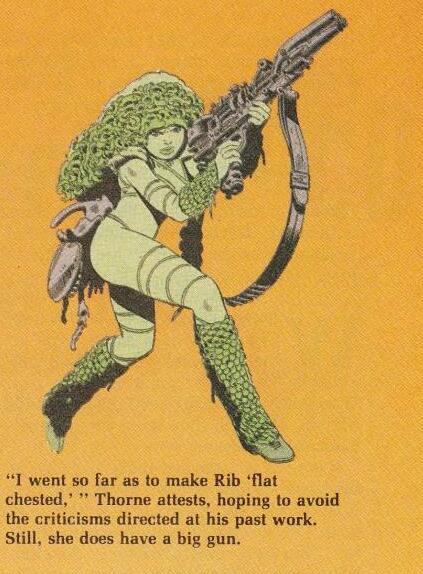
mainstream. Actually, Ribit! is flat
chested, green, and thirty inches
tall.
AH: That must be quite a change
for you.
THORNE: [Laughs] Yes, but the
sorceress Sahtee is amply propor-
tioned. She’s named for the com-
poser Eric Satie, who’s one of my
favorites. Anyway, the first two
books feature the origin of Rib and
her battle with the chrome clad
warlord. The second two books will
be a story called The Isle of the Sea
God, which was an idea I had for
the third Ghita book.
AH: Have you found it difficult
adapting to the idea of doing some-
thing that’s less adult oriented?
THORNE: I think passion does not
necessarily have to be libidinous
passion. Rib’s un-libidinous passion,
and I’m enjoying this as much as I’ve
enjoyed anything. It’s all part of a
whole. Still, if Ghita and the rest
hadn’t done so well, I might be back
drawing Korak. I might have to take
another look at the passion meter.
AH: Do you want to talk about the
concepts and characters in Ribit!,
since that seems to be your current
flame, as it were?
THORNE: The back cover blurb on
this one reads: “Medieval sorcery
confronts the deadly weapons of
modern science when the chrome
clad warlord commands his demon
hordes to exterminate the prac-
tioners of obsolete magic and
destroy the Orb of Green Crystal.”
That sets the tone of it.[…]
THORNE: I’m definitely in the low
range and love it down here. Let’s
hope that Ribit! lives up to the ex-
pectations of Comico.
AH: Comico has had a really ex-
cellent track record so far.
So this interview was published in August 1987, almost two years before Ribit was published by Comico…
The Comics Journal #280, page #60:
GROTH: You did Ribit for Comico.
THORNE: Ah, my little green Sonja. Diana Schutz
called; she was an editor at Comico, located
in a decrepit house in Doylestown Penn. that
was right out of Charles Addams. I believe
Diana was Mrs. Bob Schreck at that time. We
met and I offered a miniseries, that I would
own, called Spawn of Sorcery. She loved my
workup and script ideas, but she felt that the
title conflicted with McFarlane’s Spawn. She
euchred me into calling it Ribit! I loathed the
title, and years later I heard that she wished
she hadn’t insisted on the change.
GROTH: There are some beautiful images and in-
tricate panel arrangements in the series, but I’m
curious as to why you think it’s the best-written
stuff you’ve done.
THORNE: Well, I like the flow of it. It had an
anticlerical feel to it, like all my work. For
instance, Bobby God on the motorcycle and
the creatures drawn from mythology, there
is great power in myths; zealous religiosity
has produced a blood-soaked laundry list of
mythic figures. That’s why I’m not a person
of faith, my role as a maker of myths gives me
license. The worlds I create are blood-soaked
at times, but it’s fictional carnage.
GROTH: So what was the editorial direction at
Comico like when you were producing Ribit?
Did Schutz do much editing of your work?
THORNE: Zip. Nada. She had her name on it but
she had no input whatsoever. Comico was
run by a shlepper whose uncle was Phil La-
sorda who owned a sports team. Good old
Uncle Phil set him up in business. He didn’t
know his ass from a turnip. Comico folded
ignominiously, shortly after the fourth book
of Ribit hit the stores.
Heh heh. Well, that explains where Comico got the money from in the first place. I’m not sure how much stock to place on Thorne’s memory here, though — McFarlane’s Spawn was published in 1992, right? Right. So Schutz objecting to the name Spawn of Sorcery (somewhere before 1987, since in the 1987 interview, Thorne calls the series “Ribit”) either means that Schutz possesses magical capabilities, or Thorne is confabulating a bit in this interview.
Amazing Heroes #131, page #29:
Ribit!—written and drawn by Frank
Thorne of Red Sonja fame. The series
will be a four-issue one. Ribit!, whose
exclamation point is creidted to
Comico editor Diana Schutz, is a flat-
chested, green and thirty-inch tall
woman, who sounds like a frog, eats
worm beetles, and had hair that looks
“Like a riot of leeches,” as creator
Thorne described it. Ribit! involves a
weird battle twixt sword-and-sorcery
and high technology weapons. Thorne
has produced the book utilizing the
same kind of watercolor techniques he
used on Moonshine McJuggs, which
appeared in Playboy [I never saw it.
I only read the articles-EDJ. Editor
Schutz calls Ribit! a “very well writ-
ten, a G-rated Ghita,” and stresses
that while it will have no nudity, it will
nevertheless be an adult book.
About his work in Ribit!, Frank
Thorne said, in an interview in Amaz-
ing Heroes (#123) “I’m enjoying this
as much as I’ve enjoyed anything.” As,
undoubtedly, we readers will, too.
Fantasy Advertiser #111, page #14:
Any critical attention paid to Frank Thorne’s
work has tended to be overshadowed by his
reputation as a “good girl artist” ever since
the days when he was enlivening run-of-the-
mill Roy Thomas Hyborian scripts for Mar-
vel. While his penchant for drawing women
in classic pin-up style has undoubtedly led to
financially rewarding work for National
Lampoon and Playboy, it has obscured the
fact that he is virtually the only creator to
have extended the “sword and sorcery” genre
beyond the guidelines laid down by Robert
E. Howard. It is a delightful coincidence that
Thorne drew the Elrod cover for Cerebus 7,
since Dave Sim is the other notable excep-
tion to the Hyborian rule; but the praise duly
accorded to Sim’s remarkable achievement
may also, quite incidentally, have contrib-
uted to critical neglect of Thorne’s very dif-
ferent work. Comparison of the two would,
in fact, be ridiculous; Cerebus has long since
developed beyond its genre origins, whereas
Thorne continues to re-examine that genre
from different perspectives.
Even under Thomas’ direction, Thorne’s
unique, phantasmagoric art injects a night-
marish quality into the Red Sonja issues he
handled which is noticeably lacking in the
Conan comics. The horrific menaces which
beset the ludicrously-clad heroine appear to
have been inspired not by Howard’s pedes-
trian prose but by Clark Ashton Smith’s
overripe, decadent imagery. Thorne’s ensu-
ing essay in the field, Ghita, retains the
Hyborian style of topography and nomen-
clature but goes far beyond comics’ tradi-
tional pulp origins in drawing its inspiration
from the works of Rabelais. Although it
lapses too frequently into soft porn, Ghita
amply demonstrates Thorne’s increasing
mastery of his art; the drawings are much
more detailed yet also much more precise
than his Marvel work, and the inventive,
boisterous scripting revels in its origins with-
out ever being derivative.
His latest project, Ribit!, turns elsewhere
again for its inspiration. Thorne appears to
have been struck by the essential oddness of
“sword and sorcery” computer games – fan-
tasy adventures played out on high-tech
equipment – and has accordingly developed
a complex and subtle premise in which sci-
ence and sorcery are depicted as simultane-
ously opposing and compatible forces. A
sorceress uses a computer, an elfqueen furi-
ously manipulates an arcade game, a techno-
crat is magically turned into a dwarf. As if
overwhelmed by his first colour comic for
years, Thorne excludes black and white
definitions from his story; the “heroes” are
clearly on the losing side, the sorceress vain
and incompetent, the elfqueen enamoured of
technology. From that inherent paradox of
“science and sorcery” he derives a tale full of
ambiguity in which each page presents a new
contradiction to be savoured.
Thorne’s artwork for Ribit! is perhaps his
finest to date. He appears to be caricaturing
his own notoriety; the eponymous heroine,
for instance, would be a typical Thorne pin-
up were she not green, three feet tall and flat-
chested. The conventionally beautiful sor-
ceress ends up trapped in the form of a small
muppet monster. The drawings themselves
represent a refinement of the techniques used
for Ghita and are surprisingly free of any
nightmarish qualities, reinforcing the im-
pression that this comic is intended for
younger as well as older readers.
If that is indeed Thorne’s intention, he may
well have succeeded – Ribit! is a fine piece of
“wholesome” entertainment “for all the
family” which also provokes thought and
never plays down to the reader. It is his most
satisfactory creation to date, and it is to be
hoped that its sales benefit from the DC/
Comico distribution deal; a comic as intelli-
gent and diverting as this deserves to reach as
wide an audience as possible. Unless Thorne
loses his grip on the narrative during the
issues yet to come, Ribit may turn out to be
one of the best American colour series pub-
lished this year.
Mike Kidson
Ribit! is Frank Thorne fantasy. That
should pretty much sum it up to fans who
are familiar with Thorne’s work.
The book mixes magic, nazis, skate-
boards, heavy munitions, bizarre critters,
and mystical quests in a surreal fashion
that manages to utilize almost any plot de-
vice that comes to Thorne’s mind. It’s sort
of sword-and-sorcery, sort of hip fantasy,
and yet something else at the same time.
Ribit! also presents the beautiful women
that Thorne is well-known for; ever since
his work on Red Sonja, Thorne has become
a masterful illustrator of scantily-clad bar-
barian heroines, and Ribitl certainly falls
within that description. Prior to this book,
there weren’t too many Thorne heroines
riding skateboards, though–and it’s that
“break-down-the-traditions” approach
that’s the charm of Ribit!
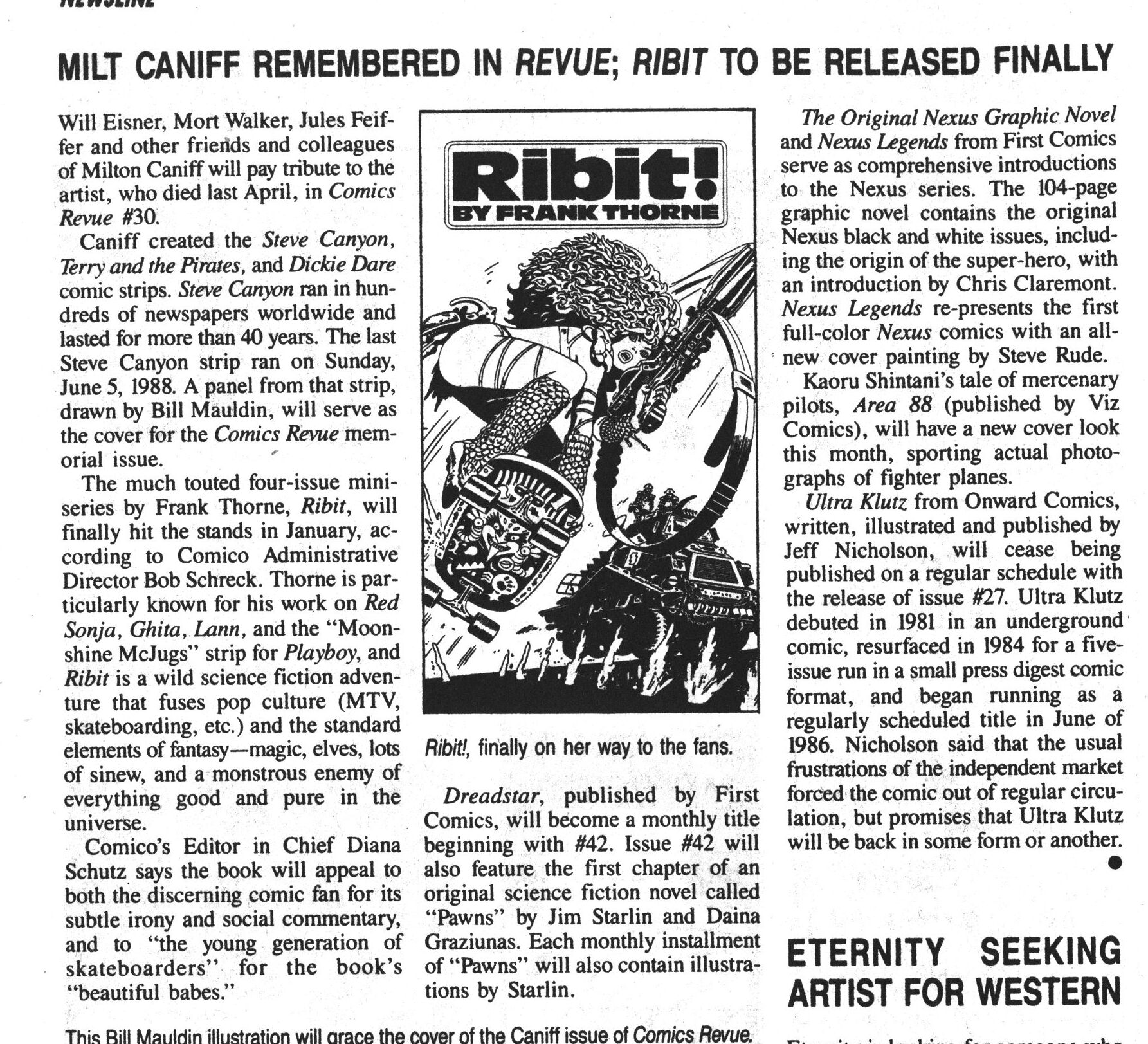
So Ribit received a lot of attention when it was published, and the reviews were all raves.
Comics Scene Volume 1 #6, page #53:
“She’s put to the test, and although
she’s small, she’s ornery enough and
thereby capable of doing everything that a
fully grown warrior woman can do,” ex-
plains Thorne. But in Ribit’s unnamed
world, “everything” can range from
skateboarding through bullet-ridden con-
frontations with parademonic soldiers se-
questered in Nazi war tanks to slashing
away at 20-foot tall automated constructs
with nothing more than a dagger. Com-
pounding the conflicts she faces in her
transition from froggy familiar to femme
fatale, Ribit slowly learns how to speak
like the humans to which she now bears a
passing, if miniature, resemblance.
The Slings and Arrows Comic Guide #2, page #541:
Magic is being driven out by science, and Sahtee, the last
remaining sorceress, decides to fight back by creating a
warrior woman. The recipe is nearly finished when Ribit,
a lizard-like familiar of Sahtee’s, jumps into the cauldron.
Ribit does indeed turn into a warrior woman, but
she’s only three feet tall, and she’s bright green. Not
that this stops her fighting – it just stops people taking
her seriously. Frank Thorne’s story has its self-indulgent
moments, but is generally quirky fun, and the ending is a
true surprise.~FC
Recommended: 1, 4
I think resistance to summarising is a good thing:
RIBIT is almost impossible to summarize. It takes place in some vague future in which there abound references to 20th-century culture, but there’s no physical resemblance to any 20th-century settings. Thorne’s world is a phantasmagoria out of Bosch, in which both magic and science are hopelessly intermingled. In essence, it’s a one-shot feature that allowed Thorne to draw any damn thing he felt like drawing, whether it worked within the context of a narrative or not.
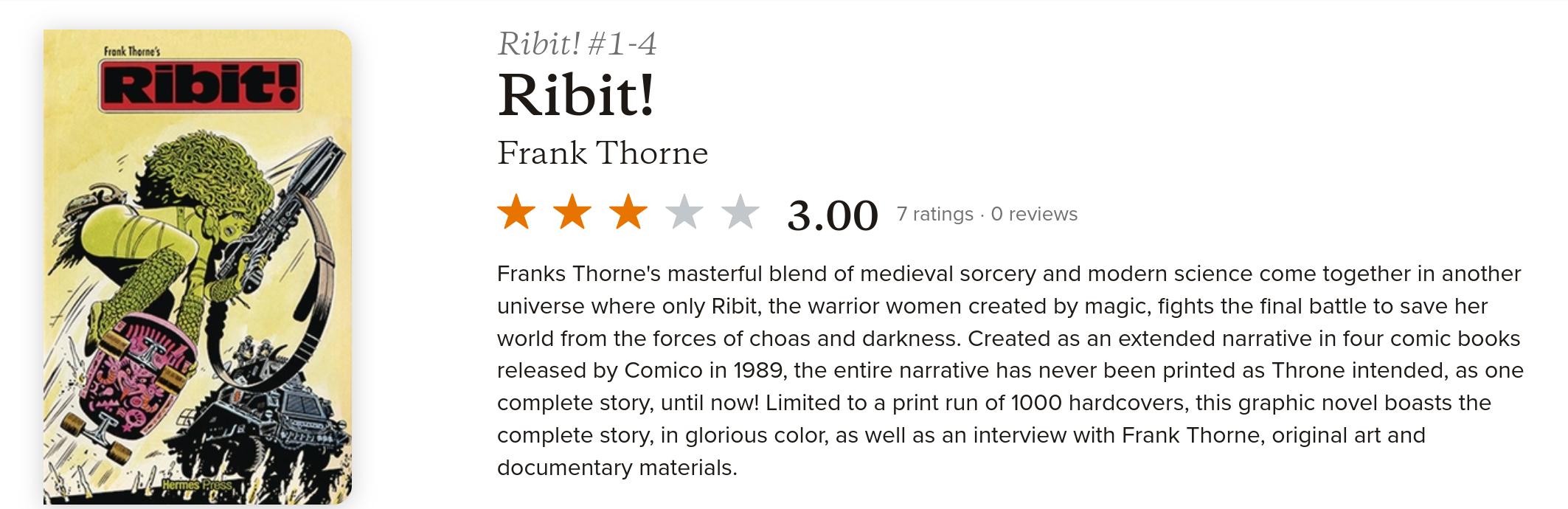
The Goodreads score is oddly low, but there are few votes.
Ribit! #1 is the first of a four-part story as presented (I suspect it was created as one big album, especially given how abrupt this one ends) and it remains as impressive a work now as it did when I discovered it in college, with phenomenal art and a cute story that does a lot of things right, earning 4.5 out of 5 stars overall. If you’re a fan of ‘Heavy Metal’ or Thorne’s art on ‘Red Sonja’, I’d recommend fishing it out of the next back-issue bin in which you encounter it.
Ribit was reprinted by Hermes Press, but in a limited edition, which is a shame. I can’t really find any reviews of it — I was wondering what an audience these days would think of it.