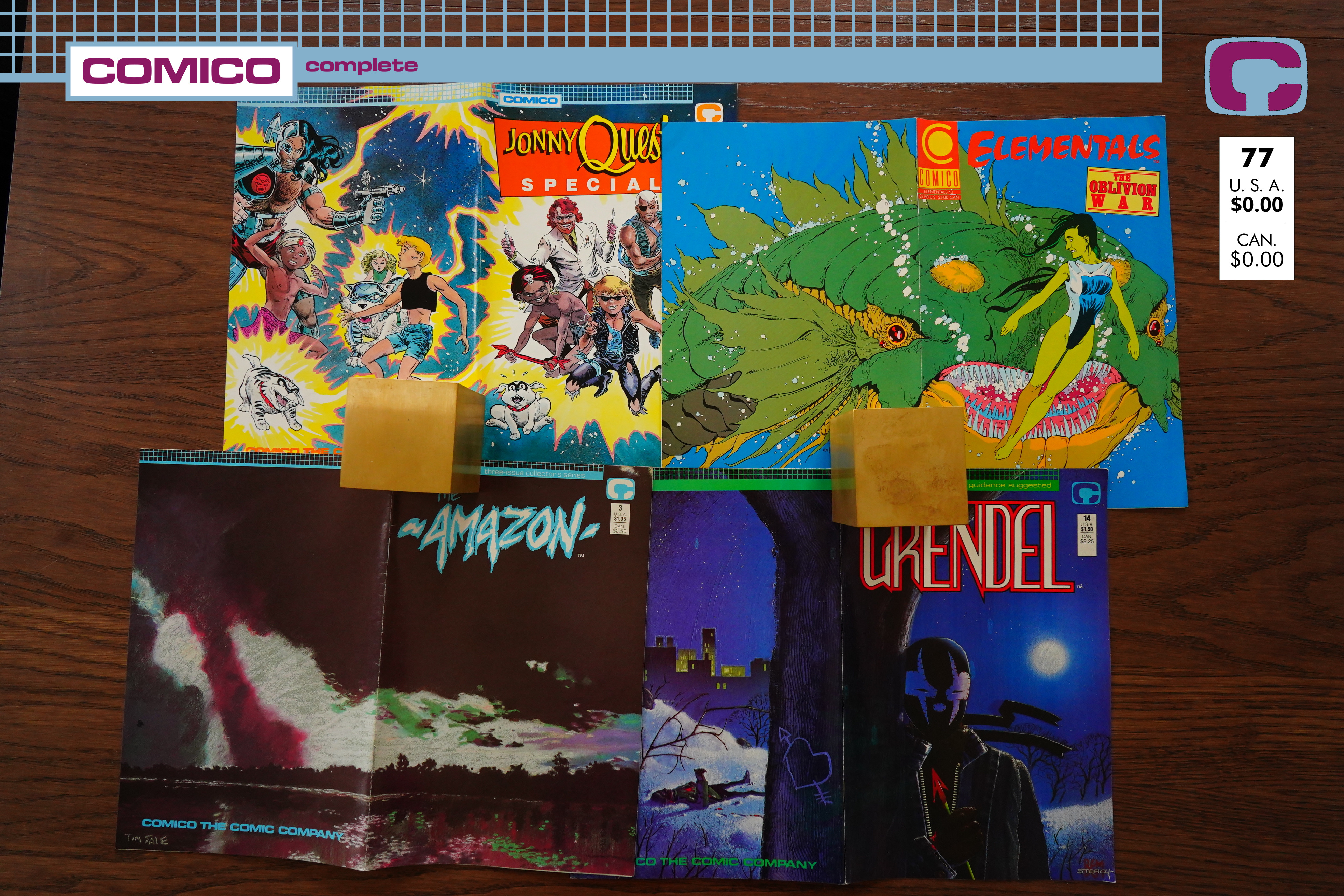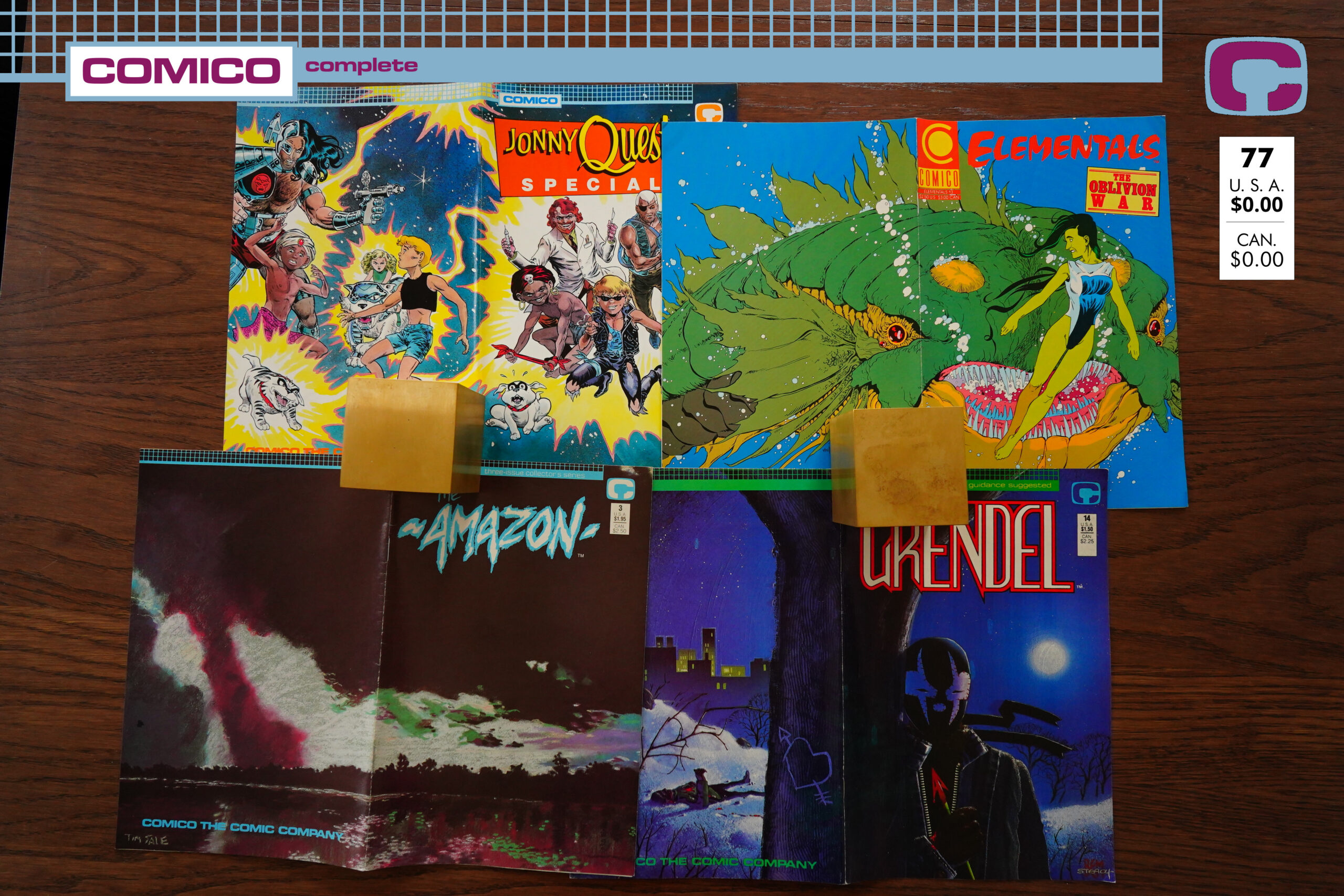
1989: The Amazon

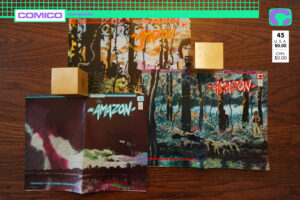
The Amazon (1989) #1-3 by Steve Seagle, Tim Sale and Matthew Waddington

So what’s this, then?

Yes, it’s about a journalist going to the Amazon to investigate something mysterious and jungleish.

Tim Sale’s artwork is really attractive. It kinda looks inspired by European comics, and in particular Italian? It’s not that far from, say, Attilio Micheluzzi, but there’s a whole bunch of Italians working in this tradition.

And we seem to be set up with a possibly unreliable narrator — or just a triple vision into the story. You have what’s being shown in the panels, and then you have the captions with hand-written text and yellow backgrounds (excerpts from his diary), and finally the captions with blue backgrounds, which are presumably his published article about his experiences (or possibly a book).

But… the confusing thing is that what all these three “levels” show exactly the same thing. The language in the diary and in the article is identical, and they don’t diverge from what we’re being shown at all.

That’s pretty confusing!

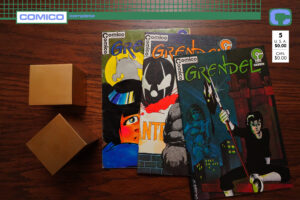
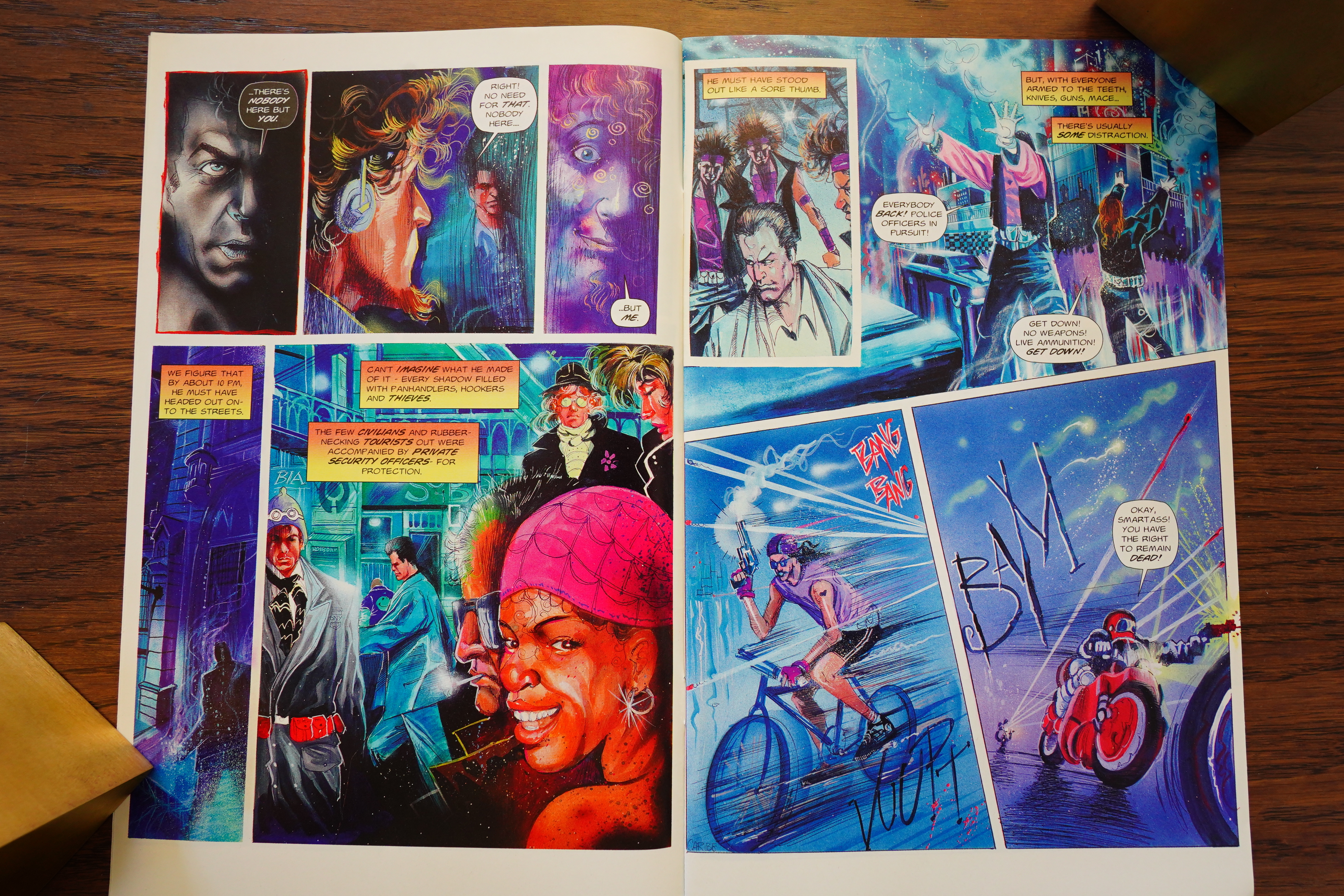
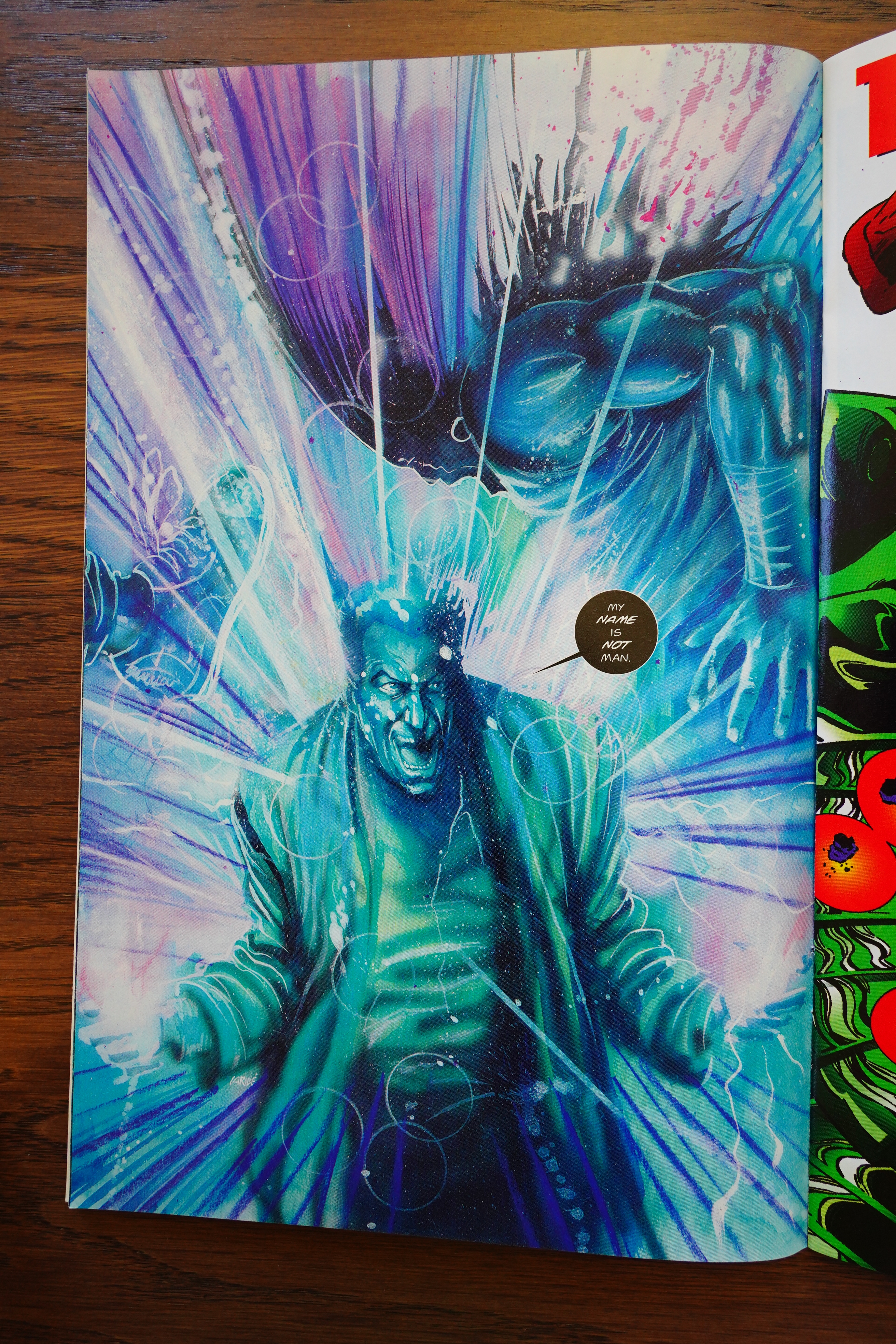
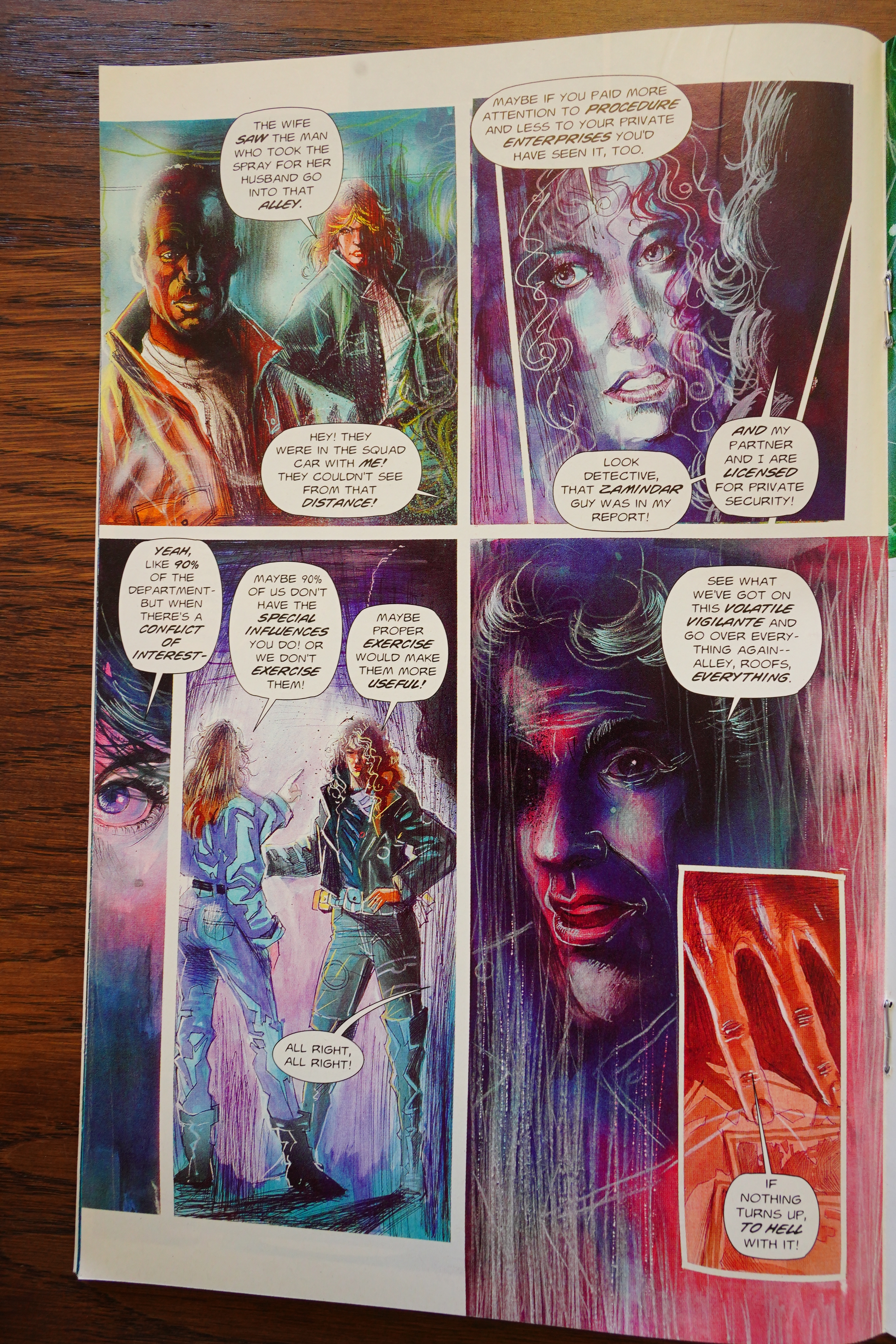
I’ve talked before about how distinctive the colouring on Comico comics are. It’s not just that they’re mostly flat, very saturated but still muted, but also how the separations are done: Comics from this era usually looked kinda sploshy (isn’t that a word) when there were areas of black ink, because they would be coloured just a bit into the black areas. So you’d see where the colour separator stopped, because if you print (say, blue) over black, it looks different than just printing black. But Comico avoids this problem by printing the colours all the way over the black areas. Sometimes leaving a pure-black outline on the edges:

It’s very nicely done — it makes a huge difference aesthetically.

Sometimes there seems to be some tension between the diary and the published text, but it dissolves quickly and leaves you wondering what the point is.

I really like the way this book is being told — Sale’s layouts are pretty traditional, but they shift efficiently as the story demands. It’s very engaging.

Is there some Frank Miller influence here, I wonder?

In each issue, we get some Amazonian factoids.

Oh, I forgot to mention the plot — it’s about a mysterious logging operation, and some sabotage happening there, and of course…

… there’s an American who’s “gone native” and is leading the rebellion. So — it’s the standard plot.

I rather like Seagle’s writing, too, but it’s a bit risible — “the breathtaking beauty of the Amazon… but its breath-making ability as well”. I guess Seagle was very proud of that one! (Of course, this is from the published article, so perhaps Seagle is taking the piss out of that kind of writing.)

Finally! In the last issue, we get some divergence between the diary excerpts (and what’s in the panels) and the published article. So it wasn’t all for nought. But man… that took some time to pay off, and the payoff was kinda weak.

And there are extremely few differences between what we see in the panels and the diary excerpts, so it’s two levels instead of the possible three ones, which seems like a missed chance.

“The weather here is out of control” — yeah, weather is usually in control, is it?

So… storywise, this is a totally standard plot. The storytelling is fun — but Seagle could have done more out of the diary/article differences. And the artwork is excellent. It’s a very enjoyable read.

Amazing Heroes #157, page #21:

The Amazon, a three-issue mini-series
created by Steve (Kafka) Seagle and Tim
(Thieves’ World, Grendel) Sale, presents
the story of Malcolm C. Hilliard, “a re-
porter of questionable ethics who heads
to the Amazon to investigate the disap-
pearance of an American worker-and
gets a lot more than he bargained for,”
according to author Seagle. Is this
missing man responsible for a series of
acts of sabotage at an American-con-
trolled logging company, or is the
legendary creature known as “The
Amazon” behind it all?
The Amazon features a curious
experiment in comic-book storytelling.
Steve Seagle explains that “the key is that
the series is told from three different
points-of-view, all of which belong to the
reporter.” The story unfolds through
standard dialogue, a journal of Malcolm
Hilliard’s notes, and the article that the
journalist writes several months after
leaving the Amazon, all of which inter-
twine. However, in assessing the accu-
racy of each of those points of view,
Seagle admits that “the truth lies some-
where among the three,” with bits and
pieces of each version actually chronicl-
ing the events of Hilliard’s experience.
Steve Seagle is extremely enthused
over Tim Sale’s art in The Amazon,
stating that “Tim is taking a quantum
leap in terms of moving toward realism—
but without losing his style. His char-
acterization is wonderful, and his
research is meticulous!”
The Amazon debuts from Comico in
March.

The Comics Buyer’s Guide #789, page #19:

The Amazon
Ecological mini-series
tells story three ways
Beginning in March, Comico
The Comic Company will pub-
lish The Amazon, a three-issue
mini-series created and written
by Steve Seagle and illustrated
by Tim Sale.
This monthly title has been
dubbed an “eco-series,” as it
goes beyond the literal explora-
tion of the mysterious jungle and
is its own experimental explora-
tion of the comics medium,
according to Administrative
Director Bob Schreck.
“The Amazon is the story of
Malcolm C. Hilliard, a reporter
for Point magazine, who has
been sent to the jungle to inves-
tigage the sabotaging of an
American-financed land devel-
opment firm. However, Hilliard
finds much more than he bar-
gained for. Writer Steve Seagle
has constructed the story so that
it unfolds to the reader by way of
three different writing
approaches: traditional dia-
logue, the reporter’s private
notes, and excerpts of the fin-
ished article that appear in the
magazine, each playing off the
other,” Schreck said.
Seagle received a 1988 Eisner
Award nomination for his work
on Kafka, illustrated by Ste-
phano Gaudiano and published
by Renegade Press. Joining Sea-
gle on The Amazon is Sale,
whose comics work includes
Thieves’ World from Donning
and a run as inker-artist on
Comico’s Grendel.
“What Steve brings to his
creations that makes them
unique is his challenge to his col-
laborators to bring something to
the project of their own,”
Schreck said, “which in turn
makes each project a true mar-
riage of the written word and
illustrated page. Because of this,
Comico and Seagle took extra
time in carefully choosing the
best possible artist for The Ama-
zon — namely, Tim Sale — and
the results of Tim’s pairing with
Seagle are stunning, to say the
least.”

Rob Rodi writes in The Comics Journal #134, page #34:

The appearance of an overtly
political mainstream comic book
about the Amazon jungle shouldn’t
surprise anyone. By the time any en-
vironmental issue achieves pro-
minence in our national media –
obsessed as they are with party
politics and personalities – it must
have reached a pretty alarming junc-
ture. The deforestation of the Amazon
is just such an issue. Network news
shows and news weeklies trumpet the
dire predictions to a population only
dimly aware of where Brazil lies on
a map: at the present rate of defolia-
tion, the Amazon could be gone from
the face of the Earth by the year 2000,
and with it its bountiful oxygen out-
put. The effect on the environment?
Unknown, but certainly irreparable.
Our government’s attempts to cajole,
bamboozle, bully, or just plain buy a
temporary cessation in the operations
from the Brazilians have gotten a cold
shoulder; thanks to decades of our
truly evil foreign poliy, the American
reputation in the Third World is not
the kind that inspires favors to be
granted. And so the Amazon is going,
chunk by irreplacable chunk.
Now Steve Seagle and Tim Sale
have used this as the foundation for
their mini-series, The Amazon. Their
hero, a rather fatuous reporter named
Malcolm Hilliard, has traveled to
Brazil to have a look at what’s going
on and to see if he can find a Pulitzer
Prize in it. His angle? An American
worker has disappeared from the site
of an Amazon timber-stripping opera-
tion, one that’s financed by an
American-backed corporation.
Seagle and Sale do a wonderful job
of establishing the oppressive heat and
exotic beauty of the Amazon, and of
the flourishing, panethnic culture in
the city of Manaus. They’ve also come
up with a three-tiered storytelling
device that’s extraordinarily clever:
first we watch the action occur in the
panels; simultaneously, we read the
overlying captions of Hilliard’s jour-
nal notes taken on the action; and
finally, interwoven with these are cap-
tions taken from his published story.
These three narrative layers — objec-
tive reality, perceived reality, and
reality tailored for publication – con-
tradict often and amusingly, telling us
much about Hilliard’s professional
vacuity in an efficient, artful fashion.
(Also, when the three levels of reali-
ty agree, the effect is powerful; we
know we’re witnessing something that
overwhelms interpretation.)

Eh… I guess Rodi read the press releases.

For the first issue-and-a-half, The
Amazon is close to perfect. Especial-
ly fine is Sale’s cartooning; it seems
that there is nothing he can’t draw,
from overhead panoramic views of
Manaus’s gritty splendor, to the
primeval lushness of the Amazon ter-
rain, to the twitch and play of
Hilliard’s facial muscles. It’s a spec-
tacular perfomance.
The trouble comes in the “political
correctness” of the book, which is
kind of smothering. Every couple of
years I read a new prediction that con-
ventional liberal thinking and conven-
tional conservative thinking have
become completely untenable, and
that we’re on the threshold of a new
system of values. But all that’s hap-
pened is that both conservative and
liberal ideologies have become more
entrenched and shrill than ever – and
more ridiculously untenable. At times,
The Amazon is about as embarrassing
a left-wing whine as you’ve ever seen.
It throws you back 20 years, when kids
from priviledged families decided that
any form of civilization sucked, and
that they should stop bathing, live 24
to a cabin, and grow herbs.
In The Amazon, the potential
devastation of the planet’s atmosphere
seems of secondary importance to
Seagle and Sale; they’re much more
concerned about the threat deforesta-
tion poses to the way of life of the
Amazon’s tribal peoples. The reporter
Hilliard goes on and on about the no-
ble savages he meets, how they, squat-
ting around their villages swatting
away flies, have something that we –
poor sons and daughters of the Age
of Reason! – have irretrievably lost.
This kind of hooey-flooey just gets me
in the neck. The romantic idealization
of tribalism, ignorance, archaism, and
savagery is probably the most un-
sophisticated notion ever to be em-
braced by sophisticated thinkers (from
Rousseau to Tolstoy and on). Today it’s
the favored theme of swoony-silly pop
artists like the filmmaker John Boor-
man, whose The Emerald Forest ex-
presses some of the same themes as
The Amazon. The whole edifice of
Western civilization – our triumphant
arts, our astonishing sciences, our in-
tricate legal systems, our thriving net-
works of trade – is repudiated in the
name of savagery by the kind of la-
de-dahs who would come running
from the mud-huts back to civilization
the moment they developed an
abscessed tooth, or goiter, or spent
more than a day or two hungry.
Even the idea that “it works for
them” is offensive in this case. Sure-
ly we must respect Japan’s Shinto
traditions and the Arab world’s
Islamic beliefs, to name but two,
although they may at times seem
strange and repellent to us. But to look
at people living at the subsistence
level, buffeted by disease and the
vagaries of nature, and to feel nothing
because of the cultural relativistic idea
that this is, after all, their traditional
way of life, is simply wrong. Cultural
relativism is only applicable to situa-
tions where there does in fact exist a
culture, and, if I may be so bold, a
“way of life” does not in itself con-
stitute a culture. A vital artistic tradi-
tion is evidence of a culture; an
energetic, growing intellectual and
philosophical life is evidence of a
culture; some system of commerce is
evidence of a culture. The Amazon’s
tribe – the “Jatapus” – has none of
these; Hilliard is infatuated with them
largely because they display no am-
bition; he mistakes ignorance and
hopelessness for spiritual tranquility.
He rails against the influence of the
Christian missionaries who are
eradicating the people’s tribal ways;
although I have little empathy for
organized religion, I do recognize the
service these missionaries are pro-
viding the tribal remnants of South
America. Can taking these
beleaguered people and feeding them,
cleaning them, and providing them a
sense of self be so bad? Can taking
them out of the Stone Age and in-
troducing them to many of the terms
and conditions of the 20th Century be
so heinous a crime? I might wish them
better than the moral thuggery of the
church in return, but I don’t wish them
worse off – which their tribal life cer-
tainly is.

*sound of axes being ground*

Seagle’s and Sale’s botched think-
ing is most clearly represented by
Robertson, the American worker who
has just joined the Jatapus to fight the
encroachment of technology on the
Amazon. The creators don’t even give
him the courage of his convictions; he
hasn’t left the crew because he has any
environmental axe to grind; he was
just drunk and moody, so he got fired.
(Hilliard doesn’t believe this, by the
way; he’s certain the site is a front for
a drug operation, and that Robertson
knows about it, but this is never pro-
ven. You get the feeling Hilliard is
willing to see Martians in the Amazon
if it means getting that Pulitzer.) When
Robertson tells Hilliard his story, you
get the impression he joined the tribe
after he got fired from the timber site
simply because it was the only other
job offer available. And he only
develops the compulsion to save the
Amazon when he’s taken over by
“Tanando” — the spirit of the jungle.
The first time you hear the site
workers mention “Tanando” in hush-
ed tones, you get a bad feeling, like
you’re about to tumble into some
awful Johnny Weismuller movie, and
sure enough, when Robertson ap-
pears, in tribal drag, he looks like a
Hollywood hunk playing Tarzan. For
all Seagle’s and Sale’s admiration of
tribal life, they have apparently never
looked at a real South American tribe
before – they don’t look like this.
When we meet Robertson, he’s been
in the jungle with the tribe for months,
but he steps out of the flora looking
like he works out with Nautilus twice
a day. He’s the very picture of the
romantic, idealized savage who
doesn’t exist and never has; he em-
bodies civilized man’s dream of
recovering what he think’s he’s lost,
and it’s a silly dream without founda-
tion. If Seagle and Sale are really keen
on this, if they want to be part of a
better world of flamboyantly painted
men with immense pectorals engag-
ing in tribal rites, all they have to do
is go to their local gay ghetto on
Halloween. The Amazon, while it
lasts, will have a different story to tell.
Oddly, enough, they often come
close to telling it. Although you may
quarrel with their thinking, and with
the furious and inconclusive ending
to their story, you bow to their cause,
and to the majesty of what is at stake.
Sale’s artwork conveys both the
astonishing scale and the evocative
beauty of the Amazon. There are se-
quences that give you an impression
of what a blip on eternity might be –
and this is no mean achievement in a
medium so often focused on the im-
mediate. If Seagle and Sale’s primary
goal was to spread awareness of the
astonishing proportions of the impend-
ing deforestation tragedy – the enor-
mity of what may be irretrievably lost
– then they’ve succeeded. The panels
of Hilliard’s boat floating down the
Amazon river, dwarfed by it, will stay
with me for a long time. There’s a
magic in these panels, a stillness,
that’s morally urgent.

Dark Horse reprinted the series as a series, and I’m a puzzled as the writer here as to why — why not a collection instead?

The Slings and Arrows Comic Guide #2, page #30:

American journalist Malcolm Hilliard becomes obsessed
with discovering the truth about rumours concerning
missing workers and disruptions at a Brazilian logging
camp. The local tribes believe a physical manifestation of
the Amazon occurs to protect the land in times of need,
and the further Hilliard digs the more he’s forced to
question his beliefs. A remarkably assured comic début
from writer Steven Seagle, and while Tim Sale’s early art is
less adept this is a rare instance of a series managing to
wrap a forceful point in a well paced story.~FP
Recommended: 1-3

Fumo di China #1, page #26:

The Earth is now a planet on the verge ofdeath: pollution and human irresponsibility are destroying it, but what is more serious is thatthey are impoverishing its respiratory system. Day after day, theAmazon rainforest, the lungs of theworld, is being seriously violated, unknowingly. This problem is oneveryone’s lips, yet the destructionof the Amazon is being perpetrated relentlessly, even with the consent of the powerful.

[…]

The fusion of the three narrative levels, which interpenetrate andinteract with each other, offers the reader ahighly enjoyable “mélange” of writtendialogues.Alongside Seagle’s splendid work, Tim Sale complements the text with incisive drawings featuring simple yet complete lines that make use of special chiaroscuro techniques and original framing, all complemented by excellent coloring that enhances the artist’s work.AMAZON is further evidence of how American authors arediscovering new subjects beyond theworld of superheroes, with very positive results.ED

Amazing Heroes #166, page #61:

This three-issue mini-series is a
chronicle of an American reporter in
search of The Big Story in the Ama-
zonian region of Brazil. An American
worker has gone missing from one of
the huge lumber operations in the
Amazon, and three months later sabo-
tage directed at that company begins.
The reporter, Malcolm C. Hilliard,
thinks that the two are related, and that
there is a good story in it. (And, ac-
cording to his personal journal,
“hopefully a book deal.”)
Right from page one it is obvious
that The Amazon is no ordinary comic
book. Instead of the usual use of pan-
els of art to tell the story, this series
employs three different methods, each
one having its own flow.
The first one uses the standard
comic-book format of panels and dia-
logue to tell the story of Hilliard’s in-
vestigations in the Amazon. This tells
us, from Hilliard’s point of view at
least, what actually happened.
The second storytelling device is ex-
cerpts from Hilliard’s personal jour-
nal, which he kept during his time
working on the story. This is presented
to the reader in a handwritten script.
It gives us the reporter’s immediate
impressions, his feelings and observa-
tions at the time, unaltered by subse-
quent knowledge and unpolished by
later rewritings.
Third, we are presented with parts
of the published article that resulted
from his investigations. To distinguish
it from the journal excerpts, it is dis-
played in typeset printing. This is the
“final version” of the events that Hil-
liard observed—or, at least, the ver-
sion that he wishes to present to the
reading public.
These three threads are interwoven,
presented to the reader in alternating
and interconnected sequences that
form a greater whole, though the
whole is not always very cohesive and
thus the reader is required to try to
assemble a “reality” out of these
slightly different points of view.
This presentation thus has many
fine possibilities for telling a story in
a way that both challenges the reader
and requires the reader to participate
in the story by trying to come up with
his/her own “final version” of what
happened. It also allows insights into
who Hilliard is and what his own bias-
es and preconceptions are. For ins-
tance, at the start of his journal he says
“I have no intention of taking sides in
this.” He is referring to the situation
in the Amazon basin, where “devel-
opment” is affecting (to say the least)
the local culture and the environment.
Yet when he encounters Christian mis-
sionaries his immediate reaction is
one of revulsion, feeling that they are
destroying the local culture even more
than the lumber companies. “Sicken-
ing. Sickening. Sickening.” He writes
in his journal. And on his first en-
counter with a lumber operation, he
describes it as “horrendous.” His
journal is much more raw and emo-
tional that the finished article. Yet, in-
terestingly enough, the article makes
mostly the same points but in a more
“reasoned” and “fairer” sounding
manner.
And what of the missing American
worker? Has he gone native to help
the local tribe fight the lumber com-
pany? And is he the “Spirit of the Am-
azon” that some of the workers feel
has been summoned by the tribe (and
which provides the title for Hilliard’s
article)? Or is there a true spirit,
known as Tanando?
As the issue ends, Hilliard’s “objec-
tivity” seems to be wavering, both in
what side he feels himself to be on and
in his judgment of what is “really”
going on.
The storytelling method employed
here has great possibilities. The sub-
ject matter of the story involves impor-
tant social issues as well as an intri-
guing mystery. Perhaps this first in-
stallment has not been quite as com-
pelling as it might have been. While
definitely interested, the reader is not
drawn into the story and made to feel
a part of it. But then, perhaps this de-
tachment is a necessary part of the
three-part presentation. The reader
must remain above the fray in order
to get an overall view and thus be able
to piece things together into a mean-
ingful whole. But if such be the case,
it is a small price to pay for the re-
wards that await the reader in trying
to make his/her own sense out of the
proceedings, instead of just being pre-
sented with a finished version of them.
GRADE: VERY FINE — T.M. Maple

Comics Interview #99, page #40:

THE AMAZON, written by Steve
Seagle, for Comico. It didn’t make any
money, it didn’t sell many issues, but
more than anything else, so far, it has
made publishers, writers, editors, artists
look at my work.
JEPH: Even Frank Miller called you.

Heh:

I’d add more information about this series but I seriously can’t find it. I tried like ten different searches and nothing comes up. It’s credited in Seagle’s wiki profile but if you click the link, nothing shows up.

Right:

The long, narrow river vistas, the streets of Manaus, the crowded cantina scenes and the lonely nights in Hilliard’s hotel dive are all rendered with Sale’s trademark precision.

Right:

Seagle provides two streams of narration—Hilliard’s personal journey, and the final, published article he’s working on—that tell the story in a surprisingly coherent way, with the different voices and different points of view of the same man complimenting each other far better than I would have expected.

Right:

The story definitely feels like the first chapter in a longer story, and may read better in trade, but this first issue is far from poor. Seagle does a good job building up the main character, setting up the conflicts, and even sneaking in a bit of education regarding the Amazon without coming across overly preachy.

It seems like Image announced that they were doing a collected edition, but it never happened?

Heh:

James Cameron’s ‘Avatar’ but angry.
John Booreman’s ‘The Emerald Forest’ but colder.
Pass.

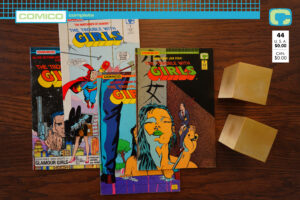
1989: The Trouble with Girls

The Trouble with Girls (1989) #1-4 by Will Jacobs, Gerard Jones, Tim Hamilton and others

Hm… Gerard Jones… that name seems familiar.

Oh, right!

The Trouble with Girls had run for 14 issues as Malibu, and after this four issue run, it would return there for 19 more issues. And then a four issue stint at Epic. So that’s not a run to sneeze at, but … Malibu was a pretty shady business in itself. The owner started a number of publishers, among them Eternity, Imperial and Amazing, and also a comics distributor, who were the pumping out masses of crap during one of the comics market boom/bust cycles, leaving tons of unpaid (other) publishers in its wake:

Read here for the sorry story.

So I’m really excited to read these comics! Let’s get started!

Comico took on a seeming endless number of series that had previously been at other publishers, and I’ve been noting how almost none of them try to introduce the series to new readers. This one seems like it’s going to be the same…

But let’s read the first three pages.

Uhm… uhm… Well, that’s an introduction for sure. But what’s most striking here (except that extremely odd sex scene) is:

Man, that’s some awful artwork. Straight from the school of the black and white boom and bust, I guess.

But! The writers do introduce the concept of the series in a very efficient way.

So this is one in a long series of comedy characters where the protagonist is a total doofus — it’s a classic setup because it works; it generates scenes on its own. And as normal, while the character is a moron, he’s also super competent.

Wink wink. But it is a very efficient way to get the introductions done.

For this kind of thing, there aren’t that many background sight gags. I guess the dogs sniffing the crotches of all the female characters is a running gag…

Man, that’s some bad drawing… and some colouring that’s so off that it can’t just be normal off-register printing — it’s like the colourist (or separator, I guess) just didn’t care at all, and who could blame them with art like this.

Well, that’s a solid joke…

But there’s more humour like this, really.

Somehow the text here is creepier than the comic itself.

So I was talking about how efficient the writers were about letting the readers know what the whole thing was about — but they really drag when it comes to actually doing the plot. It’s not that the gag here is bad — they’re fooling Lester Girls into making an action movie — but it just plods along with way too few jokes. It feels like it could have been done in a four page montage, but it takes an issue and a half.

By the third issue, they’ve gotten Chuck Austen aboard to do the inks, which I think should help. And on lettering… Angela Bocage!?? Wow.

I guess this only seems creepy in retrospect?

And indeed, Austen’s inking helps — things become more cartoony, which makes the general awkwardness of these pages recede.

But it doesn’t really help with another ponderous, slow-moving plot where you just kinda want to go “ok, I get the schtick… it’s an OK schtick but you need to add more jokes”.

The colourist starts doing a better job, too.

I guess Austen can’t work miracles — Lester Girls looks totally different from panel to panel.
And this is how the series ends — I guess it was another victim of the Comico melt-down, as we’ve covered in earlier posts in this blog series.
This is the only note that it’s been cancelled by Comico — but it seems like it continued seamlessly by returning to Eternity/Malibu.

I guess it’s not bad, really? But it’s just not funny enough.

Amazing Heroes #152, page #12:

COMICO SIGNS TROUBLE WITH GIRLS

Publisher PHIL LASORDA has an-
nounced that COMICO has signed
WILL JACOBS and GERARD
JONES to publish their action/humor
comic, The Trouble With Girls.
LASORDA stated, “Girls is the type
of book that any publisher would love
to have under his wing…and we’re
very grateful for the support and con-
fidence that MR. JACOBS, MR.
JONES, and crew have exhibited by
choosing COMICO as their new
home.”
“Obviously, we’re very happy
about the move,” said co-creator/co-
writer JACOBS. “We enjoyed work-
ing with the people at ETERNITY,
and they did an awful lot to get Girls
noticed in this business. But switching
to color was an opportunity we
couldn’t pass up.”
“Color will be perfect for this
book,” added JONES, the other half
of the co-creator/writer team. “The
wild adventures and the far-flung set-
tings of Lester Girls cry out for it.
And our artist, TIM HAMILTON,
has the sort of clean, open style that
color will really bring to life.”
ETERNITY COMICS will con-
tinue to publish The Trouble With
Girls at least through issue #14. The
release for the first COMICO issue
is tentatively scheduled for early
1989.

Amazing Heroes #157, page #228:

Starting in February the satirical critical
favorite The Trouble With Girls makes
the leap from Malibu to Norristown,
with its first full-color Comico issue.
Creators Jones, Jacobs, and Hamilton
remain on-board, although an inker of
unknown identity will probably be
joining the merry band,
“We’re very excited by the move to
color,” says Jones. At the same time, he
and Jacobs are making sure that new
readers won’t feel lost at sea by the
Eternity continuity. “People who have
never read the Eternity issues will have
no problem, but faithful readers won’t
have to sit through a lot of recapping.”
The first seven issues take Lester
through some big changes, and in an
attempt by Jacobs and Jones to beat the
one-joke rap that has sometimes been
leveled at them, Lester will be under-
going some actual emotional develop-
ment. But not to fear, the satiric edge will
still be there. The creators are attempting
to make storylines much tighter than they
were previously, as well.
The splash page of the first Comico
issue will open with Lester reading Old
Yeller and while he won’t be in the can.
Jones thinks it will be a pose to rival the
notoriety of the initial Malibu splash.
Lester will also be reading Anne of
Green Gables in the coming months.
Issues #1 and #2 find our square-jawed
protagonist in Hollywood, for the filming
of the Lester Girls movie, where he
meets the most intractable foe of all—a
director, namely Solly Greenblatt. Lester
has his idea of how his life story should
go, but soon finds that Solly has different
and more accurate interpretations of the
tale—and guess who’s got more of that
fabled clout? Issues #3 and #4 involve
Lester in a Spanish revolution. Then it’s
back to his hometown—Dullsville—for
a senses-shattering re-evaluation of his
values. This story will wrap up in #7.
Most of the old favorites will be re-
turning—the Lizard Lady, Maxi Scoops,
Apache Dick, Brett Ashley, and, briefly,
the fun-loving Foster boys. We’ll also
meet Lester’s dogs, Dean and Howells.
In multi-media The Trouble With Girls
news, Jones is optimistic about the
prospect of the movie. Currently, there
is interest from two companies which
couldn’t be more different-Godmother
Films (Tell Me a Riddle) and Impact
Productions (Commando). I guess that’s
what’s called wide-based appeal.
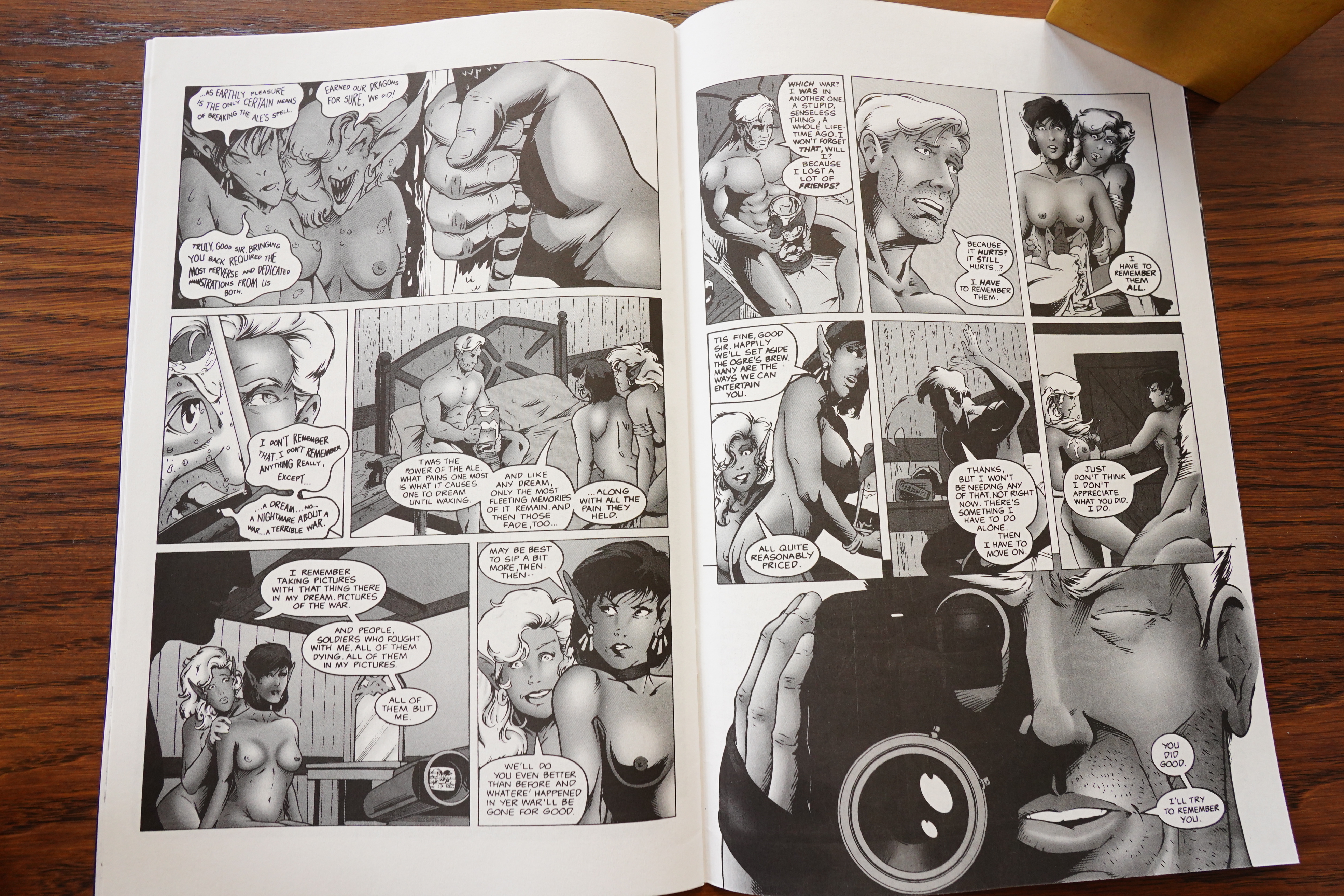
The Comics Journal #129, page #15:

The Trouble With Girls. Comico’s last
monthly issue of The Trouble With
Girls – #4 – ships in May. Eternity,
which published nine monthly issues
of the title between January and Oc-
tober 1988, will continue Comico’s
numbering, shipping #5 in July. Tim
Hamilton remains the series’ penciller,
and Chuck Austen will ink Eternity’s
first two issues.
The Trouble With Girls premiered
from Malibu Comics in August 1987,
adopting the Eternity imprint with #6
when Malibu acquired that company.
Malibu/Eternity published 14 issues
and an annual of the title before it mov-
ed to Comico late last year.
Jones explained the move to Com-
ico: “We just had this chance to jump
to color. I was hyped into the psycho-
logy that color is better. But color can
tax a publisher so much that, in a way,
it works against a low-selling comic.”
Jones said that sales of the title
doubled at Comico, but the book
nevertheless “went from a profit [at
Eternity] to break-even.”
Jones said Eternity Publisher Dave
Olbrich called him February 27, three
days after Comico “put us on hiatus,
whatever that means,” and made
“the most generous offer” of four com-
panies “seriously interested in acquir-
ing Girls,” but declined to name the
other prospective publishers.
Jones told the Journal he and Jacobs
signed with Eternity because of the
publisher’s ability to pay creators and
meet deadlines.
“The other publishers who contacted
us were either untested or we’ve seen
them having trouble getting books out
on time,” he said.

Comic Shop News #94, page #2:

TROUBLE TO ETERNITY
With Comico’s cutback on its comics line
set for June, several books are left without
an ongoing publisher. At least one of
those books has already found another
home, though. The Trouble With Girls by
Will Jacobs and Gerard Jones will move
back to its old publisher, Eternity, with The
Trouble With Girls #5. The book will retain its
numbering system from its Comico run;
the first return-to-Eternity issue will be avail-
able in July. Tim Hamilton, artist of The
Trouble With Girls for its entire run, will con-
tinue to draw the series; his work in Trou-
ble With Girls #5 and #6 will be inked by
Chuck Austen.
“We’re torn between having a new logo
done or using the Comico version de-
signed by Rick Taylor,” Eternity creative
director Tom Mason said. “I guess we’ll
have to decide that sometime before
the book ships.” He did confirm, howev-
er, that Eternity would not use the logo
used on the earlier Eternity/Malibu issues
of The Trouble With Girls.
“Needless to say we are very happy to
have Will, Jerry, and Tim back at Eternity
creating new episodes of one of the few
legitimate hit comics to be published in
the past three years,” Eternity Publisher
Dave Olbrich said.
Co-creator Gerard Jones said that he
and Jacobs were happy to
return to where they started.
“We were flattered by Eterni-
ty’s desire to get us back. Of
the four companies seriously
interested in acquiring Girls,
Eternity’s was the most gen-
erous offer.”
Co-creator Will Jacobs felt
that Eternity’s track record as
a publisher was very impor-
tant. “Eternity has proven
that it can survive in a shaky
and unpredictable market.
We are impressed with their
ability to publish regularly
and to pay creators regular-
ly considering the vagaries
of the comic book business,”
Jacobs said.
Eternity just released a Trou-
ble With Girls graphic album
containing the first three Mal-
ibu issues by Jacobs, Jones,
Hamilton, and Panda Khan
creator Dave Garcia. A sec-
ond collection of Girls mate-
rial will be published some-
time in the summer or fall of
1989.

Wizard Magazine Special #19, page #68:

With co-creator Will Jacobs, Gerard Jones brought
The Trouble With Girls to Mailbu. Since that first issue,
the series has served as a stepping-stone for Jones’ pro-
lific career which has included The Shadow Strikes,
Elongated Man, and Green Lantern for DC Comics and
Wonder Man for Marvel. He is also working on screen-
plays for Joel Silver, the famed action film producer.
The Trouble With Girls is a point of pride with Malibu
and an example of what creator-owned comics can mean
to both the publisher and the creators. Originally a Mal-
ibu Comics title, it became an Eternity title with the
Malibu-Eternity merger. It left briefly for a color series at
Comico and was eventually cancelled after four issues
when Comico cut back their product line. The series
returned to Eternity where it stayed another 18 issues,
until Marvel opted for a four-issue color run on their
Epic imprint. During that time, the series was sold to
20th Century Fox for development as a feature film –
with creators Gerard Jones and Will Jacobs writing the
original screenplay drafts.

I guess that didn’t happen.

The Slings and Arrows Comic Guide #2, page #696:

Will Jacobs and Gerard Jones’ secret agent spoof follows the
adventures of reluctant international playboy/spy Lester
Girls, who would much rather have been living a quiet life
in the suburbs, with 2.4 children, a friendly dog and
Sunday mornings washing the car. Fate has other plans for
poor old Les: he can never escape the glamorous women,
fast cars, big guns, international agents and would-be
world conquerors who are constantly on his trail.
His friend Apache Dick is usually happy to relieve him
of the burdens of unwanted wealth and half-naked
nymphomaniacs. The basic joke is a funny one and almost
all issues are well done, but it does wear thin quickly and
seems a little too formulaic after an extended run. The only
differences between the publishers are that the Comico
and Epic issues are in colour, the others aren’t. Pick up a
few issues and re-read them when you’ve forgotten
the plot.
The series is nonetheless popular enough to have
spawned several spin-offs starring both Les himself
(Lester Girls 3 issues, Eternity, 1990-1991) and other
members of the regular supporting cast such as the Lizard
Lady (Aircel one-shot 1991) and Apache Dick (Eternity,
4 issue miniseries 1990). During the short spell with
Epic, a Lester Girls story appeared in the Heavy Hitters
anthology, and the first nine Eternity issues were available
in three collections.~JC

The Comic Book Heroes, page #332:

“We’d never planned to write comics,” said
Jones, “but when Mike Valerio told us Dave Olbrich
was looking for ideas, we sent him part of an aban-
doned humor novel, The Trouble with Girls. We dis-
covered that we could do anything in independent
comics—anything—even things that made no sense
narratively or commercially. Somehow with pictures,
and with the self-referentiality and clubbishness of
modern comics, they all worked. We had more fun on
Girls than we’ve ever had on any project, and we did
the best writing there that we’ve ever done, in any
medium.” The abandoned novel turned into one of
the longest-running independent comics of its time,
running to over fifty issues from three publishers, in
color and black and white. There would be artistic
contributions from Paul Gulacy, Walter Simonson,
Bret Blevins, and others, but the vast bulk of the sto-
ries were drawn by Tim Hamilton, who started with
a nice touch for facial expressions but little else, and
matured in Girls’s pages into a solid artist who could
combine farcical action and quiet naturalism like few
other artists.

Amazing Heroes #161, page #68:

Ever watch a “one-laugh” tv show?
You know, the kind of sitcom that con-
siders itself quite funny; but needs the
constant help of a laugh-track to tell
you what’s funny? Shows along the
lines of “Gilligan’s Island,” and “The
Munsters,” are perfect examples.
There isn’t anything to make you laugh
out loud because the humor is so dry
(or non-existent/strained), but the gen-
eral idea in the vaguest sense is sort
of amusing. Sort of.
The Trouble With Girls is a one-
laugh comic book. It’s about the reluc-
tant adventures of an over-sized uber-
mensch named Lester Girls who
dreams of escaping his life of man-
sions, million$, women and violence
for a more subtle existence. Lester, for
whom action and sex are an annoying
banality, is very hard to feel sorry for.
And that’s the one and only joke.
The story starts with Lester going
at it with a woman doggie-style…
while reading a copy of Old Yeller. As
funny and shocking as that might
sound, the rest of the humor in the
story is supposed to come from soph-
omoric violence, brandname products
and Lester’s trip to Hollywood. The
only wryly clever humor to be found
upstages Lester in the Hollywood se-
quences (behind him a few movies in
production make light of the Rambo,
The Texas Chainsaw Massacre and
snuff film phenomenons). The story
could have worked very well as an
8-page juxtaposed “Secret Life of
Walter Mitty,” instead of a continuing
and strained series.
Writers Will Jacobs and Gerard
Jones cracked the National Lampoon
market during one of the magazine’s
dry spells. Though neither of them is
a Doug Kenney or P.J. O’Rourke, they
have written some funny material
(highly recommended is The Beaver
Papers, if you can find a copy). Un-
fortunately, The Trouble With Girls
isn’t one of their triumphs. One would
expect comics work from the authors
of “The Surfer Papers” to have more
of a bite.
Tim Hamilton’s uneven artwork
doesn’t help the book. While a decent
draftsman in regards to backgrounds
and inanimate objects, Hamilton can’t
draw humans well nor tell a story to
save his life. Hamilton’s chief artistic
strength is his ability to render cars,
buildings, furniture and other scenery.
He has no problem drawing cityscapes
and convincing interiors, but has
problems with everything else.
Populating his well-crafted arenas
are characters who look like they were
drawn by John Byrne… in his fanboy
days. The faces especially show how
fannish Hamilton’s work is around the
edges; as does the fact that almost the
entire story is told in medium and
two-shots.
Forget The Trouble With Girls and
check out Walter Mitty.
GRADE: POOR

There isn’t that much chatter about it on the web:

But the creative team needs to make sure they don’t give readers too much of a good thing; the package is only funny for so long before they need to introduce something fresh and new into the formula.

But it’s been out of print for yonks, and I guess there’s little chance of it ever getting reprinted, so that’s not too surprising. Still, it ran for 50-ish issues…

Right:

The casual caricatures and overly simplistic racism is supposed to be enough to let us know that the authors are in on the joke. It just doesn’t sit as well as it could.

Er:

What recommends the art on Girls, however, is that it is in no way poor or even that most dreaded word for artists, average. It’s visual pacing is energetic, never boring, its characters physically distinct and engaging, and the majority of readers may not even notice the rough patches.

Wow:

The Trouble with Girls is satire with restraint, charming and hilarious.

1989: Sam & Max, Freelance Police Special

Sam & Max, Freelance Police Special (1989) by Steve Purcell

Sam & Max had previously been published by Fishwrap Productions:

But just a single issue. And would go on to get another single issue by Marvel, and… is that it? Just three issues, and then a lot of collections? It somehow seems to have a bigger presence than that…

Anyway, this starts off with an introduction, but not really an explanation about what this is all about — but on the other hand, the title does kind of say it all.

So it’s about two super-violent funny animals…

… but not as psychotic as later entries in this genre would be (like Milk & Cheese).

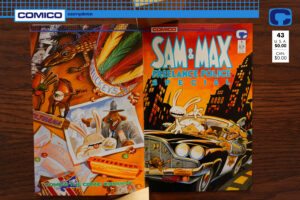
The artwork (especially with this colouring) looks really attractive, doesn’t it? Very expressive, but somehow grounded at the same time.

Is this a reference to something that happened in the Fishwrap issue? If that’s the case, it’s yet another case of Comico taking on a series and then providing zilch in the way of helping new readers along… But on the other hand, you don’t really need much, because:

The book is mostly a pile of jokes without much of a storyline.

Including sight gags in comics like this is an old tradition, perhaps perfected by Kurtzman/Elder for Mad Comics back in the 50s. Purcell doesn’t quite do the same thing — he’s much more random. I mean, those jogging roaches are fun, and that’s a nice-looking cat, but the guy in… chains? garlands? is (unless I’m mistaken) not a reference to anything, and not really a joke — it’s just a random bit of randomness in the panel.

And this is Purcell’s main method here. A guy on the ledge with a lamp in his hand, with the lamp’s cord around his neck? Well, why not? It’s quite amiable and adds interest, but, er, like — actual gags would have been funnier.

The book is a road trip book which fits this style of storytelling well. The main problem is when Purcell leans into shaggy dog type things like the above — like, is there going to be a payoff worth a lengthy set-up like this? No, not really.

But you can play this board game.

So of course they encounter buccaneers (not pirates) that have kidnapped manatees to start a new country or something, because manatees were the origin of the myth of sirens. Makes sense to me!

I guess what I’m saying is that this is a very good comic book, and it’s not a surprise that it’s been reprinted several times.

Back Issue #125, page #61:

EURY: It’s an oft-told tale that has been etched onto stone
tablets and scratched onto bathroom walls, but legend has it
that Sam & Max were inspired by a dog and rabbit combo that
your younger brother Dave came up with. Tell me that story.
PURCELL: Me and my kid brother David were always making
little books and comics. He had different characters he would
return to like Moo-Hoo Man. Sam & Max were detective
animals and that happened to be the subject of one of his
unfinished comics he left lying around. For some reason I
finished drawing his comic in a parody of the way a kid draws,
and had them commenting on how they drawn wrong, as
well as forgetting which character they were. On top of that,
they happily committed horrific violence on their enemies.
Eventually David lost interest in Sam & Max and I started to
make stories out of them, using their parody personas.
EURY: Were the names “Sam” and “Max” in reference to
anyone specific, or just pulled from a hat?
PURCELL: Those were the names he gave them. I kept the
names and the detective premise and out of the mean
parody the characters sort of revealed who they wanted
to be over time. He eventually gave them to me for my
birthday one year with an “official” document.

Sam & Max went on to become a one-season animated show, and also a successful series of video games.

This book was nominated for the Harvey Awards.

Peter Cashwell writes in The Comics Journal #133, page #53:

I suppose I should discuss religion
now, though it’s not a topic most peo-
ple would associate with Steve Pur-
cell’s inimitable Sam & Max: Free-
lance Police. In truth, though, reading
Sam & Max is a lot like listening to
dialogue between two clerics of an un-
familiar faith: it’s obvious that they’re
communicating, but the conversation
seems a bit surreal to the heathen.
Moreover, at least one of my close
friends has actually set up a shrine to
Max, using Purcell’s own “How ‘Bout
a Lovable Paper Bag Max-Head Pup-
pet?” instructions in the back of the
Sam & Max Special #1 from Comico,
and has set the resulting cult object
astride a cardboard-globe map of the
heavens on top of his refrigerator.
Clearly, Purcell is right when he states
that “Max’s terrifying head is a uni-
versal symbol of something or other,
I think.’
Religious significance aside, Max
is the most lovable sociopath in com-
ics today, a Luger-packing hydroce-
phalic bunny with the maw of a great
white shark and the cheery personality
of Norman Bates’ Cub Scout leader.
His partner and best buddy, Sam, is
(only by comparison) a responsible,
hard-working canine shamus with a
fondness for Liv-A-Snaps and a gun
the size of a Winnebago.
In this issue, they take a forced
vacation from hurling typewriters out
office windows and venture forth on
a cross-country auto trip. If this
sounds underplotted, consider the
addition of a terrorist cycle gang, a
kidnapped prairie dog, and a box of
smuggled pinatas. Besides, half the
fun is Purcell’s dead-on portrayals of
the hazards of the American road:
forced stops at Stuckey’s, roadkill,
and, of course, orange marshmallow
peanuts. The “Sam & Max Travel-
ogue” of diners was sheer genius, too
– these places are quite familiar to
any North Carolinan, and Purcell
knows them as well as the natives:
“Gigantic waitresses from towns
named after amphibians calling you
‘Darlin’ ‘ in some kind of gooey ac-
cent,” “the chain-smoking guy with
five teeth and a screw-on toupee,” and
“razor-sharp, charred strips of skink-
bacon.” It was kinda homey.
I can only speculate as to the
amount of time Purcell and his kid
brother had to spend trapped in a
small room to create these guys, but
it was well spent: I haven’t howled
with laughter at a comic book in years,
but I was laughing loud enough to
wake the neighbors at everything from
Sam’s reassurances — “I can’t think
of anything more relaxing than being
locked in a moving car with you for
about 300 hours, little pal.” – to
Max’s litany of stolen junk foods –
“Pork rinds! (Gasp!) (Choke!) Vien-
na sausages! (Uk… uk… uk) Orange
marshmallow peanuts (The Horror,
The Horror)!” That did it; I was one
of the faithful. Unfortunately, I still
can’t adequately describe the lunatic
chemistry between Sam and Max, so
perhaps this brief excerpt will demon-
strate why the are, to me, the greatest
comedy team since Laurel and Har-
dy, or even Bush and Noriega:

Amazing Heroes #157, page #191:

They’re back from their appearances in
“Munden’s Bar,” Critters, and their own
Special from Fishwrap Productions:
Sam and Max, Freelance Police!
If you’ve missed the earlier adventures
of this dog-and-bunny duo, then you’ve
missed the wackiest funny-animal team
since “moose and squirrel.” Sam and
Max are the pleasantly twisted brain-
children of Steve (Gumby’s Winter Fun
Special) Purcell, who boasts one of the
most wickedly sardonic wits in the
industry today.
In Comico’s all-new, all-color Sam
and Max, Freelance Police Special, the
boys venture out on a bizarre road trip,
where they battle pirates, travel to New
Orleans, visit a shopping mall, and
cruise past Stuckey’s. Armed with giant
guns, a blatant disregard for the safety
of others, and a propensity toward
slapstick violence, Sam and Max usher
readers on a tale they won’t forget.
Also included in this 40-page excur-
sion into lunacy is “Sam and Max’s
Guide to Our Bewildering Universe”.
(yes, it’s true: Sea Monkeys are not
primates!), a center-spread “Sam and
Max on the Road” board game for weary
travellers, and a how-to page revealing
the blueprint for constructing a Max the
Rabbit hand-puppet.
Sam and Max, Freelance Police Spe-
cial #1 is a laugh-out-loud comic book
that’ll be zooming onto the stands in late
January. Don’t miss it-it’s “curiously
refreshing.”
-JC-

Amazing Heroes #161, page #64:

I remember when I read Steve Pur-
cell’s first Sam and Max Freelance
Police story. I was in the bathtub
which seemed like an appropriate
place at the time. Purcell was so funny
I almost drowned, an idea I think he
would appreciate. There’s a
subversive quality to Purcell’s humor,
an adolescent’s delight in new things
and ways to break them. He doesn’t
really want to hurt anything: he just
wants to find out how much damage
he can inflict on something before
someone stops him.
Sam and Max are an anthropo-
mophic dog and rabbit living in a
human world. Sam (the dog) wears
a suit and carries a really big gun.
Max (the bunny) doesn’t wear
clothes, but he manages to conceal a
Luger on his person, but not even
Sam dares to ask. If you get confused
about who is who, don’t worry. They
aren’t always sure either.
In this story, their fourth adventure
(the first was published by Fishwrap
Productions; the second was a short
in Critters; the third a “Munden’s
Bar” episode), the police commis-
sioner asks Sam and Max to take a
trip. “The commissioner thinks we
may have an excess of energy, what
with the current city-wide wave of
lawfulness and courtesy,” says Sam.
Max’s response is to throw a type-
writer out the window while scream-
ing, “Death from above! AIEEE!”
From this starting point, the “plot”
follows Sam and Max’s adventures
out on the nation’s highways and all
the exciting things they find there:
Stuckey’s, vengeful wraiths, reptile
farms, motorcycle gangs and pirates.
It’s sort of like every nightmarish
family trip you ever took as a kid
rolled up together, soaked in ether,
and ignited. And, just in case that’s
not enough, there’s also a “Breakfast
at the Diner” supplement, the “Sam
and Max On the Road Official Board
Game” (use Crackerjack or Cheez-
it fragments from down the back of
the seat for board markers), and, best
of all, “Our Bewildering Universe.”
Purcell the artist does not believe
in dead space. There’s a gag in every
panel. He seems to particularly enjoy
drawing rats hanging around eating
sandwiches, and lobsters escaping
from grocery stores.
I heartily recommend Sam and
Max, Freelance Police. It’s a flaw-
lessly executed piece of manic insan-
ity. It has absolutely no redeeming
social value. Don’t pass it by-and
make sure you keep an eye on it on
the way home.
GRADE: PRISTINE MINT
— Jeff Lang

The Slings and Arrows Comic Guide #2, page #555:

Now better known for the excellent computer game, Sam and
Max are a big cuddly dog and a cute psychotic rabbit. Inspired
lunacy and ultra-violence abounds, courtesy of creator Steve
Purcell. May he earn riches beyond his wildest dreams. One
Epic issue reprints the Fishwrap comic in colour with extra
material, and the Marlowe book collection, Sam & Max: Surfin’
the Highway, reprints everything, but in black and white, while
containing nine new colour one-pagers. Sam & Max make a
brief and unexpected returns in Critters 50 and Oni Double
Feature 10.~WJ
Recommended: Comico, Epic 1-2

Not everybody are as enthused:

The book is about a cop dog and a rabbit who fight crime in an unorthodox way. The humor is hit and miss; if you played the game and didn’t like it, don’t even bother with the comic – it’s not on par with it. I’m not saying that it’s bad – it’s still wacky, sarcastic and funny, but it’s just not on the same level as the game.

Opinions differ:

The road taken with Sam & Max has long since been co-opted into mainstream superhero comics, with Deadpool the most obvious example. In any sane world Steve Purcell would have parades in his name. Sam & Max is magnificent.

1989: Ribit!

Ribit! (1989) #1-4 by Frank Thorne

Comico’s 1989 lineup seems paradoxical — Comico were bringing in more established creators than ever before, and publishing better comics than ever, but complete bankruptcy is just around the corner.

But perhaps one is the result of the other? Time and time again, creators in interviews will point out the lengths editor Diana Schutz went to keep books on schedule, having material on hand up to nine months before publication. As Comico were apparently paying for the work then Comico received it (or even beforehand), this must have been a huge drain on liquidity? And for longer series that were underway when Comico went bankrupt, this was presumably a straight-up loss, as Comico allowed the creators to take their books elsewhere and publish them there (like with The Maze Agency).

Which brings us to Ribit, a series by Frank Thorne. By 1989, I guess he wasn’t really a big name any more, but it’s a name, at least.

Thorne was big in the 70s, with his Red Sonja run and the Ghita of Alizarr series (was that for Warren?) as well as comics for Playboy &c. He is a very talented artist, of course, but his writing is pretty much always like the above: He has a tendency to natter on a bit, and sometimes the text makes sense, and sometimes not. You get the feeling that he has a short attention span while writing.

But while florid, this one makes more sense than most of the books I’ve read by him.

Thorne is controversial for other reasons, too — mainly because he has a tendency to draw a lot of characters that look like nude children, and mostly girls. There’s always an in-story explanation for this, like — “oh, they’re elves and/or gnomes and that’s just what they look like; of course they’re all adults”.

This one… is because of a botched magical potion/ritual thing, where that big lummox’ amphibian pet jumped into the pot (along with his favourite porn VHS tape), and what came out of the cauldron looked like that. Sure! Makes total sense.

Not beating the allegations.

Thorne writes a very bubbly kind of book — at the drop of a hat, you get some character spouting nonsense and … playing a video game console. The world building in this book is basically “whatever”. And the characters have names like “Vomick” — guess whether that’s a villain or a hero.

Oh no! She’s talking in funny speak! Noooooo

Thorne puts himself into the book (as a wizard he would portray as cosplay at conventions with a bikini-clad sidekick).

Epic skateboard fight!

Like I said about world building… but the thing is, I think it kinda works? It’s an everything-but-the-sink-but-then-throw-the-sink-in-anyway kinda book, and if you just let it wash over you without thinking too much about it, it’s a fun read, really. The storytelling works, and the (over)writing pulls it together.

It’s a very likeable, amiable book — Thorne’s obvious enthusiasm for the project carries it along.

c

Unfortunately, the production on this book leaves a lot to be desired. Throughout the series, it’s plagued by out-of-register printing, and with artwork as busy as Thorne’s, it’s really a problem — you feel like you’re seeing double all the time. And it’s a particular shame because Thorne’s line is as attractive as it is. (It’s like… Joe Kubert mixed with Moebius?)

Thorne likes his alliteration.

Oh, the storyline? There’s a lot of magic and fighting and vanquishing of evil wizards and the like… but it’s a love story at heart. And it ends happily, with both the lummox and Ribit being transformed into these new bodies and they live happily ever after. Or something.

I haven’t read all that much of Thorne’s work, but among those, this is hands down the best and most readable thing he’s done.

Rob Rodi writes in The Comics Journal #134, page #32:

Frank Thorne is a lot like Howard
Chaykin — he long ago chose an ar-
chetype, and Therefrom All
Descendeth. If Cody Starbuck is Iron-
wolf is the Scorpion is Reuben Flagg,
likewise Red Sonja is Ghita of Alizarr
is Lann is Ribit. Both Chaykin and
Thorne are pop manipulators of a
highly slick cast, and are fond of
mating the wheezy iconography of
genre comics with the kind of sexuali-
ty Hugh Hefner once thought would
take over the world (i.e., dirty). Your
appreciation of these cartoonists
depends, largely, on your visceral
reaction to their archetypes (in
Thorne’s case, the Warrior Woman as
Playmate of the Month), and, beyond
that, how great a sense of humor you
have about the shaggy, omnivorous,
unstoppable beast of pop culture. My
own sense of humor on that score is
fairly accommodating. There were
parts of Ribit! that had me pretty close
to giddy.
As American Flagg! was Chaykin’s
first mature work – his first to feature
any kind of political awareness and
fully-realized characters, the first to
reflect an original and idiosyncratic
sense of humor – so, too, is Ribit!
Thorne’s first really adult book. I
remember all the blood and other
viscous stuff that used to run through
his earlier works, which kind of made
my mouth twitch with the icks; I
remember Ghita of Alizarr mastur-
bating on her sword, not looking like
she was being too careful about it (I
wondered who could possibly get off
on that); I remember Lann walking
naked through a hail of body parts;
and I remember all the big ugly
demons and monsters Thorne used to
use, and generally I thought he was
creating books that really horny
fantasy-geek adolescents would create
if only they could draw like that. All
the posturing used to get to me, too
– I don’t mind fantasy comics every
now and then, but I generally like the
ones where people stand and speak in-
stead of pose and declaim.
Well, that’s Ribit! It’s a mass of stuff
you’ve already seen, from Rabelais to
Road Warrior, but there’s a benevolent
principle at work in it that may shock
you because it’s never been in
Thorne’s adventure comics before.
Suddenly everything is merry and
larky, and quite funny; it’s filled with
pratfalls and puns and a spirit of silly
playfulness. It’s set in the far future,
when magic is (again) slowly giving
way to technology, which is
represented by the evil warlord
Vomick. The world’s last magical
forces — the elf-queen Calliope, the
sorcerer Boomer Fen, and the
sorceress Sahtee – have teamed up to
beat the tar out of Vomick. But the
lines between sorcery and technology
are all kind of blurry here to begin
with; Vomick is really hot for Sahtee’s
all-powerful crystal orb, and Sahtee
herself references her mainframe
computer to see how her spells
worked. Sahtee and her oafish assis-
tant, Thog, set out to create a warrior
woman, molding her to the image of
Thog’s favorite pornographic starlet;
but one of Sahtee’s familiars, a little
lizard-thing named Ribit, jumps into
the mixture so that what comes out is
a kind of warrior pixie with green skin
who doesn’t really speak so much as
spit out syllables that sometimes you
can decipher, sometimes not. Sahtee
would like to repair the damage, but
before she can, her magical orb – and
her body – get blown to bits by
Vomick, and she has to take refuge in
the body of another familiar, which
looks a lot like a deranged Muppet.
All of this is played for as many
laughs as possible – the tone
throughout is dazzlingly daffy. The
dialogue is especially wild, from
Ribit’s warrior cries (“Sonna bccch!
Ribit pizzzdd oftt!”) to the goofy in-
vocations of the fatuous Friar Squiff
(“I exorcise thee, most vile spirit!
Vamoose from this sufferer”). Thorne
mocks the whole fantasy genre – and,
by extension, himself – by juxtapos-
ing the purple with the prosaic, even
in his narration (“And so, as her
Tristan is struck down, this mini-
Isolde explodes like a butane cigarette
lighter”). There are passages that read
like inspired screwball comedy,
especially the completely disarming
exchanges between Boomer Fen, the
inevitable wizard character (inevitably
based on Thorne himself), and
Sargasso, his been-around-the-block-
since-birth girlfriend (based, so the
back-cover photographs would in-
dicate, on Linda Behrle). They bill
and coo like two aging romantics who
have no illusions and suddenly realize
they don’t need any; it’s probably the
most adult sexual romping I’ve ever
seen in a comic, and that includes
undergrounds and alternatives. At one
point they’re lying on a beach, drunk,
and Sargasso consents to demonstrate
her ability with foreign tongues by
playing with her toes and reciting
“This Little Piggy Went to Market”
in different accents (“An’ thees leetle
peegay vent oui oui oui – all ze way
homm! Ole!”). Boomer Fen finds this
rapturous (“Sargasso – my en-
cyclopedia! My reservoir of all
knowledge!”). It’s so dizzy, you may
feel yourself transported by bliss. The
object of fantasy is to take you into
another world, and, in these panels,
Ribit! takes you to one you may never
want to leave.

[…]

The only suggestion you want to
make to Thorne is that he slow down;
everything whizzes by, as if Tex Avery
were doing a seven minute spoof of
all the Tolkien books ever written.
There’s no time to savor anything. But
that’s a small complaint; this is such
a huge step forward for this gifted car-
toonists. The only aspect of the book
that doesn’t reflect a newer, wiser, bet-
ter Frank Thorne is the cartooning
itself, and that’s only because you
can’t improve on perfection. (You
could, however, improve on the terri-
ble color separations, which sabotage
Thorne’s images throughout the four
issues.) His linework is still the most
seductive in the industry; it’s thick and
fluid and unarguably sensuous. And
his evocative use of shapes and planes
is still gorgeous and sophisticated.
You can see that his style owes
something to Joe Kubert, but whereas
Kubert is lean and mean, Thorne is
rich and voluptuous – especially,
need I say it, in his depiction of
women. You may wonder how I could
have made a face at She-Hulk’s green
skin in a recent review, only to turn
THE COMICS JOURNAL #134, February 1990
around and call Ribit a genuine femme
fatale; well, the answer is obvious:
Frank Thorne’s women make John
Byrne’s look sick. They make
everybody’s look sick. When Ribit
stares out of a panel, with saucer-eyes
and pouty-pouty lips and nostrils that
are like two pricks of a pen, and spits
out something adorable like “Ribit not
taddpol!,” you may find yourself close
to swooning. She’s a masterpiece of
pop sexuality – a cross between
R2D2 and Charo. Now that Comico’s
books are being distributed by DC, I
foresee an entire nation of young boys
encountering Ribit and bursting into
spontaneous puberty. Something tells
me that’s the kind of tribute Frank
Thorne would like.

Uhm, OK…

Amazing Heroes #158, page #74:

It seems that Frank Thorne by and
large ignores most of the current
comic trends. No incredibly realistic
“torn from today’s headlines” ap-
proach. No pseudo ultraviolence. No
whining introspective characters.
Thorne approaches Ribit! as a whim-
sical adventure-fantasy. It works
splendidly.

[…]

Frank Thorne seems to have at last
come up with the proper vehicle for
his formidable talent and wit. If you’re
tired of depressing, cluttered claptrap,
this book should excite your pleasure
circuits and restore your faith in an in-
cestuous medium. Tons ‘o fun.
GRADE: PRISTINE MINT-John A. Wilcox

Amazing Heroes #123, page #33:

THORNE: Yeah. I’m afraid this is
going to be non-controversial
[laughs]. Anyway, Phil LaSorda was
there with Diana and Bob Schreck,
who used to hang around with the
Creation Con guys when we were
doing the Wiz and Sonja show at the
Statler Hilton in Manhattan. We did
it on the same stage that Glen Miller
band broadcasts originated.
Fabulous. I was misty-eyed, being
and old trumpet player. It was a big
hall, and we filled it. Wendy was
great as Sonja. Did you ever see her
in the role?
AH: Yeah, once.
THORNE: Ohhhh. . . She was Red
Sonja. Anyway, the chemistry was
right at the Comico meeting and, for
the record, if the new series is suc-
cessful we’ll have to credit Diana for
tagging it, because I was thinking of
calling it Dread Spawn or Green
Spawn, or maybe just Spawn. Diana
said we gotta call it Ribit!, with the
exclamation point. I’m sure it’s a
good choice, because Comico has
been doing very well. Ribit! is a
four-issue, full-color mini-series.
Twenty-six pages each. It will be
released in the spring of ’88. It’s
mainstream. Actually, Ribit! is flat
chested, green, and thirty inches
tall.
AH: That must be quite a change
for you.
THORNE: [Laughs] Yes, but the
sorceress Sahtee is amply propor-
tioned. She’s named for the com-
poser Eric Satie, who’s one of my
favorites. Anyway, the first two
books feature the origin of Rib and
her battle with the chrome clad
warlord. The second two books will
be a story called The Isle of the Sea
God, which was an idea I had for
the third Ghita book.
AH: Have you found it difficult
adapting to the idea of doing some-
thing that’s less adult oriented?
THORNE: I think passion does not
necessarily have to be libidinous
passion. Rib’s un-libidinous passion,
and I’m enjoying this as much as I’ve
enjoyed anything. It’s all part of a
whole. Still, if Ghita and the rest
hadn’t done so well, I might be back
drawing Korak. I might have to take
another look at the passion meter.
AH: Do you want to talk about the
concepts and characters in Ribit!,
since that seems to be your current
flame, as it were?
THORNE: The back cover blurb on
this one reads: “Medieval sorcery
confronts the deadly weapons of
modern science when the chrome
clad warlord commands his demon
hordes to exterminate the prac-
tioners of obsolete magic and
destroy the Orb of Green Crystal.”
That sets the tone of it.

[…]

THORNE: I’m definitely in the low
range and love it down here. Let’s
hope that Ribit! lives up to the ex-
pectations of Comico.
AH: Comico has had a really ex-
cellent track record so far.

So this interview was published in August 1987, almost two years before Ribit was published by Comico…

The Comics Journal #280, page #60:

GROTH: You did Ribit for Comico.
THORNE: Ah, my little green Sonja. Diana Schutz
called; she was an editor at Comico, located
in a decrepit house in Doylestown Penn. that
was right out of Charles Addams. I believe
Diana was Mrs. Bob Schreck at that time. We
met and I offered a miniseries, that I would
own, called Spawn of Sorcery. She loved my
workup and script ideas, but she felt that the
title conflicted with McFarlane’s Spawn. She
euchred me into calling it Ribit! I loathed the
title, and years later I heard that she wished
she hadn’t insisted on the change.
GROTH: There are some beautiful images and in-
tricate panel arrangements in the series, but I’m
curious as to why you think it’s the best-written
stuff you’ve done.
THORNE: Well, I like the flow of it. It had an
anticlerical feel to it, like all my work. For
instance, Bobby God on the motorcycle and
the creatures drawn from mythology, there
is great power in myths; zealous religiosity
has produced a blood-soaked laundry list of
mythic figures. That’s why I’m not a person
of faith, my role as a maker of myths gives me
license. The worlds I create are blood-soaked
at times, but it’s fictional carnage.
GROTH: So what was the editorial direction at
Comico like when you were producing Ribit?
Did Schutz do much editing of your work?
THORNE: Zip. Nada. She had her name on it but
she had no input whatsoever. Comico was
run by a shlepper whose uncle was Phil La-
sorda who owned a sports team. Good old
Uncle Phil set him up in business. He didn’t
know his ass from a turnip. Comico folded
ignominiously, shortly after the fourth book
of Ribit hit the stores.

Heh heh. Well, that explains where Comico got the money from in the first place. I’m not sure how much stock to place on Thorne’s memory here, though — McFarlane’s Spawn was published in 1992, right? Right. So Schutz objecting to the name Spawn of Sorcery (somewhere before 1987, since in the 1987 interview, Thorne calls the series “Ribit”) either means that Schutz possesses magical capabilities, or Thorne is confabulating a bit in this interview.

Amazing Heroes #131, page #29:

Ribit!—written and drawn by Frank
Thorne of Red Sonja fame. The series
will be a four-issue one. Ribit!, whose
exclamation point is creidted to
Comico editor Diana Schutz, is a flat-
chested, green and thirty-inch tall
woman, who sounds like a frog, eats
worm beetles, and had hair that looks
“Like a riot of leeches,” as creator
Thorne described it. Ribit! involves a
weird battle twixt sword-and-sorcery
and high technology weapons. Thorne
has produced the book utilizing the
same kind of watercolor techniques he
used on Moonshine McJuggs, which
appeared in Playboy [I never saw it.
I only read the articles-EDJ. Editor
Schutz calls Ribit! a “very well writ-
ten, a G-rated Ghita,” and stresses
that while it will have no nudity, it will
nevertheless be an adult book.
About his work in Ribit!, Frank
Thorne said, in an interview in Amaz-
ing Heroes (#123) “I’m enjoying this
as much as I’ve enjoyed anything.” As,
undoubtedly, we readers will, too.

Fantasy Advertiser #111, page #14:

Any critical attention paid to Frank Thorne’s
work has tended to be overshadowed by his
reputation as a “good girl artist” ever since
the days when he was enlivening run-of-the-
mill Roy Thomas Hyborian scripts for Mar-
vel. While his penchant for drawing women
in classic pin-up style has undoubtedly led to
financially rewarding work for National
Lampoon and Playboy, it has obscured the
fact that he is virtually the only creator to
have extended the “sword and sorcery” genre
beyond the guidelines laid down by Robert
E. Howard. It is a delightful coincidence that
Thorne drew the Elrod cover for Cerebus 7,
since Dave Sim is the other notable excep-
tion to the Hyborian rule; but the praise duly
accorded to Sim’s remarkable achievement
may also, quite incidentally, have contrib-
uted to critical neglect of Thorne’s very dif-
ferent work. Comparison of the two would,
in fact, be ridiculous; Cerebus has long since
developed beyond its genre origins, whereas
Thorne continues to re-examine that genre
from different perspectives.
Even under Thomas’ direction, Thorne’s
unique, phantasmagoric art injects a night-
marish quality into the Red Sonja issues he
handled which is noticeably lacking in the
Conan comics. The horrific menaces which
beset the ludicrously-clad heroine appear to
have been inspired not by Howard’s pedes-
trian prose but by Clark Ashton Smith’s
overripe, decadent imagery. Thorne’s ensu-
ing essay in the field, Ghita, retains the
Hyborian style of topography and nomen-
clature but goes far beyond comics’ tradi-
tional pulp origins in drawing its inspiration
from the works of Rabelais. Although it
lapses too frequently into soft porn, Ghita
amply demonstrates Thorne’s increasing
mastery of his art; the drawings are much
more detailed yet also much more precise
than his Marvel work, and the inventive,
boisterous scripting revels in its origins with-
out ever being derivative.
His latest project, Ribit!, turns elsewhere
again for its inspiration. Thorne appears to
have been struck by the essential oddness of
“sword and sorcery” computer games – fan-
tasy adventures played out on high-tech
equipment – and has accordingly developed
a complex and subtle premise in which sci-
ence and sorcery are depicted as simultane-
ously opposing and compatible forces. A
sorceress uses a computer, an elfqueen furi-
ously manipulates an arcade game, a techno-
crat is magically turned into a dwarf. As if
overwhelmed by his first colour comic for
years, Thorne excludes black and white
definitions from his story; the “heroes” are
clearly on the losing side, the sorceress vain
and incompetent, the elfqueen enamoured of
technology. From that inherent paradox of
“science and sorcery” he derives a tale full of
ambiguity in which each page presents a new
contradiction to be savoured.
Thorne’s artwork for Ribit! is perhaps his
finest to date. He appears to be caricaturing
his own notoriety; the eponymous heroine,
for instance, would be a typical Thorne pin-
up were she not green, three feet tall and flat-
chested. The conventionally beautiful sor-
ceress ends up trapped in the form of a small
muppet monster. The drawings themselves
represent a refinement of the techniques used
for Ghita and are surprisingly free of any
nightmarish qualities, reinforcing the im-
pression that this comic is intended for
younger as well as older readers.
If that is indeed Thorne’s intention, he may
well have succeeded – Ribit! is a fine piece of
“wholesome” entertainment “for all the
family” which also provokes thought and
never plays down to the reader. It is his most
satisfactory creation to date, and it is to be
hoped that its sales benefit from the DC/
Comico distribution deal; a comic as intelli-
gent and diverting as this deserves to reach as
wide an audience as possible. Unless Thorne
loses his grip on the narrative during the
issues yet to come, Ribit may turn out to be
one of the best American colour series pub-
lished this year.
Mike Kidson

Comic Shop News #82, page #5:

Ribit! is Frank Thorne fantasy. That
should pretty much sum it up to fans who
are familiar with Thorne’s work.
The book mixes magic, nazis, skate-
boards, heavy munitions, bizarre critters,
and mystical quests in a surreal fashion
that manages to utilize almost any plot de-
vice that comes to Thorne’s mind. It’s sort
of sword-and-sorcery, sort of hip fantasy,
and yet something else at the same time.
Ribit! also presents the beautiful women
that Thorne is well-known for; ever since
his work on Red Sonja, Thorne has become
a masterful illustrator of scantily-clad bar-
barian heroines, and Ribitl certainly falls
within that description. Prior to this book,
there weren’t too many Thorne heroines
riding skateboards, though–and it’s that
“break-down-the-traditions” approach
that’s the charm of Ribit!

So Ribit received a lot of attention when it was published, and the reviews were all raves.

Comics Scene Volume 1 #6, page #53:

“She’s put to the test, and although
she’s small, she’s ornery enough and
thereby capable of doing everything that a
fully grown warrior woman can do,” ex-
plains Thorne. But in Ribit’s unnamed
world, “everything” can range from
skateboarding through bullet-ridden con-
frontations with parademonic soldiers se-
questered in Nazi war tanks to slashing
away at 20-foot tall automated constructs
with nothing more than a dagger. Com-
pounding the conflicts she faces in her
transition from froggy familiar to femme
fatale, Ribit slowly learns how to speak
like the humans to which she now bears a
passing, if miniature, resemblance.

The Slings and Arrows Comic Guide #2, page #541:

Magic is being driven out by science, and Sahtee, the last
remaining sorceress, decides to fight back by creating a
warrior woman. The recipe is nearly finished when Ribit,
a lizard-like familiar of Sahtee’s, jumps into the cauldron.
Ribit does indeed turn into a warrior woman, but
she’s only three feet tall, and she’s bright green. Not
that this stops her fighting – it just stops people taking
her seriously. Frank Thorne’s story has its self-indulgent
moments, but is generally quirky fun, and the ending is a
true surprise.~FC
Recommended: 1, 4

I think resistance to summarising is a good thing:

RIBIT is almost impossible to summarize. It takes place in some vague future in which there abound references to 20th-century culture, but there’s no physical resemblance to any 20th-century settings. Thorne’s world is a phantasmagoria out of Bosch, in which both magic and science are hopelessly intermingled. In essence, it’s a one-shot feature that allowed Thorne to draw any damn thing he felt like drawing, whether it worked within the context of a narrative or not.

The Goodreads score is oddly low, but there’s few votes.

Right:

Ribit! #1 is the first of a four-part story as presented (I suspect it was created as one big album, especially given how abrupt this one ends) and it remains as impressive a work now as it did when I discovered it in college, with phenomenal art and a cute story that does a lot of things right, earning 4.5 out of 5 stars overall. If you’re a fan of ‘Heavy Metal’ or Thorne’s art on ‘Red Sonja’, I’d recommend fishing it out of the next back-issue bin in which you encounter it.

Ribit was reprinted by Hermes Press, but in a limited edition, which is a shame. I can’t really find any reviews of it — I was wondering what an audience these days would think of it.