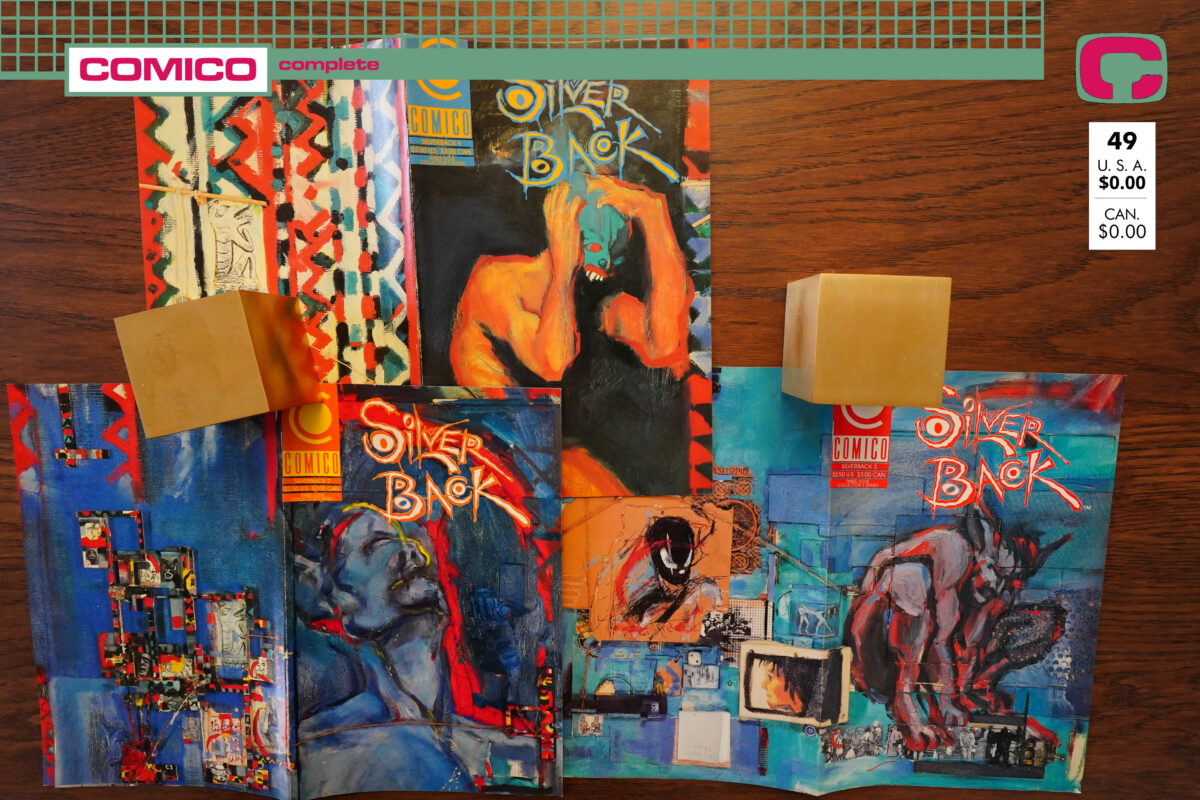
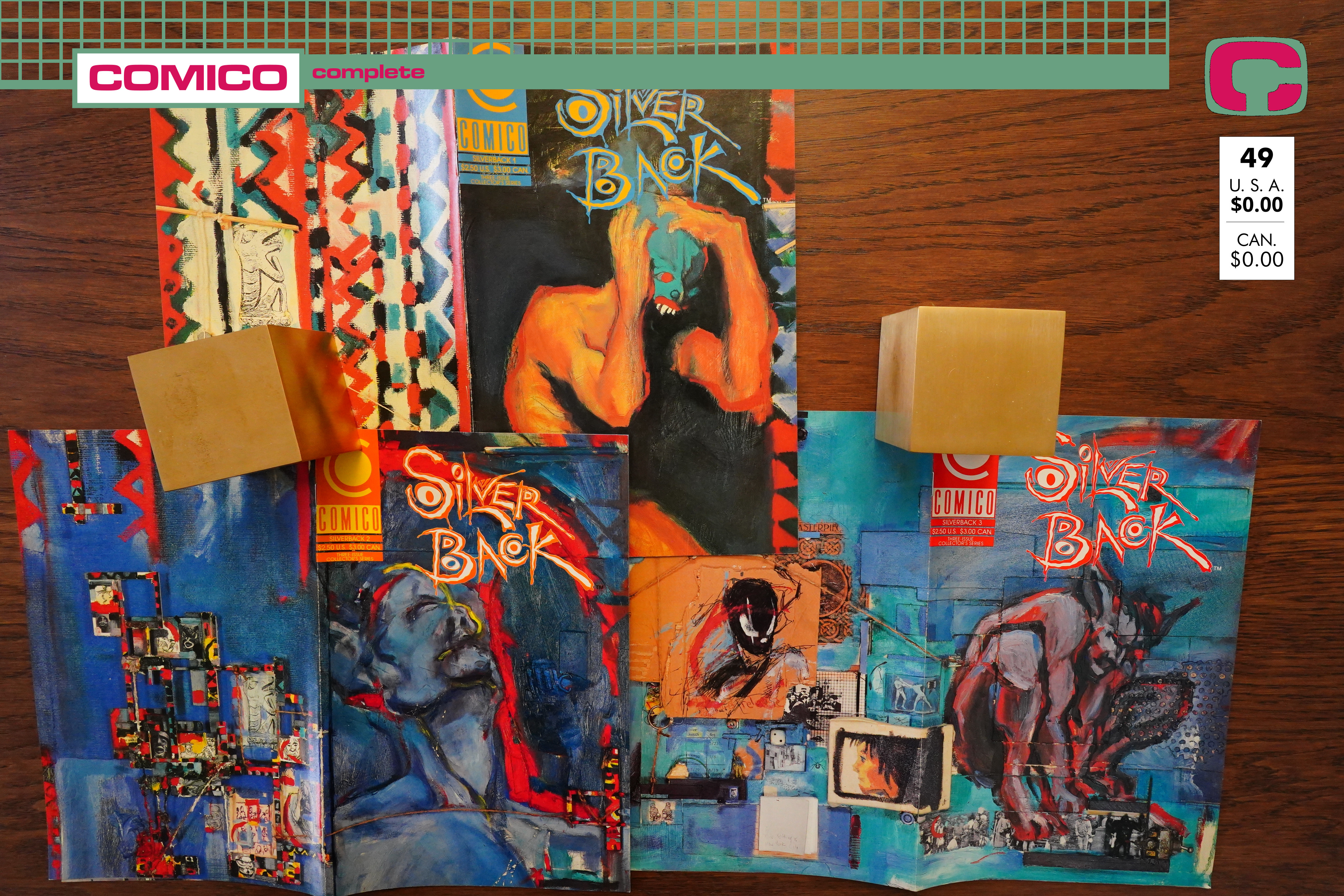
Silverback (1989) #1-3 by William Messner-Loebs, John Peck, Matt Wagner and Bernie Mireault
This is one of the few Comico books I bought back in the 80s. And not because I was into Grendel (it’s the origin story of the Grendel antagonist Argent), but because it’s by William Messner-Loebs, and I was a huge fan of Journey. (Man, those first six issues of Journey: They’re brilliant. OK, the series got kinda lost in the weeds after that, but it remained interesting. And those first six issues? Man.)
I remember zilch about this series, but I’m excited to re-read it now.
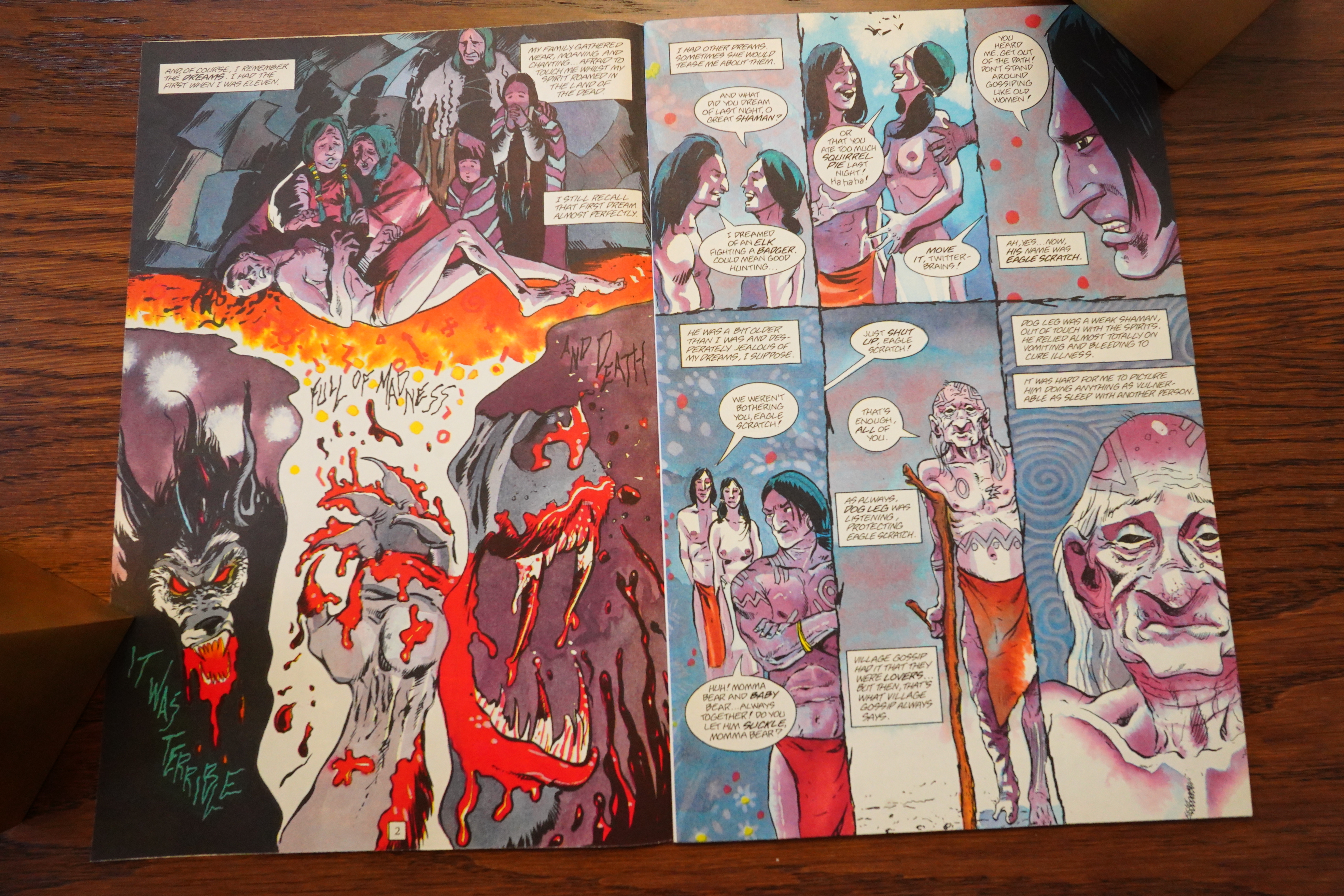
Oh, right, I think we already knew that Argent (a kind of wolf man) was a Native American, but here we get his origin story, which is about how he was done wrong by a couple of horrible gay guys. I mean, two envious superstitious cowards of shamans. Shamen? Something like that.
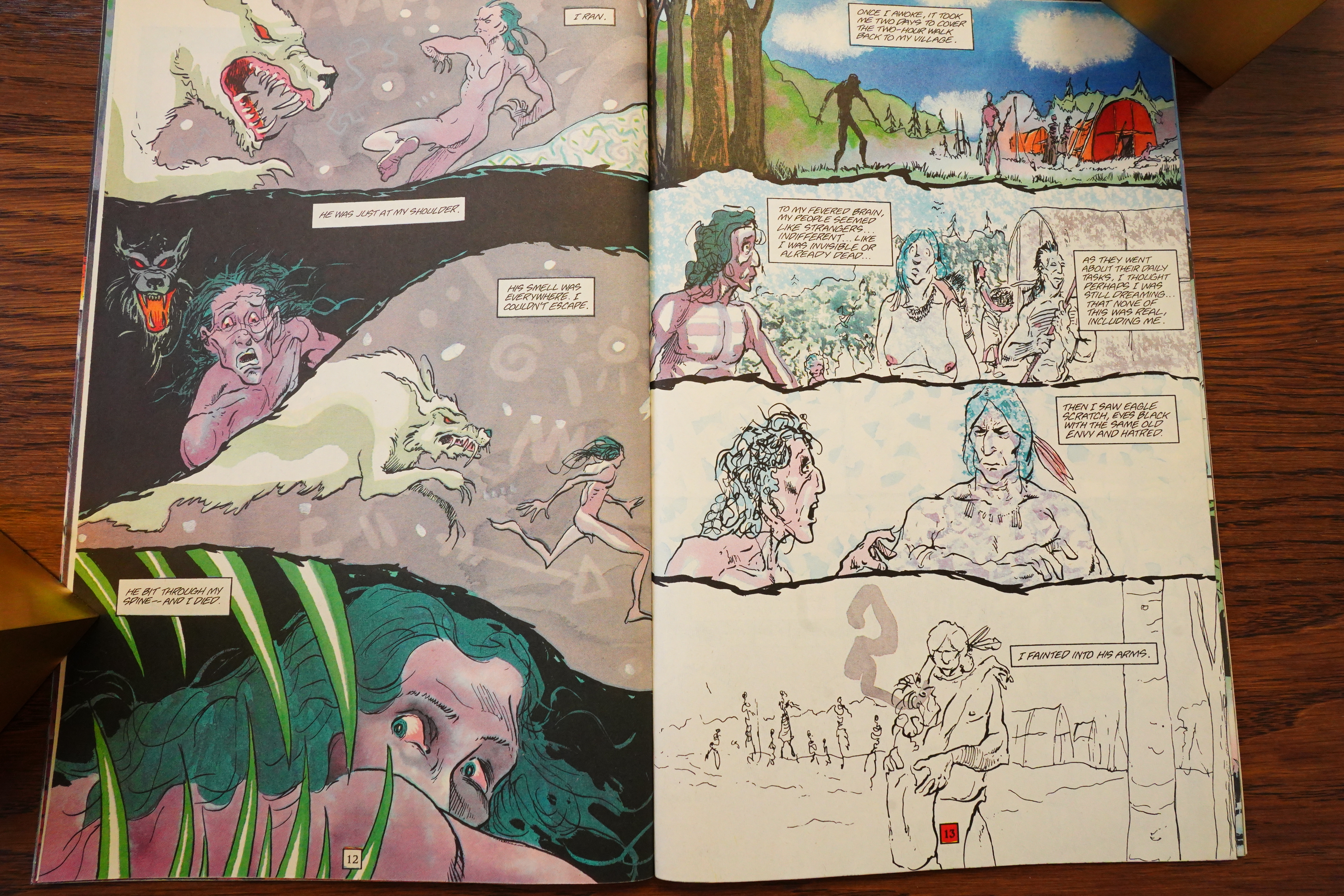
It’s pretty good, but it’s Messner-Loeb’s artwork that sells it.
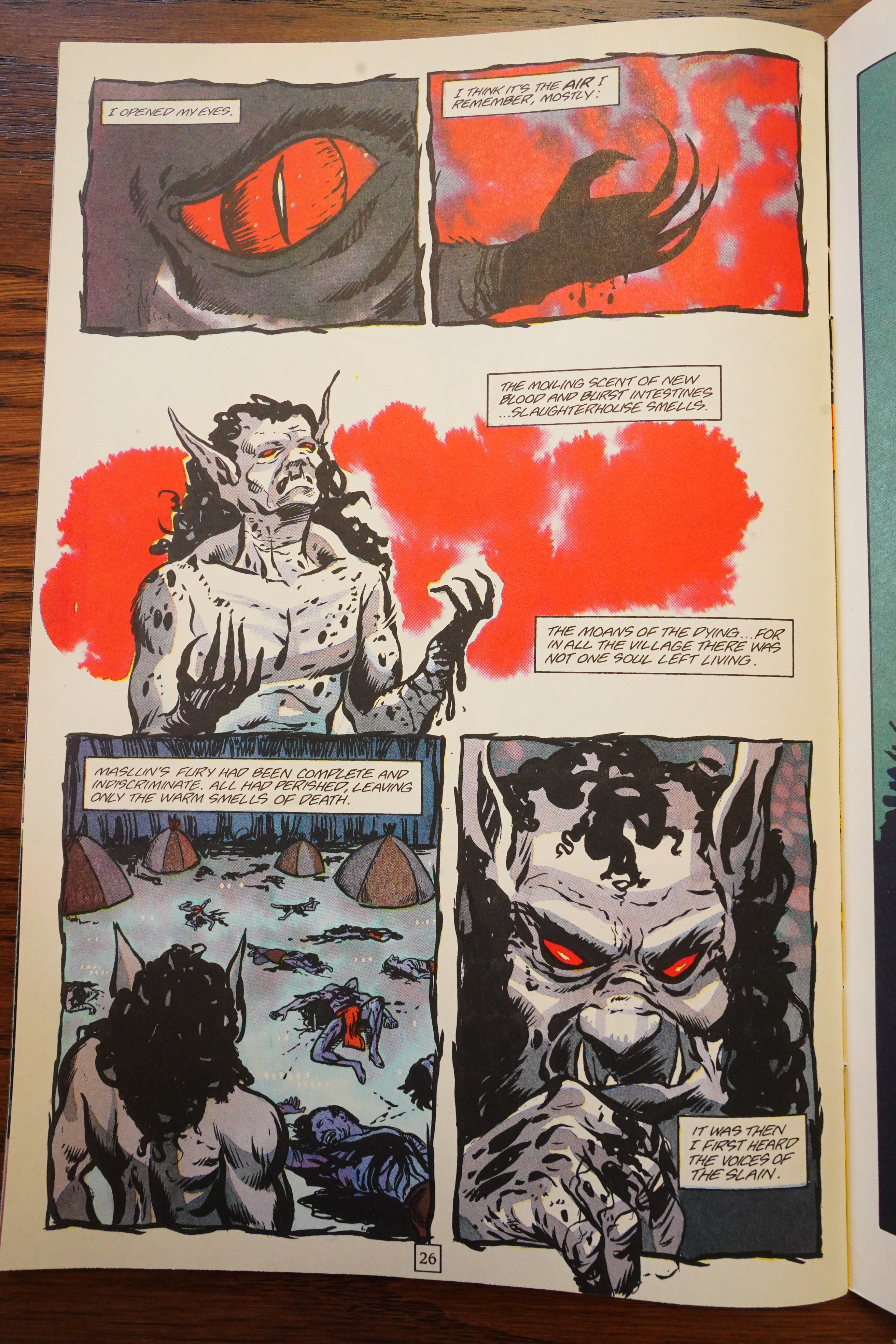
The story is pretty much a cliché, but it’s told with real nerve.
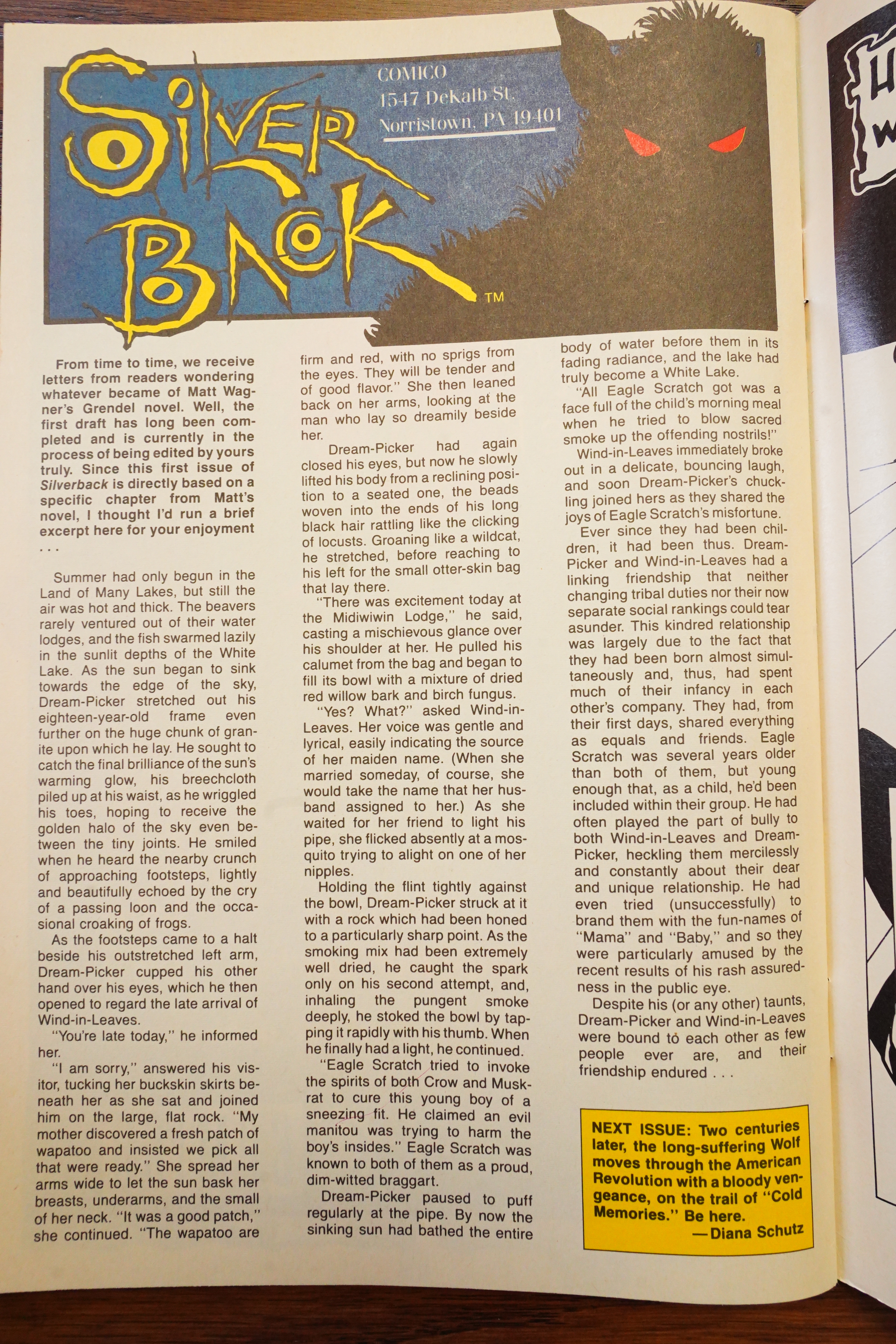
And when you read the excerpts from the Grendel novel that it’s based on, you see what Messner-Loebs had to work with — and he worked miracles.
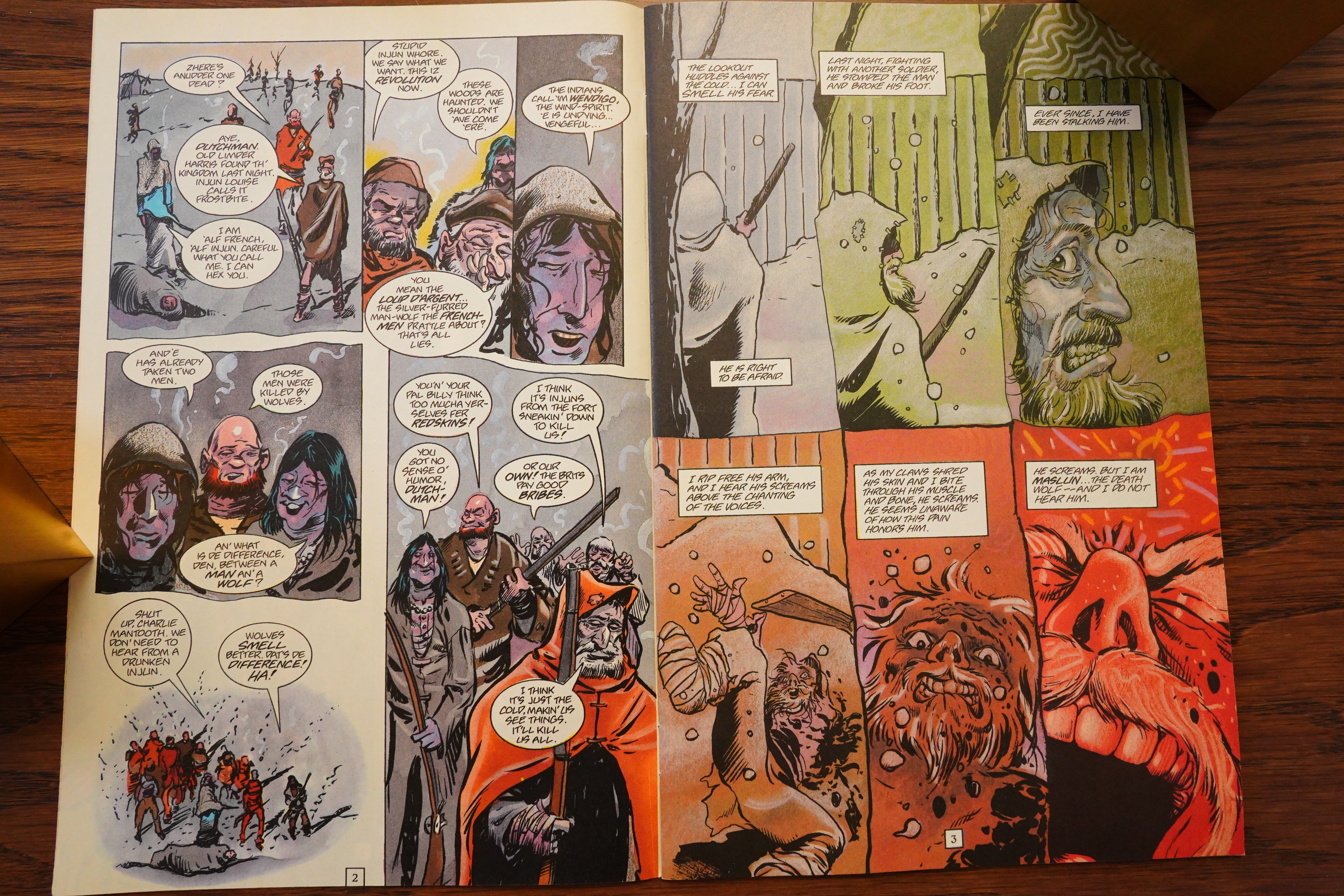
The second issue is even better, because it’s not based on … that. It’s a real horror story, and is gripping and enjoyable.
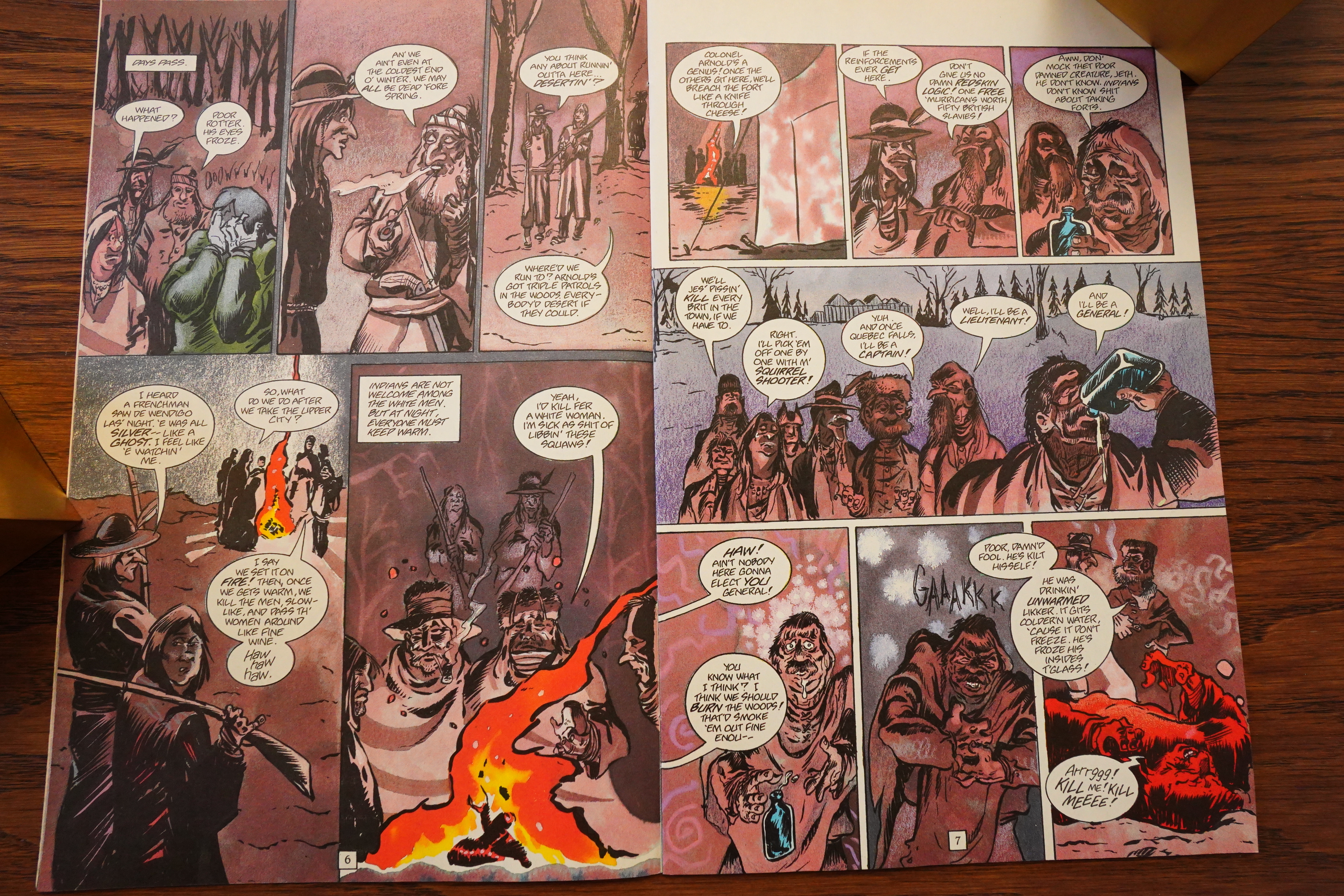
Especially the bits that are all about the sheer awfulness of these Americans who are planning to invade Canada and slaughter and rape the English. Kill ’em, Argent! Kill ’em all gruesomely!
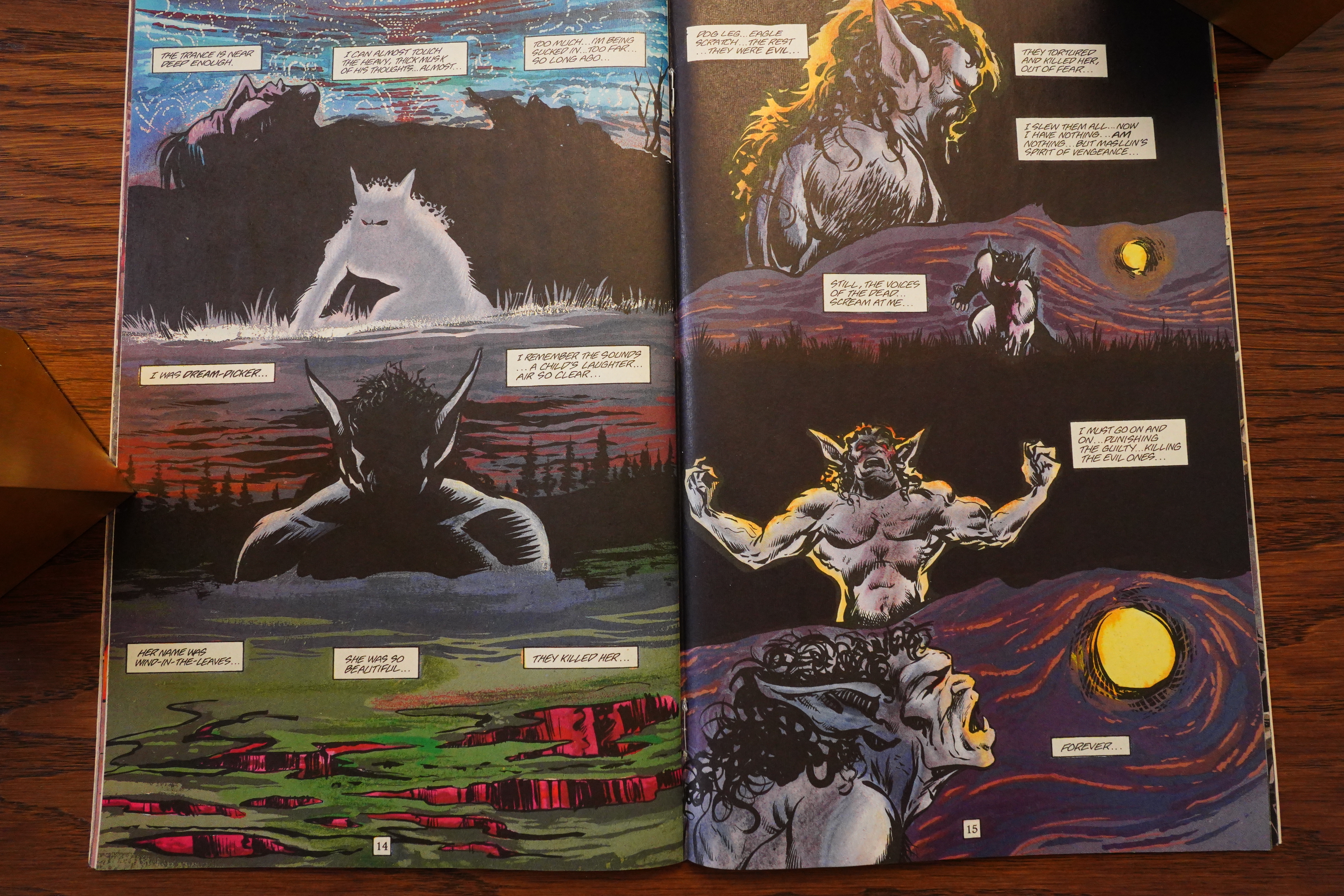
It lays out Argent’s deal well — he’s gonna be killin’ some evildoers because of the spirits in his head, etc. Very well done.
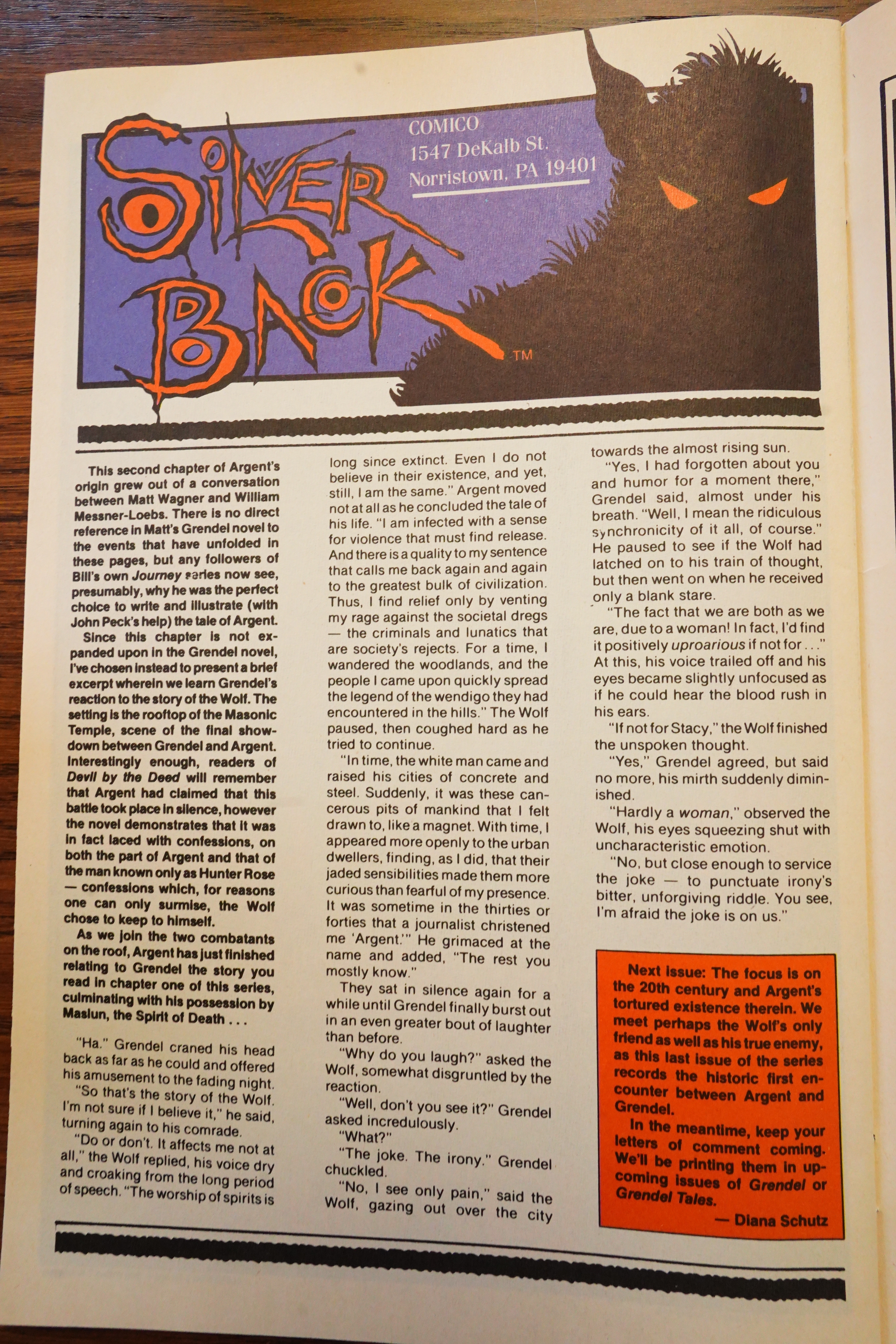
Is the above written by Wagner? It’s a reaction from Grendel on the previous story…
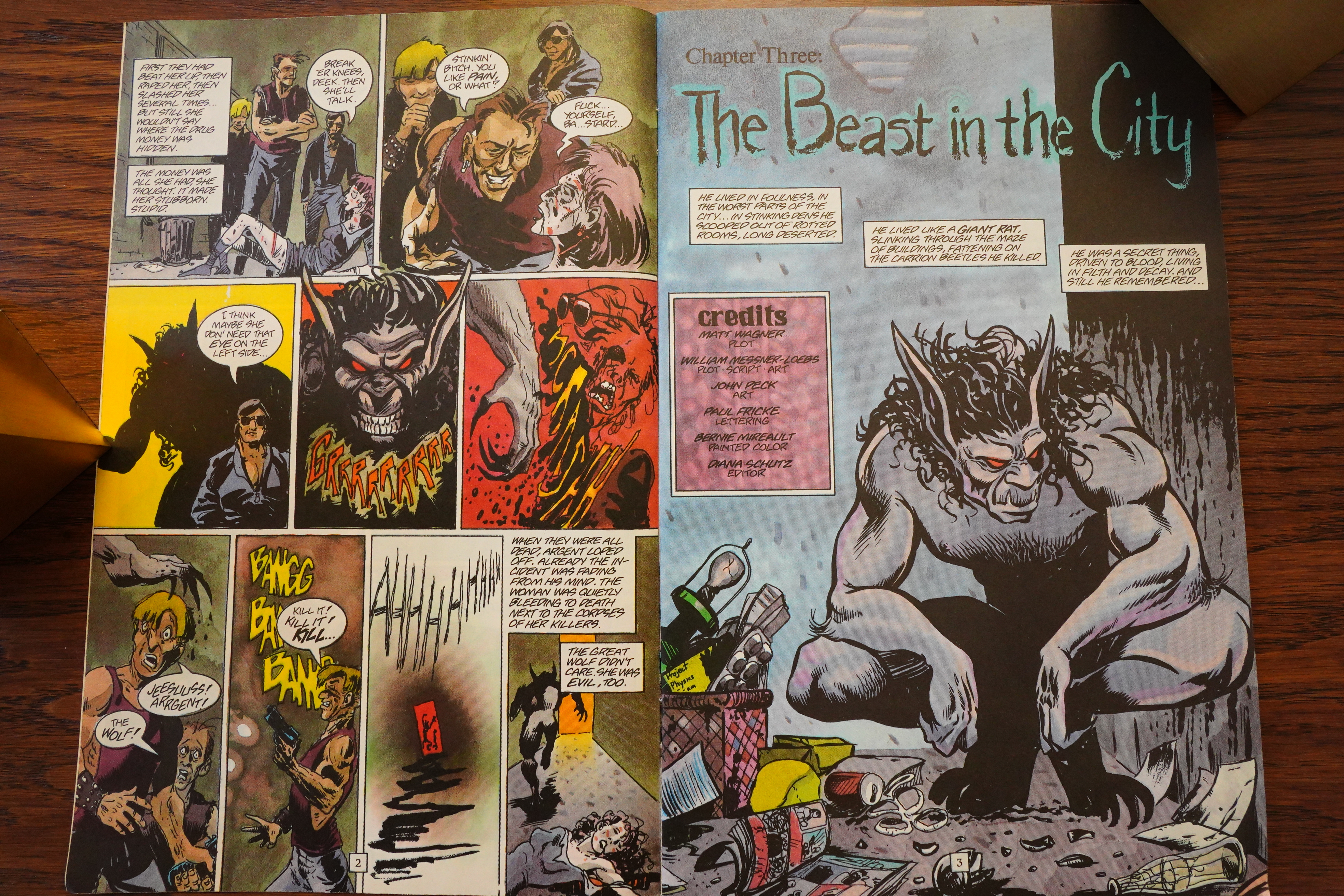
Which brings us to the final issue, wherein we’re in modern times and Argent is finally going to meet Grendel.
Both Messner-Loebs and John Peck are credited with “art”, so I’m not sure who did what here, but some panels seem way more Messner-Loebs-like than others, so I guess… they did some panels each? Perhaps Peck drew Argent? Or something?
It works, however they split the job.
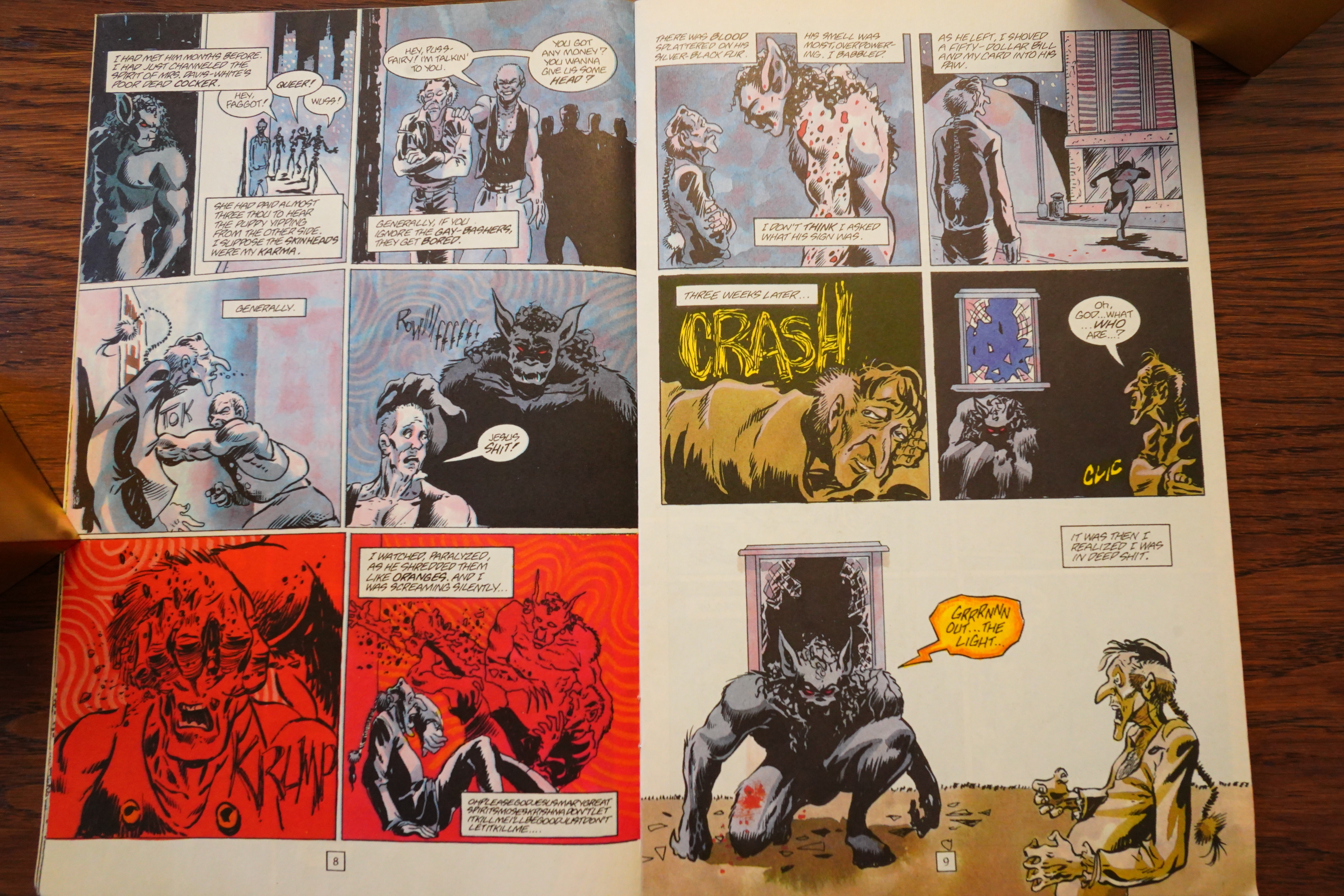
Yes, it’s a gruesome issue again, but it’s also pretty funny. And it ties things nicely together — Argent encounters another gay shaman, but this time around, he’s good and not evil.
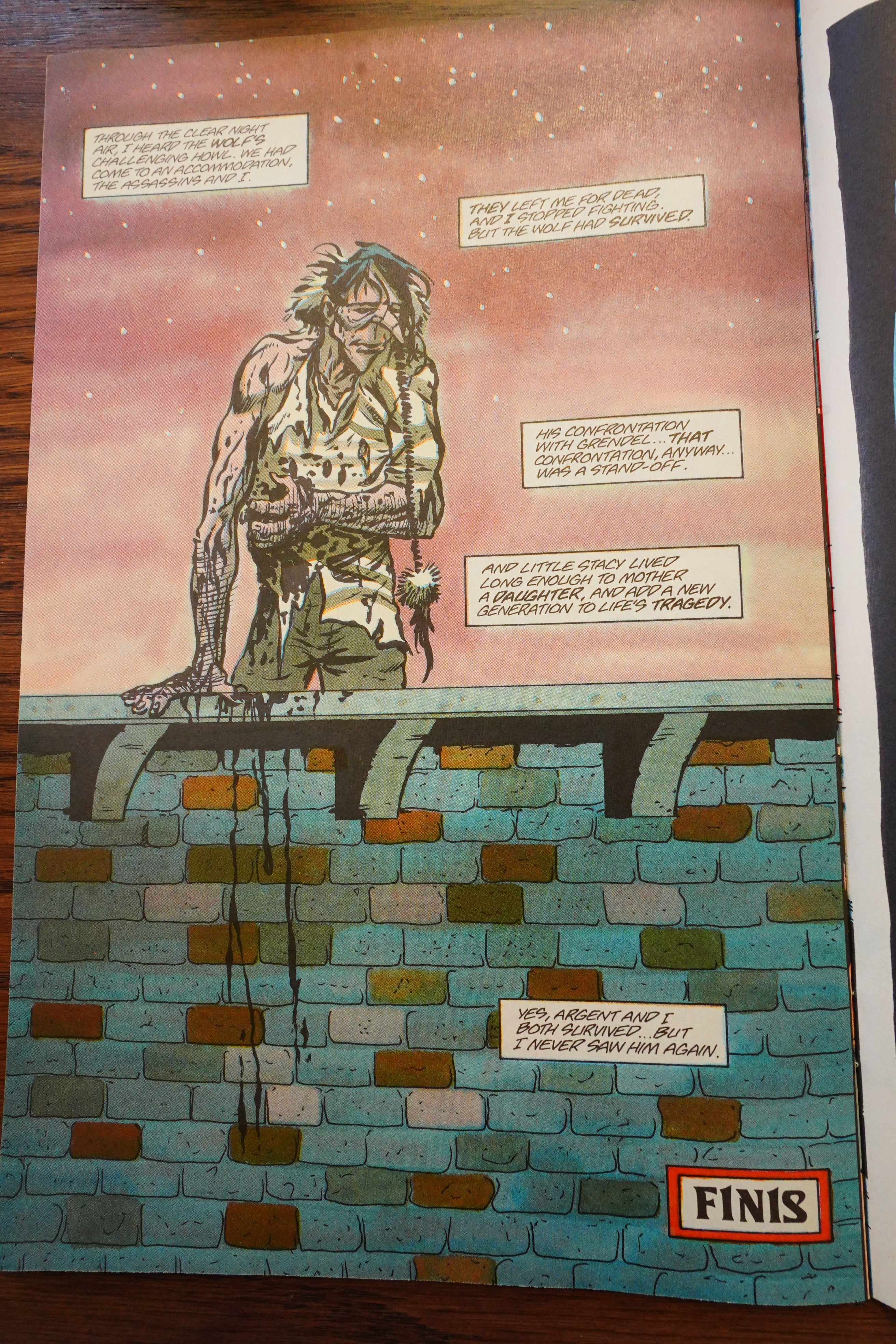
And not only saves Argent’s life, but survives himself! Unheard of!
So that was a really solid mini-series. These origins-of-side-characters things usually feel unsubstantial and unnecessary, but this one really works. Although I can see how you’d be dissatisfied if you hadn’t already read Grendel, because it leads straight into the Grendel saga.
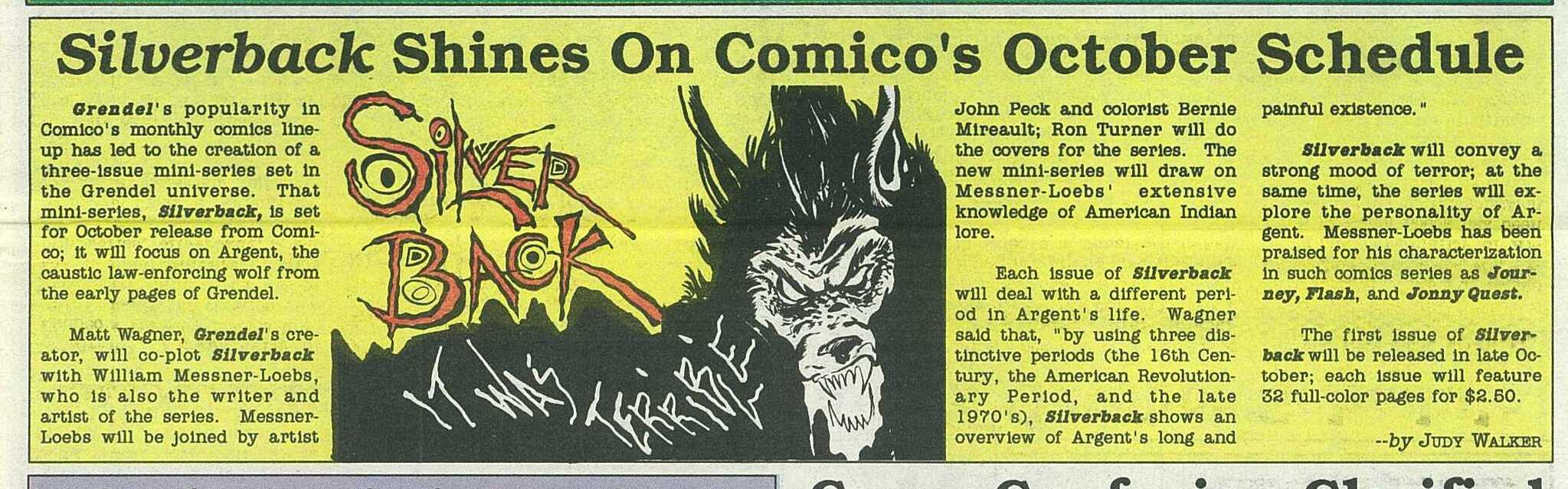
Amazing Heroes #170, page #98:
After a little fine-tuning, Silverback is finally
ready for publication. A Grendel spin-off
mini-series, this book will chronicle the story
of Argent and will highlight his life at three
different points, beginning with the 15th
century and his beginnings as a young
Algonquin indian shaman. Moving into the
18th century he is at the Siege of Quebec with
the troops of Benedict Arnold. He then goes
into the 20th century, where he continues his
trail of death and misery. Each person he kills
joins the legion of voices inside his head, and
he must kill his lost loves to survive.
Silverback is being written and drawn by
Bill Loebs, who was handpicked by Matt
Wagner. Wagner will have a hand at the
plotting, and Loebs will be joined on the
drawing board by his partner, John Peck.
Grendel fans should watch for this one.
The Slings and Arrows Comic Guide #2, page #589:
Plotted by Matt Wagner and based on his character Argent
(the wolf) from the original Grendel series, Silverback sees
William Messner-Loebs return to the genre in which he
began with Journey. It’s a very different frontier, however,
as the spirit of death, Maslun, empowers an Algonquin
brave with inhuman savagery, turning him into an
immortal wolf.
It’s not a tale for the squeamish, and Loebs creates a
tragic, downbeat atmosphere that leaves little room for
humour, while the artwork by Loebs and John Peck is
minimalist but effective.~NF
Minimalist!?
Mirault: GOOD COLOR ART-I couldn’t say. Everyone
has different tastes. You do some work that you think
is brilliant only to find your boss hates the color
orange. I remember coloring Silverback a few years
ago. The art was by Bill Loebs and Sam Peck. Very
loose. Very, very loose. It was a difficult job by any-
one’s reckoning, but in the end I found myself liking
the work I was doing on it. Forgive my vanity, but I felt
like I had saved that book. A year later I learned that
the artist didn’t like my colors. “Too purple”, or some-
thing like that. That blew my mind, but then, there’s
not many things about life on Earth that don’t.
Amazing Heroes #174, page #84:
SILVERBACK #1
Sometimes a reviewer knows too
much; sometimes, too little. For in-
stance, the first time I laid eyes on
anything done by William Messner-
Loebs, it was a Xerox of the final inks
of Silverback—and I had to be told by
friends that it is an origin story for a
character named Argent that was
killed by Grendel in an earlier issue.
As I say, the book came to me in
Xerox, and from the look of the naked
pages I felt Bernie Mireault would
have to perform coloristic miracles to
make this sow’s ear into an interesting
comic. The final inks looked like
sloppy soft-pencils. Figures were
stretched a head and a half too tall for
no significant reason. Faces ran again
and again to stupid or stupefied ex-
pressions—when they were recogniz-
able as faces at all. In side-by-side
panels at the top of one page he gave
a pug-nose and a hook-nose to the
same girl. Backgrounds were non-ex-
istent, and brushwork was everywhere
so free as to be totally indifferent to
form, clarity, or expressiveness.
Maybe I wouldn’t have been so out-
raged if the story being told was in-
triguing, but it wasn’t.
The story is of a young Algonkin
Indian born 300 years ago, who
aspires to shamanhood. The authors
have not bothered to look over the
significant portions of Black Elk
Speaks by Neihardt, nor Joe Camp-
bell’s The Masks of God. Their idea
of a shaman is of a man simply pos-
sessed by the gods of death, instead
of an individual gathering power from
his experiences in a spirit-world visit-
ed in dreams. This allows them to turn
this outraged Indian into a Wolverine
look-alike for the finale of the book.
The entire story turns again and
again on cheap cliches and knee-jerk
me-too-isms. Rival shamen discredit
the youngster, and “sacrifice” his
childhood sweetheart to assuage a
plague. He gloomily “dreams death”
hovering around everyone in the vil-
lage. And, in the final transformation
sequence, he becomes the very bringer
of total carnage, while in a dream of
possession. All this is very hack-
neyed, and betrays no understanding
of Indian life whatever. In fact, after
a three-page introduction, this suppos-
edly-serious shaman is pictured
lounging on a rock smoking a pipeful
of sacred tobacco merely for pleasure!
Only a Mudhead or maybe a Belicana
would commit such a sacrilege.
And so I had to say this book was
“simplistically plotted, indifferently
scripted, and supplied with slap-dash,
slovenly art.”
“On the other hand,” I concluded,
“Paul Fricke’s lettering is everywhere”
clear and readable. Unfortunately.”
But then a copy of Silverback #1
appeared at my local, and it did indeed
look as though Bernie Mireault had
performed coloristic miracles! It was
still a sow’s ear, but some of the empty
backgrounds had been filled, some of
the flat, slap-dash figures had depth
and shading. I began to wonder if
maybe this Messner-Loebs hadn’t per-
haps indicated how his doodling could
be improved.
And so I took a look at what some-
one says is his finest achievement-
Journey Book One: Tall Tales—and I
was amazed! Messner-Loebs is a car-
toonist, but his quirky caricatures can
be shockingly expressive. He can run
from full-out bombast to tightly con-
trolled understatement, and he seems
to have absorbed from Will Eisner not
so much a style as a storytelling sense
of expressive economy, and a love of
specific detail.
So now I look back through Silver-
back #1-and I can’t find any of Mess-
ner-Loebs’s genius in the book at all!
The care and imagination and origin-
ality he lavished on his own original
stories are absent.
And so, when it comes to rating, I’ll
grant a point for expressive color
work, and one for the painted cover,
and even another for a painted back
cover (which I like even more), and
then I’ll subtract half a point because
we all know this could have been a
much, much better book than it is.
GRADE: !! 1/2
— Larry Stark
Heh heh.
Back Issue #125, page #23:
POWERS: Around this time, Silverback #1-3 (Oct.-Dec. 1989)
also came out, presenting the origin of Argent, with William
Messner-Loebs scripting from your plots. Why is this story
important to the Grendel mythos?
WAGNER: I don’t know that it was crucially important to the
overall saga. At that point, I was mainly looking to franchise the
Grendel title into a larger spectrum, and Argent was a compelling
character whose story had only been hinted at here and there.
So it’s definitely a component in the greater narrative but more
of a sideline tale than something of world-shaking significance.
After a long time, Matt Wagner attempts something new, and it must be
admittedly done admirably, as is his wont. With Messner-Loebs, he creates a tale that blends fantasy with Native American culture,
in a story halfway between epic and reality. The psychological characterization of the characters is faithful to the
spontaneity of the Native Americans, so much so
that reading the texts in the book immerses us completely in that Native American
world, rich in spirits, gods, and nature. However, the threat of death looms over it, spread by a
werewolf, who constitutes the only
dark and disturbing element in the entire
story. It’s 28 pages worth reading…

Apparently this series has never been reprinted? How odd. All the other Grendel stuff has, surely?
Yeah, I assumed (after reading that excerpt) that the Grendel novel would never be published:
Silverback by Matt Wagner, William Messner-Loeb, and John Peck. Did not know this existed. A cool little miniseries about the backstory of Argent from Grendel. Apparently it comes from a novel Wagner was writing at the time? Did Wagner ever publish a Grendel novel? I didn’t even know there were Grendel novels. Looking online I saw Rucka did a couple, but couldn’t find one for Wagner.
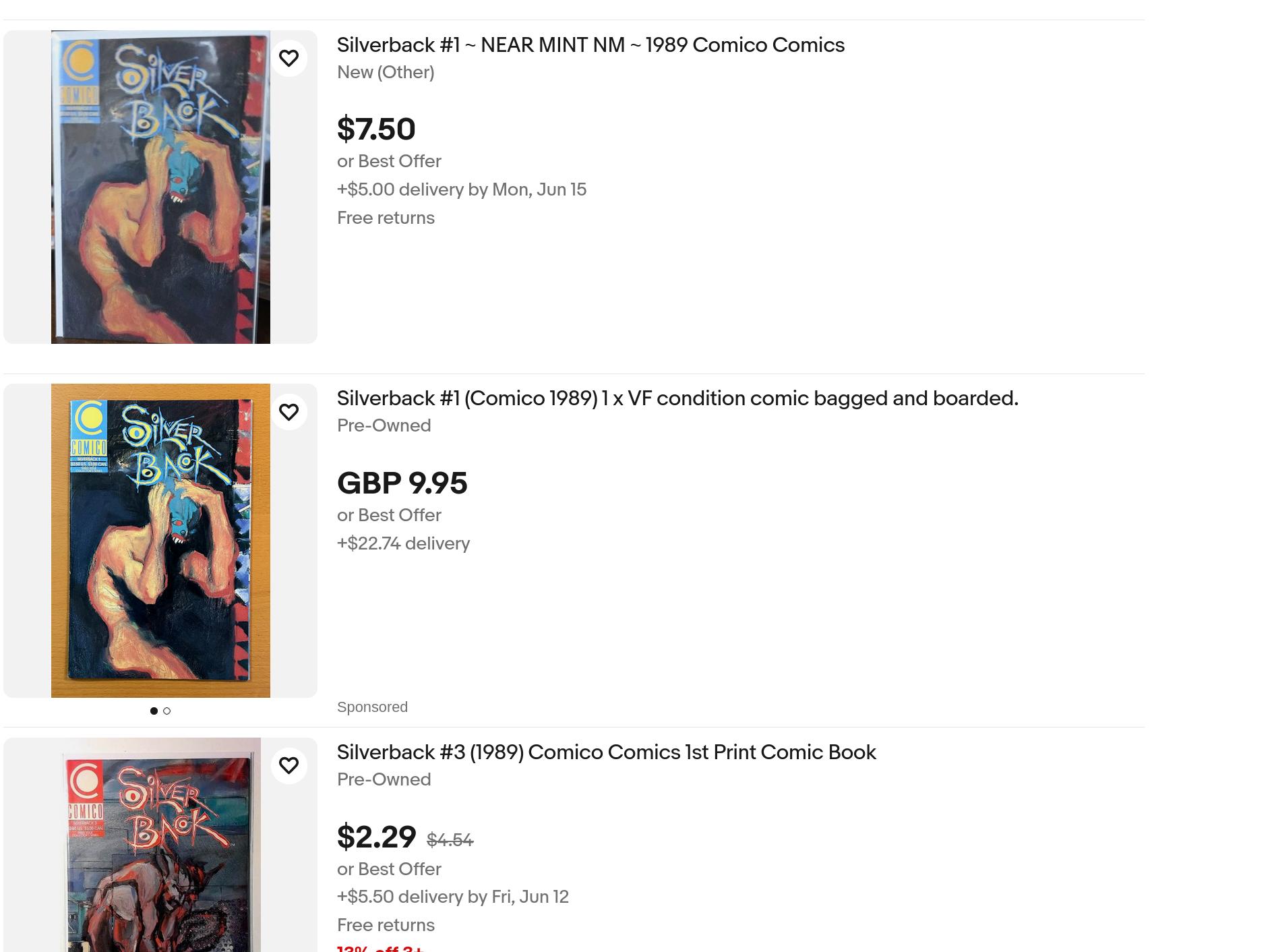
OK, so you have to cough up some money to read these comics… it’s a shame it’s never been reprinted. You’d presumably have to do so from the printed comics, because the colouring has presumably been lost to the mist of times. Presumably. And Mireault did indeed put a lot of effort into the colouring — I think he sometimes went way overboard:
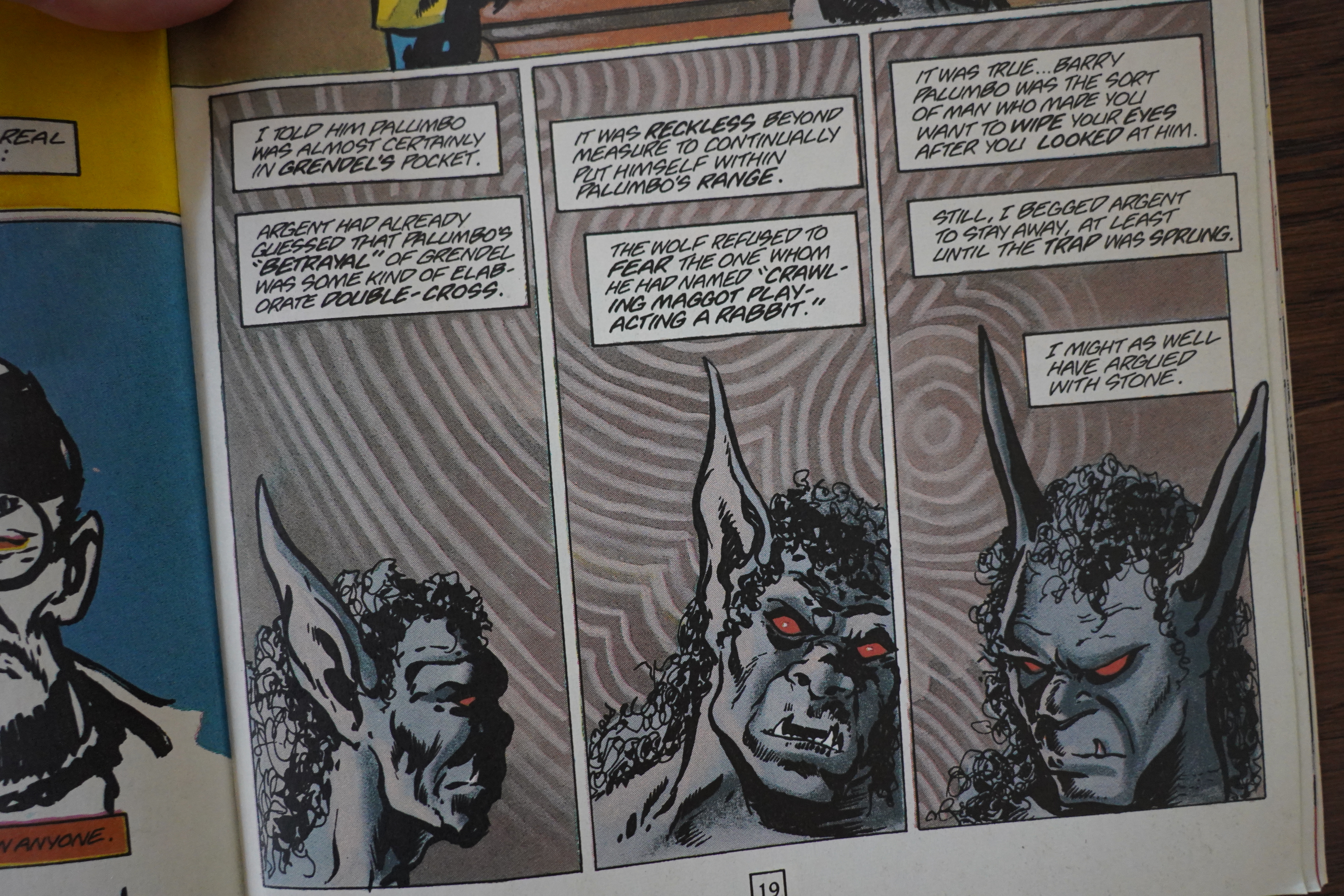
Like these swirling bits? And he repeats them — stuff like that is pretty disturbing.
Anyway, good stuff.