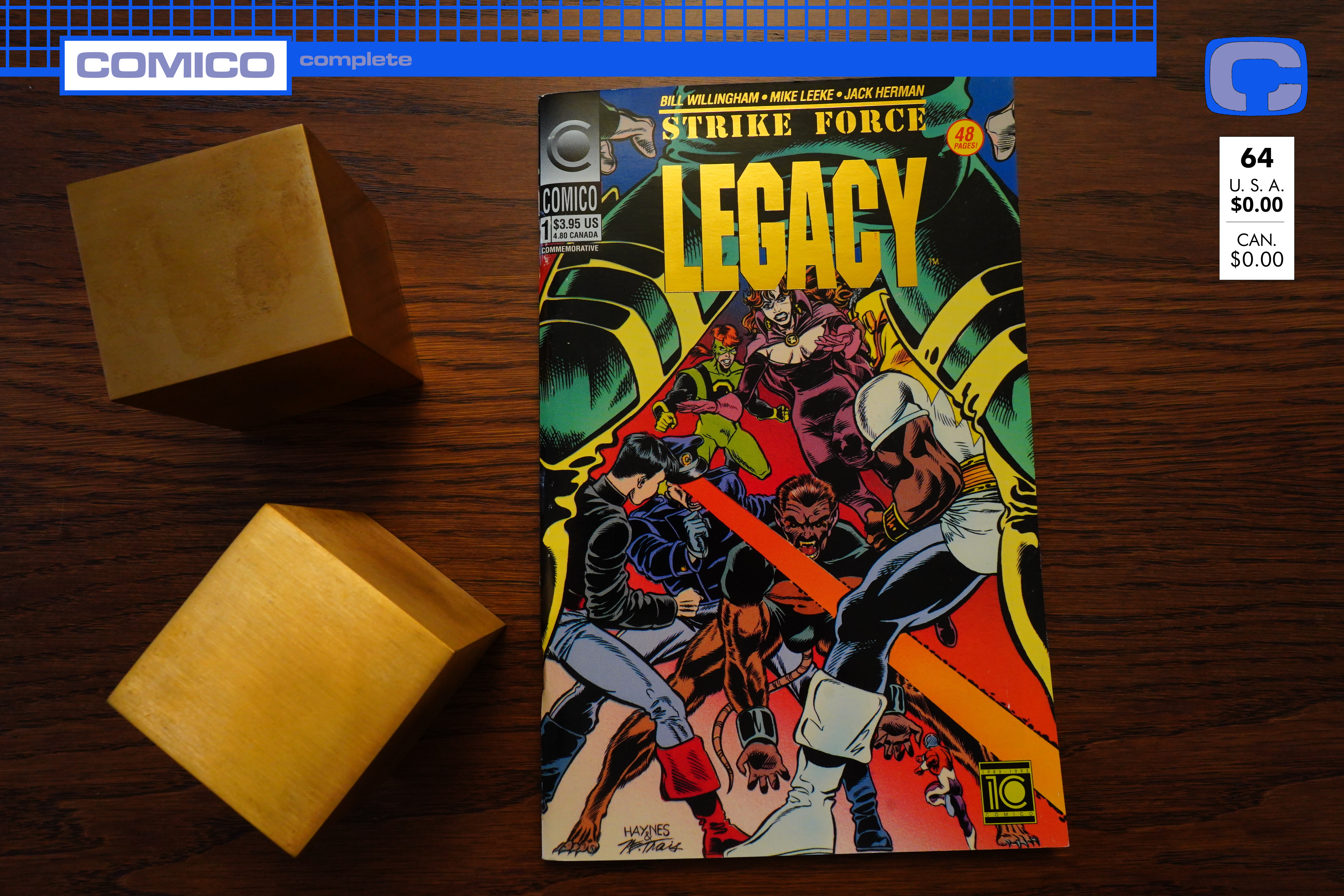
Strike Force Legacy (1993) by Bill Willingham, Mike Leeke, Jack Herman and others
Hey, we’re getting towards the end of this blog series. I only have to read 20 more issues and write 12 more blog posts.
And this is a doozy, because I don’t even have to read it.
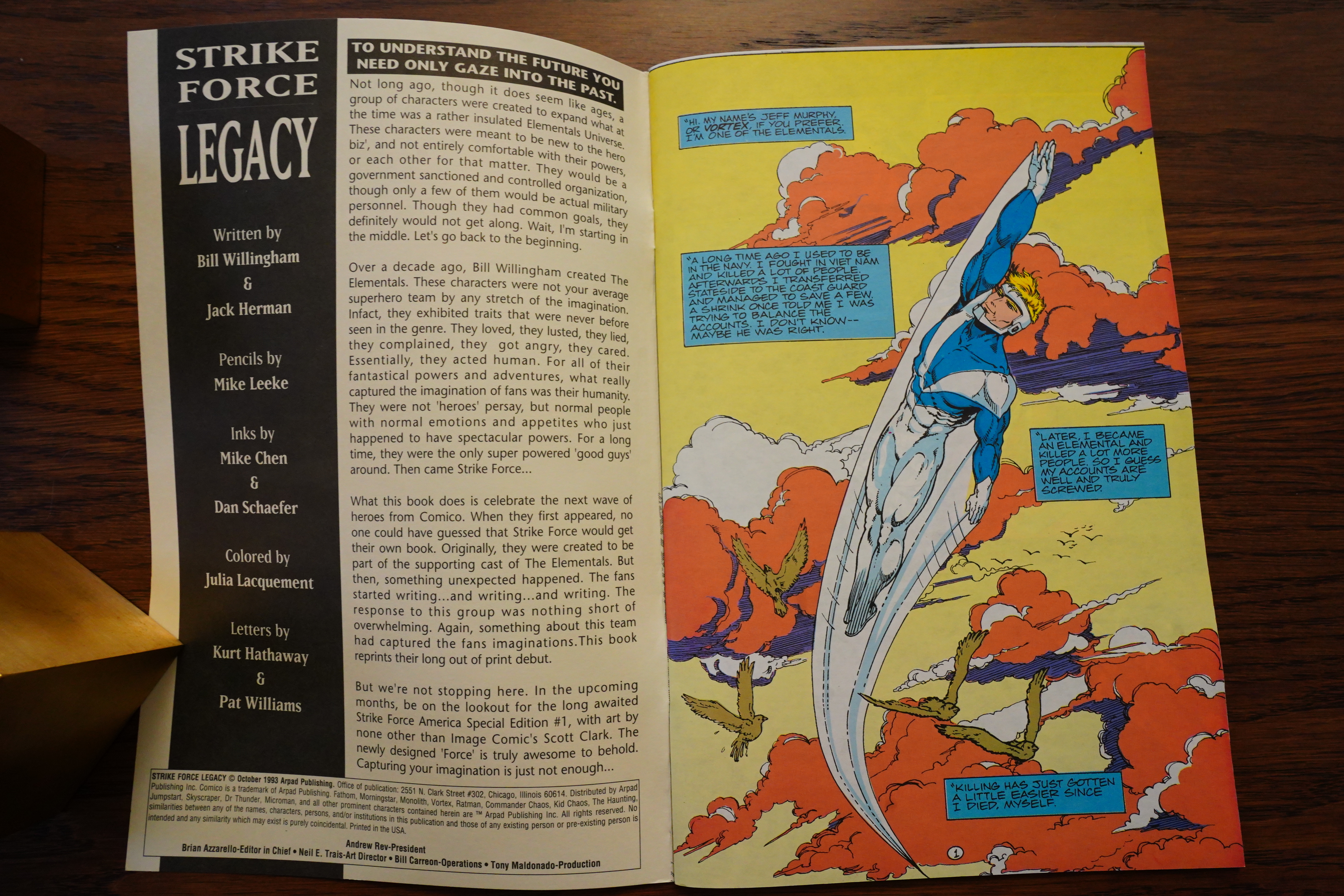
Because this 48 page special (with metallic inks on the cover and stiff paper stock) is a reprint. Which makes sense, I guess — Comico were trying to launch Strike Force America, so why not reprint their “origin story” from Elementals?
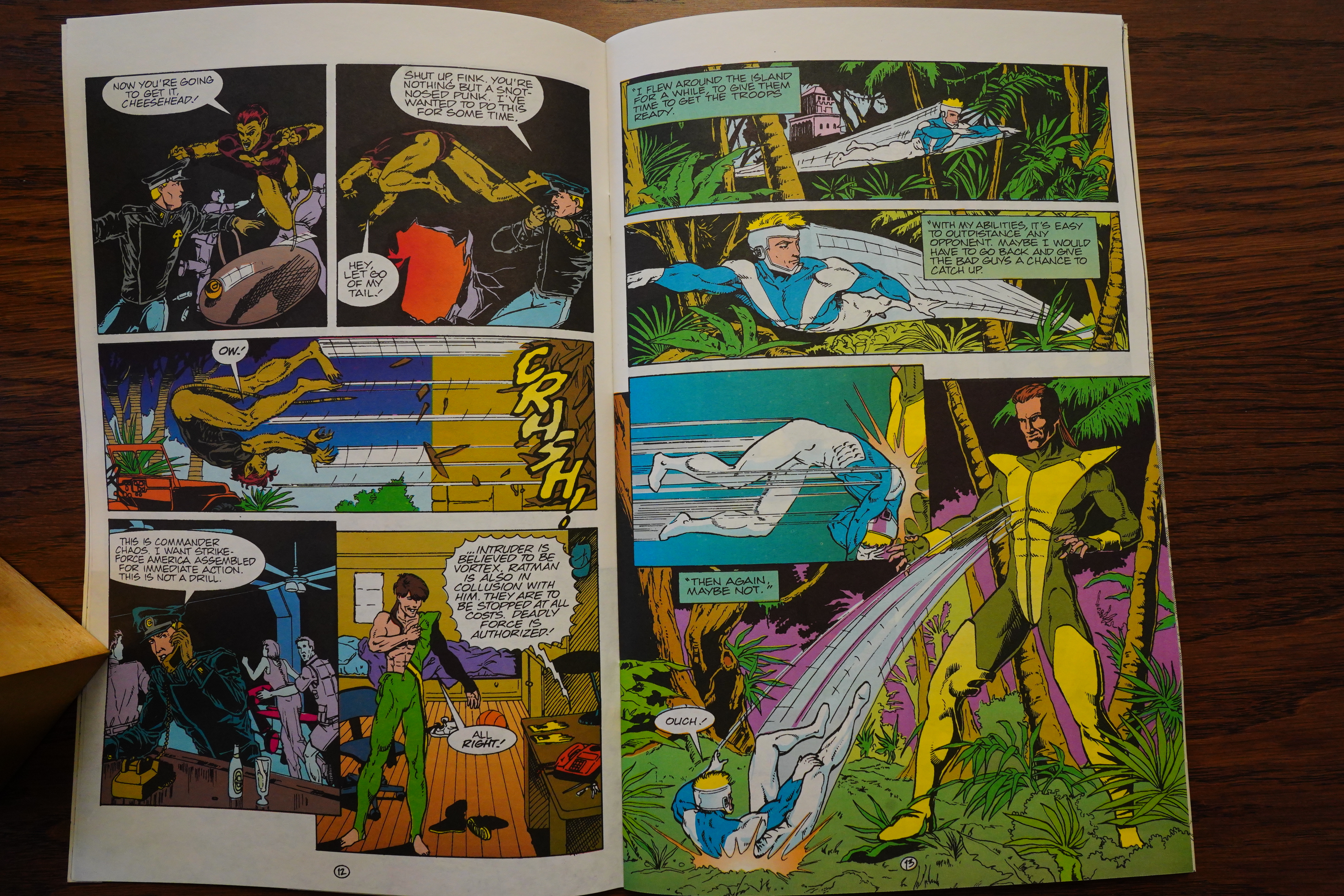
So that’s what we get.
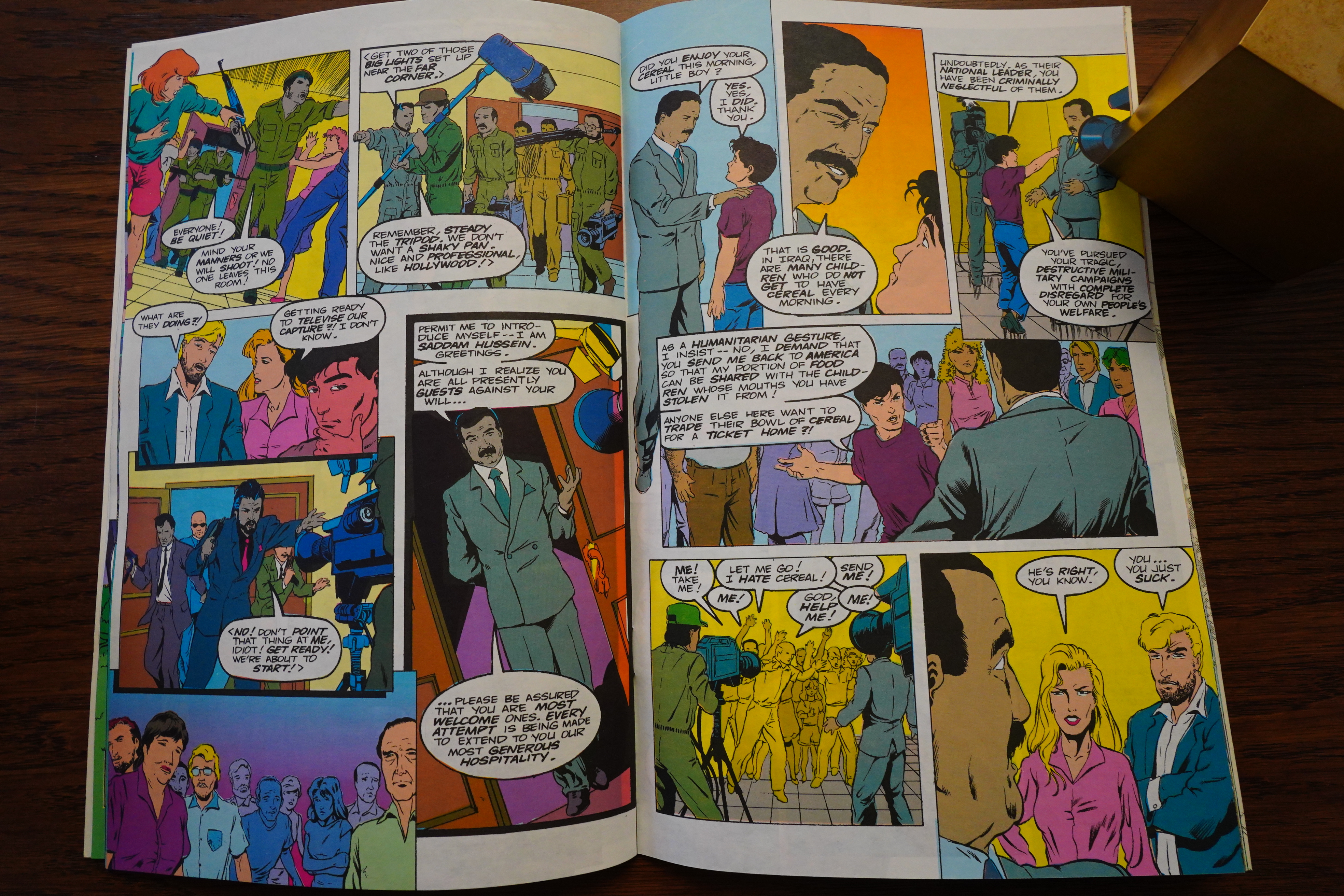
This includes the (perhaps) unfortunate Saddam Hussein issue.
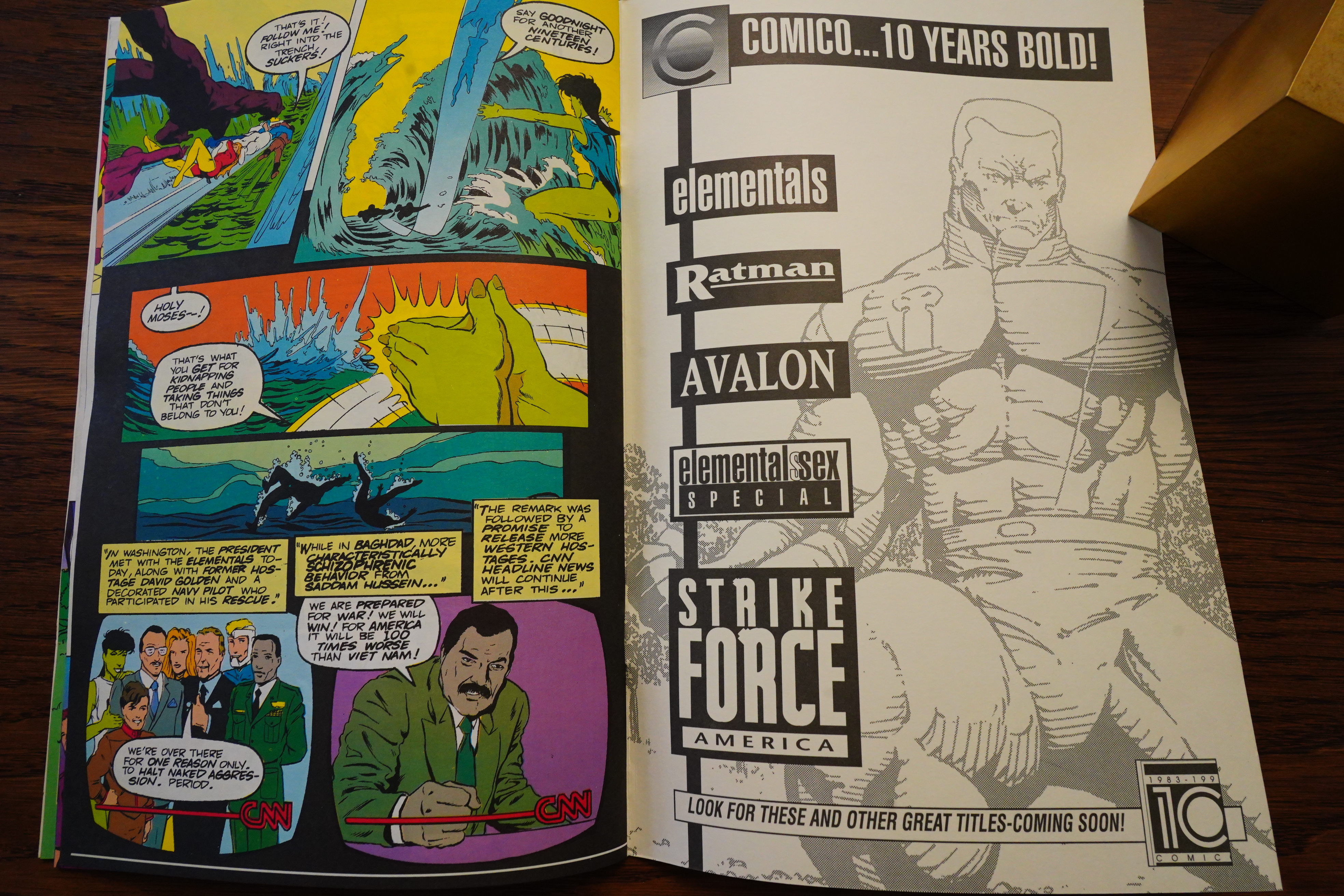
Dastardly!
As usual with Comico books from around this time, there is no coverage in the comics press of its time. But it’s a somewhat notable book in a way: It was published in October of 1993, and would be the only “new series” Comico would publish over the next couple years. Of the books listed above, I think Elementals would continue to be diffidently published, but it’s not until August of 1995 that we’d get something new from Comico: Oblivion. Which I’ll cover in the next blog post.
(Ratman and Avalon would never appear.)
But there’s a news story from February 1993.
The Comics Journal #156, page #21:
Ho Anderson signed a contract with Comico on
February 8, 1990 for “Johnny Angel,” a 20-page
story that was to appear in the first two issues
of a series entitled Comico Illustrated. The
promised rate was $100 per page – “$50 per
page for script” and “$50 per page for artwork
(pencils, lettering and inking)” — for a total of
$2,000 for the whole story, to be paid “within
30 days of receipt by Comico of the work in
question.” On February 12, Anderson turned in
the script and was paid $1,000. But after turning
in the artwork on April 4, he never received the
rest of his payment.
Meanwhile, Comico owner Phil LaSorda
had filed for Chapter 11 of the Bankruptcy Act,
known as “Reorganization,” in February. (Chap-
ter 11 allows a business to continue operating
while paying off its debts under court supervi-
sion.) In September of 1990, Chicago business-
man Andrew Rev purchased Comico; under
bankruptcy law, the money he used to buy the
company was meted out to its creditors by the
court in which Comico had filed for Chapter 11.
Anderson did not realize that he had to file
a claim with the bankruptcy court in order to
receive payment (or at least partial payment) of
the money owed to him, so he began to call Rev
periodically asking when he would be paid.
After getting no definite answer for two years,
Anderson approached the Journal in hopes that
a news story would force Rev’s hand into either
paying him or returning the artwork. During all
this time “Johnny Angel” had never been pub-
lished.
When the Journal showed Rev a copy of
Anderson’s contract and asked why he had put
off paying the artist for two years, Rev explained
that he had never seen the contract before and
had been under the mistaken impression, gained
from employees of the old Comico, that Ander-
son was to be paid upon publication of “Johnny
Angel.” When asked why he had not returned
the artwork, he said that he still intended to pub-
lish it when the market was favorable. “The right
time to publish something is at the discretion
of the publisher,” he added.
Once Rev examined the contract, he declared
that he had no obigation to pay Anderson the
remaining $1,000. “When I bought Comico, I
bought it from the courts, not from LaSorda,”
he said. “I paid one lump check to the court,
which administrated payments to creditors. [An-
derson] should’ve filed [with the court] back
then.”
Bankruptcy attorney James Schaeffer, based
in Seattle, WA, agreed that Rev is not legally
required to pay Anderson the remaining $1,000.
He also said that at the time Comico declared
Chapter 11 Bankruptcy, Anderson should have
received notice stating as much from the bank-
ruptcy court. When asked if he had been noti-
fied, Anderson said that he could not remember.
Schaeffer advised Anderson to file a claim with
the bankruptcy court even at this late date on
the off chance that some of the purchase money
remains. “If the money’s all gone, there’s not
much he can do,” he concluded.
At this point, Anderson says that he just
wants his artwork back so that he can try to get
it published with a different publisher. But Rev
maintains, “I bought the whole inventory of
Comico, of which the artwork is a part. Ho sold
his work lock, stock and barrel to Comico. It
belongs to me now.” Anderson and Rev are cur-
rently negotiating a settlement over the artwork.
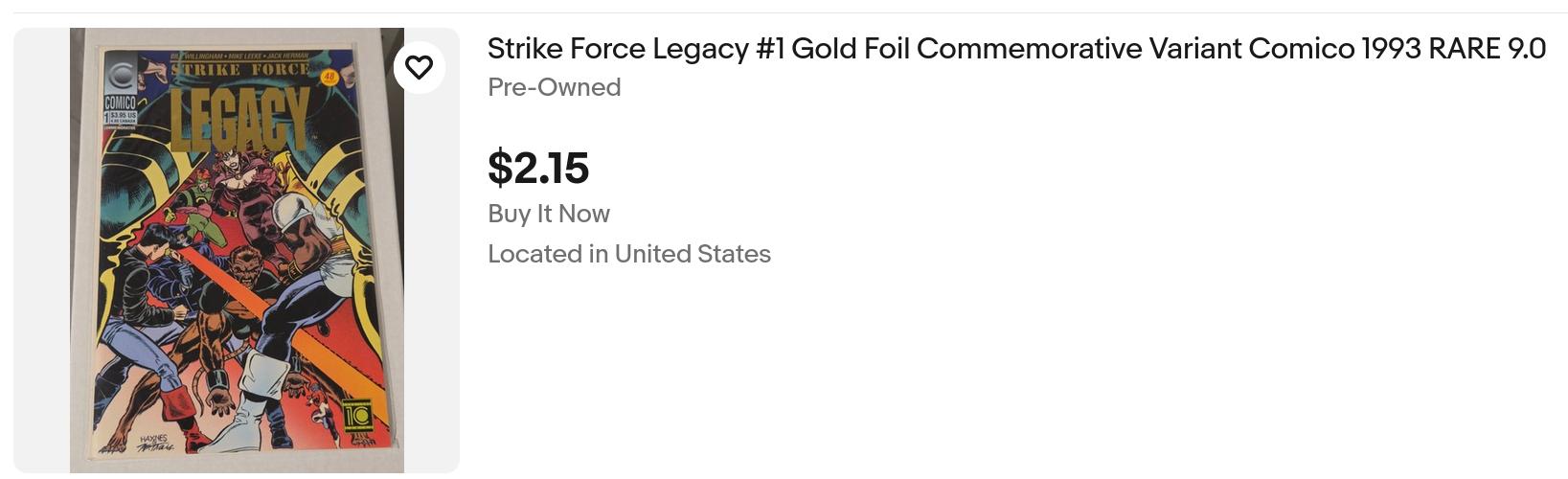
You can pick up a copy of this cheaply, but I note that there are many sellers who try to get $10 or so for this, and note that it’s “rare”. Perhaps Comico didn’t manage to ship all that many of these out to stores? Because they were out of money again?
I’m just guessing.