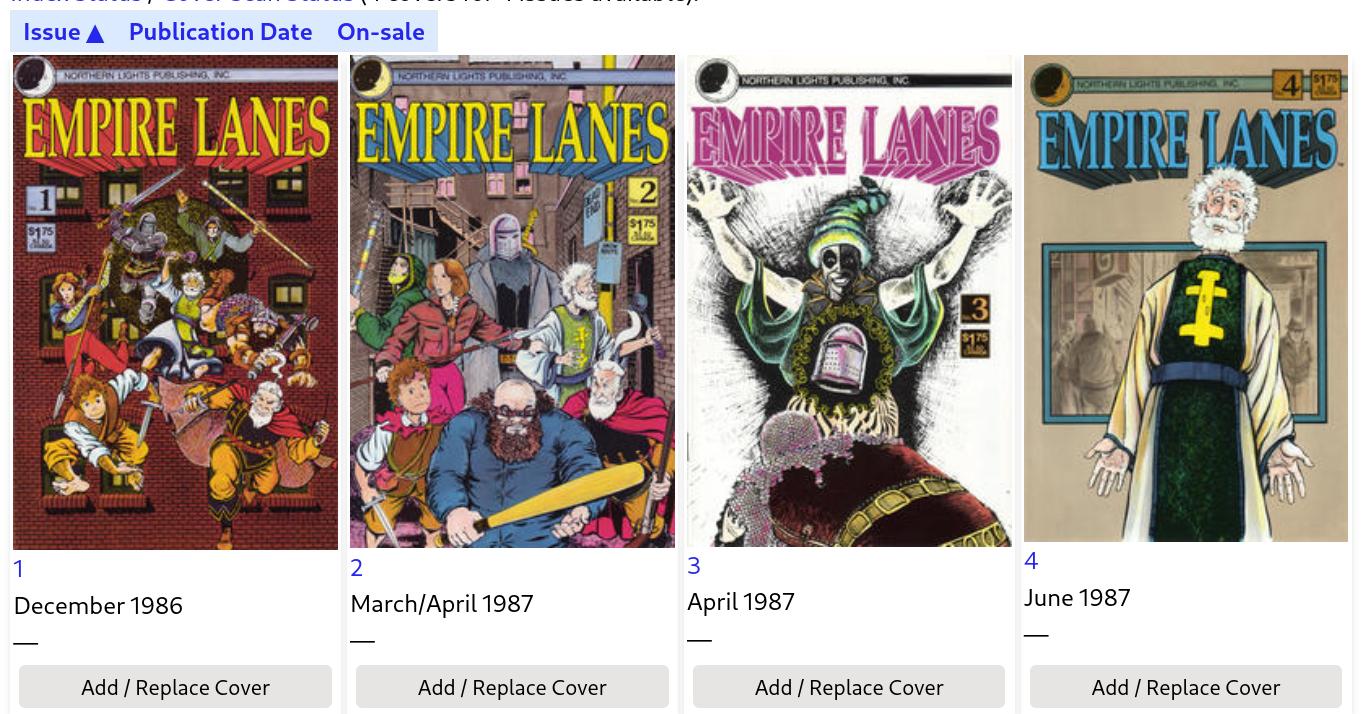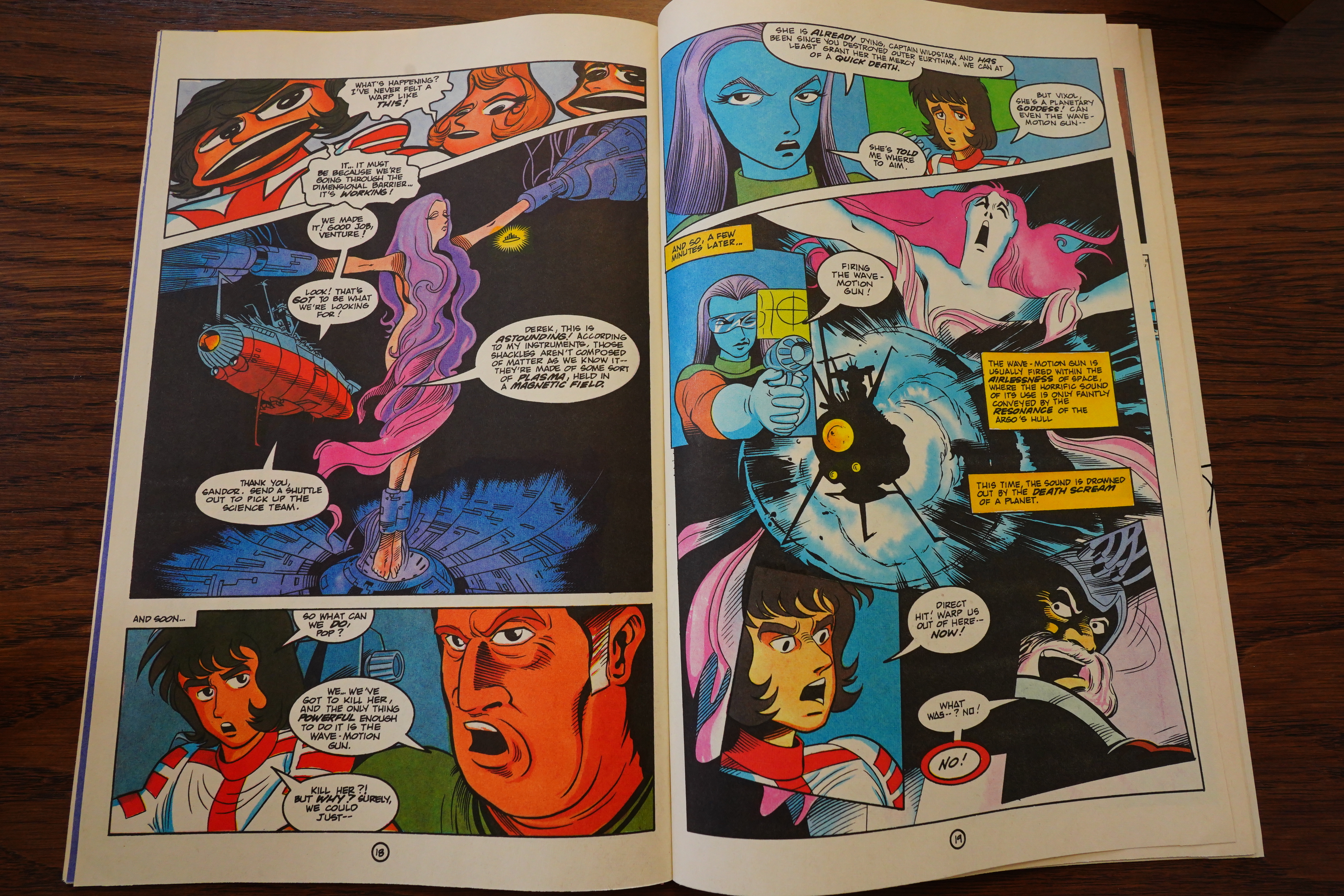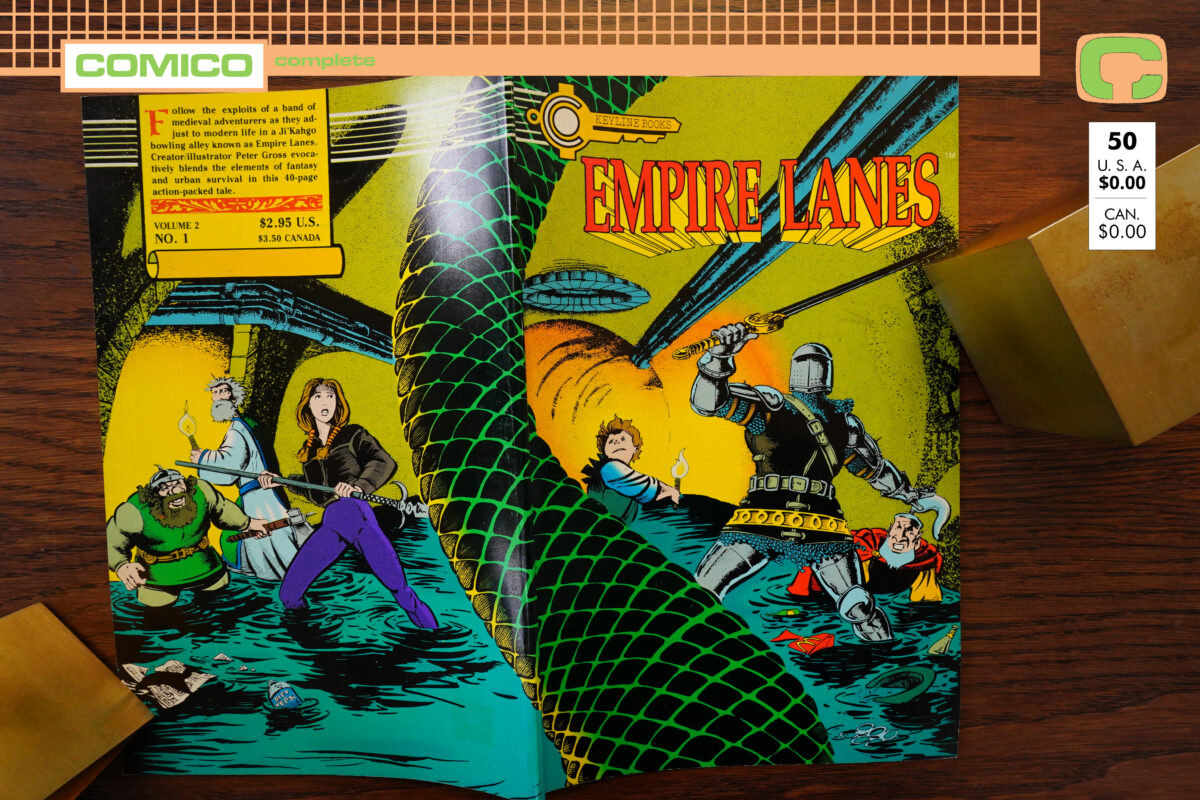
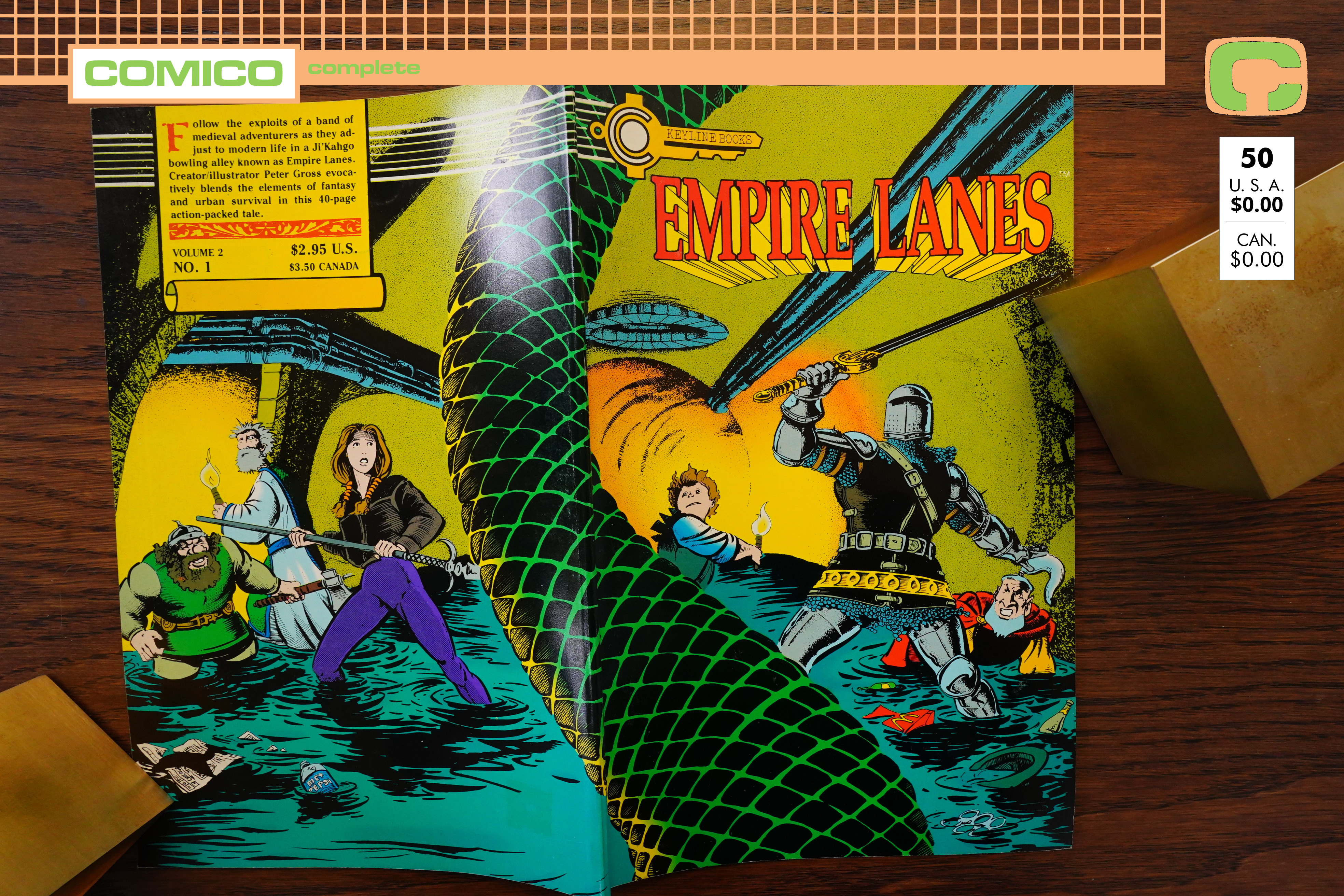
1989: Empire Lanes

Empire Lanes (1989) by Peter Gross

Sorry; time flies — it’s been a while since the previous post in this blog series, and it’s for the stupidest of reasons: Comico published three “issues” of Empire Lanes over a few months. First this one, then a collection of the previous four issues, and then the new “proper” #1.

I just couldn’t make up my mind whether to do them all in one blog post, or do it in three posts, and so I mysteriously lost the will to post at all.

So today I just finally sat down and without making up my mind, I’m apparently doing three posts.

Do you feel lucky?
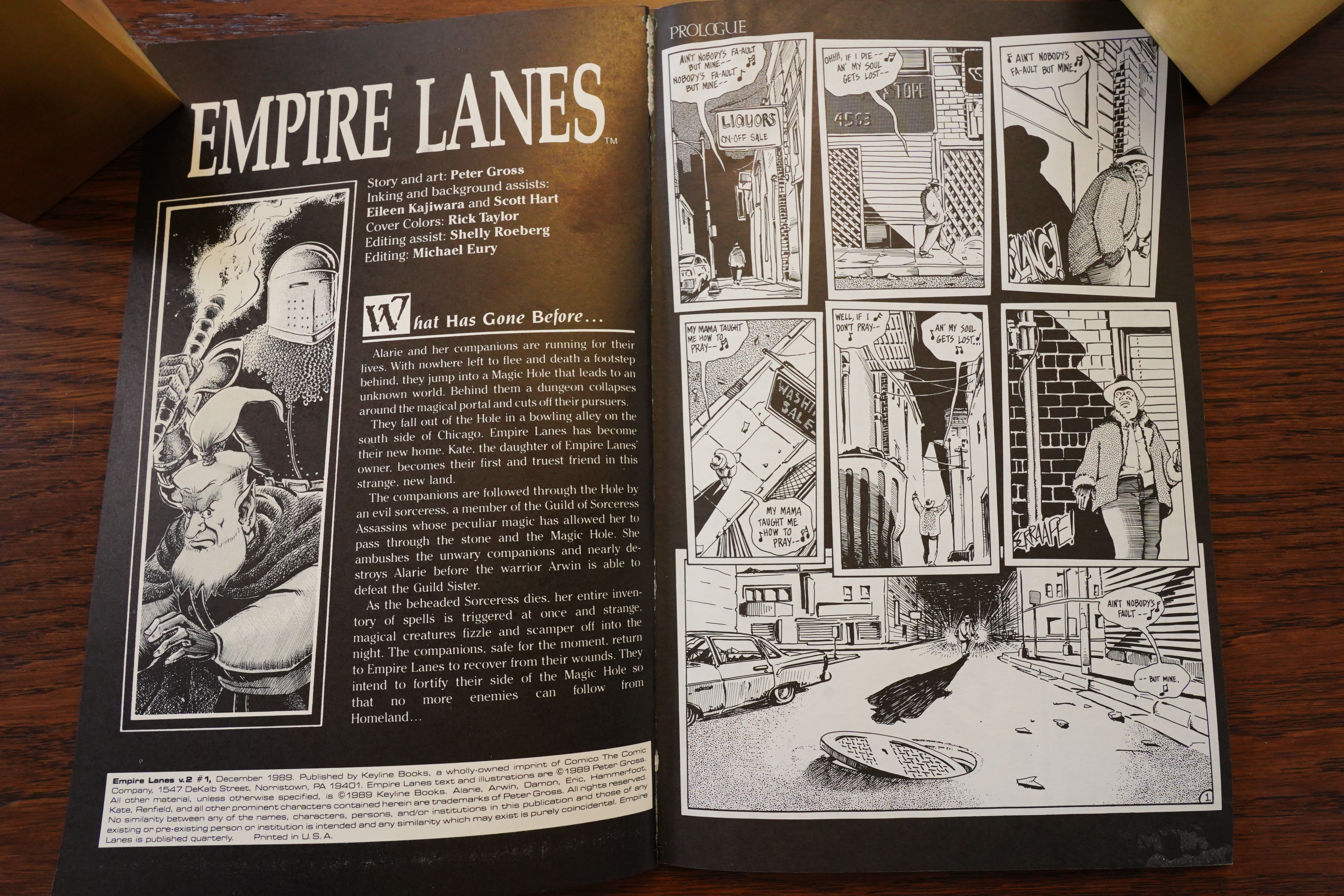
Anyway, this is yet another series previously published that Comico picked up. I can’t think of any other comics publishing company that had such a large percentage of their series being “pick-ups” like this as Comico. Pretty odd.

Unusually, though, is that this is in black and white, and Comico has established a new imprint: “Keyline Comics”. Was the idea to have a separate imprint just to keep the black-and-white comics separate? Wouldn’t that be weird?
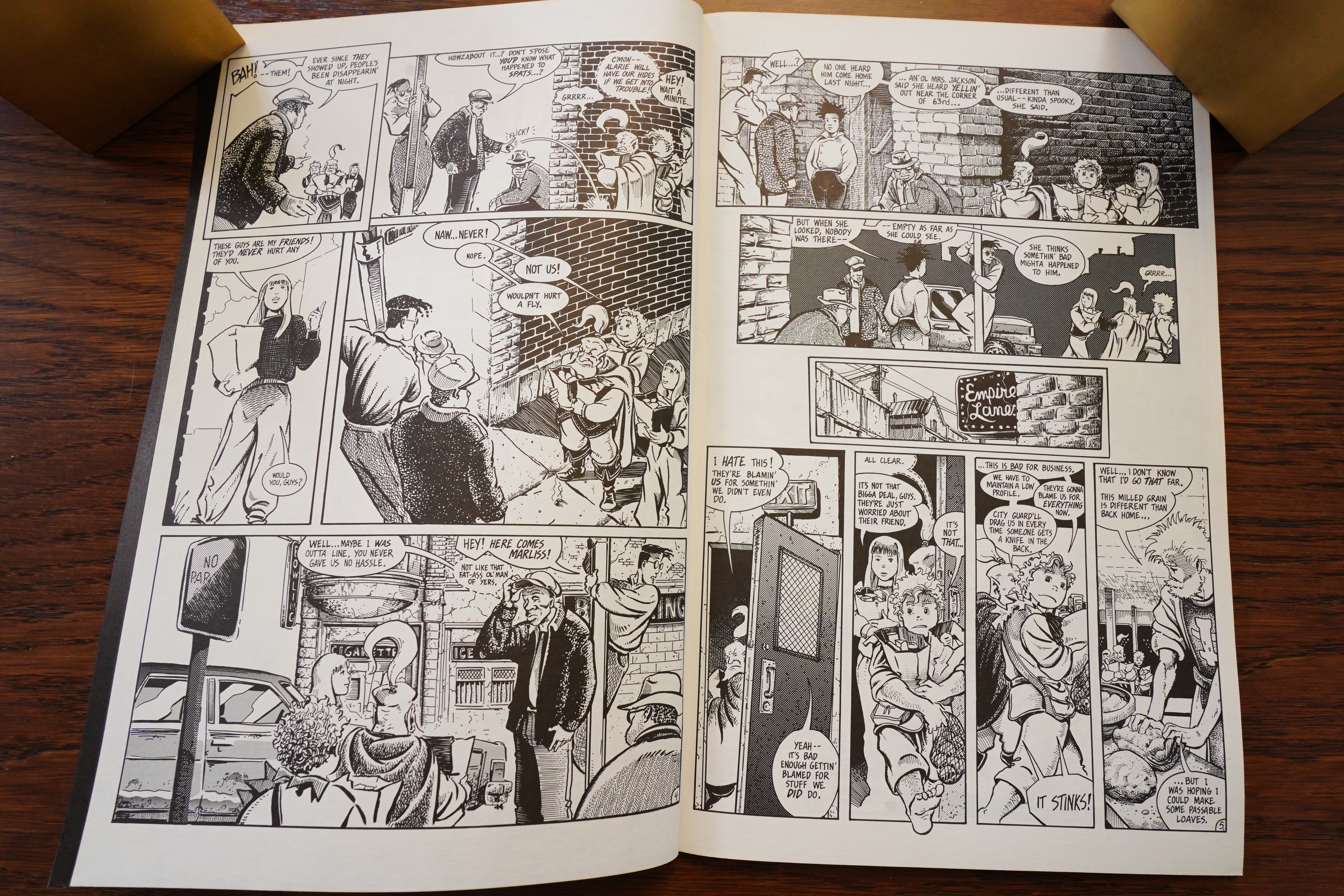
Because this isn’t totally unlike other Comico pick-ups — it’s about a bunch of fantasy people (dwarfs, “halflings”, magicians) dropping into our world. Just like Trollords. Of course, that was more of a straightforward comedy book, while this is going more for “funny fantasy”, if that makes sense…
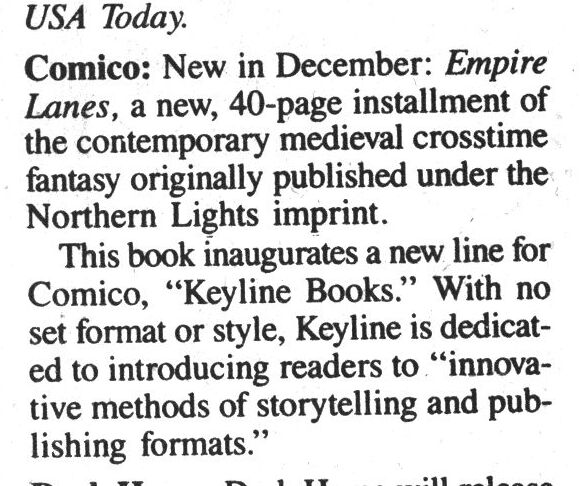
Er… so… OK, “innovative publishing formats” — I guess that means black and white? And “prestige format”? (This book has heavier cardboard covers.)

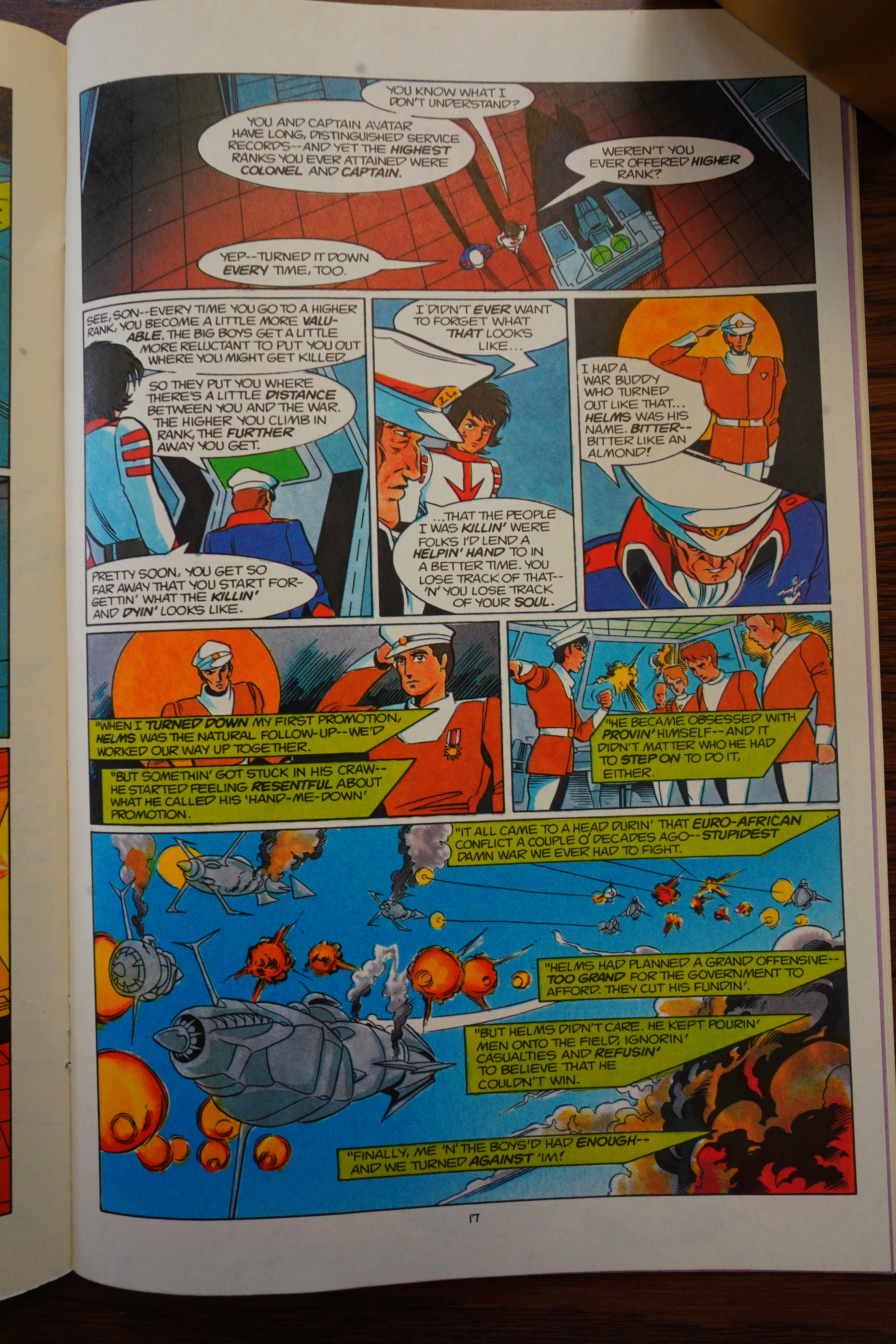
Speakeasy #104, page #17:

Keyline Books is a new imprint
from Comico, which promises “a
new style of stories, a new mode
of printing, a new line of excite-
ment”, with an emphasis on
innovative story-telling and
formats. The first of these will be
Peter Gross’s EMPIRE LANES, a
new story featuring the strip pre-
viously seen from Northern
Lights (well, it’s new-ish). It is set
in medieval times, and continues
the storyline from the original
series (although it will make
sense to first time readers as
well). The 40 black and white
square bound book will sell for
$2.95. Gross’s work has previous-
ly been seen in FISH POLICE and
STRIP AIDS.

So while they’re introducing a new line, this book is the only thing that’s announced?
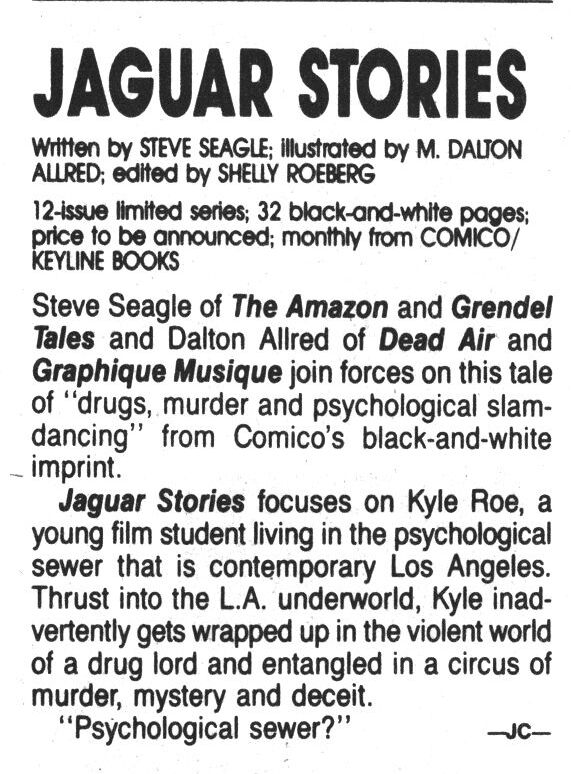
No, there’s more in the pipeline. But here they’re just calling it “Comico’s black-and-white imprint”, so I guess it’s as simple as that.
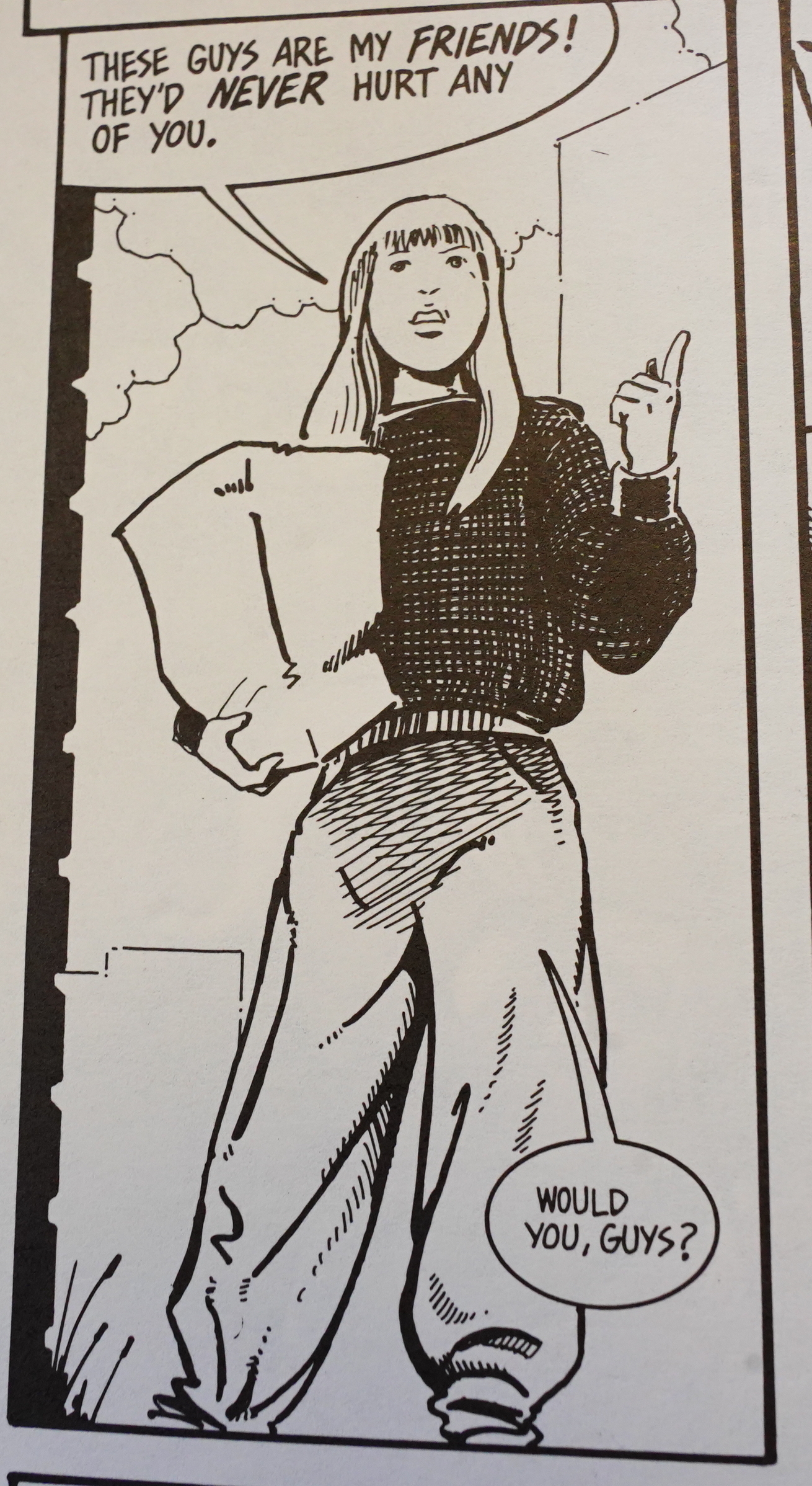
I’ve said this several times in this blog series — Dave Sim sure was influential this period, eh? But I guess there’s an explanation for the Simness of some of the books that came over to Comico in this period: Diana Schutz, the editor, was Canadian and a friend of Sim, so it’s not unnatural that creators influenced by Sim would gravitate towards Comico.
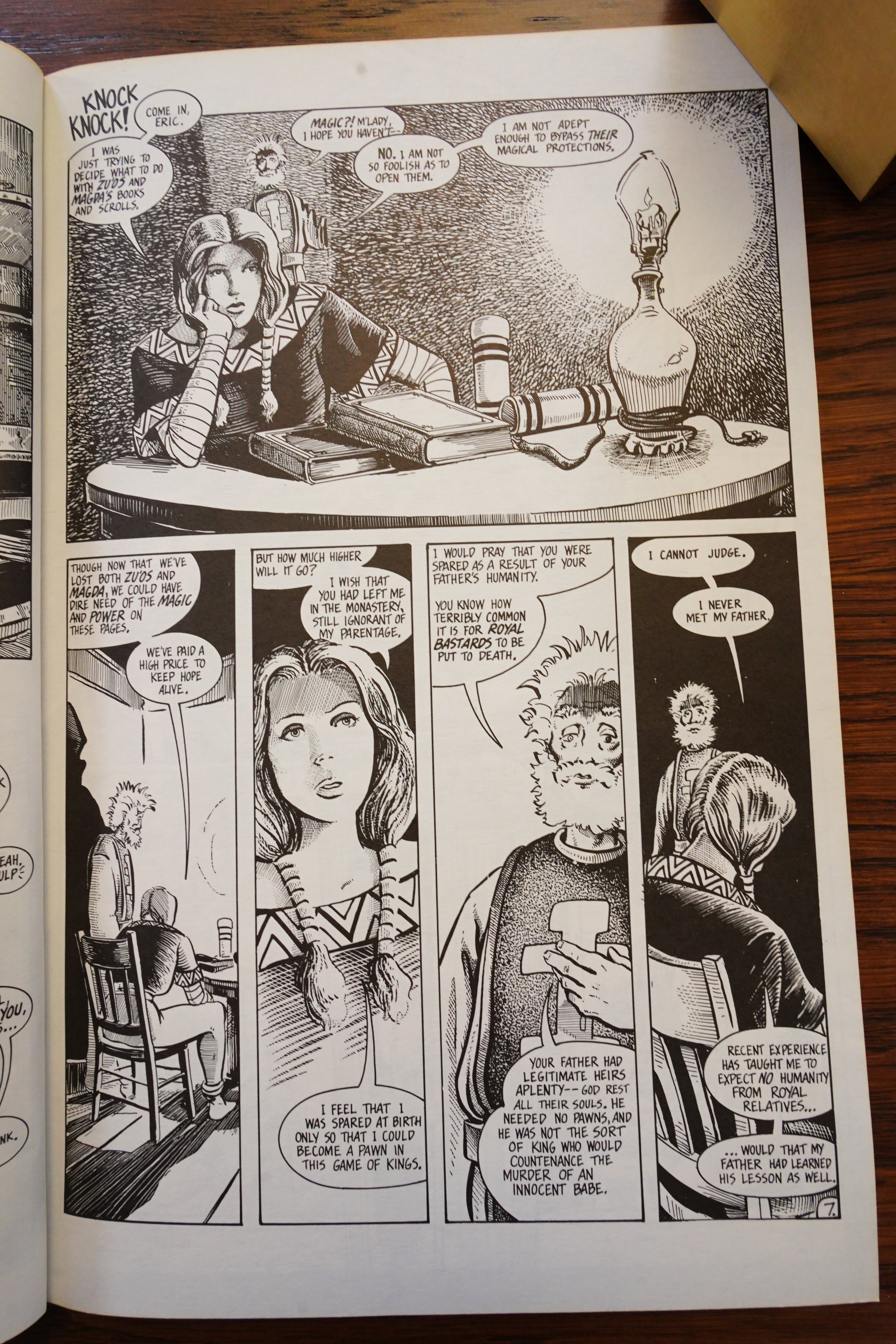
On the other hand, this doesn’t look very Simian.
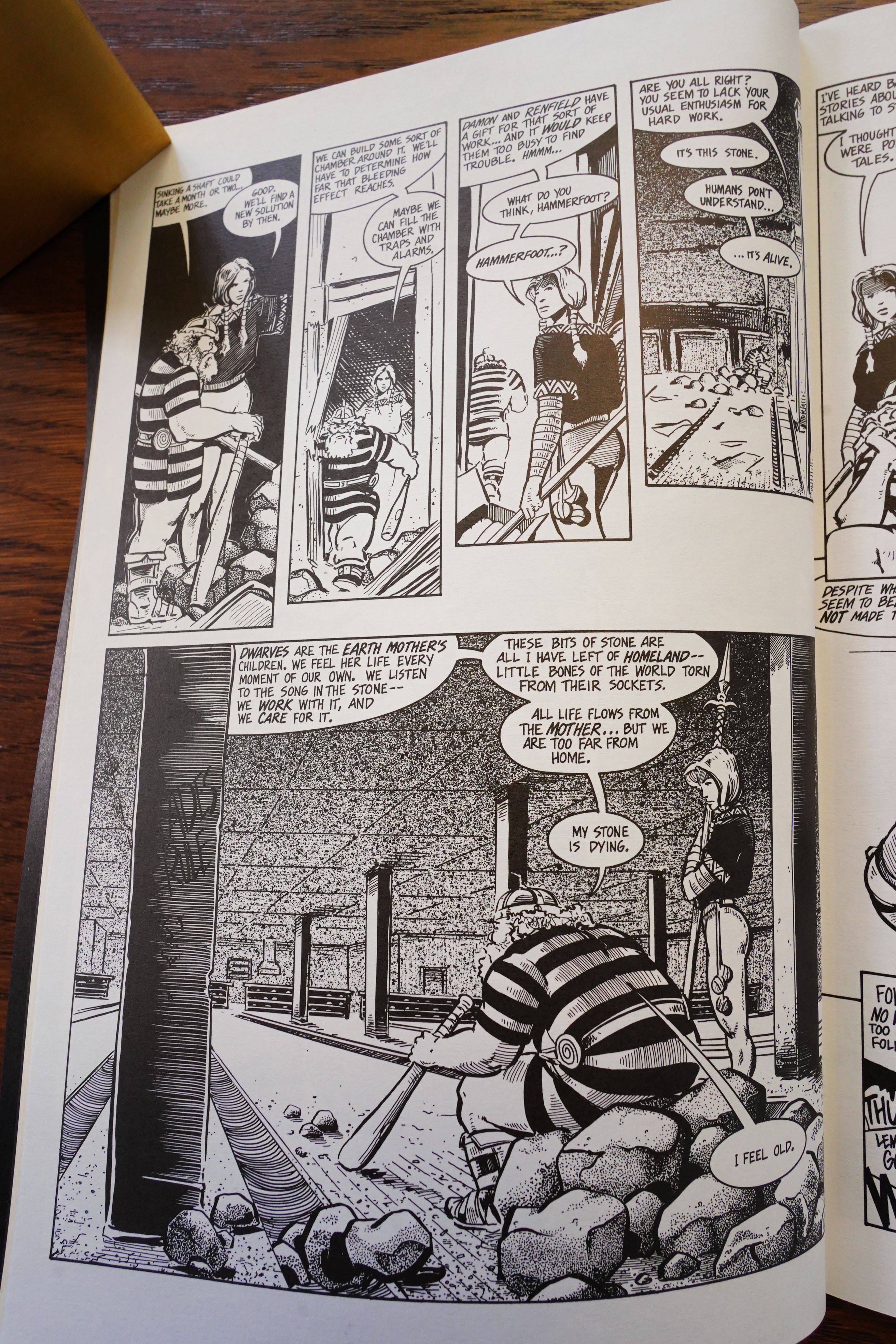
Oh, yeah — what’s this series about? Well, we do get an introduction to the concepts here without getting too bogged down in the on-going storyline. But what we learn isn’t very … encouraging? It seems basically to be “some characters from Lord of the Rings, but on Earth, now”. The dwarfs even have the same character tics as Tolkien’s…
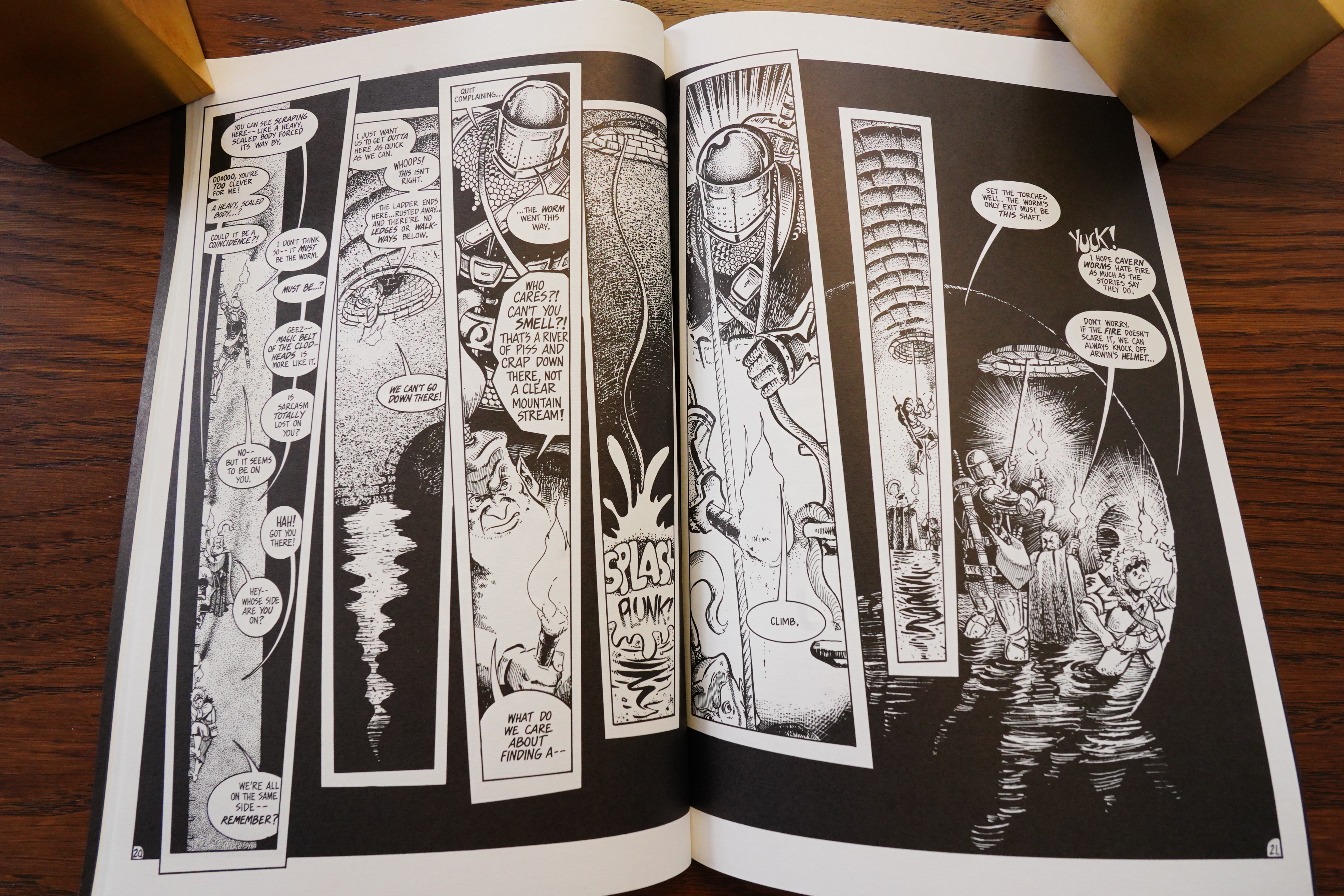
Ah yeah, I wasn’t imagining the Sim influence.
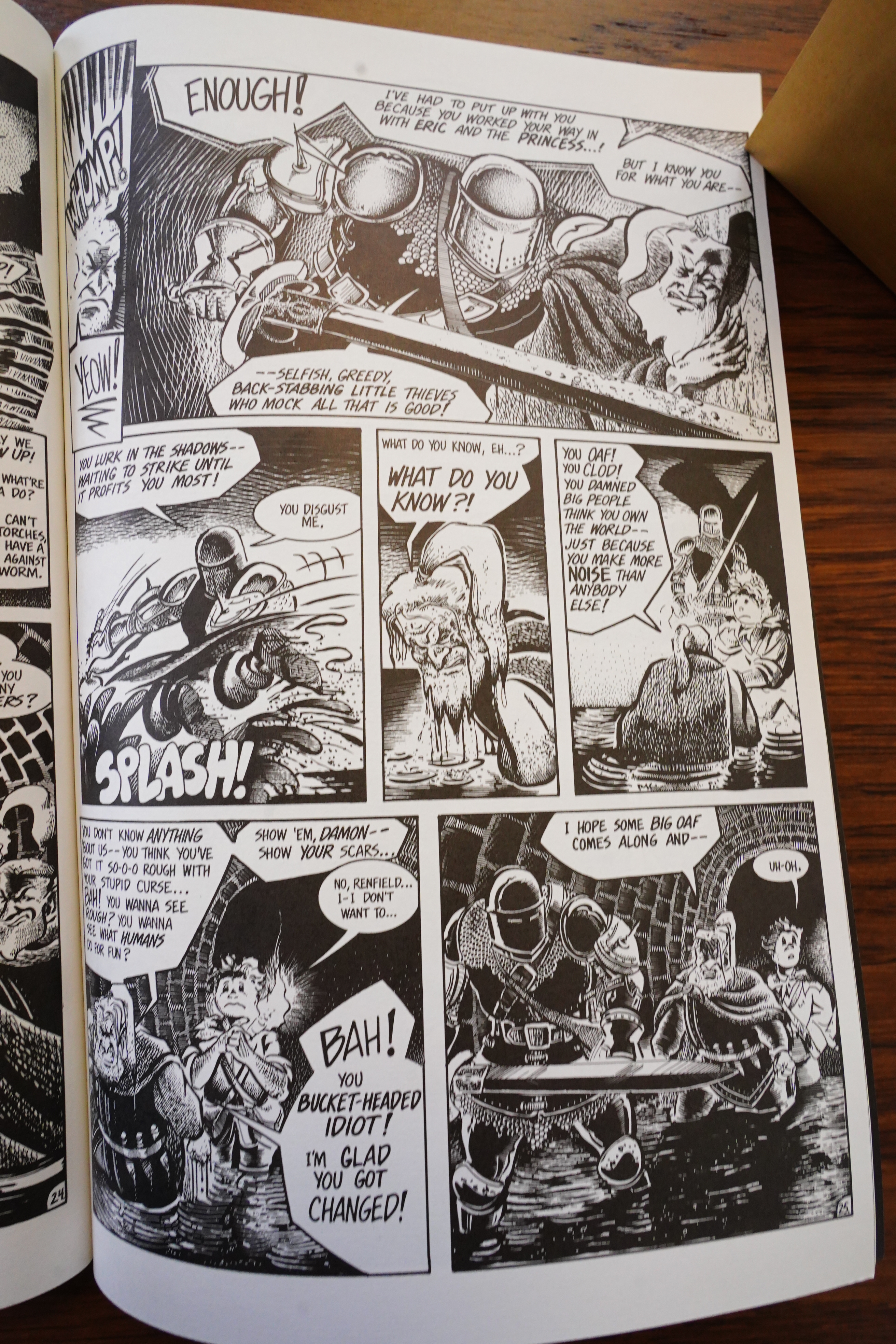
Tolkien didn’t have his characters bicker this much, though. So that’s new.
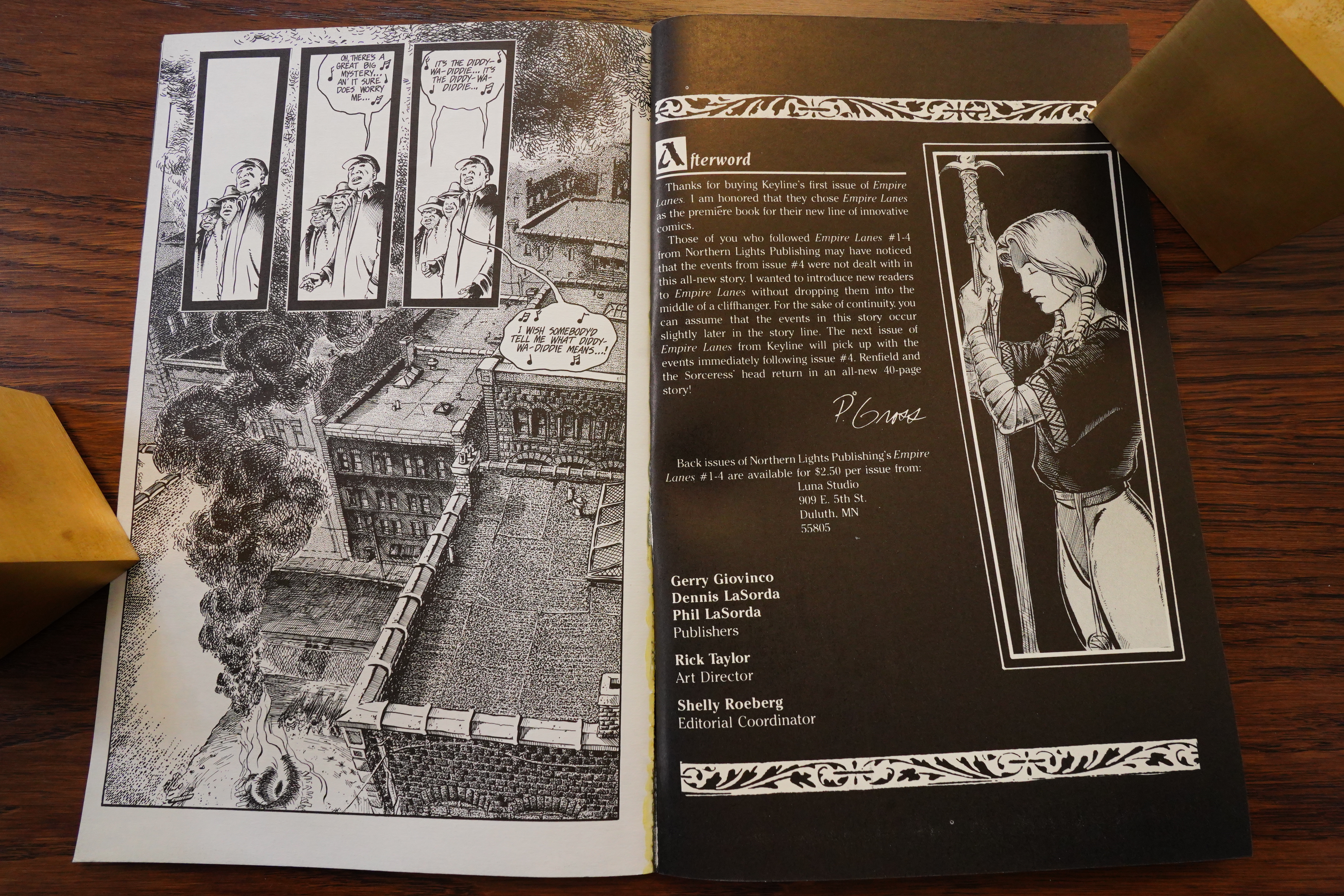
The creator explains what this book is — set “in the future” from the ongoing storyline, which is pretty… original, I guess?

Reading this book, I think I have actually read some Empire Lanes before. I think I may have had one of the original series

No! Looking at these covers, I’m pretty sure I’ve read them all before! Or most! Back in the 80s! Huh.
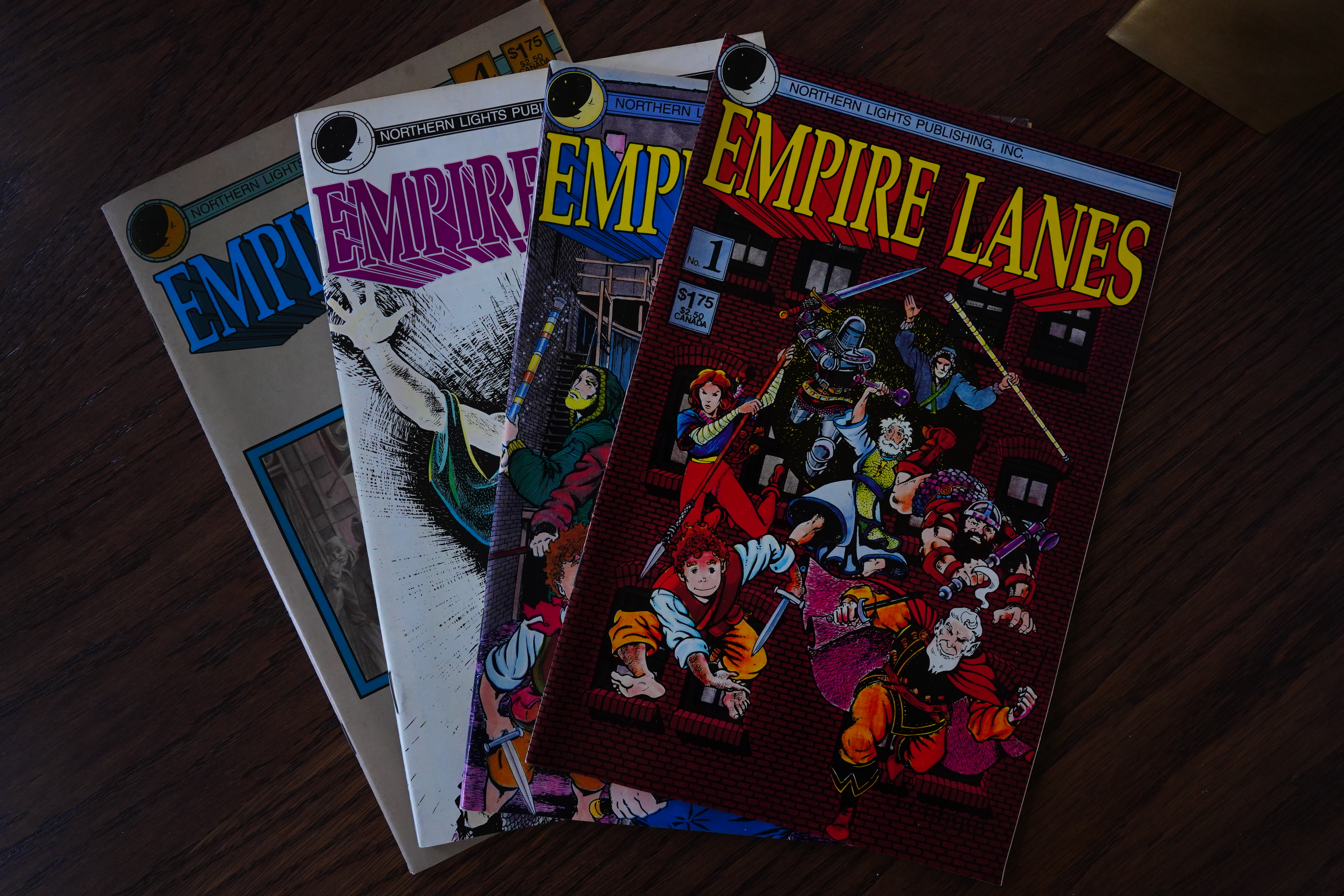
Wow! I was right! I still have them! And I found them! (In a short box marked “Singles”.)

Well, that’s surprising.

Anyway, I quite liked this issue — OK, the concepts seemed very derivative, but the artwork’s good, an engaging storyline, and some gags that worked.

Amazing Heroes #175, page #90:

Some of you might remember Empire
Lanes as one of the handful of well-
crafted black-and-white titles to come
out towards the end of the b&w boom
in the mid-’80s. It was a well-drawn,
well-written book, one of those titles
in which you could see the creator (in
this case writer/artist Peter Gross) take
huge leaps from issue to issue. It only
lasted five issues when the black-and-
white market collapsed and the book
was swept down into an inky black
hole along with a lot of less worthy
efforts. Now, Empire Lanes is back,
published by Keyline Books, Comico’s
new black-and-white imprint.
Empire Lanes involves a group of
adventurers patterned after the basic
Dungeons and Dragons character
types. There’s a warrior princess, a
knight, a halfling, a dwarf, a cleric,
etc.. The significant difference
between Empire and DC’s Dungeons
and Dragons comic is that these
adventurers are trapped in the world
of present-day Chicago, carried there
by a magic gateway in order to escape
their adversaries. It’s “Strangers in a
Strange Land,” but to Gross’s credit
this aspect of the story isn’t dwelt
upon. Gross seems more interested in
telling stories where the basic good vs.
evil morality of the adventurers is
compared to the more ambiguous
moralities of contemporary men and
women. How to deal with slums or
childbeating? What about dragons that
may not be dragons? These are the
issues Gross addresses.
Empire Lanes is gratifying because
Gross imbues his cast with something
beyond cliched characteristics. True,
the halflings are cute and mischievous,
but they also express their anger and
resentment at being treated like
second-class citizens by larger, taller
members of the group. The cleric has
doubts about the omnipotence of his
diety because his summons for aid go
unanswered.
As interesting as the stories are, the
main reason to buy Empire Lanes is
Gross’s artwork. His sense of com-
position and his use of black are
excellent. He also happens to be able
to draw people, not only hyperex-
tended demigods and overinflated
bimbettes.
Retailers who stock gaming material
make note: Empire Lanes will surely
appeal to gamers. Rack it near Dragon
magazine.
GRADE: !!!!!
— Jeffrey Lang

Amazing Heroes Preview Special #10, page #46:

The reception to Keyline’s Empire Lanes
special has been so positive that the series
will be continuing in its own quarterly series.
Briefly, the story involves classic Dungeons
and Dragons-type characters trapped in
modern-day Chicago. Expect light, fun
adventure in this one.

OK, I guess I’ll be re-reading the first four issues in a couple of days when I cover the Empire Lanes collection.
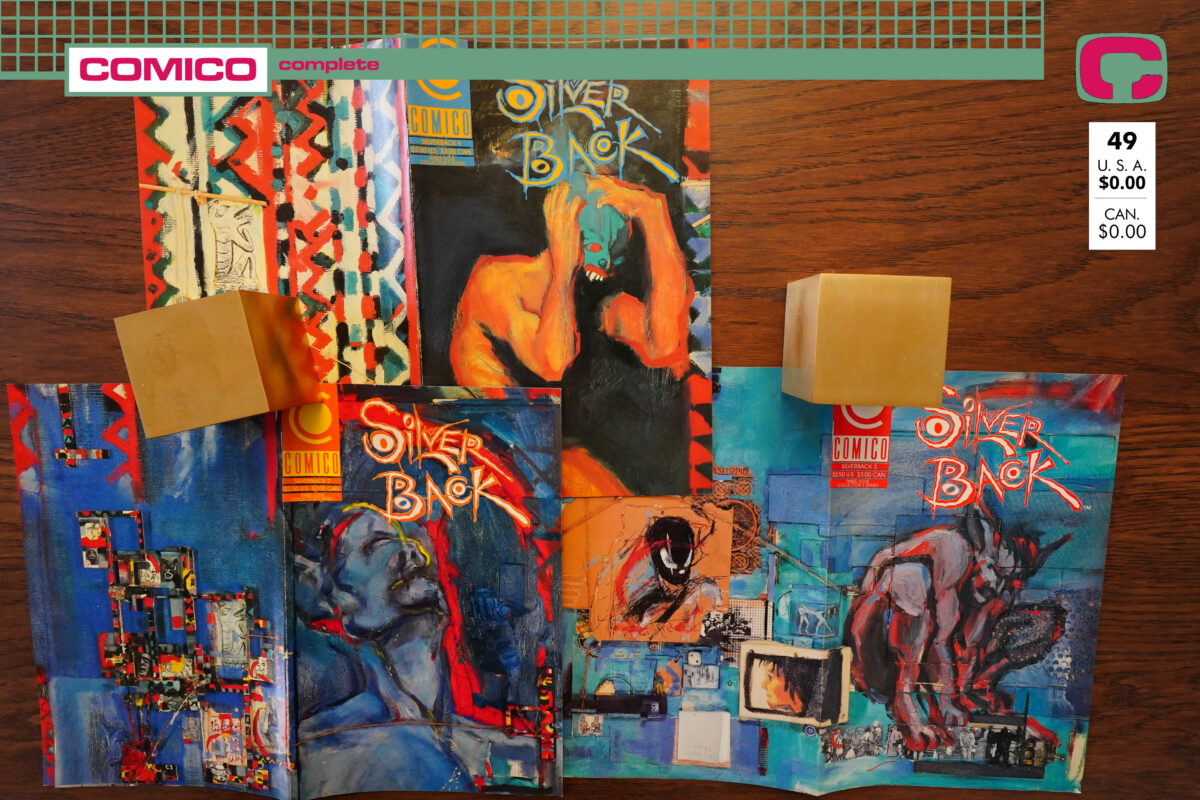
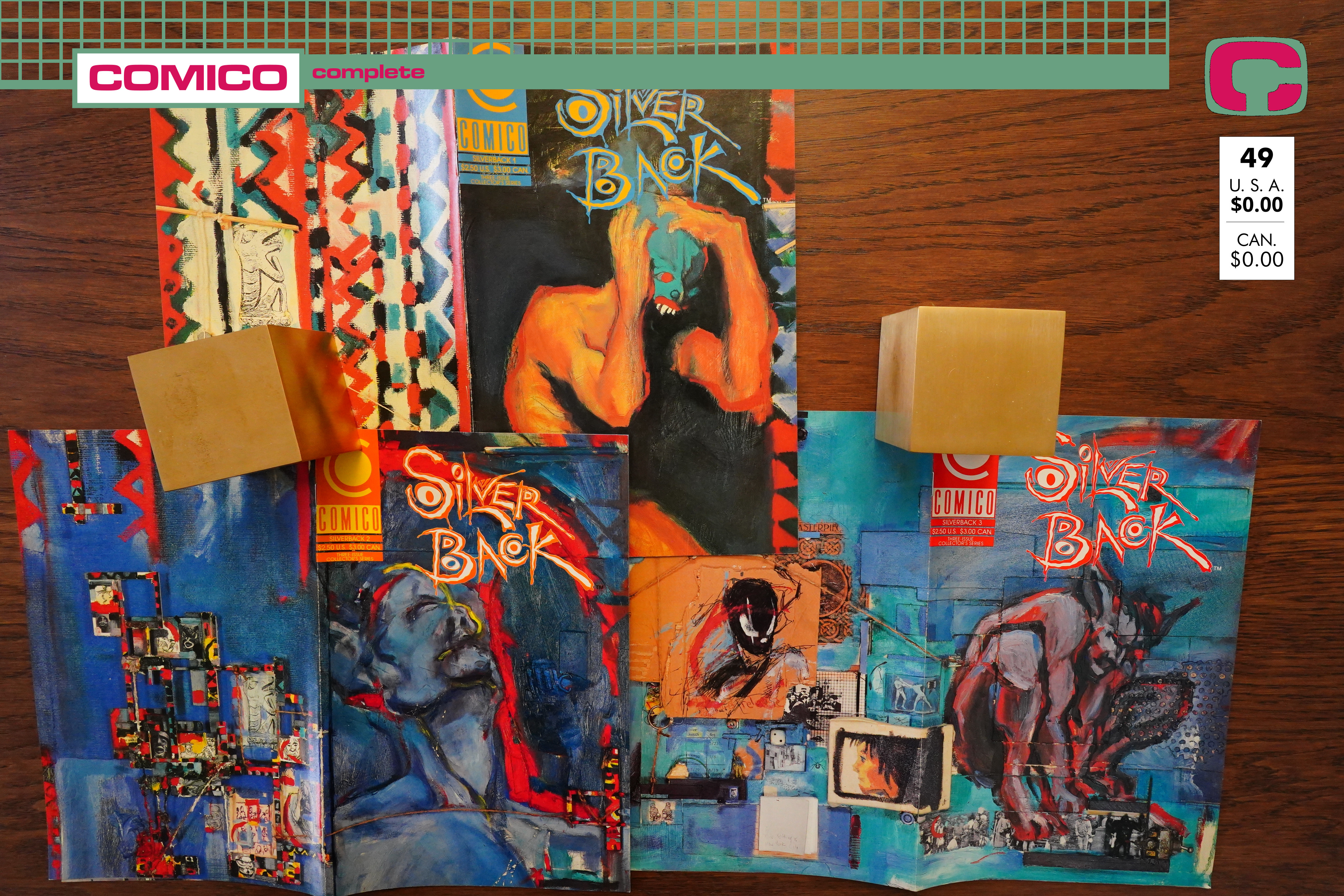
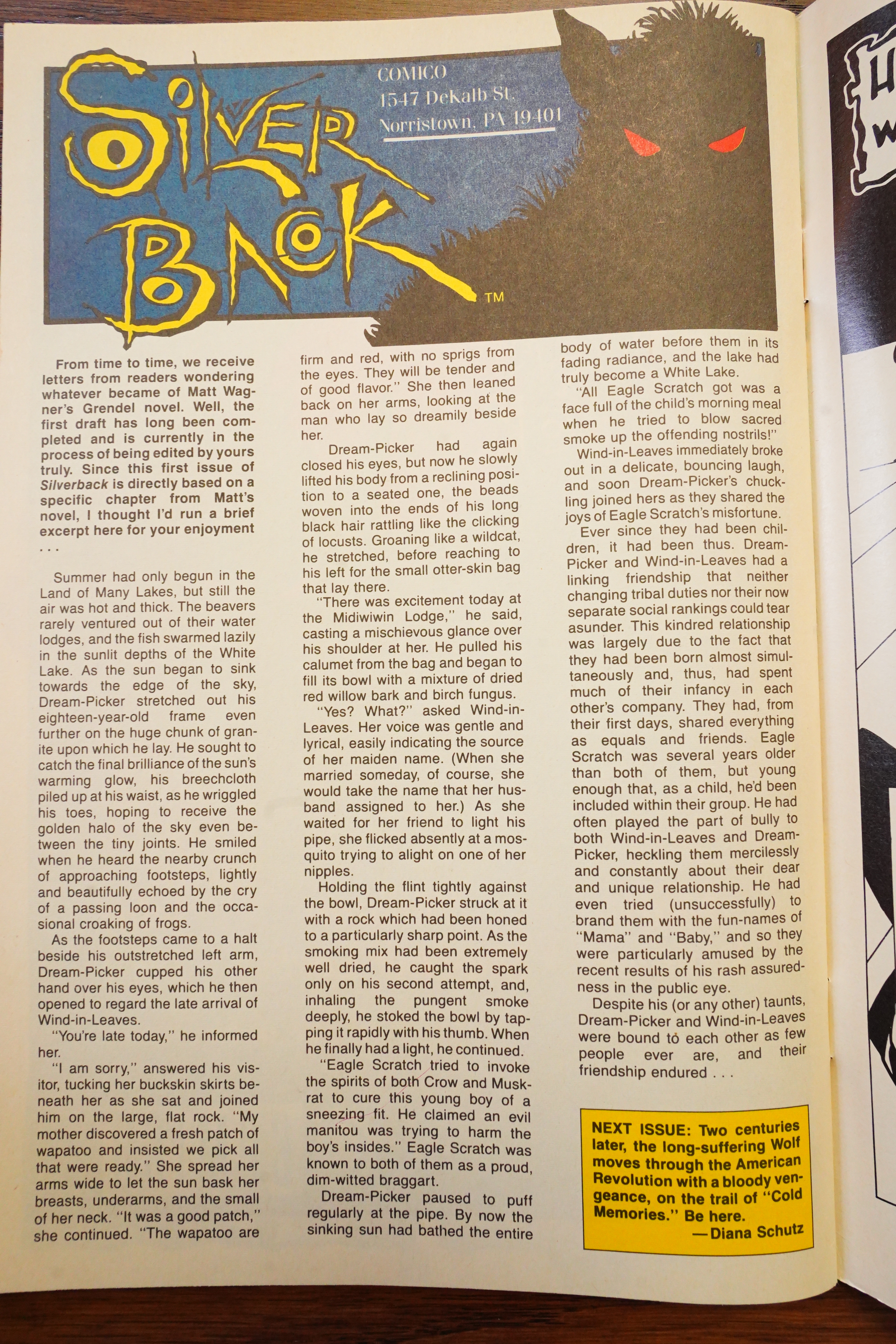
1989: Silverback

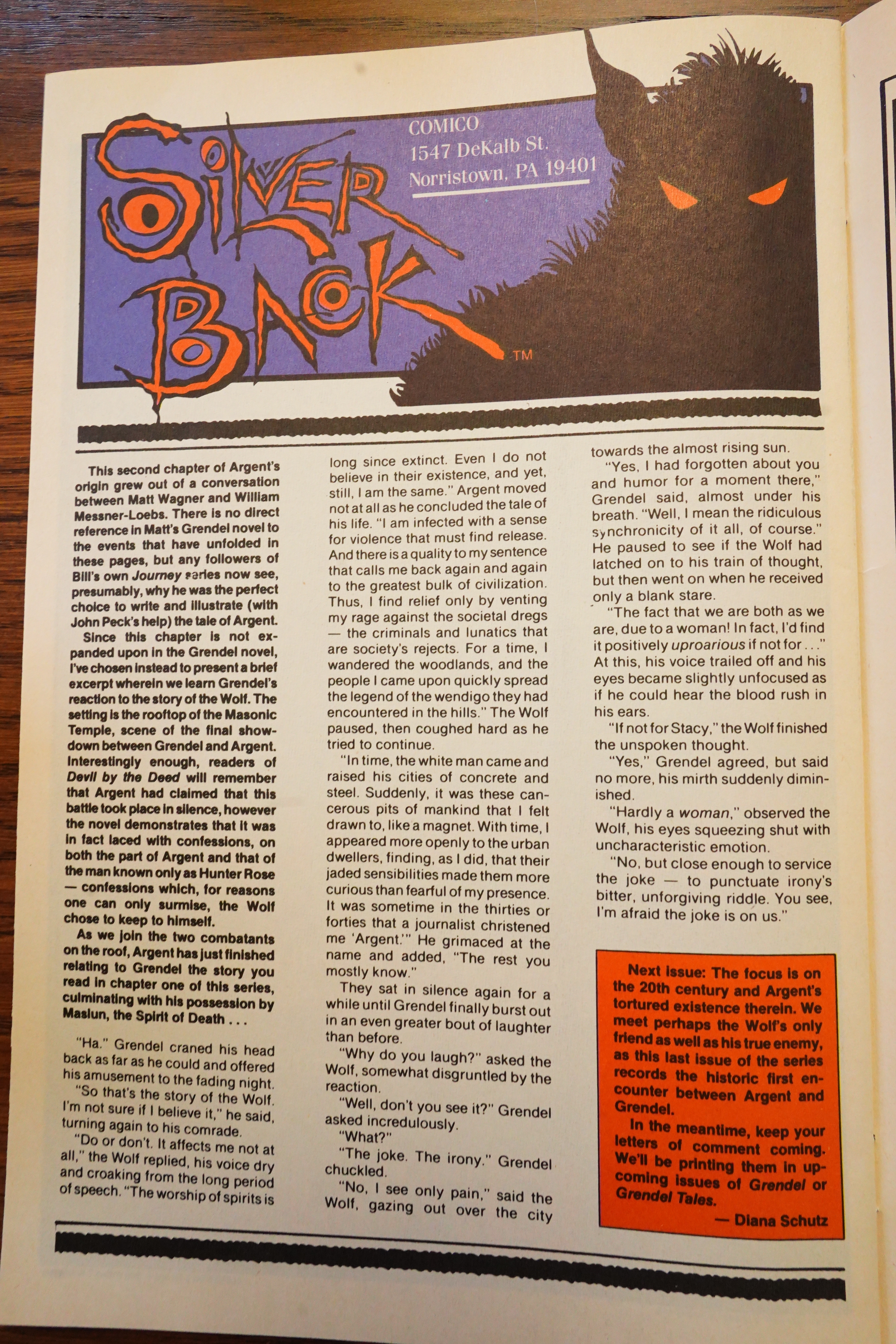
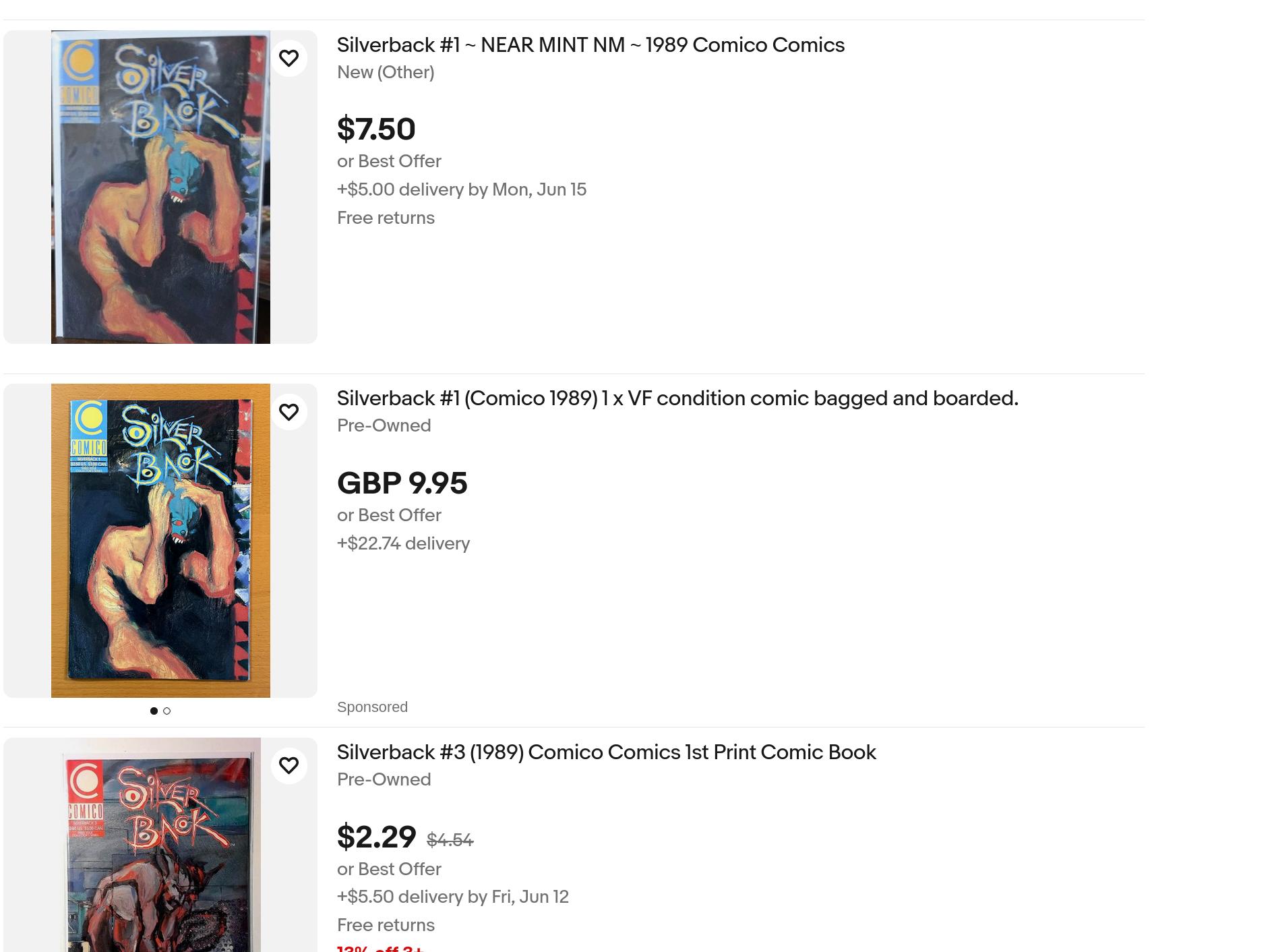
Silverback (1989) #1-3 by William Messner-Loebs, John Peck, Matt Wagner and Bernie Mireault

This is one of the few Comico books I bought back in the 80s. And not because I was into Grendel (it’s the origin story of the Grendel antagonist Argent), but because it’s by William Messner-Loebs, and I was a huge fan of Journey. (Man, those first six issues of Journey: They’re brilliant. OK, the series got kinda lost in the weeds after that, but it remained interesting. And those first six issues? Man.)

I remember zilch about this series, but I’m excited to re-read it now.

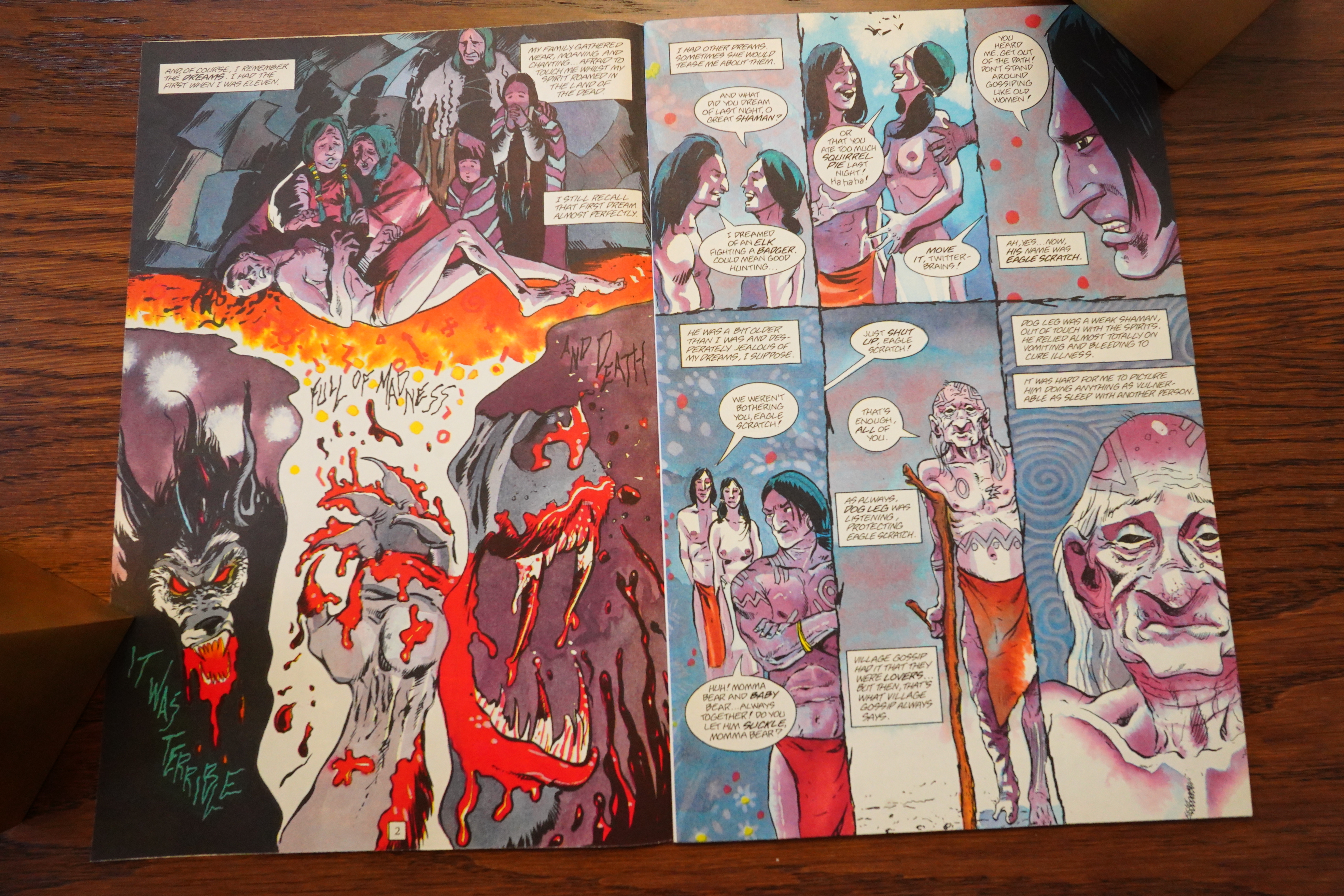
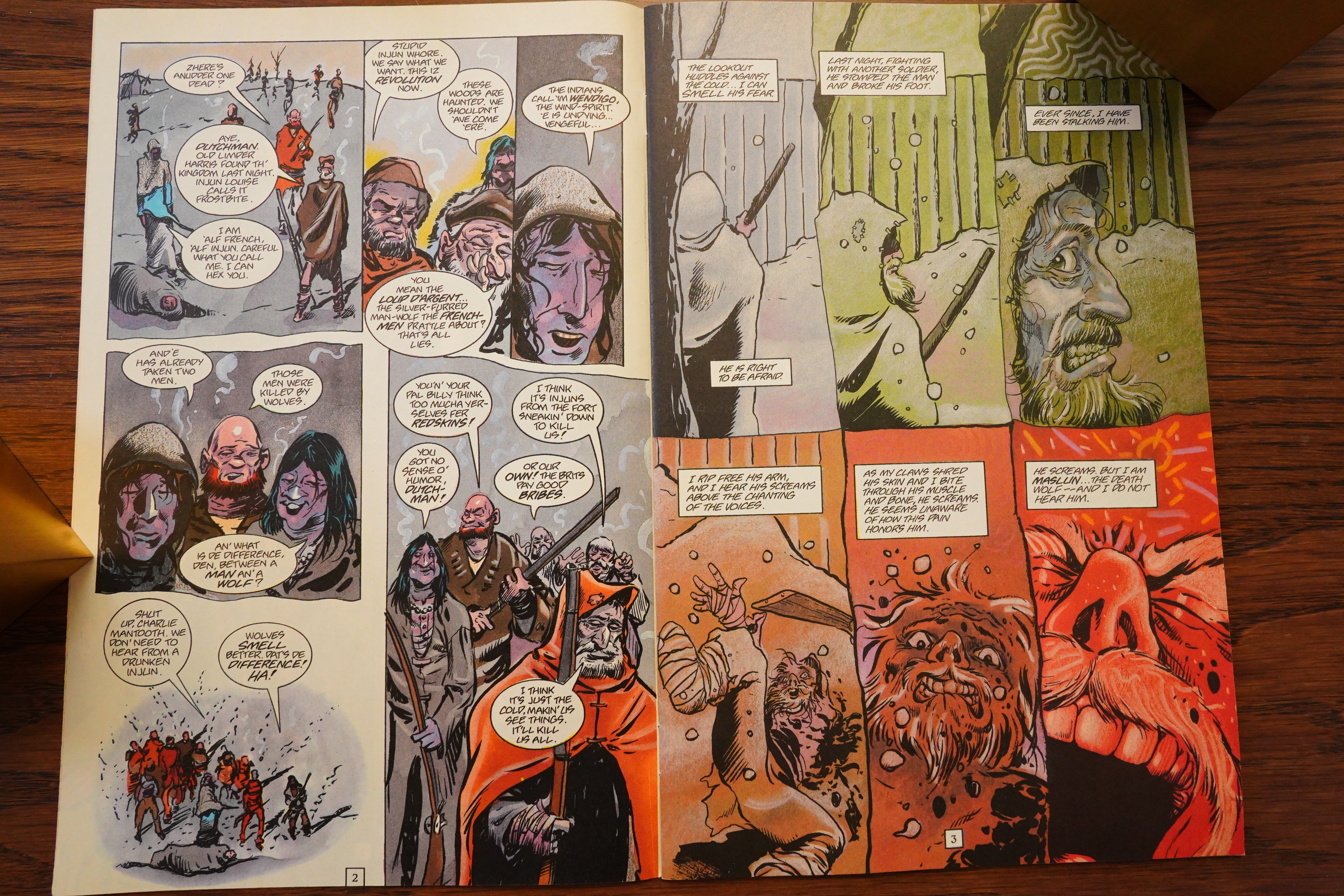
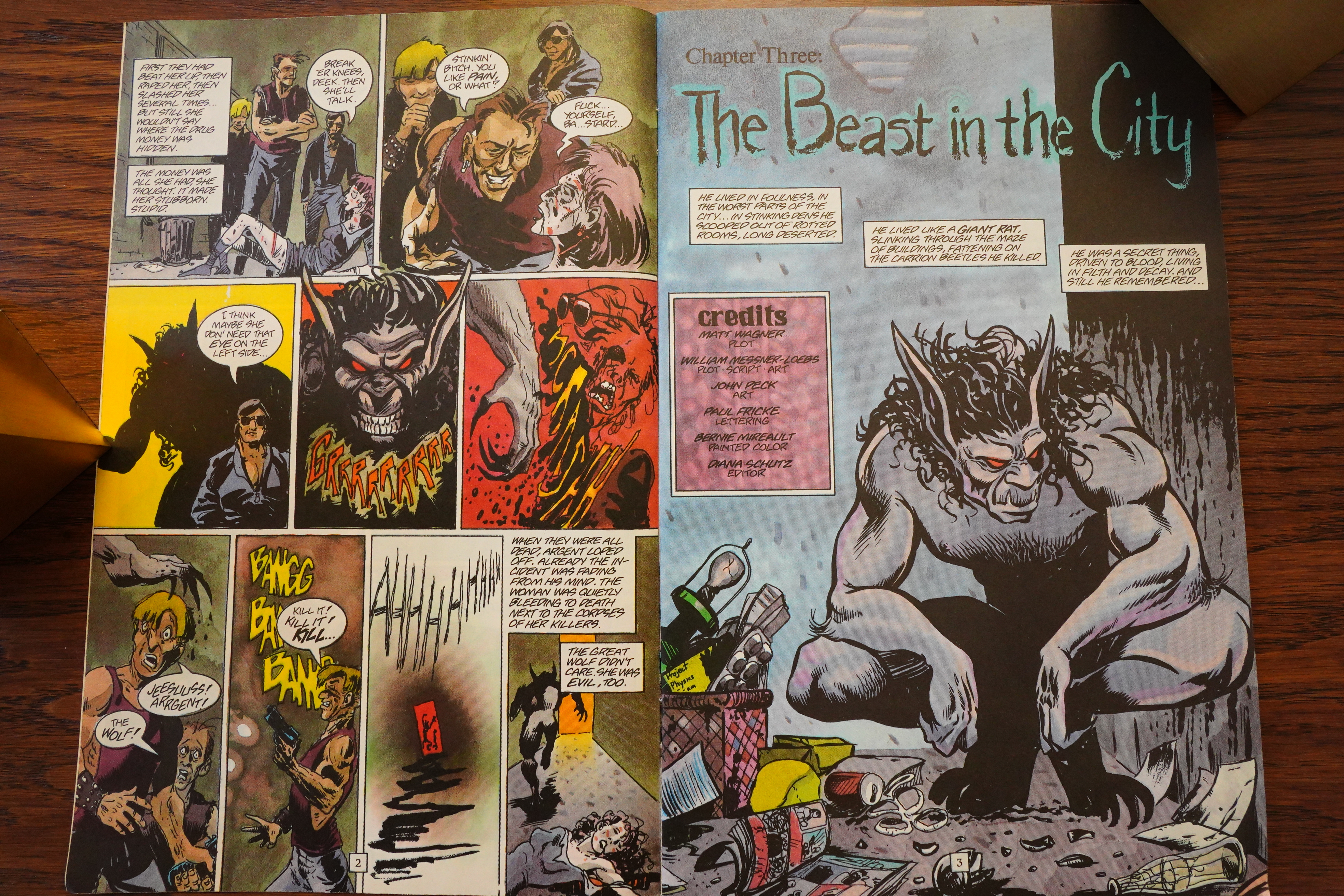
Oh, right, I think we already knew that Argent (a kind of wolf man) was a Native American, but here we get his origin story, which is about how he was done wrong by a couple of horrible gay guys. I mean, two envious superstitious cowards of shamans. Shamen? Something like that.

It’s pretty good, but it’s Messner-Loeb’s artwork that sells it.

The story is pretty much a cliché, but it’s told with real nerve.

And when you read the excepts from the Grendel novel that it’s based on, you see what Messner-Loebs had to work with — and he worked miracles.

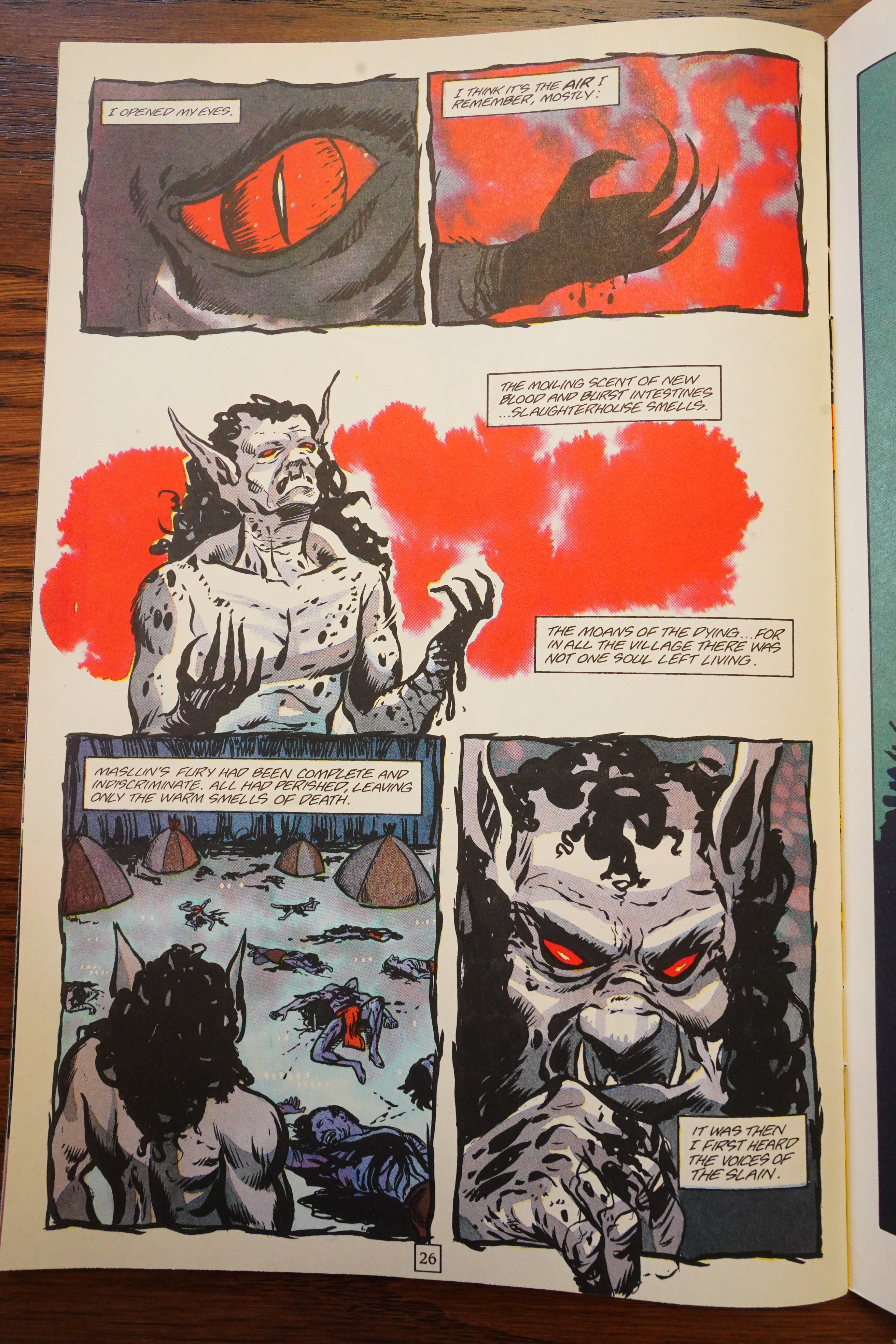
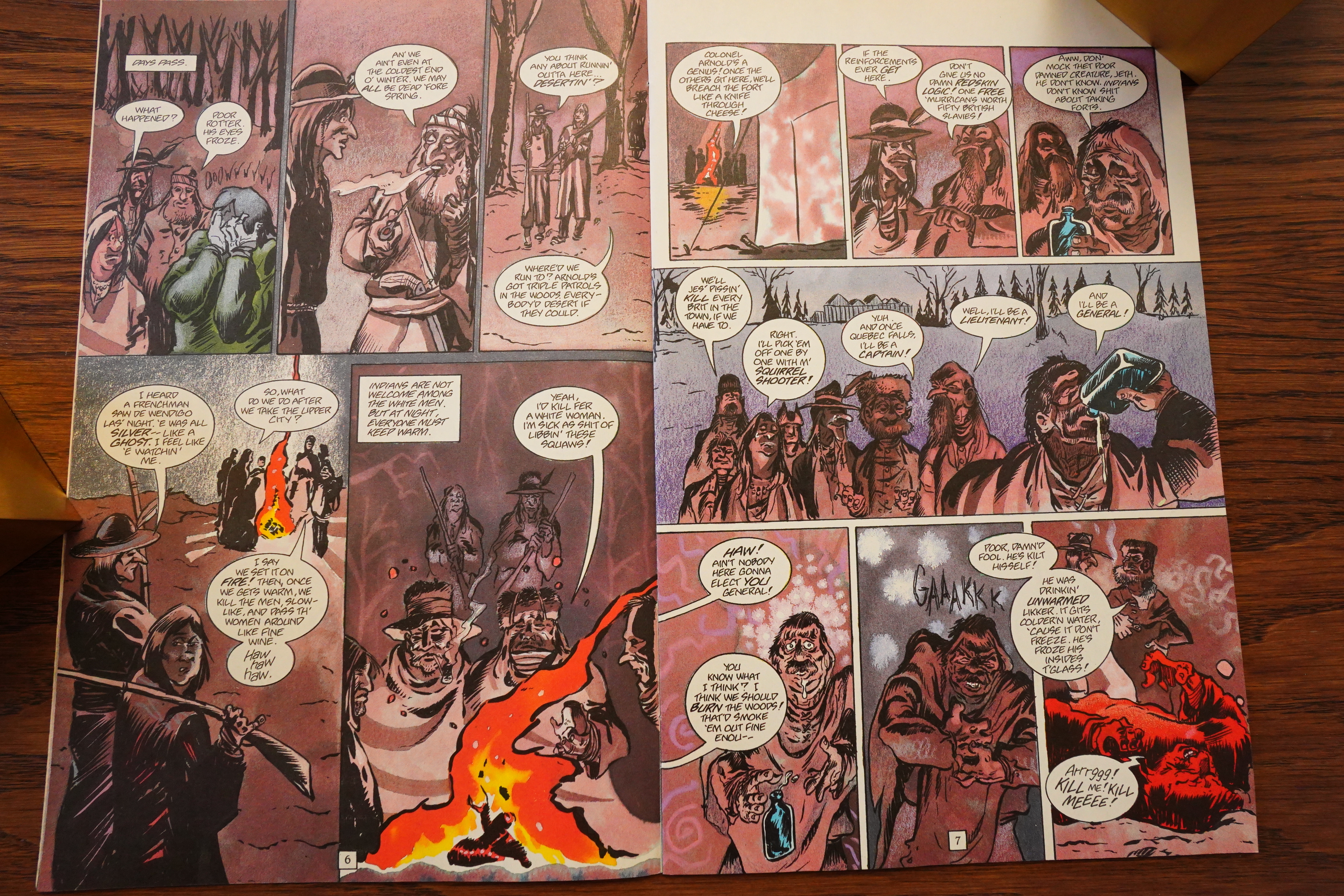
The second issue is even better, because it’s not based on … that. It’s a real horror story, and is gripping and enjoyable.

Especially the bits that are all about the sheer awfulness of these Americans who are planning to invade Canada and slaughter and rape the English. Kill ’em, Argent! Kill ’em all gruesomely!

It lays out Argent’s deal well — he’s gonna be killin’ some evildoers because of the spirits in his head, etc. Very well done.

Is the above written by Wagner? It’s a reaction from Grendel on the previous story…

Which brings us to the final issue, wherein we’re in modern times and Argent is finally going to meet Grendel.

Both Messner-Loebs and John Peck are credited with “art”, so I’m not sure who did what here, but some panels seem way more Messner-Loebs-like than others, so I guess… they did some panels each? Perhaps Peck drew Argent? Or something?

It works, however they split the job.

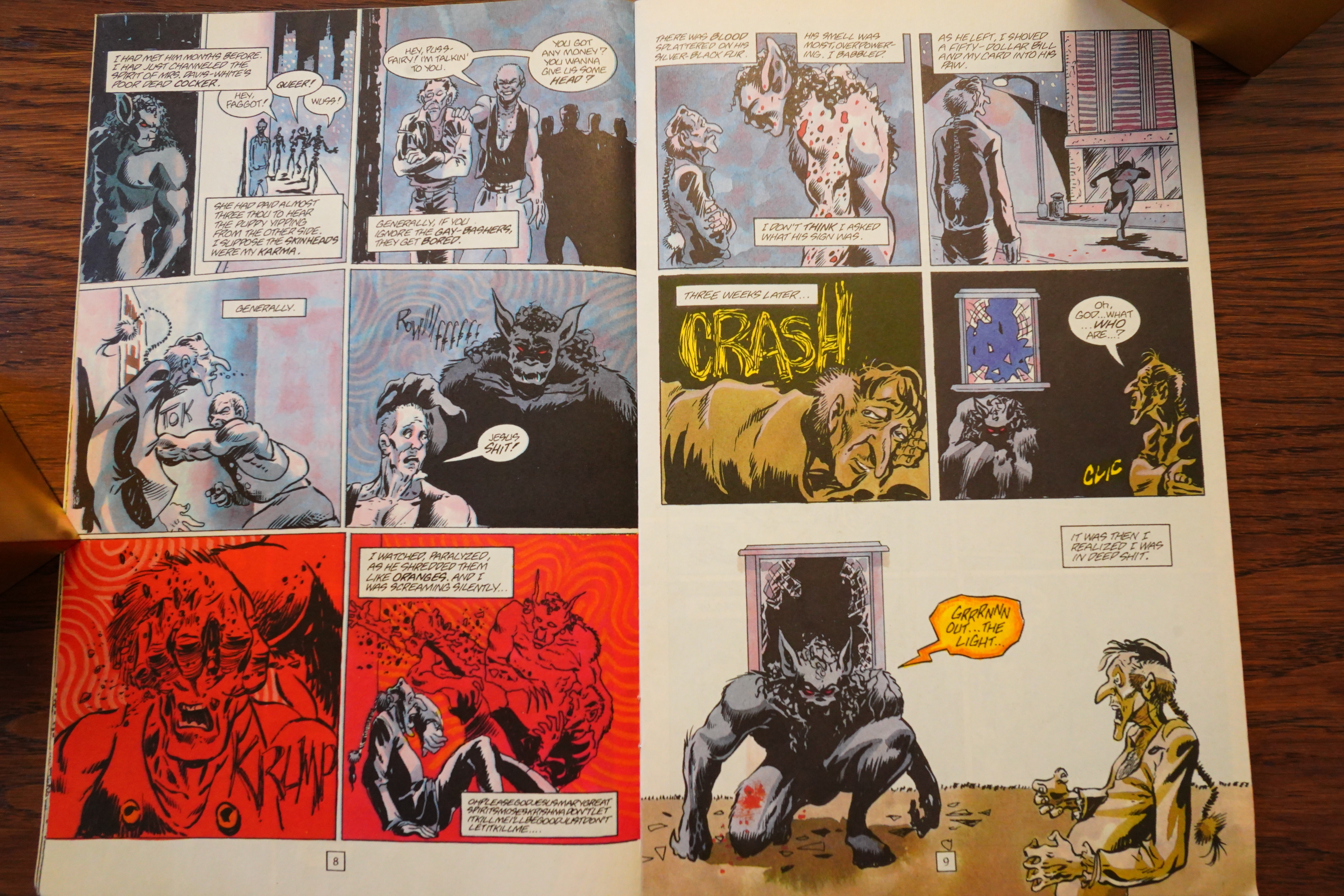
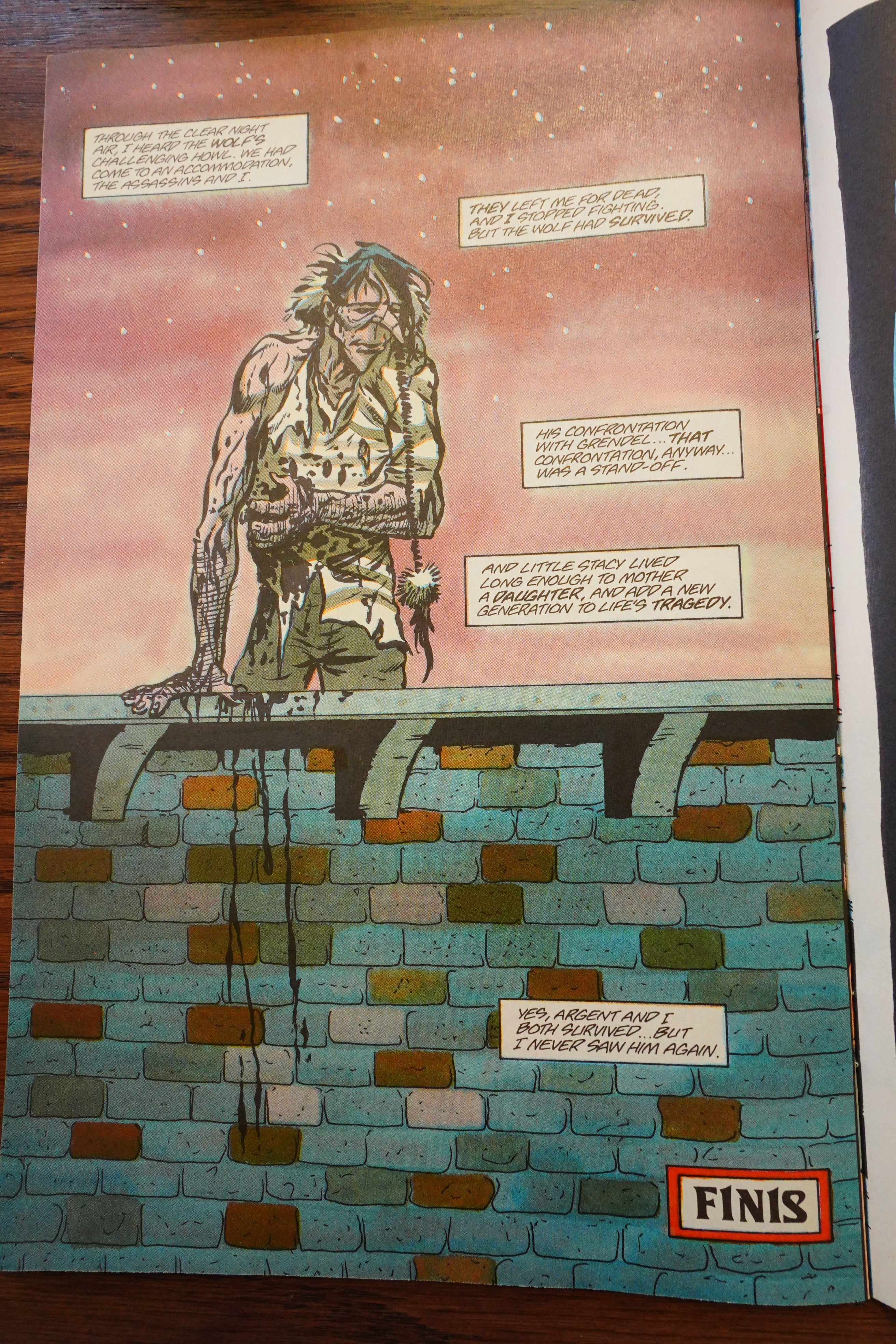
Yes, it’s a gruesome issue again, but it’s also pretty funny. And it ties things nicely together — Argent encounters another gay shaman, but this time around, he’s good and not evil.

And not only saves Argent’s life, but survives himself! Unheard of!

So that was a really solid mini-series. These origins-of-side-characters things usually feel unsubstantial and unnecessary, but this one really works. Although I can see how you’d be dissatisfied if you hadn’t already read Grendel, because it leads straight into the Grendel saga.

Amazing Heroes #170, page #98:

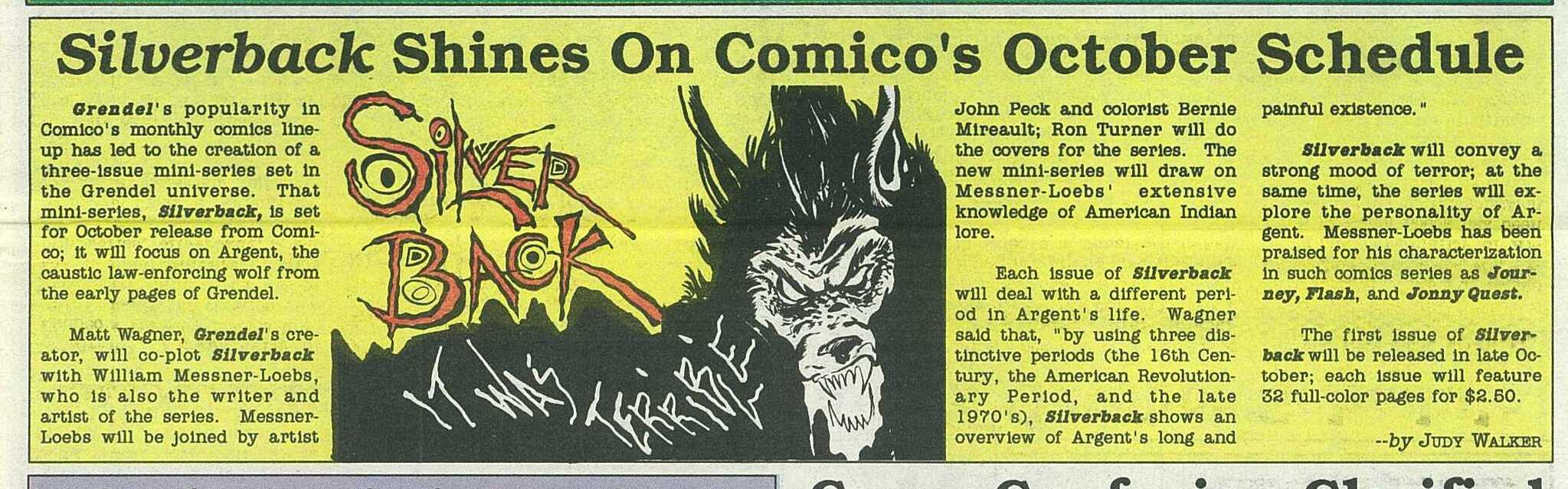
After a little fine-tuning, Silverback is finally
ready for publication. A Grendel spin-off
mini-series, this book will chronicle the story
of Argent and will highlight his life at three
different points, beginning with the 15th
century and his beginnings as a young
Algonquin indian shaman. Moving into the
18th century he is at the Siege of Quebec with
the troops of Benedict Arnold. He then goes
into the 20th century, where he continues his
trail of death and misery. Each person he kills
joins the legion of voices inside his head, and
he must kill his lost loves to survive.
Silverback is being written and drawn by
Bill Loebs, who was handpicked by Matt
Wagner. Wagner will have a hand at the
plotting, and Loebs will be joined on the
drawing board by his partner, John Peck.
Grendel fans should watch for this one.

The Slings and Arrows Comic Guide #2, page #589:

Plotted by Matt Wagner and based on his character Argent
(the wolf) from the original Grendel series, Silverback sees
William Messner-Loebs return to the genre in which he
began with Journey. It’s a very different frontier, however,
as the spirit of death, Maslun, empowers an Algonquin
brave with inhuman savagery, turning him into an
immortal wolf.
It’s not a tale for the squeamish, and Loebs creates a
tragic, downbeat atmosphere that leaves little room for
humour, while the artwork by Loebs and John Peck is
minimalist but effective.~NF

Minimalist!?

Indy Magazine #11, page #47:

Mirault: GOOD COLOR ART-I couldn’t say. Everyone
has different tastes. You do some work that you think
is brilliant only to find your boss hates the color
orange. I remember coloring Silverback a few years
ago. The art was by Bill Loebs and Sam Peck. Very
loose. Very, very loose. It was a difficult job by any-
one’s reckoning, but in the end I found myself liking
the work I was doing on it. Forgive my vanity, but I felt
like I had saved that book. A year later I learned that
the artist didn’t like my colors. “Too purple”, or some-
thing like that. That blew my mind, but then, there’s
not many things about life on Earth that don’t.

Amazing Heroes #174, page #84:

SILVERBACK #1

Sometimes a reviewer knows too
much; sometimes, too little. For in-
stance, the first time I laid eyes on
anything done by William Messner-
Loebs, it was a Xerox of the final inks
of Silverback—and I had to be told by
friends that it is an origin story for a
character named Argent that was
killed by Grendel in an earlier issue.
As I say, the book came to me in
Xerox, and from the look of the naked
pages I felt Bernie Mireault would
have to perform coloristic miracles to
make this sow’s ear into an interesting
comic. The final inks looked like
sloppy soft-pencils. Figures were
stretched a head and a half too tall for
no significant reason. Faces ran again
and again to stupid or stupefied ex-
pressions—when they were recogniz-
able as faces at all. In side-by-side
panels at the top of one page he gave
a pug-nose and a hook-nose to the
same girl. Backgrounds were non-ex-
istent, and brushwork was everywhere
so free as to be totally indifferent to
form, clarity, or expressiveness.
Maybe I wouldn’t have been so out-
raged if the story being told was in-
triguing, but it wasn’t.
The story is of a young Algonkin
Indian born 300 years ago, who
aspires to shamanhood. The authors
have not bothered to look over the
significant portions of Black Elk
Speaks by Neihardt, nor Joe Camp-
bell’s The Masks of God. Their idea
of a shaman is of a man simply pos-
sessed by the gods of death, instead
of an individual gathering power from
his experiences in a spirit-world visit-
ed in dreams. This allows them to turn
this outraged Indian into a Wolverine
look-alike for the finale of the book.
The entire story turns again and
again on cheap cliches and knee-jerk
me-too-isms. Rival shamen discredit
the youngster, and “sacrifice” his
childhood sweetheart to assuage a
plague. He gloomily “dreams death”
hovering around everyone in the vil-
lage. And, in the final transformation
sequence, he becomes the very bringer
of total carnage, while in a dream of
possession. All this is very hack-
neyed, and betrays no understanding
of Indian life whatever. In fact, after
a three-page introduction, this suppos-
edly-serious shaman is pictured
lounging on a rock smoking a pipeful
of sacred tobacco merely for pleasure!
Only a Mudhead or maybe a Belicana
would commit such a sacrilege.
And so I had to say this book was
“simplistically plotted, indifferently
scripted, and supplied with slap-dash,
slovenly art.”
“On the other hand,” I concluded,
“Paul Fricke’s lettering is everywhere”
clear and readable. Unfortunately.”
But then a copy of Silverback #1
appeared at my local, and it did indeed
look as though Bernie Mireault had
performed coloristic miracles! It was
still a sow’s ear, but some of the empty
backgrounds had been filled, some of
the flat, slap-dash figures had depth
and shading. I began to wonder if
maybe this Messner-Loebs hadn’t per-
haps indicated how his doodling could
be improved.
And so I took a look at what some-
one says is his finest achievement-
Journey Book One: Tall Tales—and I
was amazed! Messner-Loebs is a car-
toonist, but his quirky caricatures can
be shockingly expressive. He can run
from full-out bombast to tightly con-
trolled understatement, and he seems
to have absorbed from Will Eisner not
so much a style as a storytelling sense
of expressive economy, and a love of
specific detail.
So now I look back through Silver-
back #1-and I can’t find any of Mess-
ner-Loebs’s genius in the book at all!
The care and imagination and origin-
ality he lavished on his own original
stories are absent.
And so, when it comes to rating, I’ll
grant a point for expressive color
work, and one for the painted cover,
and even another for a painted back
cover (which I like even more), and
then I’ll subtract half a point because
we all know this could have been a
much, much better book than it is.
GRADE: !! 1/2
— Larry Stark

Heh heh.

Back Issue #125, page #23:

POWERS: Around this time, Silverback #1-3 (Oct.-Dec. 1989)
also came out, presenting the origin of Argent, with William
Messner-Loebs scripting from your plots. Why is this story
important to the Grendel mythos?
WAGNER: I don’t know that it was crucially important to the
overall saga. At that point, I was mainly looking to franchise the
Grendel title into a larger spectrum, and Argent was a compelling
character whose story had only been hinted at here and there.
So it’s definitely a component in the greater narrative but more
of a sideline tale than something of world-shaking significance.

Fumo di China #4, page #35:

After a long time, Matt Wagner attempts something new, and it must be
admittedly done admirably, as is his wont. With Messner-Loebs, he creates a tale that blends fantasy with Native American culture,
in a story halfway between epic and reality. The psychological characterization of the characters is faithful to the
spontaneity of the Native Americans, so much so
that reading the texts in the book immerses us completely in that Native American
world, rich in spirits, gods, and nature. However, the threat of death looms over it, spread by a
werewolf, who constitutes the only
dark and disturbing element in the entire
story. It’s 28 pages worth reading…

Silverback #1-3: Matt Wagner and William Messner-Loebs recount the origin of Grendel’s enemy Argent!

Apparently this series has never been reprinted? How odd. All the other Grendel stuff has, surely?

Yeah, I assumed (after reading that excerpt) that the Grendel novel would never be published:

Silverback by Matt Wagner, William Messner-Loeb, and John Peck. Did not know this existed. A cool little miniseries about the backstory of Argent from Grendel. Apparently it comes from a novel Wagner was writing at the time? Did Wagner ever publish a Grendel novel? I didn’t even know there were Grendel novels. Looking online I saw Rucka did a couple, but couldn’t find one for Wagner.

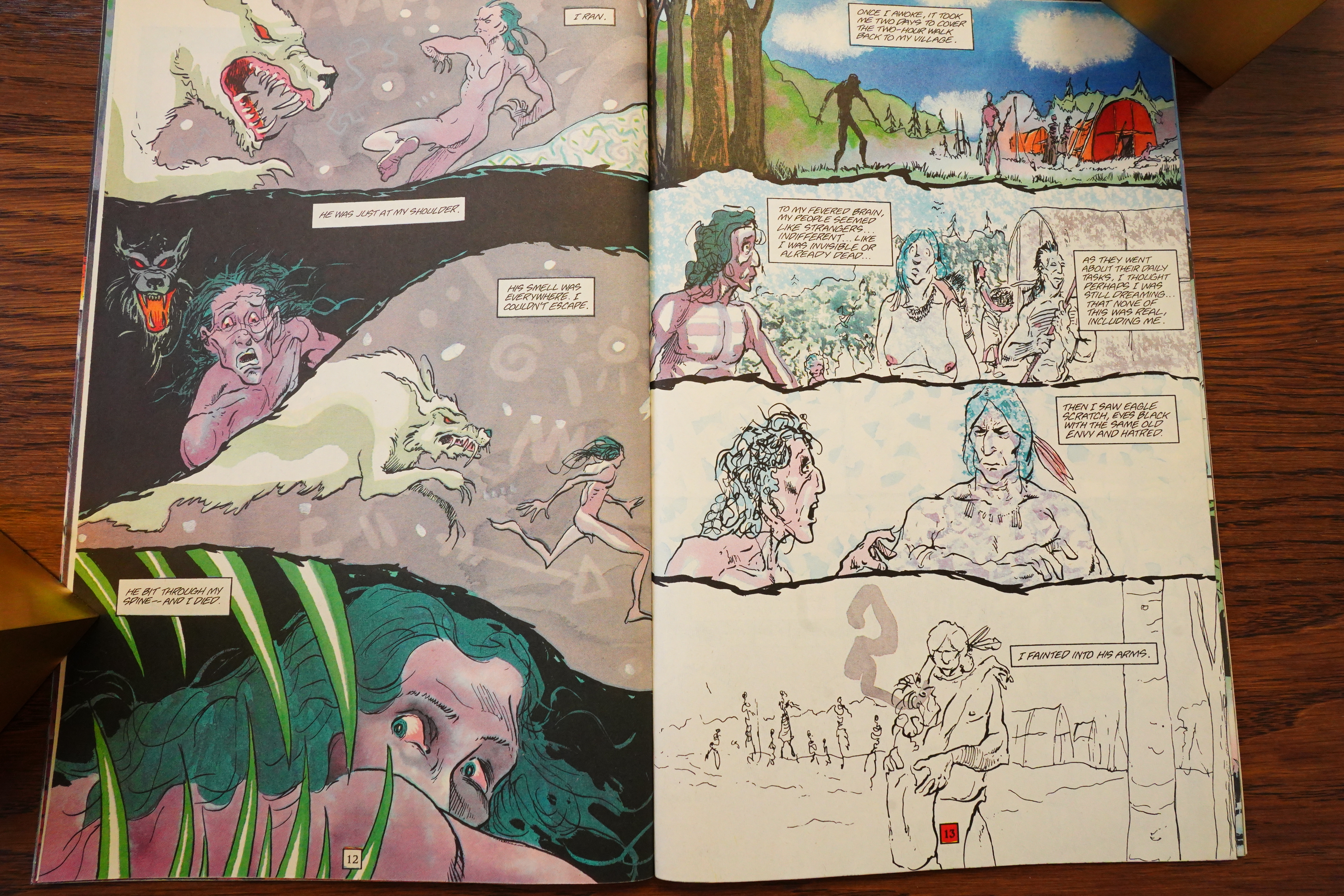
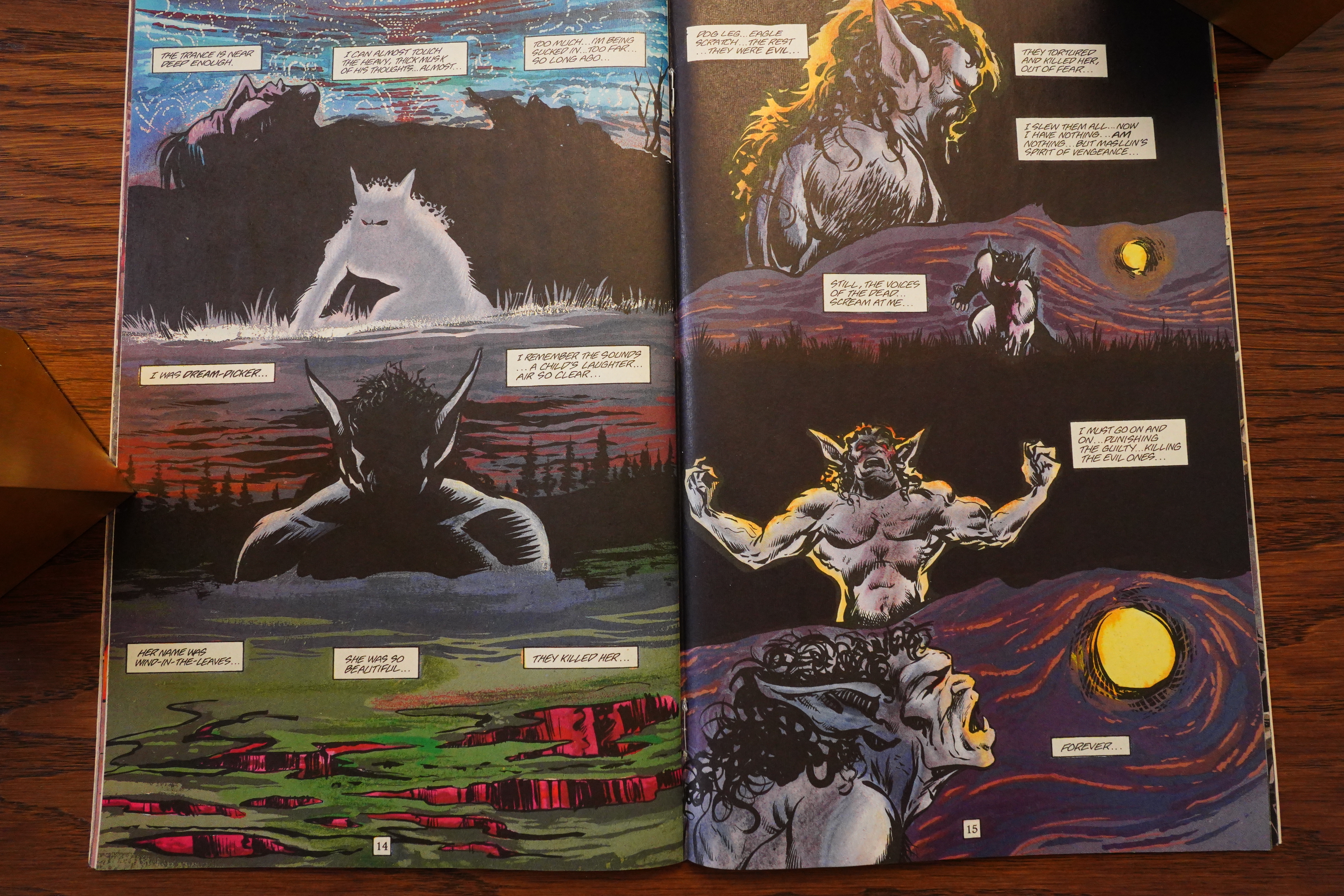
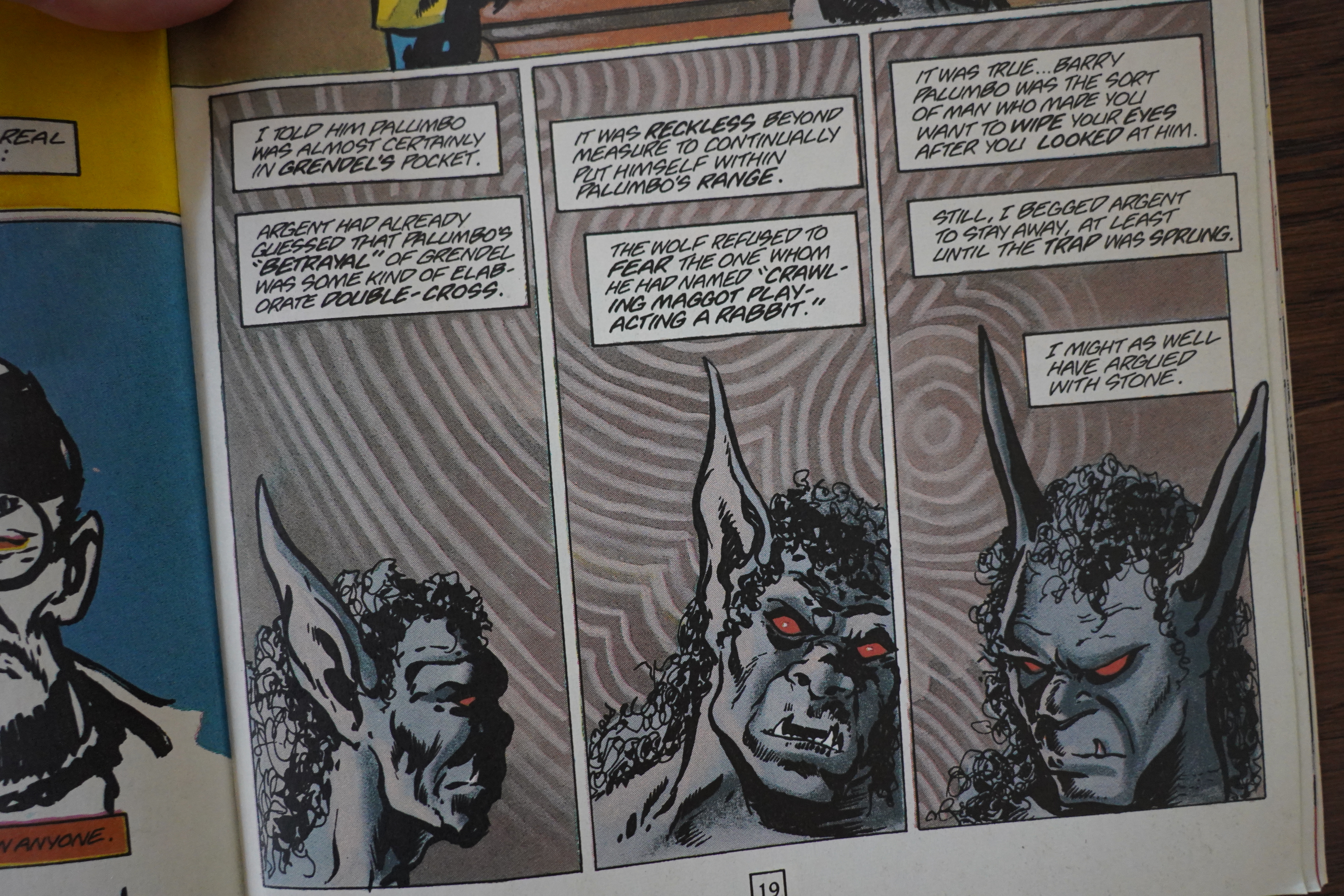
OK, so you have to cough up some money to read these comics… it’s a shame it’s never been reprinted. You’d presumably have to do so from the printed comics, because the colouring has presumably been lost to the mist of times. Presumably. And Mireault did indeed put a lot of effort into the colouring — I think he sometimes went way overboard:

Like these swirling bits? And he repeats them — stuff like that is pretty disturbing.

Anyway, good stuff.

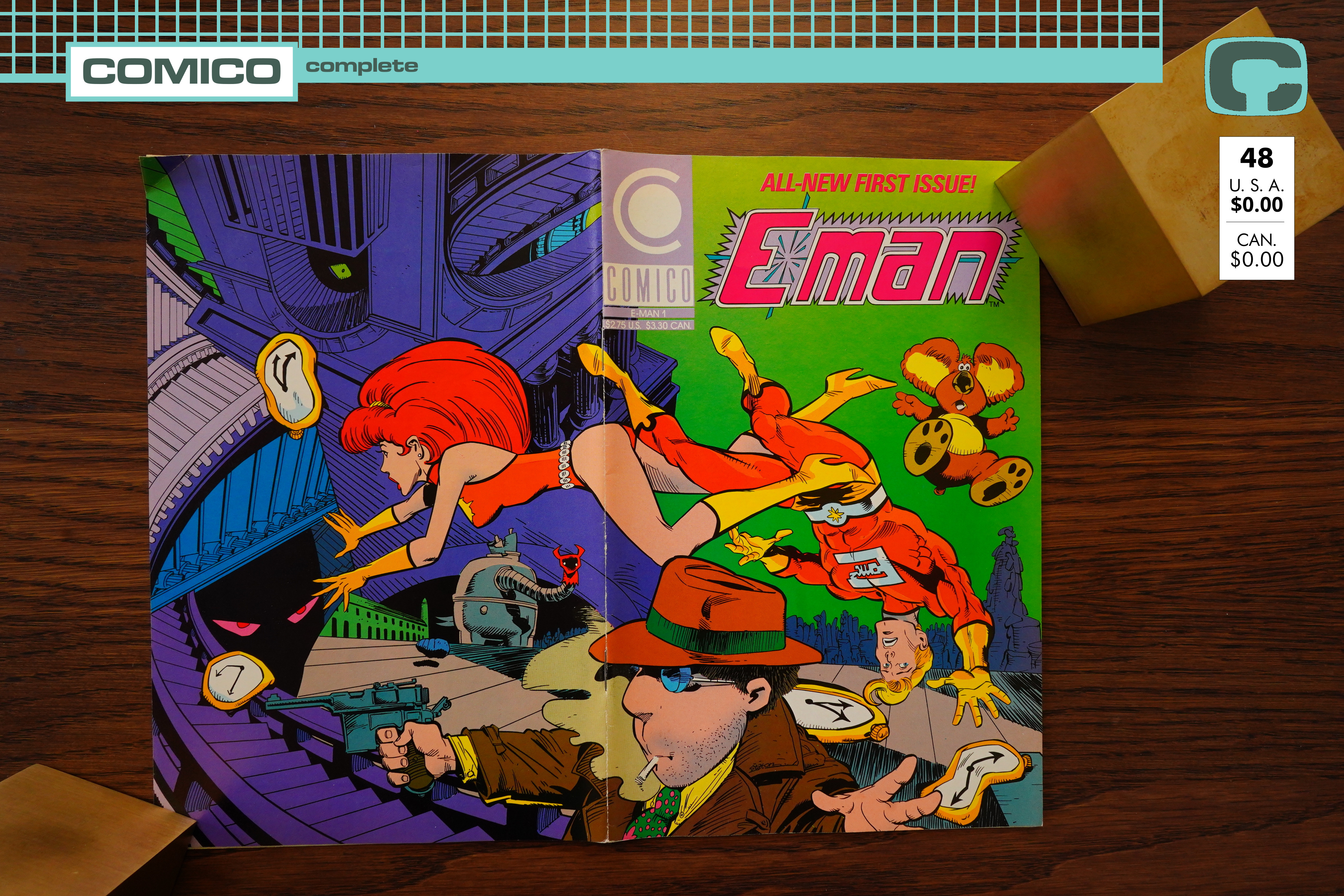
1989: E-Man

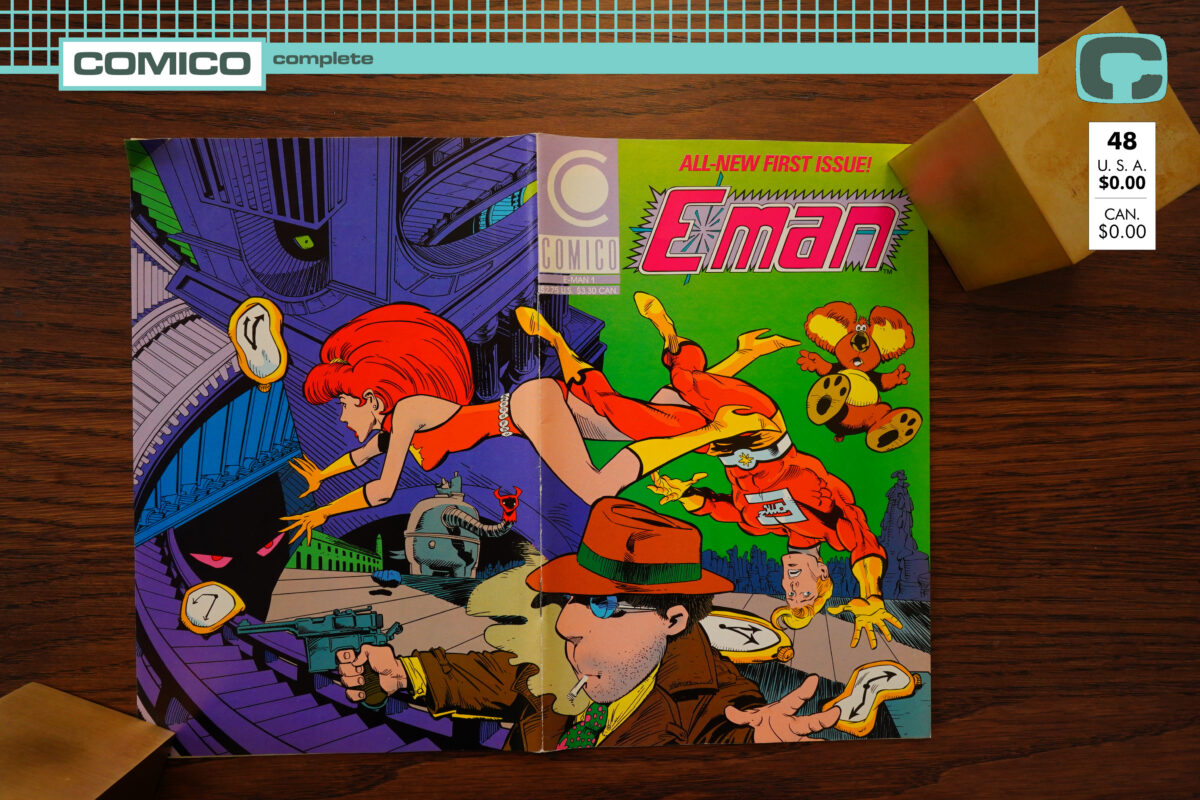
E-Man (1989) #1 by Nicola Cuti and Joe Staton

E-Man is another book in the grand Comico tradition of picking up series that have been running elsewhere. This one has a longer backstory, though — it ran first at Charlton, and then had a decent run at First Comics. And now it’s at Comico… but there’s only one issue? “All-New First Issue” certainly sounds like it’s the, well, first issue of a series, but it was apparently planned as a one-shot to gauge whether this book had any legs, I guess.

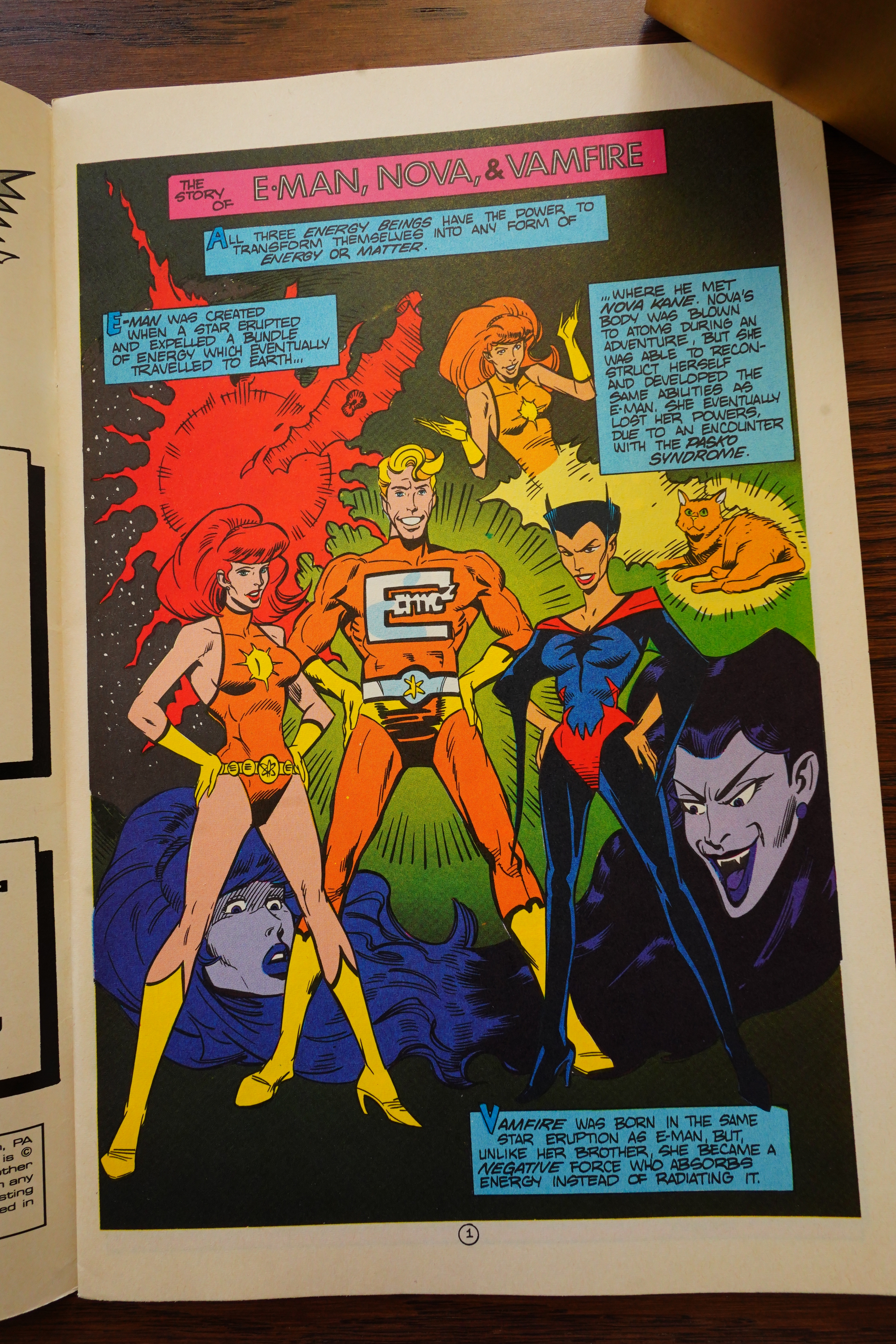
I’ve never read E-Man before myself (except one First issue, I think), but we get a one-page introduction to the characters. I always thought E-Man was more of a Plastic Man knock-off (or even Elongated Man), but he’s apparently an energy being? And there are two others with similar powers? His girlfriend and his (evil?) sister?

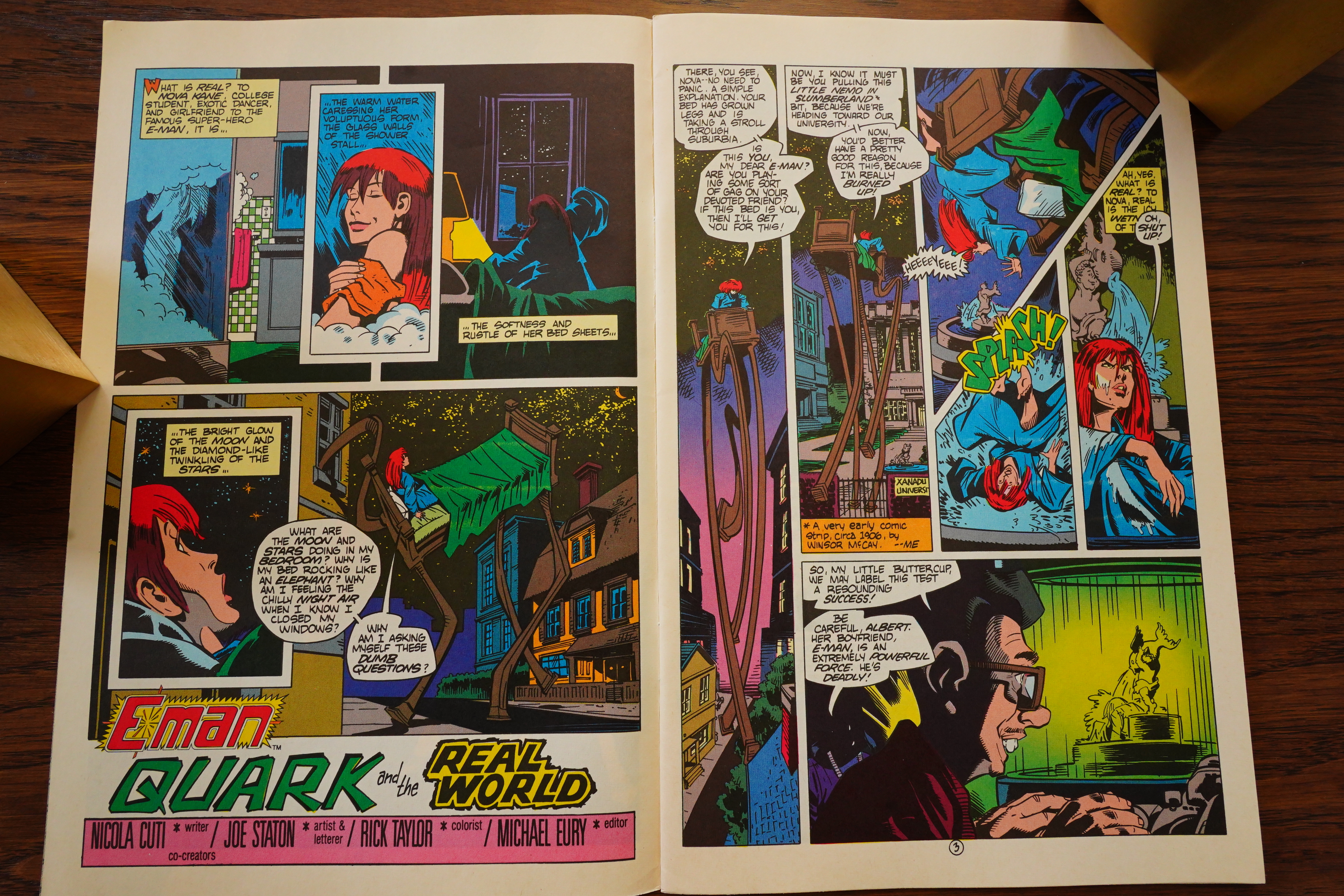
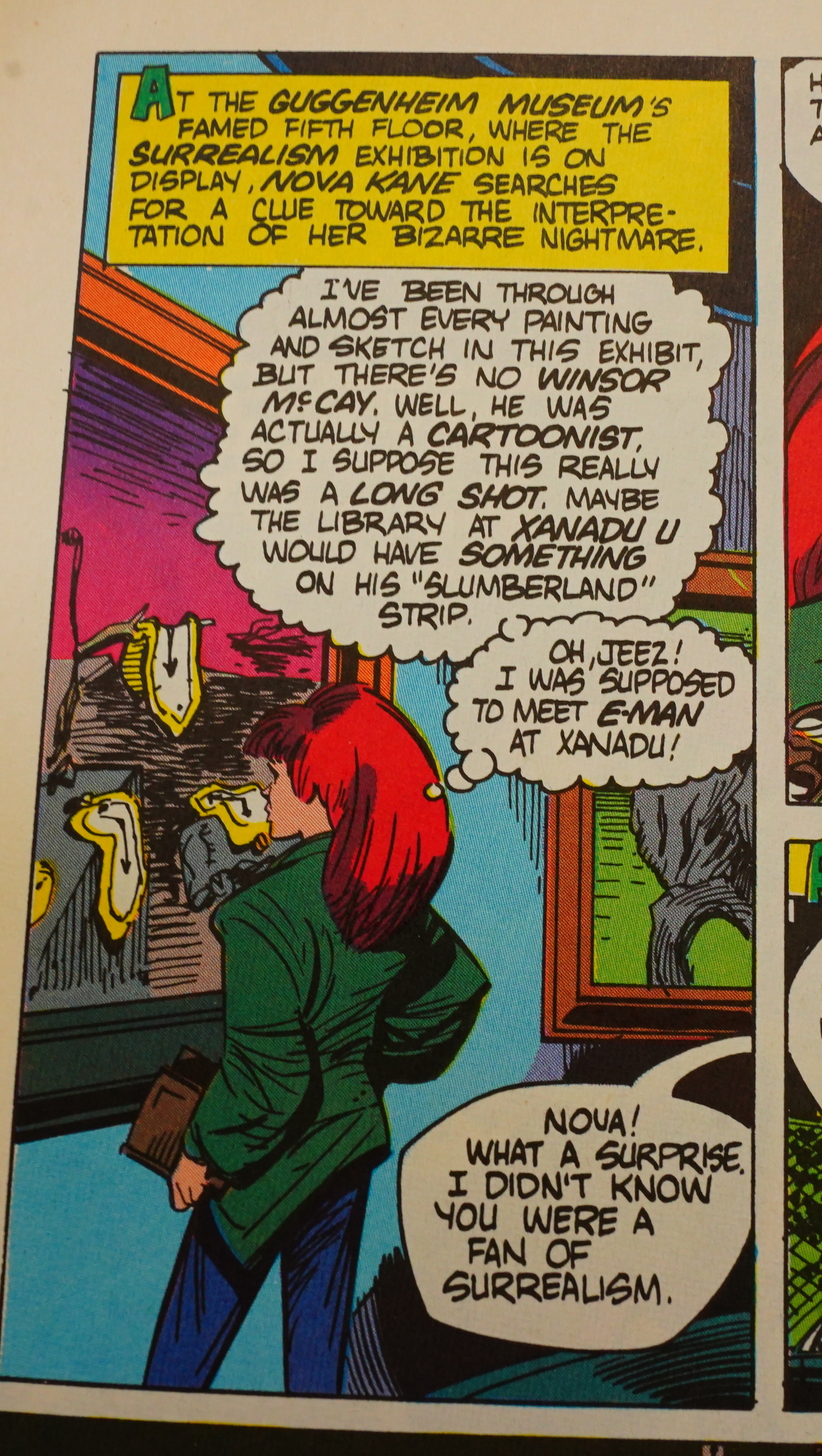
OK, so we start with a Little Nemo pastiche, which is fun, but kinda confusing — is that bed E-Man? Is he like Plastic Man after all? But, er, no? Did this happen or was it a dream?

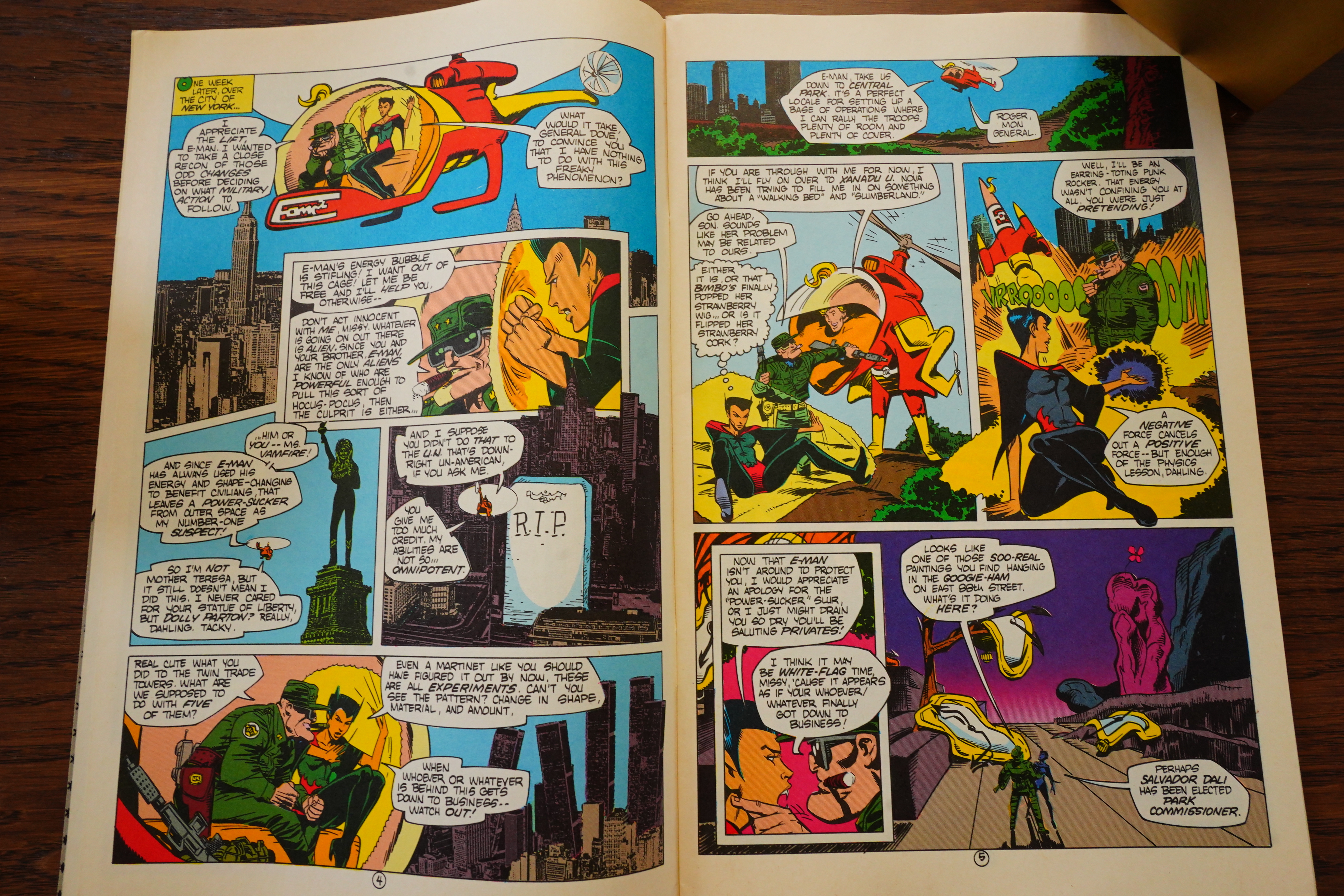
Next scene — here we have his sister being captured in an energy bubble… but… not captured after all… And the helicopter is E-Man? So this is like Plastic Man after all!? But I guess Plastic Man could go all technical like that — transform into a rocket and stuff…

Oh, it was a dream? *scratches head* I’m just saying that even for an alleged funnybook, the storytelling is kinda confusing.

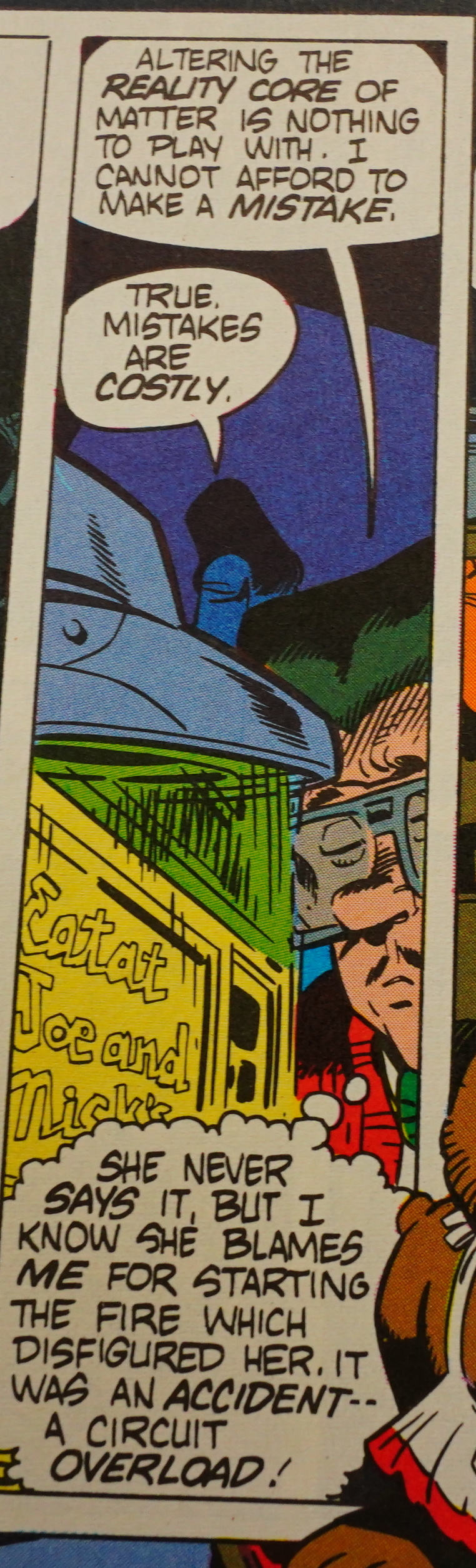
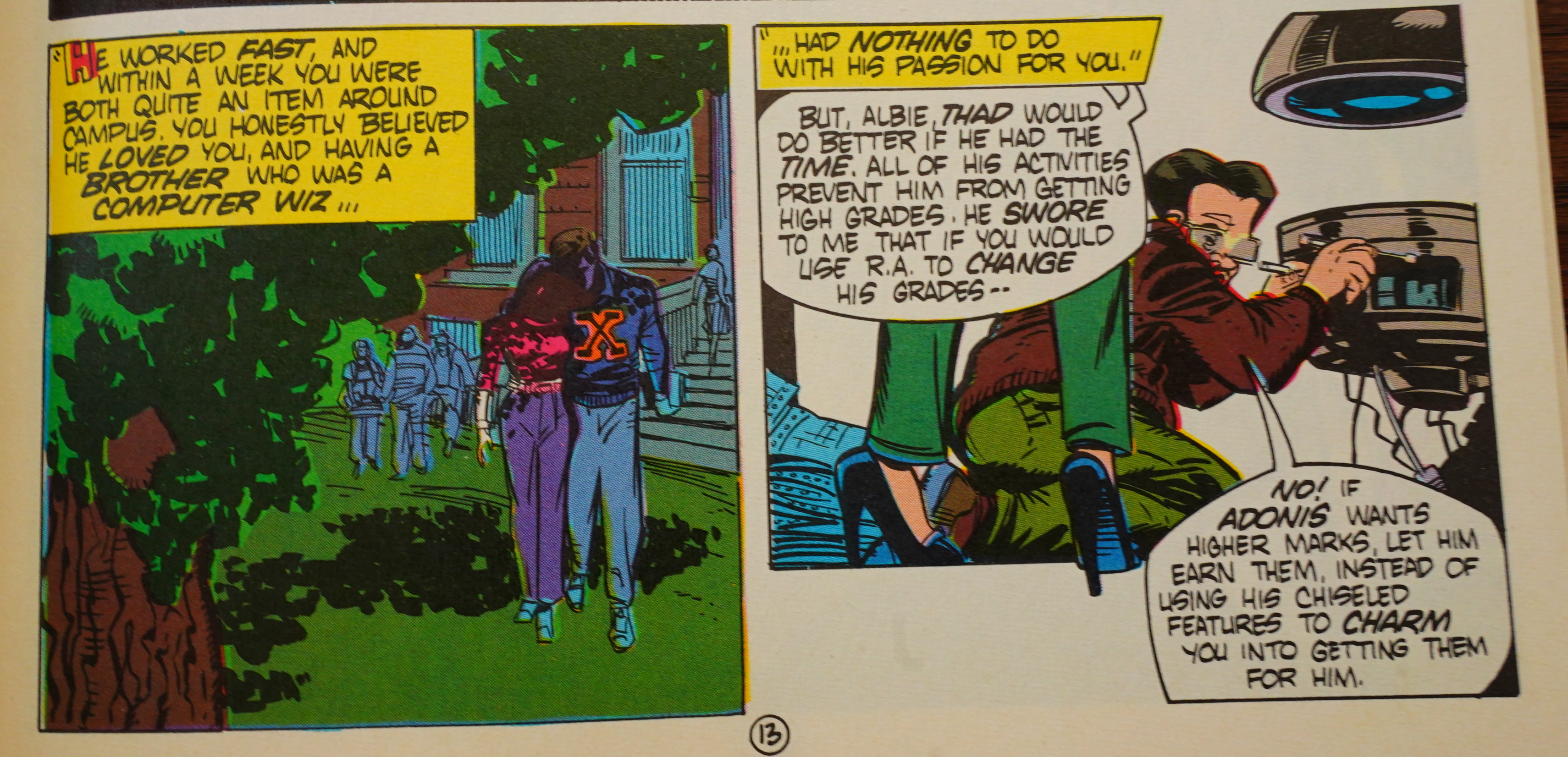
And very old fashioned: Not only do they do the “as you know, Bob” thing, but they have the characters helpfully think some thought bubbles at the reader. It’s fine, though.

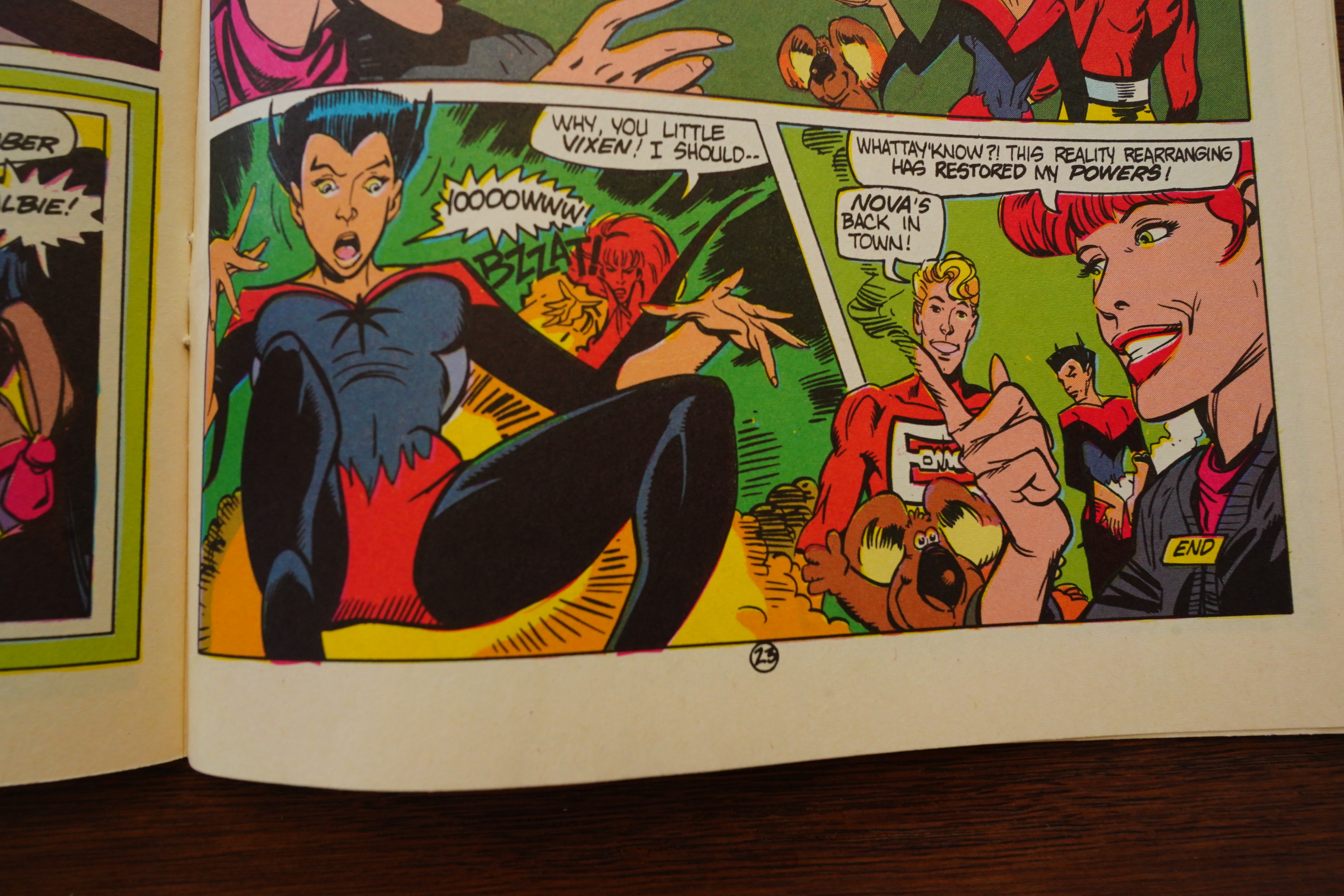
But it is like they don’t decide on what level of humour comic they’re going for — Plastic Man (to take a totally random example) is a humorous super-hero book with pretty sensible plots. Here they seem to go more for absurdity: The impetus for the story is that the inventor’s sister’s jock boyfriend (*phew*) wanted to use his reality-altering machine to improve his grades.

Which would work better if the general mood of the book was more… absurd?

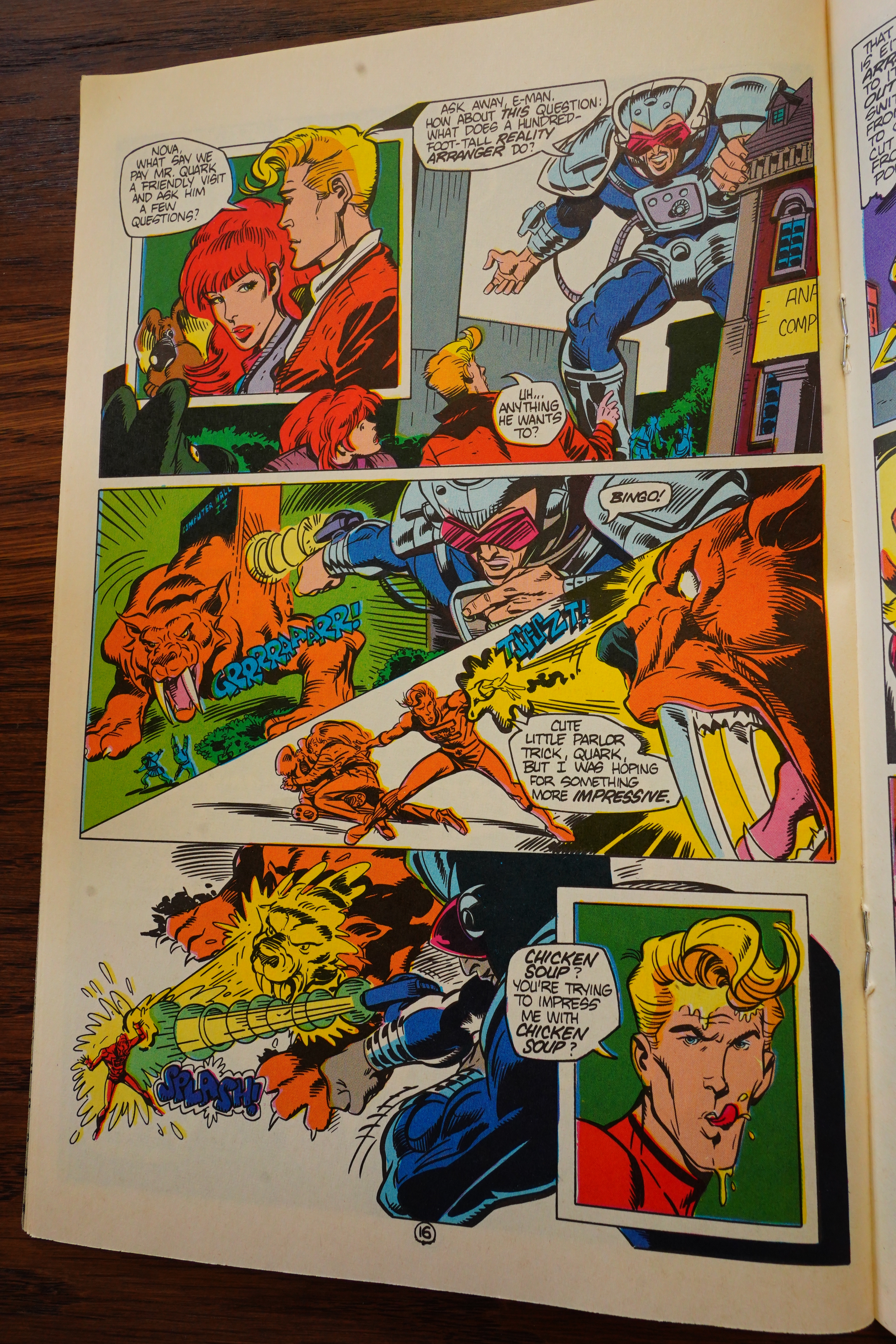
But I guess a super-villain that squirts chicken soup is pretty nonsensical, so perhaps it’s just me.

They do seem to have some overall series plot that they’re advancing, though — it doesn’t really feel like a one-shot.

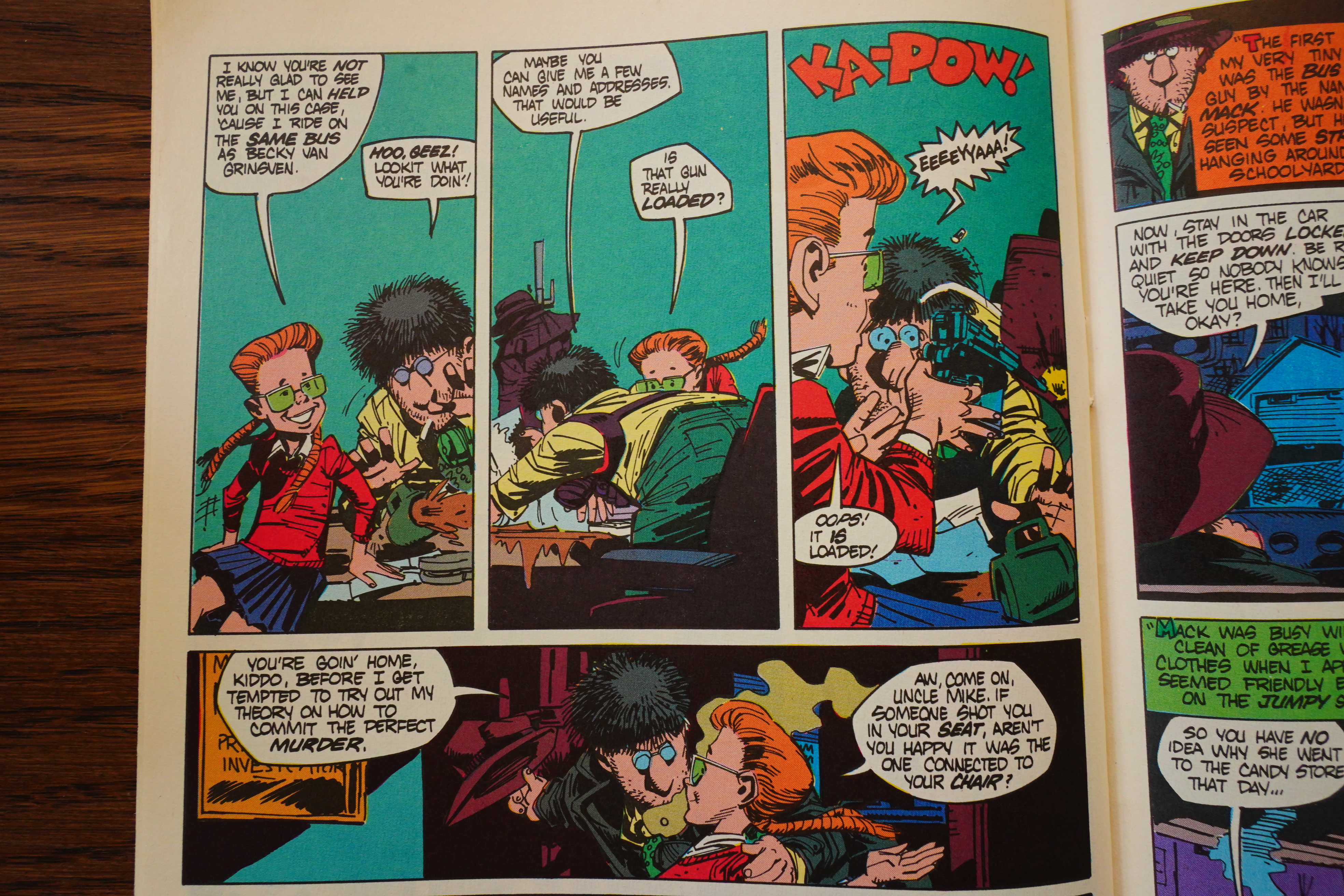
There’s a backup feature drawn in a quite different style, but with the same kind of jokes-that-don’t-quite-land.

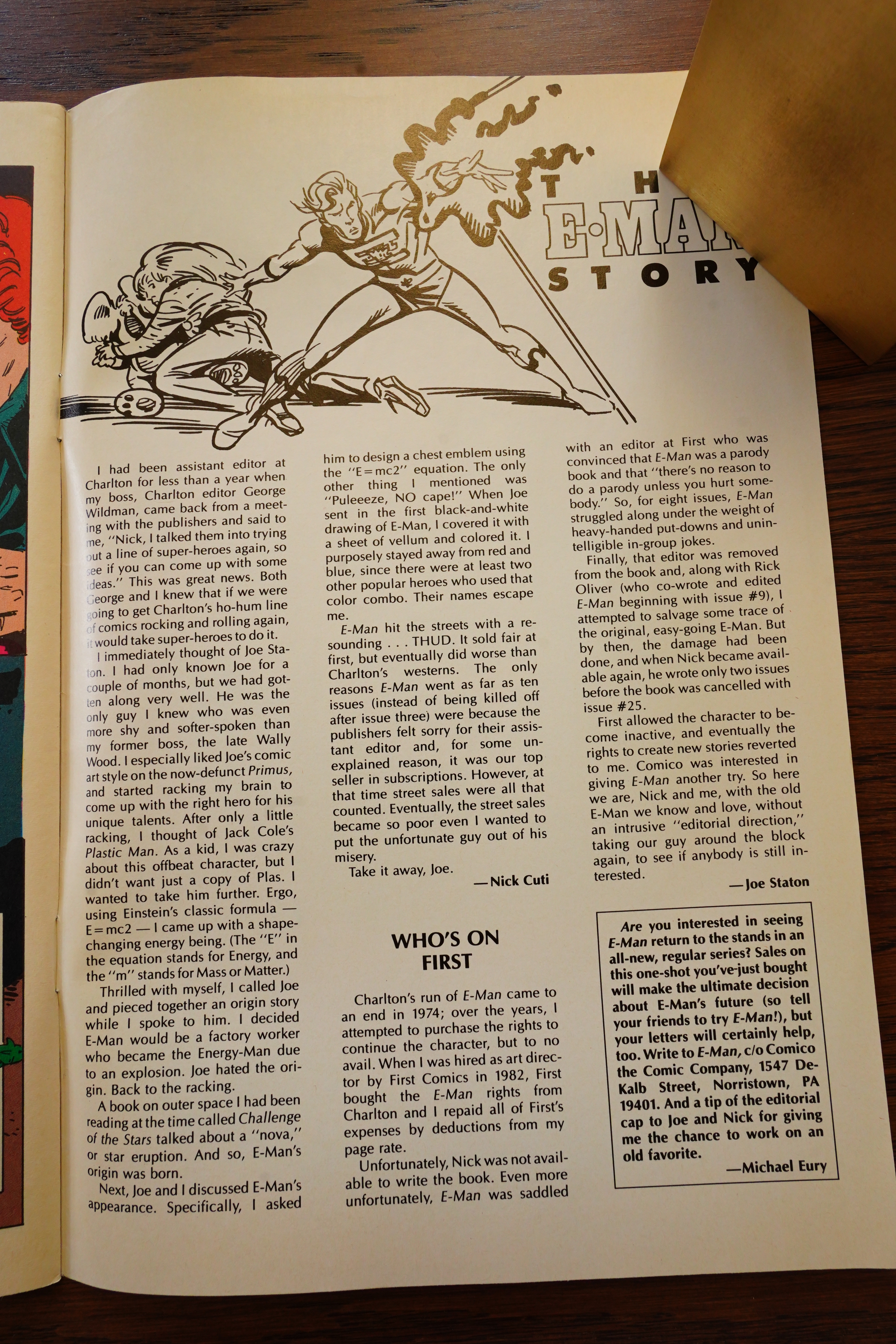
Finally, we get a history of the book from Cuti and Staton, which is nice.

Dwight R. Decker writes in Amazing Heroes #173, page #75:

Welcome Back, Alec Tronn: I’d like
to take a moment to welcome back an
old friend. That light-hearted super-
hero, E-Man, has returned for his
third comic book incarnation, this
time from Comico. What’s more, E-
Man’s creators, artist Joe Staton and
scripter Nick Cuti, are back on the
job, too. Glad to see you back, guys-
it’s been way too long.
E-Man began life in late 1973, pub-
lished by comic books’ answer to Hol-
lywood’s Poverty Row, Charlton. The
character wasn’t even human; rather,
he was an energy being from space
that took on human form, eventually
assuming the civilian identity of Alec
Tronn. As E-Man, he could turn him-
self into just about any shape and
stretch himself to nearly any length,
a combination of Tom Terrific and
Plastic Man. He even acquired a hu-
man girlfriend in exotic dancer Nova
Kane, in effect doing the Mork & Min-
dy number years before Robin Willi-
ams was teamed with Pam Dawber on
TV. Despite mediocre printing, the
10-issue run of this engagingly goofy
series was just about Charlton’s only
bright spot during the period. Unfor-
tunately sales were dismal, with Nick
Cuti saying that the title did worse
than even Charlton’s westerns.
Comico’s E-Man Volume III, #1 is
a try-out issue, and a regular series
will result if the one-shot’s sales war-
rant. All very well, except the one-
shot was priced at $2.75. It’s just a
regular-sized, 32-page comic book.
While it’s in full color and there aren’t
any ads, the price is a little on the
monumental side. Why not just put a
sticker on the book saying, “Do Not
Buy This Comic Book! We Want It To
Fail!” Unless there’s a hidden pocket
of E-Man fans out there willing to pay
any price to see their favorite hero
back in action, the bottom line would
be about the same.
It’s too bad, because E-Man is a de-
lightful comic book. Funny, a little
silly, much in the same vein as the old
Jack Cole Plastic Man. As artist Joe
Staton explains on the editorial page
in the back of the book, E-Man went
a little off the track for a while during
its second incarnation, because the
book “was saddled with an editor at
First who was convinced that E-Man
was a parody book and that ‘there’s
no reason to do a parody unless you
hurt somebody.’ So, for eight issues,
E-Man struggled along under the
weight of heavy-handed put-downs
and unintelligible in-jokes.”
That seems to be past now, and the
“original, easy-going E-Man,” as
Staton calls him, has returned in full
form. The first Comico story does
nothing less than dissolve the entire
world into primordial goo and then re-
construct it, about as drastic a way to
revive a series and reset the clock to
zero as anyone has thought of, and all
in somewhat less than five pages. As
a direct result of the world’s restora-
tion, Nova gets her powers back,
which she lost during the First run
“due to an encounter with the Pasko”
Syndrome,” as the caption drily puts
it. Since Martin Pasko wrote the first
few First issues, it seems likely that
Staton and Cuti are out to nullify the
effects of the Pasko Syndrome in more
ways than one.
But let’s run that First editor’s quote
back again. “There’s no reason to do
a parody unless you hurt somebody.”
What a hateful creative philosophy,
and what nasty and malicious stories
it could lead to! From what I’ve seen
of both Staton’s and Cuti’s work over
the years, they can be teasing and
playful, but never deliberately mean.
I doubt if either of them has it in him,
and certainly that’s a complete mis-
reading of E-Man’s cheerfully silly
nature. There have been too many
comics that would fill that unnamed
First editor’s requirements just fine,
and not enough like E-Man.
So, good luck, Joe, Nick-and E-
Man. This business needs you and
your good spirits. Let’s see some more
issues soon!

E-Man returned in a three issue mini-series a few months later, so I think I’ll cover more of the critical response to E-Man when we get to that in this blog series.

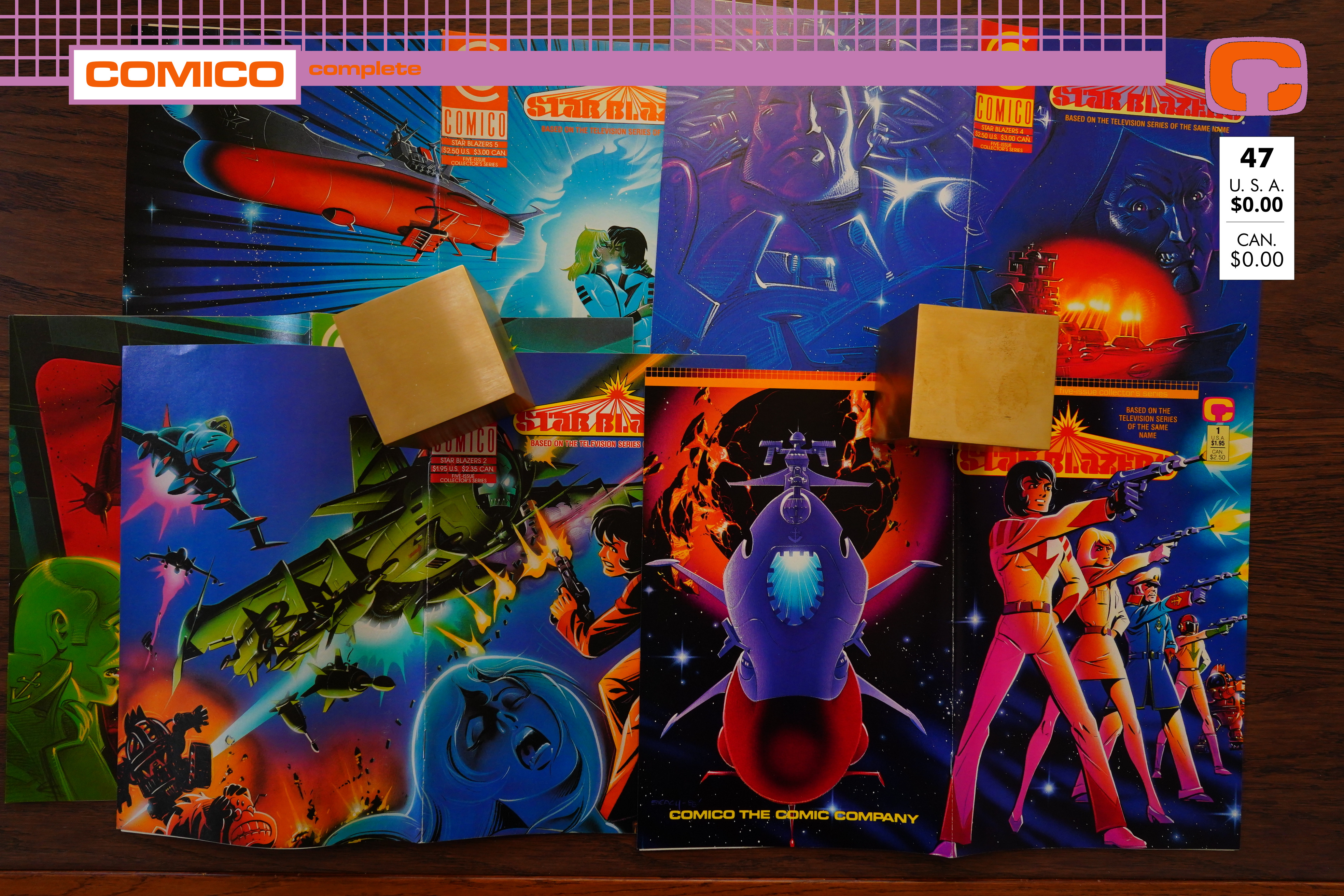
1989: Star Blazers

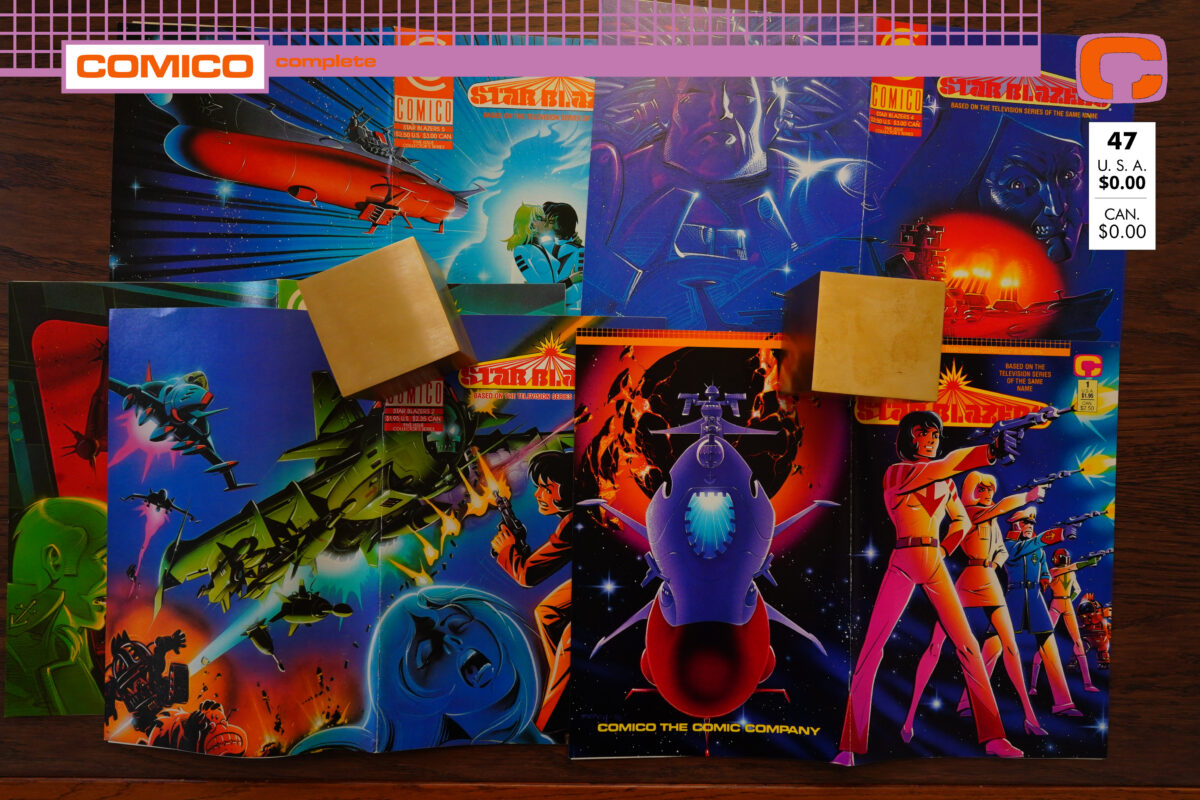
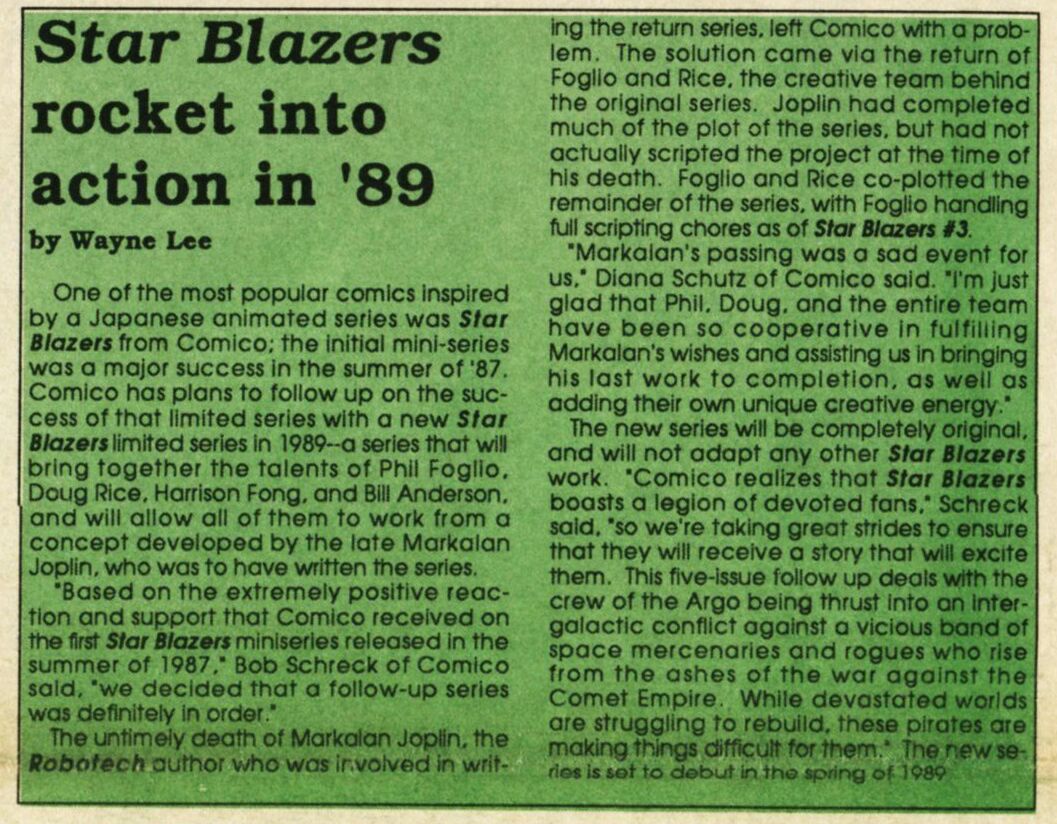
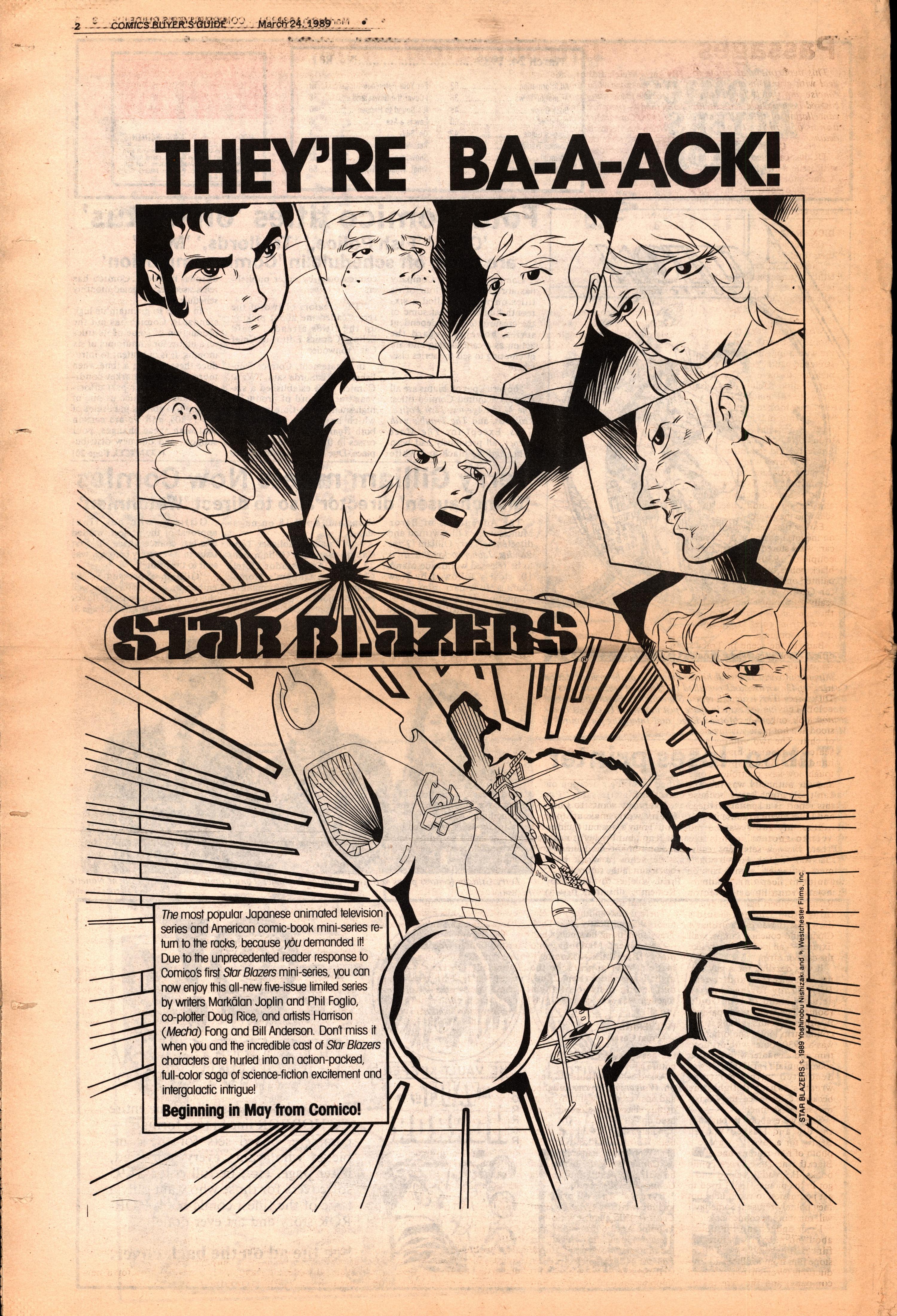
Star Blazers (1989) #1-5 by Markalan Joplin, Phil Foglio, Harrison Fong, Bill Anderson and others

Didn’t Markalan Joplin die the previous year? Oh, right — I’d forgotten the insanely long publishing schedules Comico operated with, so this must have been written a year in advance. Foglio took over the writing in the middle of the second issue.

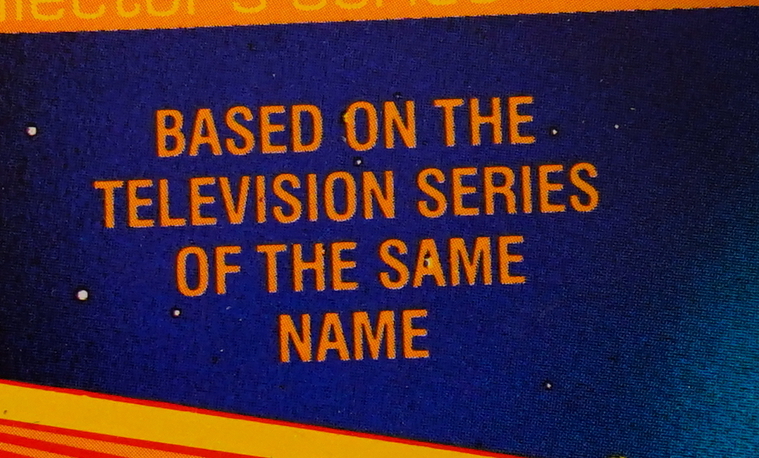
Oh, so it’s not based on Hill Street Blues? How smart of them to point this out!

Actually, it’s not just oddly phrased, but also rather puzzling — surely the series was originally called Space Battleship Yamoto or something? And then it was called Star Blazers in the US… Odd…

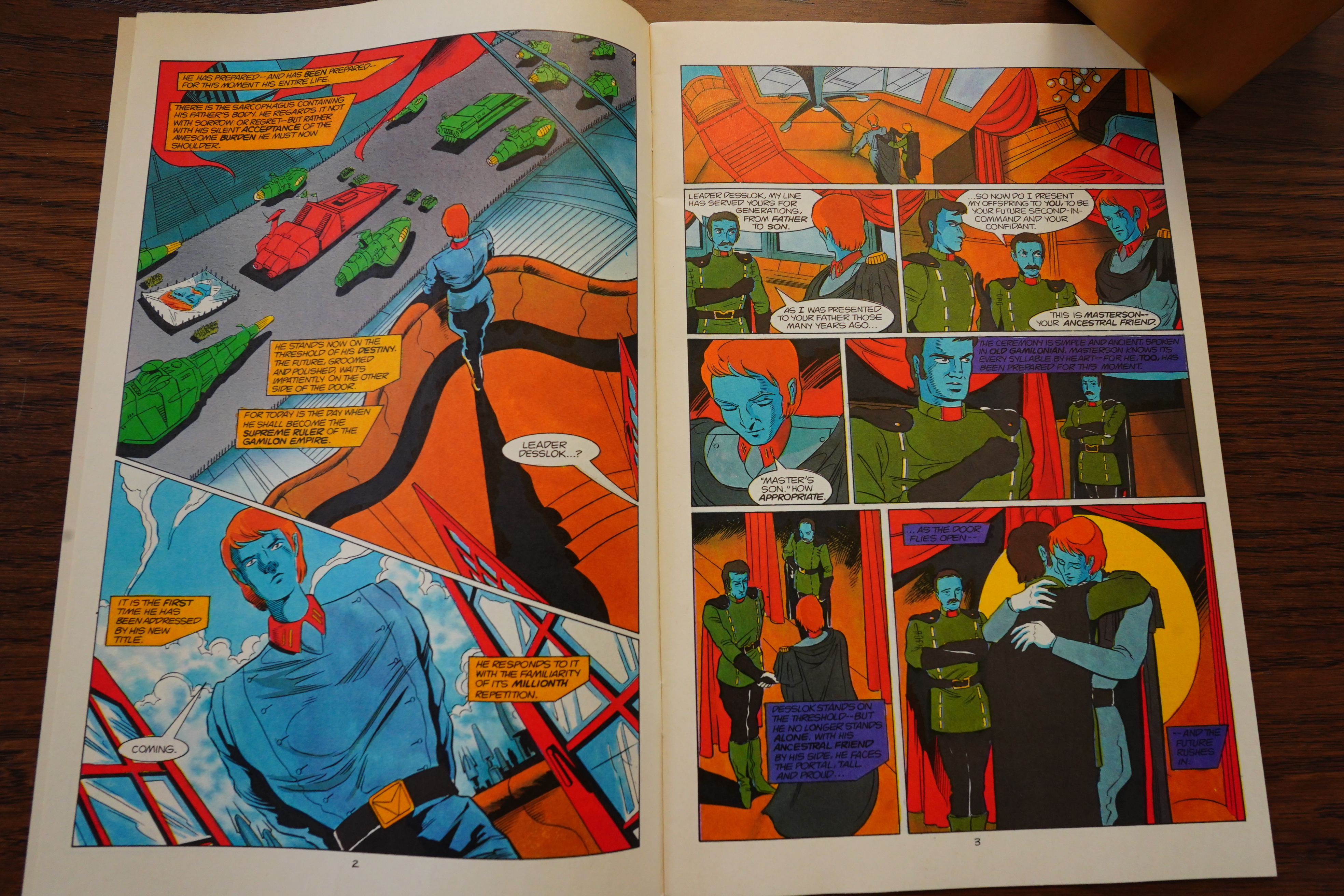
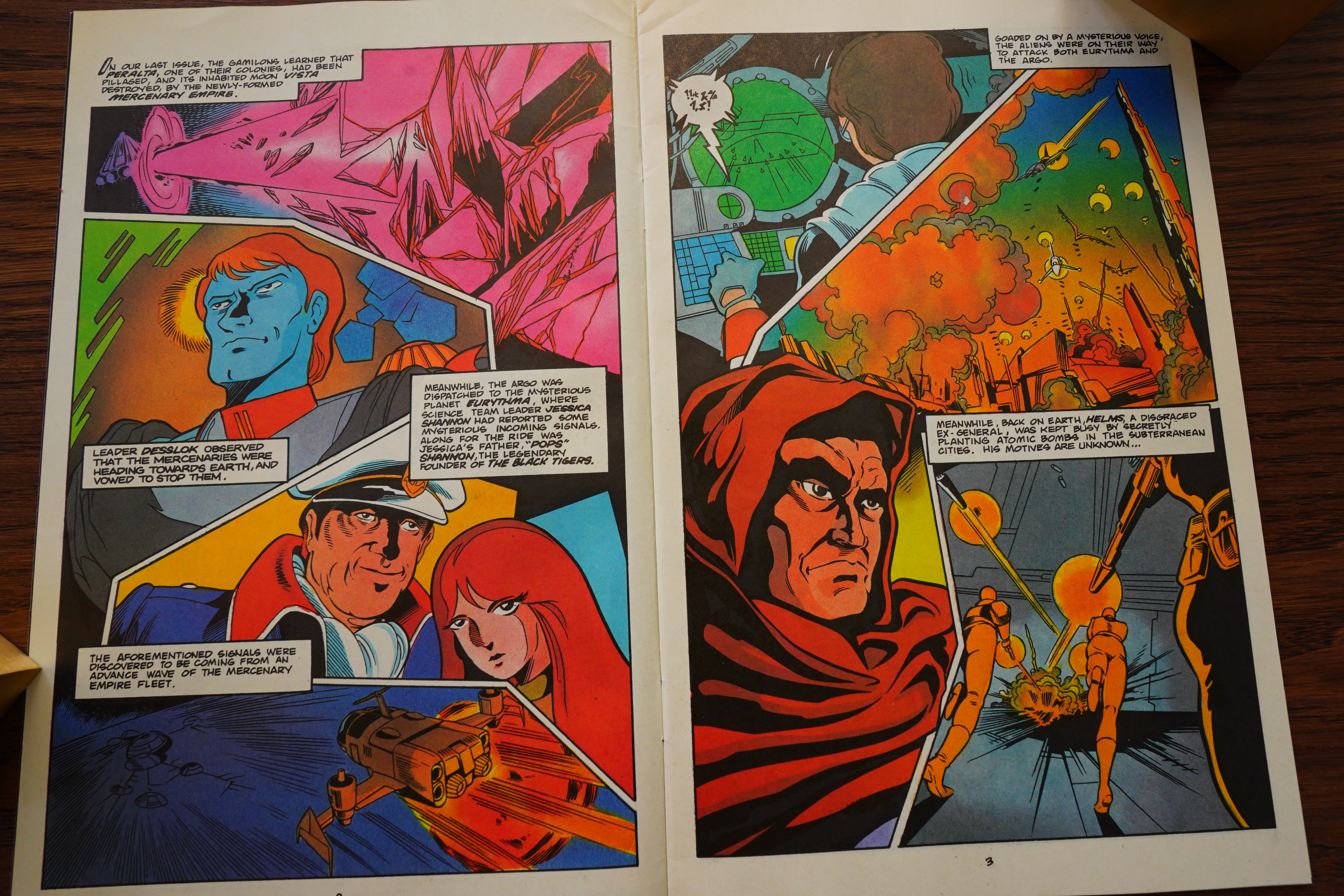
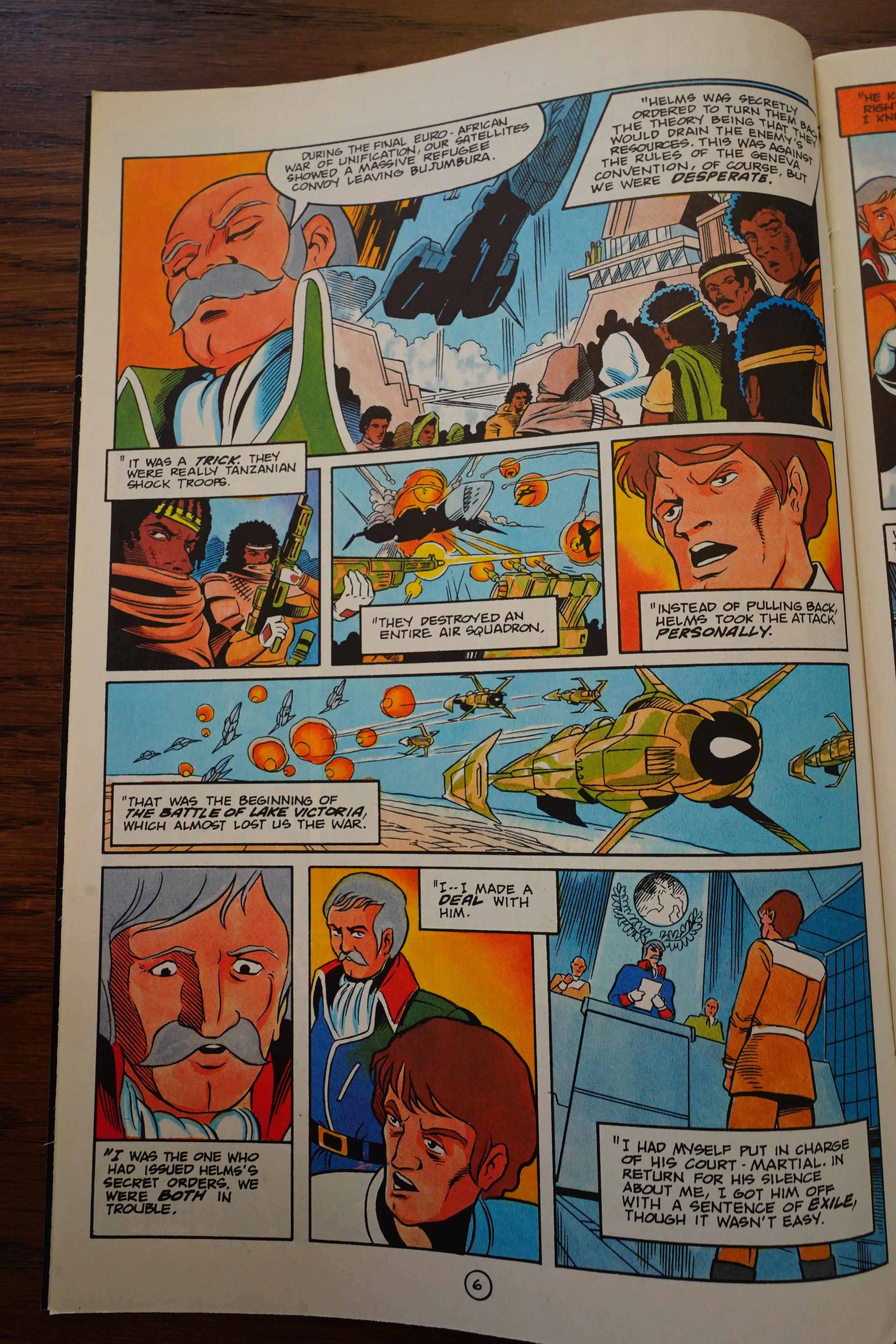
If there is one recurring thing about Comico comics, it’s that they tend to start pretty abruptly, in the middle of some action, and we often don’t get much exposition. It’s fun when it works. This, on the other hand, takes a very different approach — we get pages and pages and pages of exposition, and possibly recaps of things that have happened before?

It’s not really clear. It makes for an awkward start, though. So much plot to get through doesn’t leave any room for any characters to display some character.

Ah right… Yamoto. I knew it!

We also get the backstory of some of the characters, but since we don’t really know them, it’s like *shrug*? Perhaps this is of intense interest to fans of Yamoto.

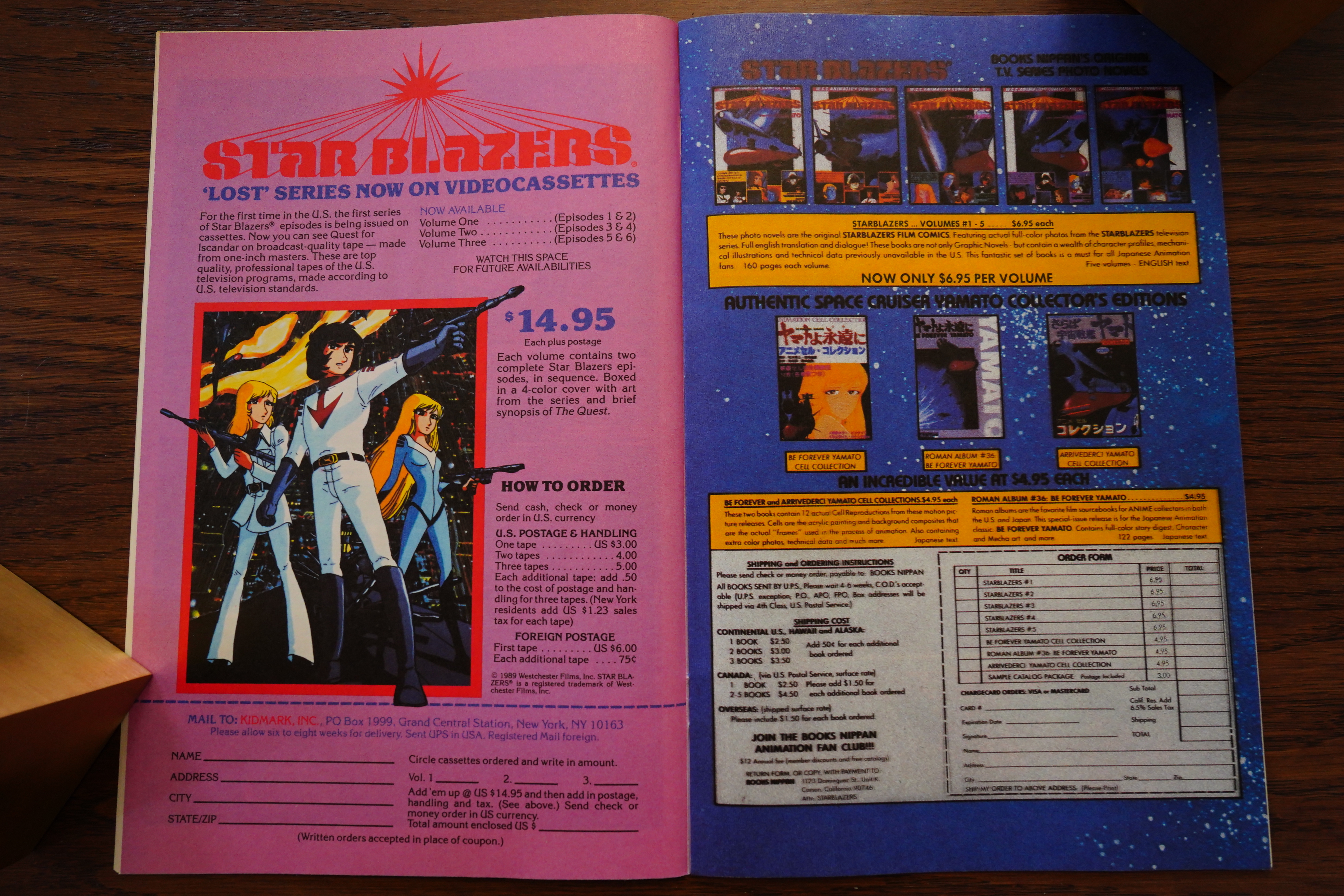
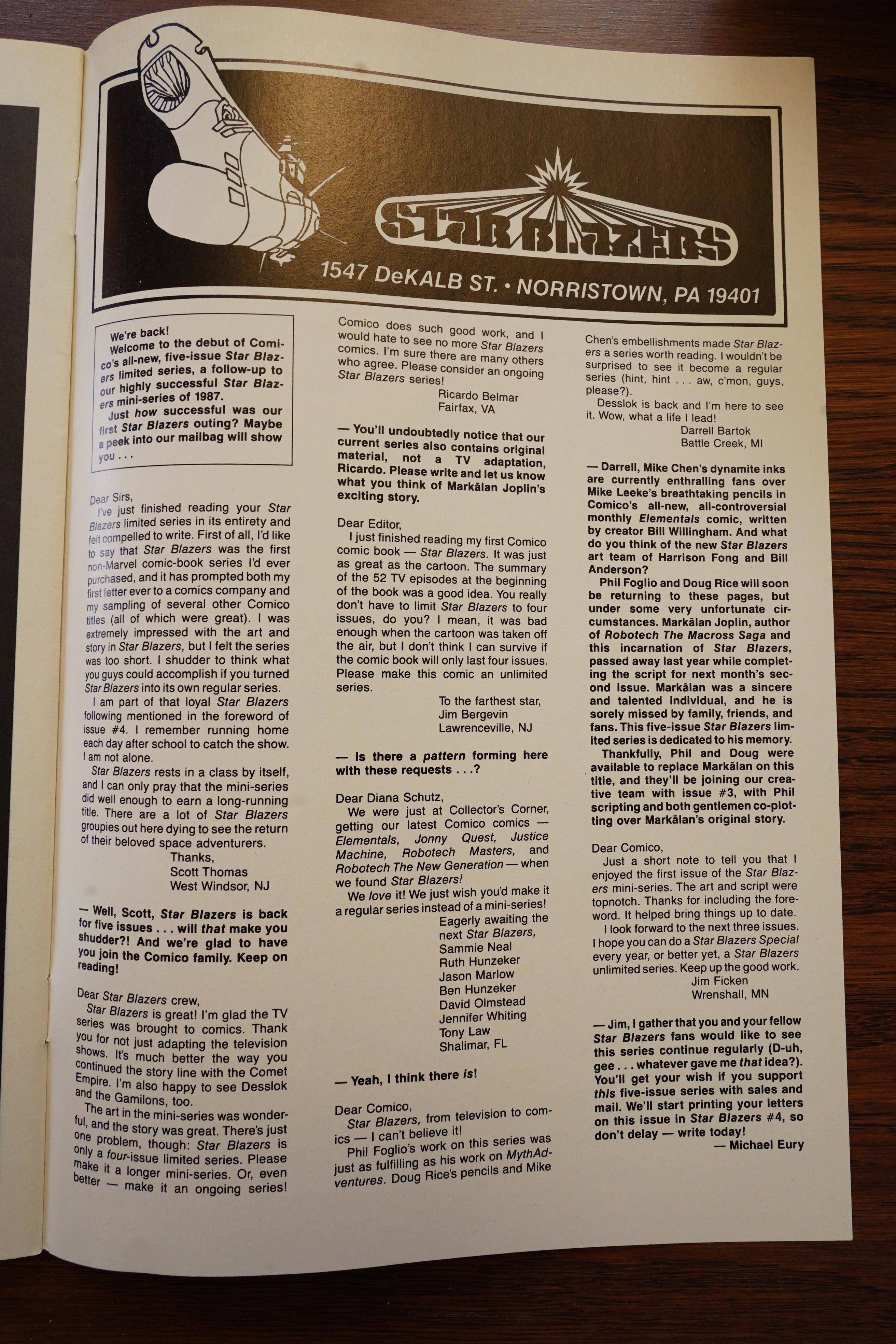
We get letters talking about the previous Star Blazers mini series.

The second issue starts with… a recap of the first issue, which seems like an odd choice for a five issue mini series. But also very unusual for Comico — they seldom do recaps.

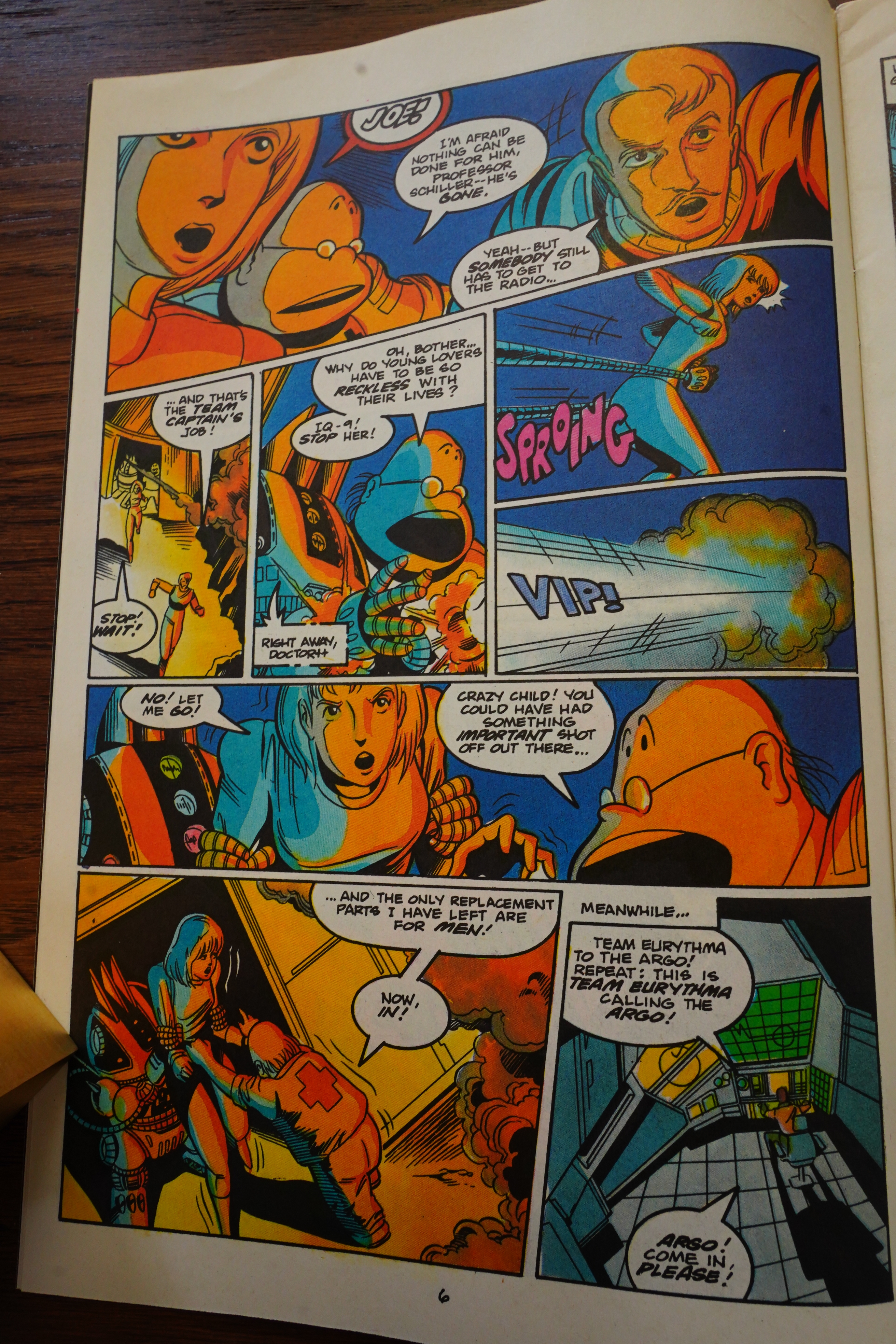
Only replacement parts for men? *ponder*

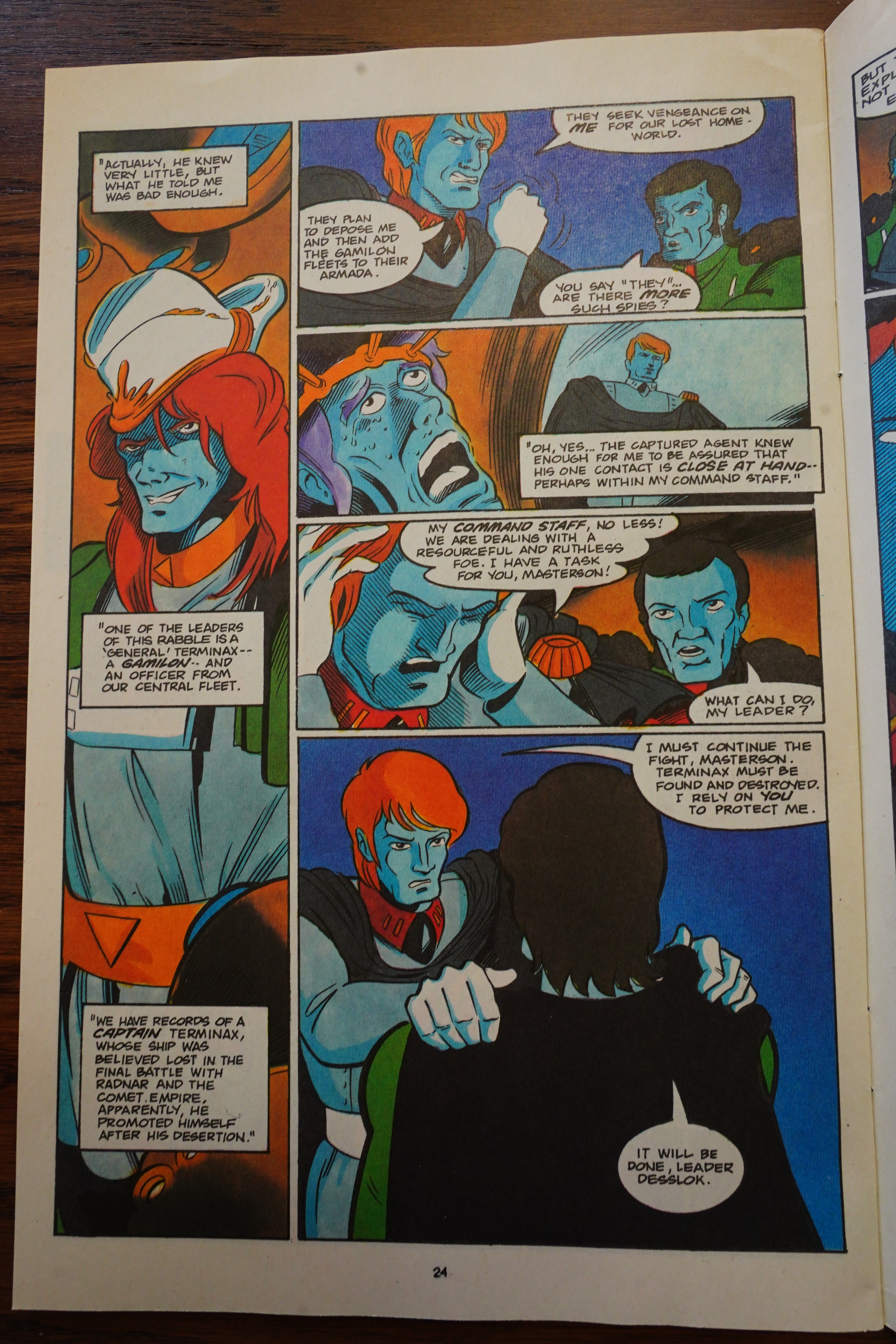
Oh, there’s a traitor on the command staff! And since the only two people on the command staff we know is 1) the guy with orange hair, who’s the boss, and 2) the guy with brown hair, let’s have a poll! Who do you think this mysterious unknown traitor on the command staff is! WHO CAN IT BE

Yeah yeah, I know, it’s a series for kids, but c’mon. Not all kids are morons.

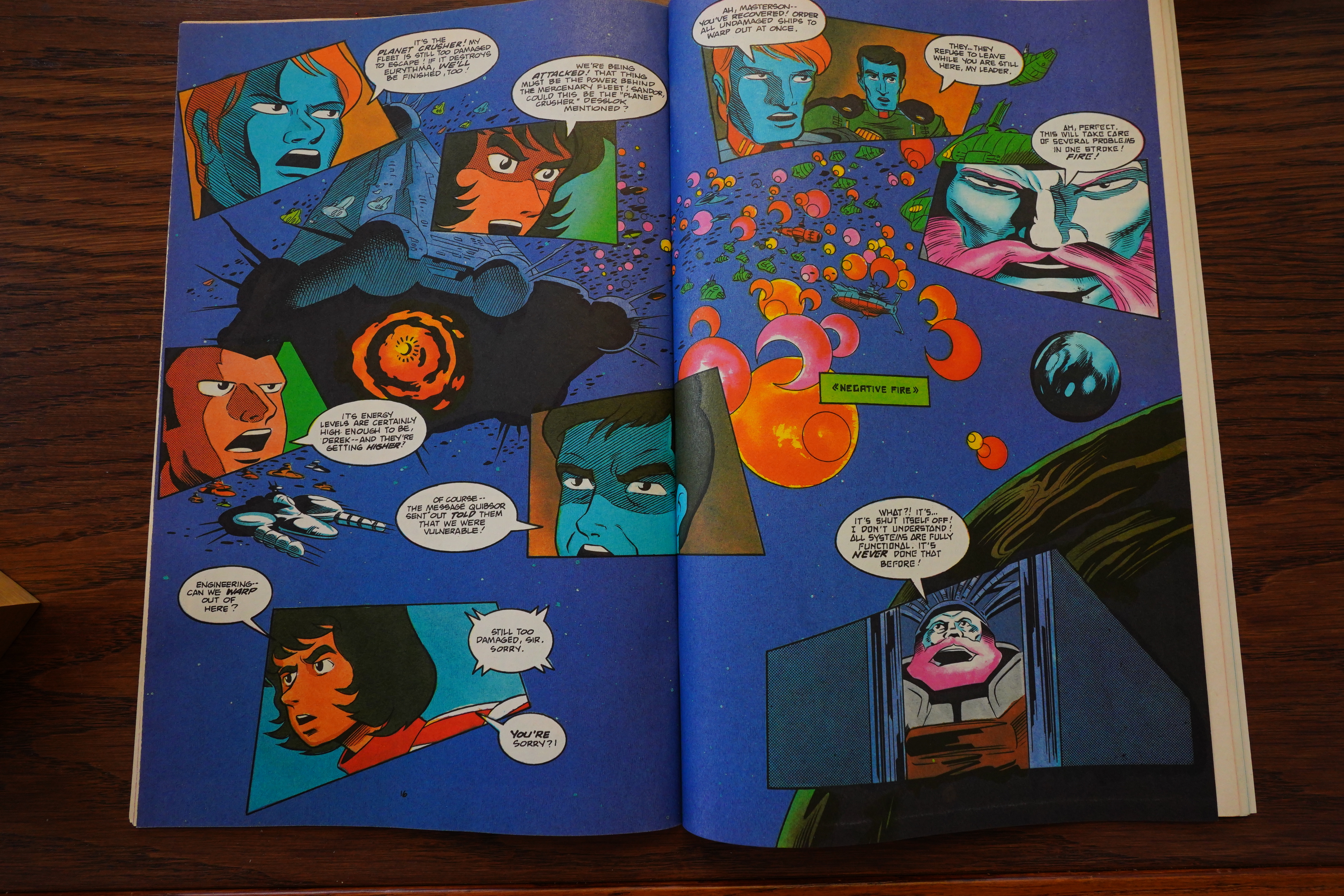
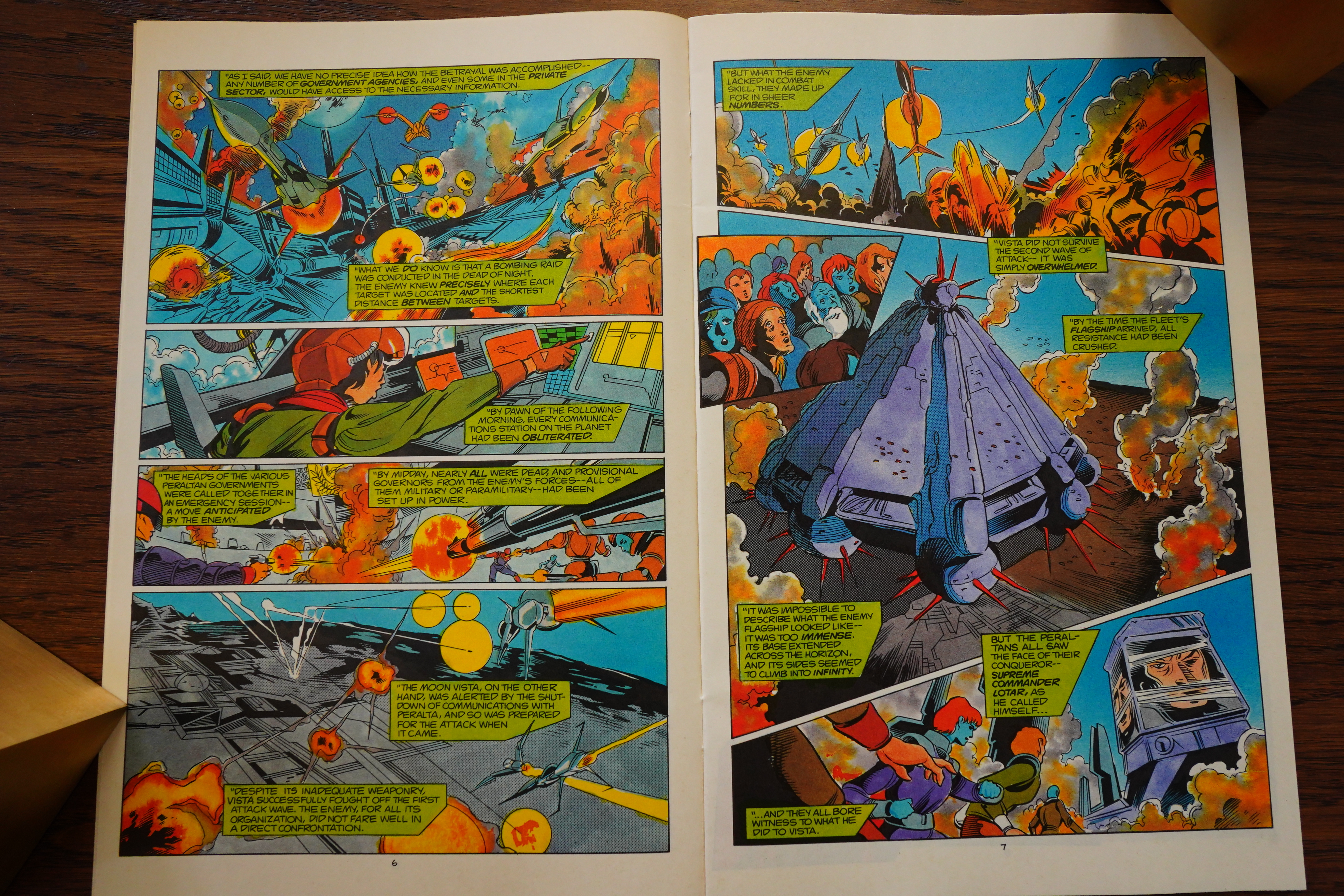
Oh, the plot… there’s about four factions, and two of them want to destroy Earth (for reasons that seem kinda vague), and then there’s the earthlings, and then there are the blue guys who are our allies. (Sort of.) If you surmise that this means that it’s chock full of plot, plot, plot, then you’re right.

Then we get the backstory of another guy, who’s not even a character in the book! Why.

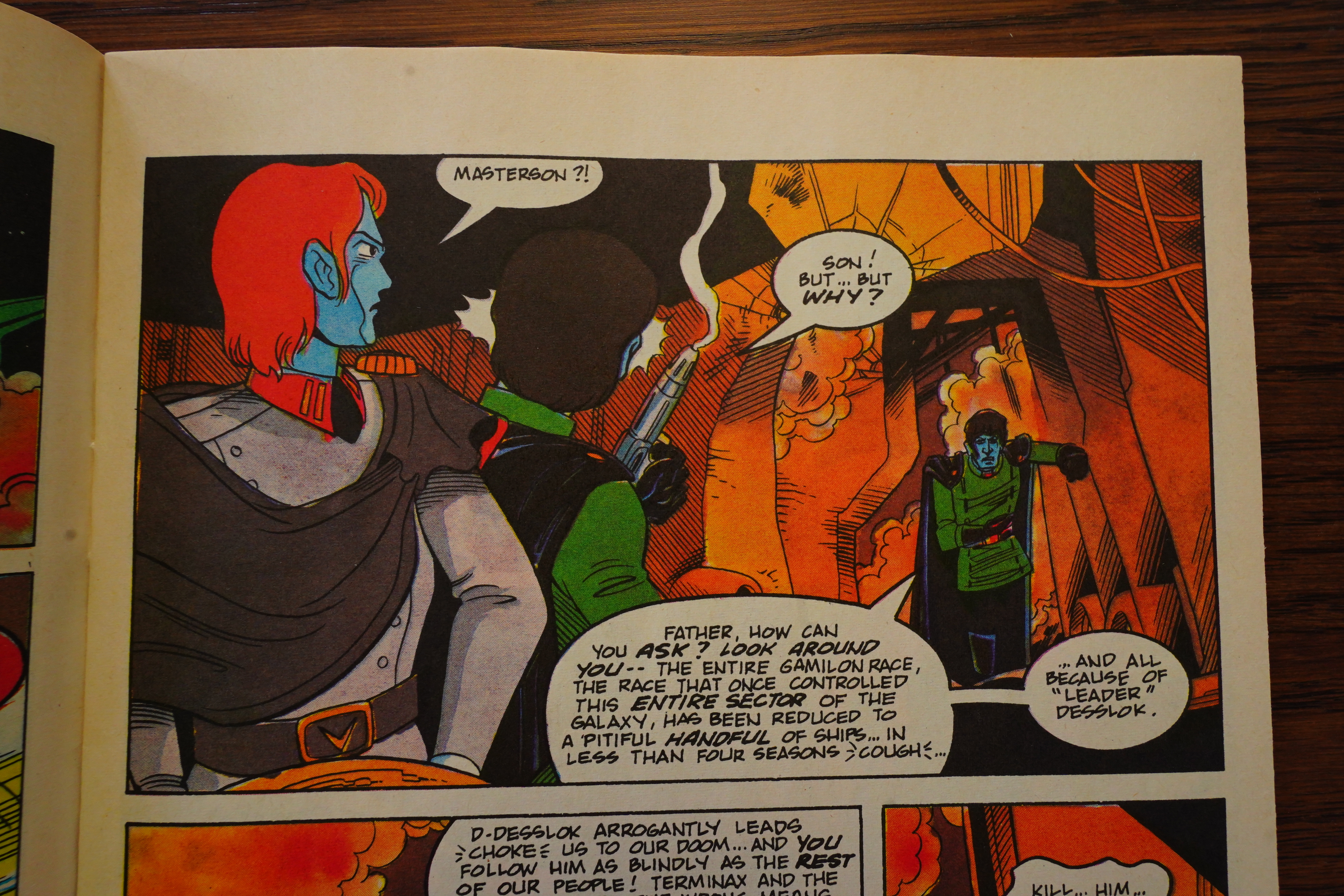
Well, whaddayouknow — the traitor turned out to be the only character in the book who it could possibly be.

Oh, and there’s the soul of a planet who’s being held captive. You know, the normal Japanese animated series stuff.

I will admit to not being in the mood to be reading something like this, so my annoyance with the book might not be the book’s fault. But even taking that into account, I think it’s a pretty lame book.

The artwork works pretty well, though.

Back Issue #59, page #76:

The first Star Blazers miniseries sold beyond Comico’s expectations,
but a follow-up series was not released for two years. No one seems to
know the reason for such a long delay, although it is possible that
Comico may have only negotiated the rights to produce one miniseries
and had to re-negotiate a new deal for a second one. Whatever the case
may be, Foglio and Rice were not asked to return … at least, not at first.
“We turned in the first one and heard absolutely nothing—good,
bad, or indifferent,” Foglio says. “It was a big surprise to us when
Comico announced another one. They didn’t tell us anything.”
The second miniseries ran for five issues and was to be written by
Markalan Joplin with art by Harrison Fong and Bill Anderson. However,
Joplin died of AIDS complications after writing the first issue. “Markalan
Joplin was entrenched in the Star Blazers and Robotech camp at Comico
when I came on board,” says Star Blazers (and BACK ISSUE) editor
Michael Eury. “I remember him fondly. He understood the material and
universe, which helped me as editor, since I was unfamiliar with the
concept. As his condition worsened, his pace slowed down, but he kept
the lines of communication going. A professional until the end.” With
Joplin gone, Comico asked Foglio to replace him. “I said, ‘Sure, if I can
work with Doug!” Foglio explains. “I enjoyed the series and the
characters, but Doug was very much the expert on Star Blazers.” Rice adds,
“I had voiced my ire to the Comico people and they didn’t appreciate it.
So, as far as I was concerned, I was never going to hear from them
again-that was the end of it. But then, they contacted Phil to do the
second series … and he got me involved. I’ll work with Phil on anything!”
This time, Rice worked with Foglio on the story, but Fong and
Anderson remained as the art team. “I was actually pleased with the
art on the second series,” Rice says. “I thought the artist had a very
nice take on the anime style.” Having to follow Joplin presented some
problems, however, since he had only written a rough plot for the series.
“His notes were unclear,” Foglio recalls. “We tried to keep as much in as
we could.” Rice added, “We had to kind of fill-in the blanks. We put
a lot of effort into it to make it cohesive. We weren’t able to change
anything, because the first issue was already in production. This resulted
in some continuity errors.” Among these was the presence of engineer
Orion and Black Tiger pilots Conroy and Hardy, who were all killed in
the Japanese version of the Comet Empire series. Although their deaths
were removed from Star Blazers, they did not appear in Comico’s first
miniseries. Also, Joplin had planned to explain the Talan/Masterson
name switch by introducing Masterson as Talan’s son and Desslok’s new
aide. Foglio and Rice were unaware of this, so they had Masterson turn
out to be a traitor and killed him off.

Heh heh.

Amazing Heroes #166, page #70:

A sub-wave of the Japanese manga-
mania tsunami sweeping the comics
industry now is manga-inspired or
manga-like original stories in English.
Star Blazers is such a product, a
comic based on the animated Japanese
TV show of the same name from
Westechester Films. Comico pub-
lished a successful four-issue Star
Blazers mini-series in 1987, inspiring
this new five-issue mini-series. Unfor-
tunately, writer Markalan Joplin died
while completing the second issue, so
Phil Foglio and Doug Rice will take
over the remainder of the series.
Star Blazers is an unpretentious gal-
actic space-opera in the Star Wars/Star
Trek mode. This series picks up dur-
ing the aftermath of the Gamilon Em-
pire/Comet Empire war, with both
sides in disarray. A double story en-
sues, one concerning the new Gami-
lon ruler and a mysterious attack on
the peaceful planet of Peralta and its
colonized moon Vista, the other con-
cerning the Star Blazers’ investigation
of a planet with a perfect orbit, Eury-
thma, and a mysterious ethereal out-
line of a woman that has appeared on
the planet pointing to a particular sec-
tor of space. Eurythma is attacked by
unknown assailants at the end of the
story.
These plotlines are apparently rela-
ted, but that is not strongly established
in the story, so there could be some
confusion for readers, especially new
ones not up-to-date on the Star Blazers
universe. It is never even clearly estab-
lished that the Blazers are connected
with the Gamilon Empire.
In general, the whole issue is rather
thick with characters and exposition
(lots of explanations and flashbacks),
though everything is handled fairly
skillfully. The biggest problem I had
reading the book was with its tired
genre. Twenty years of Star Wars and
Star Trek space opera has worn a bit
thin, and this issue includes many of
the cliches: dreadnoughts, federation
officers gone bad, even the obligatory
bar scene (which Star Trek did first
in “The Trouble with Tribbles,” by the
way).
But if you savor space opera, Star
Blazers is done pretty well. Its plot-
line with the mysterious figure is fresh
enough, and there’s an interesting sub-
theme about the relationships between
generations of space officers. The plot
about the planet Peralta, a people who
have devoted their resources to the arts
and sciences since they depend on the
Gamilon empire for defense, strikes
disturbingly near to the present-day
Japanese-American situation, so
Peralta’s destruction has some pos-
sibly interestingly real-world reverber-
ations.
The art is executed in the traditional
manga cartoony fashion, so decide for
yourself if you respond to that style.
Though I enjoy the clean linework, I
personally find that the cultivated por-
trayal of young people renders their
facial features indistinguishable.
Established Star Blazers fans should
certainly pick this up. Others may
enjoy coming along for the ride, too.
GRADE: FINE
— Thomas Dean

There’s some chatter about the series on the tubes:

After the unprecedented success of Comico’s first Star Blazers miniseries, a second miniseries was commissioned. It was to be written by Markalan Joplin and Phil Foglio. This time, a plan was made to reconcile some of the continuity flaws between the Comet Empire and Bolar Wars anime translations.

This plan included explaining how the Masterson family became Desslok’s “Talan” or “aide-de-camp” in the thinking of writer Joplin. However, Joplin’s untimely death interrupted these plans and the miniseries had to be completed by others. In any event, an entertaining story was still produced. This series was to be an issue longer than the previous one, and it also racked up great sales and some memorable original characters. However, it also had its own flaws…

[…]

A discussion with Star Blazers super fan Rob Fenelon about the second miniseries:

How did the second series come about?

Comico got another deal, to do another comic book. And once again, they hired another author who had never seen Star Blazers. His name was Markalan Joplin. They hired me to bring him up to speed, so I supplied him with the anime comics from Books Nippon, old Roman Albums, and had videotapes of the entire series. He wrote back right away about some continuity errors between the second and third season.

The reason for the continuity errors was that when Claude Hill of Westchester Films had the third series dubbed, he tapped his old friend Peter Fernandez to write it. Peter had never seen the second series. And this is one of the great regrets of my life, I kick myself because I should have known what was happening.

[…]

The comics sold extremely well in both the first and second incarnations.

And here:

And the less said about the art, the better. Much of this book looks rushed and the coloring looks atrocious in many panels. Rice and Fogilo should have handled the art chores themselves, in my opinion. The pair gave Dynamo Joe a crispness that is missing from Star Blazers vol 2, and it is something the art desperately needs.