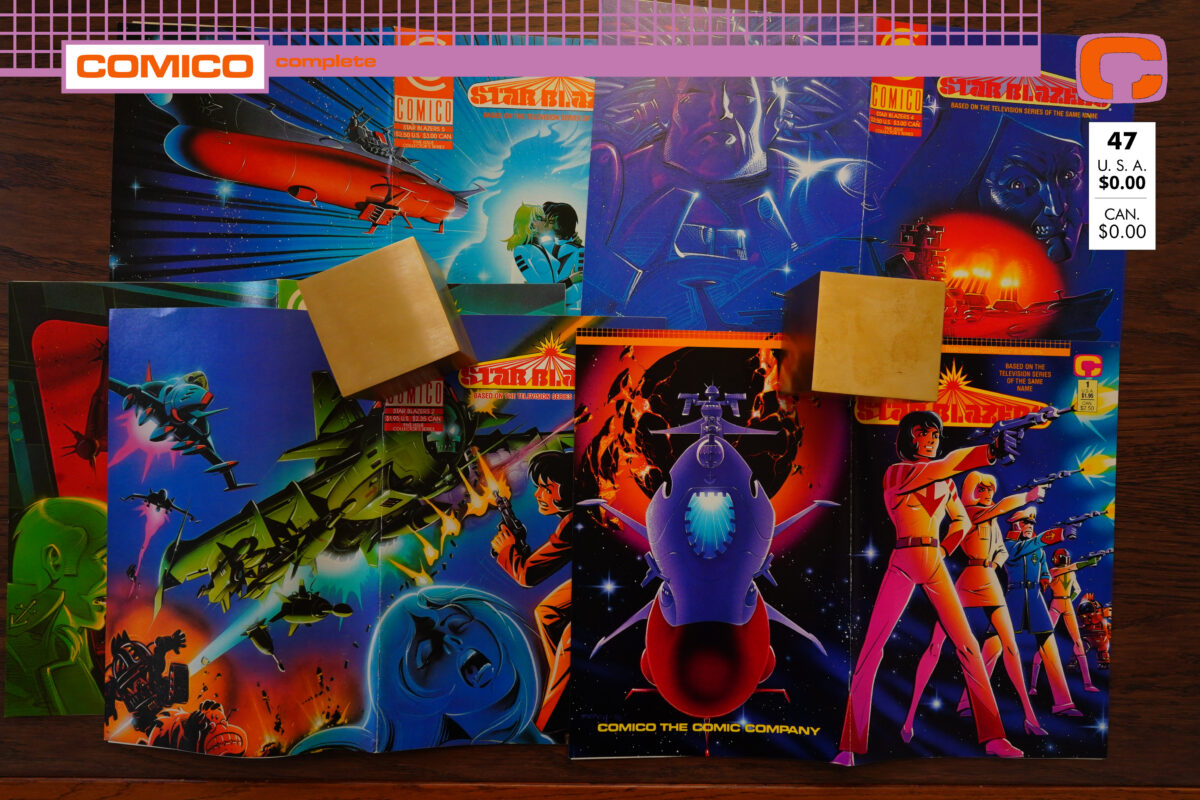
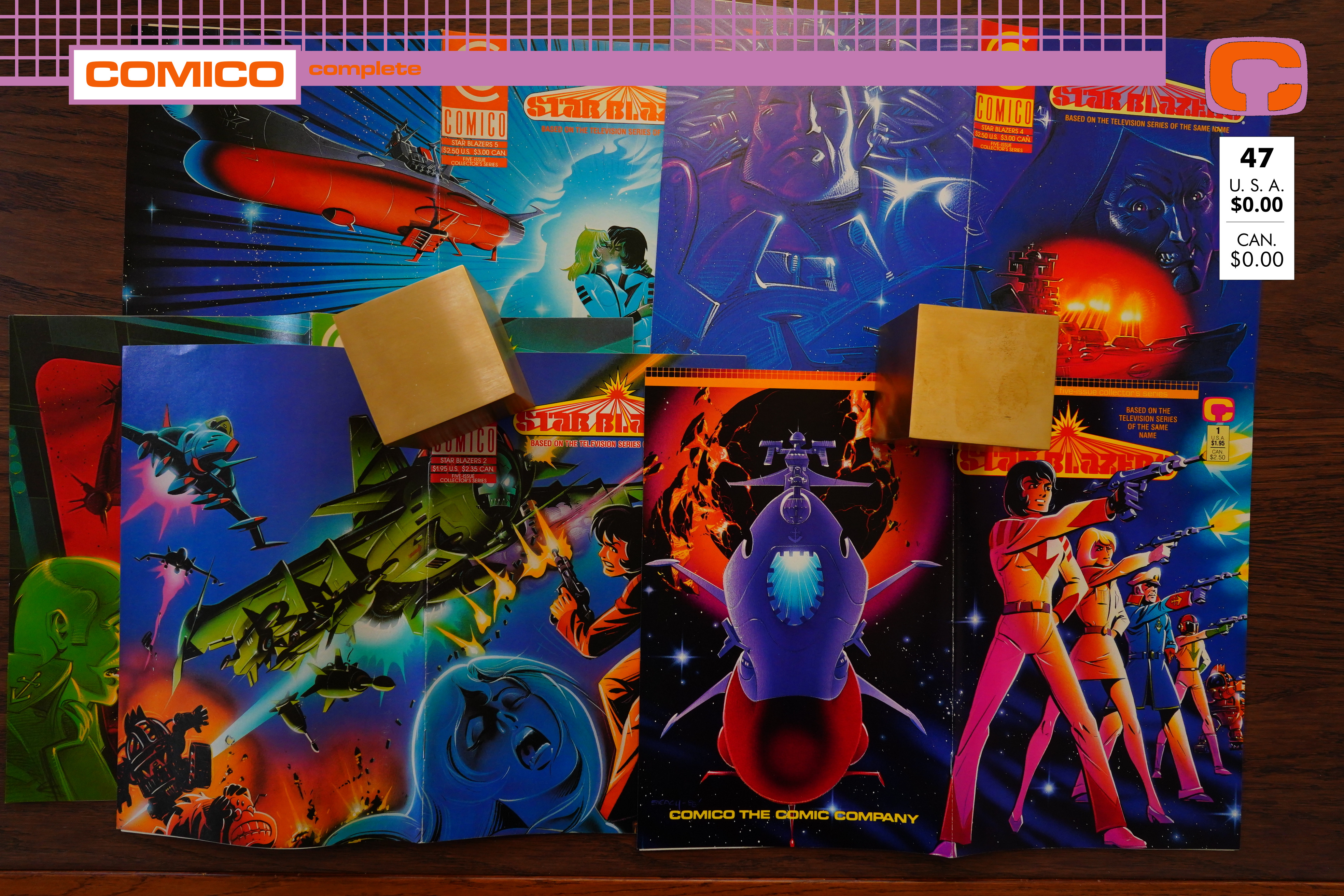
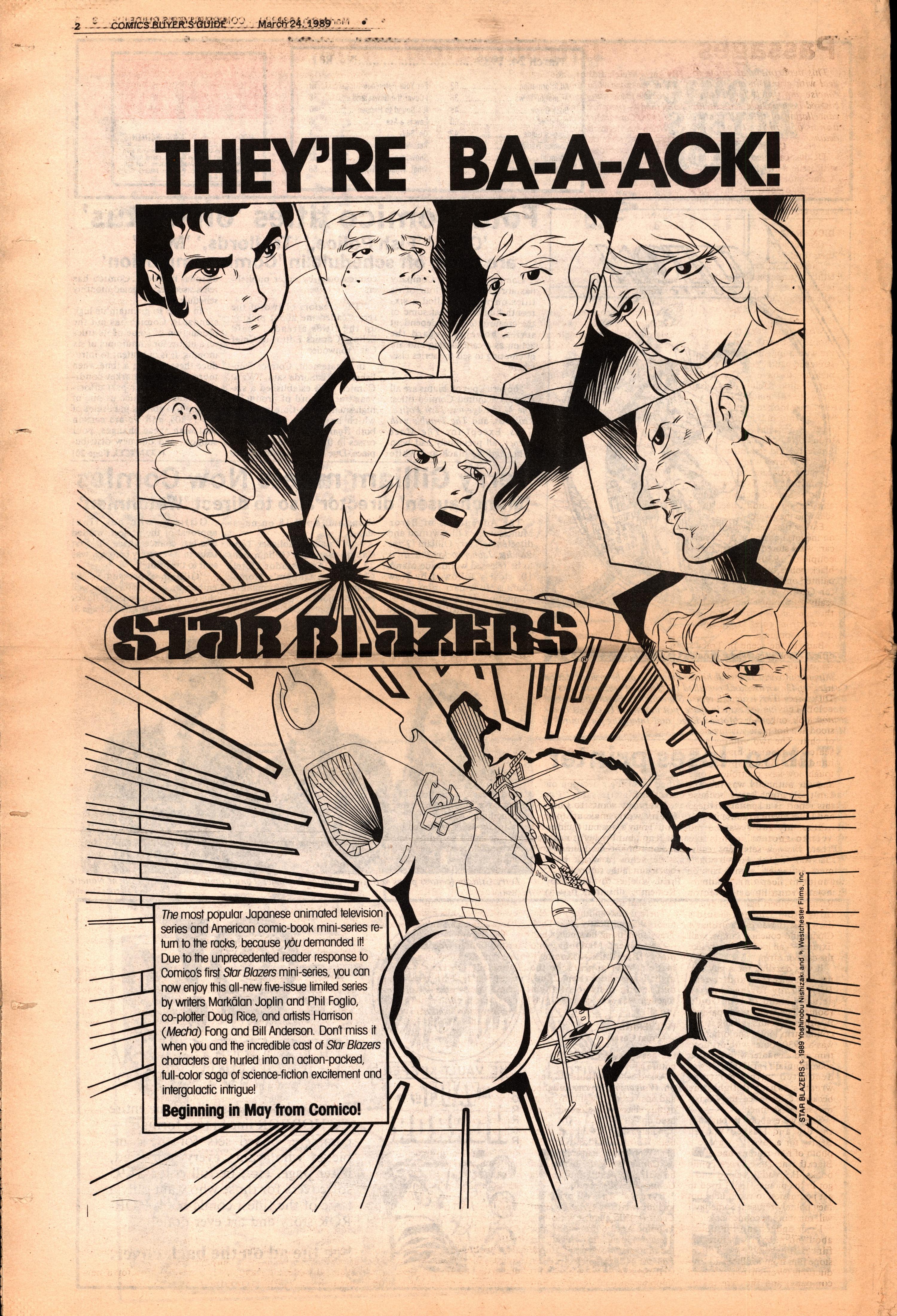
Star Blazers (1989) #1-5 by Markalan Joplin, Phil Foglio, Harrison Fong, Bill Anderson and others
Didn’t Markalan Joplin die the previous year? Oh, right — I’d forgotten the insanely long publishing schedules Comico operated with, so this must have been written a year in advance. Foglio took over the writing in the middle of the second issue.
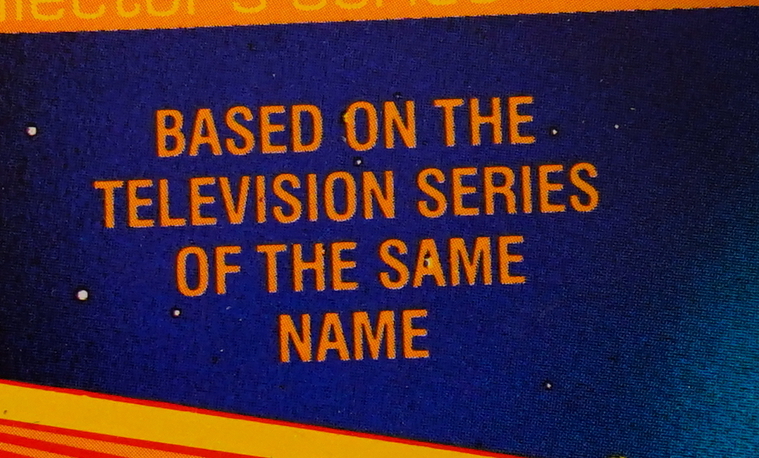
Oh, so it’s not based on Hill Street Blues? How smart of them to point this out!
Actually, it’s not just oddly phrased, but also rather puzzling — surely the series was originally called Space Battleship Yamato or something? And then it was called Star Blazers in the US… Odd…
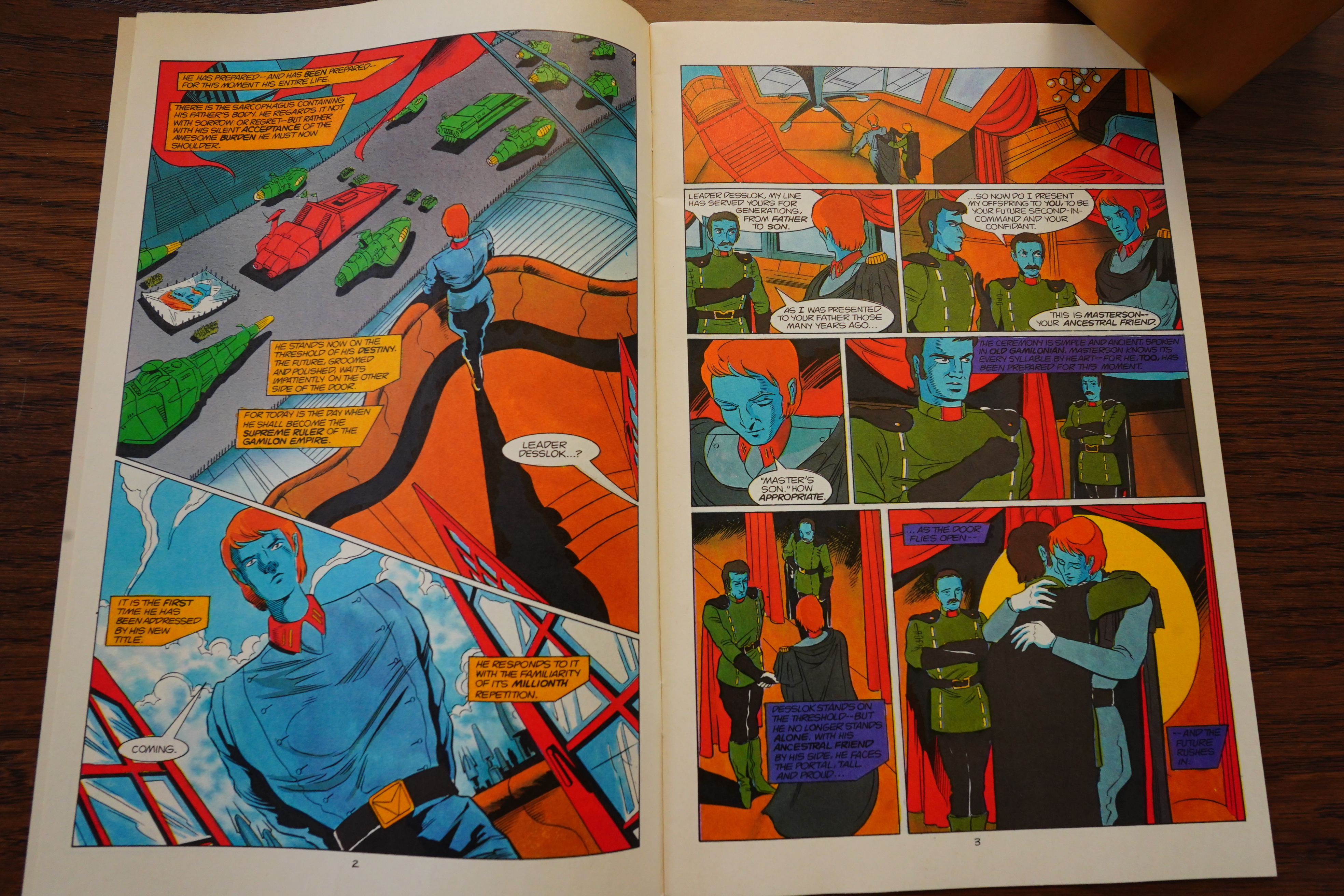
If there is one recurring thing about Comico comics, it’s that they tend to start pretty abruptly, in the middle of some action, and we often don’t get much exposition. It’s fun when it works. This, on the other hand, takes a very different approach — we get pages and pages and pages of exposition, and possibly recaps of things that have happened before?
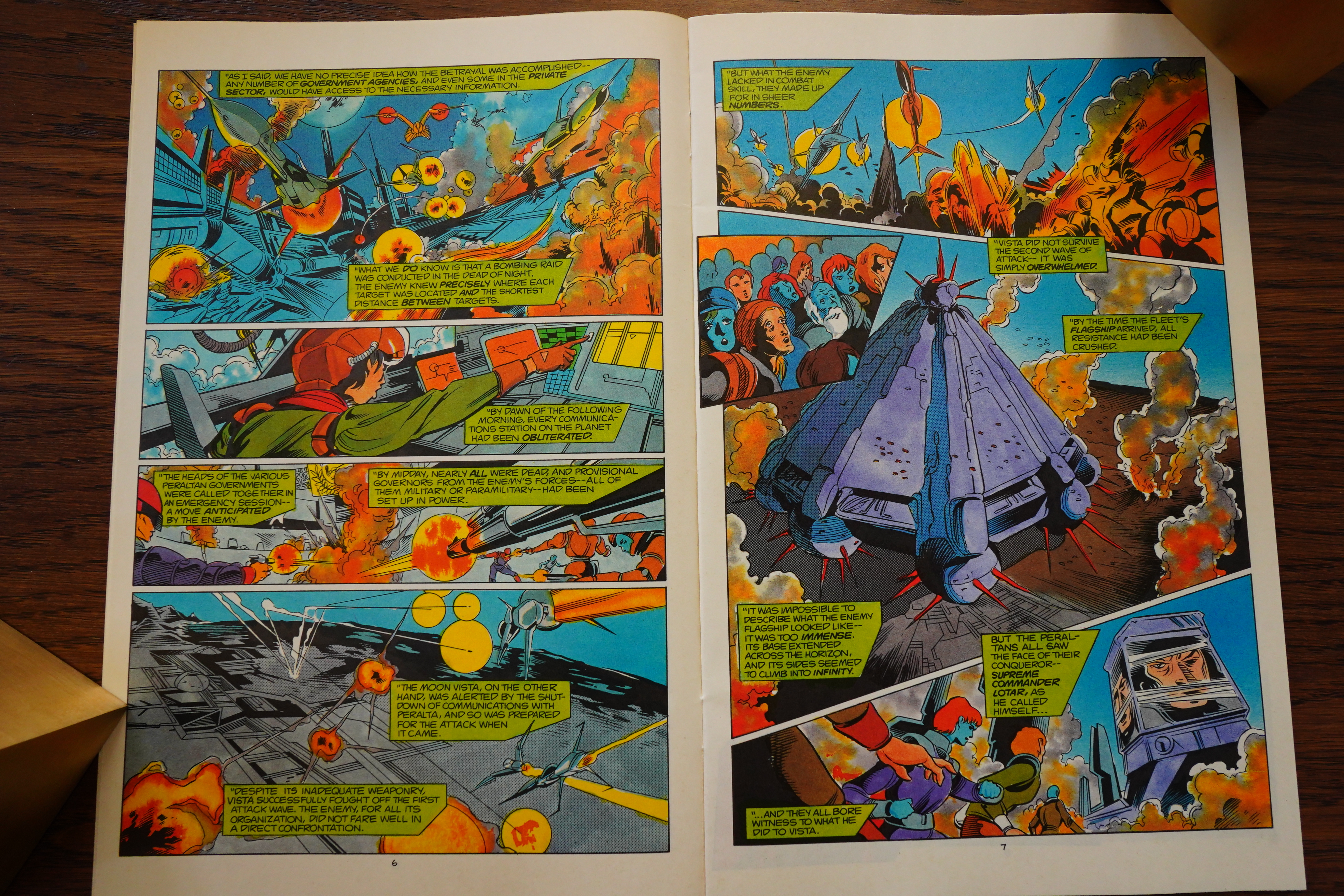
It’s not really clear. It makes for an awkward start, though. So much plot to get through doesn’t leave any room for any characters to display some character.
Ah right… Yamato. I knew it!
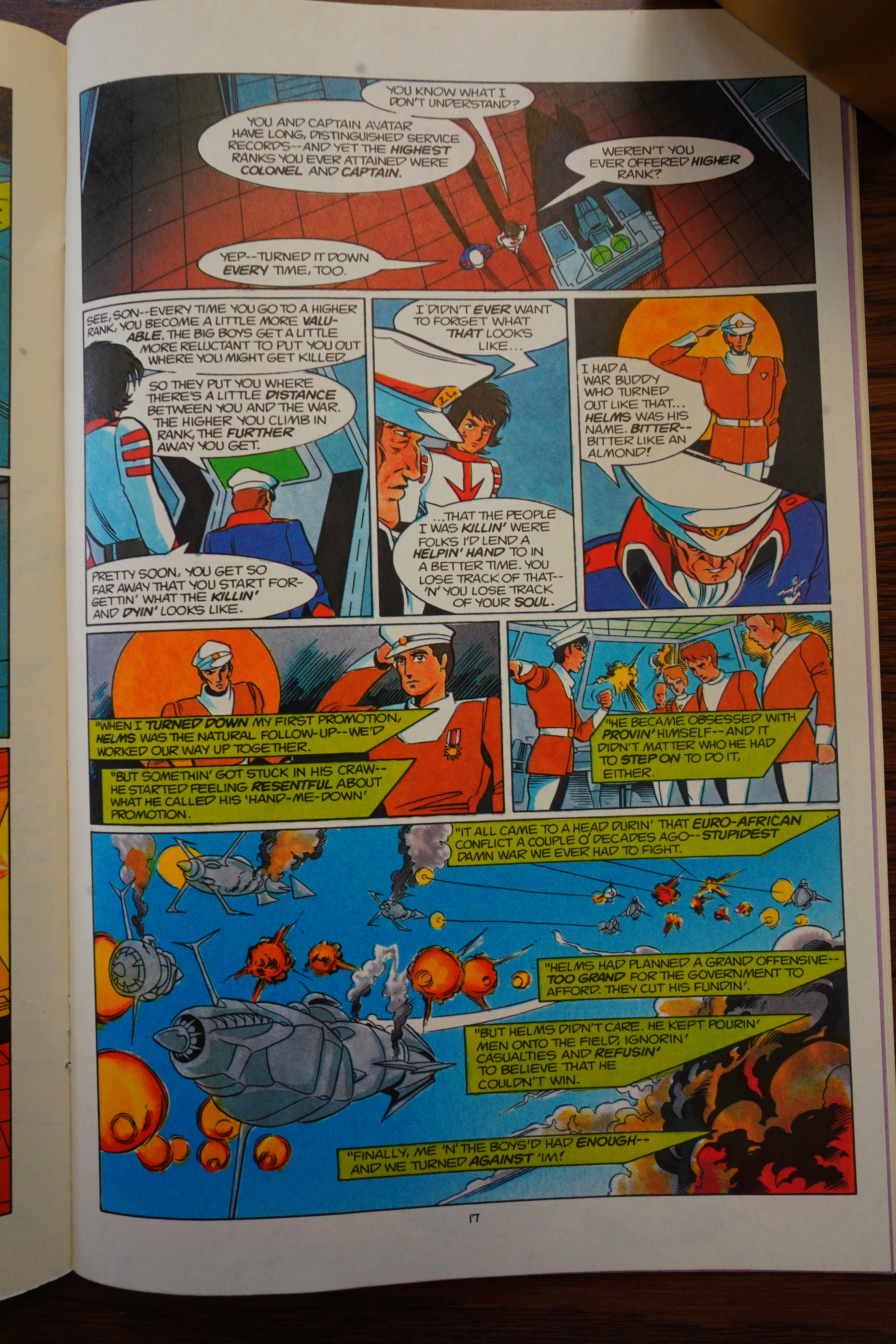
We also get the backstory of some of the characters, but since we don’t really know them, it’s like *shrug*? Perhaps this is of intense interest to fans of Yamato.
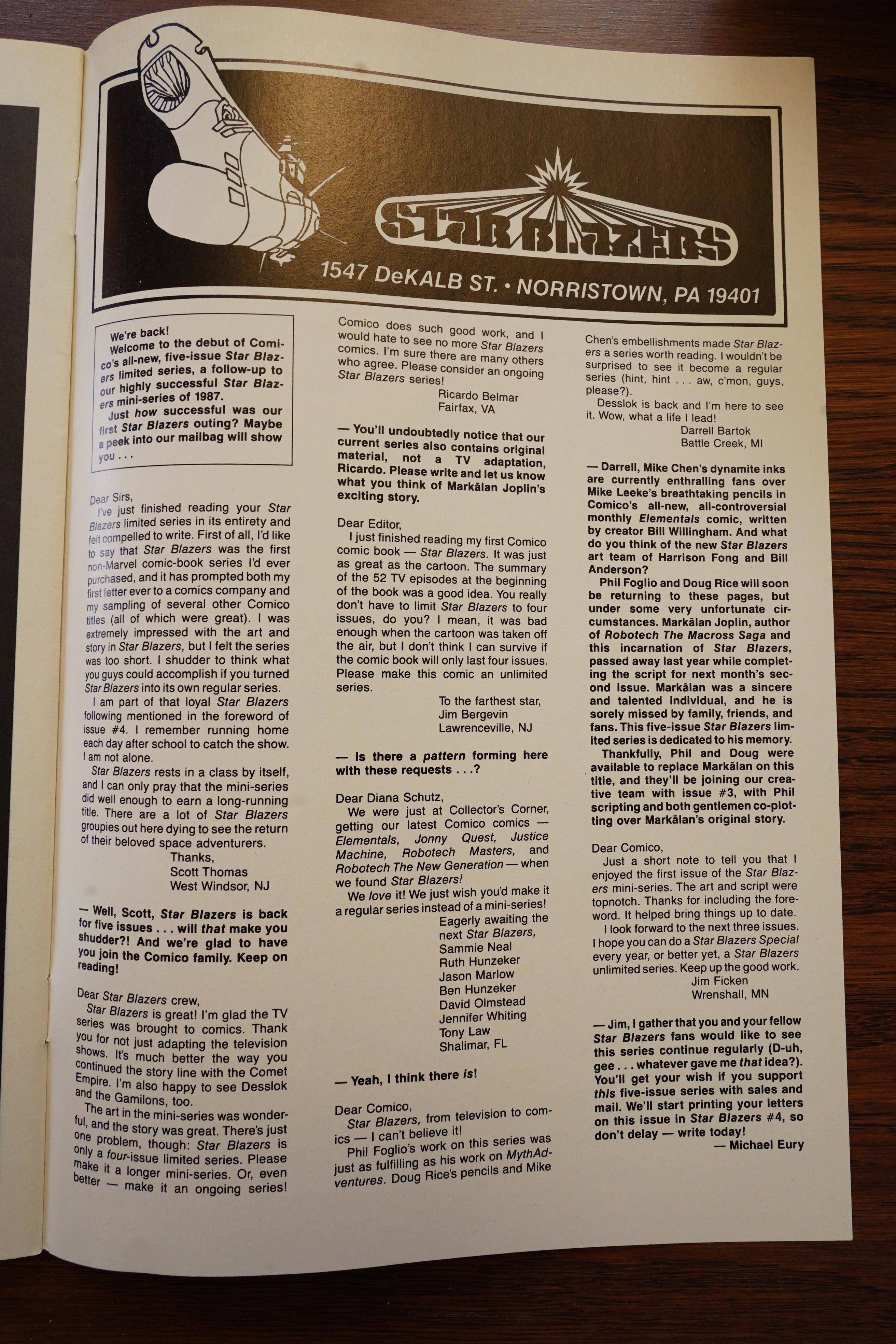
We get letters talking about the previous Star Blazers mini series.
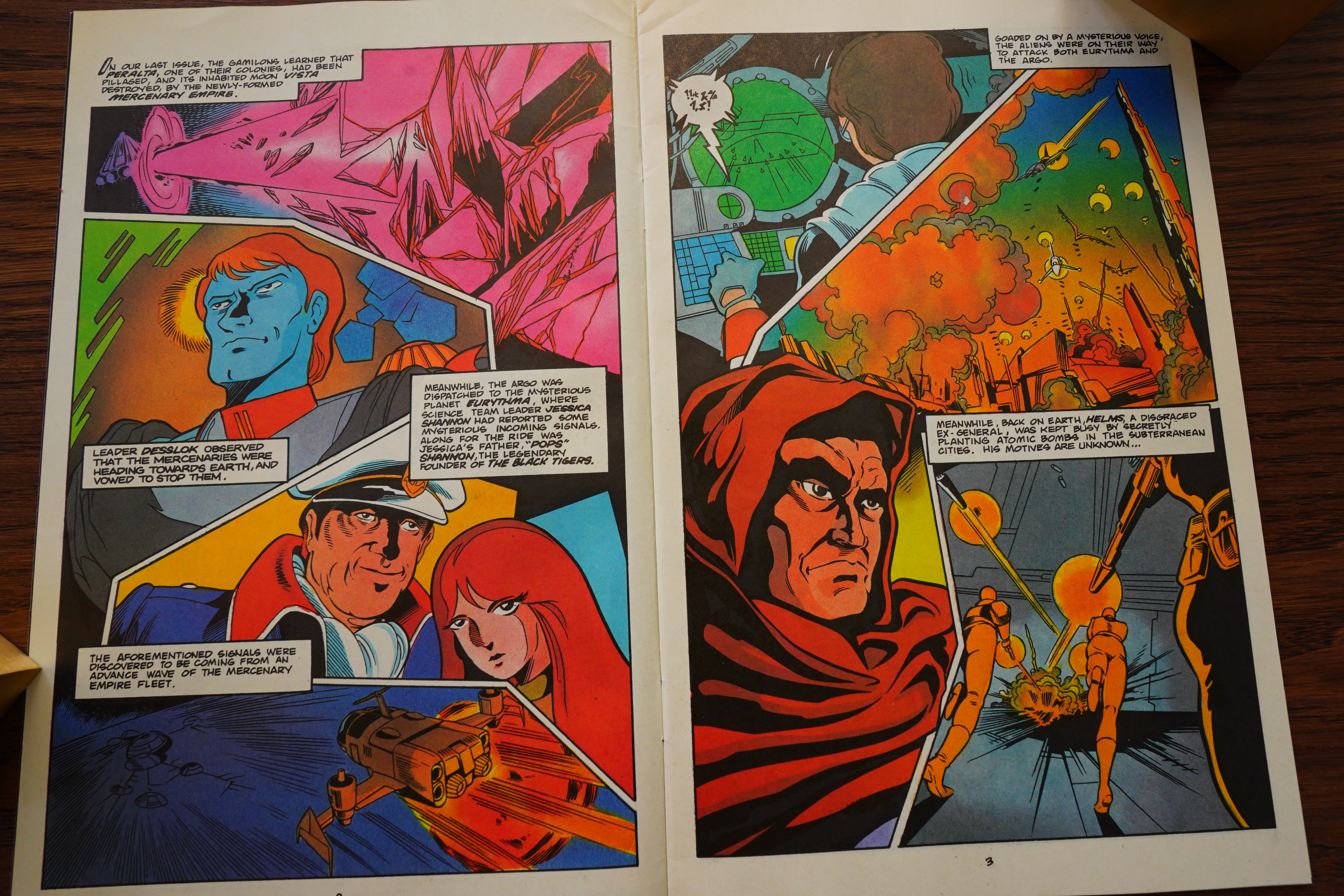
The second issue starts with… a recap of the first issue, which seems like an odd choice for a five issue mini series. But also very unusual for Comico — they seldom do recaps.
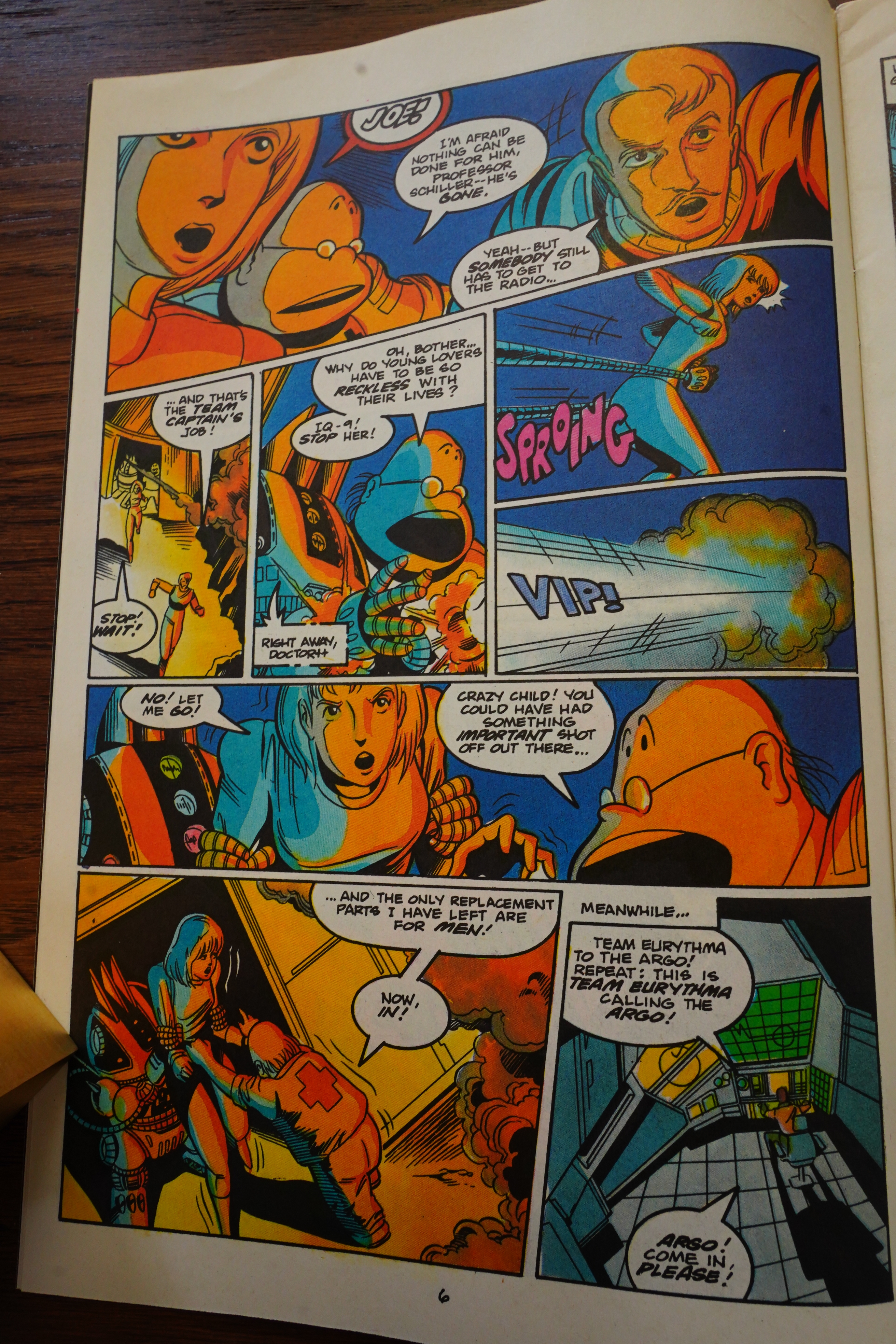
Only replacement parts for men? *ponder*
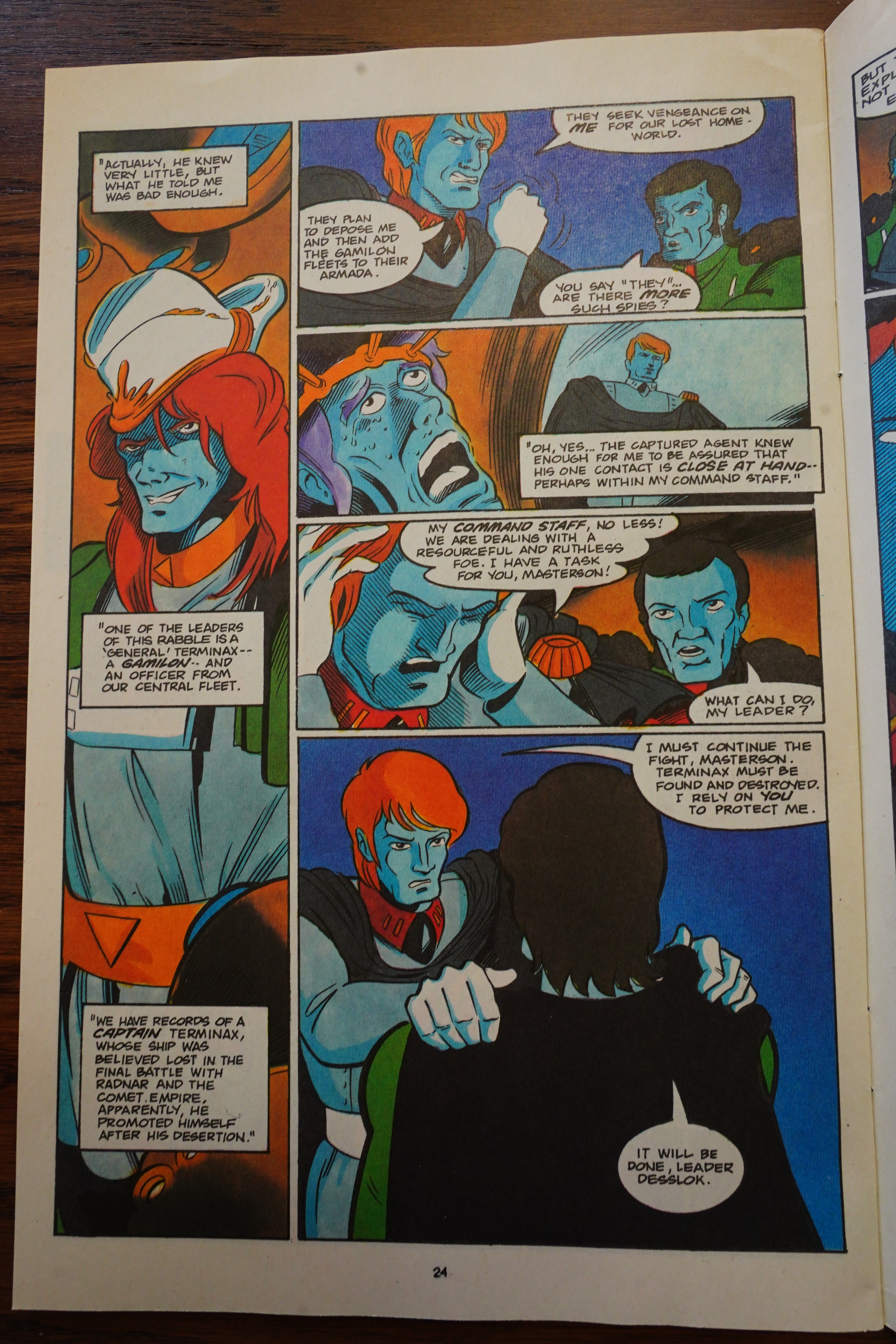
Oh, there’s a traitor on the command staff! And since the only two people on the command staff we know are 1) the guy with orange hair, who’s the boss, and 2) the guy with brown hair, let’s have a poll! Who do you think this mysterious unknown traitor on the command staff is! WHO CAN IT BE
Yeah yeah, I know, it’s a series for kids, but c’mon. Not all kids are morons.
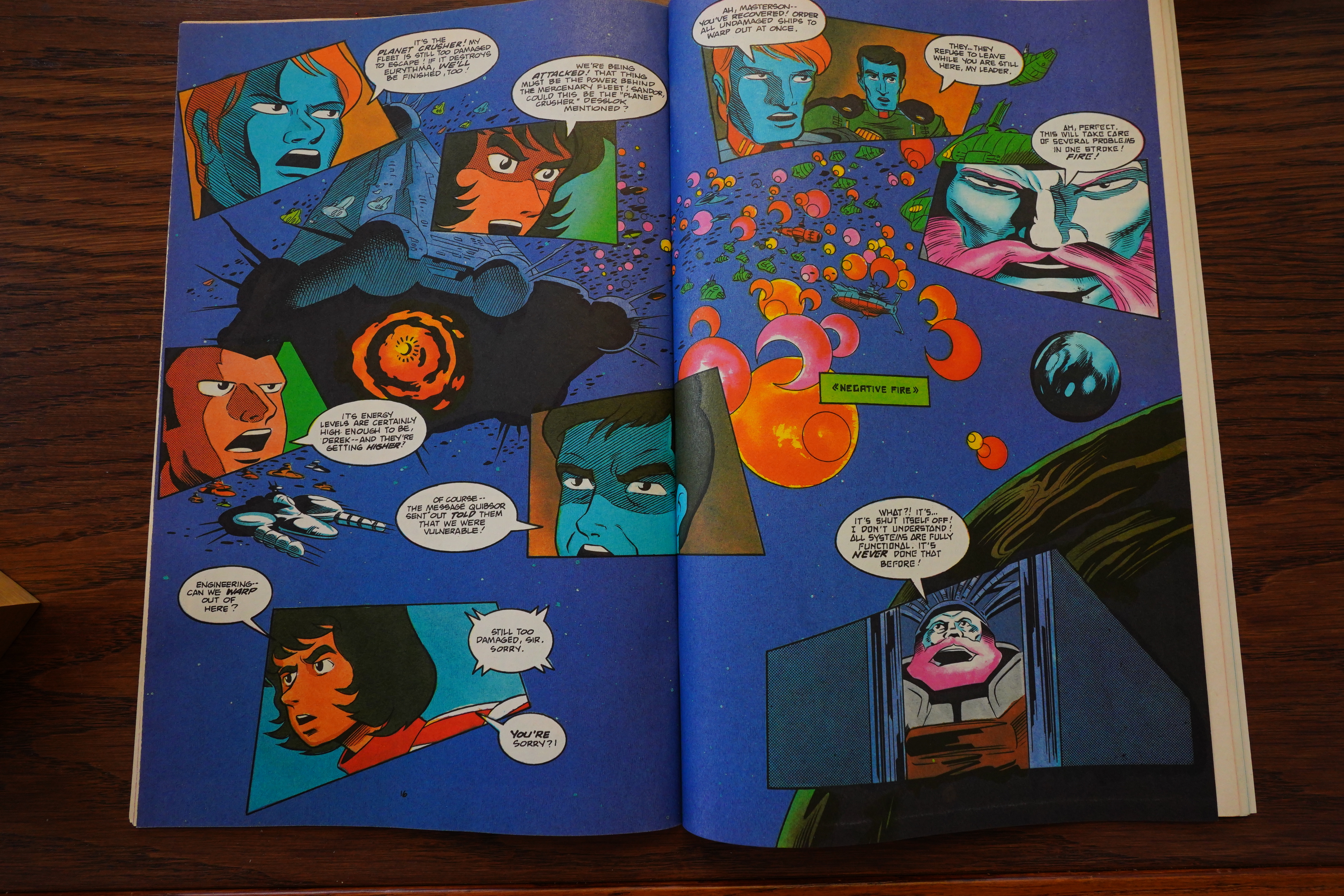
Oh, the plot… there’s about four factions, and two of them want to destroy Earth (for reasons that seem kinda vague), and then there’s the earthlings, and then there are the blue guys who are our allies. (Sort of.) If you surmise that this means that it’s chock full of plot, plot, plot, then you’re right.
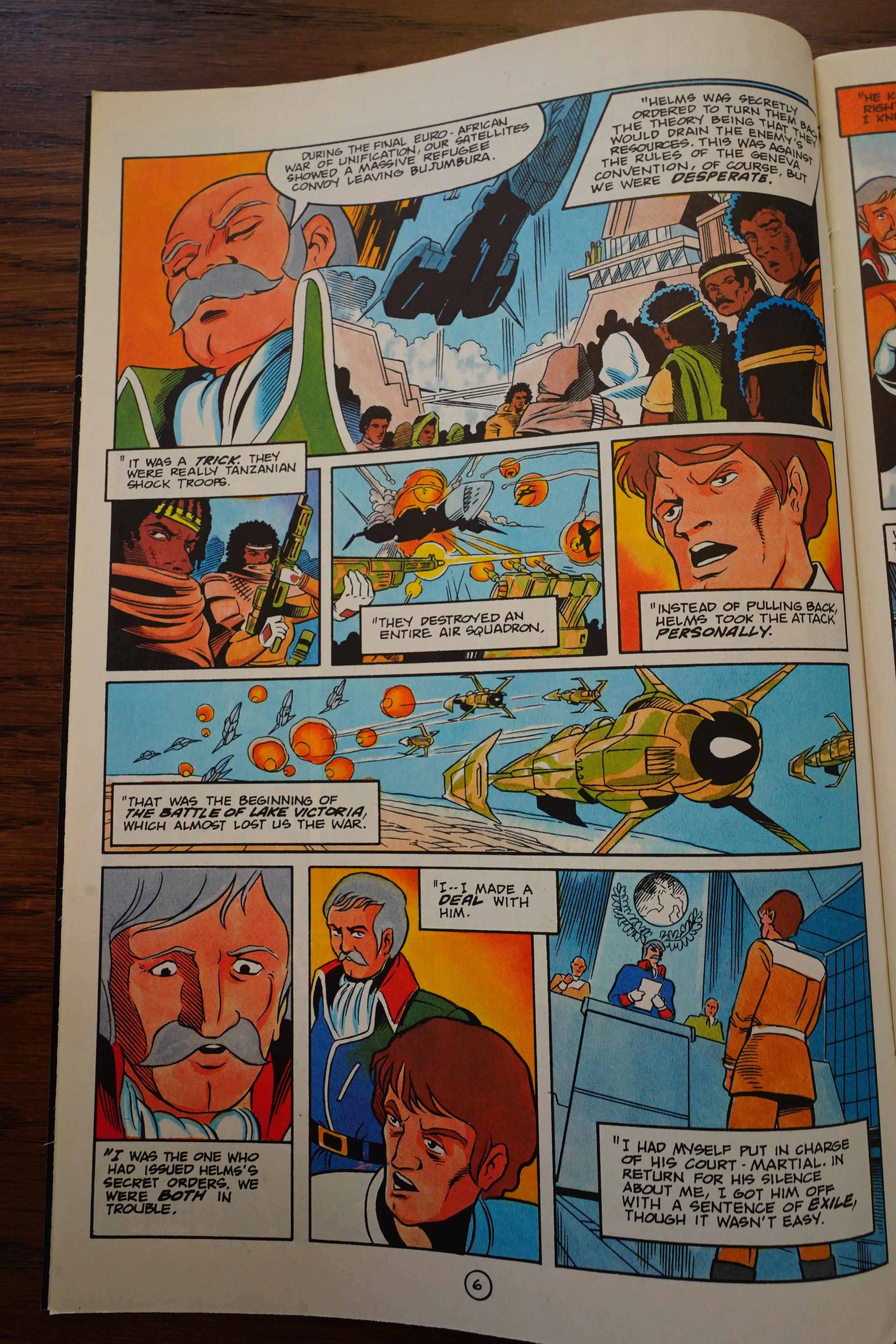
Then we get the backstory of another guy, who’s not even a character in the book! Why.
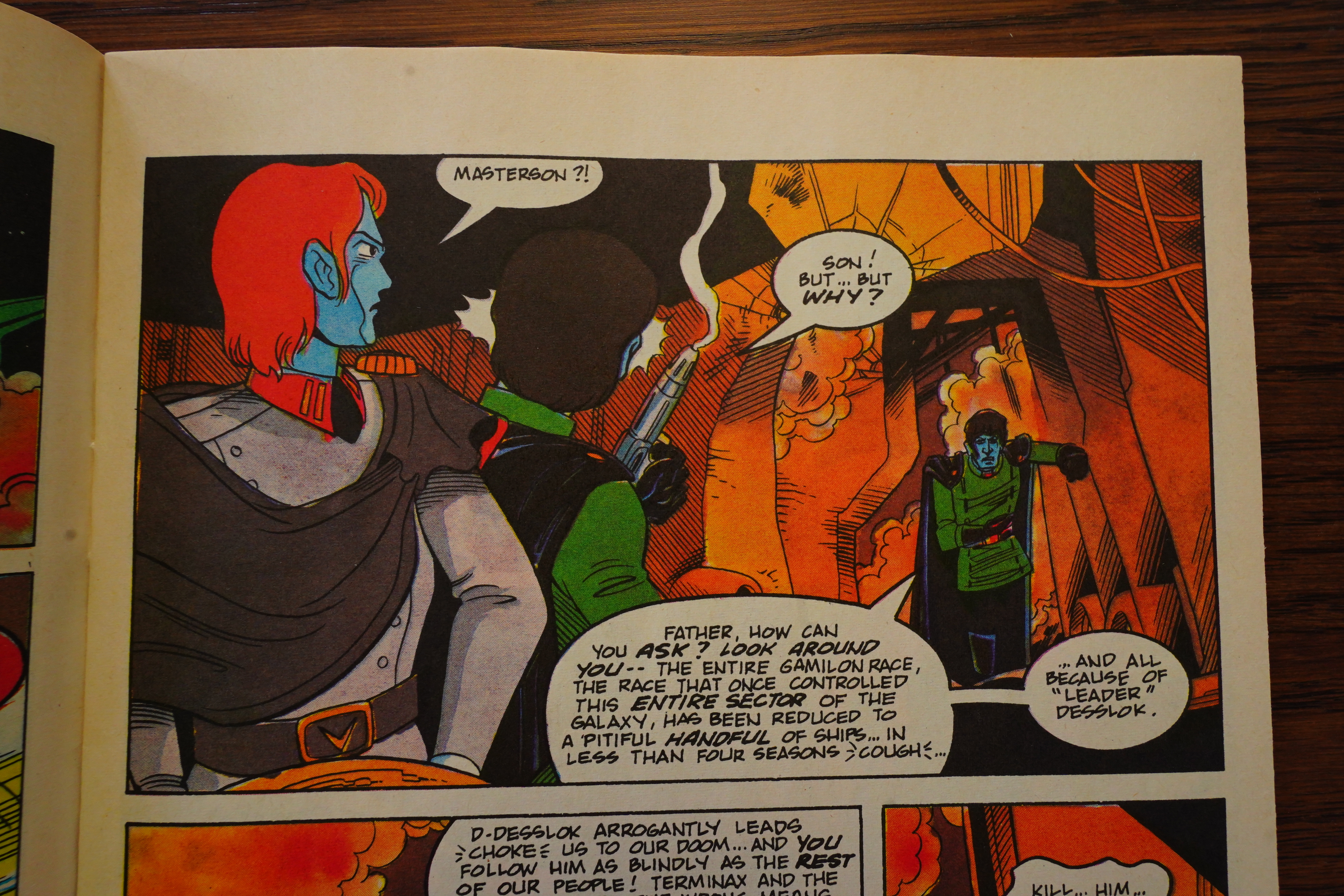
Well, whaddayouknow — the traitor turned out to be the only character in the book who it could possibly be.
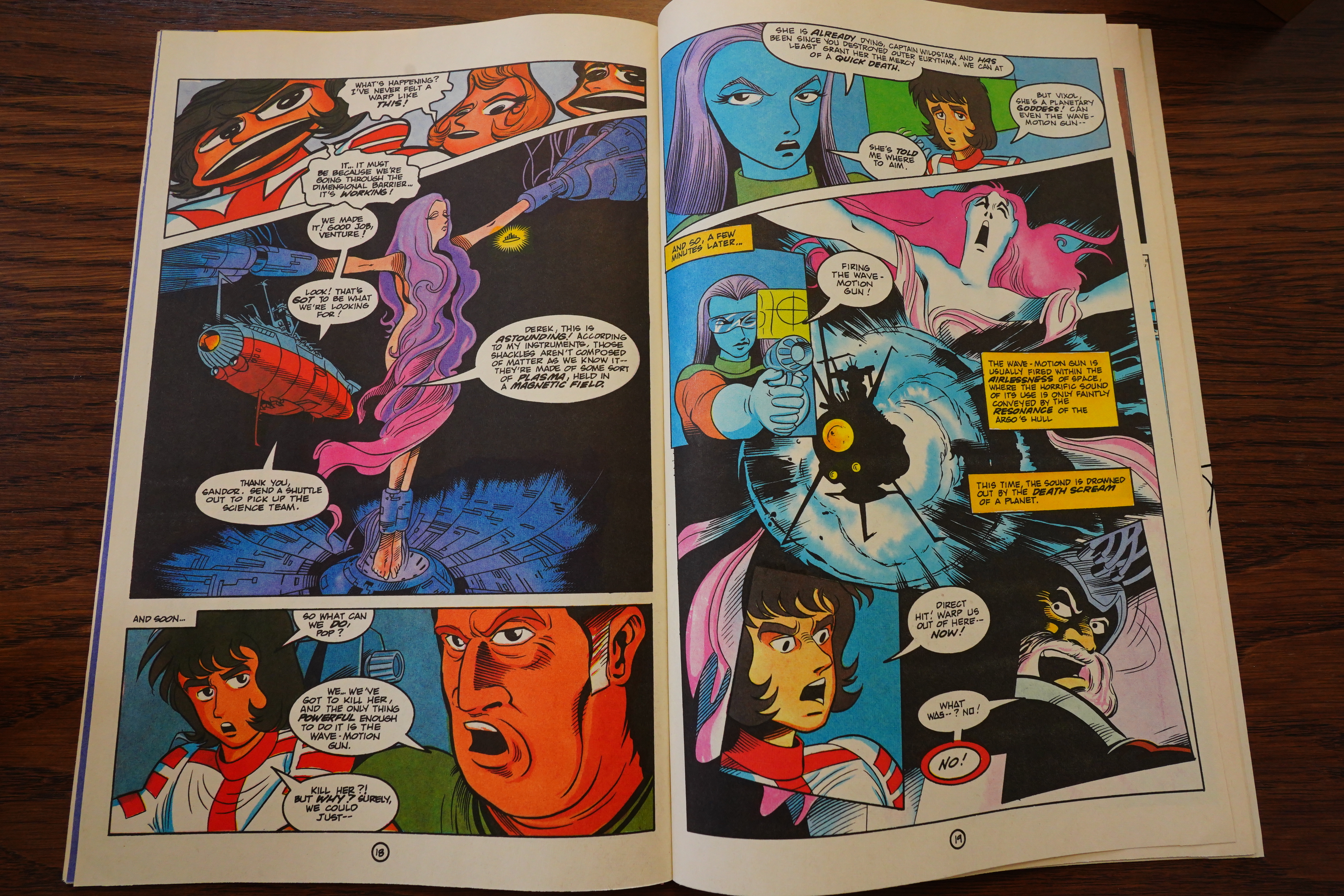
Oh, and there’s the soul of a planet who’s being held captive. You know, the normal Japanese animated series stuff.
I will admit to not being in the mood to be reading something like this, so my annoyance with the book might not be the book’s fault. But even taking that into account, I think it’s a pretty lame book.
The artwork works pretty well, though.
Back Issue #59, page #76:
The first Star Blazers miniseries sold beyond Comico’s expectations,
but a follow-up series was not released for two years. No one seems to
know the reason for such a long delay, although it is possible that
Comico may have only negotiated the rights to produce one miniseries
and had to re-negotiate a new deal for a second one. Whatever the case
may be, Foglio and Rice were not asked to return … at least, not at first.
“We turned in the first one and heard absolutely nothing—good,
bad, or indifferent,” Foglio says. “It was a big surprise to us when
Comico announced another one. They didn’t tell us anything.”
The second miniseries ran for five issues and was to be written by
Markalan Joplin with art by Harrison Fong and Bill Anderson. However,
Joplin died of AIDS complications after writing the first issue. “Markalan
Joplin was entrenched in the Star Blazers and Robotech camp at Comico
when I came on board,” says Star Blazers (and BACK ISSUE) editor
Michael Eury. “I remember him fondly. He understood the material and
universe, which helped me as editor, since I was unfamiliar with the
concept. As his condition worsened, his pace slowed down, but he kept
the lines of communication going. A professional until the end.” With
Joplin gone, Comico asked Foglio to replace him. “I said, ‘Sure, if I can
work with Doug!” Foglio explains. “I enjoyed the series and the
characters, but Doug was very much the expert on Star Blazers.” Rice adds,
“I had voiced my ire to the Comico people and they didn’t appreciate it.
So, as far as I was concerned, I was never going to hear from them
again-that was the end of it. But then, they contacted Phil to do the
second series … and he got me involved. I’ll work with Phil on anything!”
This time, Rice worked with Foglio on the story, but Fong and
Anderson remained as the art team. “I was actually pleased with the
art on the second series,” Rice says. “I thought the artist had a very
nice take on the anime style.” Having to follow Joplin presented some
problems, however, since he had only written a rough plot for the series.
“His notes were unclear,” Foglio recalls. “We tried to keep as much in as
we could.” Rice added, “We had to kind of fill-in the blanks. We put
a lot of effort into it to make it cohesive. We weren’t able to change
anything, because the first issue was already in production. This resulted
in some continuity errors.” Among these was the presence of engineer
Orion and Black Tiger pilots Conroy and Hardy, who were all killed in
the Japanese version of the Comet Empire series. Although their deaths
were removed from Star Blazers, they did not appear in Comico’s first
miniseries. Also, Joplin had planned to explain the Talan/Masterson
name switch by introducing Masterson as Talan’s son and Desslok’s new
aide. Foglio and Rice were unaware of this, so they had Masterson turn
out to be a traitor and killed him off.
Heh heh.
Amazing Heroes #166, page #70:
A sub-wave of the Japanese manga-
mania tsunami sweeping the comics
industry now is manga-inspired or
manga-like original stories in English.
Star Blazers is such a product, a
comic based on the animated Japanese
TV show of the same name from
Westechester Films. Comico pub-
lished a successful four-issue Star
Blazers mini-series in 1987, inspiring
this new five-issue mini-series. Unfor-
tunately, writer Markalan Joplin died
while completing the second issue, so
Phil Foglio and Doug Rice will take
over the remainder of the series.
Star Blazers is an unpretentious gal-
actic space-opera in the Star Wars/Star
Trek mode. This series picks up dur-
ing the aftermath of the Gamilon Em-
pire/Comet Empire war, with both
sides in disarray. A double story en-
sues, one concerning the new Gami-
lon ruler and a mysterious attack on
the peaceful planet of Peralta and its
colonized moon Vista, the other con-
cerning the Star Blazers’ investigation
of a planet with a perfect orbit, Eury-
thma, and a mysterious ethereal out-
line of a woman that has appeared on
the planet pointing to a particular sec-
tor of space. Eurythma is attacked by
unknown assailants at the end of the
story.
These plotlines are apparently rela-
ted, but that is not strongly established
in the story, so there could be some
confusion for readers, especially new
ones not up-to-date on the Star Blazers
universe. It is never even clearly estab-
lished that the Blazers are connected
with the Gamilon Empire.
In general, the whole issue is rather
thick with characters and exposition
(lots of explanations and flashbacks),
though everything is handled fairly
skillfully. The biggest problem I had
reading the book was with its tired
genre. Twenty years of Star Wars and
Star Trek space opera has worn a bit
thin, and this issue includes many of
the cliches: dreadnoughts, federation
officers gone bad, even the obligatory
bar scene (which Star Trek did first
in “The Trouble with Tribbles,” by the
way).
But if you savor space opera, Star
Blazers is done pretty well. Its plot-
line with the mysterious figure is fresh
enough, and there’s an interesting sub-
theme about the relationships between
generations of space officers. The plot
about the planet Peralta, a people who
have devoted their resources to the arts
and sciences since they depend on the
Gamilon empire for defense, strikes
disturbingly near to the present-day
Japanese-American situation, so
Peralta’s destruction has some pos-
sibly interestingly real-world reverber-
ations.
The art is executed in the traditional
manga cartoony fashion, so decide for
yourself if you respond to that style.
Though I enjoy the clean linework, I
personally find that the cultivated por-
trayal of young people renders their
facial features indistinguishable.
Established Star Blazers fans should
certainly pick this up. Others may
enjoy coming along for the ride, too.
GRADE: FINE
— Thomas Dean
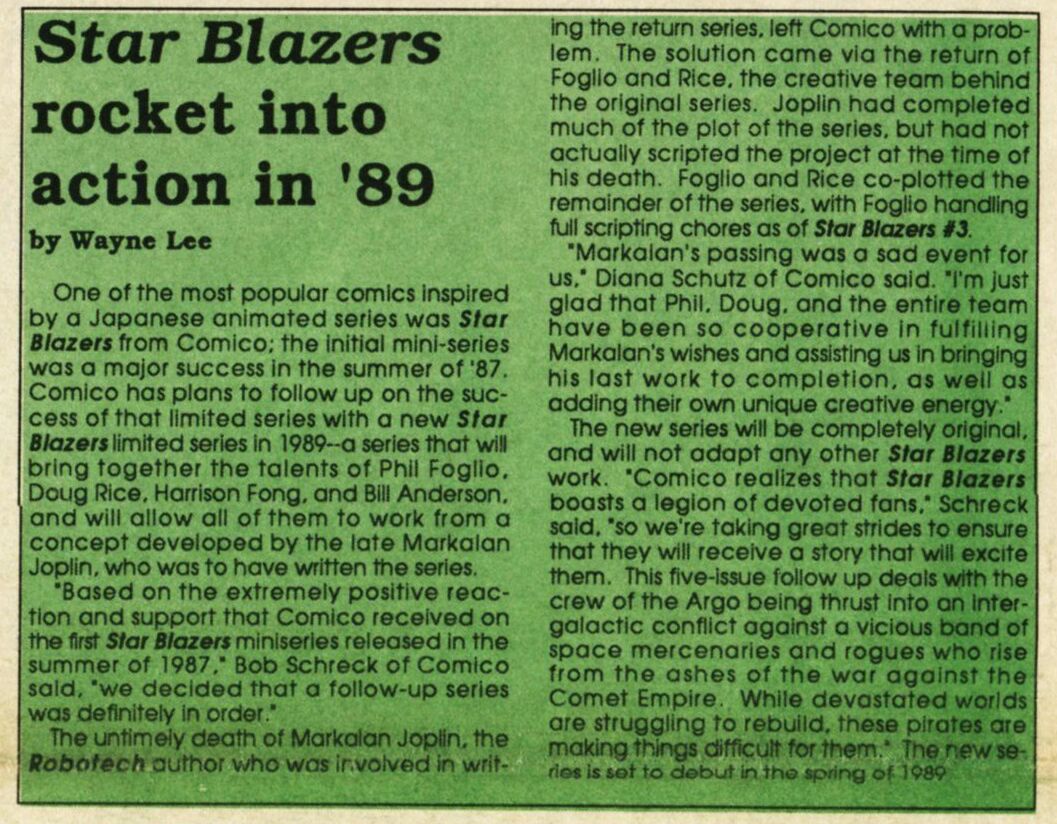
There’s some chatter about the series on the tubes:
After the unprecedented success of Comico’s first Star Blazers miniseries, a second miniseries was commissioned. It was to be written by Markalan Joplin and Phil Foglio. This time, a plan was made to reconcile some of the continuity flaws between the Comet Empire and Bolar Wars anime translations.
This plan included explaining how the Masterson family became Desslok’s “Talan” or “aide-de-camp” in the thinking of writer Joplin. However, Joplin’s untimely death interrupted these plans and the miniseries had to be completed by others. In any event, an entertaining story was still produced. This series was to be an issue longer than the previous one, and it also racked up great sales and some memorable original characters. However, it also had its own flaws…
[…]
A discussion with Star Blazers super fan Rob Fenelon about the second miniseries:
How did the second series come about?
Comico got another deal, to do another comic book. And once again, they hired another author who had never seen Star Blazers. His name was Markalan Joplin. They hired me to bring him up to speed, so I supplied him with the anime comics from Books Nippon, old Roman Albums, and had videotapes of the entire series. He wrote back right away about some continuity errors between the second and third season.
The reason for the continuity errors was that when Claude Hill of Westchester Films had the third series dubbed, he tapped his old friend Peter Fernandez to write it. Peter had never seen the second series. And this is one of the great regrets of my life, I kick myself because I should have known what was happening.
[…]
The comics sold extremely well in both the first and second incarnations.
And the less said about the art, the better. Much of this book looks rushed and the coloring looks atrocious in many panels. Rice and Fogilo should have handled the art chores themselves, in my opinion. The pair gave Dynamo Joe a crispness that is missing from Star Blazers vol 2, and it is something the art desperately needs.