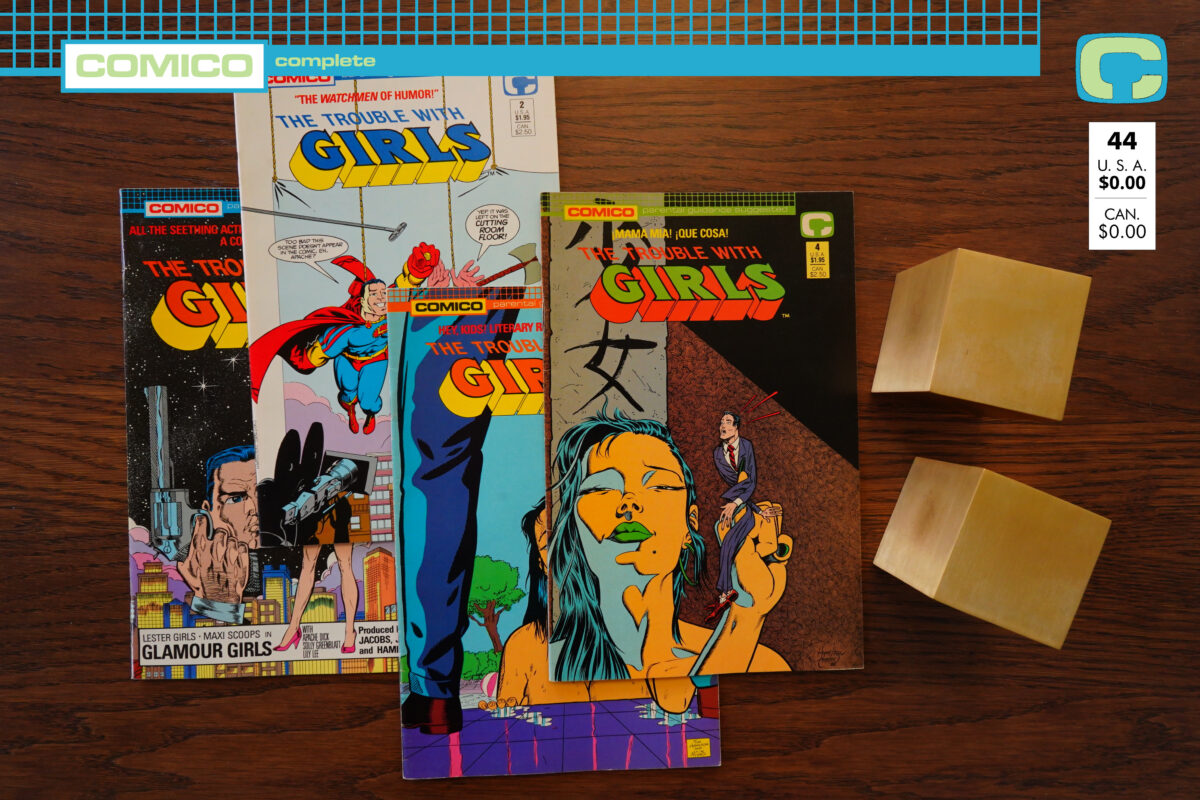
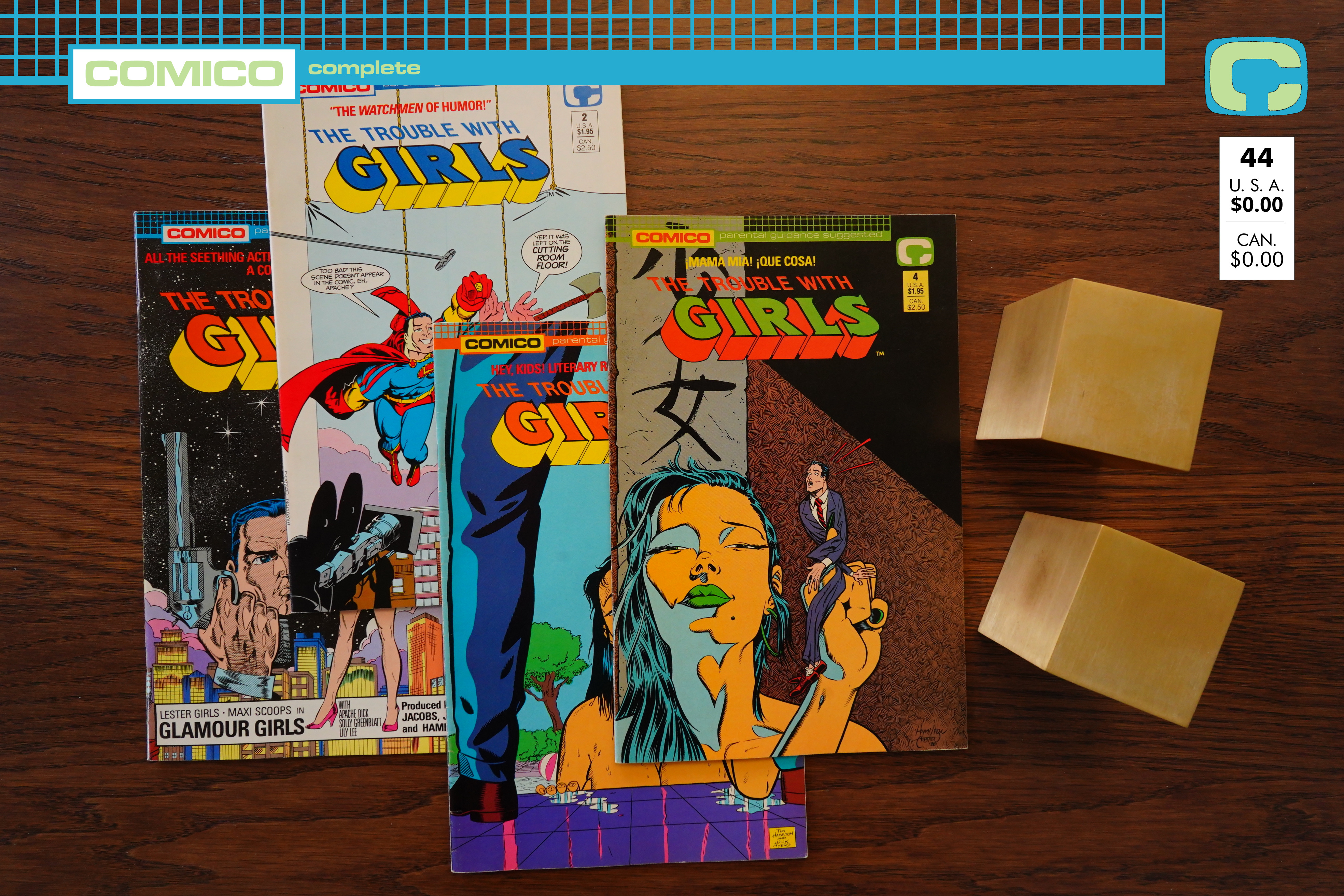
The Trouble with Girls (1989) #1-4 by Will Jacobs, Gerard Jones, Tim Hamilton and others
Hm… Gerard Jones… that name seems familiar.

Oh, right!
The Trouble with Girls had run for 14 issues as Malibu, and after this four issue run, it would return there for 19 more issues. And then a four issue stint at Epic. So that’s not a run to sneeze at, but … Malibu was a pretty shady business in itself. The owner started a number of publishers, among them Eternity, Imperial and Amazing, and also a comics distributor, who were the pumping out masses of crap during one of the comics market boom/bust cycles, leaving tons of unpaid (other) publishers in its wake:
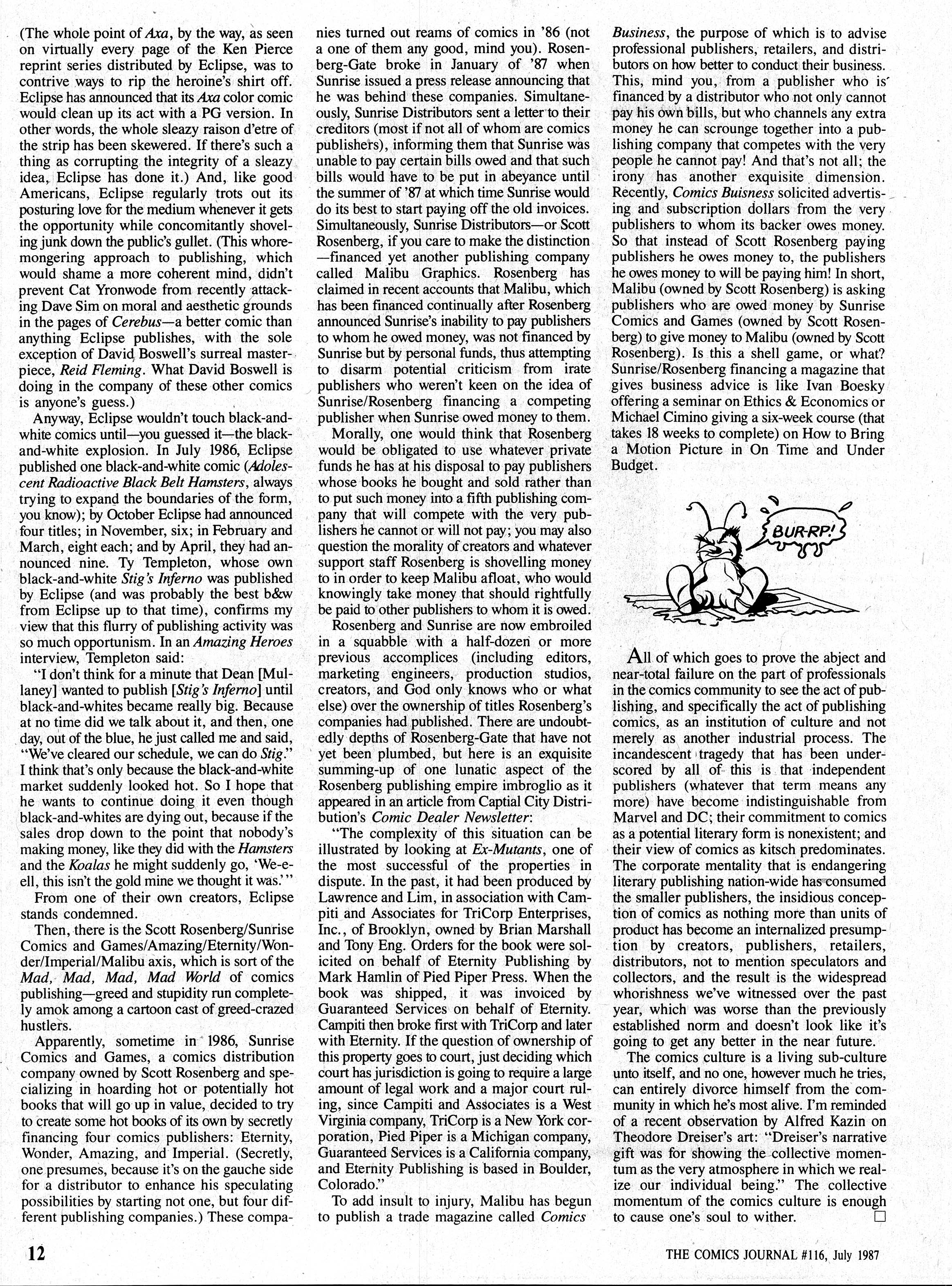
Read here for the sorry story.
So I’m really excited to read these comics! Let’s get started!
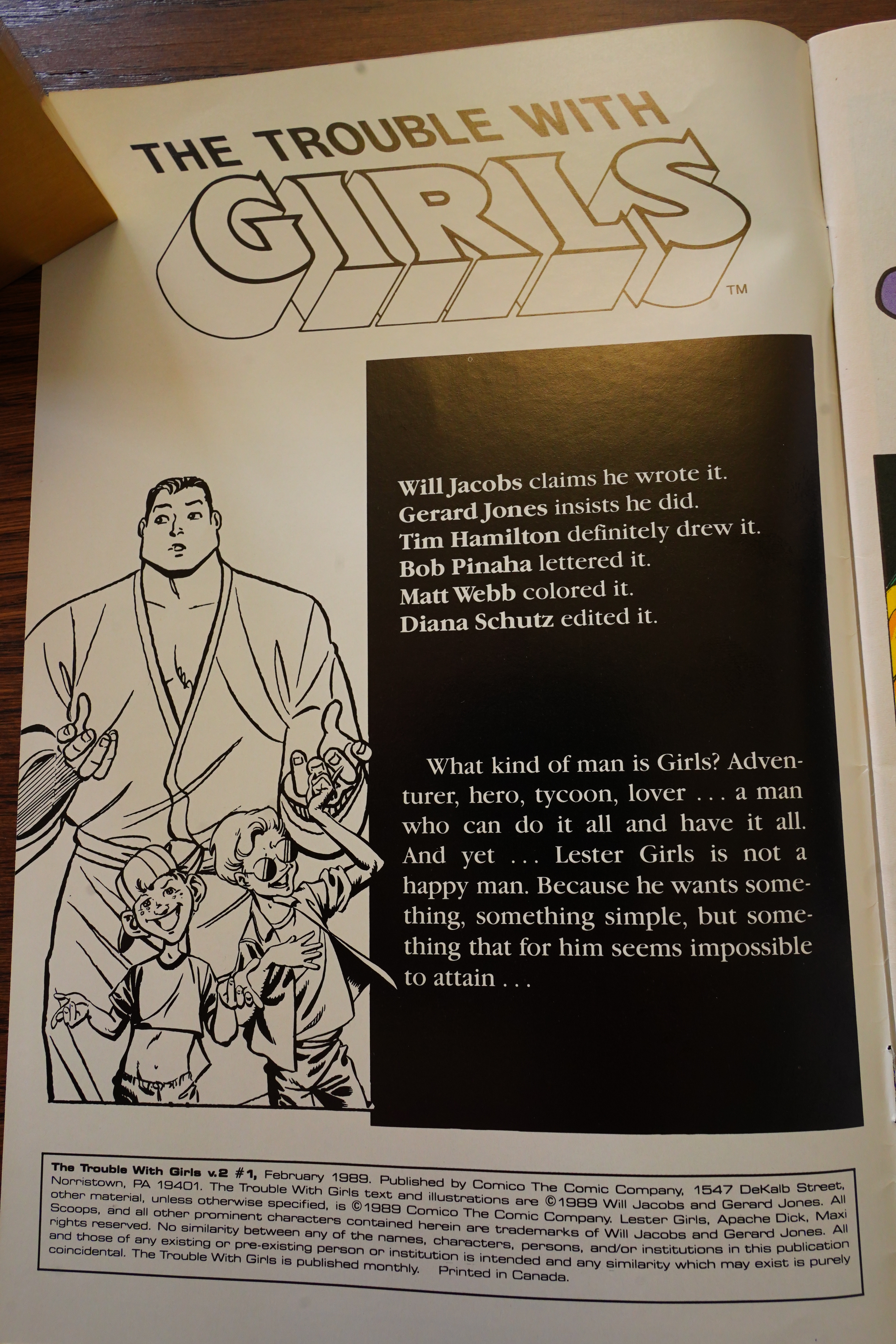
Comico took on a seeming endless number of series that had previously been at other publishers, and I’ve been noting how almost none of them try to introduce the series to new readers. This one seems like it’s going to be the same…
But let’s read the first three pages.
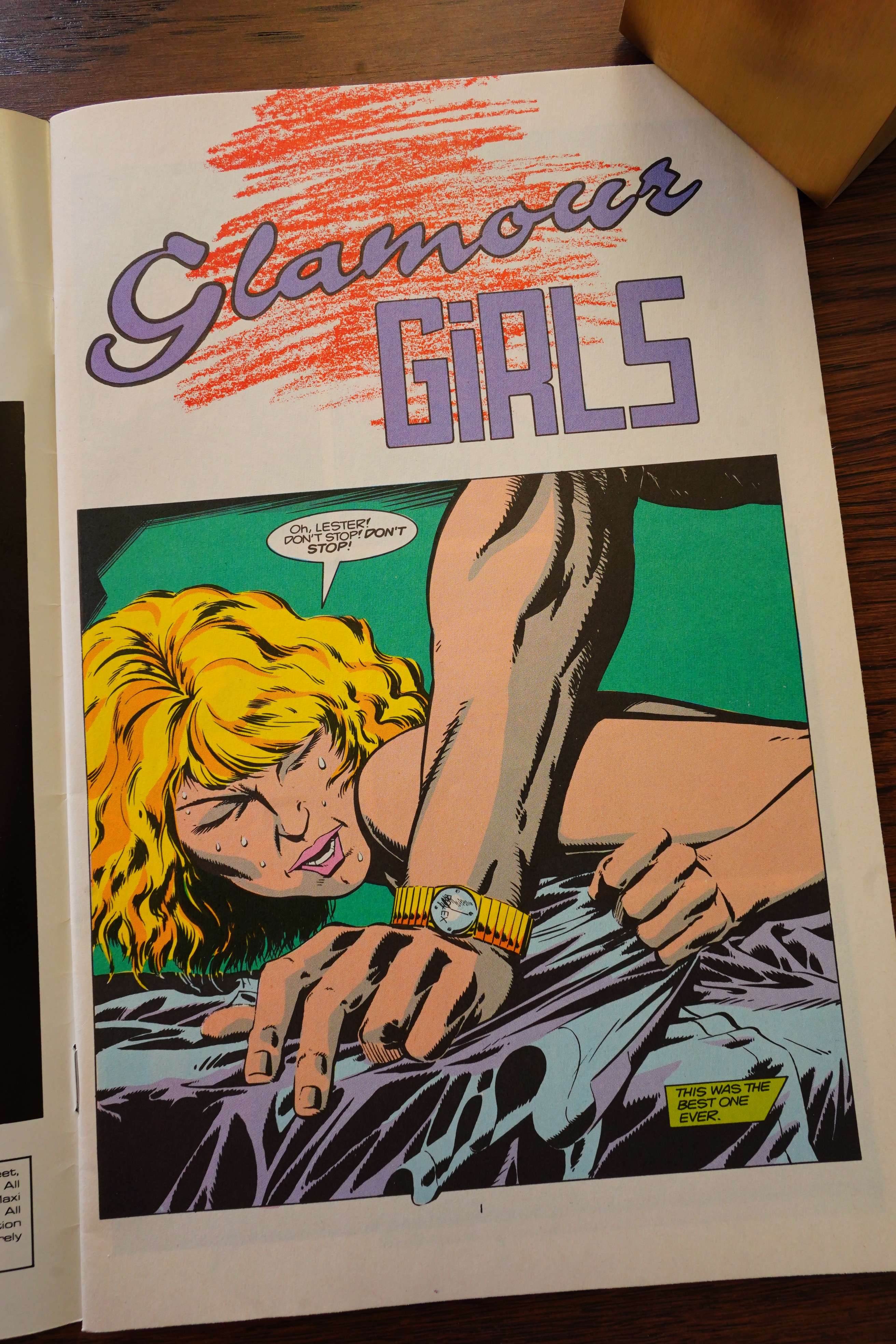
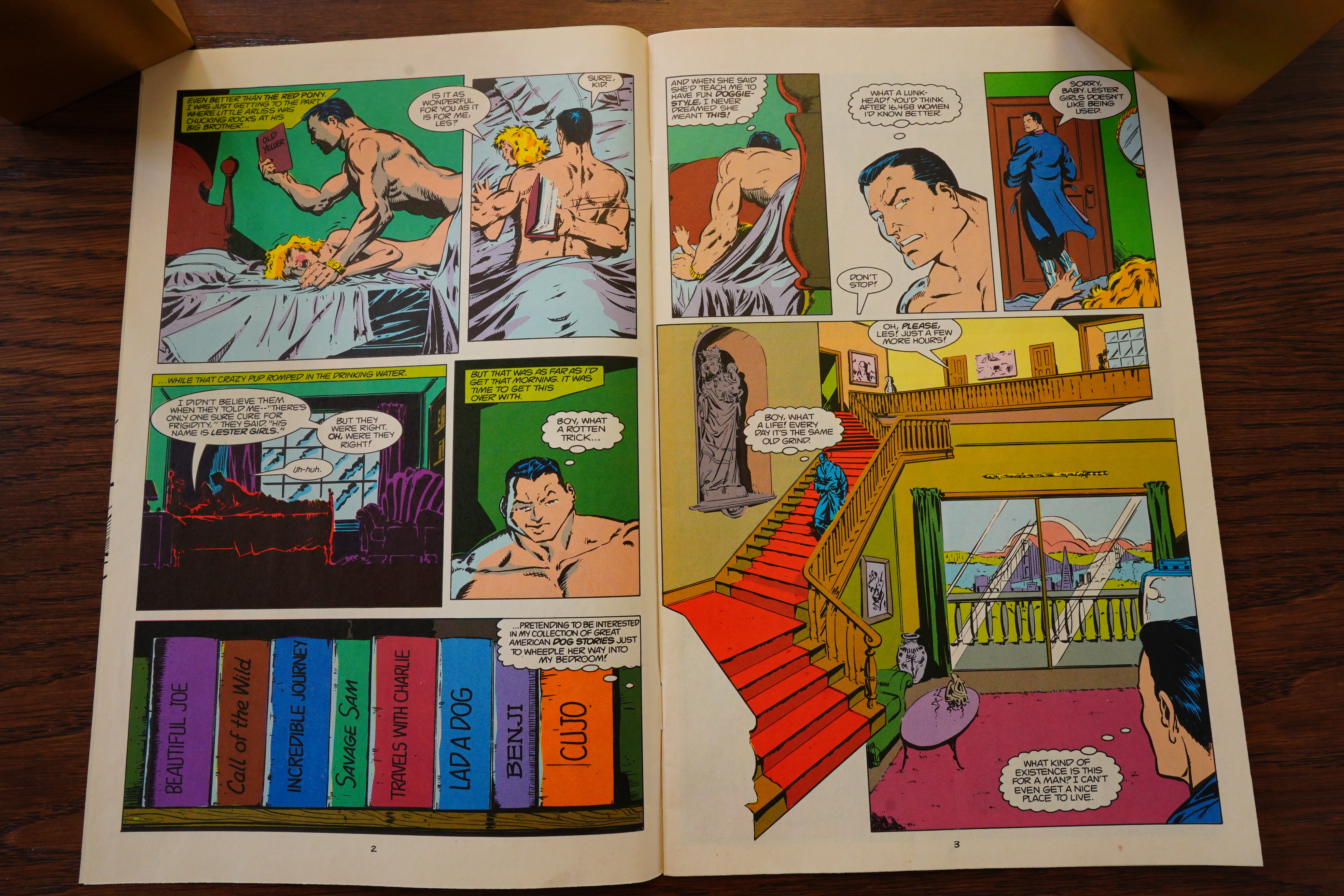
Uhm… uhm… Well, that’s an introduction for sure. But what’s most striking here (except that extremely odd sex scene) is:
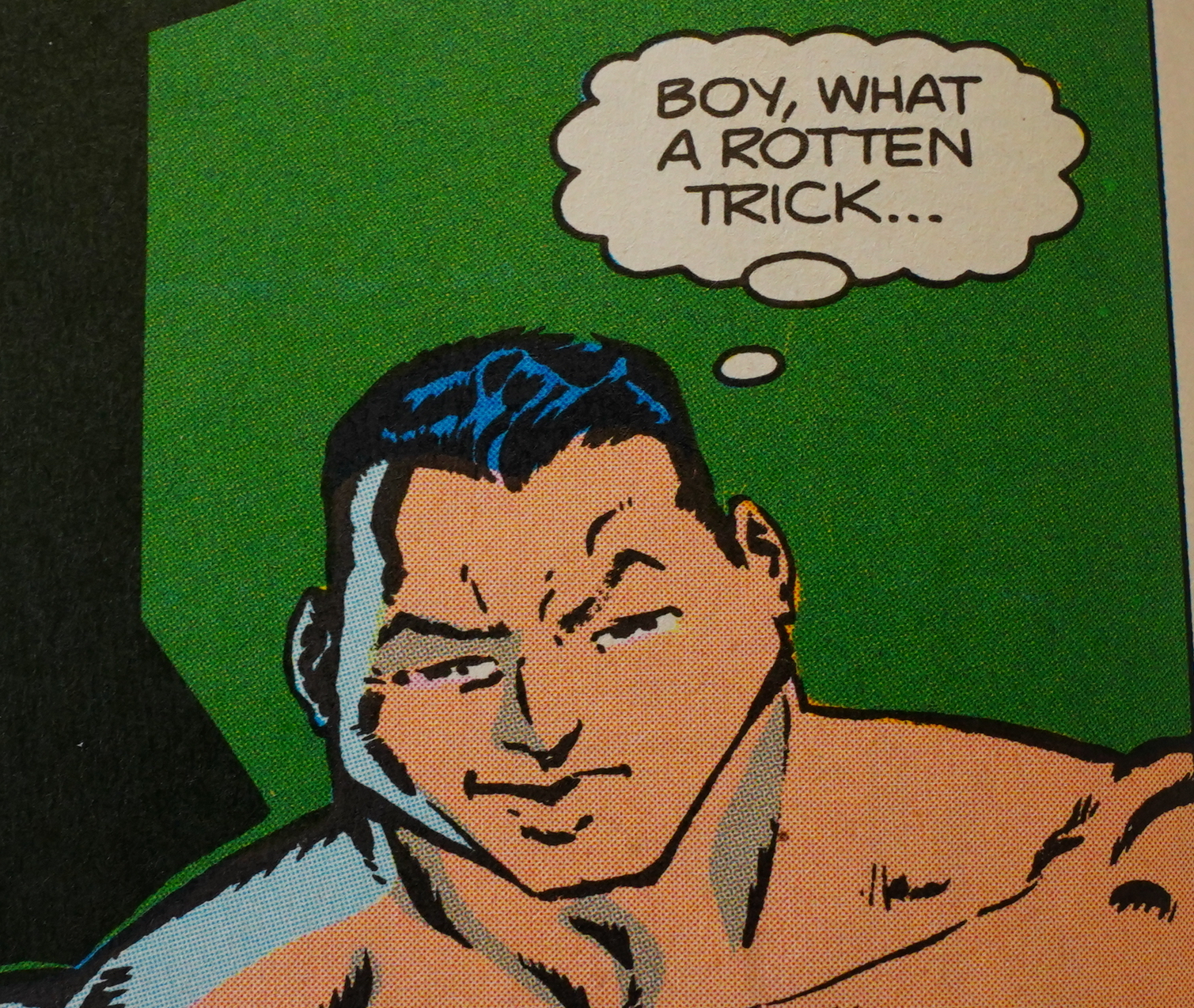
Man, that’s some awful artwork. Straight from the school of the black and white boom and bust, I guess.
But! The writers do introduce the concept of the series in a very efficient way.
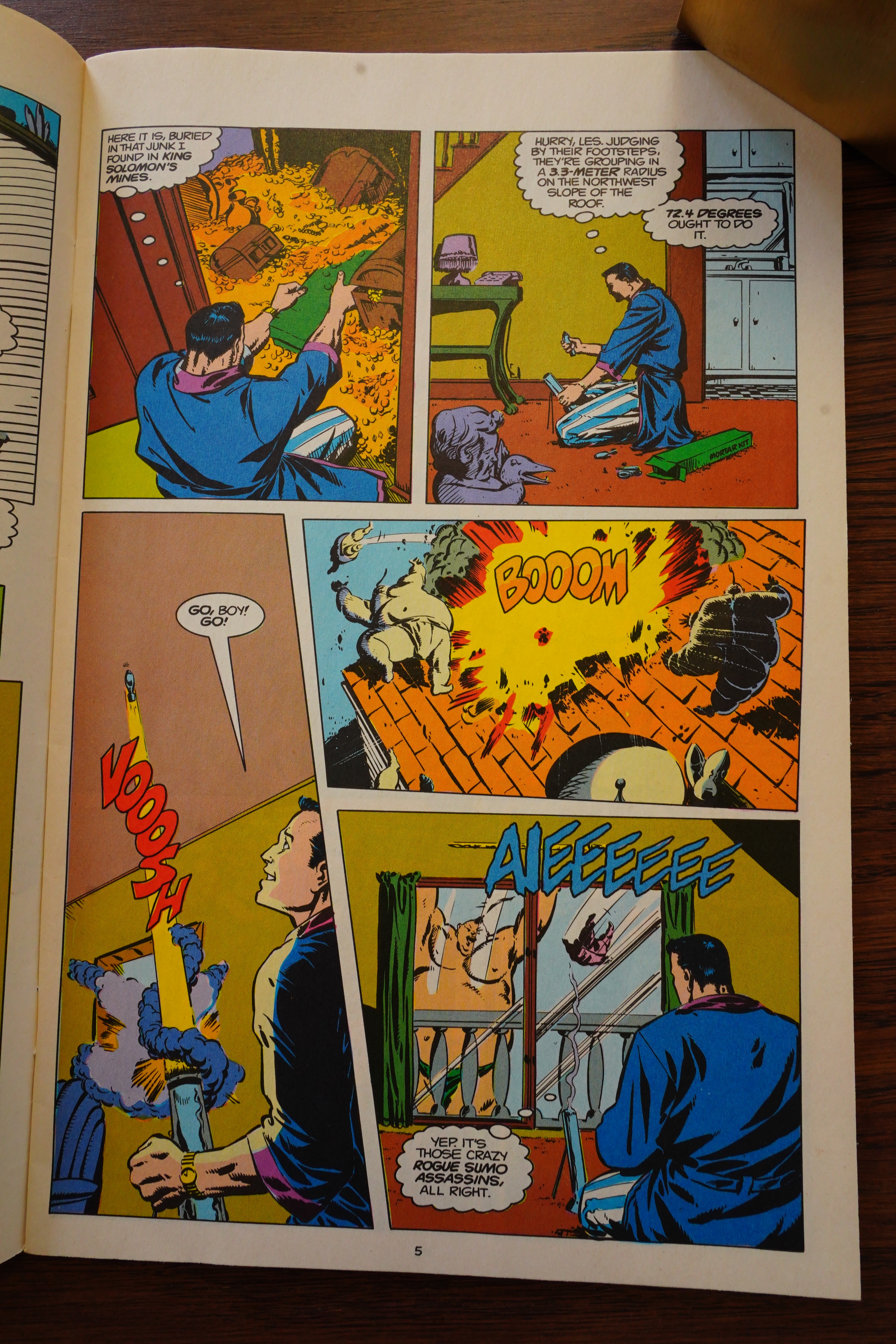
So this is one in a long series of comedy characters where the protagonist is a total doofus — it’s a classic setup because it works; it generates scenes on its own. And as normal, while the character is a moron, he’s also super competent.
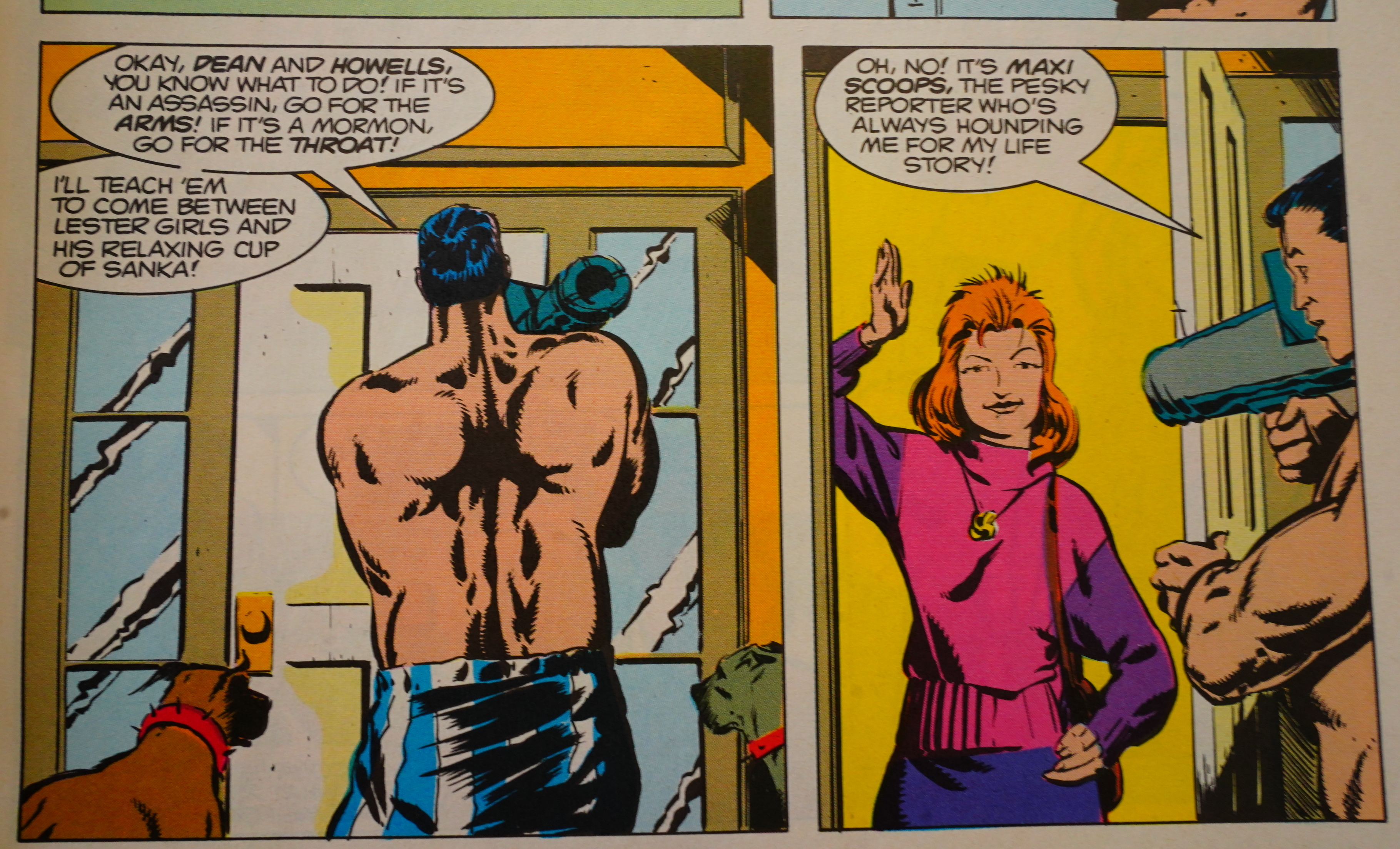
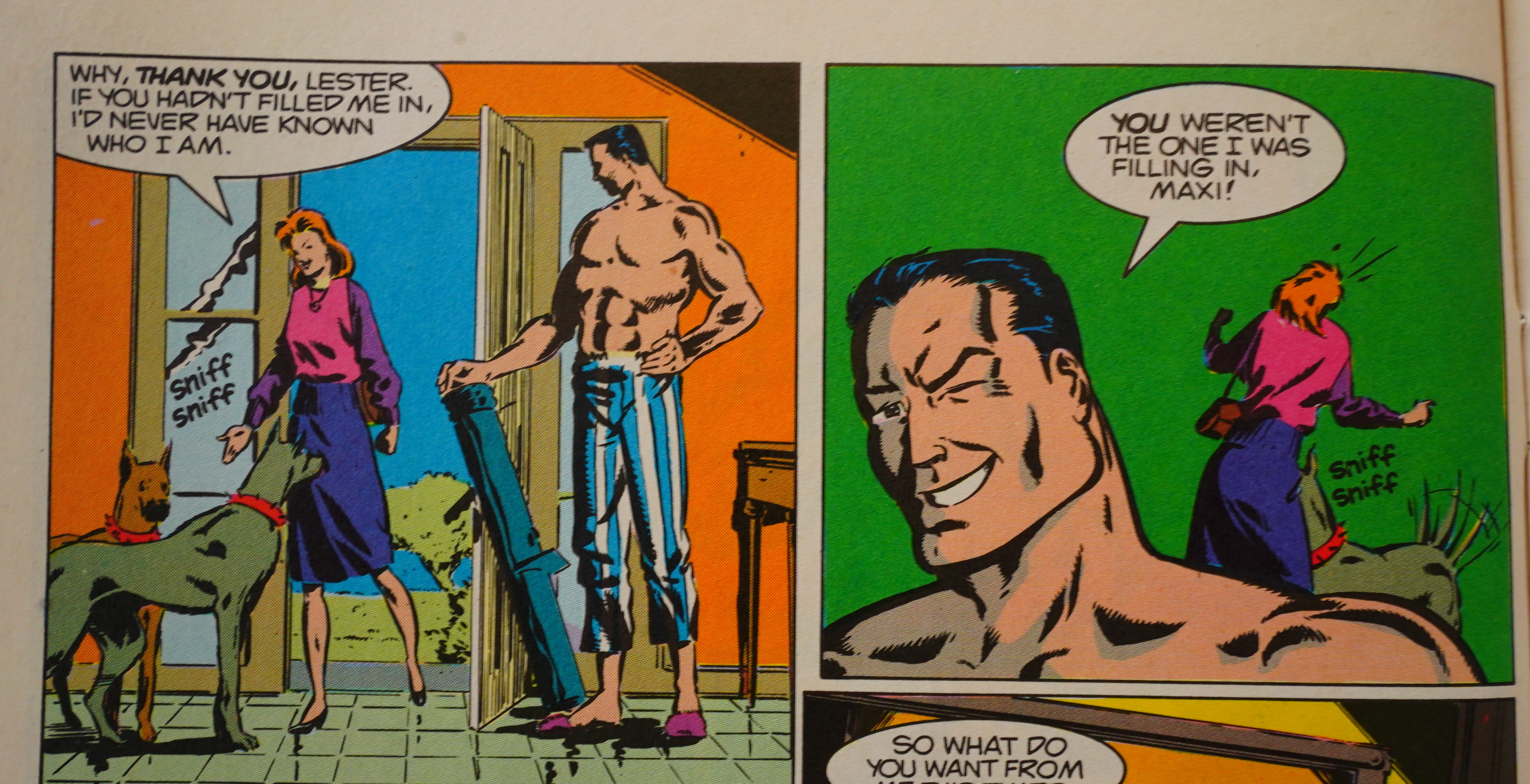
Wink wink. But it is a very efficient way to get the introductions done.
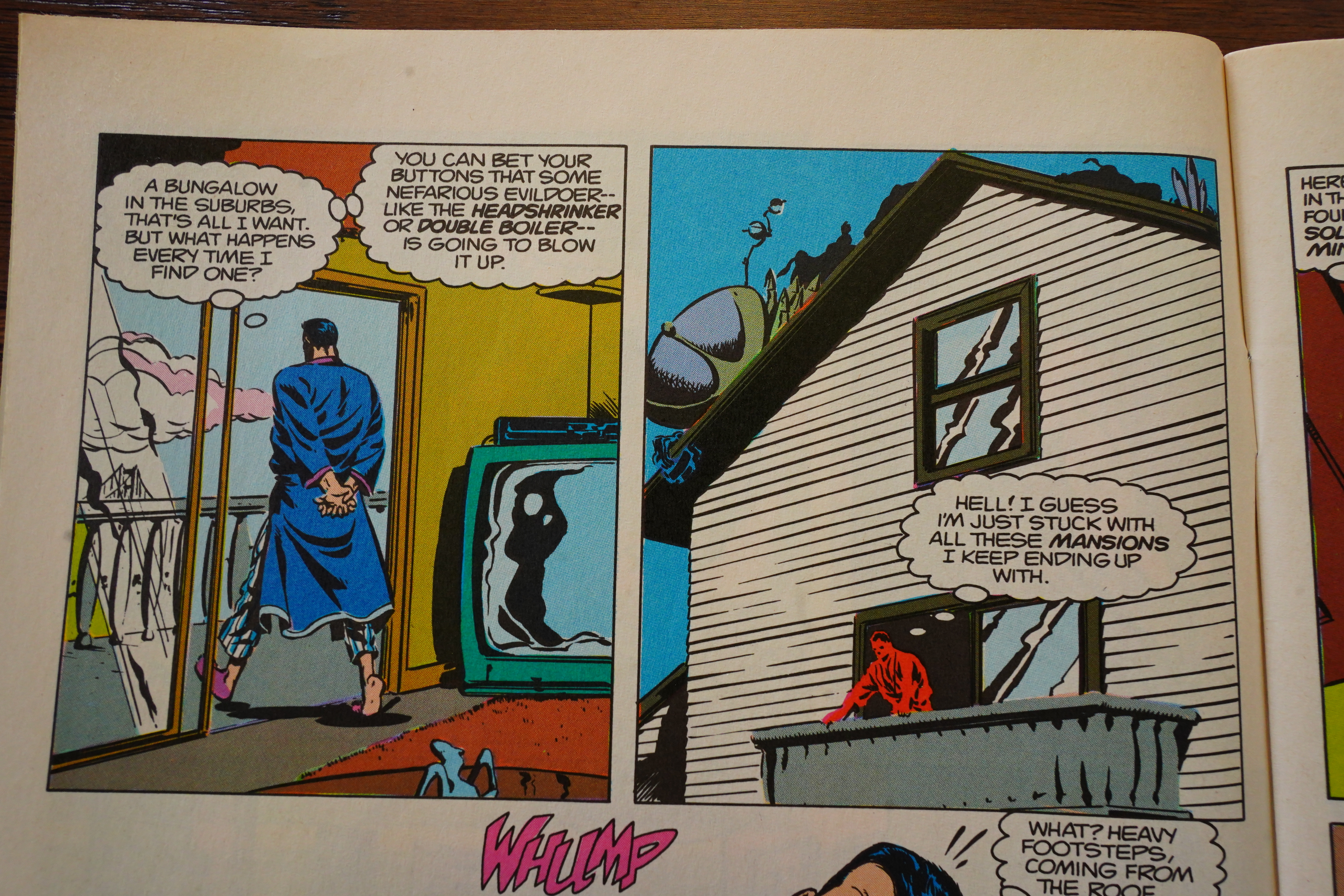
For this kind of thing, there aren’t that many background sight gags. I guess the dogs sniffing the crotches of all the female characters is a running gag…
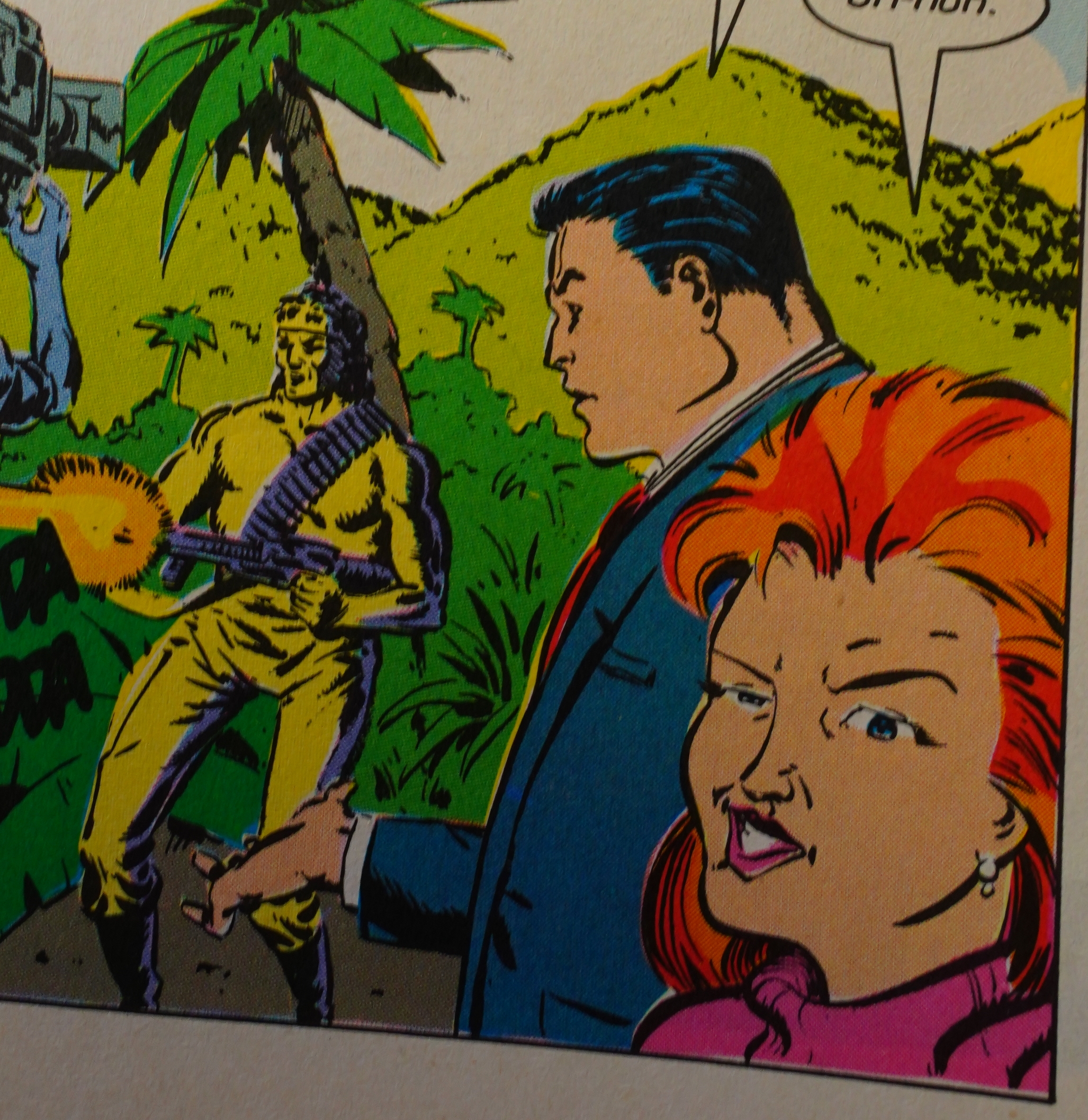
Man, that’s some bad drawing… and some colouring that’s so off that it can’t just be normal off-register printing — it’s like the colourist (or separator, I guess) just didn’t care at all, and who could blame them with art like this.
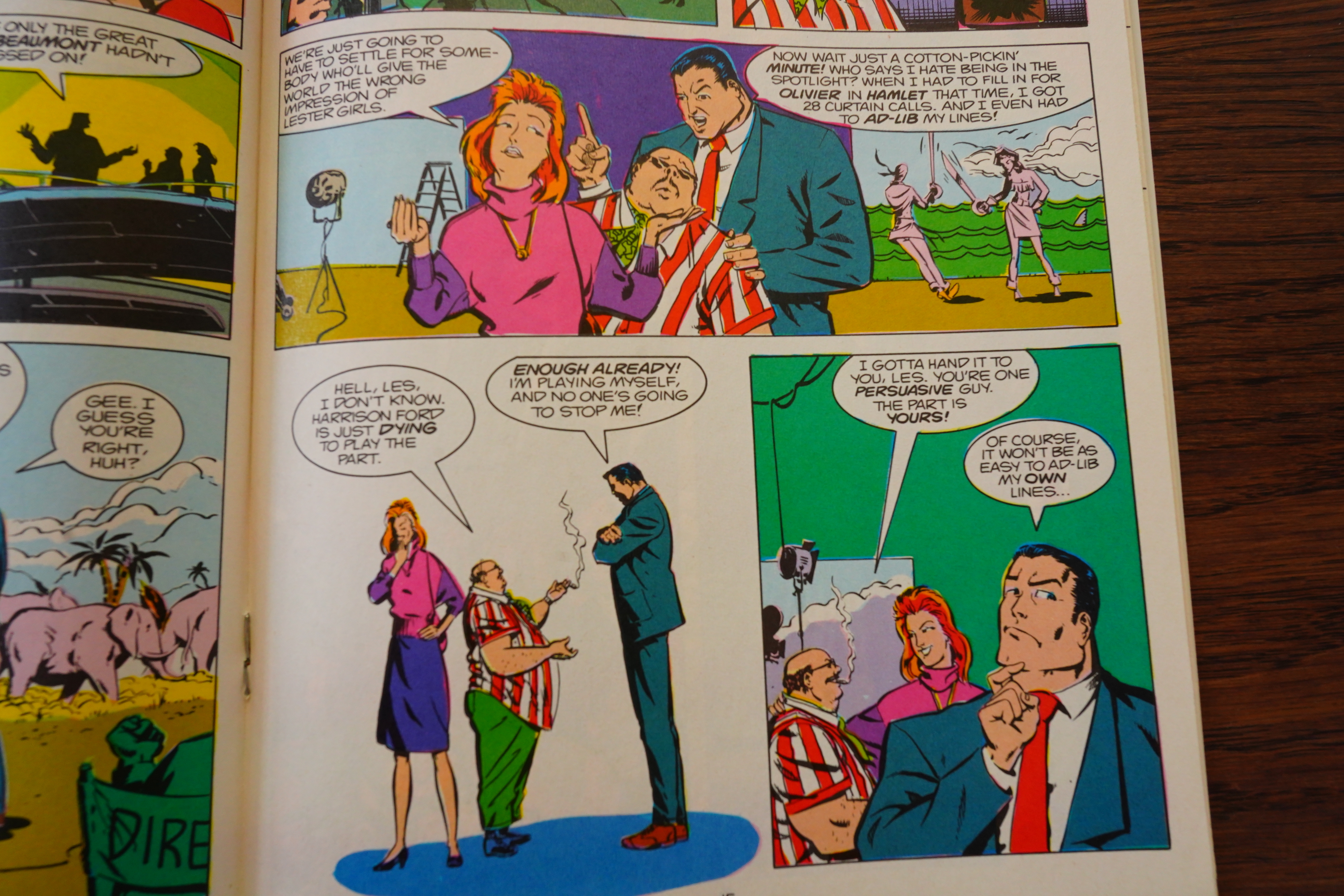
Well, that’s a solid joke…
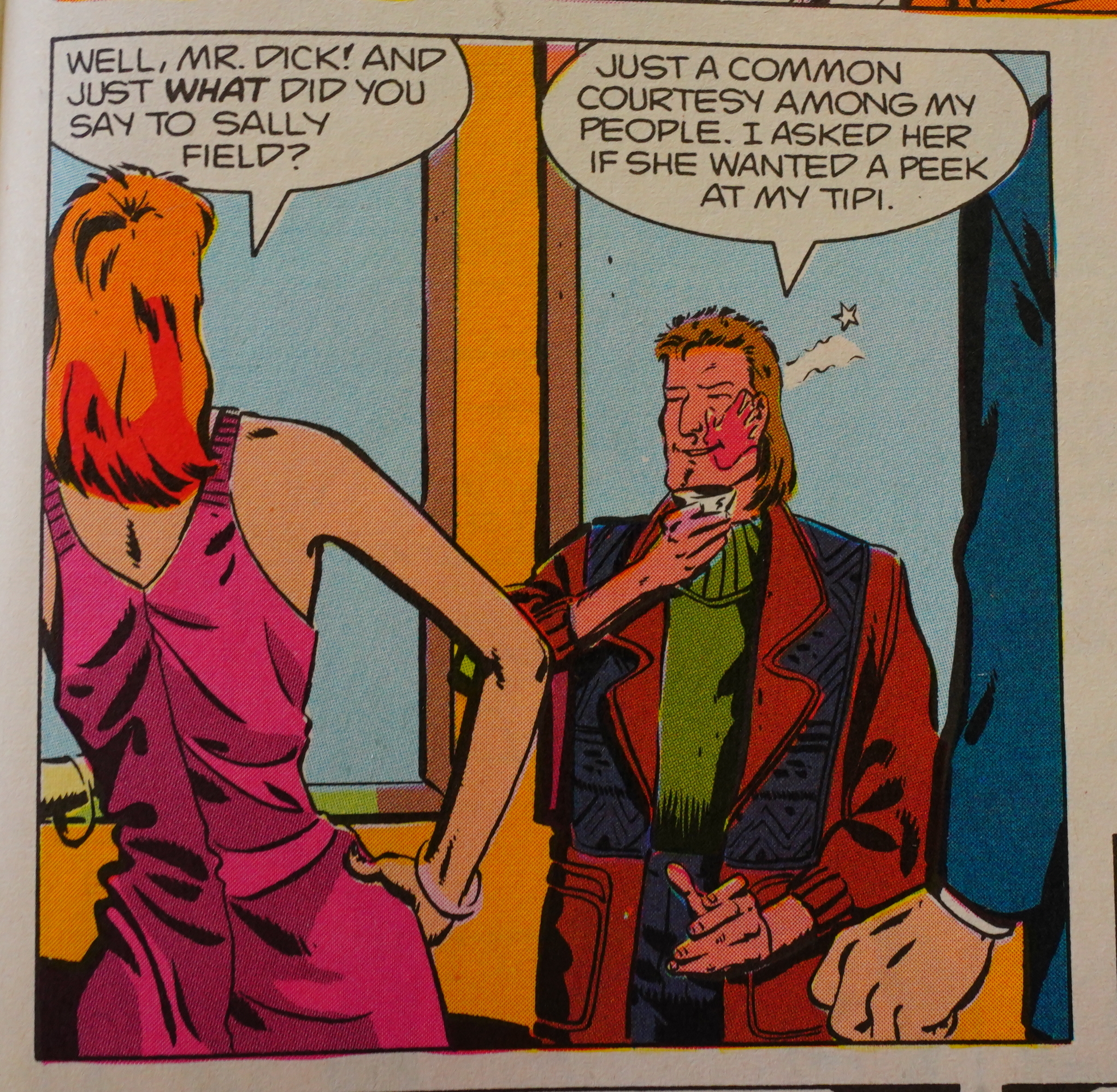
But there’s more humour like this, really.
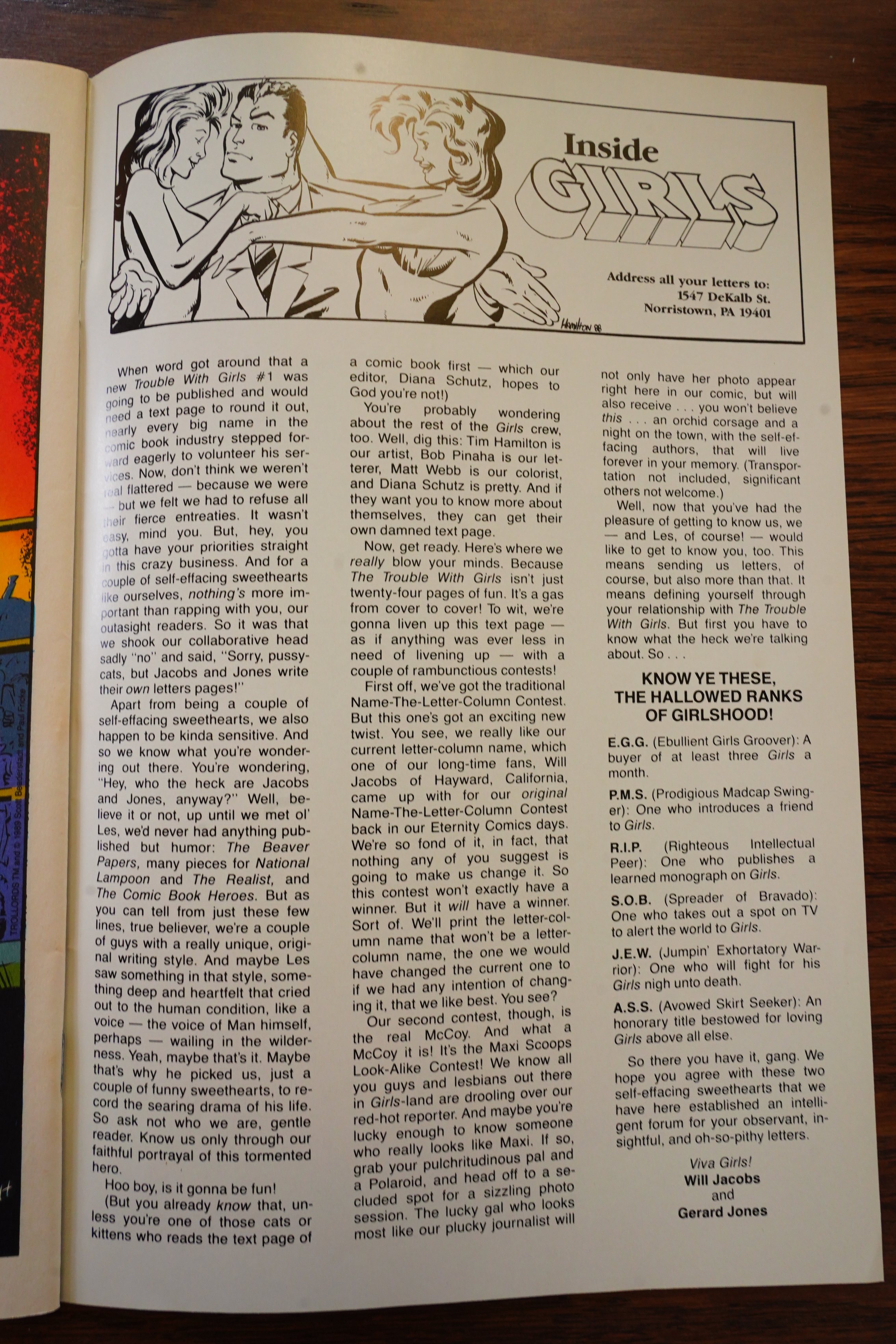
Somehow the text here is creepier than the comic itself.
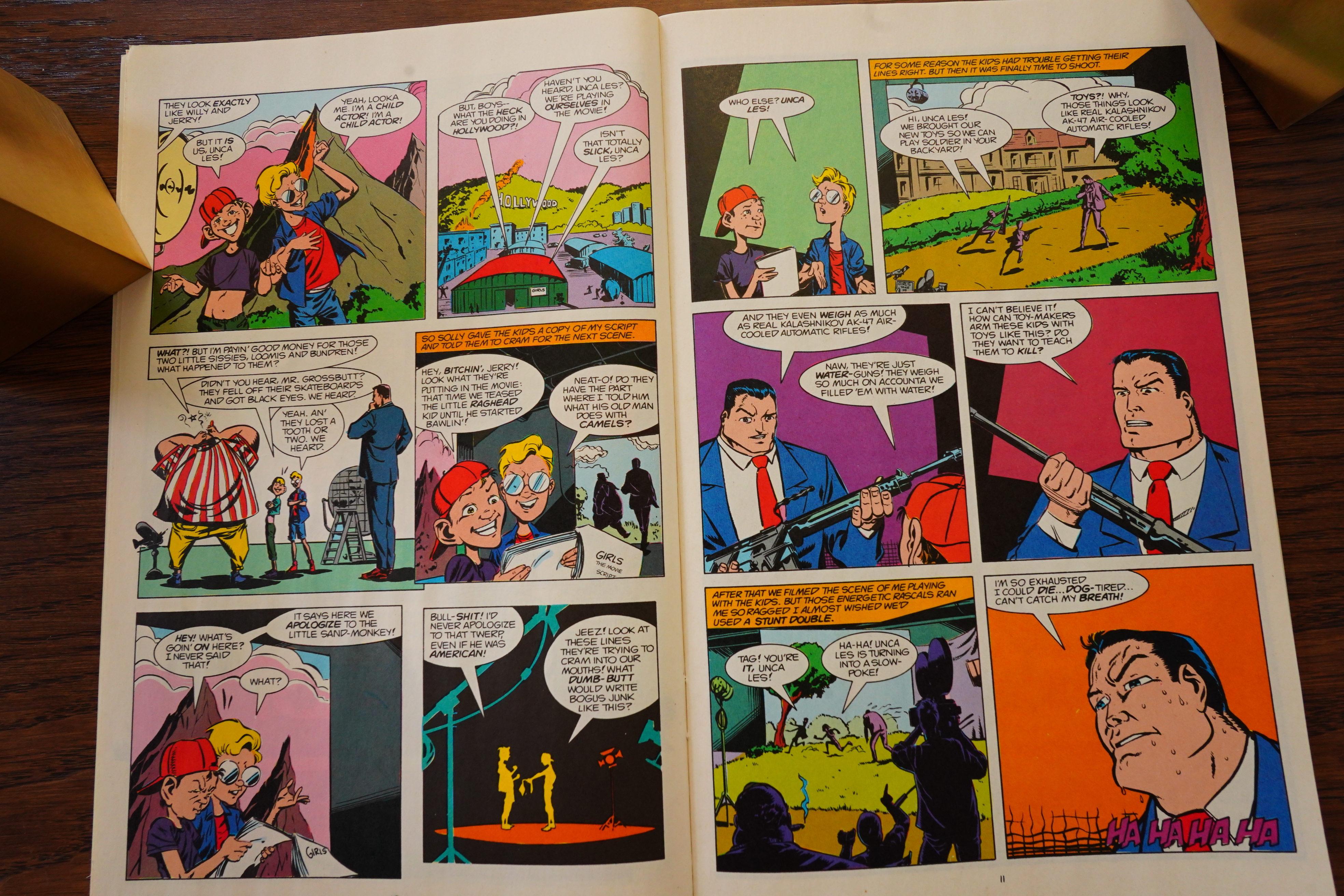
So I was talking about how efficient the writers were about letting the readers know what the whole thing was about — but they really drag when it comes to actually doing the plot. It’s not that the gag here is bad — they’re fooling Lester Girls into making an action movie — but it just plods along with way too few jokes. It feels like it could have been done in a four page montage, but it takes an issue and a half.
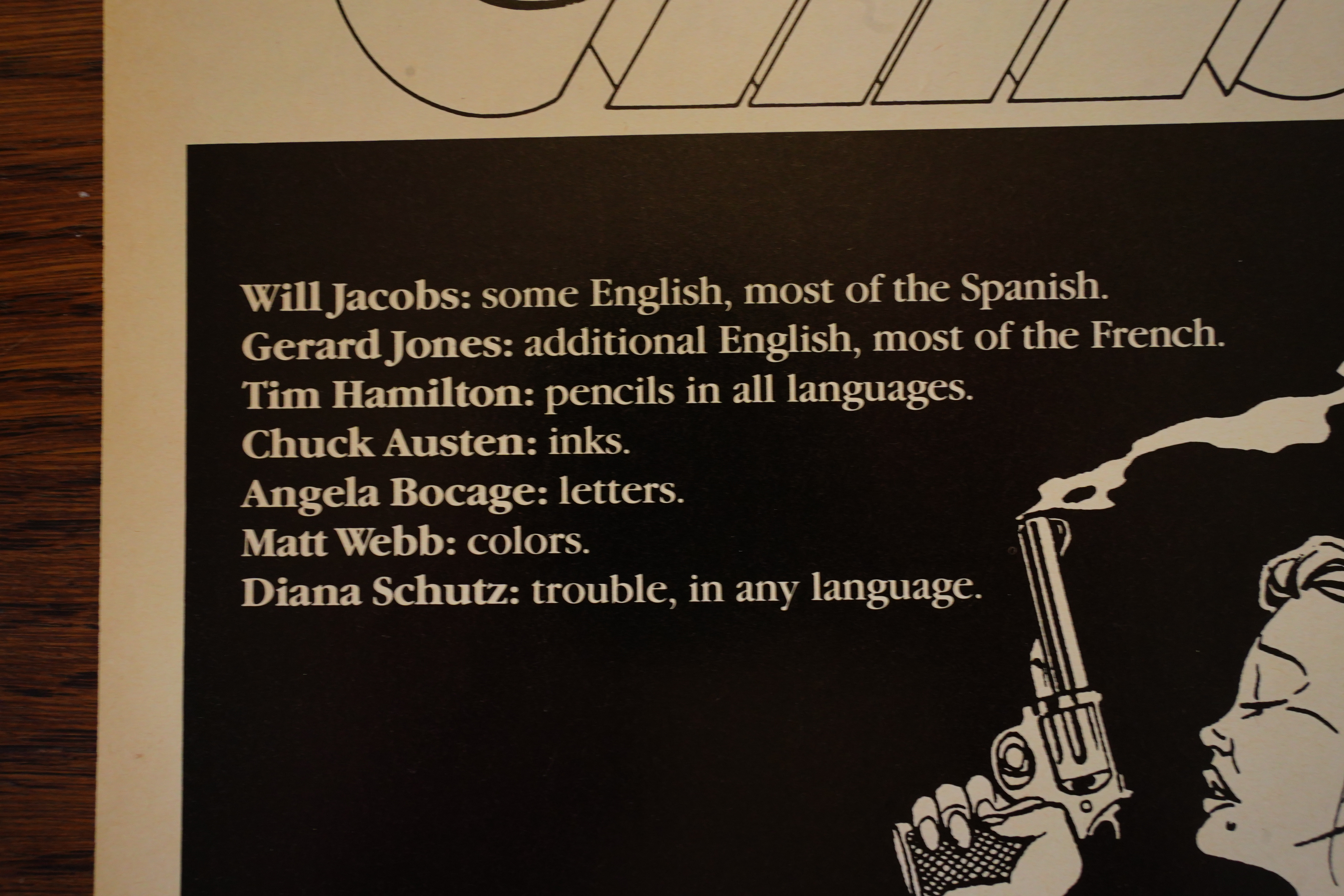
By the third issue, they’ve gotten Chuck Austen aboard to do the inks, which I think should help. And on lettering… Angela Bocage!?? Wow.
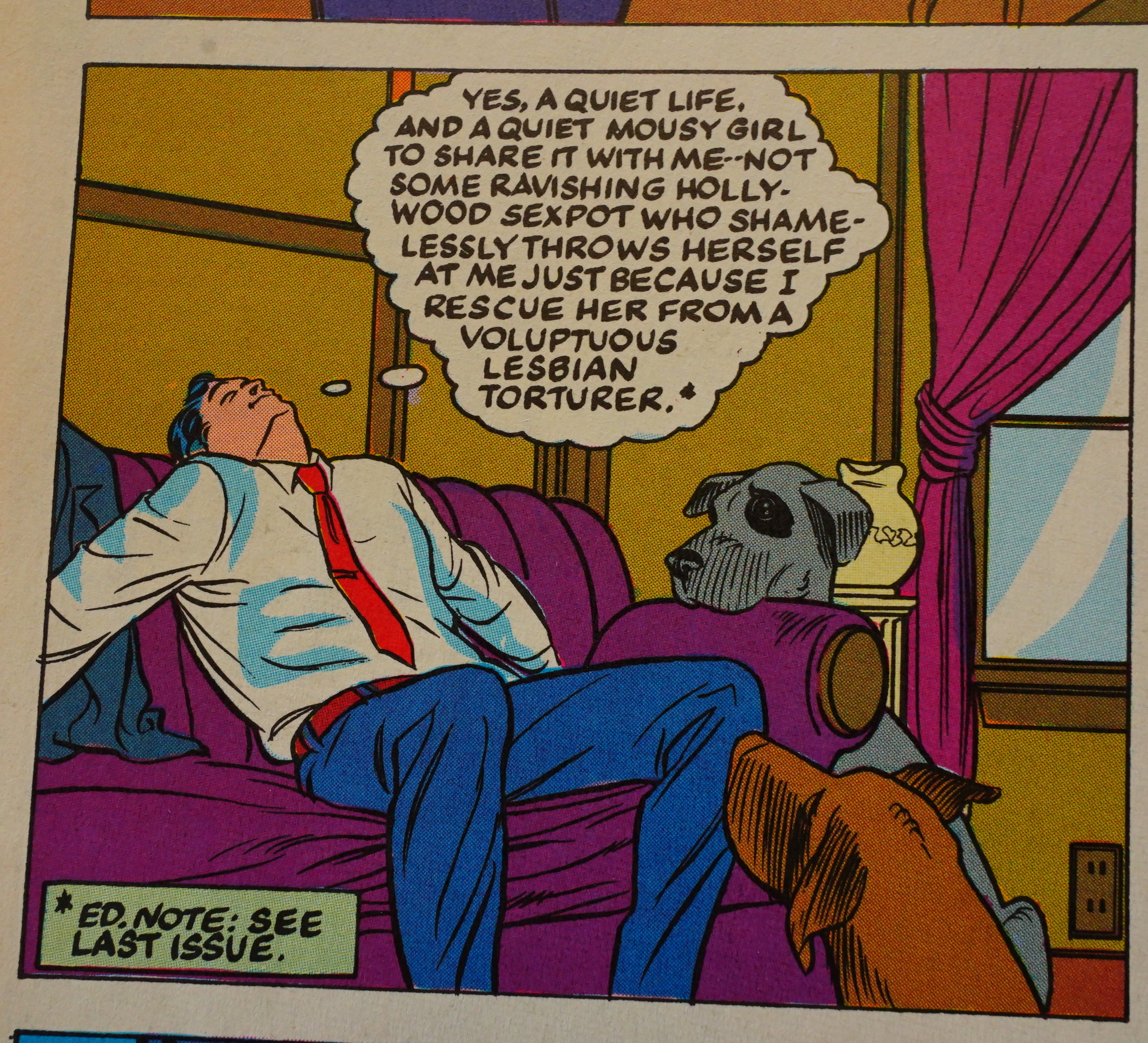
I guess this only seems creepy in retrospect?
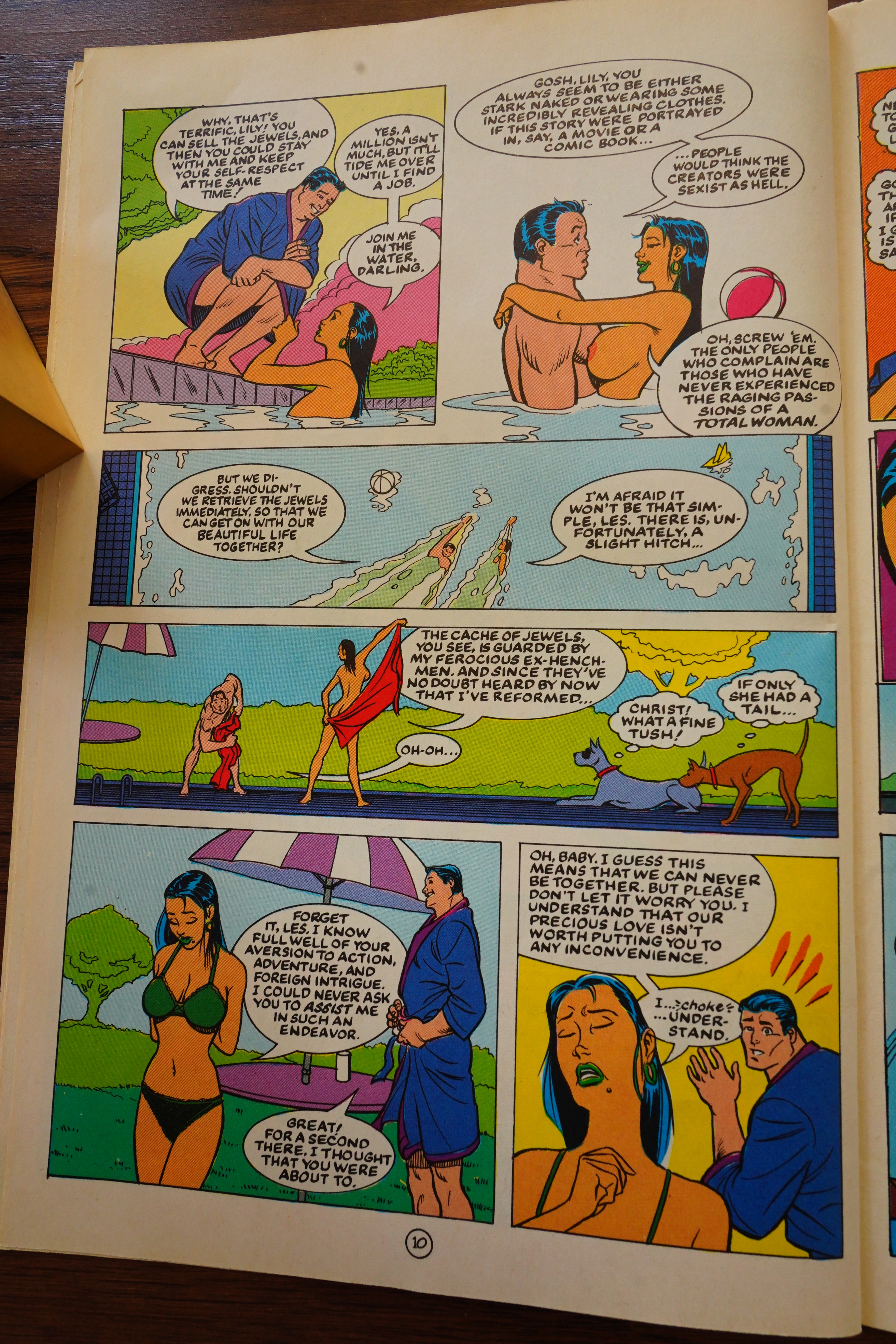
And indeed, Austen’s inking helps — things become more cartoony, which makes the general awkwardness of these pages recede.
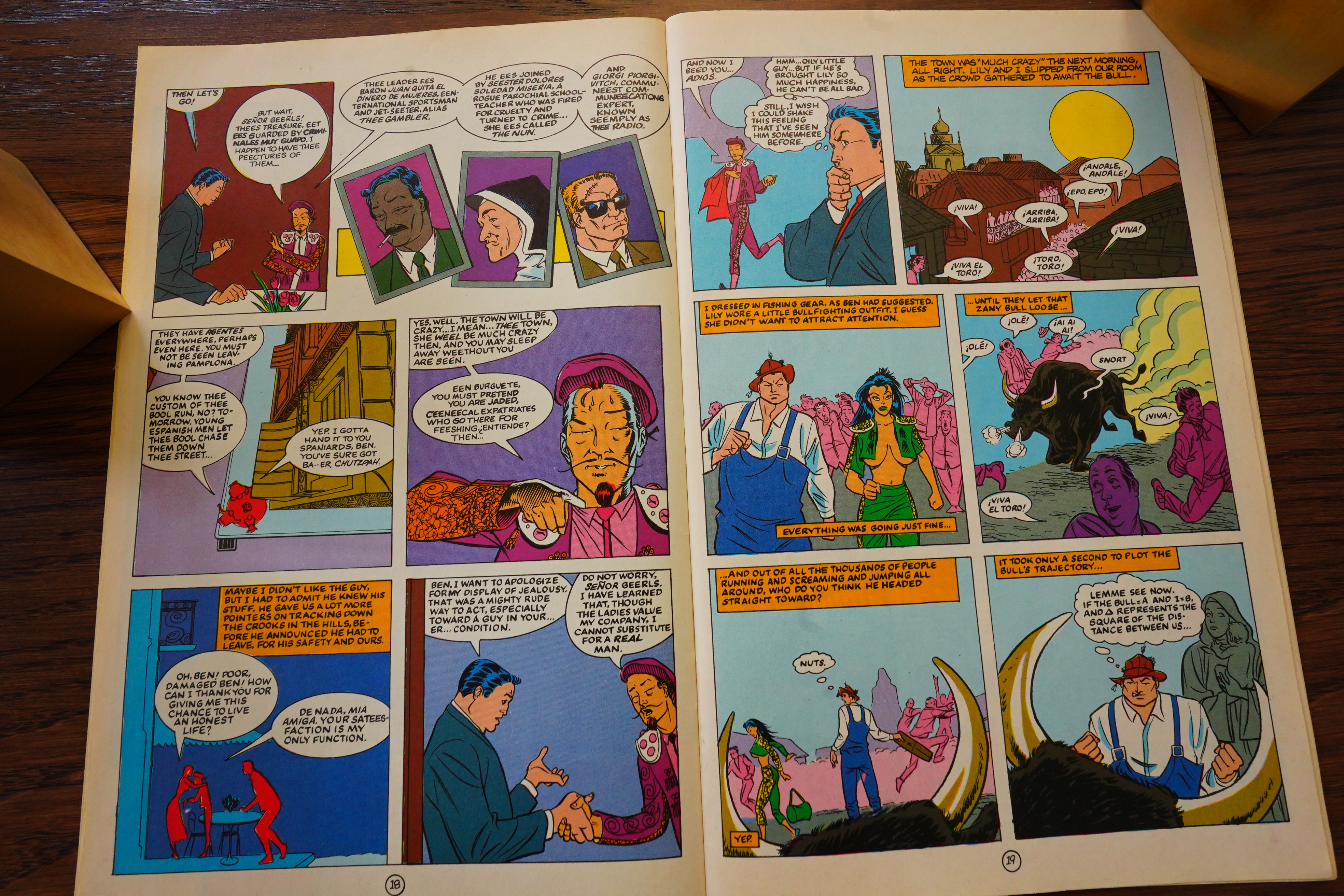
But it doesn’t really help with another ponderous, slow-moving plot where you just kinda want to go “ok, I get the schtick… it’s an OK schtick but you need to add more jokes”.
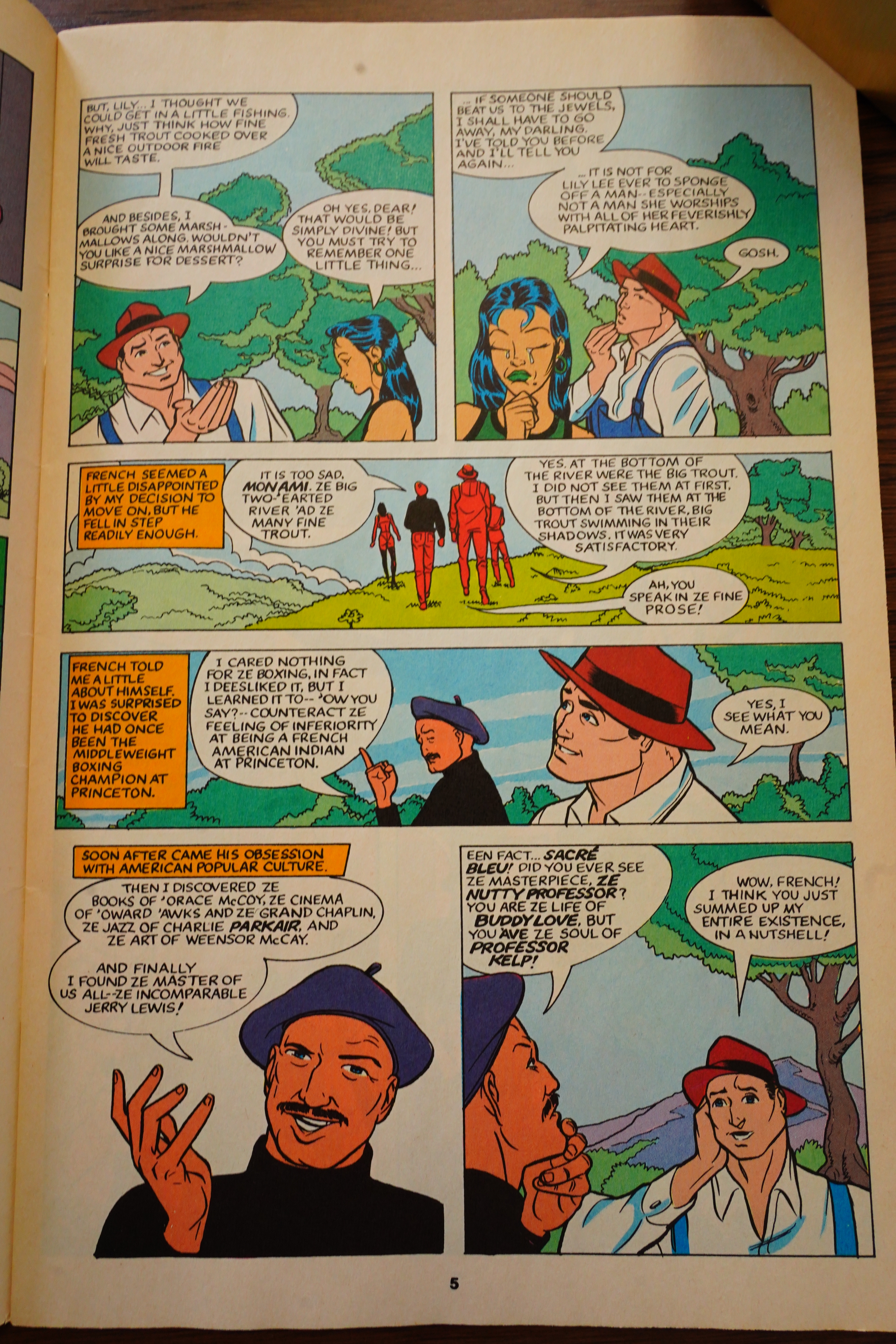
The colourist starts doing a better job, too.
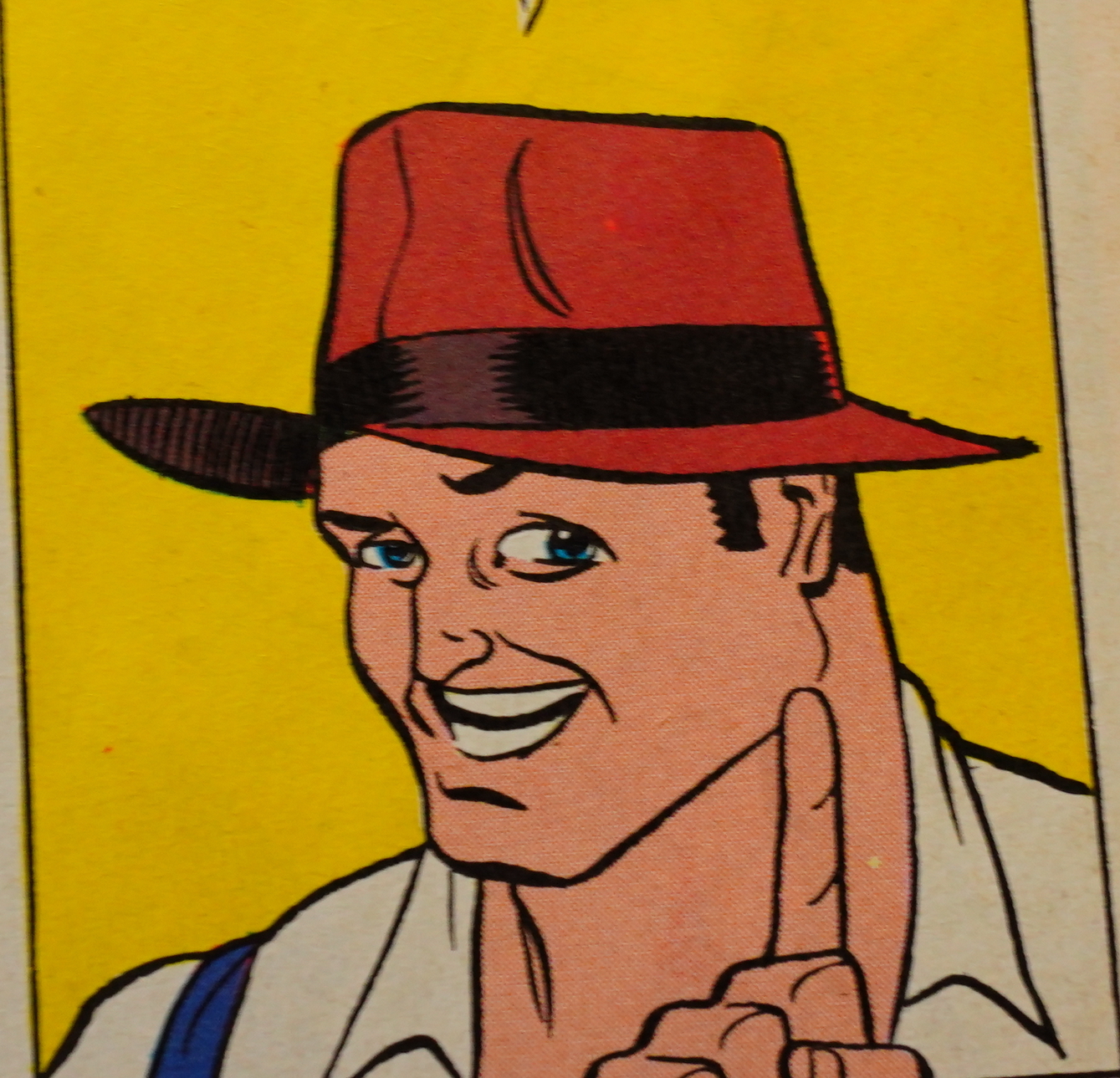
I guess Austen can’t work miracles — Lester Girls looks totally different from panel to panel.
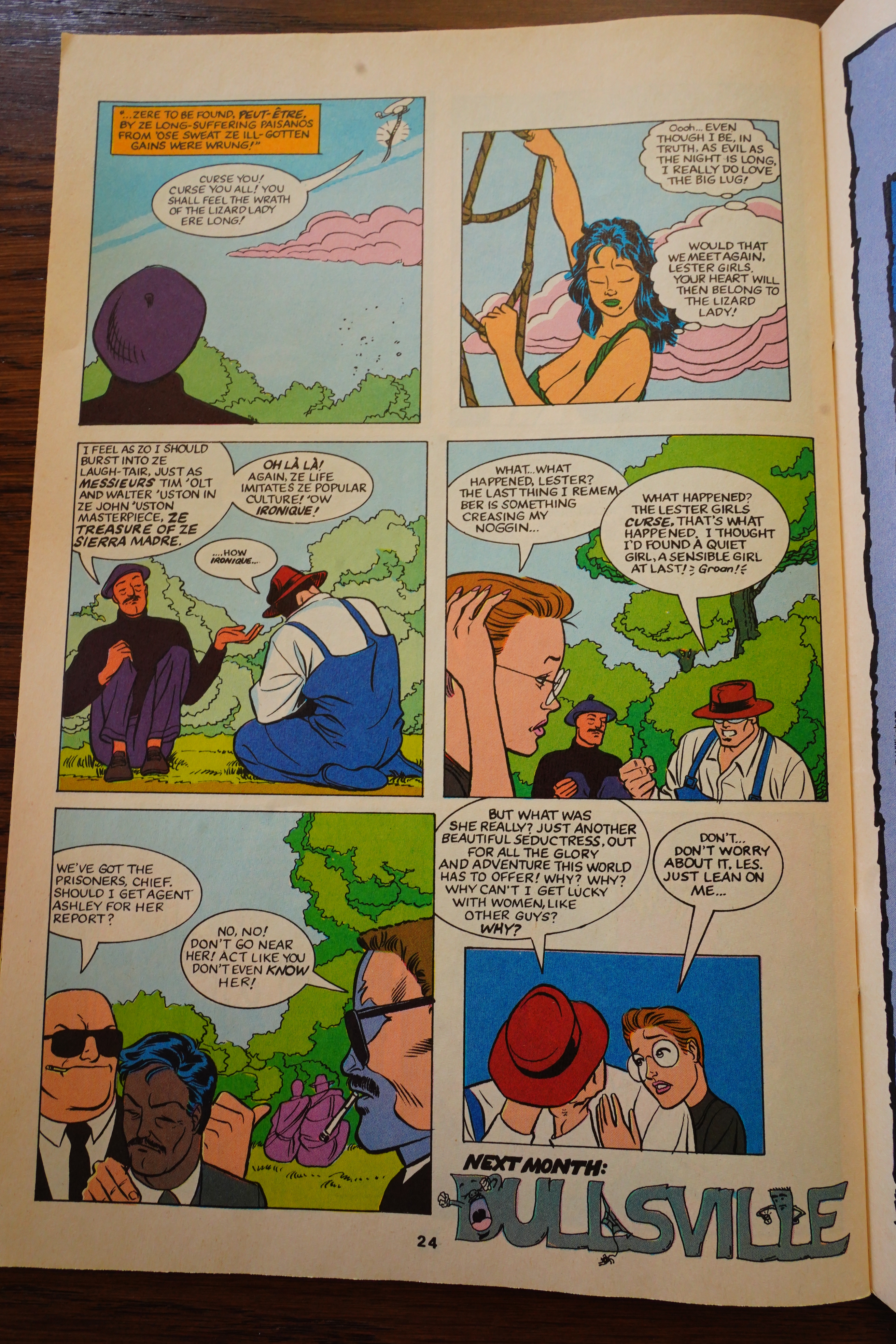
And this is how the series ends — I guess it was another victim of the Comico melt-down, as we’ve covered in earlier posts in this blog series.
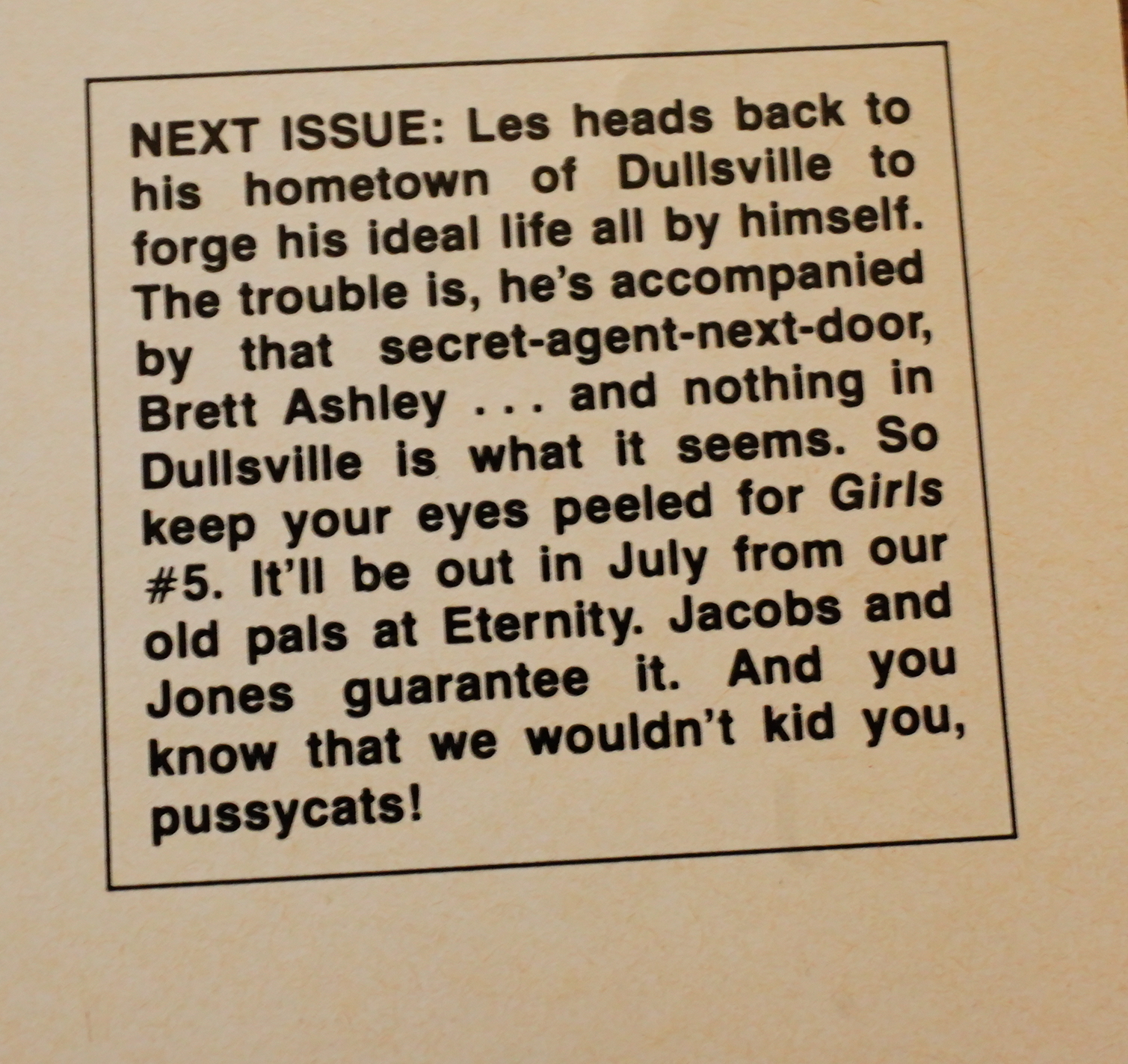
This is the only note that it’s been cancelled by Comico — but it seems like it continued seamlessly by returning to Eternity/Malibu.
I guess it’s not bad, really? But it’s just not funny enough.
Amazing Heroes #152, page #12:
COMICO SIGNS TROUBLE WITH GIRLS
Publisher PHIL LASORDA has an-
nounced that COMICO has signed
WILL JACOBS and GERARD
JONES to publish their action/humor
comic, The Trouble With Girls.
LASORDA stated, “Girls is the type
of book that any publisher would love
to have under his wing…and we’re
very grateful for the support and con-
fidence that MR. JACOBS, MR.
JONES, and crew have exhibited by
choosing COMICO as their new
home.”
“Obviously, we’re very happy
about the move,” said co-creator/co-
writer JACOBS. “We enjoyed work-
ing with the people at ETERNITY,
and they did an awful lot to get Girls
noticed in this business. But switching
to color was an opportunity we
couldn’t pass up.”
“Color will be perfect for this
book,” added JONES, the other half
of the co-creator/writer team. “The
wild adventures and the far-flung set-
tings of Lester Girls cry out for it.
And our artist, TIM HAMILTON,
has the sort of clean, open style that
color will really bring to life.”
ETERNITY COMICS will con-
tinue to publish The Trouble With
Girls at least through issue #14. The
release for the first COMICO issue
is tentatively scheduled for early
1989.
Amazing Heroes #157, page #228:
Starting in February the satirical critical
favorite The Trouble With Girls makes
the leap from Malibu to Norristown,
with its first full-color Comico issue.
Creators Jones, Jacobs, and Hamilton
remain on-board, although an inker of
unknown identity will probably be
joining the merry band,
“We’re very excited by the move to
color,” says Jones. At the same time, he
and Jacobs are making sure that new
readers won’t feel lost at sea by the
Eternity continuity. “People who have
never read the Eternity issues will have
no problem, but faithful readers won’t
have to sit through a lot of recapping.”
The first seven issues take Lester
through some big changes, and in an
attempt by Jacobs and Jones to beat the
one-joke rap that has sometimes been
leveled at them, Lester will be under-
going some actual emotional develop-
ment. But not to fear, the satiric edge will
still be there. The creators are attempting
to make storylines much tighter than they
were previously, as well.
The splash page of the first Comico
issue will open with Lester reading Old
Yeller and while he won’t be in the can.
Jones thinks it will be a pose to rival the
notoriety of the initial Malibu splash.
Lester will also be reading Anne of
Green Gables in the coming months.
Issues #1 and #2 find our square-jawed
protagonist in Hollywood, for the filming
of the Lester Girls movie, where he
meets the most intractable foe of all—a
director, namely Solly Greenblatt. Lester
has his idea of how his life story should
go, but soon finds that Solly has different
and more accurate interpretations of the
tale—and guess who’s got more of that
fabled clout? Issues #3 and #4 involve
Lester in a Spanish revolution. Then it’s
back to his hometown—Dullsville—for
a senses-shattering re-evaluation of his
values. This story will wrap up in #7.
Most of the old favorites will be re-
turning—the Lizard Lady, Maxi Scoops,
Apache Dick, Brett Ashley, and, briefly,
the fun-loving Foster boys. We’ll also
meet Lester’s dogs, Dean and Howells.
In multi-media The Trouble With Girls
news, Jones is optimistic about the
prospect of the movie. Currently, there
is interest from two companies which
couldn’t be more different-Godmother
Films (Tell Me a Riddle) and Impact
Productions (Commando). I guess that’s
what’s called wide-based appeal.
The Comics Journal #129, page #15:
The Trouble With Girls. Comico’s last
monthly issue of The Trouble With
Girls – #4 – ships in May. Eternity,
which published nine monthly issues
of the title between January and Oc-
tober 1988, will continue Comico’s
numbering, shipping #5 in July. Tim
Hamilton remains the series’ penciller,
and Chuck Austen will ink Eternity’s
first two issues.
The Trouble With Girls premiered
from Malibu Comics in August 1987,
adopting the Eternity imprint with #6
when Malibu acquired that company.
Malibu/Eternity published 14 issues
and an annual of the title before it mov-
ed to Comico late last year.
Jones explained the move to Com-
ico: “We just had this chance to jump
to color. I was hyped into the psycho-
logy that color is better. But color can
tax a publisher so much that, in a way,
it works against a low-selling comic.”
Jones said that sales of the title
doubled at Comico, but the book
nevertheless “went from a profit [at
Eternity] to break-even.”
Jones said Eternity Publisher Dave
Olbrich called him February 27, three
days after Comico “put us on hiatus,
whatever that means,” and made
“the most generous offer” of four com-
panies “seriously interested in acquir-
ing Girls,” but declined to name the
other prospective publishers.
Jones told the Journal he and Jacobs
signed with Eternity because of the
publisher’s ability to pay creators and
meet deadlines.
“The other publishers who contacted
us were either untested or we’ve seen
them having trouble getting books out
on time,” he said.
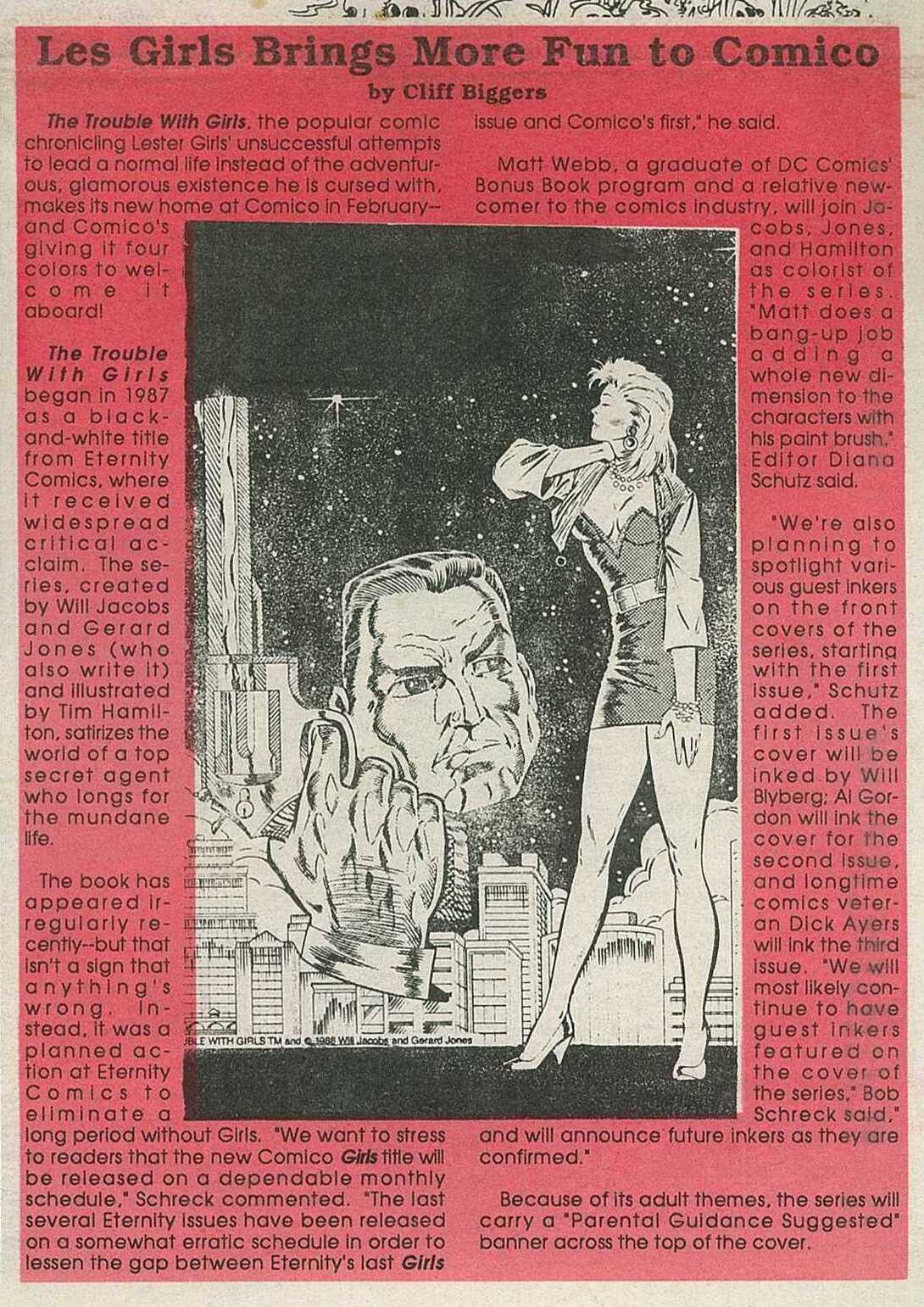
TROUBLE TO ETERNITY
With Comico’s cutback on its comics line
set for June, several books are left without
an ongoing publisher. At least one of
those books has already found another
home, though. The Trouble With Girls by
Will Jacobs and Gerard Jones will move
back to its old publisher, Eternity, with The
Trouble With Girls #5. The book will retain its
numbering system from its Comico run;
the first return-to-Eternity issue will be avail-
able in July. Tim Hamilton, artist of The
Trouble With Girls for its entire run, will con-
tinue to draw the series; his work in Trou-
ble With Girls #5 and #6 will be inked by
Chuck Austen.
“We’re torn between having a new logo
done or using the Comico version de-
signed by Rick Taylor,” Eternity creative
director Tom Mason said. “I guess we’ll
have to decide that sometime before
the book ships.” He did confirm, howev-
er, that Eternity would not use the logo
used on the earlier Eternity/Malibu issues
of The Trouble With Girls.
“Needless to say we are very happy to
have Will, Jerry, and Tim back at Eternity
creating new episodes of one of the few
legitimate hit comics to be published in
the past three years,” Eternity Publisher
Dave Olbrich said.
Co-creator Gerard Jones said that he
and Jacobs were happy to
return to where they started.
“We were flattered by Eterni-
ty’s desire to get us back. Of
the four companies seriously
interested in acquiring Girls,
Eternity’s was the most gen-
erous offer.”
Co-creator Will Jacobs felt
that Eternity’s track record as
a publisher was very impor-
tant. “Eternity has proven
that it can survive in a shaky
and unpredictable market.
We are impressed with their
ability to publish regularly
and to pay creators regular-
ly considering the vagaries
of the comic book business,”
Jacobs said.
Eternity just released a Trou-
ble With Girls graphic album
containing the first three Mal-
ibu issues by Jacobs, Jones,
Hamilton, and Panda Khan
creator Dave Garcia. A sec-
ond collection of Girls mate-
rial will be published some-
time in the summer or fall of
1989.
Wizard Magazine Special #19, page #68:
With co-creator Will Jacobs, Gerard Jones brought
The Trouble With Girls to Mailbu. Since that first issue,
the series has served as a stepping-stone for Jones’ pro-
lific career which has included The Shadow Strikes,
Elongated Man, and Green Lantern for DC Comics and
Wonder Man for Marvel. He is also working on screen-
plays for Joel Silver, the famed action film producer.
The Trouble With Girls is a point of pride with Malibu
and an example of what creator-owned comics can mean
to both the publisher and the creators. Originally a Mal-
ibu Comics title, it became an Eternity title with the
Malibu-Eternity merger. It left briefly for a color series at
Comico and was eventually cancelled after four issues
when Comico cut back their product line. The series
returned to Eternity where it stayed another 18 issues,
until Marvel opted for a four-issue color run on their
Epic imprint. During that time, the series was sold to
20th Century Fox for development as a feature film –
with creators Gerard Jones and Will Jacobs writing the
original screenplay drafts.
I guess that didn’t happen.
The Slings and Arrows Comic Guide #2, page #696:
Will Jacobs and Gerard Jones’ secret agent spoof follows the
adventures of reluctant international playboy/spy Lester
Girls, who would much rather have been living a quiet life
in the suburbs, with 2.4 children, a friendly dog and
Sunday mornings washing the car. Fate has other plans for
poor old Les: he can never escape the glamorous women,
fast cars, big guns, international agents and would-be
world conquerors who are constantly on his trail.
His friend Apache Dick is usually happy to relieve him
of the burdens of unwanted wealth and half-naked
nymphomaniacs. The basic joke is a funny one and almost
all issues are well done, but it does wear thin quickly and
seems a little too formulaic after an extended run. The only
differences between the publishers are that the Comico
and Epic issues are in colour, the others aren’t. Pick up a
few issues and re-read them when you’ve forgotten
the plot.
The series is nonetheless popular enough to have
spawned several spin-offs starring both Les himself
(Lester Girls 3 issues, Eternity, 1990-1991) and other
members of the regular supporting cast such as the Lizard
Lady (Aircel one-shot 1991) and Apache Dick (Eternity,
4 issue miniseries 1990). During the short spell with
Epic, a Lester Girls story appeared in the Heavy Hitters
anthology, and the first nine Eternity issues were available
in three collections.~JC
The Comic Book Heroes, page #332:
“We’d never planned to write comics,” said
Jones, “but when Mike Valerio told us Dave Olbrich
was looking for ideas, we sent him part of an aban-
doned humor novel, The Trouble with Girls. We dis-
covered that we could do anything in independent
comics—anything—even things that made no sense
narratively or commercially. Somehow with pictures,
and with the self-referentiality and clubbishness of
modern comics, they all worked. We had more fun on
Girls than we’ve ever had on any project, and we did
the best writing there that we’ve ever done, in any
medium.” The abandoned novel turned into one of
the longest-running independent comics of its time,
running to over fifty issues from three publishers, in
color and black and white. There would be artistic
contributions from Paul Gulacy, Walter Simonson,
Bret Blevins, and others, but the vast bulk of the sto-
ries were drawn by Tim Hamilton, who started with
a nice touch for facial expressions but little else, and
matured in Girls’s pages into a solid artist who could
combine farcical action and quiet naturalism like few
other artists.
Amazing Heroes #161, page #68:
Ever watch a “one-laugh” tv show?
You know, the kind of sitcom that con-
siders itself quite funny; but needs the
constant help of a laugh-track to tell
you what’s funny? Shows along the
lines of “Gilligan’s Island,” and “The
Munsters,” are perfect examples.
There isn’t anything to make you laugh
out loud because the humor is so dry
(or non-existent/strained), but the gen-
eral idea in the vaguest sense is sort
of amusing. Sort of.
The Trouble With Girls is a one-
laugh comic book. It’s about the reluc-
tant adventures of an over-sized uber-
mensch named Lester Girls who
dreams of escaping his life of man-
sions, million$, women and violence
for a more subtle existence. Lester, for
whom action and sex are an annoying
banality, is very hard to feel sorry for.
And that’s the one and only joke.
The story starts with Lester going
at it with a woman doggie-style…
while reading a copy of Old Yeller. As
funny and shocking as that might
sound, the rest of the humor in the
story is supposed to come from soph-
omoric violence, brandname products
and Lester’s trip to Hollywood. The
only wryly clever humor to be found
upstages Lester in the Hollywood se-
quences (behind him a few movies in
production make light of the Rambo,
The Texas Chainsaw Massacre and
snuff film phenomenons). The story
could have worked very well as an
8-page juxtaposed “Secret Life of
Walter Mitty,” instead of a continuing
and strained series.
Writers Will Jacobs and Gerard
Jones cracked the National Lampoon
market during one of the magazine’s
dry spells. Though neither of them is
a Doug Kenney or P.J. O’Rourke, they
have written some funny material
(highly recommended is The Beaver
Papers, if you can find a copy). Un-
fortunately, The Trouble With Girls
isn’t one of their triumphs. One would
expect comics work from the authors
of “The Surfer Papers” to have more
of a bite.
Tim Hamilton’s uneven artwork
doesn’t help the book. While a decent
draftsman in regards to backgrounds
and inanimate objects, Hamilton can’t
draw humans well nor tell a story to
save his life. Hamilton’s chief artistic
strength is his ability to render cars,
buildings, furniture and other scenery.
He has no problem drawing cityscapes
and convincing interiors, but has
problems with everything else.
Populating his well-crafted arenas
are characters who look like they were
drawn by John Byrne… in his fanboy
days. The faces especially show how
fannish Hamilton’s work is around the
edges; as does the fact that almost the
entire story is told in medium and
two-shots.
Forget The Trouble With Girls and
check out Walter Mitty.
GRADE: POOR
There isn’t that much chatter about it on the web:
But the creative team needs to make sure they don’t give readers too much of a good thing; the package is only funny for so long before they need to introduce something fresh and new into the formula.
But it’s been out of print for yonks, and I guess there’s little chance of it ever getting reprinted, so that’s not too surprising. Still, it ran for 50-ish issues…
The casual caricatures and overly simplistic racism is supposed to be enough to let us know that the authors are in on the joke. It just doesn’t sit as well as it could.
Er:
What recommends the art on Girls, however, is that it is in no way poor or even that most dreaded word for artists, average. It’s visual pacing is energetic, never boring, its characters physically distinct and engaging, and the majority of readers may not even notice the rough patches.
Wow:
The Trouble with Girls is satire with restraint, charming and hilarious.
Yeah, this is definitely one that works better in black and white than color. Most of the main series (besides the spin-offs mentioned in the Slings and Arrows review, there were a couple specials and an annual) is like the last two of these. There’s a decent amount of fourth wall breaking and making fun of comic book tropes but they did experiment a bit in the first two issues. It’s extremely rare for Lester to actually go along with a plan to capitalize on his fame. Also, I think Angela Bocage was their regular letterer at Malibu.