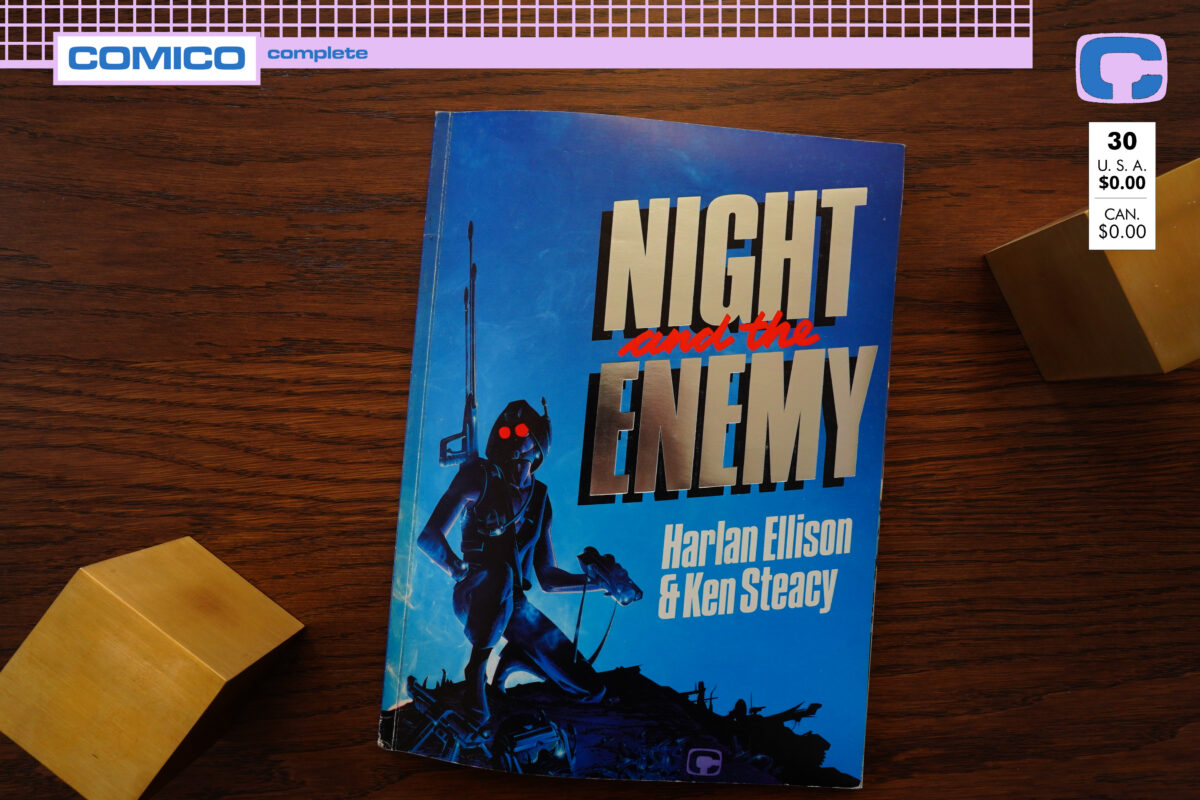
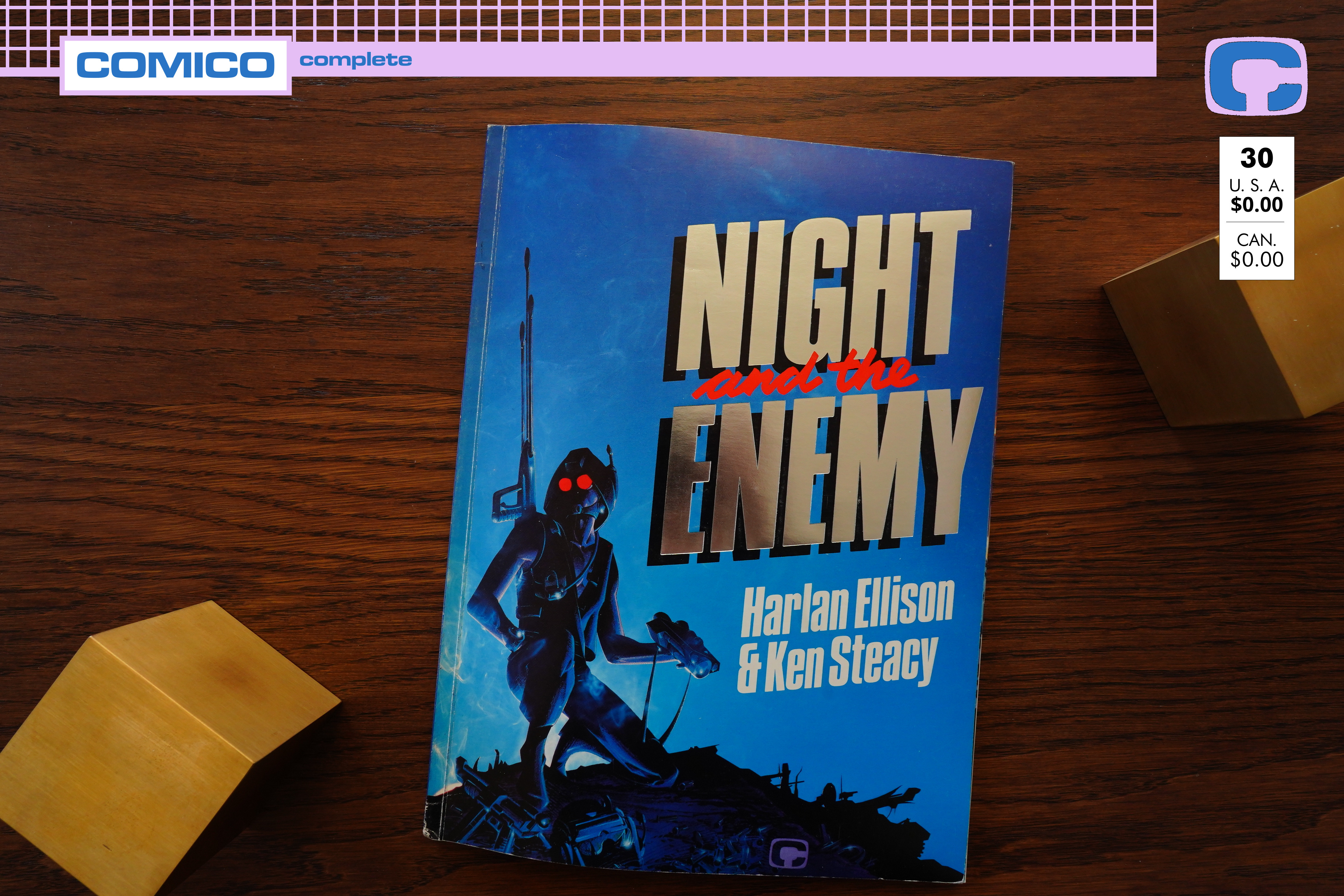
Night and the Enemy (1987) by Harlan Ellison and Ken Steacy
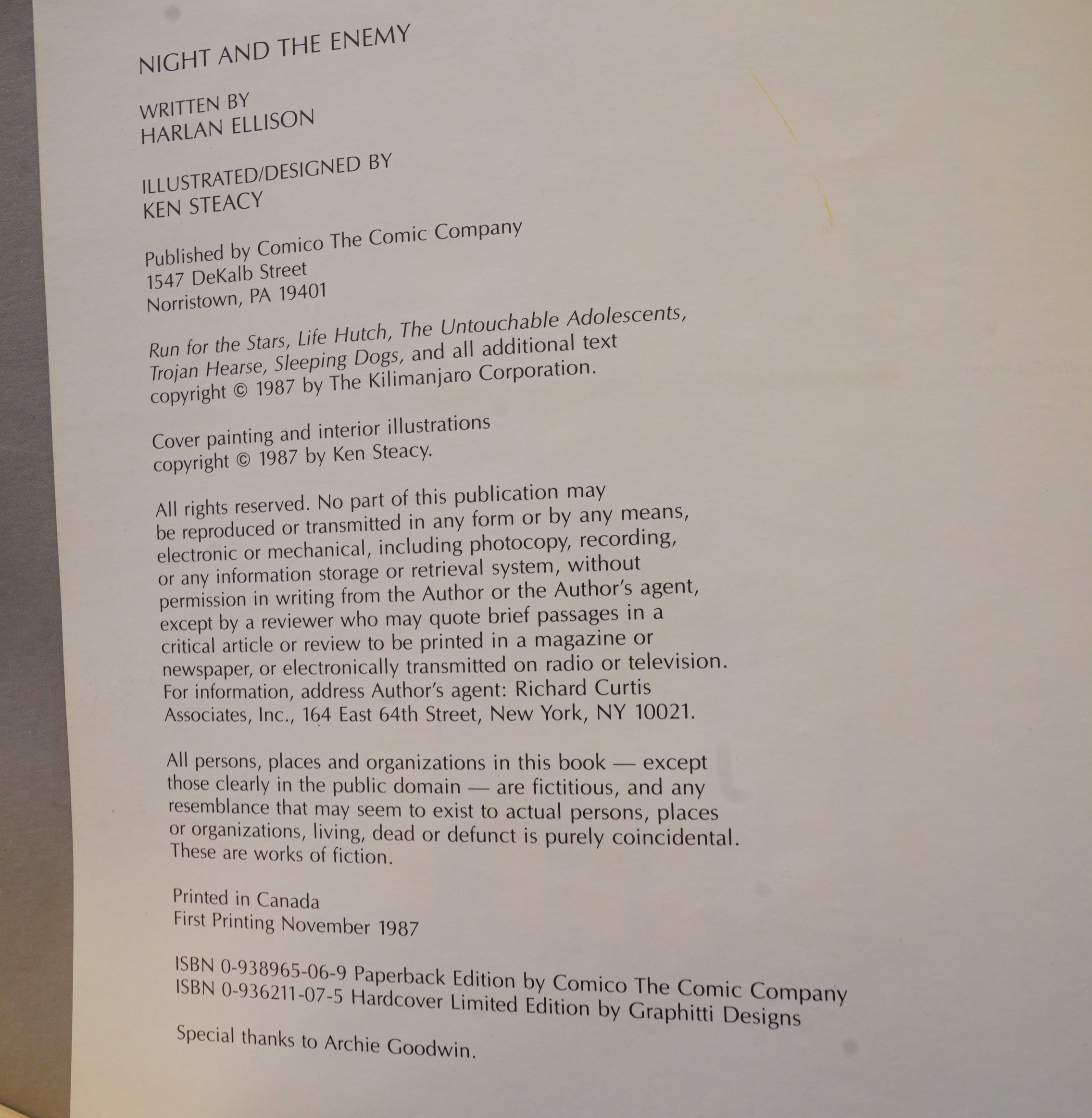
So, what’s this then? As usual with Comico reprints, this doesn’t actually mention that it’s a reprint… or what it is at all, really. The “special thanks” is a hint to those in the know — these pieces were originally printed in Epic Magazine (edited by Goodwin), and they’re adaptations of old, old Harlan Ellison short stories.
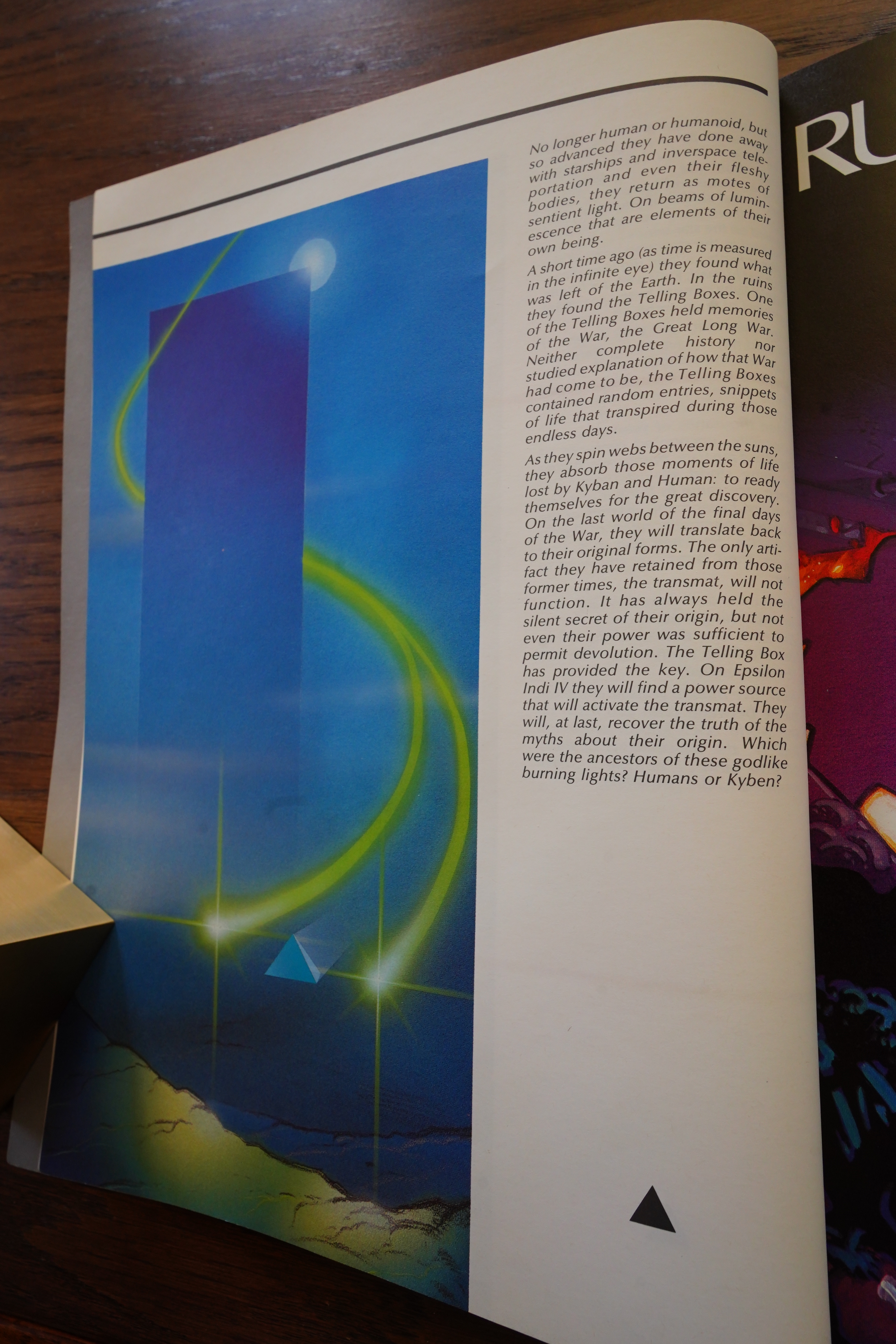
But this edition does have something new — a framing story told from the point of view of the aliens in the final story in the collection. Which is nice.
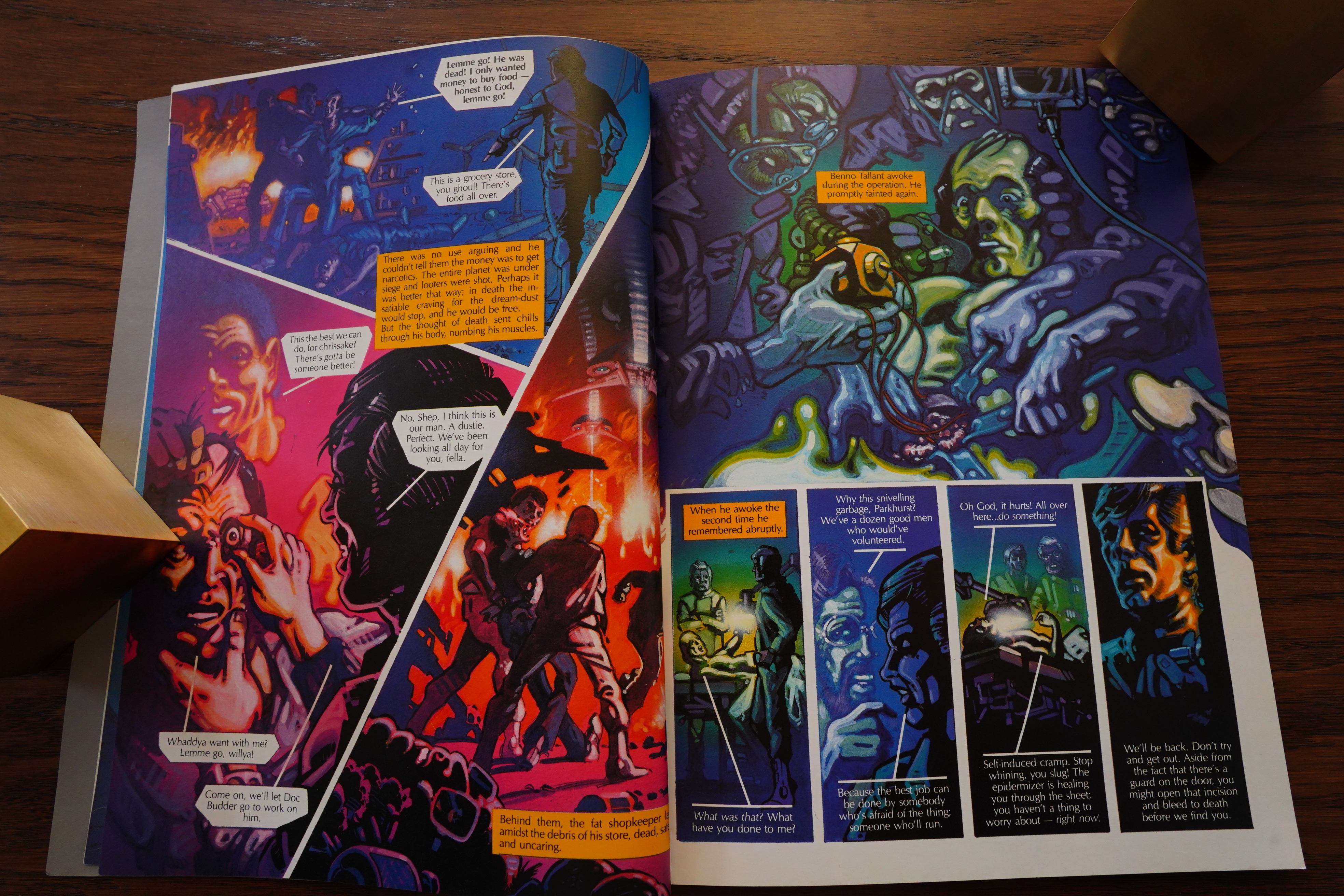
The stories have been reorganised a bit — and possibly given some new text to tie them together? Like this one was originally the third (I think), but comes first here.
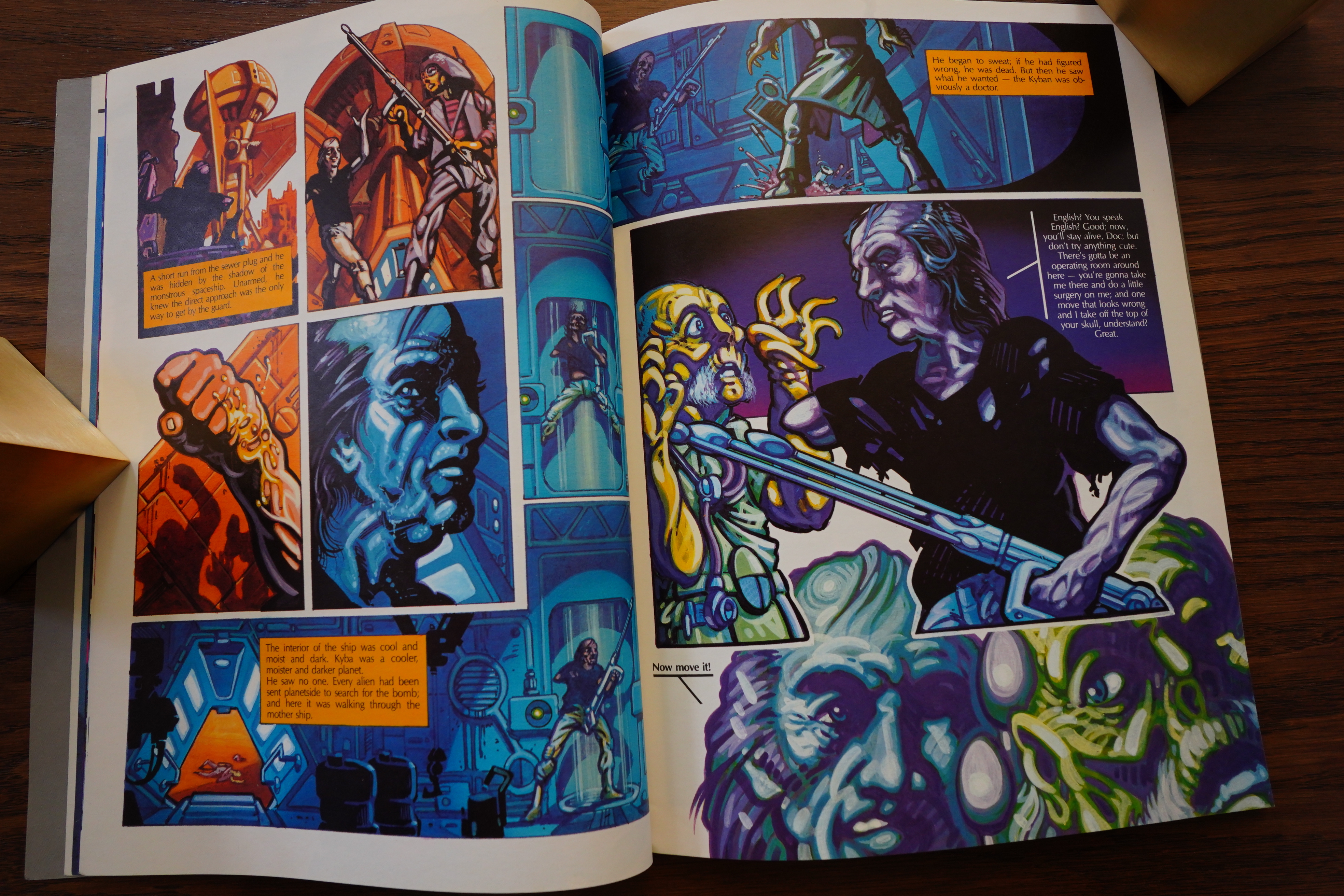
The adaptations are pretty text heavy, but they work well anyway. I’ve always liked Steacy’s artwork — this book was one of the few Comico books I bought at the time.
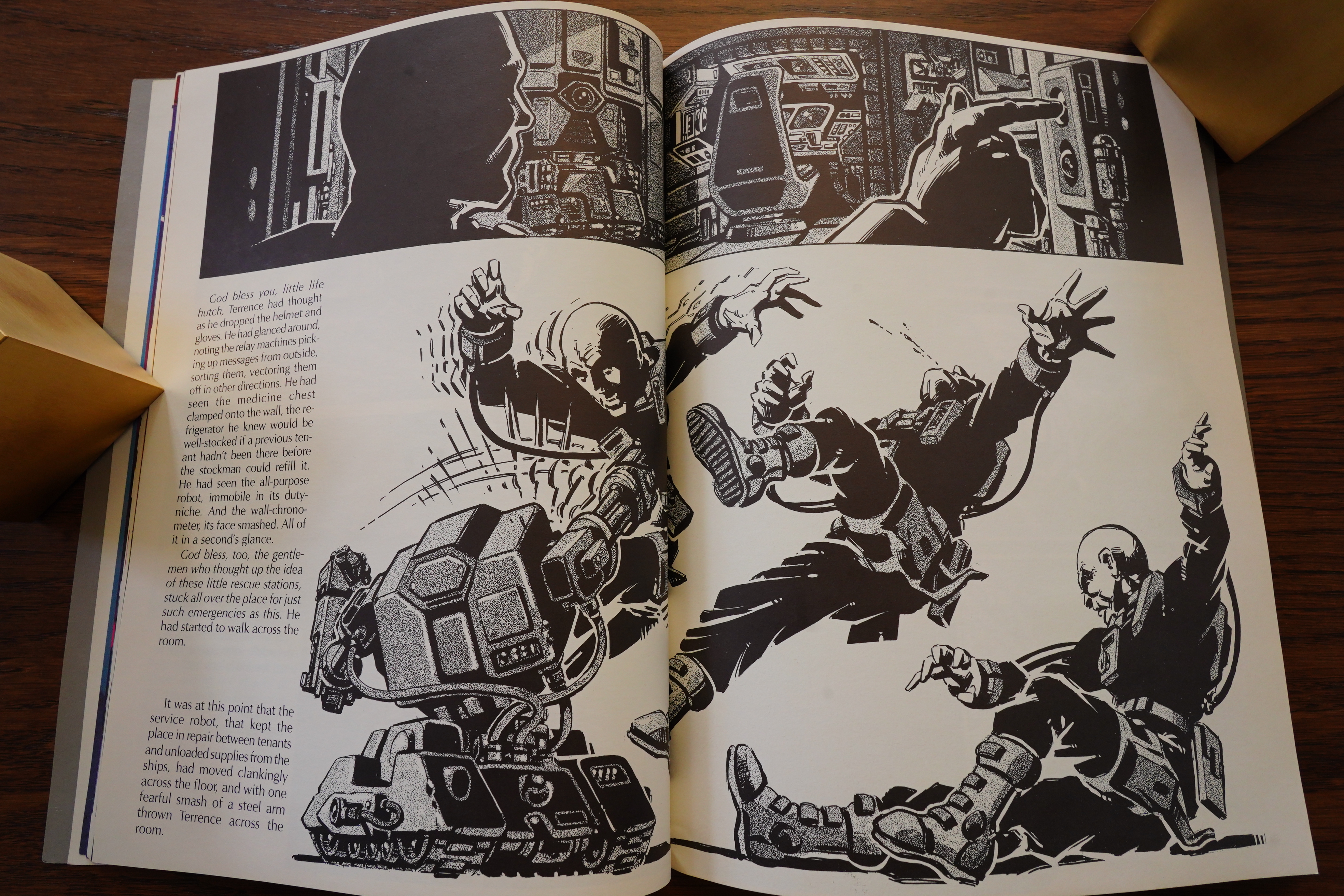
Suddenly we get a couple of pages in black and white, and I thought that was because they originally ran that way in Epic.
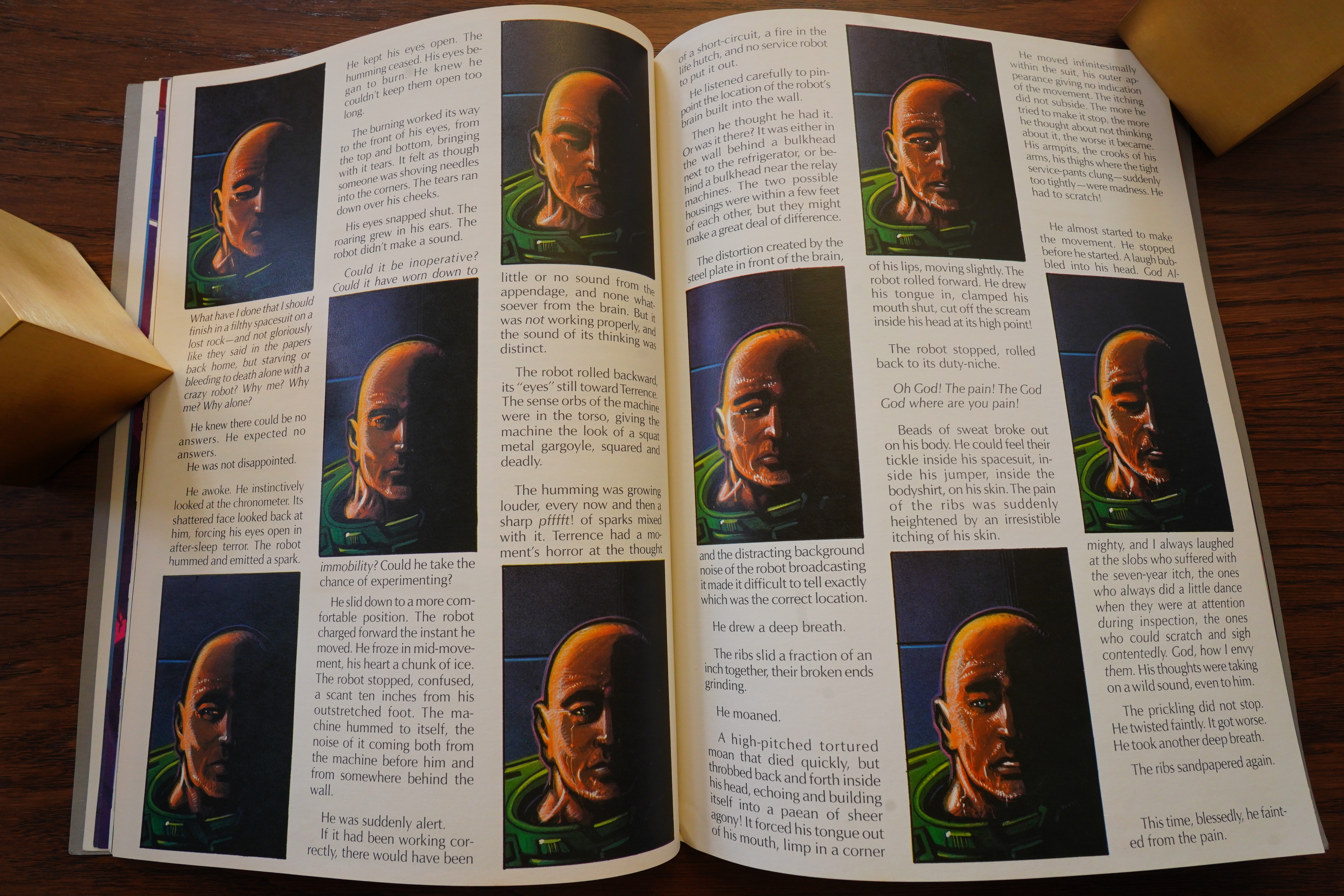
But the entire story was in B&W, but they’ve only left a couple of pages that way. Odd.
This style of adaptation was the kind Byron Preiss used to do… was he involved with this in any way?
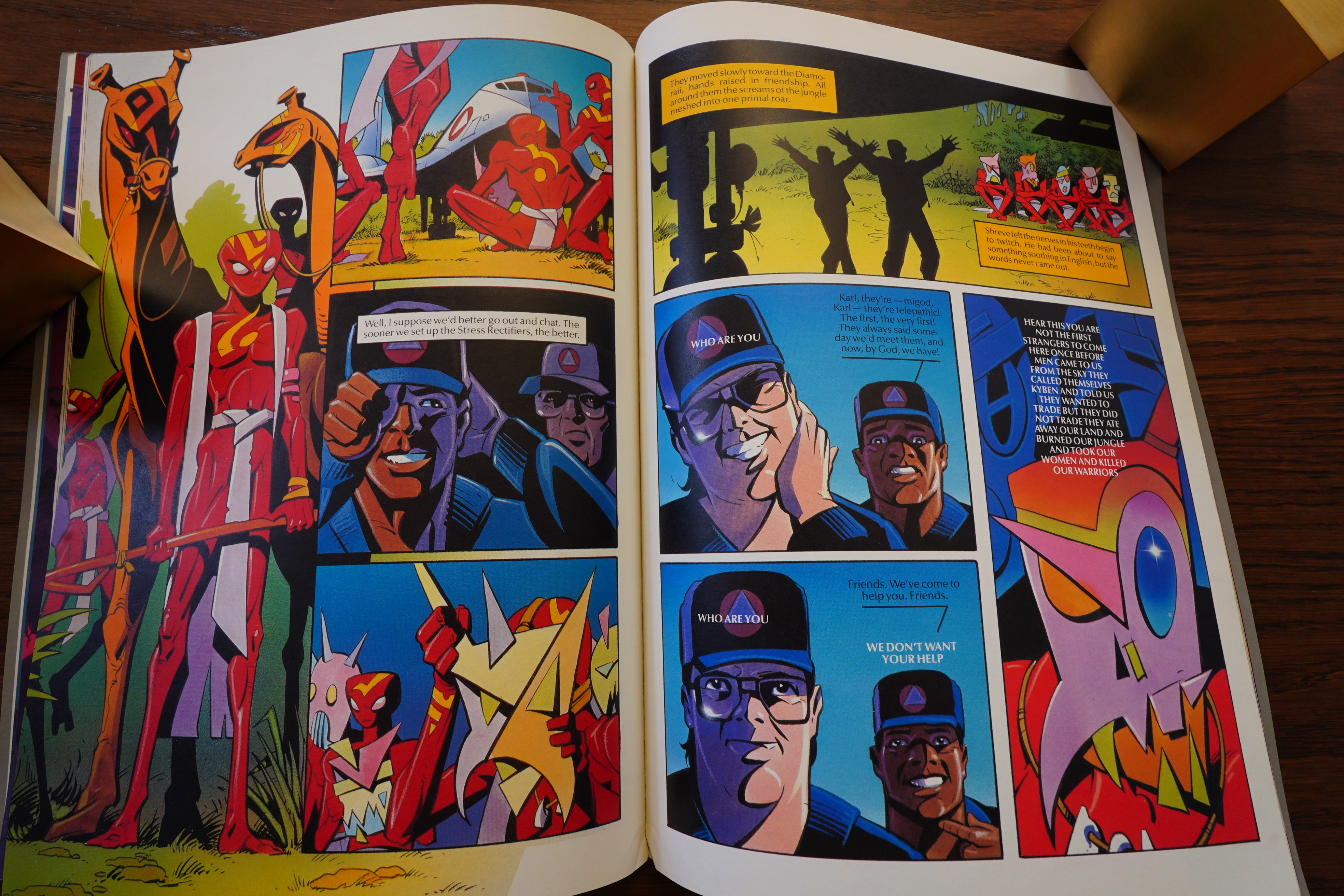
There’s one brand new story (well, OK, new adaptation), and it’s done in a more cartoony style than the rest.
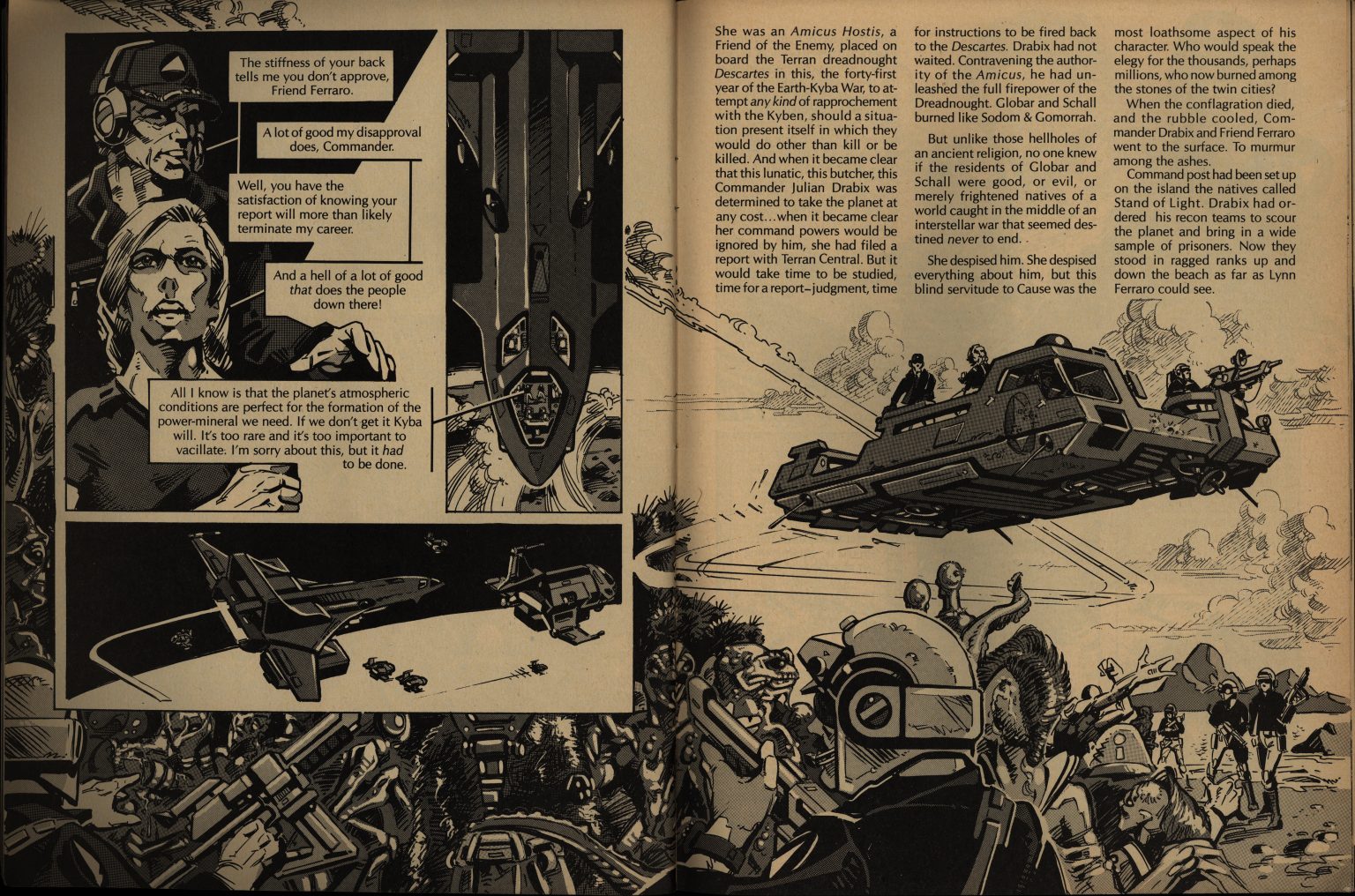
The final story was also B&W originally (Epic version above).
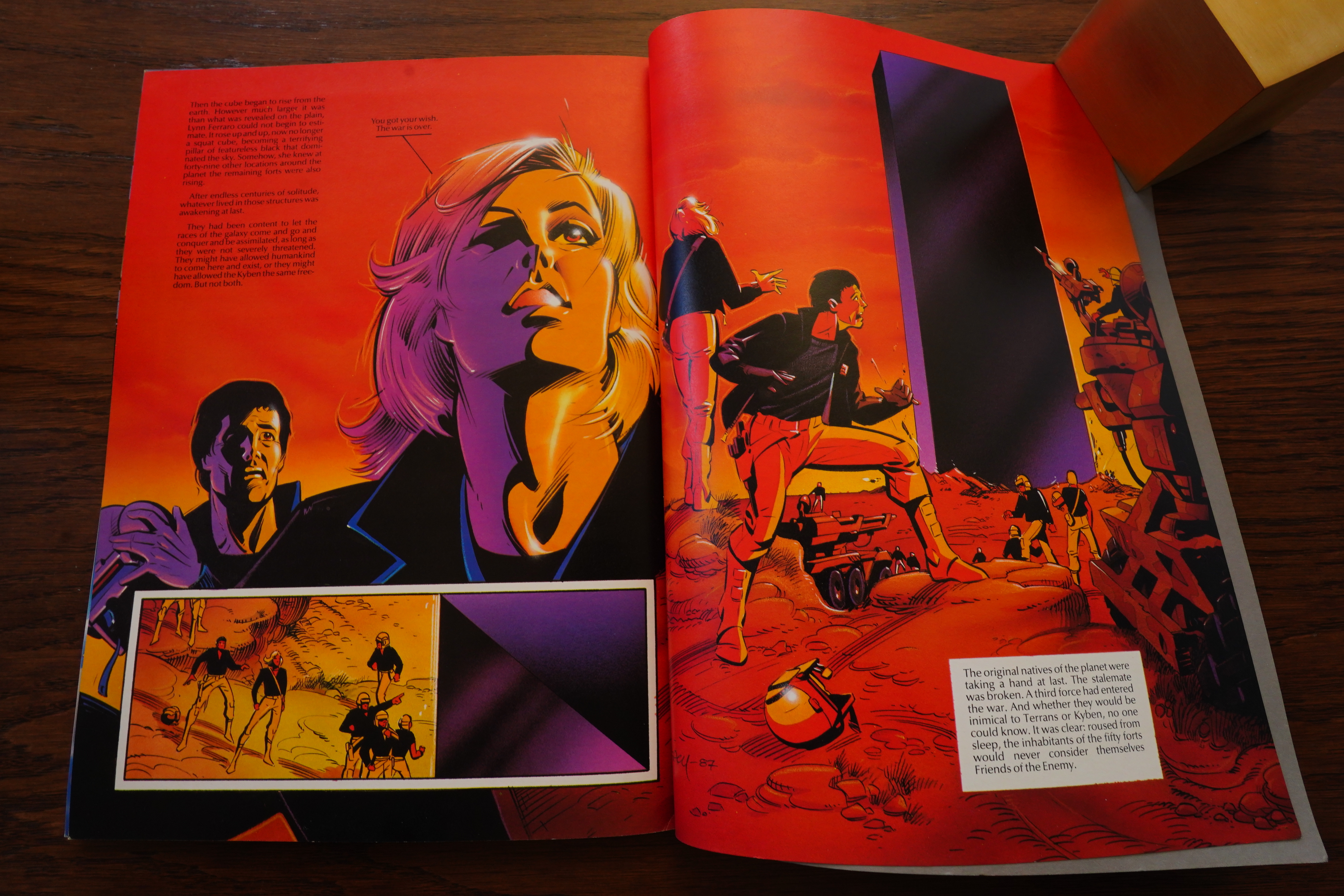
Steacy has really gone to town on doing the colour version, eh?
I think this album works well as a unit — the stories are only marginally tied together, but it reads pretty well. And has a sort of final ending.
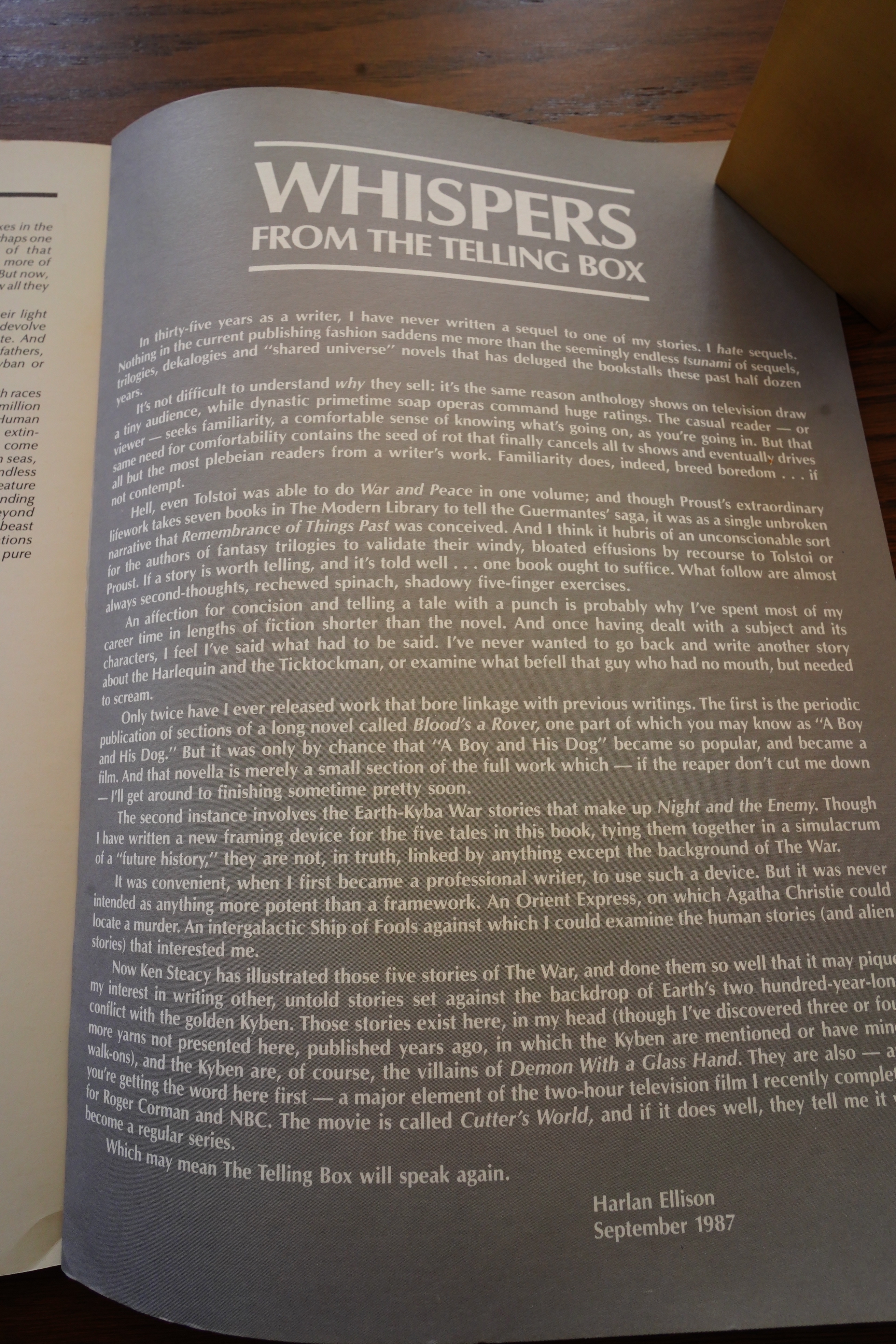
Ellison explains that he hates doing sequels, so these slightly interconnected stories are an anomaly for him.
He says that NBC is possibly doing a related movie — Cutter’s World. It didn’t happen:
When he found out I had dared to try improving his writing, Harlan went livid. His temper, of course, was legendary, and I bore the full brunt of it that day. When I told him I had no choice but to obey the man who signed my paychecks, he sneered that I reminded him of the people of Hitler’s Germany, “just obeying orders.” That’s how, for the one and only time in my life, I was accused of being a Nazi. (No surprise: the series was derailed by NBC soon thereafter.)
Speakeasy #80, page #15:
I was
asked to contribute, and I
thought this was a great oppor-
tunity to to adapt Harlan’s
stuff.’
Steacy contacted
Ellison just as
Byron Preiss was
putting together
THE ILLUSTRATED HAR-
LAN ELLISON, a com-
pendium of comic strip versions
of the writer’s more popular
work. Consequently the rights to
certain tales had been taken up
by Preiss, ironically simplify-
ing Steacy’s choice and making
available one of his favourite
tales – “Life Hutch”. Steacy ex-
plains why: ‘I love this story
because, in essence, nothing hap-
pens. A character is trapped in
what seems like an inextricably
perilous situation, and has to
think his way out of it. There’s
absolutely nothing physical he
can do and in fact any sudden
movements brings his demise clo-
ser. I had 26 or so pages in
which to do the story, and decid-
ed to paint the illustrations in
acrylic using a technique that
Paul Rivoche had been develop-
ing. The artwork was first rend-
ered in ink, and tonal values
were sprayed on with an air-
brush, again in ink, and the
highlighted areas were picked
out with thin washes of acrylic.
So the final impression you get
is that of an acrylic painting,
except that it’s an awful lot
faster. So I finished the story
and turned it in just in time
for ANDROMEDA to be cancelled.’
Fortunately for Steacy, Marvel
comics had just commenced pub-
lishing EPIC ILUSTRATED in dir-
ect competition with HEAVY METAL
magazine, with a more access-
ible, if partisan, approach. Und-
er editor Archie Goodwin the mag-
azine quickly established itself
as a venue for more ‘adult’ work
from comic creators, who were re-
warded with royalties on the mag-
azine’s sales and rights to
their characters. When Steacy ap-
proached Epic with “Life Hutch”,
Goodwin, unsurprisingly, snapped
it up, but not quite in the
manner Steacy expected. ‘I sent
Archie some copies of “Life
Hutch”‘, he recalls, ‘and he res-
ponded very favourably. Archie
knew that this was part of a lar-
ger series, and because of “Life
Hutch”‘s length they couldn’t
schedule it for a while, so he
commissioned another story by El-
lison to be illustrated by me
which had to be done right away.
That was “Sleeping Dogs”, and
due to the constraints of time,
I did the story using a differ-
ent technique, in line with mech-
anical tone, and in two page
spreads. At the time Harlan was
not crazy about it, and looking
back I don’t particularly like
it either. Despite our reser-
vations we had to go with it,
and a few issues later “Life
Hutch” finally ran, and then
Archie asked for a third story
in colour, which was “Run for
the Stars”.
Steacy continued to polish his
photo-realistic rendering on
“Run for the Stars”, which prov-
ed a painstaking effort as he re-
lates. ‘Run for the stars took
me forever to do. It was complet-
ely painted in ink and acrylic,
similar to “Life Hutch”, but in
full colour. So every single pan-
el is a rotten little painting.
It’s a ridiculous way of doing
comics and I’ll never do any-
thing like it again. I was exper-
imenting with a new technique
and a comic book affords you the
opportunity to do that, because
the format allows you to work
out a lot of problems. However,
once I started using this tech-
nique I was stuck with having to
follow it through for the whole
story.
‘Also for all three stories I
did extensive background photo-
graphic research. I chose models
for each of the main characters
and shot extensive reference.
which I hope is not too obvious.
I wanted the kind of refernece
that only on hand reference
could provide. So I had to thumb-
nail the story in and figure out
all the shots and hire the mod-
els. I shot them all in differ-
ent lighting situations, and for
the aliens, my wife, who is a
caricaturist and sculptor, pro-
duced little plasticine models
of the two main characters,
which I then photographed.
‘One of the biggest problems
with comics these days is that
they are underdrawn and over-ren-
dered, and this is precisely
what “Run for the Stars” was. I
was so anxious to get to the ren-
dering stage that I didn’t spend
nearly enough time on the draw-
ing and storytelling. I still
think it works well enough, but
it could have been much better.’
Speakeasy #80, page #15:
Both creators are more than
pleased with the Comico deal,
particularly in view of the free-
dom they have been given on the
project. ‘Ken and I could have
gone anywhere with NIGHT AND THE
ENEMY’, offers Ellison. ‘There
were feelers and offers and prom-
ises and all kinds of the usual
bull cookies. Blue sky and big
bucks, arias of hot air from ind-
ustry giants and industry pyg-
mies. We went with Comico be-
cause no one, absolutely no one,
puts together a prettier pack-
age, without censorship, and
with the sense of true
partnership.’
The result is a package ass-
embled and designed by its creat-
ors, as Steacy explains: ‘They
basically threw it back at us
and said okay, it’s your pro-
ject, so you know best how to
handle this. Most of it was
thrown into my lap because I was
very insistent that I would des-
ign the book as well. So we had
the three stories and we wanted
to do the entire book in colour,
so the black and white ones had
to be re-coloured. On “Run for
the Stars” the colour separa-
tions that Marvel did were less
than satisfactory and unfortunat-
ely EPIC ran strips on coated
stock and uncoated stock, so the
stories that appeared there were
a little inconsistent. I’ve made
a few alterations to the artwork
and redone the separations.
With the black and white mat-
erial I had to respray the art-
work in colour and go back and
pick out the highlights again to
remain as consistent to the orig-
inal style as possible. I’ve re-
drawn “Sleeping Dogs” from
scratch, because nobody really
took to the work, including my-
self. That particular piece is
my favourite coloured strip I’ve
done to date.’
Amazing Heroes #131, page #26:
Night and the Enemy-a graphic
novel due in November, written by
Harlan Ellison with art by Ken Steacy.
It will be an 8½” x 11″ book in full
color. Included will be all five of the
celebrated Earth-Kyba stories-a two-
century long interstellar conflict,
which will be tied together by an all-
new framing sequence written by
Ellison especially for this edition. Two
of these stories, according to editor
Diana Schutz, have not been seen
since the mid-1950’s, two of the three
appeared only in black-and-white in
Epic Magazine.
All of the stories will appear in
color for the first time, a good major-
ity of the material has been completely
re-done by Steacy, including creating
the first time.
some completely new interior art-
work, as well as what has been
described as a “sensational new color
cover.” It has been said before, but
Comico basks in the revelation that
Night and the Enemy will be “the
graphic novel hit of the year.”
Speakeasy #81, page #28:
NIGHT AND THE ENEMY by Harlan
Ellison and Ken Steacy (Comico)
Few writers have had as much att-
ention within the comic industry
paid to their words as Harlan
Ellison, and his fans are in for
double trouble this fall with
the release of two comic adapta-
tions of some of his vintage
tales.[…]
An altogether more lush and
well packaged book (80+ pages in
a graphic novel format, complete
with a new framing sequence pro-
vided by Ellison) NIGHT AND THE
Steacy’s best artwork, progress-
ing from the overly fussy impas-
toed acrylics in ‘Run for the
Stars’ to the clean and crisp
linework in ‘The Untouchable Ado-
lescents’. And if the work seems
a little stiff occasionally, the
composition, design and colour
more than compensate. Through-
out, the colouring is stunning,
Steacy being able to teach a num-
ber of more prominent artists a
thing or two about how to weild
an airbrush, without the reader
needing to wear shades to look
at the story.
Unfortunately that’s where
the book is disappointing, as
the loosely connected ‘Earth-Ky-
ben War’ stories are not Elli-
son’s best by a long way, with
the possible exception of the
claustrophobic and compelling
‘Life Hutch’. Written early in
his career, they tend to get
bogged down with some heavy hand-
ed moralising and cardboard char-
acterisation, and Steacy’s app-
roach is not so much to adapt
them but visualise certain mo-
ments from them. The result is
neither a collection of illustra-
ted stories nor comic strip adap-
tations, but ungainly falls bet-
ween the two stools.
As such the words and pic-
tures fail to connect as a joint
narrative a lot of the time, des-
pite the best intentions for
them to do so, as in ‘Run for
the Stars’ and ‘Sleeping Dogs’,
with ‘The Untouchable Adoles-
cents’ emerging as the closest
thing in the book to a fully
dramatised comic strip adapta-
tion. This is not helped by hav-
ing typset chunks of Ellison’s
dialogue
prose and
around the panels, giving the
strips an almost clinical feel
and taking the emotional edge
off the stories.
Still, if you’re an Ellison
fan you’d be daft to miss out on
these books, which eclipse much
of what has been perpretated in
previous comics adaptations of
his work.– Cefn Ridout
Speakeasy #80, page #15:
Steacy explains that the new
framework provided by Ellison
‘leaves the door open for a sec-
ond volume as there are about
eight or ten stories in all. The
events in NIGHT AND THE ENEMY
are actually seen from the vant-
age point of a civilisation
which discovers these stories in
the ruins of Earth, millions of
years after the fact. And they
are viewed almost like fragments
of an inflight video. They are
found in devices called “telling
boxes”, so that each provides a
subjective look at an event
which occured against the back-
drop of this centuries-spanning
war. This intelligence from the
future is trying to piece togeth-
er what happened, and there are
still a number of questions left
unresolved for the audience to
fill in. We didn’t want to pro-
vide all the answers, as we want-
ed the audience to do some think-
ing on its own. We were very
careful with how the stories
were placed so that there is a
comfortable flow between them
and their relationship to each
other makes sense.
‘I don’t think Harlan ever in-
tended this to be a series. He
had some interesting ideas for
characters in situ, and he just
plugged them into this war. Each
story concerns an individual or
a couple of individuals and
their struggles, which were nev-
er overshadowed by this huge
war. The war is not the most imp-
ortant thing in these stories,
it is a given and places the
stories within a specific time
frame.’
Considering Steacy’s Canadian
base and Ellison’s Californian
one, they worked as closely to-
gether as could be reasonably ex-
pected. And, as with the best of
team efforts, they were respon-
sive but not reverential to each
other’s input. ‘Harlan and I
have quite a good rapport and an
excellent working relationship,’
claims Steacy. ‘We respect each
other’s abilities and when push
comes to shove we will defer to
each other’s expertise in their
area. We had a synergistic rela-
tionship on the strips, spending
a lot of time on the ‘phone yell-
ing at each other. And I would
send him pencil roughs before
taking it any further. For the
most part it was fine tuning, af-
ter all it was Harlan’s words
that excited me in the first
place, and I wasn’t about to dim-
inish that in any way. Having
said that, nothing is so sacred
that it cannot be improved. I ap-
proach an adaptation so that I
can take the original and make
it something more than what it
already is in the written form.
If the whole is not greater than
the sum of its parts, there’s no
point in doing it. I don’t know
if Harlan will shoot me for this
but I think I’ve made more of
those stories by adapting and
illustrating them, with his coll-
aboration, of course. NIGHT AND
THE ENEMY, as a body of work,
stands as the finest I’ve done
to date.’
Harlan Ellison is known to be
critical of adaptations of his
work in the past, most notably
Gerry Conway’s muddled handling
of ‘Delusions of a Dragon Slay-
er’, Alex Nino inventively des-
igned though confusing ‘Repent
Harlequin said the Tick-Tock
Man’ and Alfredo Alcala’s overly
literal ‘Croatan’. However, he
is full of praise for Steacy’s
work on NIGHT AND THE ENEMY.
‘Ken has managed miraculously to
even his breathtaking level of
best efforts, and I am as happy
as an Odor-Eater in a bedroom
slipper with the result. This
book’s gonna be one snappy item,
without the faintest scintilla
of self-serving greed or venal-
ity on anyone’s part.’
Comics Interview #51, page #39:
PETER: Well, that was a hint to talk about
Ellison. Would you like to go on the record
about how Mr. Ellison is so gracious and
Mr. Steacy is a nice person?
DIANA: Ken Steacy is a nice guy and a
real crazy-man! Harlan Ellison has been
my hero for quite a long time. I think that
he is the consummate essayist, and I love
his rabble-rousing, “up against the wall,
dirtbag” attitude. When he called up and
wanted to do this graphic novel NIGHT
AND THE ENEMY, I was thrilled right
down to my tippie toes! I subsequently met
the man, found him to be honest –
sometimes brutally so – extremely funny,
extremely gracious, and essentially
somebody who would give you just as much
as you gave him, and no less. So, yeah,
damn right; Comico is – how did you put
it – the little something that could…?
BOB: The little engine that could.
DIANA: In the last two years, Comico has
gone from a company that retailers were
laughing at, to a company that is selling its
books very well, and on time. We now have
a reputation that’s strong enough that so-
meone of Harlan Ellison’s stature has come
to us to publish his material. That’s a nice
pat on the back for all of the work that
we’ve done.
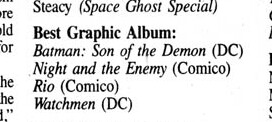
It was nominated for Best Graphic Album at the Reuben Awards.
The book was reprinted by Dover in 2015:
The story was hard to follow, and the book felt more like an illustrated novel rather than a graphic novel. I know that sounds confusing, but this wasn’t what I would classify as a “comic book” in the strictest sense.
Reception didn’t seem very positive:
This is perhaps one of my least favorite Harlan Ellison collections, but I’d still read some weaker Ellison over many other writers.
I’m not much of a fan of Ellison….His hijinks as a person have colored my ability to enjoy his work as a writer, and this is really the first work of his that I’ve ever made it all of the way through. It’s not a perfect book, at least not in my opinion….I’m generally not a fan of prose in the middle of my comic-books, and the long text sections were kind of a chore to get through, but they were all rewarding in the end.