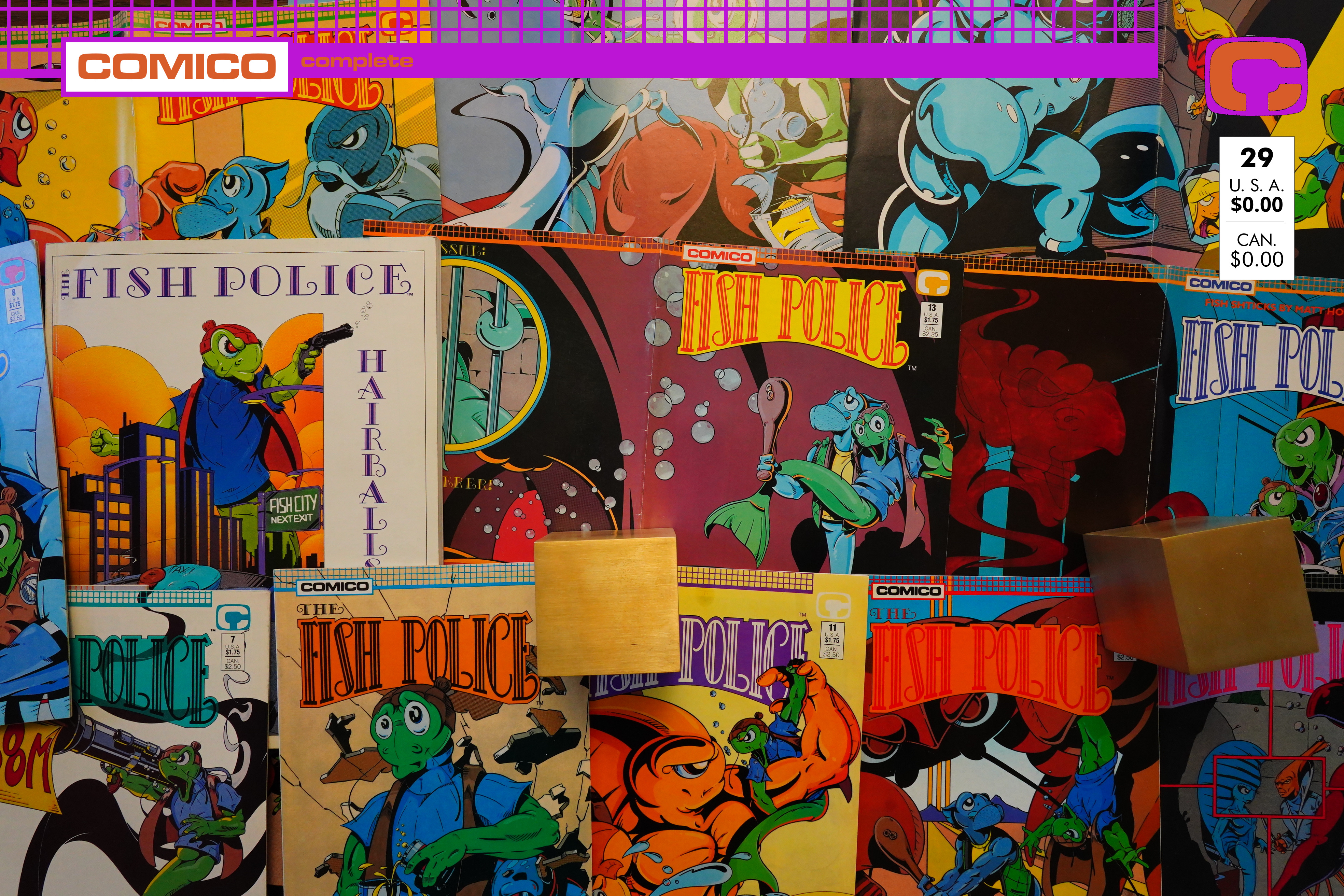
The Fish Police: Hairballs (1987) #1,
Fish Police (1988) #5-17 by Steve Moncuse et. al.
Oops! It’s been a while since the last post in this blog series… I’ve just been distracted by other things.
Let’s get to it.
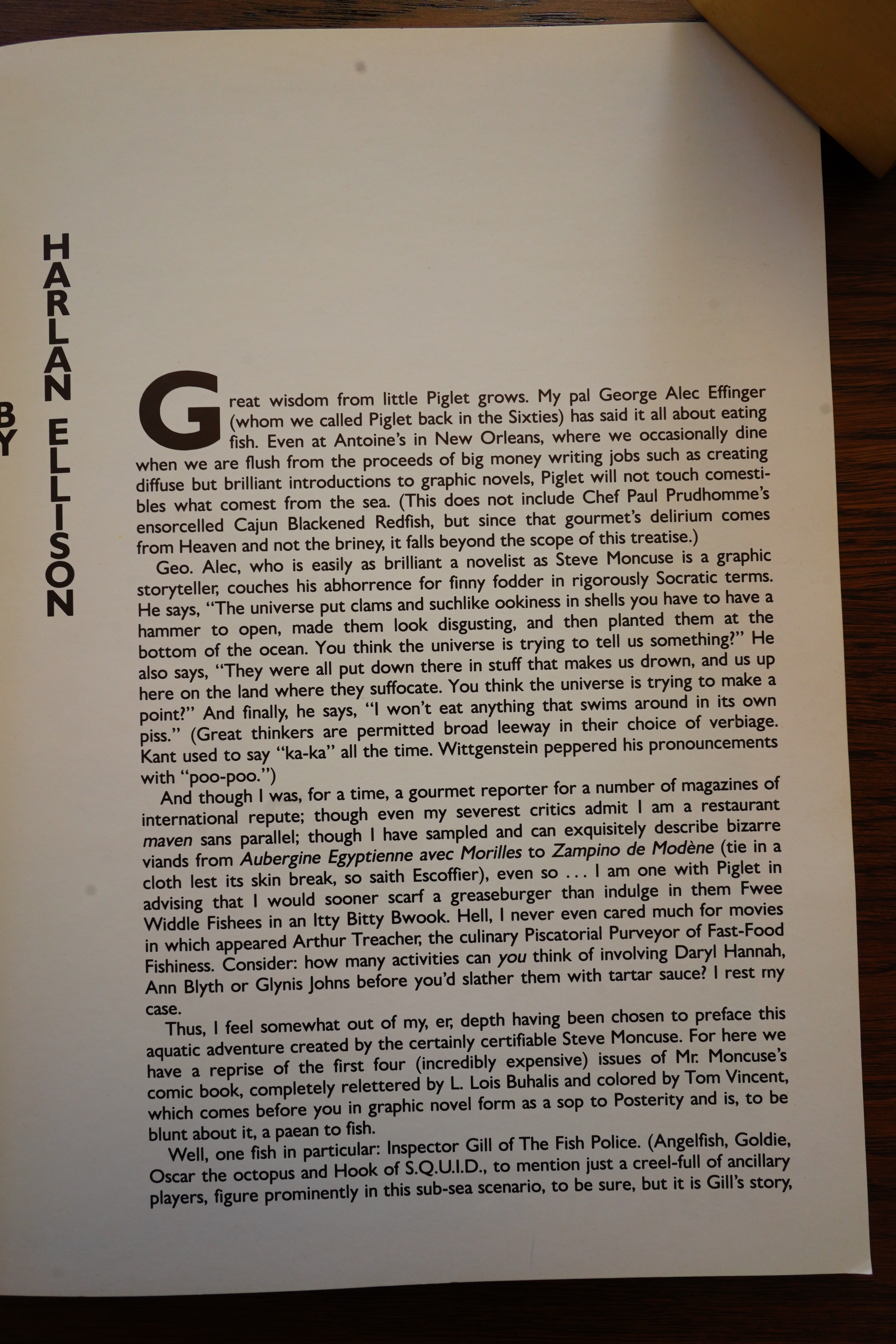
Oh, remember Harlan Ellison? No? I feel like Ellison has been forgotten more than his contemporaries, but I guess that’s what happens when you mostly do short stories and TV scripts.
He spends most of the introduction talking about how he and George Alec Effinger don’t like to eat fish — they don’t “touch comestibles what comest from the sea”. But apparently Ellison is a Fish Police fan, and that’s why he’s writing the introduction?
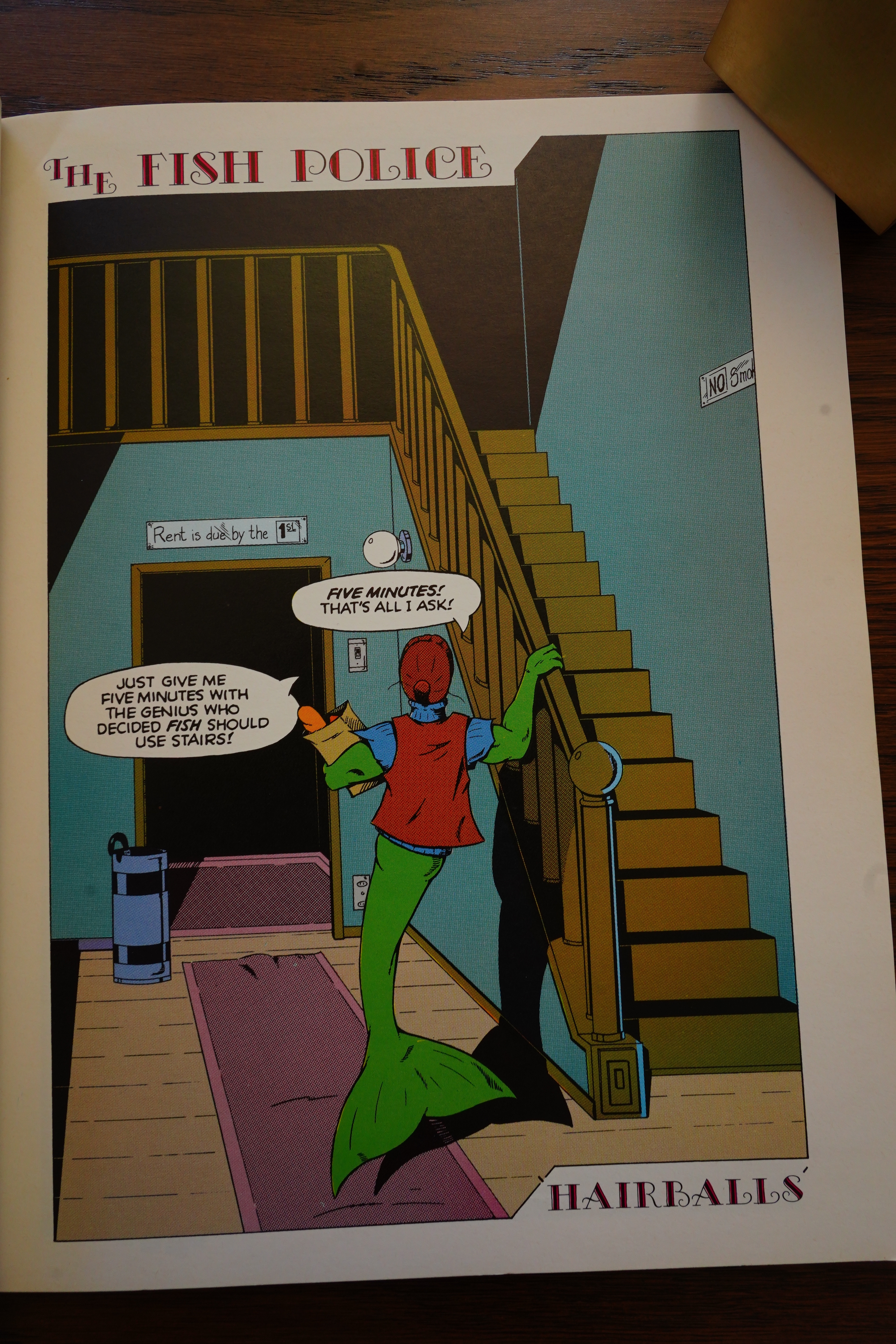
Because this is a reprint of the first four issues of the Fish Police series from Fishwrap Productions. I guess doing it in a European-format album makes some kind of sense — that was the standard “fancy” option at the time — but I guess it didn’t really sell well, because Comico continued the reprint using normal US-sized floppies starting with issue #5.
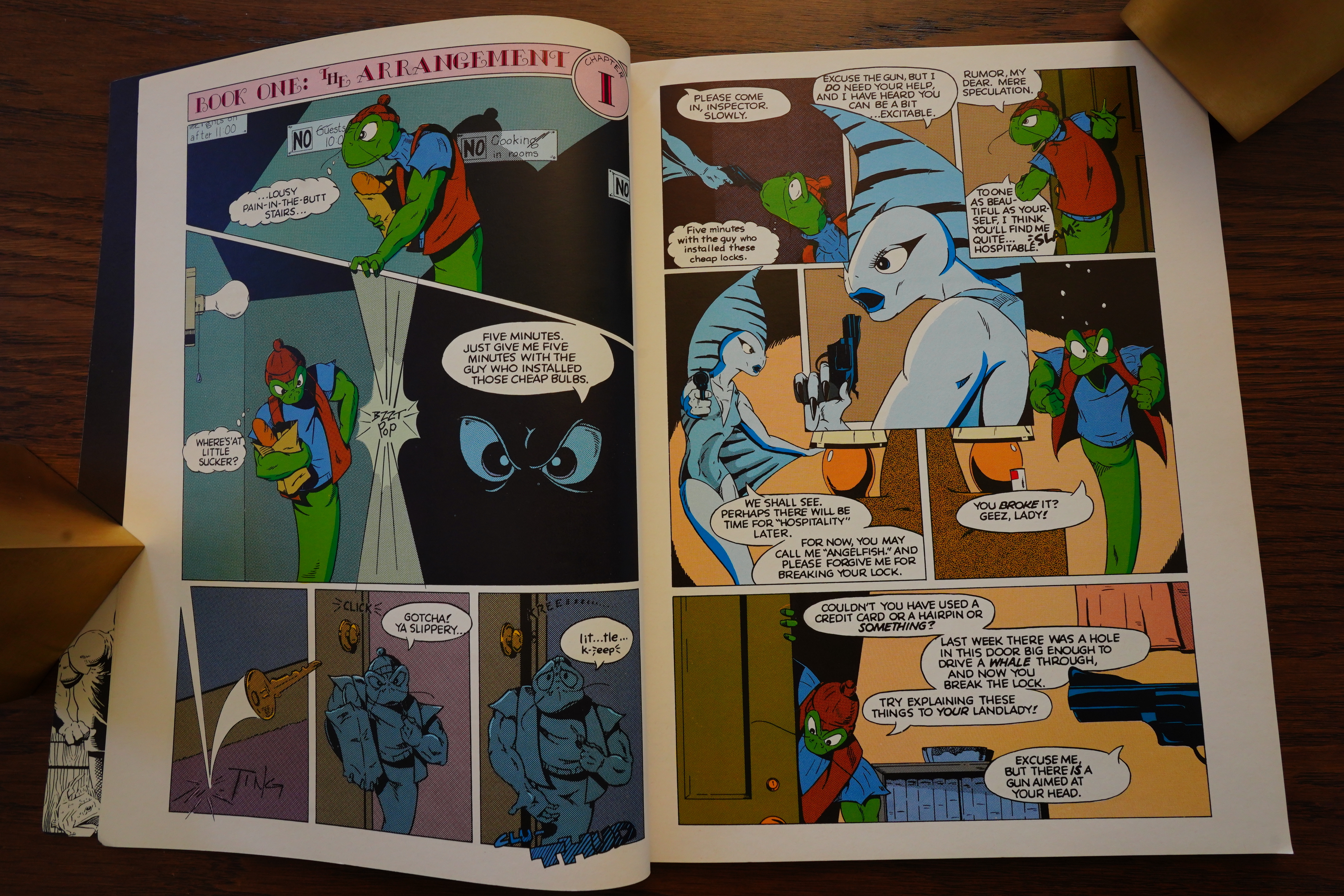
I’ve read the colour special that Comico published earlier, and that was a prequel, and kinda-sorta explains the premise of the series — but it was pretty much unreadable to someone who didn’t know the series before. So I had assumed that Moncuse eased the readers more in with the original #1, but no, not really — he’s hinting at what the gag setup is throughout these issues, but it’s never stated out loud: A human cop’s mind has been transferred to one of these fish police guys, and… then… there’s all these other guys.
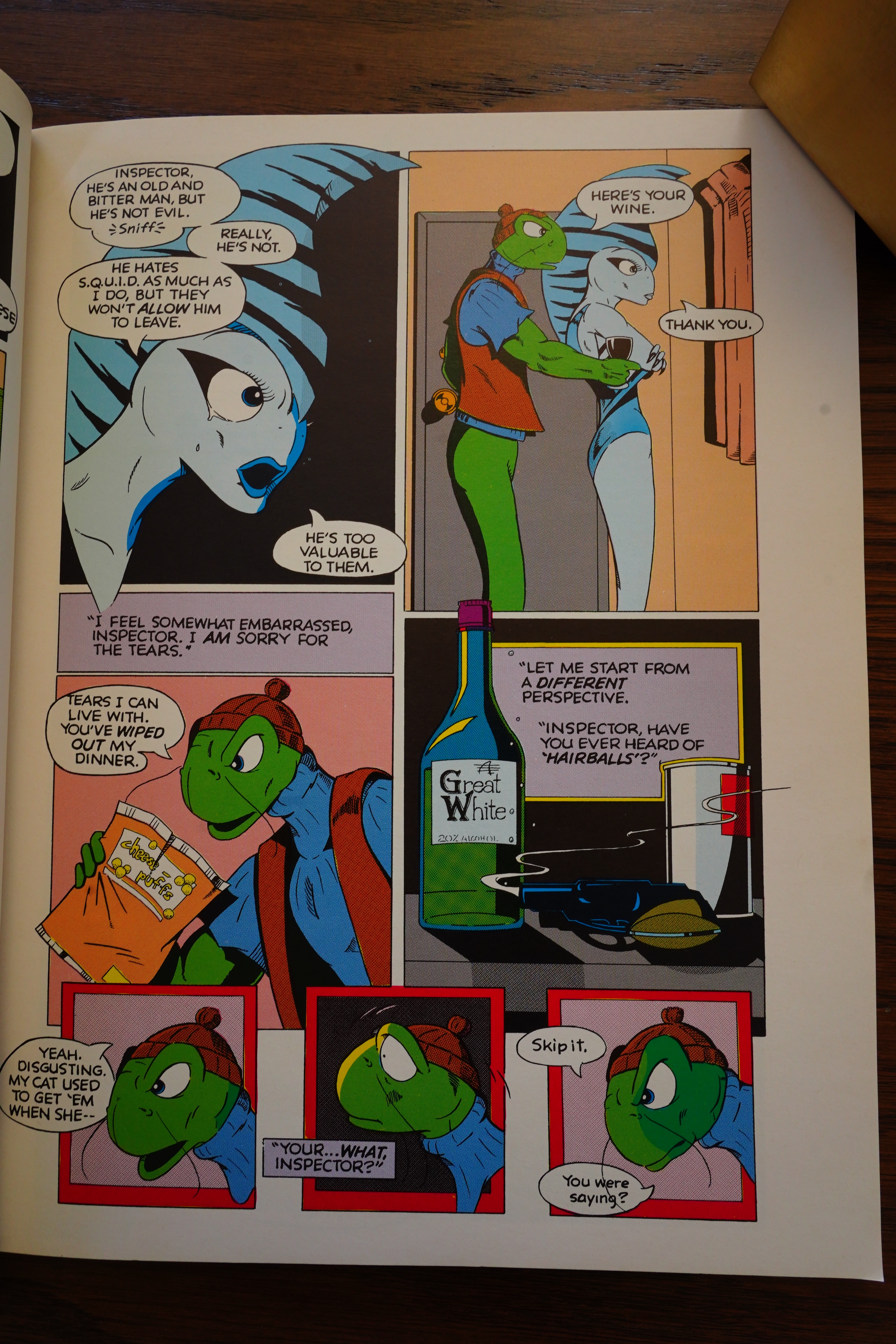
See? Hint — they don’t have cats here under the sea.
So it’s all mysterious and stuff. Moreso because there’s about two dozen characters that aren’t introduced well, either, and they all seem to have some sort of agenda going on. And they plot a lot. Which all sounds like it should be really intriguing, but it really reads like Moncuse had been doing these characters for years in a different venue, and didn’t bother to recap anything here.
Is that the case? Did he do these as a strip for, say, a student newspaper? Because these issues also read like Moncuse is 22 years old.
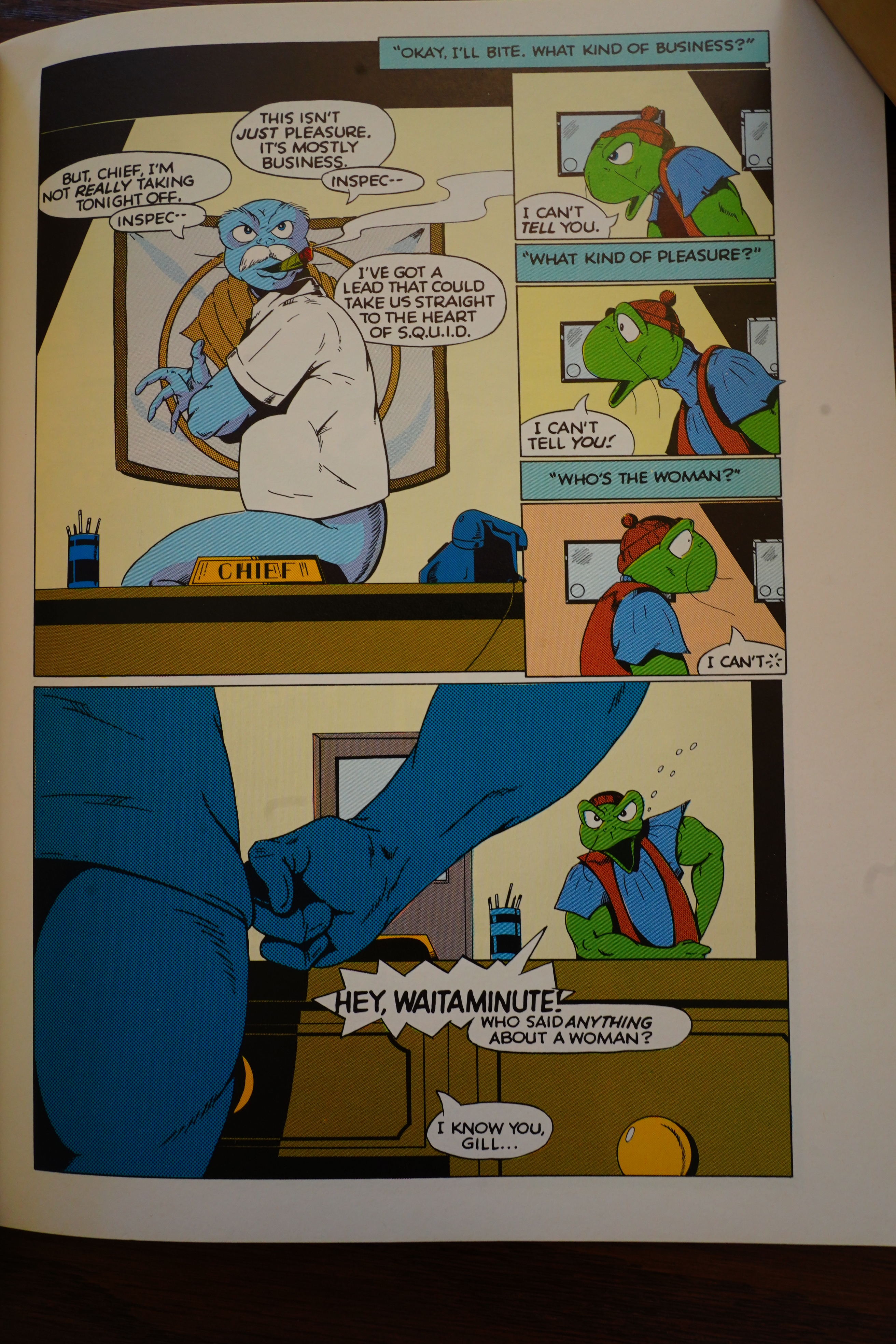
Yes, indeed, this is a comedy. You get a lot of standard skits, but Moncuse’s timing skills are so off that even the simplest gags somehow feel like you’re missing something.
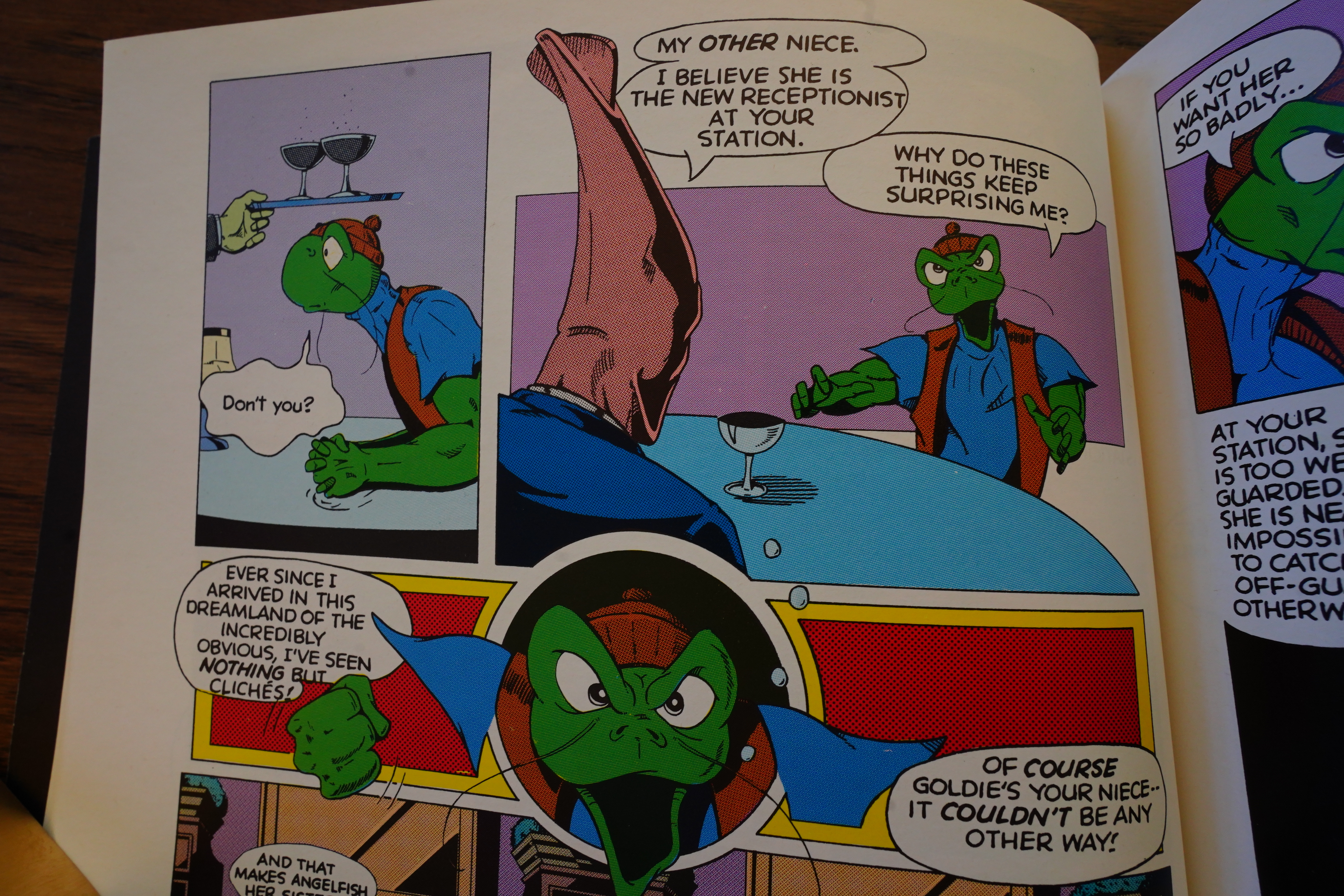
And the plot is so convoluted and incoherent that Moncuse does the traditional having-the-protagonist-comment-on-it-so-that-you-can’t-criticise-it move.
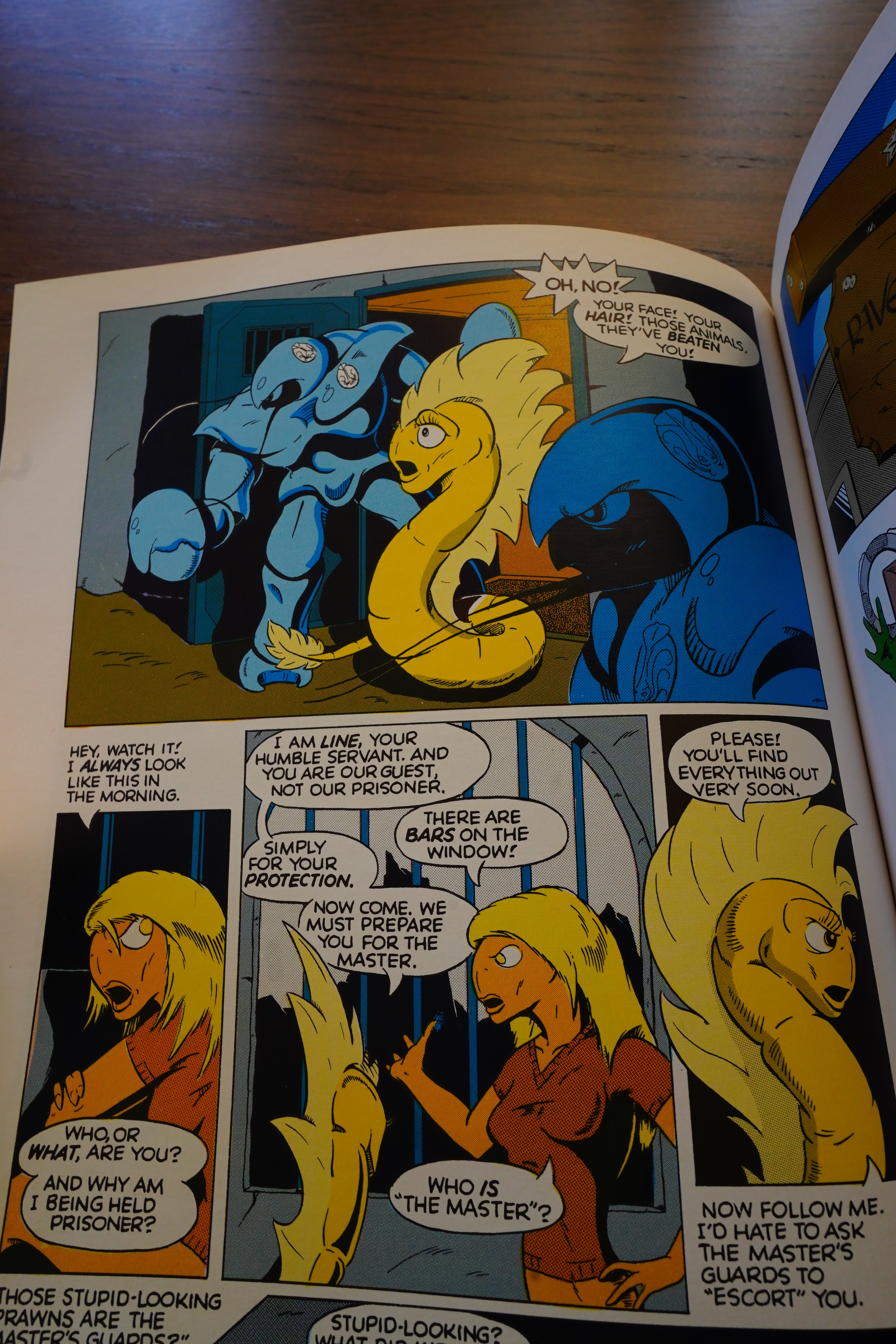
“They’ve beaten you” “I always look like this in the morning” See? That’s a joke. But the way these panels are arranged, and the directions the characters are facing and where they’re moving makes little sense, so it doesn’t really work.
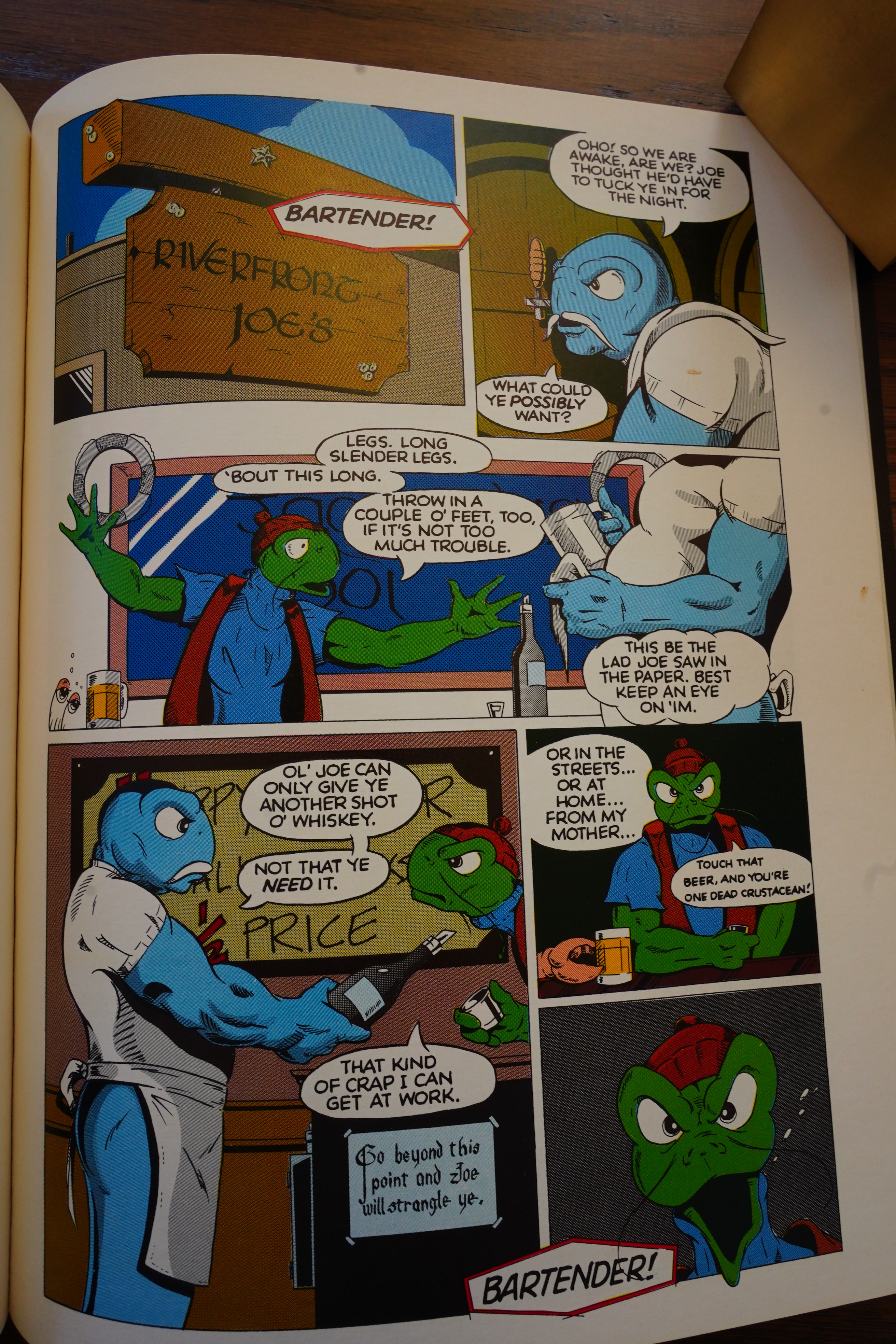
And all the scenes are like this — Moncuse is going for witty, snappy repartee with lots of chaos going on, but you have to be better than this to make it scan — you need to establish that that’s the green guy’s beer before you can have the crab guy try to steal it. And who’s shouting “bartender” at the end with that curiously-shaped speech balloon anyway?
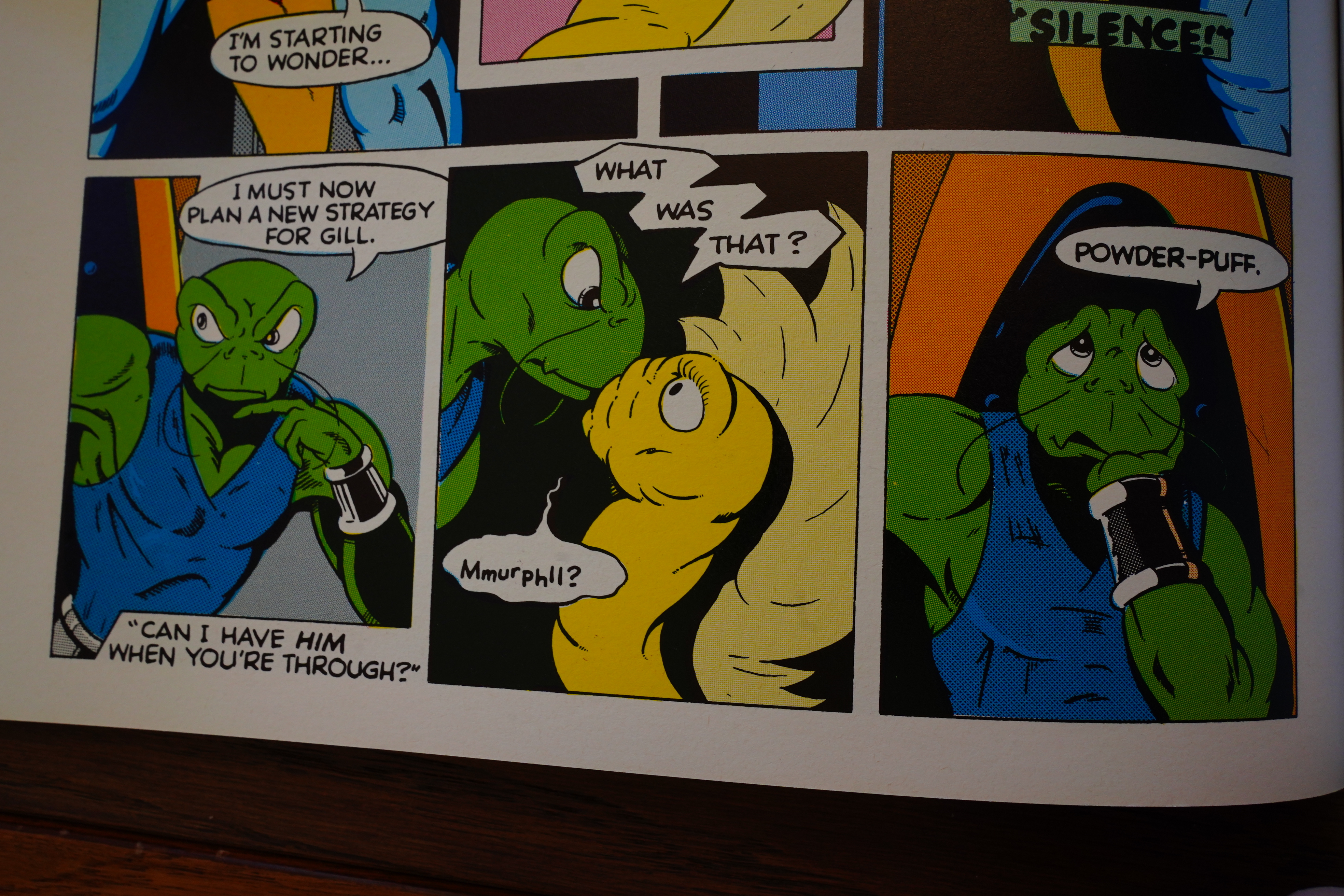
It’s like Moncuse has this private comics language — the boxes that look like caption boxes aren’t really — they’re dialogue from off-panel characters, which is why there’s “” characters around the text. But it’s often not clear who’s saying what — which doesn’t help when the dialogue seems to rely on… well, I don’t know exactly. Is that yellow guy male? I assumed the yellow guy was female, on account of the eyelashes? What does “powder-puff” then mean when the yellow guy wants the fish guy?
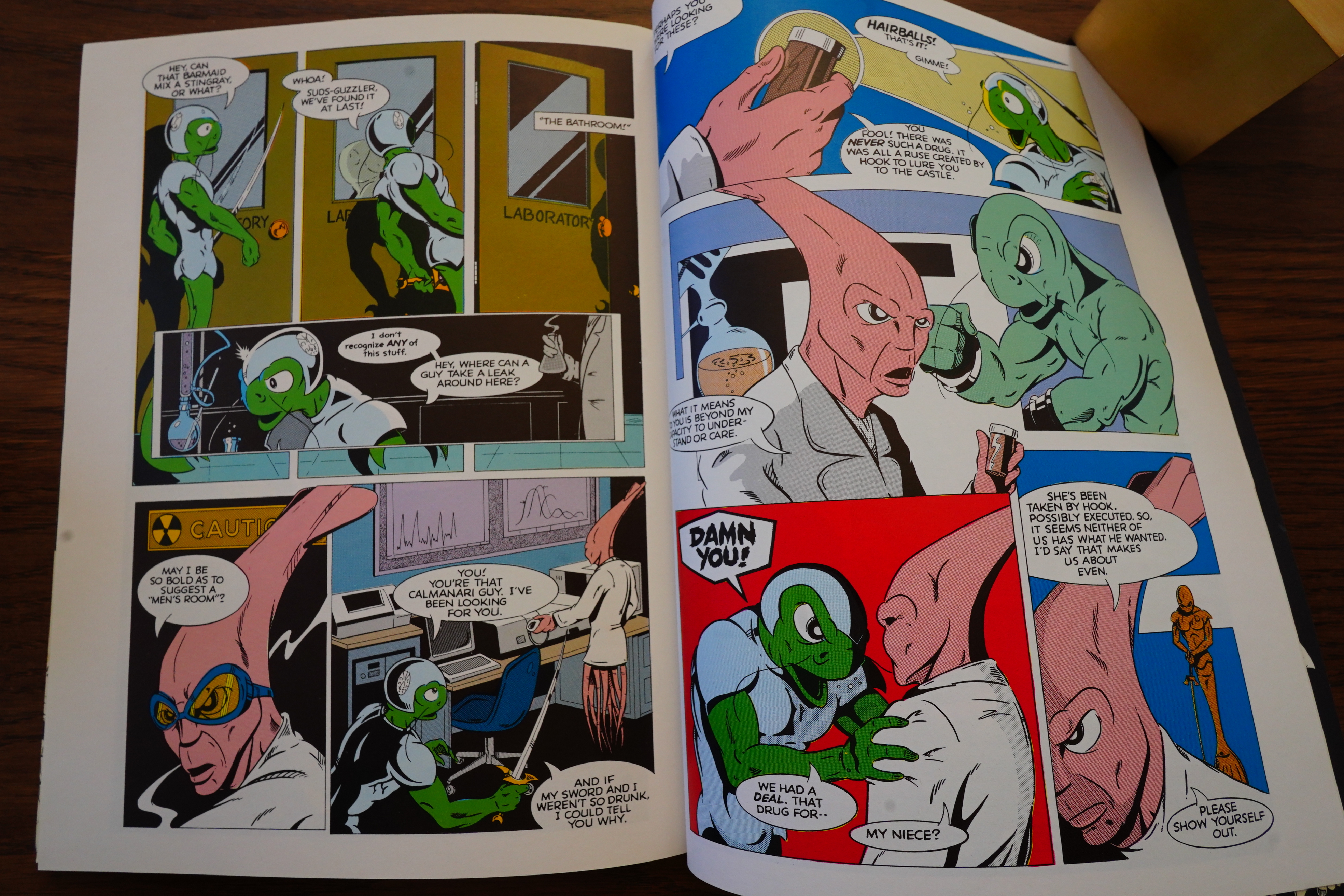
What?
So the album ends:
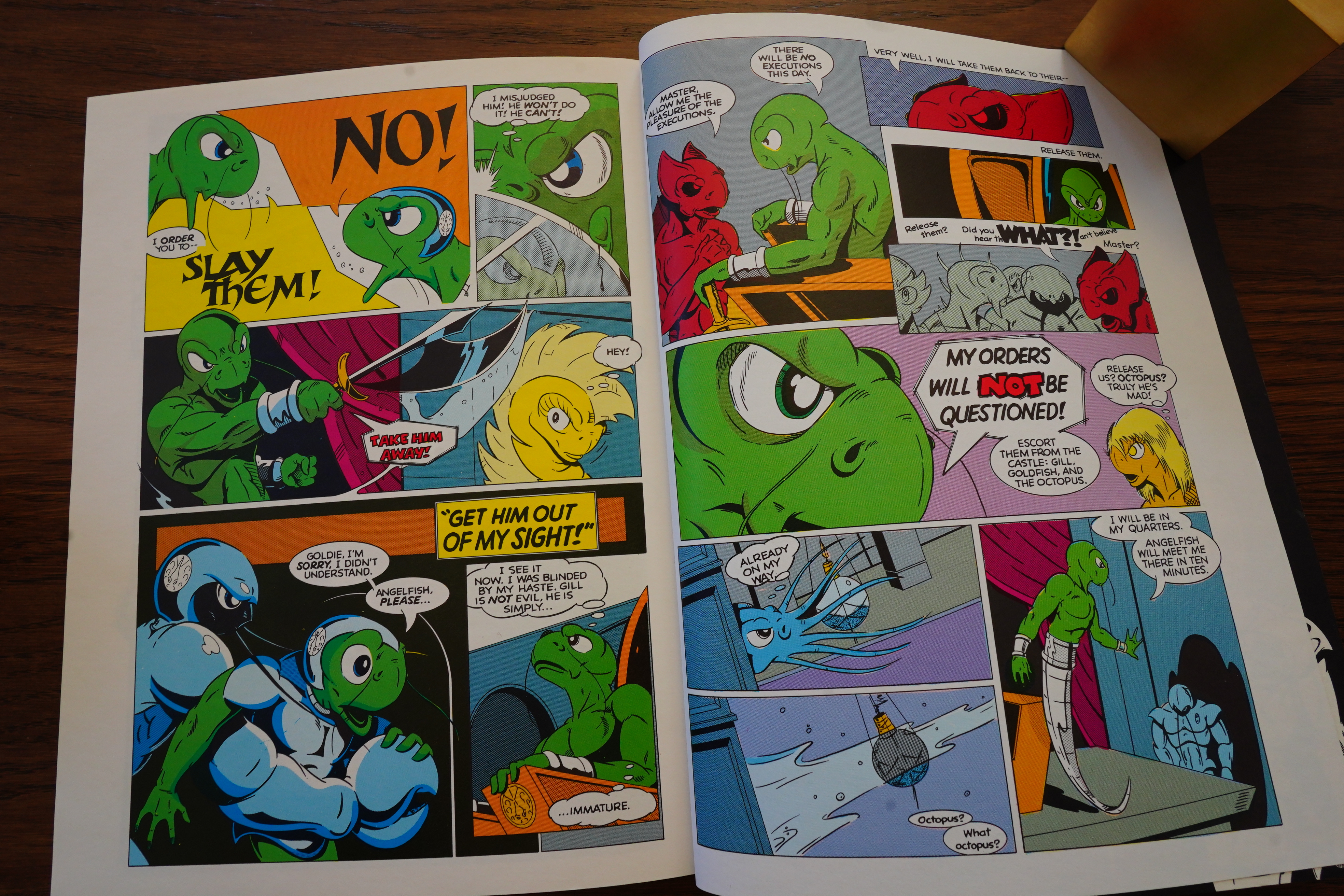
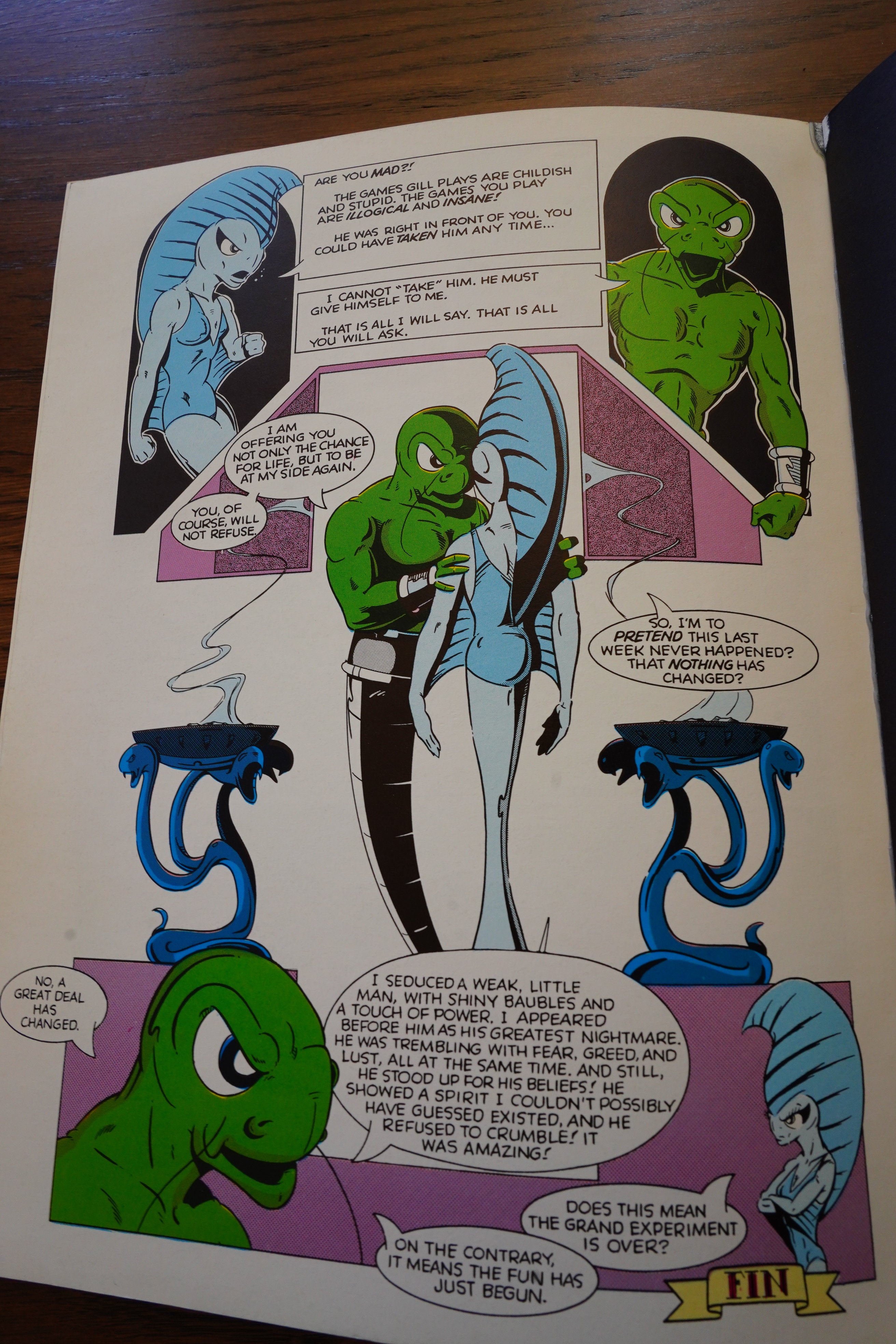
And I can’t say this strongly enough: “Wat”.
Reading this book is headache-inducing.
OK, onto Fish Police #5:
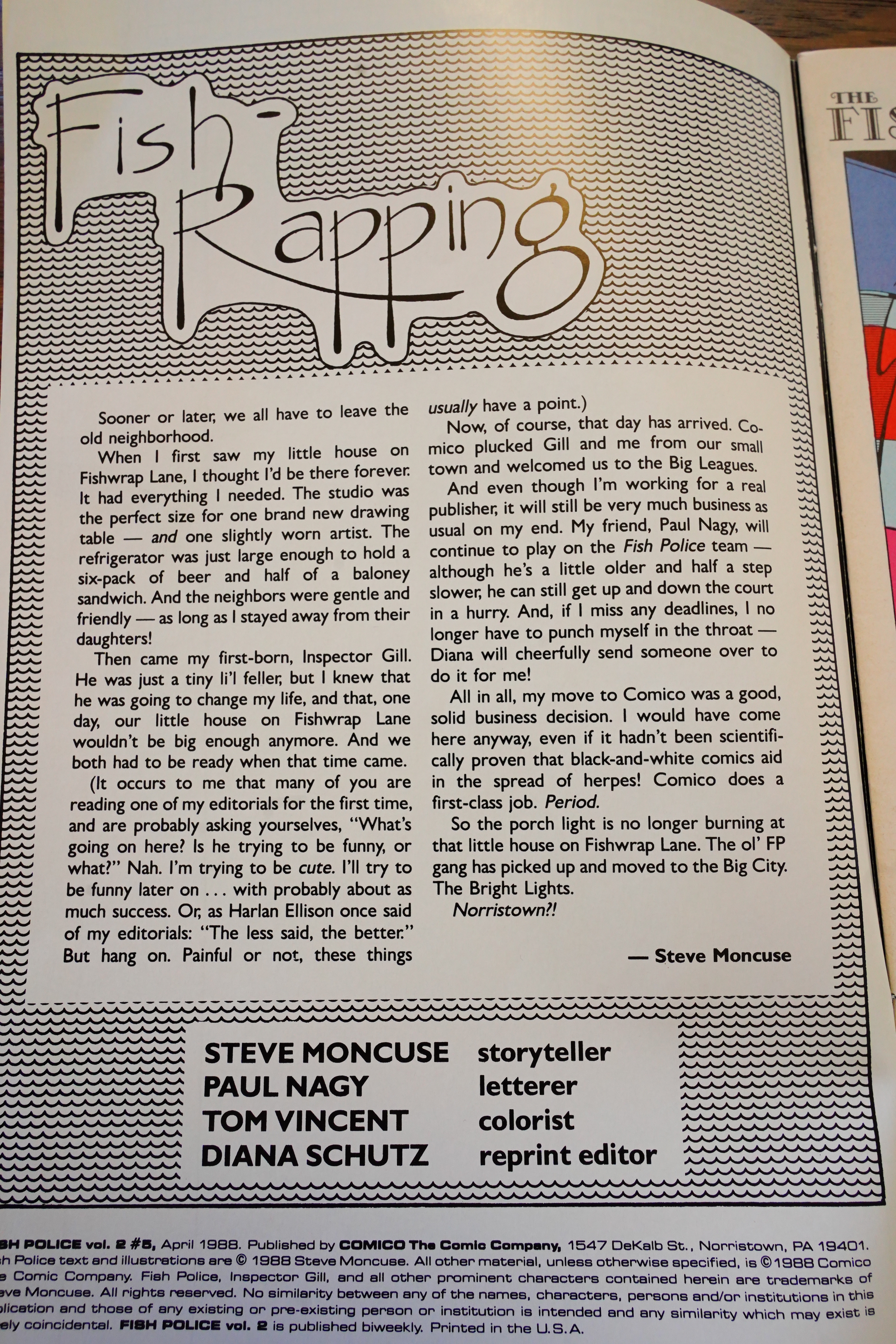
So Comico is publishing this colourised reprint every other week. Moncuse talks about bringing Fish Police over to Comico, but he doesn’t actually explain what this series is, does he? That is: Comico reprinted the first four issues as an album, and then they’re reprinting the rest as single issues, and when they’re caught up with the Fishwrap issues, Comico is going to start publishing new issues. I think Fishwrap was up to 12 issues, so I guess there would be a four-five month wait for the fans to get new issues.
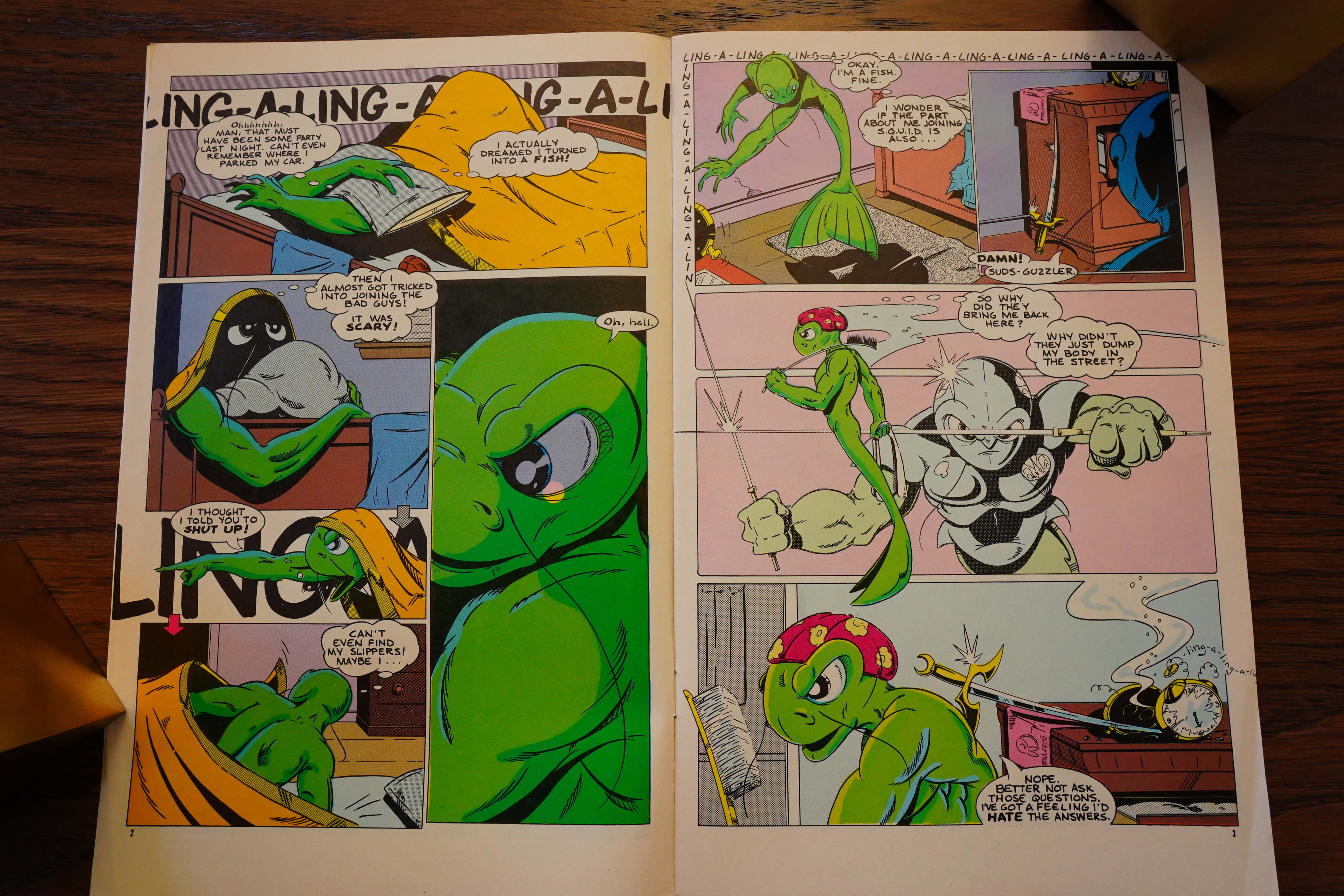
So this continues straight off of the storyline in the album, of course.
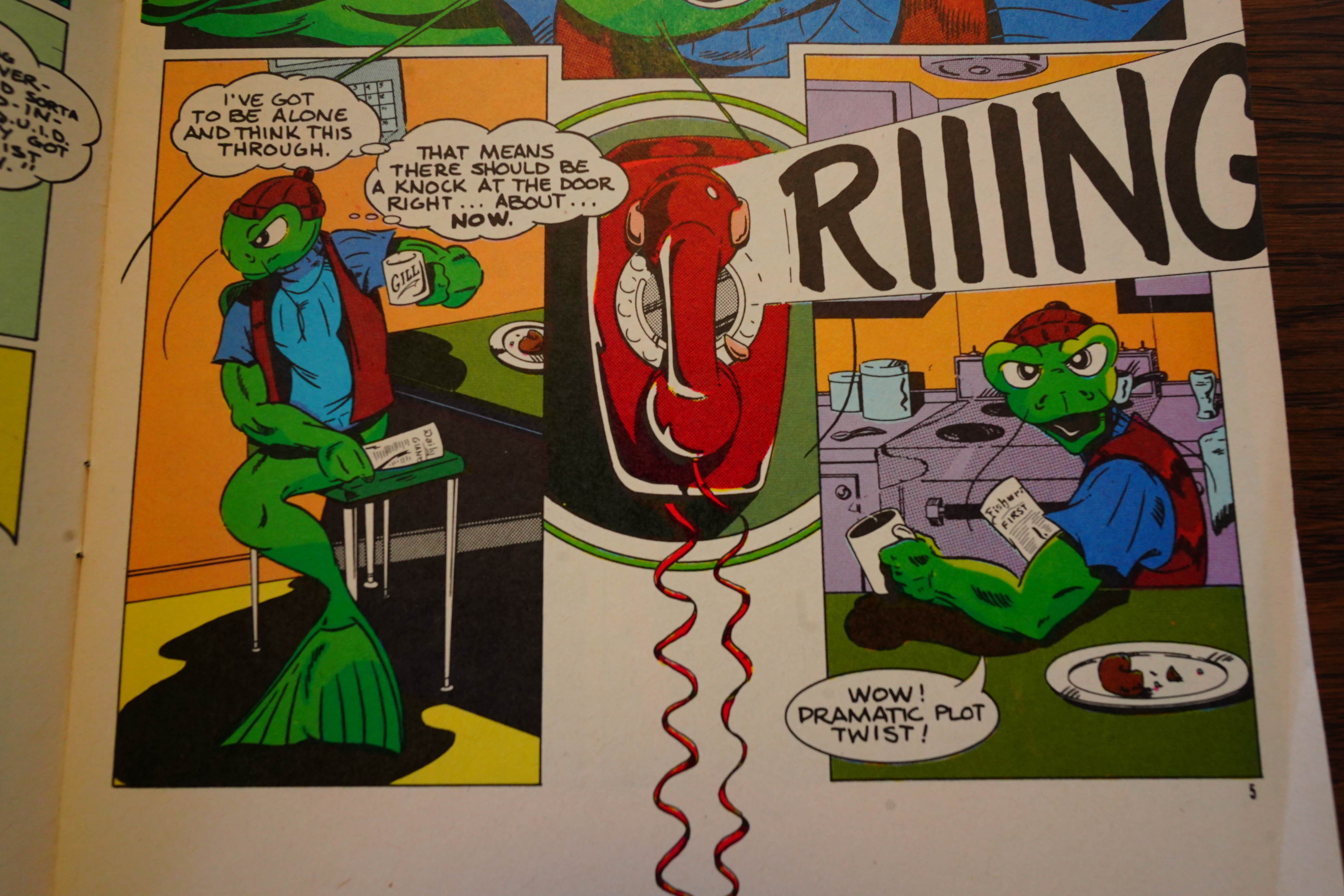
I don’t know… the humour seems to be growing on me? I mean, it’s very standard, but…
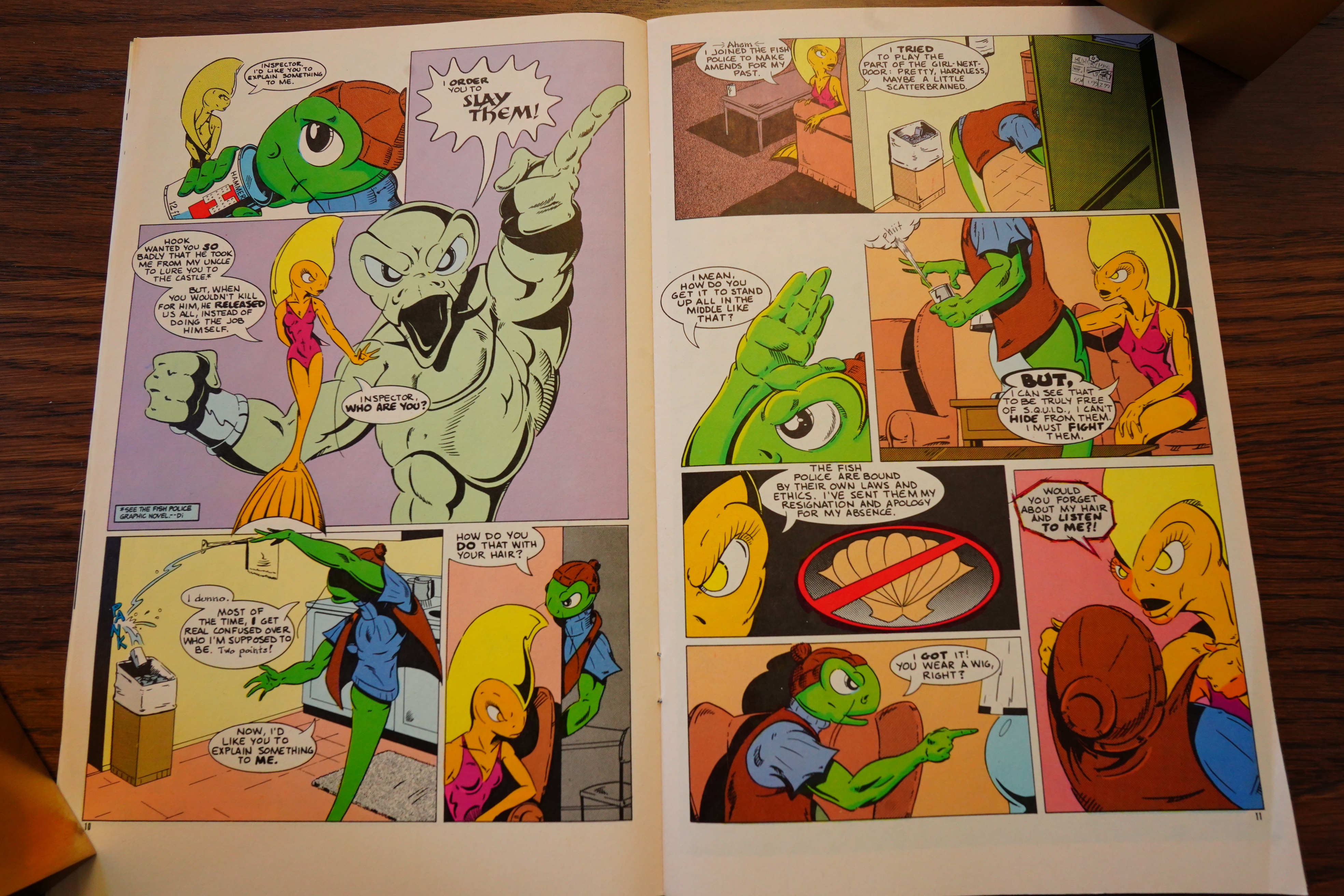
They’re still going on about various nefarious plots, but I’m still not sure whether Moncuse himself knows where all of this is going. But the colour special is referred to, even though it was (I think) done later?
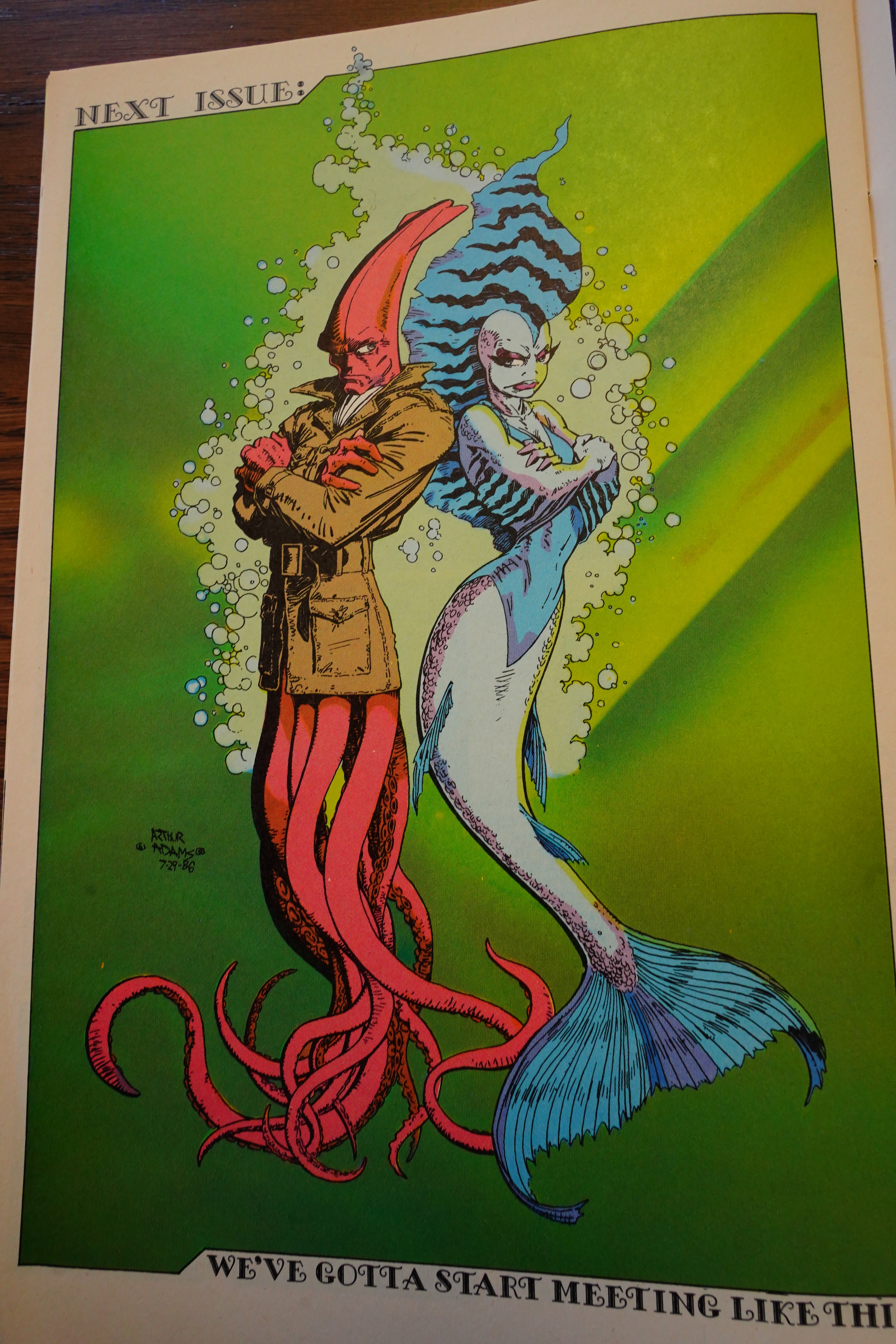
To pad out the issue, we get a bunch of pin-ups by other people.
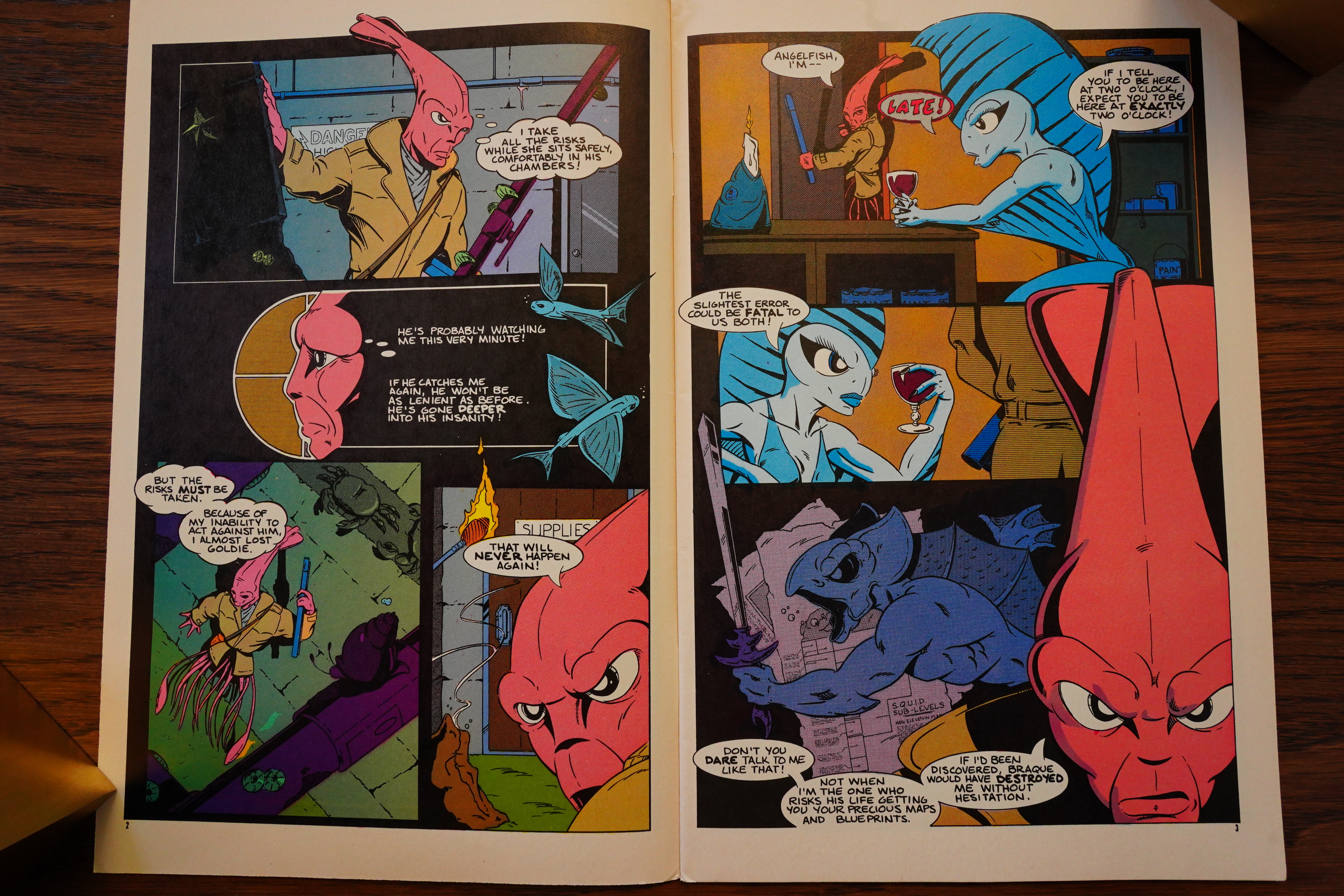
When things are actually happening, it’s not too bad, but there’s a lot of back and forth, seemingly explaining things that we either already know, or should already know, somehow…
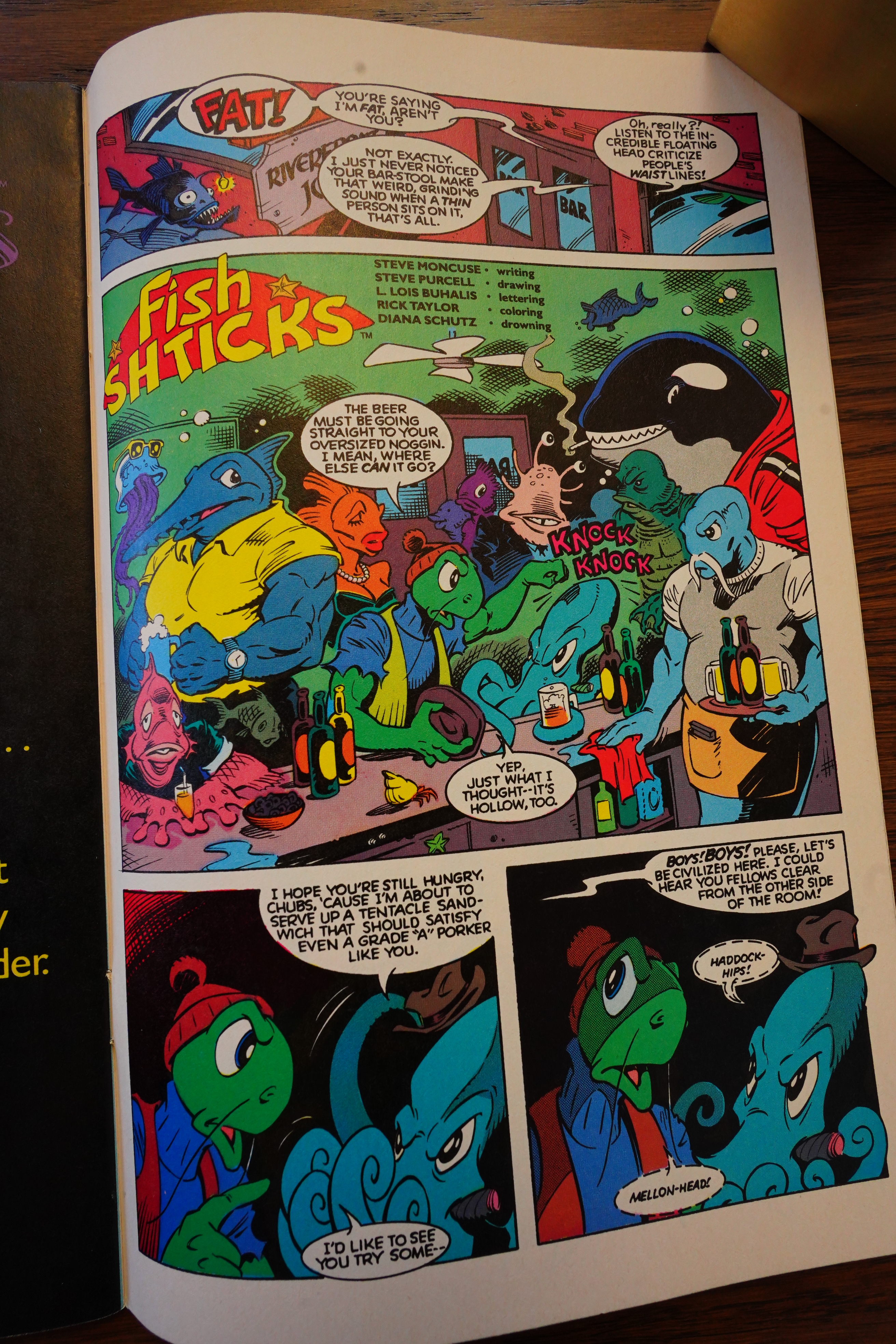
The rest of the series has a backup strip called Fish Shticks, which is written my Moncuse but drawn by other people. Most of them are pretty context less, but the ones that aren’t seem to be happening much further ahead in the storyline.
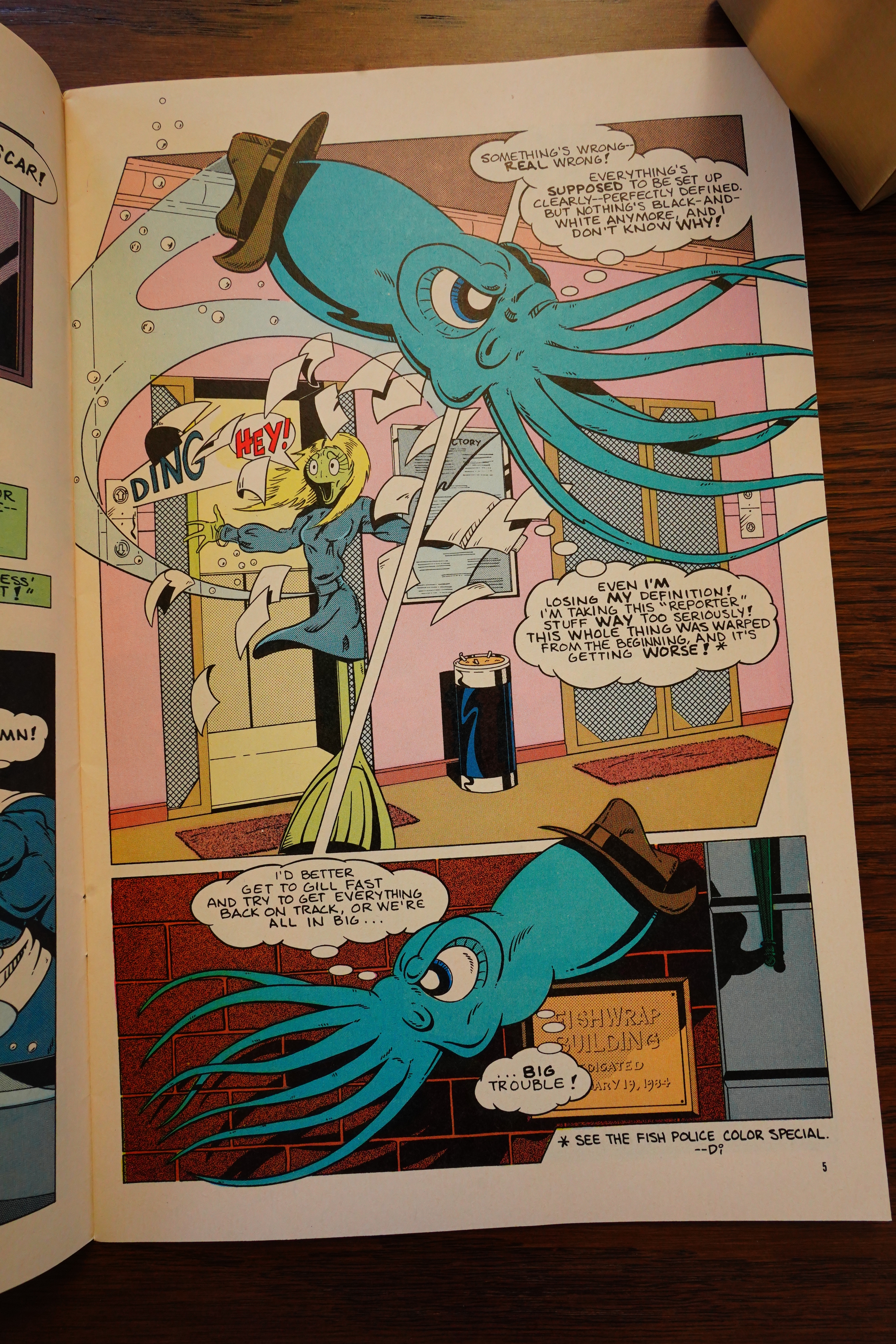
Uhm… oh! The squid guy is swimming feet first? I don’t think they do that in reality, so it makes things a bit confusing…
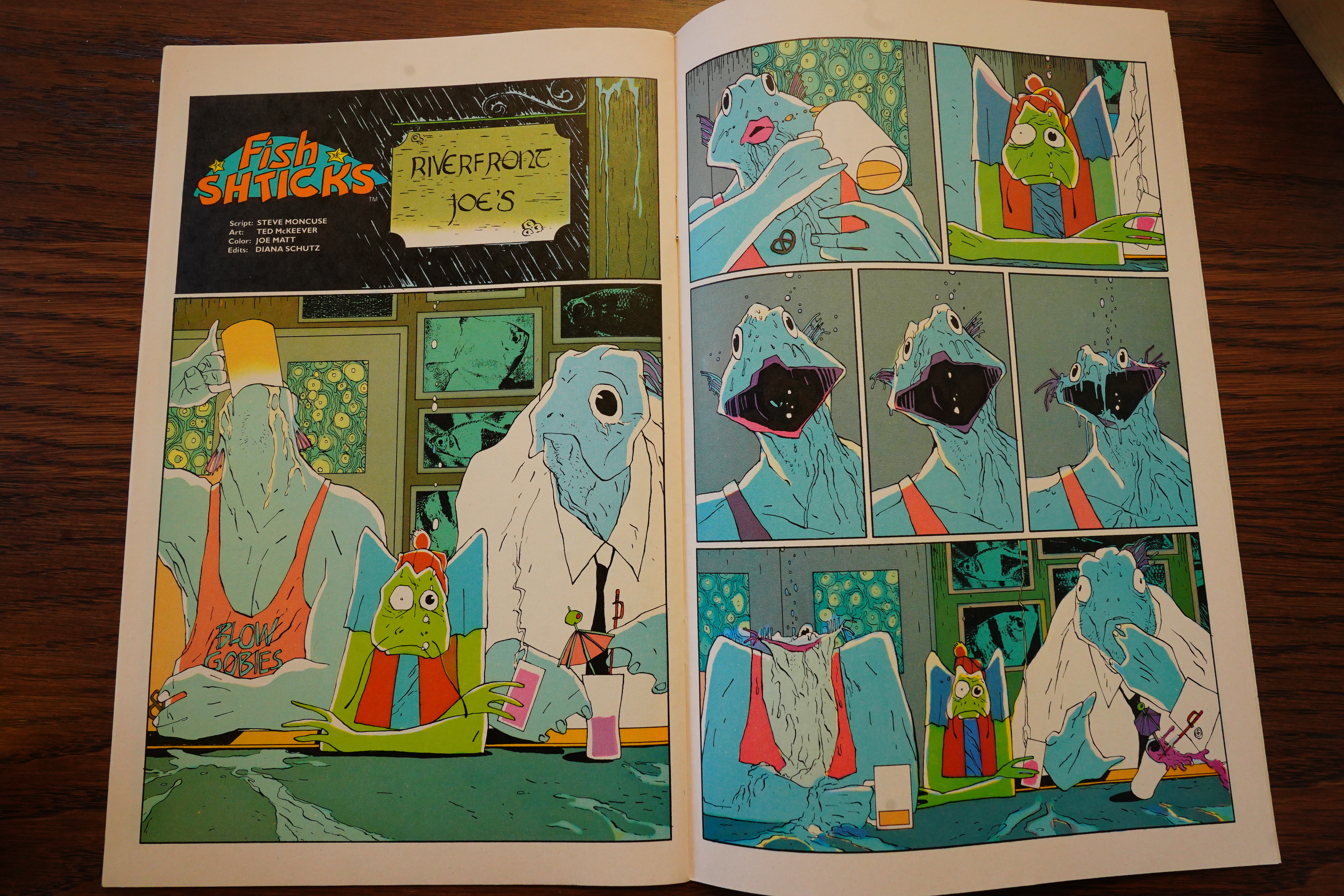
Wow, Ted McKeever!
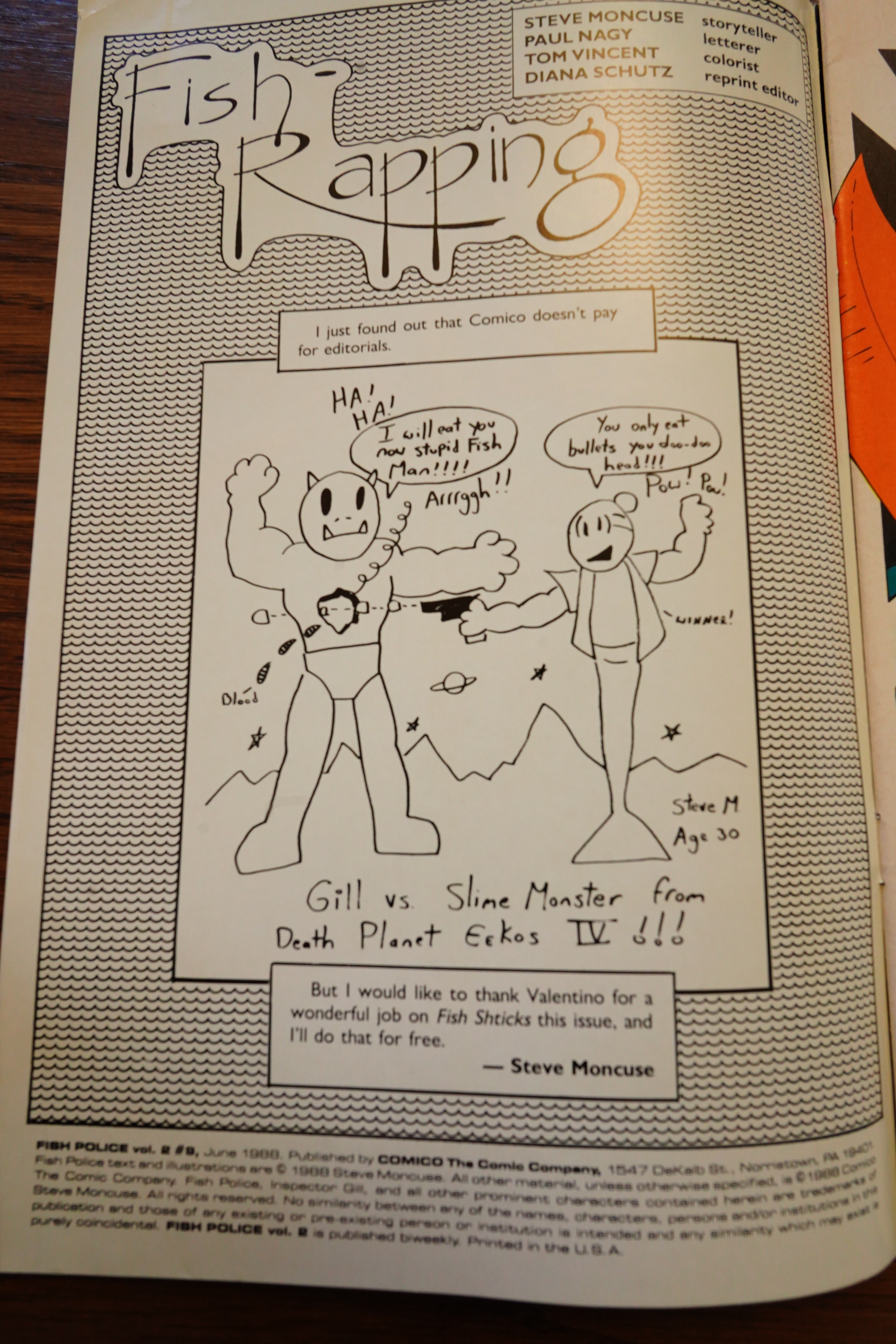
Heh.
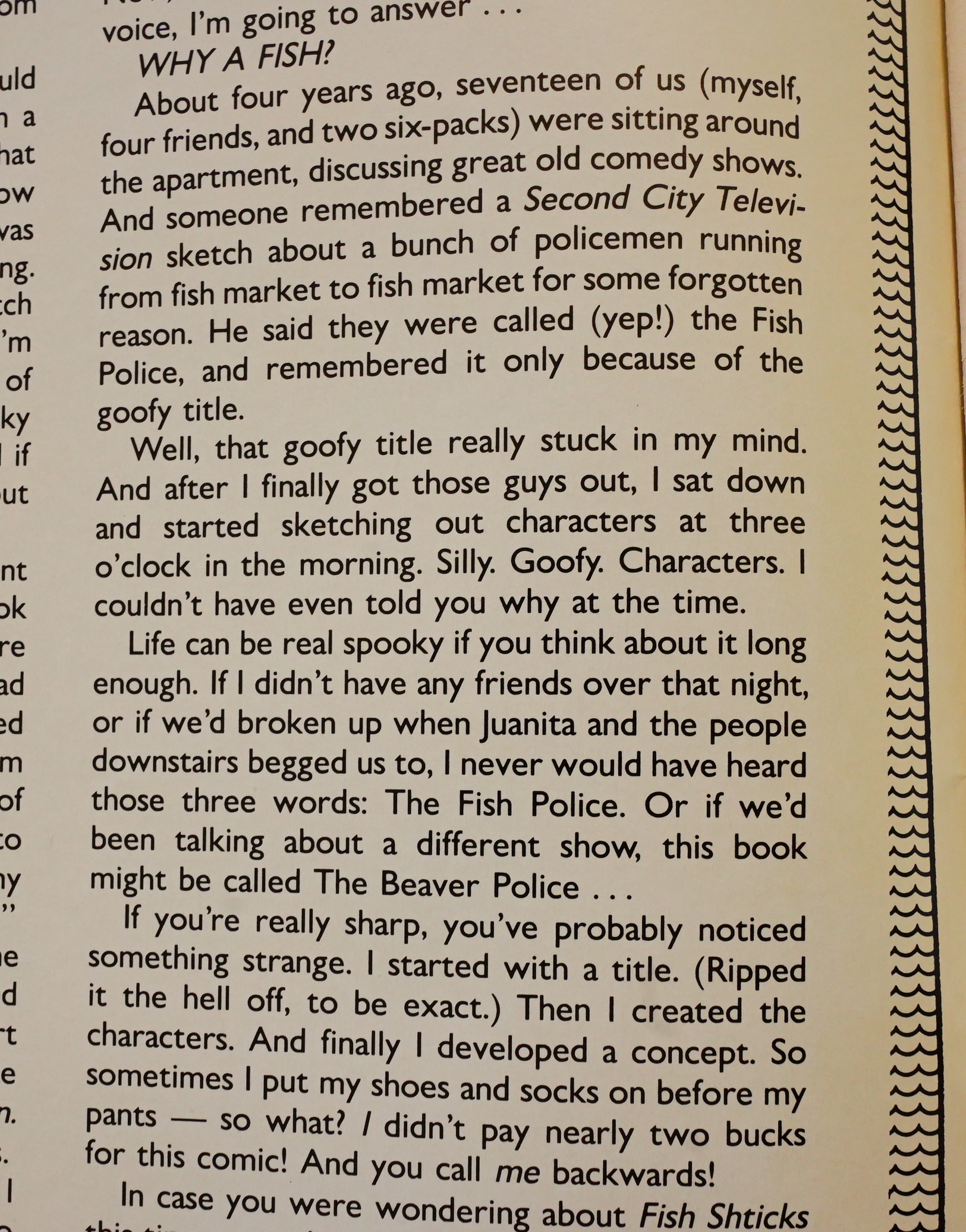
Moncuse explains how he created Fish Police: He took the name from a Second City sketch, and then just created some characters around the name, and then came up with a storyline. Which is pretty much like what the book reads like, I guess.
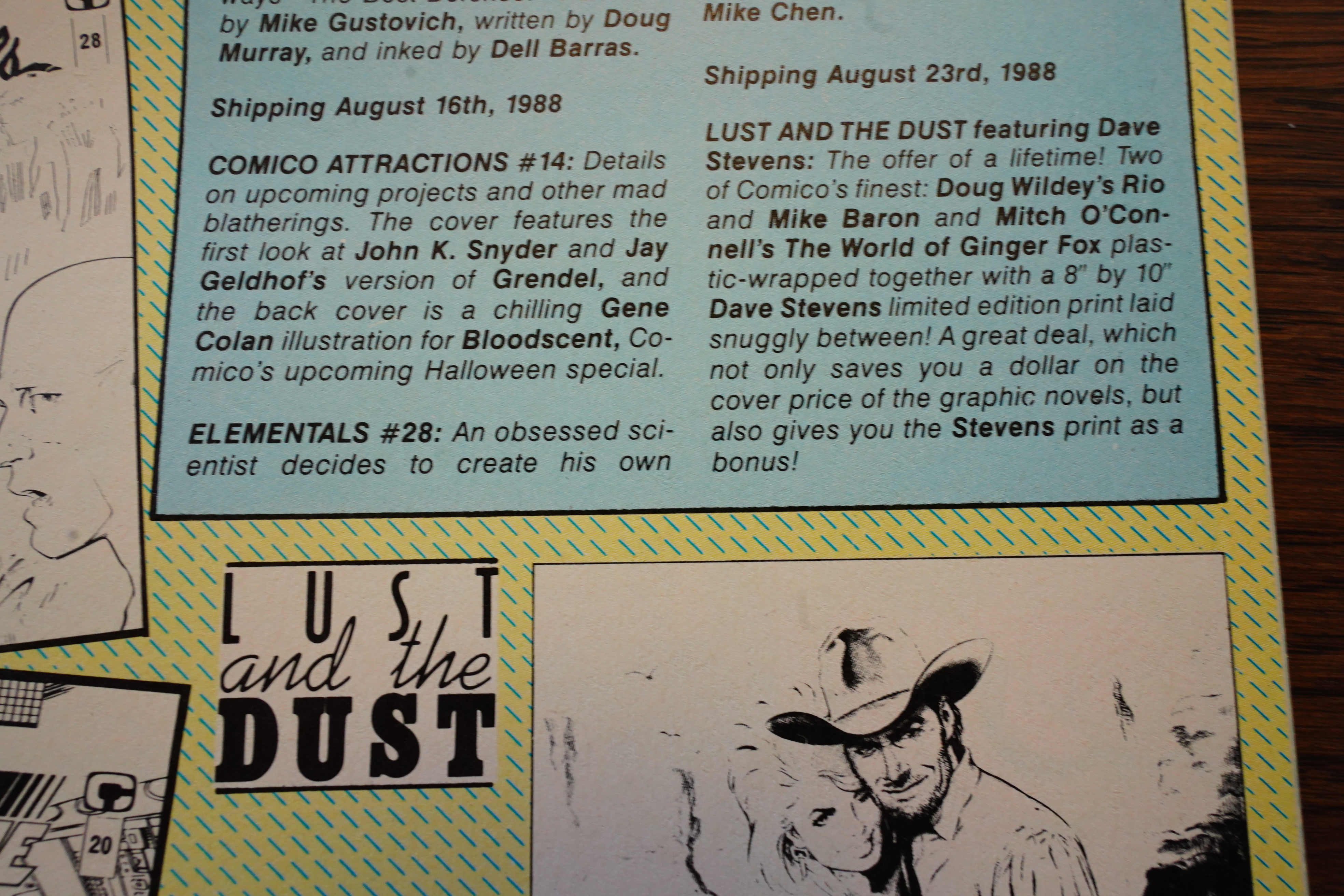
Heh. “Lust and the Dust” — Comico packaged Rio and World of Ginger Fox into one package? Well, why not.
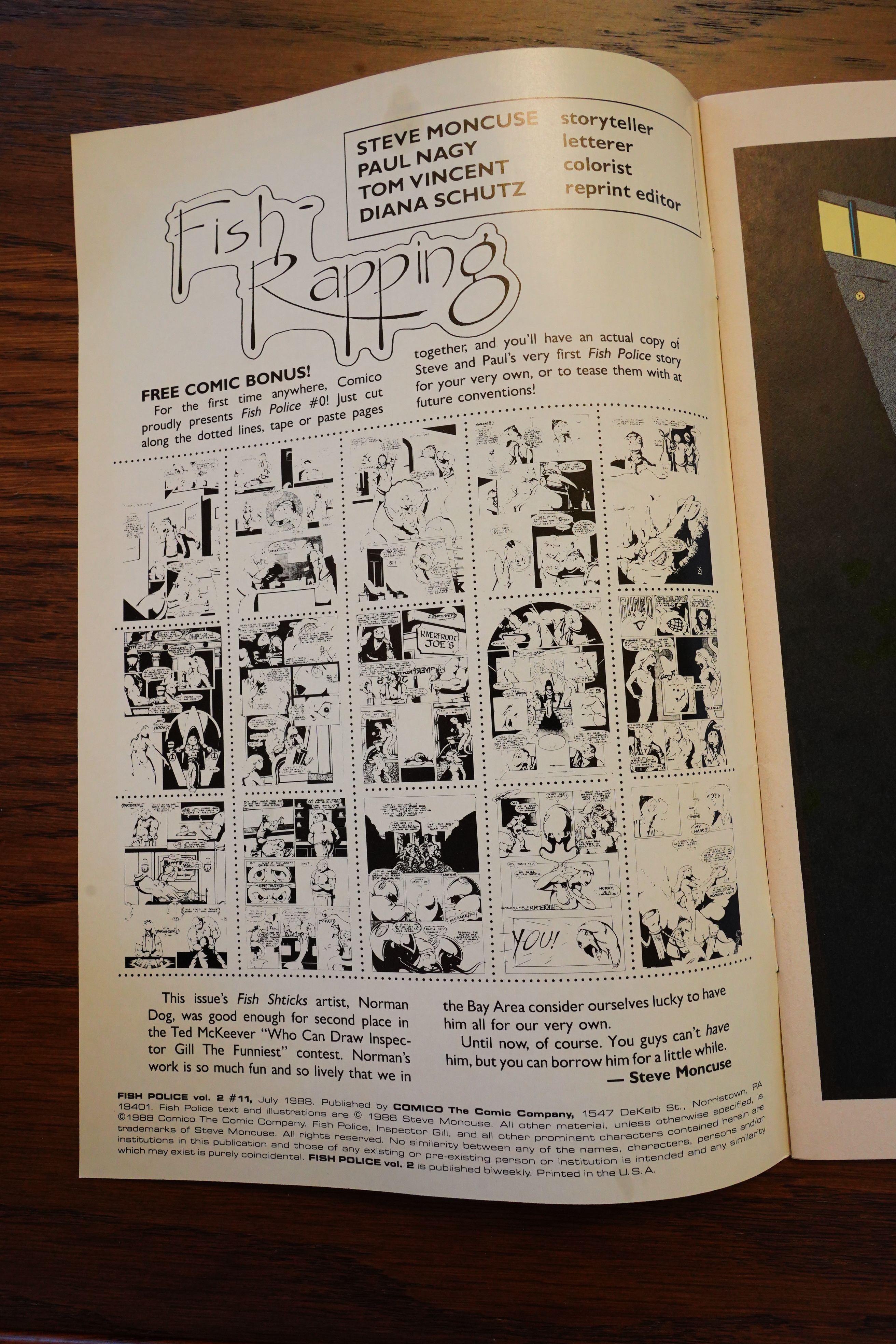
Oh, so there was a Fish Police #0? Well, that explains why #1 feels like we were dropping in on a storyline already in progress.
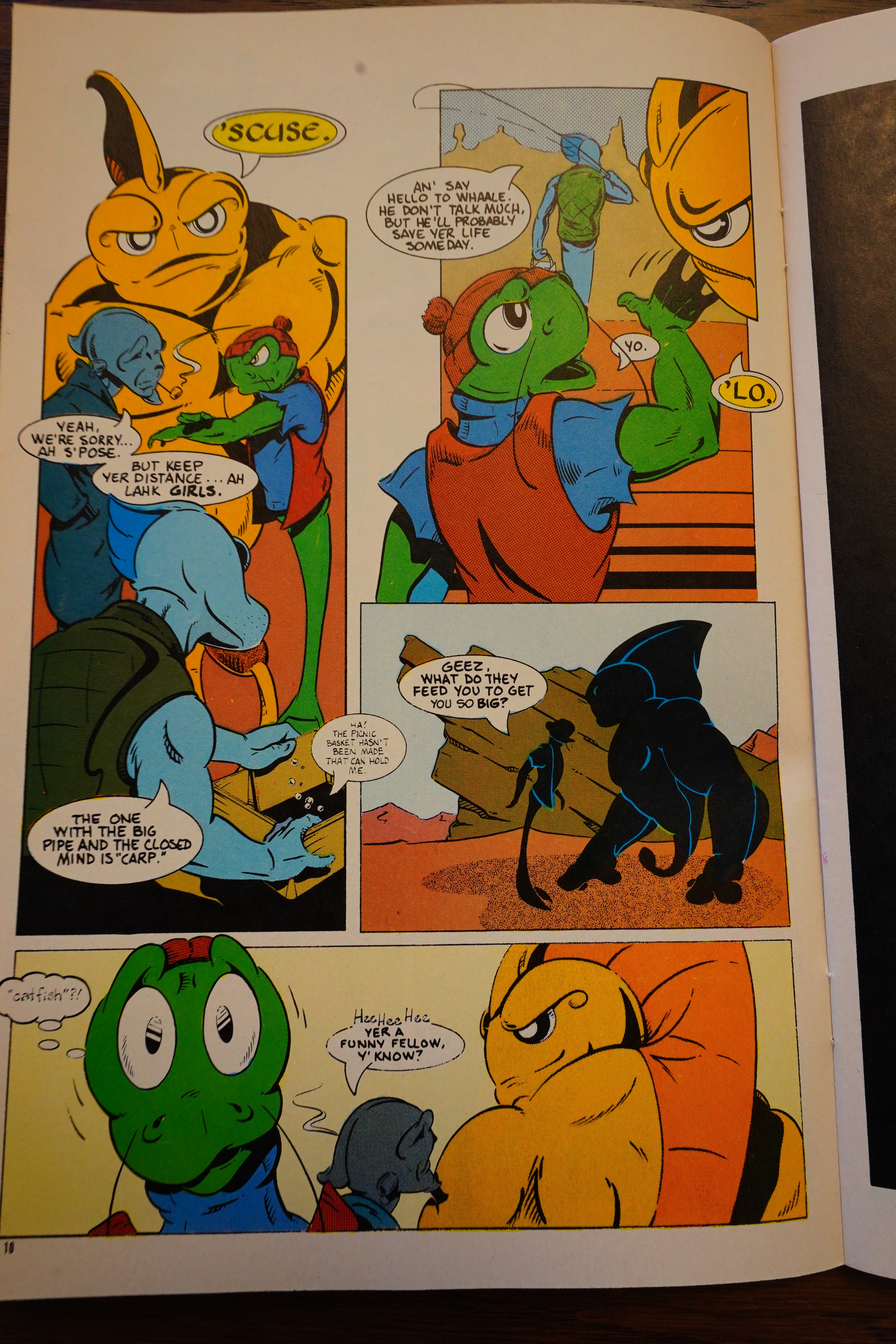
Moncuse does this sort of thing repeatedly — you have a character apparently reacting to something somebody said (like Gill reacting to the orange guy here) — but you’re not shown the orange guy saying something, so it comes off as a non sequitur. The first few times I thought Moncuse just forgot to put it in, or that some of the characters were mind readers, but I guess it’s… just something Moncuse does?
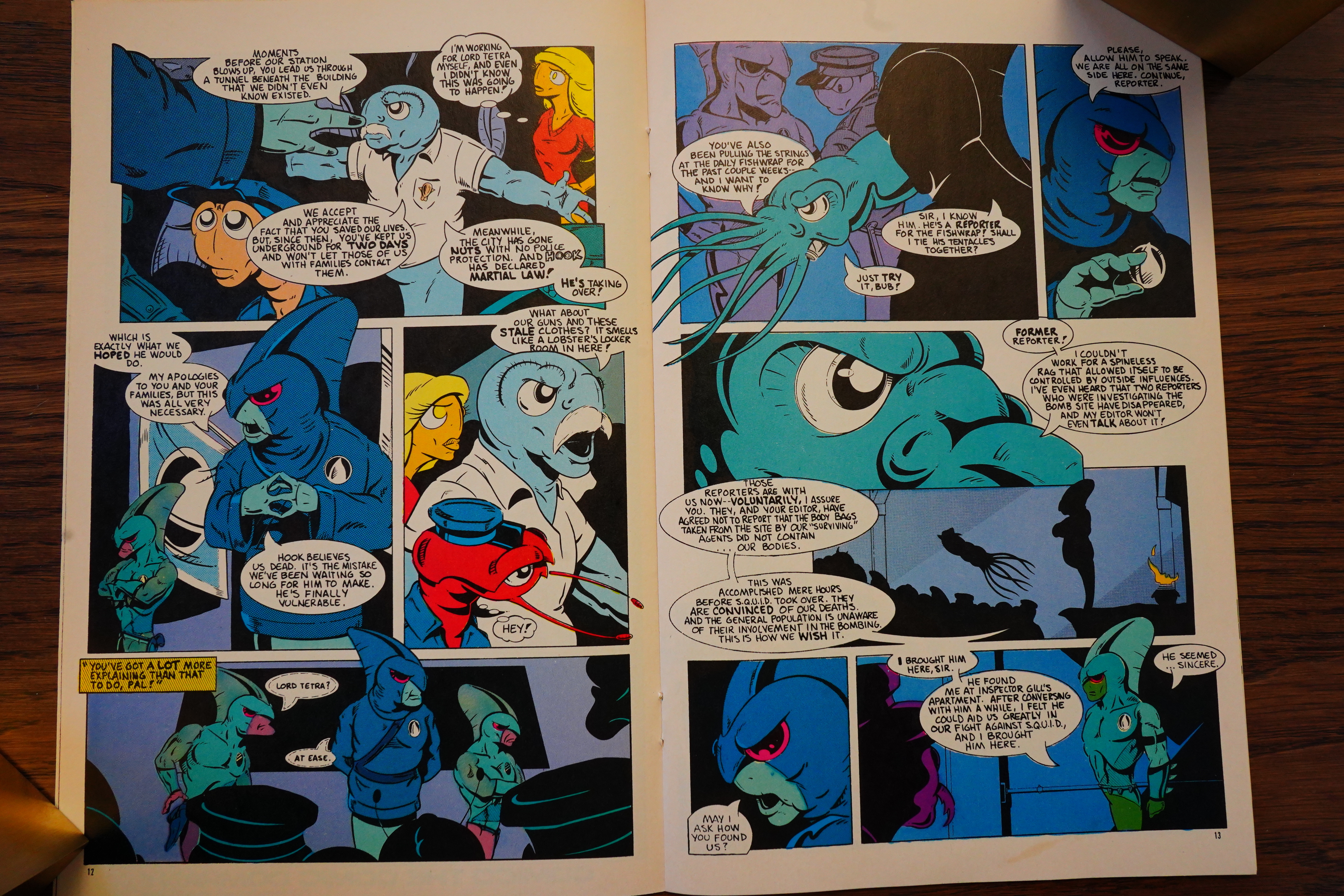
But I have to say that the series is growing on me. Instead of being annoyed by the general chaos of the storyline, it’s becoming clearer that we’re actually going somewhere — even though the storyline moves at a snail’s pace.
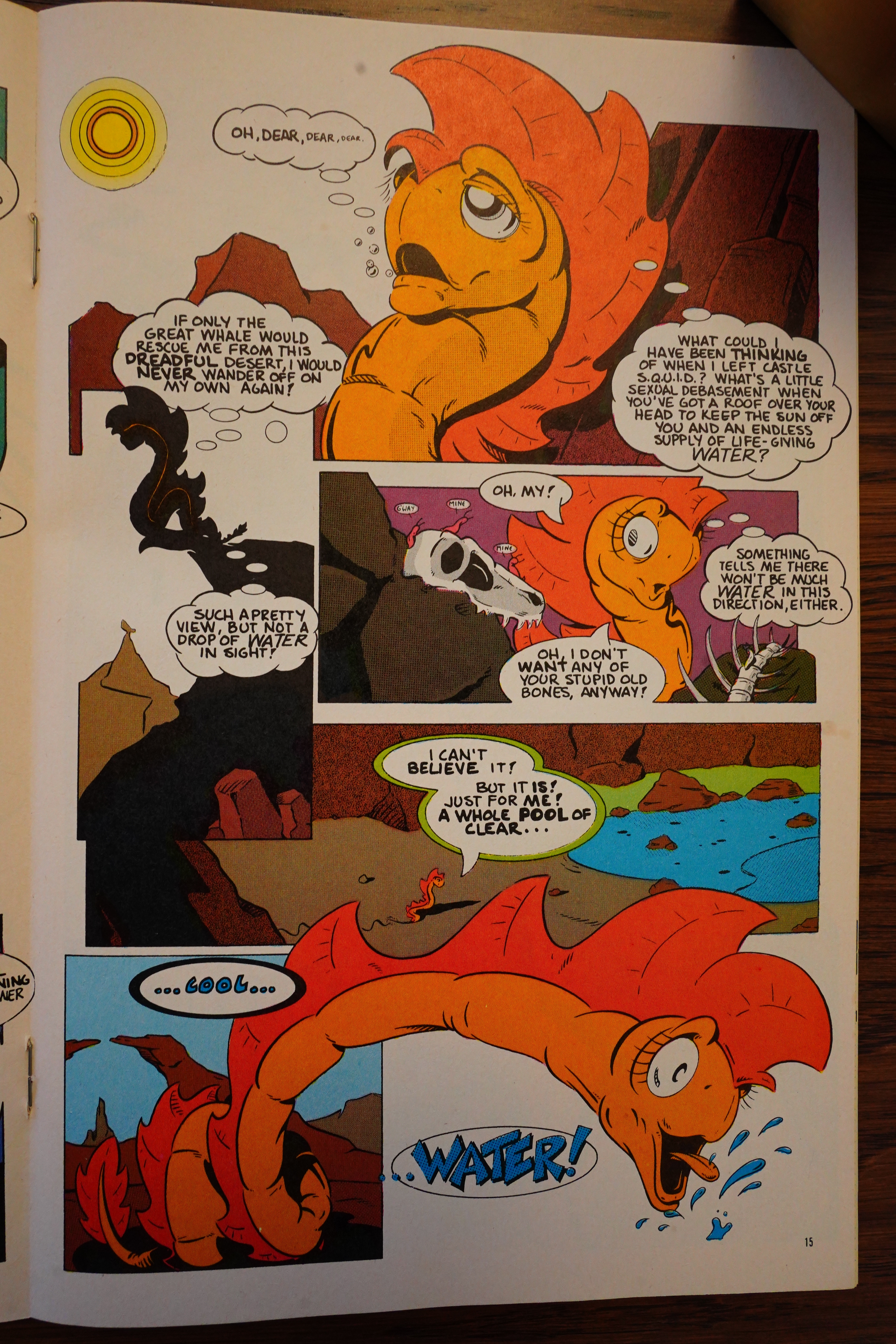
And Moncuse’s insistence on the bizarre nature of his world gets funnier the more absurd it is — like having a pool of water (under the sea).
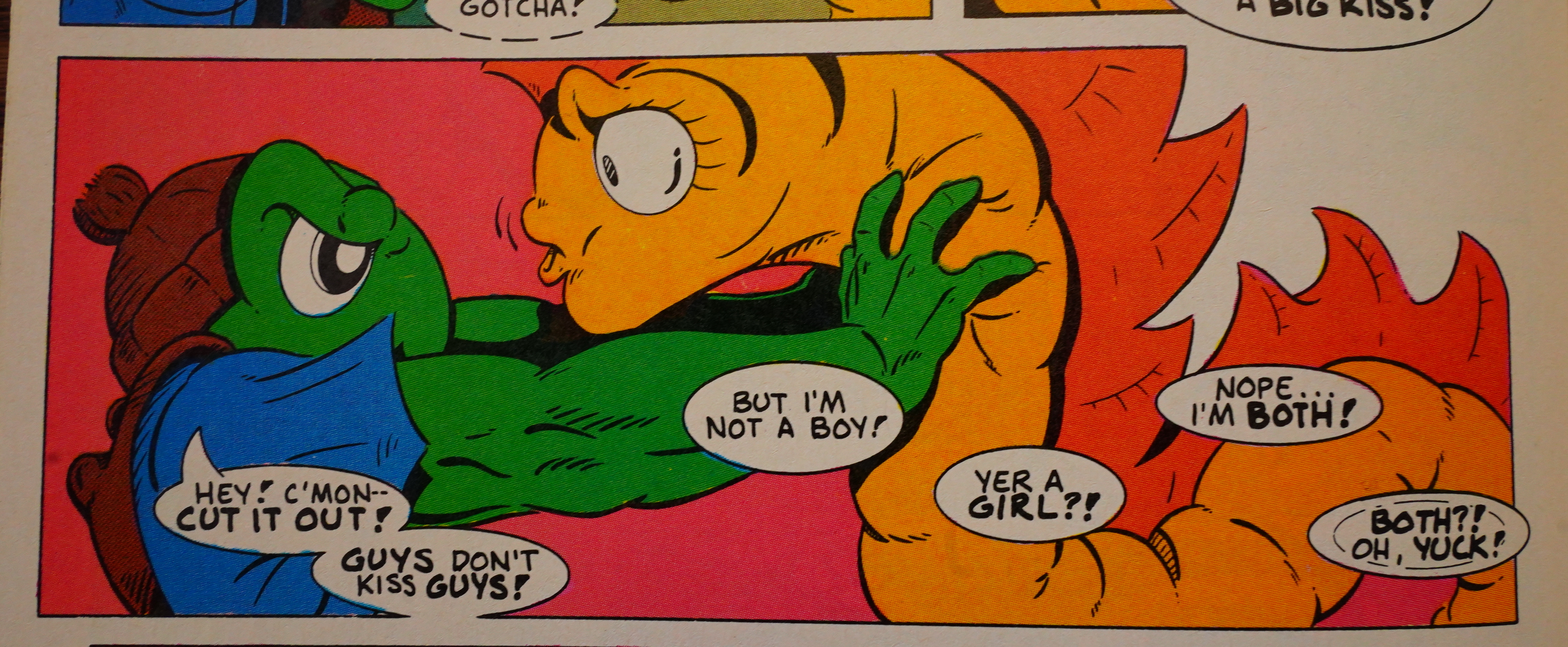
Oh, and now Hook’s joke (way up there in this post) makes more sense, I guess?
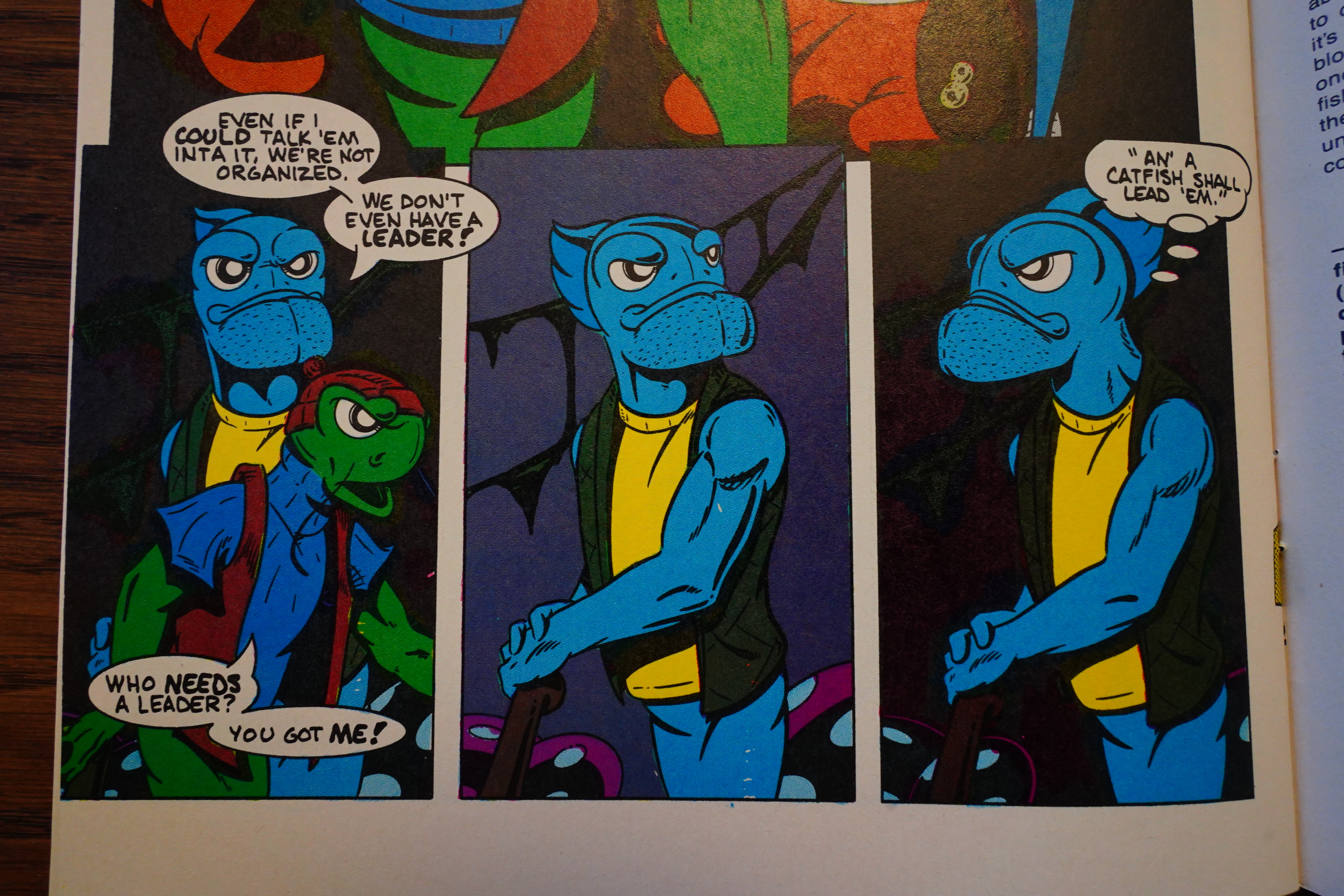
Oh — Gill is sort of a messianic character they’ve been waiting for? Hey… this is starting to give me some Cerebus vibes — hinting at intricate mysteries while doing a comedy book.
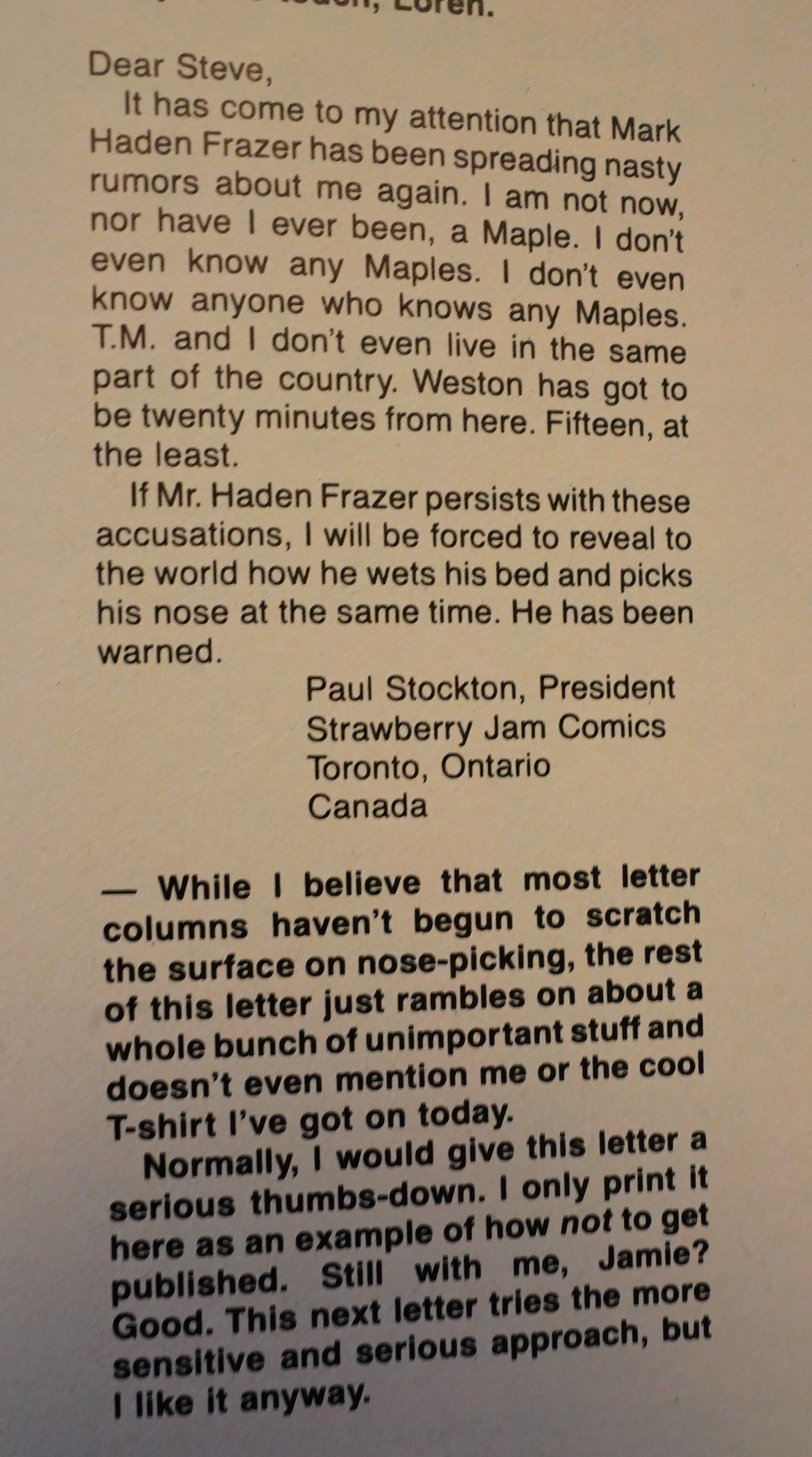
And Cerebus’ readership shows up in the letters pages, too.
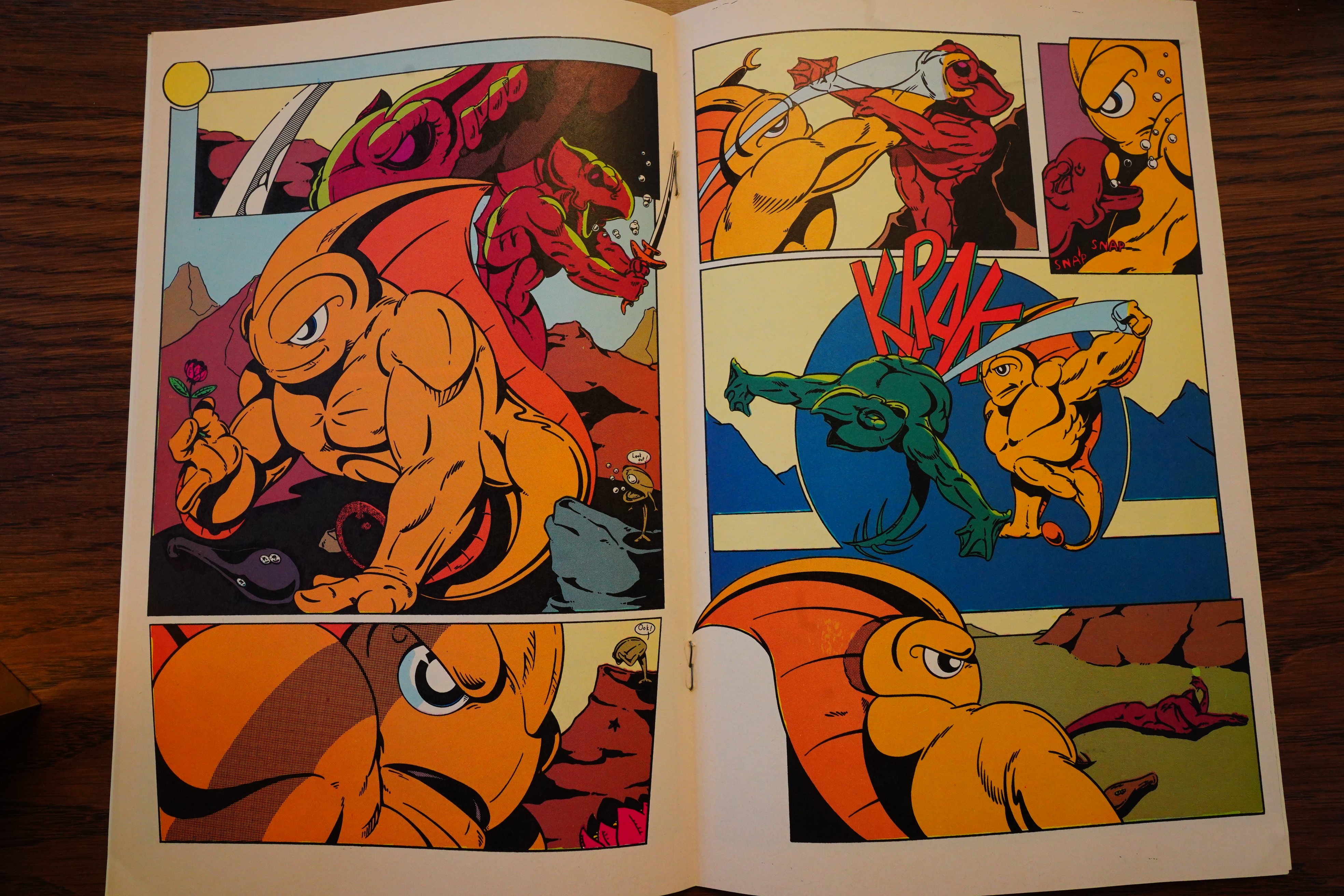
We’re now at the 13th issue, which is the first non-reprint issue, and it’s now a bimonthly series.
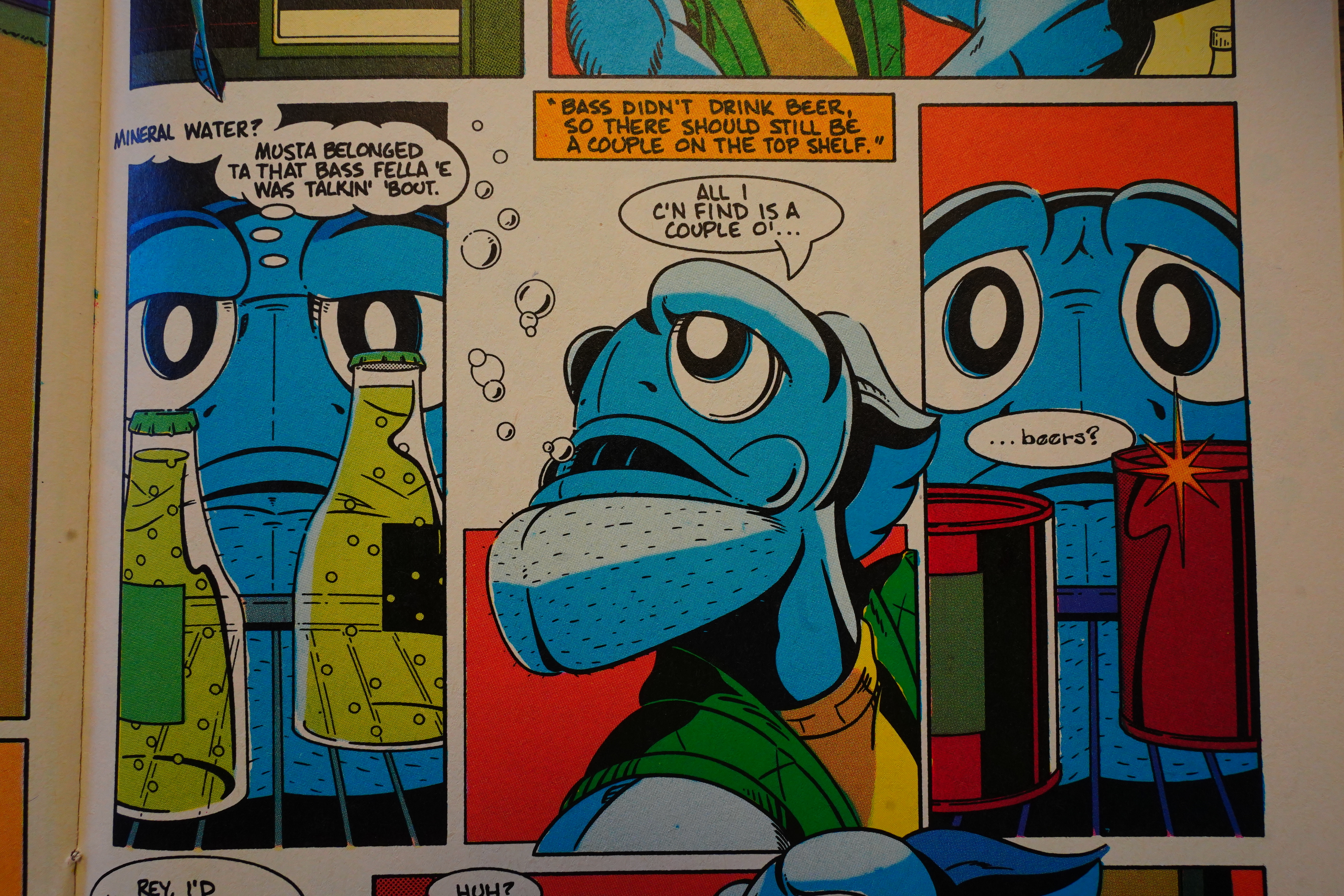
Not much changes art wise, I’d say, but the storyline seems to pick up speed. Perhaps the editor had given some hints about its being time that some things about this world were explained. Apparently the fridge is magic!?
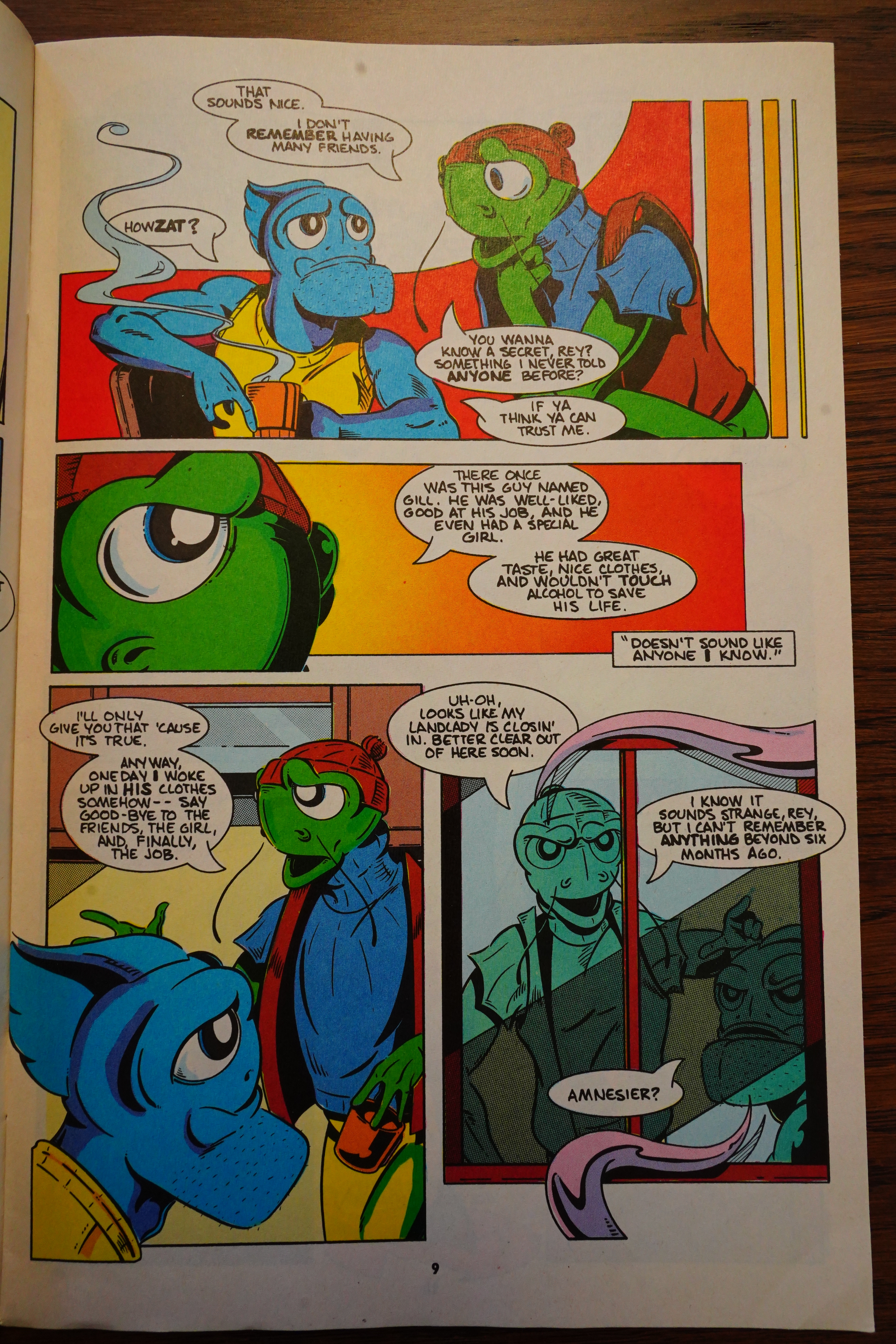
And Gill actually starts explaining to other characters what he can remember and whatnot.
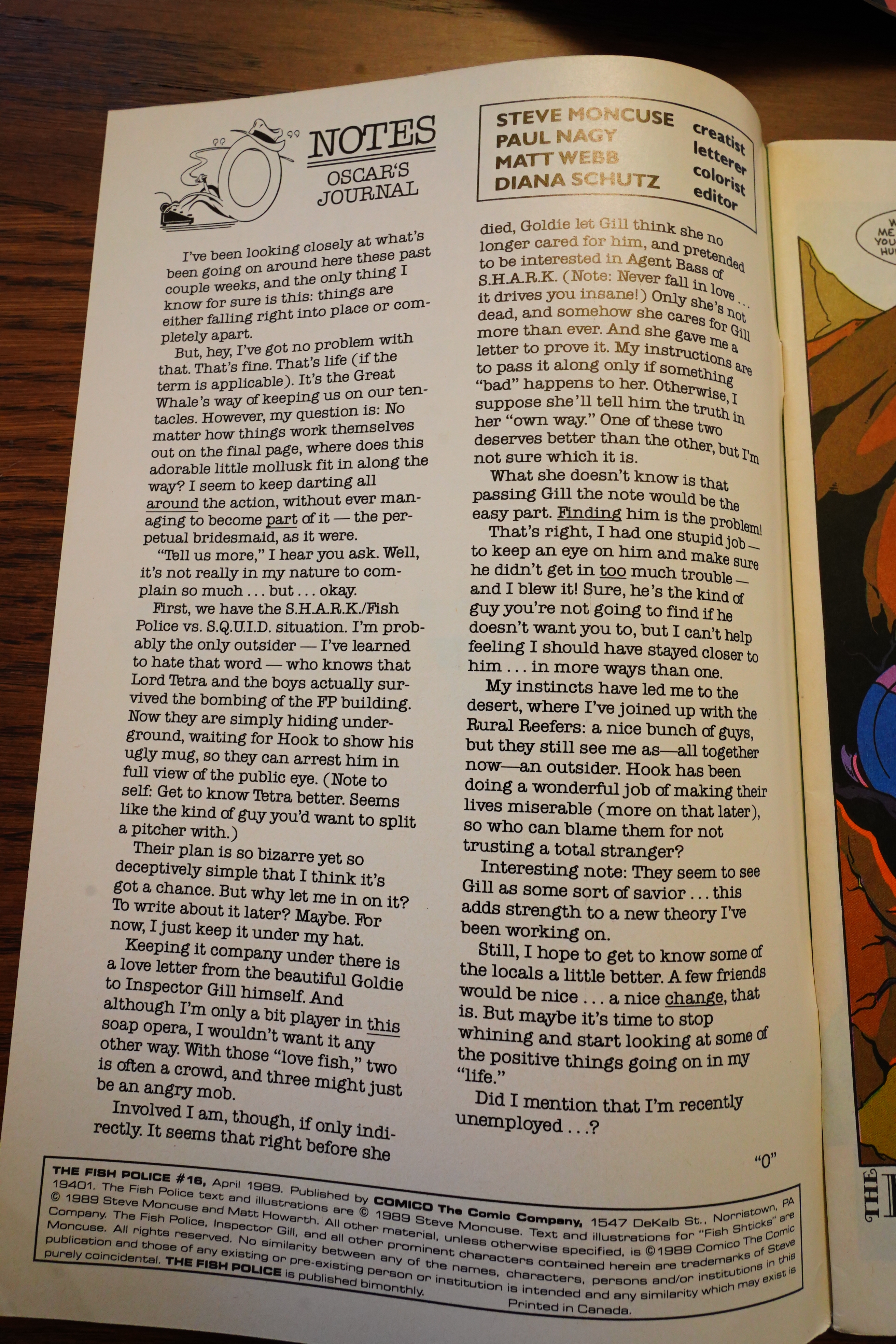
And! Instead of editorials, Moncuse starts recapping the story… but in character as the journalist character.
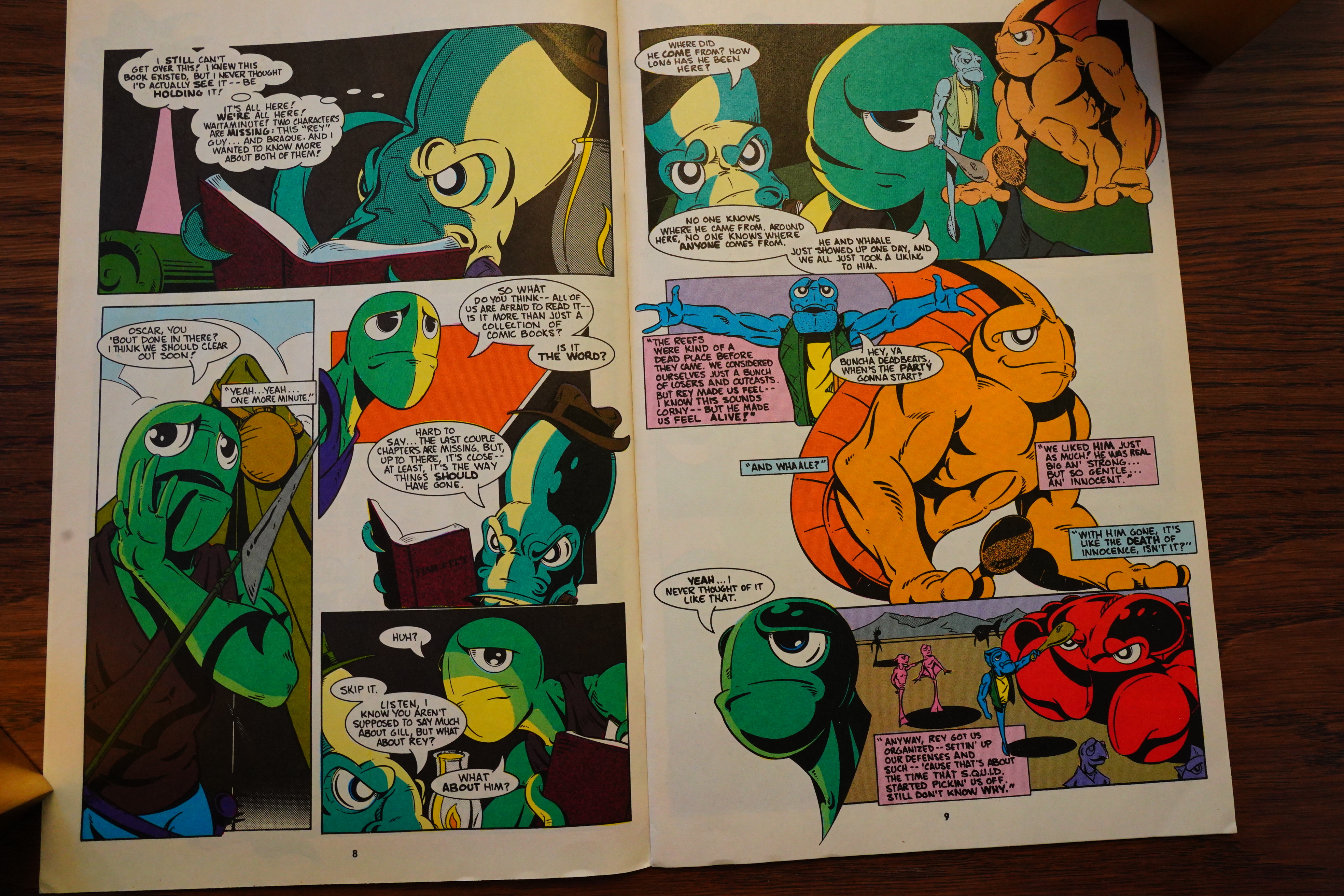
Who is finding an apparently holy book (which is a comic book?) that talks about Gill. Is this going all circular!?
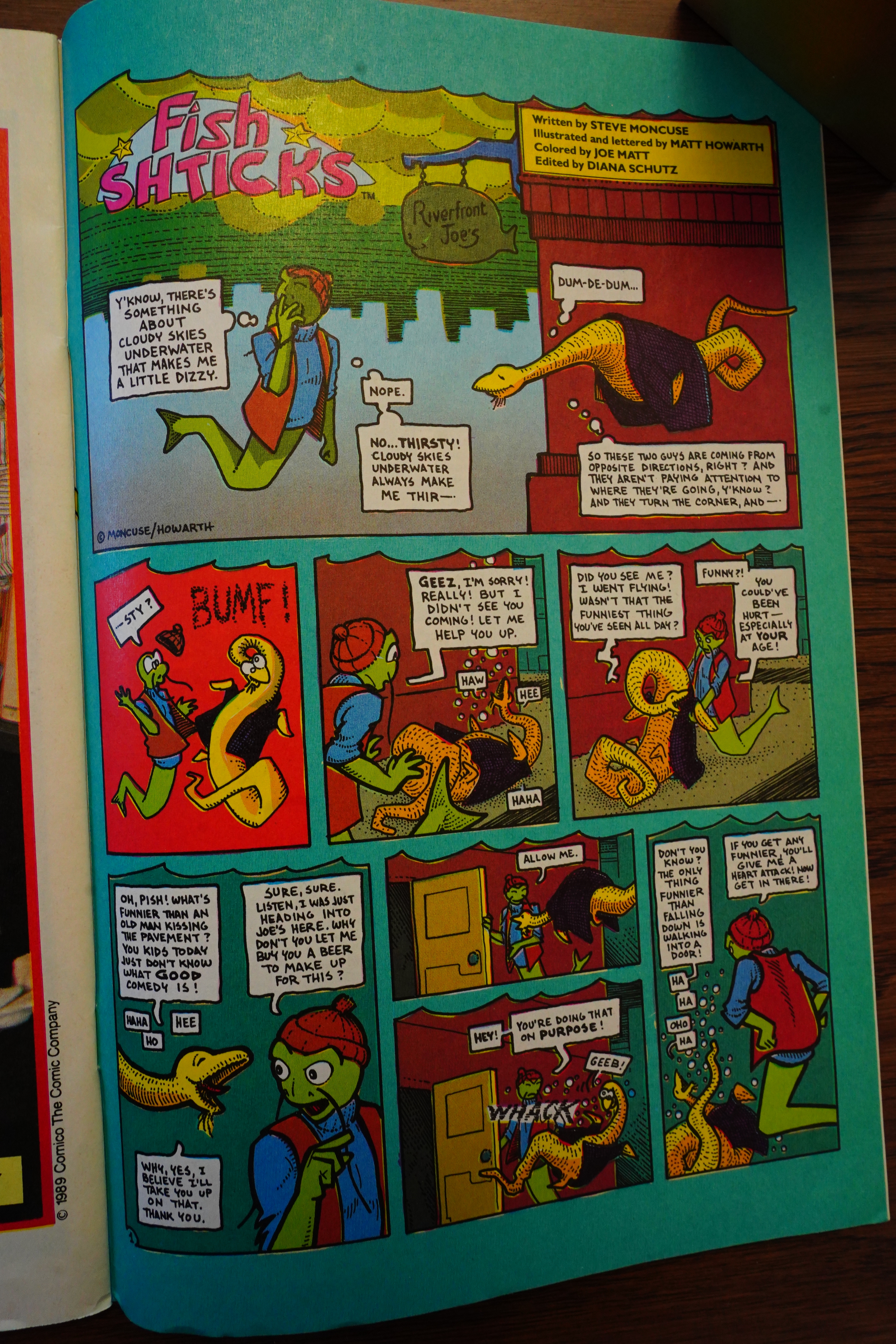
The Fish Shticks backups continue. Here’s Matt Howarth, for instance.
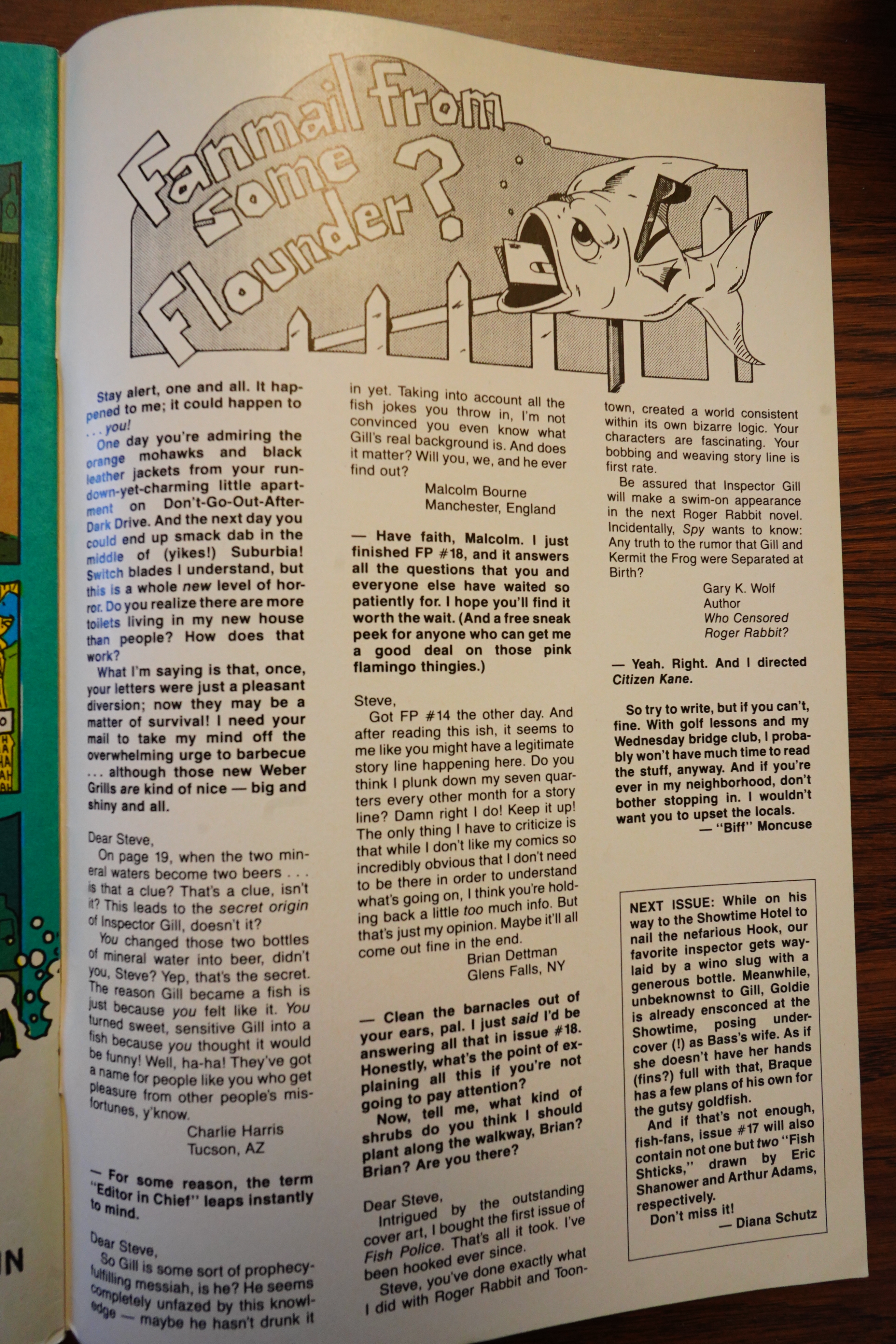
Looks like the letters writers are also relieved to finally see the storyline moving, and Moncuse promises that there’ll be big revelations in #18.
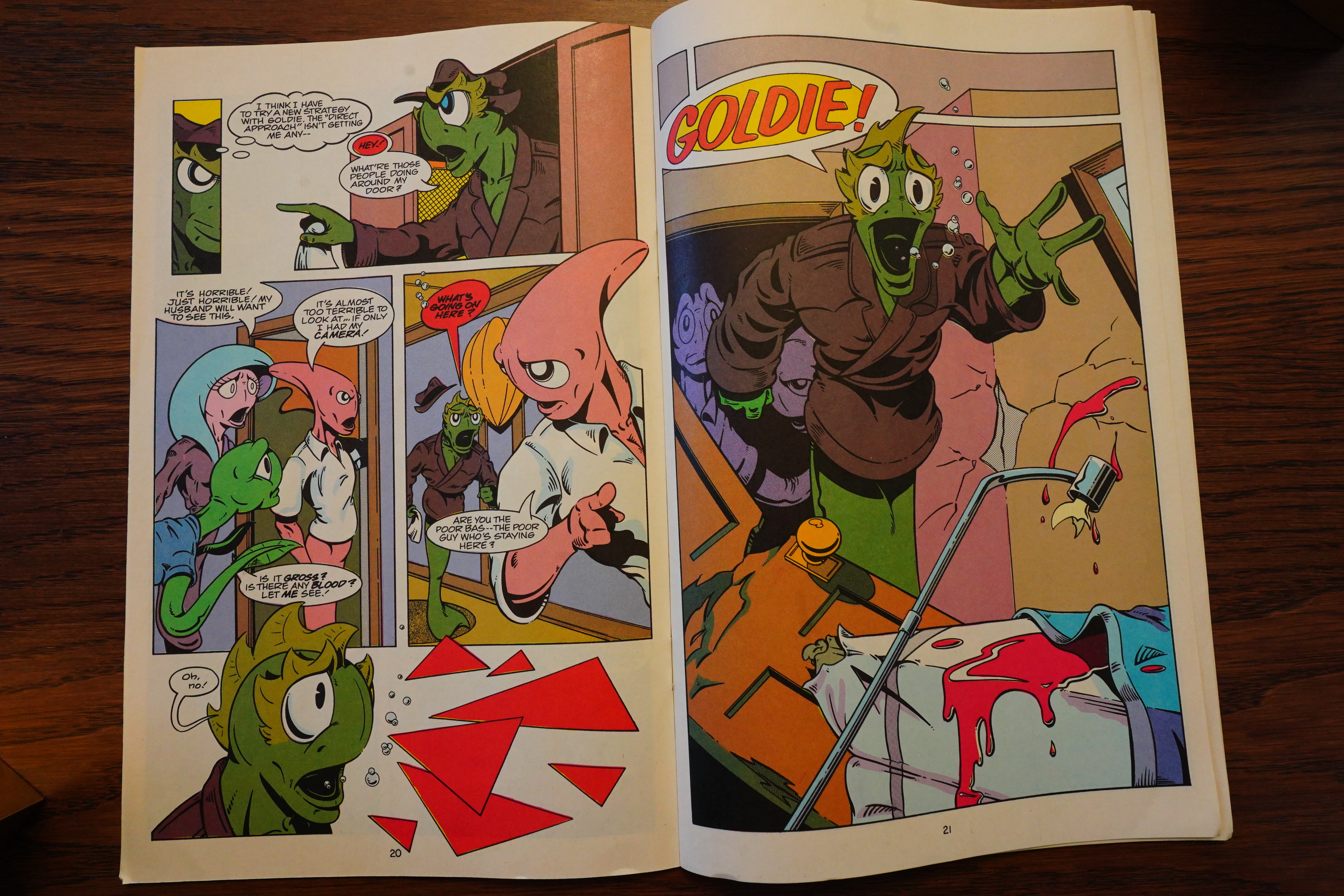
So, of course, issue #17 is the final issue, and it ends like this.
*sigh*
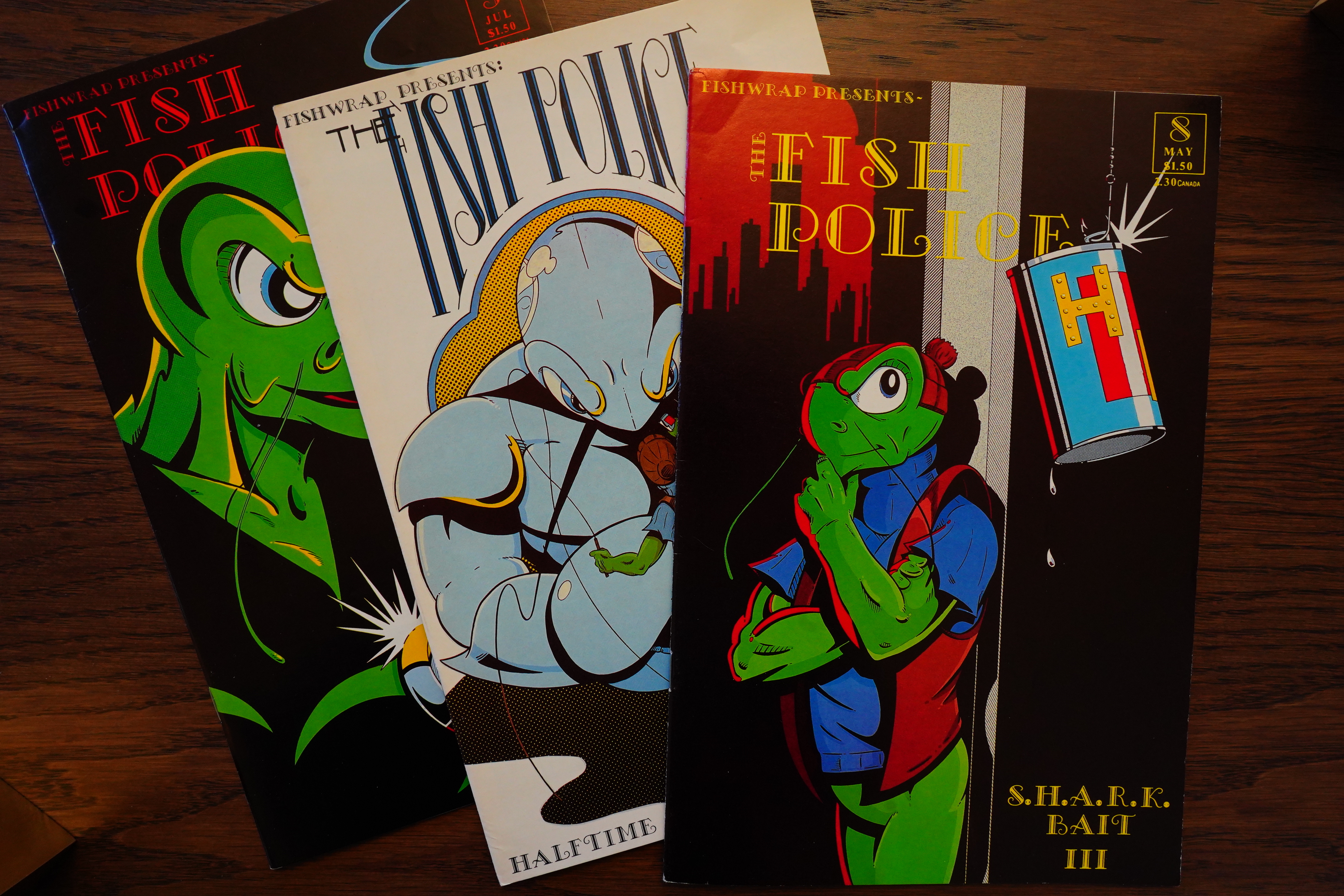
But! I also have these Fishwrap issues — because when buying the Comico issues, sellers kept sending me the wrong editions.
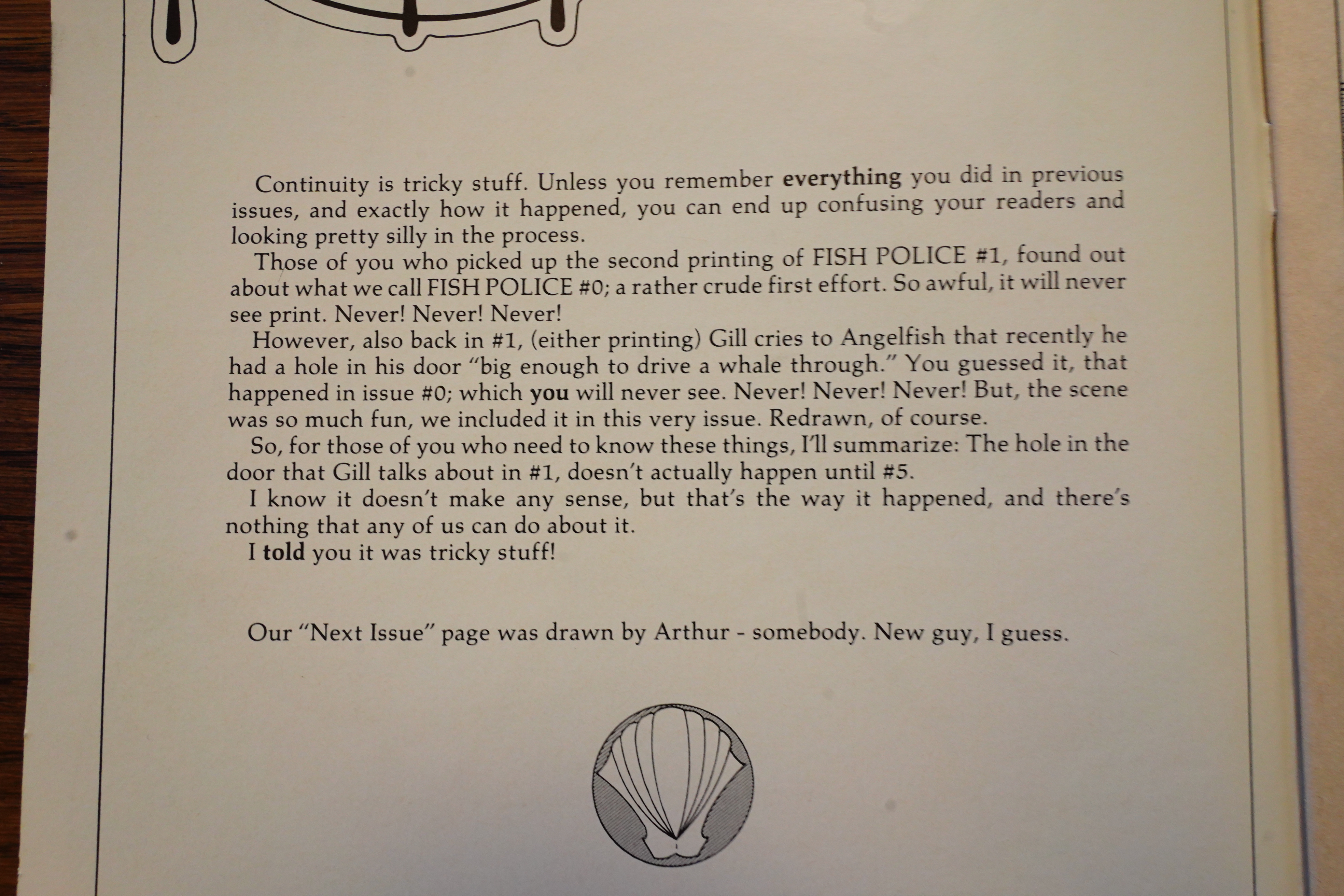
Moncuse swears to never reprint Fish Police #0. I’m a bit curious as to what that looked like. I mean, story wise.
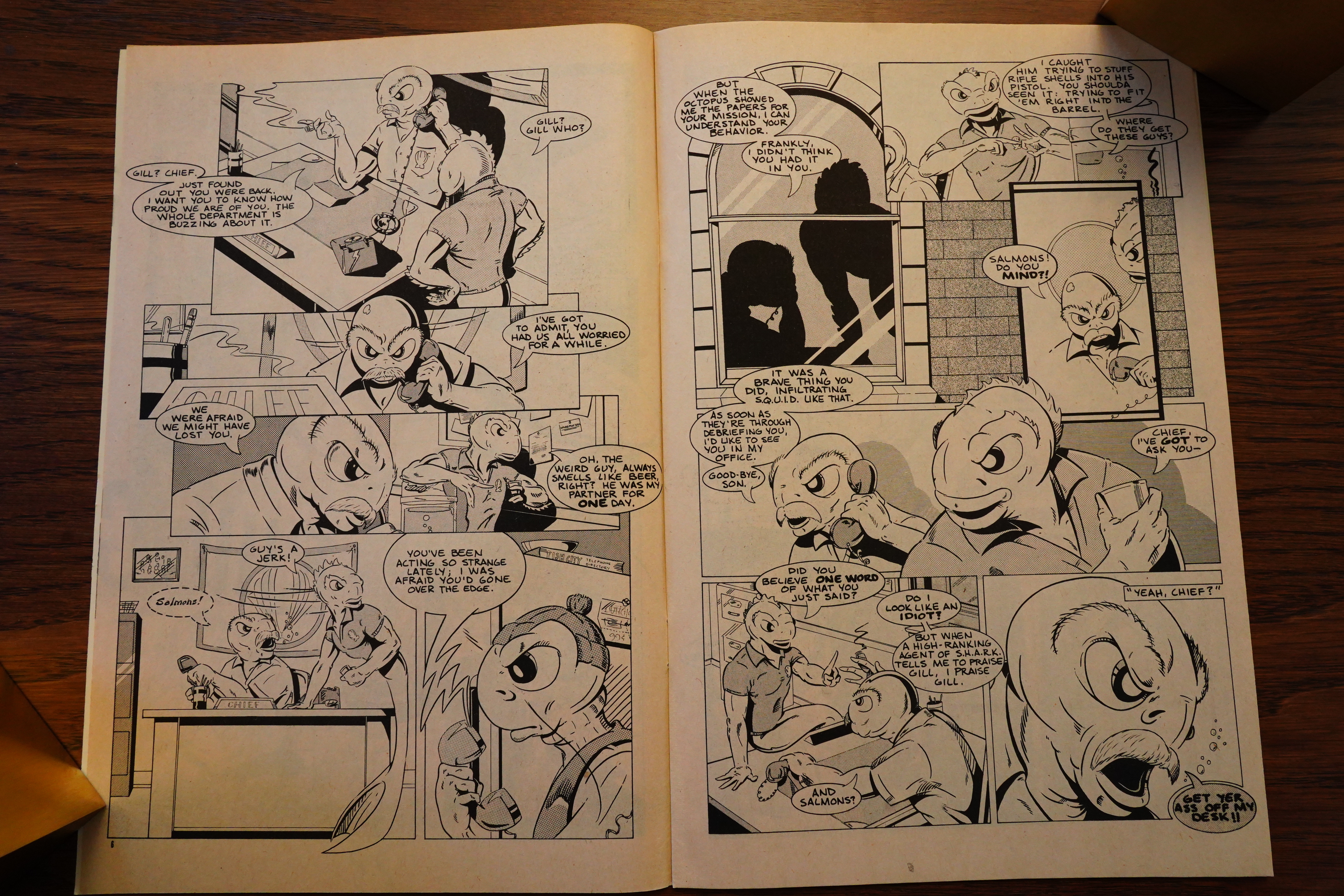
Looked pretty snazzy in black and white, I guess?
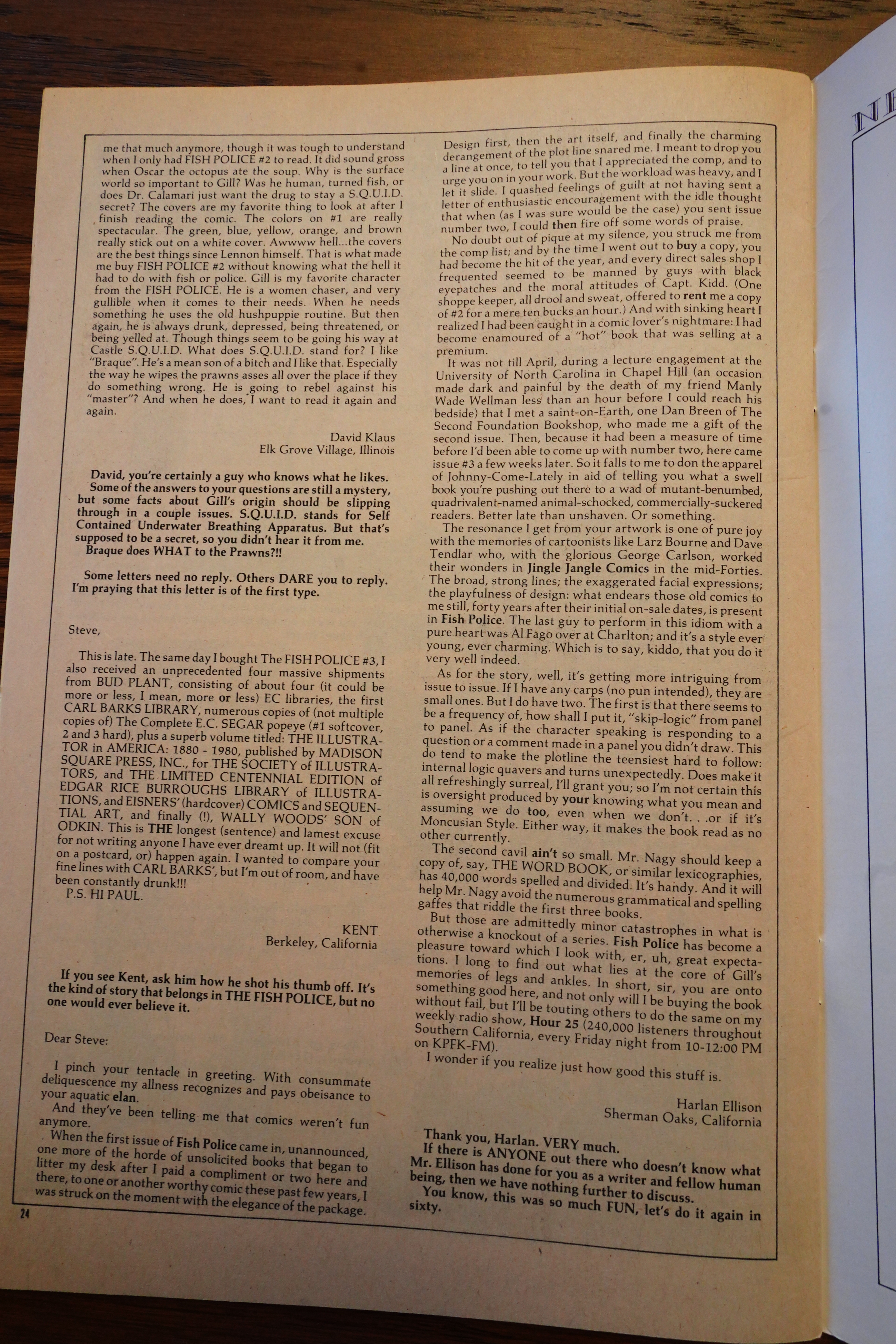
Wow, that’s a long letter from Harlan Ellison.
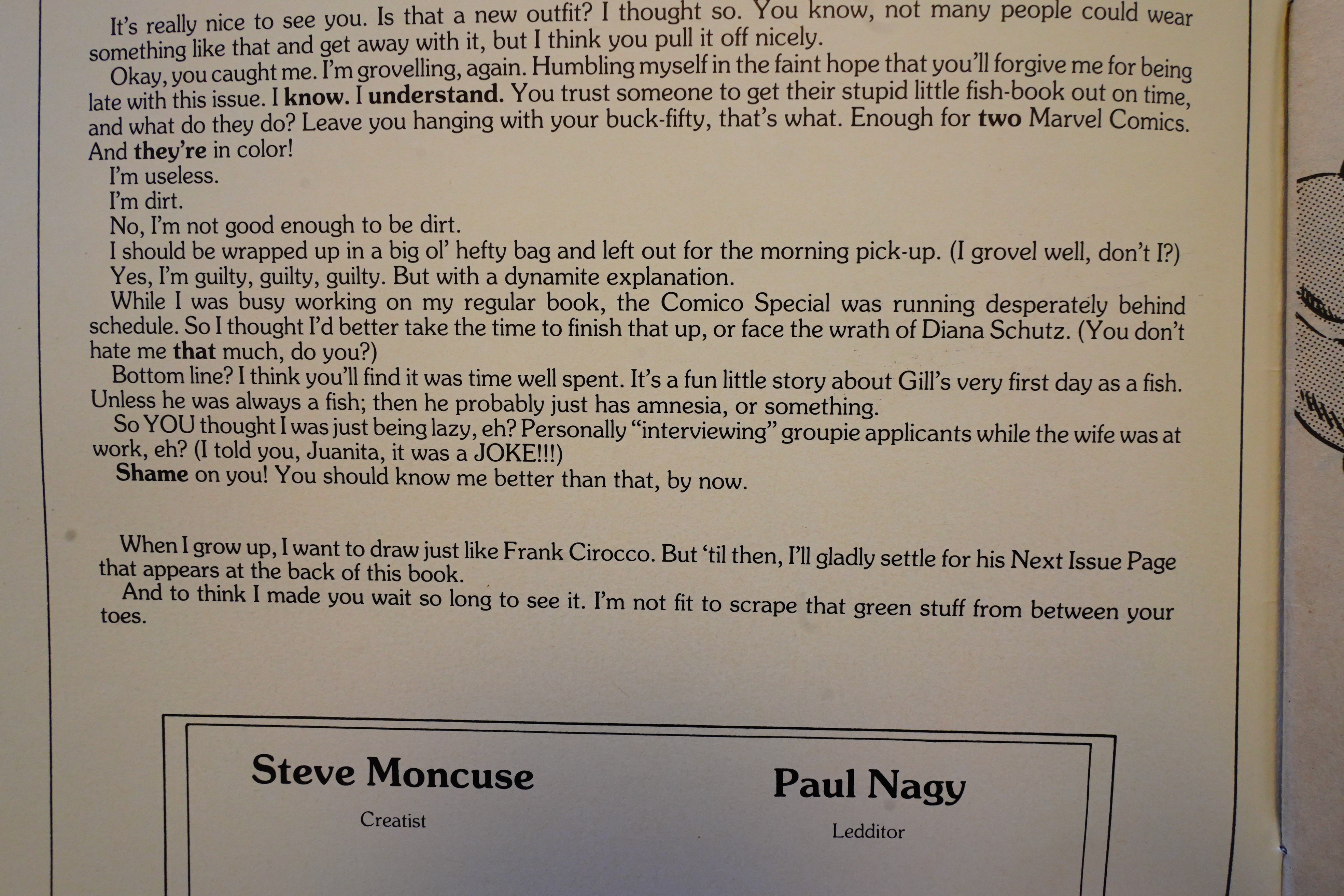
Moncuse describes the colour special — “about Gill’s very first day as a fish. Unless he was always a fish; then he probably just has amnesia, or something”. Which sounds like a joke, but I guess it could mean that Moncuse hadn’t quite decided on what’s up himself, either.
I think… that colour special was the worst introduction possible, at least for me. It emphasised the feeling that there were bits you had missed, and that you weren’t in on the joke.
I think if I’d read the series starting at #1, I would have enjoyed it a lot more — it would have been clearer that Moncuse was writing a long story where things about this world were going to be revealed slowly, and it would have been more of a Cerebus-like reading experience, where all the readers are reading for hints (among the jokes) instead of wondering whether the writer just doesn’t know what he’s doing.
Fish Police wasn’t cancelled at Comico for horrible sales, really, but because Comico were in dire economic straits:
The Comics Journal #128, page #7:
Comico Cancels Half Its Line
Less than three months after announ-
cing a printing and distribution agree-
ment with DC Comics Inc., Comico
The Comic Company has suspended
half of its regular publications. The six-
year-old Pennsylvania-based company
has consistently ranked for the last sev-
eral years among Capital City Distri-
butions’s top five comic book pub-
lishers.
The four titles placed “on hiatus” are
The Fish Police, The Maze Agency,
Trollords, and The Trouble with Girls
– all relatively new releases. While
Comico Publisher Phil LaSorda said
he hopes to reintroduce the titles after
“a minimum of six months,” creators
of the titles have told the Journal they
are actively seeking new publishers.
LaSorda announced the cancella-
tions, effective for books shipping in
July, with a March 1 press release.
“Due to recent market conditions,
Comico has reassessed its projected
monthly schedule,” LaSorda wrote.
“In order to maintain its high stan-
dards, Comico has put the production
of some of its titles on a hiatus for a
minimum of six months. It is our in-
tent to introduce these titles at a time
when more favorable market condi-
tions prevail.’
The move leaves Comico with only
two continuing titles – Grendel and
Elementals – and several limited series,
including the five-part Star
Blazers, the four-part Ribit!, and the
three-part The Amazon (the latter two
end their runs in April and May, re-
spectively). Dave Stevens’ Rocketeer
Adventure Magazine, which ships with
no regularity, remains on Comico’s
schedule.
LaSorda said DC had played no role
in Comico’s decision to cut back.
“DC played no role at all, nor does
this reflect on our agreement with DC,
he told the Journal. “The sales just
weren’t there and we have to follow the
market’s dictates. If titles don’t sell you
have to make changes and that’s what
we’ve done.
“These are our decisions to make,”
LaSorda emphasized; “there was no
input from DC whatsoever.’
Yeah, “market conditions”. Bet it had nothing to do with this:
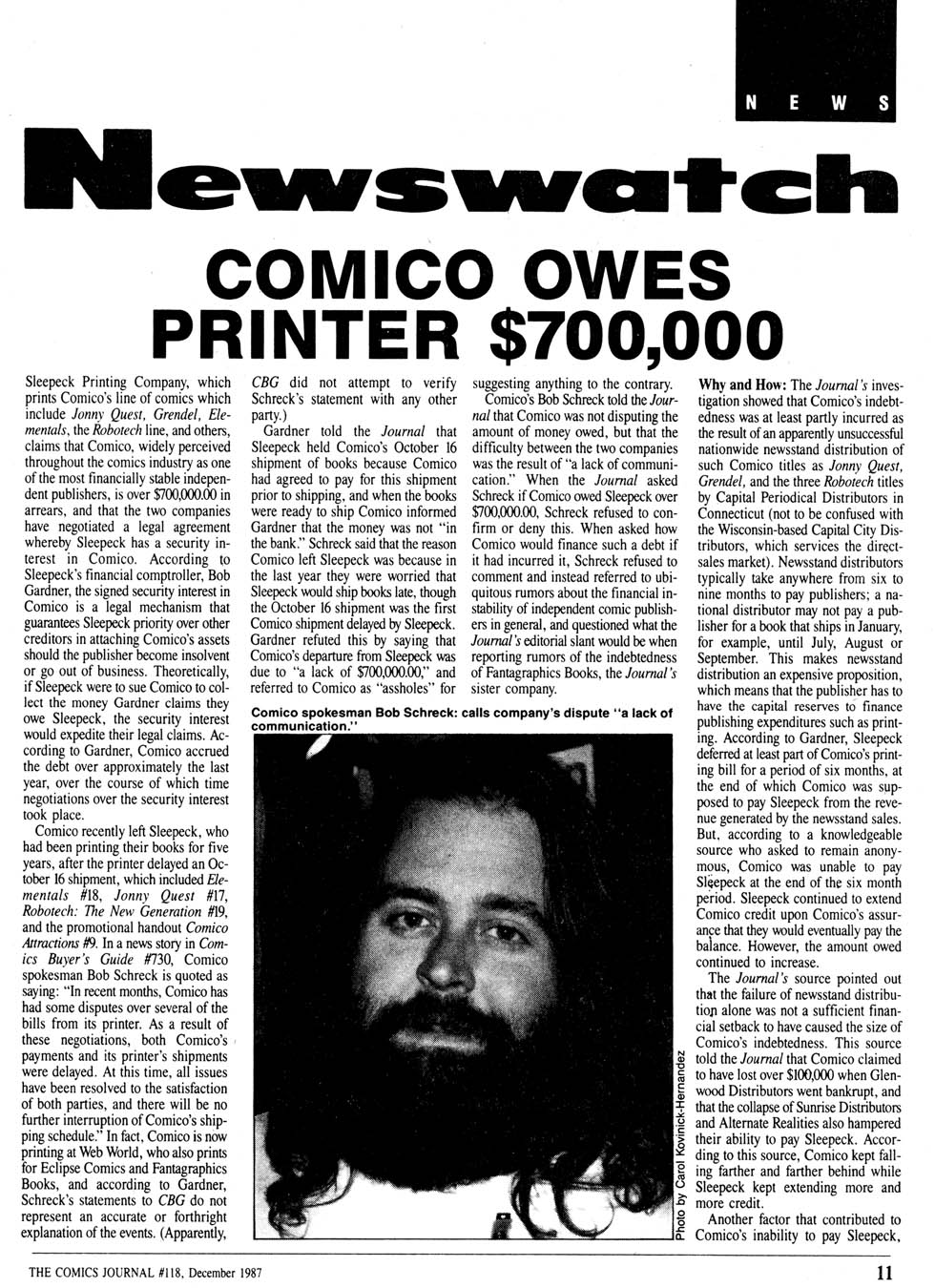
I think it’s time to look at what was going on at Comico at the time, but not in this post — it’s long enough already.
The Comics Journal #129, page #15:
Fish Police moves to Apple Comics.
Fish Police. Steve Moncuse’s Fish
Police will continue its bi-monthly
status with #18, due in August from
Apple Comics. The last Comico issue
– #17 – ships in June.
Four issues of Fish Police were pub-
lished by Fishwrap Productions before
Comico issued a one-shot “special”
and subsequently took on the title with
#5.
Moncuse said Apple approached
him for the title “only about a week
or so after I knew I’d been cancelled,”
and an agreement was reached in ear-
ly April.
Moncuse said that, despite “one or
two other pretty good offers, Apple
seemed to be the most enthusiastic.
They made me feel more wanted than
the other publishers.
“I was ready to quit the series at #20,
just to get it done,” he said, “but Ap-
ple made me feel like I really wanted
to do the book again.”
It continued for nine issues at Apple, and they reprinted #0, too.
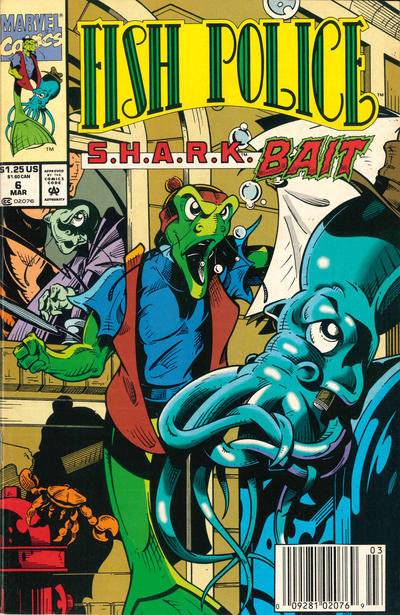
Then it moved to Marvel!? For six issues. Ah… that’s another reprint.
Fish Police has not been reprinted or collected in its entirety. But there was a three episode Hanna-Barbera animated show — it was axed quickly.
Critics’ opinions were mixed to negative. Ken Tucker of Entertainment Weekly gave the show a “C”, saying that the “comics are a lot more varied and better constructed — their plots worked as mysteries, whereas here the stories are just excuses for more fish humor”.
The Comics Buyer’s Guide #894, page #2:
‘Fish Police’ ends 5-year saga in #26
After five years, three publish-
ers, and 26 issues, Steve Mon-
cuse’s Fish Police ends its run
this month.
The last two issues – #25 and
#26, which are being released by
Apple Comics just two weeks
apart — write a finny fini to the
saga of Inspector Gill’s search
for his true identity in a world
that defies common sense.
When placed together, the
covers of the last two issues
combine to create one double-
size scene that symbolically
sums up the changes that Inspec-
tor Gill has gone through. “It’s
quite clever – and an artistic
bonus for those who appreciate
unusual cover designs. Retailers
can show it off to their custom-
ers by displaying both issues
side-by-side on the rack,” said
Apple Comics Publisher
Michael Catron.These two final issues, Catron
said, are the fulfillment of dual
commitments – to the story
and its readers – which Fish
Police creator Steve Moncuse
made long ago. The whole thing,
Moncuse confesses in the final
issue, is autobiographical.
“The Fish Police wasn’t just
my story,” Moncuse tells his
readers in a farewell column, “it
was a story about me – my per-
sonal growth from a shy, slightly
backward boy from Pennsylva-
nia to the more confident and
culturally rounded 33-year-old I
am today.”
On hand to say goodbye in the
final issue is author and critic
Harlan Ellison, who has been a
vocal supporter of the series
since its first issue. In his wistful
and emotional “Outroduction,”
Ellison explains what the series
and its characters meant to him
and compliments Moncuse on
“the satisfactory Ouroboros-like”
plot that [he] must have con-
ceived in totality when he
started, the kicker of which he
kept cleverly concealed for
years, even to detective-story
buffs like me, looking for the
solution.”
Fish Police began in 1985
when Moncuse self-published
the first issue of his sarcastic,
surrealistic comic book under
the Fishwrap Productions
imprint. It depicted a seriously
skewed world in which anthro-
pomorphic fish had difficulties
with stairs, smoked cigars, and
drank wine from goblets.
The offbeat, independent
comic book sold out and was
reprinted. Today, the original
$1.25 comic-book issues are dif-
ficult to find and sell for up to
$25.
Fishwrap published 11 issues;
then Moncuse turned the pub-
lishing over to Comico the
Comic Company. After Comico
published #17, Moncuse moved
the series to Apple Comics.
Apple has published all issues
since, seeing it through to this
month’s double-issue conclu-
sion.
“One of the great things about”
the conclusion is that it’s exactly
that – a conclusion,” said
The people behind
‘Fish Police’
The Telegraph Wire #23, page #26:
THE FISH POLICE
Maybe it’s not kosher for an employee of Comics &
Comix to review another employee’s first attempt at
publishing a comic…but I gotta have SOME fun. Be-
sides, to this date, I still haven’t met Steve Mon-
cuse–he works in our Berkeley store and I’m down
here in Palo Alto.
THE FISH POLICE is the most professional-looking
package I’ve ever seen from a budding professional to
ever hit the stands. The art is clean, bold lines
and Steve Moncuse keeps the story moving with innova-
tive layouts that complement Paul Nagy’s story.
The plot and characters are kind of a combination
of the Fish Mutants meet Hill Street Blues. The main
character, Inspector Gill, is Belker in fish guise
and the plot concerns a bad guy, Hook, who has a drug
and a dream to take over more than one world.
While I understand the need to keep the plot
from being given away in the first issue, I’m more
than a little anxious to find out what all the mystery
is about these fish-people. More than one character
has made allusions to being “only half the man I once
was.” So please, guys, explain that one to me in the
next issue, huh?
While it’s not a slam-bang issue, it has a dis-
tinction all its own and I recommend it for anyone
who enjoys a good story and great art…and the nice
thing is that this comic can only get better!
Unbelievably, Fish Police is worse.
Where Capitol Critters imitates Don
Bluth imitating Disney, Fish Police,
which only remotely resembles the
Steve Moncuse comic, uses some of
the oldest tricks in Hanna-Barbera’s
hat. Just as The Flintstones crossed
The Honeymooners with cavemen to
give the appearance of a fresh idea,
so does Fish Police cross detective
cliches with marine life to make a
“new” concept. But the detective for-
mula is even more tired than the
super-hero formula, and there’s real-
ly nothing inherently funny about fish.
I would have watched the whole first
episode, but I had a movie to go see,
and after I saw the wacky sidekick
who constantly tries out new
disguises, I felt I’d seen enough.
The combination of these two shows
is likely to destroy any chance anima-
tion had of making it on network TV,
and it’s all because Hollywood refuses
to believe that there really is such a
thing as a show that’s too stupid to
succeed.
Amazing Heroes #115, page #75:
MY TEN FAVORITE
COMICS OF 1986
By R.A. Jones10. Fish Police
Serendipity and I met as a result
of Fish Police. It just so happened
that my rave review of the first issue
saw print just about the time the
book really took off in popularity.
Creator Steve Moncuse chooses to
believe there was a direct link be-
tween the two events. Being the
honest and forthright individual that
I am, I have always chosen to let him
cling to this misconception (after all,
I may need a favor some day).
In one sense, I hope I didn’t have
something to do with its success; I
don’t want to bear responsibility for
the buying frenzy which resulted in
the first edition of the book being
so grossly overpriced (I can say that,
because it is a point on which Steve
and I agree).
Still, while Fish Police is not
worth $50, it is worth a place on my
list. 1986 was a good year for the
series, although-like many of the
independents-an erratic release
schedule worked against it.
The year saw the conclusion of the
fishy Inspector Gill’s first adventure,
“Hairballs.” Gill, whose less-than-
stunning intellect, weak will, and
penchant for drink mark him as
being far from the ideal heroic
model, had settled comfortably in-
to life as second-in-command of the
villainous organization known as
S.Q.U.I.D. When the group’s equally
evil leader, Hook, demanded that
Gill execute two female prisoners,
however, Gill discovered that he still
had a few scruples remaining.
Strangely enough, upon discovering
this, Hook set both Gill and the
women free—thus leaving us with
many intriguing questions that will
doubtless only be answered in Mon-
cuse’s sweet time.
Wisely, following this four-part
opening gambit, Moncuse devoted
issue #5 to a story that was more-
or-less complete unto itself: one that
also served the twin purpose of
familiarizing new readers with what
had gone before while setting the
stage for the next storyline.
In the process, he delivered a
clever interlude. Gill’s apartment is
invaded by one of Hook’s massive
soldiers, and Gill tricks the fellow
into a debilitating drinking match.
Issue #6 skillfully launched the
next ongoing tale. With jackhammer
pacing, it (re-)introduces all the
major characters, poses still more
puzzling questions, and leaves you
gasping for more.
If forced to use but a single word
to describe the talents that make
Steve Moncuse’s Fish Police work
so well, that word would be “decep-
tive.” I say that because his work is
so deceptively simple in appearance.
The scripting, the leanness and
sparseness of which make the stories
seem to pass with unnatural quick-
ness, actually functions on many
levels. To be sure, there are chuckles
a’plenty to be found in it, but one
also finds pathos, drama and sensi-
tivity to varying degrees.
Similarly, Moncuse makes such
efficient and effective use of line and
shading in his artwork that a cursory
perusal might lead to the erroneous
assumption that it is sparse—when
in truth it is rich with details.
Moncuse also does an excellent
job of tantalizing the reader, just shy
of the point of frustration. He piques
your curiosity with hints that Gill
may have at one time been human,
and defies you to place this bizarre
underwater world in which charac-
ters not only smoke but drink. As
much as anything else, it is the mad-
dening desire for answers that brings.
the reader back issue after issue.
The craft evident in this series has
consistently brought me back for
each issue—and helped make it one
of my favorites.
R. A Jones in Amazing Heroes #81, page #69:
THE FISH POLICE #1
Somewhere, there exists a world that
is not too terribly different from our-
own. People work and play. They
love and hate, dream and despair.
They live and die. There is one slight
difference: These people are all fish.
The hero of this tale is a gentlefish
named Inspector Gill, a police detec-
tive who is slightly inept, slightly
gullible, and slightly corrupt-but no
less loveable for it. The intrigue
begins when he enters his apartment
only to be confronted by a gun-
wielding femme fatale named Angel-
fish.[…]
Characterization is one of the keys
to the story’s success. On the surface,
it may seem that Inspector Gill exhi-
bits some of the same faults that
made me antipathetic toward Booster
Gold. But Gill seems to be trying his
best, and at his core seems to recog-
nize his weaknesses for what they
are, whereas Booster Gold seems
oblivious to anything but himself. In
other words, even thought Inspector
Gill is a fish, he displays a great deal
more humanity. His defects are much
like our own, and like us he is try-
ing to compensate for them as best
he can. You can empathize with the
guy, and therefore you care what
happens to him. The other characters
presented here also show promise,
expecially the exotic Angelfish and
her sister Goldie.
This issue actually delivers a
double-barrelled pleasant surprise.
Many, indeed most, self-published
comic books suffer from both story
and art that are sub-par, often to the
point of rank amateurism. As you
have seen, I found the scripting on
Fish Police to be on a level that
exceeds many of the more “main-
stream” comics.
Creator Steve Moncuse goes
beyond that by also delivering an art
job that would compare favorably to
that of established big name pencil-
lers. His style is clean and sharp,
attractive to the eye while observing
all the mechanics required in good
storytelling.
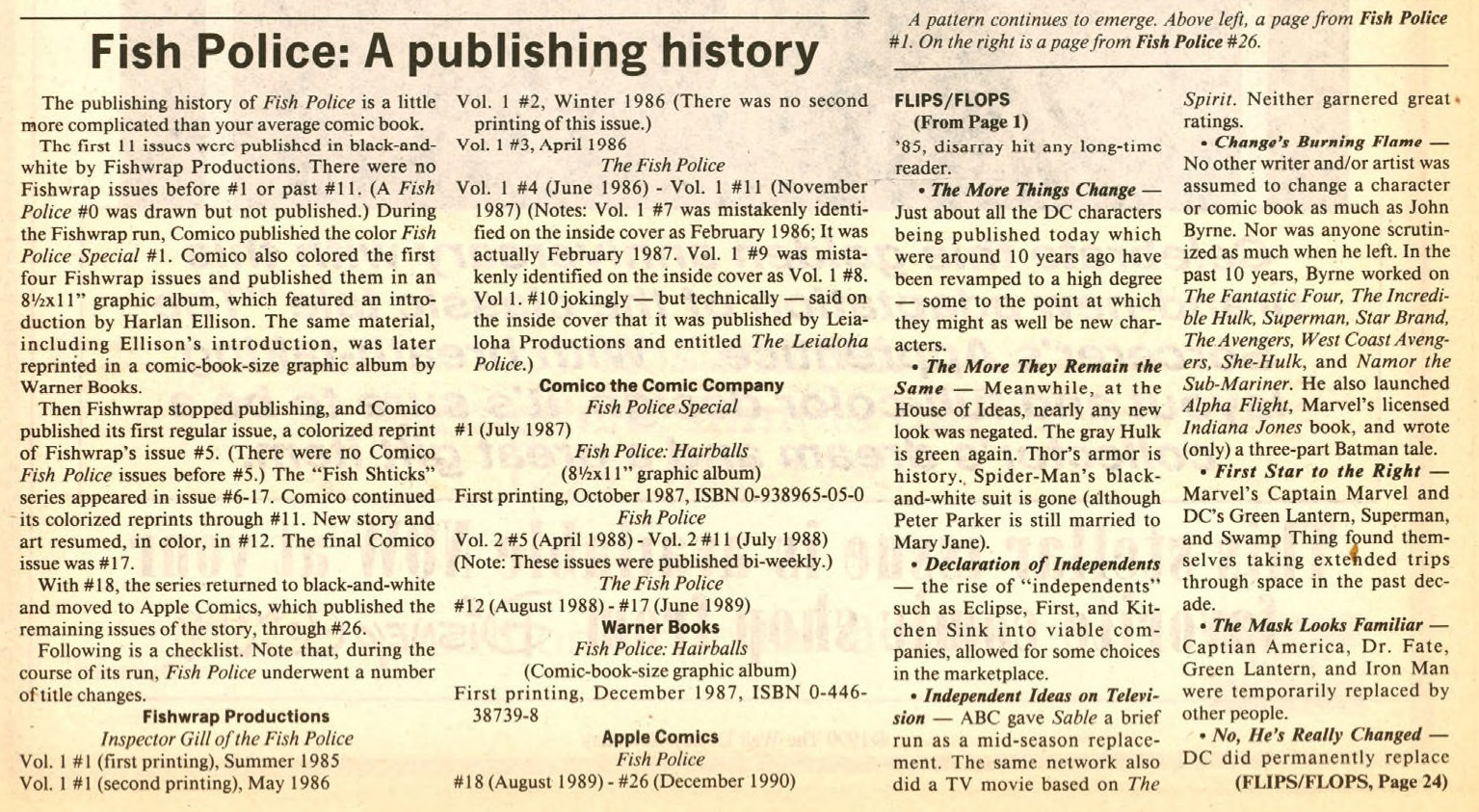
THIS was an ambitious project that
1980s. When Fish Police started in
December 1985, I don’t think Steve
Moncuse had a Babylon 5-type five-
year plan for it. He might have had
an inkling that he was onto
something special very early on but I
can’t be sure; unless I track
Moncuse down (which I might
try) there’s no real way of knowing.
I first discovered Inspector Gill,
Doctor Calamari, Angelfish, Oscar,
Braque, Goldie, Hook, Line and
Sinker back in 1988, quite ignorant
of the burgeoning alternative scene
after having been out of comics for 8
years. By the time I found the
Comico colour reprints (#s 5-11), the
Fish Police was two years old and
had built up a dedicated following.
The owner of my local comic shop
made a healthy profit from me
buying up his back stock of
Fishwrap black and white originals
and the repackaged graphic novel;
he probably wished the franchise
was as big as the X-Men because at
the time my appetite for Fish was
shark-like!
It’s difficult to explain this series
without giving away the story. Not
counting #0, which doesn’t really sit
in the scheme of things – it was a
26-part maxi-series. If Moncuse
hadn’t originally planned this to be a
finite series (and I don’t think he did),
he adapted well under the pressures
of dwindling sales and having to
constantly move publishers.
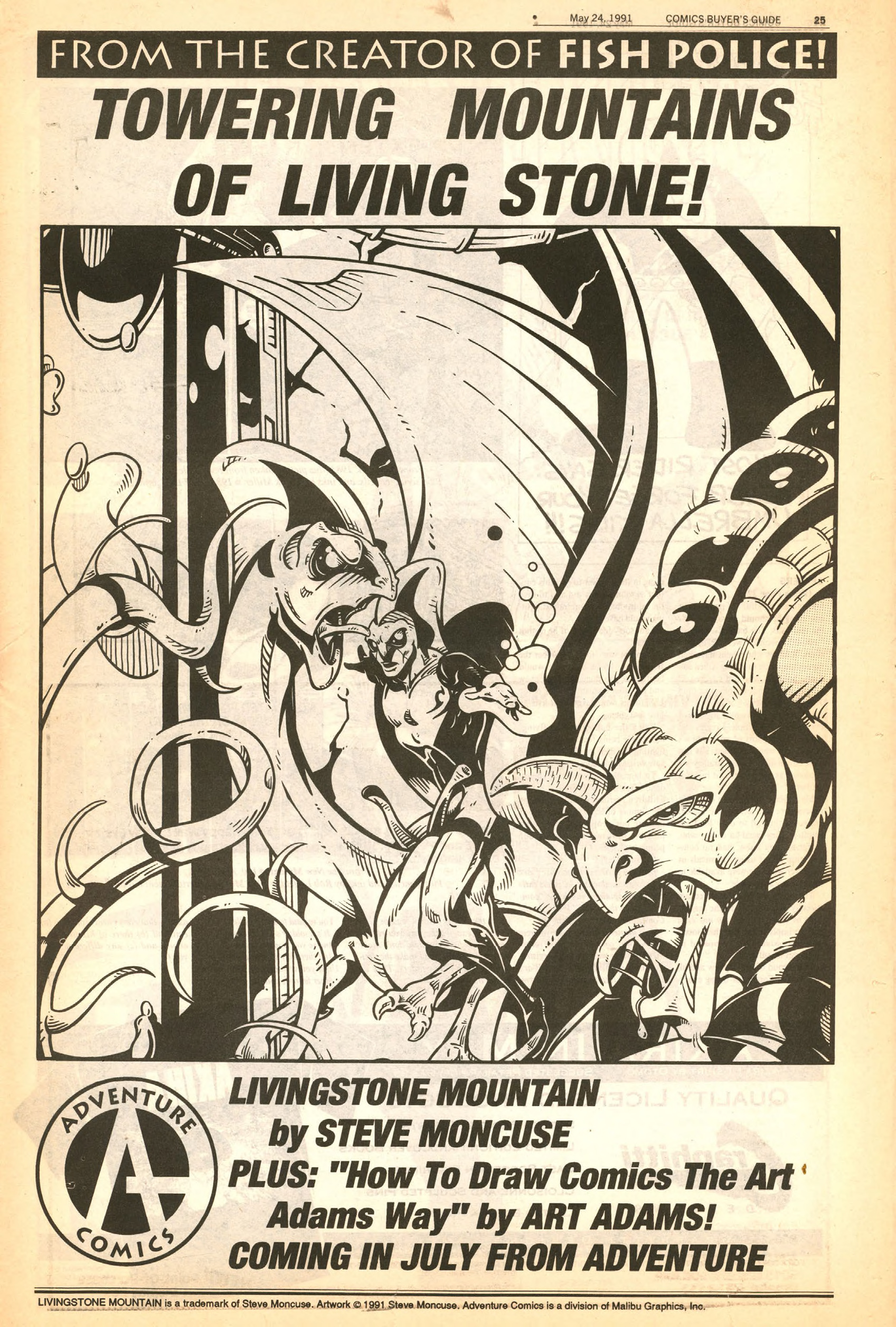
Moncuse’s next project, Livingstone Mountain only lasted four issues.
Comics Scene Volume 2 #28, page #6:
… About eight years ago, I cre-
ated a small, self-published
comic book called Fish Police.
This past February, CBS pre-
miered a prime time animated
show based on my book, cre-
ated by Hanna-Barbera. The ul-
timate success story, right?
Hardly.
I’m sure that hundreds, per-
haps thousands, of writers
have had their work changed.
heavily revised, or just plain
demolished for television or
the movies. But I’m willing to
bet those writers have at least
had the satisfaction of knowing
their material was actually
read before the studios made
their changes. I, however, can
make no such claim.
My relationship with
Hanna-Barbera was odd from
the beginning. In fact, there
was no relationship. David
Kirschner, the studio president,
told a reporter from my area
that there wasn’t one single el-
ement in my book that he
could use in his show, and
therefore found it unnecessary
to have anyone from the com-
pany consult with me or to
even say hello. And they never
did. I was not even mentioned
by name in the press kit. My
book was simply described as
“the British comic book.” I am
not British.
Here’s a review from the internet:
Fish Police has a certain charm, but the first issue doesn’t bowl me over. There’s a potentially interesting mystery setting itself up, but I didn’t really connect with it here. Or with any of the players, who’re just stock characters from every detective show you’ve ever watched.
Oh, IDW reprinted the first four issues:
The biggest problem with this book is that I have no idea why it exists in the form it does. There is no introduction explaining the history of Fish Police to the curious, nor the story of how IDW came to be reprinting it now (the closest information to be found is what’s printed on the back cover).
Very odd — it really makes no sense to read those four issues on their own.
Get ready to have your minds blown… US publisher IT’S ALIVE! has just beyond thrilled to announced the return of the the brilliant independent comic, Fish Police, created by Steve Moncuse.
This was a bizarre black and white comic that came out in the 80’s. The art is pretty good. The storytelling is very simple, with a crime noir feel. The author made a lot of fish jokes – Gill is after Dr. Calamari in the first episode.
Well, that’s it. I would rather like to know how it all ends up — is my guess about the holy book the squid finds being the Fish Police comics themselves correct? But not enough to chase down those Apple Comics issues.
Thank you for this and the other overviews you’ve posted.
Fish Police was one of the many tempting books I never tried when I was a kid, and now as an old fart have finally found the time and resources.
Not only does the IDW reprint provide little context, they used glossy paper. I sprung for the elderly Fishwrap floppies. On newsprint, Moncuse’s black and white art looks great. Transported onto 21rst century paper, it just doesn’t sing.
I wanted so bad to buy an issue of Fish Police as a kid (I don’t remember which) and was so pissed off when the guy at the bookstore wouldn’t let me. I spent the next 30 some-odd years dreaming about it. I did pick up an issue of the Fish Shticks spin-off somewhere along the line, and quite enjoyed it. But then I finally got around to buying the first five issues, along with #0, and…you know, you should never fulfill those old childhood dreams you have. I can’t tell you how disappointed I was by just how bad I thought they were. You were far too kind in your review, though I guess maybe you didn’t have decades of expectation mixed with resentment going in…
Issue #0 is just an early prototype version of the first five issues. Yes, it’s regular length. Most of the pages are re-drawn in the main series, so they look a little better but are essentially the same.
I don’t know much about Moncuse as a person but he is some sort of Christian, so the whole messianic thing turned me off. I think he’s like a more amiable Doug TenNaple.