1985: Next Man

Next Man (1985) #1-5 by Roger McKenzie, Vince Argondezzi et al

Hm… Roger McKenzie… Oh, he wrote Sun Runners, which wasn’t very good. And it was creepy. But he’s mostly known for his work at Marvel in the early 80s, I think. Yup. And he left comics a couple years after this series.

And when I saw “Next Man”, I thought of John Byrne’s Next Men, but that was apparently done after this series?

Oh, there’s apparently some story to be told of how he was booted from Marvel? I mean left.

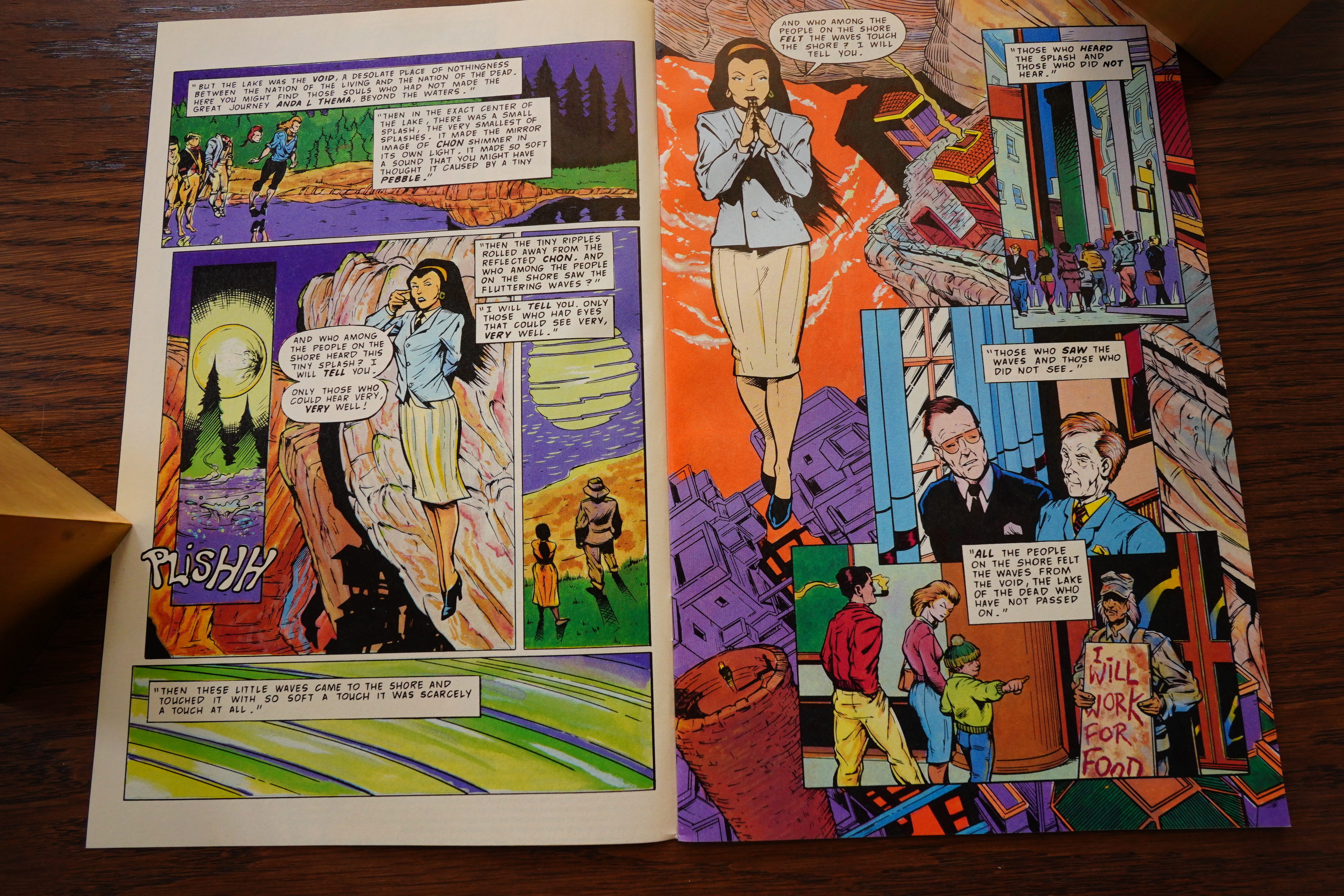
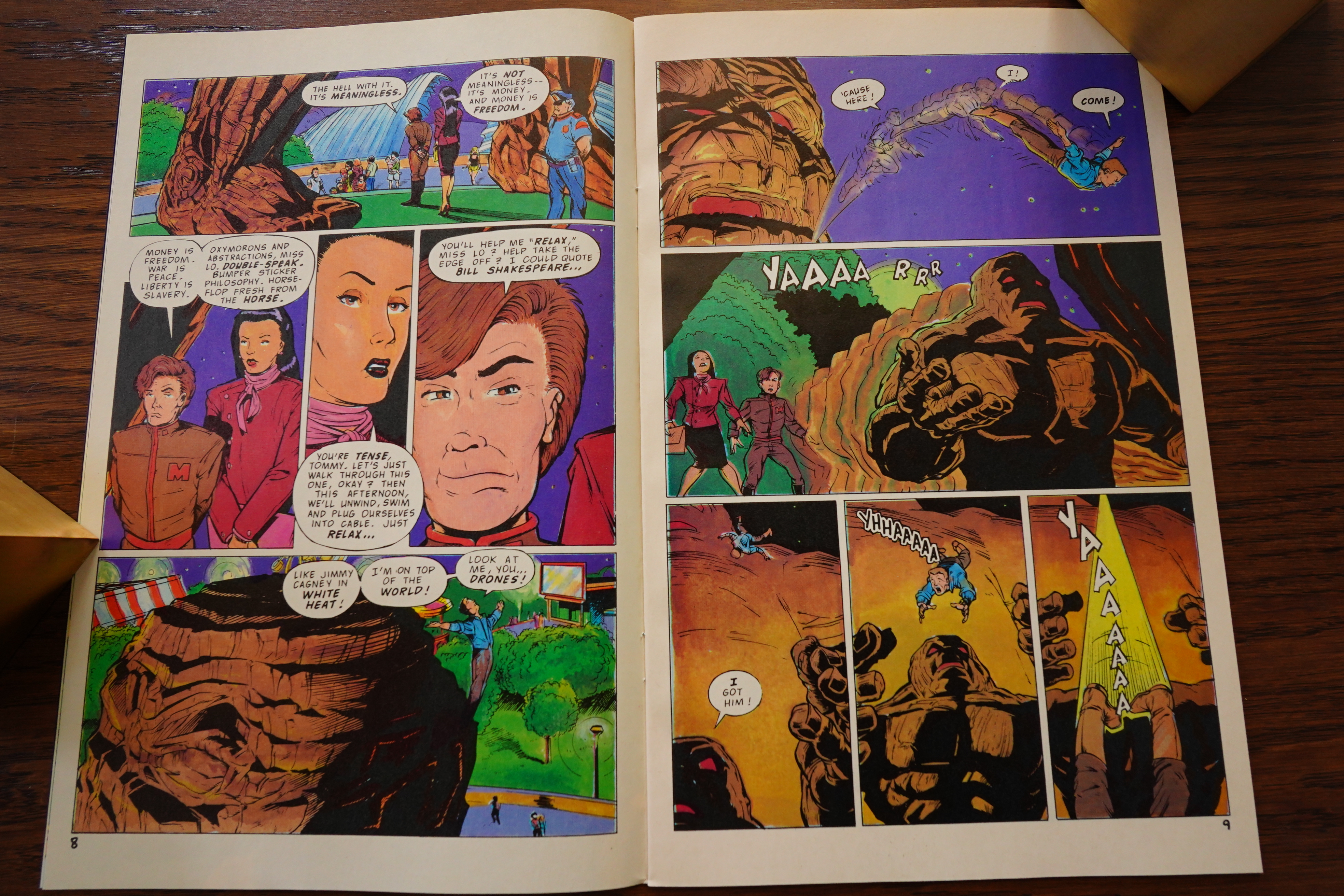
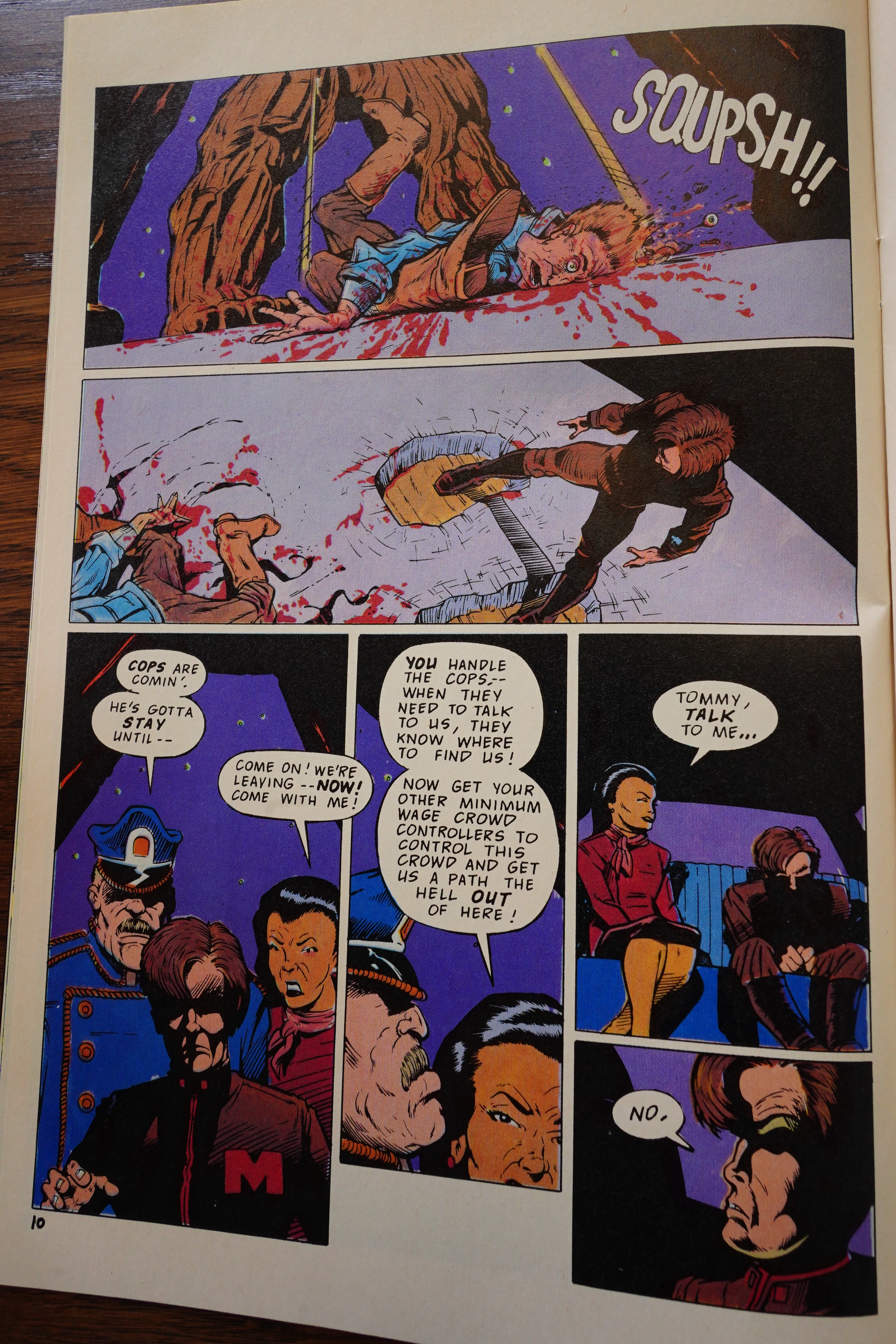
Well, OK, this seems extremely standard — some dastardly military organisation took a soldier semi-killed in Vietnam and made him into a super soldier. And Argondezzi seems like he’s a mega Kirby fan — I mean, at least as far as inking male faces go. It looks like he’s concentrated on copying that, and then just ignored things like “learn how to draw”.

Well, OK, that’s original — there’s an… er… alien running the agency?

Oops! The dastardly organisation shouldn’t have used a camera that goes WHRRR whenever soldier/super guy is going SCHWING, I guess. I mean, is getting into a romantic mood! Live and learn! Use WHRRR-less cameras, dudes!

OK, they’re sending him to space? Makes sense.

But the dastardly organisation is going to destroy the Earth first?! Because of reasons. And the science woman/love interest gets up in her feelings when confronted. Next Man is rude. No consideration.

Fortunately there’s a comedy sidekick — a green floating computer cube.

These issues are quick reads — I guess these days we’d call it “decompressed storytelling”, so McKenzie was ahead of the curve on that point. It’s just that these scenes lean so heavily on familiar scenes from movies that they read like if they’re parodies, really. A scene like this, where you take a beat for the hard-as-nails general to give a callous order, works in movies because you can enjoy the actor playing the general chewing up the scenery while lighting that cigar, but the artwork here is so basic that there’s basically nothing for the reader here to do but go “oh, I recognise the scene they’re trying to do; OK”.

There’s page after page of… “thrilling action”… but the storytelling is inept, and the artwork takes some scrutiny to try to find out what’s supposed to be going on.

And, as with Sun Runners, it’s pretty creepy to boot.

Hey, that’s a good Kirby pose. I assume that it’s been copied directly from some New Gods splash page?

Scenes like this feel like they should work, but instead it reads like an oddly humour-less parody.

T. M. Maple writes in to note that the setup seems really familiar.

Beat beat beat.

Well, OK — this page works, I think?

Hey! I’m not the only one that felt like the book seemed really off. “If the idea isn’t new, then the execution should be. Is Next Man a Kirby parody? Where’s the humour?”

McKenzie says that the vignette feeling is intentional.

Next Man is apparently dead, so his friends take the change to get romantic.

And then the series ends in the traditional way for indie comics: A panel saying “Next”. Man.

So… I’m not surprised that this book was cancelled, because it’s really bad, man. The artwork was getting better over the course of the run, but I see that Argondezzi left comics a few years later. I appreciate what they were trying to do, storytelling wise, but it just didn’t work: The decompressed style, along with material that was so familiar that it felt like a parody, made it hard to pay attention while reading these books. I’m surprised it lasted for five issues.

The Comics Journal #103, page #12:

The Next Man, one
of Comico’s newer books, will go
homeless with the publication of
the fifth issue. According to
Giovinco, the reason was poor
sales. “It was selling lower than
our other books, and it was
losing money,” he said. “If it had
been breaking even, we would
have stayed behind it.”
According to writer Roger
McKenzie, The Next Man did
have an erratic sales history. He
cited his royalty statement from
Comico, which said the first issue
sold 43,375, the second issue sold
18,480, the third issue sold 21,050,
and the fourth issue sold 20,860.
While McKenzie didn’t deny that
sales were low, he said he was
surprised at Comico’s decision,
because it came out of the blue.
We seemed to be going along
quite well,” he said. “They had
just commissioned Vince (Argon-
dezzi, the book’s artist) to do a
poster, and we never heard that
they were even thinking about
cancelling it.”
Both Argondezzi and McKenzie
were dissatisfied with the
promotion and publicity that the
book received. “They really
didn’t care about the book,
McKenzie said. He said that
Comico sent him and Argondezzi
to the 1985 Dallas Fantasy Fair,
but armed them with posters and
other promotional material for all
the books in Comico’s line except
for The Next Man. “They
shouldn’t have signed us if they
weren’t going to get behind us,
Argondezzi said. “If they had
told us the book was in danger of
cancellation, we could have tried
something to save it-but they
didn’t say anything to us until
they had made up their minds to
cancel it.” Giovinco disputed this,
though, saying that he had talked
with the creators about various
ways of pumping up sales, such
as changing the book’s frequency
from bi-monthly to monthly.
‘When we got the final cost-
analysis in for the book, though,
we decided it wasn’t worth it to
try to save the book,” he said. “It
was losing too much money for
us.” Giovinco declined to divulge
the amount Comico was losing on
the book
Both McKenzie and Argon-
dezzi, as well as Giovinco, said
that the creators wre originally
signed up to do 18 issues of The
Next Man. However, the creators
said they wouldn’t try to hold
Comico to the contract and the
remaining 13 issues. Even if they
did try to hold Comico to the
contract, Giovinco said it would
be futile. “Any publisher is smart
enough to leave himself an
“escape valve” if he gets stuck
with a complete dog,” he said.
However, Giovinco refused to
discuss the actual “escape valve’
he said the contract contained.
Argondezzi said that while he
wasn’t aware of a loophole
Comico could slip through, he
said it didn’t matter if there is
one. “We’re not going to try to
stay at Comico, that’s for sure,”
he said.
Although the final issue of The
Next Man will be issue #5, the
plotlines won’t be tied together
until the sixth issue. McKenzie
and Argondezzi are talking with
new publishers, but neither would
discuss possible new homes for
the book.

This didn’t happen, I think? But a weirder thing happened:

In 1993, Comic Company A released a special that reprinted issue #5! And then added some illustrations and an interview. Very odd.

The series has never been reprinted.

The Telegraph Wire #20, page #13:

On the other hand, NEXT MAN marks Vince
Argondezzi’s first regular comics series, but
the young artist has already begun to display
the kind of professionalism required by the
field. Heavily influenced by the “King of
Comics, ” Argondezzi brings a definite Kirby-
esque flair to the adventures of the Next Man.
This interview took place in December ’84
at the Comico offices in Norristown, Pennsyl-
vania. It was transcribed by Eric Yarber,
copy-edited by Roger McKenzie and Vince
Argondezzi, with final edits by yours truly.
Special thanks are due to Vince and to
Gerry Giovinco and Phil Lasorda of Comico
for all their help in coordinating the Next
Man cover for this issue of THE TELEGRAPH
WIRE.

DIANA SCHUTZ: The first thing I’m interested in is
why you chose to bring NEXT MAN to Comico.
ROGER McKENZIE: Easy. Because nobody else would give
us the time of day. No, not really. I had originally
approached Pacific with this idea and they said, “Fine,
we like it, let’s do it.” A year and a half went by,
and we never did it.
VINCE ARGONDEZZI: At the time, I was just starting
to get a little foot into Pacific by doing two or
three VANGUARD stories for Dave Scroggy and I sent
Roger a sample page for NEXT MAN and he said, “Let’s
get together and do it.”
DIANA: When Pacific suspended operations, why did you
move specifically to Comico?
VINCE: We’d talked to other companies, but they were
dragging their feet. Comico was there and they really
wanted it.
ROGER: And I was ready to go with it, having waited
a year and a half already and having had this idea
originally back in high school–and we won’t even go
into how long that’s been!
VINCE: I think Comico has the best attitude. They
have the smarts to let the creators do what the crea-
tors want to do. What seems to be wrong with comics,
at least in the mainstream, is that the mainstream
companies keep the same feel to all their products.
And some of the other alternate publishers are good,
but they don’t have enough commercial sense. So, on
the one hand you’ve got really crass commercial stuff,
and on the other hand you’ve got nice material with
the alternatives, but it’s so far out that the com-
panies can’t survive because they’re too creative.
Comico’s right in the middle. They’ve got beautiful
commercial stuff like ELEMENTALS, they’ve got really
sharp creative stuff like MAGE, and they’ve got work
like NEXT MAN that’s kind of in the middle. Plus
they’re branching out into stuff like MACROSS and all.

[…]

DIANA: So, what makes NEXT MAN different from all
the other superhero books that are already out on
the market?
ROGER: I think what makes it different is the way
we’re treating the concepts. We haven’t yet said,
“Here’s a superhero.” We haven’t yet said, “Here’s
a big bad villain who’s out to beat up the superhero
for no reason in the world.”
VINCE: That comes in issue #3! [Laughter]
ROGER: Yeah!
VINCE: The good thing about NEXT MAN is there’s so
much potential in the character. Basically you have
a guy who does not fit in. He has no real identity.
His father’s dead. He’s alienated.
ROGER: But he’s got so much going on that he won’t
realize it for several issues, although 1980s cul-
ture shock will start hitting him soon. But he has
found out more or less what’s going on, and he says,
“No way will I help you destroy the world.” As a
matter of fact, he destroys his creators at the end
of the first issue, or so he thinks.

[…]

DIANA: What about the fact that there are words in
comic books, and fewer and fewer people are reading
at all these days?
ROGER: What I’ve tended to do to solve that situation
is not to write any words at all.

Diana Schutz did the interview here (for The Telegraph Wire), but she’d go on to work for Comico a couple months later, which is kinda interesting.

Amazing Heroes #73, page #55:

This newest title from Comico
(“the Comic Company”) has a lot
of rough edges…but I think it
shows a lot of potential as well.
One of the best things it has going
for is its scripter, Roger McKenzie.
McKenzie did an excellent job on
Daredevil several years ago, and
his Sunrunners is an enjoyable
book (whenever it appears).
He seems to have come up with
a fairly solid formula here, a com-
bination of science fiction and
super-hero fantasy. There are
weaknesses in this first issue, at
least partly due to the unavoidable
restrictions of an origin story. We
aren’t shown much of David
Boyd’s personality-the inner man.
This is ony a minor complaint, as
this will no doubt be fully explored
as the series progresses. The Next
Man should prove to be a strong
character, and in Dr. Cross he has a
worthy arch-rival comething every
hero needs.
1 think most of the gripes that this
first issue will elicit will focus on
the art, and not without some justi-
fication. One can point to ex-
amples of stiff figures, fuzzy im-
ages, simplistic layouts. But I’m not
going to give it a blanket condem-
nation.
Many will probably dismiss the
artwork as nothing more than a bad
imitation of Jack Kirby. Experience
has taught me to be cautious of
this; after all, such outstanding art-
ists as Barry Windsor-Smith and Jim
Steranko started out doing bad
Kirby. Also, I have an advantage
over some of you in that I have had
the chance to see more of Vince
Argondezzi’s pencils 4they are real-
ly quite good, and show every sign
of improving.
I think part of the problem here
has to do with the inking. That’s not
a rap against Bill Anderson; he’s a
good inker. It’s just that his style
doesn’t seem to be completely
compatible with that of Argondez-
zi. Thus, I don’t think the art seen
here is representational of what we
can expect from Vince. Future
issues should show a major up-
swing.
Comico itself has taken large
strides in improving its product.
While I personally don’t have
much interest in their upcoming
robot series, their other titles seem
to be growing stronger every issue.
If they can only solve the problem
facing every alternative publish-
er-that of getting their books out
on time every issue-Comico
could well join First and Eclipse in
the forefront of “downstream”
comics (no derogation in that
term-just coined to differentiate
them from the so-called “main-
stream” comics).
Next Man #1 shows enough
potential that I certainly intend to
give it a few issues to prove itself.
loin me.
– R. A. Jones

The Comics Journal #105, page #26:

The newest advertising campaign
by Lodestone Publishing has
raised the ire of three creators, all
of whom deny they are working
for Lodestone, despite the claims
of the ad, published in the
Comics Buyer’s Guide.
Co-owned: The ad claimed that
The Next Man, recently cancelled
by Comico, is surfacing at Lode-
stone. However, The Next Man is
copyrighted by both Roger
McKenzie and Vince Argondezzi,
respectively the writer and artist,
while the ad said the property
was copyrighted only by
McKenzie. Further, the text in the
ad said, “… we will boggle your
mind with the name of our super-
star artist who will be handling
the series with Roger.’
McKenzie said that while he
did discuss taking The Next Man
to Lodestone, one reason he
didn’t do it is Lodestone
Publisher Dave Singer’s resistance
to Agondezzi being the book’s
artist. “Way before Comico ever
saw the product, I showed it to
Dave, and he liked it very much,”
McKenzie said. “But Dave was
considering a new artist, and
that’s one of the problems I
had with him.” Eventually, though,
the legal problems that Singer
encountered with his T.H.U.N.-
D.E.R. Agents book at Deluxe
Comics (Lodestone’s sister
company) caused McKenzie and
Argondezzi to look for another
home for The Next Man.

The Encyclopedia of Superheroes, page #242:

Alter Ego: David Boyd.
First Appearance: 1985, The Next Man #1, Comico.
Occupation: None.
Costume: Purple bodysuit; silver helmet, gloves,
boots, trunks, bands on his wrist, legs, neck, and
shoulder.
Tools and Weapons: The Next Man’s belt is equipped
with a hose known as PAL (Pulse Activated
Laser), which is fired by mental commands; he is
frequently advised by a talking green cube known
as Cubit, a vastly superior computer.
Biography: Serving as a medic in Vietnam, Lt. Boyd
is caught in an explosion in the village of Lon
Pen. Airlifted to a hospital in Saigon, Boyd is near
death. Instead of putting him on life-support sys-
tems, the doctors ship the 25-year-old to Wash-
ington, where his is cryogenically frozen. Then,
in 1984, after being transferred to a facility in
California, he becomes a part of Project Stepping
Stone. Placed in a “heated silicon gene pool” and
subjected to “helix sculpting,” he is genetically
rebuilt and given super strength and reflexes.
Becoming a superhero, he turns on his creators
who, he learns, had planned to take over the world.
Quote: “You’re a madman, Cross. But the madness
ends here and now.”
Comment: This uninspired character is another of
the rebuilt-human school of superheroes pi-
oneered by Captain America.

Miaow!

Ah, so McKenzie had planned on bringing Next Man back in THUNDARR A.G.E.N.T.S., but I don’t think that happened…

The Slings and Arrows Comic Guide #2, page #470:

NEXT MAN
Comico: 4 issues 1985
Comic Company A: 1 issue 1993
A Vietnam soldier preserved after a near-fatal explosion is
revived twenty years later, having been genetically altered.
Minimalist plotting and artwork. The Comic Company A
issue was to have been Comico’s fifth issue.~FP

Some confusion here…

There’s little written about Next Man on the intertubes. Here’s something:

Next Man was not a “hit” for Comico but it was still a good book. Though the art was a bit raw it had a very Jack Kirby feel to it, which I would have liked to seen grow with the series.

They published an ebook version of… the fifth issue:

Comic Company A was the only successful publishing and media house to survive from Comico to be carried officially by the worlds major comics distributors, with sellouts like the Next Man Collectors Edition series, and well as the studio’s award winning work in the realm of Health Care and Commercial art…making these new first steps now in to the environment of online media is fitting, and the first volly in what will be a wholesale emphasis for development towards the future of this now reinvigorated medium.

The nowadays commonplace subjects like Euthinasia, and the aftermath of the Vietnam war were not talked about too much in the mid eighties in comics.

Er, OK.

You can pick up copies of the book at cover price still.

1984: Robotech: The Macross Saga

Macross (1984) #1,
Robotech: The Macross Saga (1985) #2-36 by Jack Herman, Mike Leeke and Chris Kalnick, plus Too Many People To List

I was curious to read this series (well, the three Robotech series — I guess I’ll do one post per series) because I have dim but pretty positive memories of watching random episodes of this on TV way back then. If I understand correctly, they edited together three different animated series into one, and then that was shown as “Robotech”? Since Comico is publishing three series, I’m guessing this means that they’ve gone back to the original Japanese series division?

I guess we’ll find out.

The edits probably didn’t make the series less mysterious, but since I saw only, like, every third episode, my impression of the plot was very, er, impressionistic. The only think I can say with certainty is that one third of the dialogue was “Rick! Minmei! Rick! Minmei!”

At least that’s what I remember.

OK, now I can start reading Robotech: The Macross Saga.

The first issue is called just “Macross” — I guess the Robotech thing hadn’t been established yet? Yup:

At the same time, Harmony Gold licensed the Macross TV series for direct-to-video distribution in 1984, but their merchandising plans were compromised by Revell’s prior distribution of the Macross kits. In the end, both parties signed a co-licensing agreement and the Robotech name was adopted for the TV syndication of Macross combined with Super Dimension Cavalry Southern Cross (1984) and Genesis Climber MOSPEADA (1983).

One slightly confusing thing about that editorial is that it’s framed as a coup for Comico — but at this point, no major US companies had done adaptations of Japanese animated series yet, had they? So you wouldn’t think there would be much of a bidding war… On the other hand, Comico had a tradition of going rather hyperbolic in their editorials.

Well, that looks pretty good?

Hm… well, this looks very labour intensive. But the publisher explains:

Our vision was to produce the pages using images taken from the actual video. When this proved to be an impossible option we decided that we would create the pages using a technique similar to that of genuine animation cels.

Yeah, that’s labour intensive.

Unfortunately, the artwork is kinda wonky:

Carl Macek’s wife Svea Stauch provided the pencils. Phil LaSorda and I inked all of the main characters which included all of the aircraft, spaceships and robots. The inks were done on a separate overlay that was later lettered then photographed as a positive transparency.

I’m no expert in Japanese animation — or animation at all, really. I mean, I watched all the standards, but I’ve seen few of the TV series. And there’s (presumably) a billion sites out there devoted to Robotech analysis, so you should go read those instead if you want insightful analysis, but what struck me back when I watched this (and again now) is how fun the setup here is.

The captain has a Russian name, and everybody in his command structure are women. And while Japanese cartoons and comics have a tendency to draw presumably-Japanese characters as European (like we see with that long-haired female officer), the Black one sure isn’t. So it’s got a very international cast, and with a somewhat unusual gender division. Except that all the jet pilots are (of course) men.

But perhaps this was a standard setup at the time? I know naaathing.

Some of the artwork’s pretty good (like the guy in the foreground there), but it doesn’t really look much like Japanese animation, does it? And the people in the background there… eep.

It does have a certain charm — it just looks so odd! I like it.

I’ve read many a comics adaptation, and a major problem (especially in later years) is that they seem to be published more as souvenirs than actual comic books. That is, they illustrate a few of the major scenes that somebody who’s seen the original movie would want to see again, and then just basically don’t tell the rest: They’re meant for people who’ve already seen the original movie/tv series/whatever.

But this is pretty readable — I’m amazed at how much I recognise from watching those episodes in the 90s, and I think there’d be no problem following the plot even if you’ve never heard of this thing before.

Wow, $40 for a VHS (or Beta) tape? That’s outrageous.

With the second issue, the series is renamed to Robotech: The Macross Saga, and there’s also an announcement of two companion series (which will cover the other two series that were spliced together with Macross for the US TV market). And each series will be released on a 90 day schedule, meaning fans would get a new book every two weeks.

Seems like a pretty good plan to me.

But the way they created the first issue was obviously untenable, so they move to normal flat colours in the second issue.

And the artwork gets a bit more Japanese-looking.

Heh. Important information indeed.

And there were also ads for the Comico comics shown on TV?

Heh. Classic.

Oh, the plot — an alien ship (called SDF-1) has crashed on Earth, and other aliens wants it back. Lots of shooting ensues.

Many American cartoons around this time started off as toys, and the cartoons were there mainly to sell the toys. I don’t think that was the case with Macross? But there were lots of toys, anyway.

I think each of the four first issues have different art teams. With a 90 day production schedule, you’d think they’d be able to keep people aboard, but I guess it might take some time to shake things out. They had to scramble to find art teams for three series at once…

Yes… 10K people sound more important…?

This art team does better, but it’s still not quite on model…

Ah, yes, I remember this bit. Oh Rick! Oh Minmei!

This team overshoots completely and lands somewhere in Margaret Keane land.

But it wildly inconsistent.

There’s been so many TV series where we’ve been told that things are building up to something more — that there’s indeed a well-developed world we’re in, and that we’re slowly learning about. And then it turns out that the showrunners had absolutely no idea, and were just making things up episode by episode. “They have a plan” my ass.

With Robotech, I don’t actually remember whether things eventually made sense, but we get a constant drip of these rather incomprehensible nudges — the aliens (who call Earthlings for “Micronesians” I mean “Micronians”) apparently have a lot of stuff going on beyond waging space war… But is it going to pay off, or is this more of that “They have a plan” stuff? We’ll see, I guess.

Looks like the readers like the series, and so do I, really. Each issue seems to be adapting one episode — and they were like 20 minutes long, right? So the comics don’t feel crammed with stuff, but they move along nicely. No fillers.

Finally the team of Mike Leeke and Chris Kalnick takes over the artwork, and things get more regular.

Their first issue looks pretty stark, though. Very bold lines.

And as with earlier artists, they also have problems making the space battles look kick-ass — I think on the TV, there battles were pretty full on, right?

Oooh! The kids with these clothes were sure to be the most popular at school!

Especially combined with a real R.D.F. ID card!

The art quickly settles down, and many of the issues also settle down into a routine: We get the soap opera stuff between Rick and Minmei for half the issue, and then space battles for the other half. It works well.

The human’s behaviour is pretty unfathomable, though — they stage a beauty pageant on the space ship? In the middle of a war?

But it actually works well as a plot element — the aliens are so confused (and possibly horny) that this alters everything.

So much drama and so much plotting… I mean, this is an animated series for children, and the adaptation is too, but it’s got a pretty good flow.

Nitpicky readers, man!

We spend quite a lot of time with the aliens, slowly getting more of What Their Deal Is. But some of it feels pretty random — like they’re so confused about women mixing with the men (tee hee! tee hee!), but a couple issues later, we see that their very best fighter pilot is a woman. Is this going to make sense in the end!?

OK, you could buy VHS tapes of individual (20 minute) episodes for $10? Geez, that’s expensive.

Indeed! I like this storytelling style — always hinting at bigger mysteries.

Then we get to their weakness! KISSING!!! (Tee hee; yes indeed, this is a series for children.)

Comico went bankrupt after a few more years, despite having comics (like this) that sold very well. I’ve read some post mortems, and most of them seem to point towards what the above hints at as the problem: Comico didn’t only sell comics in the direct market, but also had newsstand distribution, which is much riskier; a much bigger gamble: You never know how many books you’re getting in returns, or whether you’ve greased the correct pockets (that’s the correct expression now). (Newsstand distribution used to be controlled by criminals for many years.)

So the text up there is presumably with newsstand readers in mind.

It is real funny, Ben!

Yeah, I’m going with my initial thought — that perhaps the writers of the animated series hadn’t really thought things through: If the aliens want to observe humans in their normal surroundings, there are several billions of them on a planet nearby. They don’t have to bother with the ornery ones on that space ship.

*gasp* They reproduce asexually! That’s why they all look the same! Except we’ve yet to see two aliens that look even remotely similar — there’s much more diversity in the alien characters than in the human characters, surely?

I AM CONFUSE!

But entertained — this series has turned out to be a much better read than I had anticipated.

But then the plot reaches a stand-still for several issues, while the comedy relief aliens try to integrate into society, and the military rejects the only information they have, as they do.

I mean, the comedy relief aliens are pretty much on point as comedy relief aliens go.

And then the inker quit, and we get a whole lot of new inkers — with varying results.

There’s one issue that’s all recap. This makes sense for an animated series, because they can just reuse previously made sequences, and add a voice-over. Voilá! Episode! Saves tons of money. But they don’t do that in the comic book, of course, so no money is saved…

Oh yeah, I forgot to mention that they did do a different thing to save money: They got rid of the wraparound covers a few issues ago, which were a standard at Comico. And they can also sell ads at a higher price on the back cover, presumably.

The inkers keep on changing, with radically different results between issues.

Oh, Comedy Relief Aliens. These scenes give off “what is friend?” energy.

Running this ad (drawn by publisher Phil Lasorda in a Don Martinesque way) in Robotech, of all places… “No cheap plastic parts to break.” THIS IS ROBOTECH!!1!

And finally both the penciller and the writer quit? But the old inker is back! What’s going on!

Yeah, that’s a radical change in the artwork, yet again. And it’s yet another budget saving episode: Rick is having a dream, and the entire issue is just that dream. So I would guess that the episode, once again, reused a lot of old elements? But the comic doesn’t, of course.

Wow, it took them this long to get “Officially Licensed Merchandise” up and running? What was all the other stuff they’d been advertising?

Wow, that’s some water damage on this copy… where did I buy these from?

Anyway — there was also a series of novelisations? Not written by the people who did the comics, though.

Well, that’s a motivation, I guess…

I like the way they hint at a bigger universe like this. The Invid? Sure. But it’s not like this makes any sense, anyway — they could have blasted the SDF-1 any time they wanted, but first the line was that they shouldn’t interfere in human development, and then it was that they needed Protoculture (i.e., the MacGuffin) which was on the ship. So how does a million (!) enemy fighters help with this, really?

Sure, OK, nitpicking a forty year old comic book based on an even older cartoon (I mean animated series) for children is, er, perhaps not the most productive way to use my fingers… But I’m going to, anyway!

There had been so many people being blown away in the daily battles that I found it pretty odd that none of the named characters had died yet. But then they go and kill off two of them within a couple issues! Well played.

Hm… Oh, I guess this is because of the newsstand distribution? So they want people to be able to find (older) copies…

Yes, a Tee-Vee is very useful! Everybody should get one.

Uhm… Joe Matt? As in Joe Matt!? He was an inker on this!? (And one later issue.) For one issue? Let’s see how he does…

Well, that’s totally OK? His only quirk is that he seems to be using tone, which none of the others really do…

Oh, and there’s a new colourist in town, too — and he’s not very good. There’s flat colours and then there’s flaaaaat colours. He seems to be concentrating on colouring inside the lines and then adds nothing else.

And he doesn’t really pay attention — people’s coats change colour from panel to panel (the guy in green is the same guy as the guy in blue).

Heh, I saw a guy on Twitter the other day moan about how much they hated this trope: Somebody seeing somebody else briefly kissing (or something), and then running away before it’s revealed that there’s nothing between them really. I.e., fake drama. I agreed so much!

Then somebody pointed out that if that guy were to stop reading books/watching movies made for children, the problem would fix itself. Ouch! Touché!

I wonder whether any of this is a reference to Japanese/US relations? Anyway, I guess it’s pretty standard for Japanese animated TV series to have an anti-war message in the middle of all the fighting, but it’s well done here.

But… Protoculture again: The aliens finally open lines of communication with the humans, and they naturally ask the humans for Protoculture (since that’s what they’re looking for). The humans just go “uuuur durr” instead of saying “well, perhaps we call it something else? Describe this Protoculture and what it’s supposed to do”, as I think anybody would have.

I guess that’s the nature of MacGuffins, though — nobody must ever probe into what it is, because the writers haven’t really decided.

The wait is over! Robotech: The Album! Can’t find it on Youtube, but there’s a lot of individual clips:

Robotech Main Title

I’ve stopped mentioning it, but the penciller and inkers keep on changing, so things get quite off model between issues. Whoever drew this issue seemed to think they were doing an issue of Archie, apparently.

Is that really how the cover looked?

Well… sort of! It didn’t translate well to black and white…

Aww! How romantic.

There’s also a refugee angle to the storyline…

And then they get in a letterer that letters all weird! Waugh!

We’re mostly spared the thoughts of the characters, but once in a blue moon there’s panels like this. Was it like this in the original TV series, too, or did they just run out of room to depict it in a more natural way.

Humans are a cowardly lot!

Huh. “Almost all the Robotech back-issues are in stock and available to comic book distributors and retailers.” That’s pretty impressive, but also worrying — were they printing so many extras? Or is this because they got returns from newsstand distribution?

If it’s the latter, that’s sound like a sound decision, but if it’s because they were over-printing, then that must have been a liquidity drain…

(Looks like the newsstand experiment only lasted a year or so…)

But this explains why Robotech issues, in general, can still be had at cover price or less (if you buy a lot of them). The only issues that were expensive were the ones toward the end of each Robotech series. I think I paid $50 for #1-33 (in total), and then $50 (each) for #34 and #36. By that point, Comico was bankruptish, so I’m guessing not a lot of copies were printed?


Oh, they did, now?

As this is a Japanese series, they then go on to destroy the Earth and kill everybody. Well, except for a few survivors. Very efficient, finally, and makes my earlier musings about the writers not actually knowing where things were going when they were dropping hints about “not being allowed to disturb the Micronians” etc etc. You’d think they’d have plotted something like this out before they started animating it, but… perhaps not? (I’m assuming here that the adaptation here is loyal to the animated series. And perhaps the Robotech animated series was changed since they edited together three unrelated series into one?)

Sure, sure, why not.

Wow, that Jack McKinney guy writes fast… he’s whipped up five (!) Robotech: The Sentinels up now? Perhaps it’s one of those collective names that have lots of different writers actually writing…

Wow, I’m good!

In 1987, the Robotech animated series was adapted into novel form by authors James Luceno and Brian Daley and published by Del Rey Books. Having previously collaborated on the animated series Galaxy Rangers, the pair released the Robotech novels under the unified pseudonym of “Jack McKinney”.

But there’s only two of them, so still impressive.

I think I said at the start that Robotech had a kind of stasis going on? Well, that’s not really true after the initial dozen episodes — things really do develop, and things change hugely.

But the last stretch of the series is about life on Earth after the apocalypse.

There’s some rebel aliens running around, and Rick is now basically a cop. But he doesn’t arrest anybody! He just stops them after they’ve killed a bunch of people and lets them run away?

Oh yeah, I forgot to mention that they stop running ads on the back covers. But most of the back covers aren’t wraparound — there’s just separate images there. Perhaps they originally meant to have ads there, but then that stopped when newsstand distribution stopped?

Huh — the book goes monthly? When they hadn’t really been able to keep the art team going on a 45 day schedule with any regularity? Well, OK, the other two Robotech series (being shorter, thank goodness) had ended by this point, so I guess it makes sense to step up the tempo. At least for the publisher.

The last stretch of the book really leans into the romance bits. But it’s like pulling teeth — it all revolves around Rick being obtuse.

*gasp* Now that doesn’t sound like a plot contrivance at all!!

Uhm… “The Masters”? As in “Robotech: Masters”? That’s the next series, right? This presumably wasn’t in the original series, but is added as a bridge between the series?

Robotech is famously edited together from three unrelated series, but skimming the Wikipedia article, it’s hard to say whether they just appended one after another, or really mixed up scenes from the three separate series in the same episodes? The article reads like you’re already familiar with everything… a common problem with nerdy culture stuff.
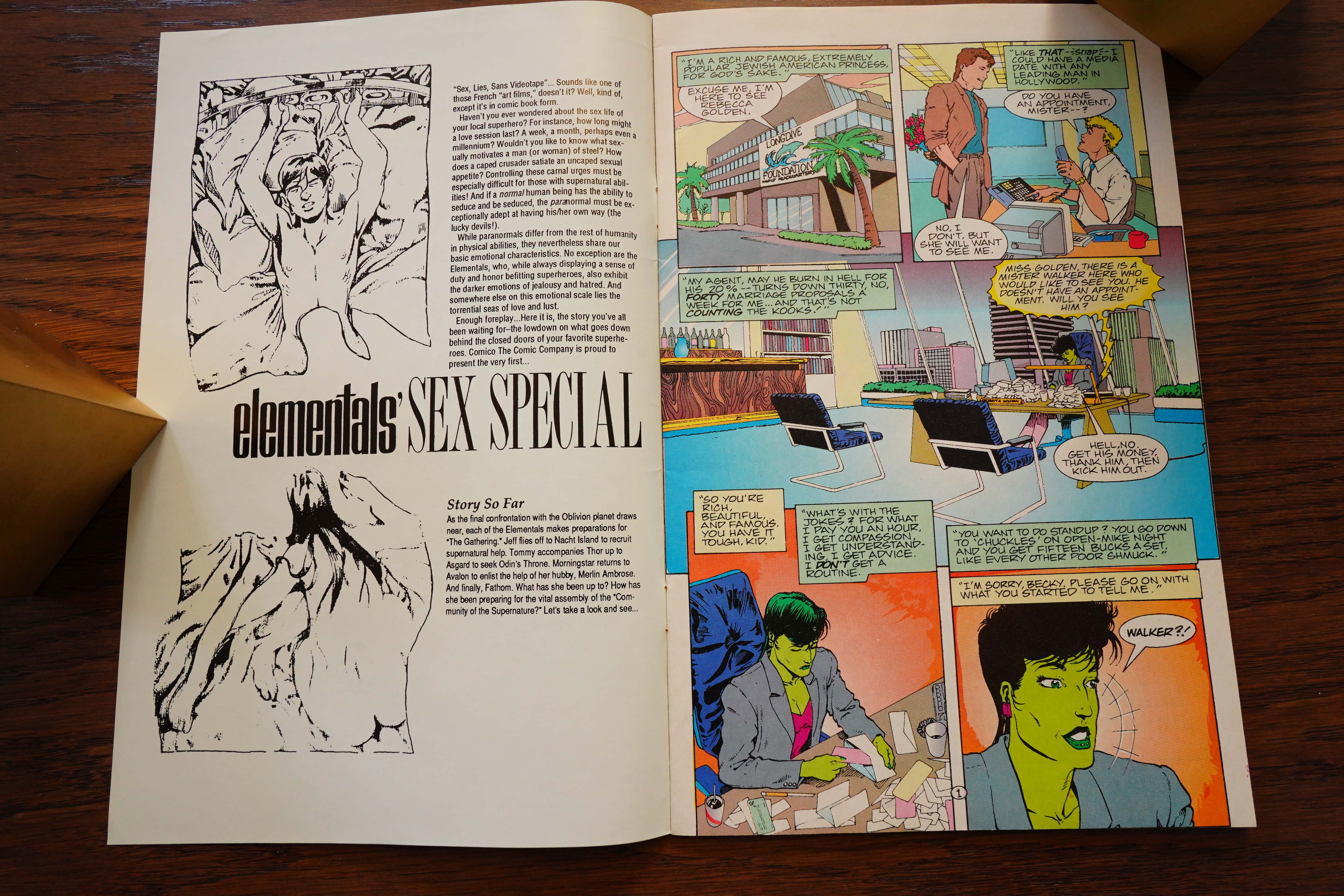
Huh. That’s one way of announcing that Comico has lost the Robotech franchise, I guess.

And… 65 episodes? Robotech II: The Sentinels was cancelled after three episodes, wasn’t it?

Scenes like this make me wonder whether Attack On Titan was influenced by Robotech at all — you have the obvious horror possibilities inherent in having one group of people being huge and the other small: Squish squish. But that’s not touched upon at all here — the huge people just shoot the small people instead. But I mean, this is for children, so…

On the other hand:

I know naaathing.

Oh. The writer died?

The editor explains, and also finally tells us how the adaptation has been done: The penciller looks at the video tape and breaks it down into comics form, and then the writer (billed as “scripter”, but that can mean anything) comes in at a later point (and adds the text). I had assumed that the writer did the adaptation, but that explains the wildly differing approaches from the different artists.

The artists discover a labour saving device.

The final issues are 90% Rick/Minmei/Lisa romance.

It goes on and on. Was it like this in the animated series, too?

Heh. “Elementals: What makes them so special?” “Bill Willingham… of course!” That’s amusing because Willingham wasn’t involved much during the final year of Elementals v1, but he’d back now as the writer for Elementals v2.

Did I mention the romance plot?

Oh, so now… the humans do know what Protoculture is? You could have told the readers, too, then.

And after a bit more shooting, they’re off to the stars!!!

Man, that’s a disappointing end to a sometimes entertaining series. I was pretty entertained for the first third of the series (while Jack Herman was the scripter), but then my enjoyment rapidly diminished: The series became more wordy and didn’t zip along any more.

The rotating cast of artists didn’t help much, but even the main artists had problems with making the space battles graphically interesting or exciting.

But the main problem with the series is that the world building was revealed to be pretty thin after all. Like I said before (days earlier for me, and what probably feels like many years for whoever is so unlucky as to be reading this), it’s a good trick to throw out titbits about the fictional world to make the reader believe that there’s some depth, but it’s an even better idea to actually have that depth. I was hoping that that would prove to be the case (what with this originating as an animated series that would presumably have been plotted out well in advance), but nope — not really.

So, OK, I’m not really the idea audience for this series in any way, and I know that there’s a gazillion fans that really like Robotech, but, man: Meh. I say meh!!

The Comics Buyer’s Guide #612, page #26:

The newest title from Comico
The Comic Company, Robotech
Masters #1, sold out its 64,000-
copy print run one day after
printing was completed, said
Sales Director Mark Hamlin.
“Robotech Masters #1 marks
the beginning of our bi-weekly
schedule,” Hamlin said, “mean-
comic released every two
weeks.” Masters will be put on
this rotating schedule along with
Robotech the Macross Saga and
Robotech the New Generation.
The creative team of writer
Mike Baron, penciller Neil
Vokes, and inker Rich Rankin-
have several issues completed to
date, Hamlin said.
“There is no re-order avail-
ability on Masters #1 from the
publisher,”. Hamlin continued,
“and anyone seeking more of
this issue should contact their
distributor or back-issue whole-
saler.”
The fourth issue of Robotech
the Macross Saga also has sold
out from the publisher, accord-
ing to Advertising and Promo-
tions Director Bob Schreck.
Comico only prints a small
percentage over its initial orders
for re-orders, Schreck said, and
in this instance the allotted re-
order quantity was bought out
from the publisher as the books
were shipping from the printer.

Even if they sold out, they didn’t seem to fetch a very stiff premium as back issues

The Slings and Arrows Comic Guide #2, page #546:

Adaptation of a highly popular US animated series, itself a
combination of three Japanese animé, Space Fortress Macross,
Southern Cross and Mospeda. When a huge alien fortress
crashes on Earth during World War III it causes a cease-fire
and eventually comes under the control of a benign faction
that creates a World Government. When the giant humanoid
Zentraedi arrive, eager to retrieve their weapon and the
mysterious ‘Protoculture’ that makes Robotechnology
possible, they become foes and eventually allies in an
intergalactic conflict. It’s all told through the experiences of
three young people locked in a romantic triangle; reluctant
fighter-pilot Rick Hunter, career soldier Lisa Hayes and Lynn
Minmei, a cute and fluffy popstar whose singing causes
emotional breakdowns in the aliens. The scripts adapt and
embellish the TV episodes and the art, sadly, does likewise.
Whereas scripter Markãlan Joplin manages to work beyond
the Saturday Morning blandness of the teleplays when he
replaces Jack Herman in issue 17, creating a depth absent
from the source material, the illustration, slavishly following
the production style is unpleasantly fuzzy and lacks edge or
drama. The remaining episodes of the TV show are adapted
in Robotech Masters (Southern Cross) and Robotech The New
Generation (Mospeda).

Protoculture Addicts #4, page #16:

I will have to be brief this time with
this Comico review: there was only one series
still going and unfortunately it is now over.
I told you last time that issues #29 and #30
were less appealing than previous ones.
Fortunately I can’t say the same of #31 and
#32 which are much more in the real Leeke
style. Issue #33 is average but I must note
the effect on page 9: Lisa drowning her pain
very fast. Quite well done! Only one problem
with this ish: the mix-up of pages 4 and 5.
Hum, an overworked editor? Good work in
issues #34 and #35. The small modifications
to the original script by M. Joplin which I
found annoying in earlier issues now seem to
be quite well suited to these adaptations of
episodes 31-35. Diana Schutz has done a good
job, I cannot find the exact place where she
took relay in #35 script. Issue #36 is
brilliant; the art is very nice and clean,
pages 22-23 being gorgeous in fact; the
adaptation by M. Joplin is clever and moving.
A job very well wrapped up by Comico. Let’s
thank them for four years of hard work. Our
eyes must now be turned towards Eternity and
their Sentinels’ comic. Fortunately I’m very
happy to see that our good friends are doing
a fine job.
Alain Dubreuil

Amazing Heroes Preview Special #1, page #90:

Previously titled Macross, this book
has changed its name with its sec-
ond issue to keep in step with the TV
animated SF program, Robotech, on
which it is based. Robotech actually
consists of three similar but diffe-
rent Japanese TV cartoon SF adven-
ture serials which have been rewrit-
ten to make a single 85-episode
animated serial for the American
syndicated TV market. However,
each of the three component adven-
tures will have its own comic book.
Comico plans to issue the three
books on an overlapping six-weekly
schedule, so that a new isue will
appear every two weeks. The com-
ics will begin as straight adapta-
tions of the TV adventures but, it
they are successful enough, each
will continue past the TV saga into
original stories.
Robotech: The Macross Saga is
the first of the three Robotech
stories, comprising the first 36
episodes of the serial. A gigantic
alien spaceship, the SDF-1
(Macross), crash-lands on Earth at
the end of the 20th century. Ten
years later, a military/scientific
community has grown up around it.
The humans have just figured out
how to get the SDF-1 operational
when a fleet of Zentradi spaceships
arrives around Earth to reclaim it.
The SDF-1 unexpectedly starts fir-
ing automatically at them, the Zen-
tradi think that Earth is attacking
them and retaliate, and Earth is sud-
denly involved in a space war. The
story features many scenes of SF
battle action (gotta display those
spaceships and robots that Revell is
selling the models of). However, is is
basically a soap opera about seve-
ral of the young people caught up in
the action: Rick Hunter, a teenaged
pilot; Lisa Hayes, the lieutenant in
command of the bridge crew on the
SDF-1; Lynn Min Mei, a teen-aged
pop singer who becomes the focus
for morale among the humans; and
their friends.

Amazing Heroes #157, page #188:

January’s Robotech The Macross Saga
#35 will feature “Season’s Greetings,”
a holiday tale co-written by Markalan
issue #36 brings to a close Comico’s
popular adaptation of this celebrated
Harmony Gold animated TV series. In
“To the Stars,” Admiral Gloval com-
mands Lisa Hayes to uncover the roots
of Robotechnology, while Khyron
concocts some seedy plans for the SDF-1
and the SDF-2.
Fans of artists Mike Leeke and Mike
Chen will be happy to learn that they will
be introducing a dynamic new artistic
style on the soon-to-be relaunched
Elementals, debuting from Comico in
March; and Robotech devotees are
reminded to follow the adventures of
Rick Hunter and company in Eternity
Comics’ new Robotech II: The
Sentinels title.

Amazing Heroes #145, page #192:

ROBOTECH II:
THE SENTINELS

Eternity Comics, in an exclusive arrange-
ment with Harmony Gold U.S.A., Inc.,
has acquired the rights to Robotech II:
The Sentinels for a series of comic
books and related projects.
“Robotech II: The Sentinels is a
direct sequel to the original Robotech
series,” Eternity Editor-in-Chief Chris
Ulm explained. “It occurs 10 years after
Robotech (but before New Generation)
and features several of the same charac-
ters, particularly Rick Hunter and Lisa
Hayes from the first series.” According
to Ulm, the long-awaited wedding of
Rick and Lisa will finally take place in
Robotech II.
Robotech II was originally developed
as a 65-episode animated series. “Scripts
for all of the episodes were written but
production was halted after only three
were filmed,” Ulm said. Those first three
episodes will be edited together for a
feature movie to be released later in 1988.
Ballantine Books is also adapting and
expanding the Robotech story in a series
of paperbacks for mass-market release
this summer.
“Our comics should hit the stands at
the same time as the movie,” Eternity
Publisher Dave Olbrich said. The series
writer and artist will be announced
shortly.
The first Eternity Robotech II projects
are scheduled for release in September.

I guess if the series was halted after three episodes, it wasn’t very popular in Japan?

Back Issue #137, page #51:

Merrill concurs, although he’s rather blunt when
giving his opinion on where Harmony Gold’s biggest
success stands today. “Harmony Gold and Robotech are
definitely a part of Japanese animation’s success in the
US… I do think Robotech right now is a legacy property
that has failed to demonstrate any ability to move
forward in any sort of narrative fashion, in spite of
decades’ worth of attempts to do so. The brand’s
greatest value right now is as an ’80s nostalgia
property. New people are not getting into Robotech.”
While that might be true, the fact is Robotech itself
was and still counts as the first recognizable anime for
a whole generation, helping just as much as Astro Boy
did in the ’60s and Toonami and Pokemon did in the
’90s to bring about the world we have today, where
most anime airs at the same time virtually all around
the world. And that’s not nothing.

Amazing Heroes #75, page #28:

AH: What are the differences be-
tween Robotech and the original
Japanese programs?
MACEK: Very little. Macross was a
smash hit in Japan, and Tatsunoko
continued the same story trend when
it followed Macross with The
Southern Cross and Mospeada,
Genesis Climber. All three are about
space fleets of human-looking aliens
who invade futuristic human worlds.
The heroes are young members of
the human defense forces. The aliens
are looking for some secret that the
human have. It was easy to re-write
the scripts to give the aliens the same
name and turn the secrets into the
same secret. Differences in charac-
ters and costumes are explained by
making it three different attack waves
of the invaders, years apart. The on-
ly real change involved the second
story segment, The Southern Cross,
which we call The Robotech
Masters. In the Japanese programs
it’s not our Earth that’s being in-
vaded, it’s a human colony planet.
I had to go through the video tapes
carefully and edit out every scene
that shows two moons in the sky.

Geez.

Protoculture Addicts #3, page #33:

ROBOTECH: THE MACROSS SAGA
With issue 32, the Robotech comic
published by Comico is beginning to take more
liberty toward the original story, probably
under the influence of the novels published
by Ballantine Books. It is really good:
dialogues and
satisfactory. We find some winks such as on
page… (I hate non-paginated comics!) where
Khyron said “Macek’s Eyes!”. There is also an
homage to Markalan Joplin, deceased last May
before having finished issue 35 which had
been completed by the staff of Comico. By
chance, issue 36 was finished. It will be a
special issue “incorporating events from the
Ballantine Books adaptations and foreshado-
wing what was to come in The Sentinels”. The
last four issues are definitely not to
missed!

Manga Newswatch #3, page #11:

“Comic adaptations available through
Comico: the comic company,” That’s
what the closing credits of Robotech
said. And it was true. From 1985 to
1988, Comico published 86 individual
issues of Robotech comics plus a
graphic novel. With two exceptions,
these were adaptations of the actual TV
episodes, which were particularly useful
for fans who wanted a record of the
story, but did not have VCRs. They were
split into three series which ran
concurrently; Robotech: The Macross
Saga, Robotech Masters, and
Robotech: The New Generation. The
Robotech Special, titled “Dana’s Story”,
adapted the episode of the same name,
but also included additional material
from some of the Robotech novels by
Del Rey Books. It was released after the
Macross Saga books had concluded
their run, so as not to spoil the ending of
that story arc. Robotech Genesis: The
Graphic Novel, was an all new prequel
story written by Carl Macek set during
the global civil war and describing the
original landing of the SDF-1 on Earth
and its exploration by Gloval, Fokker,
Lang and Edwards. Comico also
published Robotech 3-D, a retelling of
the first episode of the Macross Saga,
complete with 3-D glasses.

Amazing Heroes #75, page #32:

AH: How closely will Comico’s
Robotech comic book follow the TV
program?
MACEK: There’ll be no story dif-
ference at all. Issue 1 of the comic
book is episode 1 of the TV show,
issue 2 is episode 2, and so on.
The only difference is that the
Robotech TV program will be told
in a single story sequence, while the
comic book will be published as
three overlapping sequences. The
first 36 episodes of the TV programs
are Macross, the saga of the first at-
tack on Earth. Then the story jumps
a generation and episodes 37
through 60 tell the adventures of the
cadets of the Robotech Military
Academy as they fight the renegade
Robotech Masters. Then the story
jumps again, and episodes 61
through 85 tell how the descendents
of the Macross cast return to Earth
to free it from the Invids, rivals of the
Robotech Masters who moved in
after the humans and the Masters
had weakened each other. Comico
is publishing this serial as three
separate comic books which will be
distributed at the same time. The first
story sequence is titled Robotech:
the Macross Saga; the second is
Robotech Masters; and the third is
Robotech: the New Generation.
Each title will be issued every six
weeks, and the three will be on an
overlapping schedule two weeks
apart, so there will be a new
Robotech comic book out every two
weeks. The first three issues of
Robotech: the Macross Saga are
already out. The first issue of
Robotech Masters is the next due
out; then the first issue of The New
Generation; issue 4 of the The
Macross Saga; issue 2 of Robotech
Masters; and so on.
AH: Does this mean that Robotech:
the Macross Saga will end after issue
36, and that the other two will end
after their 24th and 25th issues?
MACEK: Not at all. If they’re still sell-
ing successfully when they reach the
end of the TV episodes, I plan to go
on writing the continuation of the
adventures of Rick Hunter and his
friends; of Dana Sterling and her
friends, and of Scott Bernard and his
friends.

There’s really remarkably few articles about Robotech in the comics press at the time. Which is pretty odd — this was the first big adaptation of a new phenomenon — “Japanimation”, as it was called at the time — but nobody really seemed to pay attention?

Comic Shop News Special #1, page #39:

One of Comico’s most successful
titles were their Robotech books.
Comico was among the first Ameri-
can publishers to anticipate the
popularity of Japanese comics
and animation in the U.S.
Robotech was originally called
Macross: The Robotech Saga but
changed the title to Robotech with
the second issue when it was
announced that Harmony Gold
would be syndicating a half-hour
Robotech cartoon (translated to
English from the original Japanese)
to U.S. television stations. This result-
ed in quite a sales-success in areas
where the show was seen, and
precipitated a boom in reprints of
Japanese comics (called manga)
like First’s Lone Wolf & Cub, Eclipse’s
Area 88, Kanul and Mai the Psy-
chic Girl, Marvel’s Akaira, and
NOW Comics’ upcoming Speed
Racer manga reprint. It has also
made way for other successful
adaptations of popular Japanese
animated series like NOW’s Speed
Racer and Astro Boy, Comico
quickly expanded to three differ-
ent Robotech titles, issuing a new
Robotech comic every two weeks.
As the show was replaced on
many stations (a limited number
were made available for U.S. syndi-
cation) the sales softened. But
Comico continues to do a monthly
regular Robotech comic. “We really
feel a committment to the
Robotech fans who have stuck with
us from the early days,” says
Schreck, “we’ll continue the book
until the stories end, at least into
early 1989.”
Comico has been really lucky so
far to find that difficult blend of
aesthetic and critically appreciat-
ed material, while still trying, and
many times succeeding, to finding
commercially viable successes. So
when we look at new material
under consideration we have two
criteria. One, is it something we
can sell enough of to make some
profits that we can put back into
the project, and, two, is it some-
thing we can be proud of publish-
ing? Is it a quality series?”
Schreck says he feels this diversi-
ty of concepts with consistency of
quality is one of Comico’s
strengths.

Comics Interview #23, page #27:

And then, out of the blue, Comico asked
Rich and myself to come up there one day.
They were starting this whole MACROSS
comic series. MACROSS #1 was done by
Carl Macek, who is very established, and
Svea Stauch, and was inked and colored by
various members of the Comico Bullpen. It
took them a long time to do it. And I think
what they wanted to do was change the
whole process and make it more of a regu-
lar comic, flat coloring and everything, so
they wanted to do something a little simpler.
And if nothing else what Rich and I were
trying to prove was that we were reliable.
It was not necessarily that we were the best
artists that they could have hired, we were
reliable enough so that we could hopefully
get #2 done on schedule. We had about two
weeks to do the whole issue. It was good
practice, that was the way we looked at it,
we were getting paid for it, and we didn’t
have a helluva lot to complain about.
And then we were asked to do MAC-
ROSS #3 in about a week. Actually, I am
fonder of that one than I am of issue #2, even
though we had to do it a lot quicker. The
way they were plotting the book was like
page for page, word for word, and I can’t
say I was speaking from many years ex-
perience – but from reading them for as
long as I have, I just didn’t think it was
working as a comic. So, essentially, I re-
plotted it even though I had a script and
everything. I changed a lot of the premises.
I took it upon myself to change it for the
better, I thought.
DAN: I see.
NEIL: I used my own best judgement. I
used the basis of the story; following the
plotline. I just drew it my own way. I didn’t
sit in front of a video machine and watch
a scene, freeze frame it and study it, then
draw it shot-for-shot. I thought, “They
might as well put a book together that is just
frame blow-ups and print it up and just put
little word balloons on them, if they want
that. Why hire artists to draw if they don’t
want them to draw something?” So I just
went for it. The funny thing about this is
the two videos that I was given for MAC-
ROSS #2 and #3 were in Japanese. And if
you’ve ever had to plot something that was
in a foreign language and you didn’t under-
stand any of that language – it’s not very
easy. You have no idea what they are say-
ing in the dialogue…
DAN: There’s no possible way to do it.
NEIL: Well, there’s a possible way to do
it, but it doesn’t always turn out right in the
end. I was a lot happier with MACROSS
#3, because I did it with my own layouts,
my own pacing, I didn’t have to go by any-
body else’s work, and then Carl scripted
from that.

Wow. In the beginning, at least, the penciller had to adapt it using untranslated video cassettes, so he had little idea what was being said! Presumably the scripter got the translation, I guess…

Comics Interview #51, page #38:

BOB: If you really sit down and look at
ROBOTECH, particularly the MACROSS
and NEW GENERATION segments, com-
pared to Saturday morning cartoon
mindlessness, the plot lines are a lot more
intricate and interesting, even though they
have been altered for America. The nudi-
ty has been taken out, and a certain amount
of the violence has been taken out of it. A
good deal was left in, because America
loves its violence and hates its bodies!
But ROBOTECH is something we had
handed to us on a silver platter, and releas-
ing the three books on a six-week basis, we
had to get it out, we had to get it done. We
weren’t afforded what we’re doing on STAR
BLAZERS, which is full-process cel
animation-like coloring on a four-issue
limited series. So, you just do the best you
can.

The Slings and Arrows Comic Guide #2, page #405:

The original Macross was a Japanese animated series
featuring ‘mecha’ – planes and other equipment that
transformed into robots. The comic started as an adaptation
of that Japanese series (1), but then the Robotech TV series
was created as an English-language adaptation of Macross
and two other Japanese mecha series and the comic had a
change of title to Robotech: the Macross Saga, and also of style.
The story centres around the Macross battle fortress. This
was built by unknown aliens and crashed on Earth in 1998.
Humans put a lot of effort into mending it, and it repays
them by powering up its automatic defence systems when it
senses that its old enemy (the Zentraedi) are in range, and
then blasting half of the Zentraedi fleet out of the sky. This
means that the Zentraedi immediately wage war on Earth,
and the humans make no attempt to explain but simply
launch the Macross and pursue the battle out in space. This
launch drags most of the surrounding city along with the
ship, so the stories can feature a lot of domestic urban detail
(beauty contests and teenage recording stars, mostly) mixed
in with the heroic teenage fighter-pilots. This plot doubtless
seems really clever and cool when you’re about ten, and as
entertainment for children goes, it’s well crafted (apart from
1, which had ghastly artwork), though one hopes that any
girl-child who picks it up already has enough self-
confidence to shrug off the relentless undermining that’s
inflicted on the female characters. However, if your tenth
birthday is but a dim memory and you’re not in the
advanced stages of manga addiction, you can safely give this
one a miss.~FC

Ouch!

The Comics Journal #116, page #57:

The Robotech books also use
dreams a lot, but mostly as a
device to recapitulate their con-
voluted storylines. Robotech: the
New Generation #13, adapted by
Markalan Joplin, makes the best
use of “mind games,” as Harrison
Fong’s dynamic (if uneven) pencils
depict the dream-journey of one
alien-fighter (name of Rand) as he
learns the motives of Earth’s alien
invaders. Fong and Joplin also
handle the adaptation work on
Macross Saga #17, which is less
successful in that the dream is
merely the musings on previous
adventures by protagonist Rick
Hunter.

OK, that’s enough of that.

I can’t really find much chatter about the Comico Robotechs on the internet, bu here’s a review:

On the other hand even Joplin’s alterations last issue and this doesn’t make this romance rather rushed. Miriya sure switches from great warrior to struggling housewife rather fast and I don’t think she’s been around them long enough to have had the personality switch we saw in the show. The comic doesn’t have time to focus on it so it’s not as jarring a change. I know some marriages happen fast. My parents did and so did my cousin and her husband but this seems a bit too fast.

Nobody reprinted Robotech: The Macross Saga until 2018, when Titan reprinted it in full.

Here’s a review:

Before starting this, jaded by many comic book disappointments, I assumed this comic version wouldn’t live up to the show or that it’d be slow and I’d just have to slog it out. Not the case at all. I found it very difficult to put down. It was just as good as the cartoon in every aspect. The fast paced variety, humor, drama, romance.
I loved every page.

And another:

The bad news is that the artwork was B-level even by 1980s anime and comic book standards, and some of the gags and story lines were old-fashioned even then. While Macek tried to keep the combinations of serious drama and offbeat humor under control, the source material just had a lot of it, and that often worked against the series.

Heh:

They’re just ok. It would help if you watched the show first though. Just mute it whenever a certain teen idol starts singing…

And now I have two more Robotech series to read… I’m not really looking forward to that now.

1984: Elementals

Elementals (1984) #1-29 by Bill Willingham and a cast of thousands

Elementals was, by far, the most commercially successful book at Comico. Or perhaps I should say property — after Comico went bankrupt and then rose from the grave, it was the thing propping up the company. (I guess Macross may have sold more? I don’t know.)

But I’m not quite sure how to approach Elementals for this blog. With Airboy over on the Eclipse blog, I did all the various series and spinoffs in one super duper long blog post. And I could do that with Elementals, too — heaven knows that there’s enough spinoffs — but I don’t think I have the stamina to read all those Elementals books without something else in between.

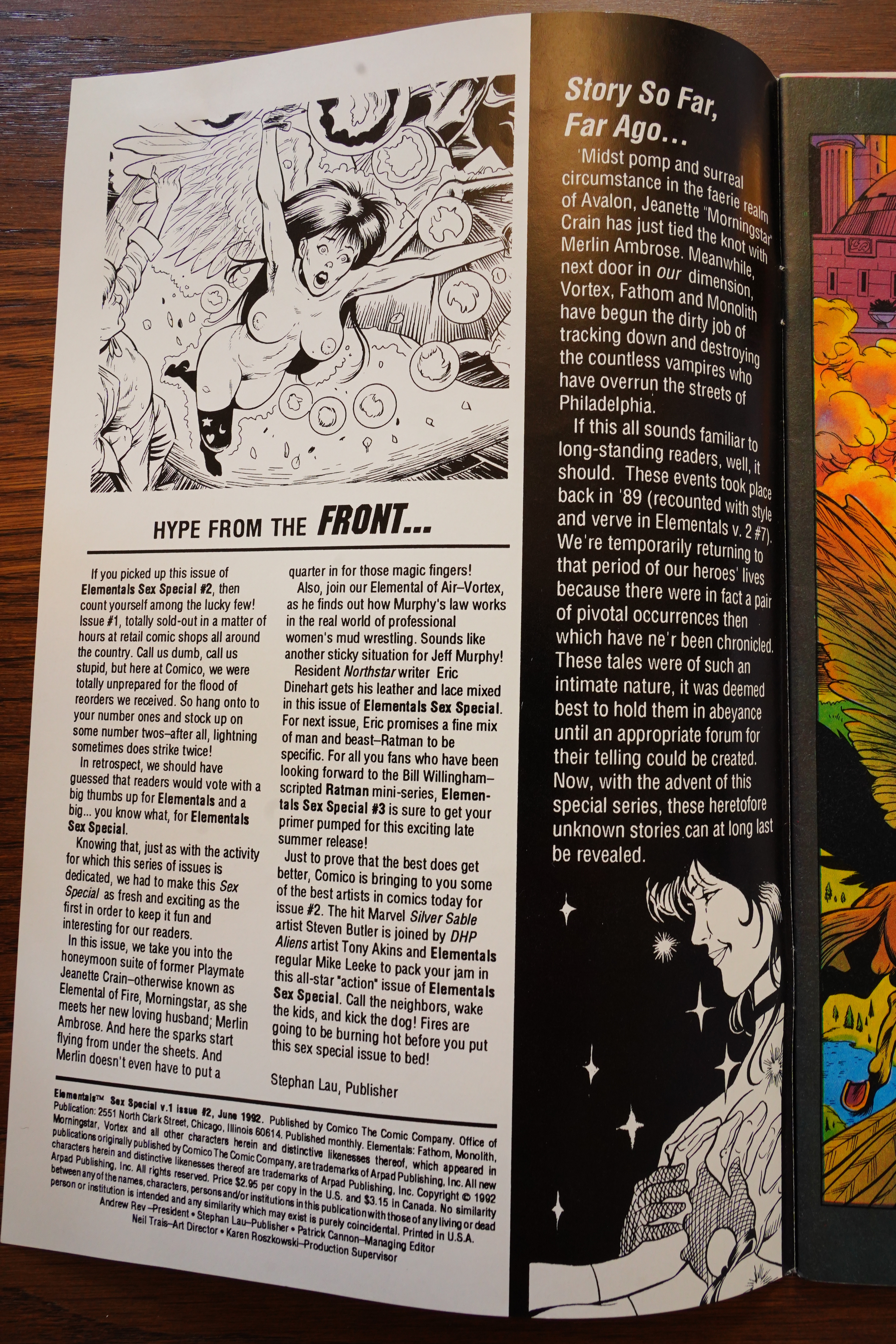
So I think I’ll do one post per series… Although I might change my mind later. And perhaps lump Elementals Sex Special, Elementals Sexy Lingerie Special, Elementals: Lingerie and Elementals Sex Special volume 2 into one post?

I guess we’ll find out when this blog series reaches the 90s.

OK, so the Elementals were introduced in The Justice Machine Annual #1 published by Texas Comics. Hm… Texas Comics… that sounds familiar…

Nope. They only published one comic book, so I must be thinking of something else.

But if they were introduced in an “annual”, that sort of implies that there was a regular series?

Yes. From Noble Comics.

This sort of thing would go on to become a regular thing at Comico, I think — that is, Comico picking up a series that’s already been published somewhere else. And then not actually doing much of a recap of the previous issues.

The unusual thing here is, I think, that Elementals stayed with Comico to the bitter end (i.e., 1997). Many of the other series that flitted by (“flitted”? sounds wrong MUST REMEMBER TO CHECK BEFORE PUBLISHING BLOG) lasted for only a handful of issues before going on somewhere else.

Comico were very gung-ho about creator’s right, so this makes sense in that context, in a way: The creators own everything about their comics, so why not move around? But it also makes one wonder why some people bounced off of Comico so quickly, and why Elementals remained at Comico even after the bankruptcy and the resurrection by the new (villainous) owners in the 90s…

Time will tell! I haven’t done any research into that yet.

This reads very, very much like you’re supposed to have read that annual, though. We are, sort of, given a introduction of these characters, but nobody’s sitting down with the “as you know, Bob, after you died, you were given these powers by some Gods that we’ll talk more about later”. Which is a good thing! But there’s a wide chasm between infodumping and just assuming that the reader knows everything already, and this is more on the latter side of that gorge.

The storytelling is bumpy. There’s more than a few pages like this where it’s not very clear what reading order the panels (or speech balloons) are supposed to be in.

And strange things like the upper right panel there… OK, the er space ship is on a downward trajectory, so the speech balloons are, too? Well, OK?

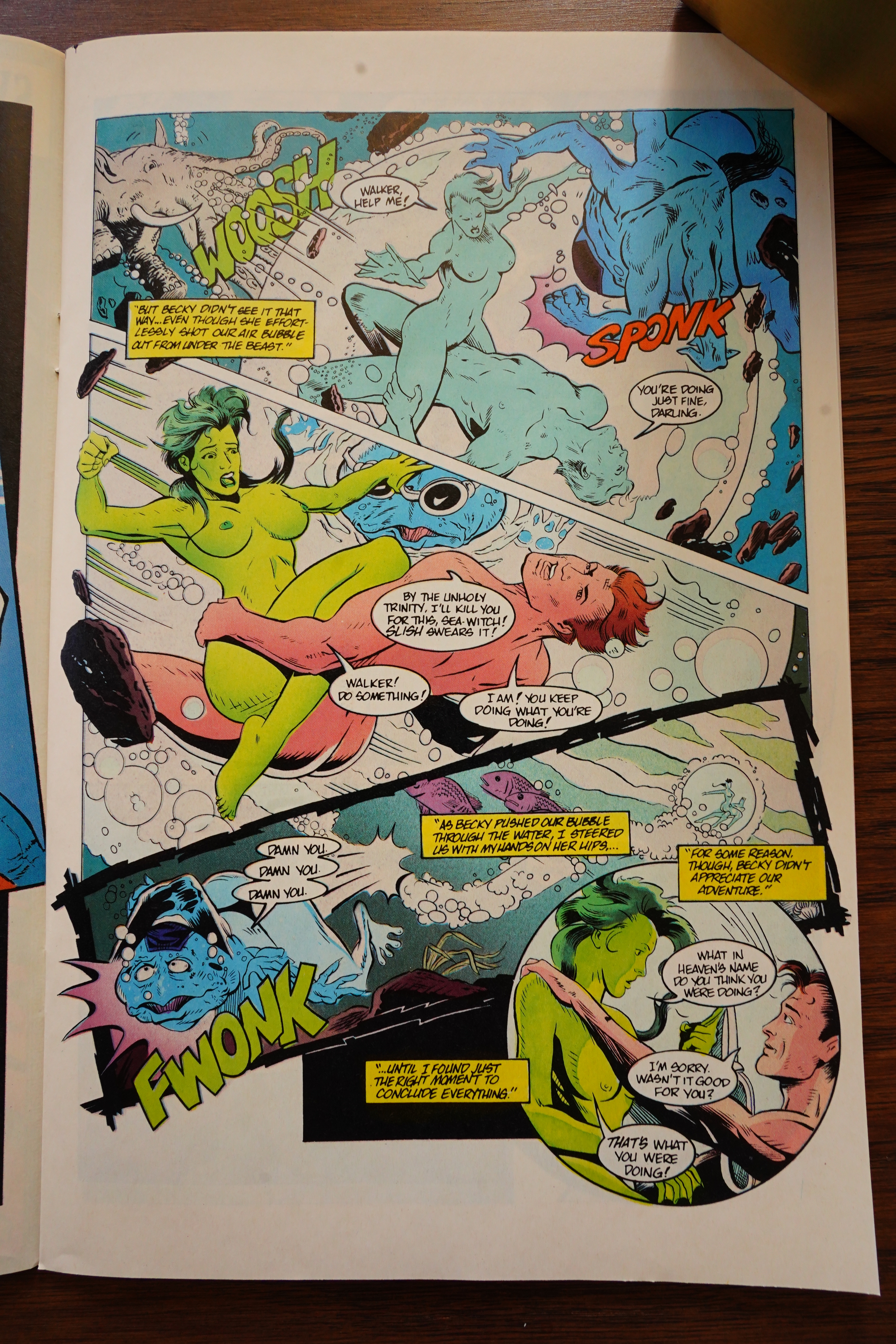
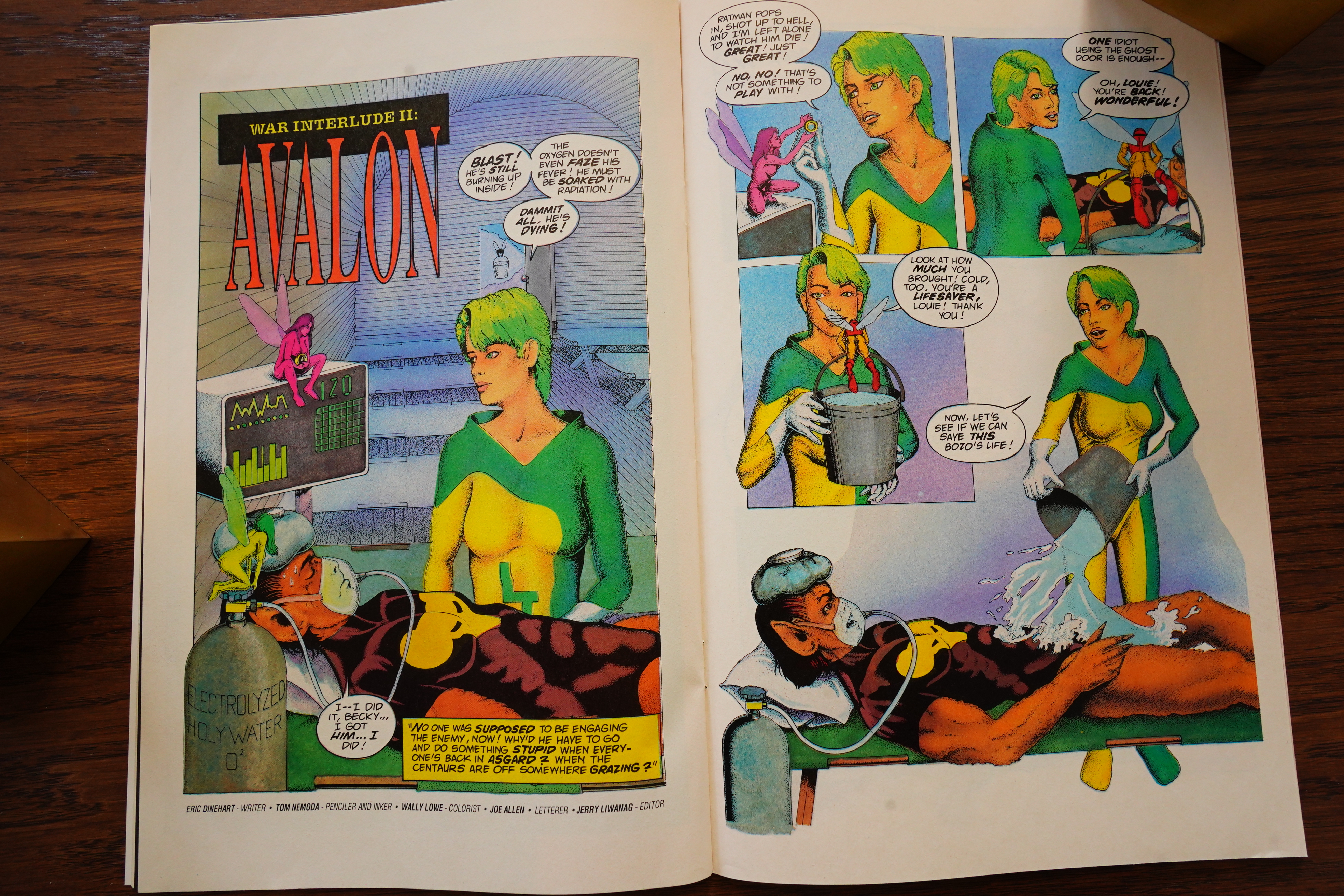
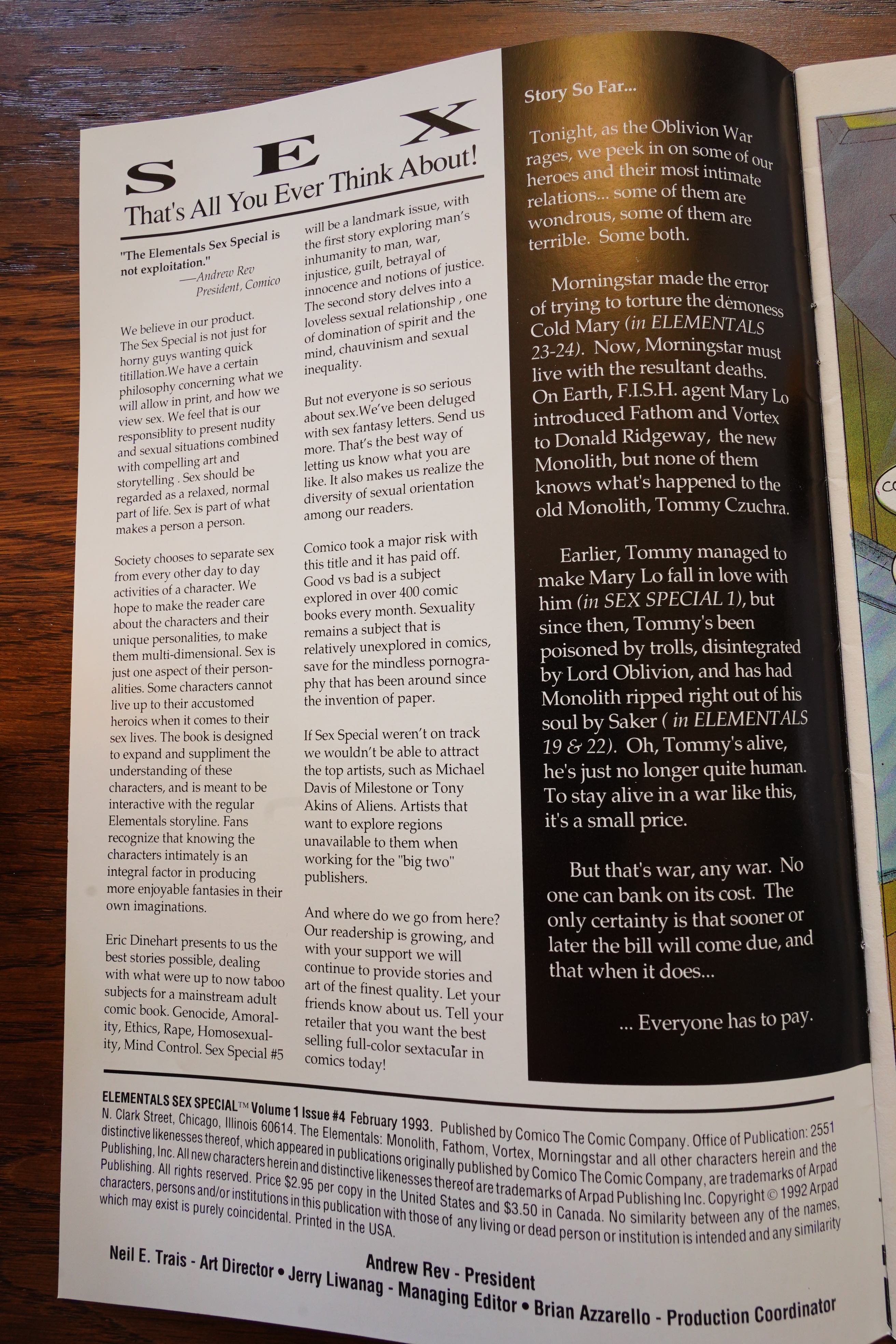
In the Zombie Comico years in the 90s, many of the Elementals minis seem to be porn based (I haven’t actually read any of them yet, but names like “Elementals Sex Special” seem to, er, give a hint), and I wondered why a super-hero franchise would take that turn.

But… I think the fetishistic thing seems to be part and parcel of the series from the very start? I mean… just based on the line work here? Is it possible for a pencil line to be porny? I guess a little Michael Golden goes a long way… Hm…

Willingham, of course, went on to do porn himself (with Ironwood and Time Wankers, for instance) in the early 90s.

“Let’s assume that all of you did die.” “There are times — when I wonder about that myself.”

Yes, if I had died and been brought back as a super-hero, I would have wondered a bit about that myself, right?

Elementals is just so oddly put together! Reading this book is a pretty head scratching experience: Is the oddness because there’s stuff that’s going to be explained later, or just because Willingham isn’t a very good storyteller? (Spoilers: It’s the latter.)

Speaking of fetishistic — one fat bad guy in a thong and one female hero in frilly lingerie are certainly choices…

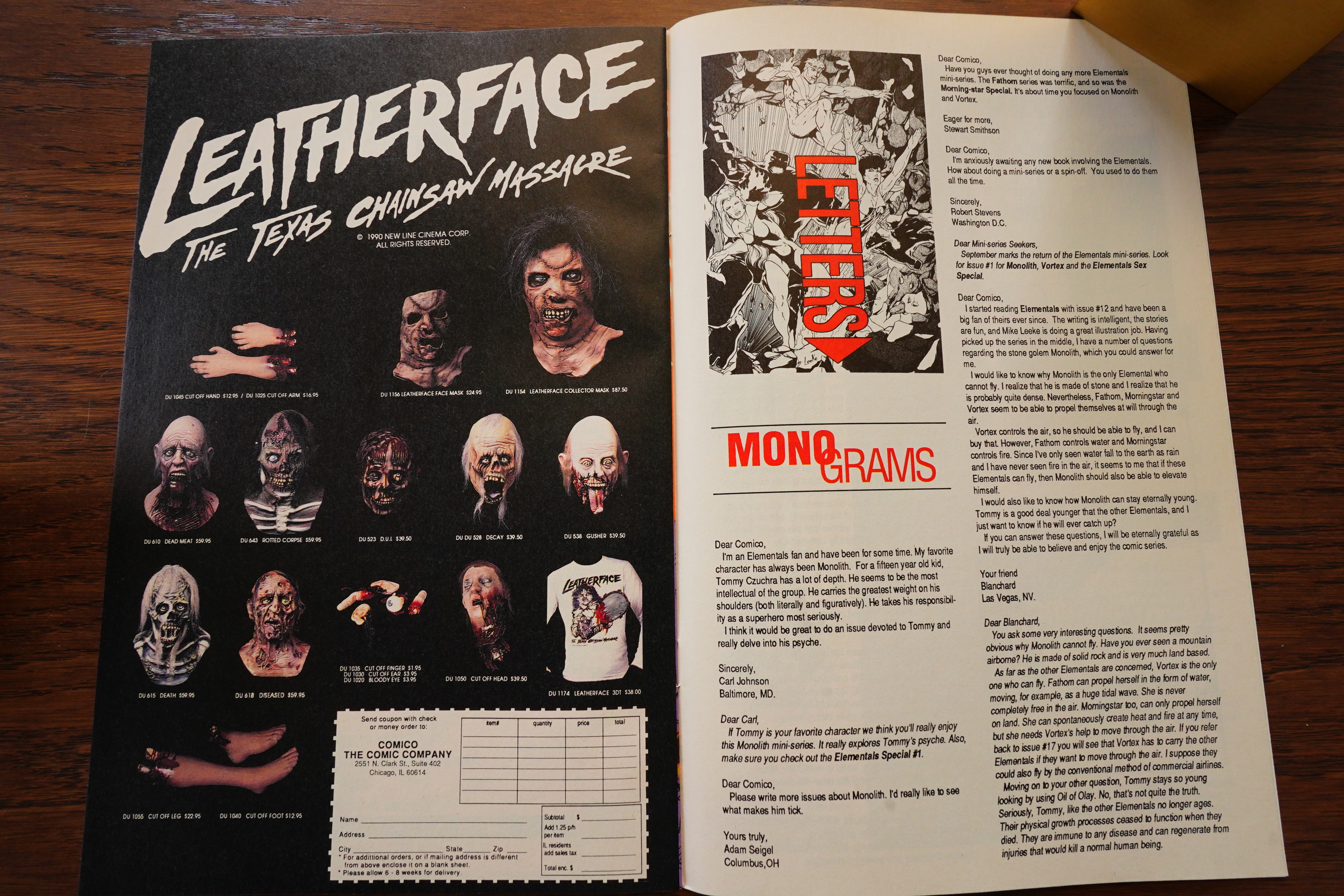
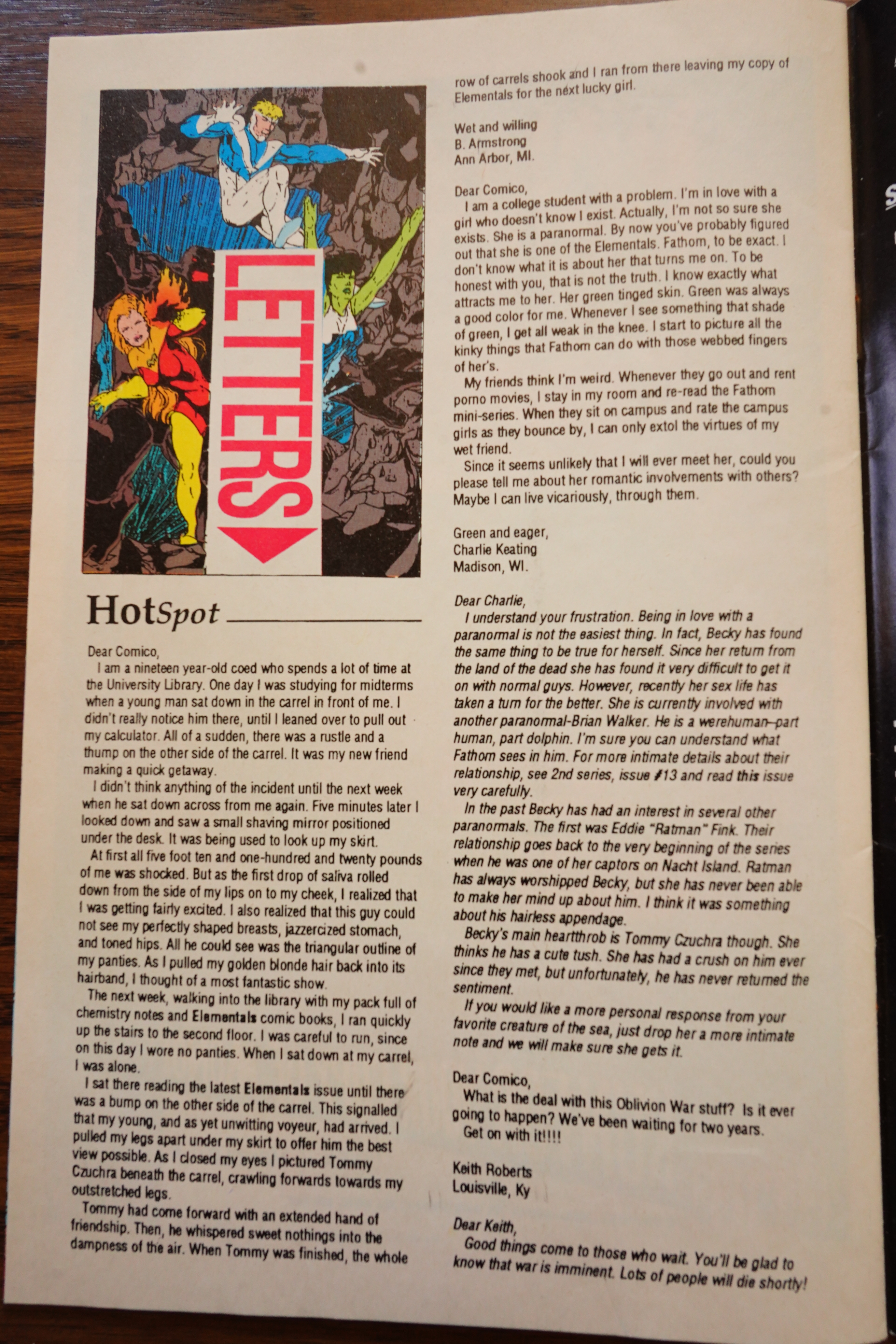
Since there’s been previous issues, we even have a letters column in the first issue.

I surmise from the editorial in the second issue that somebody told Willingham that the lingerie costume (I assumed that wasn’t her costume but just what she happened to be wearing when she lost her dress) is a bit “eh”, so she’s getting a new one. “I was lucky to have friends who made me see that, in spite of myself.”

Oh, OK, the lingerie wasn’t her costume? It was that thing with the micro mini skirt, I guess.

And… we’re being informed that the first issue was done over a number of years, but from now on all the material is new. That could certainly help explain the weird storytelling.

Professionalism, FBI agents. Professionalism in the office!

OK — here’s the in-story explanation for the new costume: “Now they’re in costume!” Well, OK then!

And, yeah, the er 12-year-old kid who turns into the big earth monster turns naked every time he shifts back into human form? Makes sense.

That’s the villain — and he knows the traumatic backstory of all of the different Elementals. One is a Vietnam vet, one is angry, and one is a frightened “Jewess” (I quote). The evil guy ends up giving Monolith a costume made of ectoplasm later, which isn’t very evil of him, I have to say.

And then we get their origin stories all of a sudden! But again, it really feels like Willingham is reminding the reader of something the reader is supposed to have read before — it’s just weird. I don’t think that’s what’s going on, but that’s what it feels like when reading these pages.

See, they had tied him up in his super-duper-strong big earthy form, but now that he’s a child again, he’s free! D’oh! Why didn’t the villains think of that!

And viola! Here we get character building — her Jewish identity is shown by her use of Yiddish words like “tookas”, which is perhaps not the most common spelling of that word. And I think that is the only kinda-sorta Yiddish word we get? Perhaps Willingham just forgot…

T. M. Maple writes in to say that he thinks the book is perhaps touching on looking a bit porny, but Willingham makes a striking defence by pointing out that he also has a naked boy in the book. And besides: “Being hyper-aware of the state of undress of women in comics has quickly become the most fashionable Shibolet [sic] of “enlightened” comic readers.”

Well, that’s an ad, certainly…

A writer needles Willingham by rolling his eyes at all the violence in the book — in particular the earthy guy (who’s really a twelve-year-old) squeezing people to death. Willingham offers the standard defence that the real problem is unrealistic violence where nobody dies.

OK, we’re getting more background info on the evil bad guy, but I can’t express enough how this still reads like we’re being reminded of something we’re supposed to already know. It feels like having a mild brain aneurysm.

Yuck!

Hey, that letter must have really needled Willingham…

With the fourth issue, Willingham brings in a person on “script”, which I guess means that Jack Herman writes the words based on Willingham’s plot? That’s what it usually means, but people use these words differently sometimes…

The bad guy is given a really elaborate background (he’s two thousand years old, and he, too, was dead at one point, but he was resurrected by the guy on the lower right hand panel, which I think is Jesus (no names mentioned)). Which is original — we know nothing about the main characters, but we get a lot on the villain…

And… remember all that talk about this not being a comic book, and people die? All of a sudden the guy that the earthy kid squoshed to death is alive again!?

I don’t think there’s any followup of that, so I dunno…

On pages like this, you can totally see what Willingham is going for. But again, it just doesn’t work — that “split panel” at the top there is supposed to be a dramatic shapeshifter scene, but it doesn’t really read that way.

Four years!? I thought they’d just been reanimated!?

*sigh*

Again, a typical scene: You can certainly deduce what’s happening here, but so many of these pages read like “eh? oh”: There’s no flow or natural progression to the events.

And this is how the first storyline ends — with the villain that has been given all this build-up just being popped into a hell dimension egg. And he was presented as being super duper powerful. It’s just weird — like Willingham hadn’t quite achieved object permanence.

Apparently the first handful of issues were published very irregularly, but Willingham informs us that “the publishing irregularities have been resolved”. Diana Schutz was brought aboard as an editor and Bob Schreck took over as “director”, so perhaps that explains it. More research needed.

Eep! Willingham is really good at these creepy scenes…

NOOO! NOT HIS WHOLE ARM!!!

The more things change…

So with the villain gone, Elementals turns into more of a normal super-hero comic, with the heroes saving people from burning buildings, and Learning An Important Moral Lesson and stuff. Which is preferable to whatever that first sequence was, really.
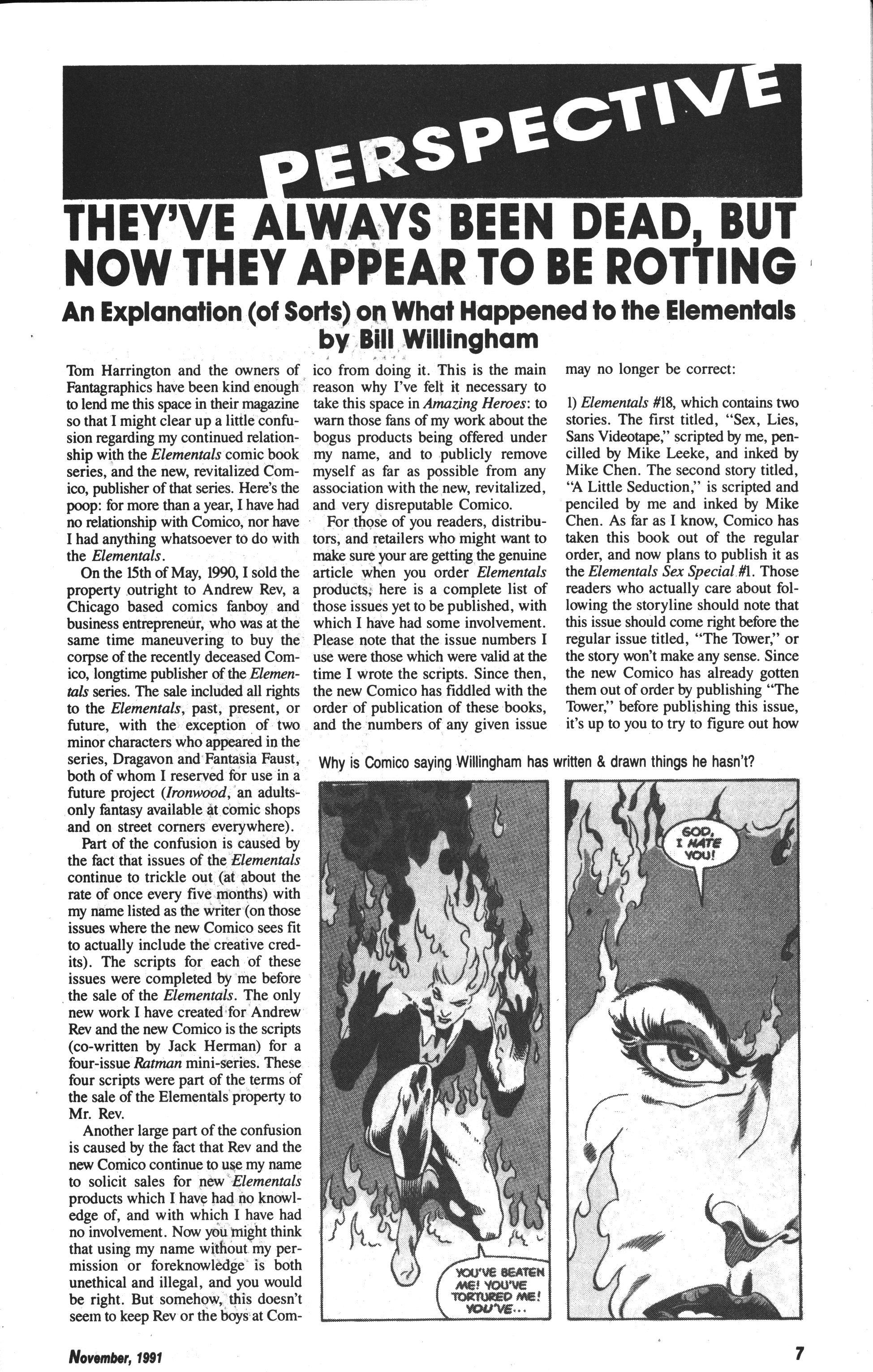
Hey, that’s a more stylish Mage ad.

Willingham presents most of the cops and the military as somewhat bad people, but I think that FBI agent is supposed to be one of the good guys? And still he shoots that rat-faced guy just because he’s been double-dared to do so…

That’s a kinda striking wraparound cover… Quite a few of them are pretty good, really.

I’m not sure what I expected from this series. While reading other super hero/action series for various blog series, I’ve been pleasantly surprised by how entertaining they turned out to be (again, take Airboy as an example). This series attempts a lot… or perhaps, is just written by somebody with a low attention span. Some parts feel like a silly super hero team comic book, while other bits insist on being All Serious For Grown Ups, and these shifts don’t come off as intentional.

I think what he’s saying here is that he didn’t have time to pencil this issue, so we get a whole lot of people. Steve Bissette? Mike Mignola? The Pander bros? Huh! Sounds interesting.

Heh, Schulz and Schreck show up, but are brushed off.

Oh deer. That’s a Bissette page. Not his finest work, but I guess the inker perhaps didn’t quite… er… do the right thing?

Huh, a submissions guide… I guess they wanted to expand the line?

Here’s Mignola… I guess this was before he became famous?

Nobody seems to have told the Pander brothers that Monolith (the guy in brown) was supposed to be twelve?

Here’s a reader that finds the recurring nastiness interesting.

Oh, so that’s why her costume changed. Makes sense!

Willingham is frequently off model himself. Yes, that is indeed Monolith again.

Oh, there was an Elementals Special published that dealt with child abuse? I guess we’ll see what that’s about when I get there… let’s see…

Yeah, in a week or two (or three), I guess? I do these blog posts “chronologically”, but depending on the date when the first issue of a series was published. For long-running series, I find myself peeking into the future a lot, so to speak.

I’ve done a few of these blog serieses (that’s a word) now, and at one point I started wondering whether it would be more fun to do a publisher strictly chronologically. That is, one post per issue, in the order they were published. Then I told myself not to be stupid, and then I got angry at myself for dismissing my ideas, and then I went to bed.

PROBABLY.

Eep. Willingham’s forté just isn’t drawing children…

He’s getting quite good at this sort of stuff, though.

How the turntables!

Keith Wilson comes aboard as inker (and Willingham apparently scripts this one himself).

It’s a dream issue where we learn about Monolith’s childhood, which is very traumatic indeed and involves his father physically abusing him.

Wilson’s inks seem to work better for Willingham than the previous one, and it being a dream issue, Willingham can easily drop doing backgrounds. Which he doesn’t like to do, anyway.

Even as dream issues go, it’s pretty weird. But… he’s fifteen now, or is that just in the dream? Oh, I guess… He was twelve when he died (I think it was stated somewhere; I may misremember), but it’s been a few years, and he’s now fifteen? But since they’re dead, they don’t age? I dunno.

Oh yeah — I remember reading Giovinco’s blog post about this, which is pretty interesting.

Read more here — Giovinco says that he came up with this colour chart that then became something of an industry standard…

We then start getting special guest pencillers — I think Willingham drew less than half the issues from now on…

Jill Thompson is famous and stuff now, but back then, her artwork looked pretty basic.

Wow, that’s a lot of comics. I guess 1987 was their Imperial Moment. They were pushing out a lot of stuff, most of it commercially successful, and some of it even pretty good, I think? I guess I’ll find out when I get there.

Then! Suddenly! Special recap issue! That explains everything.

Grant Miehm started out as a special guest penciller, but would go on to be the regular penciller for a while…

Oh, but what’s going on in the stories? Well, it’s still the same odd mix of team comics tropes, like Super Power Training Scenes That Turn Serious, and various conspiracies that seem to be brewing… but without really gelling. Which isn’t strange, because I guess you shouldn’t brew jello.

Things in general are just… off.

It’s not that these are boring or anything — they’re not — but it’s hard not to keep an eyebrow permanently arched.

Diana Schutz writes an editorial explaining why they didn’t help Fantagraphics defending against the ridiculous suit by Michael Fleisher. And… it’s because they were busy, and besides, they felt Gary Groth was a “muckraker”. I’m paraphrasing slightly!

War is hell! I mean… Being a super hero is hard!

That’s a very mysterious ad… Oh! I guess it’s for the Comico Black Book? Which was something they released to celebrate their fifth anniversary. We’ll cover that much later.

I think the issues that work best are when Willingham just let them be regular super-heroes. This arc, where they fight a vampire, was pretty entertaining, for instance. In typical Willingham fashion, it’s a disgusting incel vampire; a parody on the Dracula trope: Not only does he kill women and drink their blood, but he gets sexually excited and ejaculates on them.

“Fun for the whole family”, I guess, but it different, at least…

Is that an abnormally large staff for a company like this? Perhaps not? That’s a lot of publishers, at least, but perhaps they don’t actually work there.

Grant Miehm takes over as penciller permanently, apparently.

And remember that evil guy who was the main villain? He’s back all of a sudden! But then tells his co-conspirators that he’s not going to do anything until… a specific recently (prematurely) born baby dies, and then he’s gonna… do something… It’s unclear what.

So Willingham is setting up things that feel like are going to be long, complex story lines, but it’s hard to have much confidence: Perhaps this is going to pay off, and perhaps not?

Oh, that Fathom!

I guess the regular new penciller didn’t work out?

And we’re introduced to yet another cabal of characters — this time it’s a magician who’s also an assassin? Procurer? Is this going to go anywhere?

Well, Willingham is back on pencils…

… and we get more mysterious conspiracies set up. I lost count — I think we’re up to at least four? five? more or less secret organisations setting up things?

War is hell! I mean, being a super-hero is hard!

Oooh! An officially embroidered SATIN JACKET!!! Very cool, very cool.

And then Willingham sets up yet another secret evil organisation, apparently — centred around an eeevil preacher, this time around. (Or did he already do that? It’s taken me several days to do this blog post, so I’ve already started to forget stuff.)

I wondered whether Willingham had xeroxed that guy… and I guess he might have, but the inking looks done by hand (i.e., differently each time).

And the preacher’s plan was to torture 1,200 people to death in the most horrible way possible, and then count on God to ressurrect the worthy ones. (We’re shown some of the tortures, but since this is a family oriented blog (I’m not saying which family) I’m not showing those bits.)

And it works! Now the next issue is going to be an epic fight sequence between these dorks and the Elementals? Nope — none of this is mentioned again. (At least not for the duration of the first Elementals series — perhaps they’ll show up in the next volume?)

Similarly, a guy is covered in goo from villain called Chrysalis, so he’s transformed into… something. Which also seems like a setup for a storyline, but apparently no?

I guess you could read these issues as a totally normal Monster Of The Month series — it’s certainly not unusual to have lots of different villains to confront a super-hero team. It’s just the way Williams introduces these things — it’s difficult to read this introduction of a Thor-like guy (even if he’s sort of a parody) as being the start of something bigger, but again — nope.

So meta!!!!1!

Instead of dealing with any of the millions of things that have apparently been set up, the Elementals are brought to Peru by some Marxist revolutionaries…

… that turn out to be misogynistic and stuff! Oh the irony!

For the last few issues, Willingham is listed as “Creator” instead of “Plot” or something, so I don’t know what that means. Did he stop writing the book?

*gasp* Sudden backstory!

And in this world, Chicago has an annual night where they put everything to fire. Why not.

Now that’s a pretty bizarre complaint — a reader writes in to complain about Comico publishing collected editions of some of their comics. Because he collects everything Comico publishes, but he doesn’t want doubles! laughs in twelve variant editions forty years later

But I rather felt his pain while doing the shopping for this blog series. I mean, the gimmick here is to read “everything”, but what does that mean? I drew the line at collected editions, too, so I won’t be reading Magebook etc. And that hurts my CDO (that’s kinda like OCD, but with the letters in the correct order).

We finally learn something about the blond-haired one’s background… Er… Yeah, Vortex? He’s a Vietnam vet, and he apparently slaughtered an entire Cambodian village (children and all) because he’d been told there was a Russian agent there. Sure! The ironic twist is that he then learns (after this meeting) that the village had ejected the Russian agent before he arrived, so he killed an entire innocent village! Those children were innocent after all! Oh the irony!

The military is dastardy as always.

Yeah!

Heh heh…

They return to the old theme of it’s-hard-to-be-a-famous-super-hero, this time partly from the point-of-view of a girl who’s got a crush on Monolith.

Hey! That book sounds fun… I’ll be reading it later…

Oh yeah, the plot — she goes to Seattle to find Monolith, and she’s then immediately kidnapped by child pornographers… and then saved by Monolith after apparently having been abused. So above’s the immediate aftermath.

It’s like…

As meet-cutes go, that’s not a very cute one.

But apparently Willingham isn’t to blame for this one — Jack Herman is apparently solely responsible for writing this one?

Oh, and Willingham stopped doing any of the art several issues ago.

For the final two issues, we’re introduced (nooo!) to another conspiracy that’s trying to create their own elementals to do experiments with.

It breaks all the rules! Now I really want to read it.

And this is how Elementals (volume 1) ends — no announcement that it’s ending or nothing. Just “End”.

So I wondered whether this meant that Willingham was leaving or something, but according to comics.org, he continues on. So I don’t know why they renumbered — perhaps they just wanted a new #1? I guess I’ll find out (perhaps) when I get there, but it’ll be a while.

Perhaps all the unresolved stuff in this series will be dealt with in volume two? I have no idea, but if you take this series seperately, I feel some vindication for my scepticism throughout the series: So many conspiracies were introduced, and then none of them (if I counted correctly) had any followup.

Reading this book felt like somebody gaslighting you constantly. I think it’s just due to Willingham not being very good at what he was trying to do, but perhaps volume two will show me that I’m wrong? I’m not really looking forward to reading it, I must say.

But apart form the aneurysm inducing effects, I guess this series isn’t that bad, really? Lots of awkward artwork, sometimes risible storytelling, generally an icky feeling to the proceedings — but I’ve read worse, certainly.

It obviously had to have been a commercial success, considering how many issues of this stuff they would end up publishing. The appeal is rather elusive, though.

OK, what did the critics think?

Amazing Heroes #86, page #51:

It was a dark and stormy year for
Elementals. Contractual disagree-
ments between creator Bill Willing-
ham and Comico threatened to end
the series before its first storyline
could conclude. Fortunately for all
concerned, a mutual agreement has
been reached and the book is back
on the stands. Even better, there is
every indication the book will be ap-
pearing on a regular, possibly mon-
thly, basis.
Only three issues appeared over
the course of the past year, but they
were important in defining both the
Elementals and the world they in-
habit. Issue #3 revealed the demonic
source of the evil Lord Saker’s
powers. It also continued to show the
graphically realistic consequences of
violence-which is a trademark of
the book and the cause of some
controversy.
Issue #4 carried the “heroes in cap-
tivity” motif to its logical, yet seldom
seen, conclusion, as the Elementals
were held captive on Saker’s island
for a full year. A source of possible
new controversy appeared, in the
form of religious undertones. While
never explicitly stated, it is obvious
that Saker had been restored to life
by Jesus Christ, whom Saker consid-
ered to be an egomaniacal charlatan.
This issue also did the old Batman
stories one better by presenting the
most unusual and amusing escape
trick I’ve ever seen-in which Fathom
literally flushed herself to freedom
down a convenient toilet.
The climax to the “Natural Order”
story came in issue #5. Fathom again
took the spotlight, rescuing her
fellow Elementals with a giant tidal
wave that killed scores of Saker’s
mercenaries. Even as one plotline
ended, the threads of several more
were dangled before us.
There are some observers of the
comics scene who probably feel that
no book featuring super-heroes is en-
titled to be in any Top Ten. While I-
too am desirous of greater diversity
in comics, I feel that to simply
dismiss the entire super-hero genre
displays a snobbery that is every bit
as intolerant as that shown by those
who refuse to read anything that
doesn’t have a costumed character in
it.
Willingham is at least attempting
to tackle superheroics from a diffe-
rent angle, and take it in diverse
directions. I think that, for the most
part, he succeeds. I also agree with
his philosophy regarding the depic-
tion of violence. All of its deadly con-
sequences should be shown, rather
than glossed over. If we truly feel the
horror of death, perhaps we’ll final-
ly develop a respect for life.
Even with only three issues, Ele-
mentals is worthy of a spot in the Top
Ten, and if it truly succeeds in main-
taining a regular schedule I believe
it will become an enormous success
for Comico-possibly the rock on
which that company can grow and
flourish.

Well, it’s heartening to see R. A. Jones put Elementals on his top ten list of 1985 — I’ve never agreed with any of his reviews, I think?

Amazing Heroes #85, page #57:

ELEMENTALS #5

When last we saw the Elementals,
the heroine known as Fathom had
executed one of the most unusual
escapes ever seen. Now she returns,
in an equally unique manner.
Melding with the ocean and form-
ing a tsunami-a giant tidal wave-
she sweeps over Nacht Island, the
hideout of the evil Saker, where her
teammates are still held captive.
In the ensuing chaos, the other
heros make their individual bids for
freedom. Their villainous counter-
parts, the Destroyers, stand in their
way. Quarter is neither asked nor
given. In the island’s central tower,
Saker unleashes the rampant energy
cloud known as Shadow-Spear. He
has no time to savor his actions,
however, for he is then attacked by
the Elemental called Vortex.
The battle ends when Saker is
snatched by a demon he had inad-
vertently unleashed, and is pulled
into a dimensional netherworld.
Navy jets sweep over the island, cap-
ping off the victory. The story here
is ending, but-in the dark skies
above the island and in the dank tun-
nels beneath it-new stories are
beginning.
After a hiatus of several months,
1985 Bill Willingham
Elementals creator Bill Willingham
is back with a vengeance, bolstered
by a new contract and a restored
sense of enthusiasm. The story here
has some rough edges that may be
reflective of his extended absence.
Some scenes are simply not shown-
Fathom’s defeat of the Electrocu-
tioner, for example. Others are not
fully developed, and therefore not
fully understandable. The demon
that grabs Saker seems to come from
left field, its appearance as unex-
plained as it is unexpected (though
part of my disorientation here may
come from the long passage of time
since I read the last issue).

No, the storytelling just sucked.

By and large, though, Willingham
delivers a rousing finale to this multi-
part epic. He presents the dark side
of superheroics; people bleed and
die. (Remember those charming but
unbelievable days when superpow-
ered free-for-alls always convenient-
ly took place in neighborhoods that
were “due to be torn down anyway,”
and therefore deserted?)
Willingham gets strong support
from his writer, Jack Herman. The
script is lean and tight. In fact, it may
be too lean in spots; a little more
exposition may have shed much
needed light on the aforementioned
scenes that were left in the dark. This
is a minor complaint, offset by the
generally fine dialogue. The best
example of this comes when Rat-
man, standing in the path of the on-
coming tidal wave, says only “Becky!
You came back!” before a wall of
water engulfs him.
Likewise, Willingham’s art is of
high caliber. It is marred slightly by
occasional illustrations that seem
somewhat lacking in detail, but these
are the exception rather than the rule.
He seems to be at his strongest in the
application of shading, producing art
that is as impressive in black-and-
white as it is when it is fully colored.
Having Elementals back is good
news indeed. The book captured the
attention of fandom when the first
issue hit the stands. That attention
has been diminished somehwat by
the strip’s erratic schedule. When it
did appear, it brought with it an
added dimension of its depiction of
the superhero that is the staple of the
industry.
All parties concerned now seem
confident that the book will appear
on a regular, consistent basis. If this
proves to be the case, I feel certain
that Comico will have a bonafide hit
on its hands. If you have not yet
sampled Elementals, I heartily rec-
ommend that you do so now.

That’s R. A. Jones again…

Gene Phillips in The Comics Journal #116, page #56:

Bill Willingham’s Elementals
uses the dream-sequence concept
to better effect. Issue #12 journeys
through the mind of Tommy
(Monolith) Czuchra, a fifteen-year-
old whose dreams detail the abuses
he suffered at the hands of his
father, his ambiguous relationships
to the other Elementals, and a con-
voluted prophesy by an old enemy,
suggest that in the future the
Elementals may become corrupt
rulers of Earth. I still perceive a
looseness in Willingham’s line-
work, but, with the departure of
inker Rich Rankine, new inker
Keith Wilson gives a greater sense
of tone and weight to bodies and
finer delineation to backgrounds
(pages seven and 13 are particular
knockouts). At this point it’s dif-
ficult to say whether or not Will-
ingham’s cosmic scenario will
touch on any philosophical profun-
dities, but it sure looks nice.

That’s an unexpectedly positive review.

Fantasy Advertiser #87, page #4:

THE ELEMENTALS #1 sold its 50,000 print run within 3
weeks, to put it second only to AMERICAN FLAGG in the
independent comics sales charts. From #2, Rich Rankin
joins creator Bill Willingham as inker, with scripting
chores taken over by Bill; from #3, Bill Willingham is
taking over as letterer, as well.

Wow! 50K copies!

Andy Mangels in Amazing Heroes #137, page #89:

Elementals #23, ‘Mad Gods and
Englishmen’; Bill Willingham,
writer; Jill Thompson, penciller;
Keith Wilson, inker; Comico; $1.50

The Elementals has always been one
of my favorite titles, ever since the
Comico guys gave me a free copy of
#1 at the 1984 San Diego Trade Show,
days before it was to hit the stands. It
still remains high on my list, although
it tends to fluctuate more lately.
This issue finds the Elementals in
Canada fighting giant bugs mutated by
the ShadowSpear (When is that plot
device going to end? Yawn.), while on
the moon, Thor watches a broadcast
about them on TV (?). He decides that
they herald the dawning of a new
heroic age, so of course, he must
engage them in battle. He heads for
Earth, engages them in battle, but
when they win, takes his toys and goes
home, leaving the Elementals in a very
precarious position.
A short plot, and a large amount of
the story is spent on fight scenes, but
what has always made the Elementals
so good is the character interaction.
All four of the heroes share something
basic in common (they’re all dead, for
starters), and interact like a family.
They usually realize the basic absur-
dity of the situations they face. For
instance, when Monolith figures out
who the man they’re fighting is, he
thinks: “The magic hammer, the
strength, the red hair—it’s got to be
him! But the Superman suit—and the
fake English accent? It doesn’t fit. It’s
straight out of a bad comic book!”
It is this self-aware humor that
makes this book so enjoyable. It seems
that the new Justice League Interna-
tional crew took their cues from
Elementals, because the two books are
traditionally so close in tone as to
seem to be by the same creative teams.
Still, Elementals has tackled some
fairly adult issues, and some “mature”
things as well (what do we call sex or
violence since they sometimes aren’t
adult or mature?).
The art this issue is by Jill Thomp-
son, whose work is not anywhere near
the level of regular penciller Bill Will-
ingham, but she manages to convey
the script well. She would do well to
work on her page design, panel lay-
outs, and storytelling though, as many
of the pages are confusing to read. Bill
Willingham’s script is (as usual) good,
with a few rib-nudging fanboy jokes
thrown in. This issue however would
probably not appeal to non-comics
readers as much as diehard super-hero
fans.
Elementals is almost always one of
the more entertaining books around.
It is not a suberb example of the craft,
but it is an enjoyable read. An a no-
risk way to spend $1.50.
What I really want to know is why
they don’t call Thor “Thor” anywhere
in the whole issue. Marvel may have
a copyright on the logo, but you can’t
copyright a myth. That’s why both DC
and Marvel can have a Hercules.
And why does he speak in a British
accent?
Grade: Mint

Fantasy Advertiser #92, page #7:

ELEMENTALS AND EVANGELINE CANCELLED
One of the best-selling of all independent comics,
The Elementals by Bill Willingham, will be cancelled
after #4, and Evangeline by Chuck Dixon and Judith
Hunt ends after #2. In both cases, disputes of unre-
vealed type has been given as the reason, but this
must be considered a very serious blow for Comico.
Hints and rumours suggest that First Comics, whom
Willingham has just joined as new penciller on Amer-
ican Flagg, may well take up the Elementals series,
but this is unconfirmed at present.

This must be about those “production issues” that Willingham was talking about. At one point they announced the cancellation of the series?

“Disputes of unrevealed types” — well, the Evangeline disputes were pretty clear, but I’ve yet to find any details about what problems Elementals had…

The Comics Journal #278, page #81:

DEPPEY: The Elementals also struck me as a
series that was very explicitly not written for
kids, which again, is standard almost today,
but for superhero comics at the time was al-
most unheard of. I mean, I suppose, aside from
the more thoughtful approach to superheroes
in general, there was also the addition of sex,
which … eventually culminated in “Sex Spe-
cials” in the book.
WILLINGHAM: If I’d known that that’s what they
were gonna do with it after I left, I probably
wouldn’t have laid those seeds early on, but
yeah.
DEPPEY: Can I assume then that those Sex Spe-
cials were not your idea?
WILLINGHAM: Well, yes and no. What ended up
being the first Sex Special was actually just
going to be one of the regular issues, I forget
which number it was, but it was just gonna
be put in the numbering along with every-
thing else. And there were people stretch-
ing the boundaries of comics then. I mean,
Chaykin had just come out with his Black
Kiss and stuff that said, “Here’s more things
you can do with comics than just what you’re
getting.” And, you know, that sort of inspires
the rest of us to see where we can go with the
same material. But Comico, when they got it
in, they said, “This is great. We might have to
bag this issue.” I said, “Fine.” But at the same
time, Comico was very visibly going out of
business without mentioning it to us, and the
fellow Andrew Rev, who took over Comico
and started it up again, this thing was already
completed. It was ready to be published,
printed. He was adamant that it not be just
part of the regular series numbering and
made the first Sex Special out of it, which
got some attention. I guess it sold more than
the regular issues, so that decreed that there
would be a second and a third and fourth
and so on. All of which I thought was pretty
ridiculous. It’s almost like they take one ele-
ment of the story, “Oh, it’s sex, so we’re hav-
ing a Sex Special.” And, you know, if there
were others that had, like, the kid Tommy’s
ugly cereal recipe for what he liked to eat in
the morning, it made as much sense to me to
just put that out as the first Elementals Food
Special, because there’s an actual recipe you
can follow in there if you wanted to.

The Comics Journal #103, page #11:

Negotiation, cancellation, and
arbitration have combined to
produce changes in Comico’s
publications. Bill Willingham,
creator of The Elementals, and
Comico have come to terms on a
new contract. Judy Hunt and
Chuck Dixon have won the right
to take Evangeline to a new
publisher, and Roger McKenzie
and Vince Argondezzi’s The Next
Man has been cancelled.
Transmuting contracts:
Publication of Willingham’s
Elementals was suspended after
the fifth issue because
Willingham and his lawyer were
no longer satisfied with the
contract he had signed, and he
wanted it renegotiated. According
to Gary Green, Willingham’s
lawyer, the original contract was
too vague, and it no longer
accurately reflected Willingham’s
currency in the comics market-
place. “The first contract was a
real boilerplate deal,” Green said,
adding that the contract appeared
to be an amalgamation of portions
of contracts that Comico liked.
The attorney also said that the
contract was outdated, because it
treated the high-selling Elementals
as a “speculative” property,
“and we all know that’s no longer
necessary,” as Green put it.
“It’s not necessary for Comico to
patronize Bill any more.’
As far as any dispute over
copyright that existed, Green said
that the only question was
whether Comico was being
vigilant enough in protecting
Willingham’s copyright, such as
timely in filing copyright papers
on Willingham’s behalf with the
Copyright Office. “And, in case
Dave Singer [publisher of the
embattled T.H.U.N.D.E.R.
Agents] is reading this, the
Elementals are not in the public
domain!” he said.
The new contract also gave
Willingham a better percentage of
royalties, although both Green
and Willingham declined to
discuss the actual figures.
Willingham also said that the
contract was not as well-written
as it should have been, calling it
a “cut-and-paste” job. “When it
came to the attention of my
lawyer, he had trouble decipher-
ing it,” he said. “But both
Comico and I were learning to be
businessmen back when it was
written, so it’s understandable.”
Both Green and Willingham
said the new contract is much
more professional, and it specifies
the duties of all the involved
parties much more clearly.
Willingham indicated that items
such as the payment schedule,
royalty reporting, and publishing
frequency were not specific in the
first contract. “But there’s no
room for misinterpretation in the
new contract,” he said.
As to the specifics of the
contract, Willingham, Green, and
Gerry Giovinco, co-publisher of
Comico, all declined comment,
saying that the contract contained
a confidentiality clause that
forbids discussion of figures in
the contract.
The next issue of the Elemen-
tals, issue #5, will be out toward
the end of the year, after a lapse
of nearly a year. Willingham said
he wasn’t working on the book
while negotiations were
proceeding, and it was during
this time that Willingham made his
abortive effort on First Comics’
American Flagg! [See Journal
#102]. Plans for the Elementals is
a bi-monthly frequency through
issue #8, due out around June
1986, and then monthly thereafter.

So they had a contractual dispute that led to Elementals not being published for a year…

Amazing Heroes #161, page #30:

Bill Willingham’s Elementals. Ask any
seasoned comics fan about it, the gen-
eral consensus will be: “It was a great
series.” Published by Comico, this
series about four people who died and
returned to life with super-powers sur-
prised and impressed people with its
original approach to super-heroes.
In those pre-Watchmen days, the
Elementals lived in a real world where
their actions had real reactions. Most
notable was its graphic presentation of
violence. Bodies broke as buildings
did in those battles between super-
beings, just as we suspected they
should. Luckily, the Elementals could
heal from virtually any injury, given
time.
Readers responded favorably to
Fathom, Monolith, Morningstar and
Vortex and their respective mastery
over water, earth, fire and air. They
were taken by plotter/artist Willing-
ham’s and scripter Jack Herman’s tales
mixing hard-edged supernatural con-
flicts with some serio-comic situa-
tions. Fathom even received a solo
mini-series.
Then something happened. More
and more issues were drawn by guest
artists. Finally, after two rather in-
spired issues, Willingham’s involve-
ment seemed to end altogether. To
make matters worse, those last two
issues initiated a storyline that was
begging to be completed. Meanwhile,
Elementals continued for a few more
months with fill-in quality stories
which disenchanted readers until it
was eventually put on hiatus.

What Happened?
Elementals suspended publication be-
cause, according to Willingham, he
and Comico were “kind of on the
outs.” But mostly, it was “just because
I was a little bit burned out on the
Elementals. I was not all that excited
about the book so I was thinking about
ending the contract with Comico” and
cancelling Elementals.
Instead, Willingham explained, he
and Comico discussed Elementals and
other projects and decided Elementals
would continue with Willingham writ-
ing, but not drawing it. Though he
doesn’t consider himself a slow artist,
drawing the comic regularly without
sufficient inspiration took too much
time.

Finding A New Team
During the hiatus, Willingham re-
charged his creative batteries and
commenced plans for the new Ele-
mentals. Once the contract for the new
series was signed, a creative team had
to be assembled.
For the art, Willingham made a
short list of talent that he’d like to see
handle his creations. Among his “fan-
tasy choices” were Paul Smith and
Kevin Nowlan. His first “real” choice
was Adam Hughes, who was pegged
for Comico’s detective series, The
Maze Agency, before Willingham
could nab him. His second choice was
an old friend of his, Mike Leeke,
whom he knew when he lived in
Philadelphia.

OK, so that was why Elementals volume 1 ended? Willingham wanted a break? The final issue of v1 was in September 1988, and the first issue of v2 was in March 1989, according to comics.org, so it wasn’t a very long break.

You could easily tell that Willingham had lost interest in the book, though…

Superhero Book #1, page #223:

Independent publisher Comico the Comic Com-
pany picked up Willingham’s creator-owned
superteam shortly after the Texas Comics debut.
and issued Elementals #1 in 1984. Erratically
released at first, Elementals gamered a loyal fan
base, largely due to Willingham’s provocative cre-
ative voice. As a writer, he stretched with each
installment-over time, he addressed occultism,
child abuse, sexual identity, religious obsession,
immoral ministers, depression, and suicide, all
while delivering well-paced, solidly scripted super-
hero stories. A disciple of folklore, Willingham also
introduced fantasy themes into Elementals, with
storybook and mythological characters appearing,
territory he later continued to cover by writing the
critically acclaimed series Fables (2002-present)
for DC Comics’ Vertigo imprint. As an artist, Willing-
ham matured with each issue, starting as a compe-
tent copycat (while popular Batman and Micronauts
artist Michael Golden’s influence is quite obvious in
his early work, Willingham commands a firm grasp
of storytelling) but blossoming into a remarkably tal-
ented illustrator.
But Willingham came and went, and Elemen-
tals issues written and drawn by others lacked his
magic and verve. In early 1989, Comico devised a
“best of both worlds” scenario to keep Willingham
on the title and publish what had become a strong
seller for the company on a monthly schedule: Ele-
mentals was relaunched with vol. 2 issue #1, with
Willingham scripting and providing cover art, but
with Mike Leeke and Mike Chen on interior art.
(superstar artist Adam Hughes, then an up-and-
comer, guest-penciled Elementals #12). This plan
worked well-until bankruptcy forced Comico to
close its doors in the early 1990s.

Amazing Heroes #159, page #50:

“When is Bill Willingham coming back to do more Elementals
stories?” “When is Comico going to drop those fill-ins and put
continuity back into Elementals?”
Recently, Comico has been deluged with mail asking those
very questions, and, after months of preparation, we’re doing
something to answer them-something exciting!
Bill Willingham is back at the creative helm of comicdom’s
most provocative super-team, now as the writer and cover artist
(and interior artist of occasional Elementals Specials, like Special
#2, now on sale), reintroducing the much lamented issue-to-issue
continuity to the series.

OK, I’m not the only one noticing the lack of continuity…

Back Issue #24, page #83:

Writer/artist Willingham’s stories didn’t shy from
shining the spotlight on televangelistic hypocrisy,
transgenderism, the rewards and penalties of celebrity,
contemplated suicide, and other issues that would still
resonate with today’s reader. Team members fought over
both moral and business matters and they sometimes
worked for the public good, not just because it was the
right thing to do, but for the publicity. Death became
a very real component in the characters’ lives, sometimes
discussed not as something to be avoided, but as an
expeditious way to stop an un-imprisonable enemy.
Not every good deed met with success nor every evil
act met with punishment.
But by issue #23 (Mar. 1988), Willingham lost
interest in the series and stepped away from his creation,
leaving it to writer Jack Herman, who had worked as
intermittent scripter since issue #4, and artists Jill
Thompson and Keith Wilson, who guided the first volume
to its final issue, #29 (Sept. 1988). However, what father
could stay away from his child?
[Editor’s note: Despite numerous contact attempts,
BACK ISSUE could not reach Bill Willingham to procure an
interview for this article. We hope to schedule an interview
with Mr. Willingham in the future, at which time we will
afford the original run of Elementals a closer inspection.]

OK, so Willingham wasn’t involved with any of those issues where he’s listed as “Creator” only? Then things make more sense. But I mean, Jack Herman could have developed some of the plot lines anyway, and Willingham’s own storylines were already really disjointed…

The Comics Journal #102, page #19:

Bill Willingham off American
Flagg! due to missed deadline

Bill Willingham, recently hired by
First Comics to pencil American
Flagg!, has been removed from
the book because he missed his
deadline. Because of the deadline
problem, American Flagg! #28
did not come out in September as
it was scheduled, making this the
first shipping date that First
Comics has missed in 179 issues.
Cause and effect: Flagg! #28 was
to be the first issue by the new
team of Chaykin and Willingham,
with Willingham pencilling from
Chaykin’s plot. According to
Willingham, problems started at
the plot stage: the plot was three
weeks late, and First Managing
Editor Mike Gold called him to
ask if he could pencil the entire
book in a week. “By the time I
was asked to take over the book,
someone should have already
been well into pencilling it.
Willingham said. Gold said that
the plot to the issue was late, but
he denied that it was three weeks
late, and would say only that it was
“a little late.” He also denied that he asked Willingham to draw
Flagg #28 in a week, saying that
he only asked Willingham to send
in one-third of the pages in a
week.

[…]

Aftermath: Due to the production
snafu, Joe Staton will become the
new penciller on Flagg!,
beginning with issue #28, with
Barta remaining on as inker.
As for Willingham, he is still
negotiating to continue The
Elementals for Comico, and if the
negotiations turn out successfully,
he said he would like to continue
that book at Comico. He added,
though, that on the day he saw
the ad in CBG, he received a call
from Obadiah expressing an
interest in publishing the popular
Elementals. ‘I don’t think I
burned my bridges behind me at
First by being late,” Willingham
said. “But perhaps the bridges
were burned by them in pro-
ducing this fun advertisement.”

Wow. That’s some ad from First Comics.

Amazing Heroes #95, page #8:

SCHOLARSHIPS: Elementals creator BILL
WILLINGHAM and Comico the Company, in
association with the Joe Kubert School of Cartoon
and Graphic Art, have announced that they will
be awarding four annual thousand-dollar
scholarships to students at the school who are in
their second year. Two of the students will receive
the “Elementals Scholarship” based on their
pencilling skills, while two others will receive the
“Comico Sequential Art Scholarship” for their
storytelling skills.

Huh.

Hello? Hello? Anybody still here? Time to wrap this up…

Comico published collected editions of the earliest issues, but the rest have never been reprinted. So while it was commercially successful at the time, there isn’t any great clamouring these days to read these books? I guess it might also have to do with the rights situation — I don’t know who ended up owning it in the end…

Yeah, I’d need a citation for that:

Comico’s publisher, Andrew Rev, purchased the Elementals property from Willingham in the 1990s.[citation needed]

Willingham went on to produce a lot of books — first some porn stuff from Fantagraphics, as previously noted, but then a lot of stuff for DC. He hit the jackpot with Fables in 2002, which ran until recently:

He describes himself as “rabidly pro-Israel” and says that Fables “was intended from the beginning” as a metaphor for the Israeli–Palestinian conflict, although he argues that Fables is not “a political tract. It never will be, but at the same time, it’s not going to shy away from the fact that there are characters who have real moral and ethical centers, and we’re not going to apologize for it.”

[…]

In September 2023, Willingham put his Fables series into the public domain after a dispute with DC Comics over publishing and media rights for Fables. DC has since responded that Fables is wholly owned by them and the company will take appropriate action to protect its intellectual property

I’ve read a couple of Fables collections, but I don’t remember much about them.

OK, before I go, I should do some googling to see whether there’s any reviews out there:

Here’s one:

A great series that is, sadly, hardly remembered.

Willingham—who today is probably best known as the writer of Vertigo’s Fables—draws and writes one of the best superhero books of the 1980s. It starts out strong here, and gets even better in the issues that follow (if you can find them.)

Oh, there’s a whole HobbyDrama thing devoted to its history:

As the comic continued, it quickly became clear that Elementals was more a horror story with Superhero elements rather than a traditional Superhero book. It contained scenes of violence and gore that were considered extreme for mainstream comics at the time, layered on top of some rather dark thematic elements. The first was establishing that the only way to get superpowers in the Elementals universe was to die traumatically, a fact that would inform the book going forwards.

[…]

It also introduced more and more magical and supernatural elements, including a council of wizards who aided in the rebirth of Saker as a part of a dark plan. This peaked with the introduction of Avalon, a parallel fantasy world filled with dragons, Elves, griffons, wizards and whatever else. Finally, the Elementals fought Thor, who was introduced as the literal Norse god of thunder.

And then it kind of stopped. Issues 23 to 29 of the first volume were all one-shot filler issues with little to no involvement from Willingham. While there were a bunch of ongoing plots; Saker, Avalon, the Faithful and so on, none of them were ever addressed.

[…]

Elementals survived the bloodbath, having been purchased by Rev. It was relaunched in 1989 with a second volume. Willingham was back at the helm, immediately picking up on many of those hanging plot points. At the same time, the events of issues 23-29 of volume 1 were basically ignored.

Ah, right.

This person likes the book:

Willingham’s pencils are beautiful, partly because he fills each panel with such detail. His fight scenes, particularly, do a very nice job accommodating all the characters while still managing to convey a sense of fluid motion. The battle scenes in issues #3 and 5 are especially stunning. When Shapeshifter changes into a snake to fight Morningstar, the transformation is almost erotic, due largely to Willingham’s clean lines and style. It’s not groundbreaking art, but he has such a good sense of composition that the art is elevated above standard superhero work. Although it’s detailed, it doesn’t feel cluttered, and his women are attractive while still managing to be anatomically to scale – they’re athletic, which is nice to see.

This one, too:

FINAL RATING: 8.0 (out of a possible 10) There are flaws, but the story is good, different from how fans of a mainstream super-hero comic would expect it to run.

Uhm:

Elementals #9 is a blast from the past that’s still relevant (and influential) today, and it’s easy to see this books’ themes and ideas in the comics of 2012, earning this one a lovely 4.5 out of 5 stars overall.

Yeah, I’m sure everybody doing comics today are using Elementals #9 as their template.

OK, now I’m done!!! What’s next? Eep! Robotech: The Macross Saga, 36 issues. I was aiming for a couple posts per week with this blog series, but it may take longer. Or perhaps there’s less to write about with Robotech, and I’ll have a post whipped up real quick? Stay tuned! If you can bear the excitement!

1984: Mage

Mage (1984) #1-15 by Matt Wagner and Sam Kieth

Here we are — the first major Comico series, I guess — I think it’s a series that was both pretty successful commercially, and also well-regarded by critics? And it’s one that I read as a teenager myself, but only partially.

Let’s go.

Oh, well — how old was Wagner at the time? Born in 1961, so 22-23, I guess. So you can excuse some of the verbiage here. It’s better to be ambitious than not, eh? But the realities behind Mage are more mundane:

Comic Fandom Quarterly #5, page #15:

They were
assigned to do a book called
Evangeline which was about a kind
of futuristic religious dystopia. They
were interested in doing what’s
known as gang printing. When
you’re printing any sort of book the
printing presses are so wide that
you can easily print two comic
books side-by-side, and you can
print two comics, two titles, for pretty
much the same price as you would
print one, because of a certain minimum number of copies
that they will run through. Well if you’re running through
those copies on X side, you can easily run through another
one over here, and in fact these days publishers do all
sorts of things in what they call the trim section. They’ll
print bookmarks, flyers, giveaways, all sorts of stuff. They
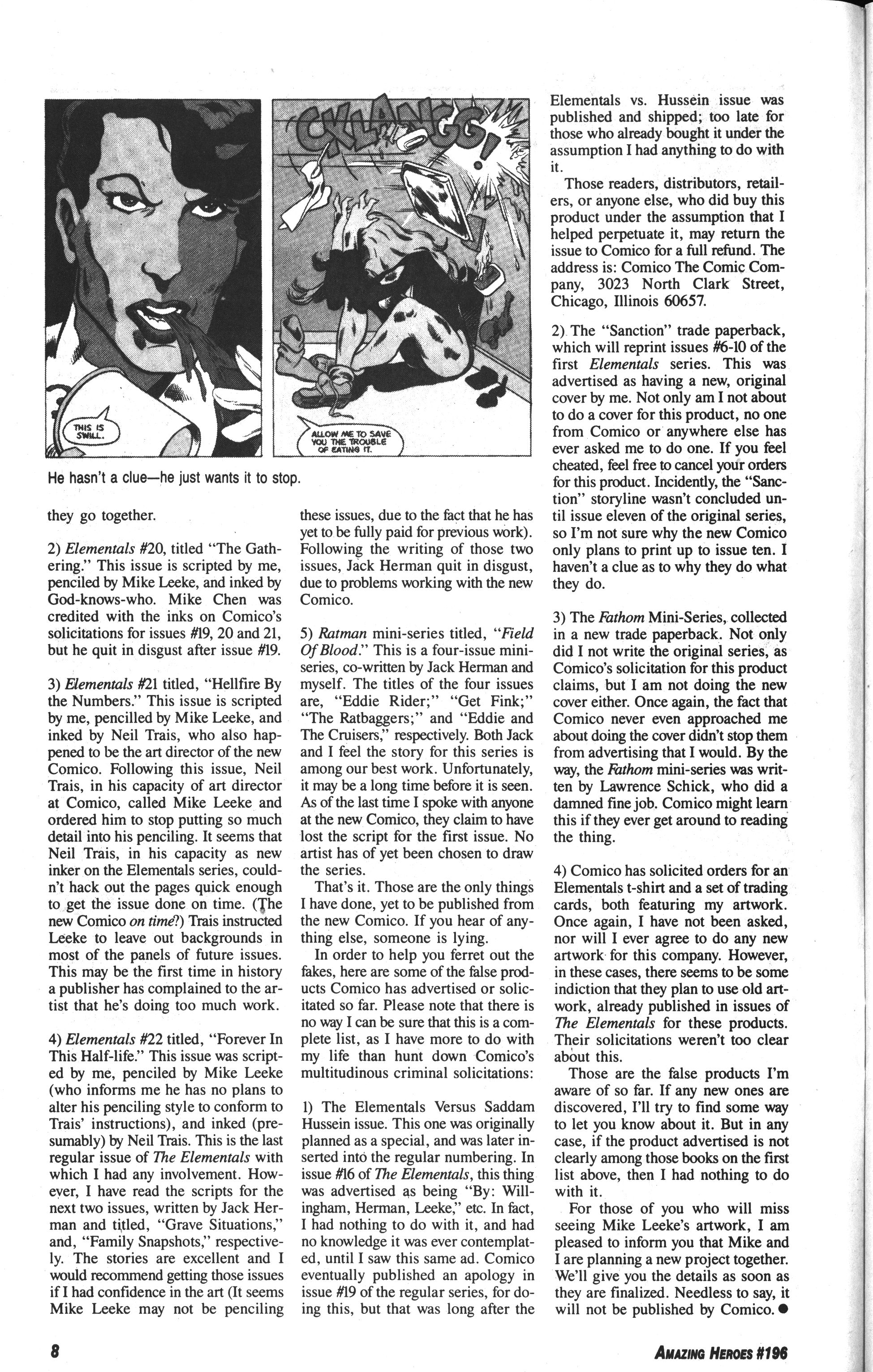
make absolute most use of the paper available. In those
days, as far as we thought about it, was just gang printing
two books at once.
So Comico in those days couldn’t really afford to sign
another outside talent, so it fell to one of the four initial core
group of creators to create this new book for color
distribution where we had been black and white before.
And I by default was the one who had the least amount of
negative fan mail on Grendel, so I got the golden ticket to
do up a new series in color and that turned out to be Mage.
I returned to this thought of kind of Arthurian legend
interpreted in modern day. At that time I considered
Grendel as kind of a failed experiment, like “All right, tried
that, didn’t quite take off, got this other opportunity. Let me
face forward and move ahead and approach that.”

Graphic Nonsense #2, page #7:

Well, originally with MAGE I had been adapting
the arthurian Tales along the lines of a super-
hero, futuristic, in fact it looked awfully like
the king Arthur that eventually came out in
(DC’s) CAMELOT 3000, and when I read that DC
were going to do that I shelved the whole pro-
ject, but when CAMELOT eventually came out I
didn’t really like it and felt I could do some-
thing different because basically here we just
had the legend of Camelot with space-guns and
I realised that that wasn’t what I wanted to do,
tell the same old story all over again, I wanted
to add some of my own personal attitudes and
reflections, so that’s when I decided to go
more for using the archetypal motives in legends
instead of the exactitudes, which is why we didn’t
have Guinevere or Lancelot in MAGE, we just had
the people that fulfilled the major roles.

So Mage spun out of Wagner being into Arthurian stuff, but then Camelot 3000 came out, so he had to drop his original project. And then the Comico guys needed, quickly, a new colour comic book to print to not lose money, and viola: Mage!

Saying that, though, might have made for a slightly less enthusiastic editorial introduction…

All the issues have a chapter title page like this. Kinda stylish.

That looks really good — but we’re starting Mage just like we started Wagner’s Grendel series — with two guys sitting on the ground somewhere and talking. I guess sitting in an alley is a variation from sitting on a rooftop…

It’s clear from the start that this is going to be a more humorous book than Grendel — I mean, not in the overall (extremely serious) plot, but in scenes like this that show a lot of comedic timing.

But what’s up with the colouring? I like it a lot, but I’ve seen a lot of people talking about it as The Worst Thing Ever. And it’s certainly original — it’s very smudgey looking. But there’s a reason for that:

The photostat paper that was used had a polymer base that made the gray-line very durable and stable. They would not shrink or warp when the color, which was usually water based, was applied.

Unfortunately, the surface of the paper was not absorbent at all. Painting with translucent watercolors and dyes was difficult, often creating a streaky or smudgy look especially in areas requiring larger coverage.

They used this very labour intensive method to do the colouring. No colourist is credited in the books, but I guess everybody at Comico lent a helping hand, or something?

I think it’s a really interesting look — it’s gritty and dirty — especially in the first issue, which is printed on some kind of high grade newsprint. (The other issues are printed on a cream coloured (but higher grade) stock.)

Oh yeah, the story — I like how it’s being revealed — lot of intrigue from various intriguing characters.

Wagner tries a lot of differently things, storytelling wise. These shifting perspectives during a dialogue scene work well, for instance, but in other scenes, it can be hard to tell just what’s going on.

Early Comico issues had the worst cover numbering ever. They use random colours for the logo and text. Sometimes it’s easy enough to tell what the issue is, but sometimes it’s nigh impossible. I’m glad they redid this scheme after a while, because it’s just a pain to deal with.

“The artist should, instead, seek to tame the public with the raw essence inside him.” Uhm… yeah, ok.

See? Whiter paper in the second issue. The colouring looks starker here, but it’s still works.

Unfortunately, Wagner starts infodumping a lot, which is something that continues until the next to last issue, really. One letter writer complains about not a lot happening in each issue, and how the lack of captions means that Wagner has to show everything instead of talking about it — but there sure is a lot of talking about things in dialogue form instead.

Wagner does this zip-a-tone thing only once? I guess he was getting bored.

There was a long fight sequence in Grendel that had a dialogue scene going on over the right-hand pages, and then a fight scene on the left-hand pages, and that worked very well, I thought. Apparently Wagner thought so to, because he repeats the format in Mage.

Heh heh. The look on his face.

Wagner has the characters dropping mysterious hints about Kevin Matchstick’s (that’s the bearded guy) real identity. What can it be!

I appreciate that they have the characters explain things to each other this way — it’s certainly very effective. But it makes this setting seem paper thin: It feels as if Wagner is putting everything on the page; it doesn’t feel like we’re in a well-thought-out world, really. There’s just these elements needed for this story, and we’re being told what they are.

I think what Wagner is saying this time around is that it’s just easier to draw himself, because he can just use himself as a model? I’m not sure.

Whoah. That’s very Sam Kieth-looking, isn’t it?

Wagner was ahead of his time. These days, all characters need to have a traumatic background (i.e., “depth”), but that wasn’t really the case in the 80s. But Matchstick gets one — and it’s that he… killed his pet dog when he was a child?! Well, ok then.

Another way he was ahead of his time (but seriously this time) is that there’s no recapping: This is a complete story that reads like a complete story. There’s a short recap of the previous issue on the inside front cover, but no in-story reminders, which was unusual at the time even for things that were meant to be limited series. Take, for instance, limited series published by Epic Comics at the time — recap-o-rama in every issue.

This was never published, and this is the first I’ve seen of any artwork for it. Looks good.

Aha! This is where I came aboard as a teenager — I think I’d read a positive review, possibly in The Comics Journal? So I started reading here… but I think I bailed again after a few issues?

But I remember this issue quite well, at least — it’s all set in a prison.

“In process color on enamel coated paper”. Back in the 80s, people were very into paper quality.

And wouldn’t you know it: Sam Kieth comes aboard as the inker! It seems a natural choice, since Wagner’s artwork has the same kind of vibe, sort of. Very inky.

The first issue with Kieth looks pretty much the same as the previous issue, really.

Except that they start running these annoying ads in the middle of the story. I’ve never understood why they’d do something like this — it really distracts you from what you’re reading. And since these are all internal ads, they didn’t even get money for doing it. Ugly ads, too.

Is it to seem more like a “real” comic book, since Marvel and DC does it this way?

Mage also gets a back-up feature: Grendel. The first four-page part is a recap of what happened in the original three Grendel issues.

I like the look of these pages — very art deco — but this sort of non-storytelling is pretty annoying, in my opinion. It’s like reading somebody recapping a story, and it continues on this way even when the actual recap is done. But what do I know — most people love reading recaps. Just get the “plot” without any of that pesky storytelling.

These back-up strips were later collected in the Devil By The Deed graphic novel.

The Scooby Gang grows, as is common in these kinds of things…

But what’s not usual is that the wizard guy says that they’re not going to torture the bad guy, because they’re good guys. These days it seems like everybody’s learned from 24 that the first thing you do after capturing a bad guy is to torture them.

But! Instead the wizard guy just lightly threatens to kill the guy by splashing water on him. Because these white bad guys die if they get water on them.

So for the rest of the series, our heroes go around with spray bottles of water, right? Right?

No.

Wagner goes on a promotional tour.

This is unheard of these days, but the Mage readership grew as the series progressed. The final issue was allegedly the best-selling one. So I guess it makes sense to do a full recap in the middle of the series.

And speaking of t-shirts…

Look what I’ve got!

No, it’s not from the 80s, but I think I bought it, like, a couple decades ago? At least one decade? It’s Graphitti Designs and everything… It’s held up pretty well. Doesn’t look like they still do t-shirts?

I really liked this fight scene — it takes place in a magical bottomless pit, and has people popping out of walls and stuff. It works very well.
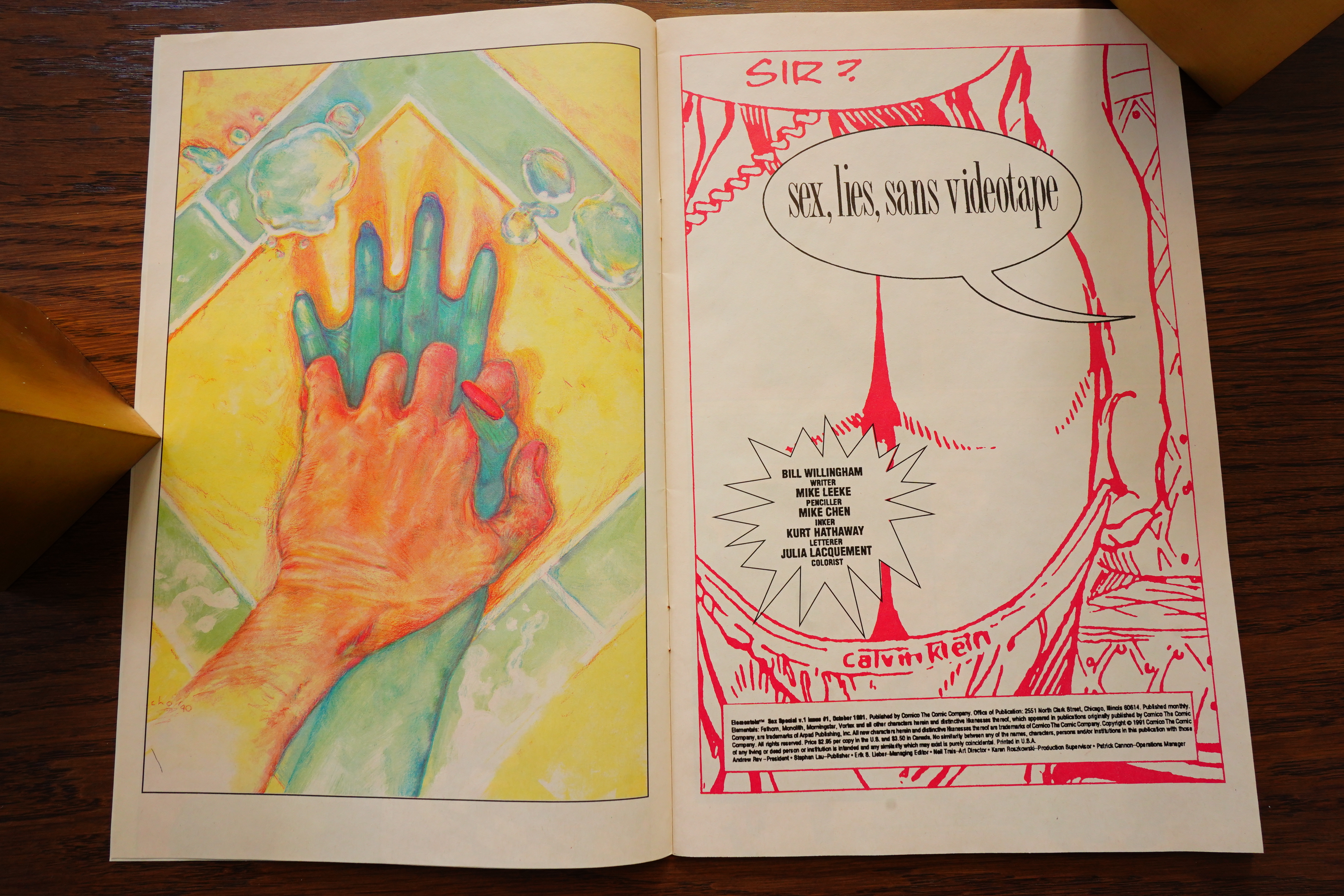
Huh.

Magebook was produced in an interesting way:

Matt had informed us early on that MAGE, likewise, would be a limited series. The idea of collecting it in graphic novel format as well became a goal.

Then we were presented with a production issue. In an effort to minimize unit costs, our comics were being gang-printed and though MAGE was a critical success it sold in smaller numbers than most of our other books, resulting in an overstock of the title to be stored.

There, warehoused on a skid, was the opening chapter of what would become our first published graphic novel.

After the first issue we began not binding the interiors of the books, storing the excess signatures for future use. After four issues of MAGE had been published we collected the signatures and the overstock of the first issue and had them neatly bound in a graphic novel format producing MAGEBOOK for merely the cost of the cover and the binding.

MAGEBOOK was a collection of the original print-run of the first for issues; ads, letter pages and all. Due to its success, we repeated the process for the second volume which has notably larger size dimensions than the first volume because of the availability of trim area that was lost on the first volume due to the first issue of MAGE having been previously trimmed and bound as a comic book.

Very smart and very thrifty. I can’t remember reading about any other collections being done like this? Yes, publishers have taken already-published comics and bound them into paperbacks before, but not using left-over signatures…

Oh, the original t-short had a bigger lightning?

OK, we’re getting toward the end… “The fire of doing is potentially destructive, because we are then struck with the concrete severity of what we have done.”

A year has passed, so Matchstick has grown a mullet. Because his hair had grown in the back while he was in a coma. But not on the top. I mean, it’s magic.

I was rather surprised that Wagner fridged the 18 year old kickass sidekick — because Wagner killed off another sidekick the previous issue, and I assumed that would be enough to instil in the Hero the proper Heroic Anger or something. But nope.

Oops spoilers.

“From out of that frightening (yet delightful) void that is yourself, you must dredge up that elusive energy that makes these dreams into concrete realities.” I’m using my Secret Wagner Editorial Decoder Ring here, and I think what he’s saying is that drawing a comic book is a lot of work, and he’s going to try to avoid doing that in the future. But writing comics is a lark, so he’s going to concentrate on that instead.

We enter into the final big confrontation in the traditional way — with somebody bucking up the hero. Pull yourself together, man!

And then the final issue is a double sized fight sequence — sometimes two fight scenes at the same time.

With fold-out dragons and everything.

And then it ends with a… fizzle, I have to say, unfortunately.

The next chapter didn’t happen until 1998, apparently.

Well… uhm… is Mage any good? Well, I did enjoy reading it today. I really liked the artwork — everything about the artwork, really: The line, the colouring, the many different storytelling approaches.

But the plot is just a bit weak. It seems like the series is in a stasis from the get go. It’s not that there’s little action — there’s plenty, but it comes in the form of the-villain-sends-out-challenges/they-are-vanquished, and then repeat repeat repeat until the final bit. That is, there’s no build-up, and we really don’t learn much of interest about this world as the series goes along. Probably because there’s nothing to learn — what you see is what Wagner’s figured out.

It’s pretty good? Not awesome, but pretty good.

Mage has been collected many times — first of all as the Magebooks, but also in many different forms. The earliest one was from Starblaze/Donning.

If you’ve read Coleen Doran’s Very Bad Publishers series of articles, especially this one, you’ll understand why I laughed out loud (on the inside) when I read this credits page. The first name there was the editor at Starblaze, and she had nothing to do with the contents in this book whatsoever — it just reprints the first four issues of Mage. But it’s very on brand to put herself there.

More confusing is why Diana Schutz is listed — yes, by the time this edition was published, she worked at Comico, but she didn’t have anything to do with these issues, I think?

Anyway, what I’m wondering is whether they recoloured the stories.

So here’s an original spread…

And here’s the Starblaze. It’s a larger format, but looks very similar.

Here’s a detail from the original issue…

… and here’s Starblaze. Yeah, looks identical, I think. But better originally, I think — the white, shiny paper makes everything too bright, in my opinion.

The Panelhouse #2, page #23:

Mage (Comico) by Matt Wagner.
I suppose you’ve got to give Matt Wagner
credit for getting away with it for so long.
He’s managed to forge a career in comics
based on this dirge of a series where nothing ac-
tually happens! It’s kind of hard to describe. At
first glance it doesn’t look so bad, but careful
study rewards you with a tedious, pointless, fif-
teen-issue chase scene with Arthurian preten-
sions. Wagner gives a good impression of a story
without actually having one, and the longer
you look at his bland artwork (vaguely remi-
niscent of early Frank Miller on Prozac),
the worse you realise it is. Awful twee
characters with awful twee names,
(Kevin fucking Matchstick!), dull
story, dull art. All in all the perfect j
cure for insomnia, perhaps Mage
fans (fucking hippies!) enjoy it as
a zen experience. Honestly, the
whole fat-headed farce makes me
want to puke! Gong!

Heh, heh. It’s a list of The Worst Comics by Martin Hand. It also has Skateman.

Comics Interview #9, page #73:

For example, when I did the first issue of
MAGE for Comico, Matt Wagner, the
artist, had all the balloons inked in when
he sent me the artwork, so all I had to do
was place the lettering in the balloons
according to his script. But he’d have
enormous balloons where maybe four or
five words went, and in another panel
have twenty-five words in a tiny balloon!
It’s my biggest complaint. I guess the
pencillers aren’t aware of it, and don’t
keep in mind balloon placement and where
the words will go and things like that. It’s
the letterer’s job to place the balloons in
the best place – where they’ll move the
story along.

Fantasy Advertiser #87, page #22:

MAGE #3 (Comico)
“The Mousetrap” by Matthew Wagner
I reported on MAGE #1 a couple of issues ago, and
recommended it to you; I’m happy to confirm that it is
progressing nicely, and is one of the most innovative,
engrossing comics this side of SWAMP THING.
But it anyway, if you’re into buying $1.50 comics,
that is; you get white paper, keen colouring, and a
writer/artist who’s determined to do something new
with the old hero game.
Plot you want? Well, okay, but it doesn’t sound much
out of context. Kevin Matchstick has been recruited by
Mirth, a good guy; in this episode they’re joined by
Edsel, a capable lady with a car of the same name.
Against them are five grackleflints, each with poison
spurs on their bony elbows and an individual special
power, and their not-so-dear old father, the Umbra
Sprite. And they’re all searching for that mythical,
mysterious character, the Fisher King. If he’s killed,
then the forces of darkness win the upper hand. Kevin
and his friends have to thwart the grackleflints…but
there are powerful magicks crackling in the New York
air…
It may sound hokey, but you must admit that it is
not your average super-hero slug-fest. Instead, let
me assure you that it is different; it is original,
and it is good.
-Christine Padgett

Back Issue #103, page #69:

EURY: How and when did you land in the editor’s chair
at Comico?
SCHUTZ: Not long after the Marvel Kerfuffle. I started
with Mage #6, containing the first color Grendel backup,
published in March 1985. Bob Schreck and I moved
to the Pennsylvania burbs, where Comico was located,
in May 1985.
How did I get that job? On Bob Schreck’s considerable
coattails! Bob had already begun working for Comico
in late 1984 from his home in Levittown, New York-
as the company’s entire marketing department. With Comico’s
move to color comics in early 1985, owners Phil Lasorda
and Gerry Giovinco wanted him in-house on a daily
basis, and Bob must have talked those guys into hiring
me as part of the deal.
EURY: Why was Comico’s work environment more
attractive to you than Marvel’s?
SCHUTZ: The seven-minute commute! And it was a
comfortably small company: five or six people working
out of the top floors of a creaky old house in Norristown,
Pennsylvania. More importantly, Comico was an early
publisher of creator-owned comics, a still-new idea in
those days and a political position that Bob and I supported.
People forget, now, just how hard many of us fought
for creators’ rights in the early 1980s.

Amazing Heroes #45, page #59:

Having put the literary screws to
Guardian, I was hoping to find
something a bit more palatable
in Mage. I was looking forward
to Comico’s first color comic,
expecting it would be a cut
above the rather amateurish
efforts seen in their previous
books.
It wasn’t. If anything, it was of
even lower quality than was
Guardian. Strangely enough, it
reminded me of that long ago
moment in my childhood when
I decided I would not buy Archie
comics. I found that I could read
them from cover to cover so
quickly that I felt I wasn’t getting
my money’s worth.
The same is true of Mage.
The book contains pages and
pages of nothing but silence and
sound effects. It’s just as well I
suppose. When words are used,
it is to present the most stilted
dialogue this side of a Victorian
novel; words your mind sheds
like drops of water.
The “hero” of the story-if
such an appellation can be ap-
plied—is one Kevin Matchstick
(!). Kevin is full of more self-pity
than the Thing in his darkest
moments. Since we see nothing
to engender such pity, the man
comes off as a whining bore.
Kevin strikes up a conversa-
tion-God knows why-with a
stranger on the street. The
stranger happens to be the
Mage, who-again for reasons
known only to God (and, one
hopes, Matt Wagner) — endows
Kevin with super powers.
Totally against his will, Kevin
is thus drawn into a conflict be-
tween the Mage and deadly vil-
lains known as Grackleflints!
Does it make any sense to you?
Me neither. Do you care?
Neither did I.
A disjointed story, forced
dialogue, and unimaginative art
do not make for a big time win-
ner. Comico’s titles have been
dropping like flies, and Mage
has only one wing to start with.
Skip this one-you’ll be glad
you did.

That’s the always-wrong R. A. Jones, and he’s even more wrong than usual, I guess. But he makes some valid points.

Fantasy Advertiser #85, page #15:

MAGE #1
“Outrageous Slings and Arrows” by
Matthew Wagner; Comico, $1.50
Here’s an interesting item – a 30-page
story, in laser-separated colour on a
Mando-type stock, that defies any easy
categorisation.
Colours are subdued and moody, a good
support for solid, workmanlike art. This
may or may not be a superhero comic, it
could go a number of ways–our protagon-
ist, the delightfully named Kevin Match-
stick, happens to be wearing a tee-shirt
with a lightning bolt insignia, which is
useful for the cover. But what of Mirth,
the World Mage? How did he give Kevin
his power? Who’s controlling the poison-
spurred Grackleflints?
This was the first Comico book I ever
picked up, and it’s left me hungry for
more, and to see what happens next – our
hero has just been chucked out of the
window of the subway car, straight into
the path of an oncoming train that’s no
more than four yards away, making the
large “To Be Continued” tag surplus to
requirements, somewhat…
I love the opening sequence, too, the
first meeting of Matchstick and Mirth.
In fact, I like the whole thing; it has
more to do with the 1980s than any other
normal-format comic I’ve come across for
years. There is, in more ways than one,
magic here.
-Chris Padgett

Comics Scene Volume 1 #3, page #56:

The success of Mage gave Wagner the
opportunity to bring Grendel back. “Start-
ing with Mage #6, a fuller more elaborate
retelling of the Hunter Rose-Grendel
stories was published as a four-page back-
up,” Wagner relates. “That ran straight
through to Mage #14. I told it from a jour-
nalist’s point-of-view and decorated the
text with full page art deco illustrations.”
Although Mage sold well, issues in-
cluding the Grendel back-up sold the
most. Both Wagner and Comico were
flooded with mail from fans asking for
Grendel to be reprinted in full. The back-
up pages were compiled and released as
Grendel: Devil by the Deed, a graphic
novel with a new wrap-around cover
painting by
Wagner. So far, it’s
Comico’s bestselling graphic novel.

The Telegraph Wire #22, page #17:

DIANA: It’s pretty evident that all through MAGE there
are many references to Arthurian legend. Do you want
to comment on that?
MATT: Well, many many people have pointed that out.
I get a lot of letters on the subject. I should also
point out that many many people are pretty sure that
they know what’s going on. Some are close, some have
some points right, nobody has gotten it completely
right because they’re taking it very literally, and
I don’t take Arthurian legend as literal. It is
probably the most archetypal legend in Western liter-
ature. You can find traces of it in just about any-
thing. The places it reaches…the Arthurian influ-
ence is just immense. Not necessarily in the specific
characters intruding on literature, films, etc., but
the general plot, the general feel. It just has so
much in it: It has glory, it has happiness, it has
irony, it has despair, it has sadness. It covers
just about the whole spectrum.

Comics Interview #14, page #40:

BILL CHADWICK: How did you get the
idea for MAGE?
MATT WAGNER: Often just one little
word will be the foundation of an idea, and
you start building on it. I just liked the word,
“mage,” and started building a sorcerous
character from there. I did a few sketches
of this wild, semi-punkish-looking guy. The
Mage is toned down now, somewhat, in his
appearance. Originally, he was a little more
extravagant. And then I decided I wanted
him to be the title character, but not the main
character. And as it turned out, this main
character, Kevin, is modeled after me,
physically.
BILL: Why?
MATT: For several reasons. One, I’m a
real cheap model. (Laughter.) And I have
an easy visual reference in myself. I am also
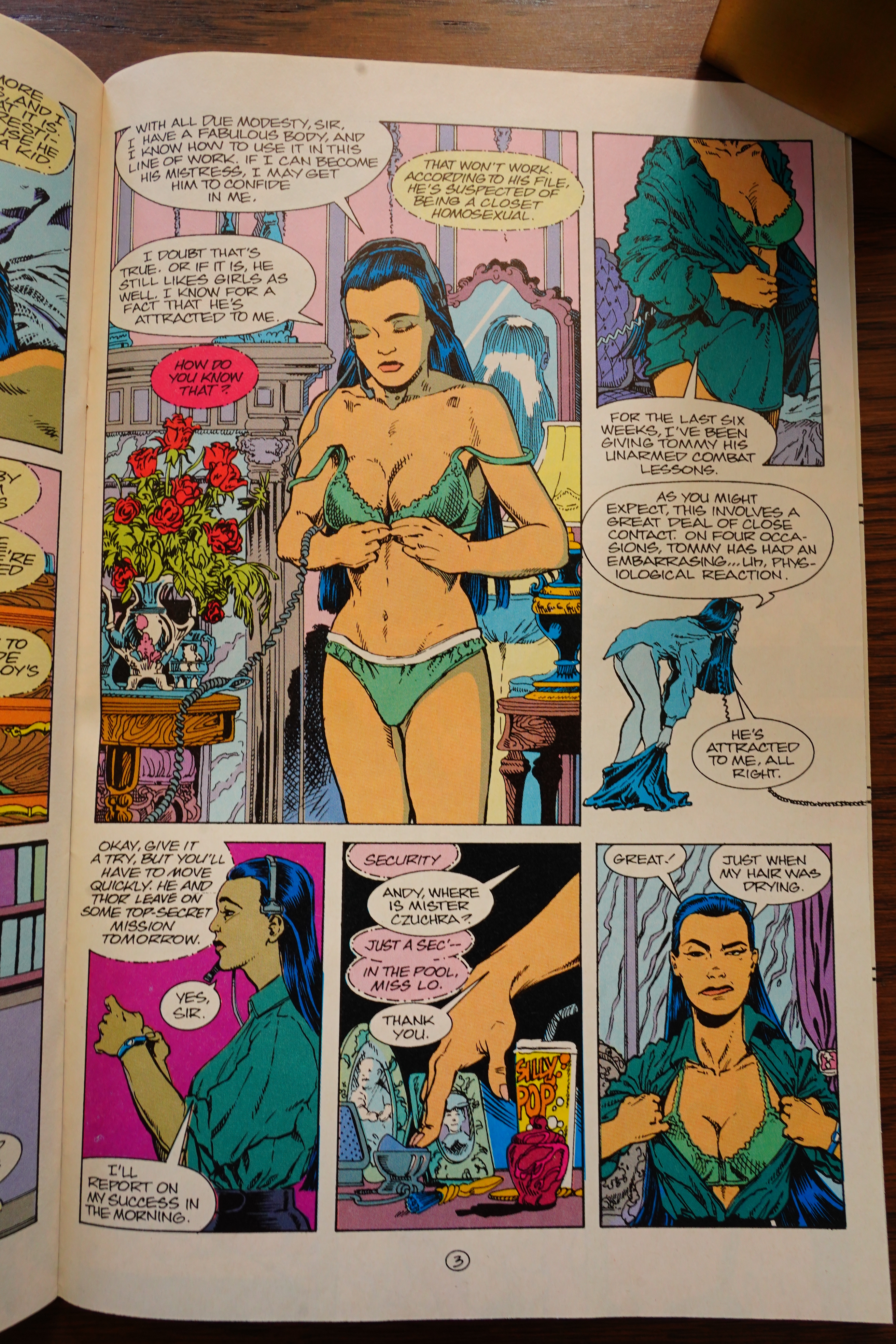
the negative counterpart of what the Mage
looks like. I’m built big and solid and a lot
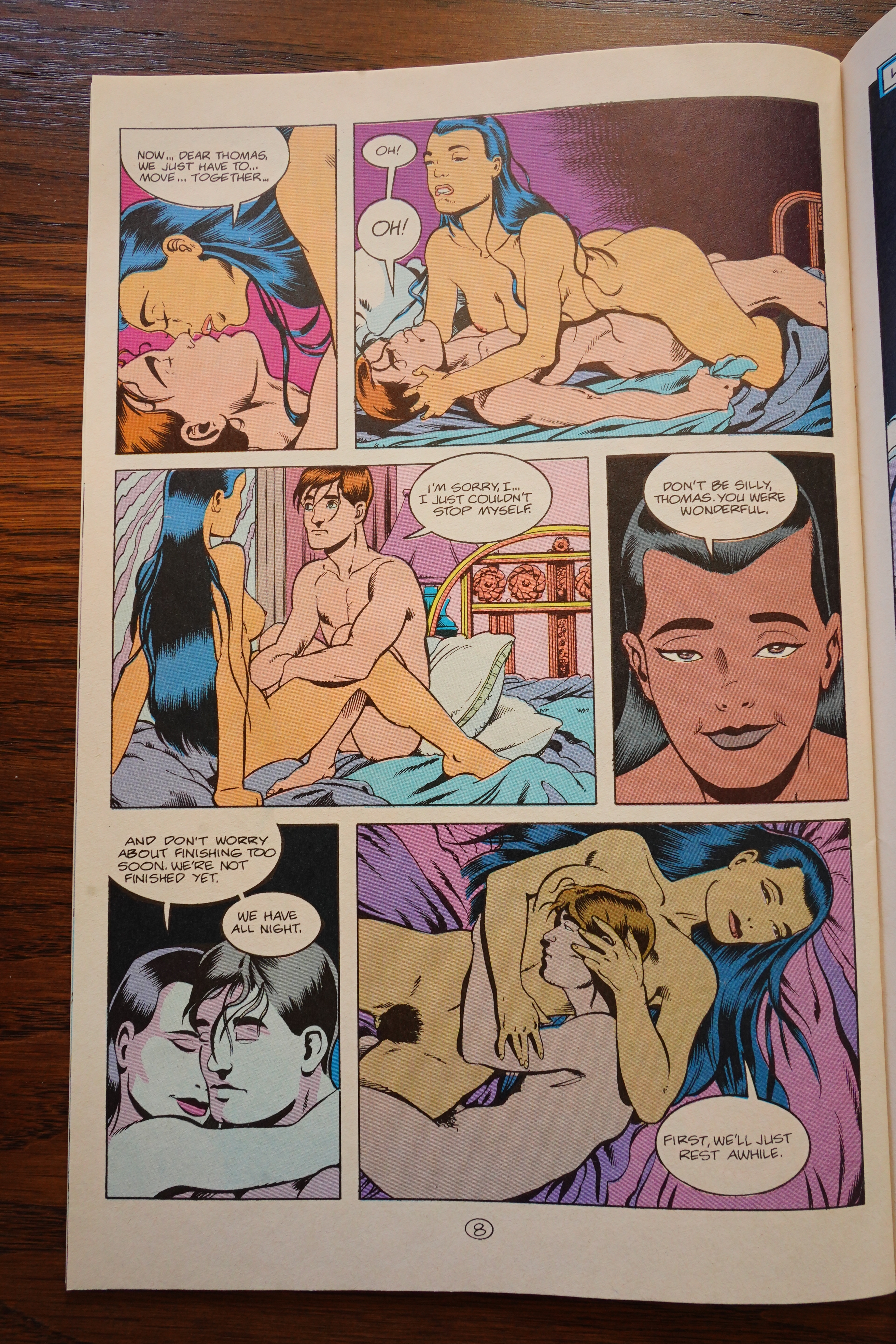
more down-to-earth looking than the Mage,
who’s little and whimsical-looking. You see,
I had started to see things happening in com-
ics that are very reminiscent of Hollywood
during the Thirties and Forties. The com-
ics industry is becoming Hollywood – that
big a business. We’re getting many stars in
the comics. There are trade journals in com-
ics reminiscent of the movie publications
that were very popular during the Thirties.
And they’re both escapist entertainments,
for the most part. The big difference is that
in comics you have no actors. You have the
characters, but you have no flesh-and-blood
counterparts to these characters. Therefore,
in comics, the creators are becoming the big
stars. I’ve noticed that the creators pop up
in comics nowadays – sometimes more
often than the characters themselves. It
seems like John Byrne draws himself into
every other issue of the FANTASTIC
FOUR. And I wanted to take that one step
farther and make the creator and the main
character the same person.
BILL: And that person is Matt Wagner.
MATT: It’s not totally biographical. Visual-
ly, Kevin looks like me, and some parts of
his philosophy are like mine. He talks an
awful lot like I do, and his mannerisms are
an awful lot like mine. He even dresses like
I do. I also give him a certain amount of my
personality, asking myself, “How would I
react if all of a sudden I was being thrust
into this kind of situation?” – if all of a
sudden somebody was doing things around
me — and I was doing things — that weren’t
supposed to happen, according to rational
thinking, and if this Mage were telling me
that I’m the hero and that I’m destined for
greater things. And so you can have an ob-
jective and subjective view of Kevin at the
same time.

Wizard Magazine #86, page #34:

After 10 years, Mage writer/artist Matt
Wagner has found a way to reprint
old and coveted issues of Mage: The Hero
Discovered, the first Mage story published by
Comico from 1984 to 1986. When Comico
went bankrupt “[Mage] film was scattered to
the four winds,” according to Wagner.
Wagner’s current Mage: The Hero
Defined from Image Comics spiked inter-
est in the old Discovered. New readers were
shut out of previous tales of Kevin Match-
stick, the modern-day representation of
King Arthur. After discovering an old
printer that had copies of the archived film,
Wagner is now “remastering, recoloring
and relettering everything.”

OK, you get the idea — there was a lot of attention paid to Mage while it was being published.

But what about on the interwebs now? Here’s one:

As a look back at some early attempts to break away from the outline of the “superhero comic”, Mage: The Hero Discovered is a fantastic piece of work.

And another:

While I enjoyed this book and will definitely return to it, I think it would have reached maximum impact for me years ago. It’s a simple story with distinct good and evil; while as the story progresses, shades of gray may come into the tale, these gradations are not there now.

And another:

Mage: The Hero Discovered #13 is a bitterweet shocker, but a transformative experience for character, creator and reader, earning 5 out of 5 stars overall. If you haven’t read it, I highly recommend that you do so, NOW.

And:

A pleasure to revisit this cult 80s indie comic, not so much for the story – Arthurian urban fantasy folderol, albeit done well – as for Matt Wagner’s delightfully clean art and storytelling, with very sympathetic inking by Sam Keith making things even smoother.

There’s a lot out there.

I haven’t read Mage II or III — perhaps I will? I mean, I’m not opposed to reading them, but I don’t really feel the need, either.