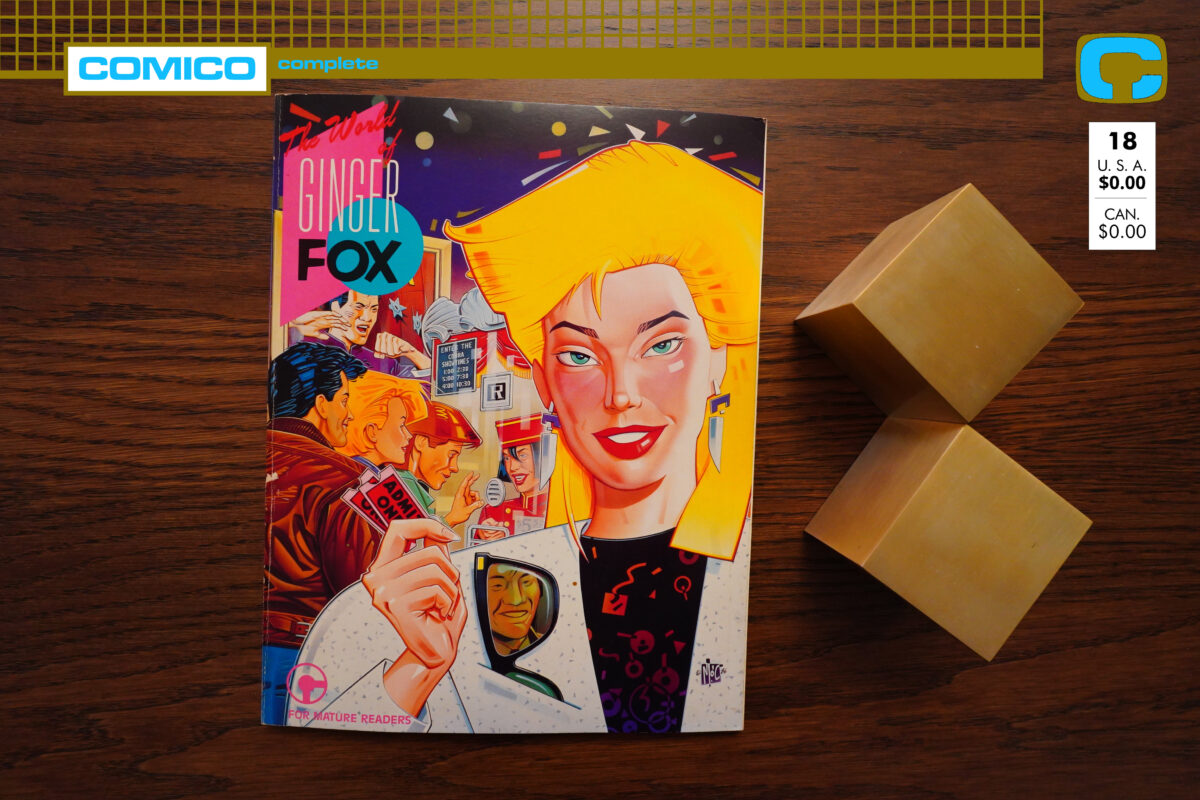
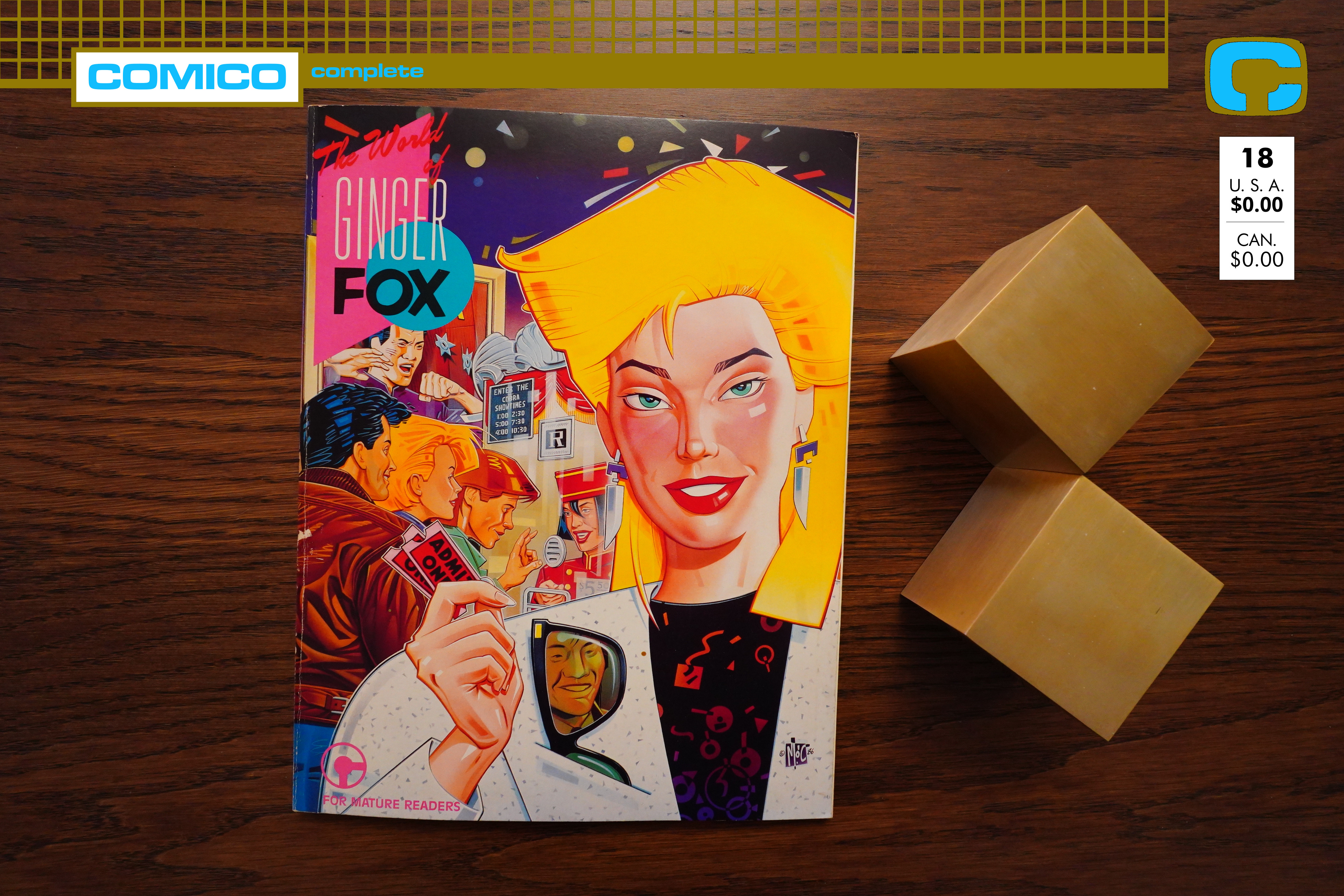
The World of Ginger Fox (1986) by Mike Baron and Mitch O’Connell
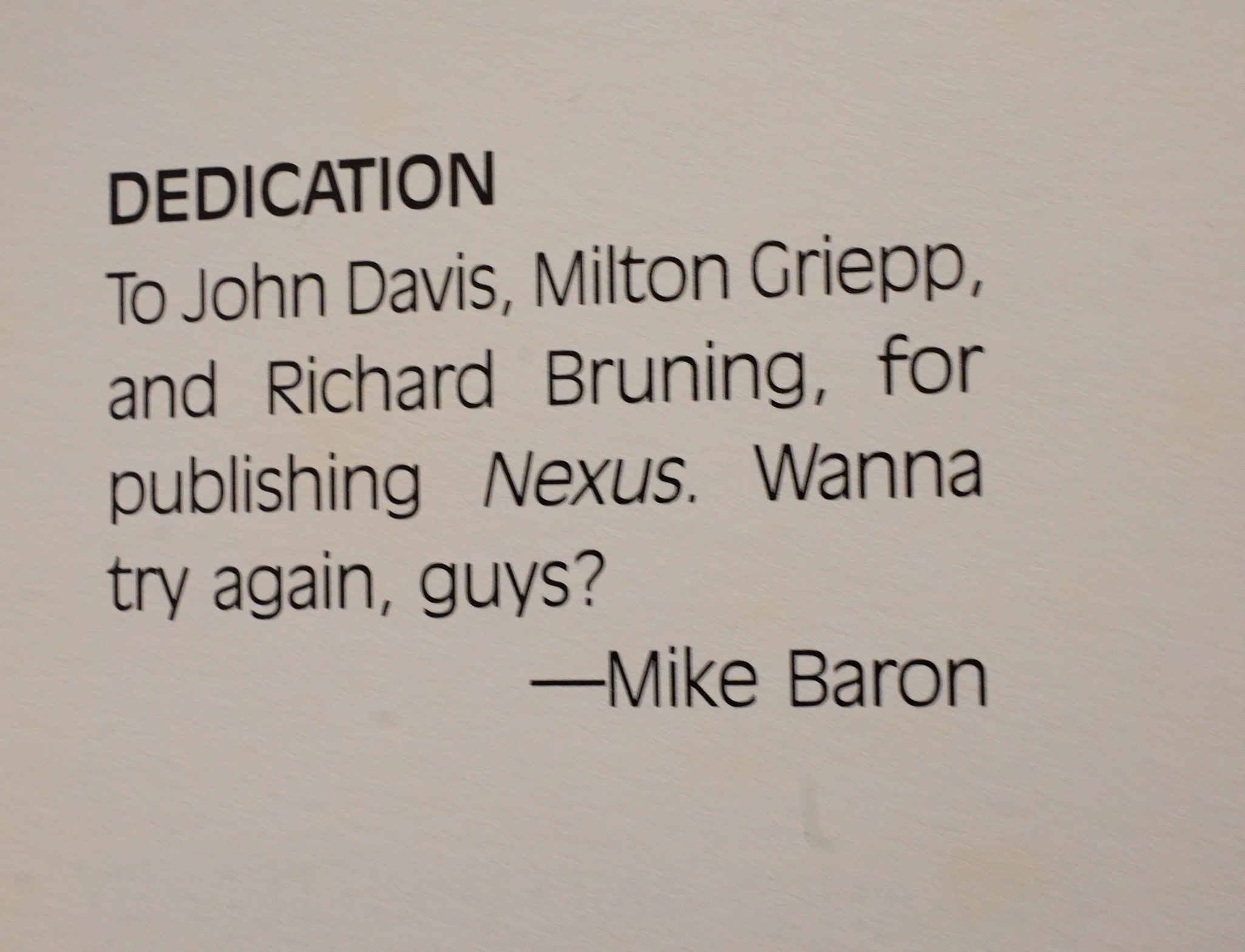
Err… That’s a weird thing to put in your graphic novel. Is Baron asking his previous publishers to save him from his current publishers or something?
Oh, hi! This is a blog post about The World of Ginger Fox, the first original “graphic novel” published by Comico. I mean, I guess you could make the case for the Robotech graphic novel being the first, but that’s a spinoff from the series, so…
Mike Baron is mostly known for his Nexus series with Steve Rude, but I most recently read the Robotech Masters series he wrote, and it was horrible. So I’m approaching this with pretty low expectations. Let’s read the first three pages:
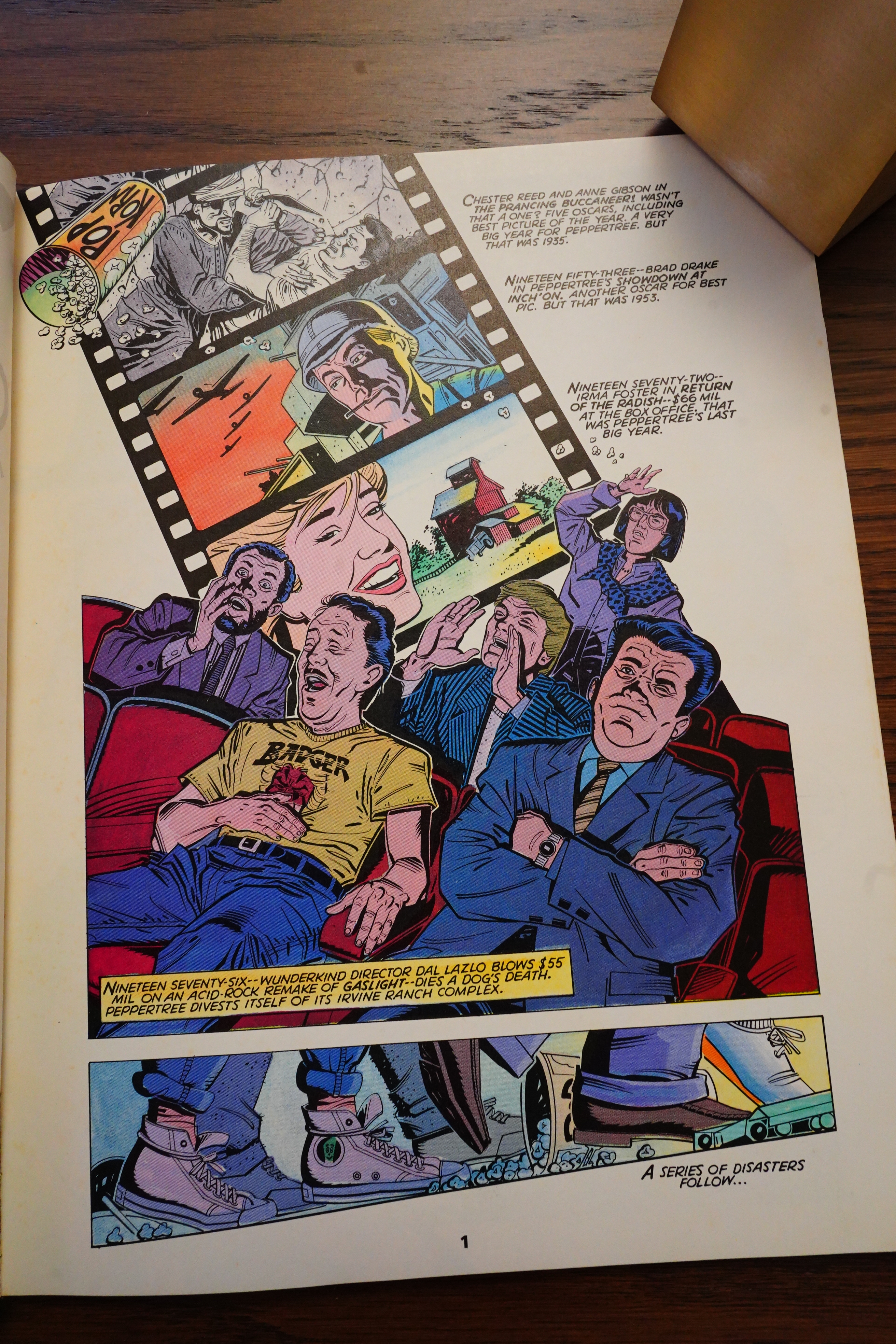
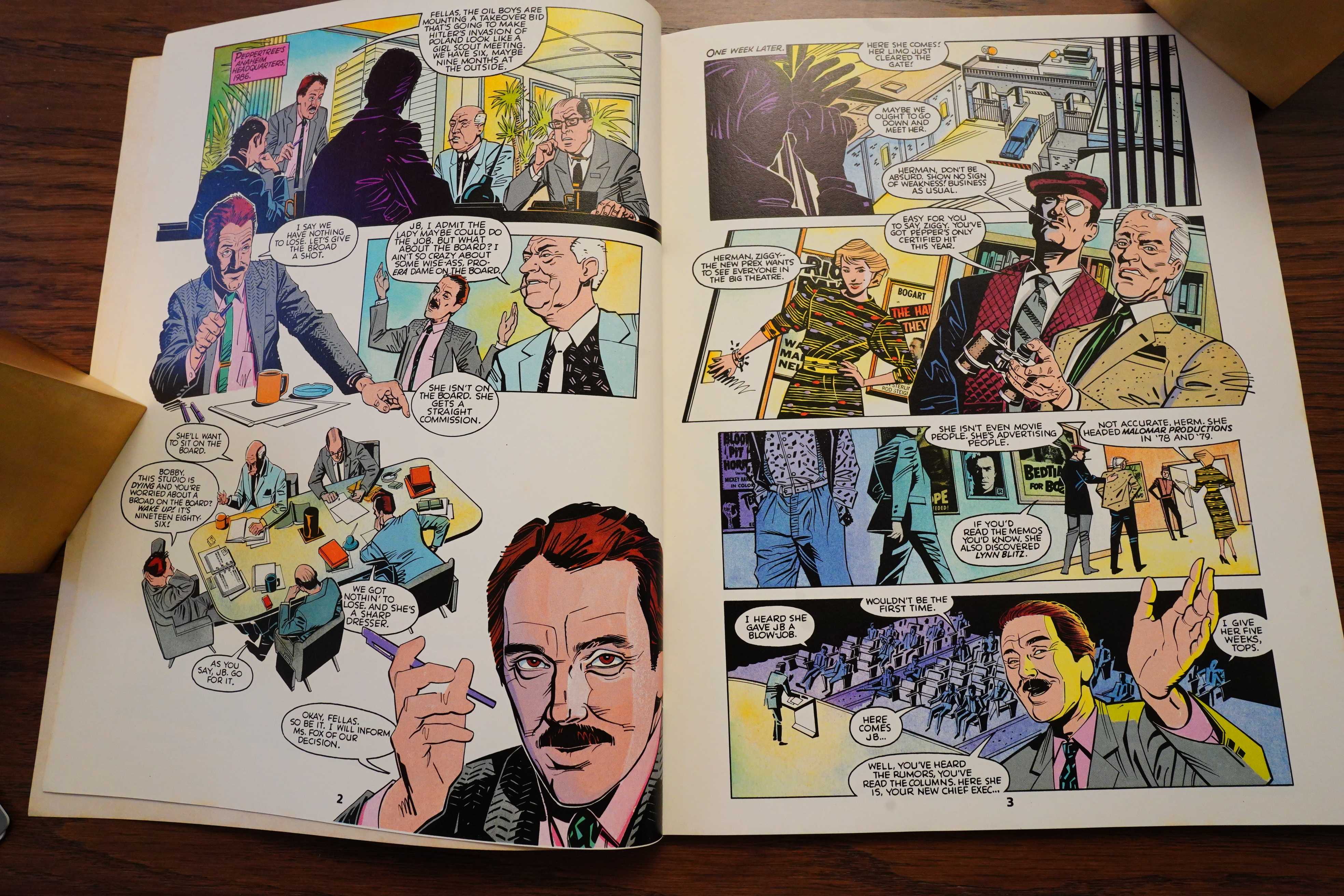
OK, I like the artwork. The name Mitch O’Connell seems really, really familiar to me, but I can’t quite place it. And I’ve got this “method reading” thing going here — I never do any research before reading or writing my take on these comics, so I have to postpone any googling until the end of this blog post.
But I think this artwork looks really British somehow? And, of course, intensely mid-80s.
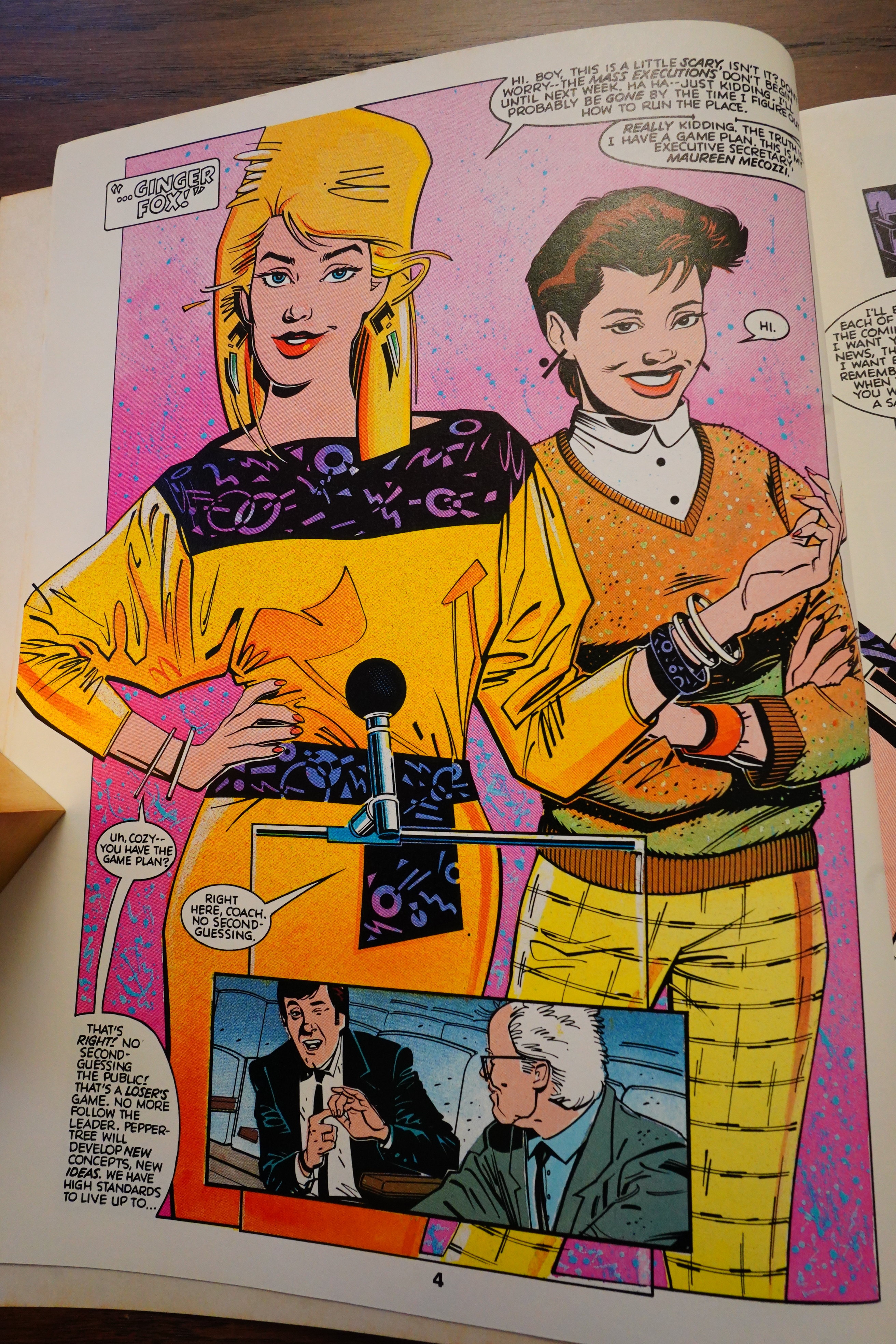
It’s like John Prentice is drawing figures based on layouts by Patrick Nagel, right? Or perhaps that’s just me. There’s also something very American about it… It’s quite attractive, though, even if it looks kinda wonky in places — like, those two faces on the women up there don’t quite belong on the same page.
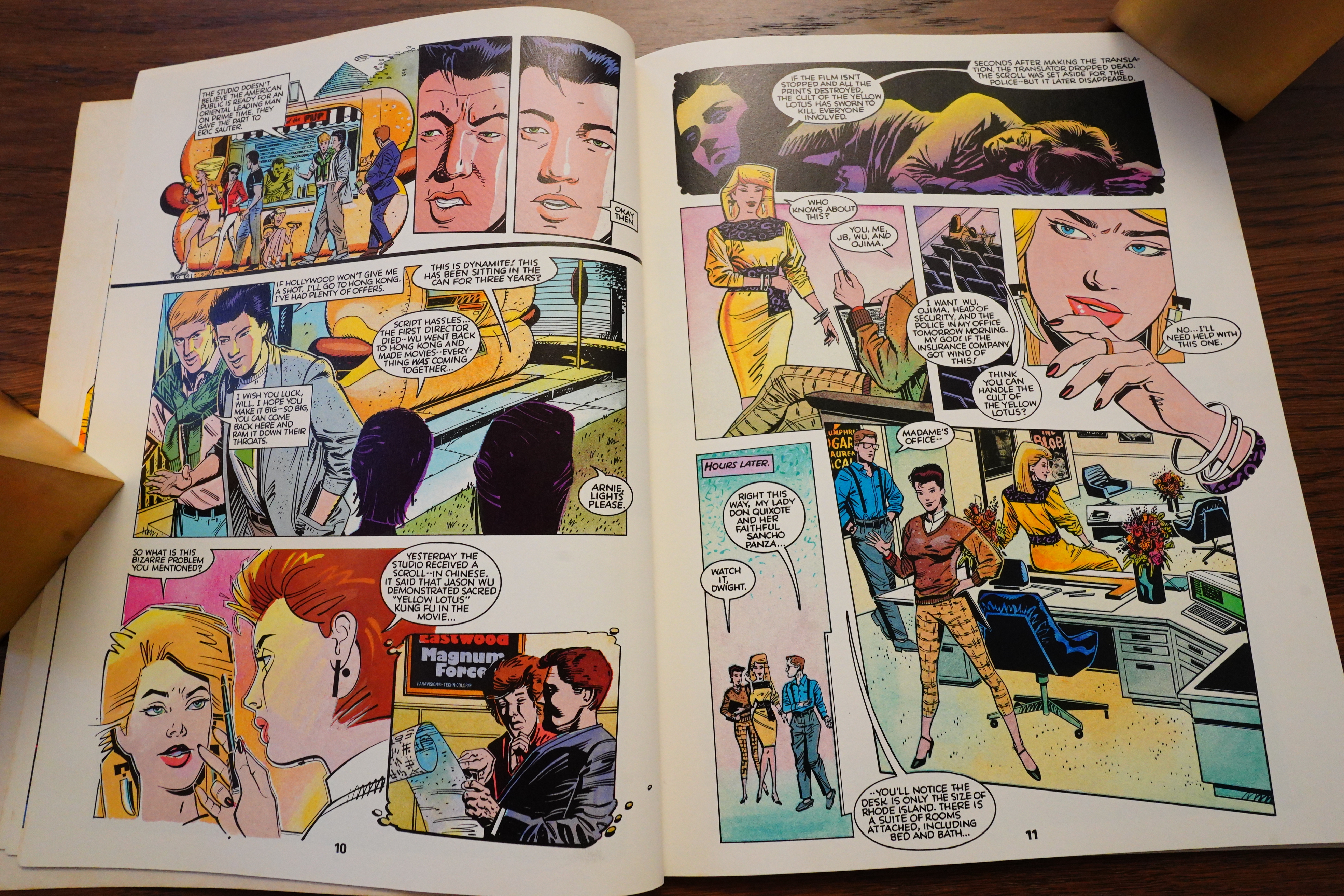
The story is also very mid-80s: It’s about a new executive (Ginger Fox) arriving at a declining movie studio, and will she be able to turn the ship around? Or is it bankruptcy time? It’s not very original, but it’s a solid, well-used premise.
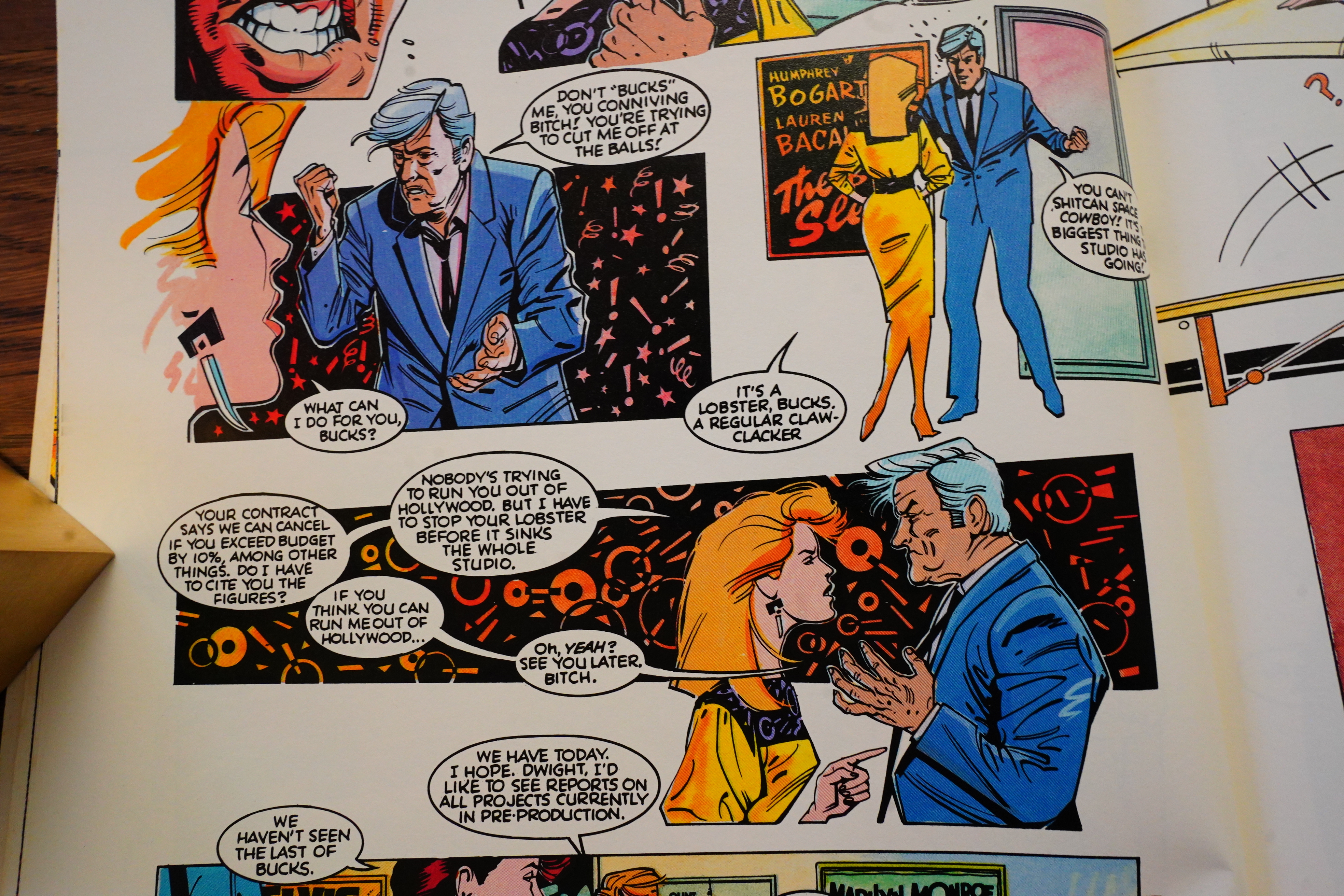
The most disturbing thing about the book is the word balloon placement. O’Connell has these rather loose panel arrangements, sometimes with borders and sometimes not, and the word balloons seem to float rather freely.
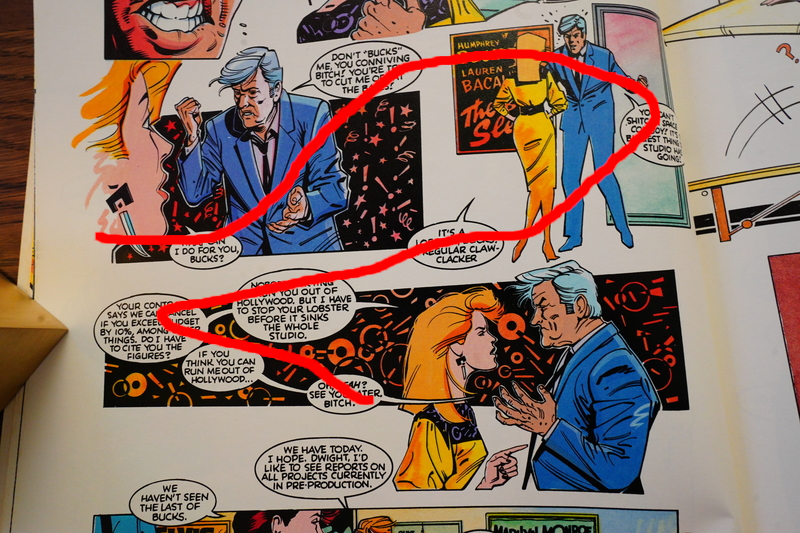
It seems like they’re hinting at a snakey reading order like this — but that’s wrong, you read these two rows strictly left to right. But then on other pages, snakey is indeed the reading direction meant — and this means that you have to reparse these pages a lot, which is tedious. I wonder whether the letterer came up with the balloon placement, and was just new at it — these things seem pretty amateurish.
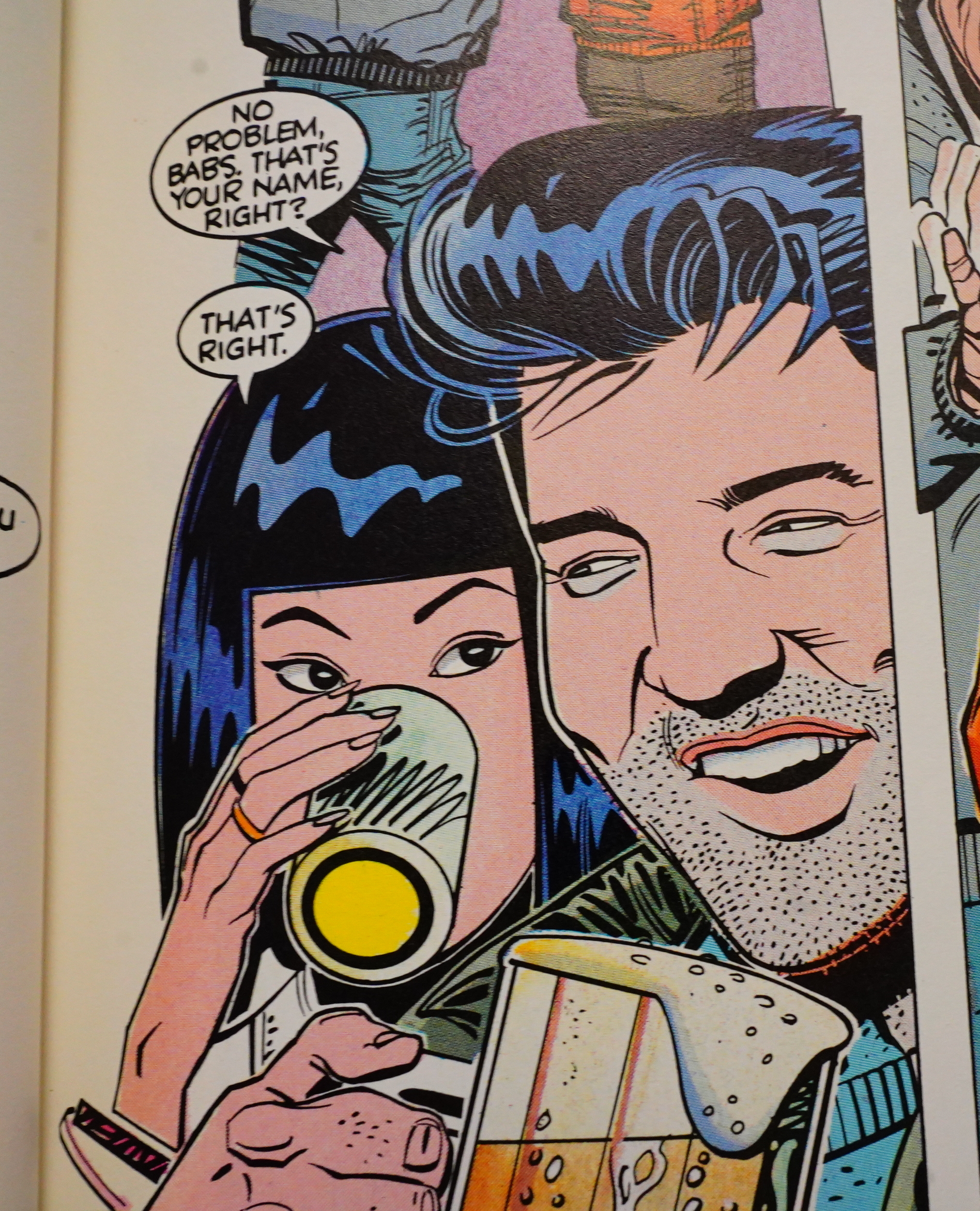
Man, O’Connell’s artwork seems so familiar… I feel I’ve seen it a lot, and in conjunction with… Raw-adjacent comics? Perhaps it’s just the Elvis thing.
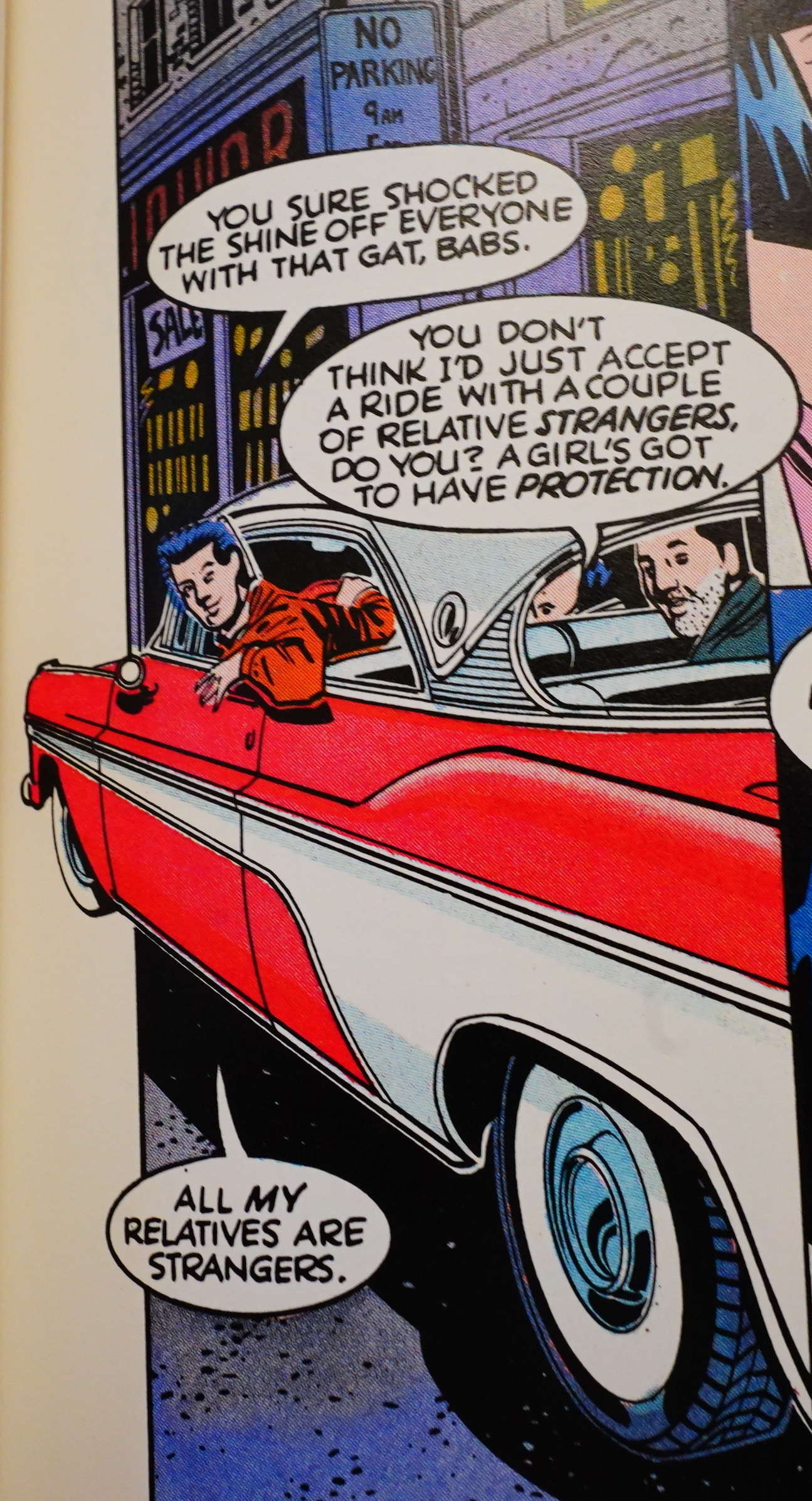
Baron tries to add humour, as usual, and as usual, it’s not exactly hilarious.
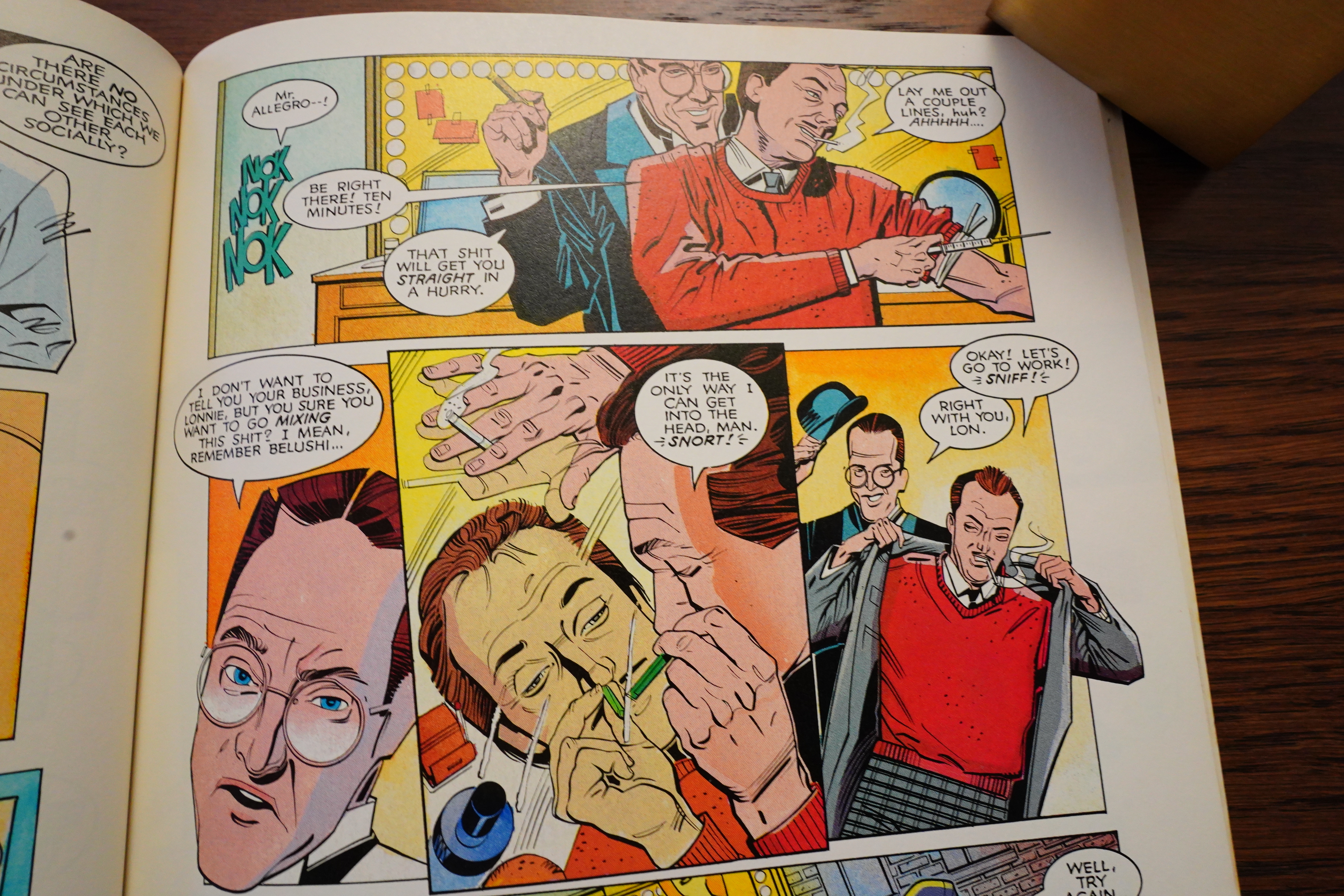
Oooh! Drugs! Oh no!!! At least he’s an efficient multi-tasking multi-user.
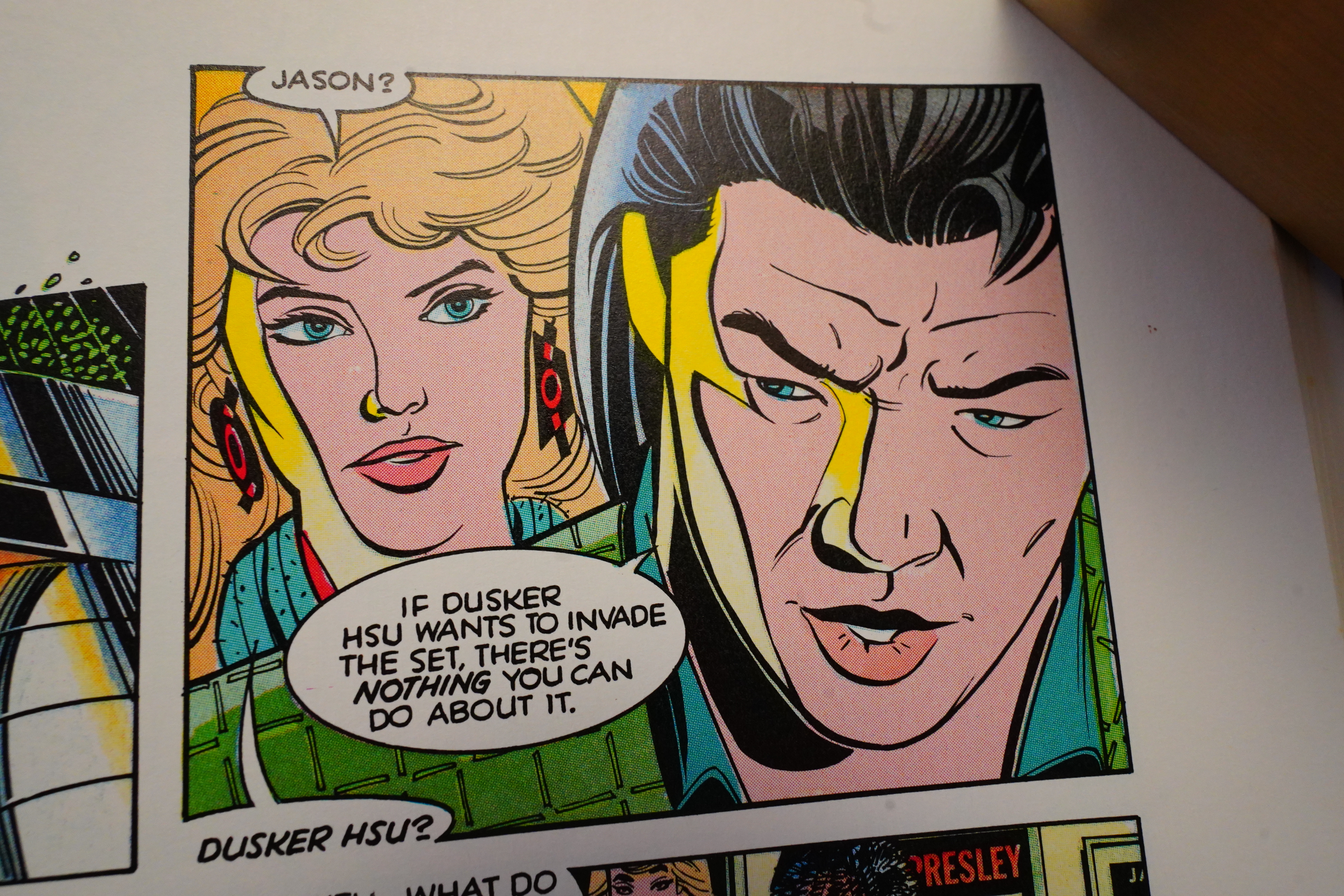
Oh yeah, I forgot to mention the plot — it’s about a secret society of Kung Fu guys who want to shut down a Kung Fu movie. The main guy is called Dusker Hsu. Get it? Get it? (That’s a Hüsker Dü reference.)
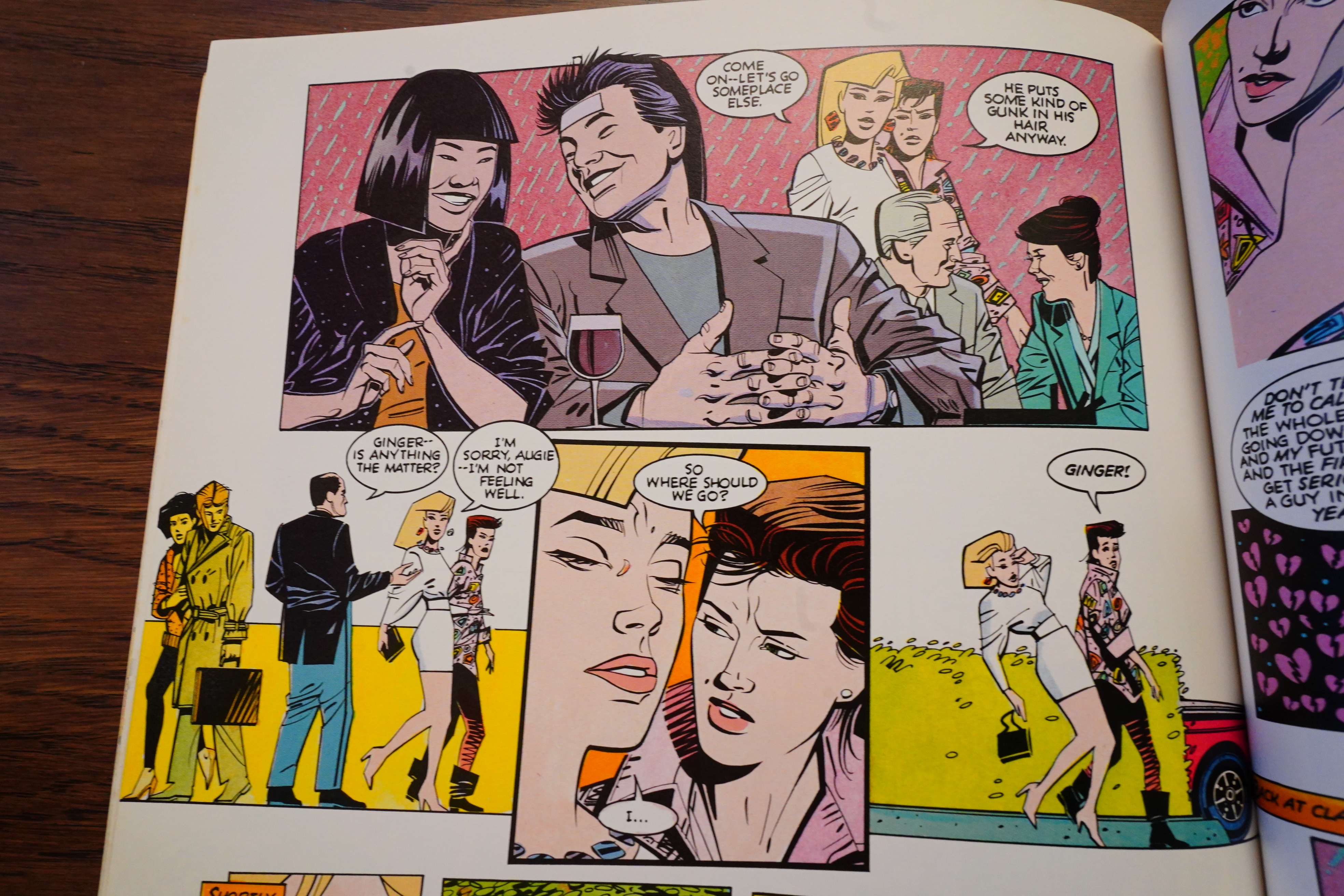
There’s also a romantic plot which has such stunning scenes like Ginger Fox fainting when she sees the guy she’s kinda dating at a bar with another woman.
The book is a bit of a mess. There’s plenty of plot going around, but none of it amounts to much. And it ends like you’d expect, with a triply happy ending.
I liked it? It’s got a breezy thing going on that’s really appealing. But it doesn’t quite work.
According to comics.org, it’s never been reprinted, which is… not that unexpected, really, because:
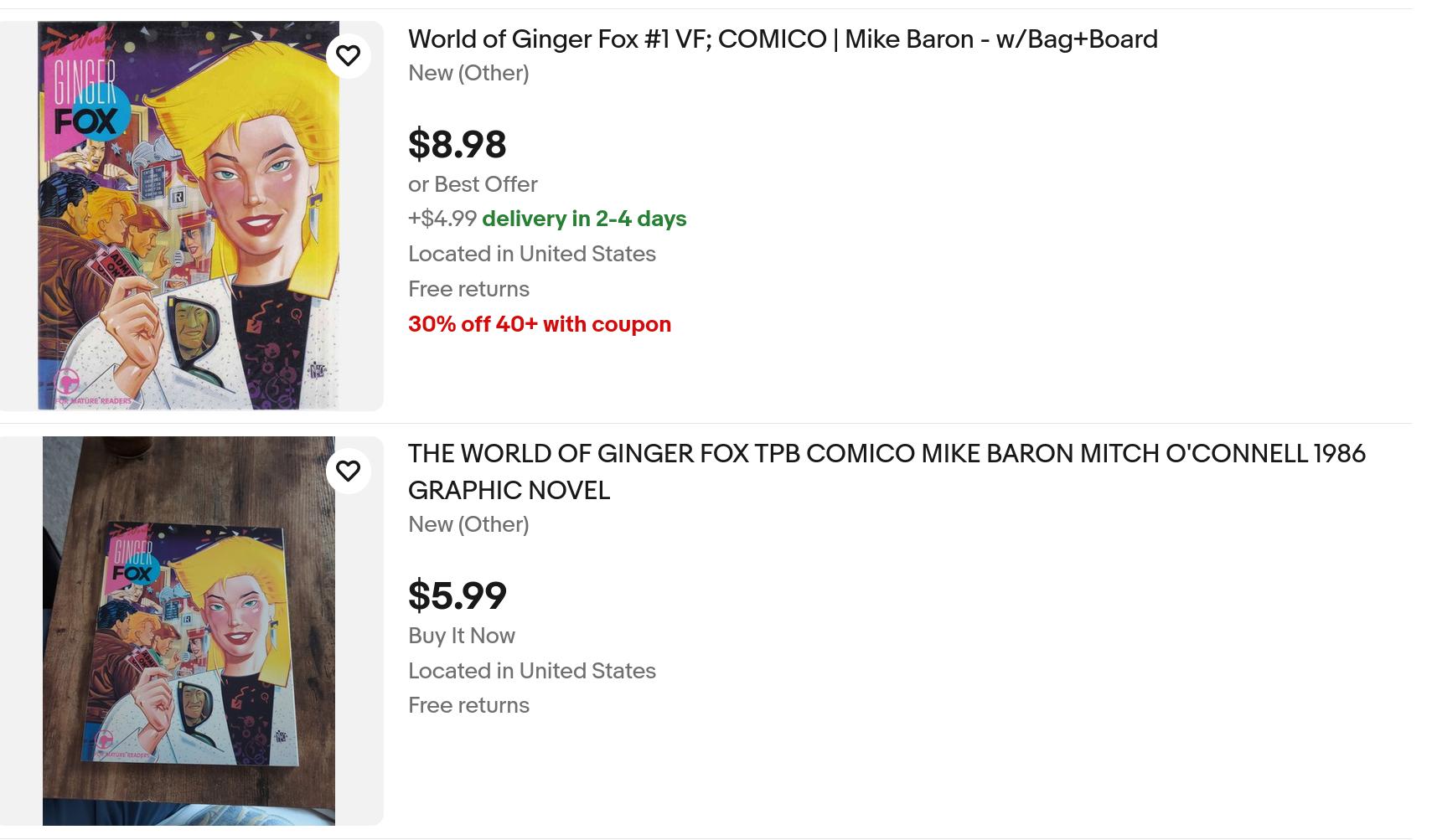
You can pick it up from ebay cheaply.
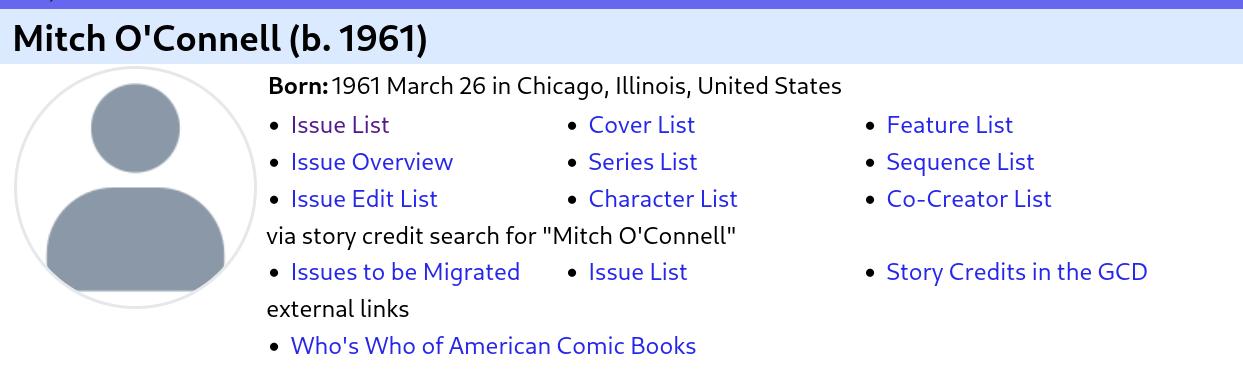
I was totally wrong about O’Connell. Too bad I can’t go up there and edit what I’ve already written because my “up” key stopped working the other day. I’ll have to live with the shame! And looking over the books he’s done, I don’t think I’ve read many of them at all.
Rob Rodi writes in The Comics Journal #115, page #35:
Comico (“The Comic Company,” as it
rather redundantly subtitles itself) recently
accelerated its slow, careful climb to market
respectability by issuing a highly-touted,
slick-looking graphic album by the popular
and almost ubiquitous Mike Baron. The
World of Ginger Fox is designed to
compete with the Marvel, DC, and First
graphic novels, and it should do the job;
it’s as attractive a package, it’s priced
competitively, and it’s about as effective.
It tells the story of the beautiful new presi-
dent of a failing motion picture company
who comes in swinging and puts everything
to rights. It’s about as dreadful as it sounds,
but it has its moments. From the synopsis
you might think it has as much to do with
movies as Dynasty has with oil or Falcon
Crest with wine, and you’d be right, but
what saves it from that depth of embarrass-
ment is that Baron gives us just enough
accessible “insider” talk to flatter us into
thinking we know a lot. (I don’t know much
about the film industry myself, only what
I read in Final Cut, but then again, that was
enough to convince me I don’t want to
know any more.)
As a fantasy about power and its uses and
abuses, as a high-style flit throught the fast
lane, and as a journal of the ins-and-outs
of corporate entertainment, Ginger Fox is
pretty lame stuff. Baron has demonstrated
before-most notably in Nexus and The
Badger, also his own creations-his unwill-
ingness to be better than his medium. For
him, comic books have an inherently loopy
surreality that tends to throw all serious
intentions into sort of garish, Mack-truck
relief. He glories in the kind of goofball, seat-
of-your-pants sensitivity that, paradoxically,
makes his work seem almost enlightened,
as if he’s beyond all this “comics-as-art” lip-
flapping and just wants to have sort of a
high-profile gas. He’s going to be an awfully
good arbiter of our present culture, I think,
for future sociologists. Ginger Fox is so com-
pletely a product of the 1980s that in 20
years it’s going to seem hilariously quaint.
I doubt this would displease Baron, either.
But you do ache to see more from him.
I’ve complained about his blithe acceptance
of character archetypes before, and Ginger
Fox couldn’t be more archetypal. You know
what you’re in for as soon as you open the
book and find the movie studio’s board of
directors debating whether or not they’re
desperate enough to let “the broad” have
a crack at saving their hides. (The studio
is ripe for a takeover by “the oil boys.”) Of
course, with a set-up like that, “the broad”
has to turn out to be perfect. And Ginger
Fox is perfect. She comes in looking like
Christie Brinkley on one of her best days,
and announces a new plan for saving Pep-
and announces a new plan for saving rep
public! That’s a loser’s game. No more
follow the leader. Peppertree will develop
new concepts, new ideas.” This is some of
the most trite writing Baron has ever done.
You can just hear Heather Locklear reciting
it. (Wouldn’t a real CEO, given only two
months to save a studio’s hash, be talking
about shorter-term, more immediate
solutions-marketing strategies, advertising
gambits, distribution deals with indepen-
dents?)
Ginger goes on to review the list of
“orphaned” projects still in production; she
kills one outright, a cheesy space-opera,
incurring the wrath of its director, and
“adopts” two others. All are over-budget
and late, but she uses her instincts to tell
her which to dump. And of course, her
instincts are perfect. The director of the
space-opera turns out to be a vengeful,
unforgiving type who tries to sabotage the
studio and all of Ginger’s hard work.
Wouldn’t it have been more fun if Ginger
had been more of a self-centered, don’t-fuck-
with-me-I’m-always-right sort-if some of
her rough-riding over her auteurs were
shown to be as fascistic as their work was
masturbatory? If she had a few freakin’ flaws,
for Pete’s sake? But no, she has to be an
ideal-with youth, beauty, guts, savvy, great
clothes-and, hey, she’s sexually active and
a great mom. Saint Ginger of the Corporate
Ladder. (In the midst of her troubles, she
even arranges an audition for her actress
housekeeper; Mary Poppins ain’t got nothin’
on this gal.)
She’s pretty much a cipher as a result. She
falls for one of her actors, a Bruce Lee-type
who’s starring in an action film called Enter
the Cobra (which, from the confusing selec-
tions we’re shown from it, seems to be
autobiographical), and you think it might
render her human; instead, this actor turns
out to be perfect too. But then, he has to
be. Ginger loves him. (However, being a
perfect CEO, she won’t date an employee.
Integrity can be a harsh mistress.)
There are subplots about a drug-addicted
actor who is the key to one of the films
Ginger has inherited, and about a secret
kung fu sect that is out to ruin Enter the
Cobra, so that both films, upon which the
studio’s fate hangs, are in danger; and don’t
forget that pissed-off space-opera director
who’s trying to ruin her, too. So Ginger has
a lot on her mind. I could have lived
without the scene of her fainting from her
exertions and her moral unequivocacy; it
smacks of cheap theatrics. It’s only there to
put the seal on her sainthood. And it’s
sexist, too. (Would a male CEO pass out in
a tough spot? Did Lee Iacocca swoon while
waiting for approval of his federal loan?)
Ginger’s perfect kung fu boyfriend takes
care of everything, which includes kicking
the shit out of an old kung fu master and
helping the addicted actor kick the habit,
and then the story ends with the whole cast
taking in the premiere of Enter the Cobra,
which is a smash hit. Well, of course it is.
Ginger believed in it, didn’t she?
Wouldn’t it have been wittier-and more
modern-if the film had been a failure, but
with the last-minute news that its sound-
track album had sold enough advance units
to save the studio? But Baron insists on
trendy “retro” melodrama. It’s not exactly
a cynical work-Baron is never cynical-
but so much of it is regurgitated from old
Joan Crawford and Ginger Rogers movies,
where the woman at the top is better than
all the men, but so lonely, so misunder-
stood. (Comic book fans will probably be
most reminded of the old Millie the Model
comic-except that it’s 1986 and Millie’s on
the other side of the camera.) It presents the
acceptable, ’80s face of sexism. (You get the
impression that Ginger wouldn’t be as good
an executive if she didn’t dress cool.)
There are also some celebrity “cameos”
that are simply beneath mention, so let’s
not mention them.
The artwork, by Chicago commercial
artist Mitch O’Connell, is pretty, if a trifle
busy; he has a couple of neat tricks-such
as giving us panels with all the characters
shown at midsection, so that we’re aware
of their body language (an untapped source,
given the instant accessibility of facial
expressions). He has a pleasing, confident
rendering style, something like a cross
between Steve Rude and Alex Toth, if you
can even imagine it. Ginger Fox is at least
a treat to look at.
And, to borrow another movie “insider”
term, it may indeed have legs. I think it’ll
work best in about 20 years-the way we
look back at, say, Green Acres today, and
wax nostalgic for the kind of culture that
could have created such a curious thing,
even though we couldn’t stand it at the
time. Until then, file this one next to
Metalzoic and The Sensational She-Hulk.
That seems to be the height to which it
aspires. Congratulations, Comico.
That’s a very fair review — I agree with what Rodi says here, especially the “Ginger Fox is so completely a product of the 1980s that in 20 years it’s going to seem hilariously quaint”.
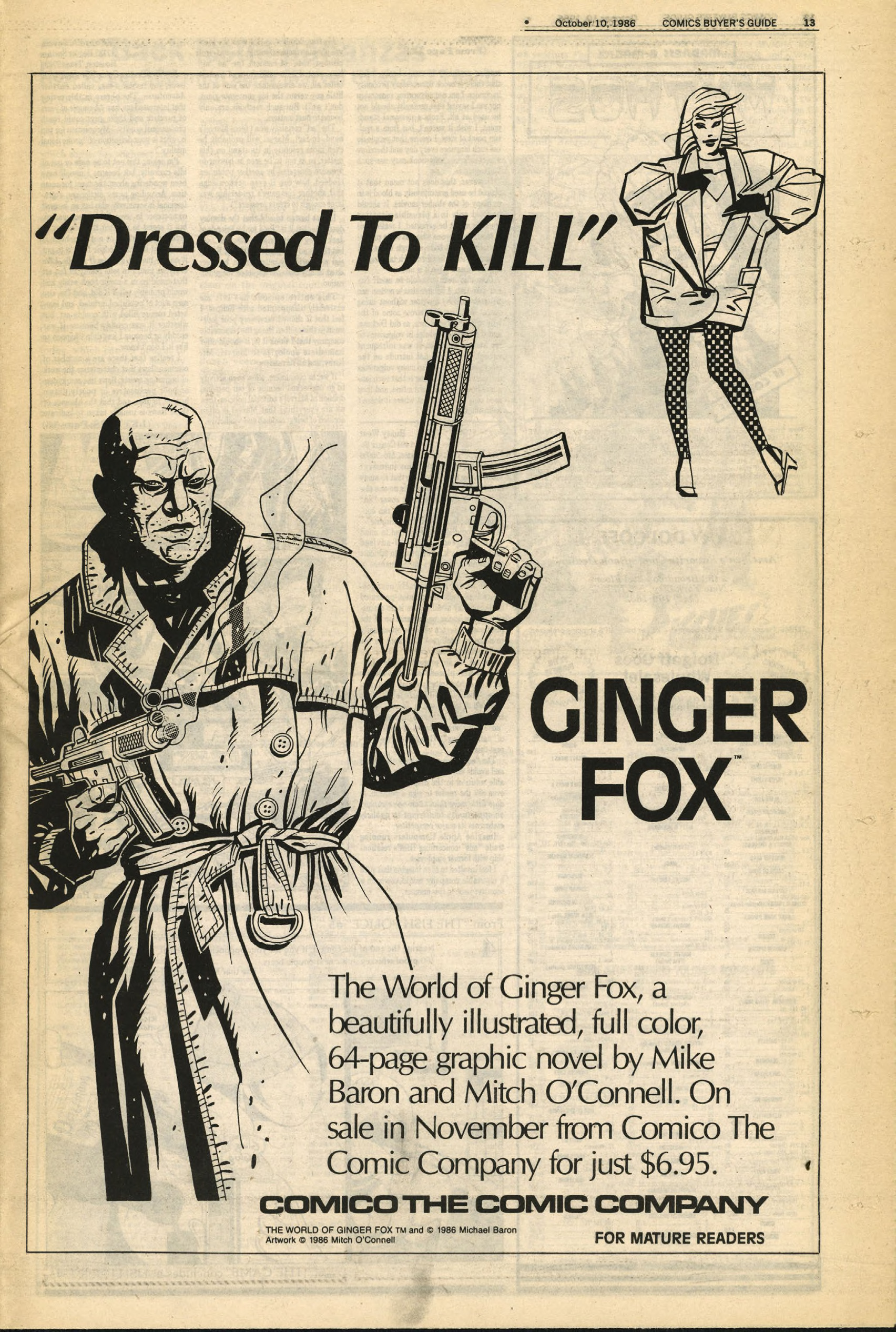
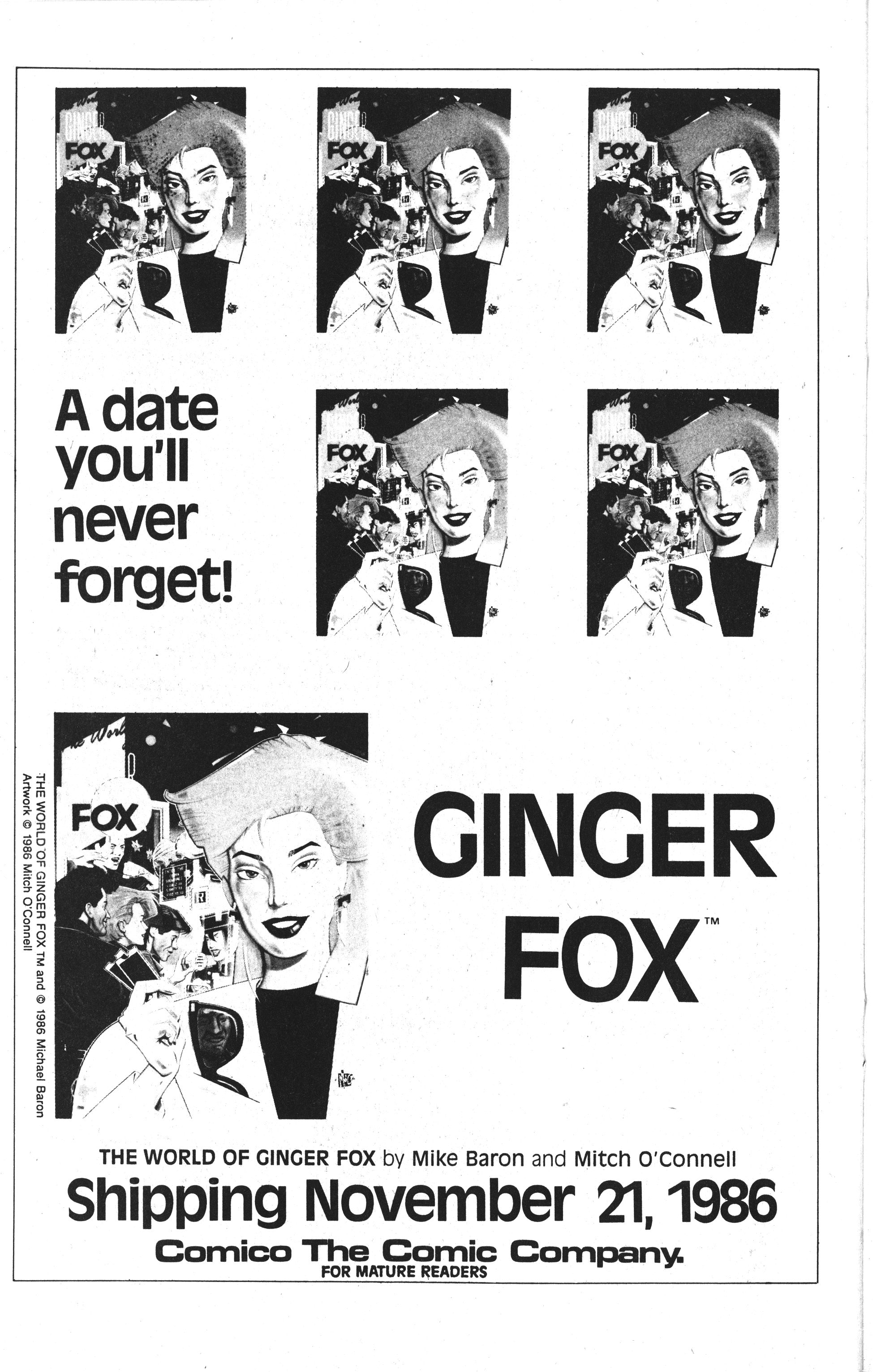
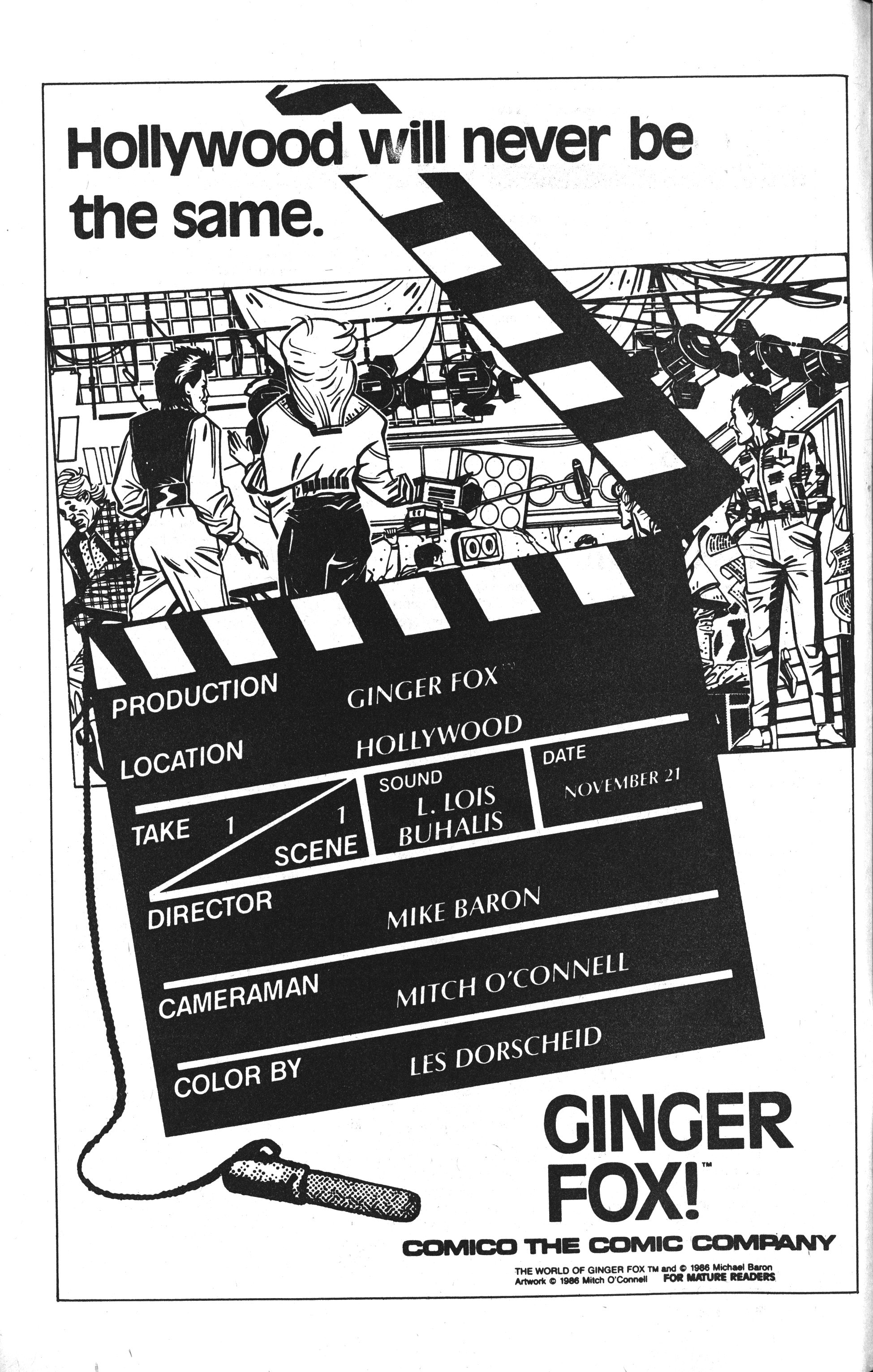
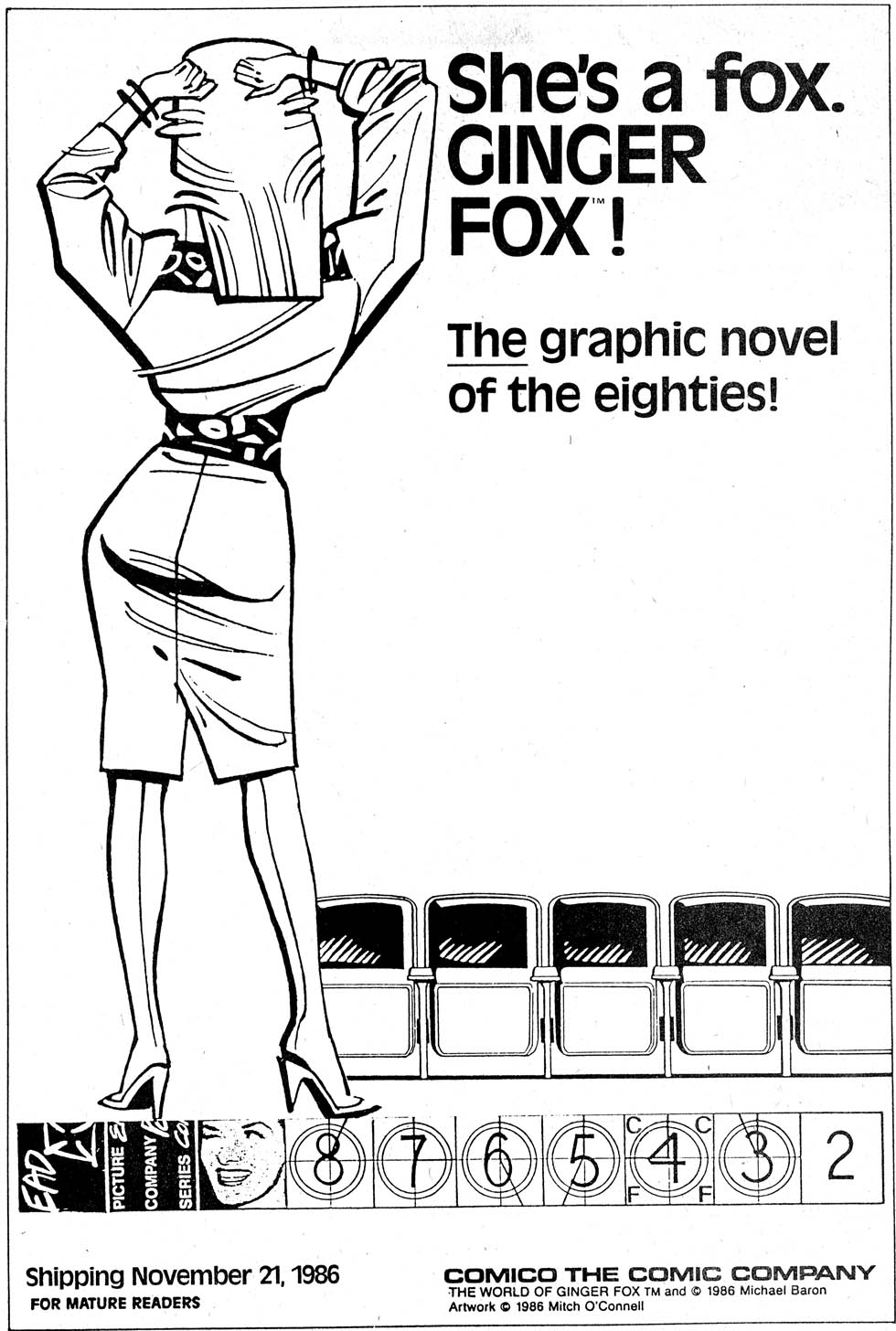
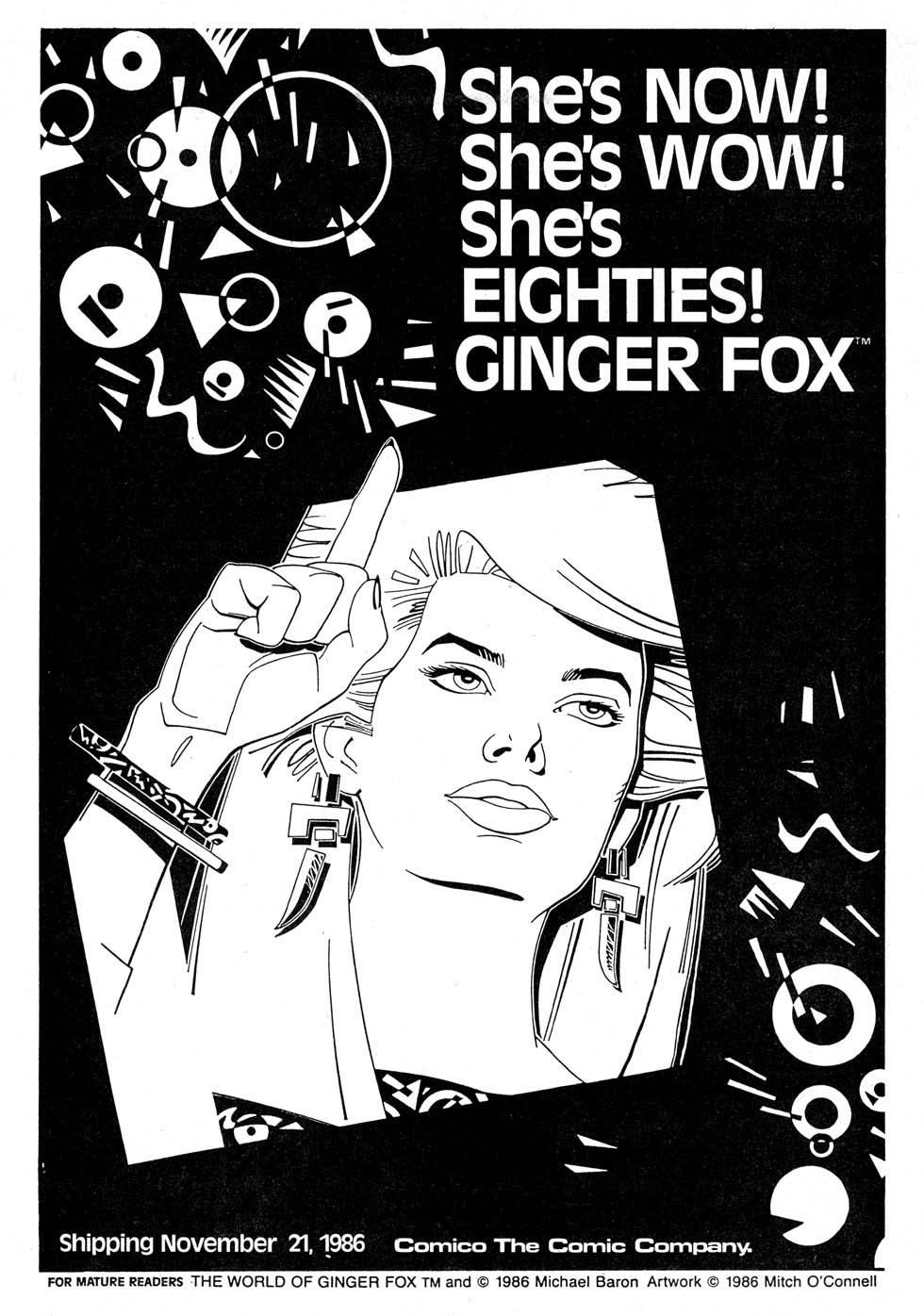
Well, Comico certainly got behind the album — lots of ads. And this is just a sample. Are they good ads? Eh…
Gerry Jones writes in Amazing Heroes #112, page #65:
This isn’t real reality. It’s
Hollywood. A glamorized wish-
fulfillment Hollywood at that.
Hyped-up, packaging-oriented, fast,
fluffy, superficial, sexy, fun. It’s also
kung fu, which isn’t real reality
either. Ritualized, baroque, violent,
colorful, predictable but suspense-
ful. It’s a weird combination. It
makes something that isn’t reality
but isn’t fantasy. It isn’t mainstram
but it isn’t genre. I don’t know what
it is. But it’s a blast.
Mike Baron-thanks to the suc-
cess of the funny, startling, chilling,
pseudo-philosophical niftiness of
Nexus-is in the enviable position of
being able to call his own shots. He
can dream up a goofy story aobut
a hot young female Hollywood
studio executive turning a kung fu
movie into a major hit and falling
love with its Chinese star despite the
interference of the deadly Yellow
Lotus secret society, and he can get
it published as a full-color graphic
novel. It’s a silly story, based on a
whole mountain of sillinesses (a
kung fu movie, especially with an
Asian star, becoming a studio-saving
hit in 1986? Who you tryin’ to kid,
Baron?). The characters are pretty
two-dimensional, the emotional de-
velopments pretty quick and conve-
nient. But what the hell. It’s
Hollywood. And it’s fun.
It’s refreshing just to see a slickly-
produced, smoothly-written, all-
color comic book about the big
world outside the concerns of funny-
book folks. Who cares if it’s as pat
and insubstantial as any Hollywood
action-comedy? That makes it a
better reflection of the world it’s por-
traying. Granted, I’d liked to have
seen more romance, more studio
shenanigans, more character stuff,
and not so many fight scenes. But
I don’t think Baron put the fight
scenes in as a concession to the
expectations of comic fans. I think
he put them in there because he’s a
genuine kung fu freak. And maybe
the best thing about reading this
story of his is sharing his own obvi-
ous fun and sense of creative
liberation.
(But Baron does pull one blunder
that should be posted as a warning
to writers everywhere: He tries to
give us a scene full of Good Writing.
The scene is a screening of Pepper-
tree Studio’s movies-in-progress for
new president Fox and her Exec Sec
Maureen. They see part of a lame-
brained space opera and laugh it into
extinction. Then they see a scene
from a “serious” movie in which a
Puerto Rican junkie launches into a
sobbing entreaty to the virgin Mary
to help him turn his life around. It’s
the most mawkish piece of senti-
mental schlock I’ve ever seen. “It
ain’t, it ain’t for me I’m askin’… it’s
for my little girl…It’s for Mary.”
I figured, if Ginger and Maureen
laughed at that other thing, how
they’re going to howl at this one. But
I turned the page to find Ginger say-
ing, “I like it.” Is this a prolonga-
tion of the joke, I wondered? But
then, with horror, I realized that
Baron had meant this slop to be
Serious Writing. It took me about
five pages to get back in synch with
the comic. Challenges like that, no
writer should ever put on himself.)
I thought the same thing! This Gerry Jones must be some kind of genius… let me do a quick google on the name and OH MY GOD
NO CARRIER
Baron does a good, deft, facile job
with a charming story. But the real
star of this comic is Mitch O’ Con-
nell. I don’t know where this guy
came from, but I hope he never goes
back. He’s a minor miracle, an ap-
parent newcomer to the field who
strides in with a dazzling, sophisti-
cated, versatile style of his very
own.
O’Connell’s not just another Mar-
vel/DC-style Hot New Sensation,
finding different ways to combine
George Perez, Jim Starlin, and Neal
Adams. He brings in an enormous
vocabulary of designs, motifs, illus-
trator’s tricks, fascinating faces, and
ingenious compositions. He dedi-
cates the comic to, among others,
Alex Toth, and a better influence for
this kind of work couldn’t have been
found. Toth did some romance com-
ics in the early 1950s that have never
been touched for visual inventive-
ness and sophisticated design (check
out Eclipse’s True Love if you don’t
believe me). O’Connell obviously
learned from those, transformed
what he saw into an Eighties con-
text, and assimilated it into his own
forceful graphic style. Clothes,
backgrounds, page designs, even
figures, are broken down and flat-
tened out into sharply evocative
designs. He uses clever bits of
shorthand—a background of broken
hearts unfurled like wallpaper
behind an unhappy Ginger, the final
scene in film-frame style to blur the
distinction between movie and
reality—with remarkable unobtru-
siveness.
Very design-conscious, very snaz-
zy, very slick, this is cartooning for
the age of music videos and Keith
Haring watches. But because it’s
always evocative and never loses its
narrative flow, it’s also completly
legitimate comic book art. O’Con-
nell and Ginger Fox were made for
each other. I look forward eagerly
to seeing what he can do with some
other—any other—material.
The Comics Journal #115, page #27:
The World of Ginger Fox, a
Comico graphic novel by Mike
Baron and Mitch O’Connell, was
featured in the February 1987
issue of Playboy in the “After
Hours” section. According to
Comico Administrative Director
Bob Schreck, “The article profil-
ing Ginger Fox emphasized how
most of the ‘hot’ new graphic
novels produced for adults were
of a serious nature and indicated
that Ginger was a much-
welcomed departure from that
type of book.’
Schreck added that Playboy’s
national cable TV channel was
interested in the graphic novel as
well. “There is a strong possi-
bility that Ginger will be featured
in an upcoming edition of the
monthly Playboy Video
Magazine,” said Schreck.
Four Color Magazine #1, page #12:
Returning to the topic of Comico
media attention, the new graphic
novel The World of Ginger Fox has
appeared in a graphics magazine and
Philadelphia Magazine.
Schreck added, “So far the few
direct-market retailers and warehouse
managers who’ve seen Ginger have
been very enthusiastic about the pro-
ject. I am certain that once the retailer
puts Ginger on display, it will fly out
of the shops. It is one of the best writ-
ten, most incredibly illustrated graphic
novels you’ll ever read.”
The Comics Journal #110, page #91:
When are you going to do
a non-super-hero strip?
BARON: November of 1986, The World of
Ginger Fox will be out. It’s published by
Comico. Mitch O’Connell will be the art-
ist. It’s my third totally new creation. It’s
pure soap opera set in Hollywood. The en-
tire thing is written. It’s half drawn. I have
the pages here, I’m going to show you in
a little while when we get off this machine.
But I’m tremendously excited about this.
This is my effort to get the romance crowd.
Of course, all I can do is write the story. To
get those ladies who would never dream of
looking at a comic book is going to take
another effort, but I think we have a battle
plan for that too. But the answer is, it’s in
the works.
SMAY: Is it going to be full color?
BARON: Yeah, it’s going to be full color.
It’s going to be a graphic novel, 64 pages
long. It’s gonna blow your mind. Mitch
O’Connell is an artist who lives in Chicago.
He works with my good friend Bill Reinhold
quite a bit. Bill is the artist for the Badger.
Mitch has been inking a lot of Bill’s covers
for the Badger. He does clip art. He does the
most amazing clip art. I see it popping up
everywhere. It’s in our local newspaper. It’s
in a lot of journals I get in the mail-because
his art is so startling and inventive. It’s very
designer oriented. It’s got a lot of deco influ-
ence but it’s very modern.
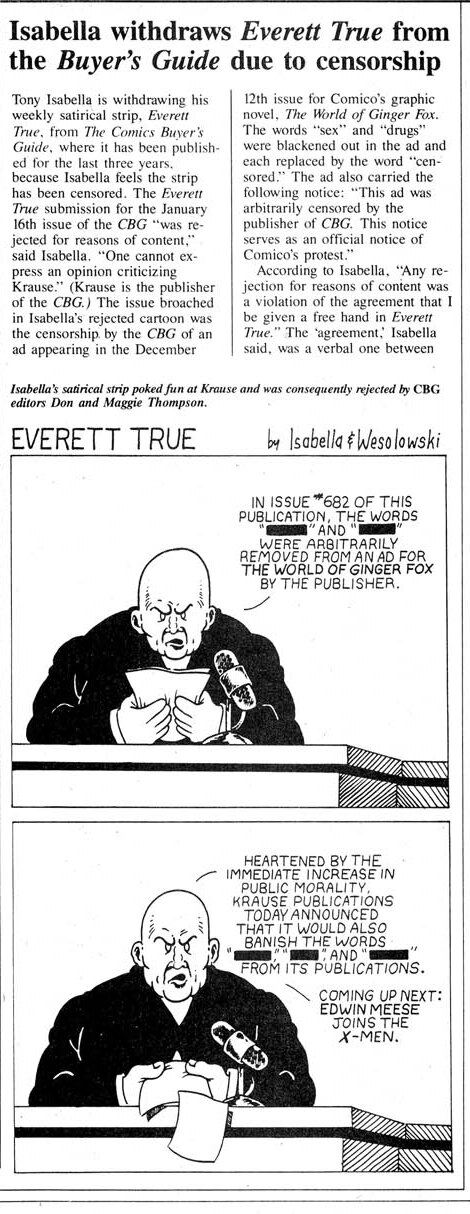
Ginger Fox returns a year later in a four issue series drawn by the Pander Bros, and I’ll cover that later.
There’s a few reviews on the intertubes:
This might be the most 80s comic I ever read.
Hm:
Sexy, cinematically violent and wickedly tongue-in-cheek, this adult comics caper is markedly different from almost anything you’ve ever seen and thoroughly deserves another bite of the graphic novel cherry.
Hm:
This one is definitely worth tracking down. Fans of Mike Baron’s work on The Badger won’t be surprised at all by the martial arts portion of the story, but both it, the romance, and the film industry portions are handled in very clever fashion.
The review itself was a bit of a takedown, but this general description of Baron’s work caught my attention at that time…
“For him (Baron), comic books have an inherently loopy surreality [sic] that tends to throw all serious intentions into sort of garish, Mack-truck relief. He glories in the kind of goofball, seat-of-your-pants sensitivity that, paradoxically, makes his work seem almost enlightened, as if he’s beyond all this ‘comics-as-art’ lip-flapping and just wants to have sort of a high-profile gas. He’s going to be an awfully good arbiter of our present culture, I think, for future sociologists.”
Heh:
An 80’s throwback. Mike Barron tries to write Get Shorty, but fails. The Art from Mitch O’Connell is great and really gives those 80’s vibes in the best way.
OK, that’s it. The next blog post in this series may take a few extra days to arrive, because it’s a longer series again: Justice Machine.
Yeah, I think (maybe) you’ll have more of an opinion about the miniseries- it goes off in some weird directions and is a different kind of mess. Still, there’s some stuff I don’t think I’ve seen anywhere else before.