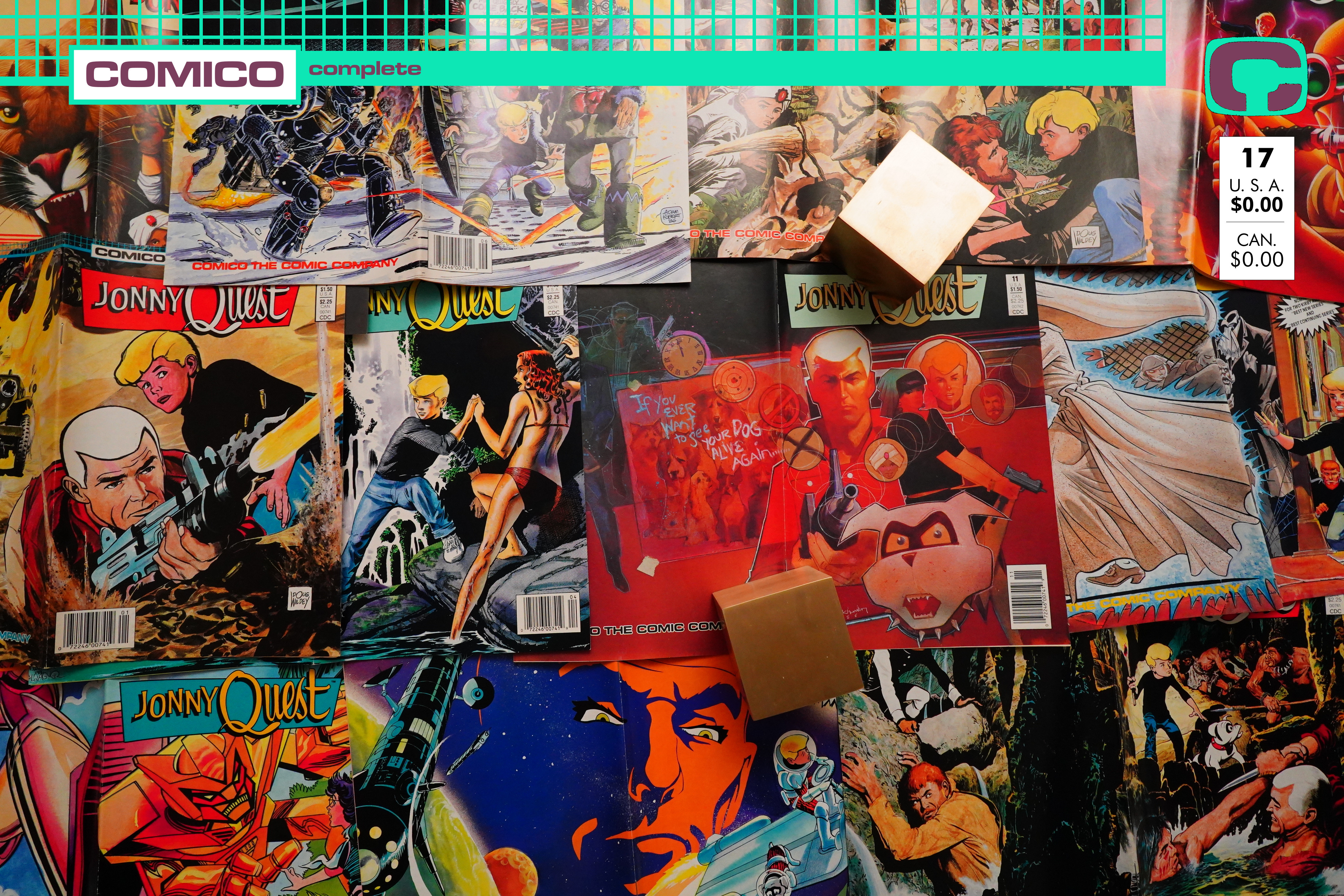
Jonny Quest (1986) #1-31 by William Messner-Loebs and a cast of thousands
This blog post has taken a lot of time — not because reading these books has been boring, but because I got busy doing other things, so I’ve just not had the time to read them. So this blog post is probably even more scattered than usual — I may have forgotten what I’ve written at the start when I get to the end…
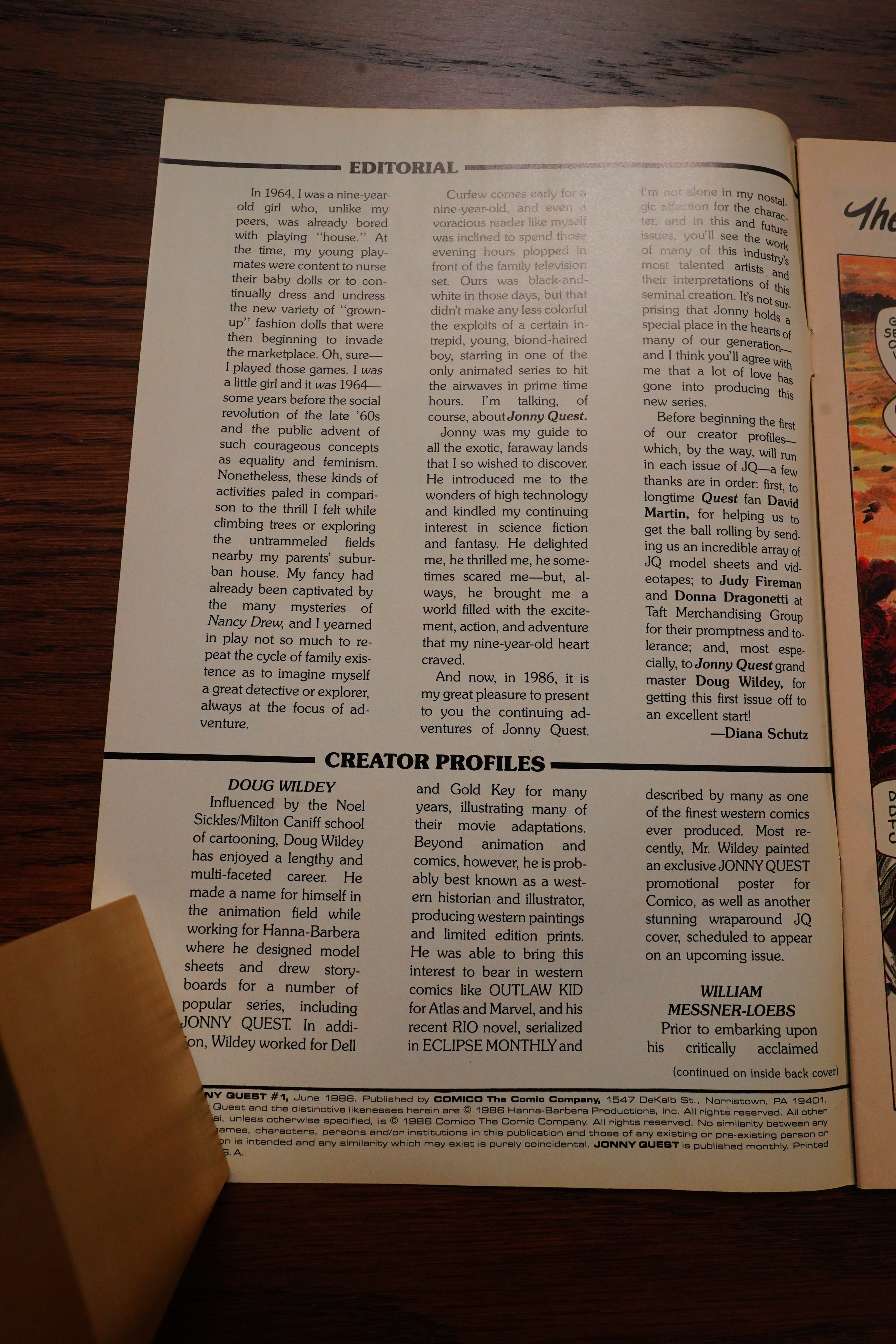
I know nothing about Jonny Quest. The only time I can remember seeing him mentioned is in connection with this series, really. But it turns out that it was a cartoon that ran for 26 in the 60s — i.e., it was cancelled after one season. So I’m not sure whether Diana Schutz’s introduction here is supposed to be taken at face value — was this really a beloved series that they were finally doing an adaptation of, and everybody’s excited? Or is this more like the Robotech situation, where (apparently) nobody involved had any real passion for the project (until perhaps later in the series when they got some fans aboard) and it’s just a way to make some money?
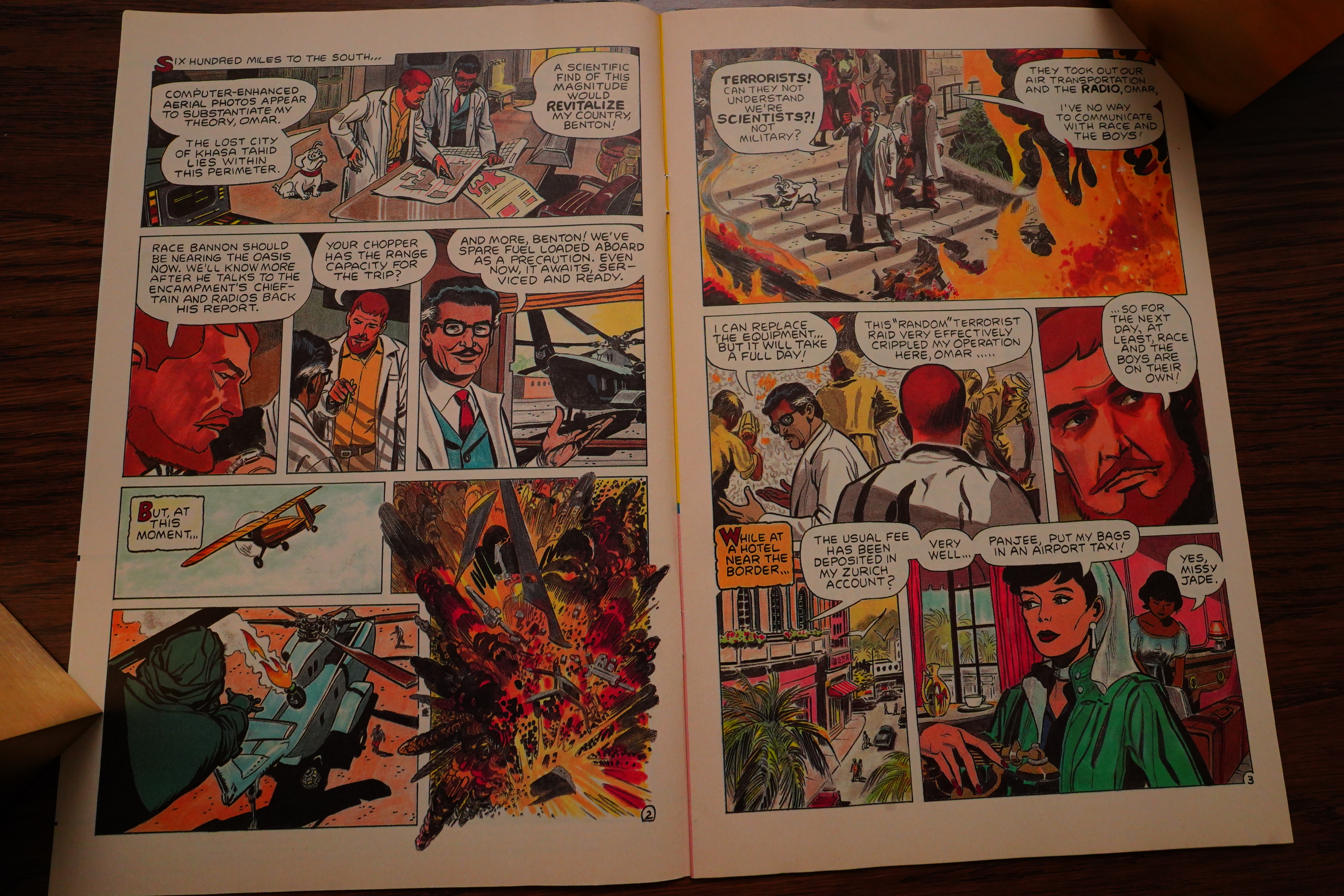
The first issue isn’t typical — it’s two short stories instead of one longer story. Doug Wildey does the first one — perhaps on his own? It’s not clear.
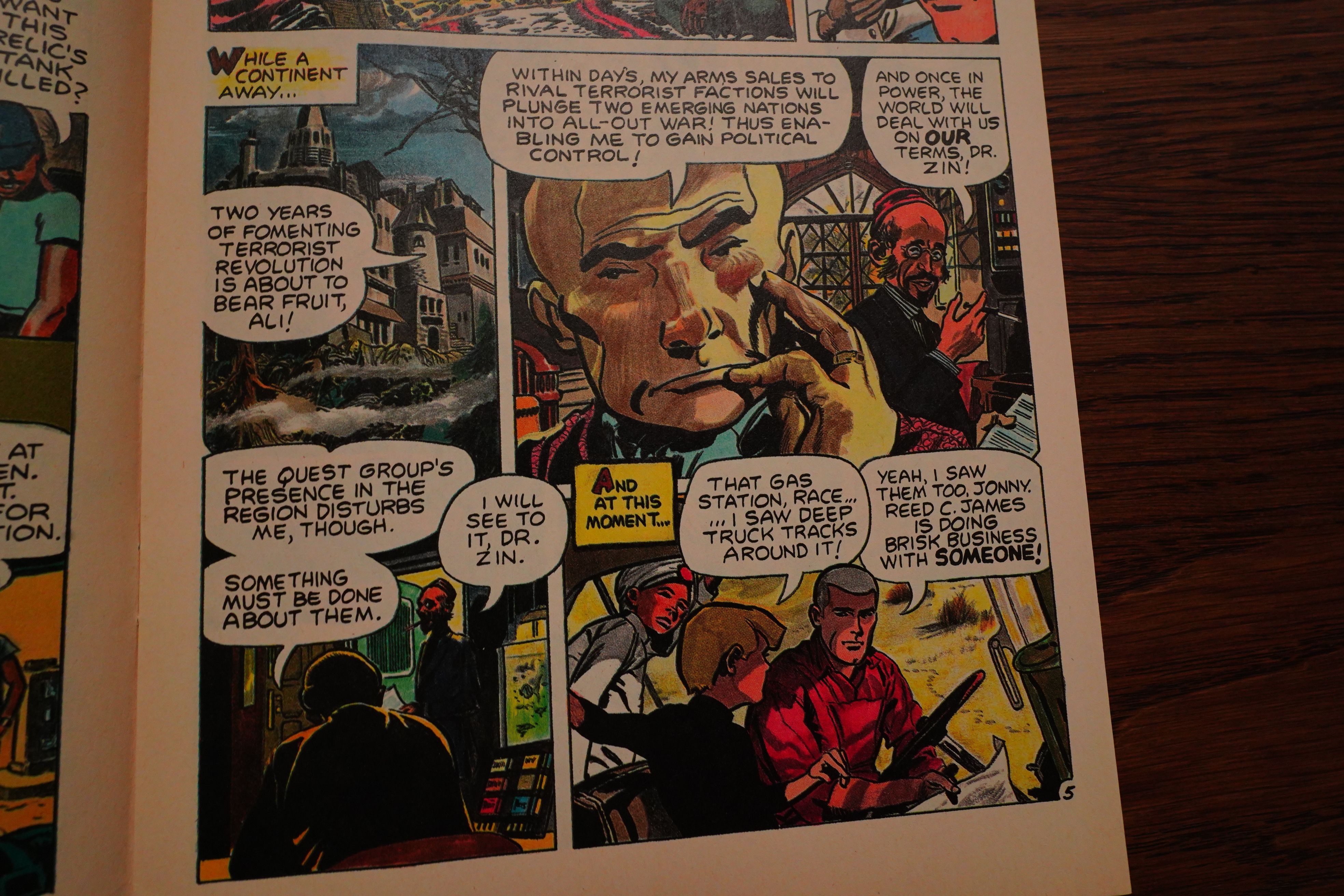
So… the bad guy is called Dr. Zin, which is nice, and then there’s… two kids? One blond, one in a turban. And there’s a white-haired tough guy? So the series is about these three guys having adventures?
I do like that they don’t infodump at us, but it really feels more like they assume that everybody knows who these guys are.
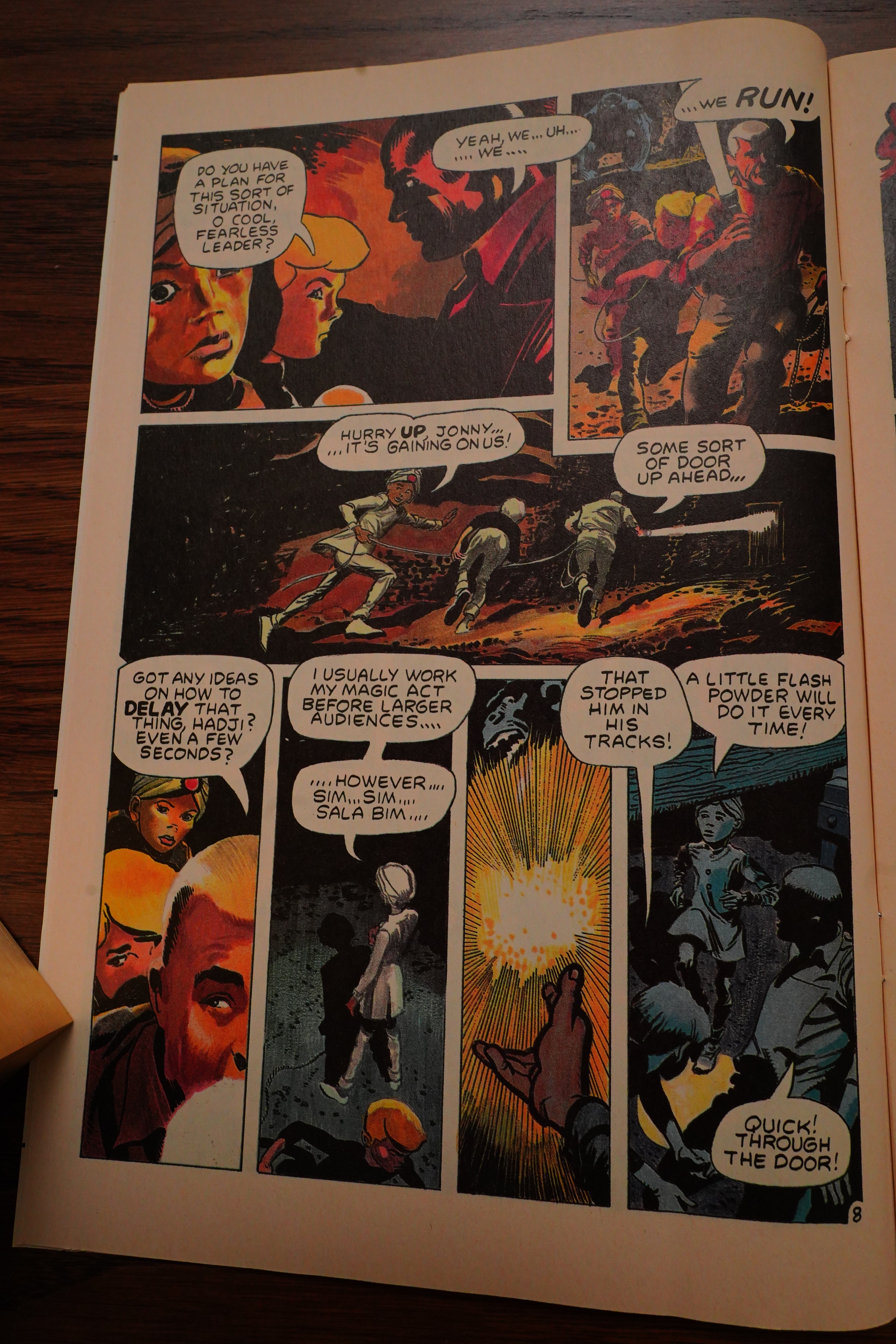
And… the kid in the turban can do magic!? Or perhaps just magic tricks?
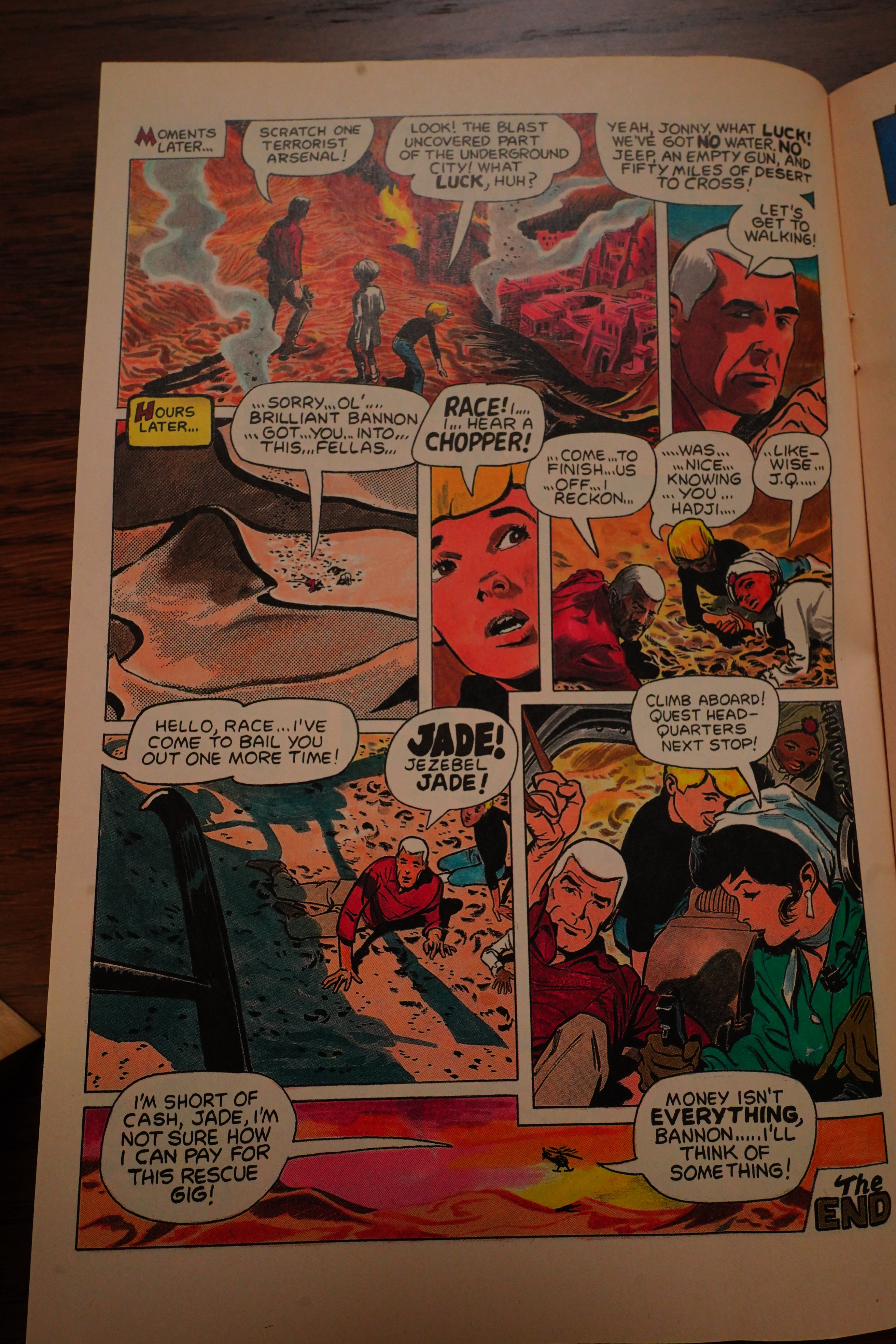
Well, OK, if this is a money grab, it’s done well — that was a solid short story, if you like this kind of thing.
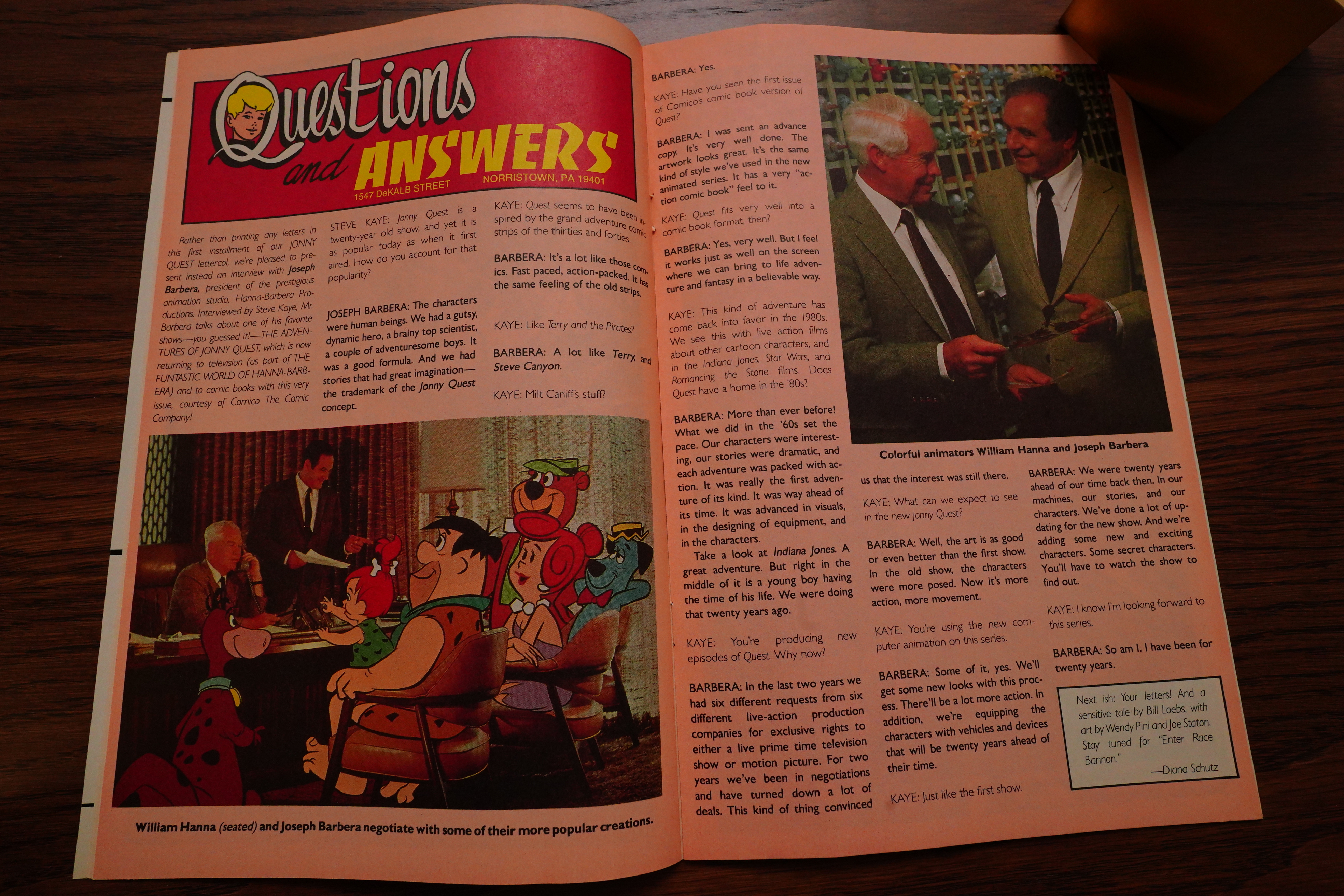
We get two pages of background, and that’s it.
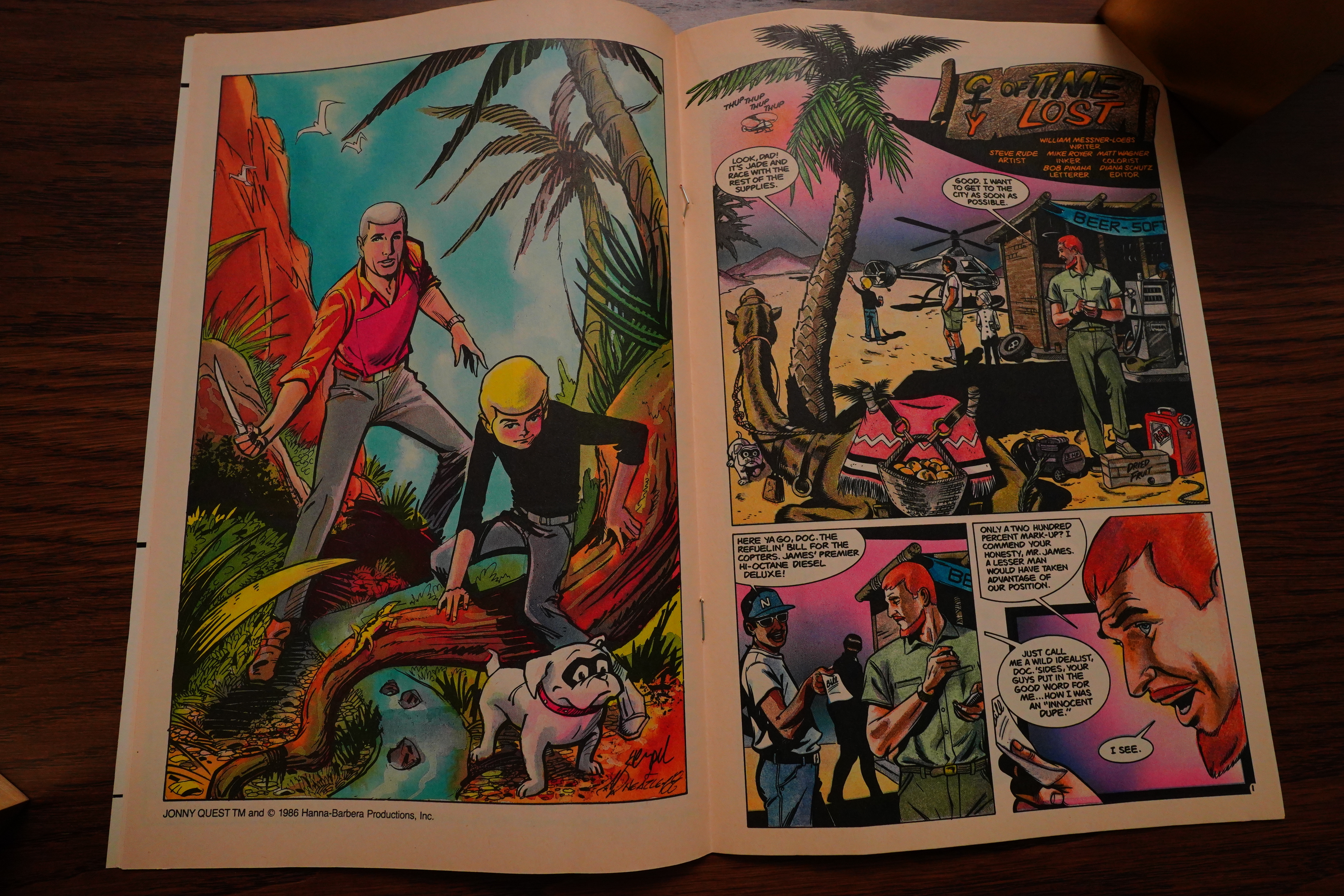
Every issue has a pinup or two.
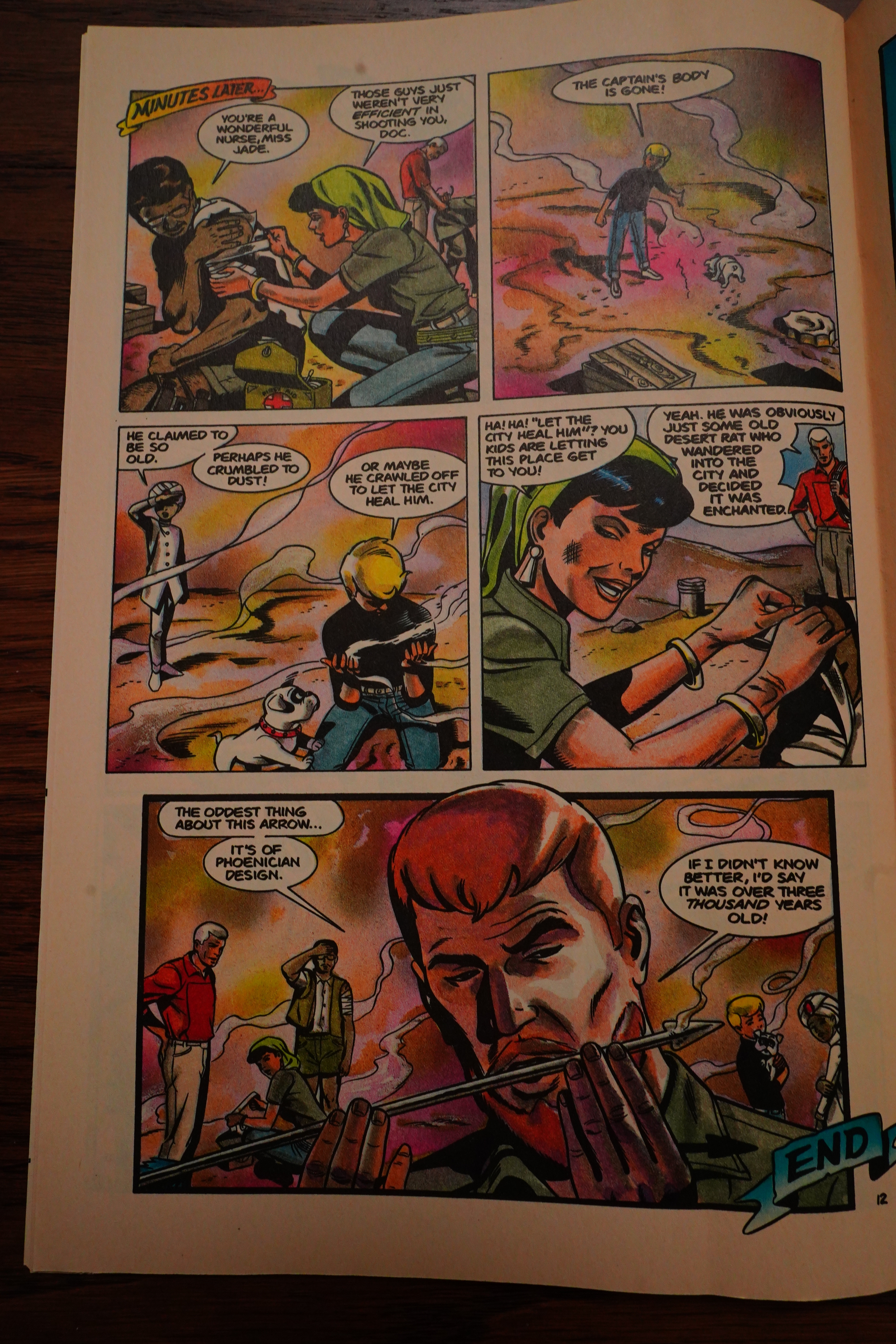
And… another short story ends.
Well, I think I have the answer to my question at the start there: This doesn’t feel like a money grab. You can feel the enthusiasm everybody has for this project, just oozing from the pages. It’s palpable.
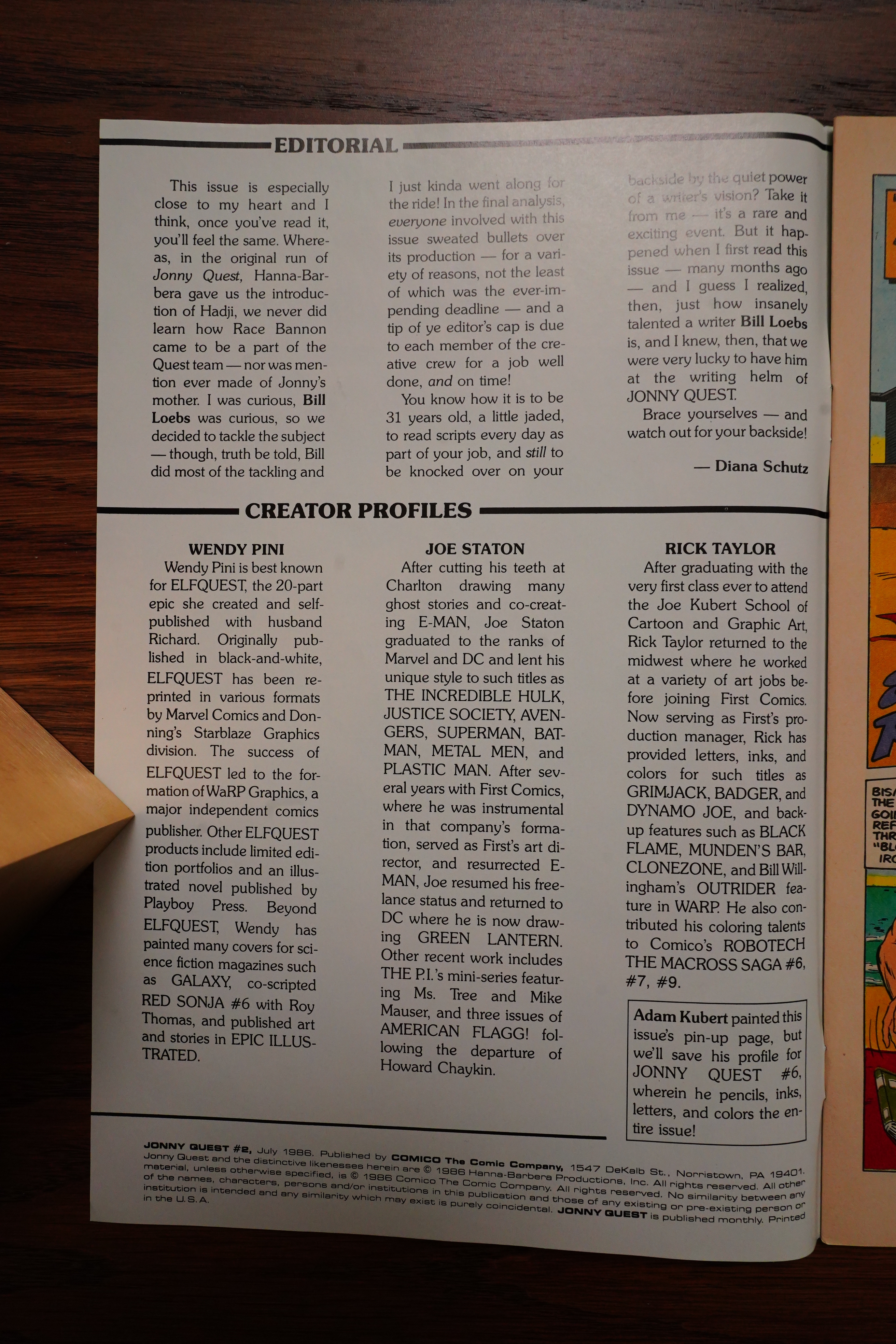
This series doesn’t have a set art team. Messner-Loebs is going to write them all, but having somebody new coming in every issue sounds like it’s going to be a jarring read, perhaps? On the other hand, they seem to be going for a top notch roster of artists… is the deal here that all comic book artists just love Jonny Quest so much that they all want to do an issue?
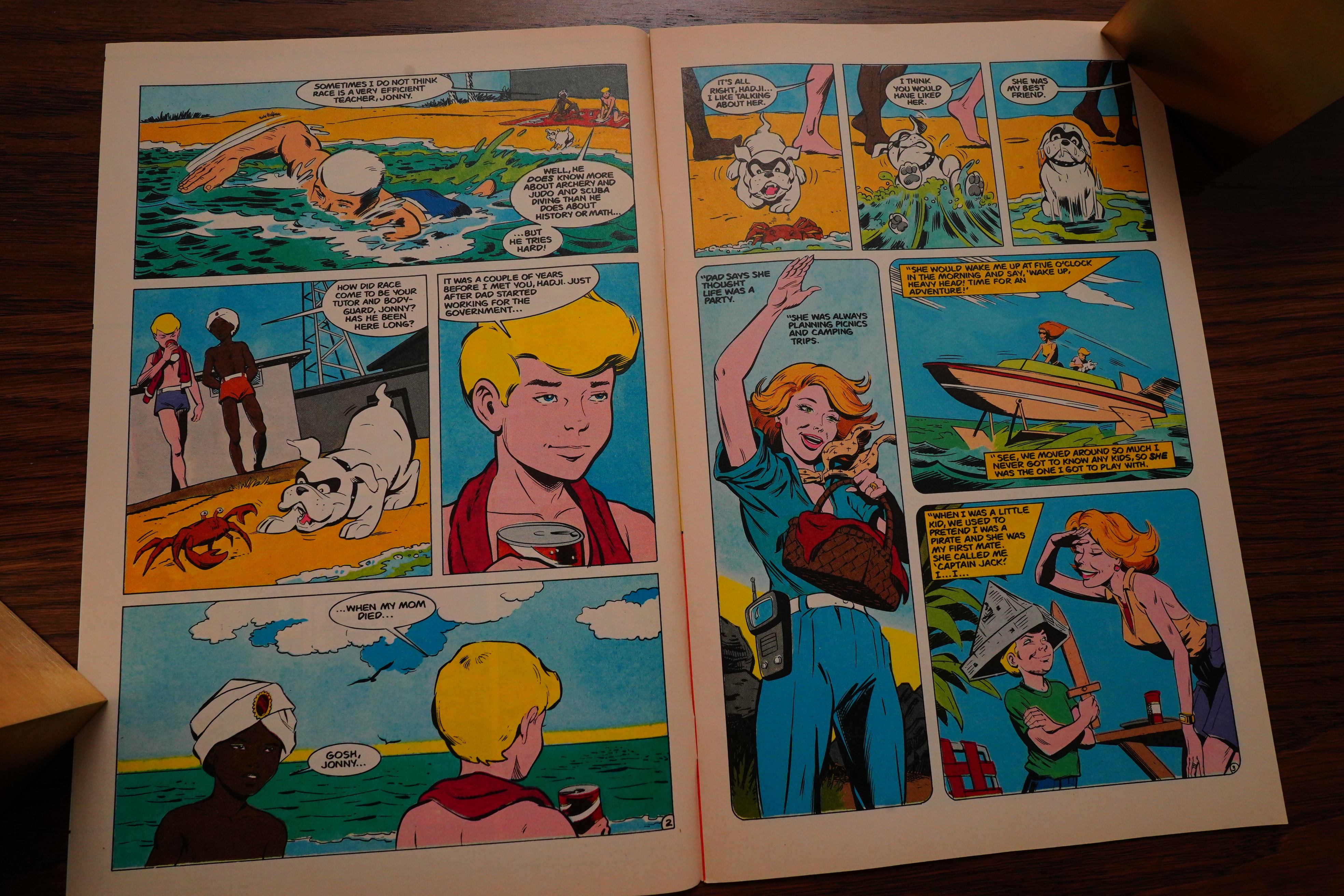
In the second issue, we do get some background — but it’s not really clear why the adults are willing to put these kids (and their dog) into lethal danger all the time.
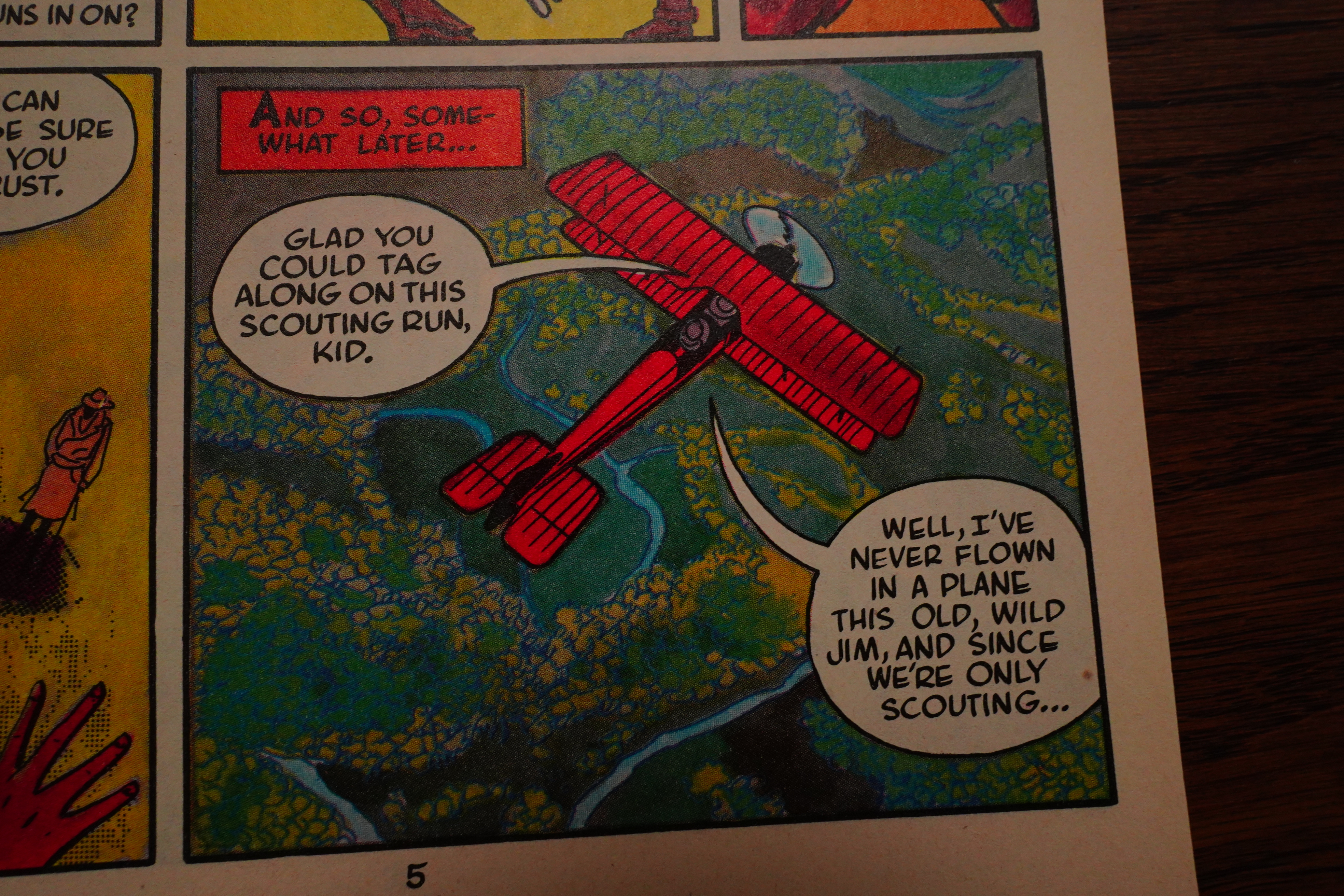
Hempel & Wheatley do some interesting things with the colouring.
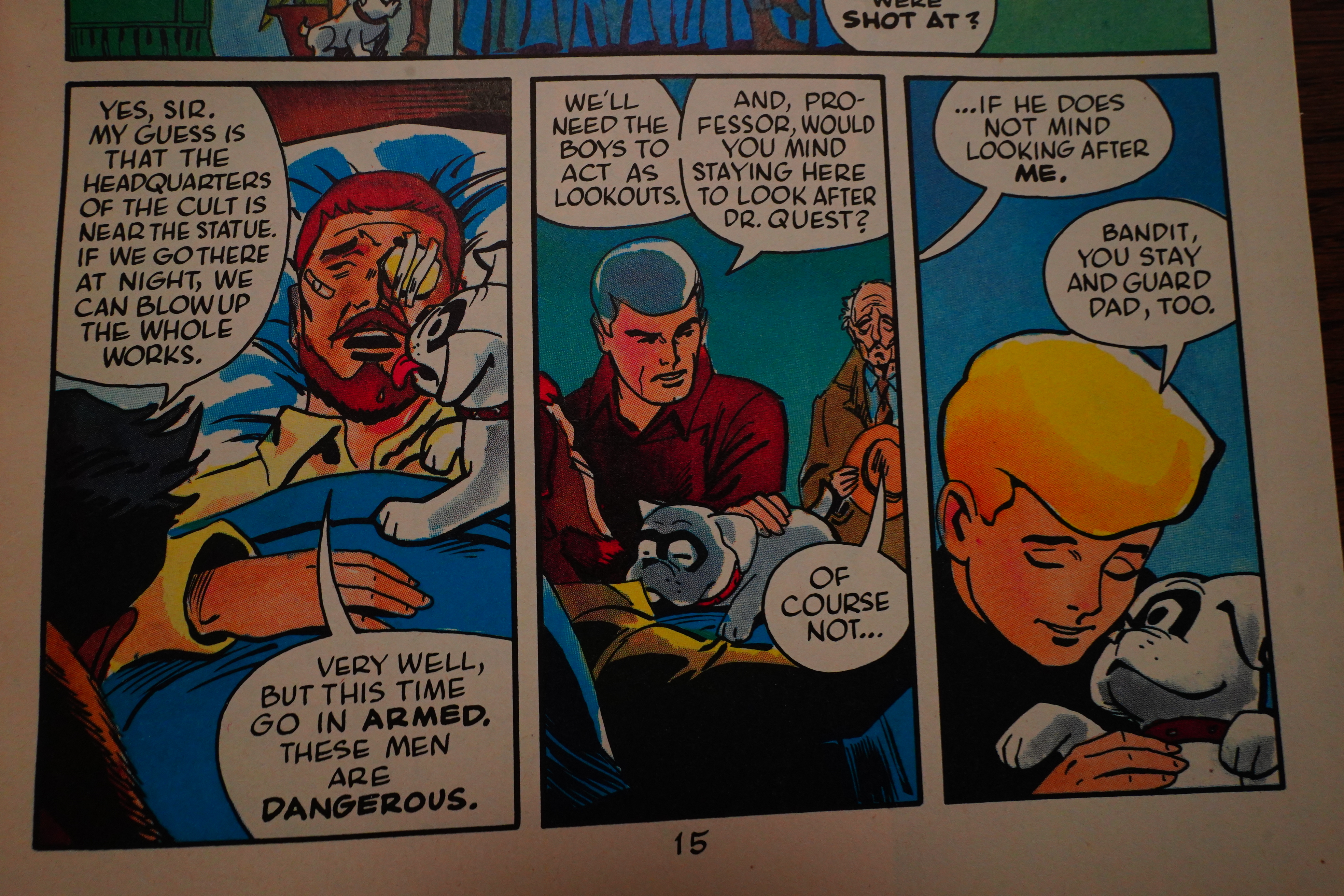
“We’ll need the boys to act as lookouts.” Well, if they need them, I guess…
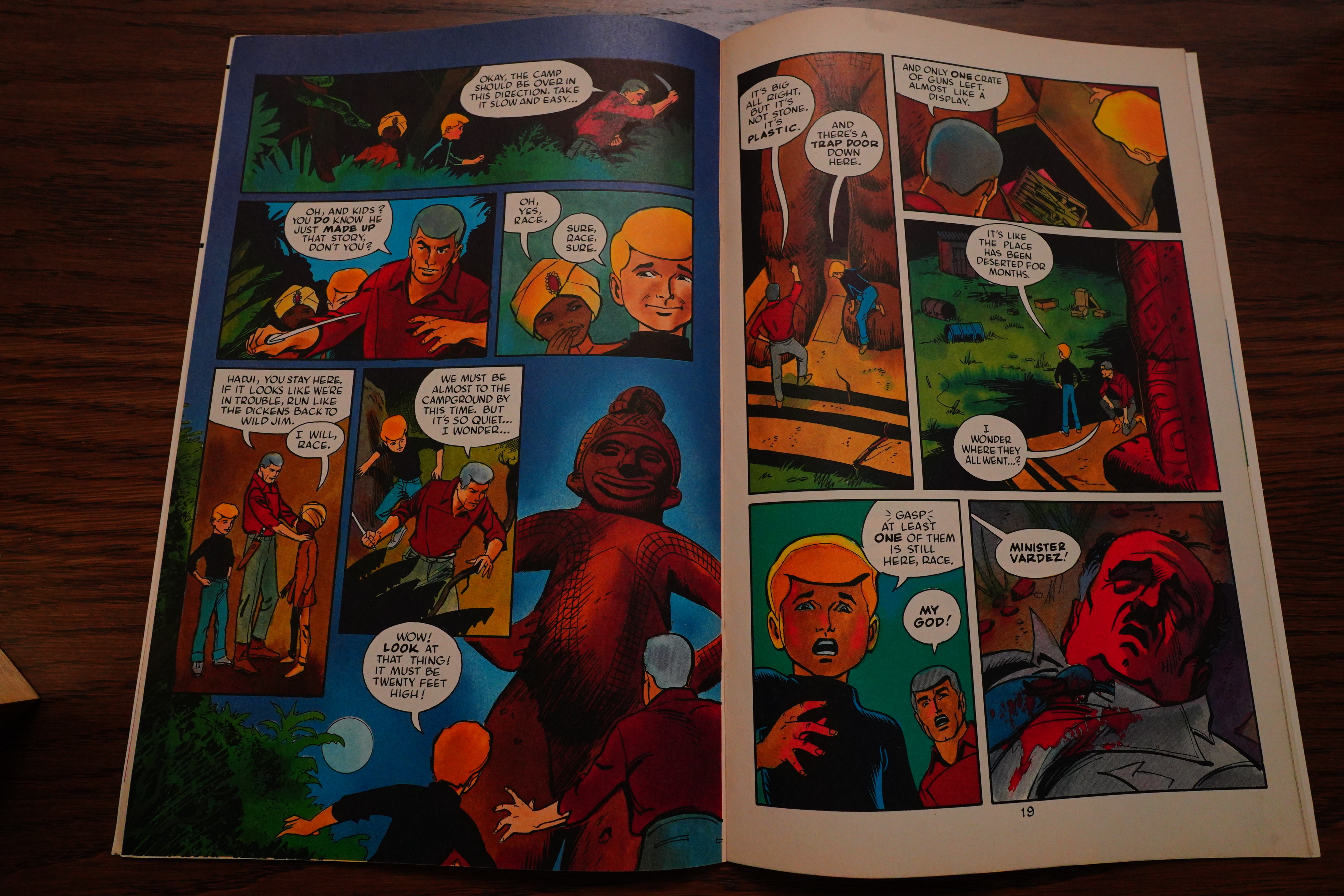
Scarred for life!
I know, I know, the concept is “kids go on adventures”, and that’s fun — but when doing this kind of thing, they usually try to formulate some kind of answer as to why it’s fine, and they haven’t been shipped off to live with an aunt or something instead…
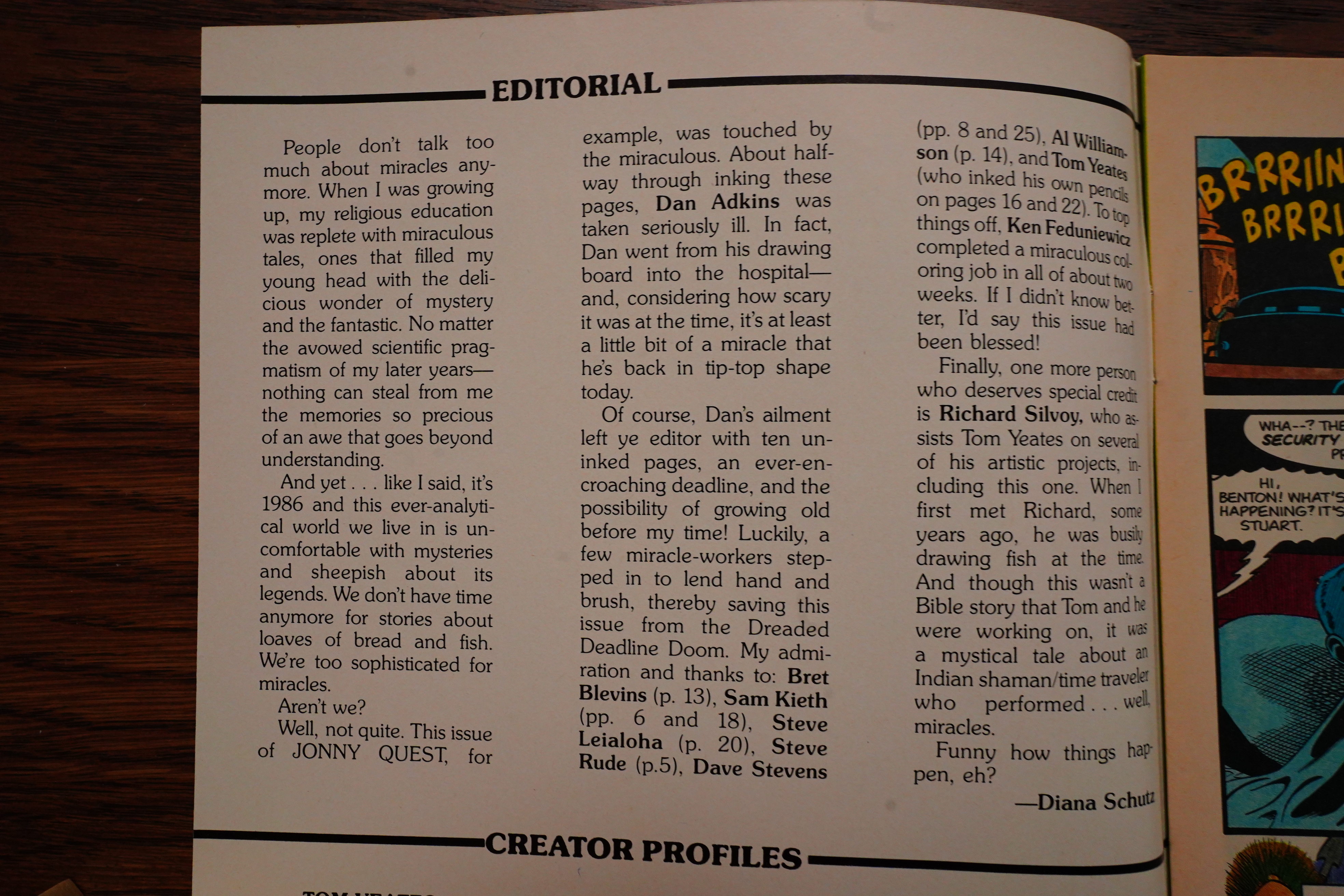
A miracle strikes! And it involves Dan Adkins taking ill, but others stepping in to do inking instead.
This sort of thing always makes me wonder why they don’t just delay the issue instead, or swap in another. Especially on a series like this, where they have to have several going at the same time, from different artists.
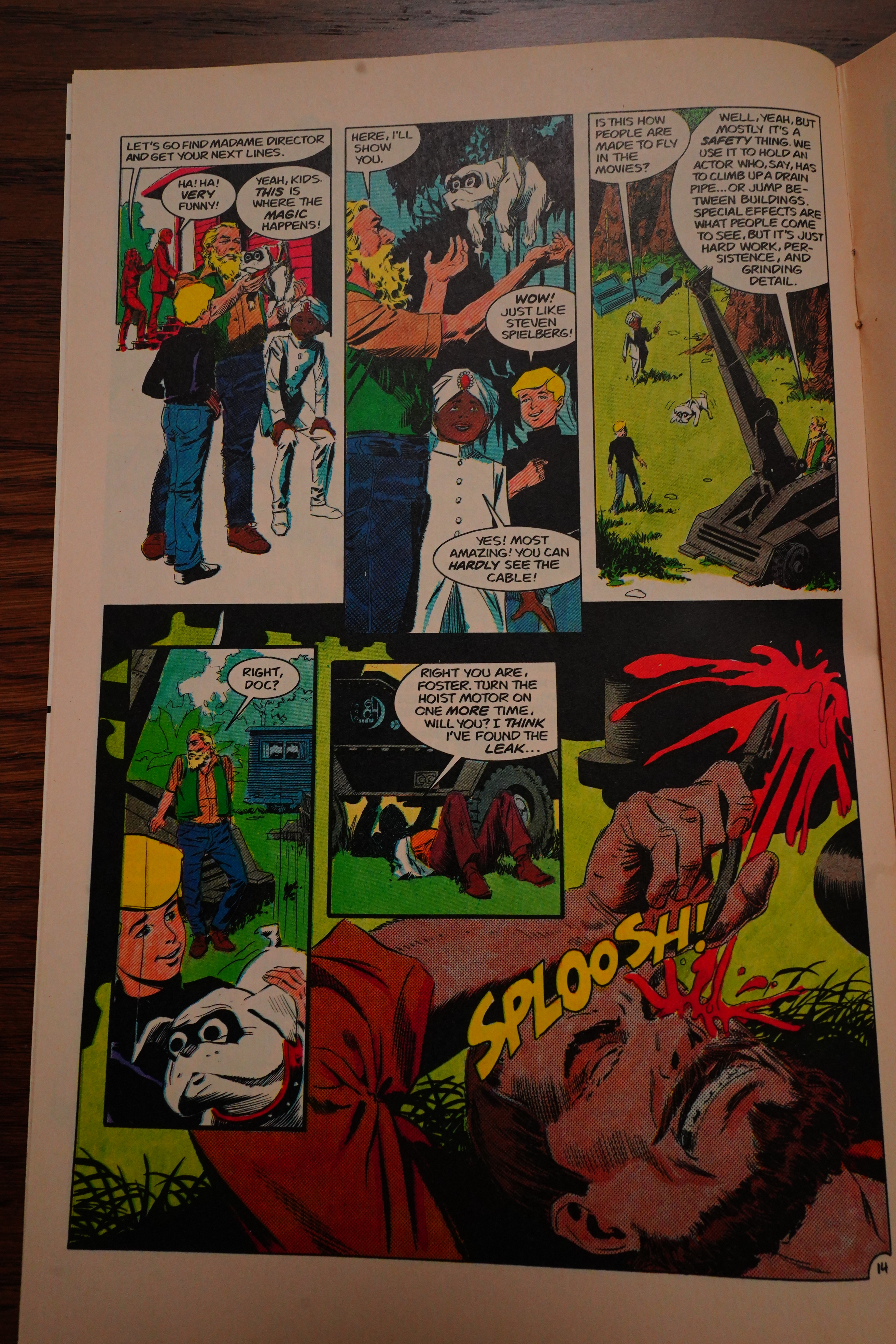
Here’s Al Williamson (!) inking a random page. The issue looks amazingly consistent, really.
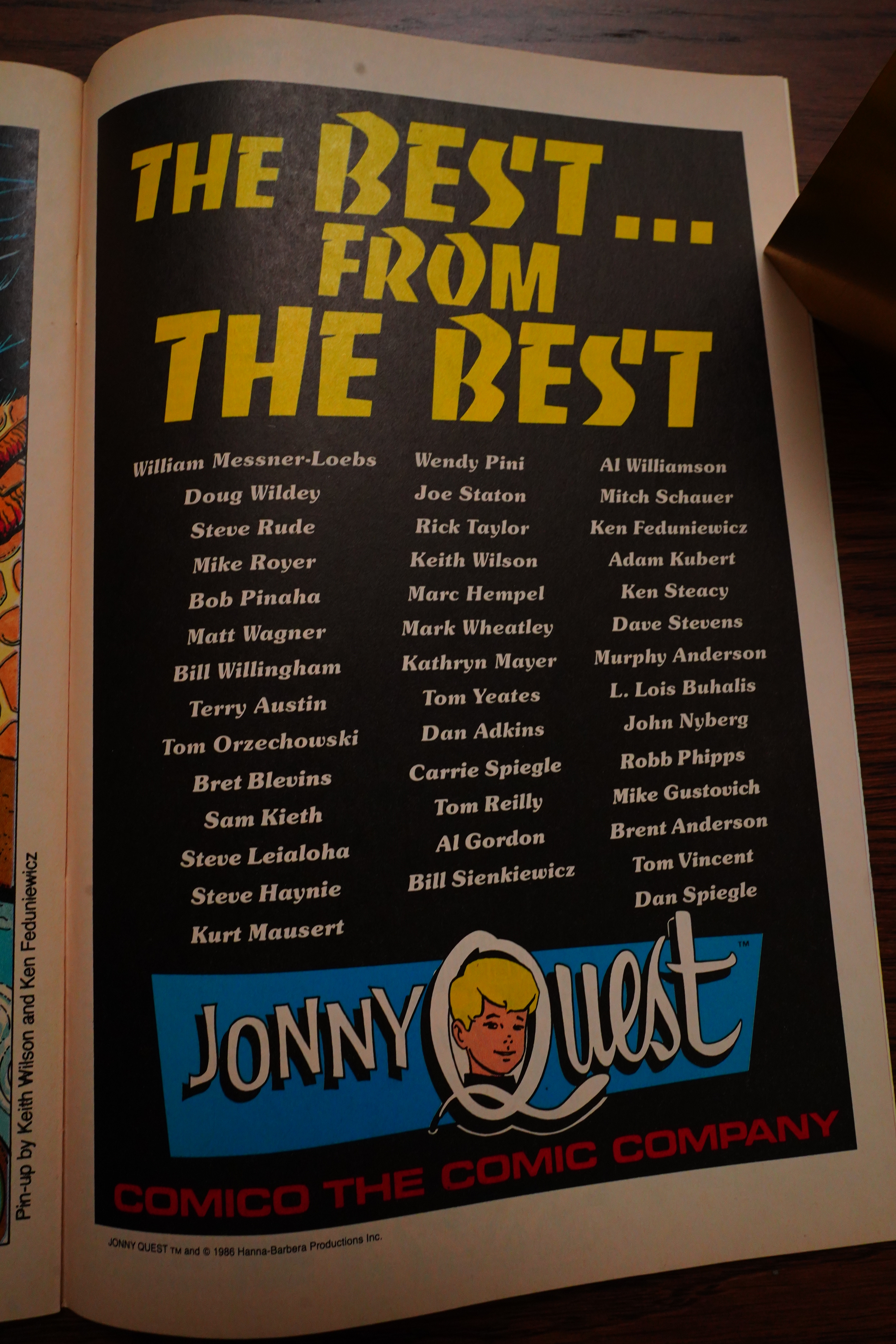
That is some list of artists.
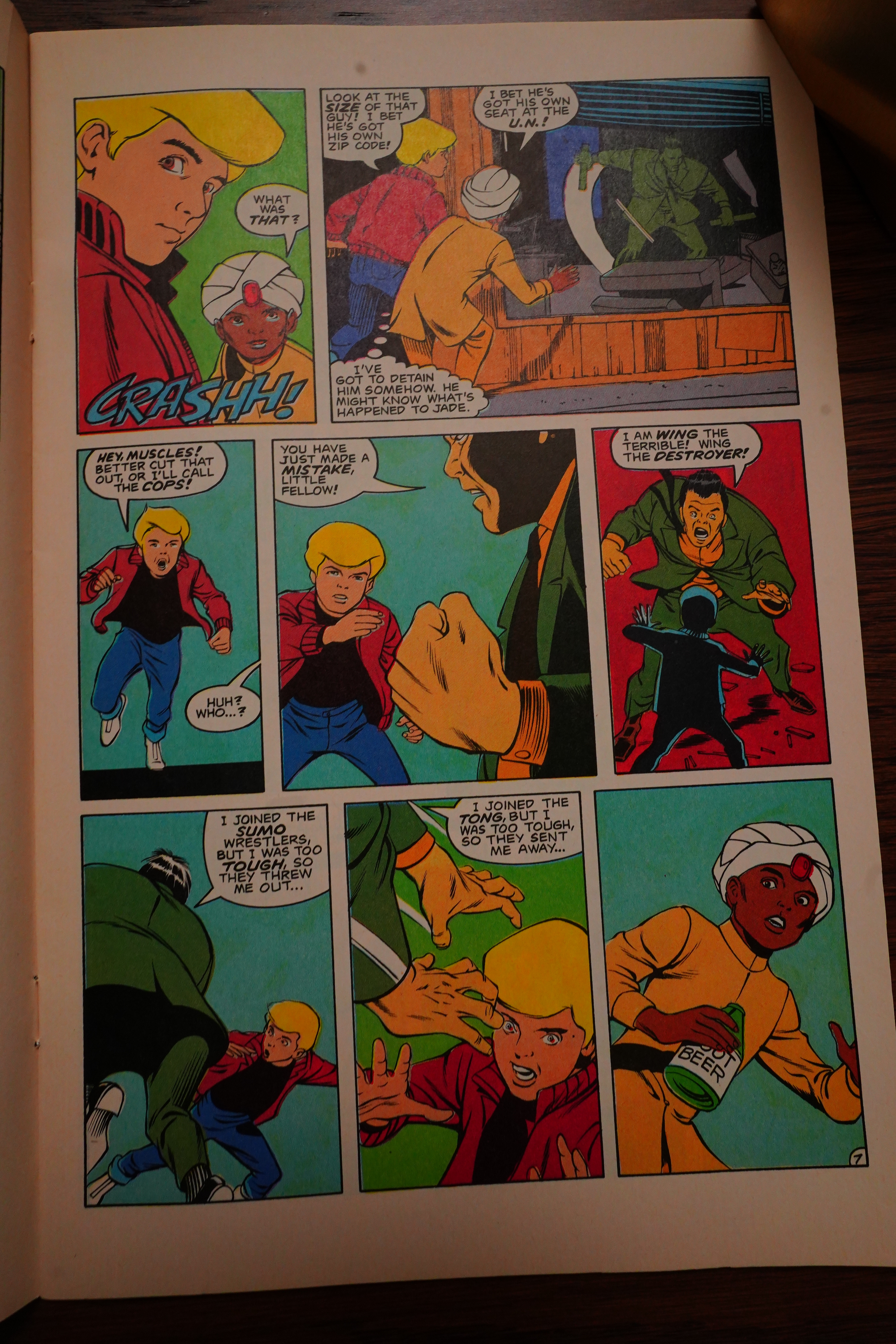
Mitch Shauer’s issue is pretty weak — most of the artists involved are really having fun, but this one’s lazy.
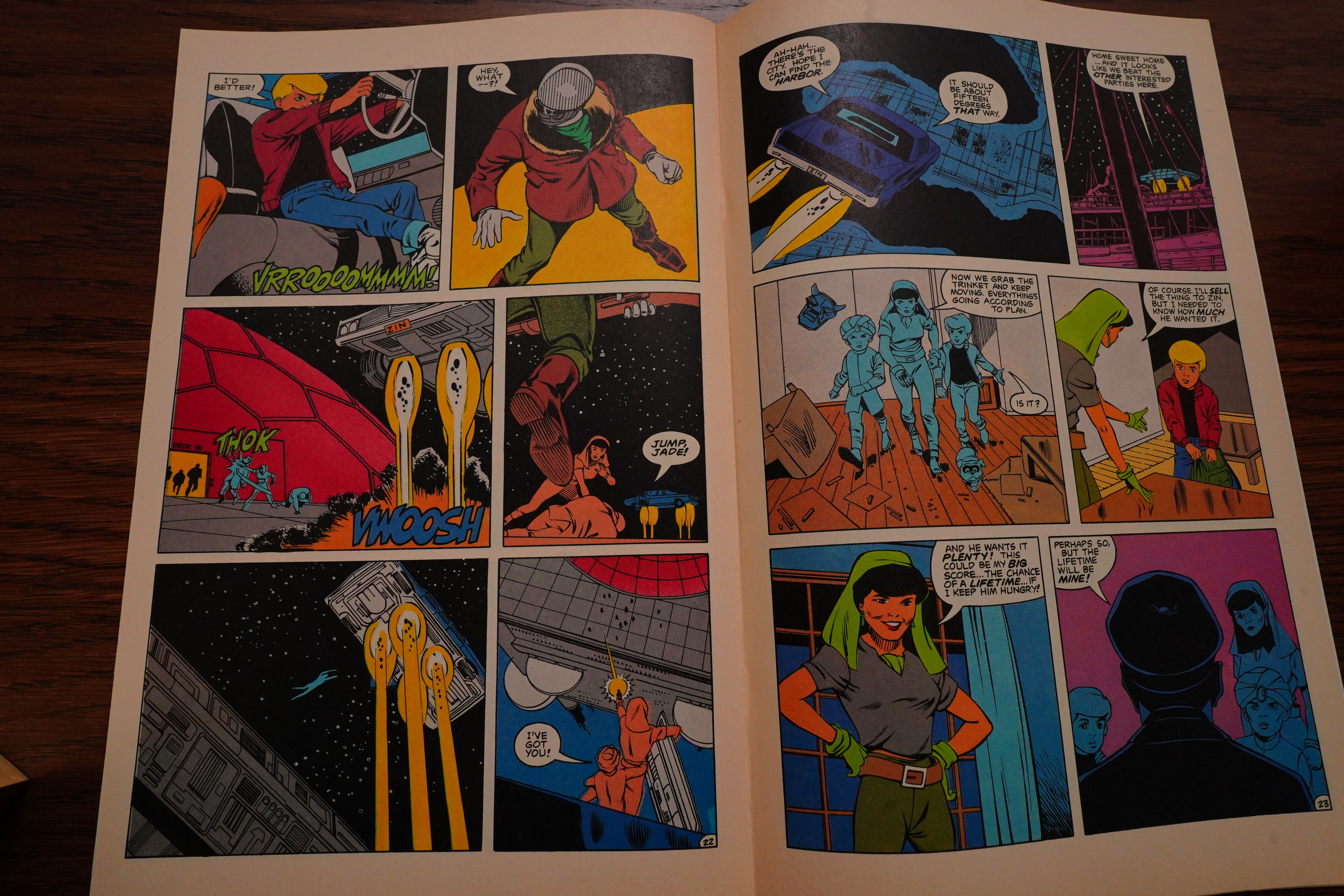
Jonny Quest seems like an everything-and-the-kitchen-sink sort of series. We have archaeology action/adventure as the main entry point, apparently, but then there’s space ships, magic, time travel, dinosaurs, whatever they can come up with that’s fun and cool, I guess? It doesn’t make for much of a consistent world, but eh, what’s the difference. And:
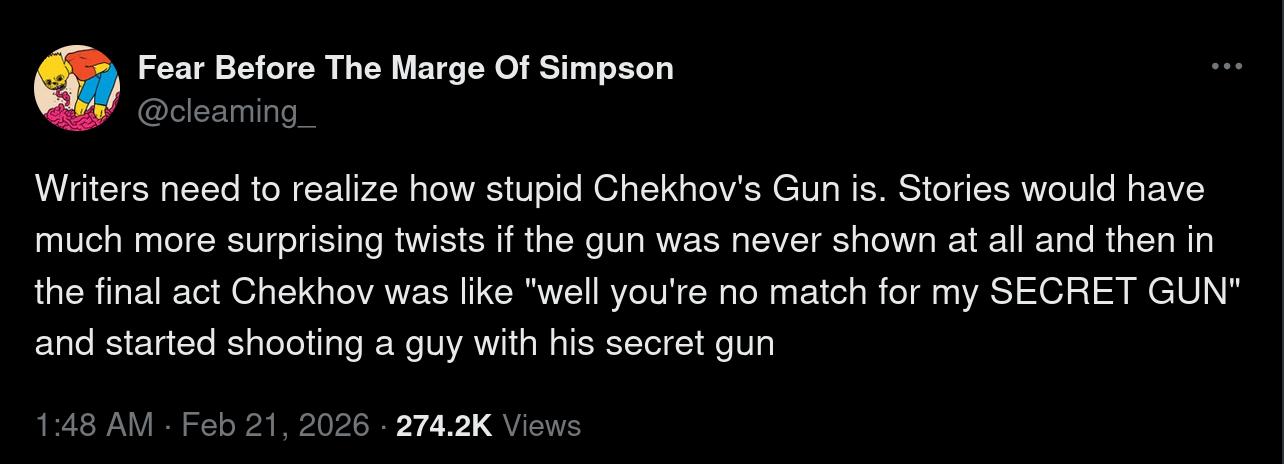
See?
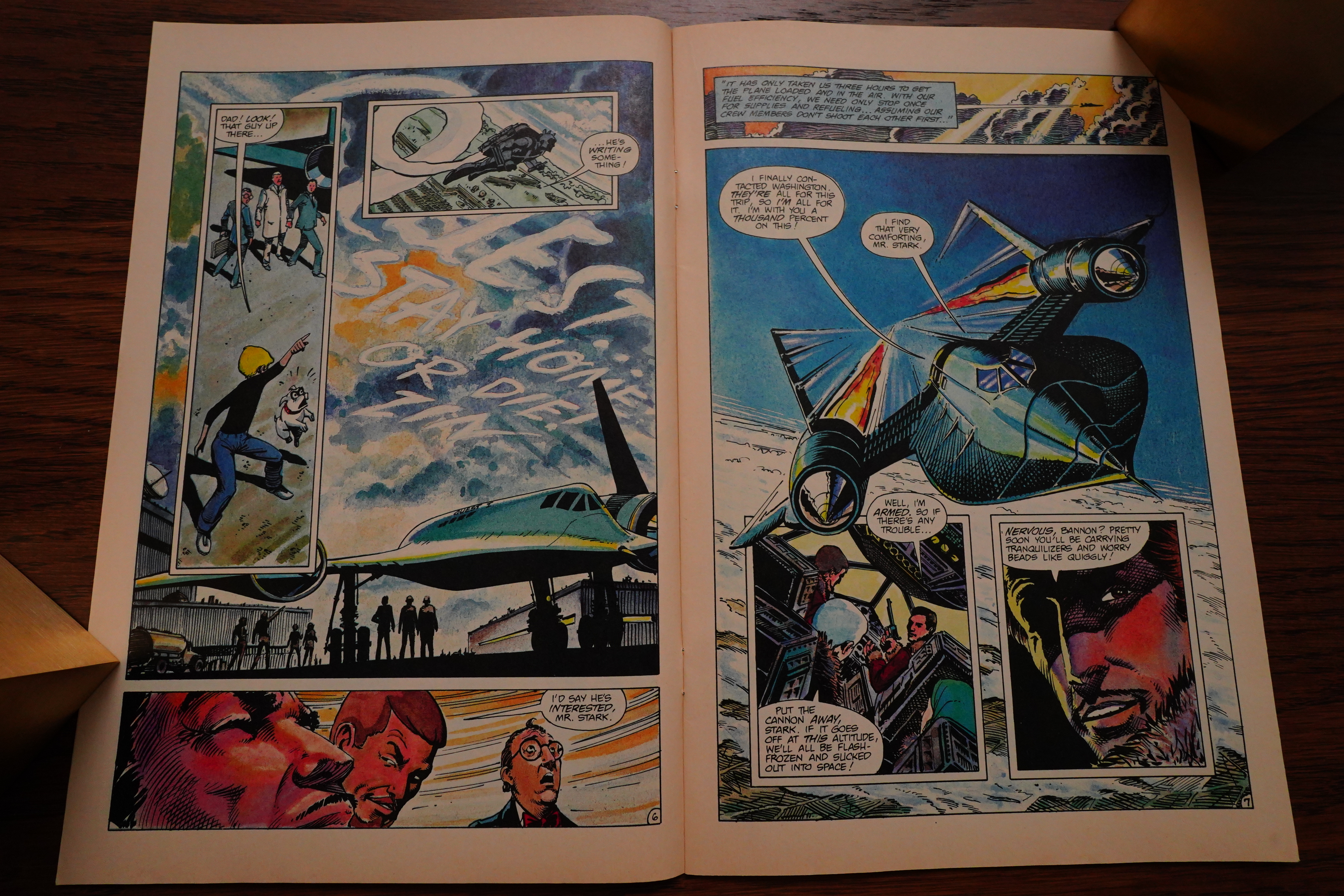
Adam Kubert does everything but the writing — art, colours and lettering. Looks pretty cool.
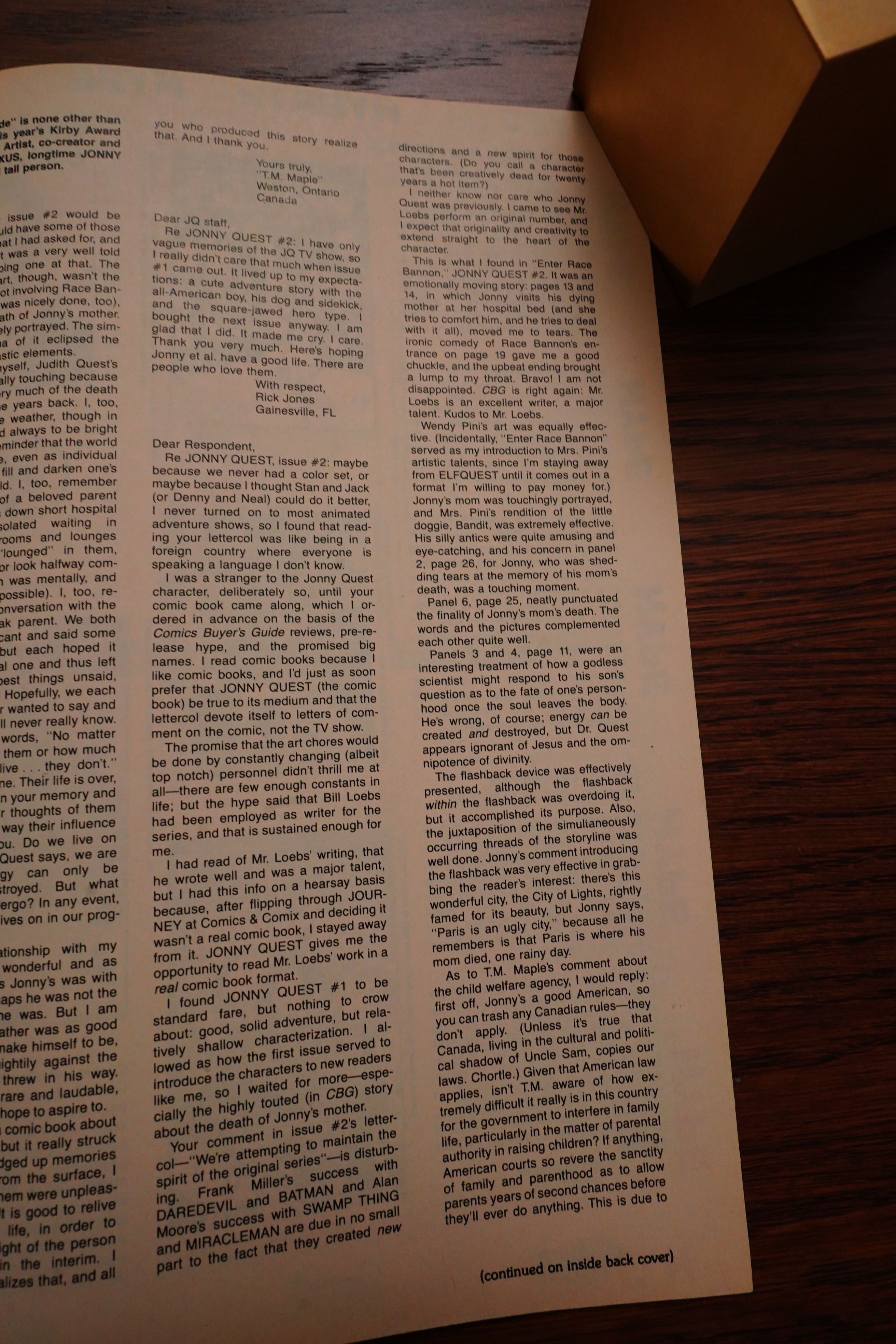
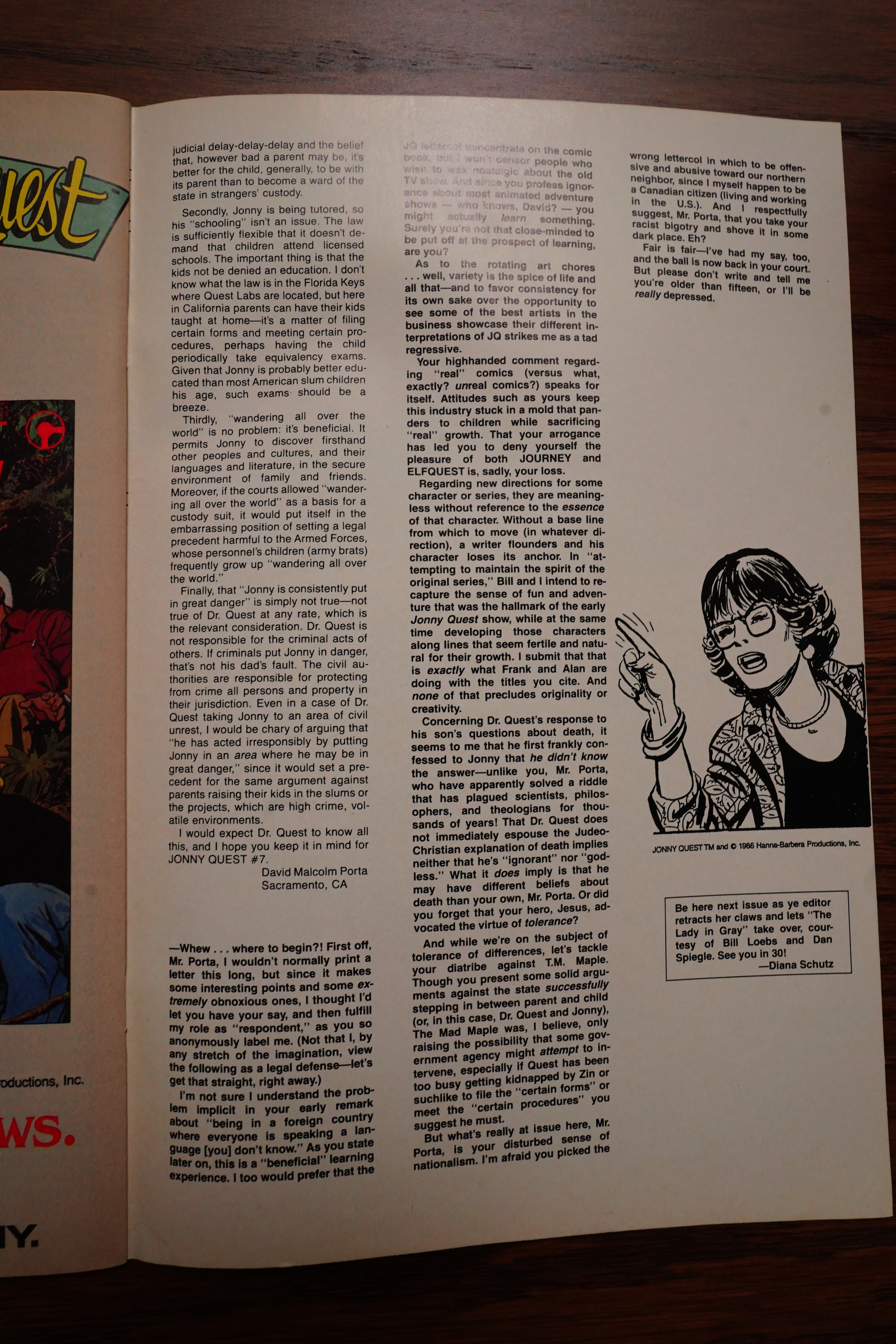
A reader writes in to… well, pooh-pooh a different reader’s thoughts about putting these kids in school, and Schutz gets really annoyed.
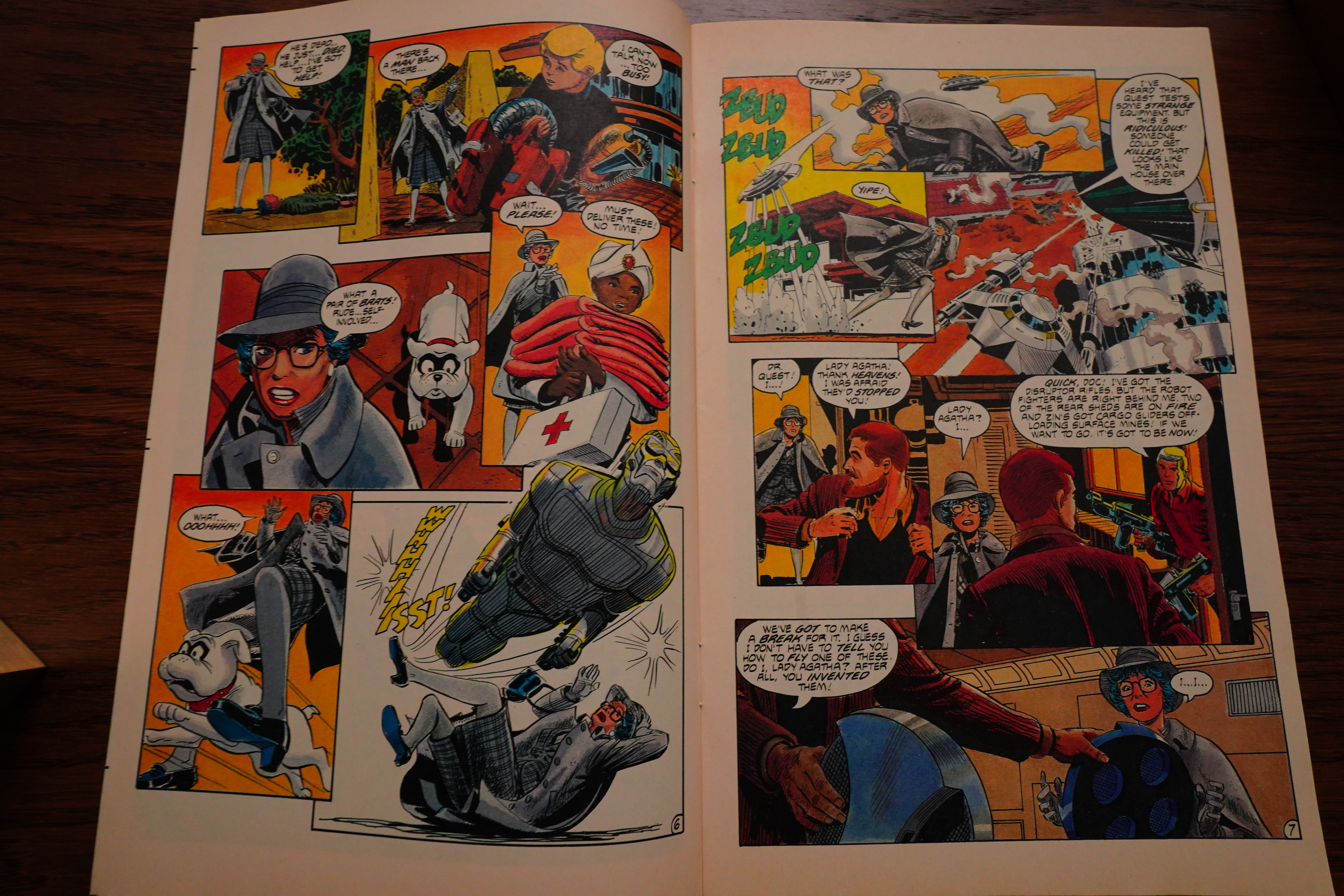
And in the next issue, a social worker drops by to check on the kids!!! Hilarity ensues.
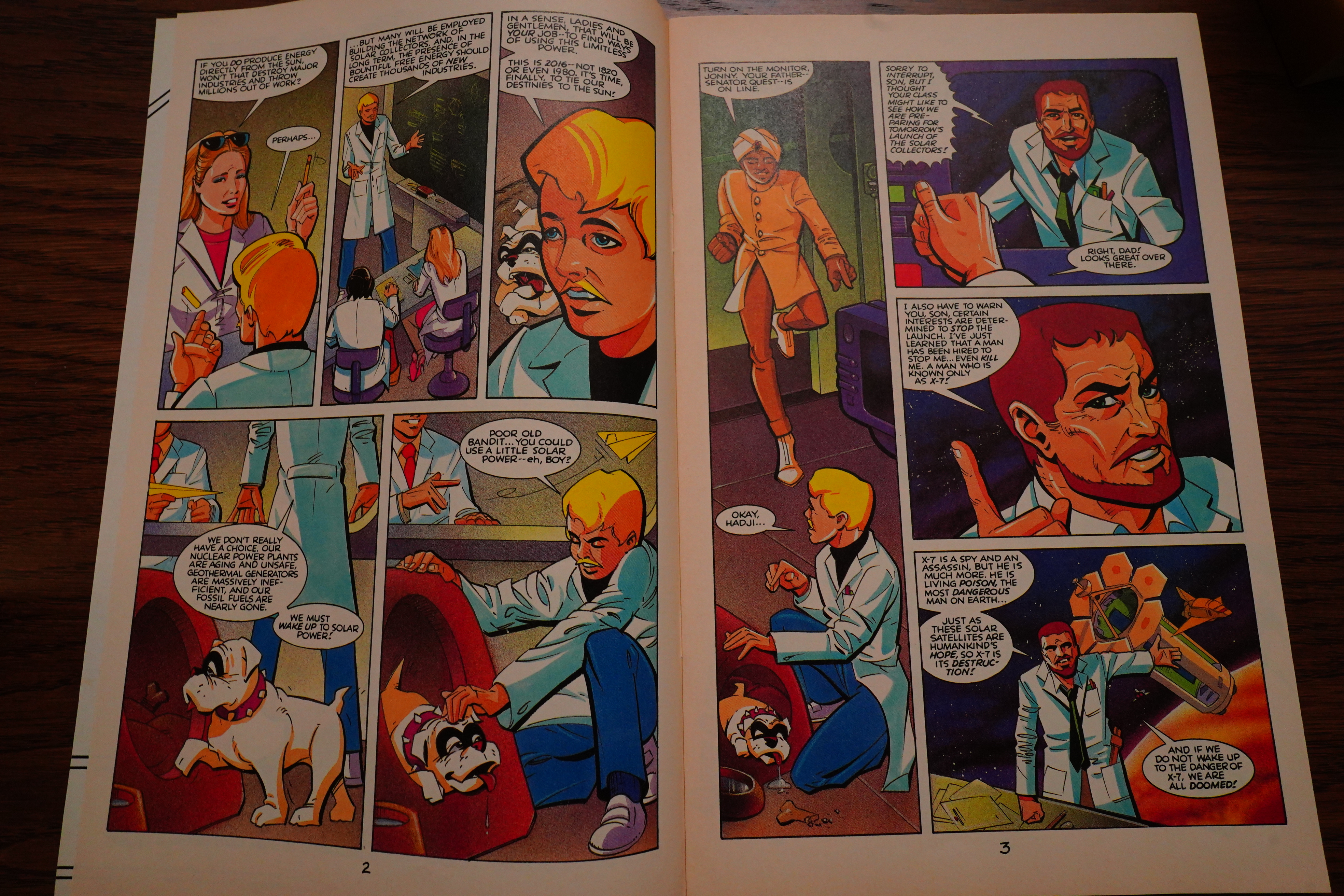
Ken Steacy stops by to paint an issue — which turns out to be a dream issue, looking at a possible future. It’s surprisingly good.
OK, I think I’m now one third in, so here’s what I think so far: This is much, much better than I thought it would be. Every single issue has a solid adventure, and most of the artists are really on form. There’s some slight continuity between the issues, but really, you could read them in random order and not notice.
I’m pretty entertained — I’ve always been a fan of Messner-Loebs, ever since Journey — and this series is solid fun. Let’s hope it continues that way.
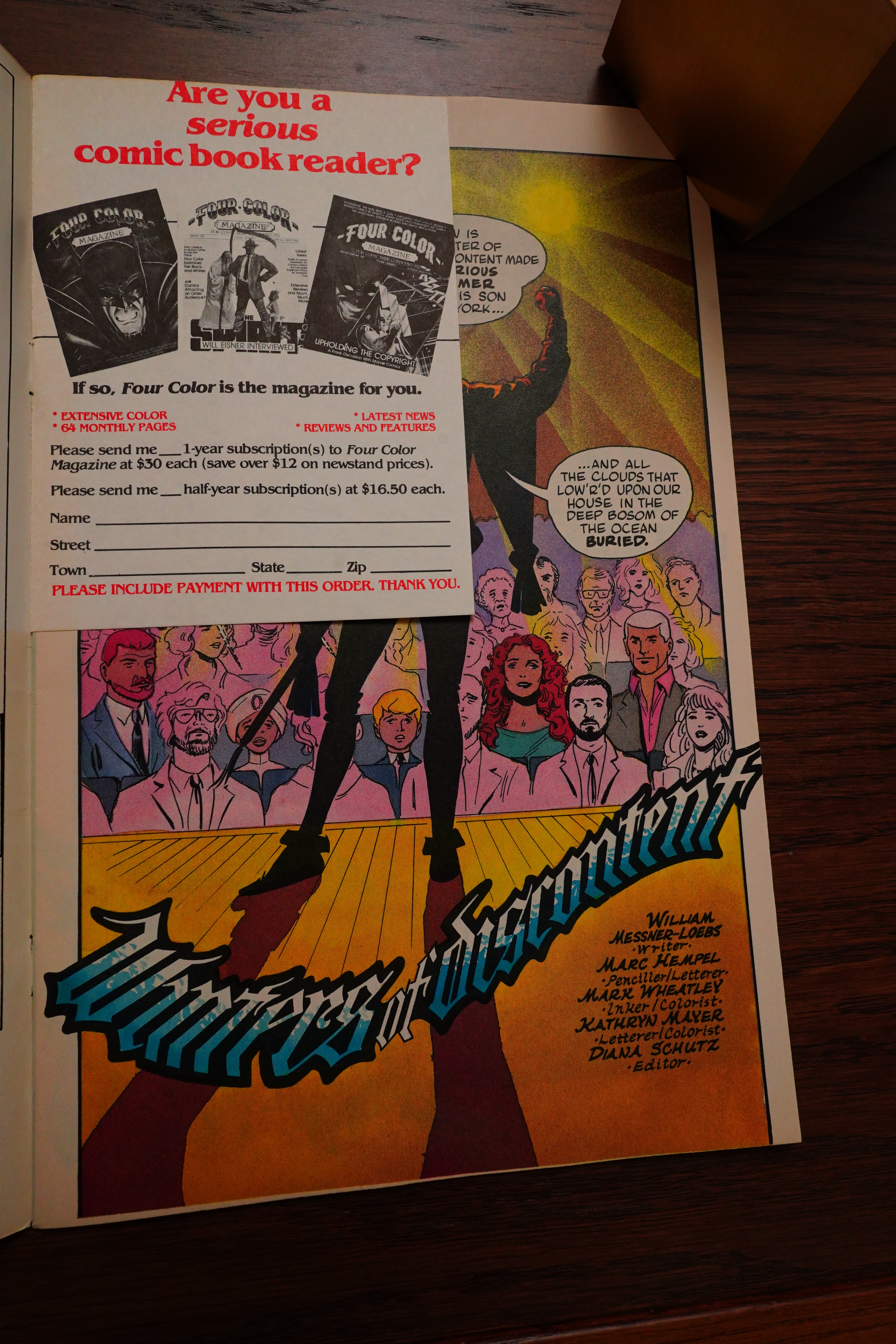
Wow — a card insert ad for Four Color Magazine? Weird.
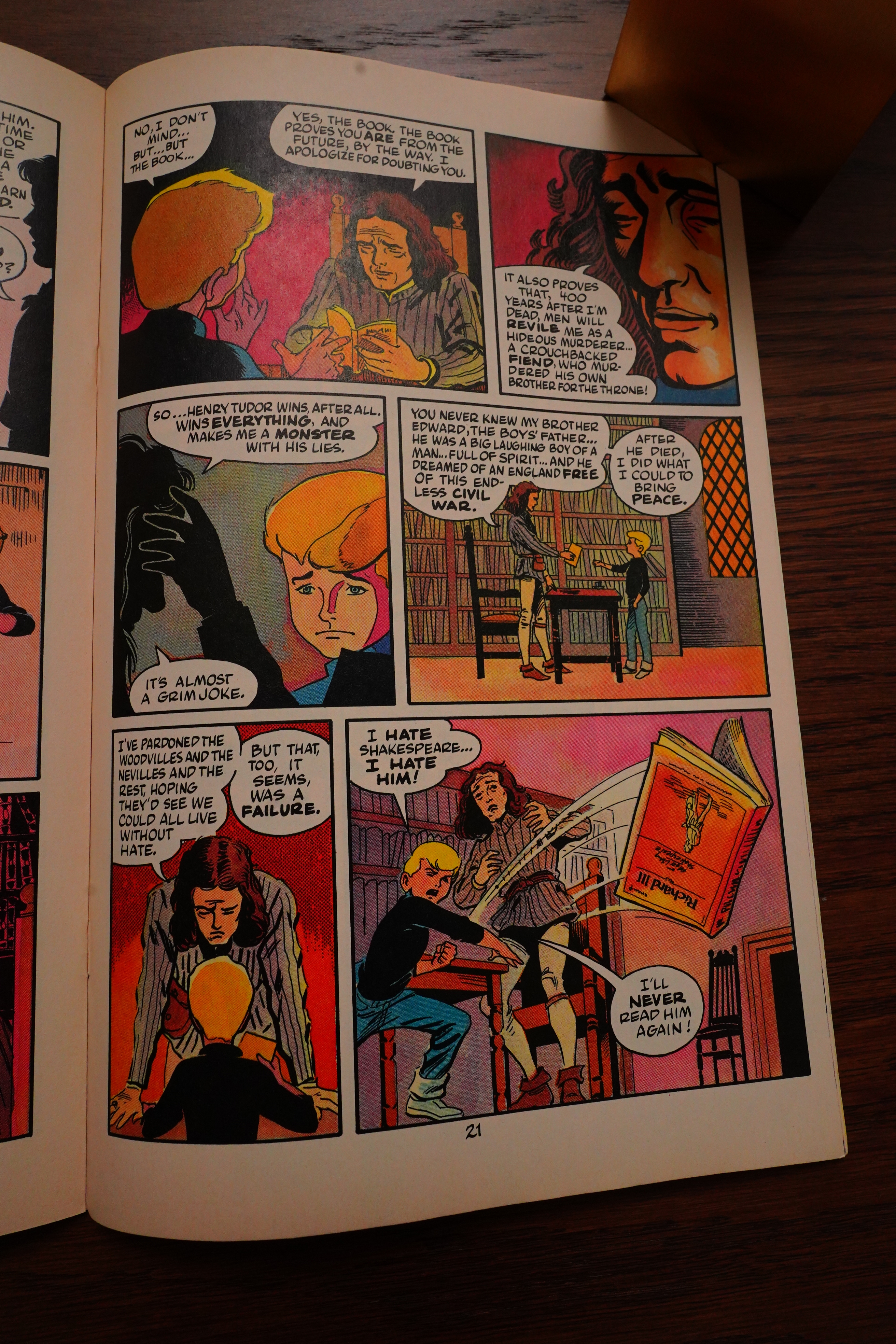
Messner-Loebs casts around widely for plots, so he takes the plot from that Josephine Tey book in an issue. Why not? It’s a time travel/dream issue, of course. I do think if you do too many of these, it’s going to become rather silly after a while.
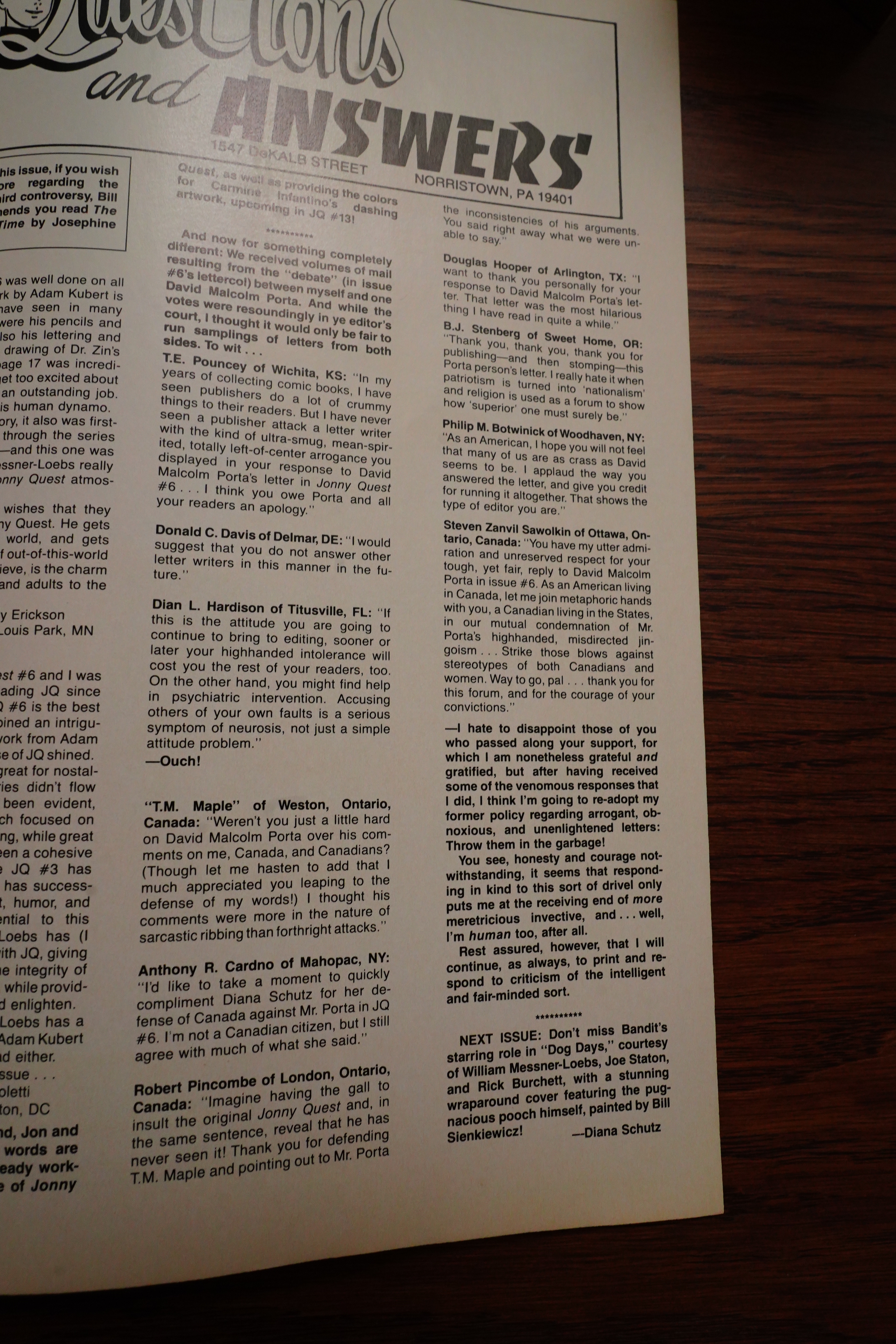
Readers react to that showdown between that Real American Reader and Diana Schutz.
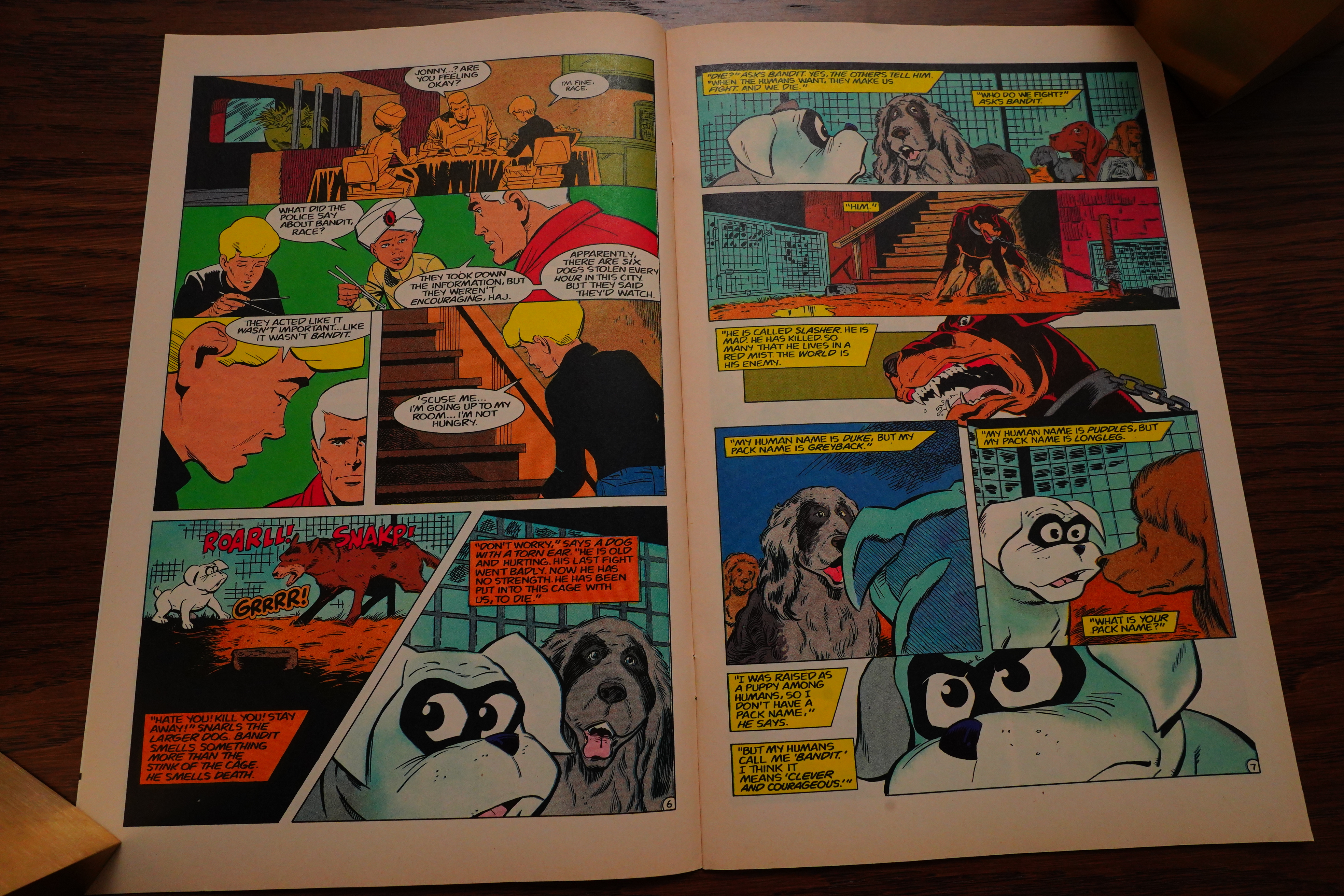
The dog has to have his solo adventure issue, of course. Well, it’s not totally solo… but it’s a really good issue. Quite moving and exciting. The letters pages some issues later agreed, calling it the best issue of the series.
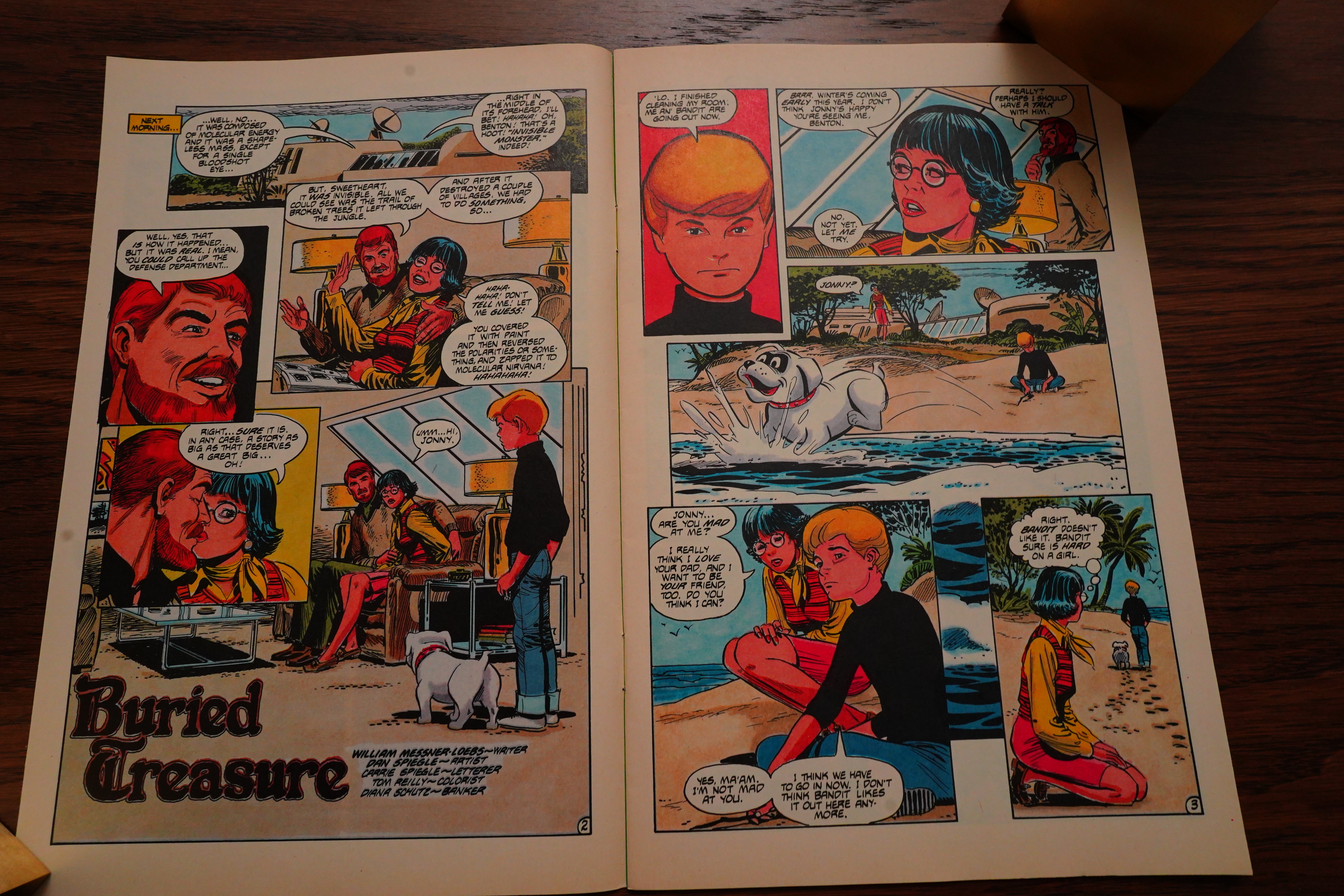
The obvious way to go with a series like this is to do “character building” instead of just going on one adventure after another. And if you have actual characters instead of blank slates, they may generate stories on their own.
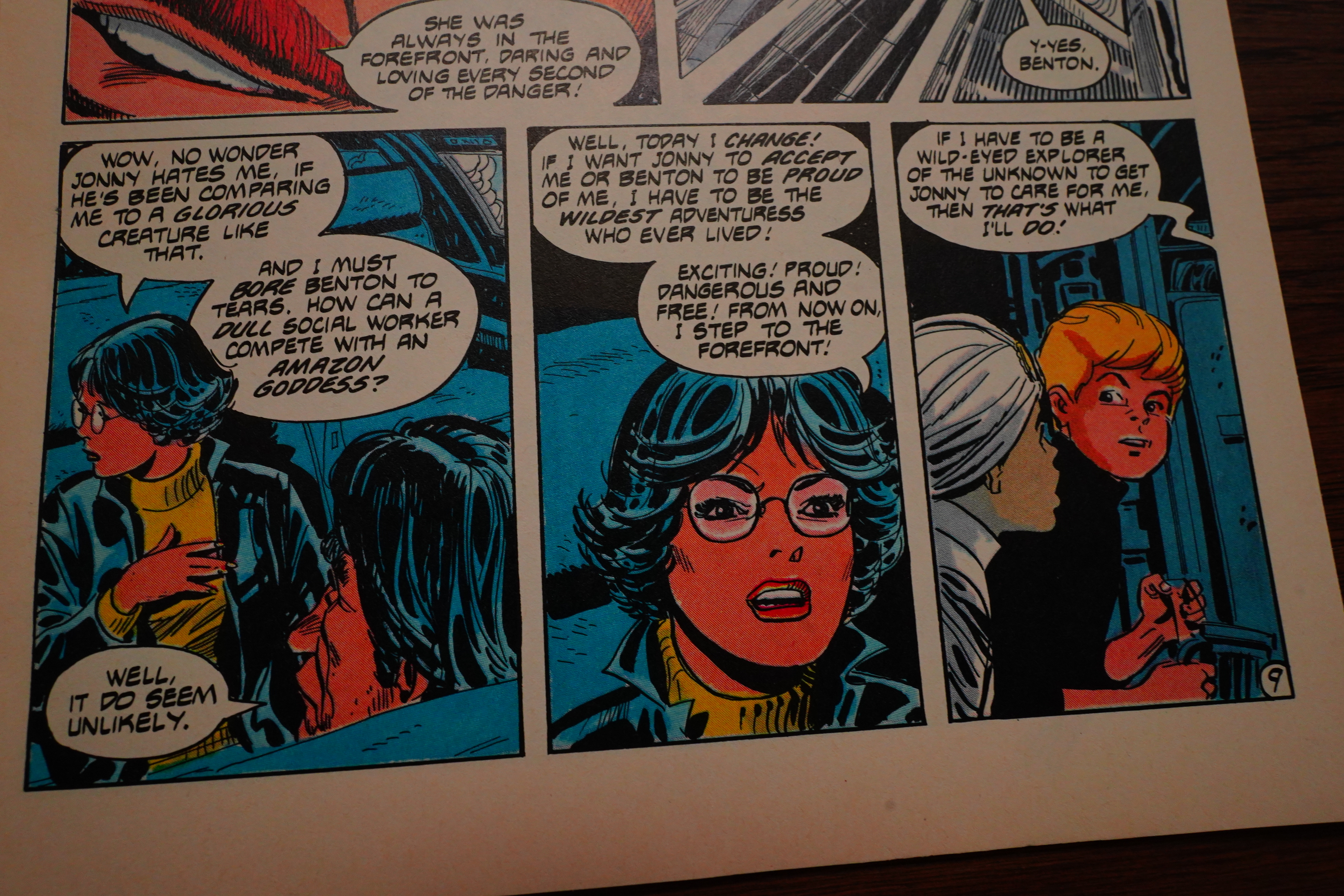
And I think Messner-Loebs manages to do this in an amusing way, while not losing track of having action going on.
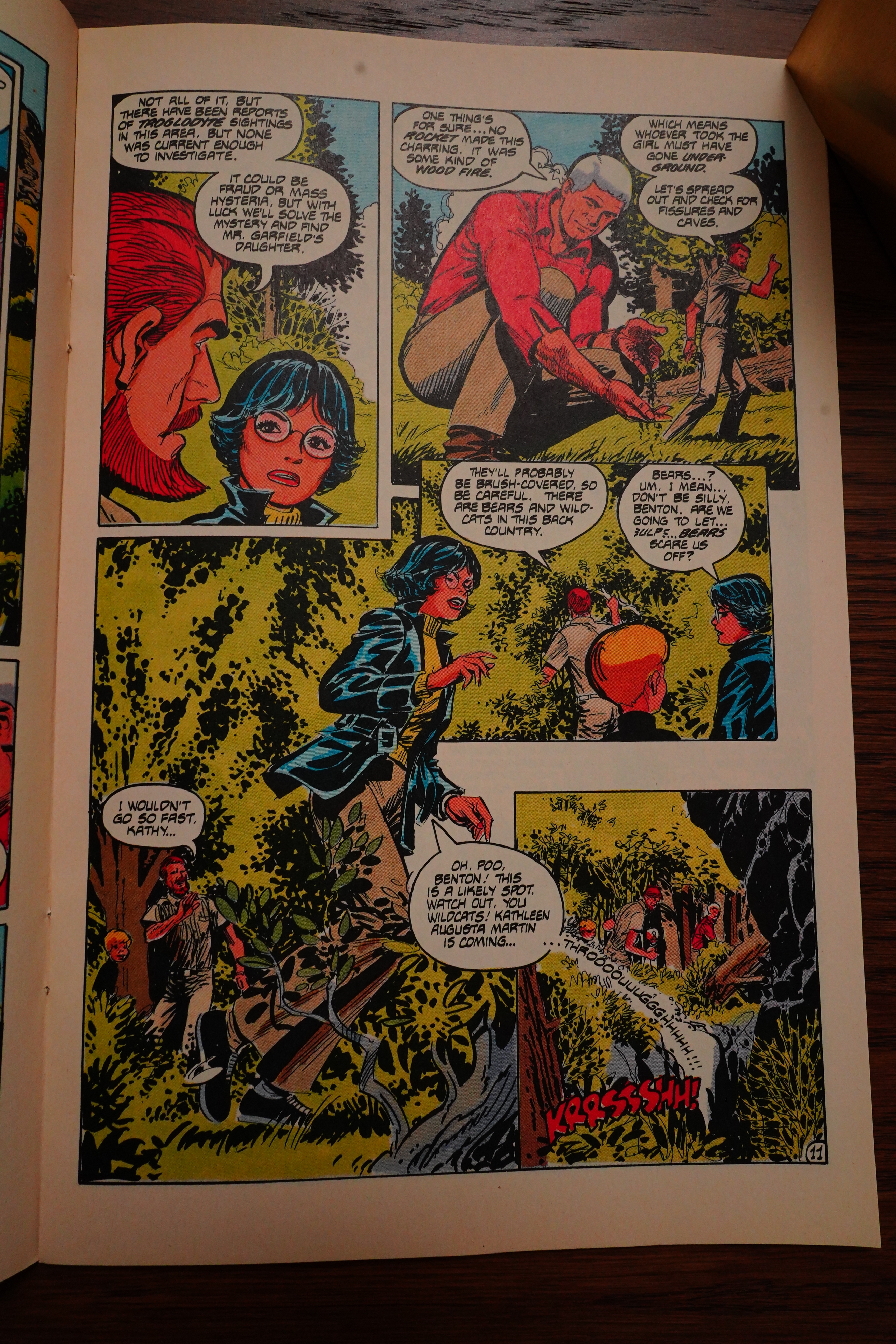
Dan Spiegle returns on this issue, and I see that he’s still trying to introduce a new reading pattern. Look at the above…
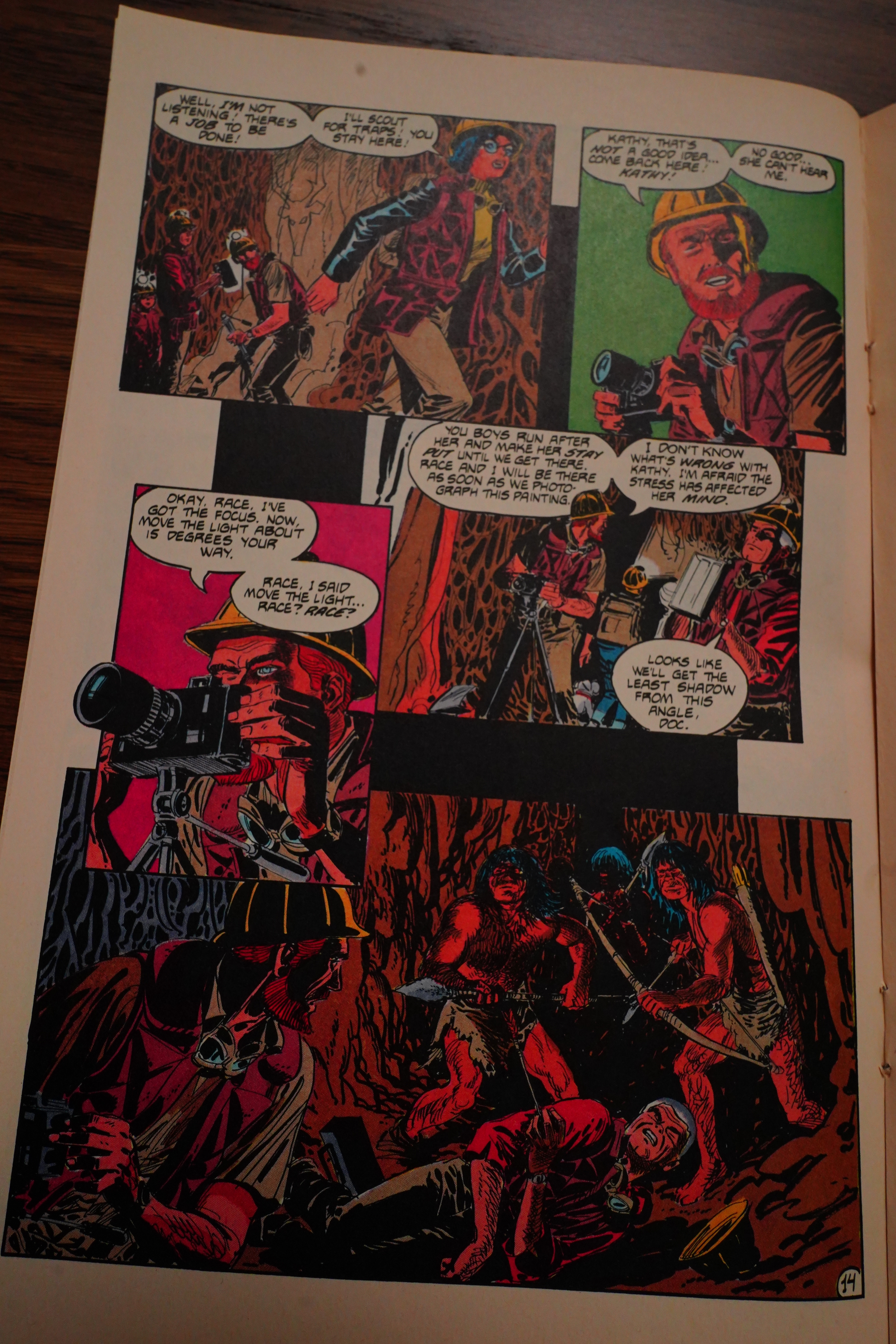
… and then this: Yes, it’s meant to be read in a “Z” way, and Spiegle does this for about half of the pages. I think it works quite well?
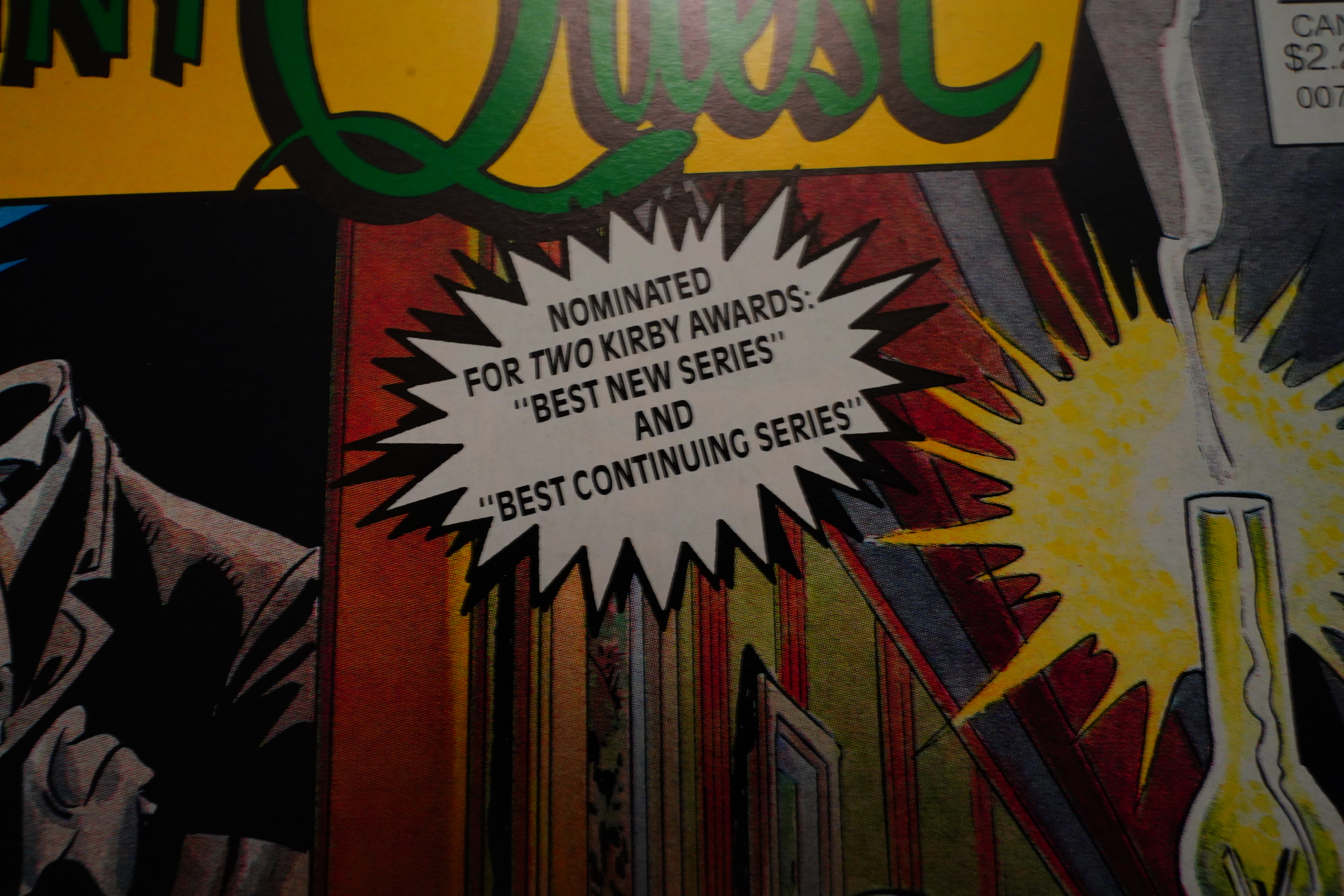
Apparently the book is both a commercial and a critical success.
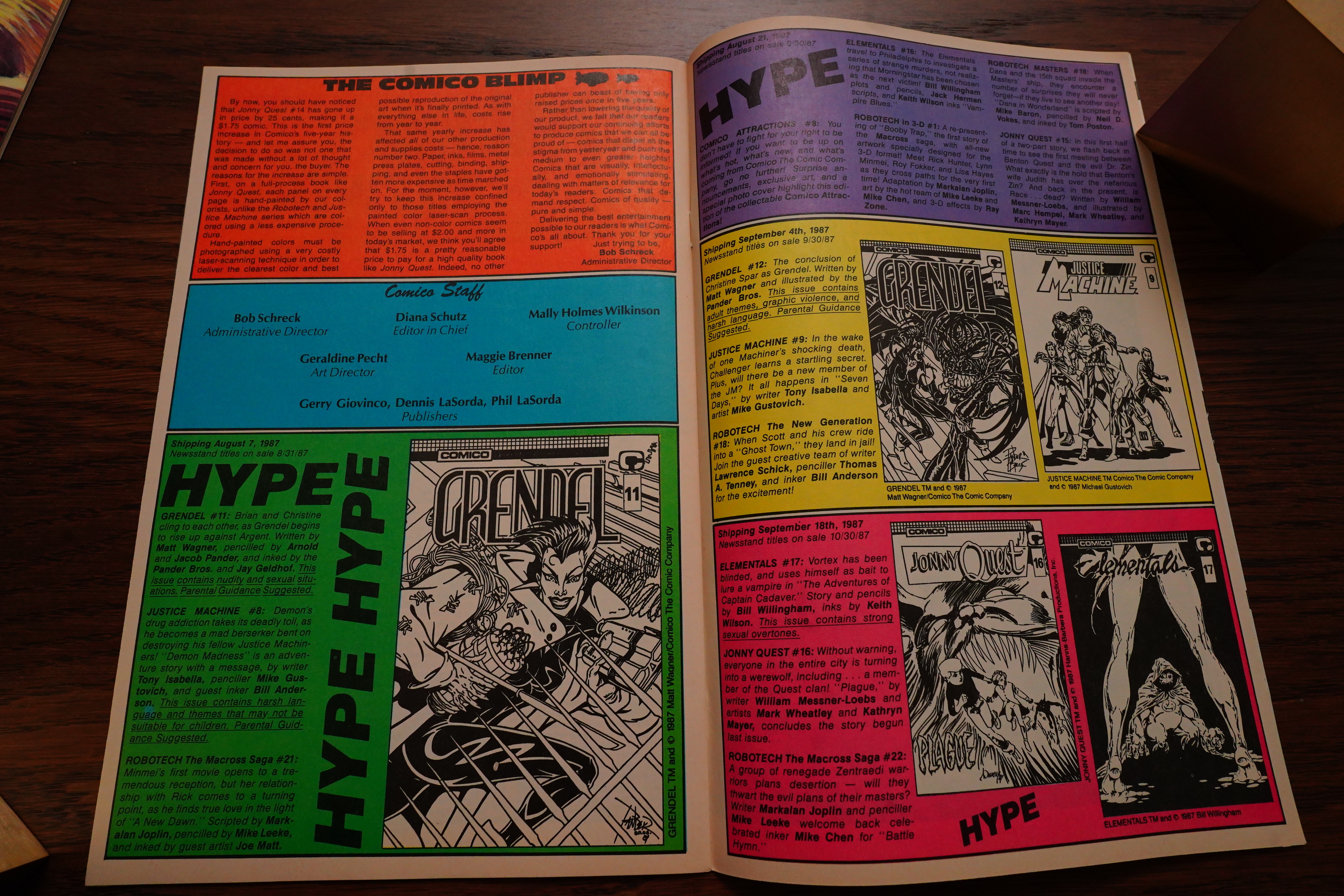
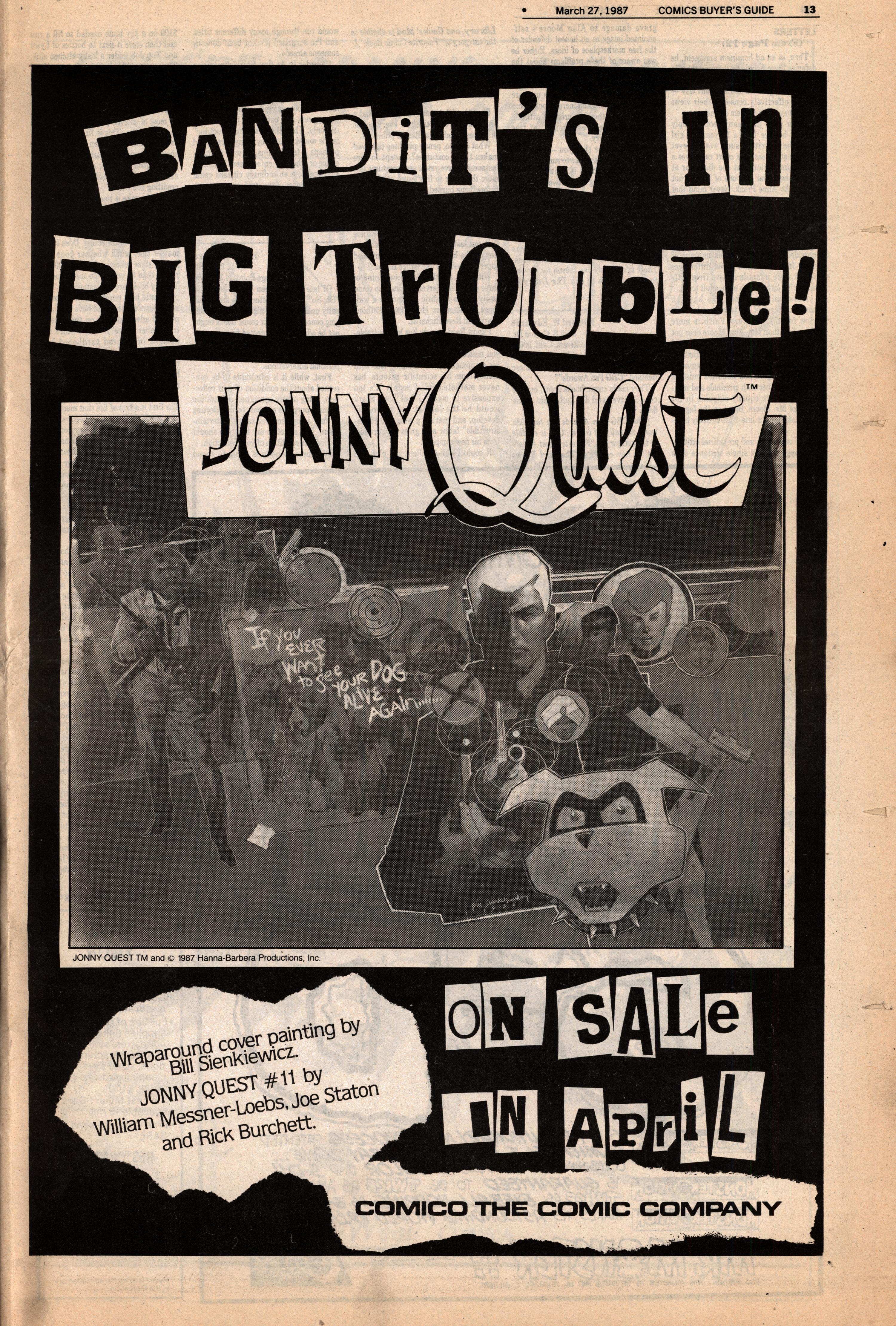
I may have mentioned this before, but man, the design on these pages… OK, they don’t want to pay to have the colour separations done on these small covers — fine. But then it’s like “well, this is a colour book, right? So we need colours!” And then you end up with the above, which has to be some of the ugliest design on a thing like this possible…
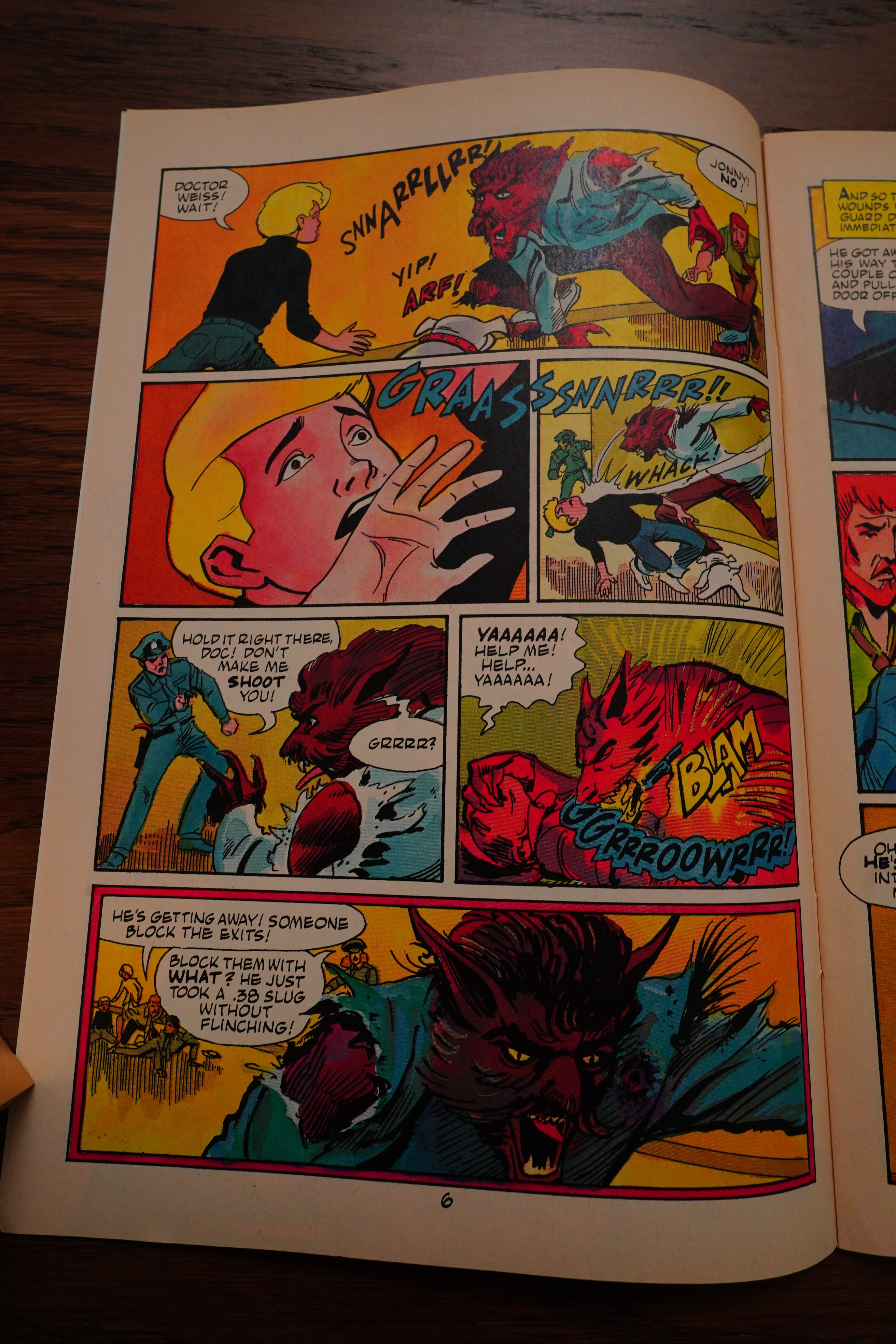
As the series progresses, you can see the enthusiasm drain from the project. The book settles down to having Hempel/Wheatley as the art team, and now that the book has a monthly schedule, the art grows pretty basic. I mean, it makes sense to try to settle on a smaller roster of artists, and Hempel/Wheatley can do good stuff, but it’s starting to feel phoned in.
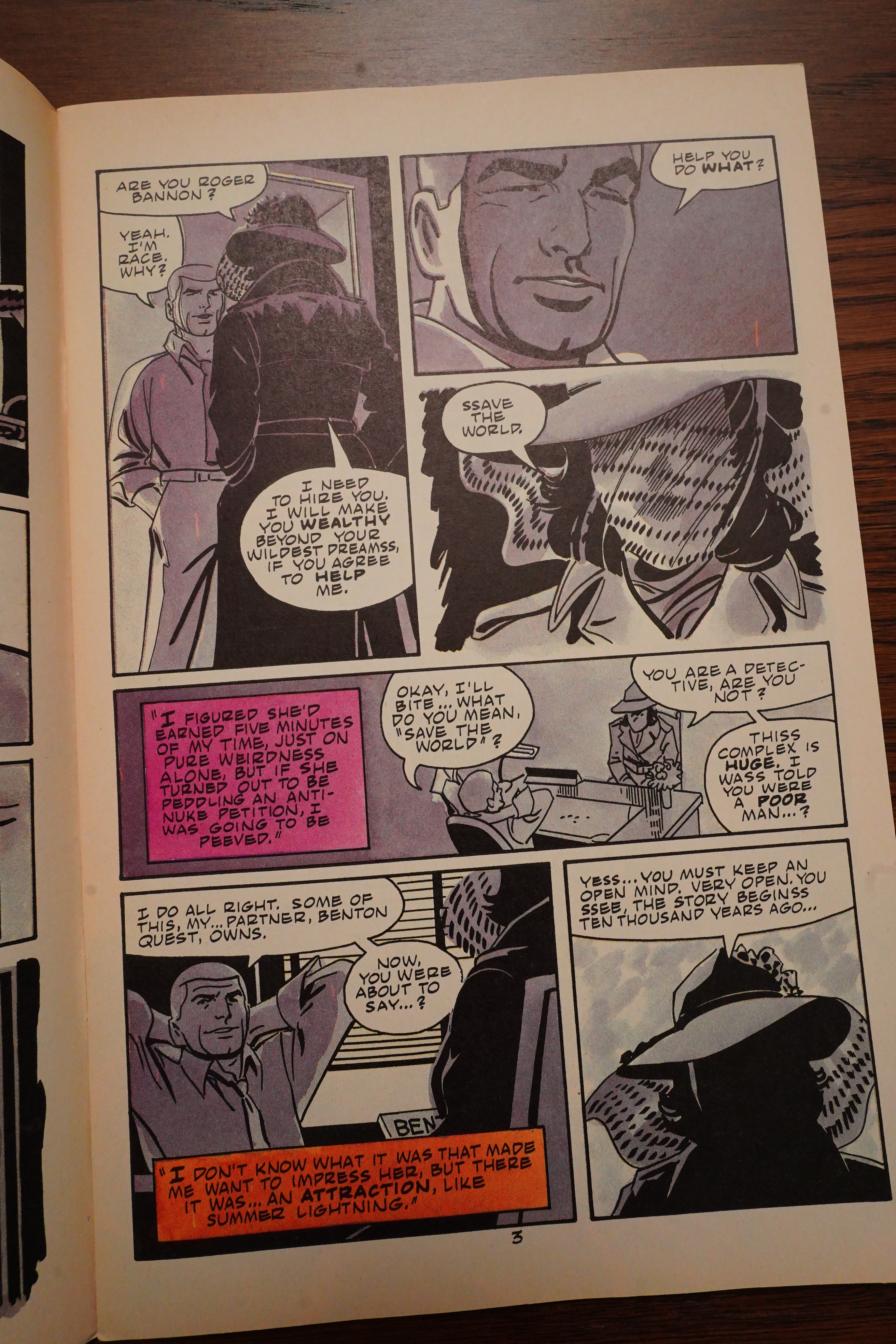
The stories are a bit of a random walk — sure, why not do a film noir issue?
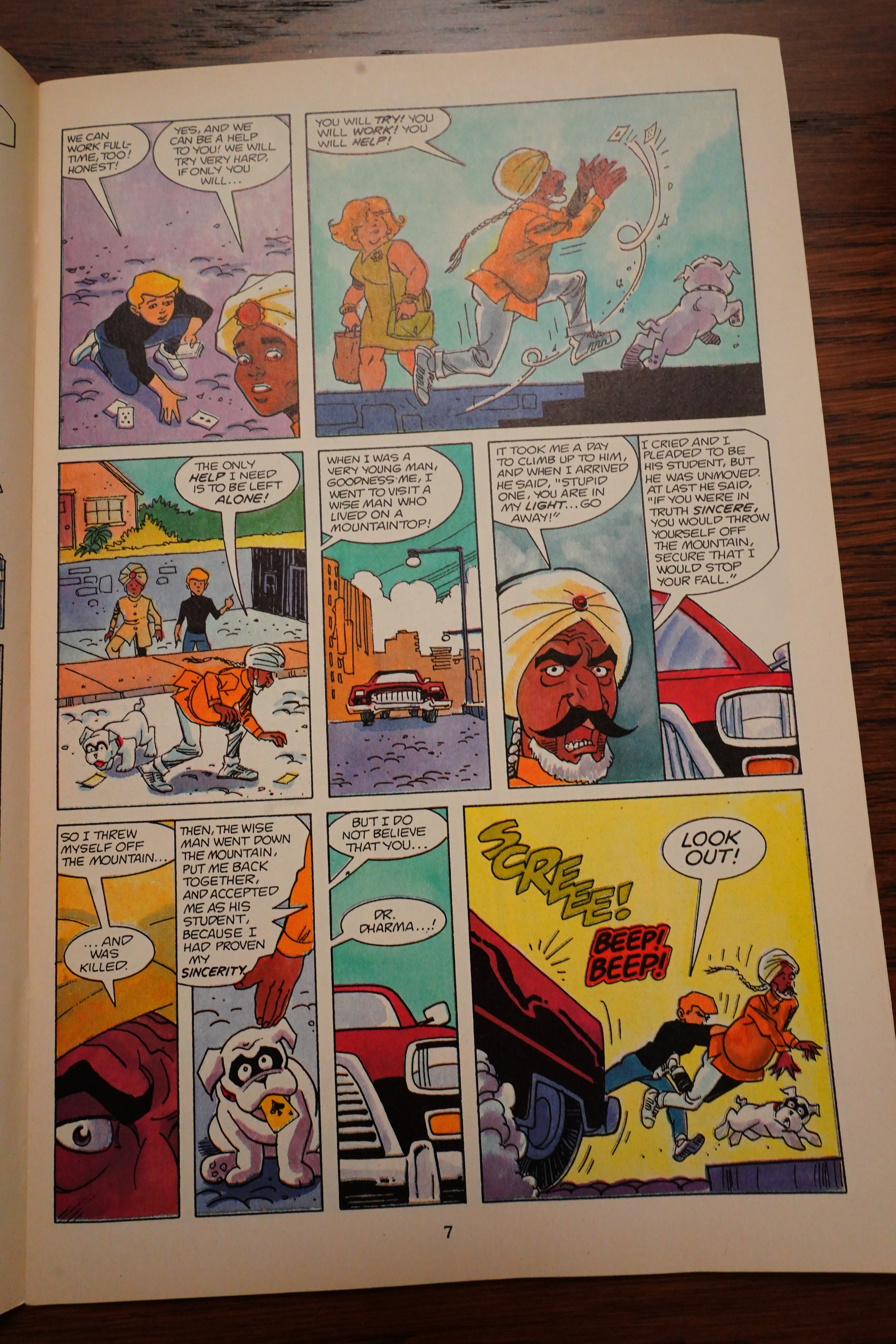
It just works better when Messner-Loebs grounds the exploits in the characters, like when the other kid goes looking for a swami. (Art by Ernie Colon.) It’s just funnier and more interesting.
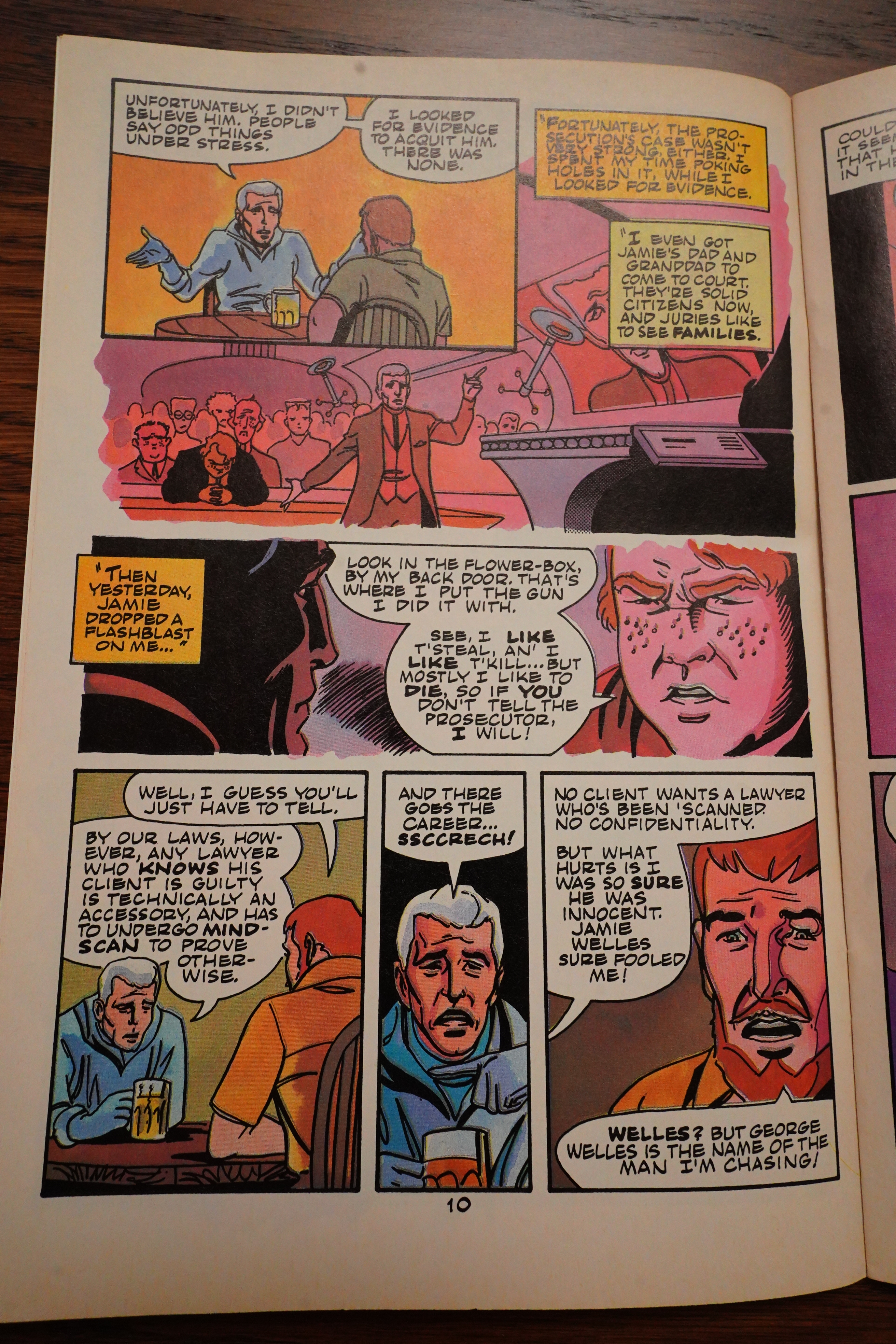
The worst of the issues are the time travel ones — there aren’t that many, really, but they’re not really very inspired.
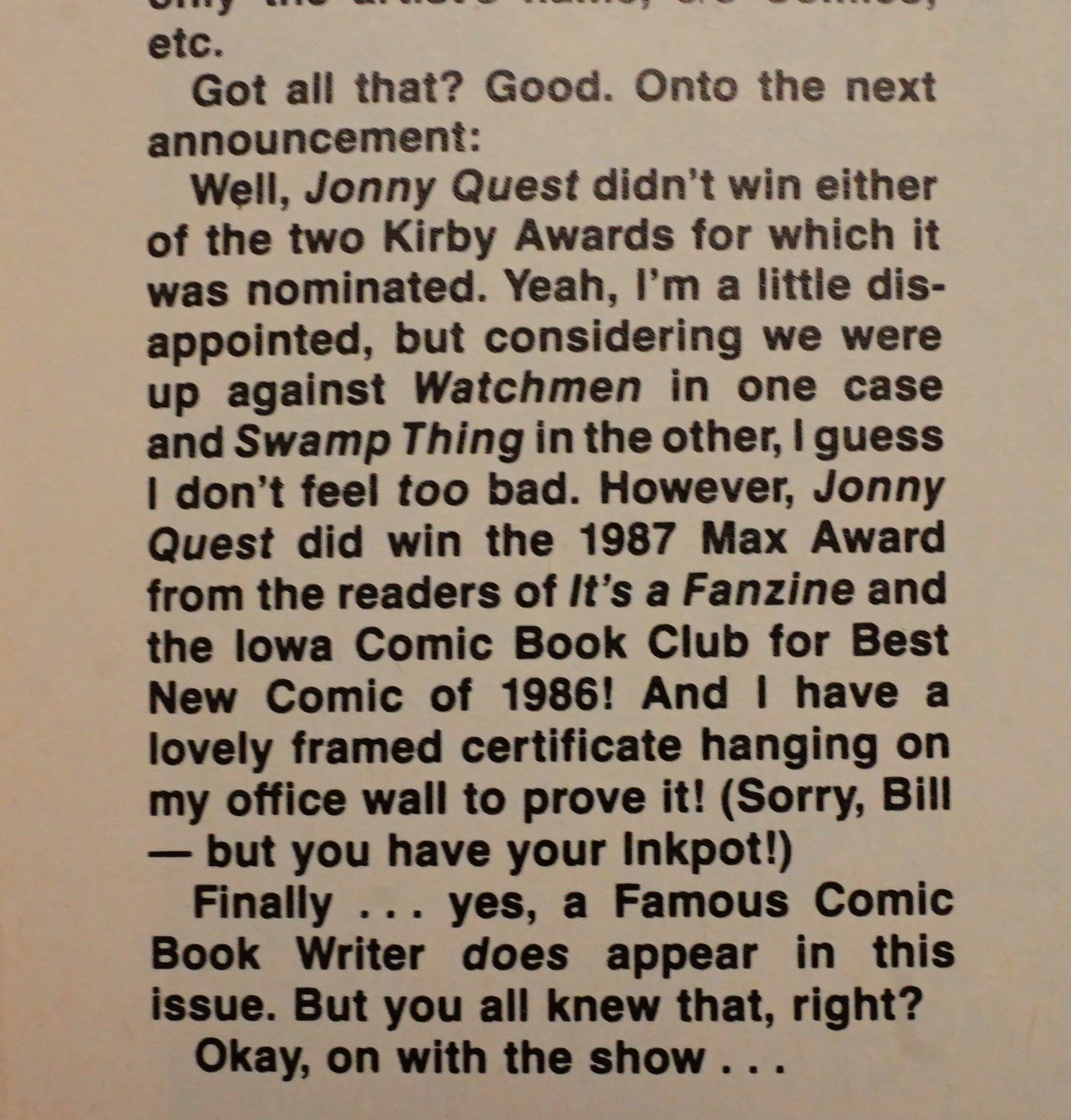
Jonny Quest didn’t win any of the Kirbys it was nominated for, but it won the It’s a Fanzine Max Award.
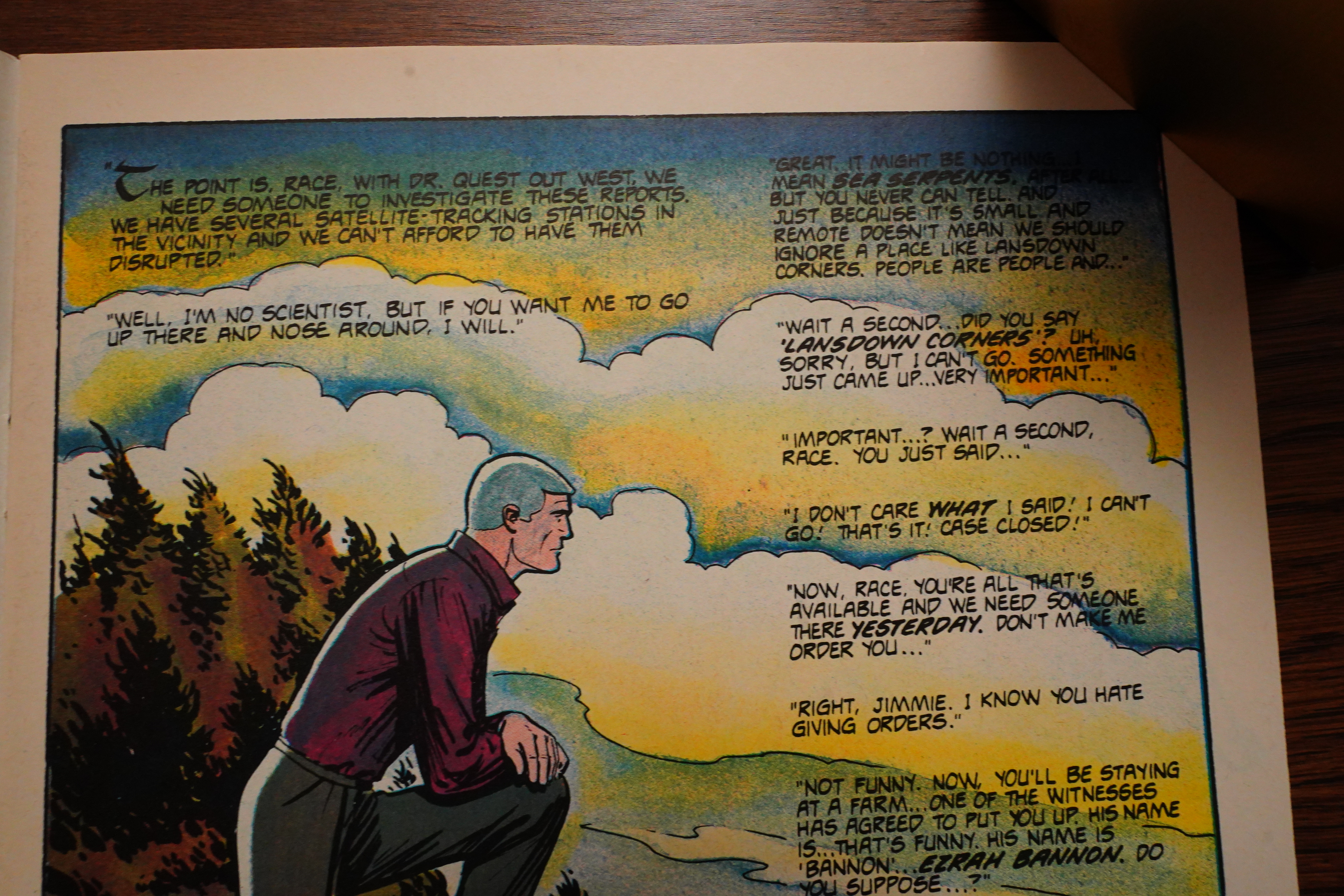
It’s fun looking at the different approaches to colouring and separations — they’d mostly figured out how to do this by this time, but you still see a lot of variation from issue to issue. And something like this isn’t something you’d ever see today. (Colours by Joe Matt.)
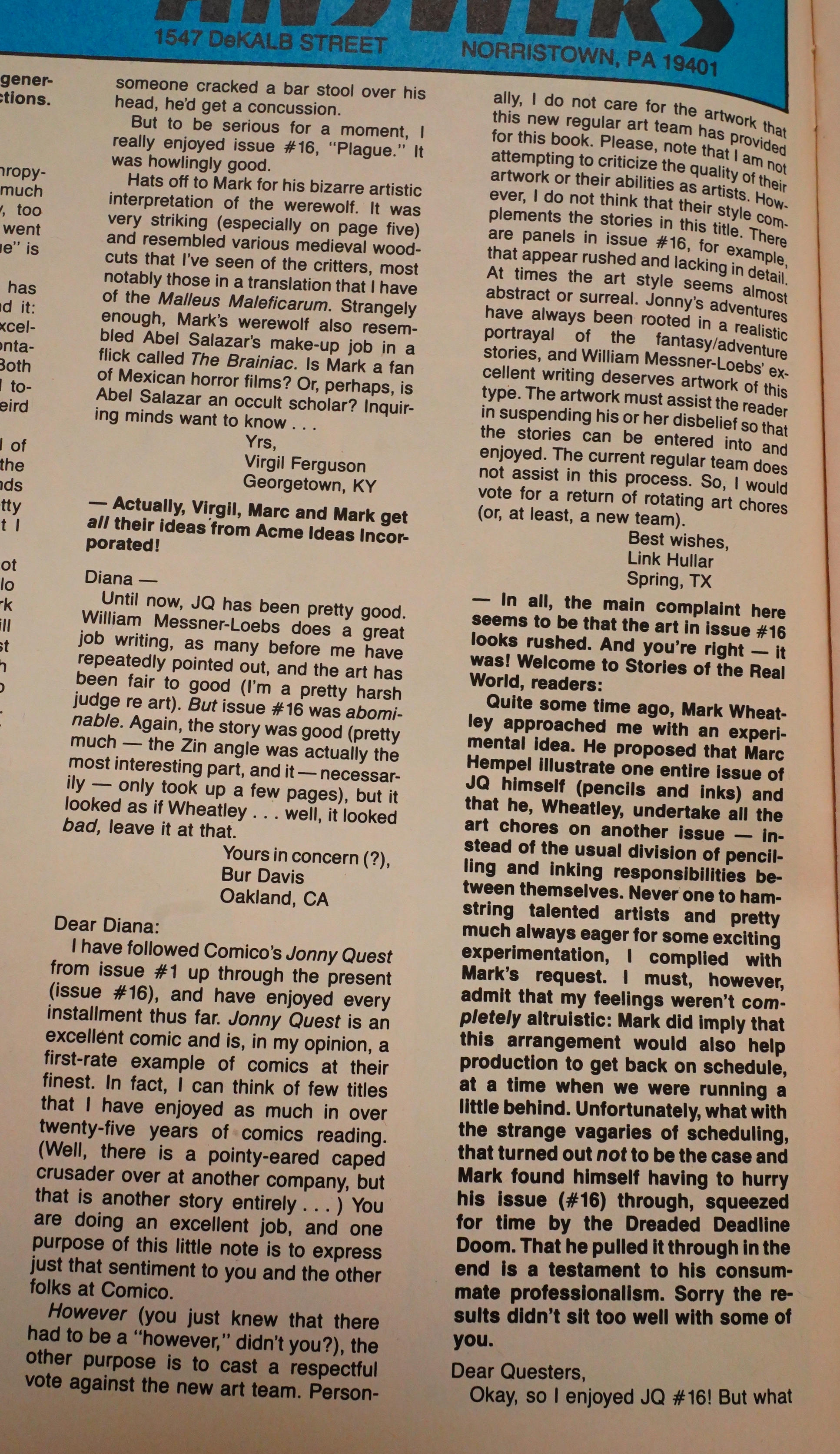
OK, I wasn’t the only one that reacted to that particularly naff Hempel/Wheatley issue — it was indeed done in a hurry.
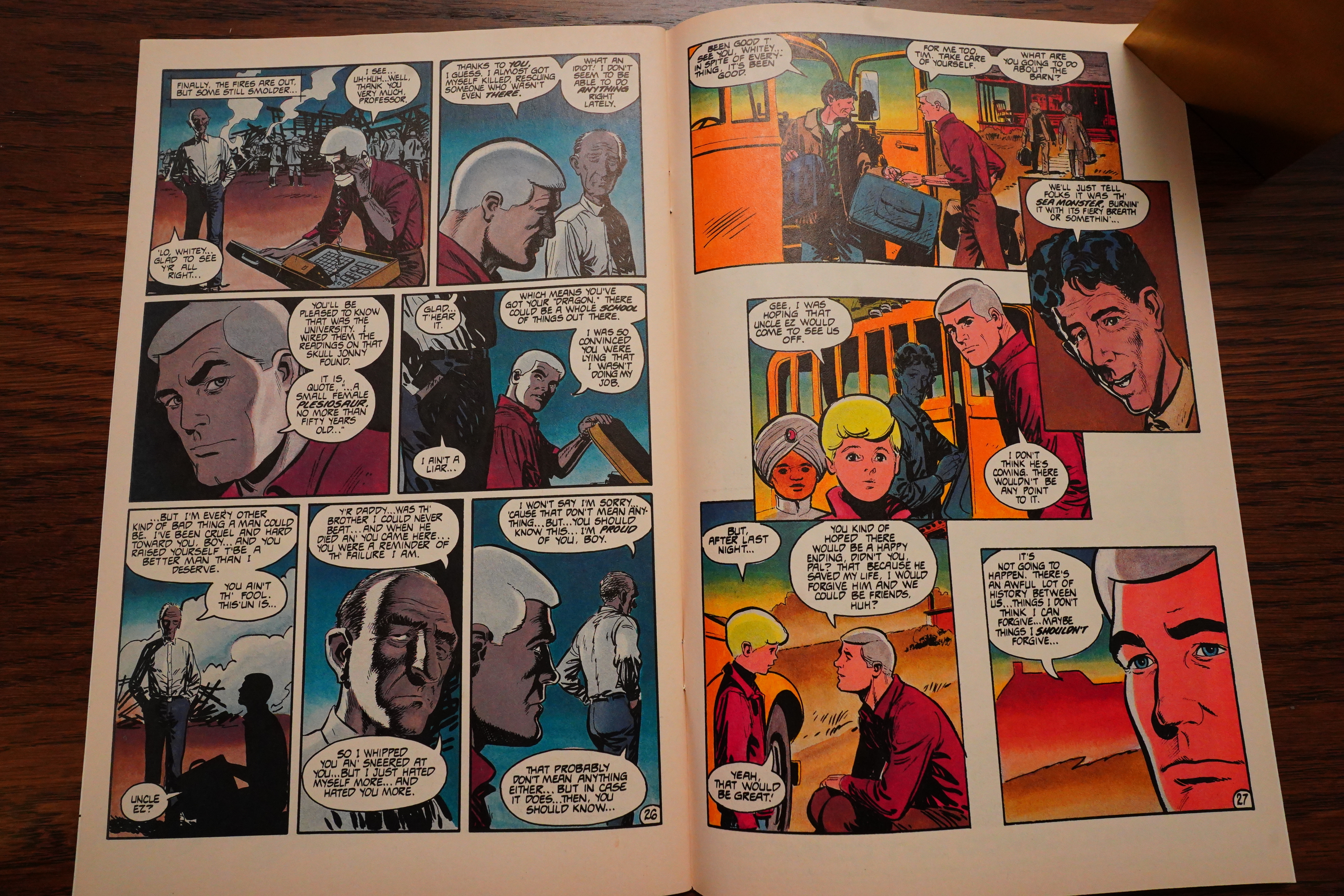
Messner-Loebs and Dan Spiegle does an issue about going home — it turns out that whatsisname with the white hair was brought up by an abusive uncle, and when he goes home, he finds out that things were less clear than he remembered them being. But his uncle was still an asshole. Which makes this a pretty nuanced issue.
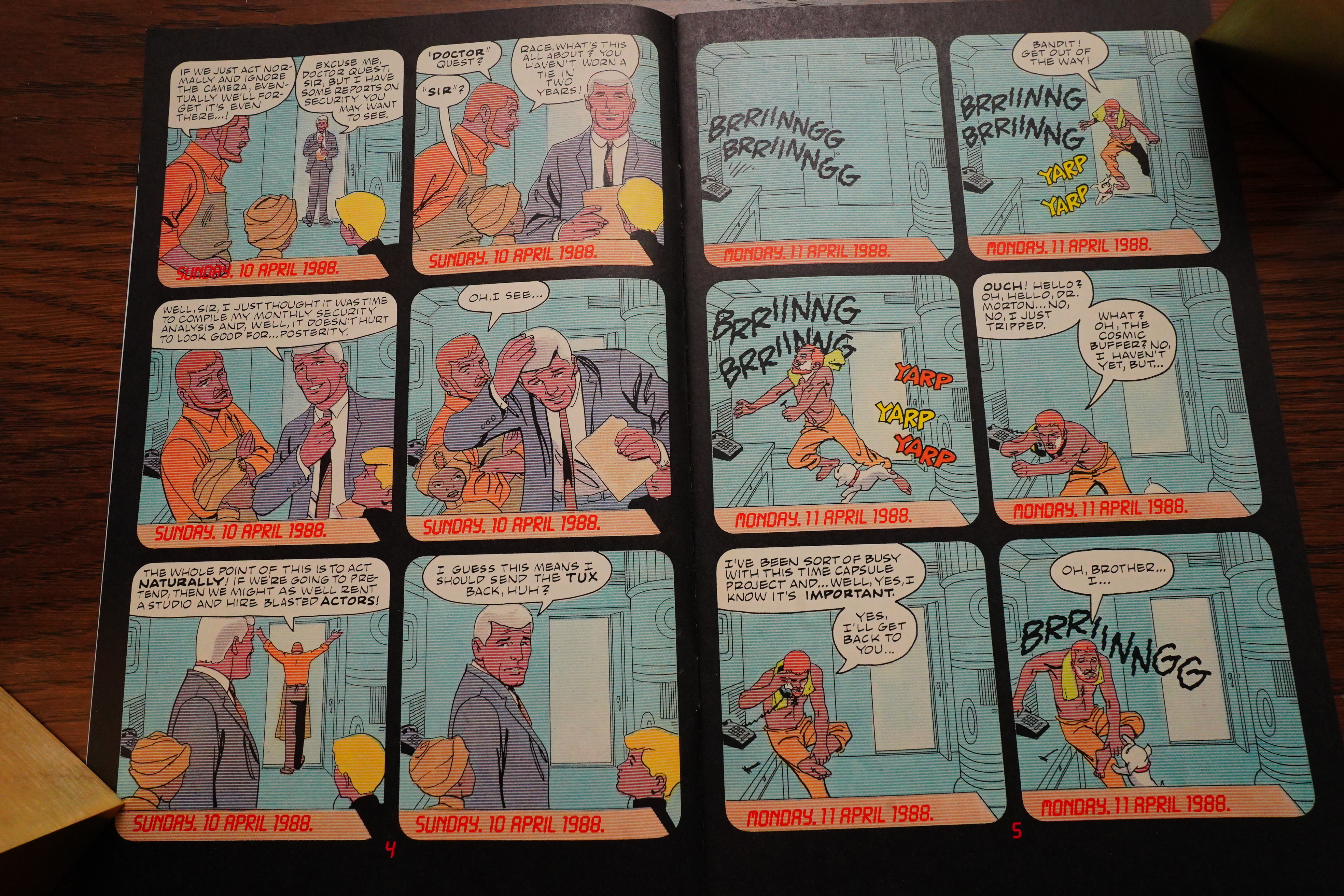
And then we get an issue with a fixed camera! That can’t have been very entertaining for the Marc/ks to draw, but it’s a very amusing issue.
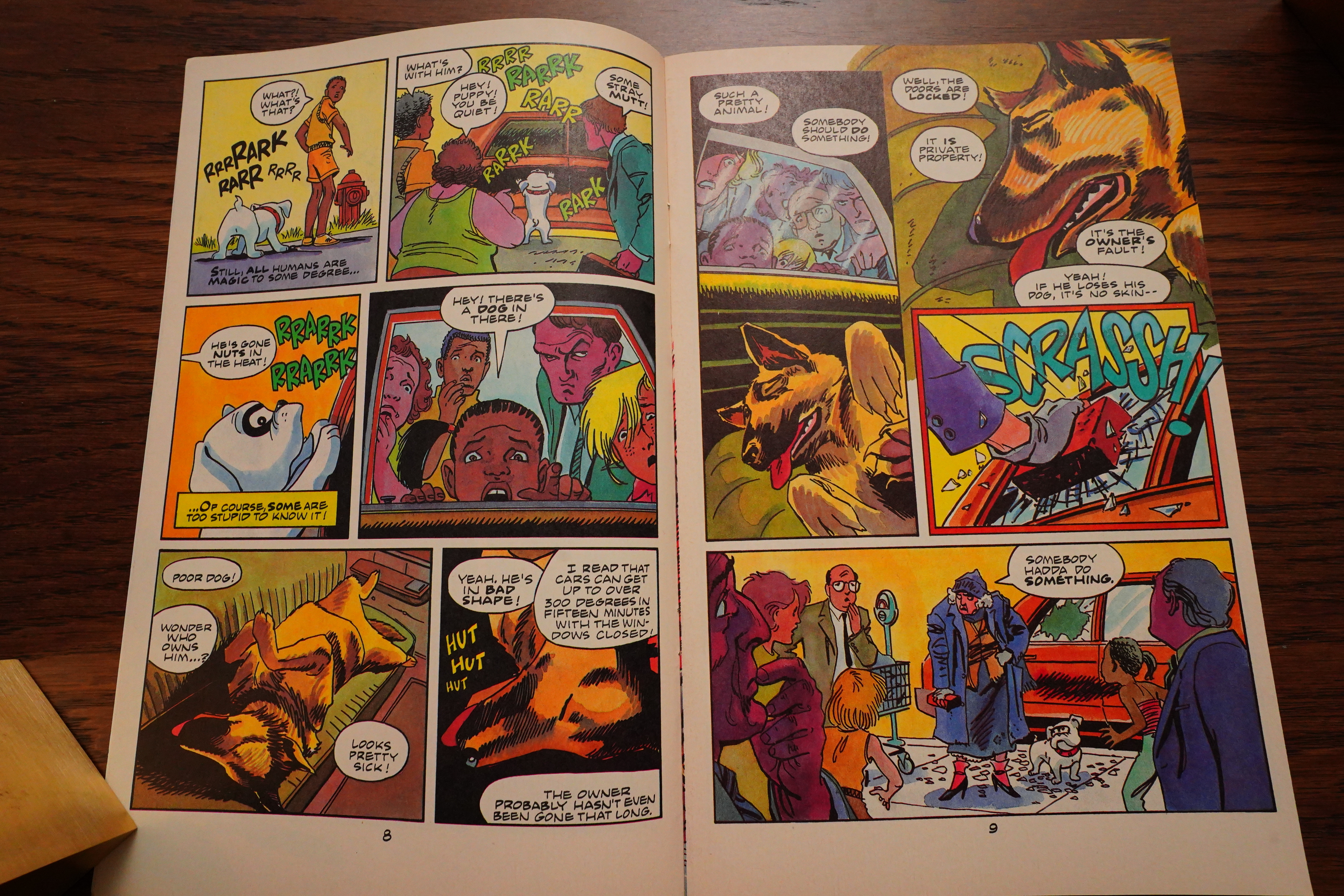
And another dog solo issue! And again, very touching!
I felt like Messner-Loebs kinda lost his way there for a few issues in the mid-teens, but now he’s on a roll again — every issue having a strong story, and with great variety. The only problem is that we’ve moved pretty far from the Two Kids, A Scientist, James Bond and Their Dog Go On Adventures, which was the setup here…
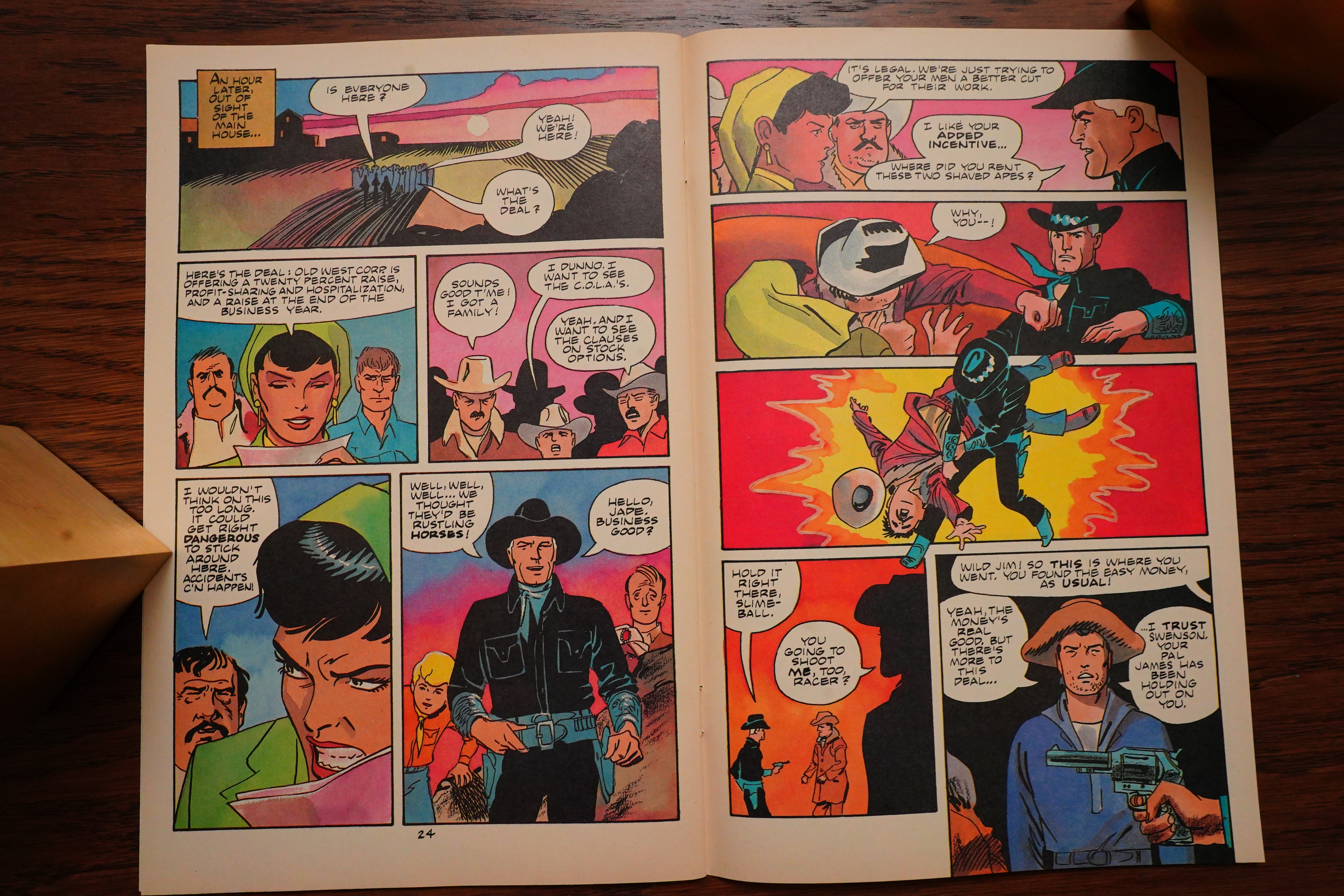
But then Messner-Loebs’ stories get more and more disconnected from… well, anything — a two-parter where they solve a half-assed mystery out west? Sure, but… It’s such a bad mystery!
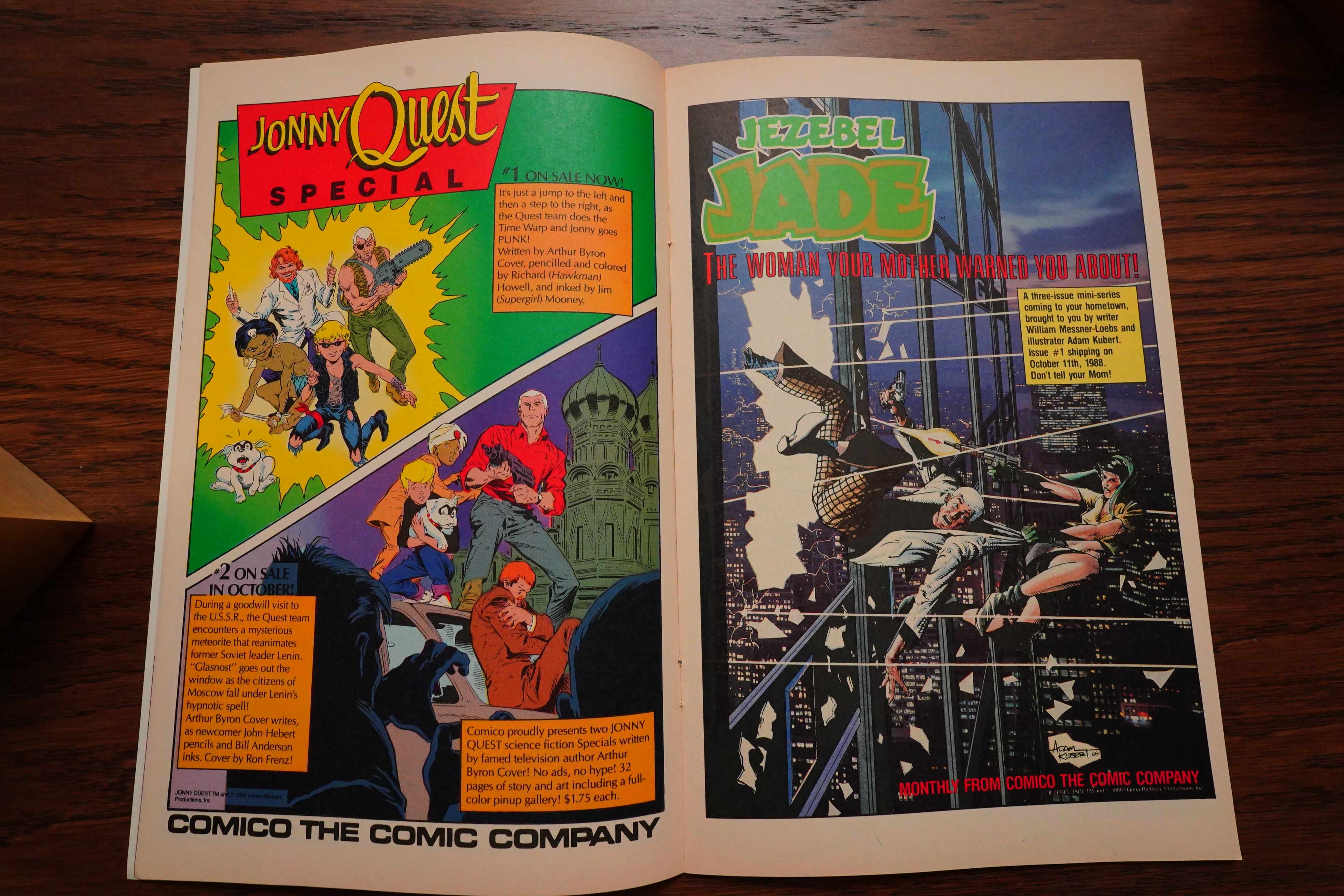
We’re coming towards the end of the series, and it was cancelled due to low sales. Why are they then bringing out two Jonny Quest mini-series at this time, then? Hm… Oh, perhaps the licensing agreement with Hanna-Barbera is lapsing, so they’re squeezing some last minute dollars out of it? But that only makes sense if they weren’t losing money on the property in the first place… Or perhaps they don’t pay more, so this gambit makes it possible to avoid losing money the last three months?
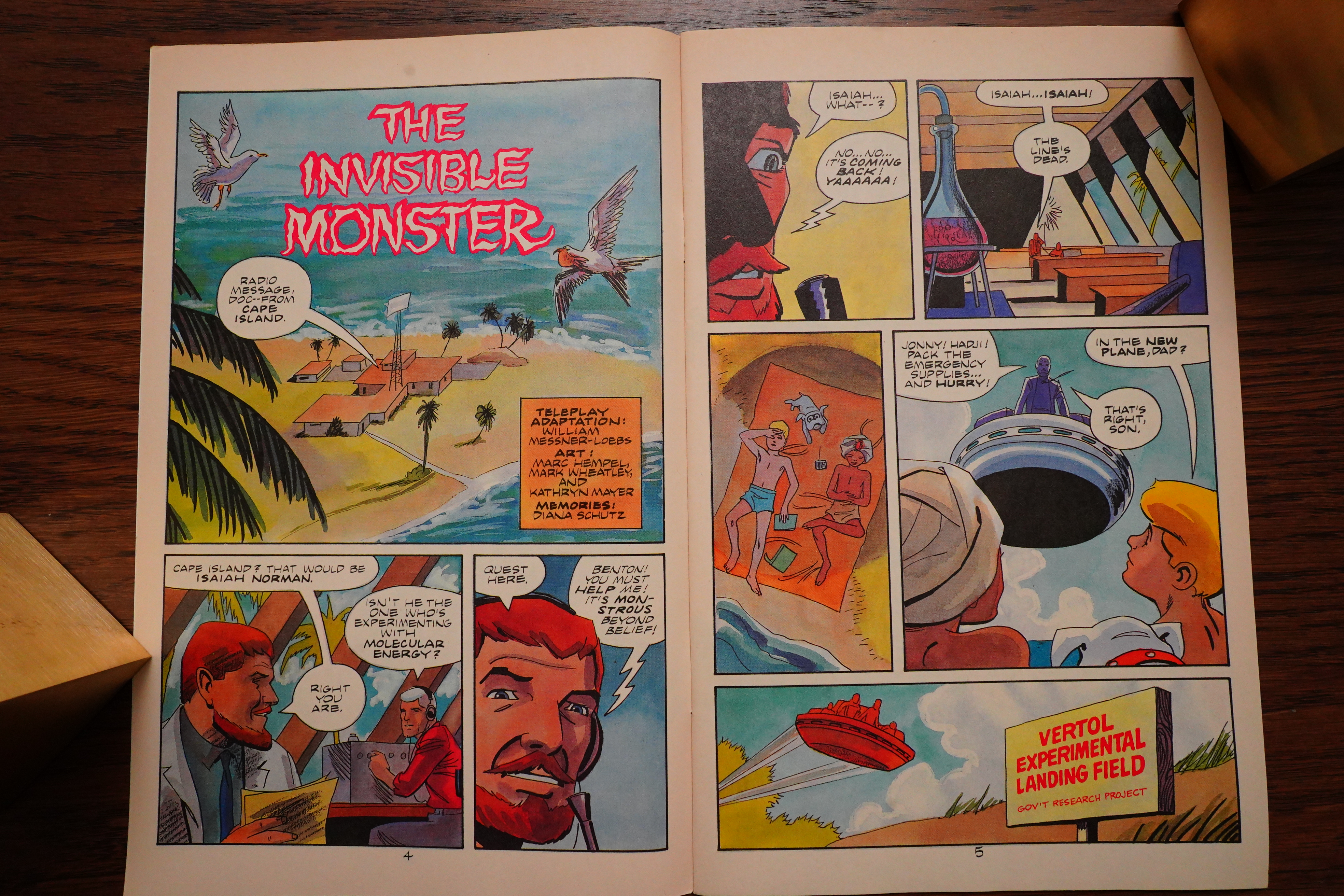
The next-to-last issue adapts one of the original stories — the first issue to do this. I think the Jonny Quest Classics series did this, too, but it’s weird dropping in an issue like this at random… Perhaps Messner-Loebs just had run out of stories?
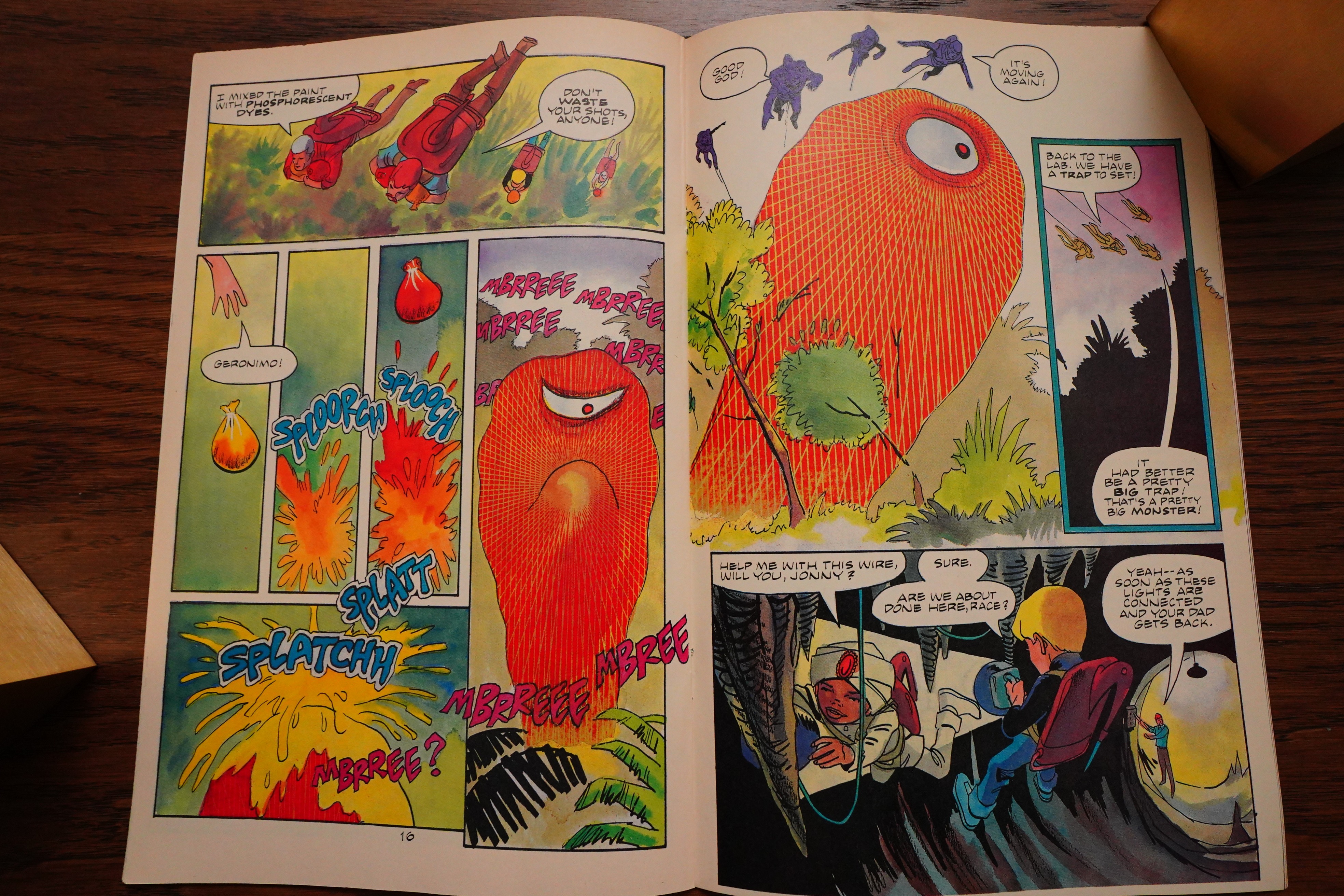
If this is a typical episode of Jonny Quest, I don’t understand why it’s fondly remembered, because it’s easily — easily — the worst issue in the series. The plot makes no sense, and there’s very little excitement: Just random stuff happening until they run out of pages.
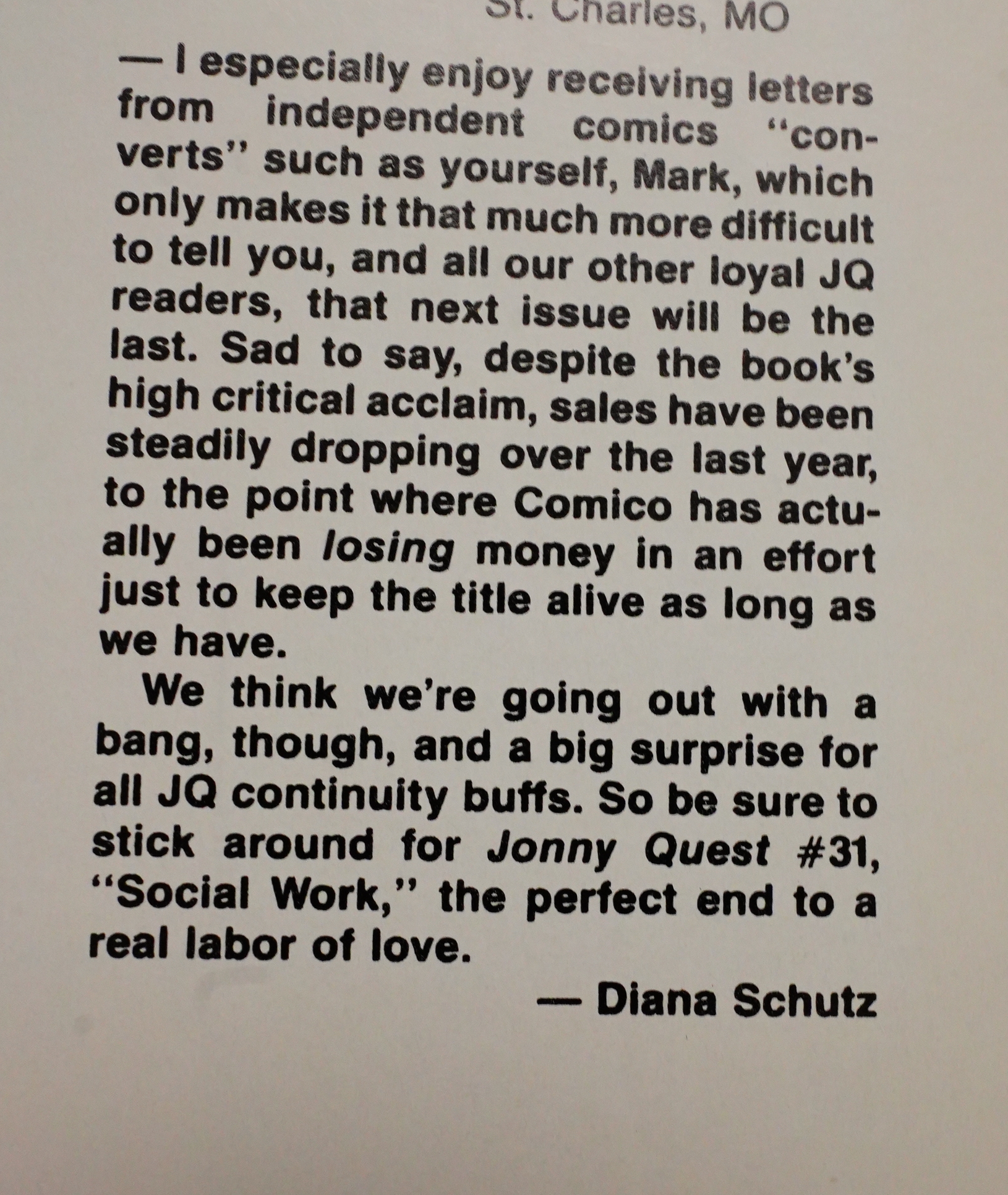
Diana Schutz announces the cancellation, and states that they’d been losing money on the title.
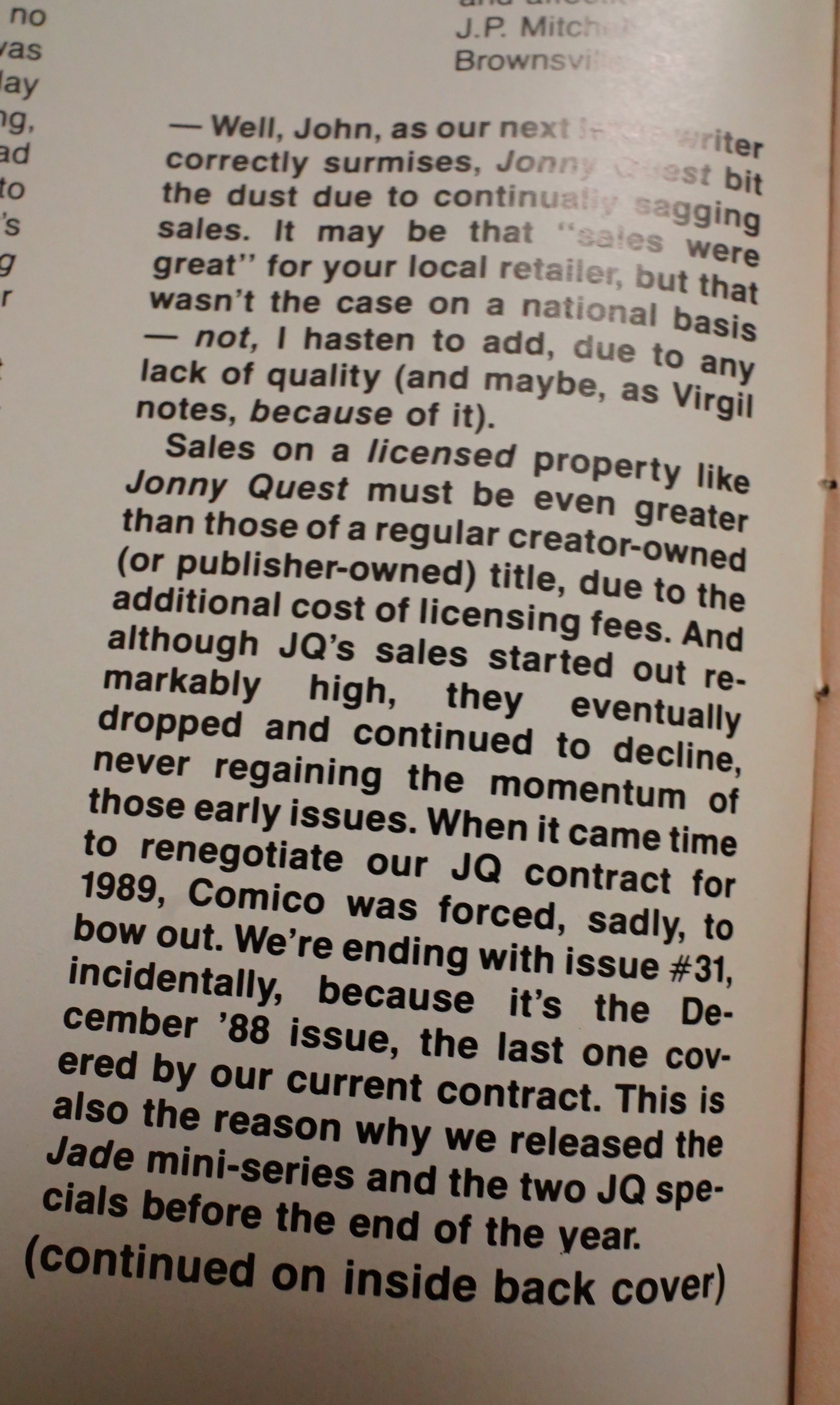
Wow. In the final issue, Schutz confirms my speculation about why they chose to release those two mini-series all of a sudden. Right again! I’m so smart S. M. R. T.
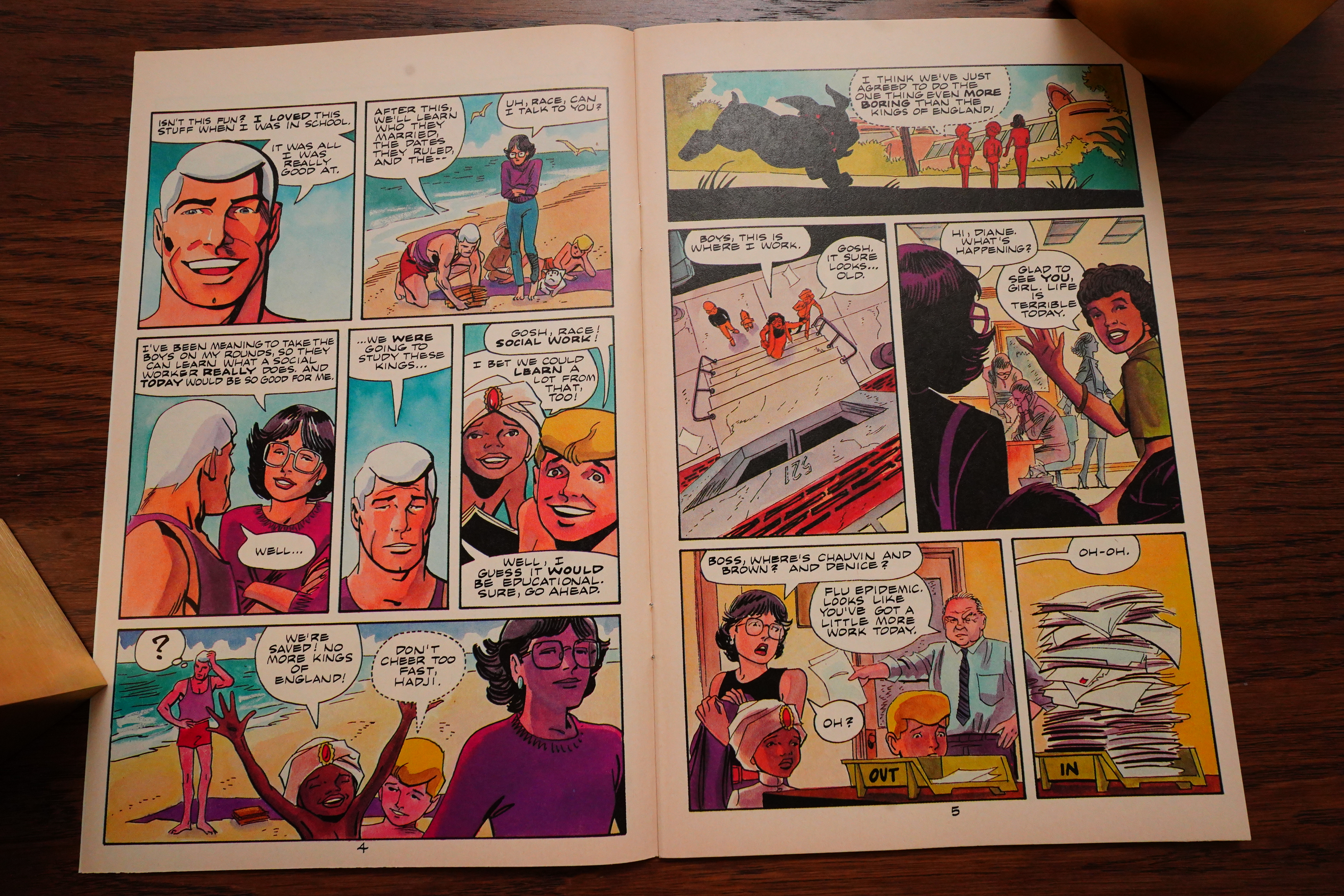
In the final issue, the kids go on their most exciting adventure yet — they follow the social worker to work, and get to see old people getting kicked out of their homes and stuff.
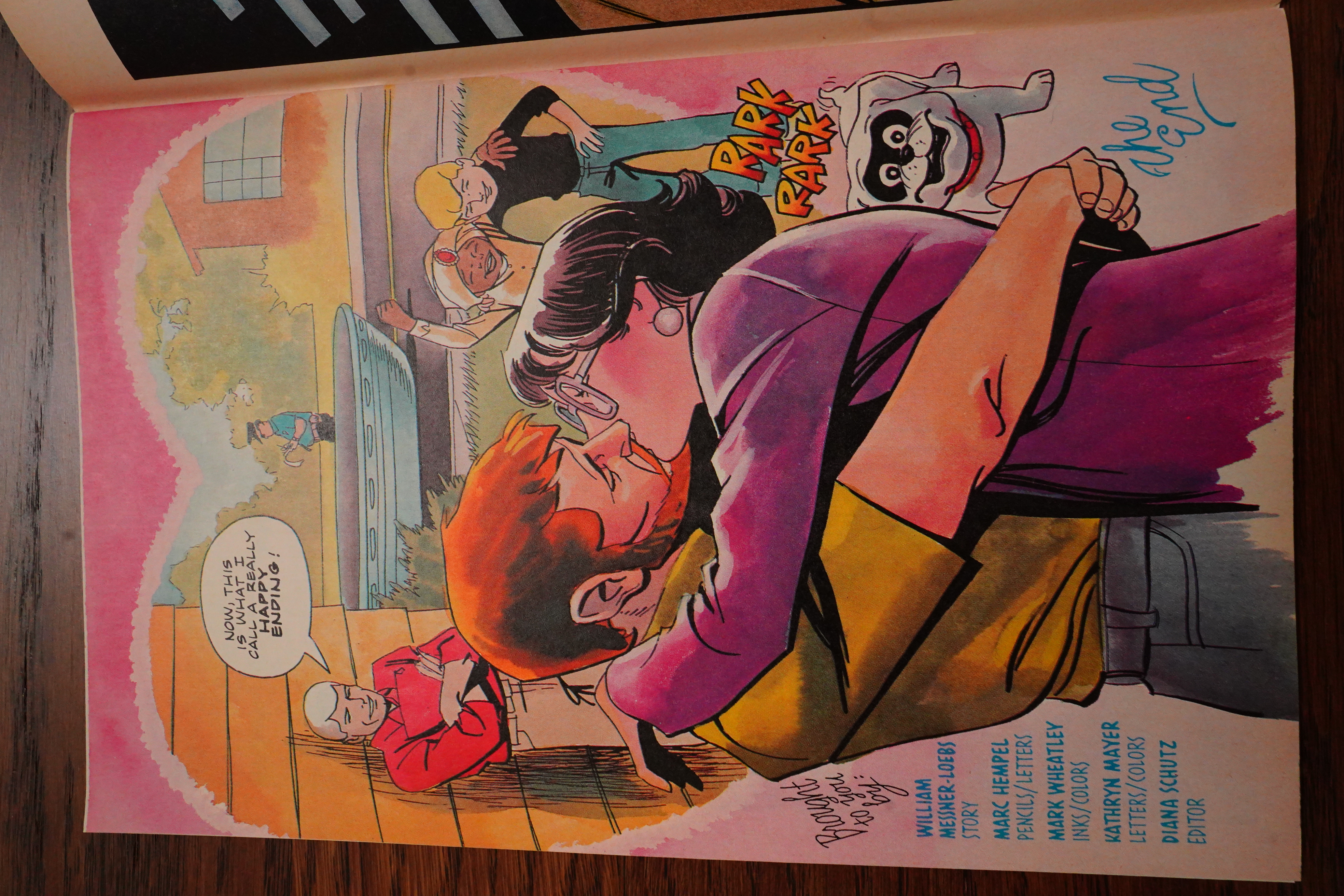
And then… Their dad marries the social worker finally! The end!
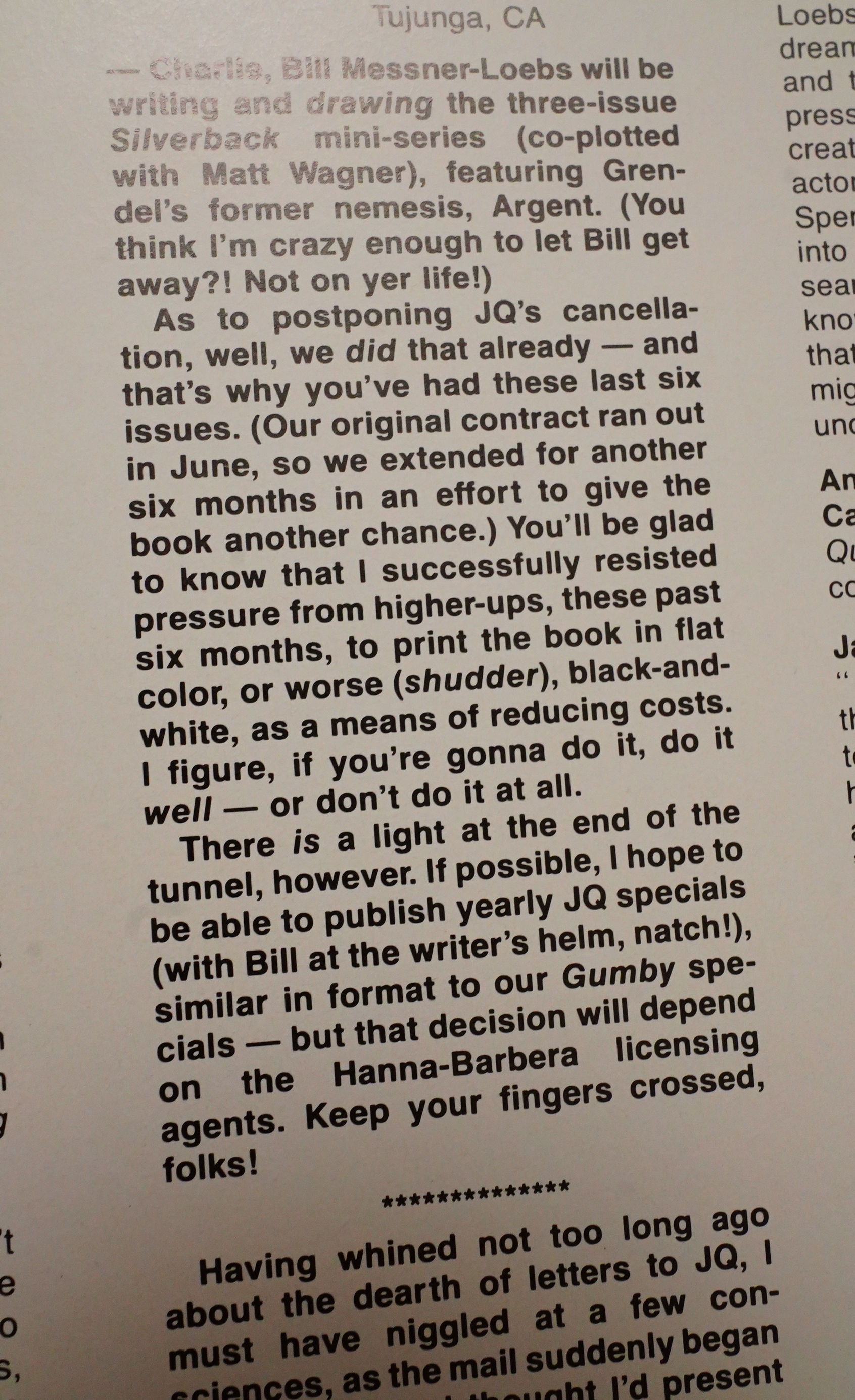
Schutz fought for the series until the end, it sounds like.
So… Wow, I finally got to the end. I think it took me ten days? But I had other things to do; it’s not like it took me all this time to read these 31 issues. But… it’s also to do with how these issues are structured: After reading a handful, I didn’t really want to read any more.
Reading this series has been like like reading a short story collection. Almost every issue is a one-and-done story, and while there’s some progression plot-wise, it’s very, very slight. But more than that, the stories didn’t really feel grounded in the characters: For many of them, you could have slotted in any characters and it would have been the same story.
Individually, I liked almost all of the issues. Collectively, it was a slog to get through, especially after Hempel and Wheatley took over the artwork. It’s not that they’re bad artists — they’re fine — but it’s hard to get excited about their work here.
And who was this series for? Obviously, at the start they set off with great (and contagious) enthusiasm, but then that dissipated, and we were left with a series that wasn’t really about a family going off on James Bond-like adventures, but just… random stuff. But the people who’d enjoy reading a story about the vicissitudes of social worker like aren’t likely to pick up an issue of something called “Jonny Quest”, are they?
But what did the critics say?
Diana’s gameplan for Jonny was
twofold. First of all, she received a
lot of response and interest from art-
ists interested in drawing Jonny. This
fit in fine with her plans because the
amount of lead time required for Taft
approval of each book, would have
created a nightmare for any single
artist. With visions of scheduling
dancing in her head, Diana decided
to use a different artist each issue. As
firmly convicted as she was about
multiple artists, she had just as strong
a conviction that there should only
be one writer, to keep a sense of
balance. This prompted a difficult
search for her. “I knew there are
many great artists who could do this,
but there are few great writers,” she
explains.
On the phone with Sam Kieth,
inker of Mage, Diana related her
dilemma to him. As luck would have
it, Kieth had been talking to his good
friend Bill Loebs. William Messner-
Loebs, as many are aware, is the
creative force behind Fantagraphics
Books’ Journey. Loebs had told Keith
that it would be nice to have another
project besides Journey to be work-
ing on. When Sam talked to Diana
the next day, and she told him she
was looking for a writer who would
stay with the book, Sam Kieth sug-
gested that Bill Loebs was available.
Diana thought this was a marvelous
idea because she was a long-time fan
of Journey, and felt that Loebs had a
real strength in character develop-
ment. She called Bill up, and he
thought it sounded like an interesting
project.
By his own admission, originally
Bill would never have considered
such a project, because he was used
to working with his own characters,
and felt it would be difficult to work
with someone else’s. Diana con-
vinced him that the company would
be open to trying new things with
the cast of Quest. As he delved a
little into their pasts and their motiva-
tions, Bill began to notice the
parallels between Jonny Quest and
Terry and the Pirates, in terms of
locales and characters. Another
motivation for him was that he cur-
rently was getting more into Carl
Barks, and the way he had been able
to go in, take an animated cartoon
character, and adapt it for the dif-
ferent needs of a comic book. This
feat fascinated him, and Jonny Quest
presented Loebs with the opportuni-
ty to try something similar. To Diana’s
delight, Bill phoned her and ac-
cepted the assignment.
As they began looking into the pro-
ject, Loebs and Schutz put together
some basic ideals. The continuity
aspect will be minimal. Every issue
has a beginning, middle, and end
which is partly a function of wanting
to have as many artistic interpreta-
tions of Quest as possible, and being
a mirror of the TV show. Diana did
want some elements to carry over. It
will be the kind of continuity in that
the events of a previous issue will
have some kind of effect on a later
issue. “These are concessions to
reality,” says Diana, and as an ex-
ample she cites, “If Jonny breaks his
arm one issue, which I am not say-
ing is going to happen, he will not
suddenly be out of a cast by the
following issue.”
Comics Scene Volume 2 #1, page #60:
Big changes are in store for
Comico’s Jonny Quest, according to
writer William Messner-Loebs. Begin-
ning with issue #14 (on sale now), the
series, which has been illustrated by
rotating artists since its inception, will
settle down to the regular team of Marc
Hempel and Mark Wheatley, formerly
of First Comics’ Mars series, who had
drawn Jonny Quest #3.
Though not a fan of the original
show, Messner-Loebs has decided to
play up two minor characters from the
original series-the mysterious Jezebel
Jade from Race Bannon’s espionage past
and the Eurasian arch-villain, Dr. Zin.
“In talking to my friends who were
big Quest fans,” Messner-Loebs ex-
plains, “they all say, ‘Oh boy, Jade was
in all those episodes and Dr. Zin was
behind all those plots.’ Actually, each
one is only in two episodes. But because
people are so sure there were more, it
seemed logical to carry that through. So,
I’ve built up those two characters.”
Reader reaction to Jade and Dr. Zin
has been overwhelmingly positive and
there are plans to feature them even
more prominently. A three-issue Jade
mini-series is in the planning stages.
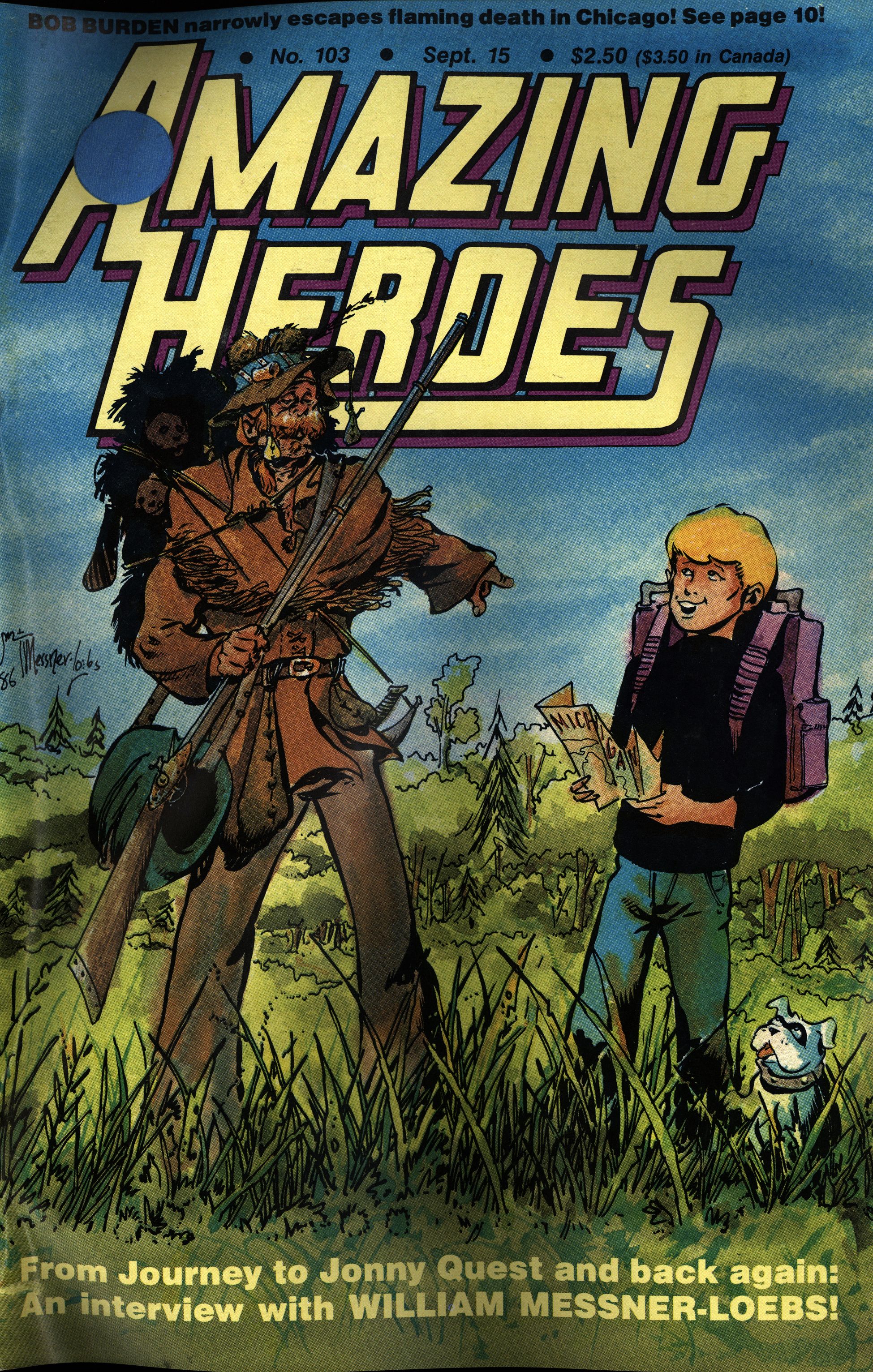
Amazing Heroes #103, page #27:
Amazing Heroes: Bill, I understand
the first few issues of Jonny Quest
have sold phenomenally well.
William Messner-Loebs: So I hear.
But in this business, you can never
tell. I remember Dave Sim telling
me once that because everything is
[pre-purchased] all along the line,
there’s no way of finding out exact-
ly what anyone does with those pur-
chases. Theoretically, 19,900 of the
20,000 Cerebus that were selling
could be in plastic bags in some
[retailer’s] boxes, accumulating dust.
I always think about that whenever
we talk about sales figures, because
you really don’t know what’s hap-
pening. But, so far, it looks real
good for Jonny. Certainly I’ve sold
almost as many Jonny Quest # 1 in
one four-day period as I sold of the
first ten issues of Journey. I wonder
what that means.
AH: I assume you’re happy with the
success of the book?
Messner-Loebs: Yeah. It was a
totally different thing to be working
with somebody else’s characters and
trying to bring them to life and bring
something of my own experience to
them, to walk that fine line between
paying homage to an old television
series and just mummifying it.
AH: Did you like the old Jonny
Quest show?
Messner-Loebs: Not much.
[Laughter] I came along at the
wrong time. Almost anybody who
is considered to be nostalgia bait for
it was about 11 when they saw it,
which is about the same age as
Jonny was supposed to be. I was 17
-a very critical and very animation-
conscious 17-so I was never able
to get past the limited nature of the
animation. Also, I was never able to
get past the disappointment left over
from the almost unspeakably heavy
Hanna-Barbara hype that accompa-
nied the show. I took that very
seriously when I was 17, also.
Heidi MacDonald writes in Amazing Heroes #119, page #69:
Bill Loebs is pretty incredible
when you think about it. Look how
bleak the picture is: a spin-off of a
20-year-old cult kid’s cartoon show,
yet another licensed property, and
one that doesn’t even have a steady
artist…you’d expect this to be tol-
erably dopey, at the very best. But
picking Bill Loebs to write this book
has to be one of the smartest moves
that Comico has ever made. We all
know Journey was a fascinating,
magnificent bastion of naturalism
and human drama in the sea of slug-
fests, and we knew that Loebs was
a good writer, but who could have
guessed that he’d turn this spin-off
into a completely entertaining com-
ic, full of allusions to all manner of
High and Low culture, and recall-
ing nothing so much as the Golden
Years of children’s comics?
Loebs’s Quest stories all have one
silly element each, (viz. the mystery
object which everyone was after in
issues #5-7) but he knows exactly
how silly they are, and exactly how
to push each element just far enough
to be entertaining without being
ludicrous. (It’s very much like what
Carl Barks used to do in his long
Uncle Scrooge epics.)
Likewise, despite the somewhat,
um, meandering pacing to which
Journey was often prone, Jonny
Quest proves that Loebs is one of the
few comics writers who can tell
satisfying stories, complete in each
issue, stories which have beginnings,
middles, ends, characters, and even
a theme or two. In literary circles
this is known as writing. In comics
it’s known as a miracle.
For instance, take the Loebs-Ken
Steacy story in #8, “The Curse of
X-7.” Observe first Steacy’s brilli-
antly lurid cover. Hadji, Dr. Quest,
Race, even…(gasp!!) Bandit…
hanged by their necks. Shocking
stuff. Now admittedly, if I saw this
on the cover of, oh, say, The X-Men
I’d have to stifle a yawn. But here,
it’s a wee bit startling.
Inside Loebs plays havoc with one
of the oldest tricks in the book-is
it a dream or not? First we see Jonny
a man of 30 or so, teaching his
science class. Within a few pages,
Bandit has died of an old age, and
Race and Dr. Quest have been mur-
dered by X-7, a robot villain of
dreadful aspect. Then we learn that
his flash-forward is really a dream
flashback, of Jon ten years later, now
seeking a bitter vengeance against
X-7. Suddenly we find out this too
is a flashback from an even older
Jonny, and this turns out to be a final
flashback of a very aged Jonny, es-
tranged from Hadji, even more lost
in his vengeance trip, and still
searching for X-7.
It’s all played out in a perfectly
eerie fashion. Steacy’s angular and
idiosyncratic art sets a surreal tone,
keeping the reader off-balance as to
just what the heck is real here. Of
course, on page 22 we find out that
the real (present day, young) Jonny
was dreaming all these dreams
within dreams, brought on by a tank
full of poisonous insecticide—an
insecticide known as X-7.
On the surface, this could be any
stupid super-hero book—we have a
killer robot, a disastrous vendetta,
a furturistic society, a “Hey it was
all a dream!” ending. But Loebs
uses these overfamiliar elements
masterfully. He gives his stories
contexts and motivations. Notice
such details the older Hadji’s asce-
ticism, or “The Race Bannon Socie-
ty,” a combination of the John Birch
Society and the KGB which snoops
into people’s lives under the pretext
of searching for X-7. It’s a rich con-
cept, and yet one just thrown out in
passing.
The next issue, “A Fire In Green”
Meadows” is just as heady, recall-
ing, in a playful way, both William
Inge and Hayley Mills in its small
town setting. Jezebel Jade’s arrival
in the peaceful town of Green Mea-
dows could spell trouble a la Picnic
or even The Music Man, but when
the gang gets involved with a mys-
terious panther haunting the out-
skirts of town, it reminds me of a
Mills Disney vehicle from the early
60’s. (Damn, these are weird com-
parisons, and they’ve all got the
genders wrong, ‘cuz Jezebel is Wil-
liam Holden and Jonny is Hayley.
Oh well.) Of course, there’s a
pseudo-scientific McGuffin-an
enzyme that turns garbage to
energy—a lost treasure, childhood
friendship, dark secrets from
people’s pasts coming back to haunt
them, and all stirred together into a
hokey but tasty brew.
On the artistic end of things,
Quest is first-rate all the way.
Steacy’s was a standout for flashi-
ness, but the dependable craftsman-
ship of Murphy Anderson in #9 and
Dan Spiegle in #7, is a real pleasure
too. Even artists whose work I usu-
ally have problems with-Mitch
Schauer and Tom Yeates-turn in
sterling jobs. Of course Doug
Wildey’s appearances are the su-
preme treats. All of the artists in the
book take on a deliberately flat, very
objective style—anyone who tries to
give Race’s shock of white hair any
kind of ruffling or volume is mak-
ing a serious mistake—which works
beautifully with Loebs’s straightfor-
ward storytelling. Marc Hempel and
Mark Wheatley are an excellent
choice for regular artists, as their
work in #3 has a blend of objectiv-
ity and stylization.
Jonny, Dr. Quest, race, and Hadji
are far from being rounded charac-
ters in any sense of the word, but
they fill their stereotypical roles to
the utmost. Loebs has also made the
most of the supporting cast from the
animated series—Dr. Zin makes a
dandy villain, and in a few issues
Loebs has turned Jezebel Jade into
one of comics’ premier femmes fa-
tales—and the only one who looks
ravishing in a snood. (Even I must
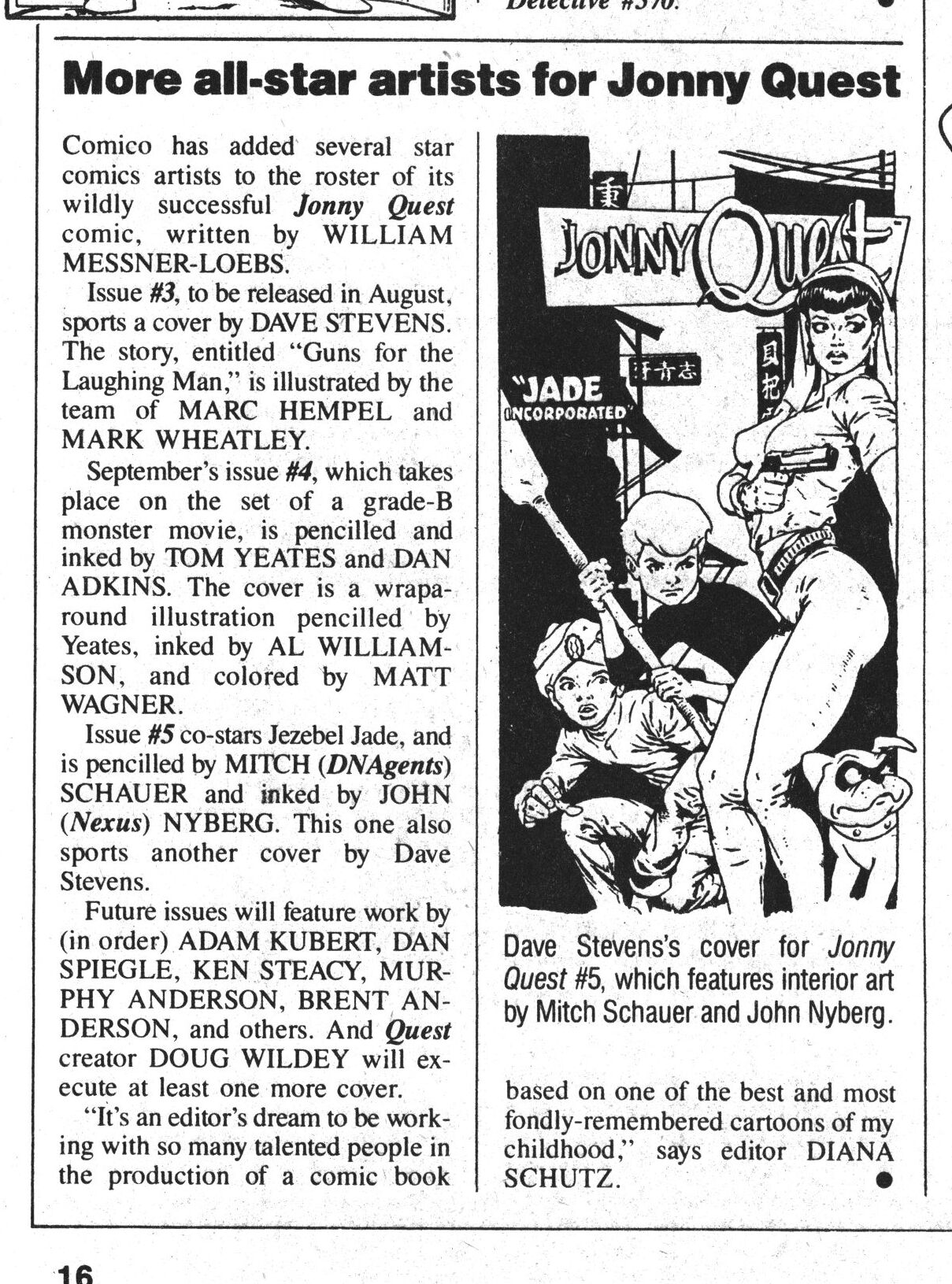
tip my cap to Dave Stevens’s cover
of #5.) And what can you say about
Bandit, aside from the fact that he’s
corny, and he’s adorable.
On paper, there’s no way Jonny
Quest should be as good as it is. A
great deal of it can only be described
as being hokey, and yet Loebs and
friends make it work. It’s good clean
fun, totally American to the core, as
the Flaming Carrot might say. Like
Mister X, this is a class act, with
first rate coloring and covers. Com-
ico’s put together a damn fine
package. You really get your
money’s worth with this one.
Heidi MacDonald is right as usual.
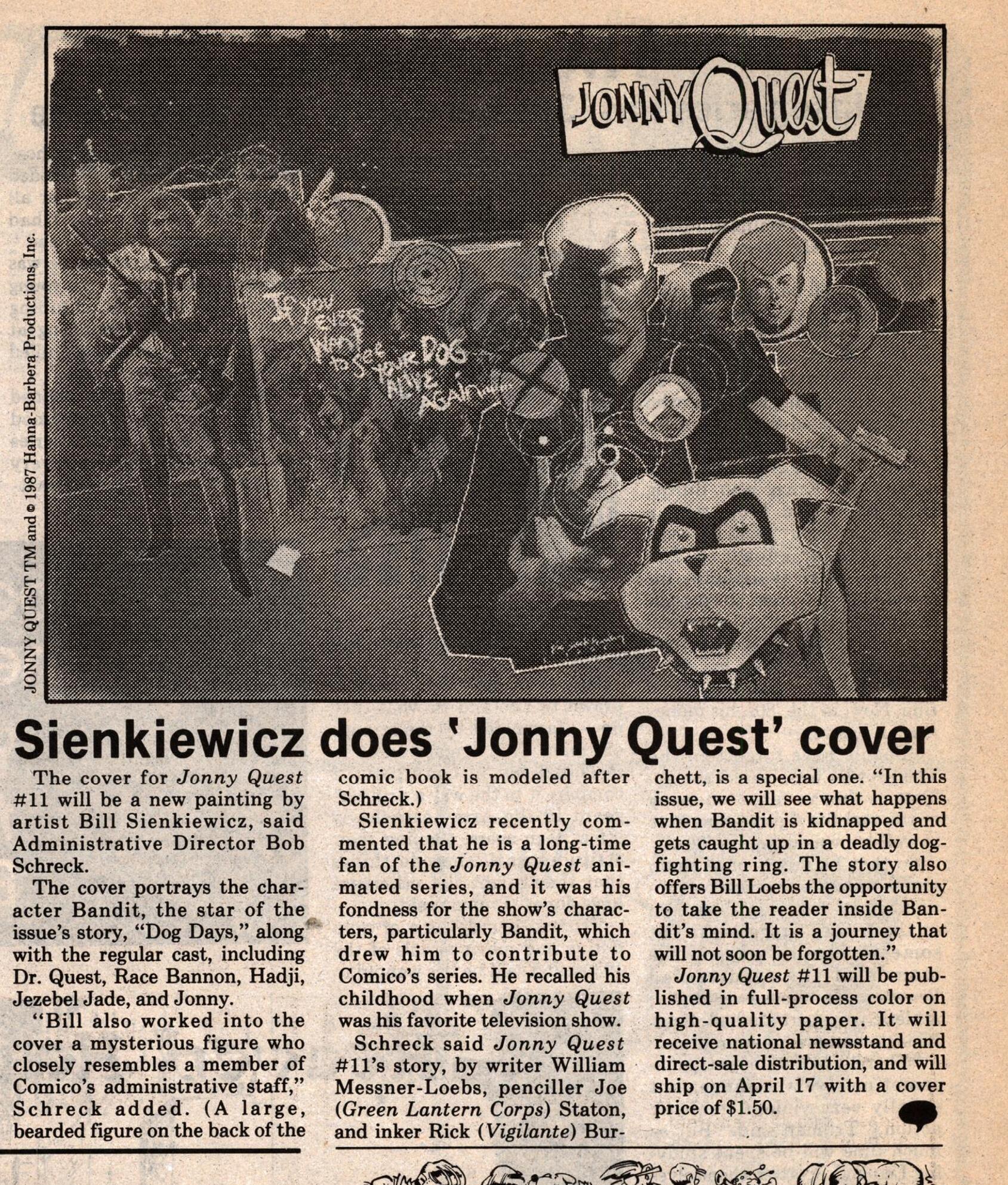
It looks like Jonny Quest got plenty of attention at the time — which surprises me a bit, because Comico wasn’t able to get any press for their Robotech series. But of course, Japanese animation hadn’t really taken off in comics circles at the time (I mean, compared to what it would be ten years later).
Andy Mangels writes in Amazing Heroes #137, page #87:
Jonny Quest #22, ‘Vantage Point’;
I was not excited to get this book . . . at
first. I kind of flip through Jonny
Quest when it comes into my store,
to see if there’s anything interesting
that catches my eye. So far nothing
has, because I haven’t read a single
issue yet.
I remember (vaguely) the Jonny
Quest cartoon show from my younger
days, and I did kind of like it then,
although it did seem a little weird at
times. My favorite was Race Bannon.
I absolutely despised Hadji. Didn’t
think too much of Bandit the dog
either. So, I settled down on the
carpeted floor of my office and began
to read Jonny Quest, fairly certain I
would not be entertained.
The story begins as Dr. Quest is
installing a camera in his lab, which
will record everything in its sight for
one full week and etch it onto a disk.
This disk and viewer will then be
launched into space for a thousand
years, in the most ambitious time
capsule project yet. Although every-
one at first acts up in front of the
camera, Dr. Quest advises them that
they will soon forget it’s there. In time,
they do.
What follows is an entire story told.
from one single point of view: that of
a stationary camera. A camera only
records exactly what is shown, leaving
nothing to the imagination, nor pro-
viding any other points of view. The
issue is what the camera records over
the course of the week. Dr. Quest
finds himself much too busy and
unorganized, and decides to hire a
secretary. Unfortunately, all of his
prospectives employees are frightened
off at the idea of working with dino-
saurs werewolves, cult attacks, small
arms, and hovercraft! When a secre-
tary is found, Quest finds himself
embroiled in a search for a missing
father, battles with an adopted cat,
mixed-up appointments, and a mad
scientist who thinks Quest has turned
the world against him.
I found myself chuckling many
times during my reading of the issue,
which is something I rarely do when
reading a comic. it was the classic no
win situation for Quest; every time
something seemed solved along came
five other things to complicate mat-
ters. The ending is not quite up to the
rest of the book, but seems predictable
given what has been done before in the
story. My only disappointment with
the story was that it seemed astonish-
ing that such a historical recording
would be so casually treated, but this
is comics, and the motivations do
completely fit into the Jonny Quest
structure as I recall it. I can forgive
that one nitpick, given the highly
enjoyable quality of the book. This is
great family fare, fun for adults and
children alike.
Bill Loeb’s writing is funny, and the
characters are fully fleshed out (even
the incidental ones). His dialogue fits
the way the characters look, and tells
us exactly what we need to know
about that character. The art is com-
petently cartoony, although I’m not
ultra-wild about Hempel and Wheat-
ley’s art style. It suits Jonny Quest
well, interestingly enough looking
better in black and white than in color.
This is not to say that the coloring is
bad (it’s usually well done), but to say
that the art does not seem to be drawn
for color. By the way, there is a great
appearance by a TinTinesque mad
scientist in here, that no TinTin fan
should be without.
I was pleasantly surprised with Jon-
ny Quest, although I can’t really say
I’m going to follow it in the future. I
will do more than flip through future
issues though. Give it a try.
Grade: Mint
Comics Interview #73, page #26:
SCOTT McCLOUD: JONNY QUEST
seems to be quite a special book to a lot of
people. It attracted some big names.
What do you think its special appeal was?
BILL LOEBS: Well, that’s a good ques-
tion. I think largely its appeal was
chronological. You tend to find it more
appealing the younger you were when it
first came on. I was, I guess, in my late
teens when it came on, so I tended to
notice more of its problems. I looked at
it a little more so I tended to notice more
of its problems. I looked at it a little more
technically, in terms of animation and that
sort of thing, than a lot of people seem to
have. And I also think that a lot of the ap-
peal is, even though the kids are treated
like kids and the dog is treated like a dog
– in that no one is particularly precocious
– they are treated as adult members of
the expedition. There’s none of this,
“Gosh, these are ten-year-old kids. We
should leave them at home and go have
the adventure, Race.”
SCOTT: It’s not as condescending as
some other things.
BILL: Yeah. I think there’s a lot of that.
That was something that struck me when
I read the original TOM SWIFT books
also, where even though his father was an
inventor – theoretically pretty clever –
his father was invariably wrong. Tom was
always coming up with things and his
father was invariably wrong. Tom was
always coming up with things and his
father would end up, “Oh, you were right,
Tom. This was just the perfect time to in-
vent an atomic tank.”
SCOTT: . That’s a very ’80s attitude isn’t
it? We’ve seen that a lot in the cinema
recently.
BILL: Yeah, usually with authority
figures that are somehow abstracted once
or twice from being actual parents.
SCOTT: Right. A guardian or an uncle.
BILL: Yeah. As a matter of fact I was
reading a book which was analyzing old
fairy tales in terms of Freudian symbols,
and it said that the reason that you had all
of these evil step-mothers was not that
there were more step-mothers back then
than now, but that it’s a way of hating your
own mother without having to actually
deal with hating your own mother. That’s
also the reason that the witches traditional-
ly have a hood thrown over their features.
They’re really hiding features that you
don’t want to see because it would be too
traumatic to have to realize that that’s who
you’re hating.
SCOTT: So you think on a milder level
that that kind of surrogate character was
showing up in JONNY QUEST?
BILL: Well, yeah.
SCOTT: Obviously not with his…
BILL: We’re actually talking about the
sort of youth exploitation films where the
young people trash the university
presidents or the girlfriend’s father or
something like that — real obvious
avoiding of trashing your own parents.
One of the really neat things about RISKY
BUSINESS, one of the things that makes
it something more than just exploitation,
was that it’s actually dealing with saying
this out loud. The more direct you are the
more it approaches art, even if it’s about
things that may seem exploitative.
SCOTT: Well, getting back to JONNY
QUEST before he gets away…
(Laughter) How was your working relation-
ship with TaftEntertainment? Did you sub-
mit works in progress to them for
approval?
BILL: Yes. Every step along the way is
submitted, not by me but by Diana
Schutz, who acts sort of like a clearing
house for all of this massive amount of in-
formation that goes through.
SCOTT: How deeply involved are they
with the actual production of the stories
and whatnot?
BILL: Well, they haven’t been at all in-
volved up to now except in being real in-
terested. What I essentially did was work
up twelve story ideas and submitted them
and they liked them all, and I submitted
my first script and they liked that one, and
so forth and so on.
Comics Scene Volume 2 #1, page #57:
One of the most welcome revivals of
the 1980s has to be Jonny Quest. A
prime-time animated adventure
show which aired for only one season in
1964, Jonny Quest was a boy’s adventure
book come to life. It featured intelligent
characterizations, fantastic plots, a stir-
ring jazz theme and, although a ratings
disappointment, it has attained cult status
among aficionados of TV animation.
Twenty years later, the children who
thrilled to Jonny Quest are now adults,
and the great JQ revival is in full swing.
Last year, Comico launched its Jonny
Quest comic book, written by William
Messner-Loebs and drawn, so far, by a
battery of talents including Steve Rude,
Wendy Pini, Al Williamson, Dan Spiegle
and many others. Last fall, Hanna-
Barbera aired new Quest episodes as part
of their Funtastic World of Hanna-Barbera
syndicated show.
The man who created the series, il-
lustrator Doug Wildey, greets this revival
with a certain detached amusement.
“I hate to blow anybody’s personal illu-
sions out of the water,” he says today,
“but I didn’t think that Jonny Quest was a
very good show.”
Heh heh.
Amazing Heroes #159, page #79:
Jonny, We Hardly Knew Ye Lad
What’s this I hear that as of issue 31
Jonny Quest by Loebs, Hampel and
Wheatley will be discontinued. What
was it’s drawback, poor sales? Had it
ever occurred to them that maybe their
story renditions to the character
weren’t quite up to the level as that of
the founding cartoon. I mean that the
originators went all out to base actual
scientific research around each epi-
sode, stories drawn from evidence of
existing information that made the
stories somewhat believable! Super-
sonic jets, lazers, hydrofoils, moni-
tored walkie-talkies, flying back-
packs, etc…etc!
The best that Comico put out were
the issues based on the “classic”
Jonny Quest television cartoon epi-
sodes, the one’s illustrated by the
genius behind the character, Doug
Wildey. Now if Comico had continued
to bring those episodes to comics form
sales may have generated positive. I
for one would like to see Alex Toth
illustrate three of his favorite episodes
to the series, or maybe if they would
put out a bio-formated 200 page book
about the conception of the original
Jonny Quest series by Hanna-Barbera
with drawings and photos and vital
information, now that would be some
book for all us Quest enthusiasts to
have in our library. How about it?
Top 10 Comics No Longer Being Published
by Jerry Smith[…]
10. Jonny Quest — I loved the
cartoon as a kid, I loved the
comic book as an adult. This is
where I first discovered the work
of William Messner-Loebs, one
of the finest writers of current
comics. Messner-Loebs took the
concept of the cartoon and to-
tally fleshed out the characters.
He made Professor Quest, Race,
Jonny, Hadji, and even Bandit
three-dimensional, enjoyable
characters. So many of his sto-
ries on JQ will stick with me for
the rest of my life: the ghost story
with references to all kinds of
writers and classic stories hid-
den in the dialogue, the origin of
Hadji, the Bandit solostory where
we see how much the dog loves
his friend Jonny, I could go on
and on about Messner-Loebs’
touching scripts. This is a much
missed book.
OK, that’s enough.
This series has apparently never been reprinted? That’s kinda surprising, isn’t it? But here’s some reviews from the internet:
Overall, Jonny Quest #13 by Messner-Loebs, Infantino, Kubert, and Pinaha is an enjoyable ghost story utilizing key elements of the cartoon’s characters and story elements. It was a favorite when I was a kid and I find it largely holds up even now. The artwork from Infantino and Kubert alone is worth a look.
Let me admit right here and now that I thoroughly enjoyed Jonny Quest. Messner-Loebs’ story was engaging, with thoughtful character development and just the right amount of humor and action.
Messner-Loebs shows us again what a solid writer he is and how much he understands this world and these characters. Everyone is pitch perfect and feels like they’ve come right out of the show.
OK, I’m out. What’s up next? I hope it’s something shorter… OK, Ginger Fox.. but then there’s Justice Machine! Man, Comico published a lot of long-running series in their early years. But that’s changing drastically in 1987.
Jonny Quest was reasonably popular, at least in America. There have been a few television revivals and appearances in other shows over the years and a few comics series (including one that’s running right now). The animation was ahead of its time and it was Hanna-Barbera’s first real action series. If you’ve ever seen The Venture Bros, Jonny Quest was one of the original inspirations for that.
But yeah, it’s influenced by Alex Raymond and Milt Caniff- pulp adventures that pull from most any action genre. Pretty much anyone who bought the comic would be familiar with the show. Obviously, I’m a fan of this and of the show. Looking forward to your thoughts on the specials and miniseries when they come up.