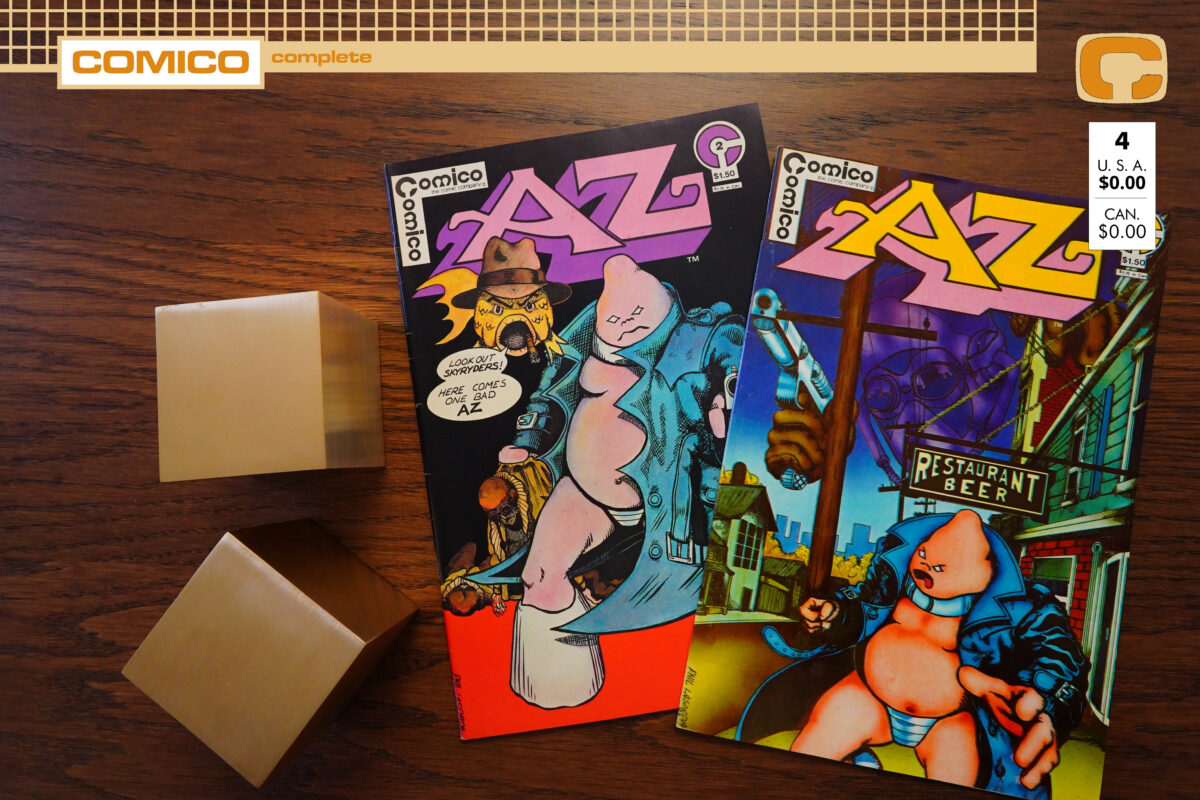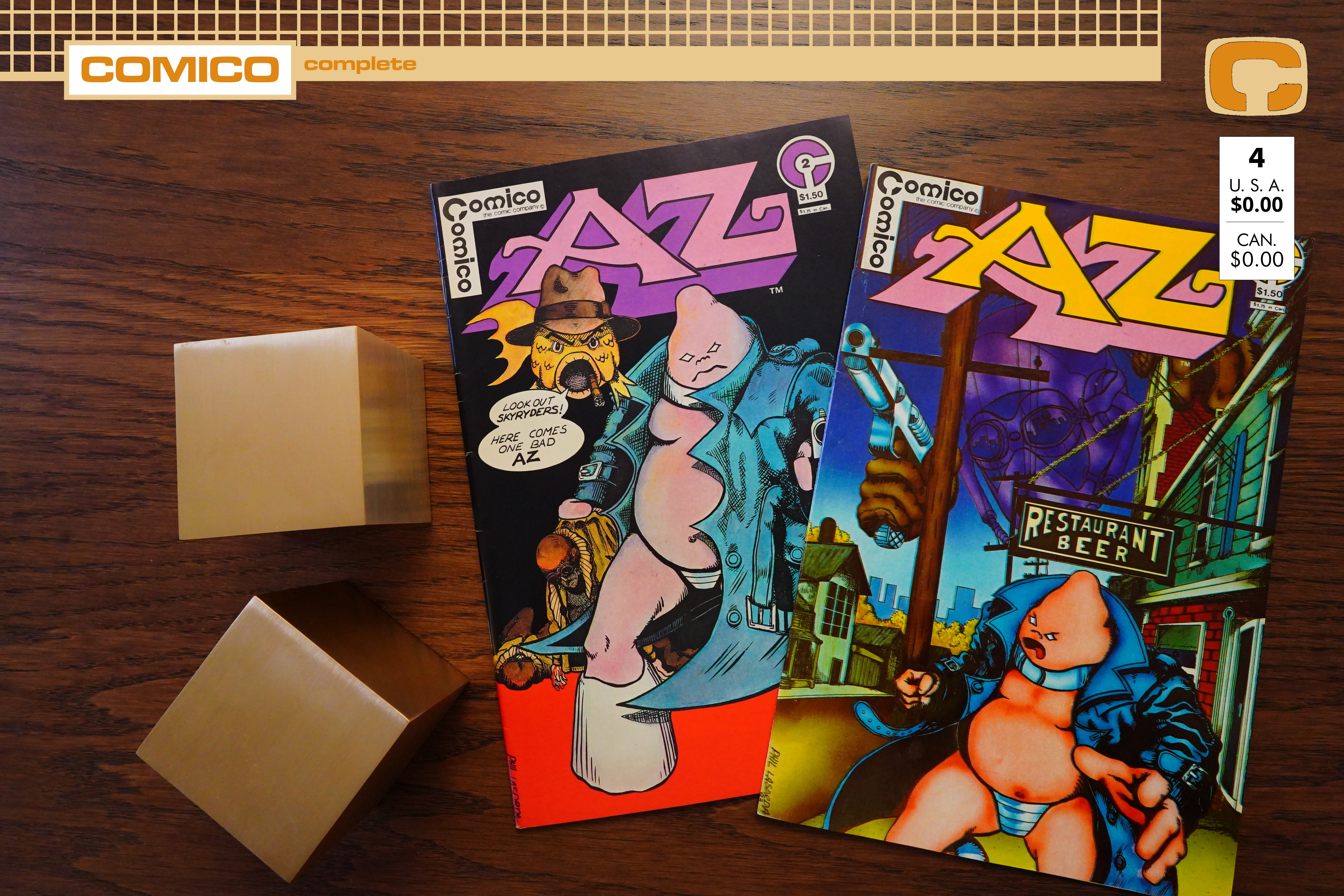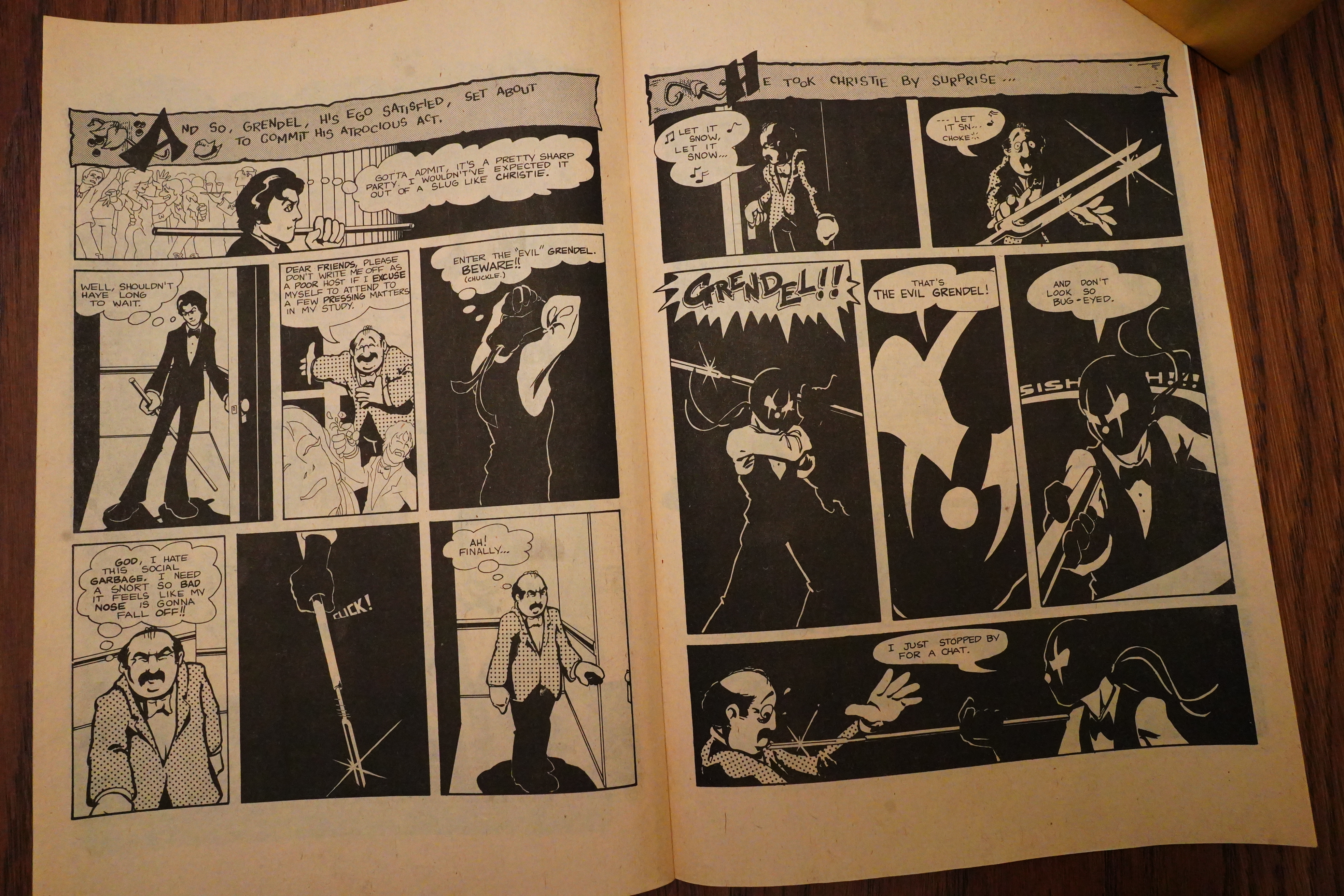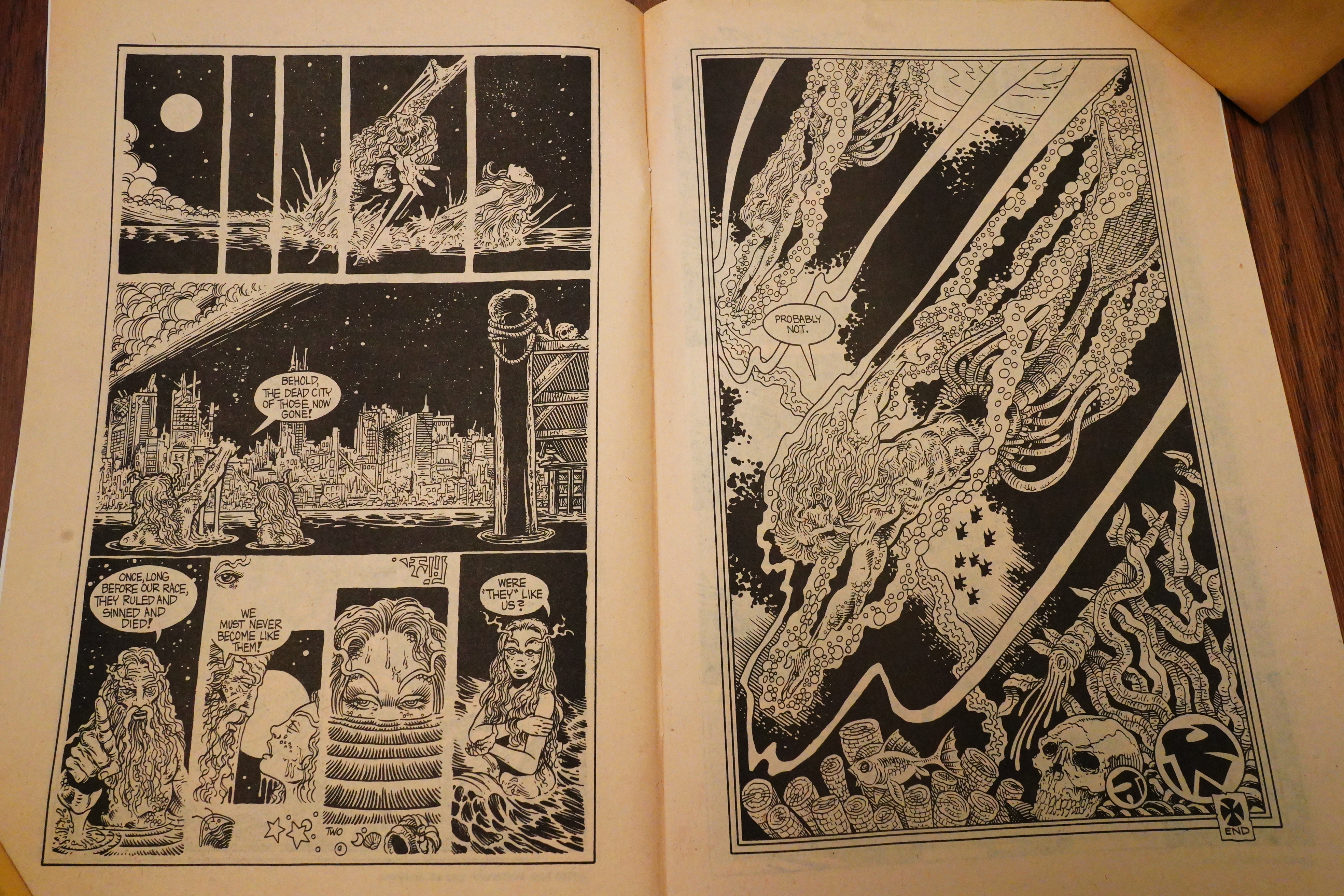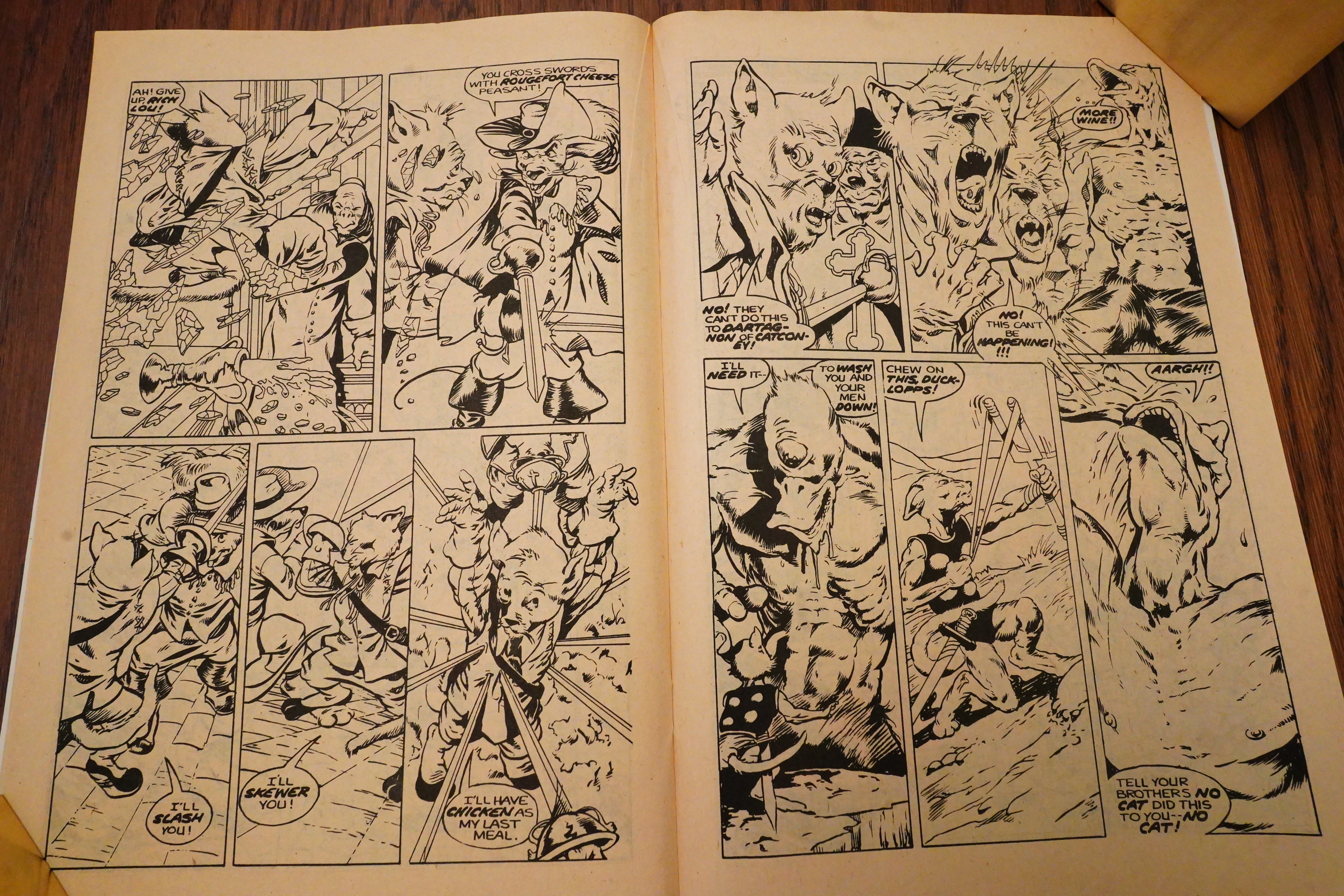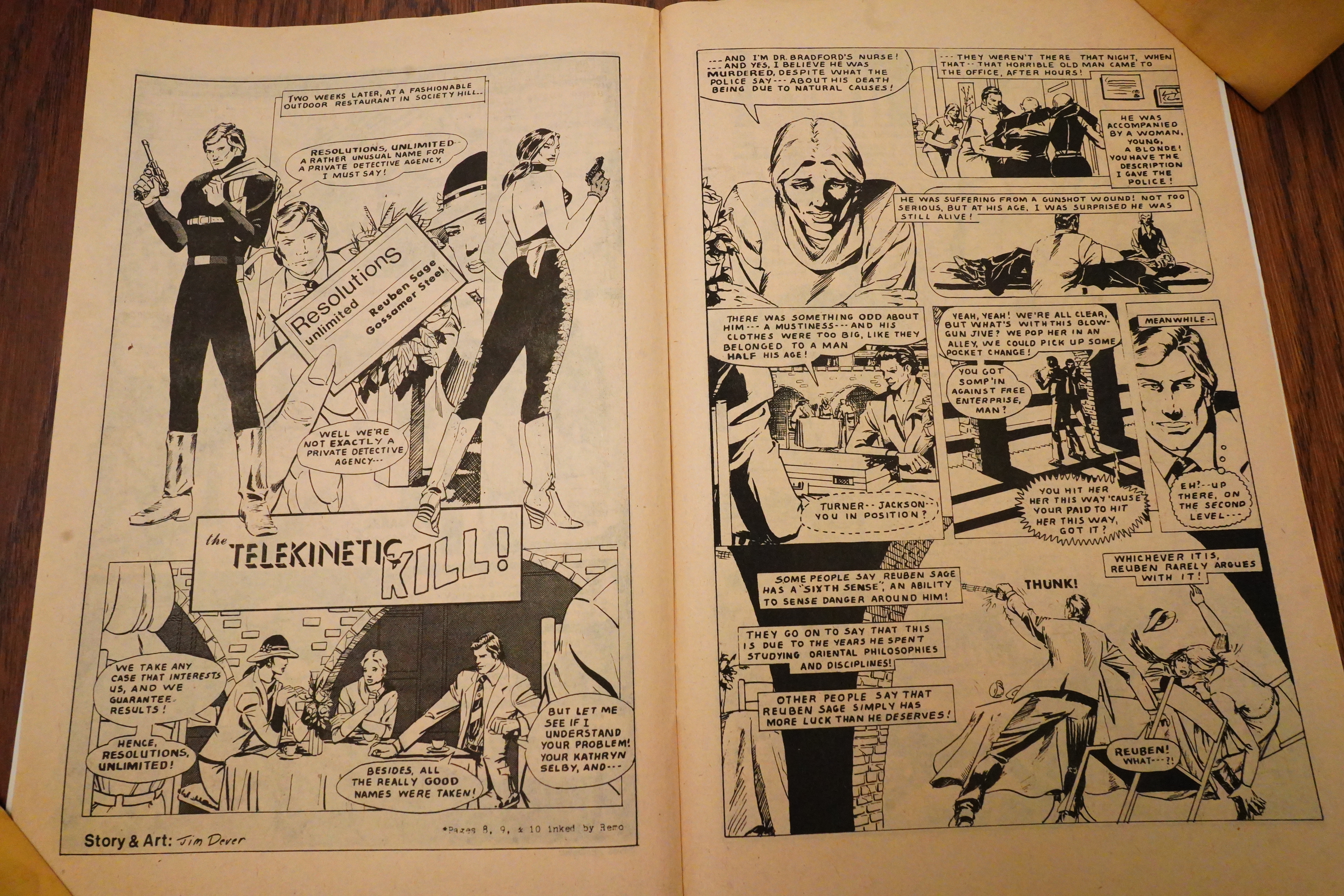
1983: Az

Az (1983) #1-2 by Phil Lasorda

This is the third and final of the original series by the Comico founders, so I guess it’s a good opportunity to blather on a bit about Comico (so far) in general. But first, let’s look at some Az.

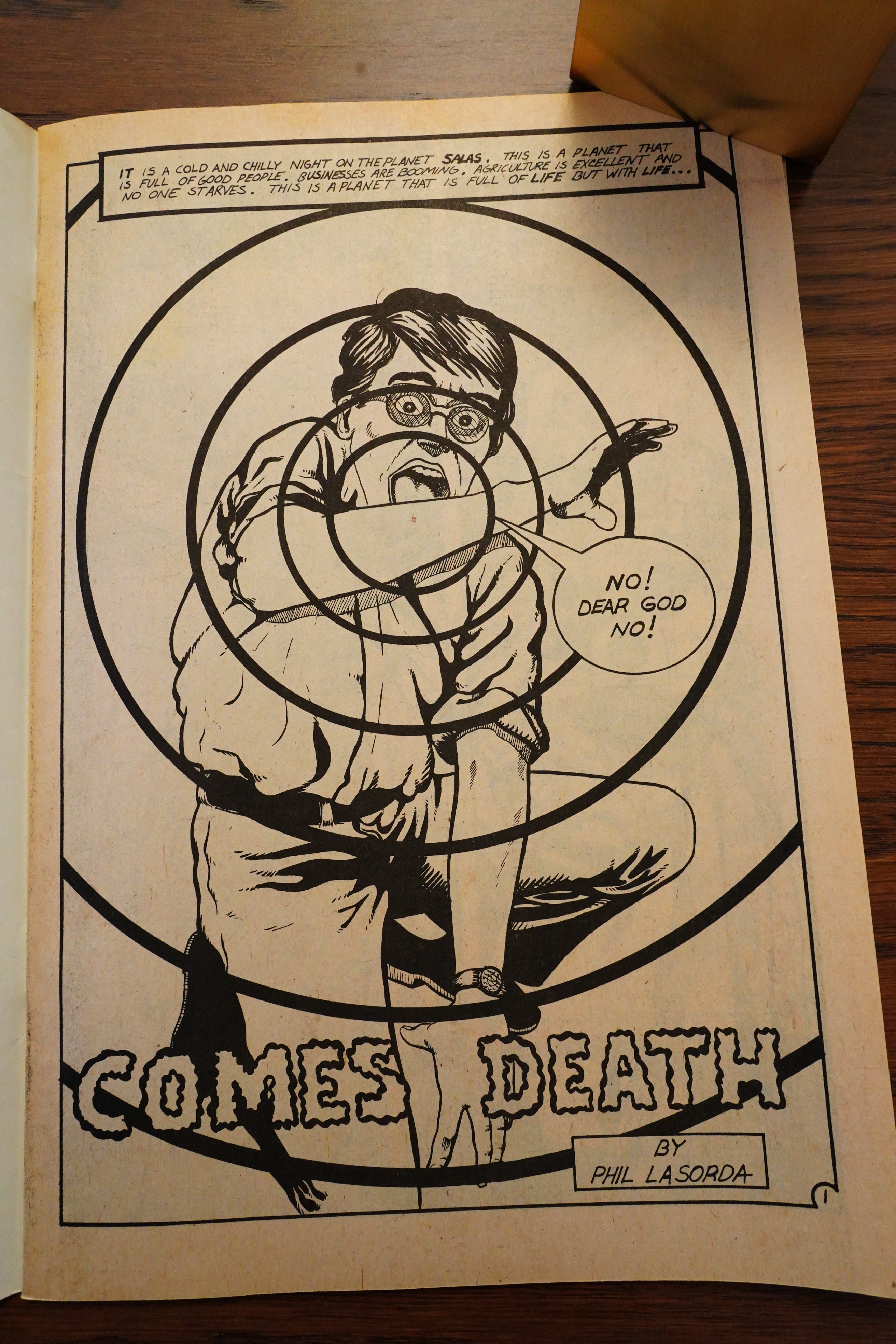
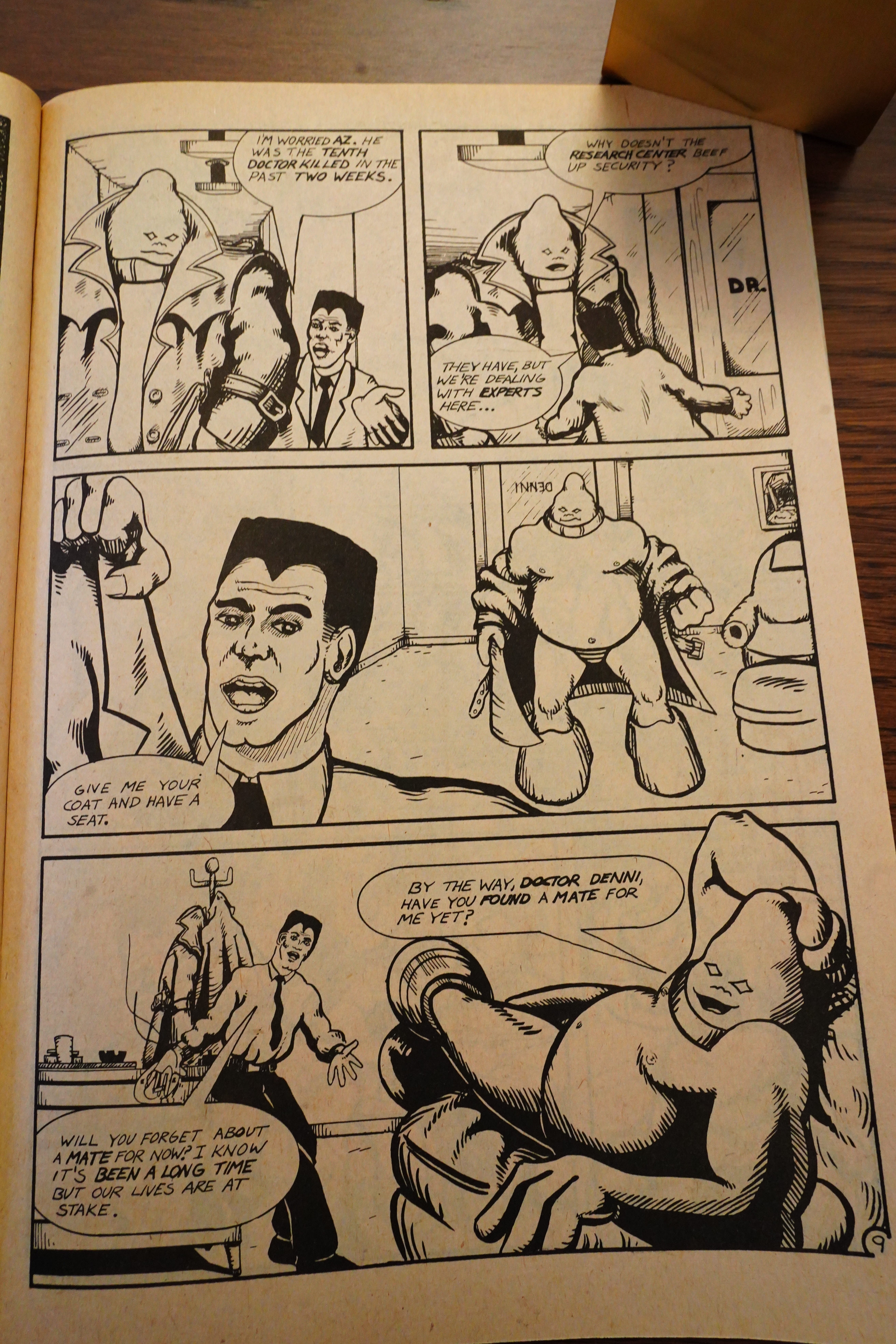
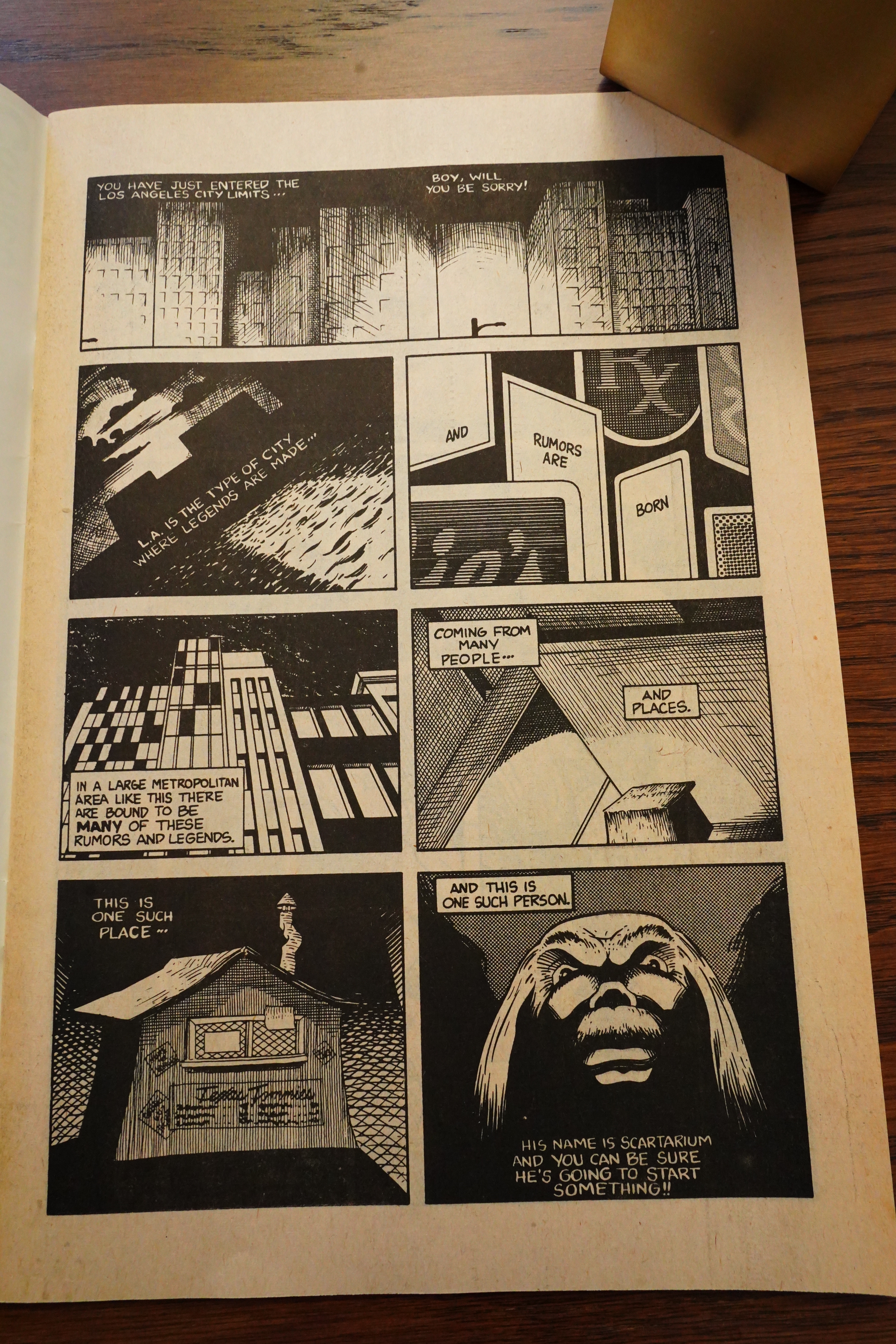
Well, that doesn’t look so bad…

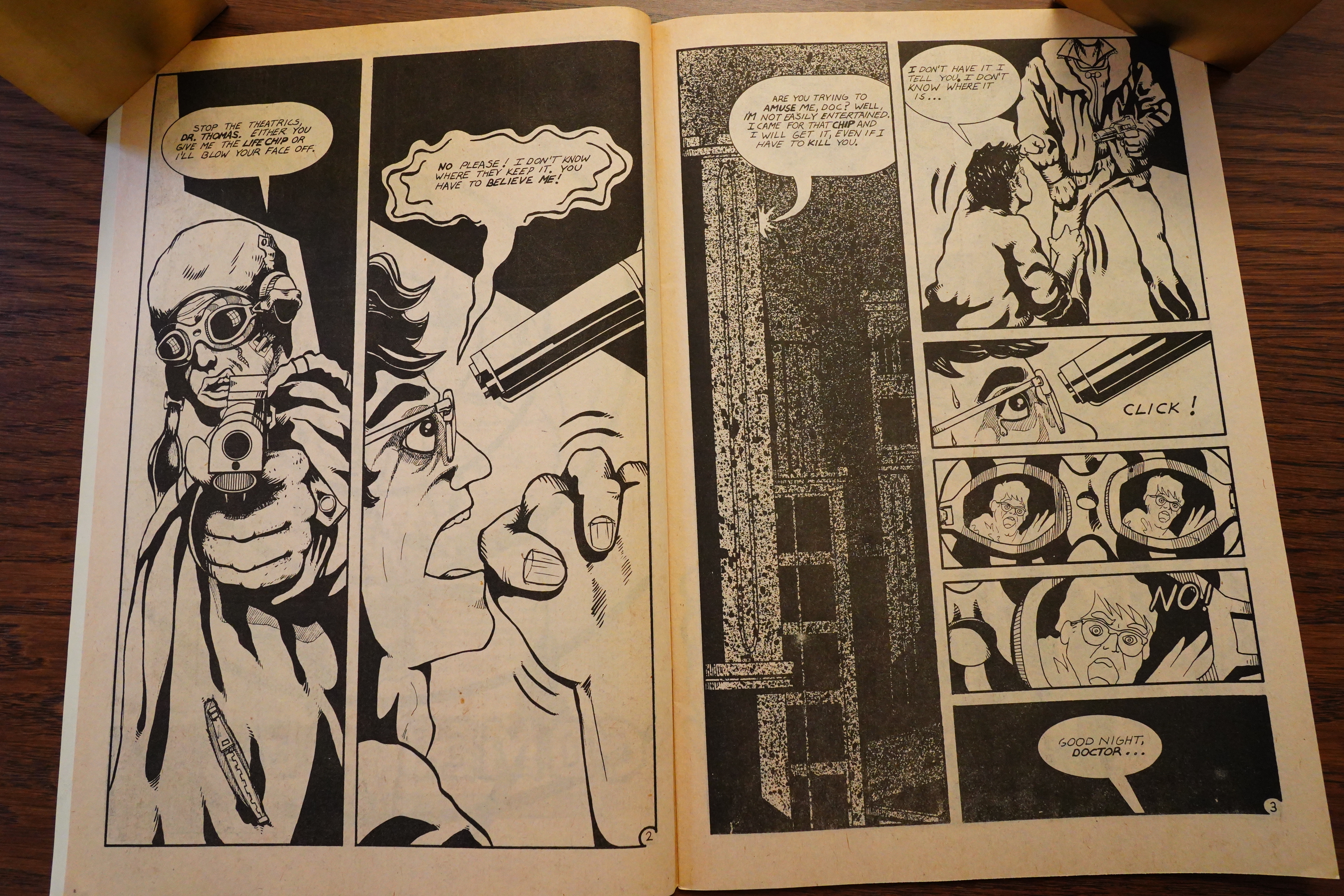
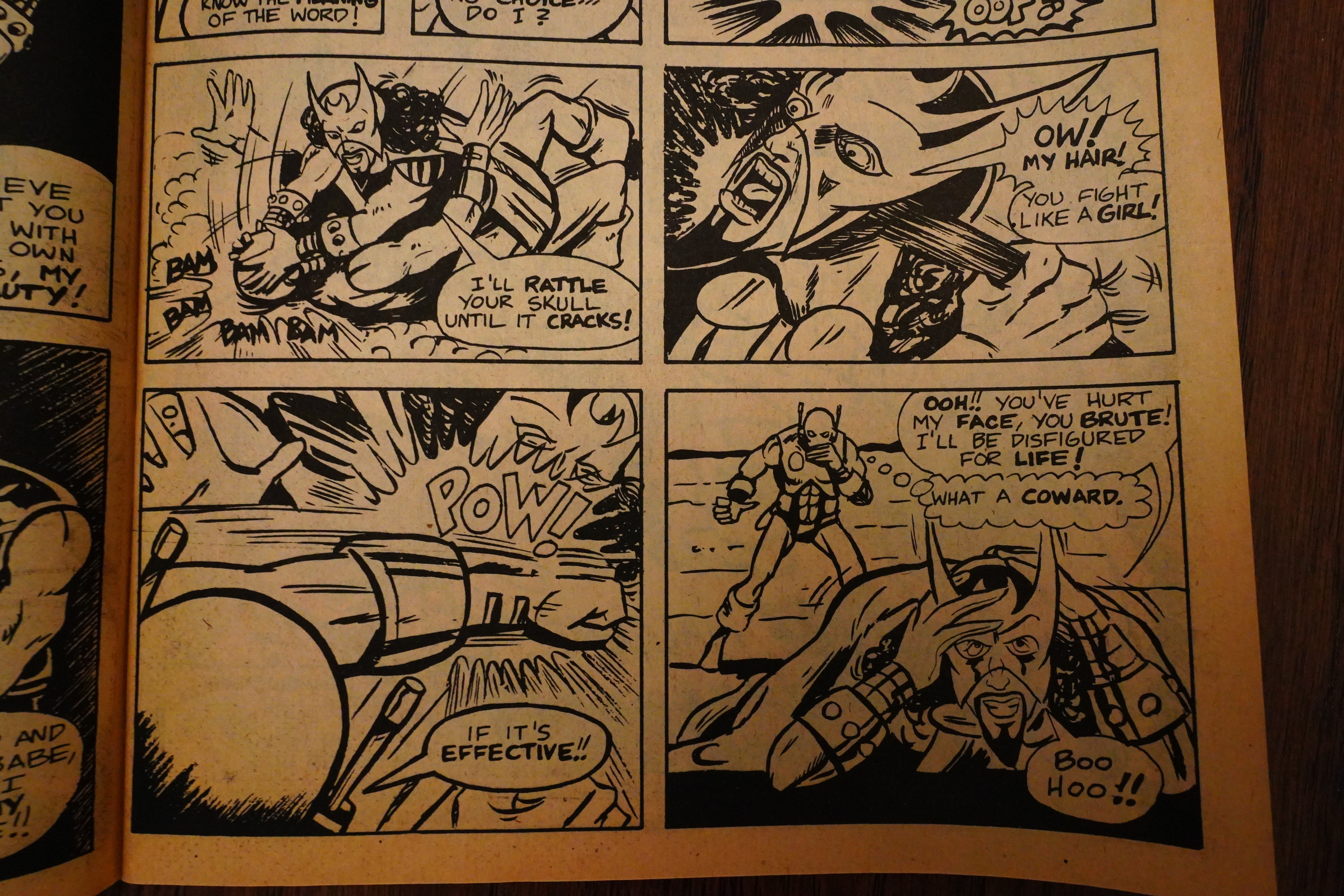
And Lasorda has gone to town with his toothbrush, spraying ink all over this filthy cityscape. And ultraviolence!

It’s not the worst way to start a series? And this seems to have nothing to do with the Az piece in Primer #1? Which is good news.

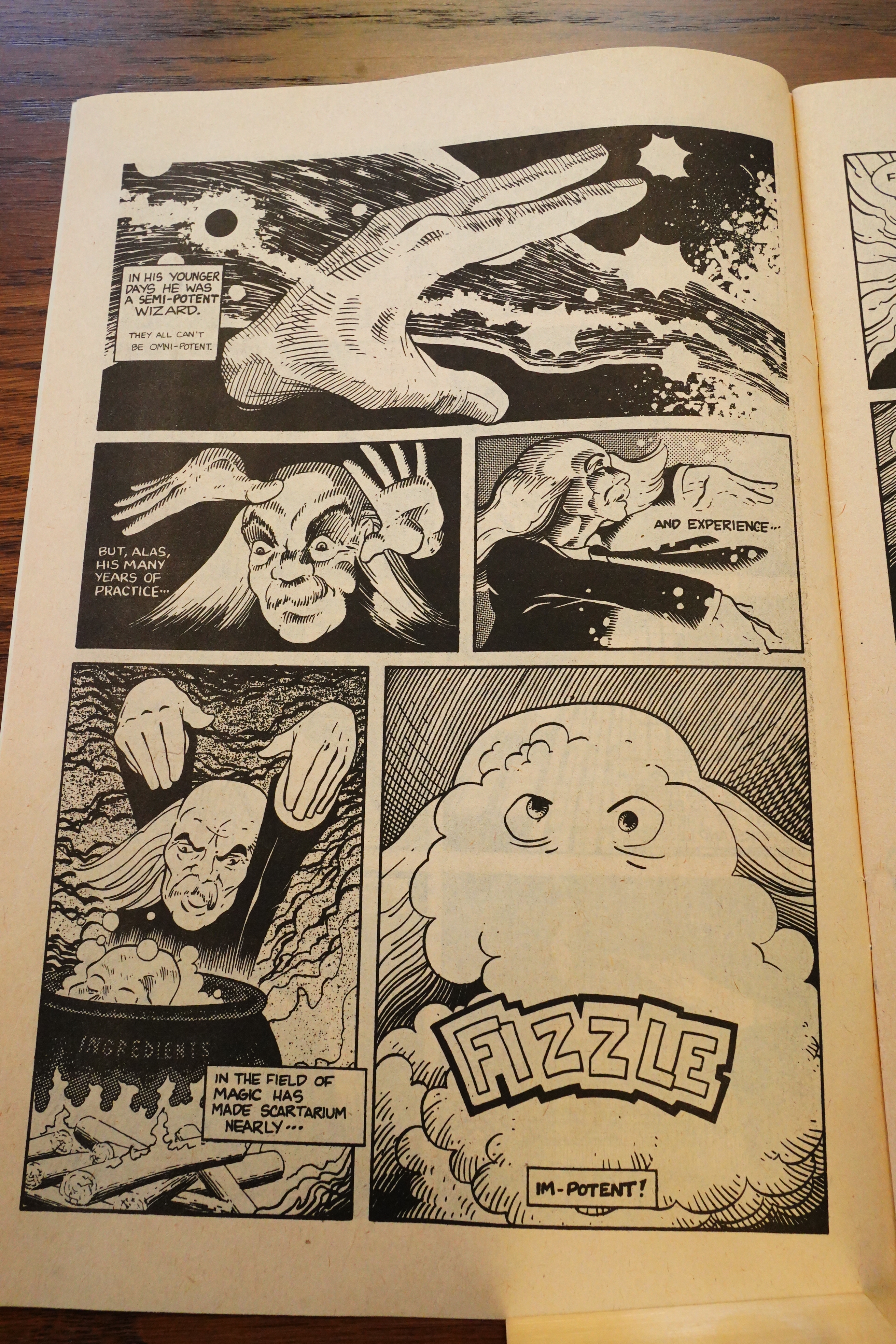
OH MY GOD

FOR THE LOVE OF

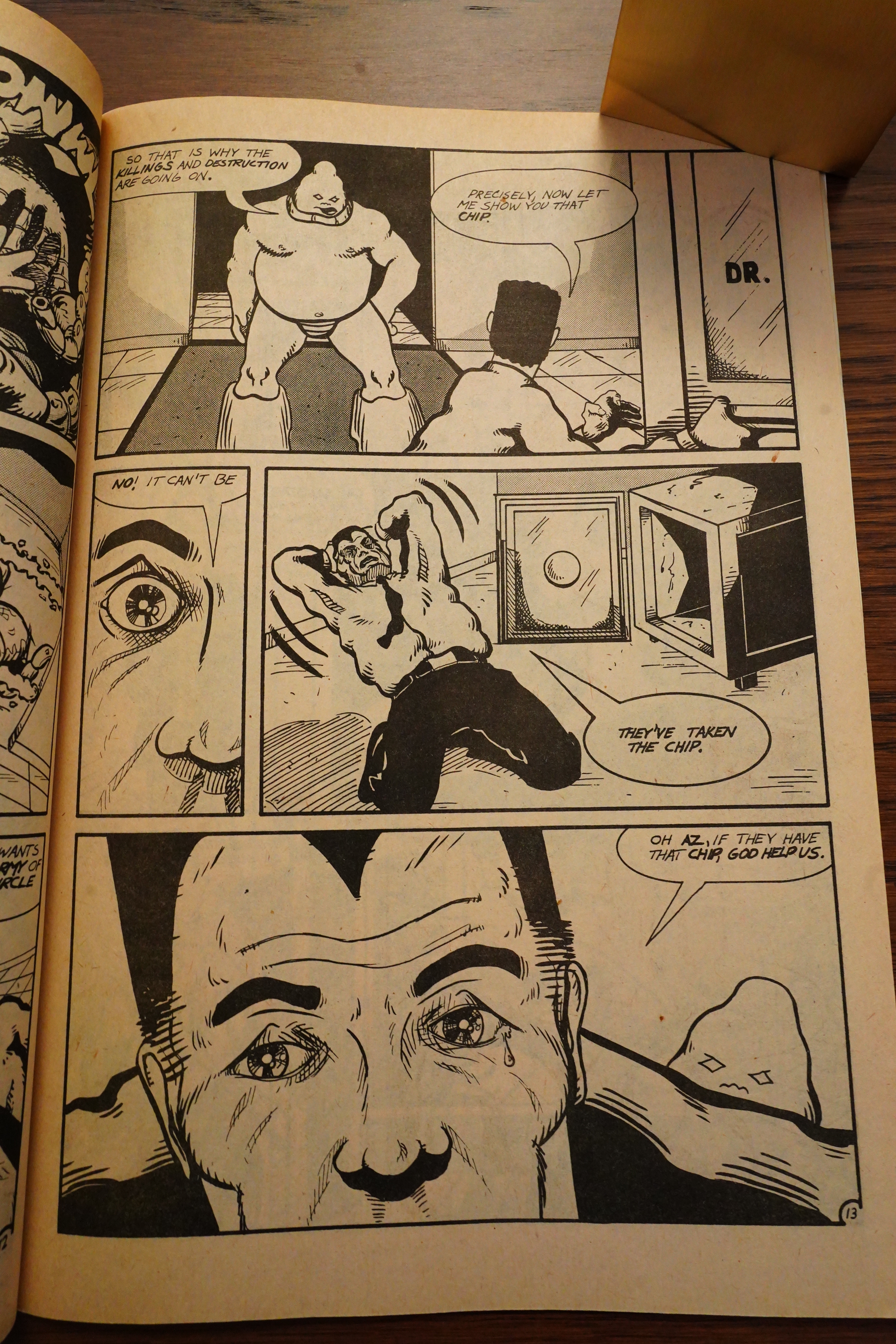
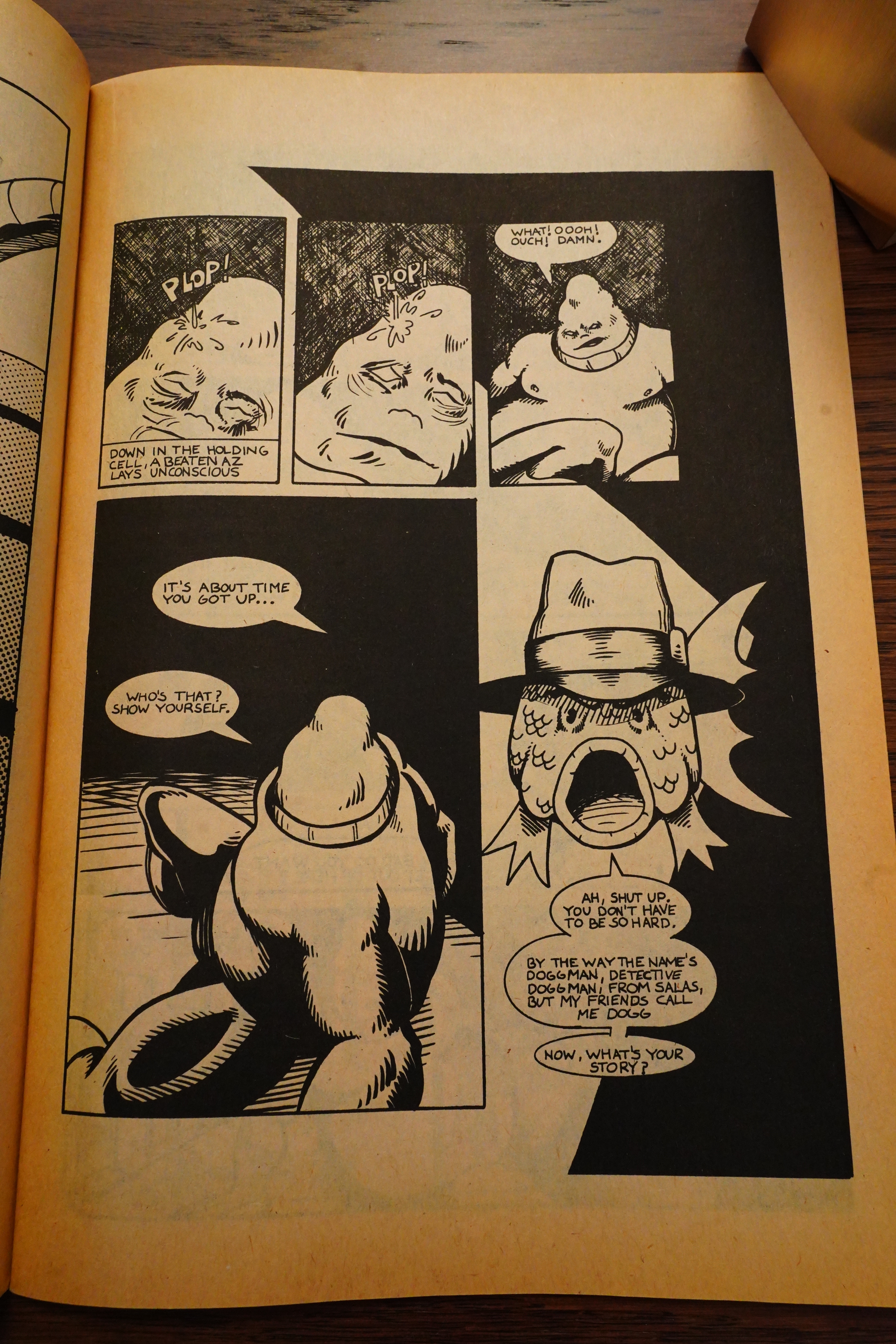
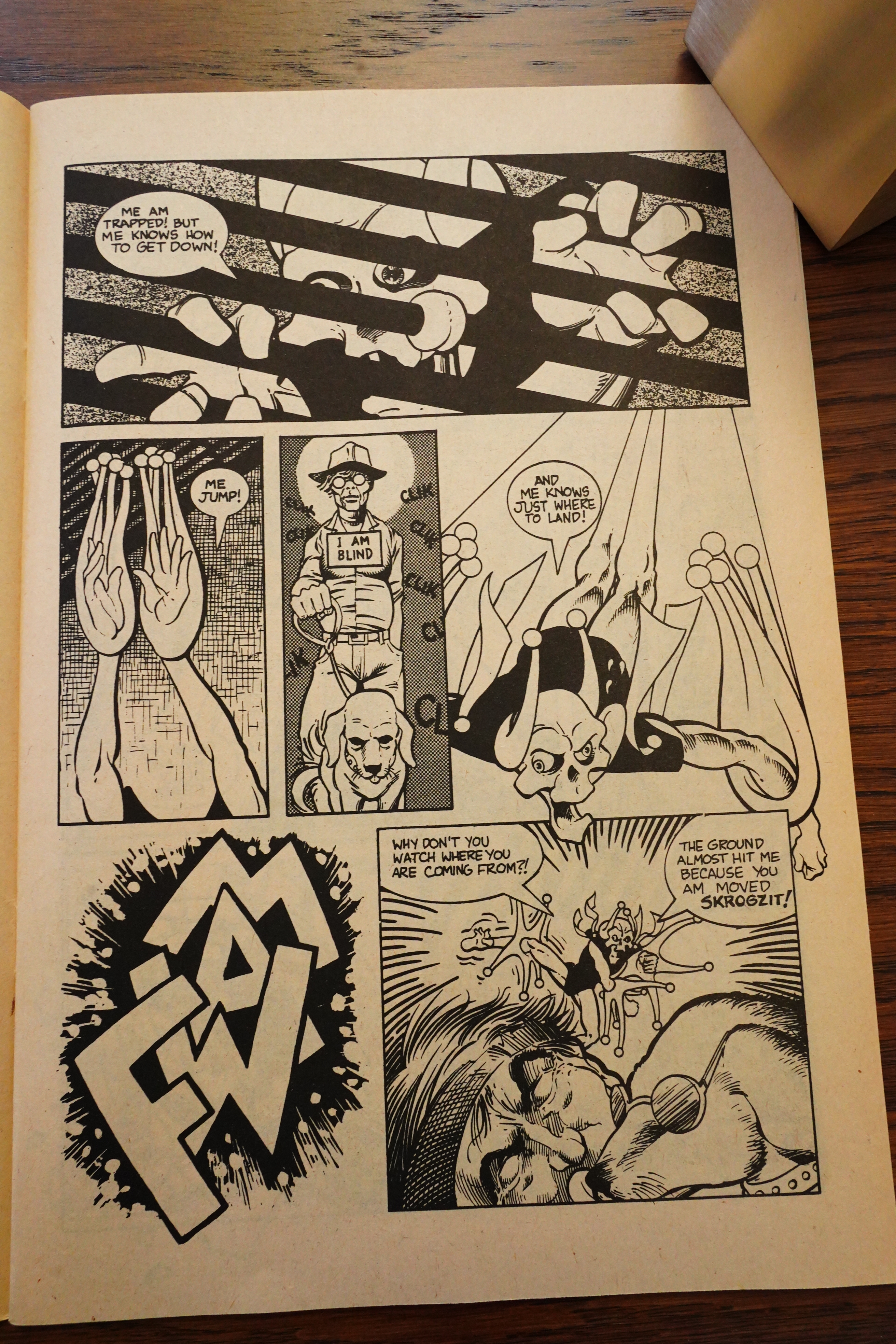
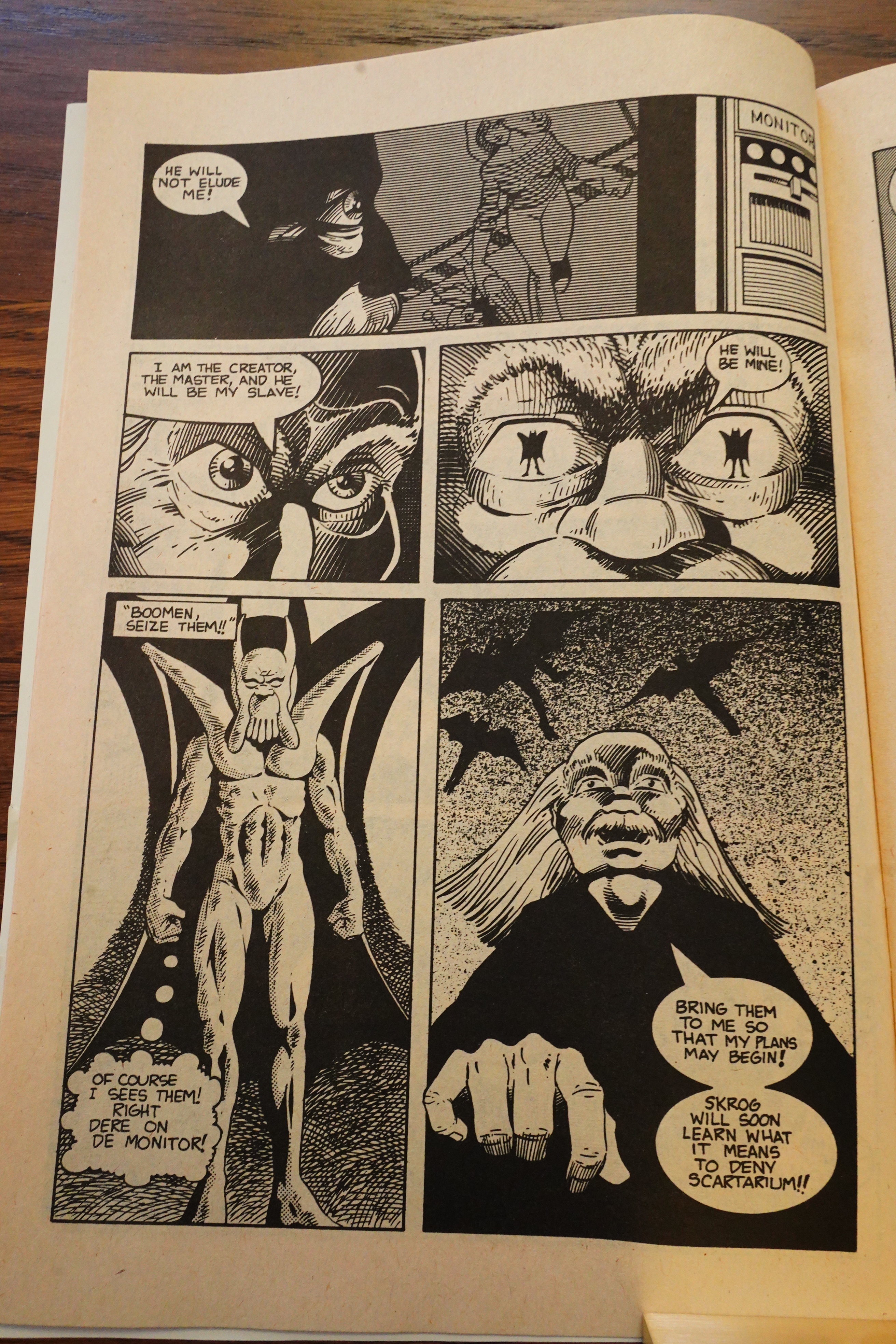
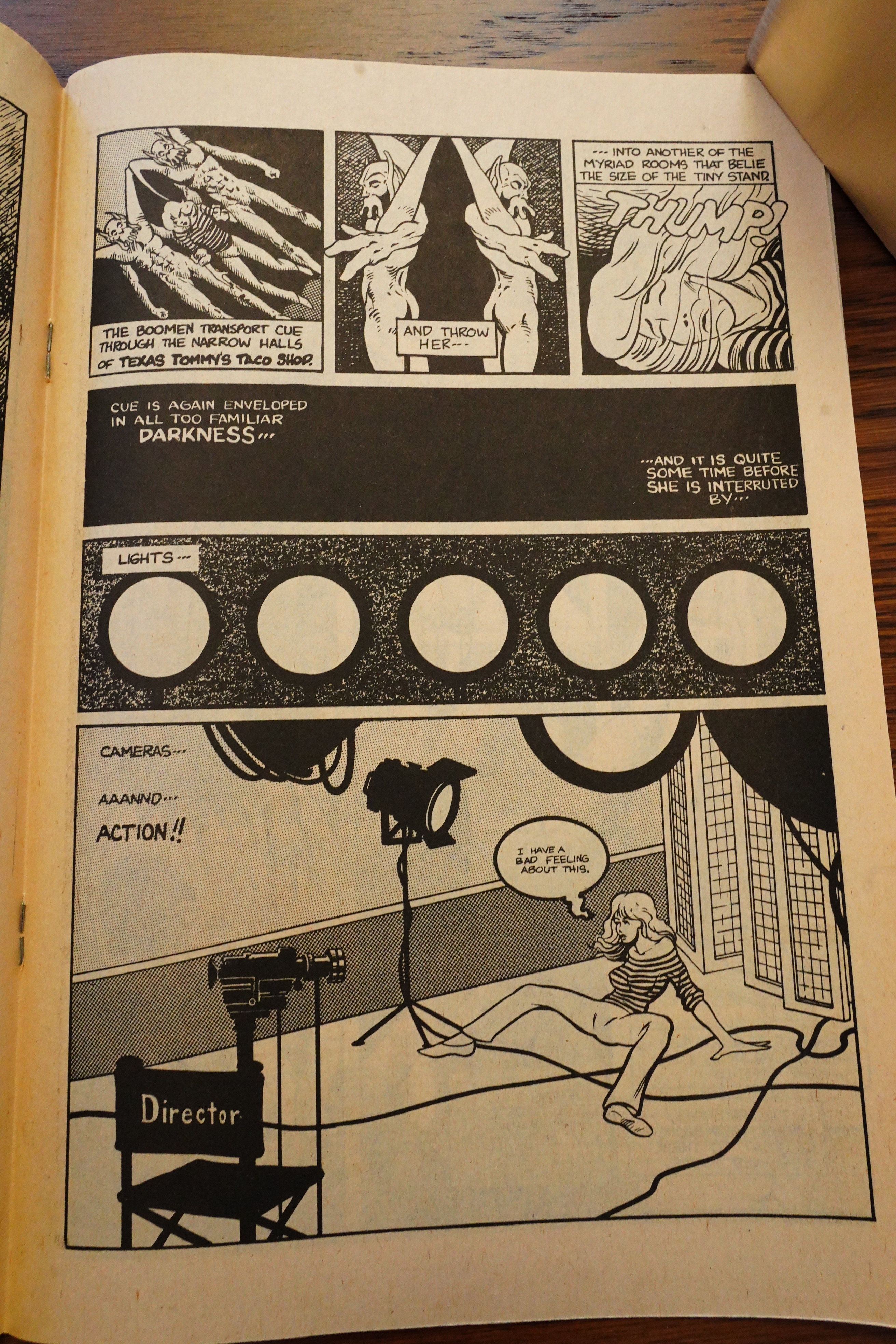
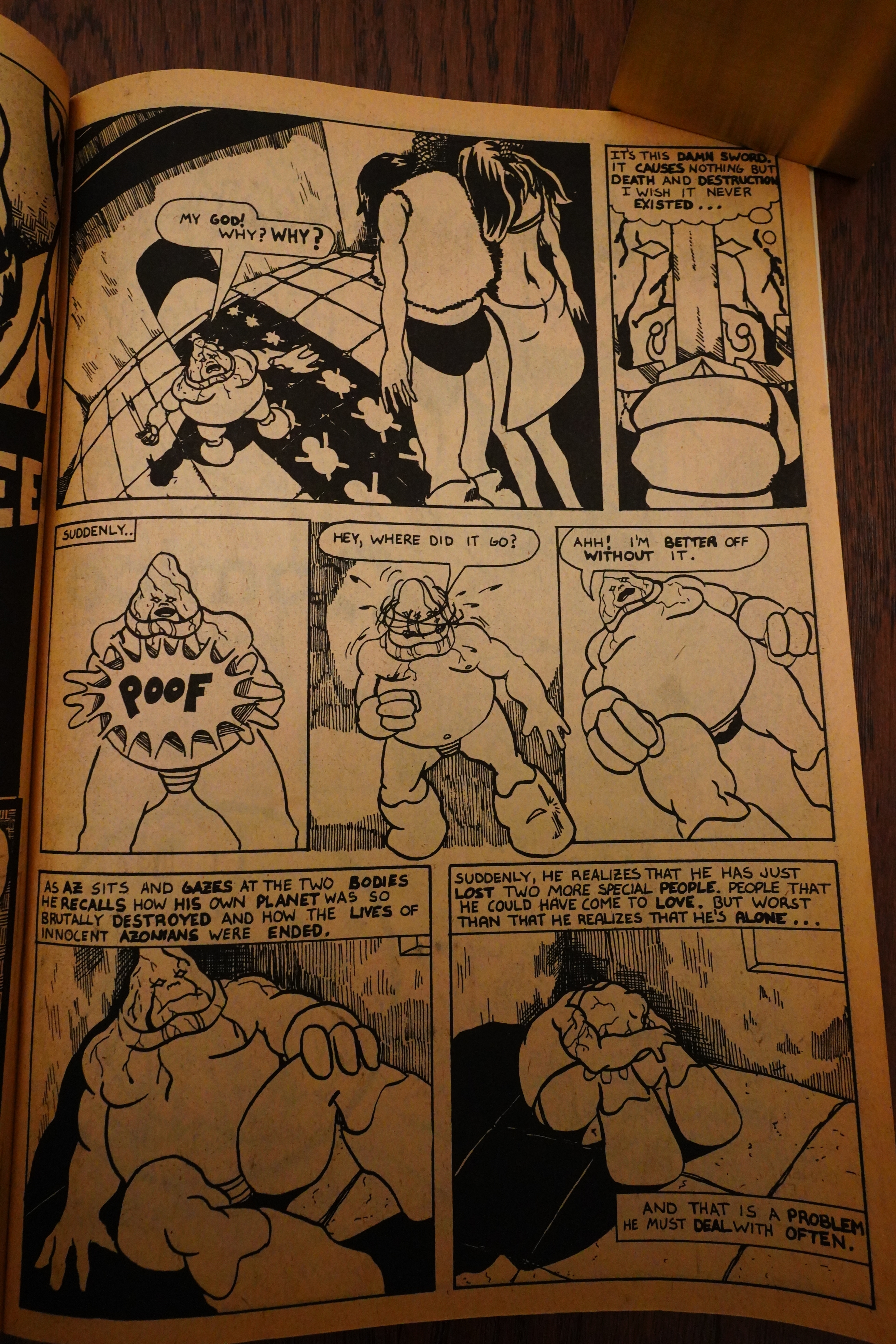
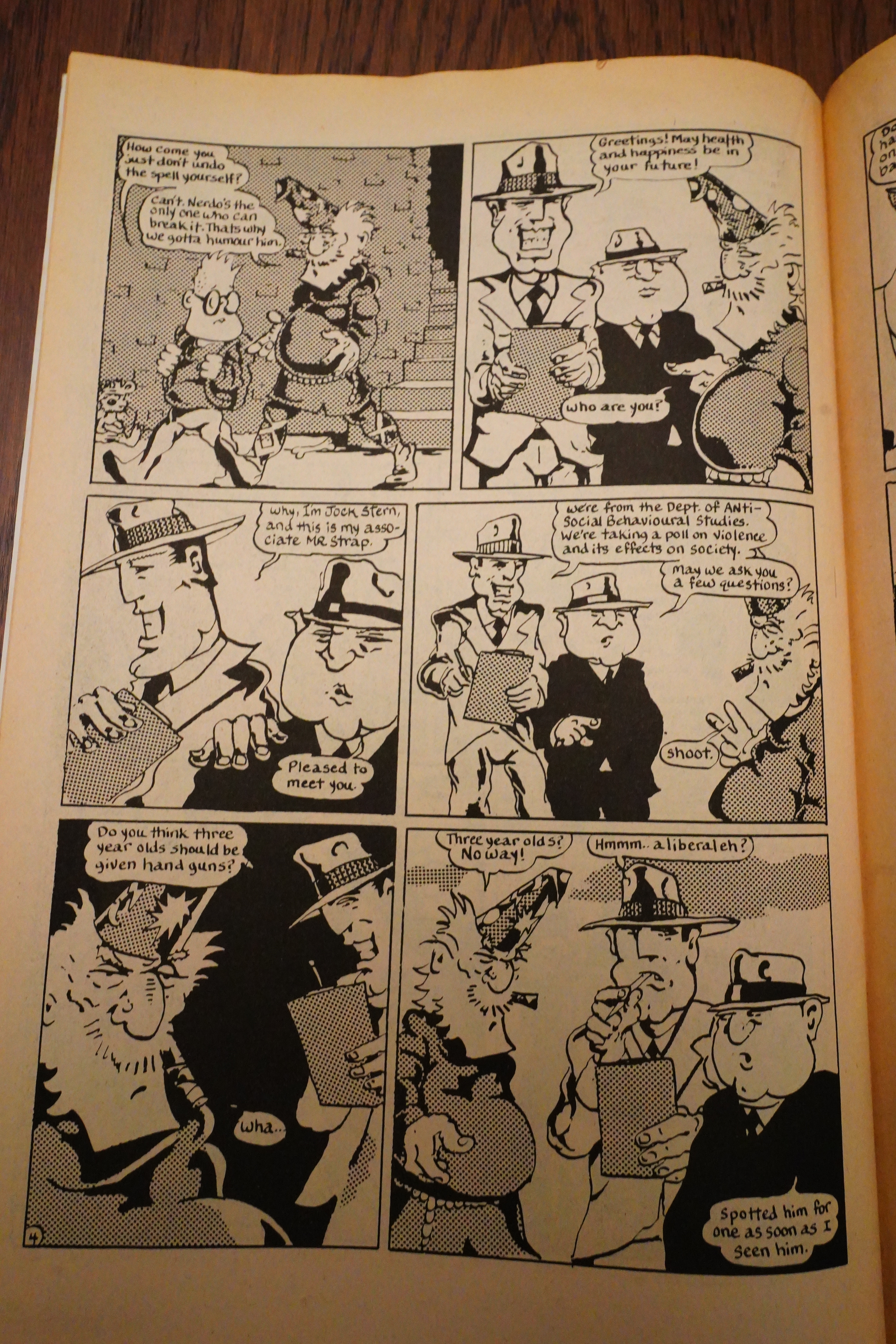
OK, this is pretty bad. It’s so bad that it’s hard not to wonder whether the artwork is bad on purpose — I mean, it’s funny? But the storyline doesn’t really seem to go for humour much otherwise?

What would Captain Ockham say?

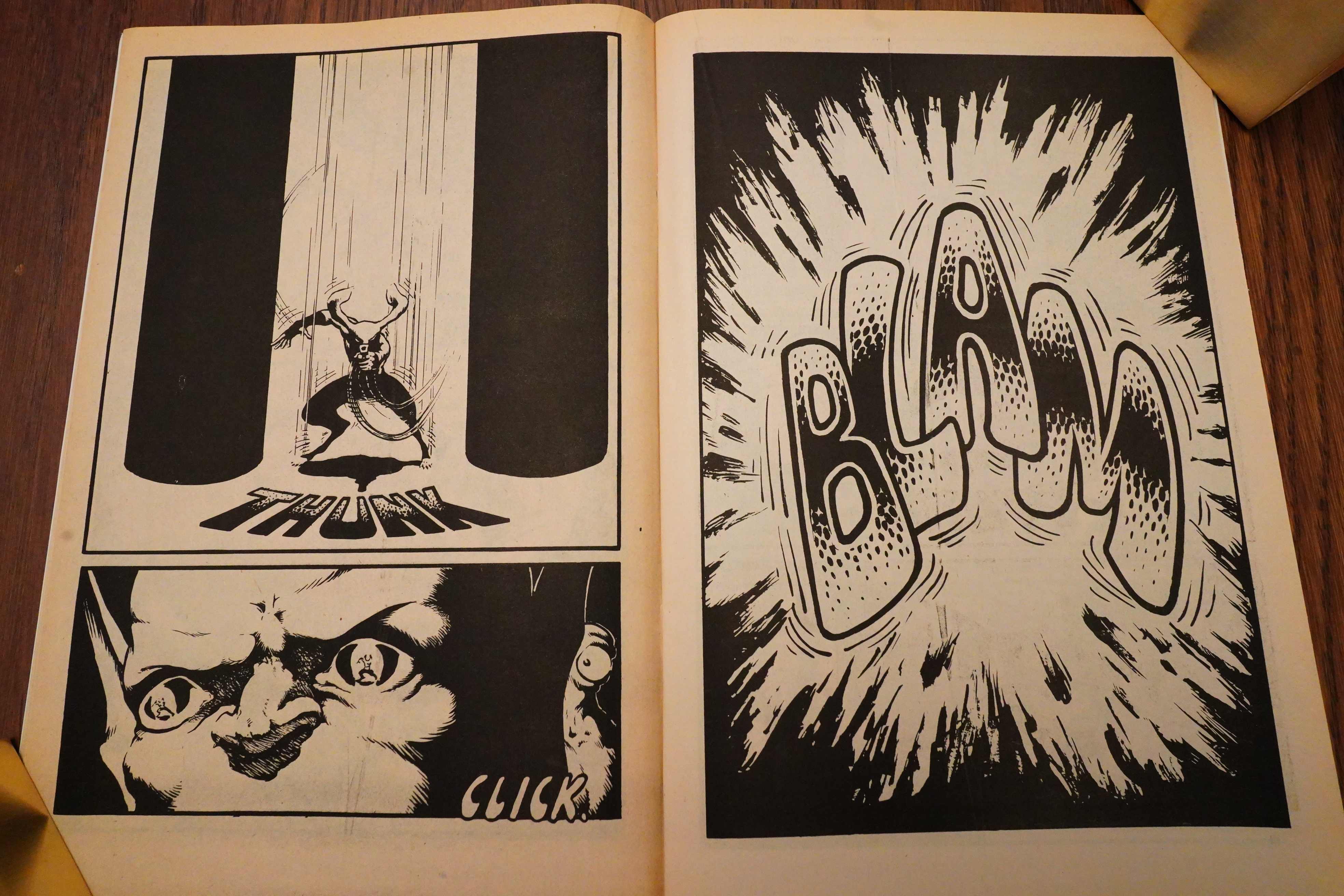
Well, Lasorda has his priorities when rendering things…

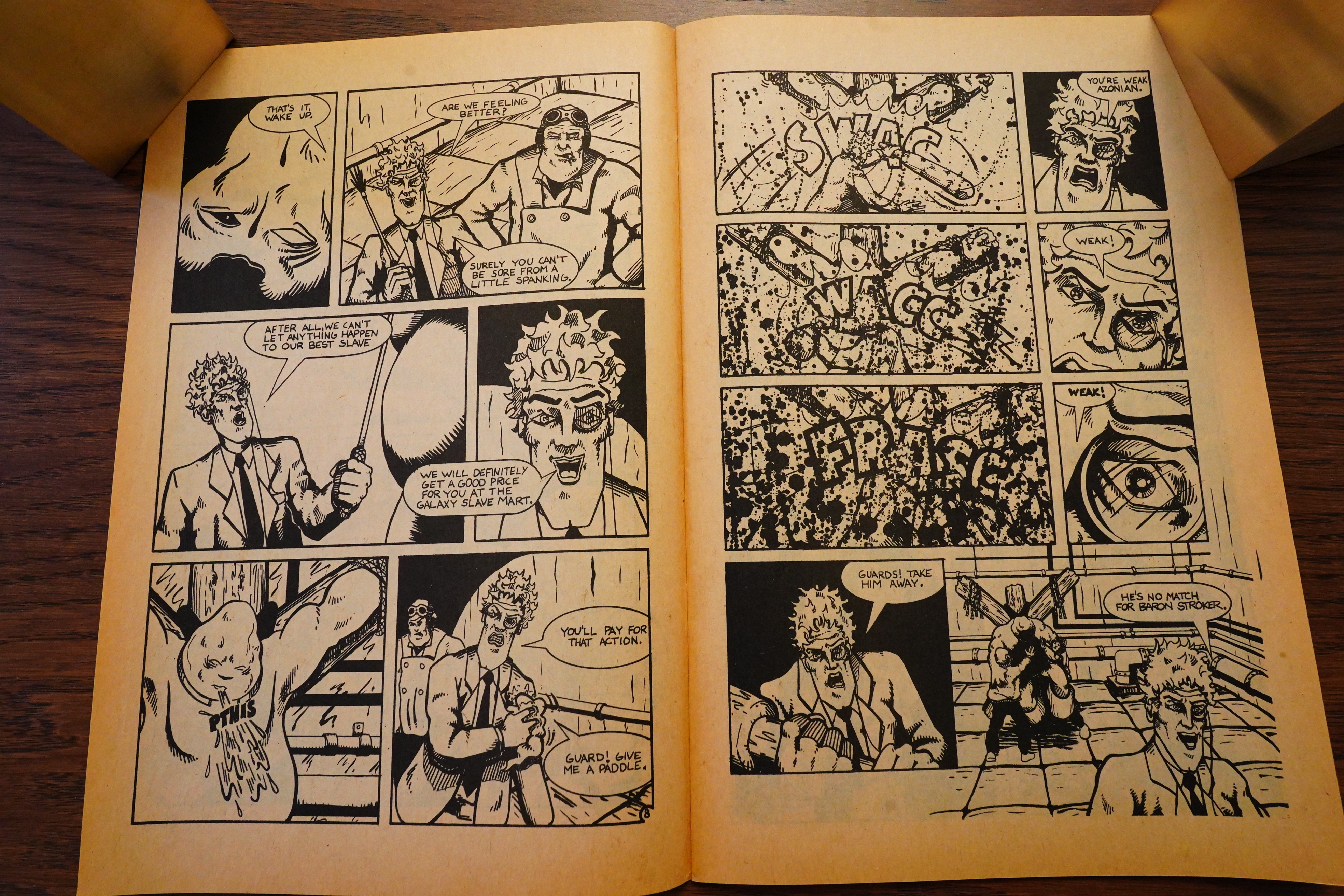
This really looks like something a teenager would have cooked up, but I think all the Comico people were, like, 23 when this was published? Of course, this could have been drawn years earlier, but…

The shifts from “gritty” ultraviolence…

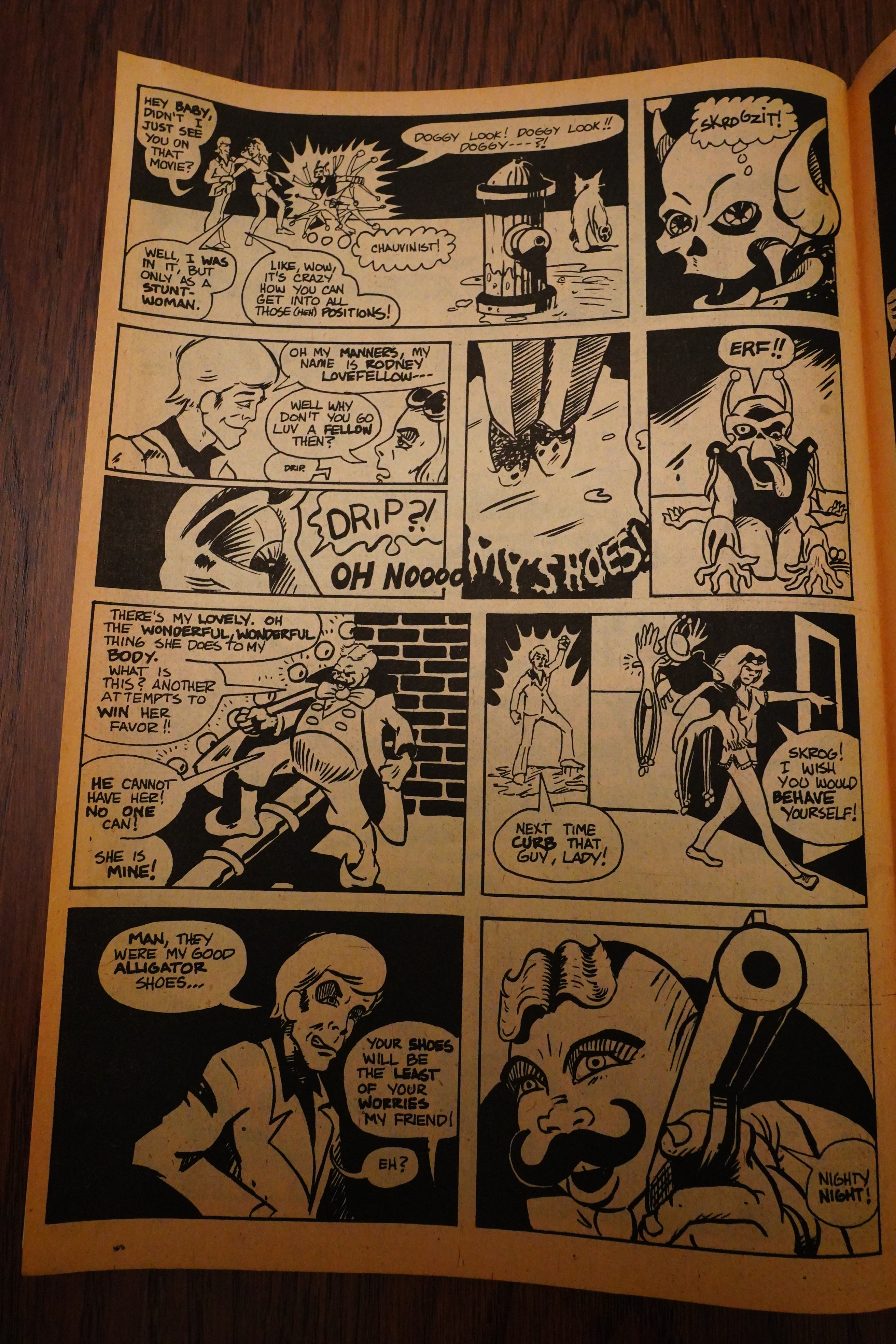
… to oddball comedy seems very much like what an easily distracted teenager would do, I think.

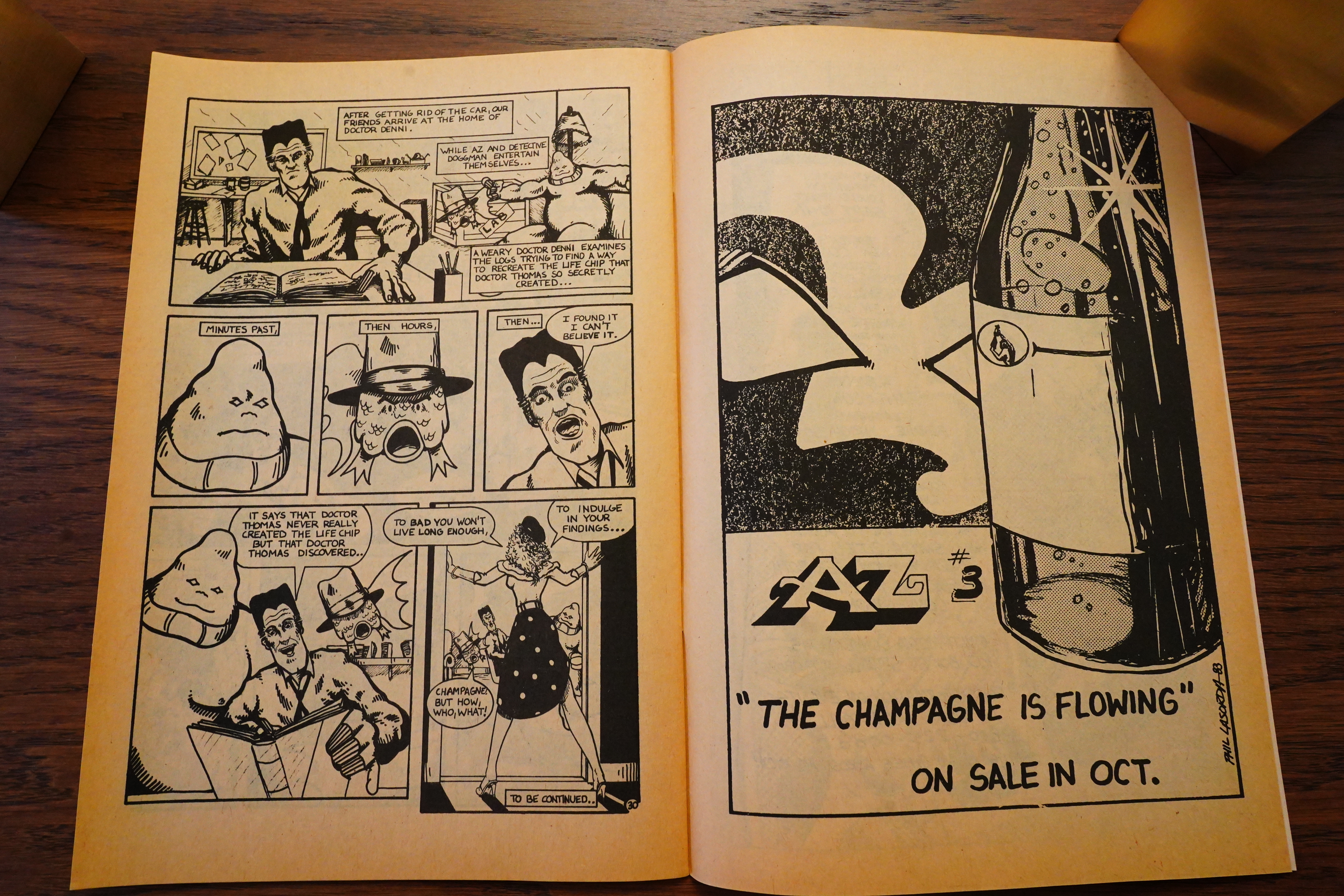
And then the series ends, never to return, with the traditional indie comics “to be continued” sign off.

The artwork’s inept, and so is the storytelling, and the plot (if you can call it that) seems to be going nowhere. So, like the two other “ongoing” series from Comico, this is a pretty bad comic book.

But bad comics are nothing new — there’s a lot of them out there, and publications like this usually get a response of “well, it’s rough around the edges, but it shows potential!” and so on. But reading contemporary reviews of these books, there’s a palpable sense of hostility towards them that you rarely see in the comics press.

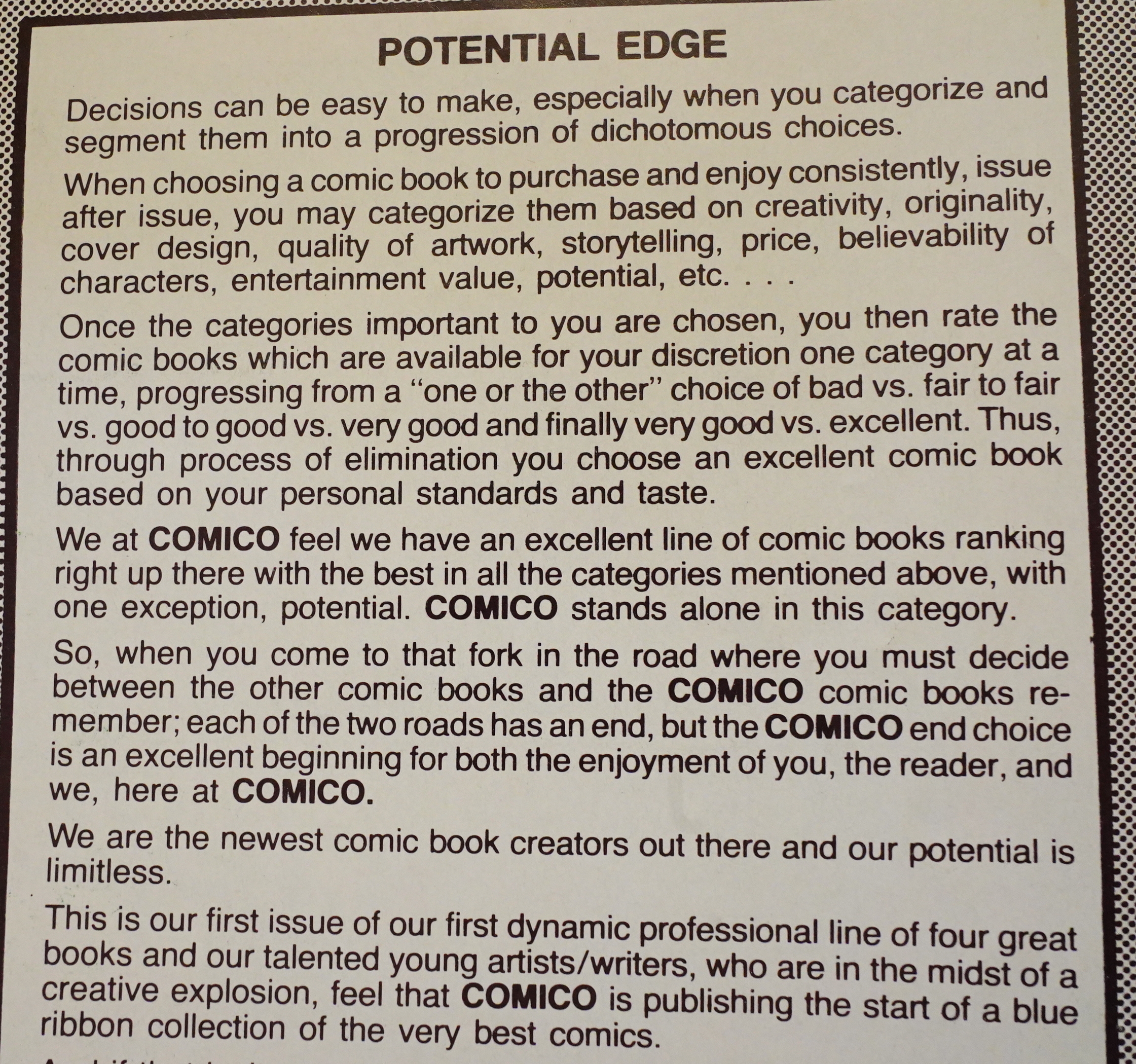
And I think some of the reason is the apparent delusions on display here. All three of these series had the same editorial, so they had to have been proud of the ridiculous verbiage here (with dubious grammar). And it’s obvious that this would rub reviewers at the time the wrong way: Instead of judging these books as fannish amateur books by some hapless almost-teenagers, this editorial line professes that these are part of “dynamic professional” line of comics.

Comico blanketed the comics press with ads for these books, which means that Comico had money to spend, which perhaps further alienated people — as in “they had money to spend? ON THIS?!?” Somebody described these comics as “ugly comics with ugly names”, which is accurate — comic shops ordered a lot of copies of these books based on the ads and the solicitations (that were done without much in the way of artwork samples), and the reactions when they received the books were probably along the lines of “and what are we supposed to do with this shit, then?” People didn’t see them as another charmingly amateurish book, but as somebody trying to swindle them.

It’s not surprising that Comico then pivoted to publishing other people’s comics, because nobody were going to order further issues of this stuff.

The Telegraph Wire #10, page #6:

COMICO
Beginning with the fourth issues of
SLAUGHTERMAN, AZ, SKROG, and GRENDEL.
Comico will be publishing its entire line
with the exception of PRIMER in full colour.
According to these new publishers, the pur-
pose of the change is to “put Comico in the
comics limelight.”

This didn’t happen.

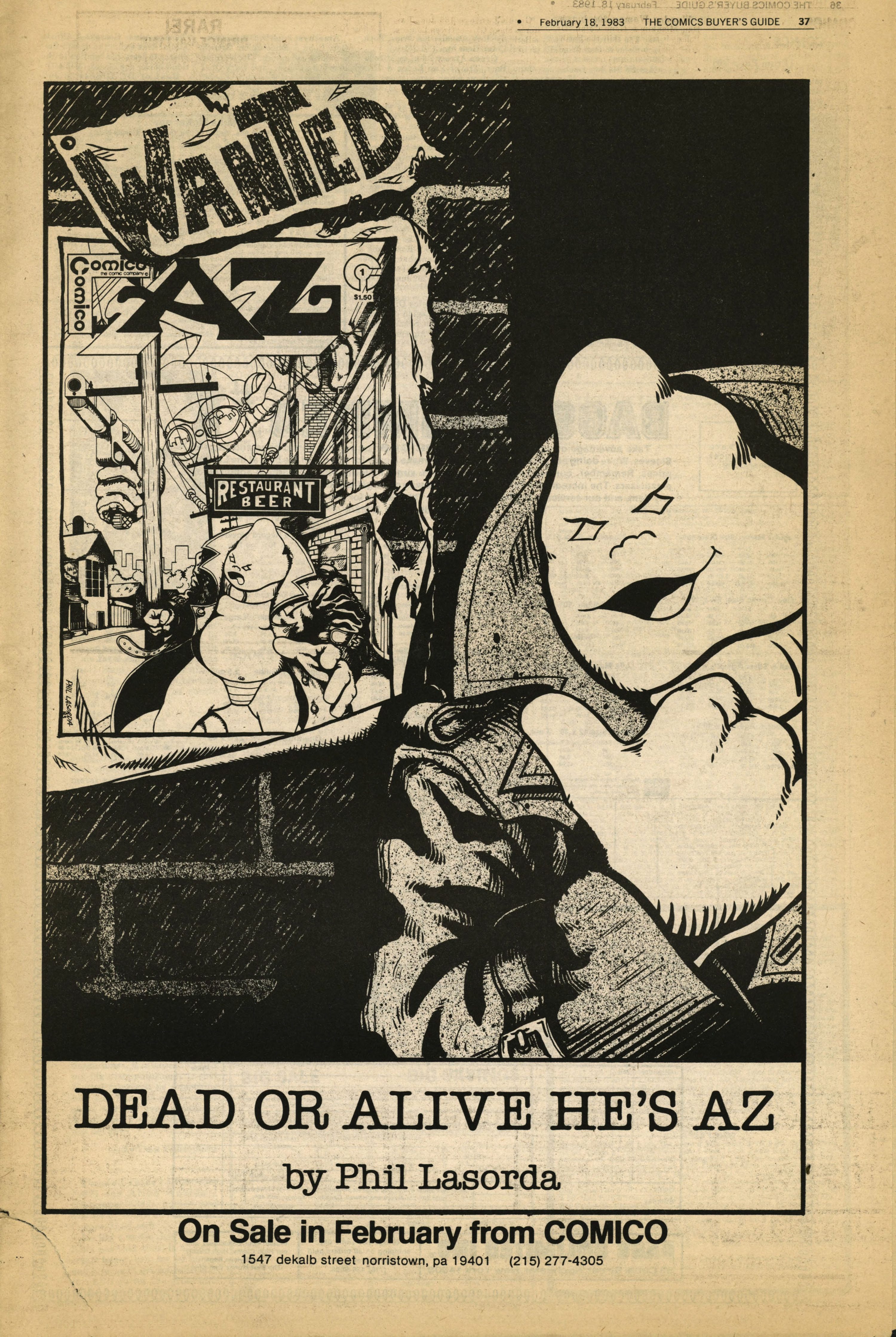
Full page ad in The Buyer’s Guide.

The Slings and Arrows Comic Guide #2, page #55:

AZ.
Comico: 2 issues 1983
Dear, oh dear, oh dear. Az is large pink alien (an Azonian),
who is captured by the evil monocled Baron Stroker. There
are a few nice ideas, like a cigar-smoking fish, but you
can’t sympathise with our pink friend as he’s a violent
bugger. The abysmal art only made matters worse. This is
sub-standard fanzine level at best, so who would
have thought Comico would grow into a respected
publisher.~HY

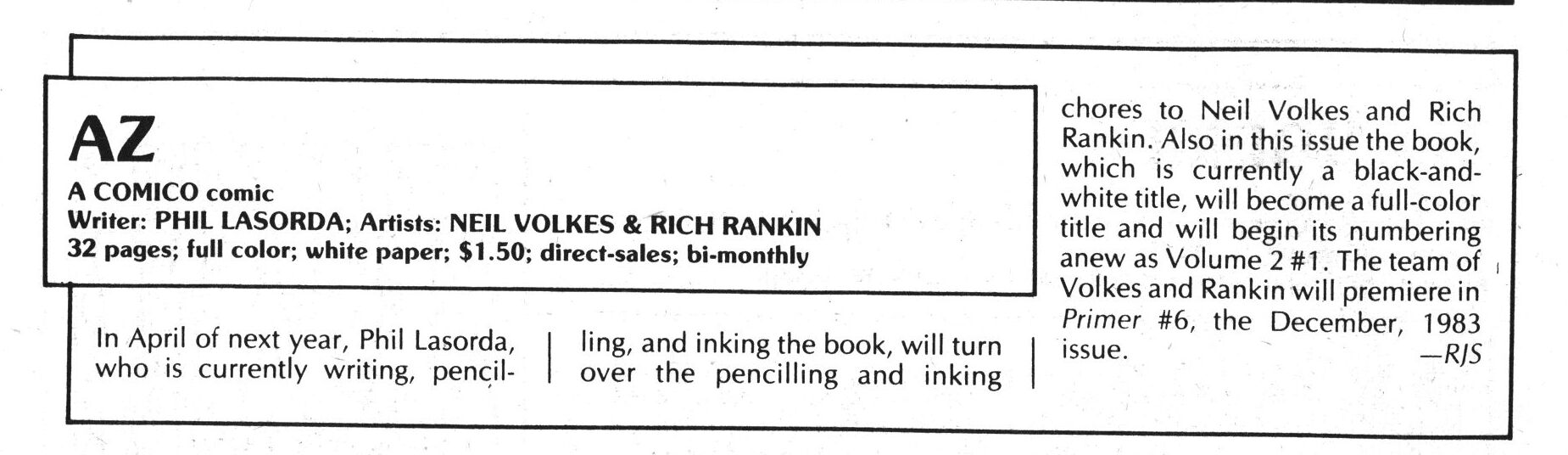
Oh, Lasorda had planned on outsourcing the artwork.

Comics Interview #5, page #7:

DAK: What’s interesting about Comico
is that you don’t give the impression of
having analyzed the market and said,
“Well, superhero groups are selling well,
so let’s do superhero groups.” You really
have taken a chance, with characters like
Az — a fat pinhead wearing a raincoat…
PHIL LASORDA: I designed him after
my father.
BILL (COOCH) CUCINOTTA: Wait
’til he reads that!
PHIL: I had a psychology teacher in
college analyze AZ for me, and he said
for women it is a penis gratification, and
more women are going to like the char-
acter than men. He felt Az would have a
certain tendency to sexually excite women.
GERRY GIOVINCO: Personally, Phil,
AZ changed my life.
PHIL: I just have penis envy. Only
kidding! Az is really weird. When I first
created him, he was really primitive. I
was into the “love” thing. And when I
first came up with AZ, I pictured it as a
child’s book, with pastel colors. On his
planet, there is no such thing as killings,
or hatred — there is a lot of love and
butterflies and that sort of stuff. But his
planet was destroyed, so he curses every-
body for that. Yet every now and then, he
has that love inside him, that desire to
help other people. His whole mission now
is, “to make more Azonians.” Rumor is
that there’s another one out there, and he
just has to find it.
DAK: I thought that was a unique
motivation, too. Not the old, “My parents
were killed, so now I’ve got to stop
crime!”
PHIL: Well, see, he is only here for a
little bit of time. He goes from planet to
planet. He is going to be on an old-age
planet, in the fifth issue. The cover is him
in a wheelchair.
My brother is a physical therapist, and
when I was in college, in order to earn
extra money, I worked with him in an old-
age home, a nursing home. I talked to
people and saw how they felt about lone-
liness. I decided to bring that into the
book and incorporate Az to show how he
deals with older people.
Az goes through these different ex-
periences and different emotions. A reason
I left his eyes blank was that I wanted to
get other people’s feelings into Az. I want
them to picture themselves in Az. Every-
one picks on you, everything happens to
you, you feel like an Az . . . A-Z, not the
other one.

Is that how Az from Vokes/Rankin would have looked?

Comics Interview #83, page #16:

PAT: I’m going to tell you a secret: I was
the managing editor of COMICS
SCENE when the first Comico titles
came out and we were running a column
called “Pick Hits,’ in which I chose what I
thought were the best titles coming out.
When I saw the first set of Comico titles
– with the possible exception of yours; I
don’t remember if it was in there – I
turned to the editor, Bob Greenberger,
and said, “Gee, I wish we had a ‘Bottom
of the Barrel’ column.”
What’s the one I remember – Adge,
or something like that?
MATT: AZ – that was done by Phil
Lasorda, the owner.
PAT: So, it was surprising, four or five
years later, to see Comico doing material
that anyone actually wanted to buy.

There’s even less written about Az than Slaughterman and Skrog…

Well, this guy liked it:

I genuinely loved this!Comic absurdity at its finest.

I think this had better art and story than the first Vol (2 issues) of Grendel, like hands down! (I love Grendel btw).Phil Lasorda could have taken the adventures of the AZONIAN “AZ” and the floating fish “Detective Doggman”, to similar levels of success, at least judging by these stories.

Hey, there’s an entire Progressive Ruin post about Az:

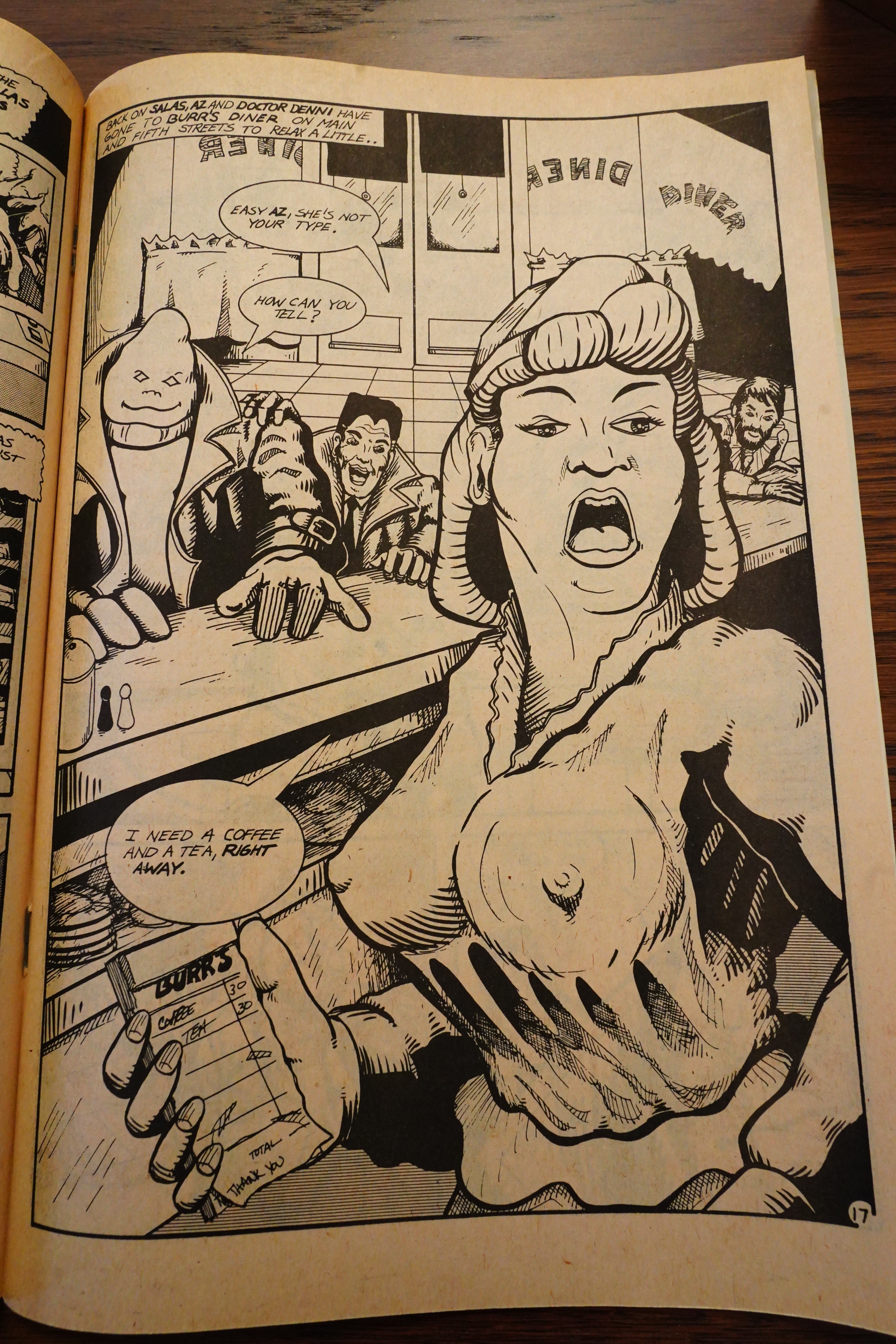
So basically I’ve had an interest in amateur work like what you see here in Az, a sort of unfettered approach to putting your imagination on paper and getting it out there for people to read, without the constraints that could be put upon the project by larger publishers. It’s rough around the edges, I’m not sure about the setting for the story (more on that in a sec), there’s a full page drawing with a waitress in the foreground whose nipples are very carefully delineated beneath her shirt which is — a choice…like I said, unfettered.

Aside from that last bit about the nipples, which, honestly, that was out of nowhere, this isn’t a terrible comic. It sets up the premise, introduces our hero, tells its story…not polished in the slightest, but retains a measure of charm anyway.

Well, I have certainly read worse than Az — I mean, a lot worse — but this seems overly generous.

Anyway — the next post will hopefully be about an actually good book.

1983: Skrog

Skrog (1983) #1 by Bill Cucinotta and Bill Anderson

This is the second of the three original Comico series. And look:

I bought a lamp! Perhaps that’ll fix my problems with uneven lighting that I had on the previous blog posts…

Hm… do I see a Cerebus influence?

OK, this is one of those punny comics, which I approve of, but…

With extremely zany humour. But, er, it doesn’t really work, does it? I mean, it does seem kinda like high school humour, which is almost appropriate, because I think Cucinotta was in his early 20s here, but it’s really basic.

The artwork’s not altogether bad, but he attempts more than he really has the skills for.

Oh the puns.

That looks really, really Dave Sim-ish, doesn’t it?

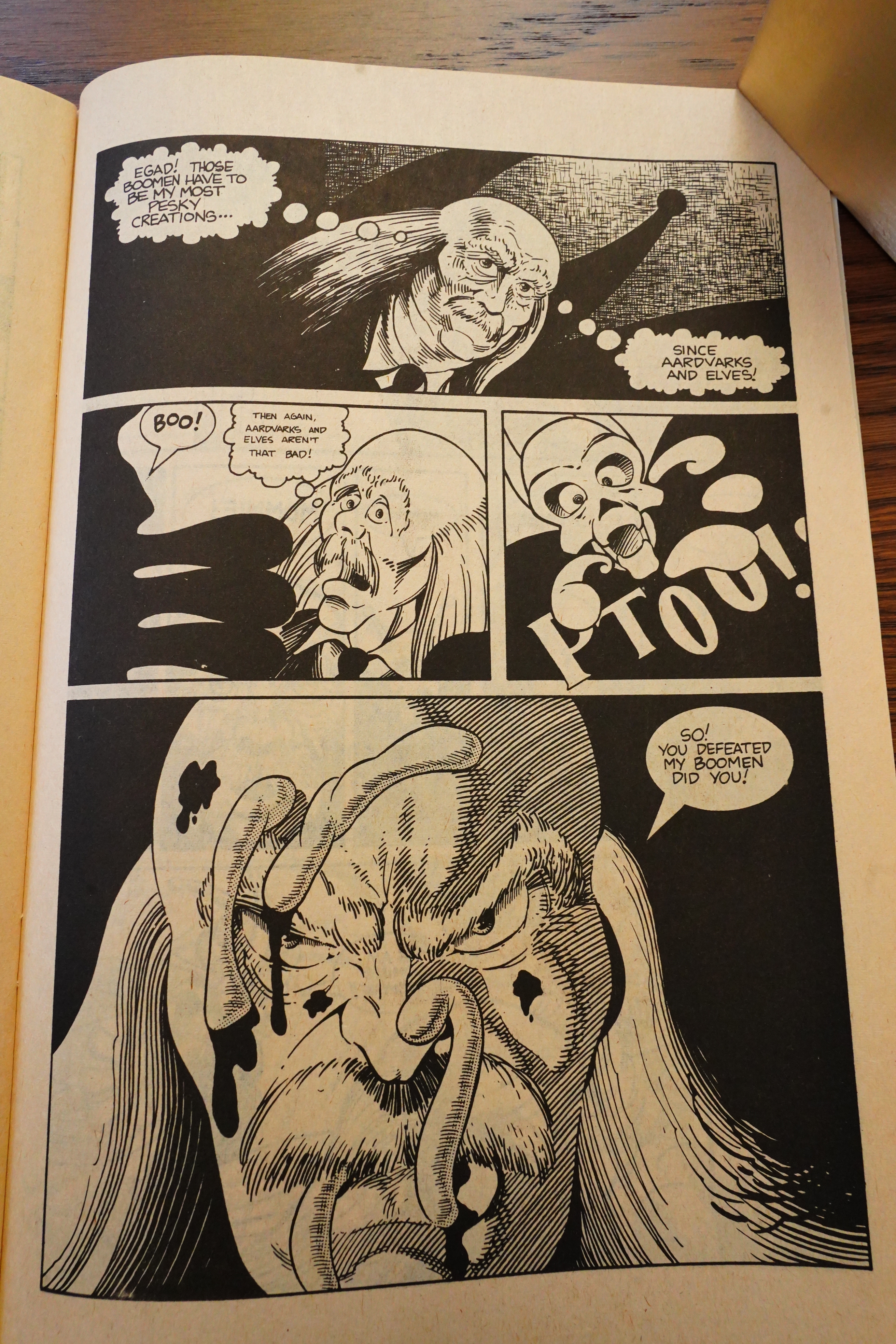
It’s sometimes not altogether trivial to say what’s going on, and even if you do understand it, it’s still a bit eh? Like here, Skrog has bitten off the tentacles of the henchmen monsters and then spits them into the wizard’s face, and … and… But why?

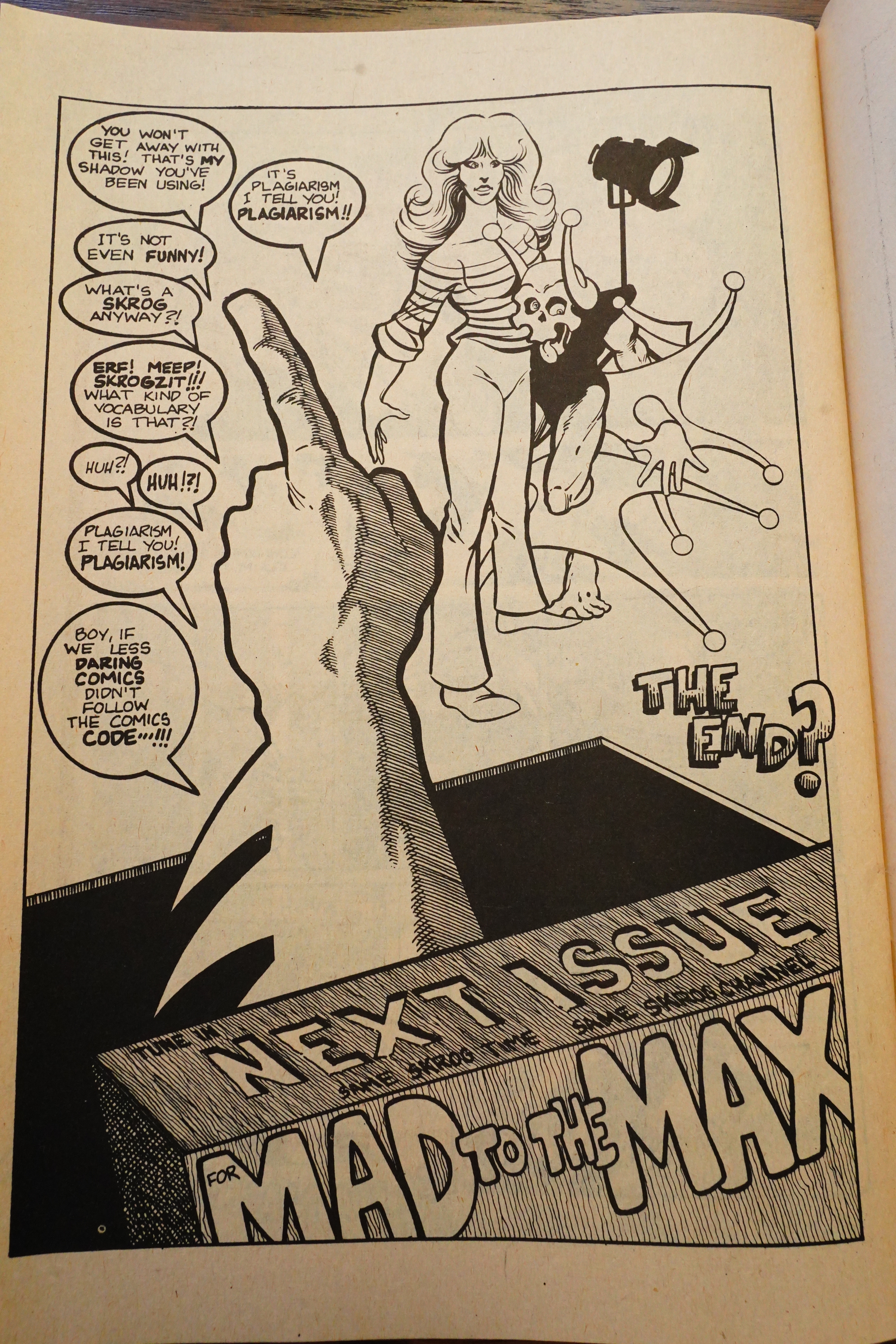
And this is how the issue (and the series) ends. Is that Batman’s hand? Did I miss something? Is this a total non sequitur? Oh, yeah, his shadow is on the cover… I forgot.

In 1987, Cucinotta released a sequel, and that’s apparently it for the character. Oh, and a story here?

Amazing Heroes #30, page #62:

Comico, the publisher of Az,
Grendel, Primer, Skrog, and
Slaughterman has been kind
enough to send me copies of
their titles for review purposes. I
in turn have decided to scruti-
nize the first issue of Skrog,
since it is in my mind the best of
the lot.
Make no mistake, Skrog is
very much a fan effort, but that
should not deter you as a
reader. It should in fact stimulate
your curiosity—all too often, the
mainstream comics seem to fos-
ter cookie cutter writing and art
styles, but the creator of Skrog
spurns the typical Marvel/DC
treatment for an individual,
iconoclastic approach.
Skrog is a freewheeling
conglomeration of ham-bony
humor, irony, and sheer extra-
vagance that avoids superhero
cliches by lampooning them.
And fine satire it is, consisting of
telling visual puns and succinct
witticisms (which is a welcome
contrast to something like
E-Man, which is starting to
resemble the walls of a bath-
room stall where the punsters
get paid by the word).
I feel quite assured in stating
that there has never been a
character/series comparable to
Skrog. It’s all mad, vivacious
fun, and sheer, goofy appeal.
And to me, that’s entertain-
ment.

Satire?

Comics Interview #5, page #8:

GERRY: That is an interesting thing
about our characters. None of them have
eyes except Skrog, and Skrog’s eyes
never focus. Too bad we didn’t bring any
early versions of Skrog. He used to have a
knife sticking out the top of his head!
PHIL: Like you said about us being
different . . . Dave Scroggy of Pacific said,
“You guys are so different, there is no
way you could say no to a book as
different as that.” People like the chances
we are taking with the books.
COOCH: The reason that we are different
is that everything is totally personal.
GERRY: Every one of us has something
to do with the character we are drawing.
Every time I look at SKROG I die –
because it is Cooch all over, every ex-
pression the character makes.
COOCH: Well, I do hibernate in trash
cans.

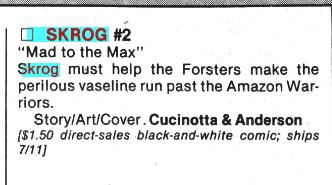
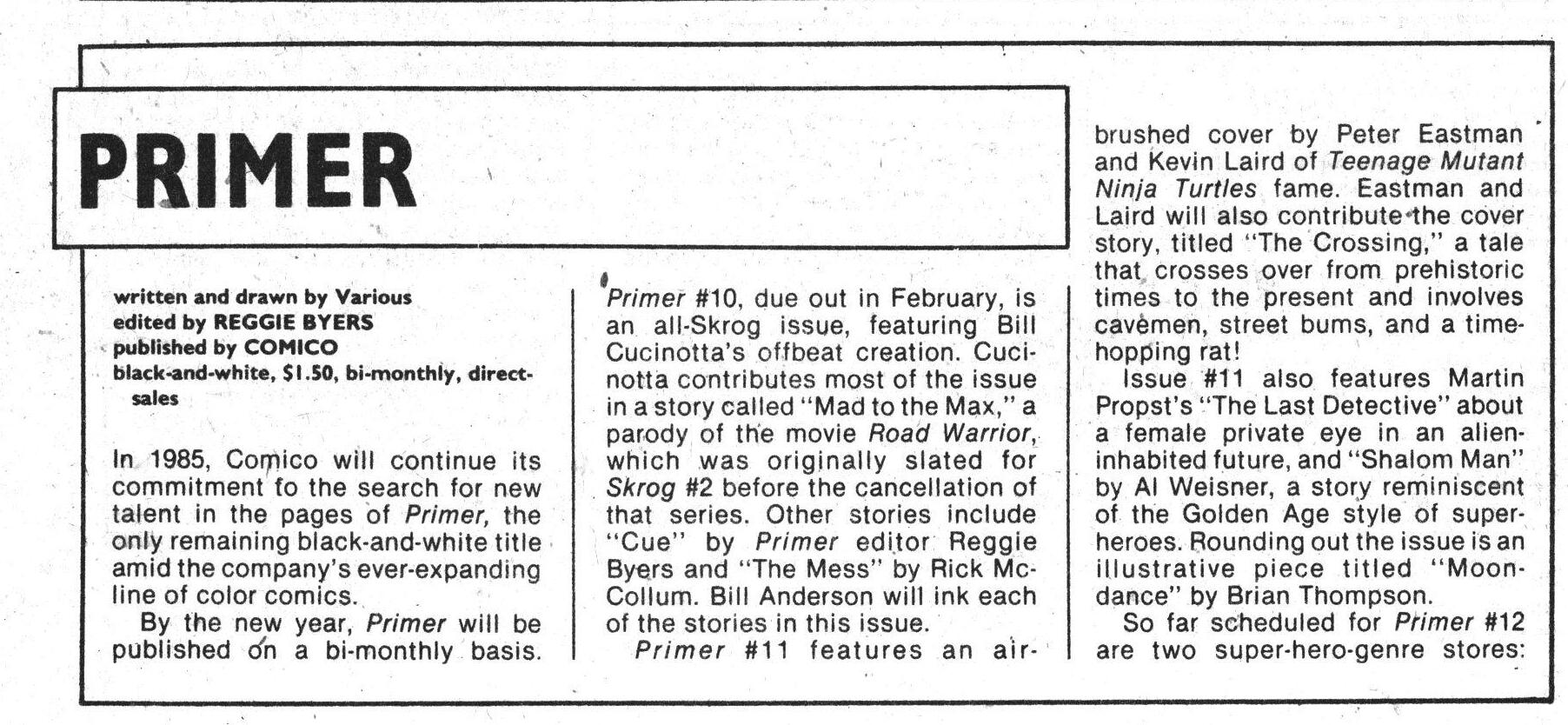
A second issue was put on the schedule, but cancelled.

Heh, they had Primer planned up to #10, which ws supposed to be an all-Skrog issue?

Comics Interview #10, page #50:

SKROG has been skragged.
(Laughter.) Bill Cucinotta, the creator
of SKROG, is going to be working on a
much more refined character, a macabre
individual: PAIN.

That didn’t happen, either…

The Slings and Arrows Comic Guide #2, page #593:

SKROG
Comico: 1 issue 1984
Crystal: 1 Special (‘Yip Yip Yay’) 1987
Skrog is very much a prototype Mask, with the same mixture
of madcap whimsy and parody, which makes the title sound
far more interesting than it is. Unfortunately the wacky action
and stream of consciousness dialogue is hung on a two page
plot stretched to twenty. By the special the art has improved,
but it’s still a waste of paper.~WJ

Ouch!

From the infamous Alternative Comics Cadaver Derby in The Comics Journal #98, page #51:

If ever a comic book company got started on the wrong foot, this is the one. Com-
ico’s opening line, with titles like Az and Skrog, featured art that was as ugly as the
characters’ names. Dealers waved copies of Comico comics at me and cried
piteously, “I’m supposed to sell this?”
Beginning, then, with one of the worst reputations in the industry, Comico set
Evangeline. After a particularly homely first issue, Mage began to shape up. And
Elementals, the first issue of which did amazingly well for an alternative book,
about it.
The bloom may be off the lily, though. The creators of Evangelinehave cancelled
a comic book adaptation of a Japanese adventure cartoon.
This one could swing either way. Even odds.

Amazing Heroes #55, page #17:

CUCINOTTA LEAVES: BILL CUCINOTTA, who
had been a partner in Comico since May 1982,
has left to devote more of his time to pursue
his career as a freelance designed and
illustrator. Cucinotta was co-publisher in the
firm, handled the promotional efforts there, and
created Comico’s Skrog book.

I guess that explains why there’s no Skrog/Pain from Comico.

Comic Book Artist #15, page #69:

Chris: I seem to remember the Primer was in early ’82? Is that
about right?
Matt: Yes. Again, I think First Comics were around at that point, as
well, Eclipse and not much else in the way of… well, there was
WaRP and Aardvark, but they were self-publishing one book apiece,
so there were not that many publishing houses outside of Marvel
and DC, and the direct sales market had just crept up into existence,
and they were willing to take on independent publishers where the
newsstands weren’t. So we had this opportunity and we slipped in
to it. I will say the initial batch of books weren’t very well received
when they were actually shipped.
Chris: They were quite famously ill-received.
Matt: Yeah. Quite.
Chris: There was a point, I think, where retailers were just
ordering every independent book that came out.
Matt: You’ve got to remember, too, that this was in the days when
the ordering catalogs were nothing like these large, ornate, full-color
affairs you see now. You often had to order books off little more than
a tiny little paragraph of text, you usually saw no graphics. [laughs] I
think another reason they got ordered, too, was that Giovinco had
quite a nice little graphics sense, and so our ads always looked pretty
damn good! [laughs] But when the books came in, they didn’t look
so damn good. Oh man, it was kind of a desperate time! We’d all
quit school, and were really trying to do this, and realizing that
we probably weren’t ready for it, weren’t the professionals we’d
conceived ourselves to be. [laughs] Of the four books, Grendel was
the only one that was modestly received. I won’t even say it was
greatly, or even positively received, but it generally got more positive
feedback than the other three.

And how!

This is the only review I can find on the interwebs:

This is one messed-up comic – and a tricky one to grade, as well. From an objective perspective, Skrog is clearly more fanzine than professional comic. But the introductory editorial insists it’s a “fantastic, new, professional comic book,” one “ranking right up there with the best.” Comico would go on to publish some of the best indie books of the 1980s; this is not one of those. This series’ odd mix of fantasy, horror and humor might just work if the creative team had had time to grow. But Skrog would prove to be a one and done at Comico.

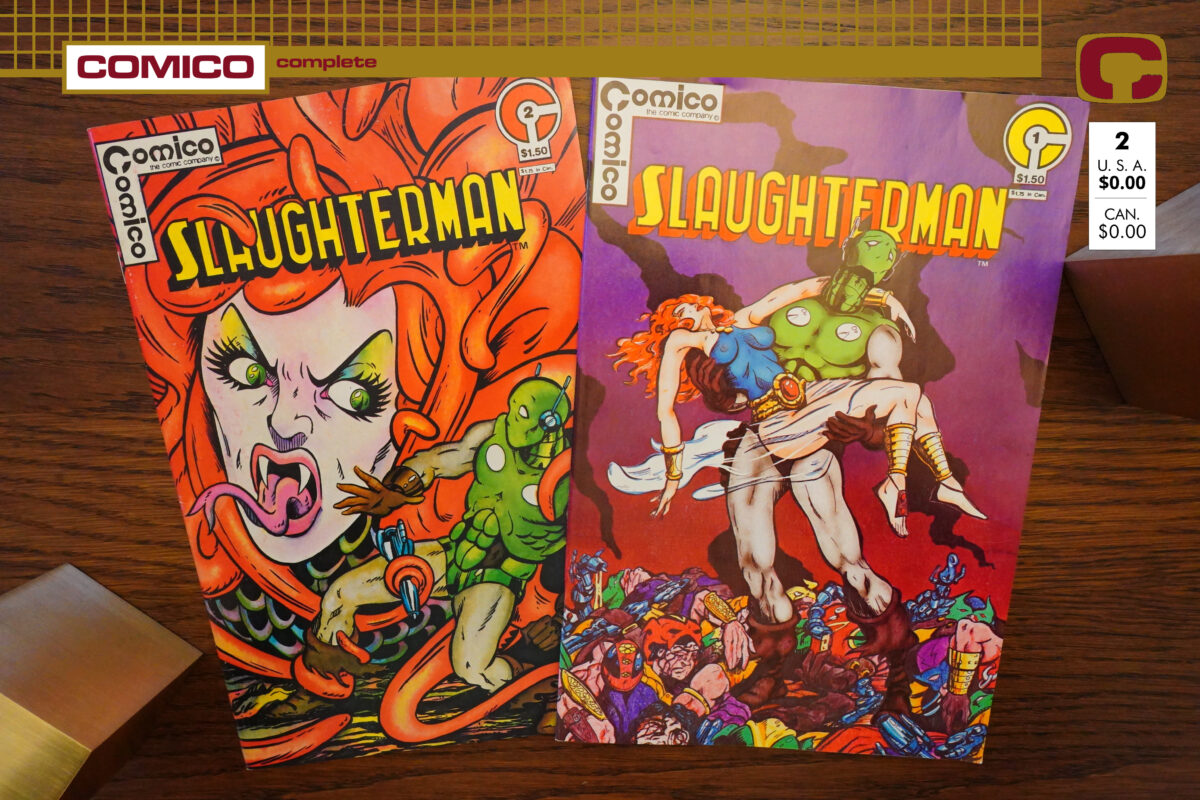
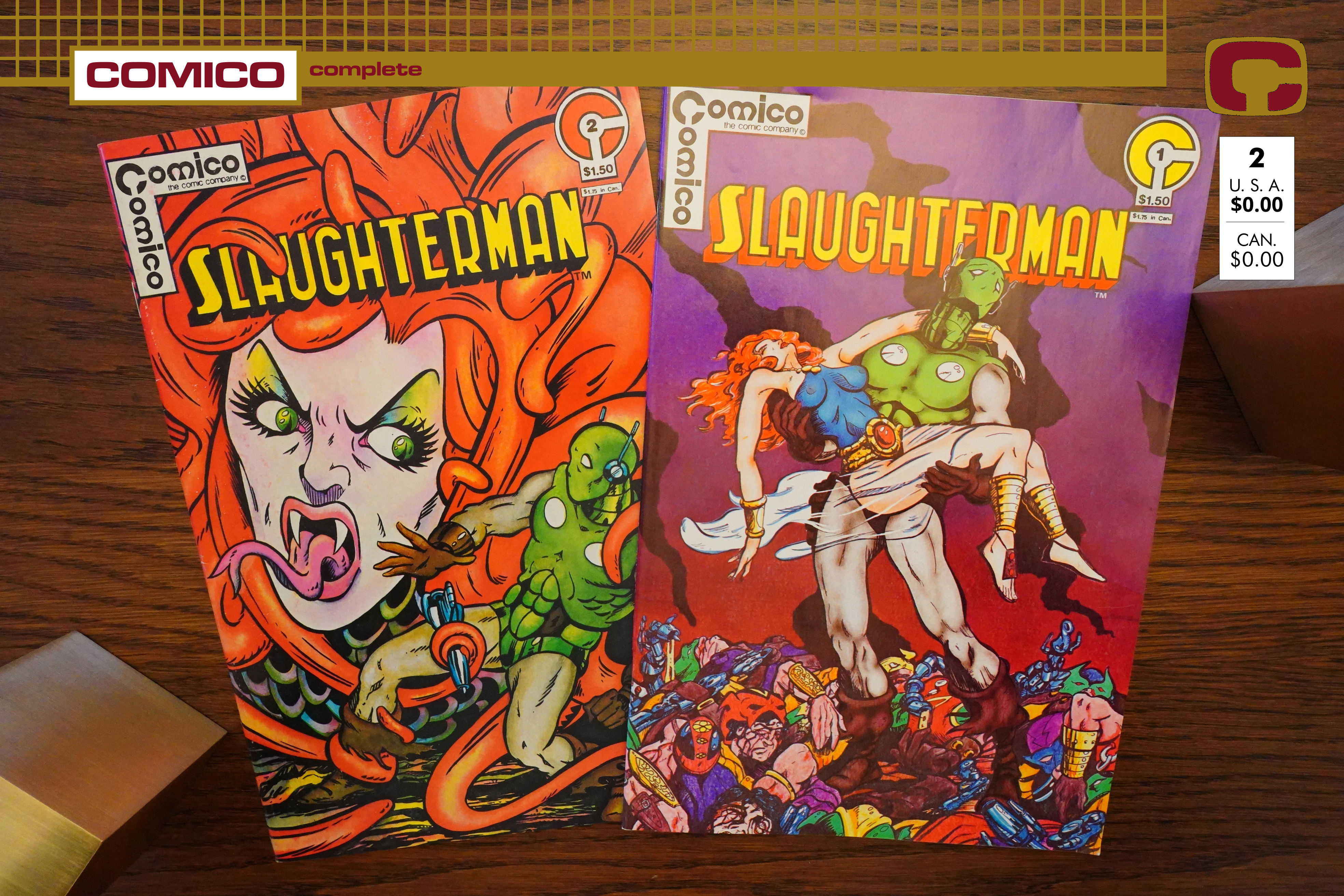
1983: Slaughterman

Slaughterman (1983) #1-2 by Gerry Giovinco

I think this is one of the few Comico comics I had as a teenager. I had a “policy” — I’d try one comic from all new independent publishers just to see whether they had good taste or not. (This stopped when the Black & White Explosion got underway, because it just became impossible then.) And I don’t remember anything about this book, but I can’t have been very impressed, because I didn’t buy anything from Comico for a while after that. I think the next book I bought was Mage #7 or something? And even after that, I mostly just skipped the Comico solicitations — I picked up things like the Jam Color Special, but…

So now I’m kinda excited to read this again to see whether I agree with my… 14 year old? self.

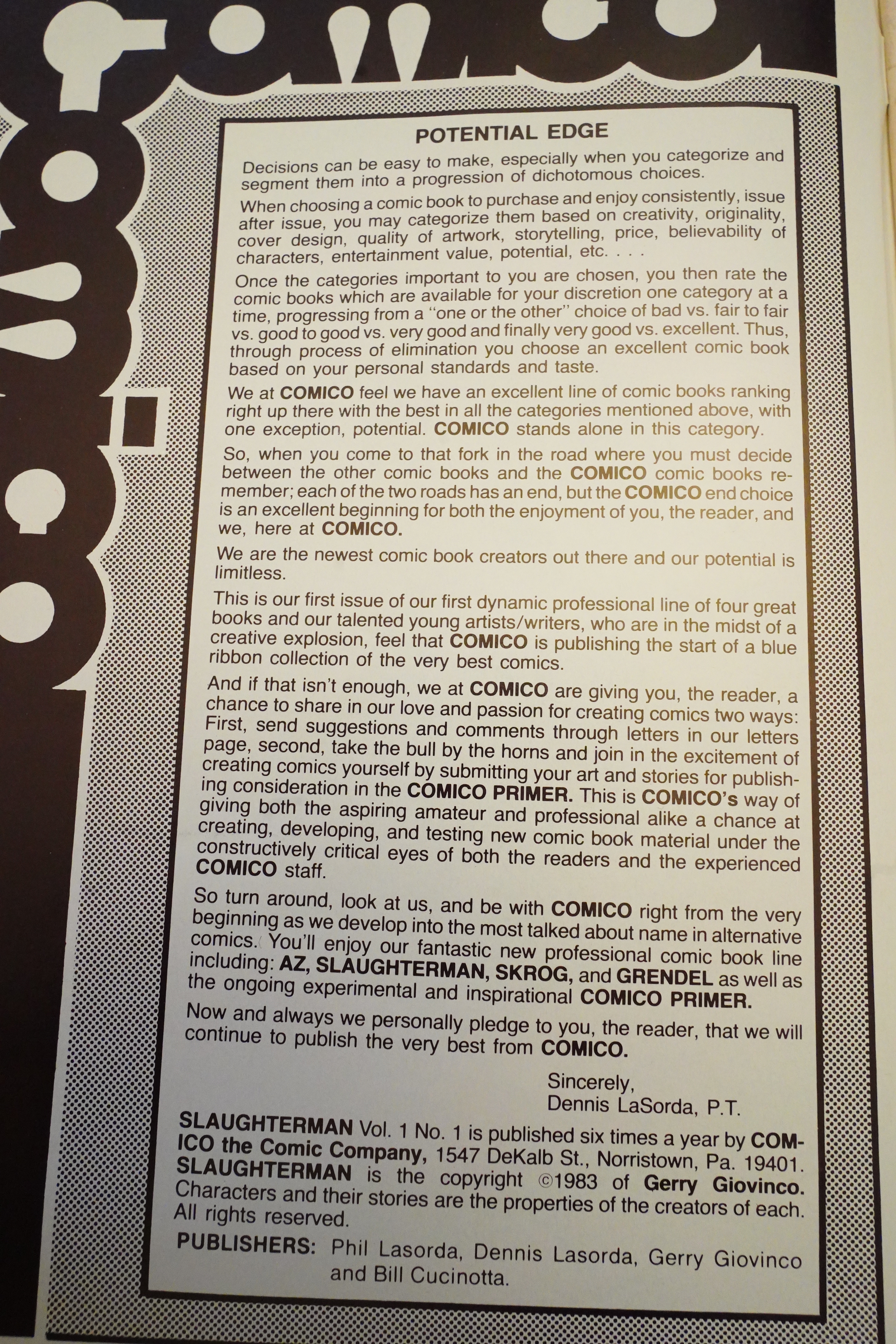
Oh wow. “Segment them into a progression of dichotomous choices”. Perhaps I just fell off my reading chair laughing back then?

And then it gets worse — we get a hard sell with “our first dynamic professional line of four great books […] in the midst of a creative explosion”. Yeah, I can feel the breeze from my eyes rolling, reaching me from four and a half decades ago.

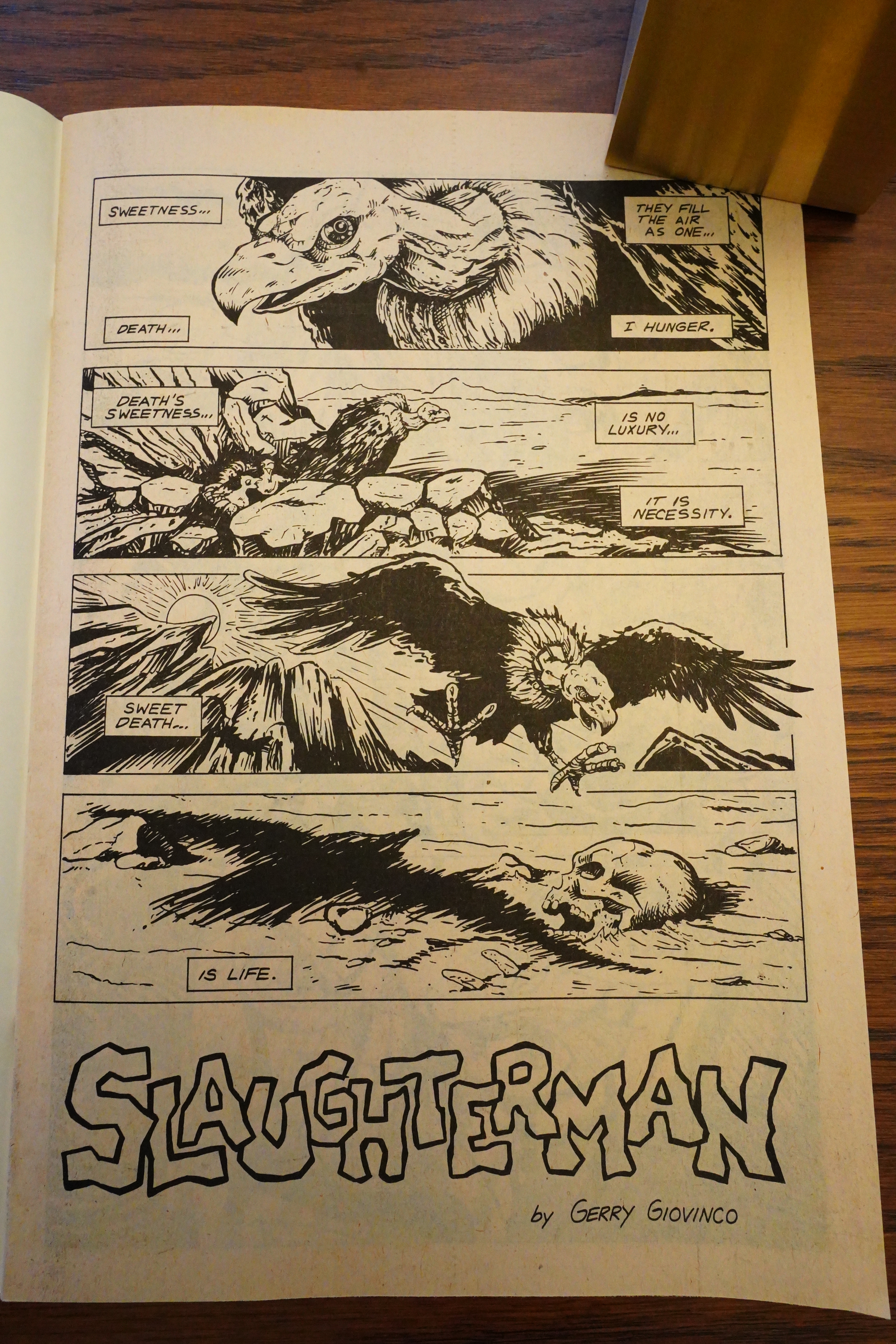
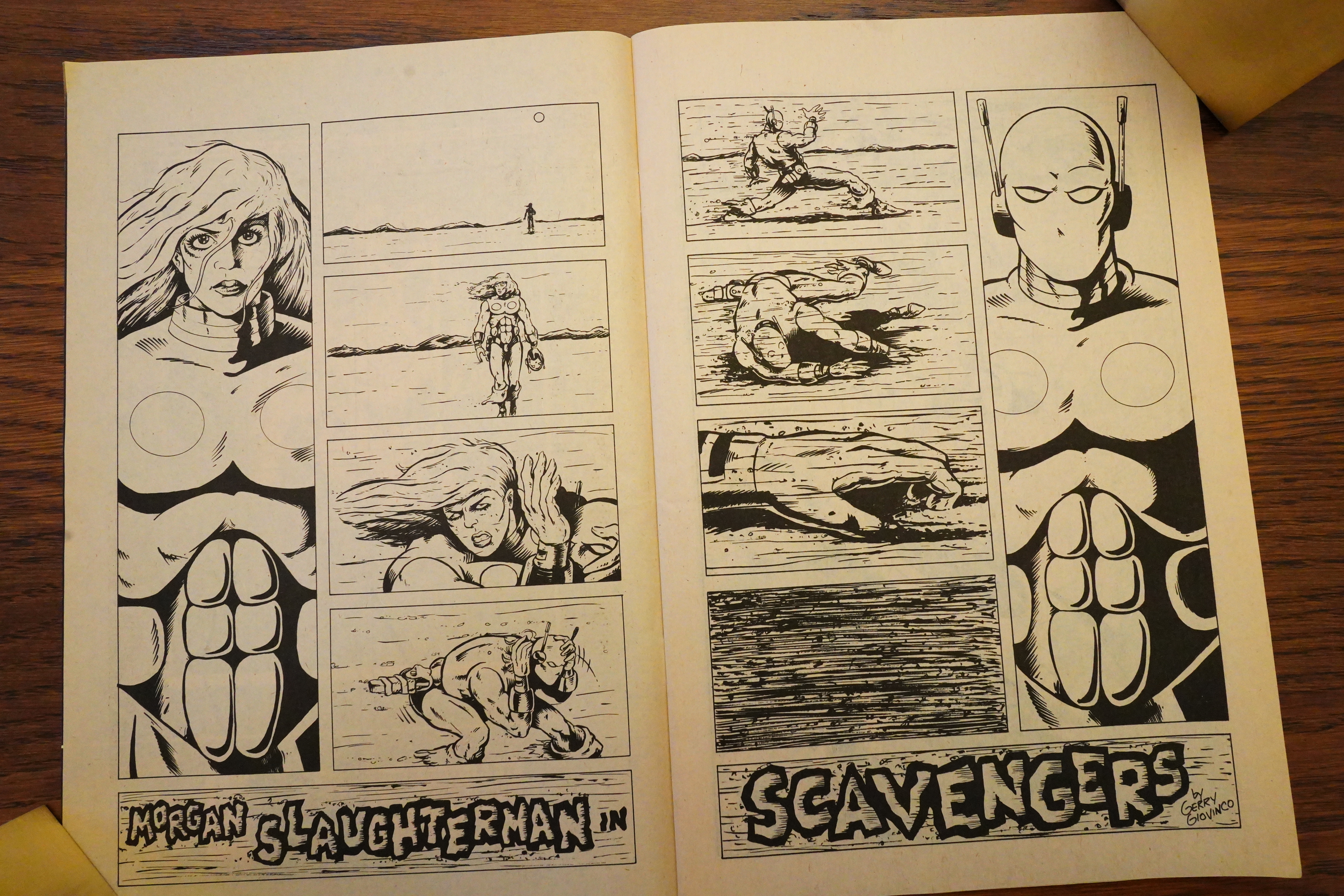
But hey! This doesn’t look bad! It’s much, much better than the artwork in Primer #1, which was published just some months earlier. (But I guess the artwork may have been older than that.)

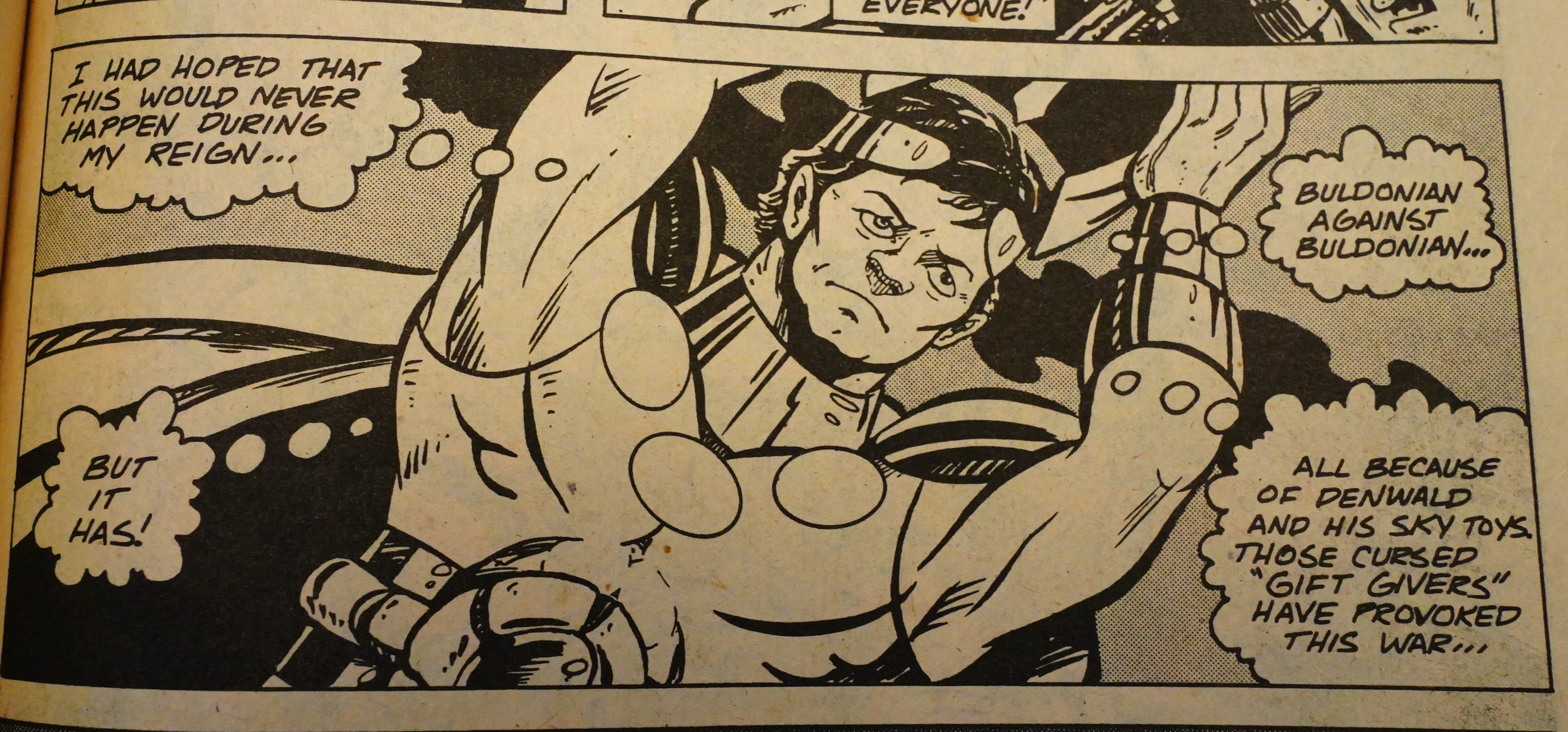
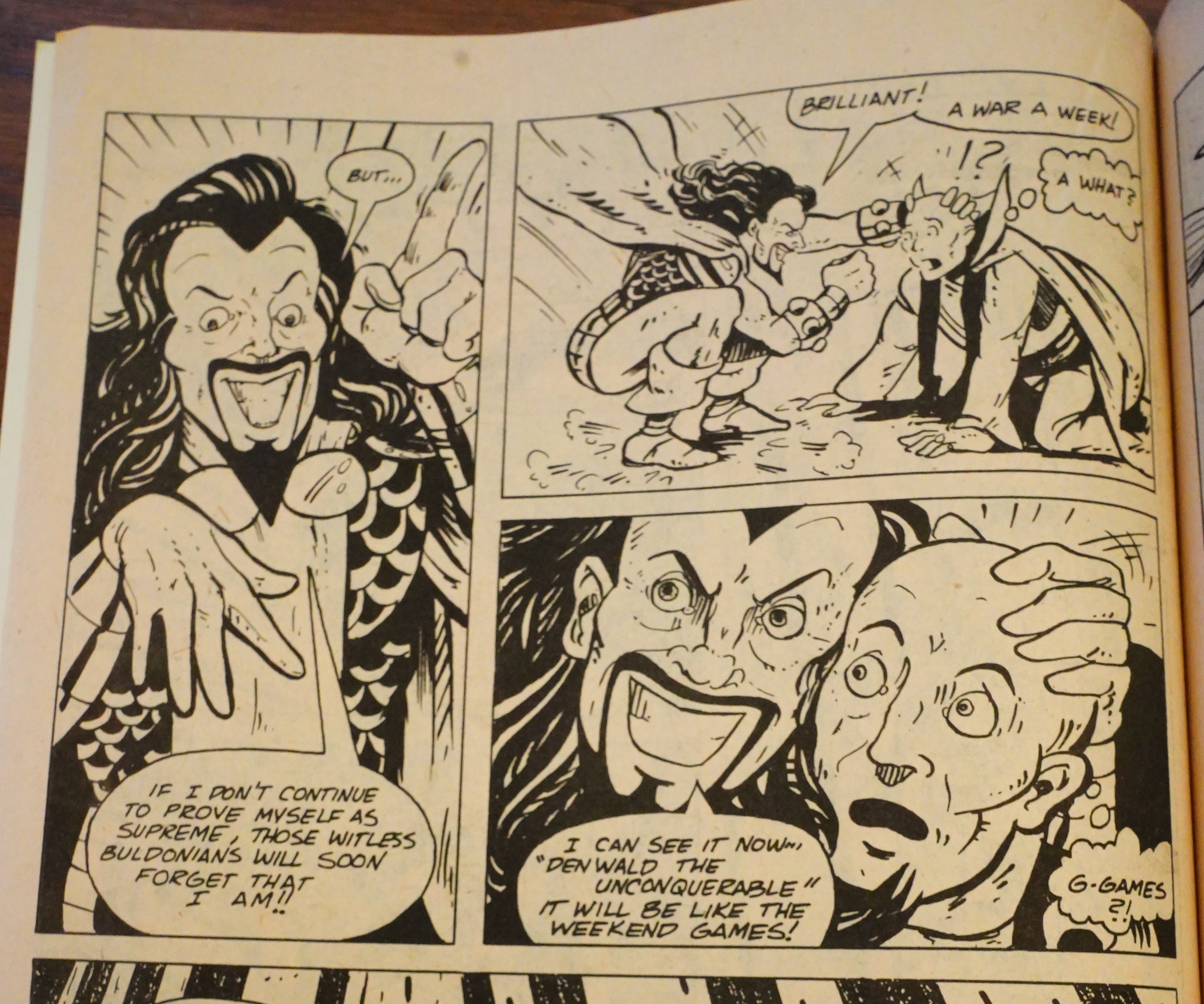
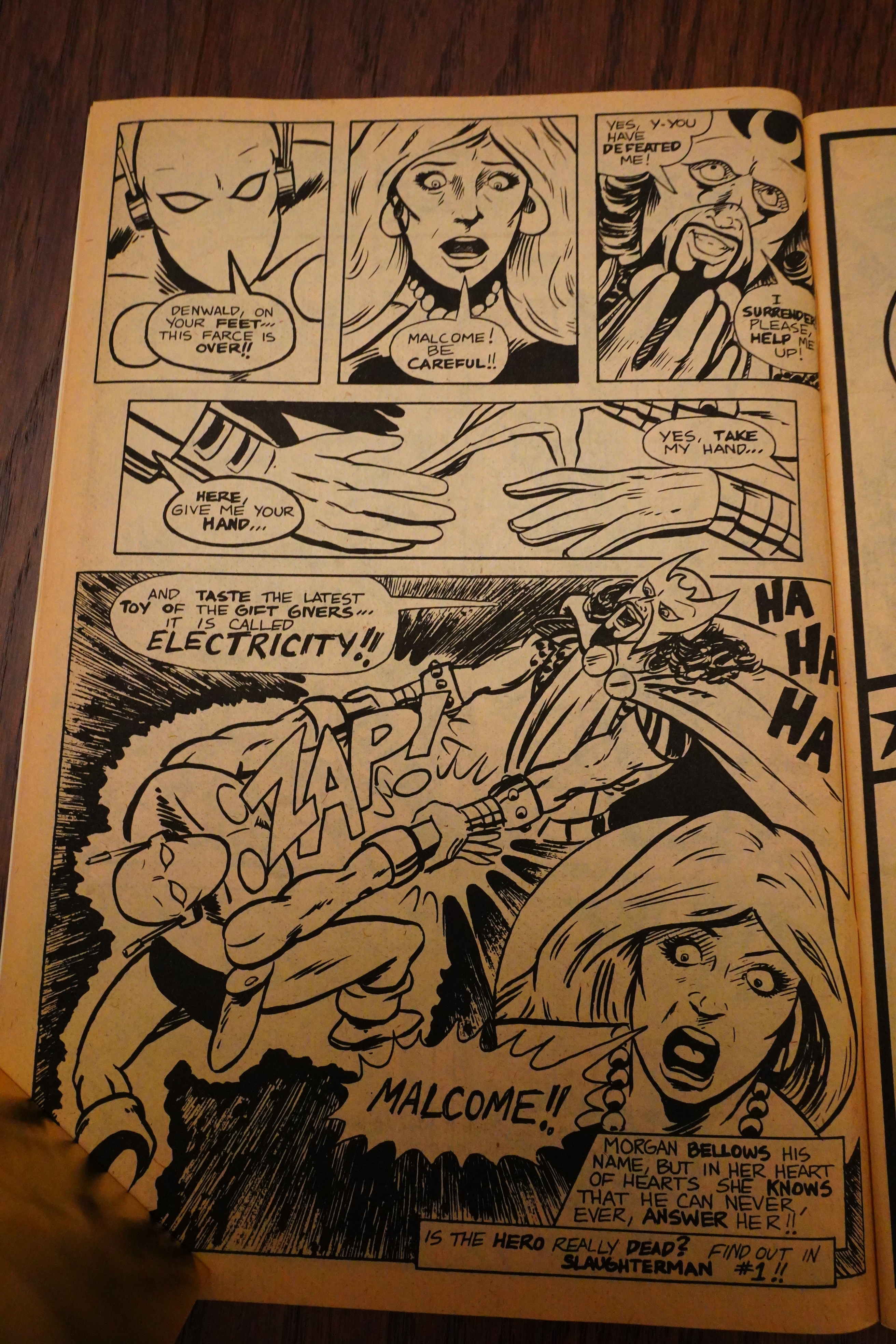
We pick up from where we left off. The piece in Primer #1 ended with Slaughterman apparently being killed — a traditional cliffhanger ending. But then it turns out that he’s really dead after all!

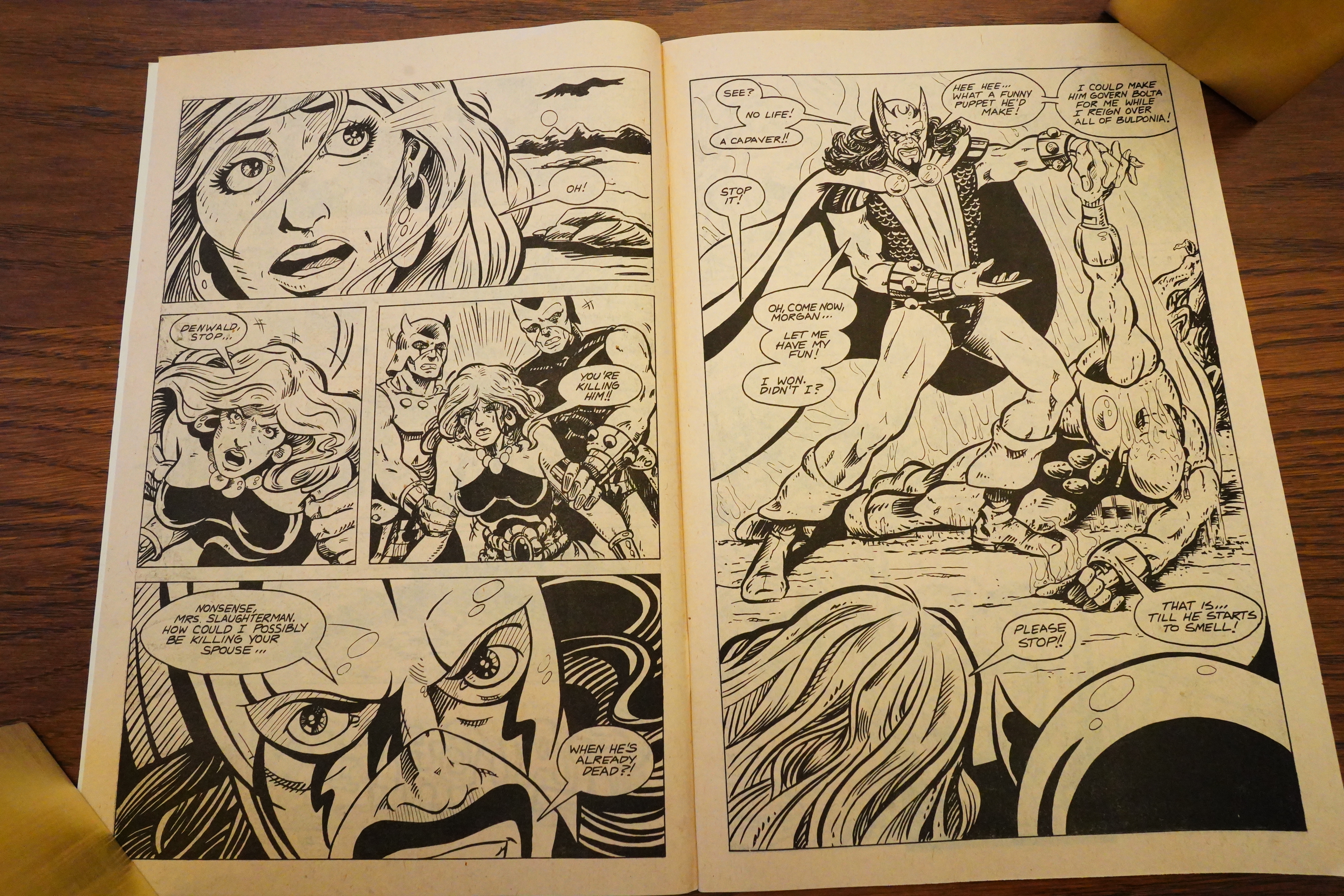
Well, that’s certainly an original way to open a series — with the protagonist dead (and with a feeling that you should have picked up Primer #1).

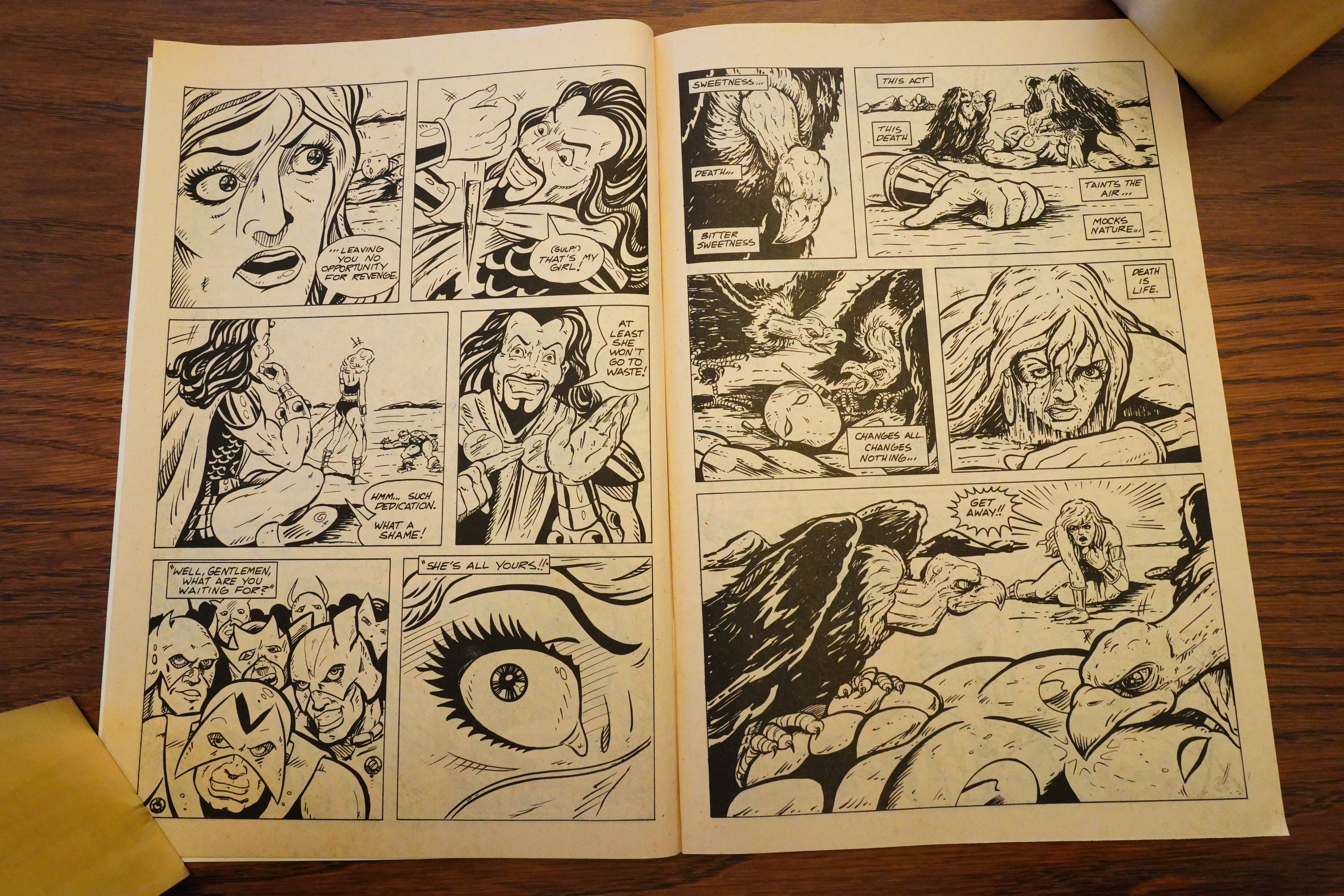
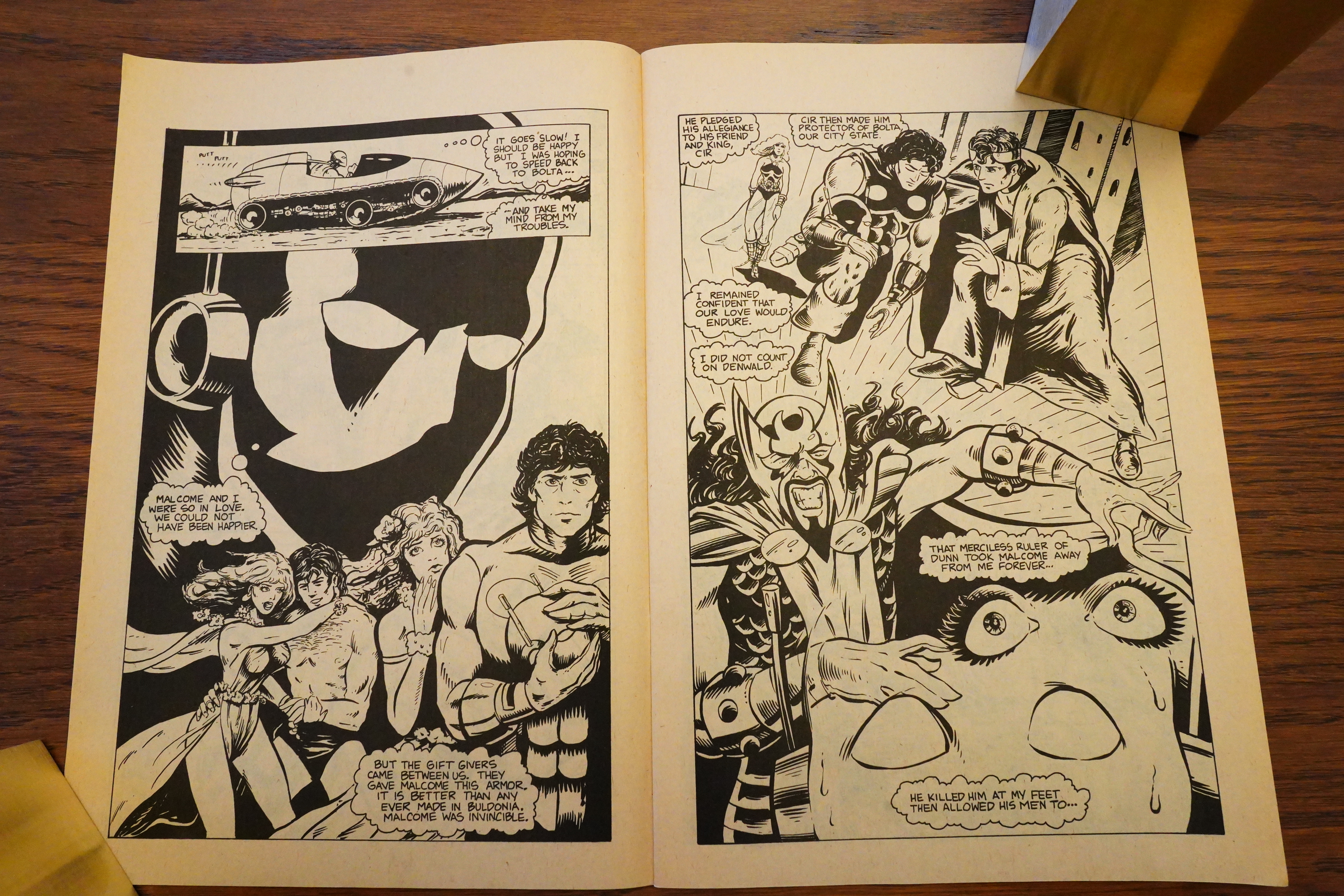
It’s pretty jarring — the bad guy is appropriately cartoonishly evil, but when you couple that with a gang rape, it’s a bit… what’s the word I’m looking for… disgusting?

OK, the setting is on a primitive-ish planet, but there’s mysterious aliens (perhaps) that are dropping weapons there. To have fun, perhaps? Could be leading up to something meta?

I guess having a villain this cartoonish allows you to skip having to actually write a coherent plot.

Giovinco is pretty ambitious, really — he tries lots of different storytelling approaches, and I have to say that it’s pretty successful on that level.

But it doesn’t really seem to be going anywhere? So we get lots of flashbacks instead.

And of course a whole lot of fighting.

But it seems like the status quo that Giovinco is aiming for is that Slaughterman’s wife is the new Slaughterman, but she has to hide who she is because… er… probably patriarchal reasons.

So you have a medieval setting, with sci fi weapons, and a mad evil villain, concealed identities, and possible humour from gender swapping, and… it’s not a bad setup, really? There’s certainly lots of possibilities for carrying on. Up the Khyber.

But are these two issues good? No, not really. But they’re better than I thought they’d be. Especially the artwork. How old was the artist at this point? 23? Well, OK.

The series ends the traditional way indie comics series end: With an announcement of the next issue, soon to follow.

Comics Interview #5, page #15:

PHIL: You did that in THE COMIC
BUYER’S GUIDE. Gerry sent a press
release to tell them about the upcoming
issues of SLAUGHTERMAN, SKROG,
AZ and GRENDEL. The press release
even revealed the surprise ending of
SLAUGHTERMAN. I said, “Gerry,
you shouldn’t do that.” He said, “Oh,
they won’t print that.” (Laughter.) But
we got a big response from California,
when it came out that Slaughterman was
a transvestite superhero, so that was neat.

[…]

DAK: What struck me as unusual was
killing the title character in the first issue
of SLAUGHTERMAN.
PHIL: People are often put off by the
unusual quality of our books, but just as
often that offbeat quality grabs ’em. A
friend of ours, Reggie Buyers, a fan and
an artist, told us this story: He was in Fat
Jack’s Comic Store in Philidelphia, and a
kid comes in and picks up AZ #1. He
says, “What is this crap? And he starts
cutting it up – verbally, that is. He flips
through it and says, “Who would buy
this?” Then he keeps looking through it,
all the way to the end – and buys it! It’s
funny, but it happens. I think if people
pick up the books, read them, and find we
have something special to say, we’re
going to catch them. I know it!

The Comics Journal #75, page #19:

Az, Morgan Slaughterman, and
Skrog: Another independent
comic book company aiming at
eventual four-color, nationally
distributed publication is
Comico of Norristown, PA. The
partners behind Comico (Gerry
Giovinco, Phil Lasorda, Bill
Cucinotta) have put together a
promotion package featuring
their characters Az, Morgan
Slaughterman, Mr. Justice, and
Skrog, and are trying to line up
support from distributors.
Further information on their
plans can be obtained by writing
Comico, 1547 Dekalb Street,
Morristown PA 19401.

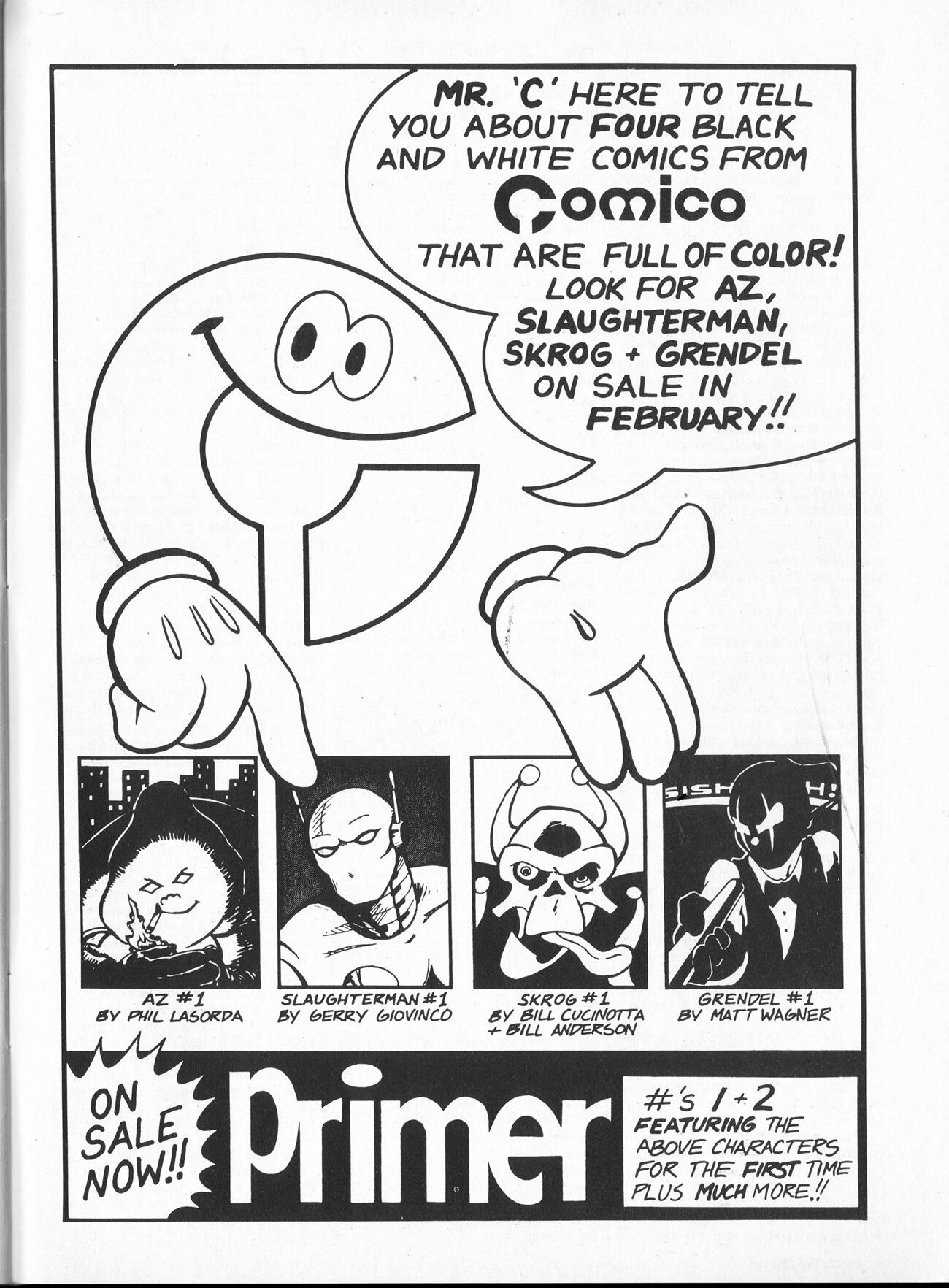
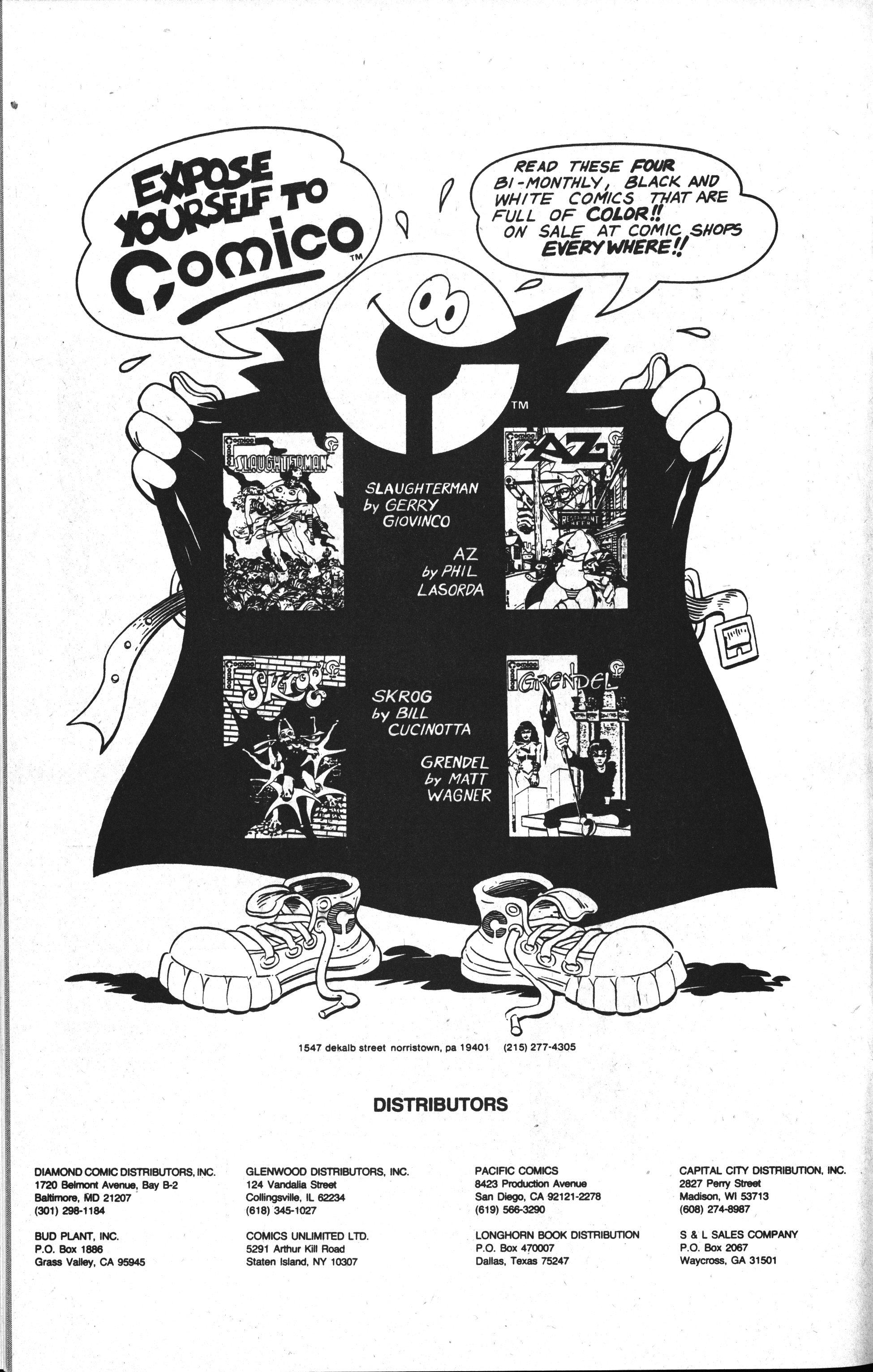
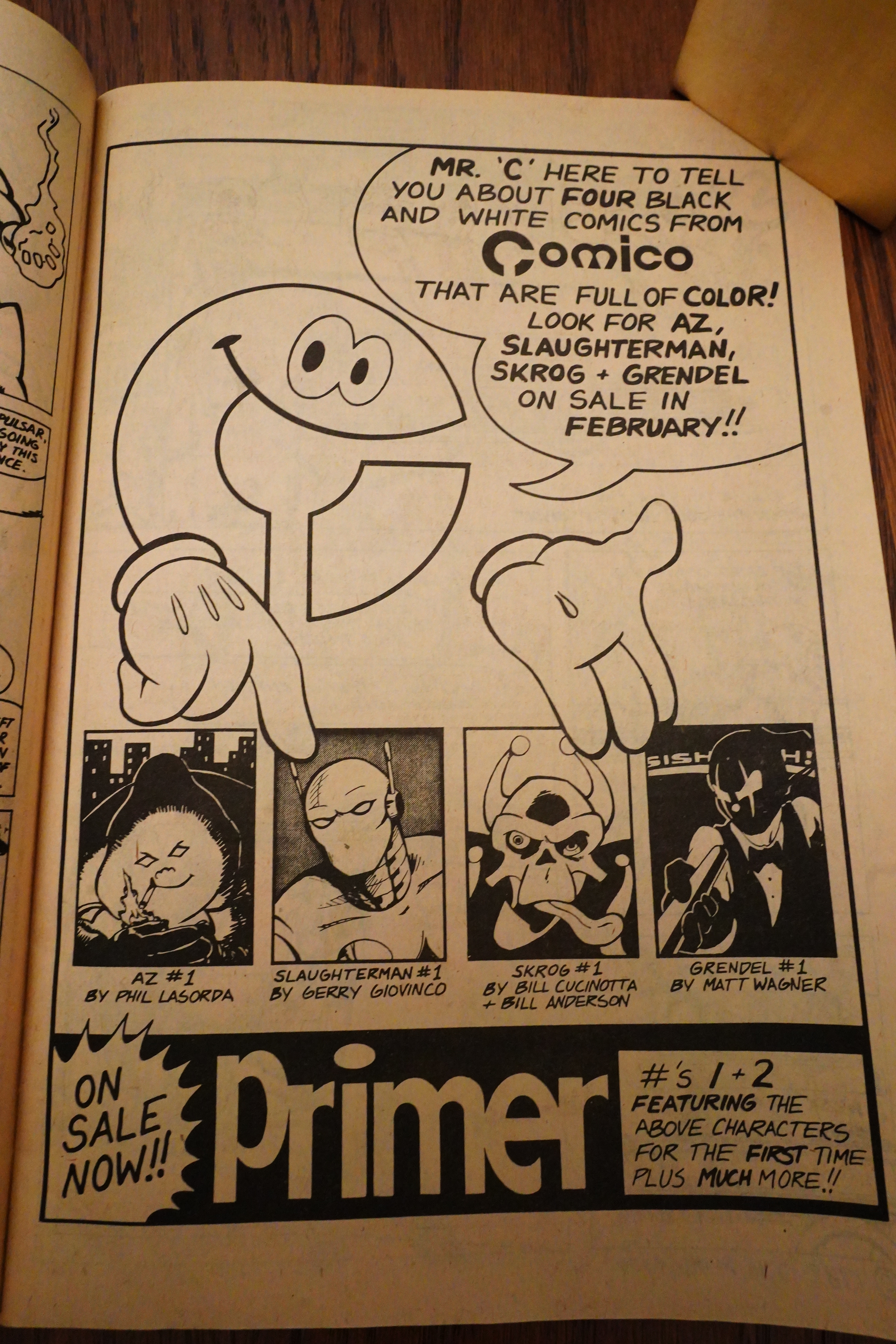
Reading interviews with the Comico guys, one thing they emphasise is how important it is to get the word out. So there’s an unusual amount of ads for early Comico issues to be found in the comics press, like this from Comics Scene.

Comics Interview #5, page #8:

GERRY: My character, Slaughterman,
is the so-called “first transvestite super-
hero.” Personally, I am not a transvestite
-(in a high-pitched voice) really. But I
try to put myself in all the different
characters. With me it is sort of a challenge.
SLAUGHTERMAN is more about social
relationships, religions, religious ideals,
things like that, and I try to incorporate
my ideas about them into the strip, using
the character. SLAUGHTERMAN is a
little straight-jacketed by the comics for-
mat – all our characters really go beyond
that. My character is unusual, because it
is a woman in a man’s suit of armor!

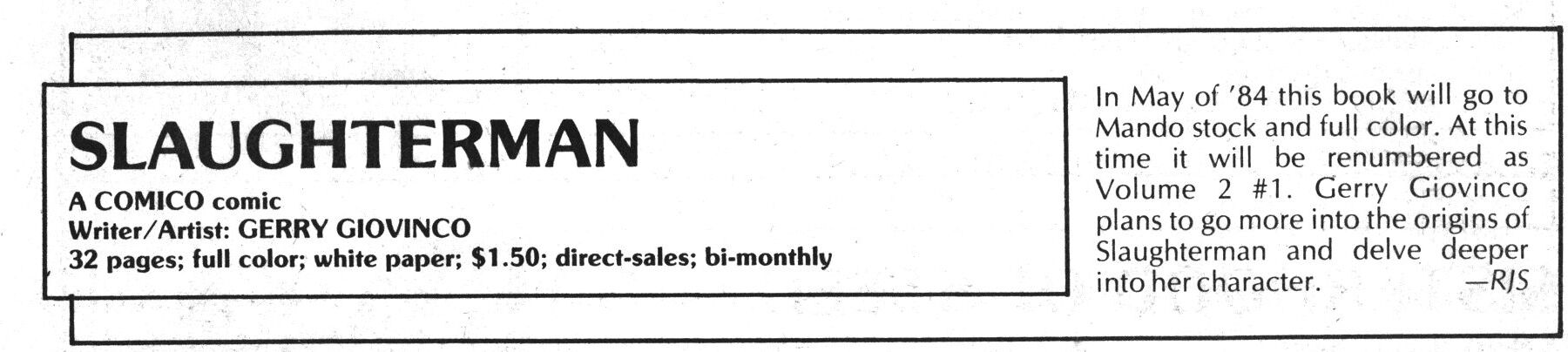
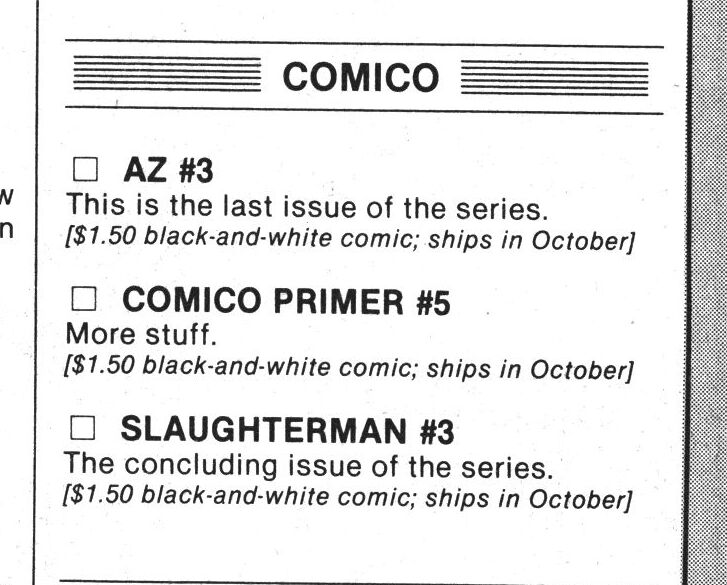
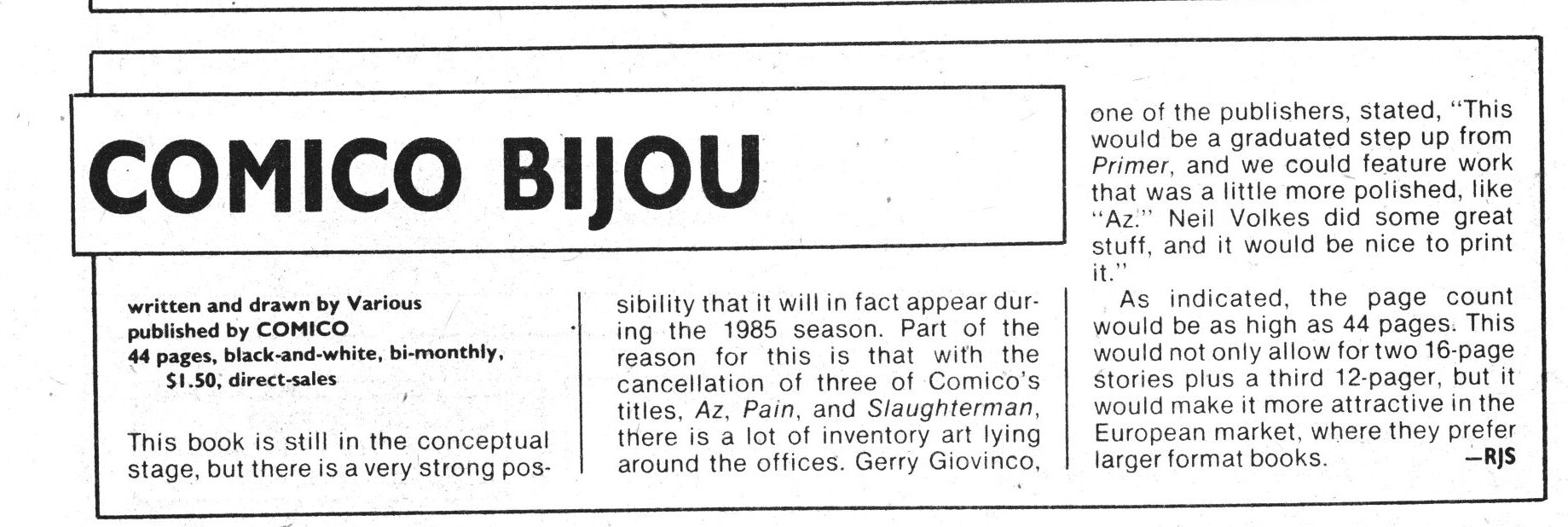
Amazing Heroes previews — this didn’t happen. When Comico switched to publishing colour comics, they planned on transitioning all their comics — Slaughterman, Az, Skrog — to colour. Instead they just cancelled them all.

Comico started as a way for these guys to publish their own comics, and they did that for about a year — and then they stopped, and instead concentrated on publishing other people. I guess it’s kinda what happened with Denis Kitchen and Kitchen Sink?

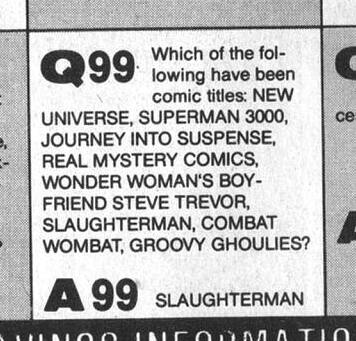
From a Comics Interview quiz…

Comics Interview #5, page #13:

PHIL: The next two books we had plan-
ned were SLAUGHTERMAN and TALE
FEATHERS — we were into a big duck
thing — which was also going to feature
AZ and SKROG.
GERRY: But then we decided, “What
the heck! If one book can make money for
us, we could sell four books and make
four times the money!” We had Dennis
supporting us, so we could put four books
out and make the money back. Which
was the best thing we ever did, because
PRIMER barely met costs, but when we
put out SLAUGHTERMAN, SKROG,
AZ and GRENDEL, sales of each were
four times the sales of the PRIMER.
PHIL: It shocked us. It really did.
GERRY: The books paid for themeslves,
and then we made that much on top of it,
so we were really very happy with them.
We figure, if we are doing all right in black
and white, we will do even better in color.
Capital Comics’ sales jumped consider-
ably when they went from black-and-
white to color.

Yeah, comics anthologies never sell much in the US.

Well, that’s a slogan!

The Comics Buyer’s Guide #498, page #52:

Comico has released the first
issues of Az and Slaughterman.
I understand Slaughterman is
selling fairly well in at least some
stores. That seems just, since
Slaughterman is the better of
the two. Az is too confusing in its
storyline and too difficult to get
into, Slaughterman is more
direct and coherent. The
artwork in both leaves a great
deal to be desired but there are
indications that there is raw tal-
ent underneath the crudities
waiting to be developed. I can’t
recommend these out of hand,
but I do suggest you look them
over; they are not without possi-
bilities. And there will be color
in future issues, I’m told.

Comics Interview #5, page #9:

DAK: What if one character becomes
ultra-popular, or if a character is very
unpopular?
GERRY: That is a real big question. We
are thinking in terms of flexibility. As
mentioned, GRENDEL is not going to
last forever. I know that Matt already has
another character planned. I don’t want
SLAUGHTERMAN to last forever, either.
My book is pretty well projected, though
– it is going to be out there for a couple of
years, if it is successful. And I think our
characters are loose enough to last as long
as we want and, if they are unsuccessful,
hopefully we are creative enough to come
back with something else.

Amazing Heroes #47, page #18:

GONE: Comico’s Slaughterman has been
cancelled. Additionally, the new Comico titles
Az, Skrog, Armageddon Warriors, and Pain
have all been delayed, although the material
intended for Skrog will be showing up in an
early issue of Comico’s Primer anthology
comic.

Oh, that’s the first I’ve heard of Armageddon Warriors and Pain, and it’s a notice that they’ve been cancelled.

Back Issue #2, page #37:

ME: Matt, in your earlier
work, before Diana, was
there an editor?
MW: Uh-uh. Nope. I guess
Gerry Giovinco ostensibly
gave it a shot. The whole
set-up in the early days of
Comico was that we all did
our own books, the four
books. Skrog, Az, Slaughterman,
and Grendel. And they were all
poorly executed. They were all
the thinly disguised Ids of each
of the creators, and you were
just kind of responsible for your
own gig, you know? There was
no editor, there was nobody
correcting artwork, or anything.
DS: This was before I got there, but you got out three
issues of Grendel. And if I’m not mistaken, none of the
others got out more than one issue of their own. You’re
the only one who-
MW: I was the only one who got any response that was,
like, “I want to see more of this.” (laughs) I mean, they
were all scared and that’s why when they made the
decision to go to color, when they hired Bill Willingham
to do The Elementals for them-and as we know, gang-
printing is cheaper so they needed a second book to
print with The Elementals-I was the only one who had
any sort of positive response from any readers, so de facto,
I won the slot. And that’s how I developed Mage.

Yeah, that didn’t happen, either.

I can’t really find any proper reviews of Slaughterman — I guess there wasn’t a lot of enthusiasm.

But! I found a link to Giovinco’s blog (from 2010-2015), and it’s all on archive.org. However, there’s no index there, so I did some downloading.

Look!

1983 was our first year attending with a booth and we were quick to realize how easy it was to get lost in the vast auditorium of vendors, publishers and artists. Comico was a small black-and-white publisher at the time featuring five titles: Az by Phil LaSorda, Grendel by Matt Wagner, Slaughterman by myself, Skrog by Bill Cucinotta and our new-talent anthology, Comico Primer. We had our sites set on publishing color books and had begun to promote our intentions.

There’s tons of interesting blog posts there. I’ve scraped archive.org for the ones in the “The Comic Company” category, spent some hours massaging the data, and put the pages here. (If that’s not OK, let me know — but it’s just a cache of articles that you can also find on archive.org. It’s just easier to reference from here, because I can search the articles.)

But, as far as I can tell, he hasn’t written a lot about Slaughterman? But I may just not have found the articles: archive.org is so slow and such a chore to sift through.

Let’s see if anybody else on teh interwebs have reviewed Slaughterman…

Here’s one:

Giovinco’s pencils are hit and miss here. Some panels are brilliant, from vultures gnawing on the dead hero, to close-up images of Morgan’s teary eye as she is about to be assaulted by a barrage of brutal henchmen. Yet other panels look rushed, with underdeveloped characters and designs. Still, I see potential here and it’s a shame Giovinco did not continue drawing…but he had many other interests besides art.

Here’s Progressive Ruin:

Even if the contents of the books could be amateurish and a little crude, the cover designs (and slightly larger dimensions) were on-target and definitely stood out as something different. “These Aren’t Your Daddy’s 1980s Comics!” they almost seem to shout.

And… that seems to be it? Okidoke.

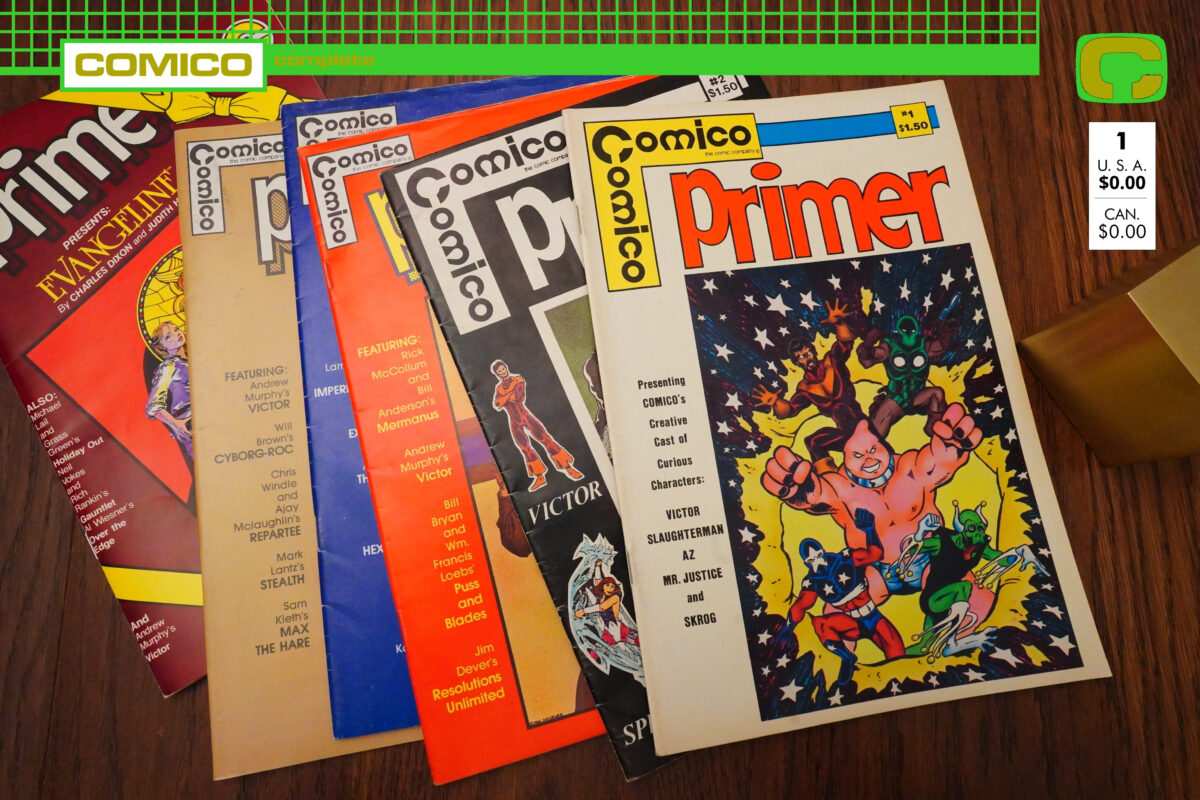
1982: Primer

Primer (1982) #1-6

*phew* First post in this blog series… let’s see if I have everything set up right… Well, the camera seems to work, anyway. I think I need better lighting? I gotta set that up…

Anyway, this is Comico’s first publication. For some reason or another, I thought it was going to be a “showcase”-style series — that is, every issue would be dedicated to one thing, and then it would be spun off into its own series (if “successful”). But it’s not! Instead it’s a normalish anthology series. Most issues are 40 pages long, but with some 32-pagers in between.
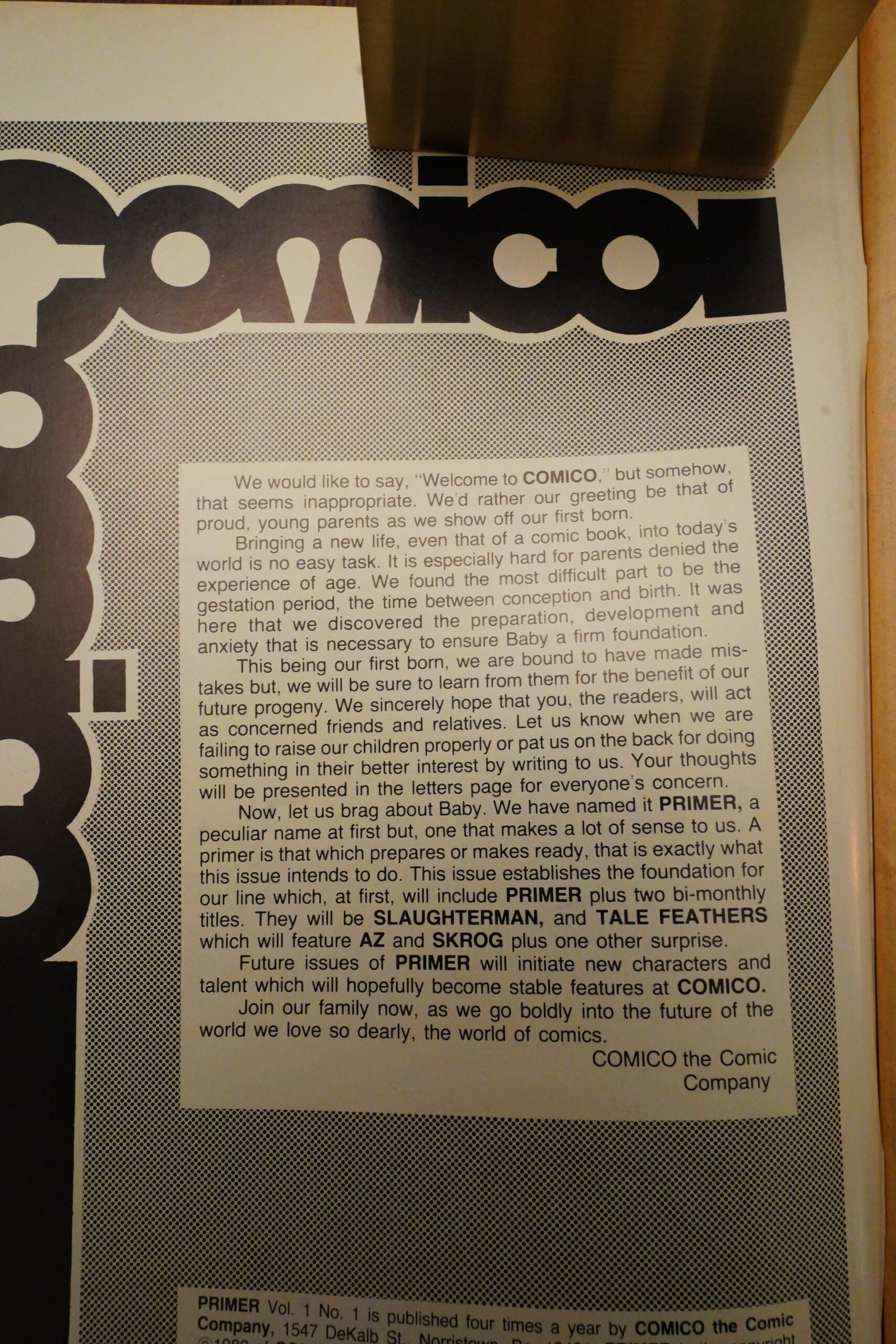
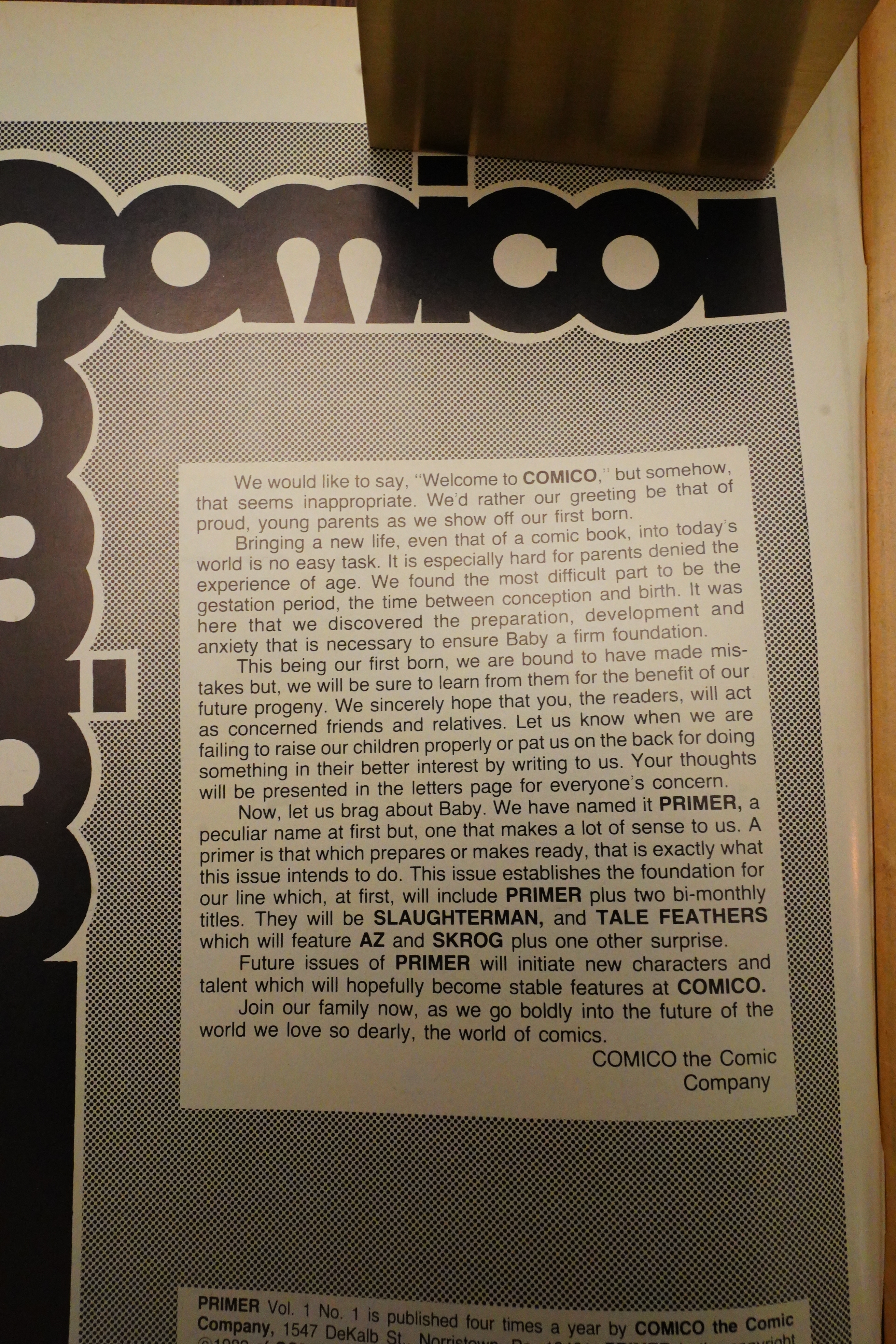
But I had the “spin-off” part right — the idea is to feature new characters, and then spin them off into own series. But already by the first series, they’ve decided to start a Slaughterman series, as well as something called Tale Feathers, featuring Az and Skrog. (Which would end up in separate series.)

Perhaps not coincidentally, the creators of Slaughterman, Az and Skrog are the same people who started Comico, so it’s kinda more of a self-publishing effort, in a way. But a stealthy one.
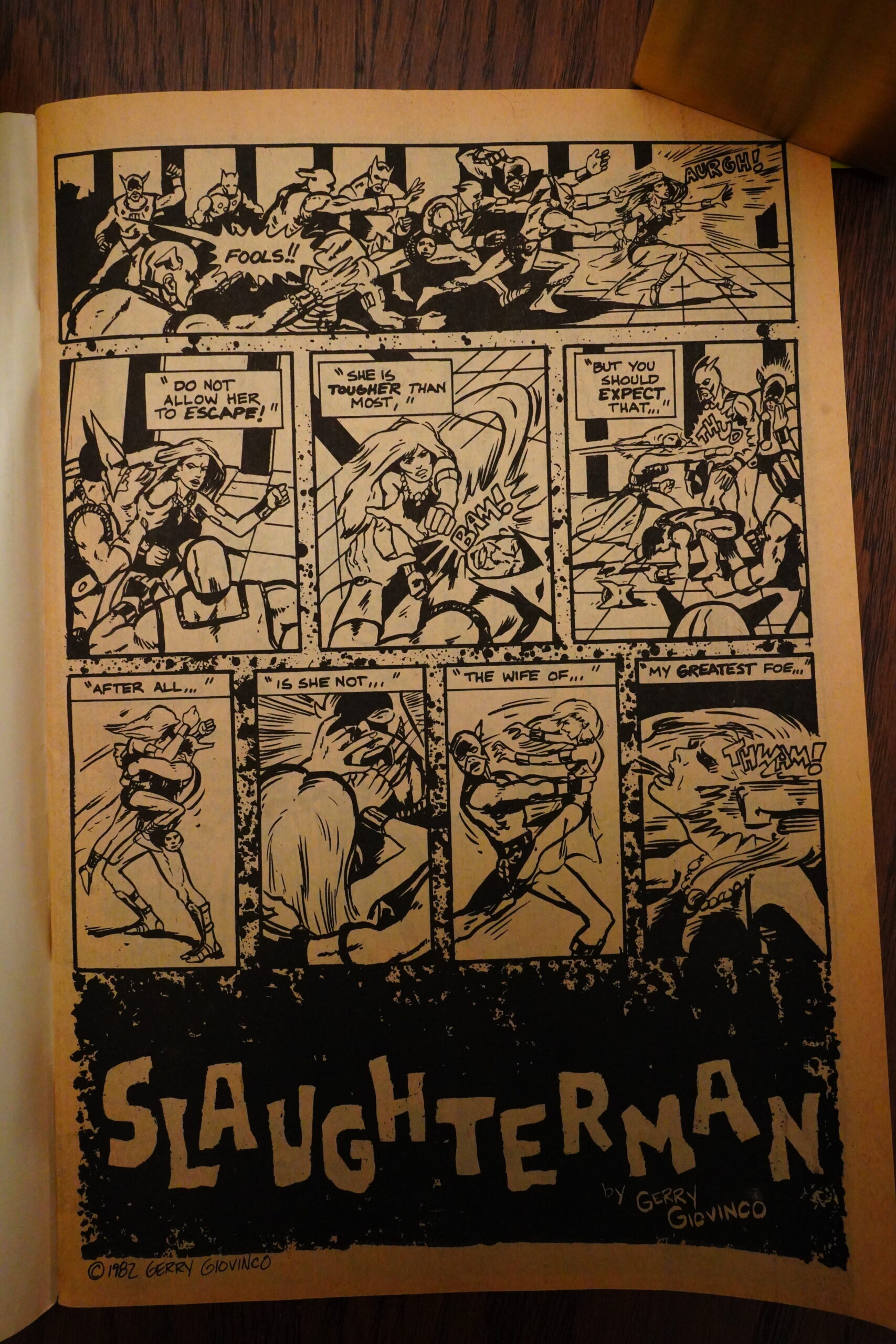
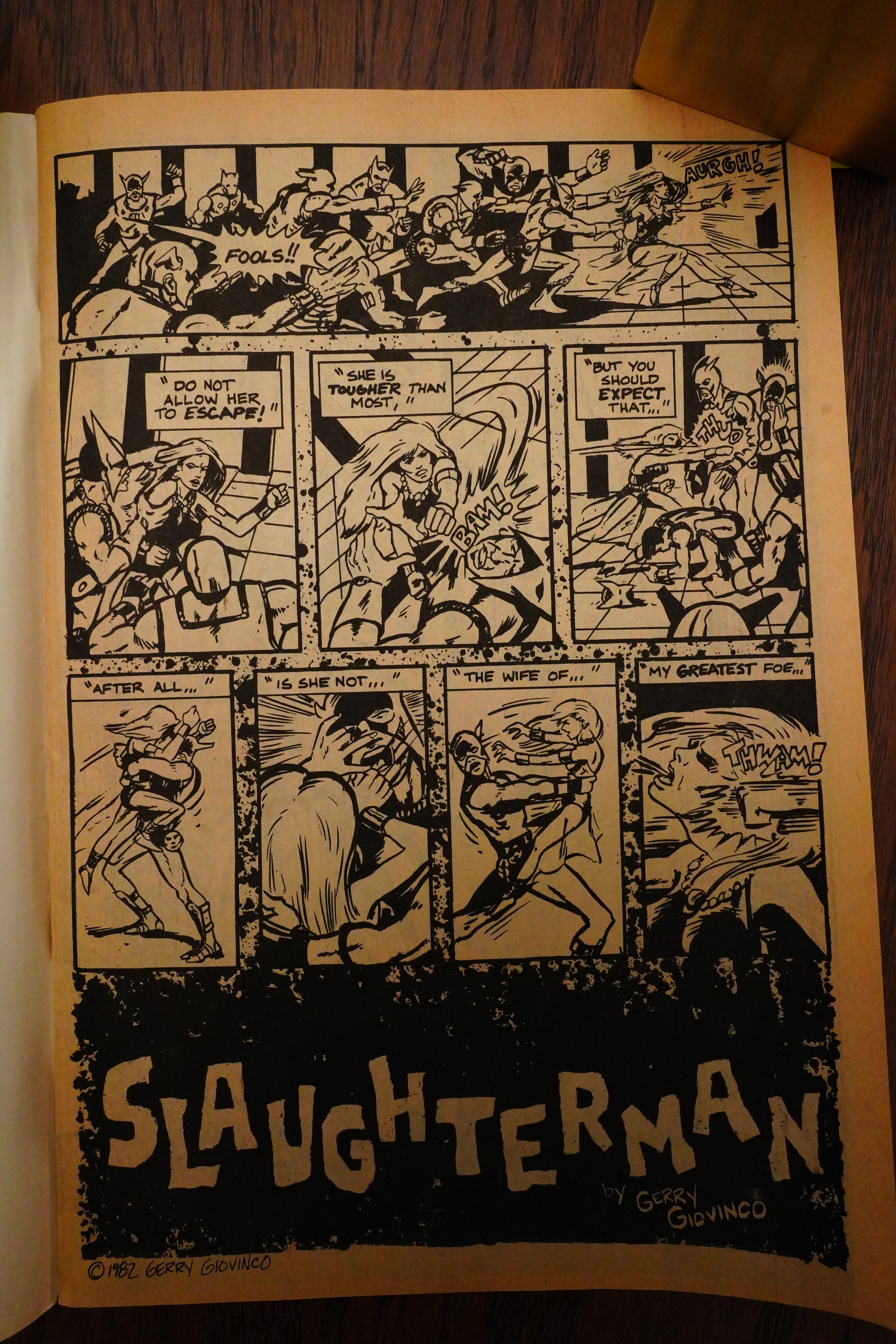
Oh deer. Gerry Grovinco’s Slaughterman looks a bit rough, eh?
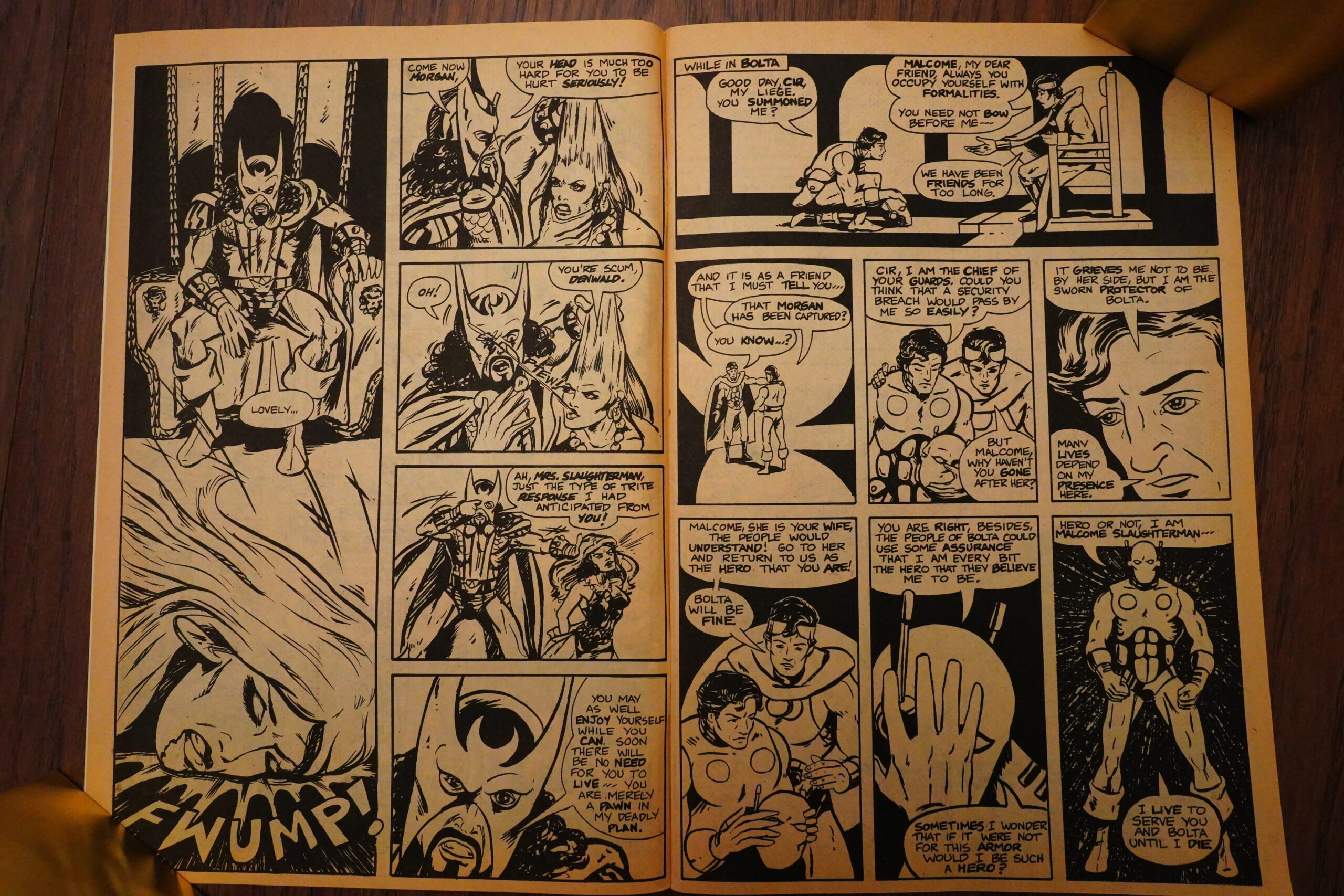
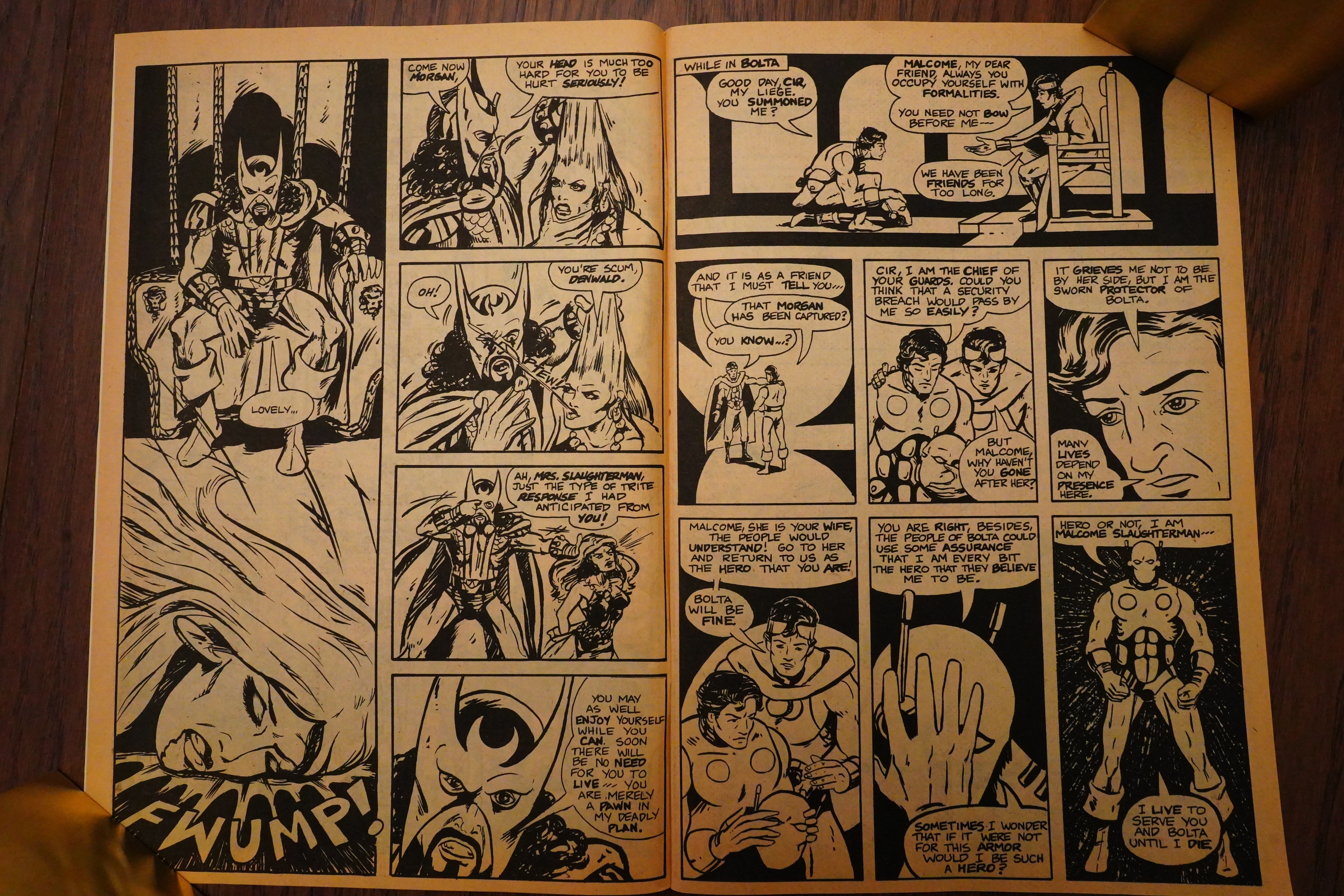
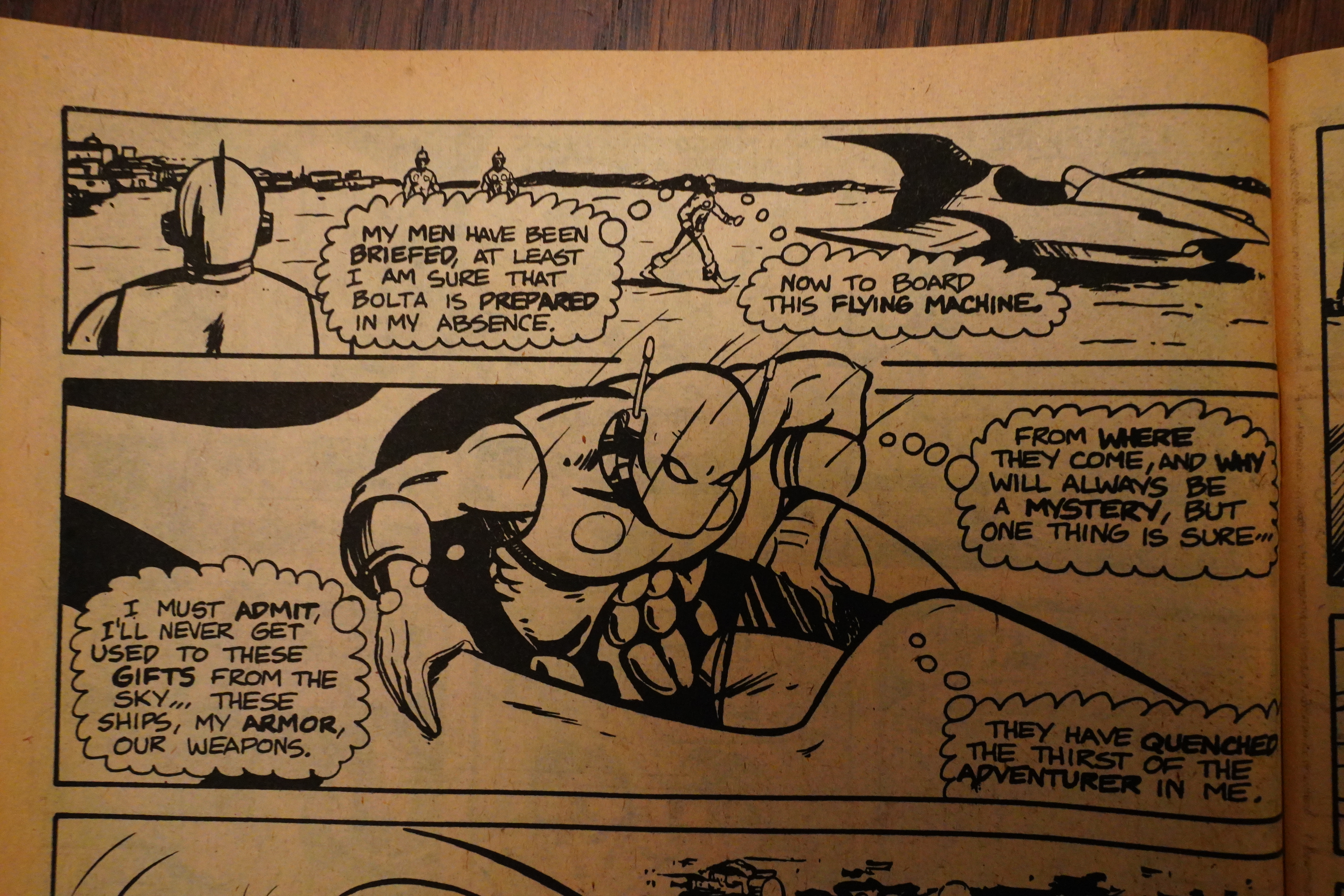
But it’s a strange mix of an apparently medieval setting coupled with super-hero tech? (The costume design is perhaps influenced by Dave Cockrum?)

Anyway, the bad guy kidnaps Mrs. Slaughterman, and fights ensue.
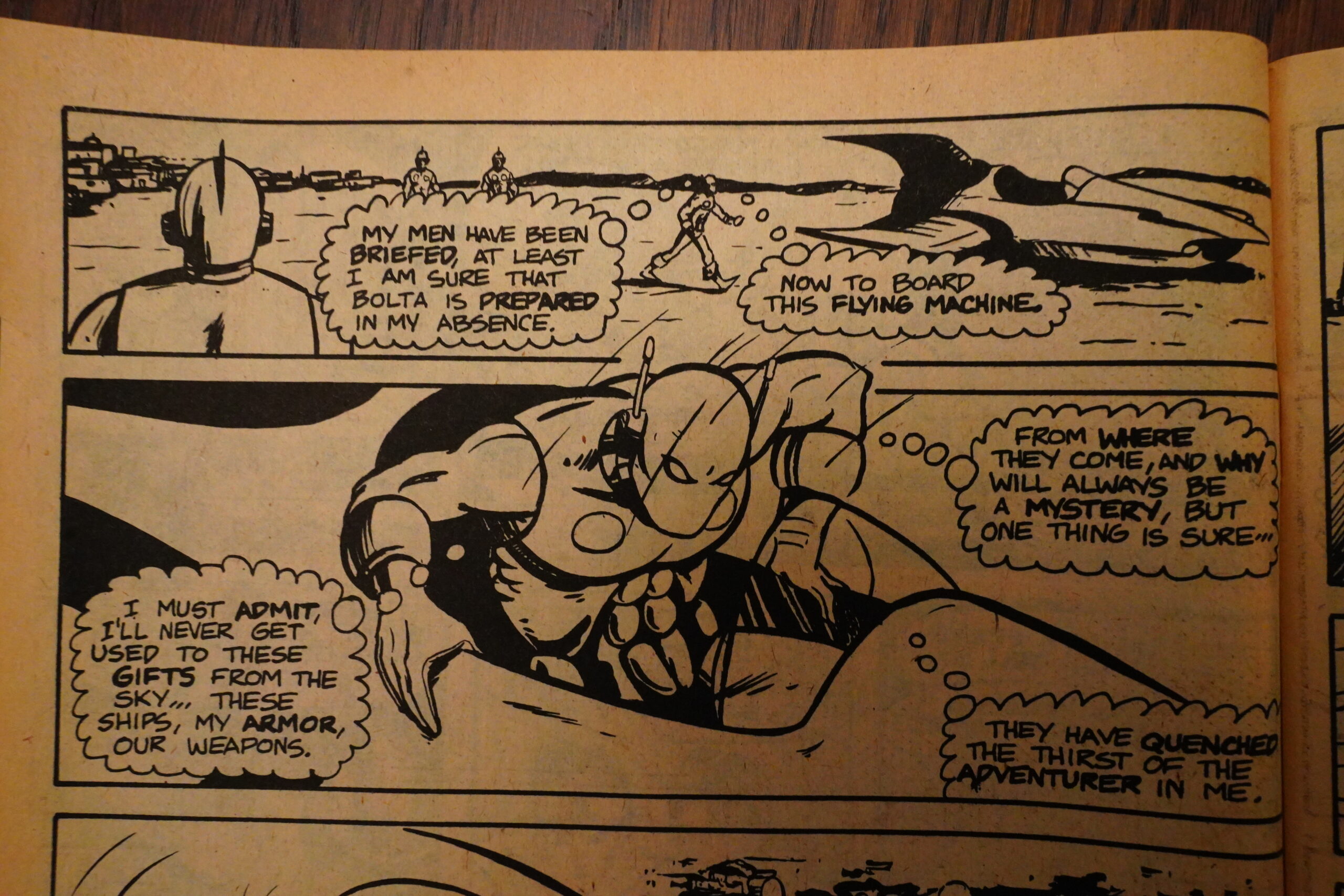
We get an explanation for the tech mix, sort of…
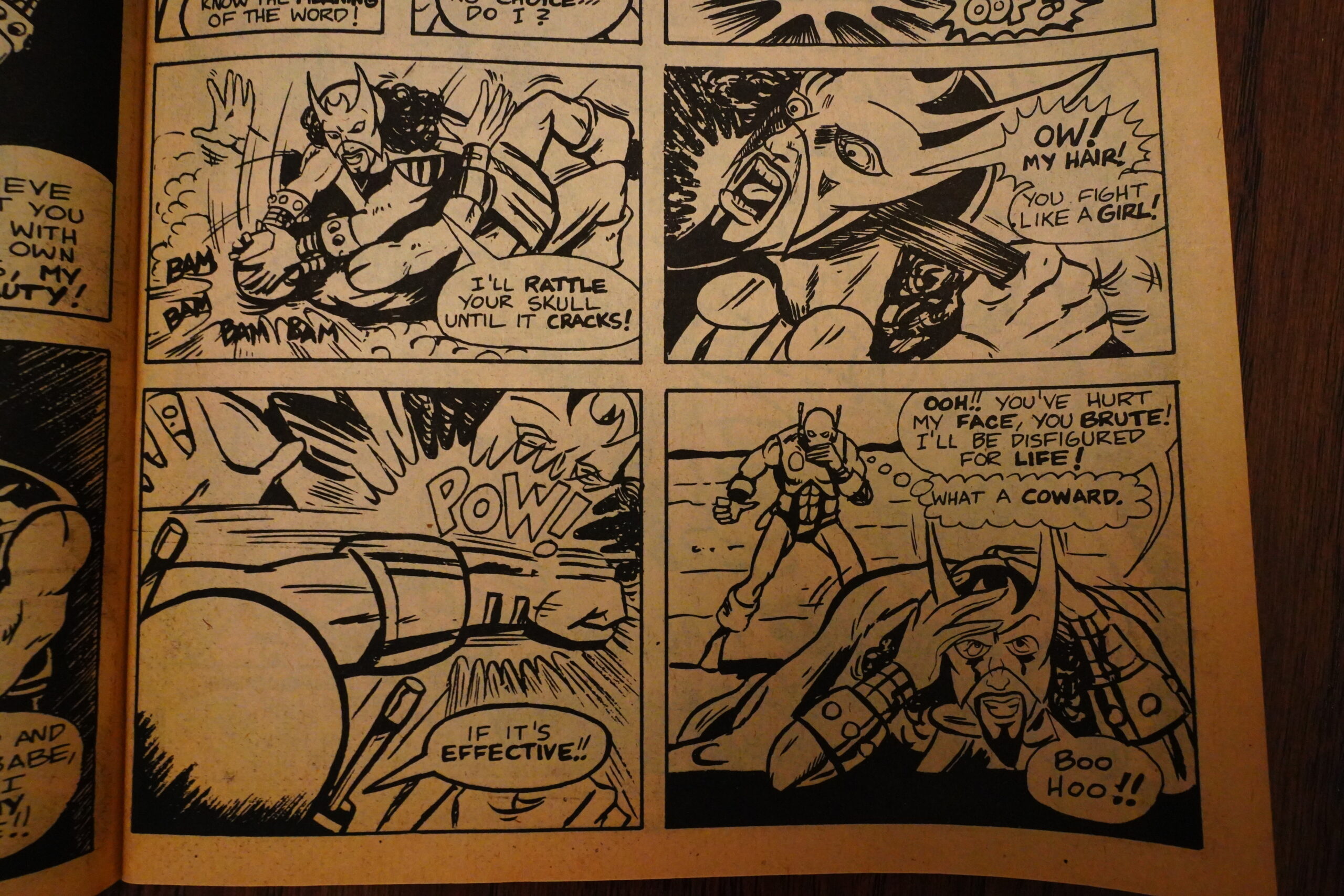
And then… suddenly it’s a humour strip?
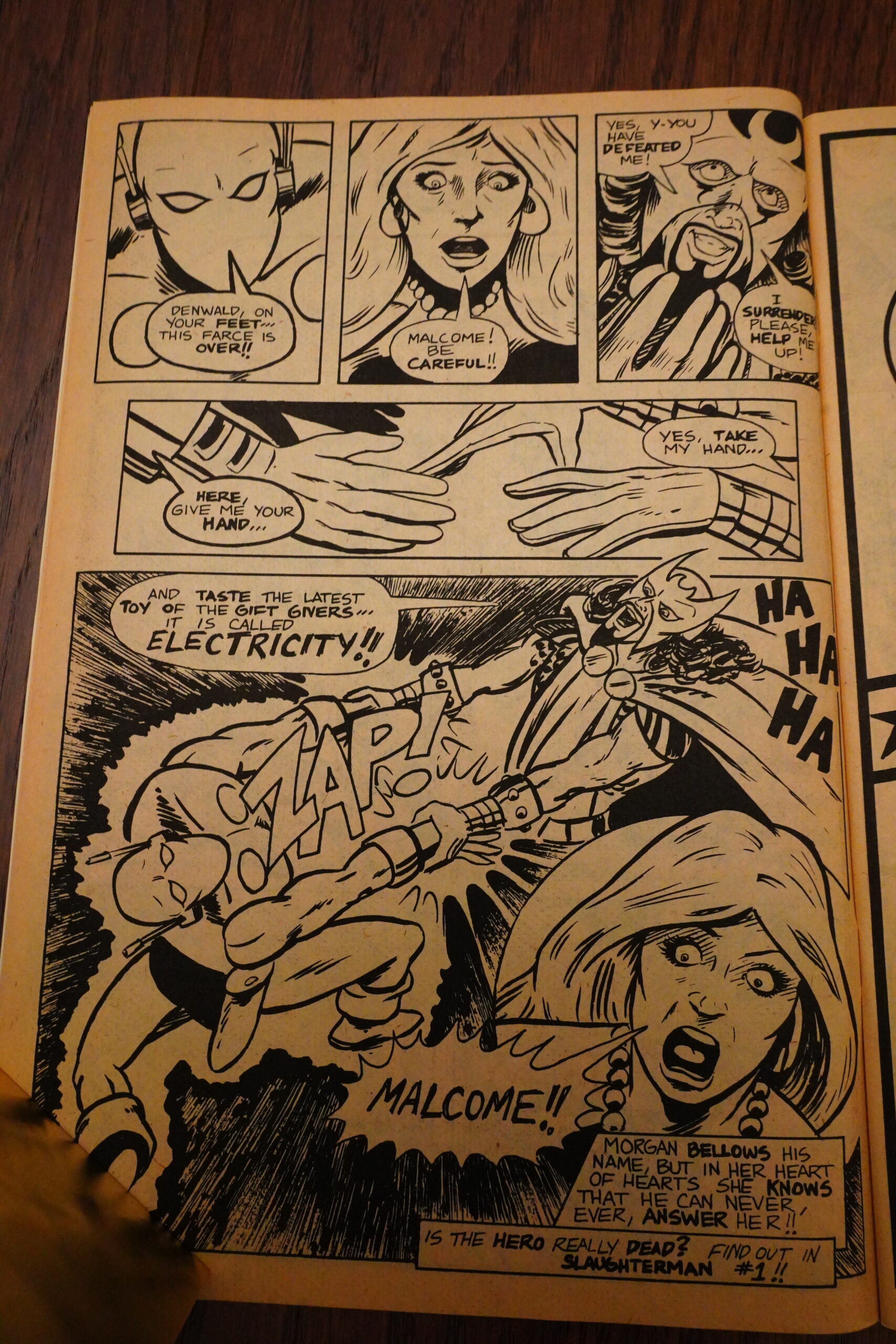
OK, so they’re leaning into the “find out in #1” thing — at least for Slaughterman.
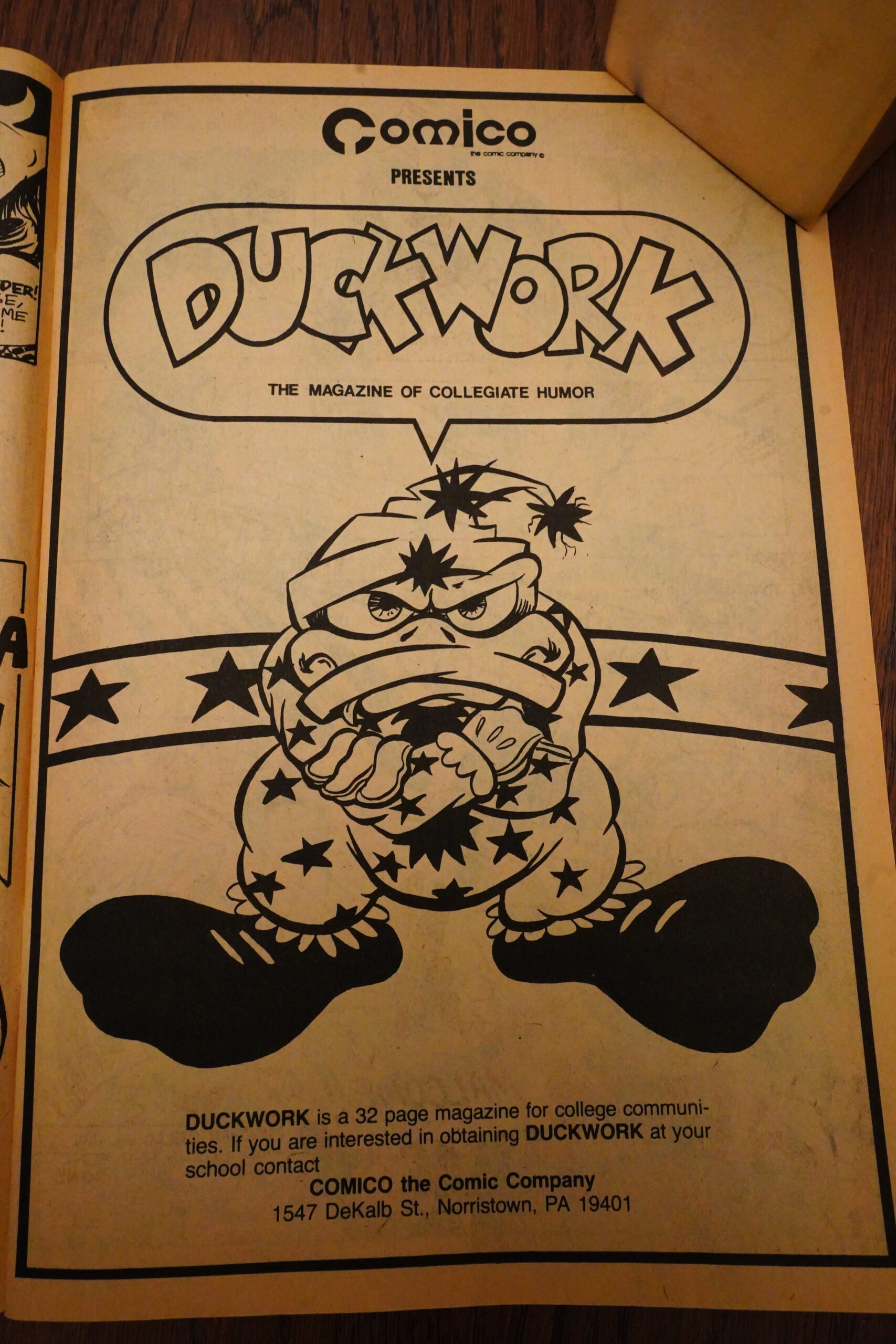
This didn’t happen, but apparently this is where many of the Comico people came from?

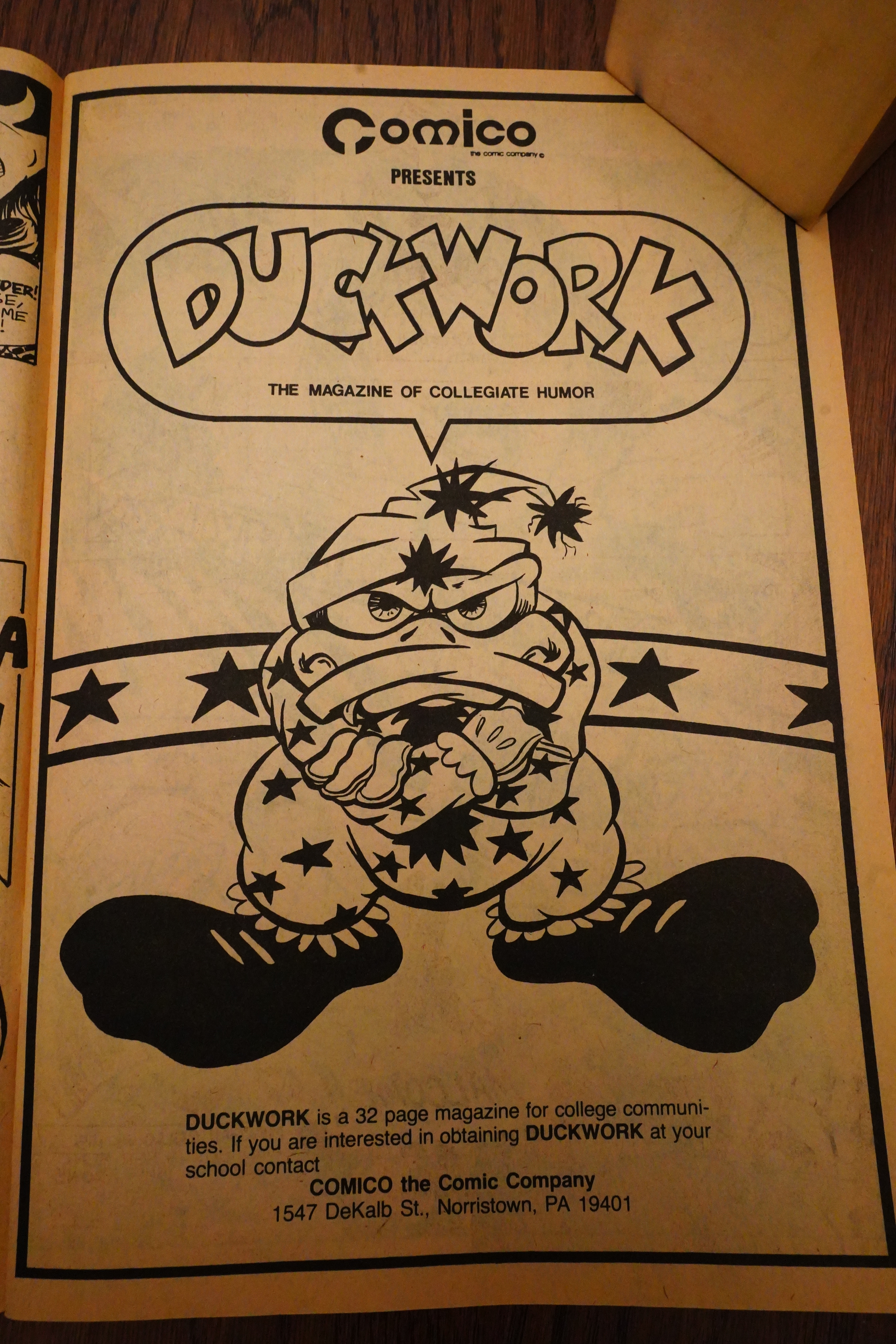
DUCKWORK was a short-lived newspaper “CREATED FOR THE PHILADELPHIA COLLEGE OF ART COMMUNITY” back in the early 1980s. It lasted a handful of issues until the school pulled the plug on the funding.
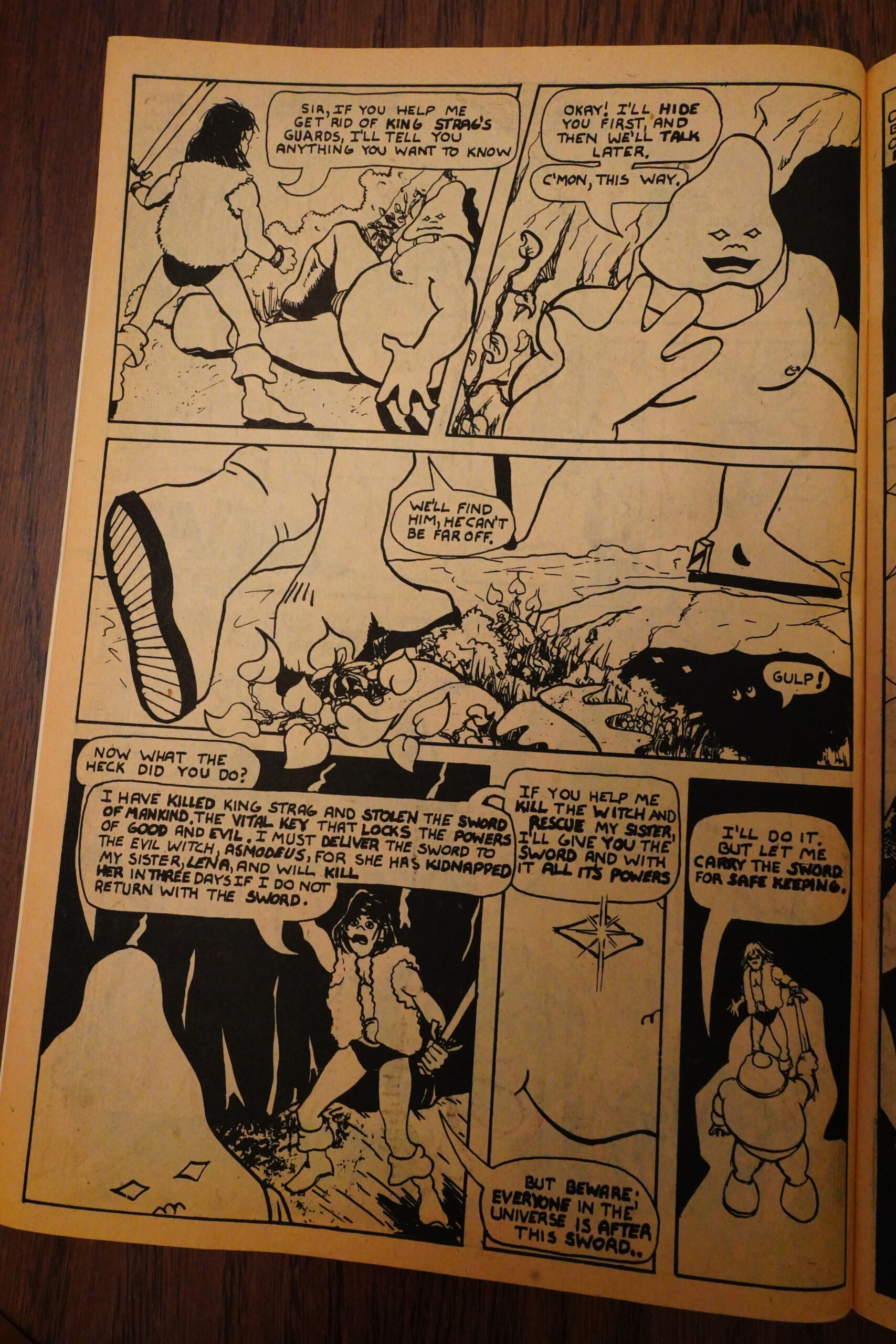
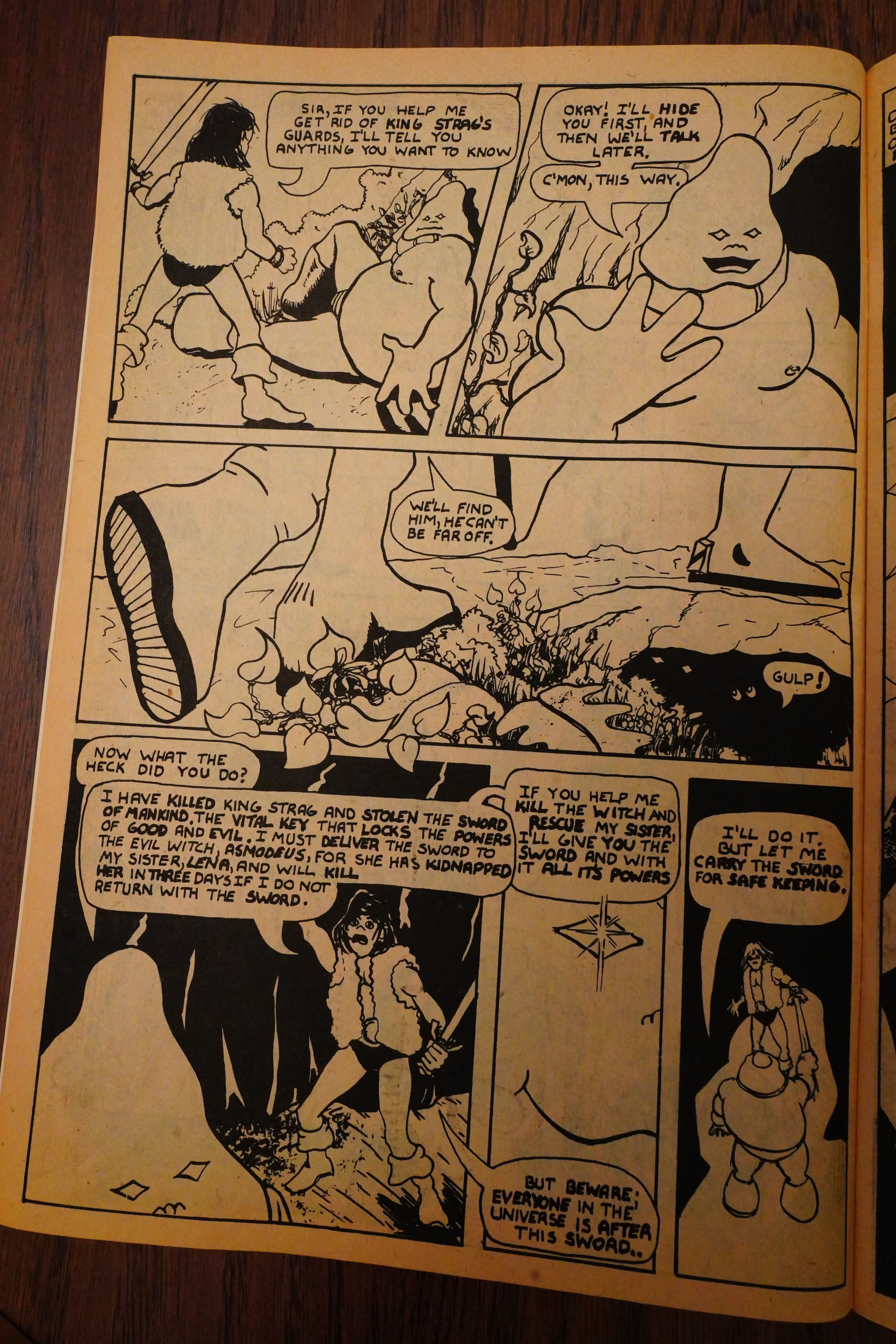
Next up, we have Az by Phil Lasorda, where… a villain has kidnapped somebody’s sister!? Is this an All Kidnapping All The Time anthology? The setting also seems similar — it’s a sword and sorcery thing with science fiction bits.
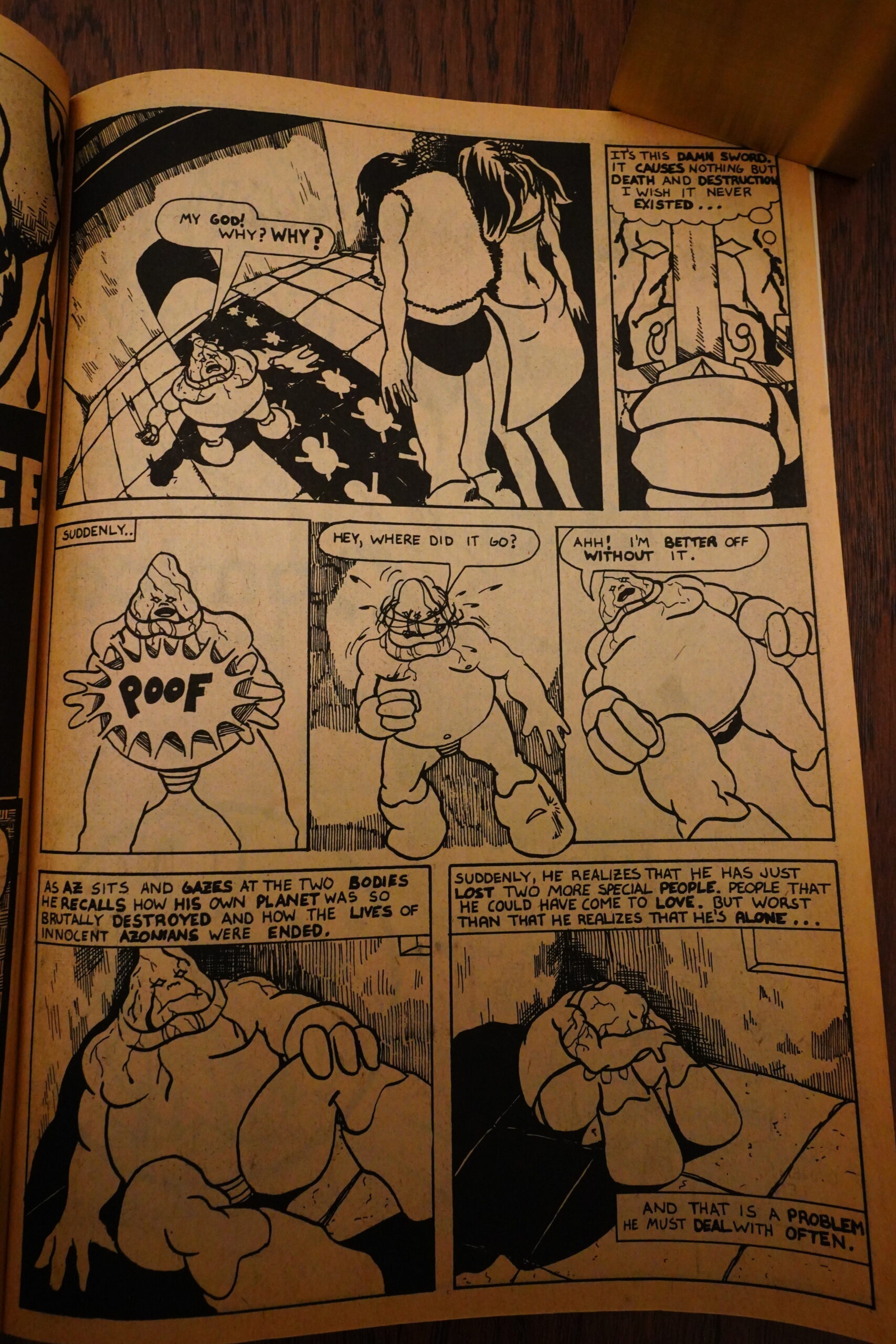
But with a twist? This is how it ends.
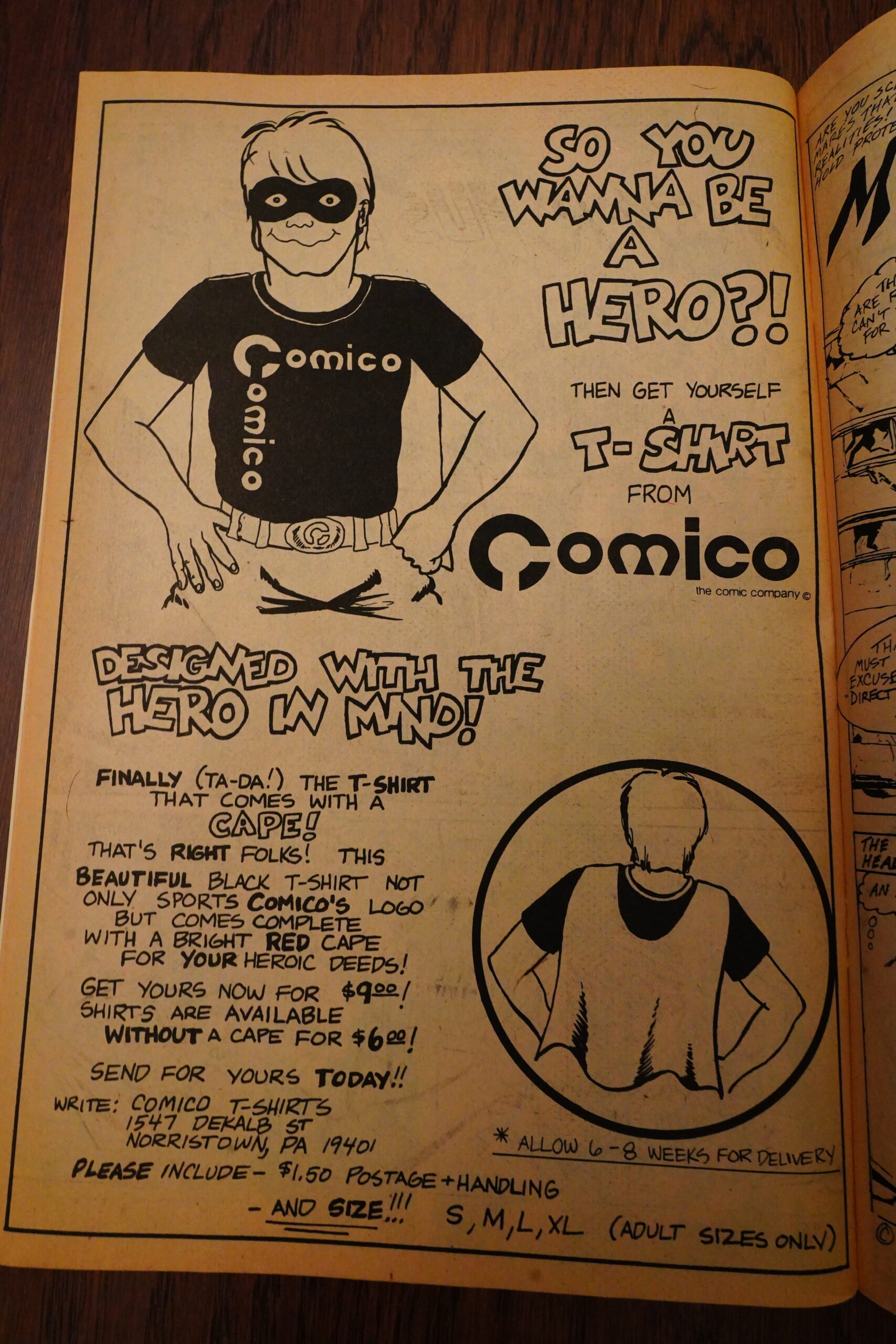
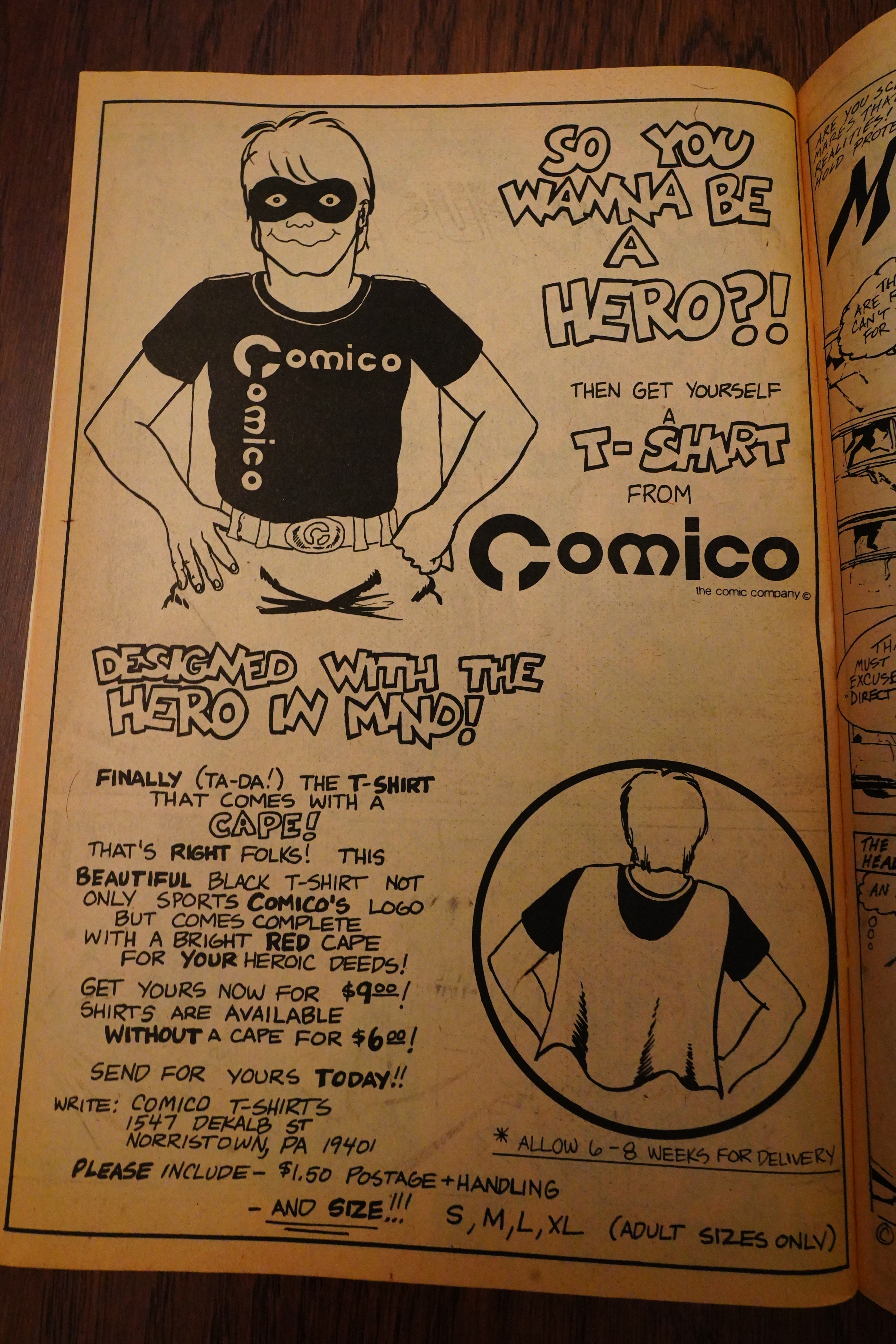
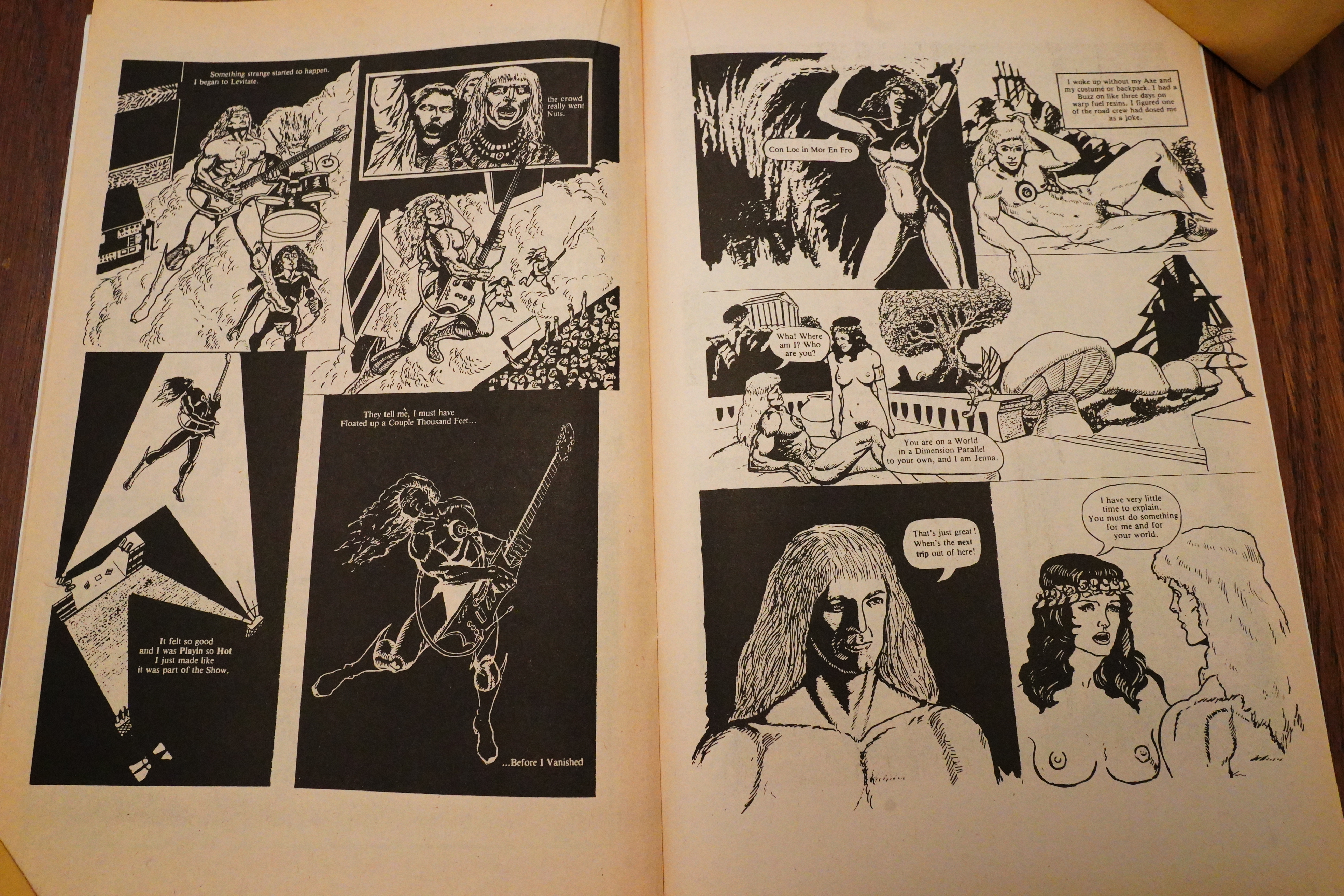
And there’s t-shirts. With a sown-on cape! Wow! I can’t tell if it’s a joke or not, though.
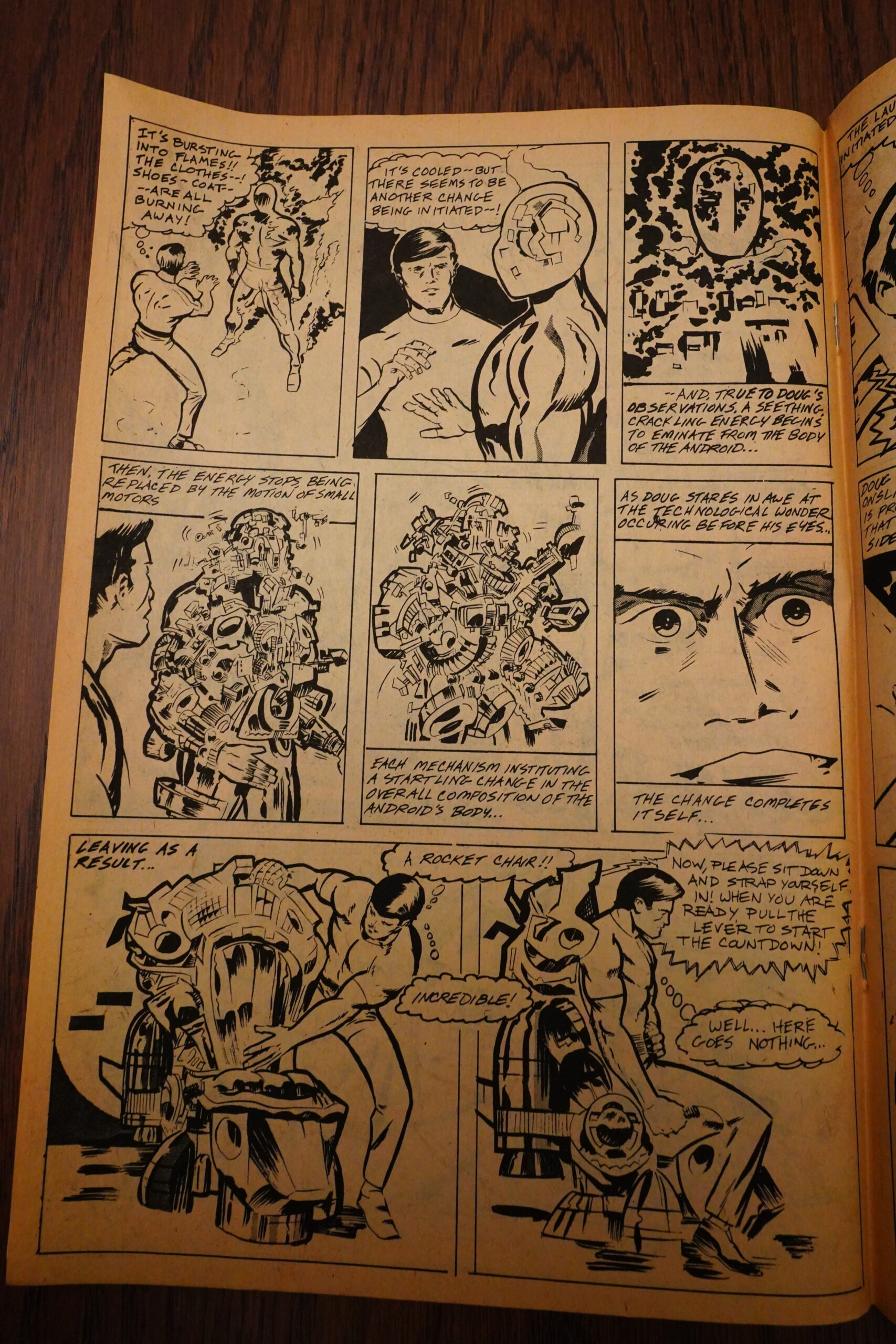
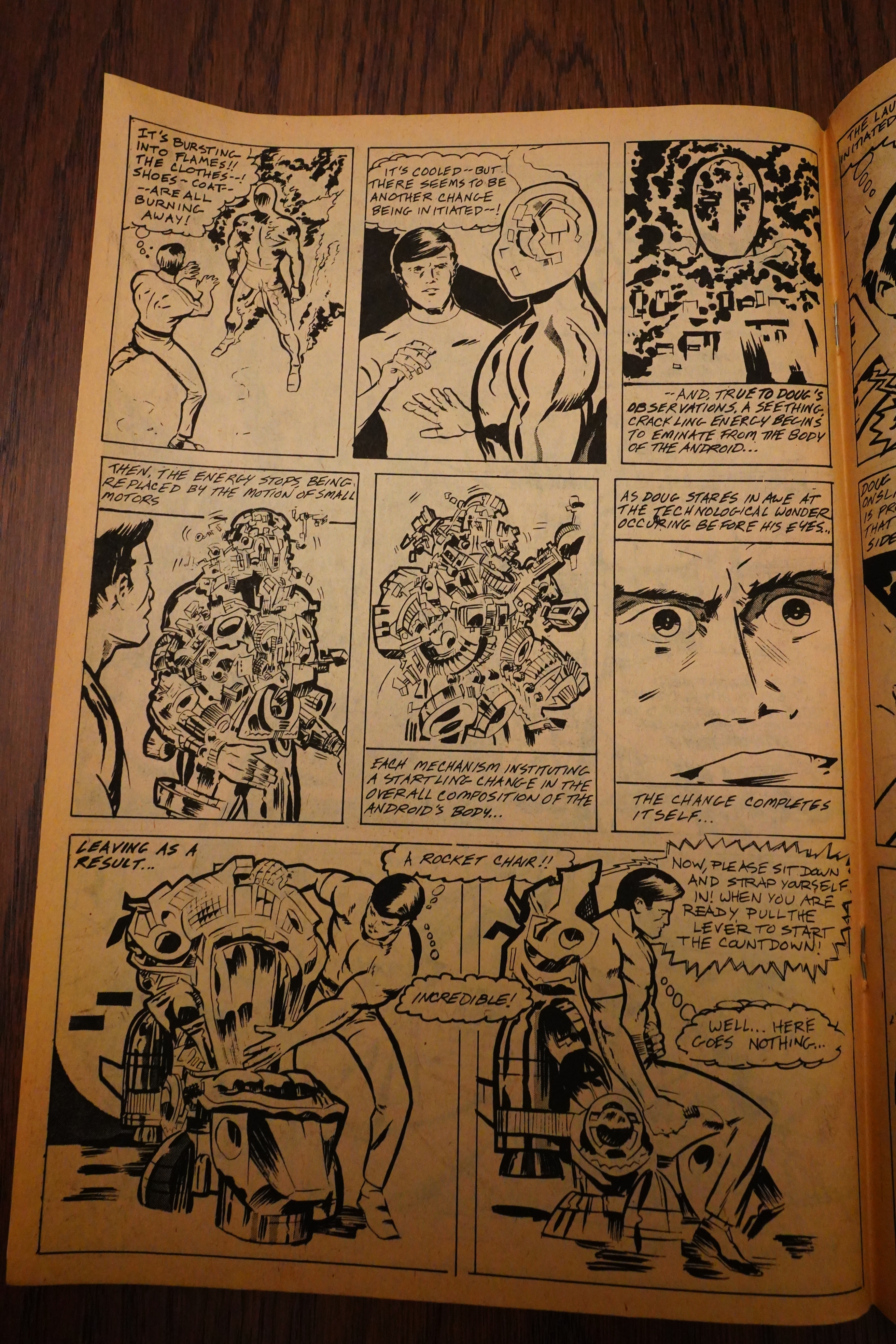
The vibe of this book is, as you’ve seen, very amateurish, but this thing by Vince Argondezzi has some crackle. Some Kirby Crackle. It’s pretty unreadable, though.
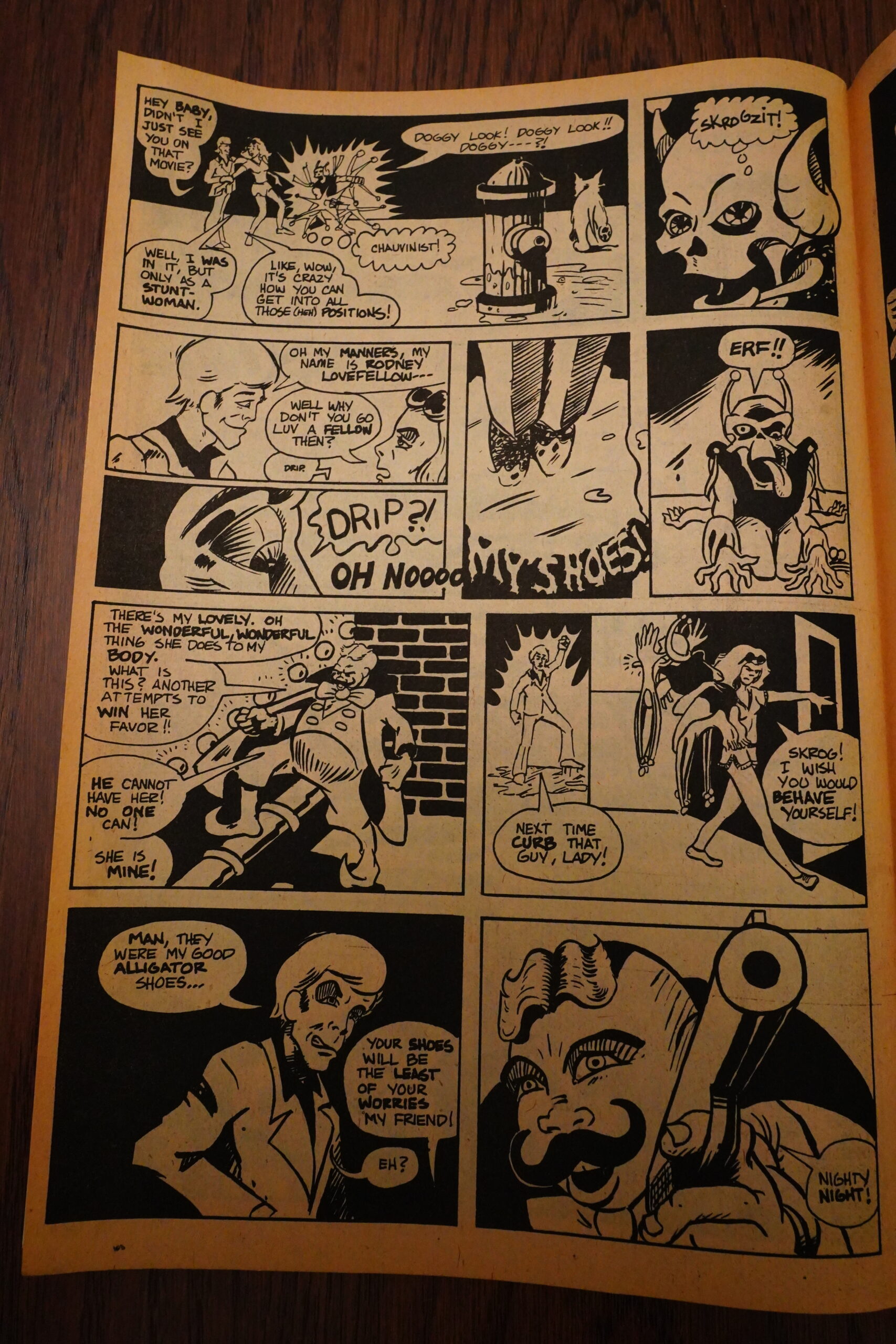
The final of the three original series is introduced — Skrog by Bill Cucinotta. It seems to be a humour strip, but it’s so weirdly told that it can be hard to tell.
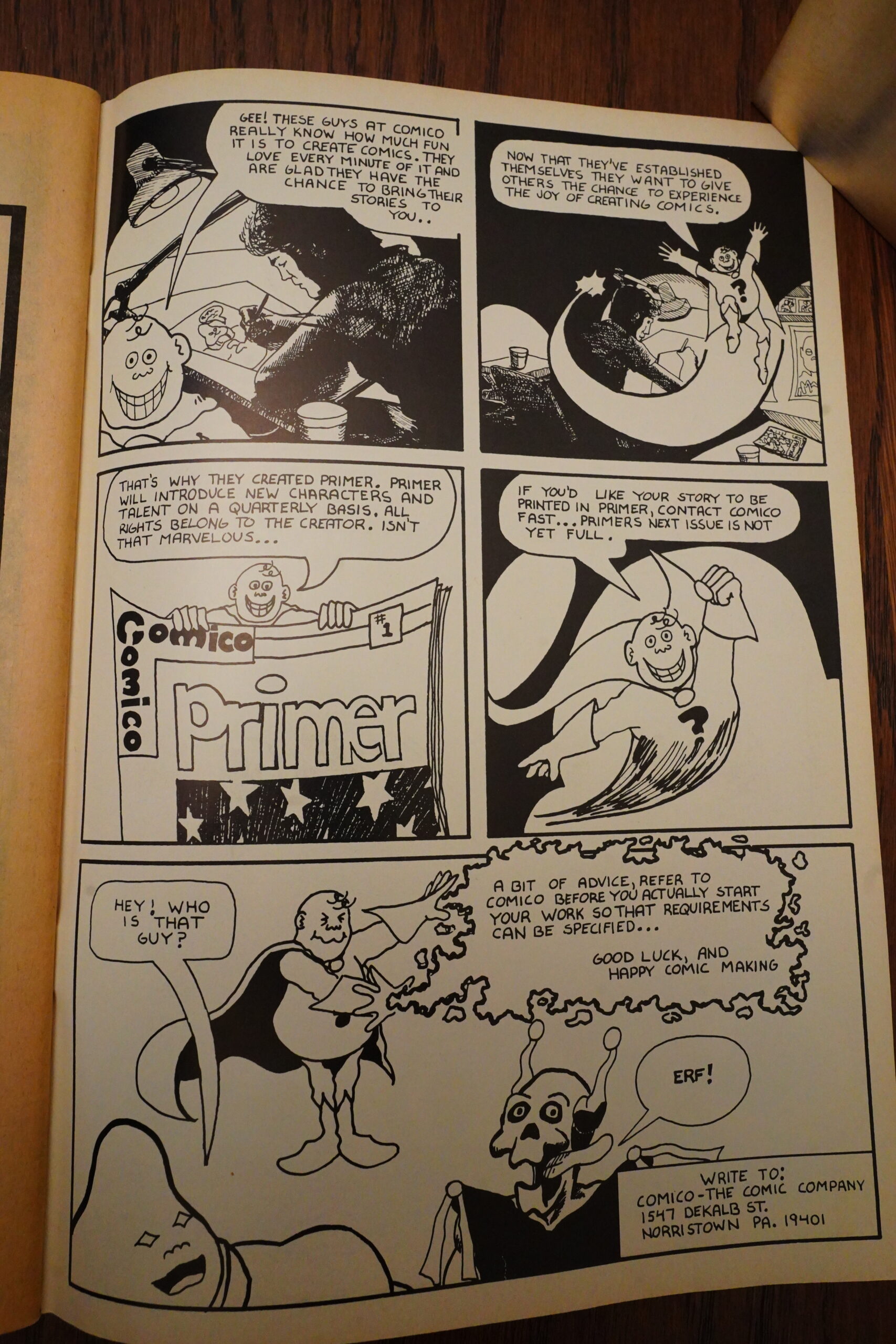
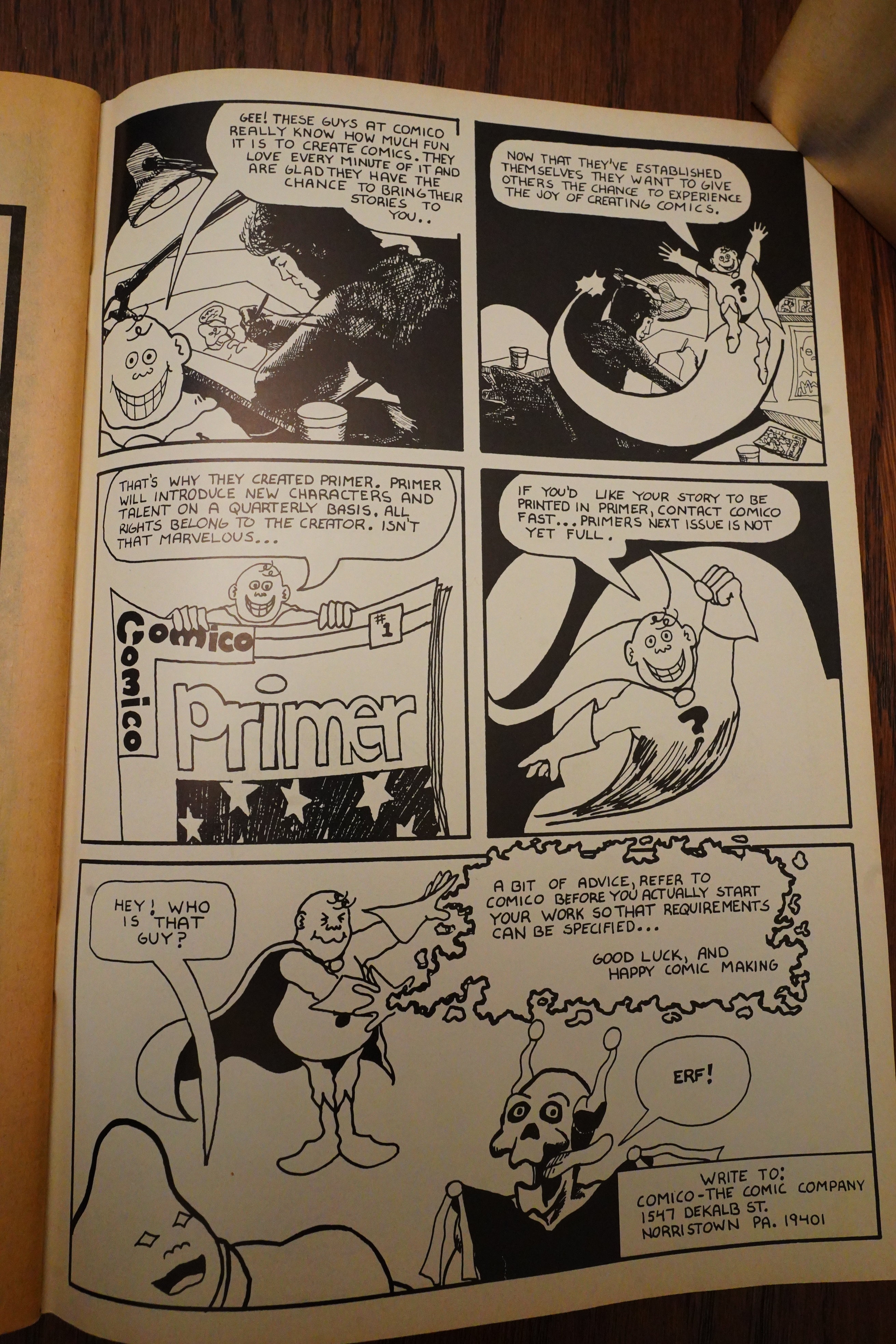
Finally, the pitch: You, the reader, can send your comics to Comico, and perhaps they’ll publish them.

Now, this doesn’t mention anything about money. Did they pay contributors to Primer?

But how’s that for a first issue, and as a series concept?

Well, to take the last part first: Anthologies rarely sell. And anthologies that are “New Talent Showcase”-ish — forget about it. But I understand the impulse for doing something like this — it seems like it should work: Readers get to see fresh talent and stuff. But that brings me to the first part of the question:

These comics suck. I’m sorry; I’m trying not to descend into Old Man Shouts At Forty Year Old Comics Written By Teenagers, but these comics are bad. The artwork’s not altogether the worst I’ve seen, but these strips are barely readable. And I survived the Black & White Explosion; I’ve seen some bad comics!

It’s a really inauspicious way to launch a comics publisher, and it’s amazing that they were able to continue. But I assume this is the reason why:
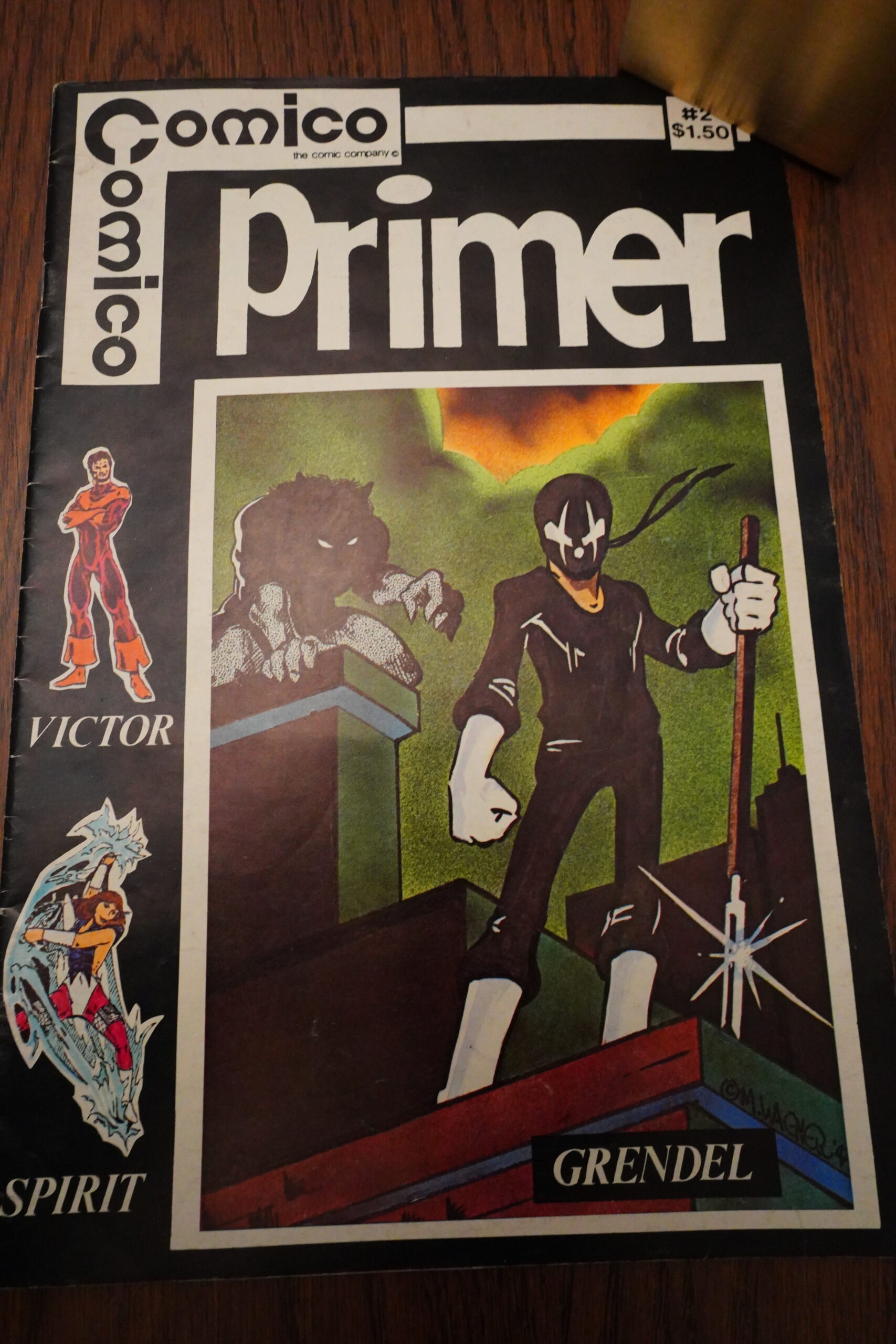
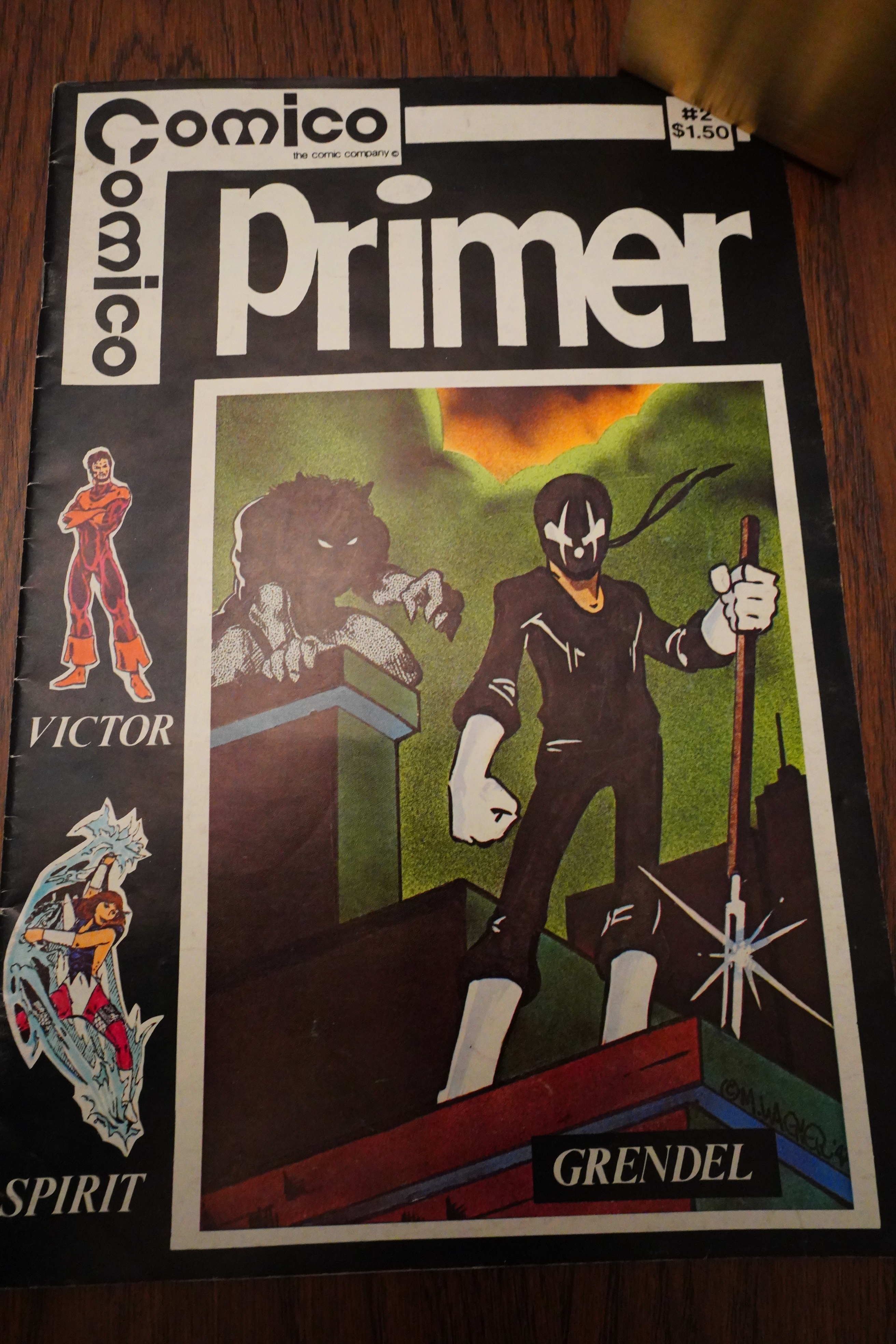
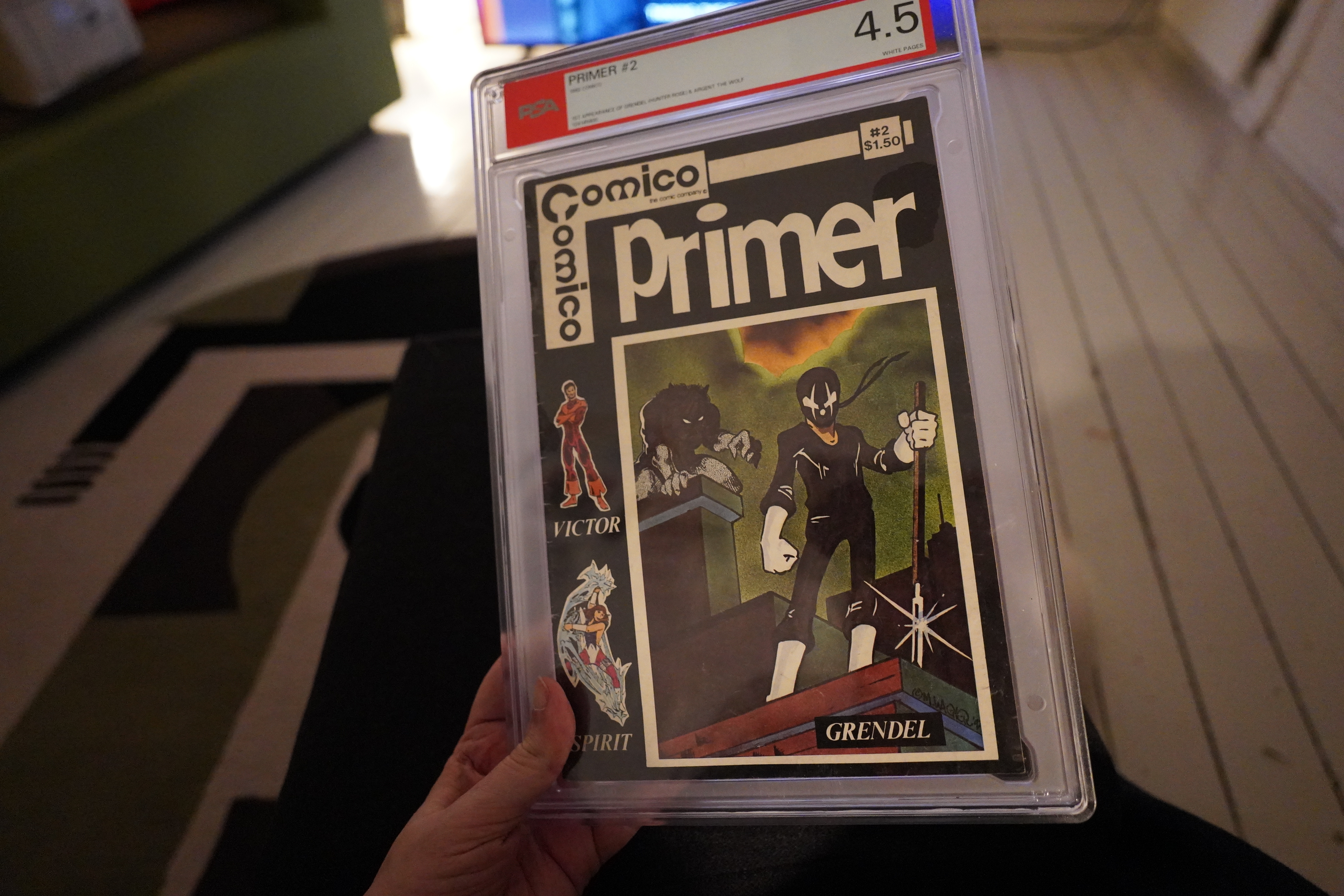
Matt Wagner met them at a comics convention and they offered to publish Grendel, which led to the only Actually Expensive comic I had to buy for this blog series.
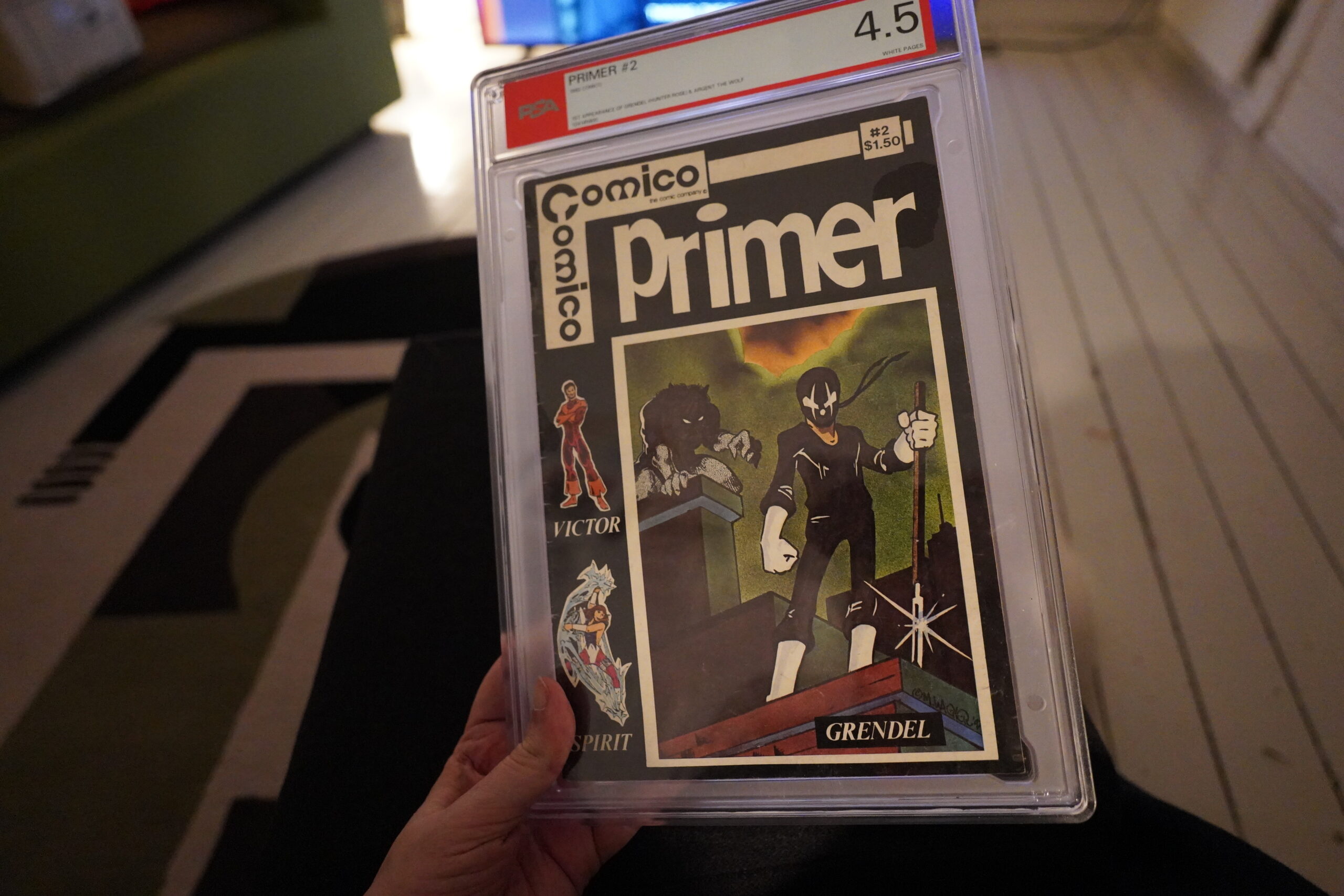
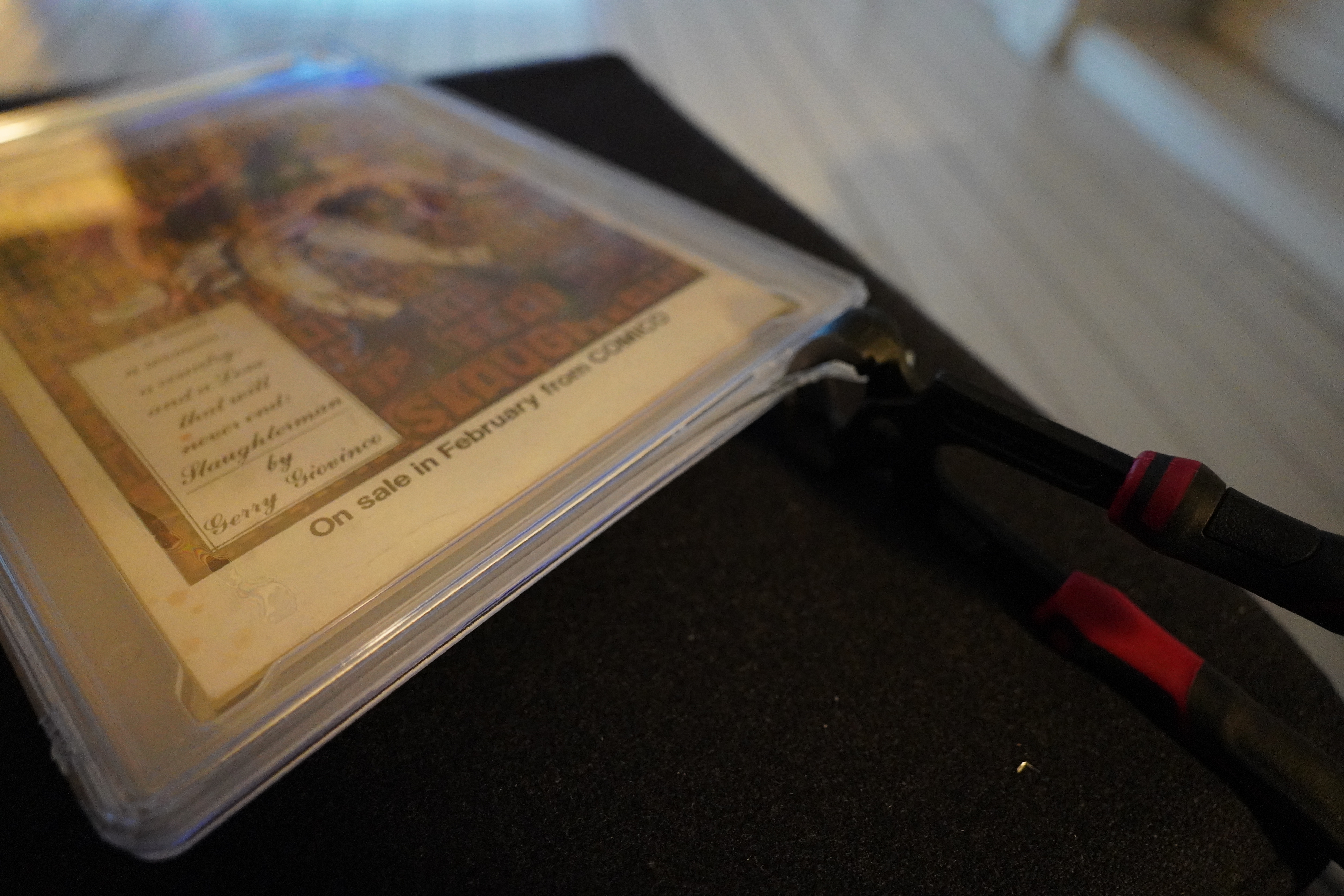
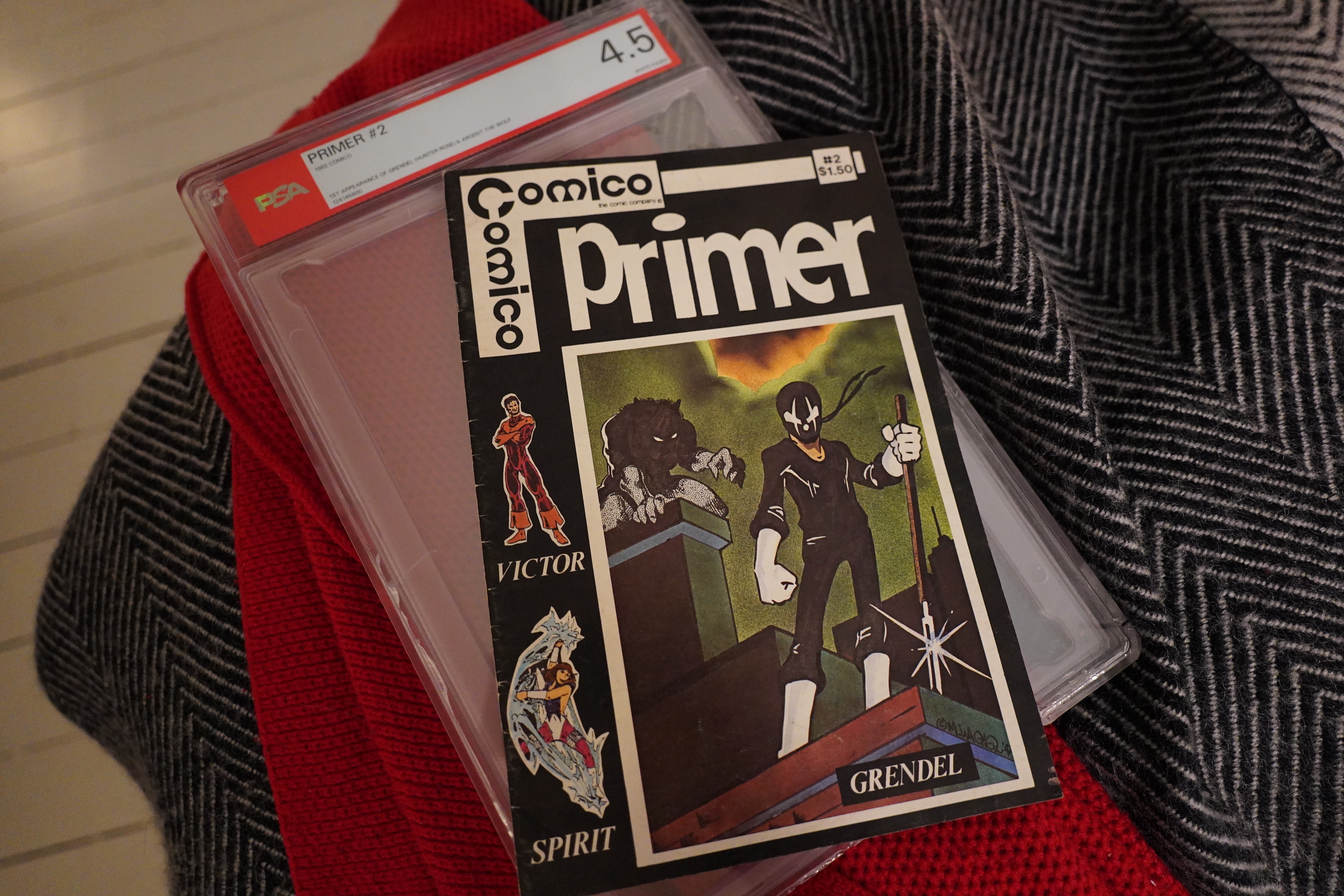
Even the cheapest copy I could find came slabbed.
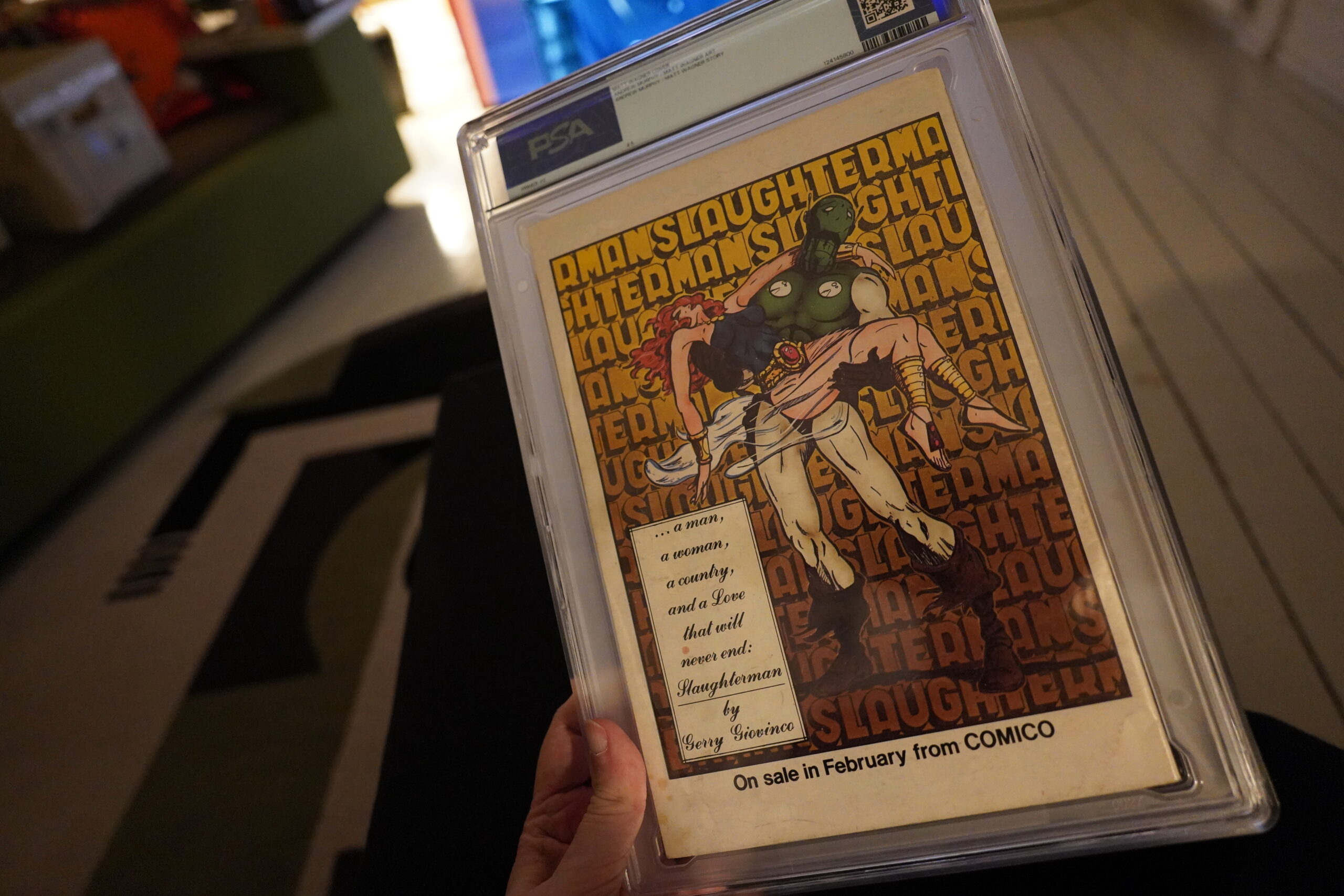
From… “PSA”? I didn’t even know that there was a slabbing company called that…
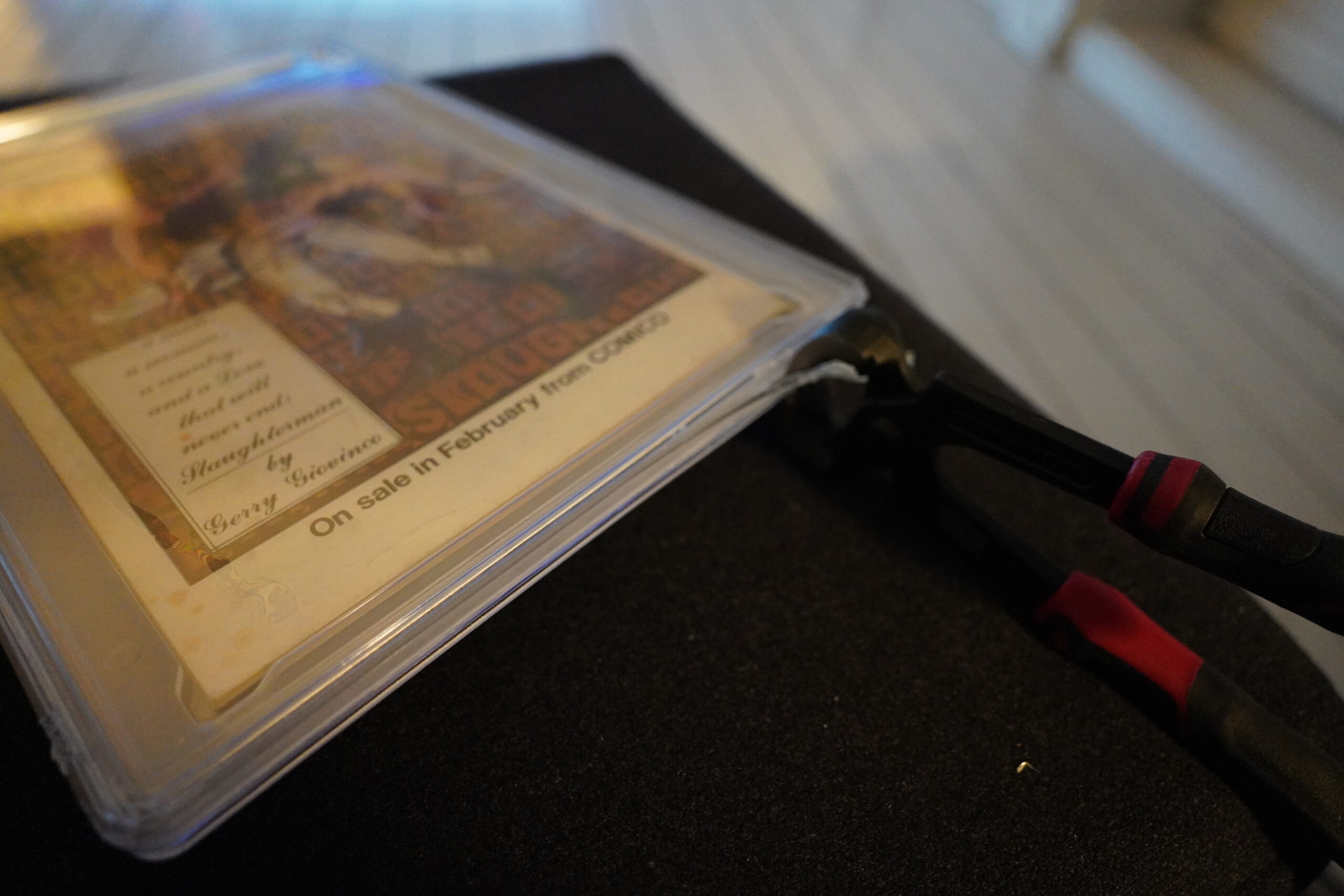
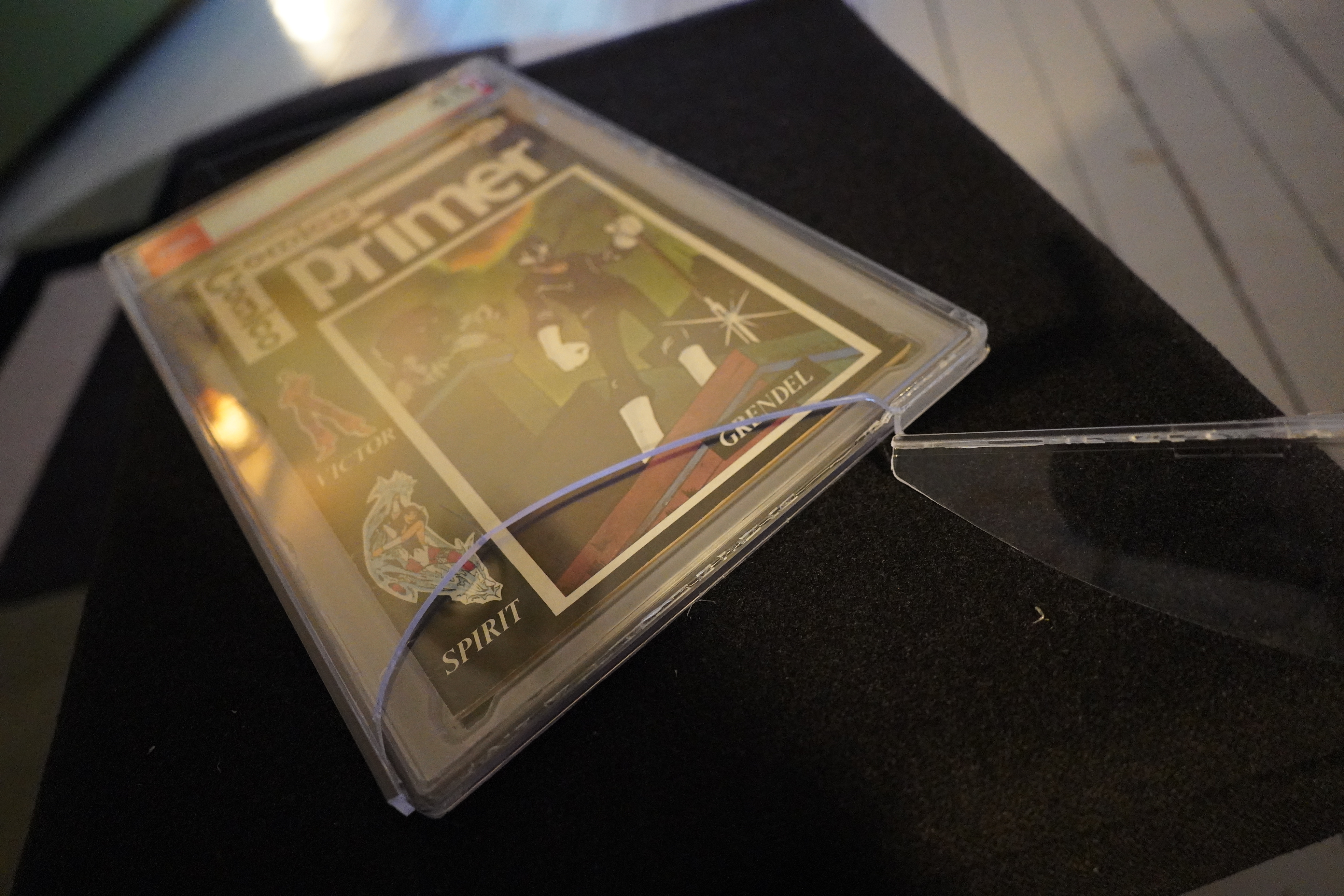
And man, these slabs are solid!
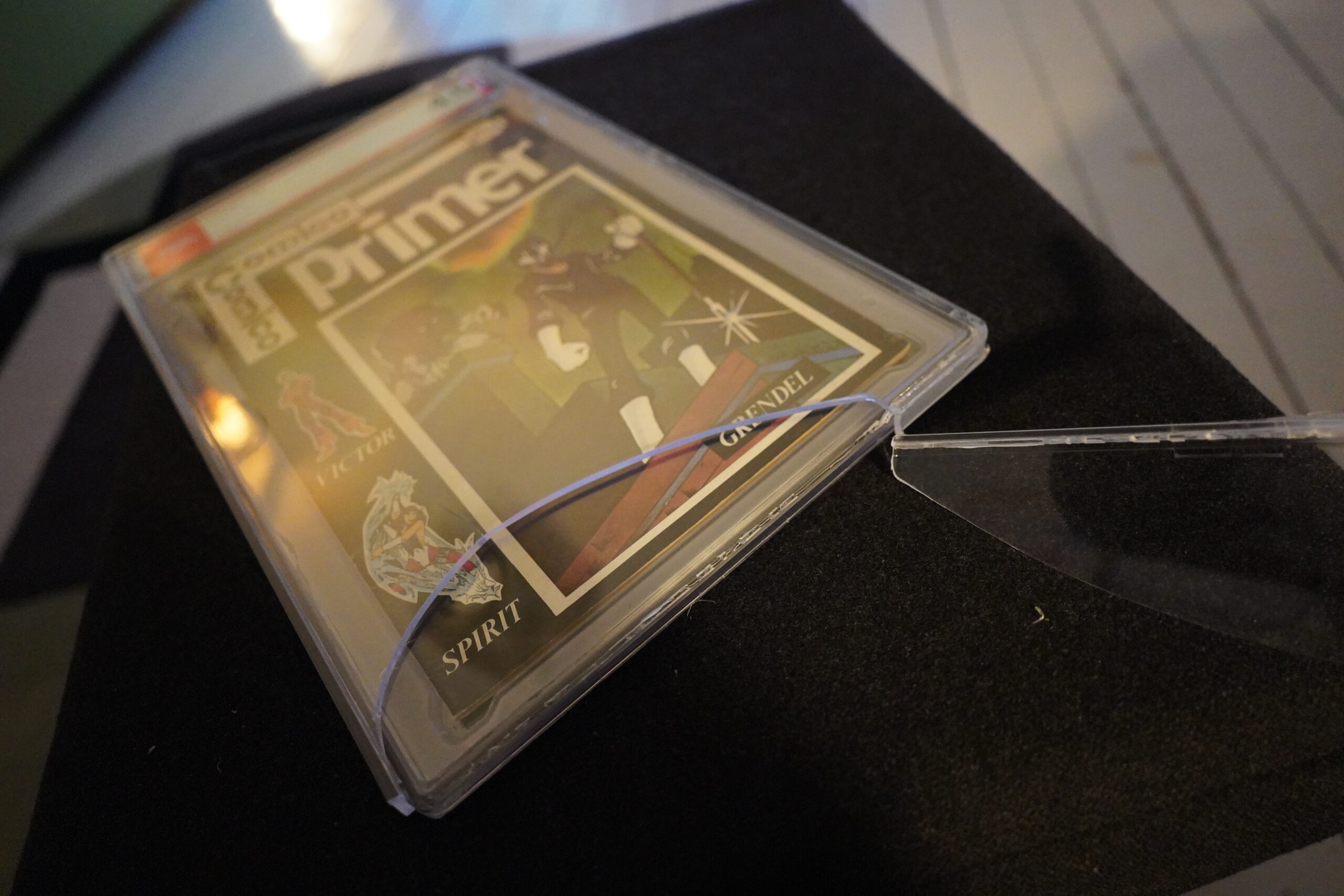
It took me ten minutes to get this far.
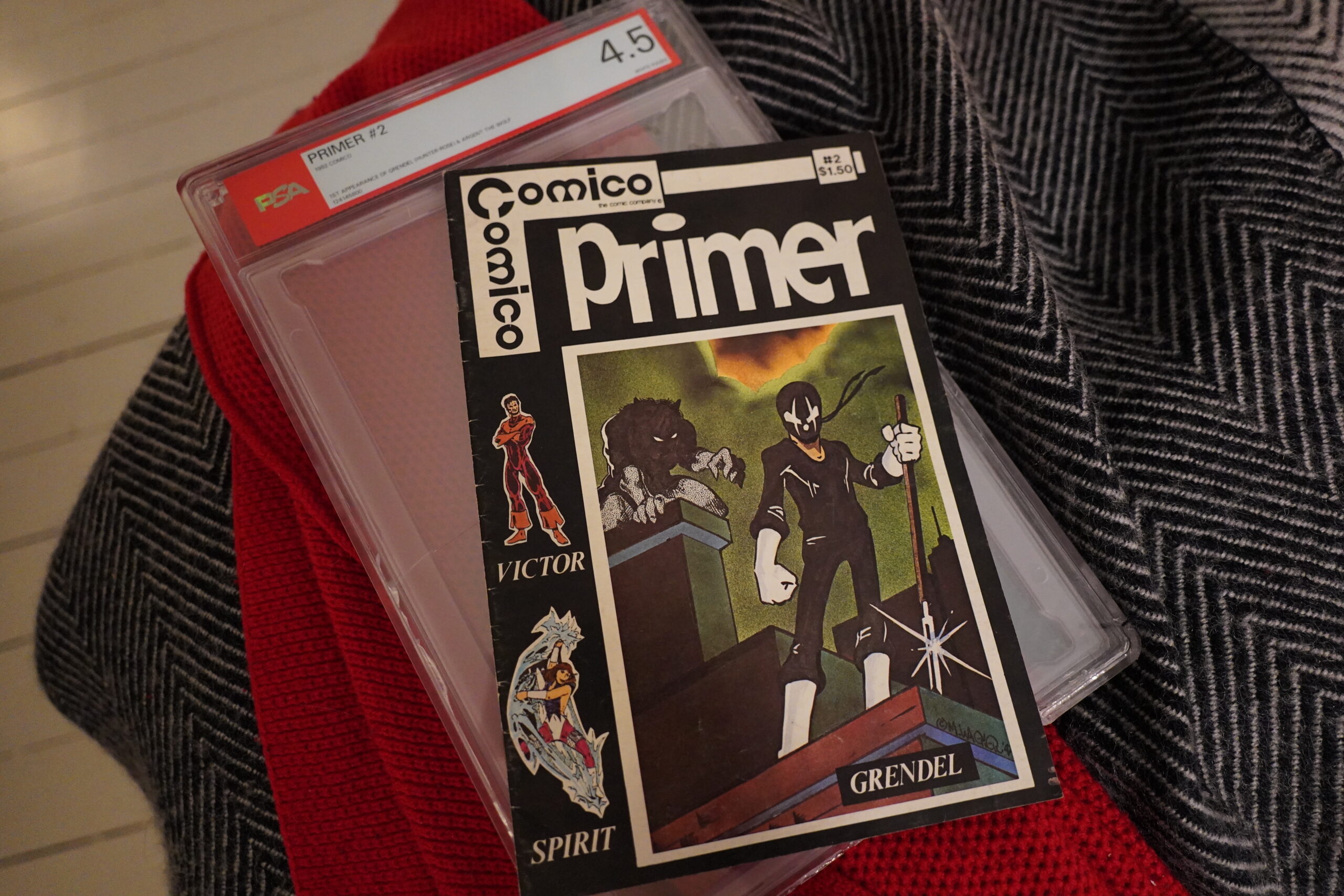
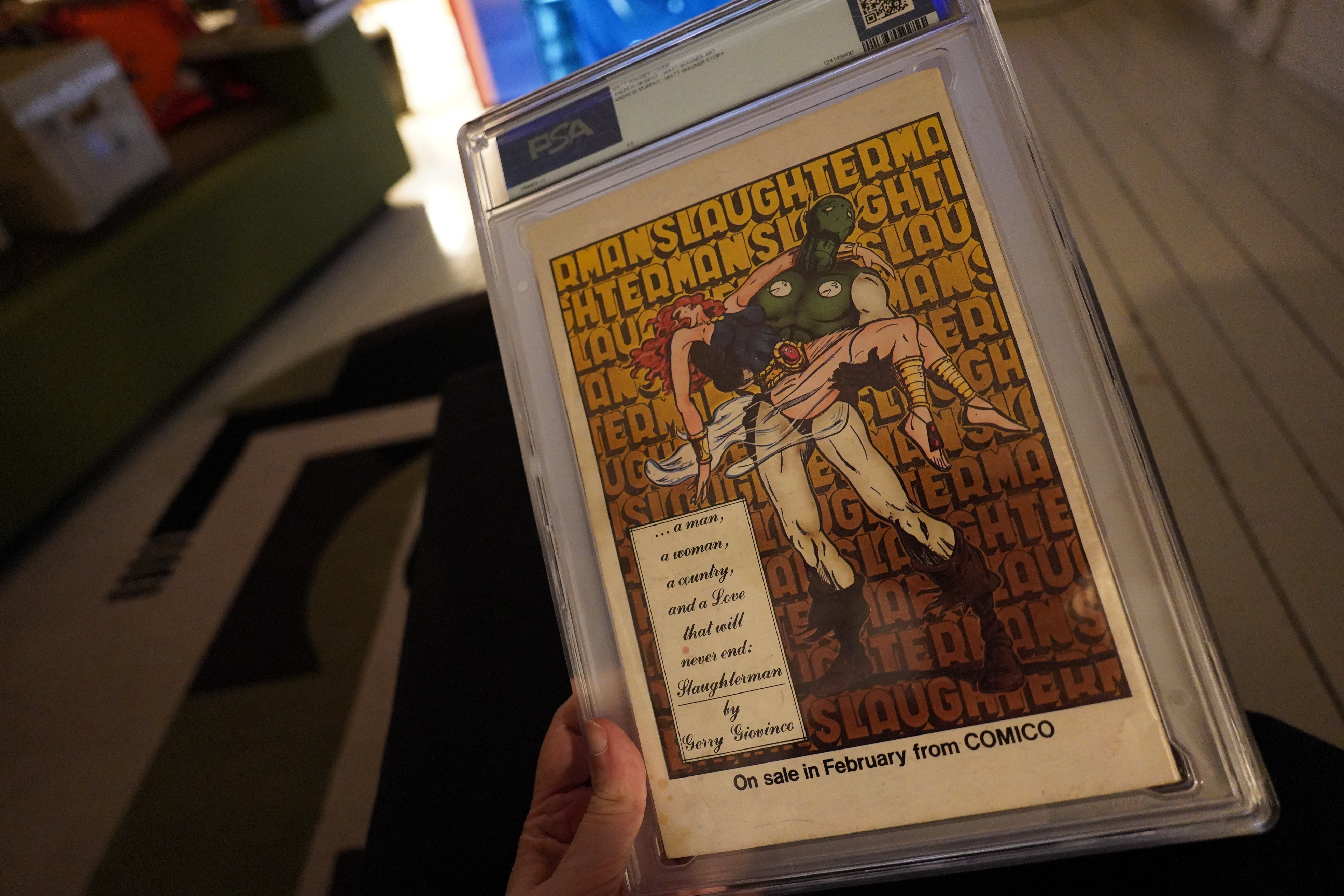
But I finally got it open enough to slide the book out.

The reason it’s so expensive is that this is the first appearance of Grendel. But I find it rather odd that all the actual Grendel issues — both the subsequent three-issue B&W series as well as the forty-issue colour series — can be gotten pretty cheaply. So collectors have just decided upon this being An Item, even if there really isn’t that much demand for Grendel comics in general? There’s so many slabbed copies of this for sale on ebay…

I’m not a collector, so I don’t really get the impulse.
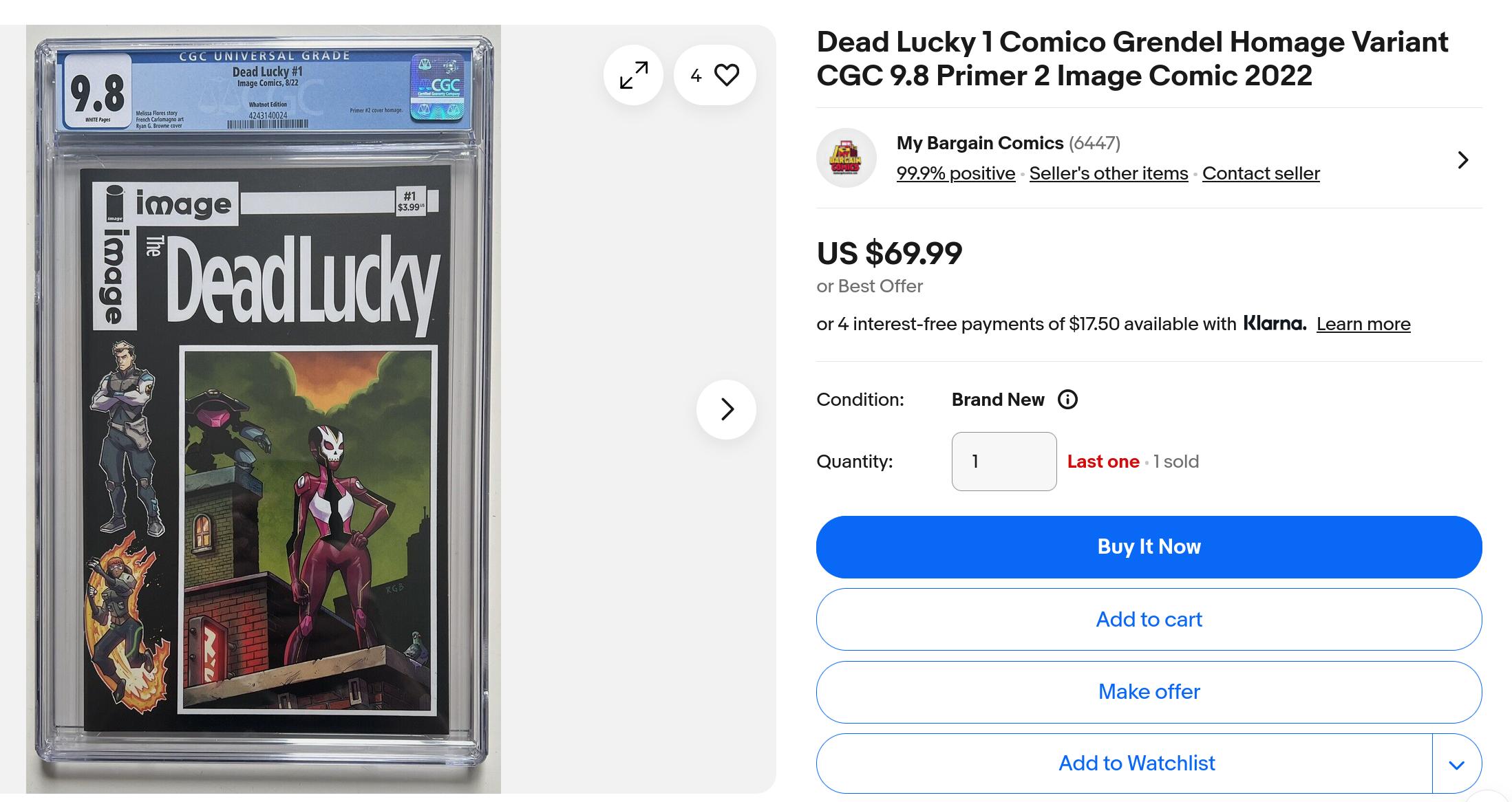
There’s even a homage cover edition that sells for solid money.
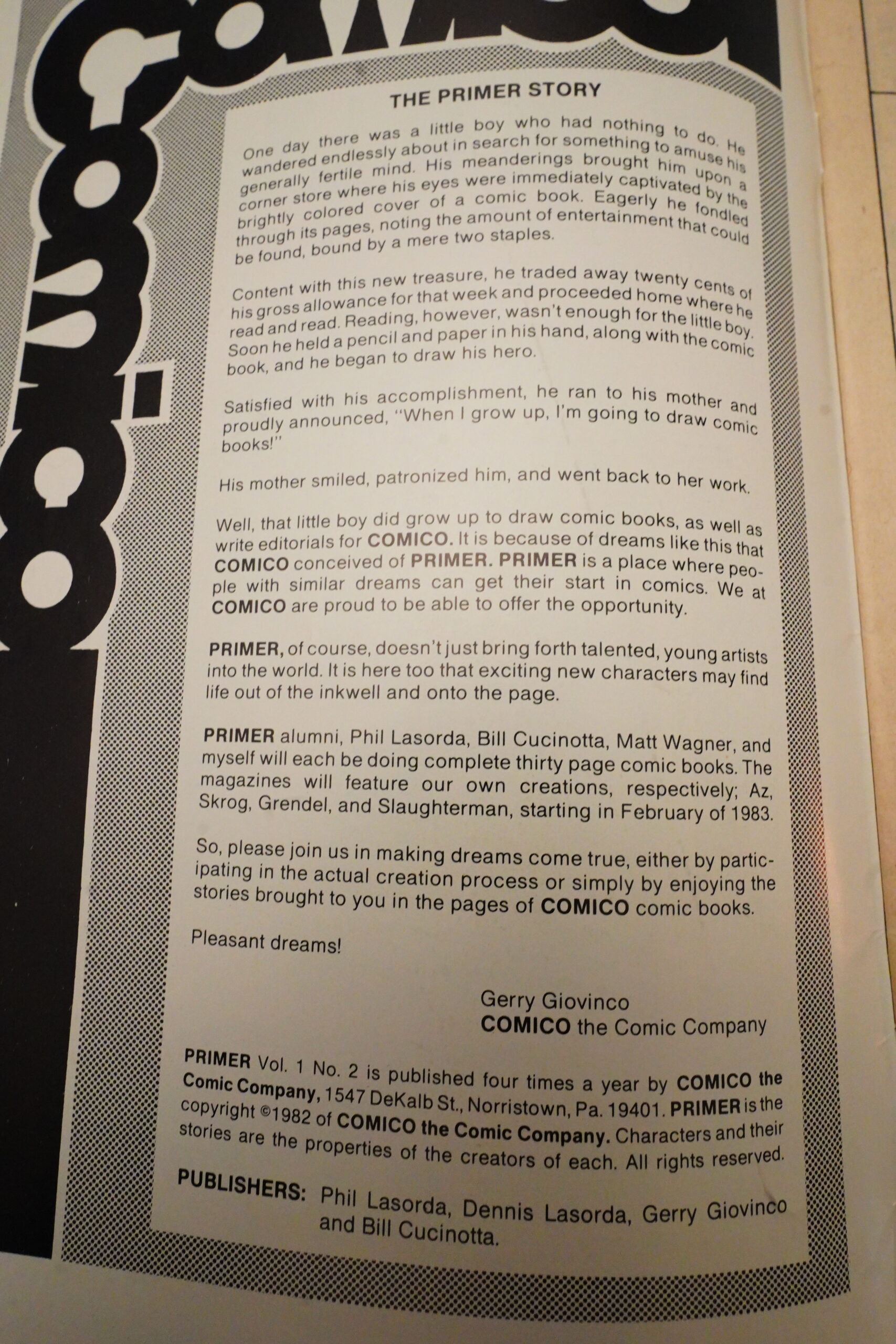
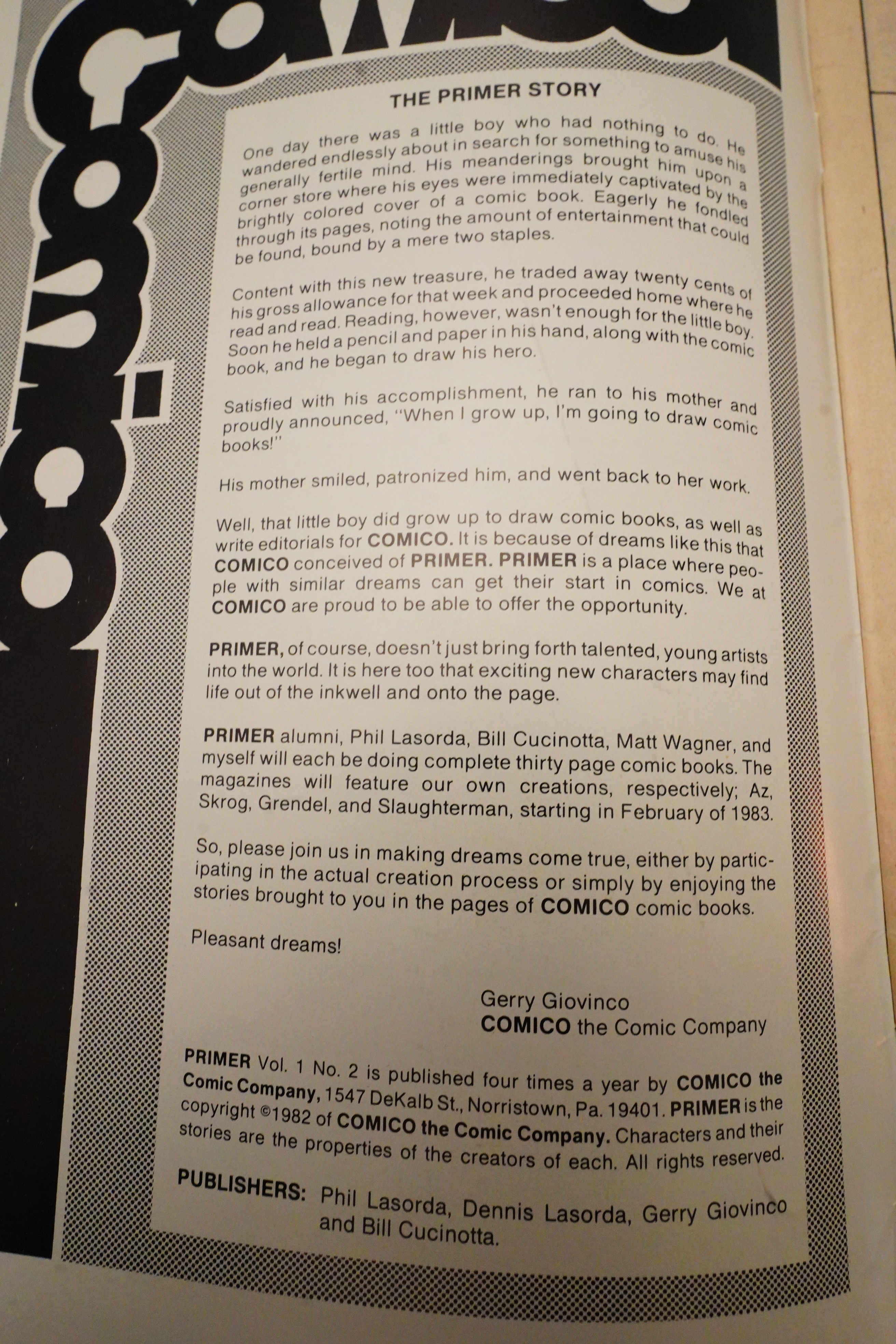
Anyway, Gerry Giovinco tells us a bit about his background, and then we’re told that Phil Lasorda, Dennis Lasorda, Gerry Giovinco and Bull Cucinotta (I see a slight theme going on in these names) are all co-publishers.
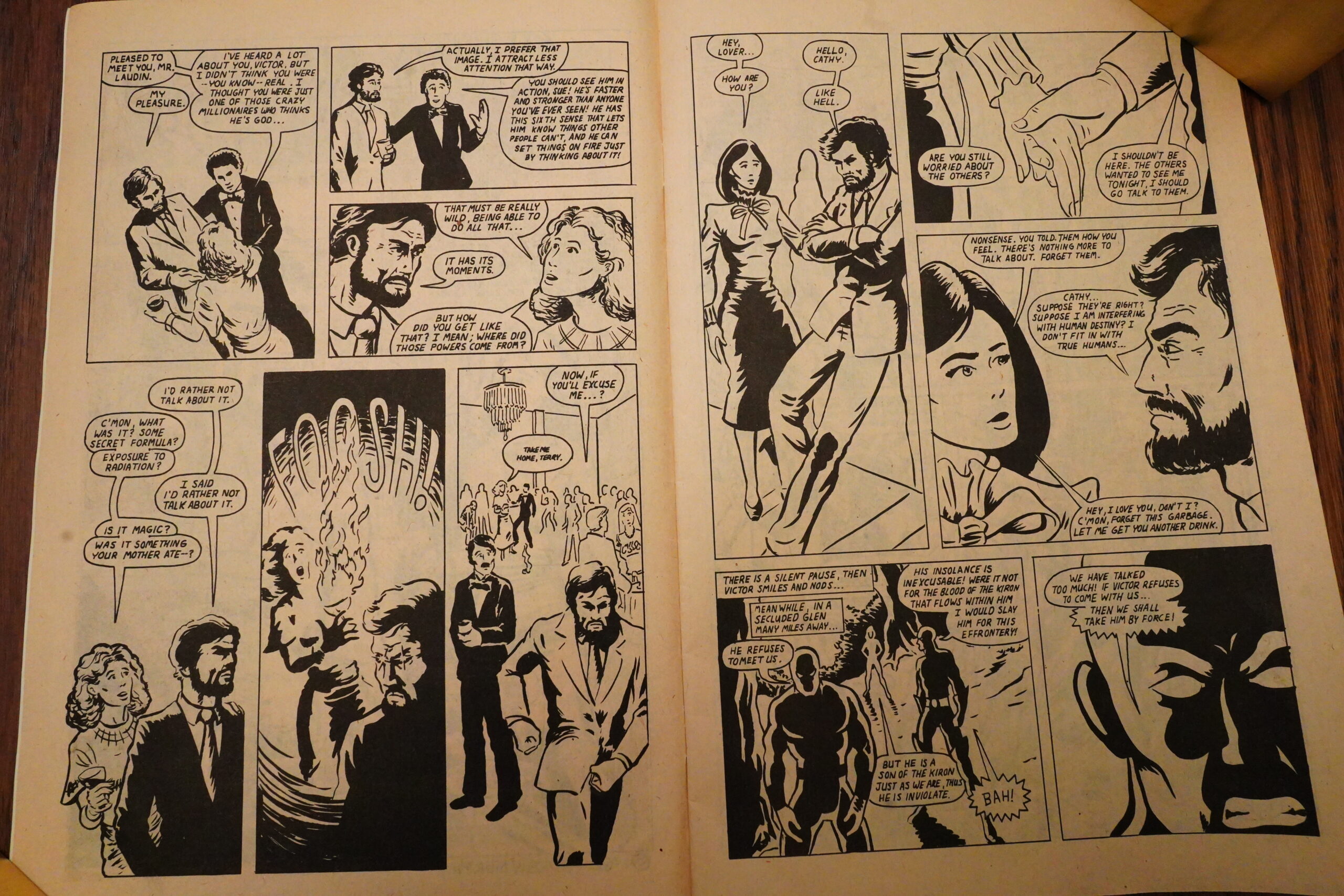
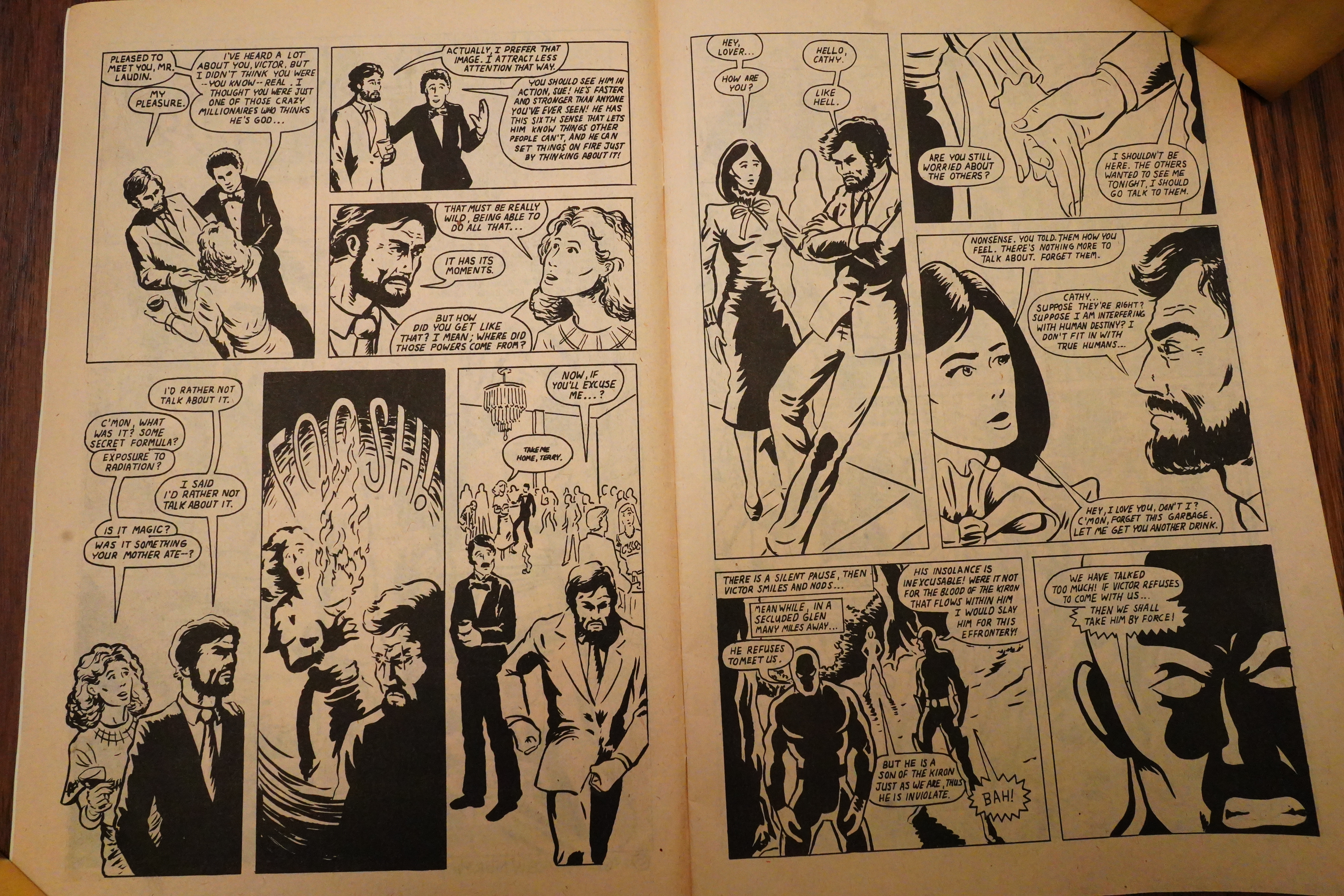
Issue #2 starts the Victor serial by Andrew Murphy, which continues to run through all subsequent issues. There are no other continuing serials.

It’s more coherent than the pieces in #1, really, so it’s understandable. I’m assuming he’s also in high school, though.
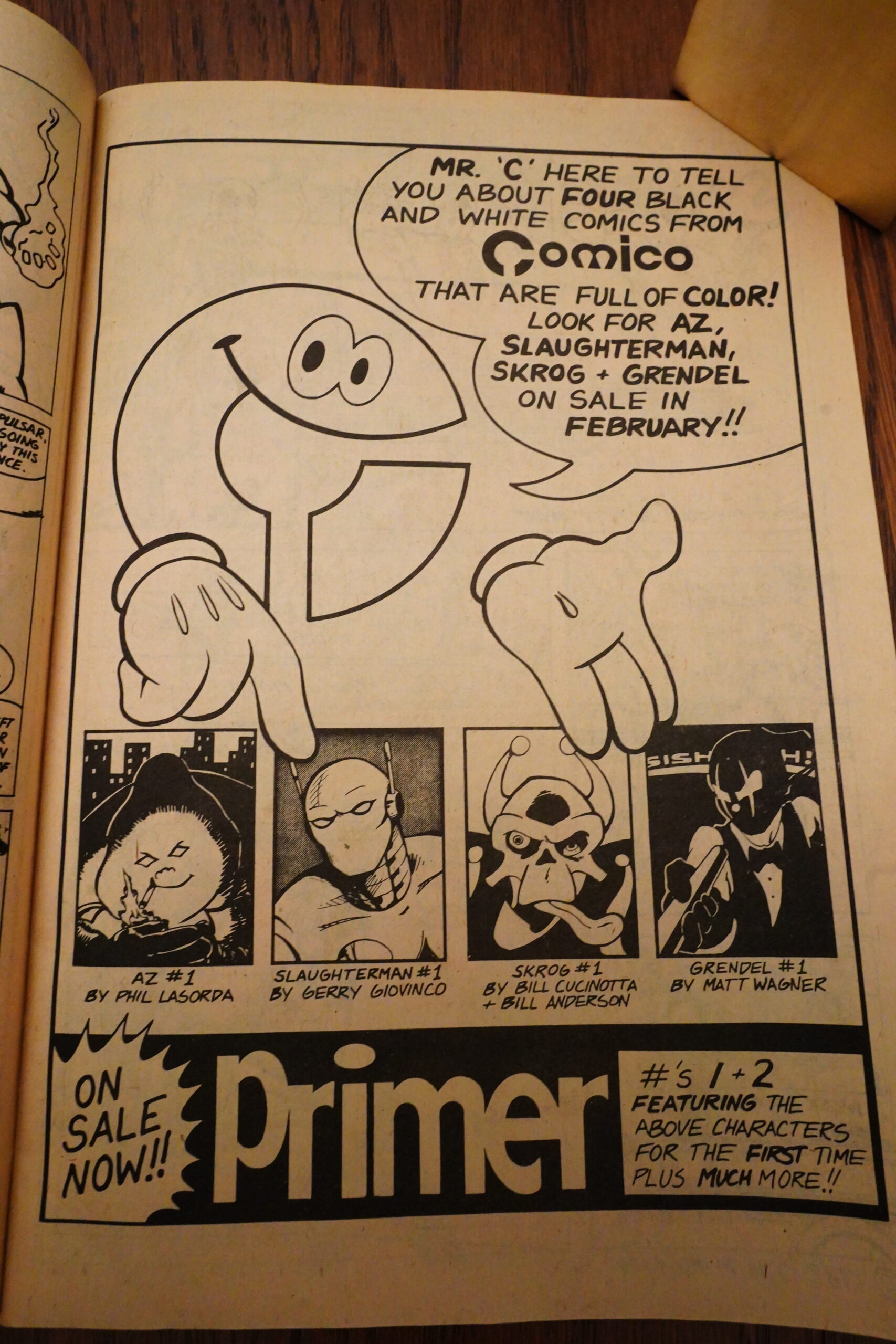
Comico added Grendel to the schedule tout de suite, and now Az and Skrog have been assigned their own features. So Comico now has five regular titles going, which is pretty ambitious.
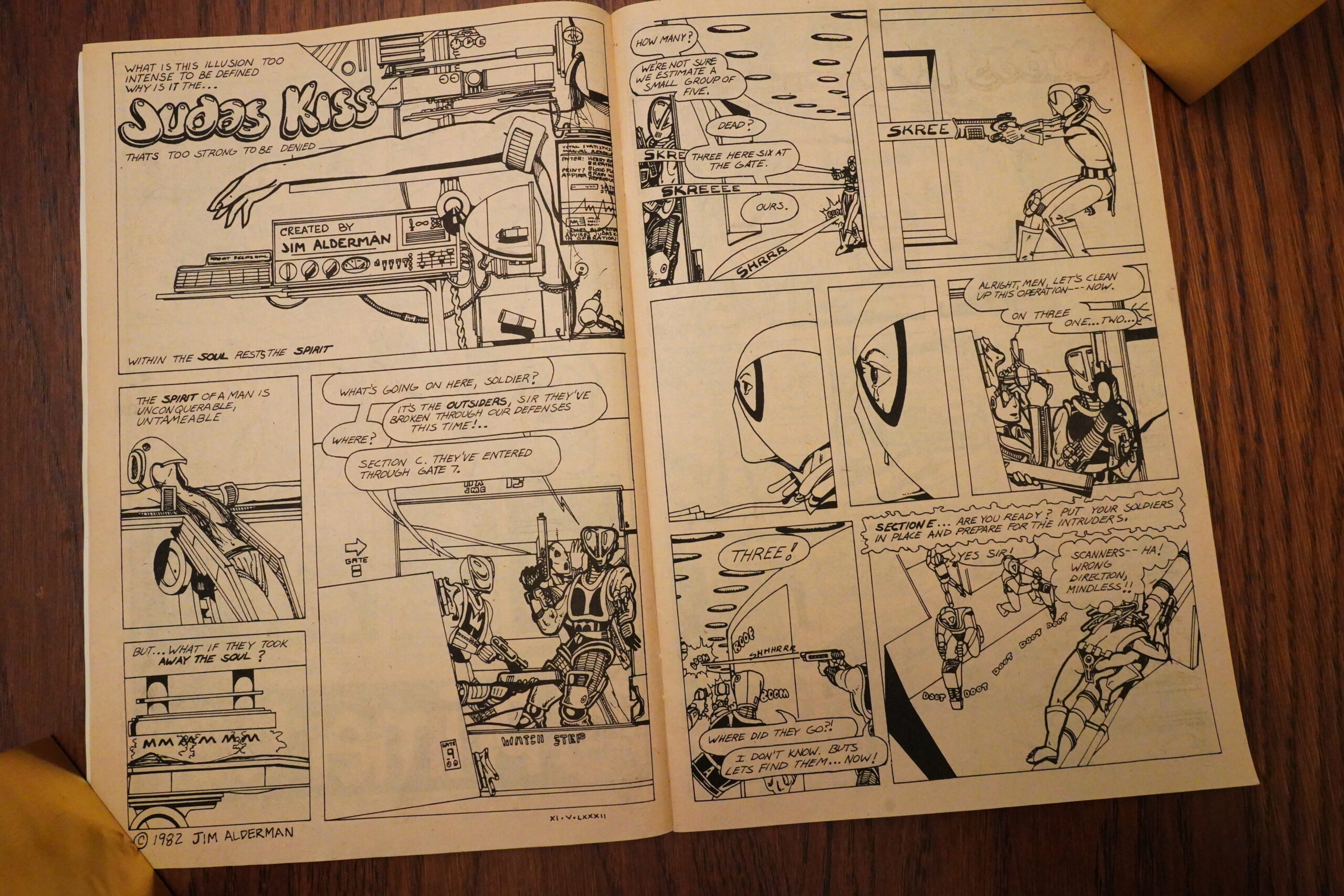
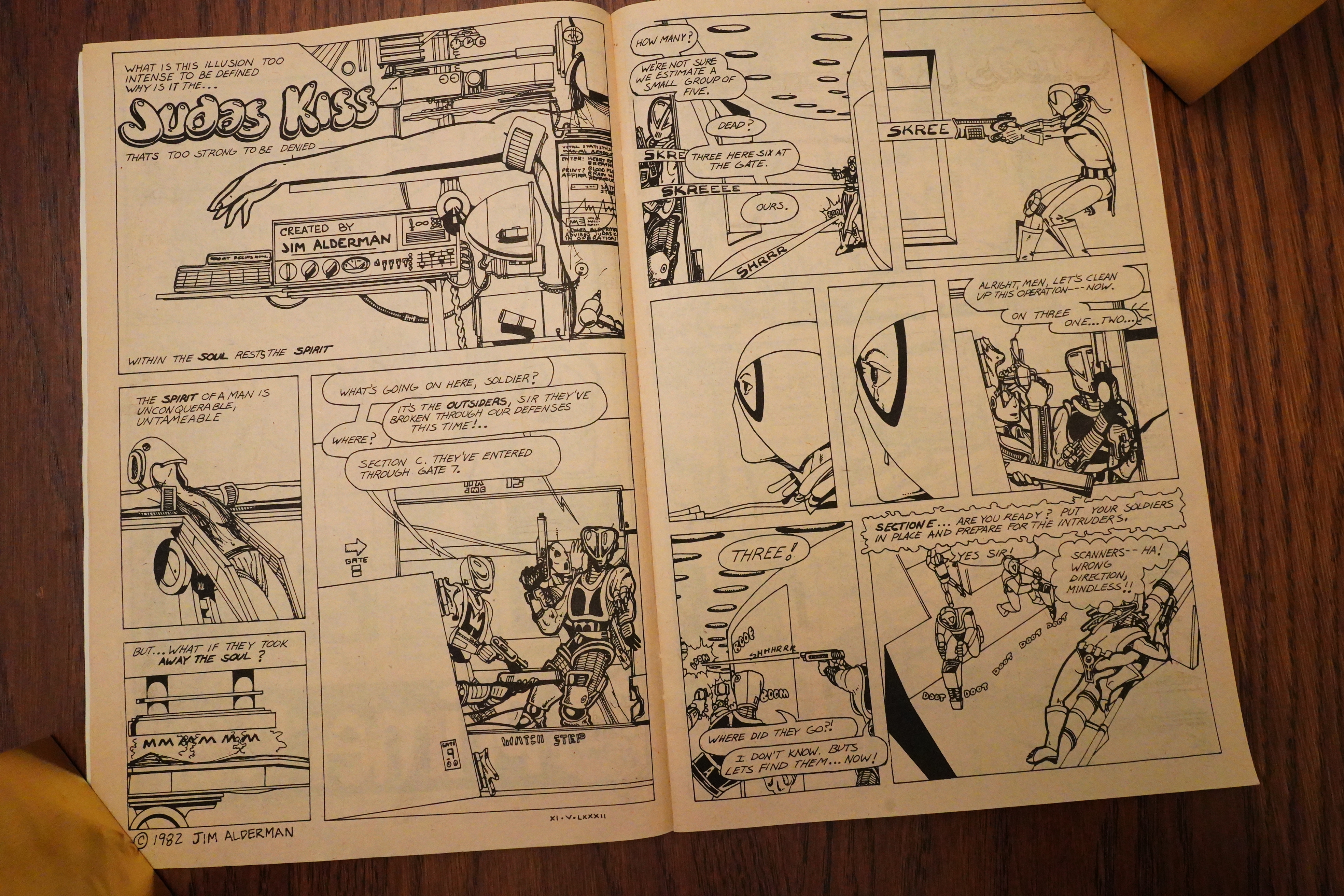
Jim Alderman’s piece looks interesting graphically — the starkness works.
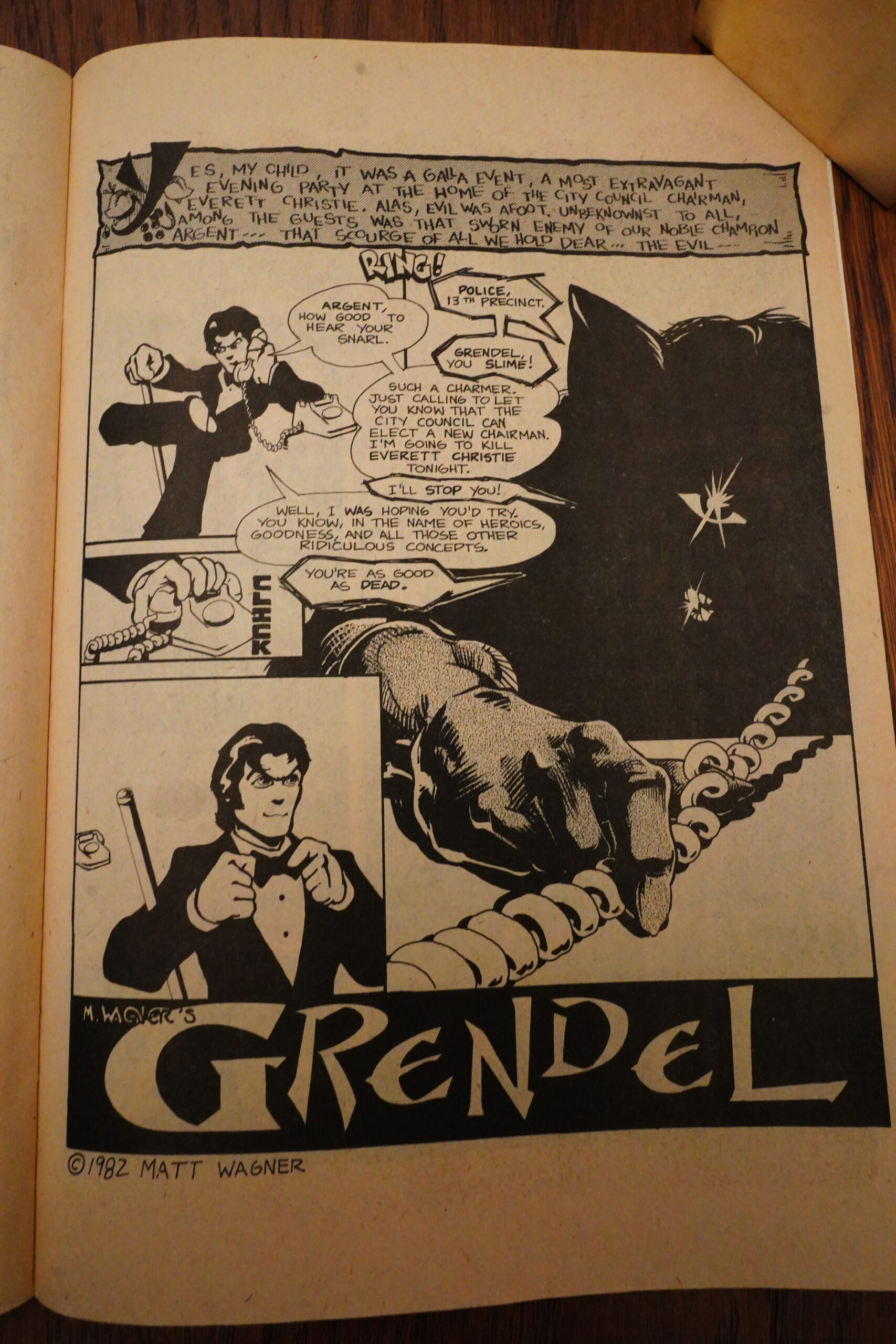
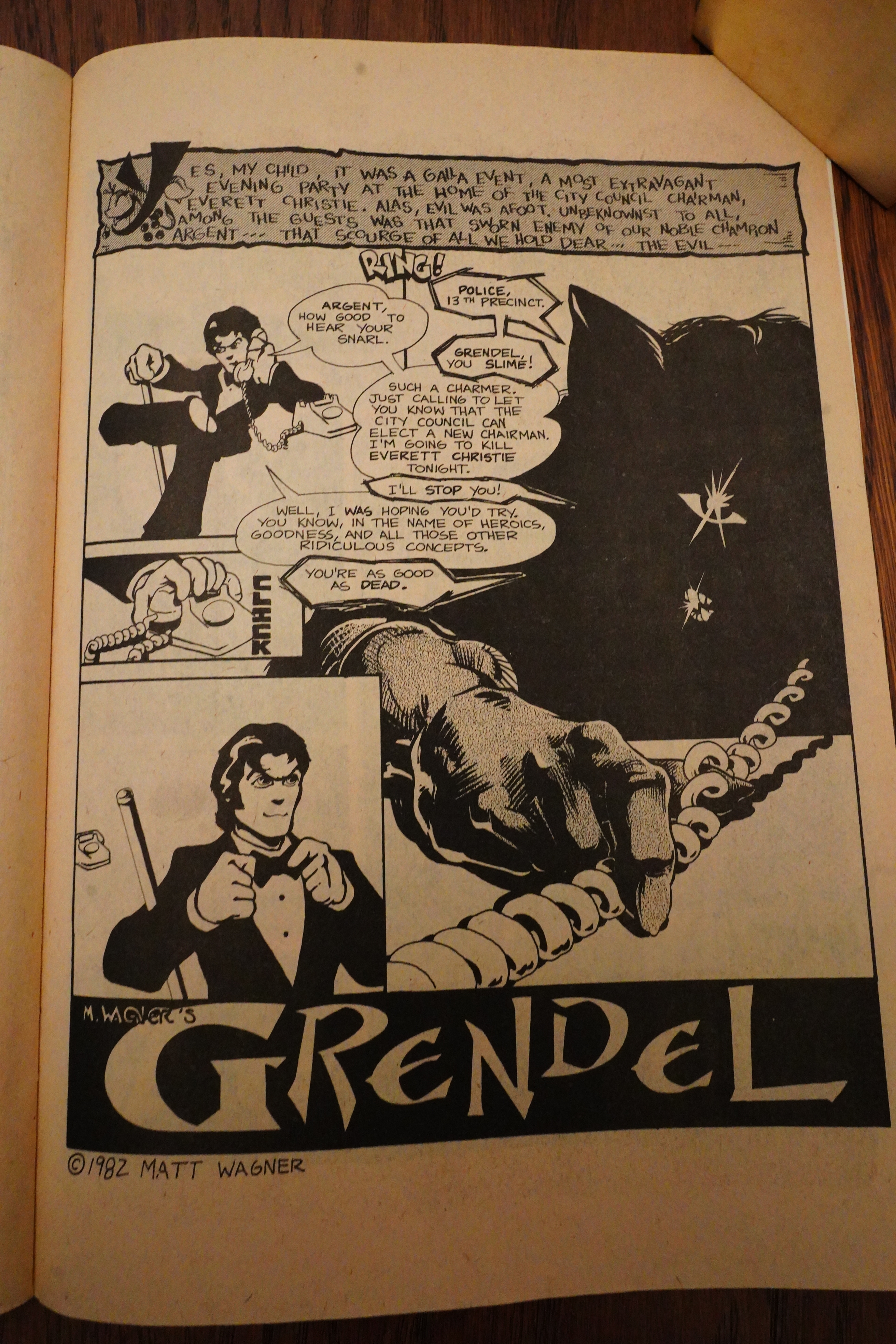
But this is what’s important — Grendel by Matt Wagner.
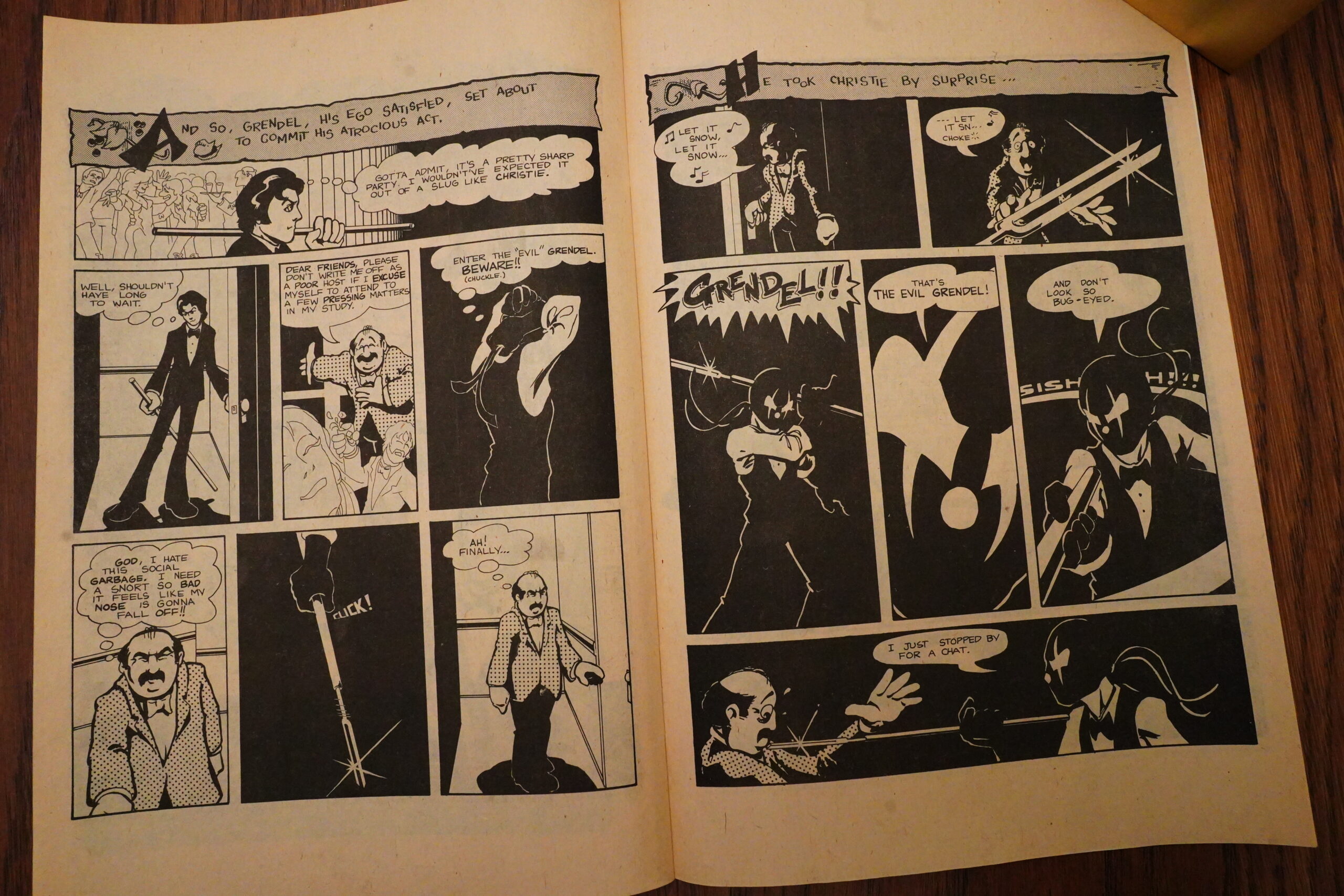
And it’s so much better than anything else here, so I’m not surprised that they gave him his own title immediately. From the form factor here, though, I guess Wagner had originally drawn this with a magazine in mind?

Well, I hope all the people collecting slabbed comics are happy with their slabs.
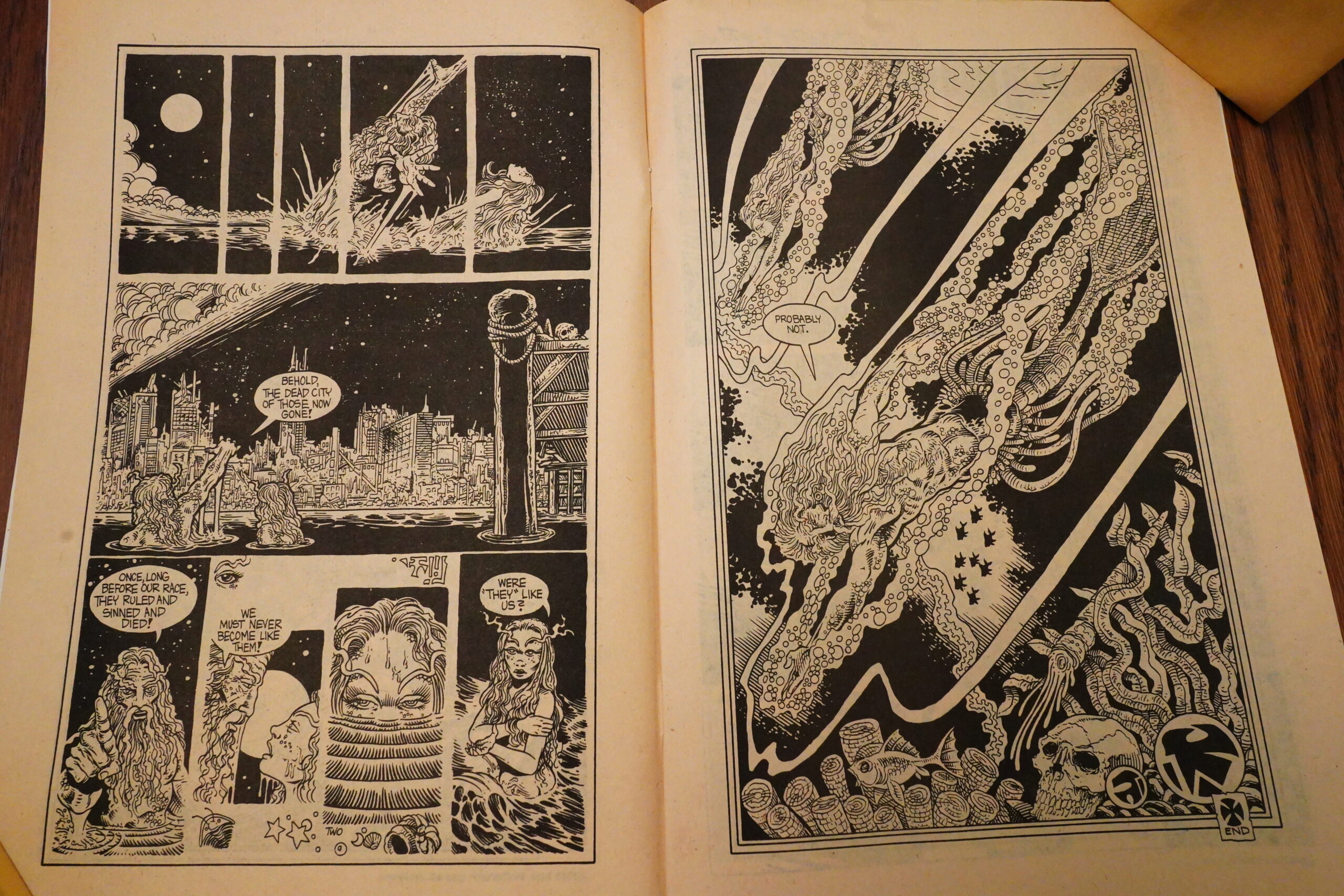
Primer improves a bit with the third issue. Rick McCollumn and Bill Anderson’s thing looks good, at least.
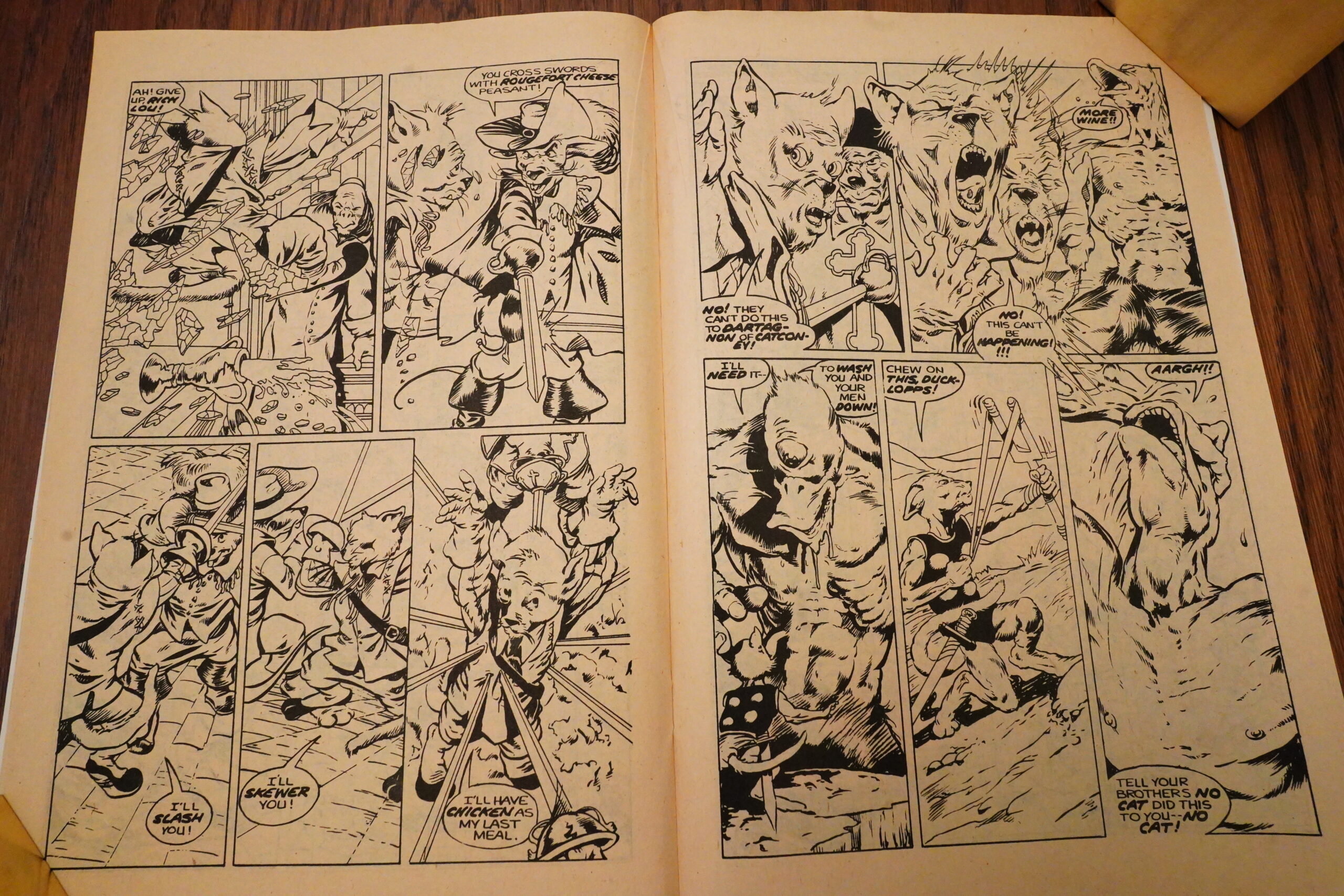
This is credited to Bill Bryan and William Francis Loebs, which is surprising — I mean, that inking looks a bit like Loebs, but the (lack of) storytelling doesn’t. And Loebs was a published artist by this point, right? Or is this a different guy? Not William Messner-Loebs? Perhaps it’s an old piece?
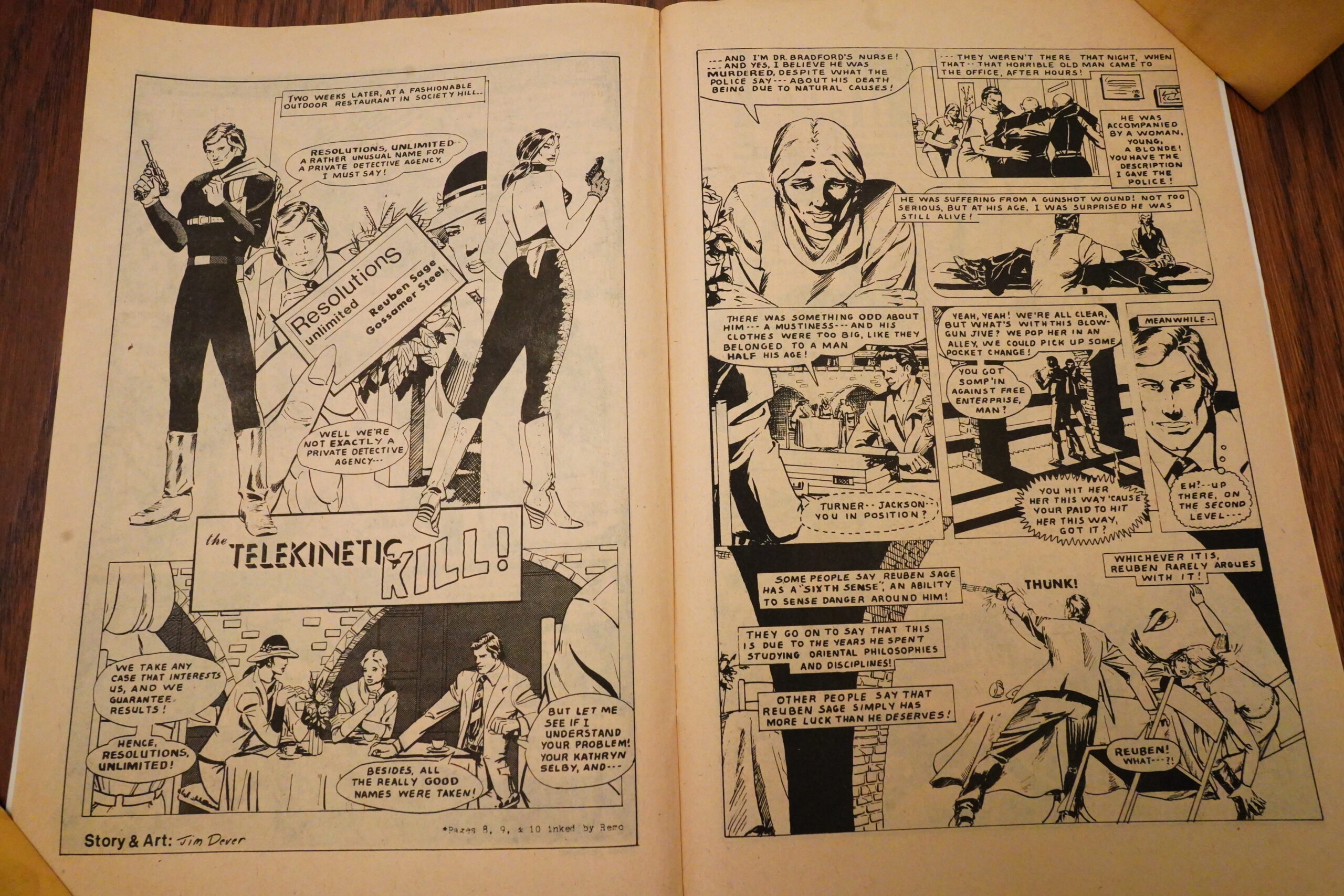
Jim Dever does a strip about… actually, I read this an hour ago, and now I can’t remember. It’s not good, though.
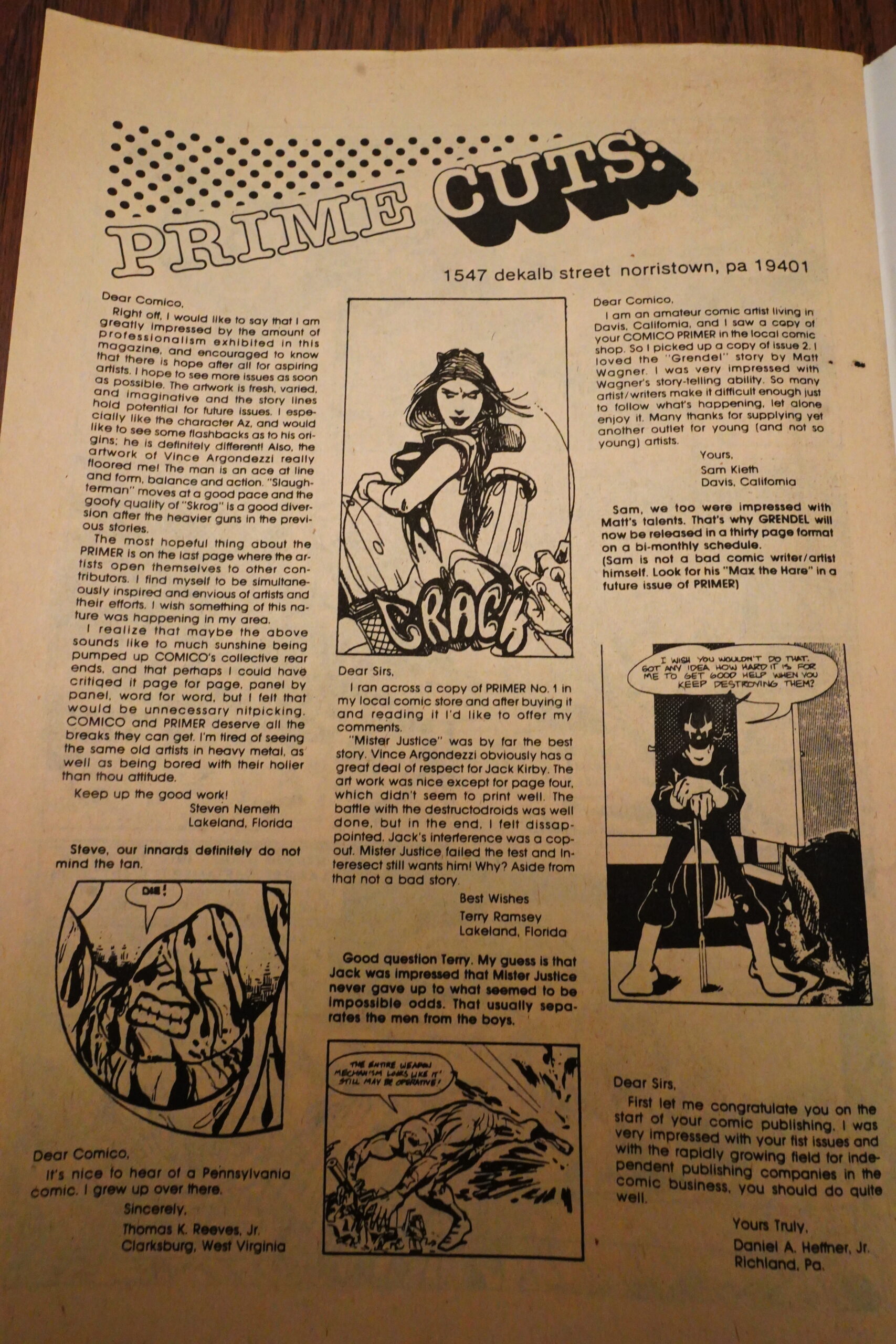
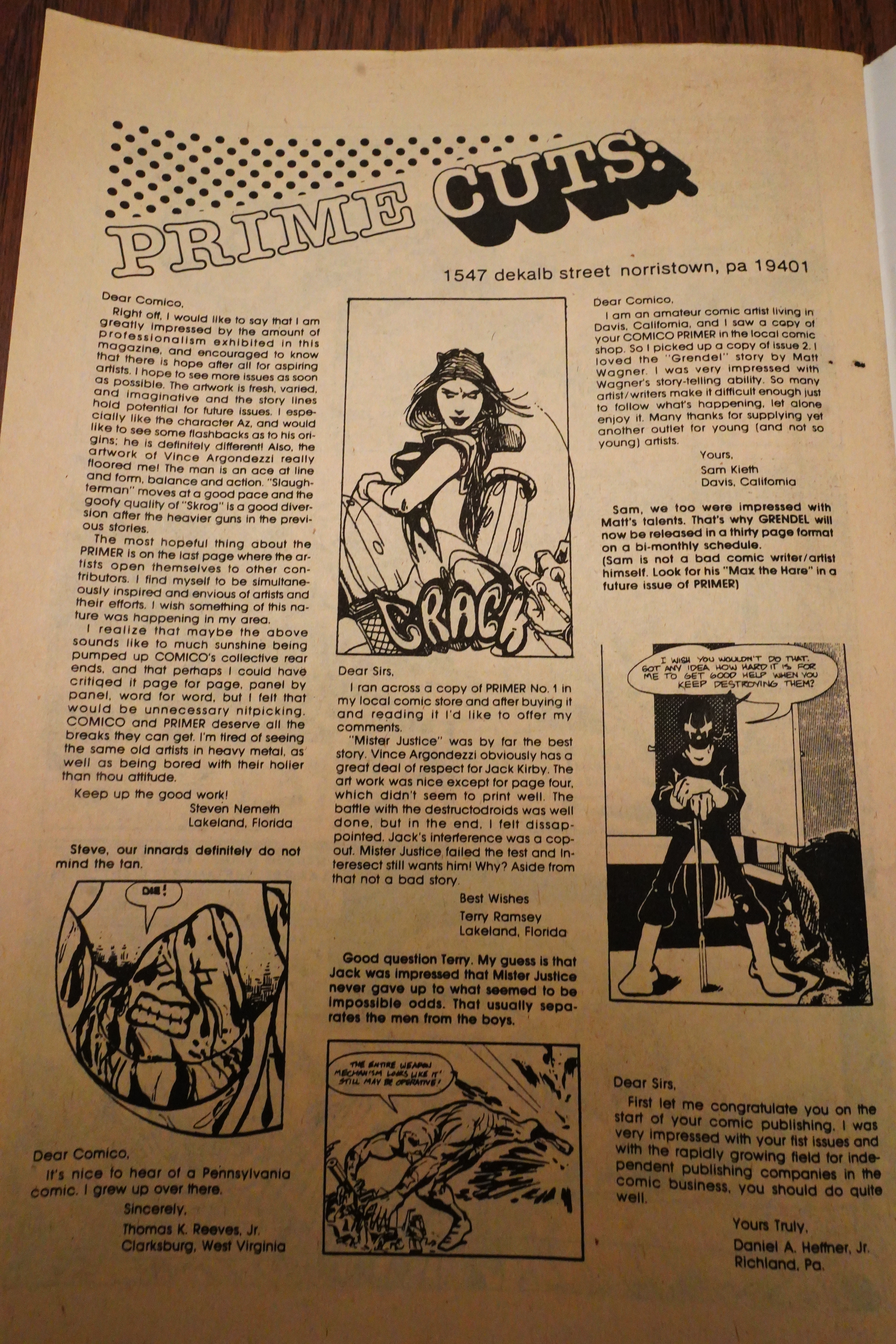
A person writes in to say that Primer is totally awesome, which just goes to show that tastes differ. But more interestingly, Sam Kieth (!) writes in to say that Grendel is good. Wouldn’t Kieth later go on to ink some issues of Mage for Matt Wagner?
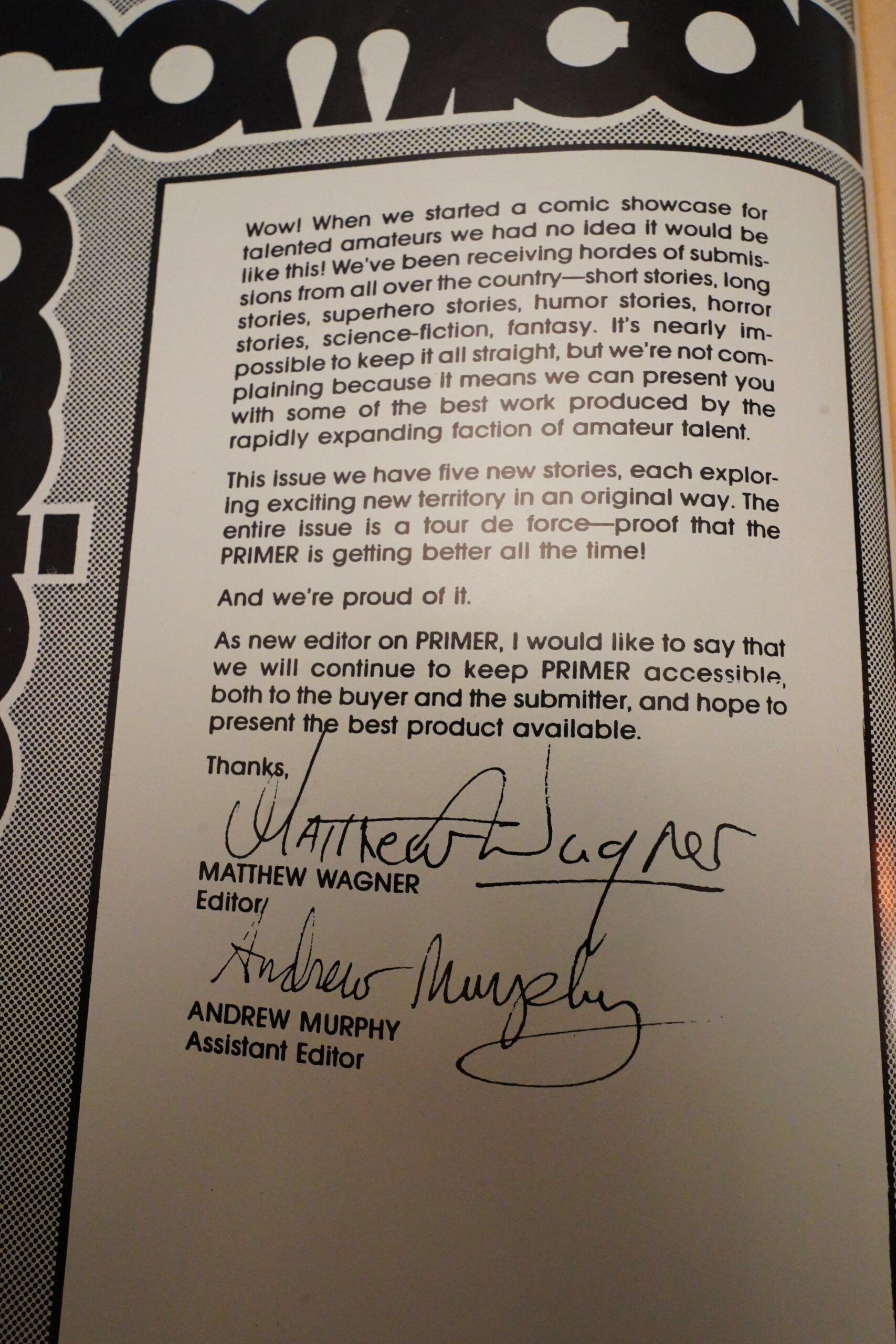
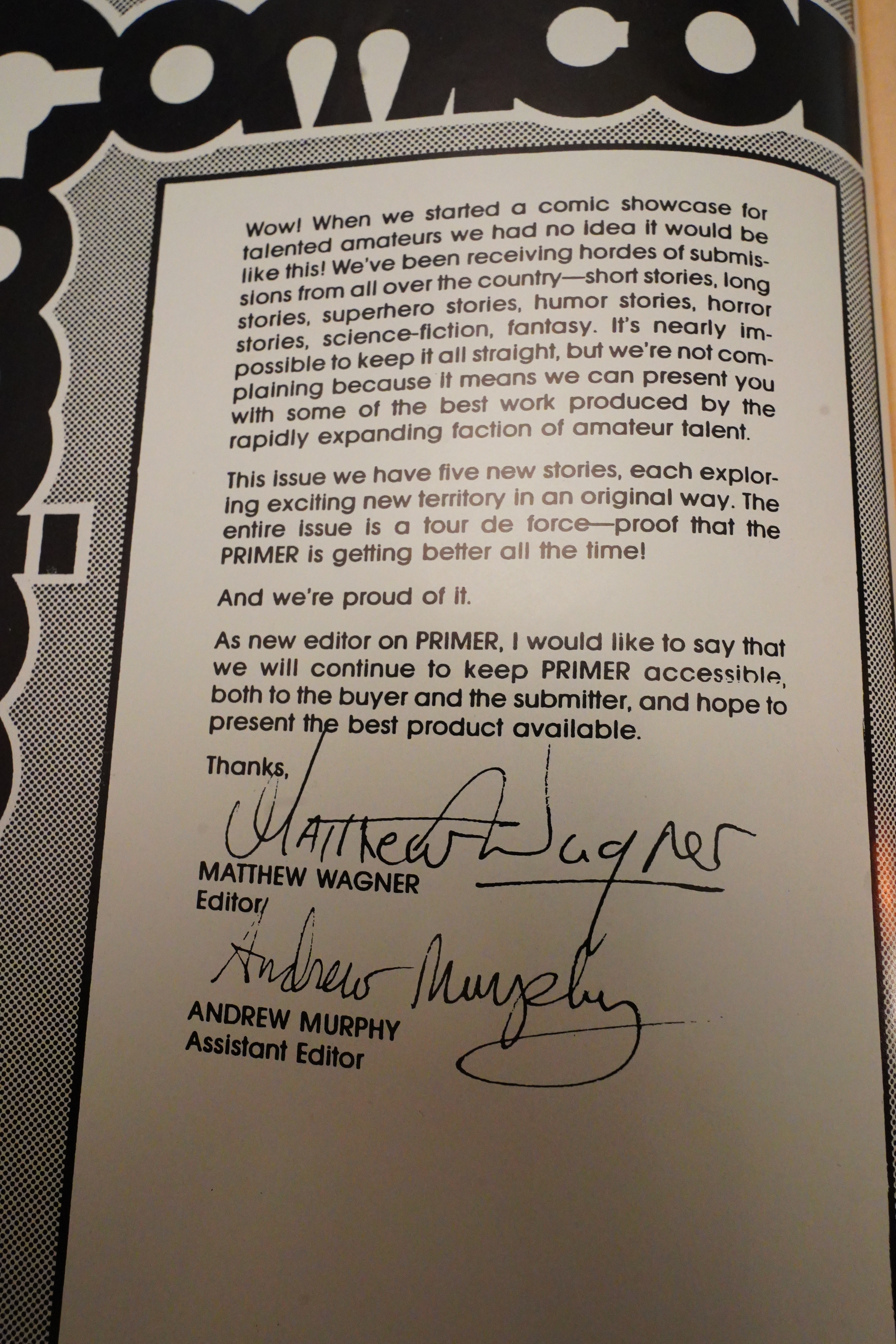
And then Matt Wagner takes over as editor! Perhaps things will get better now…
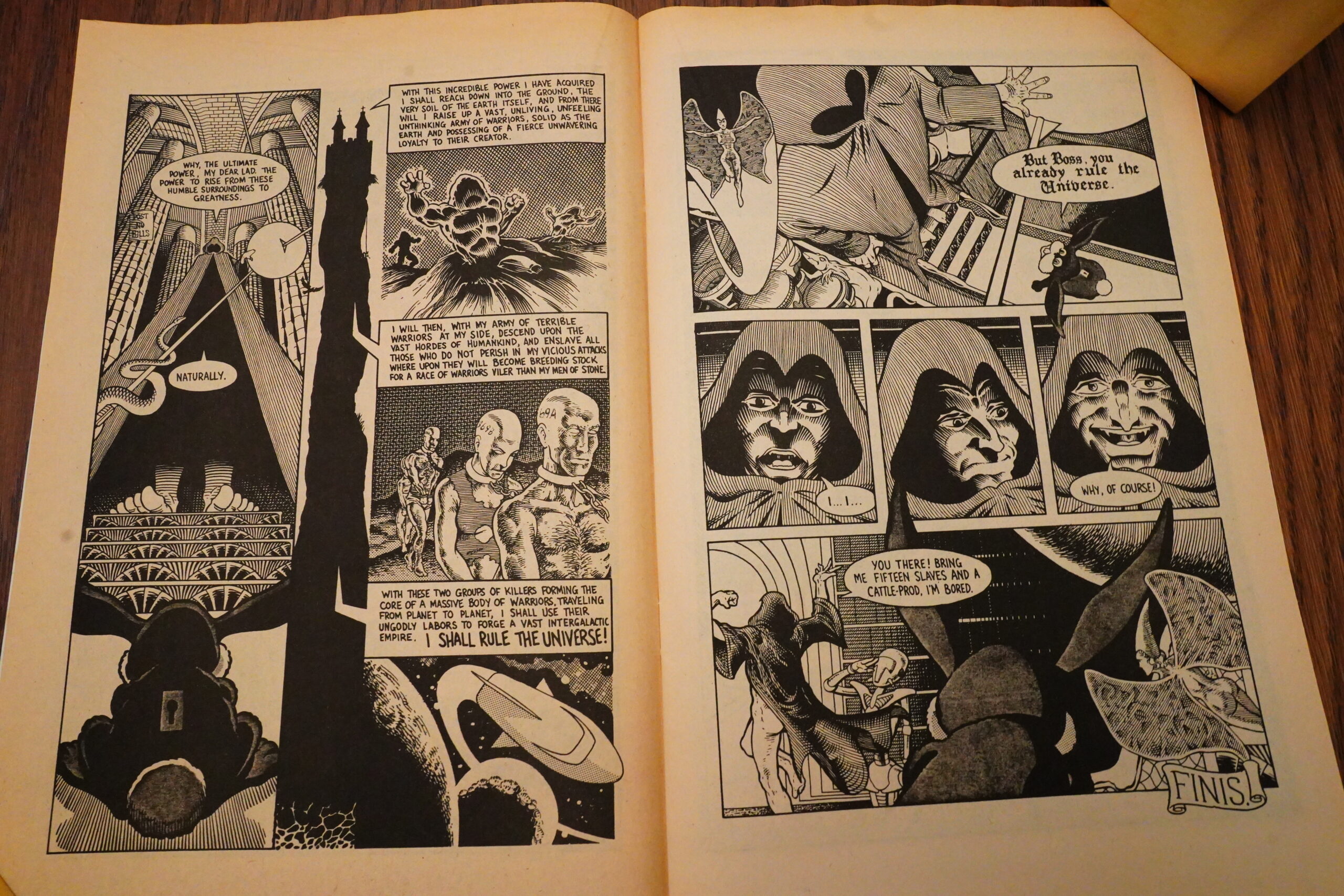
Bill Anderson returns with a little jokey piece.
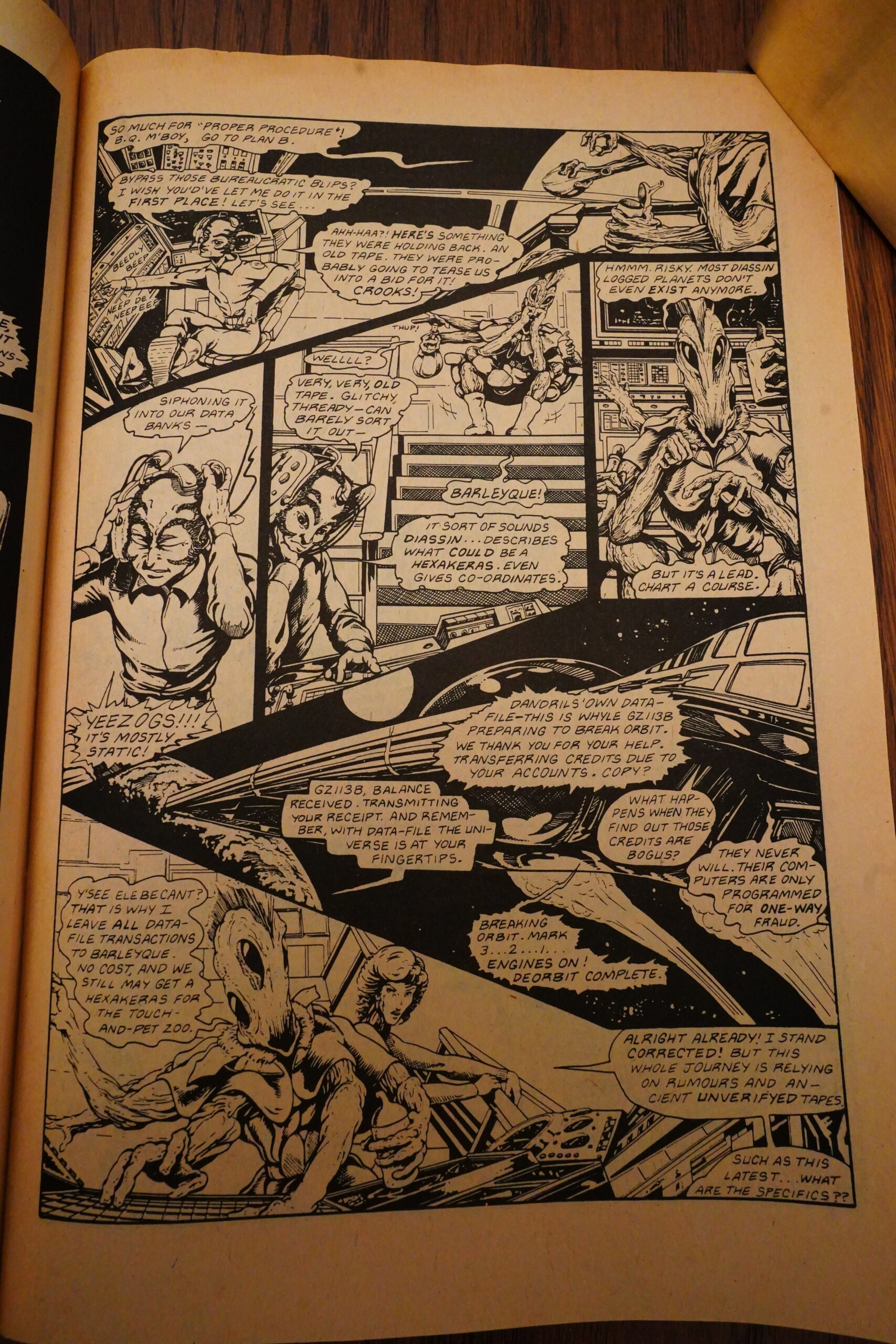
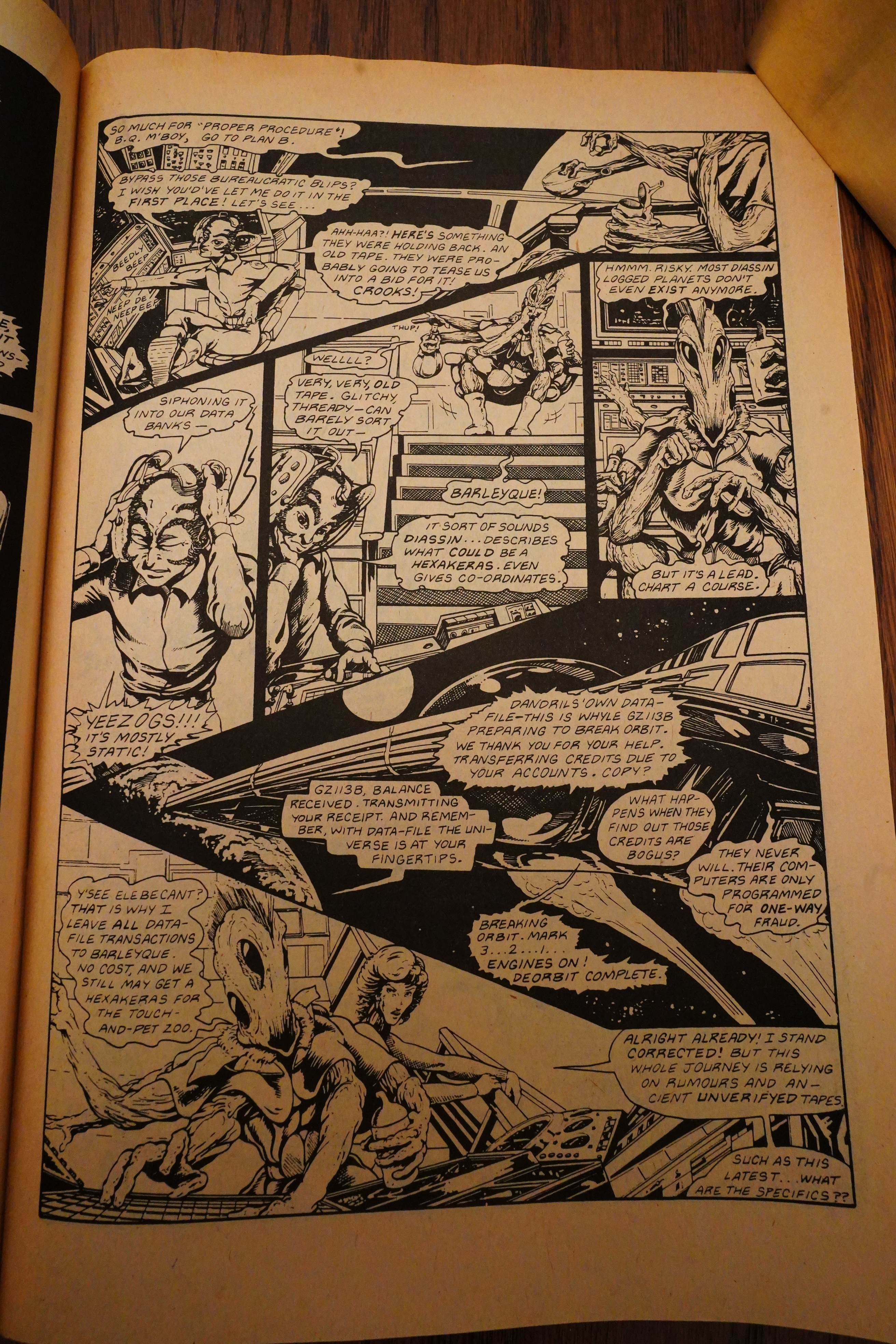
Bernie and Barb Armata does a headache-inducing science fiction thing. I really don’t mean to be so negative to something probably made by high school kids — the rendering here is pretty good, but it’s just unreadable.
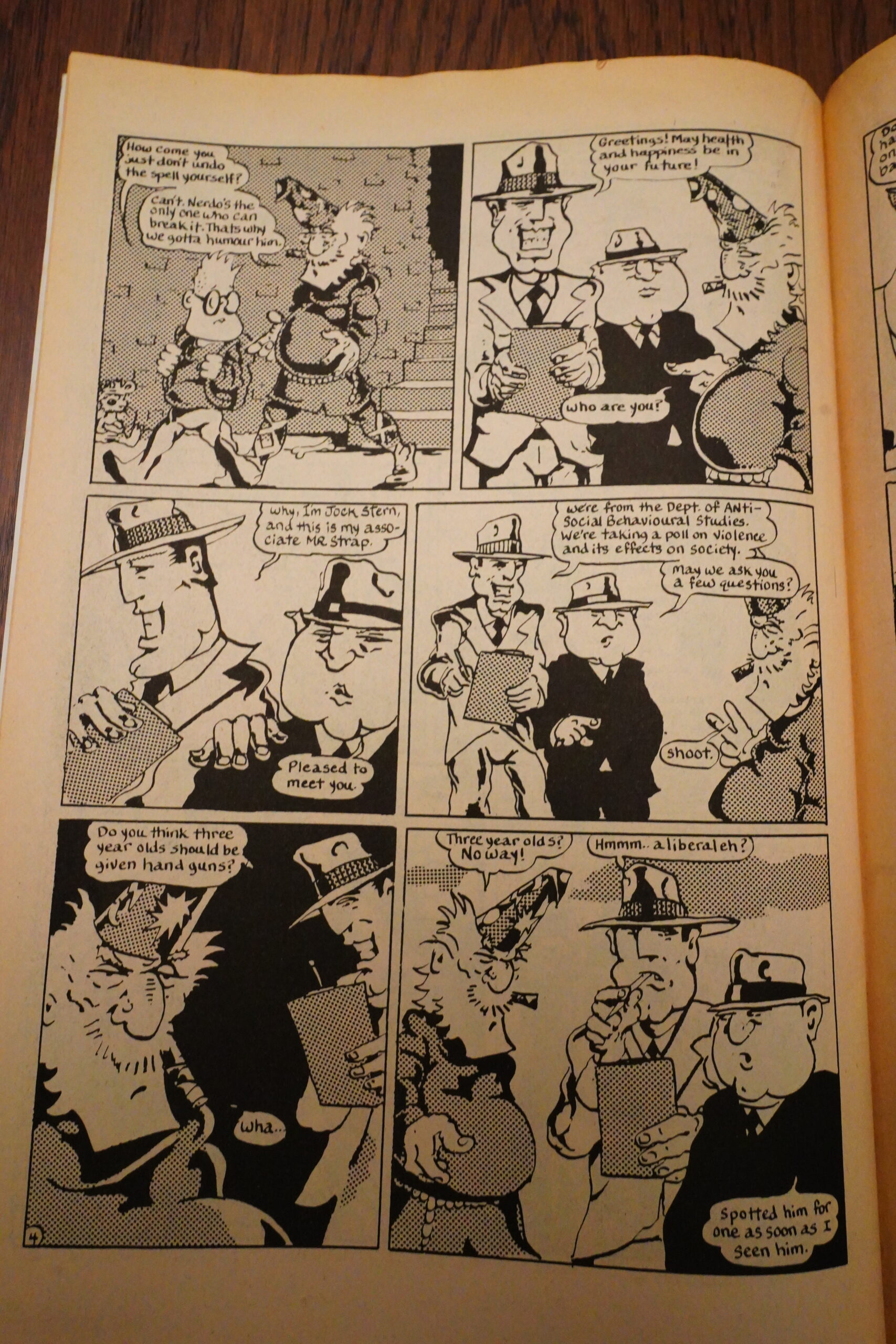
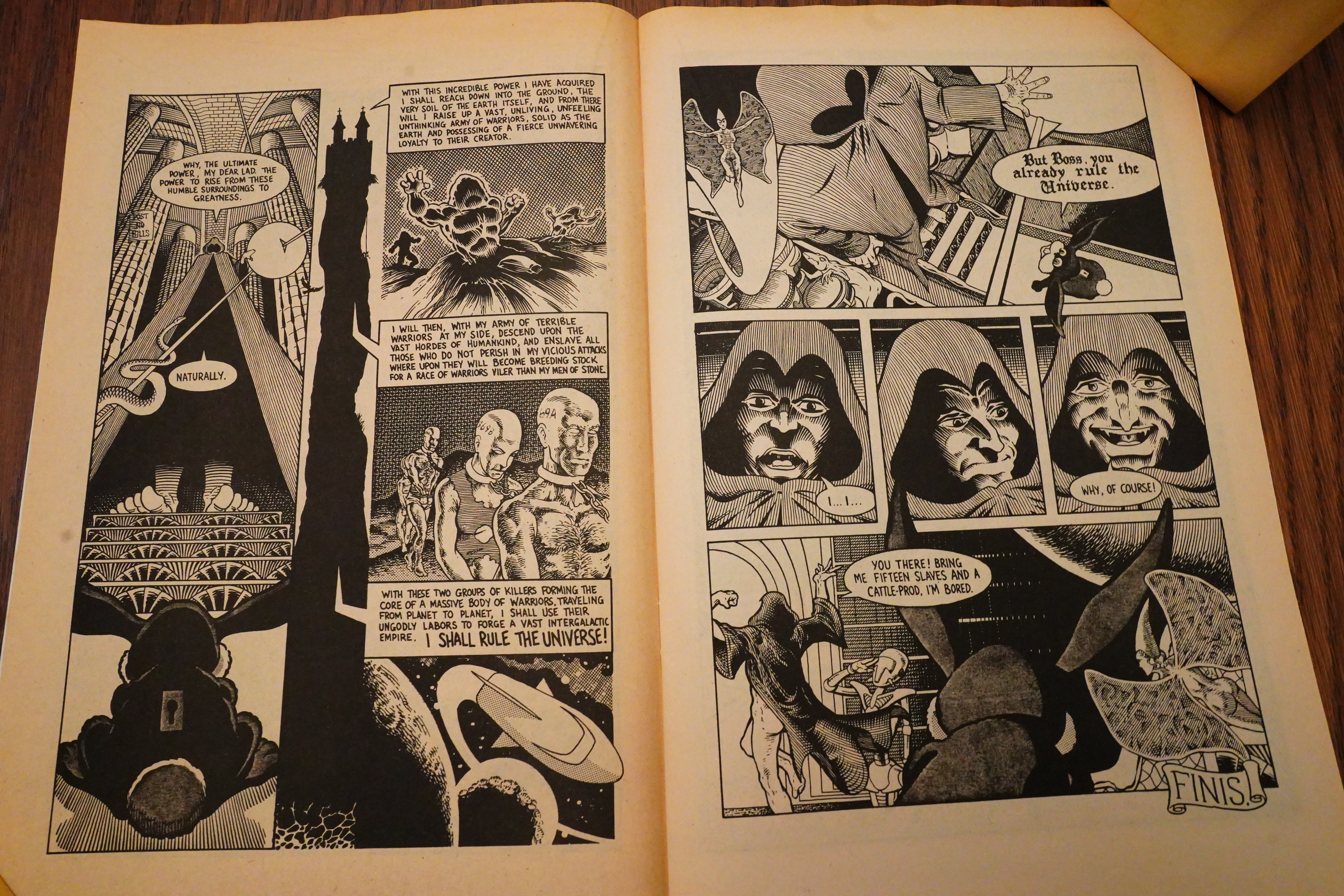
Larry Nadolsky’s thing is better… but the jokes are pretty weak.
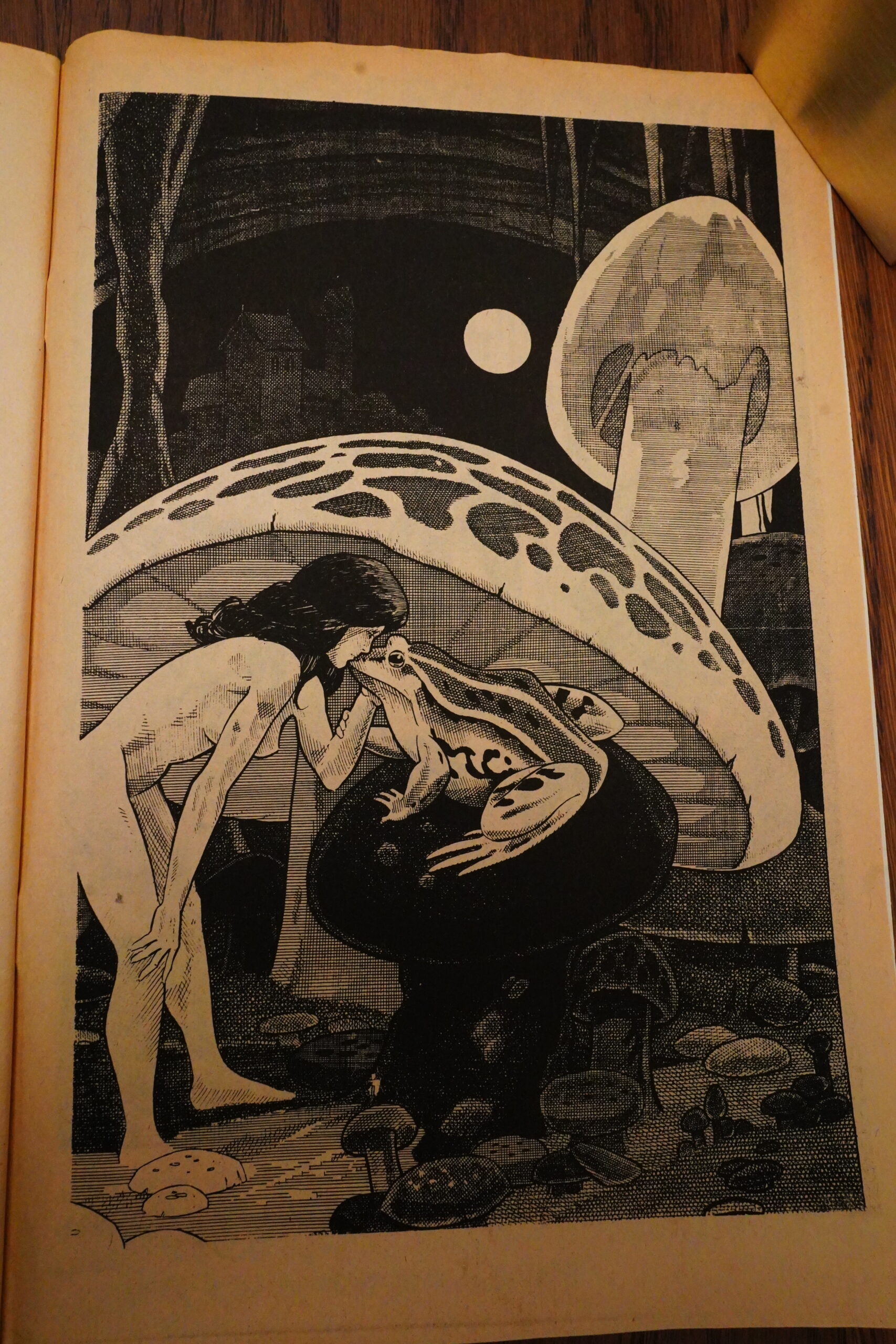
Ron Kasman’s pin-up here is the best thing in the issue.

So… Wagner taking over didn’t really help much.
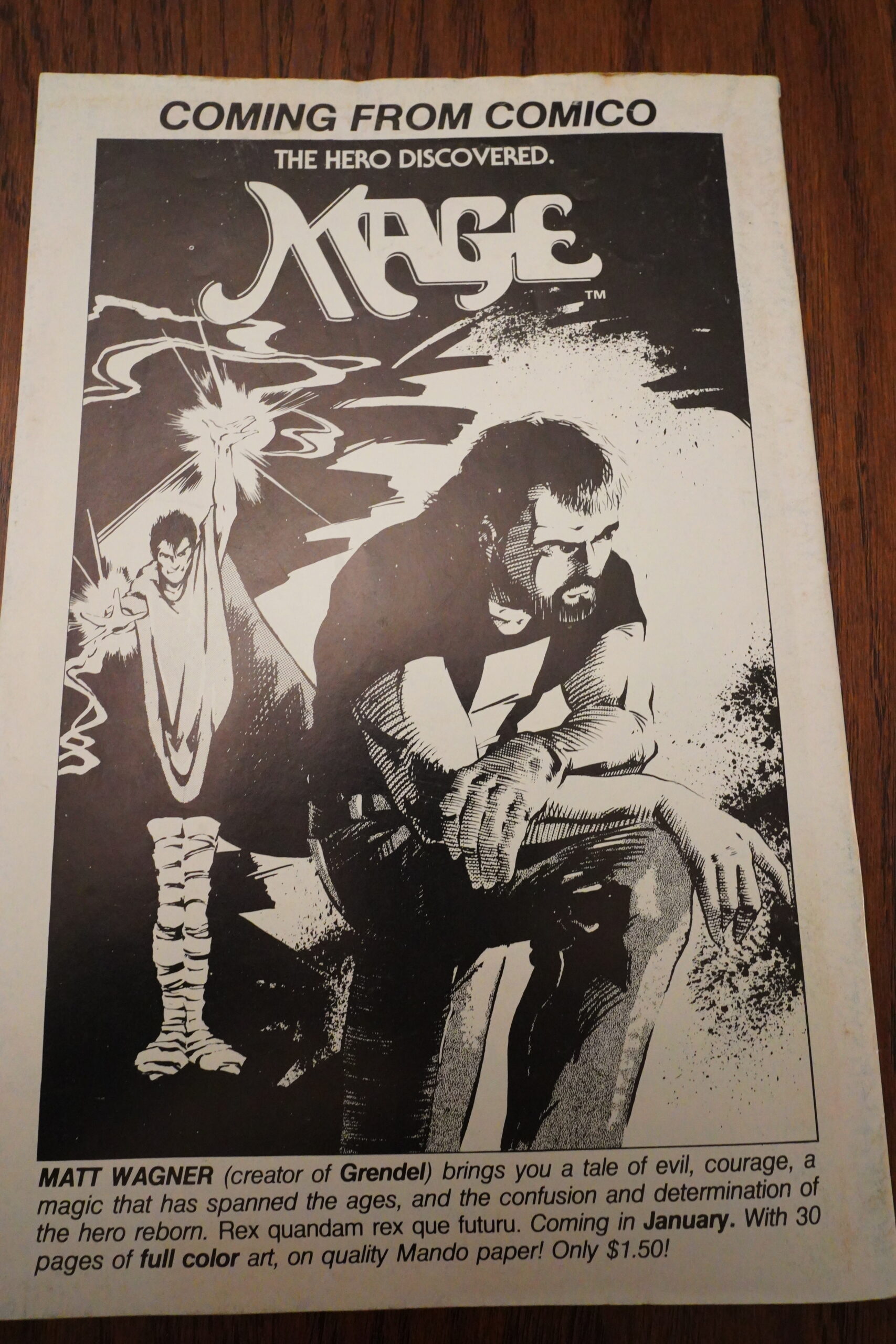
And they’re already launching Mage? I thought that came later…
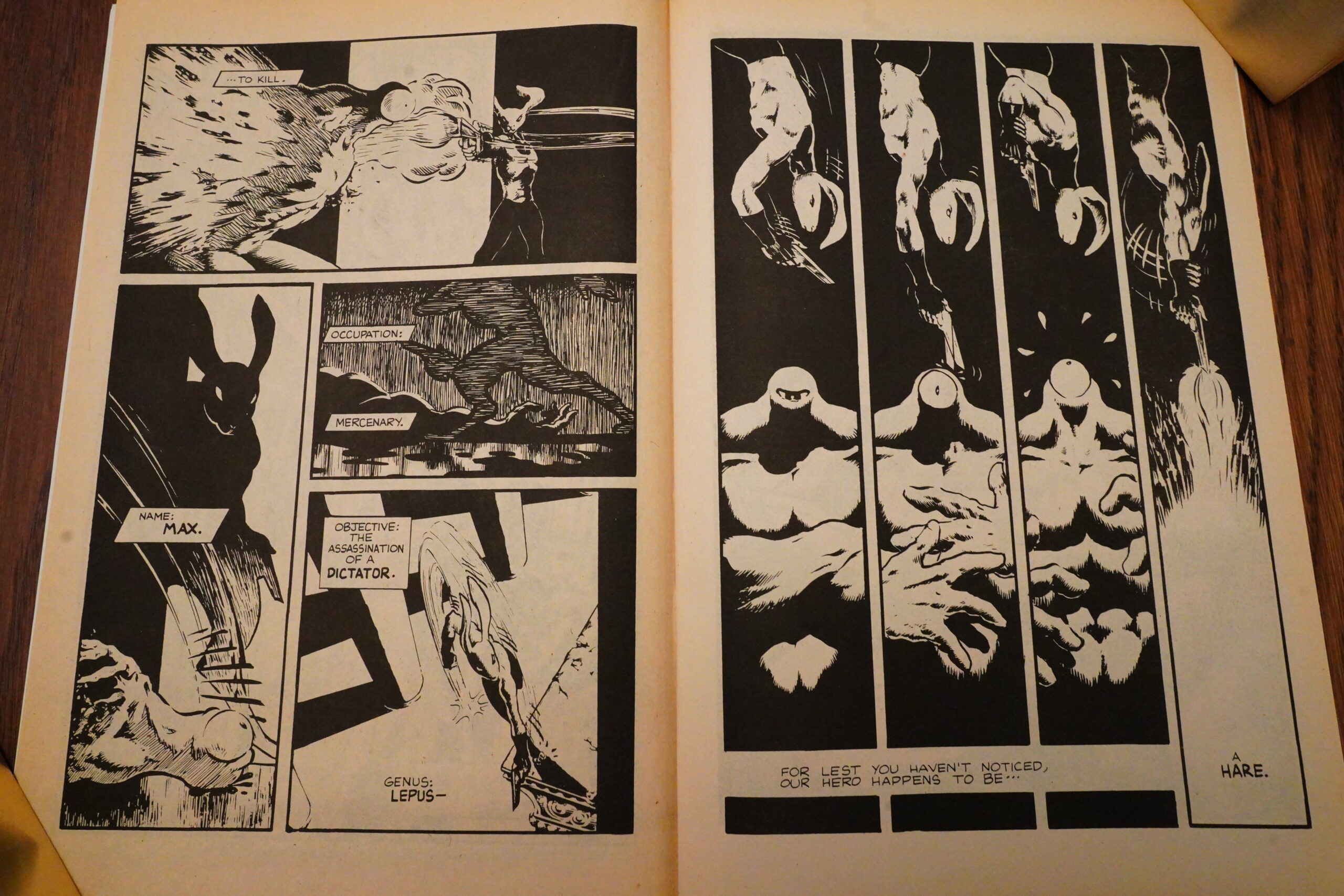
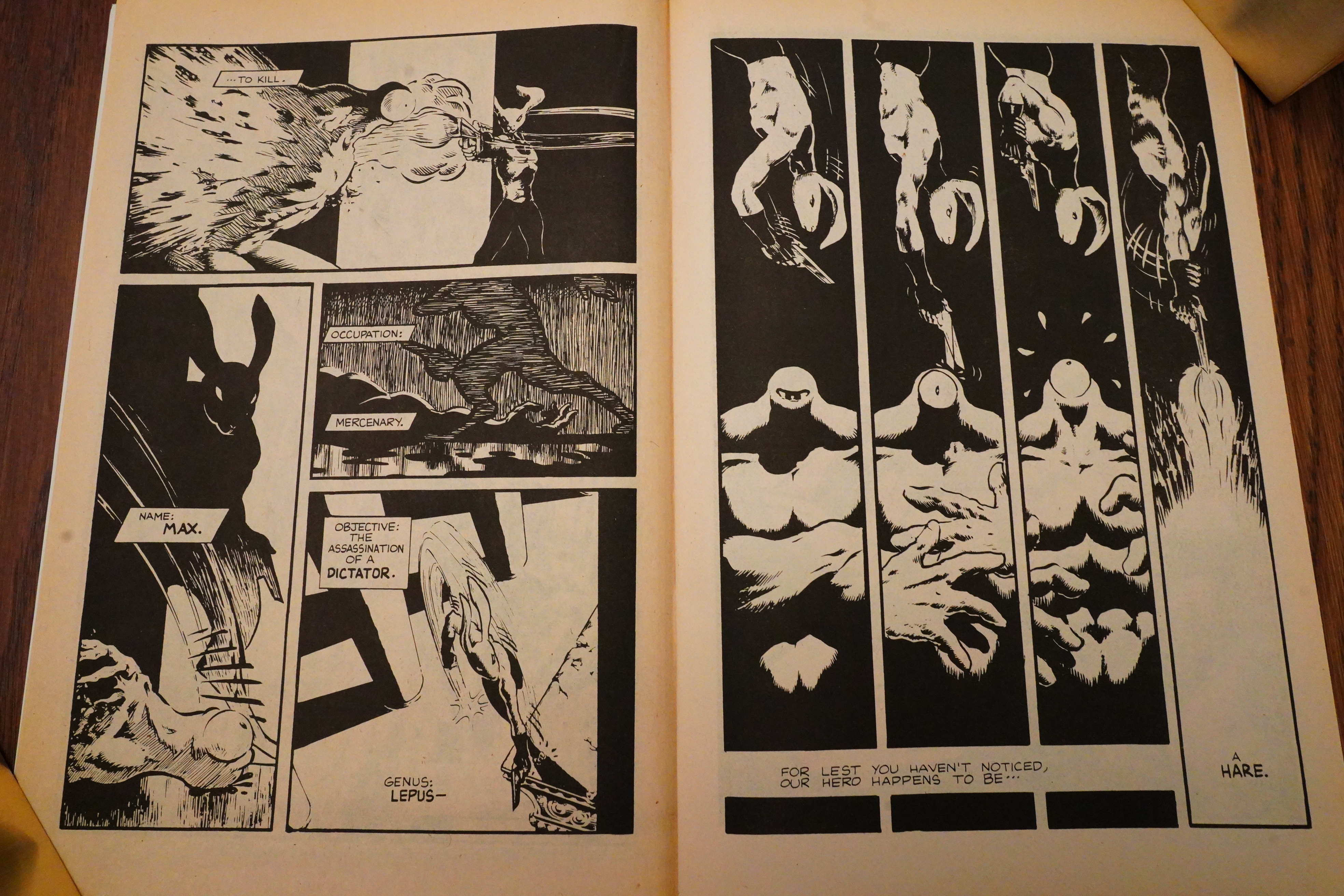
Max the Hare by Sam Kieth! Well, The Maxx is a rabbit, sort of, so I think this is a sort of prequel to The Maxx, perhaps? Kinda? Sorta?
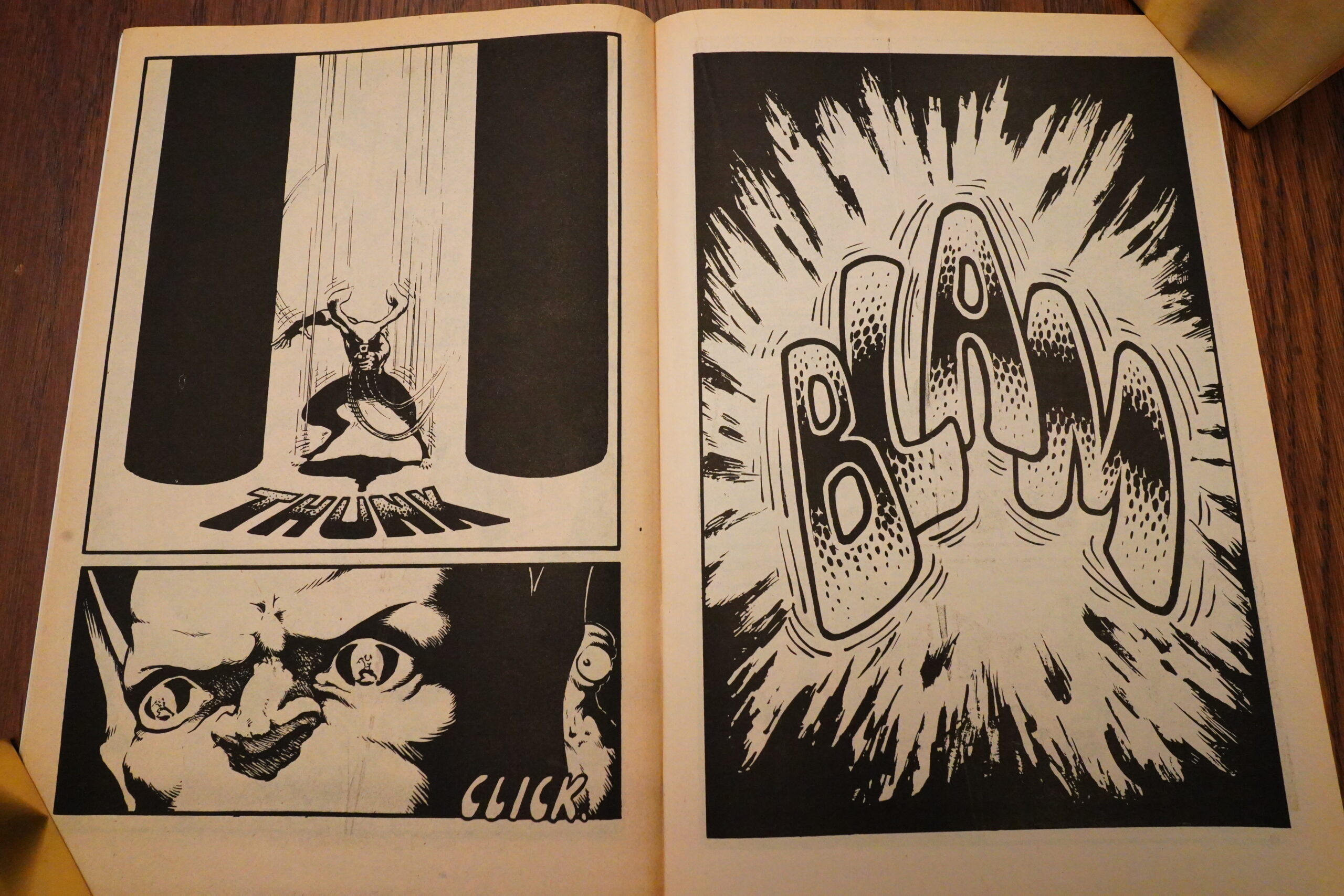
It’s pretty stylish, but doesn’t really go anywhere.
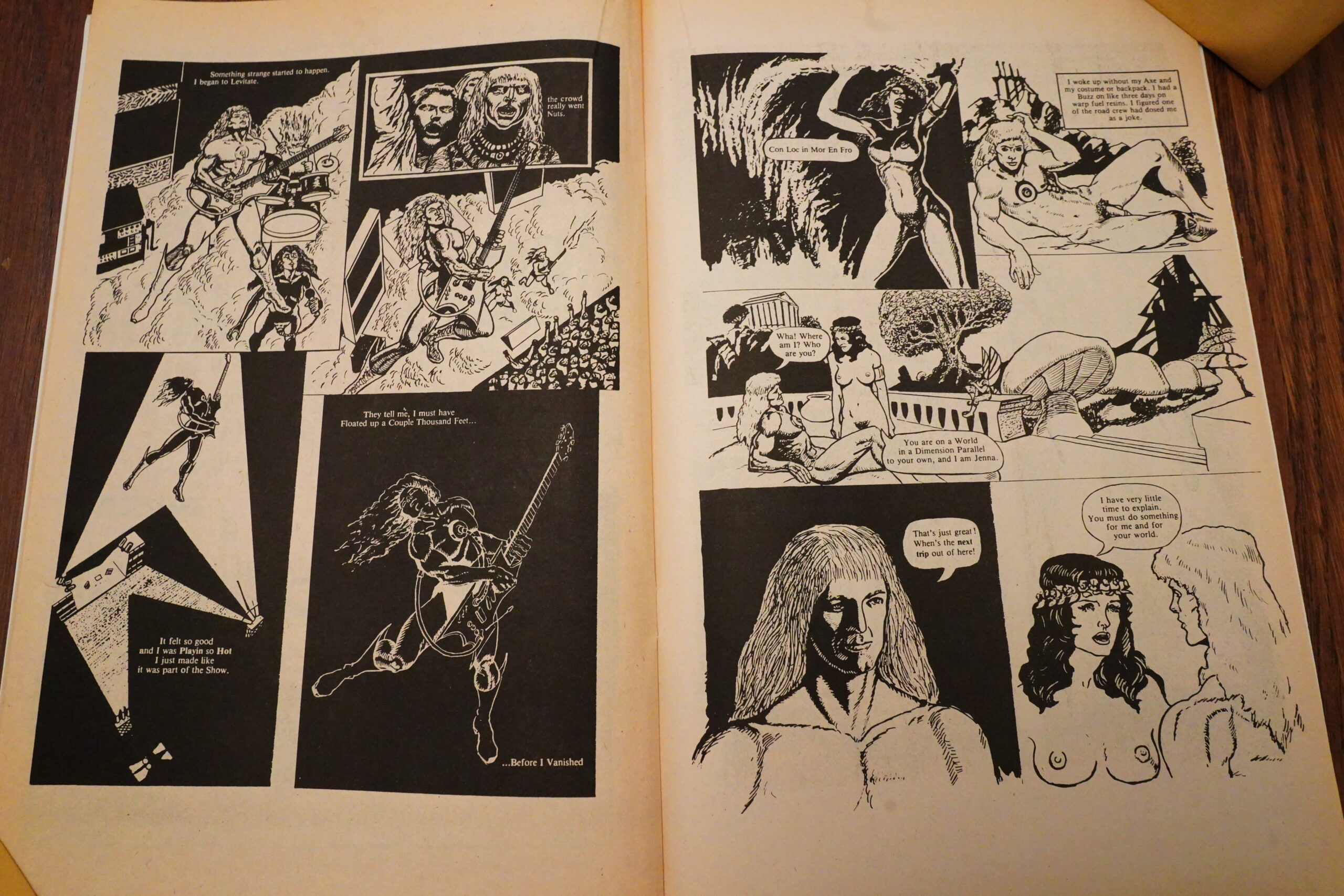
Will Brown did the pretty good cover, but his artwork here is pretty basic.
This looks pretty OK, but again, it doesn’t go anywhere.
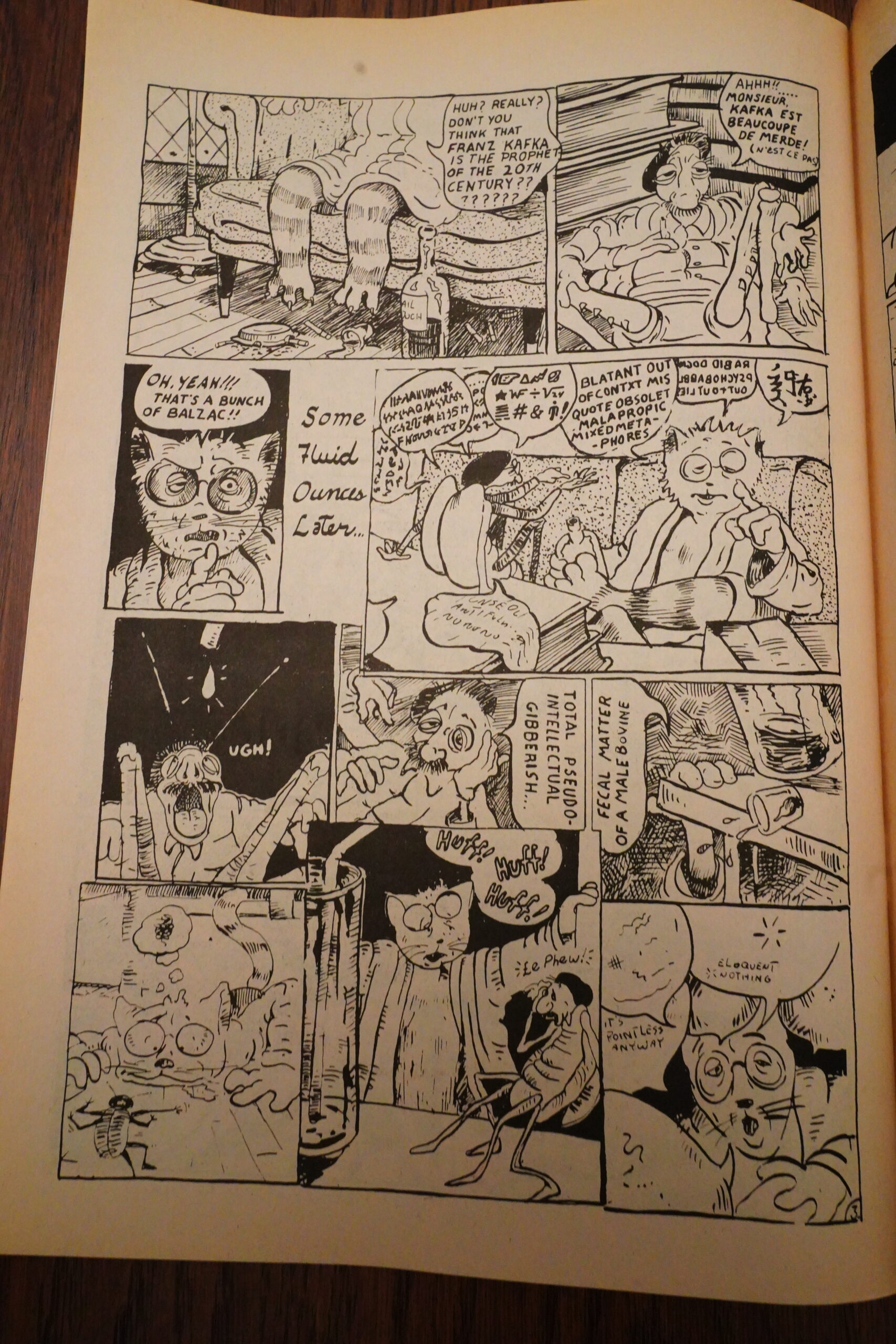
Chris Windle and Alan Mclaughlin’s thing is chaotic, but pretty successful.
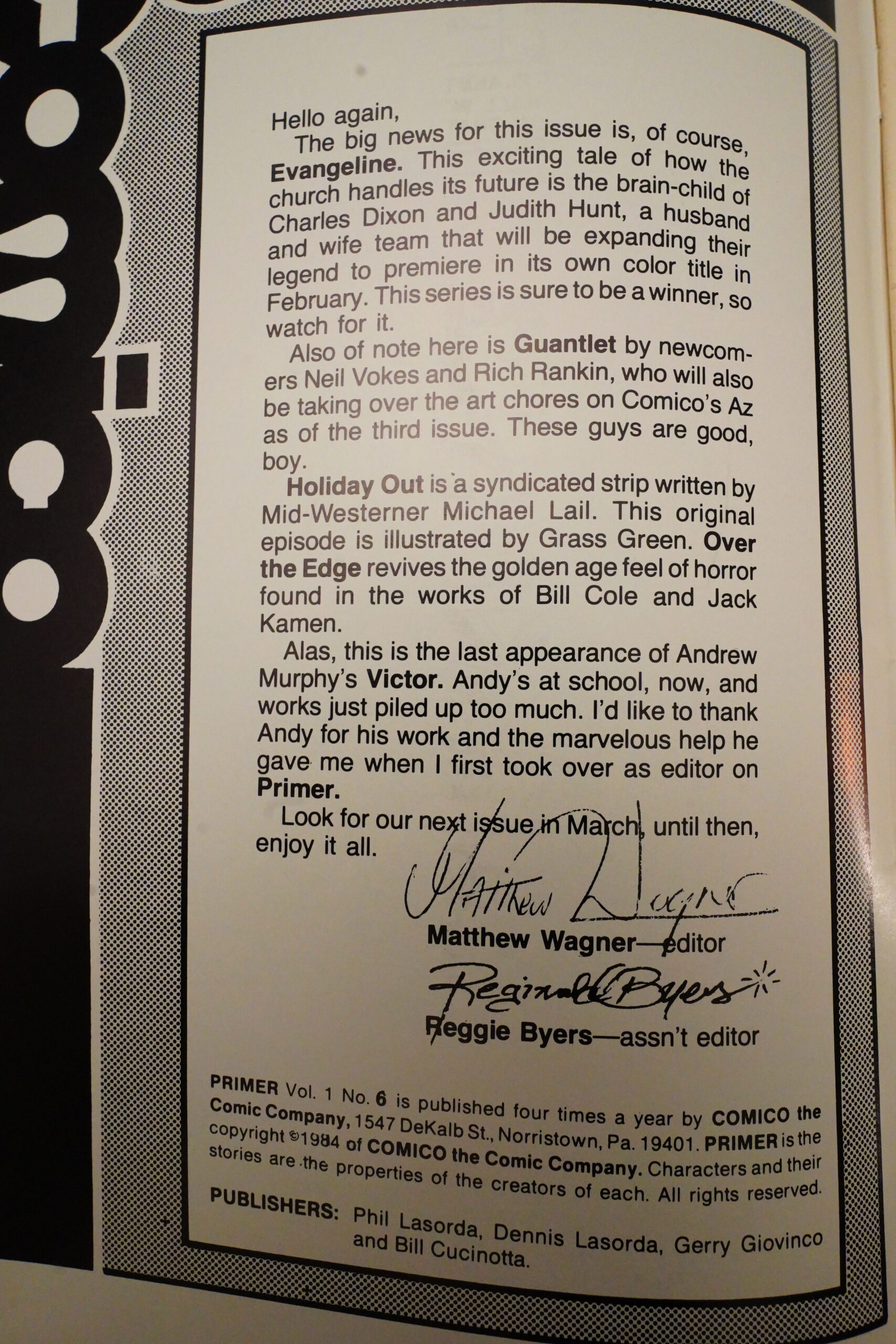
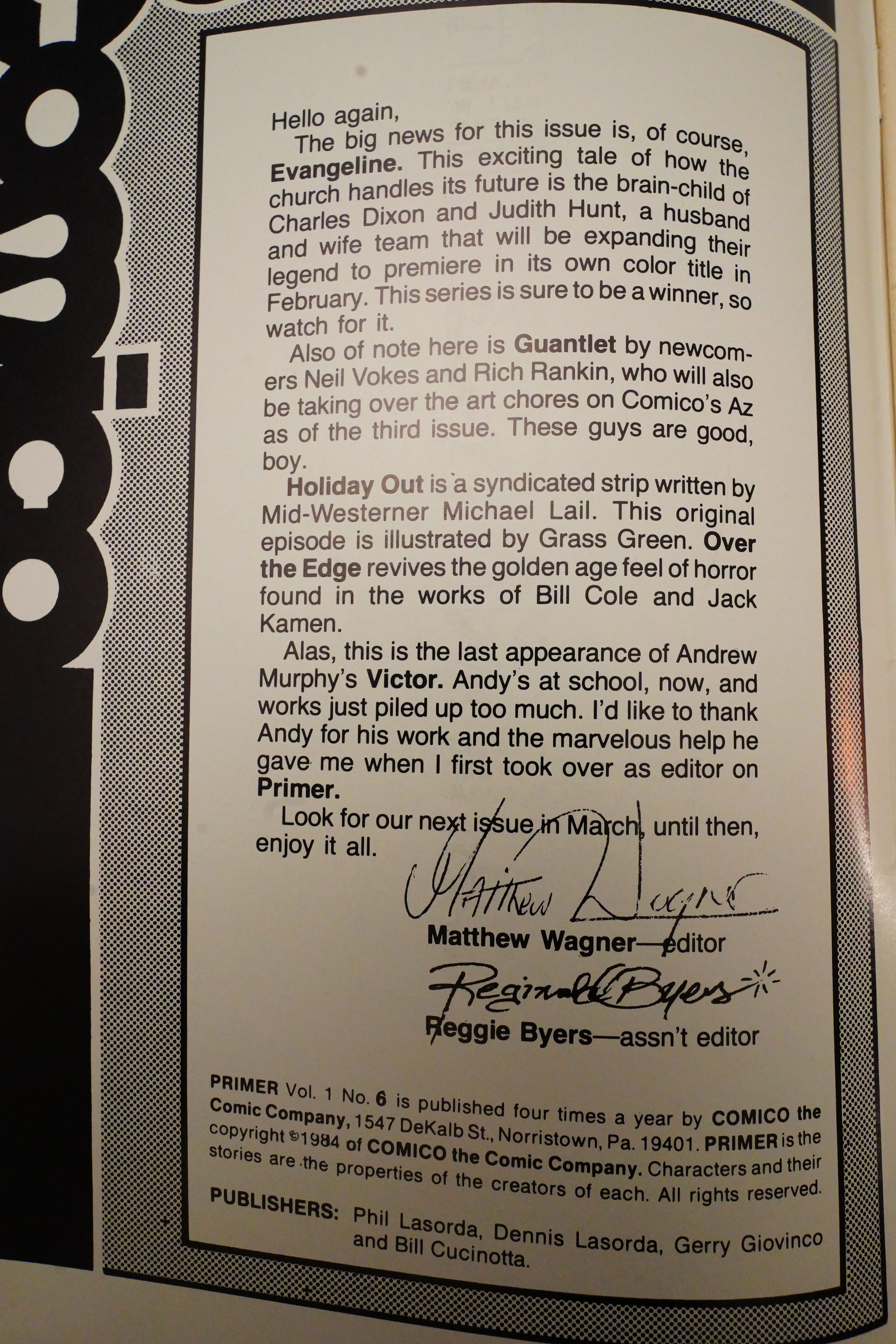
The editorial of the final issue doesn’t really intimate that the series has been cancelled…
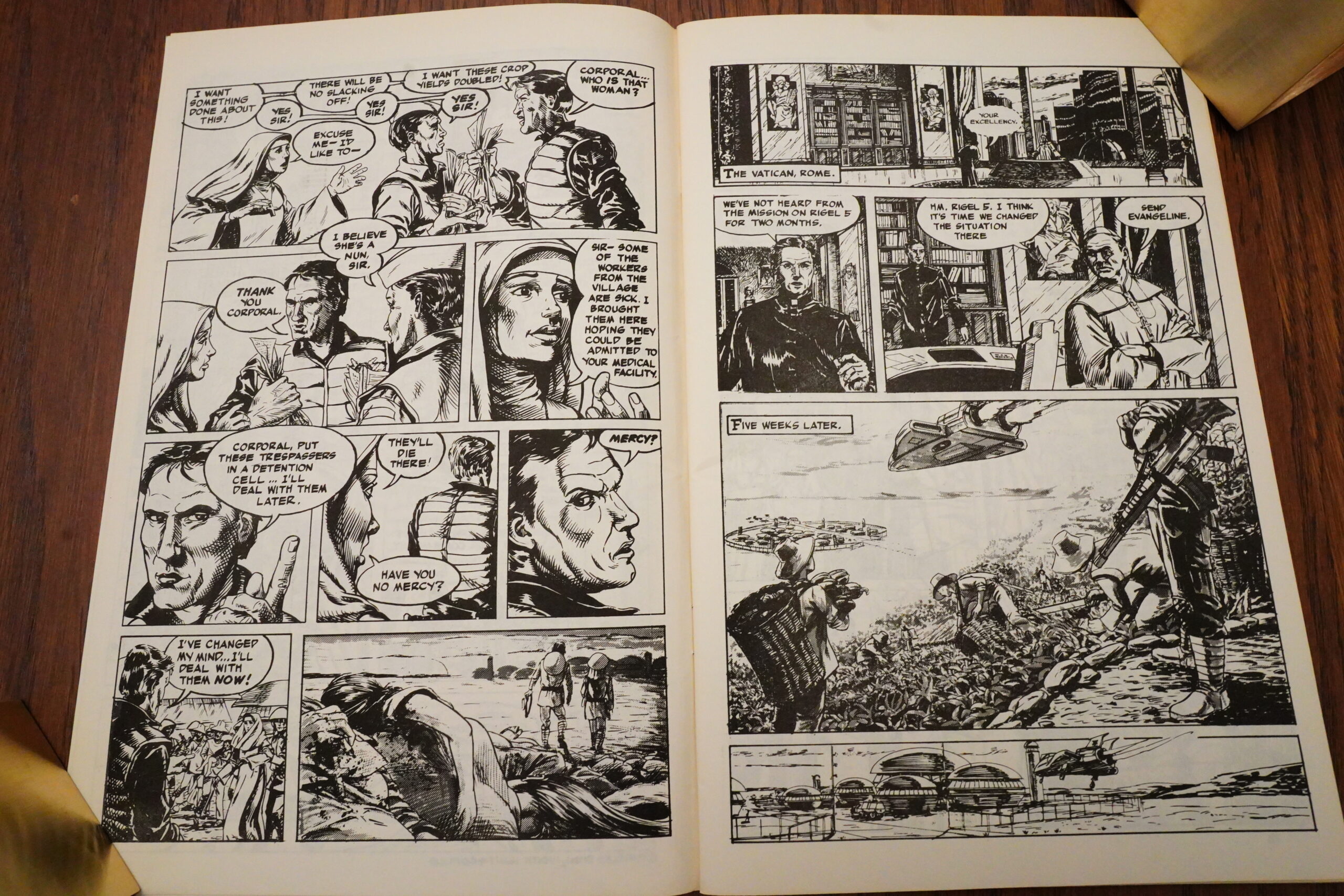
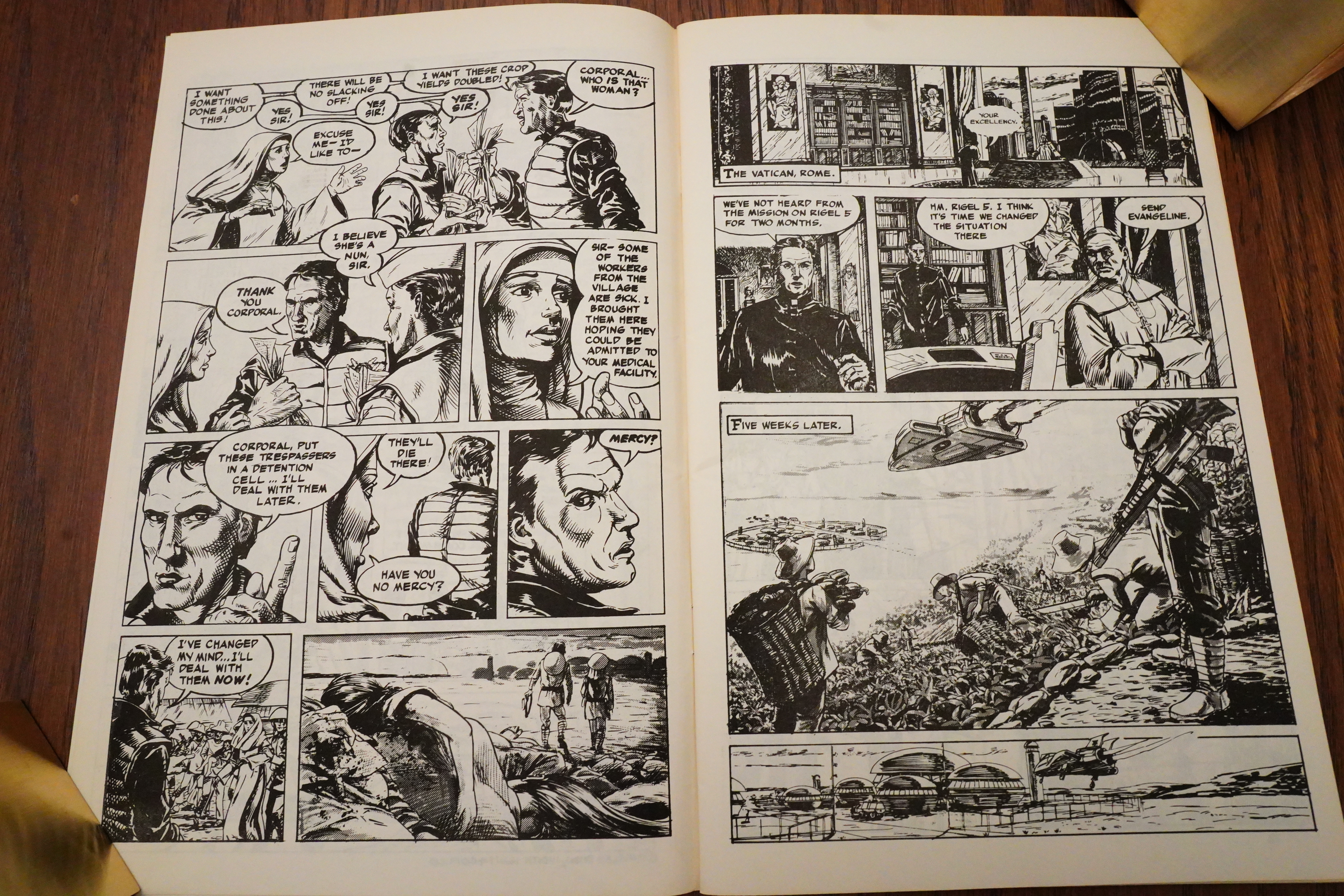
But it’s printed on better paper, and it has the first appearance of Evangeline by Charles Dixon and Judith Hunt. It’s an actual, proper story and all — perhaps the first to appear in the series?
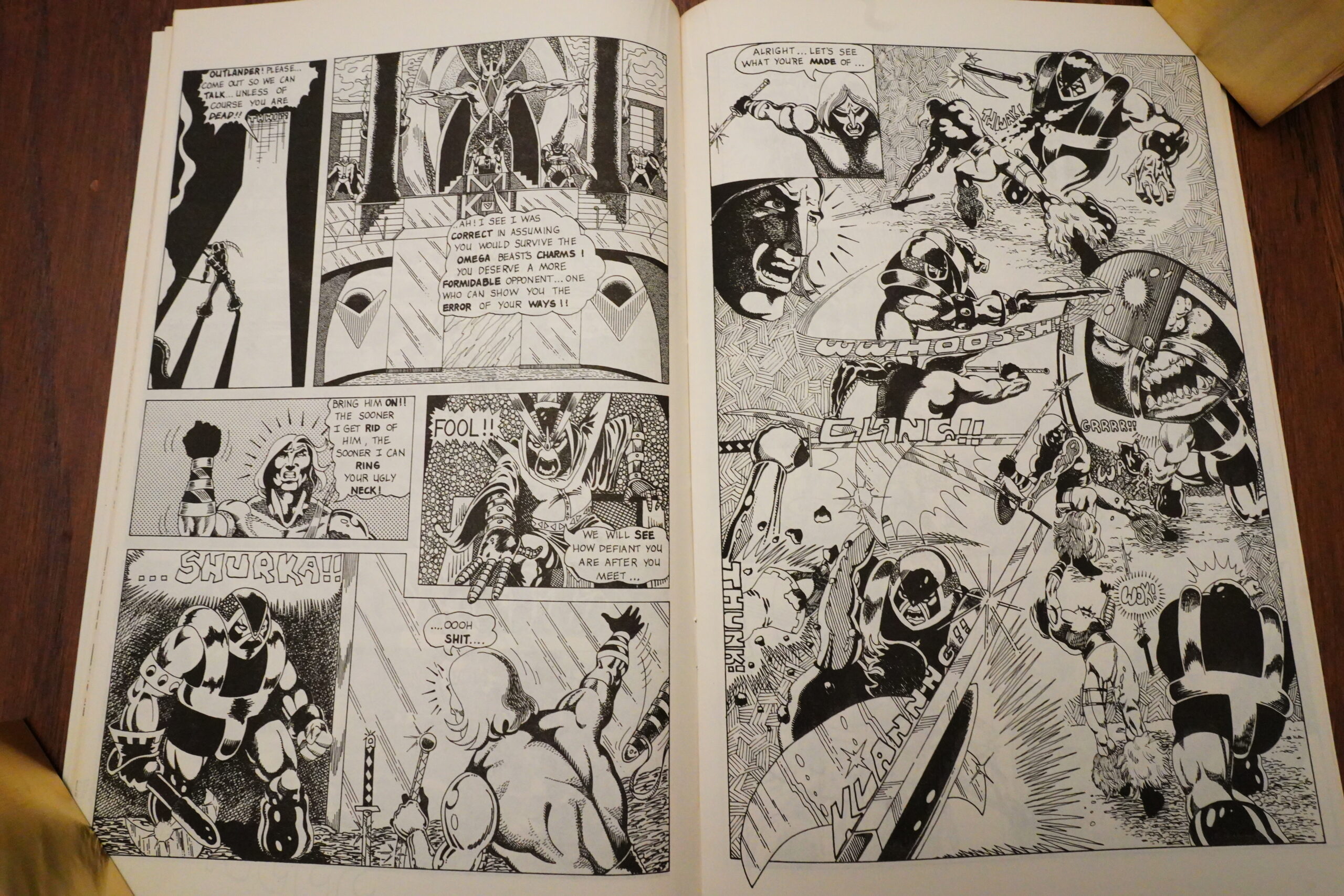
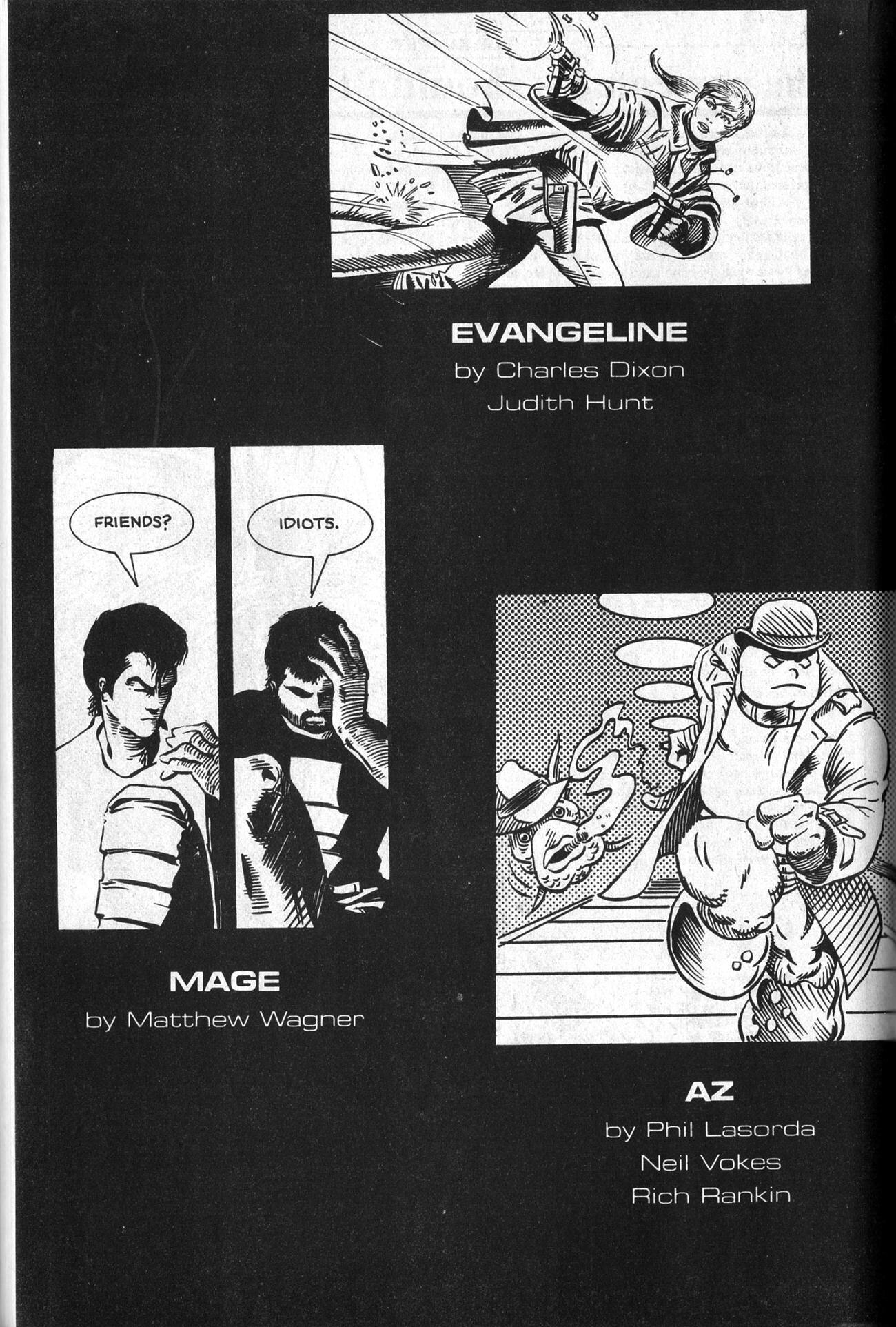
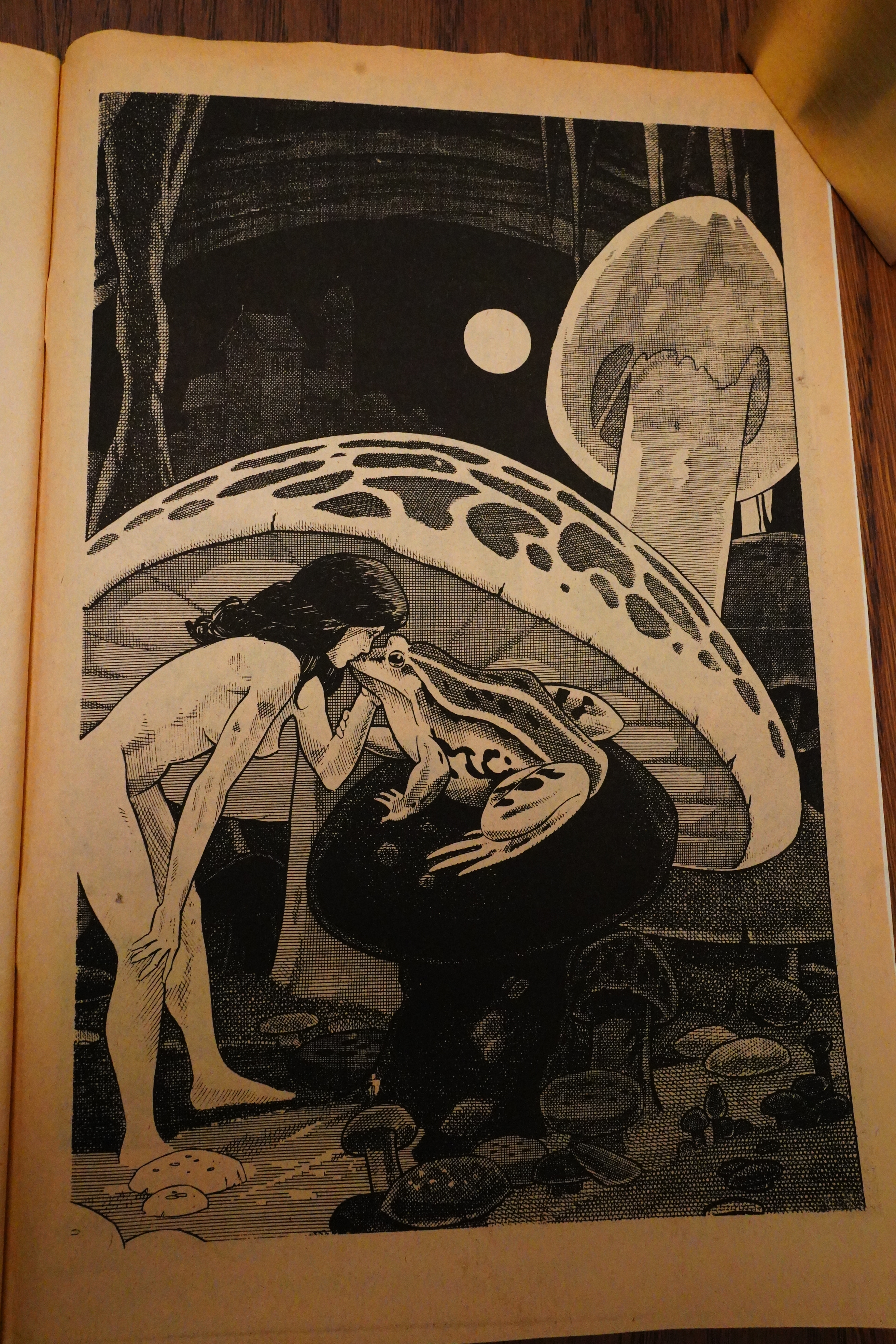
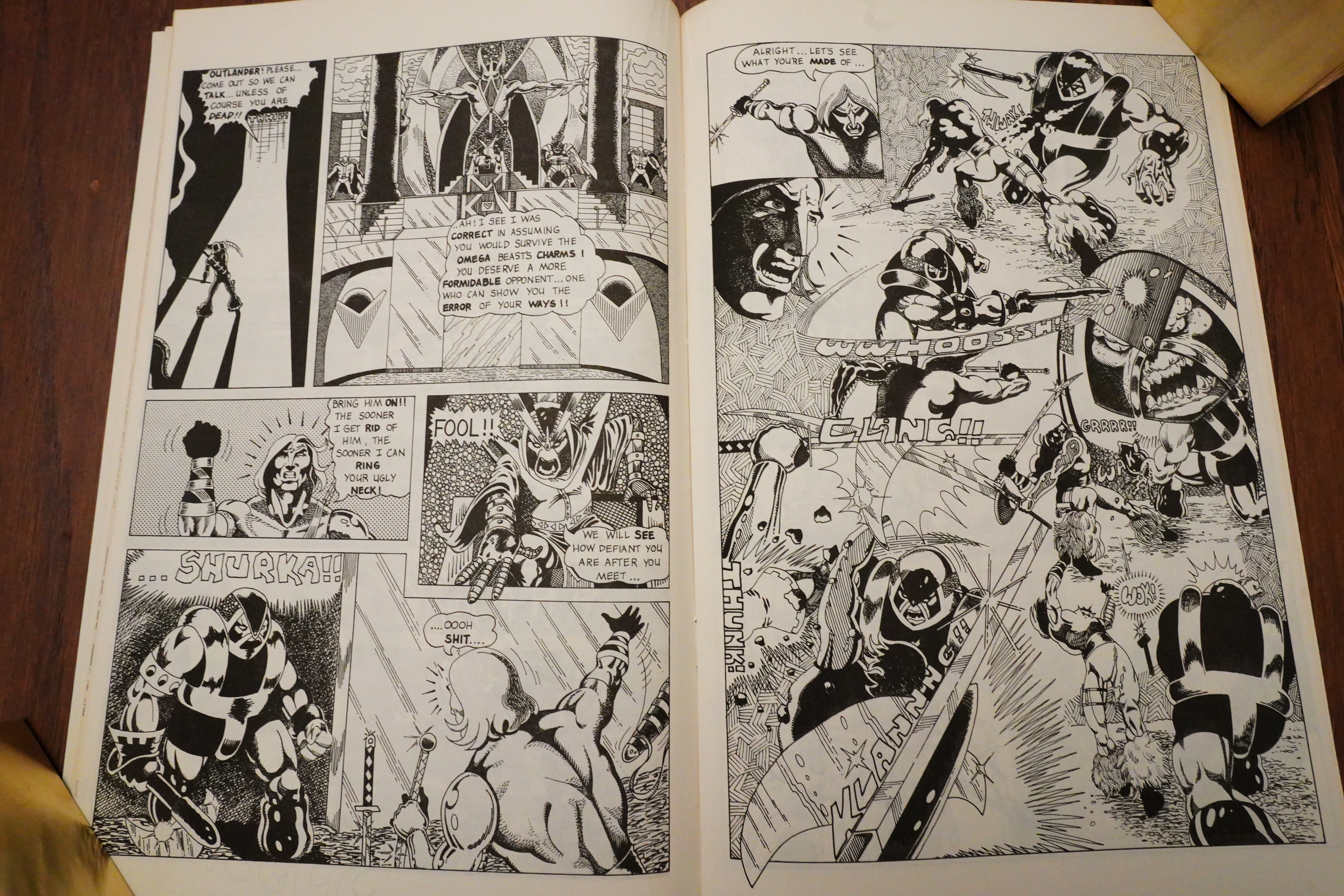
And the last one. Neil D. Vokes and Rich Rankin’s thing is… what you see above.
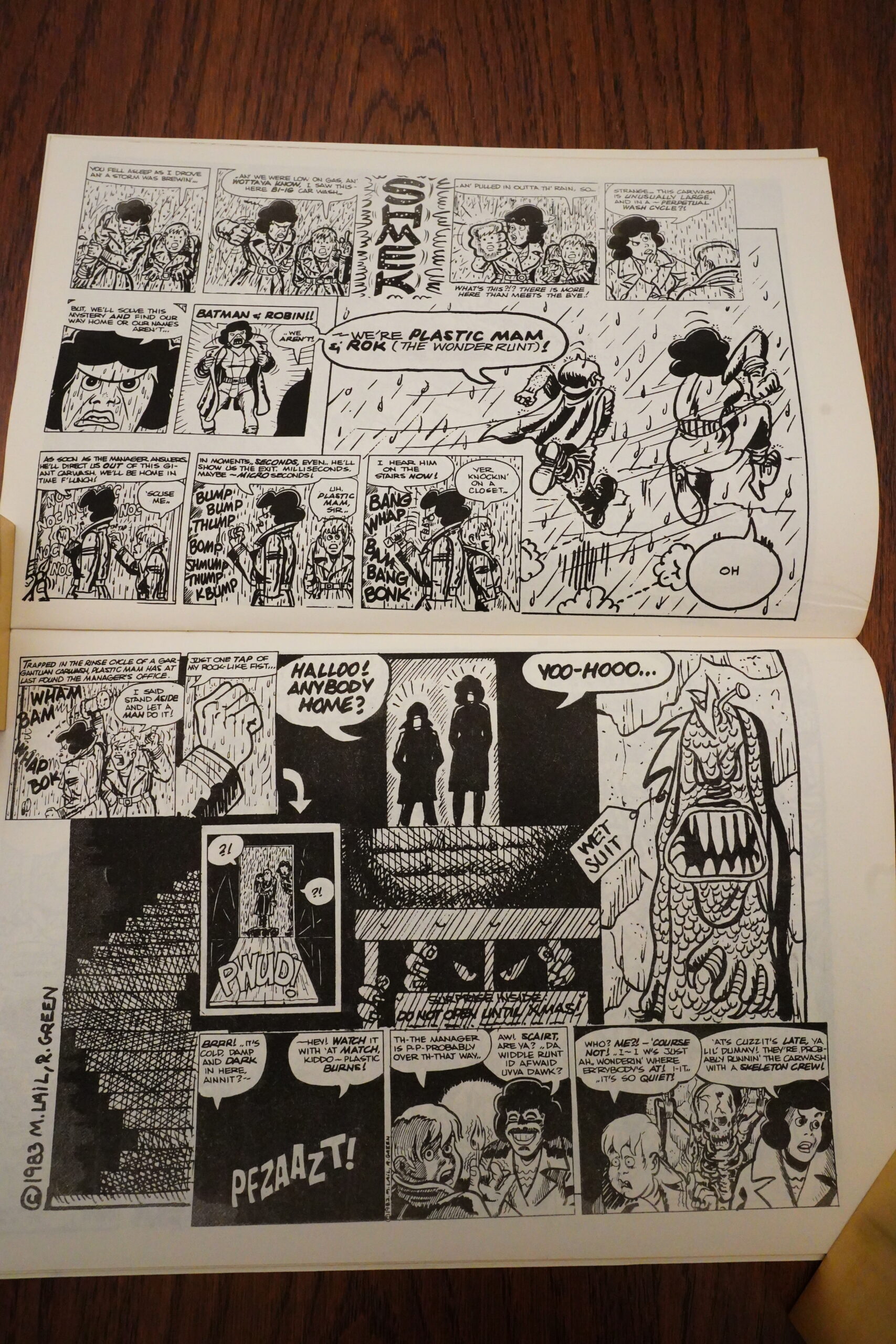
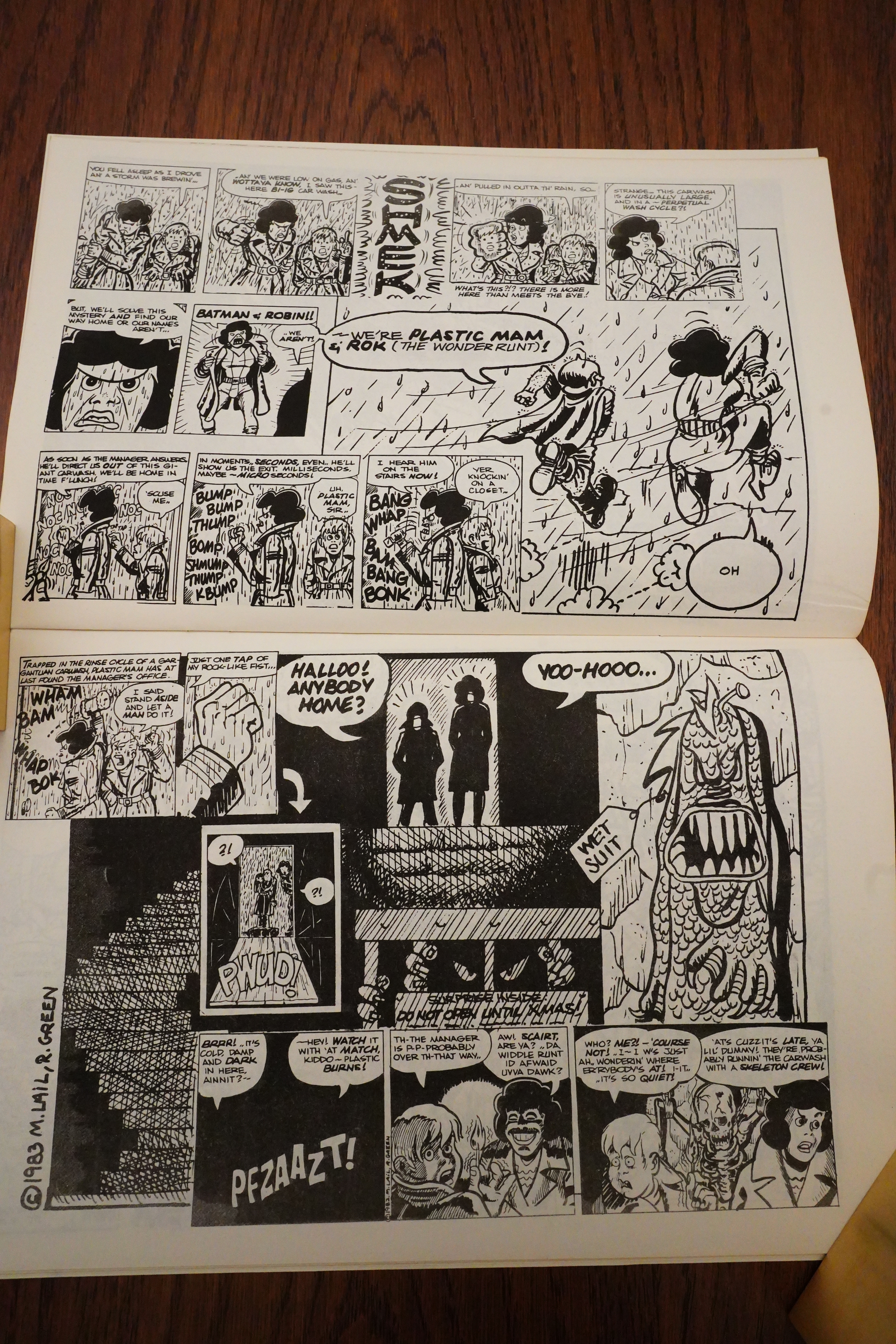
I was going to say “that looks a lot like Grass Green”, and then it is! Co-created with Michael Lail.
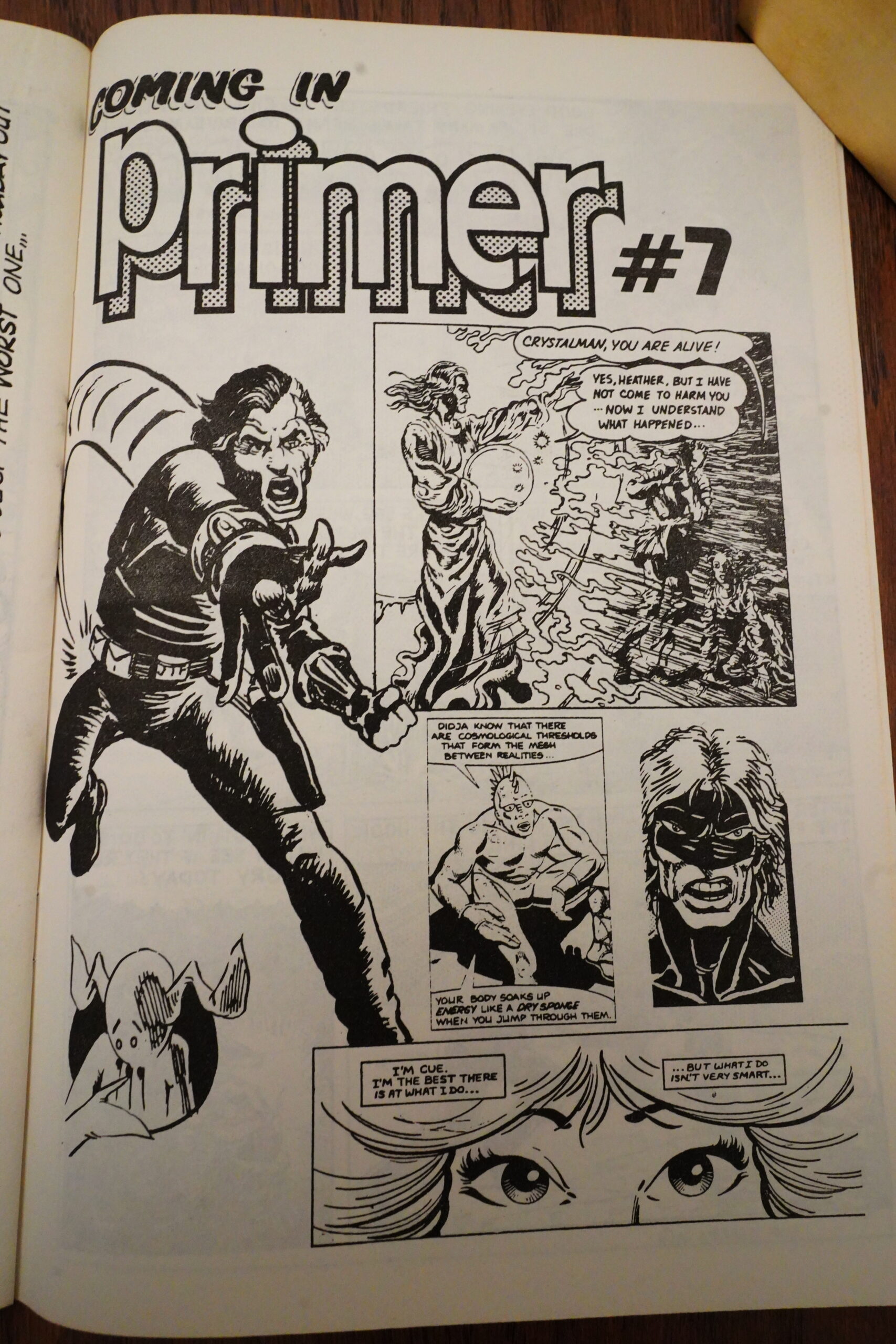
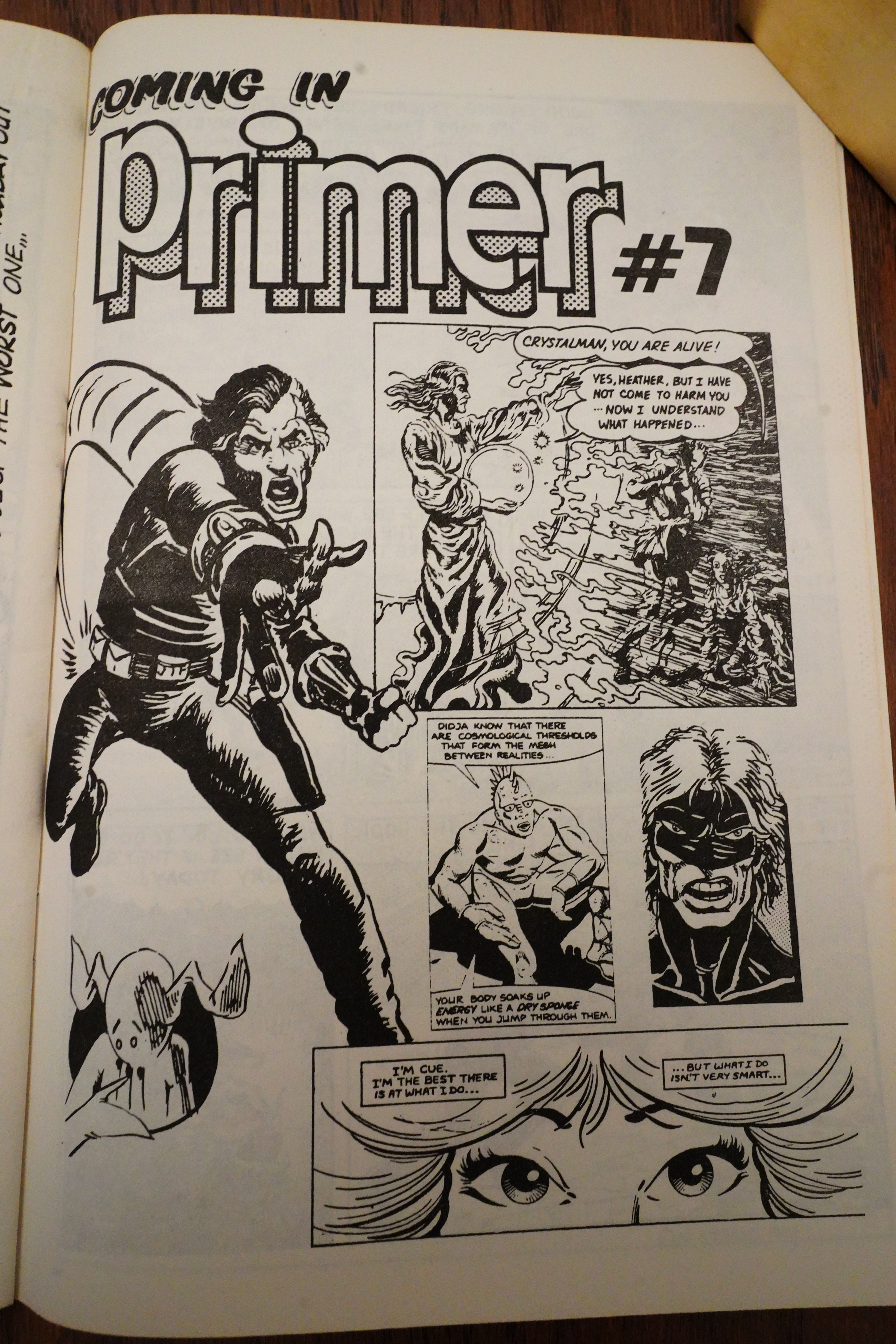
So they had the stuff for Primer #7 lined up? I think only one issue had a “coming up” page (other than this), which is pretty typical.
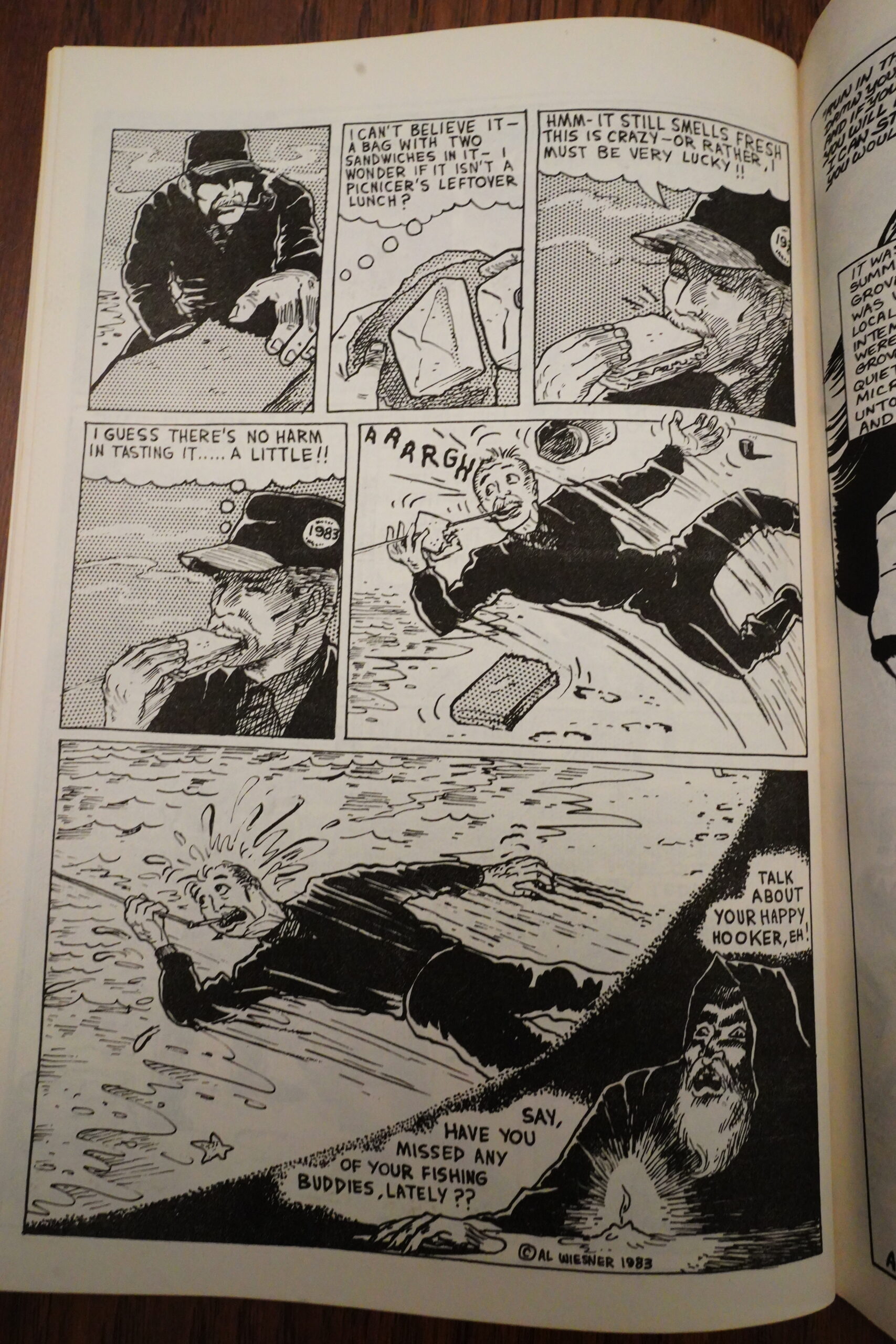
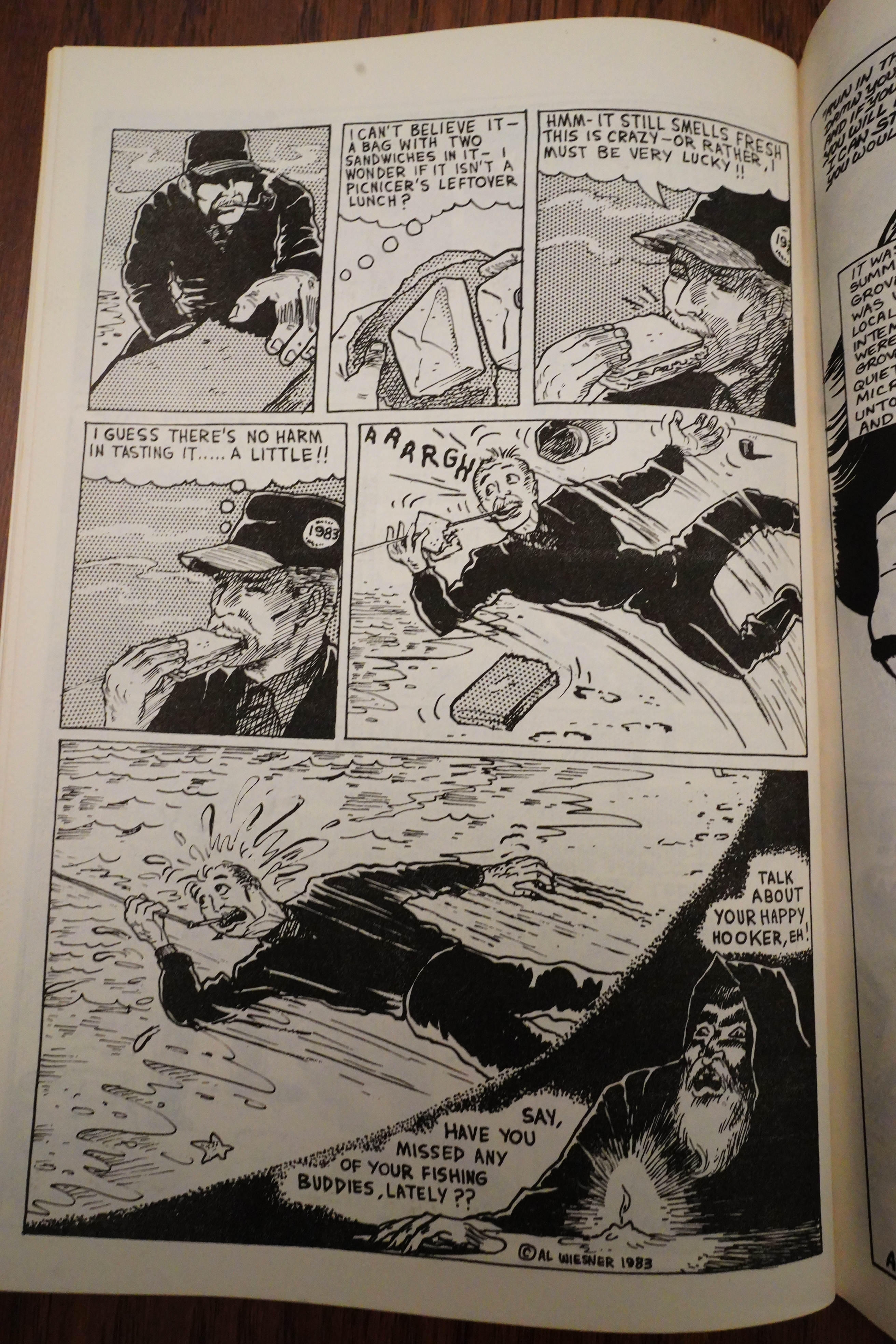
Well, that sort of thing happens. (Al Wiesner.)
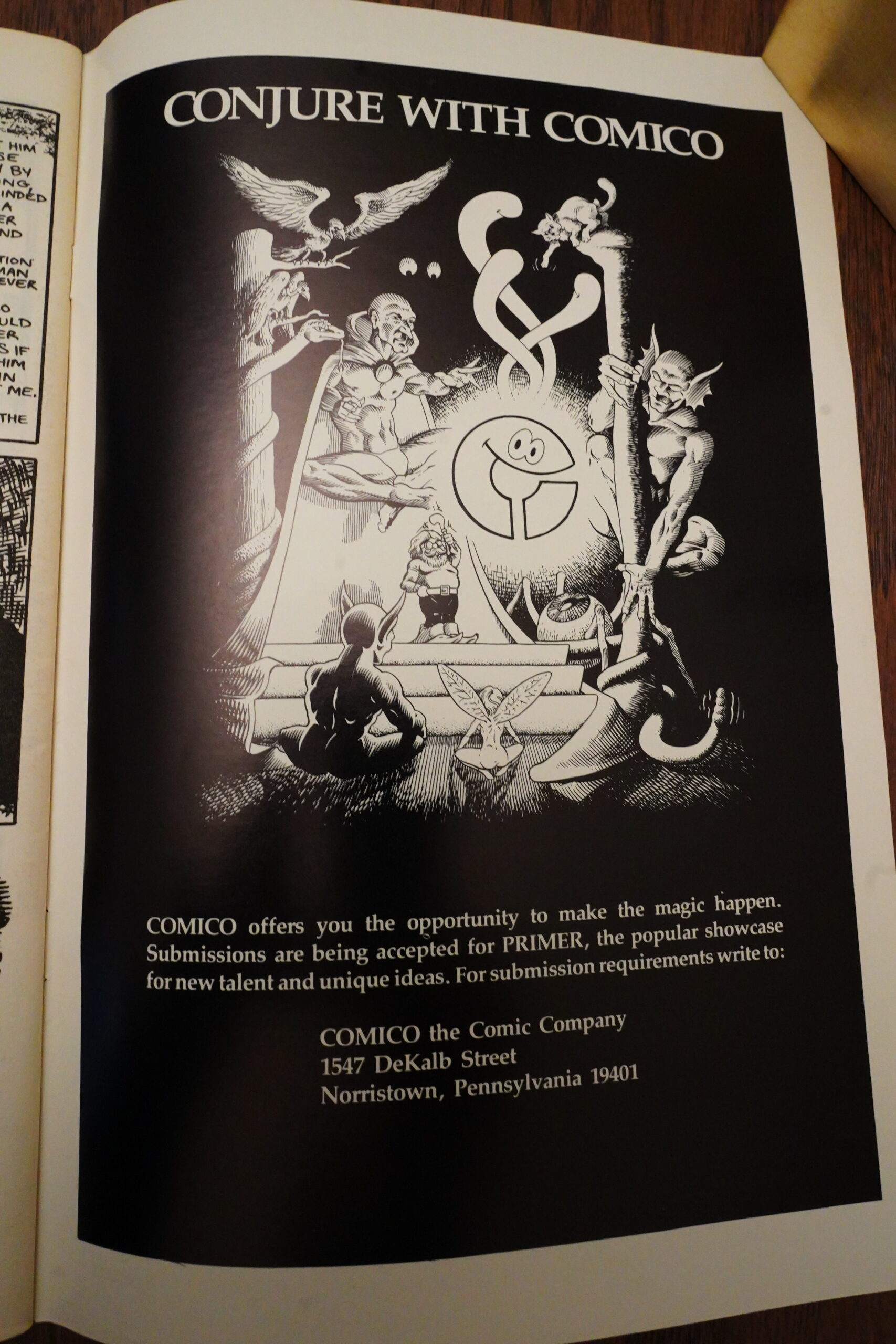
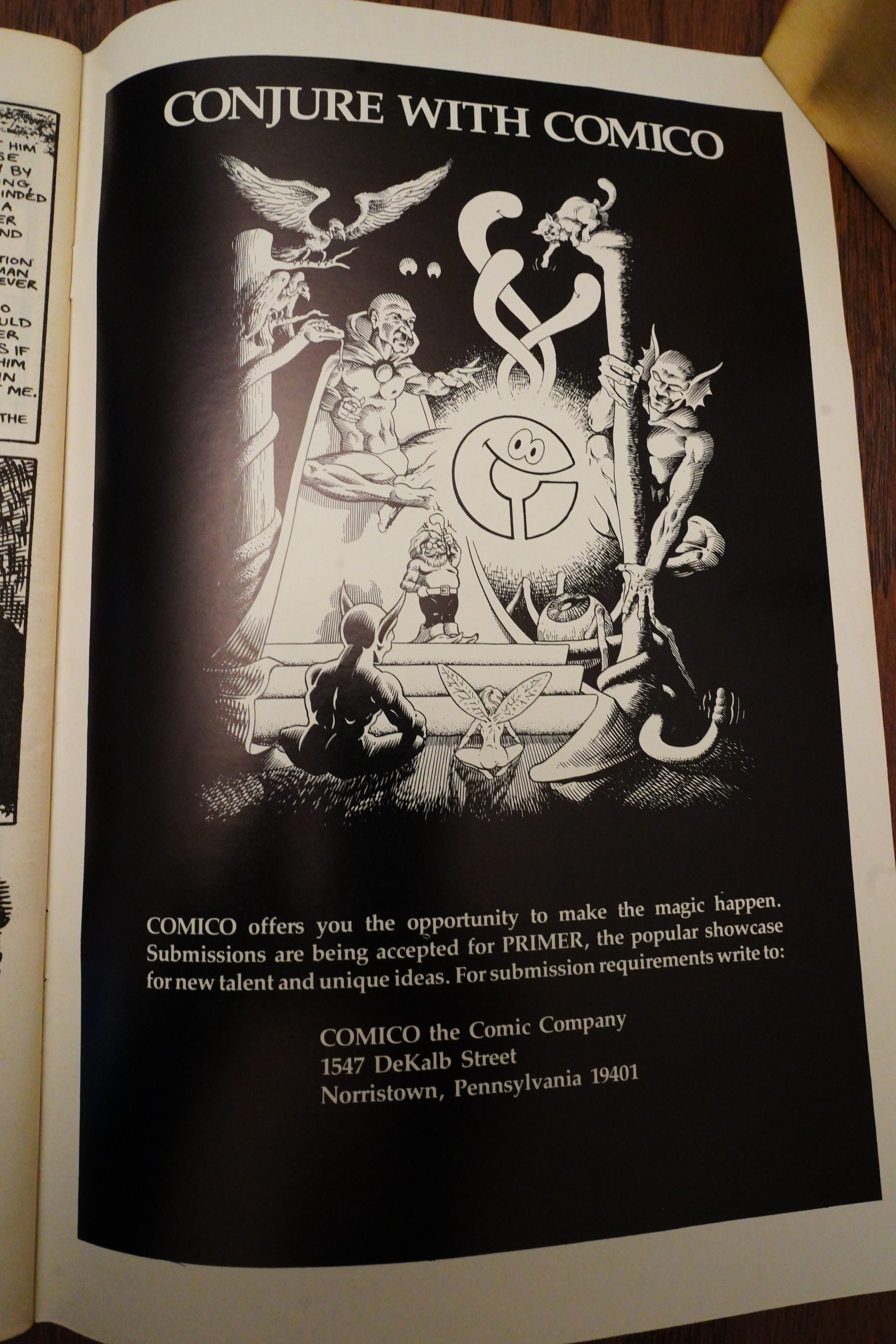
They’re still asking people to submit things…

Well, that’s it. It was not a good anthology, and I ran out of things to say about it halfway through this post; sorry!

Let’s see whether other people had things to say…

Oh, Gerry Giovinco has blogged about the early days:

It occurred to me that the anthology format had greater potential for us than we had originally planned. Rather than be merely a vehicle to introduce our own feature characters into the Direct Market, the format gave us a venue to feature the works of the many undiscovered talents that we were becoming acquainted with on the convention circuit.

It took me a while to find this — the site is gone now, and finding the right URL on the Wayback Machine took me an hour! Here’s the category page… I guess you have to iterate through various dates in the URL there to get all the posts?

The impact of Primer is still felt in the comics industry today.

Uhm… Oh:

I can tell you that “imitation is the sincerest form of flattery.” Bill and I were both caught blushing when IDW announced that it would be publishing The ACT-I-VATE Primer.

I guess that’s … felt…

Works that were planned to be published in Primer that I am sorry we missed out on were Pain by Bill Cucinotta, Panda Khan by Dave Garcia and a little pre-turtle story by Kevin Eastman and Peter Laird.

Right.

Heh heh:

Our first comic book was a black and white comic titled Primer #1. Historically the reviews on the comic have sucked but it was our first product and at the time we were very proud of our work.

[…]

We sold less than two thousand books but it was enough to cover the printing costs and generate enough interest for Primer #2 which enjoys it’s place in comics history for the first appearance of Matt Wagner’s Grendel.

OK, but here’s some comics news from around that time:

The Comics Journal #84, page #16:

ComiCo Announces Two New Color Comics

ComiCo, a recently created
comics company located in
Pennsylvania, has
announced a radical change
in its publishing plans.

During 1983, the company
started five comic book
titles, Az, Grendel, Skrog,
Slaughterman, and Comico
Primer-the last of which
served to introduce new
characters to the line. All
five were published as black-
and-white comics and sold
for $1.50.

New Color Titles: ComiCo
had originally planned to
convert all but Primer into
color comics, to be printed
at World Color Press in
Sparta along with the other
major comics companies. (It
is a generally accepted fact
that color comics sell better
than black-and-white comic
books or magazines; when
Denis Kitchen converted the
Spirit magazine to a color
comic, he reported dealers
anticipated an immediate
tripling of sales.)
Now, however, ComiCo
has decided to break into the
color comics field via two
entirely new projects:
Evangeline and Mage.

[…]

The Rest of the Books: As
for the rest of ComiCo’s
line, it will indeed transfer to
color comics format next
vear, with the first color
issues appearing in April.
The only two exceptions will
be ComiCo Primer and
Grendel, which will continue
in black-and-white.

Amazing Heroes #37, page #61:

COMICO PRIMER #5

Some of you will recall a short-
lived comic book published by
Charlton, entitled Bullseye.
Each issue showcased the work
of unknown artists and writers,
with offerings ranging from terri-
ble to fairly good. Well, Bullseye
has bitten the dust, but Primer
has stepped in to fill the void.
The main drawback in the
books Comico has released thus
far has been the amateurish look
about them, as though they
were taken directly from an
obscure fanzine out of Podunk,
U.S.A. As such, they have been
ignored by many readers, my-
self included.
But just as a “B” movie can be
enjoyed if you go into it with
lower expectations, so it is with
Comico’s Primer. If you pick it
up knowing that you are going
to see work that is still in its
infancy, you can have fun with
it. And the greatest pleasure in
this type of book is in discover-
ing a raw talent you know may
one day be a star in mainstream
comics.
Issue #5 starts out strong with
a beautifully rendered cover
illustration by Will Brown. It is
very interesting to compare this
with his rather crude art in an
earlier work, “Cyborg-Roc,”
which is presented in this issue.
Andrew Murphy contributes
an ongoing superhero strip
named “Victor.” The art and
story are fairly simplistic, but he
does attempt to have his char-
acters talk and act like people
-people who just happen to be
superheroes.
The finest art comes from
Sam Kieth, in a story entitled
“Max the Hare”; an anthropo-
morphic animal story that is
deadly serious and graphically
violent. Kieth’s talent as an artist
is obvious and I think you will all
become familiar with both his
name and his work in the not-
too-distant future.
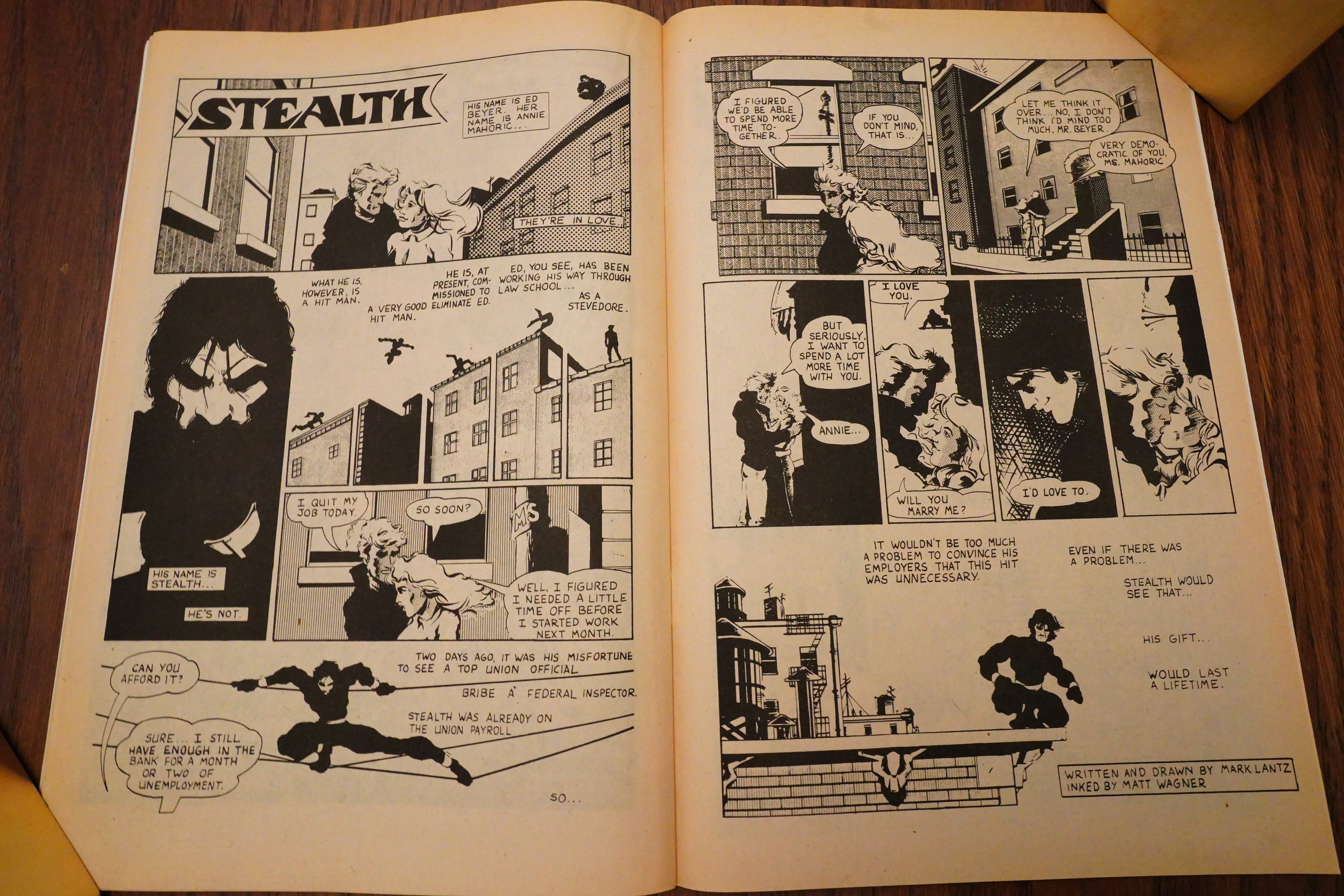
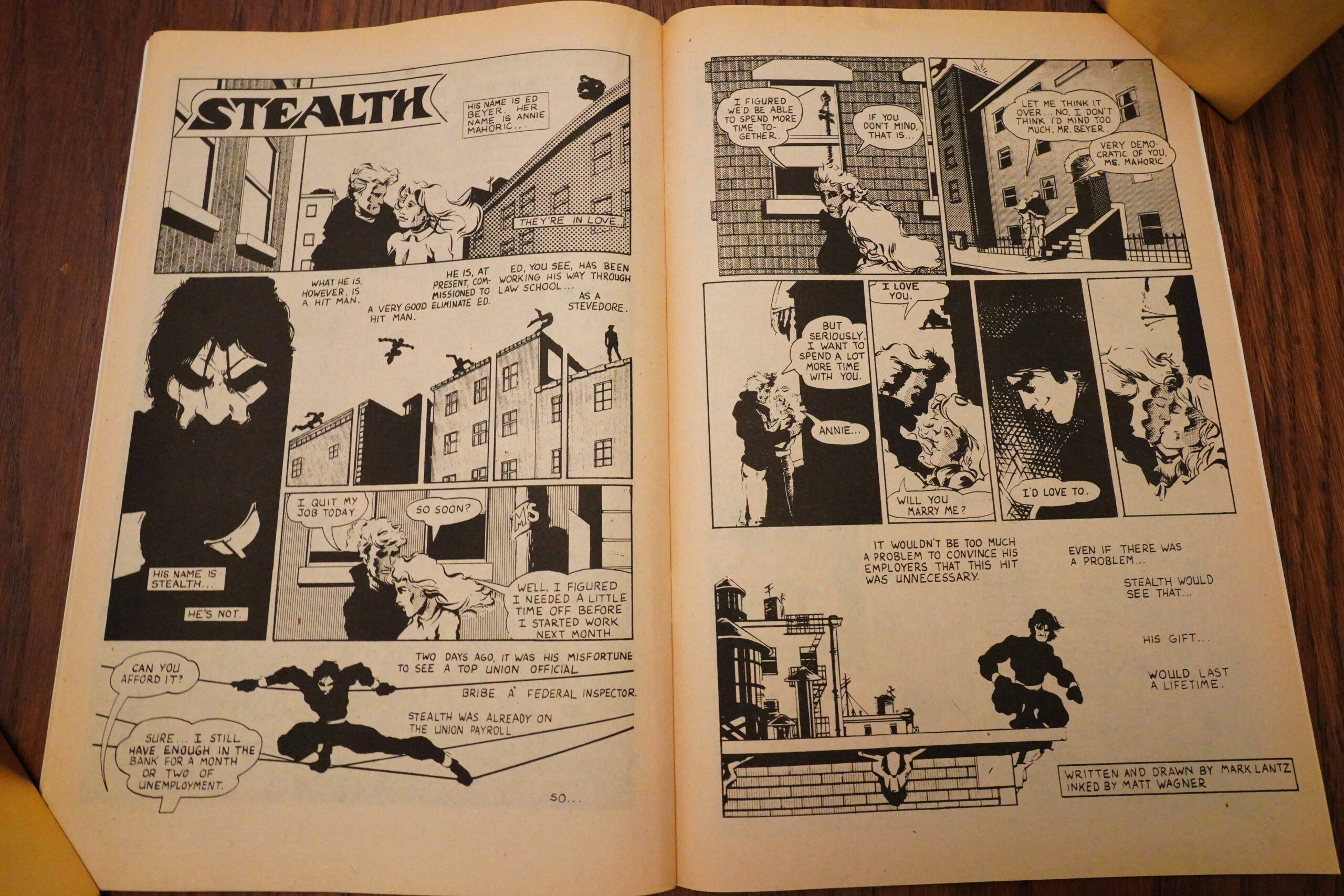
Artists Mark Lantz and Matt
Wagner also show potential in a
two-pager entitled “Stealth.”
The final contribution, “Repar-
tee,” is a Fritz the Cat-style bit of
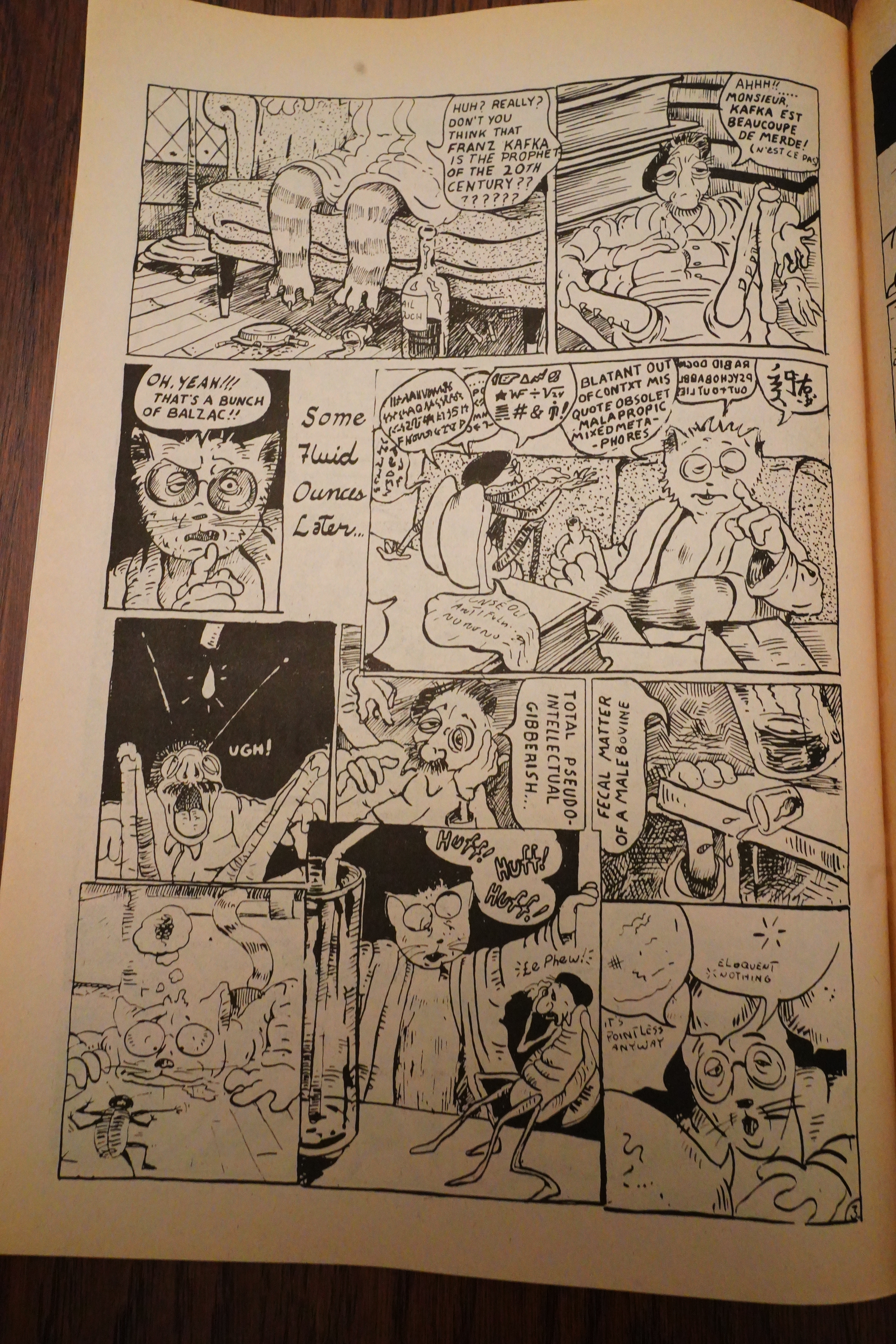
fluff from Chris Windle and Ajay
McLaughlin.
It’s good to have a showcase
like this where new talent,
unrestrained by the Comics
Code, can show us their wares.
The rather steep price ($1.50)
and black-and-white format will
no doubt discourage prospec-
tive buyers, but if you happen
to have a spare buck and a half
rattling around in your pocket,
pick up a copy of Primer. It’s
comics in the rough, but that’s
what makes it fun.
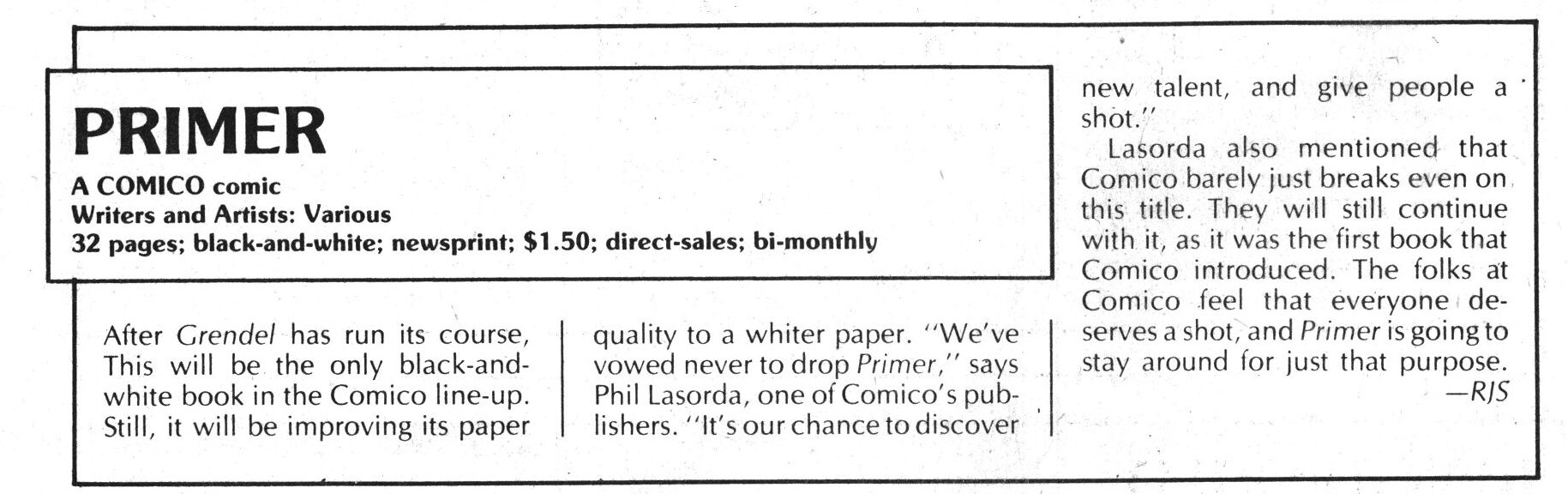
Yeah, sales were bad. I guess they were forsworn — “We’ve vowed never to drop Primer”.

The Comics Journal #79, page #27:

ComiCo News: After releasing
two issues of the company’s
“tutor magazine” Comico
Primer, the new comics
company is planning to release
several new titles, starring the
various characters that
premiered in Primer.
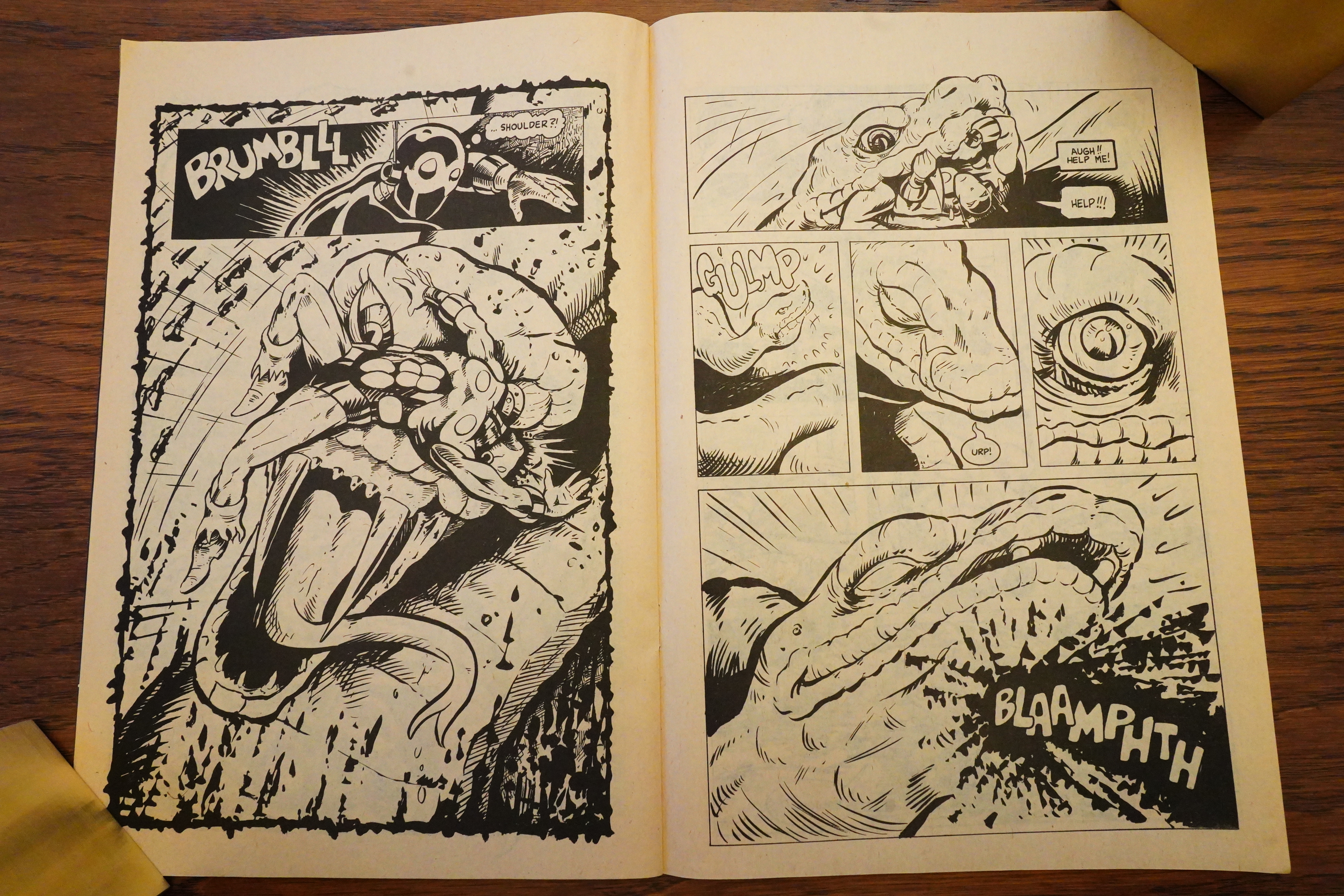
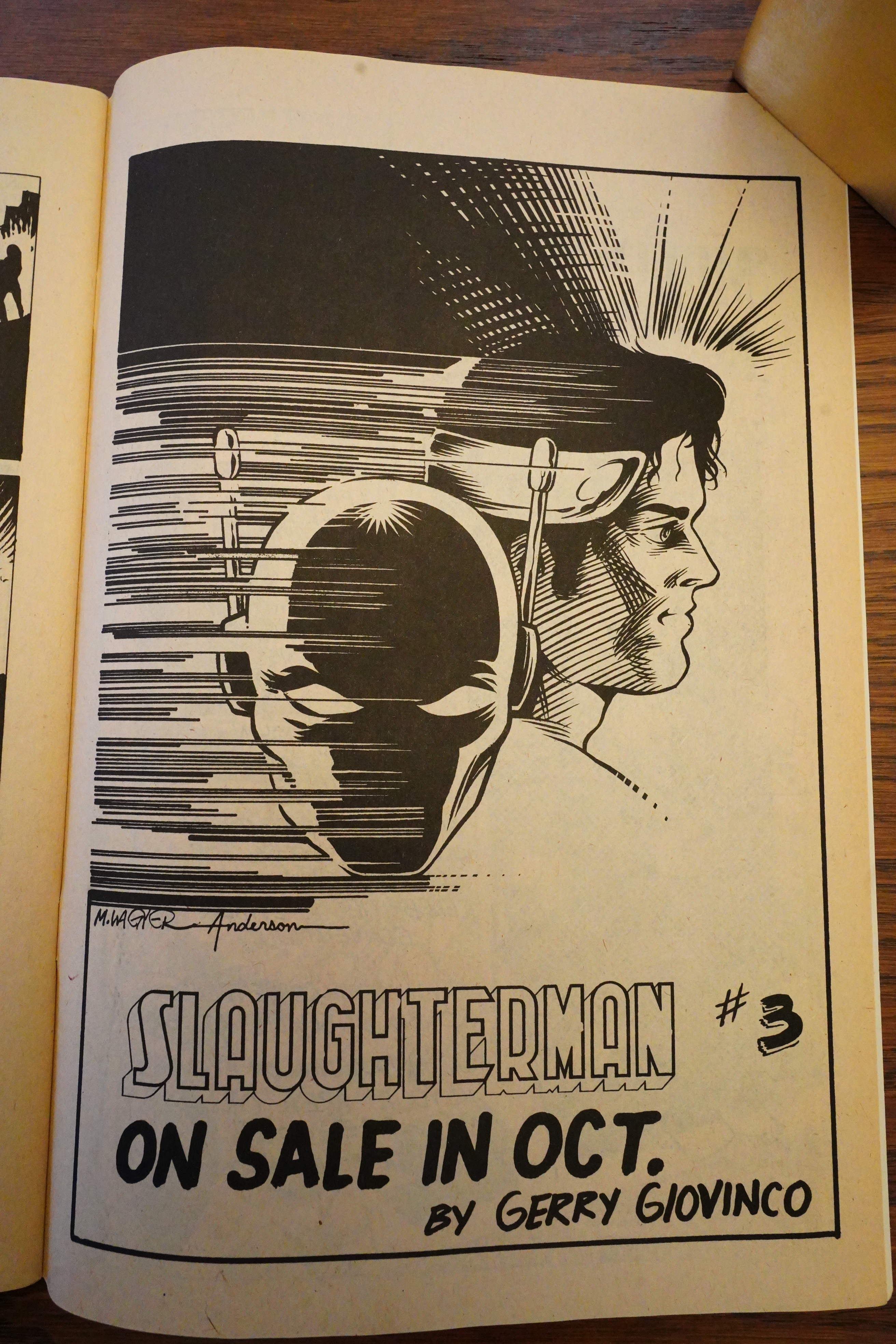
Slaughterman by Gerry
Giovinco and Az by Phil
Lasorda will be appearing in
February; these will be followed
in March by Skrog by Bill
Cucinotta and Bill Anderson
and Grendel by Matt Wagner.
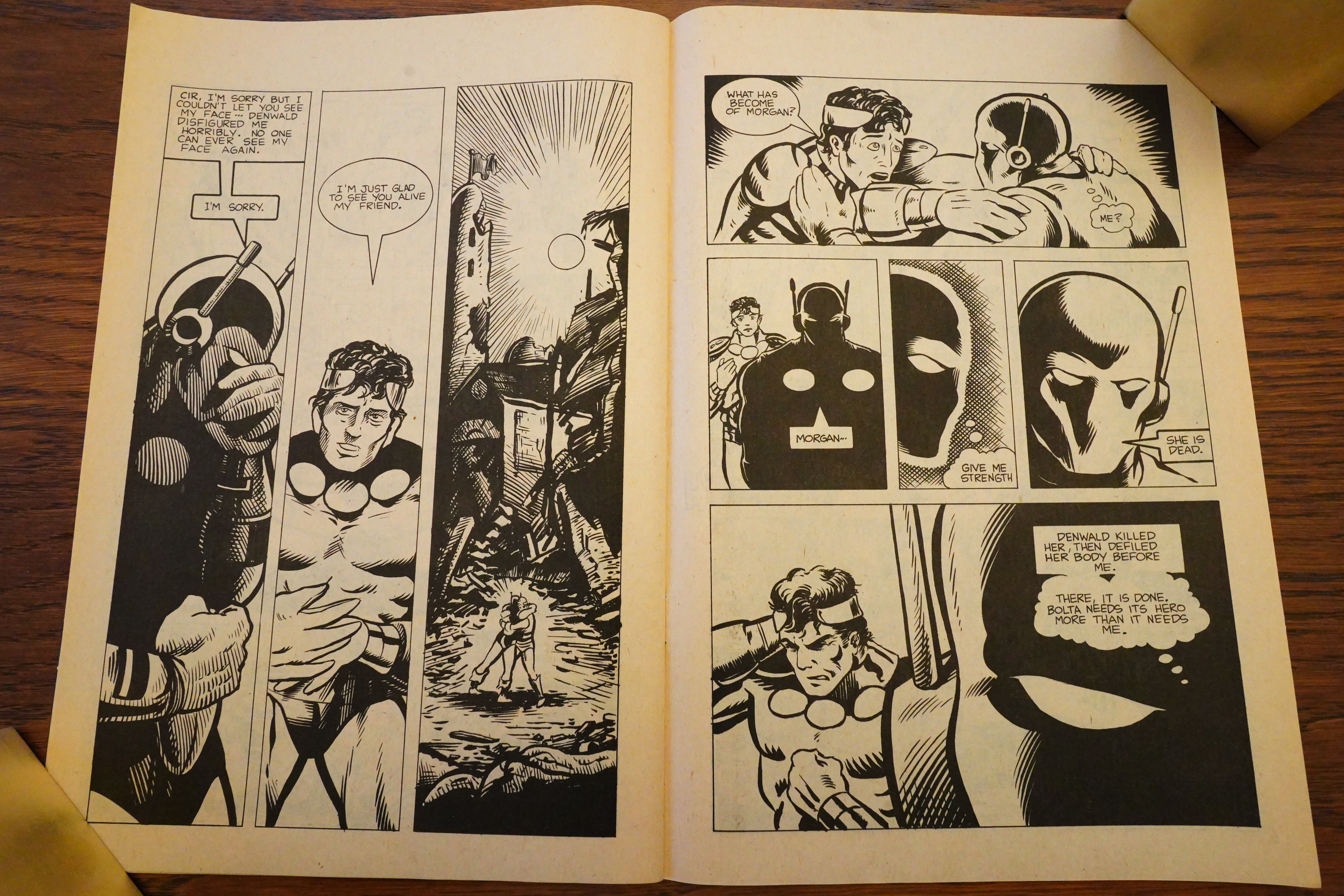
Each of these titles will be 32
black-and-white pages, with
full-color covers.
Comico Primer will continue
as well, with the third issue
slated for March release. In
addition to the usual artists, it
will feature a story by Mike
Hernandez, who has seen a story published in Moon Knight.

Back Issue #125, page #7:

POWERS: What are your thoughts on the early Grendel appearance in Comico Primer
#2 (1982) and the original three-issue run of Grendel (Mar. 1983–Feb. 1984)? In other
words, what did you learn from these energetic first efforts with the character?
WAGNER: Well, as I said, my initial efforts were admittedly crude but also, as you said,
energetic. Of the four premier Comico titles, only Grendel garnered much positive
response, and that’s what eventually led to me getting the chance to develop a color
title for them, which turned out to be Mage (again… a whole ‘nother story). And there’s
an old professional adage in the field that everyone has 100 pages of bad comic art that
they need to poop out first before they get to something credible and at least marginally
professional-looking.

Comics Interview #83, page #7:

PAT: I got that feeling. When did
the final version of GRENDEL really jell
for you?
MATT: First, a little history about me
and Comico:
I originally met the people who
formed Comico while we were in college
at the Philadelphia College of Art. We
used to produce an underground tabloid
called DUCK WORKS, which was full
of school news and duck cartoons. They
dropped out of school to produce
COMICO PRIMER #1, a primitive
black-and-white anthology. They asked
me to do a ten-page story for the
second issue; so I started coming up with
some ideas.

Wizard Magazine #23, page #139:

Miscellaneous independent back
issues from the ’80s continue to come
into their own, due to the popularity
of current hot series and creators.
Books like Cerebus #1 and Comico
Primer #2 (the first Grendel)
continue to be impossible to get.
Meanwhile, Comico Primer #5 is
climbing the charts because it’s the
first Sam Kieth work in comics, as
well as the first Maxx (who’s just a
rabbit in this book. You collectors are
really nuts!)

Indeed!

The Comics Buyer’s Guide #498, page #35:

PRIMER no. 1 and 2

Despite the very professional-
looking ad campaign which
ushered ths new company into
the field, the products seen so
far are little more than semi-pro
stripzines. If you go into reading
them with that in mind, they
come across as pretty damn good
little semi-pro stripzines. If you
have higher expectations, you’re
bound to be disappointed.
Okay, so what i see in these
two issues is like this: a complete
story filled with funny Kirby
swipes (and fairly recent ones,
too) including Jolly Jack himself
as one of the characters (Jack
Pizzano, he’s called); a character
named Spirit which will proba-
bly send Will Eisner to his law-
yers for a polite letter of warning
acter herself is nothing like
tured by the name Spirit, and
that, friends, is a no-no); and the
introduction of Comico’s regular
line-up of characters who have
spun off or will spin off into
their own titles – characters
like Az, Skrog, and Slaugh-
terman.
Perhaps if Comico’s hype
didn’t make ’em sound so all-
fired professional, i wouldn’t feel
this way, but i don’t think
there’s anything here we haven’t
seen before in simi-pro strip-
zines for years — except for the
new, fashionable Japanese ani-
mation influence in the charac-
ter design of Grendel. If the
anatomy were better, the back-
grounds really drawn in instead
of hinted at with black and
white solids, and the inking done
with anything a little subtler
than the heavy line most of the
contributors effect, i would
enjoy these books quite a bit
more.
Now, rather than trashing
them as failed professional
books, let me look at them as
nifty little stripzines put out by
a bunch of enthusiastic fans in
Pennsylvania. Looked at in that
light they are plenty of fun for
the money, about on a par with
Earl Geier’s Bald Ego, Rodney
Schroetter’s The Weirdo and
any of Jacques Boivin’s one-
shots. They are even worth the
buck and a half they cost. But if
“pro” comics are your bag, steer
clear; you’ll wish you’d spent the
money on the latest Marvels,
DCs, Firsts, Eclipses, Pacifics, or
even Americomics instead.
Caveat emptor.

The Slings and Arrows Comic Guide #2, page #516:

Comico PRIMER
Comico: 6 issues 1982-1984
The first Comico title was essentially a fan publication. A
very basic black and white anthology, it introduced Az,
Skrog and Slaughterman, all of whom graduated to their
own titles and disappeared quickly, and Mr Justice, who
never got even that far. If the title is to be remembered it’s
for the first Grendel story in 2 and the first appearance of
The Maxx in 5. Unless you’ve got more money than sense
only Matt Wagner and Sam Kieth completists are advised
to search out the issues in question. Both display early
talent, but Neutro would sparkle amid some of the other
material present.~FP

Anyway, not a lot out there… I guess Primer didn’t get much attention at the time either.