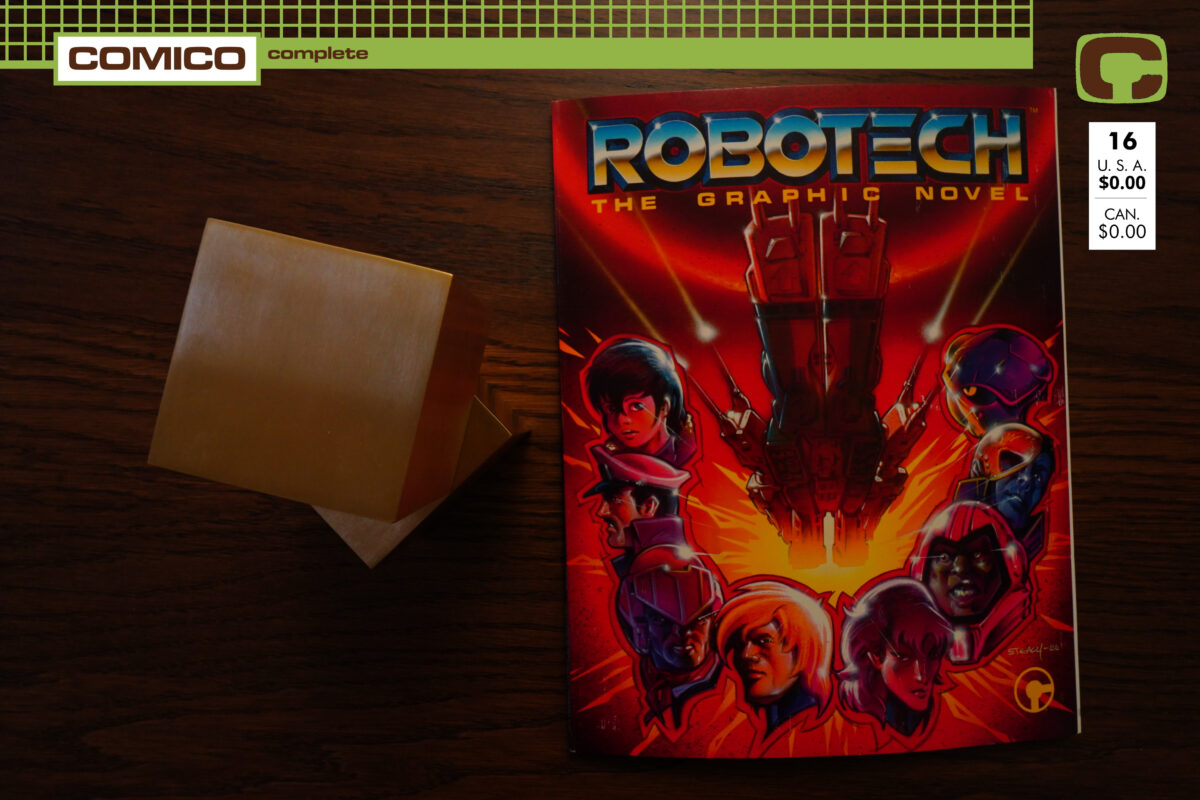
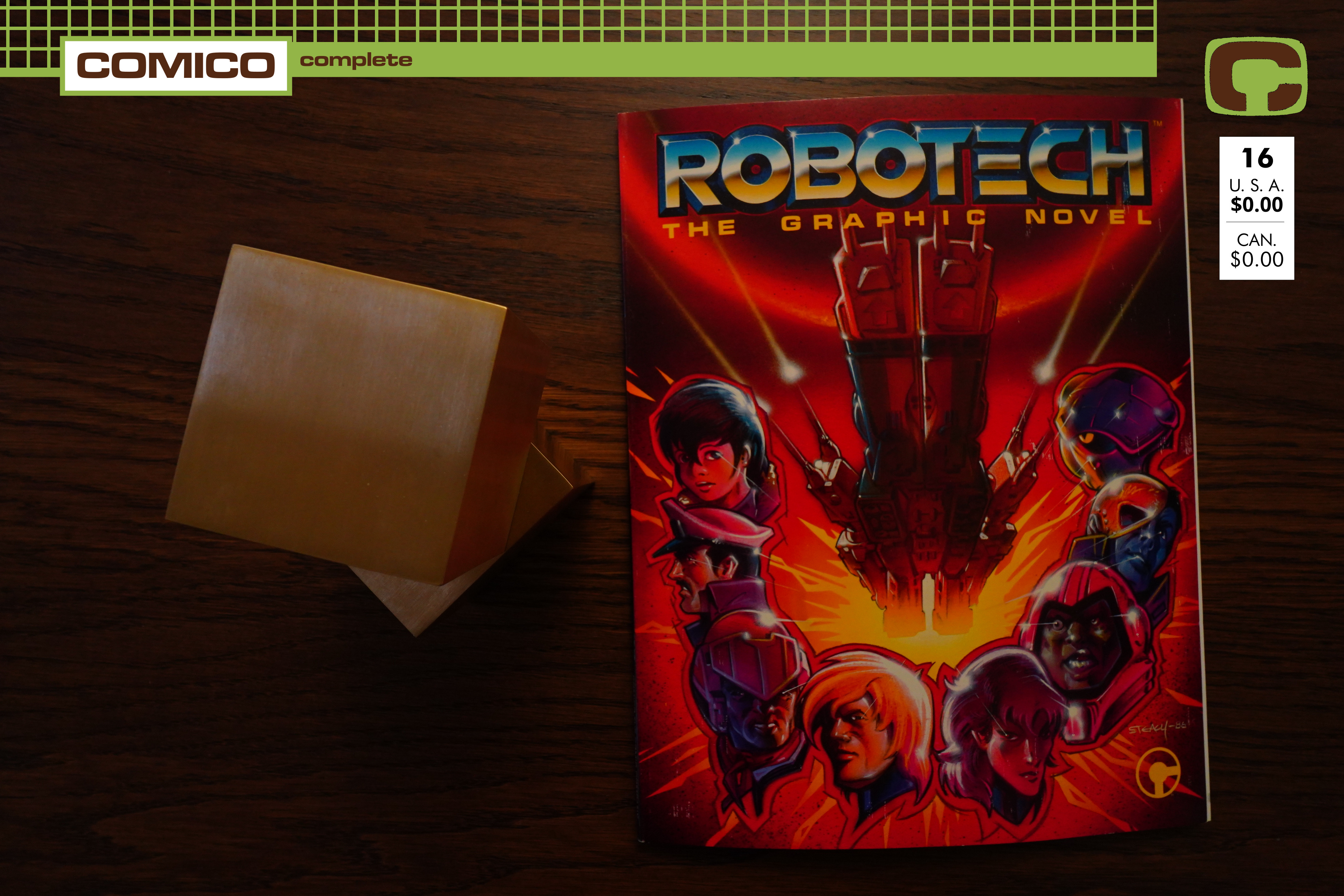
Robotech the Graphic Novel (1986) #1 by Carl Macek, Mike Baron, Neil D. Vokes, Ken Steacy et al
I planned on doing one single blog post for all the Robotech specials, but apparently I changed my mind. Because I didn’t feel like doing more than this graphic novel today.
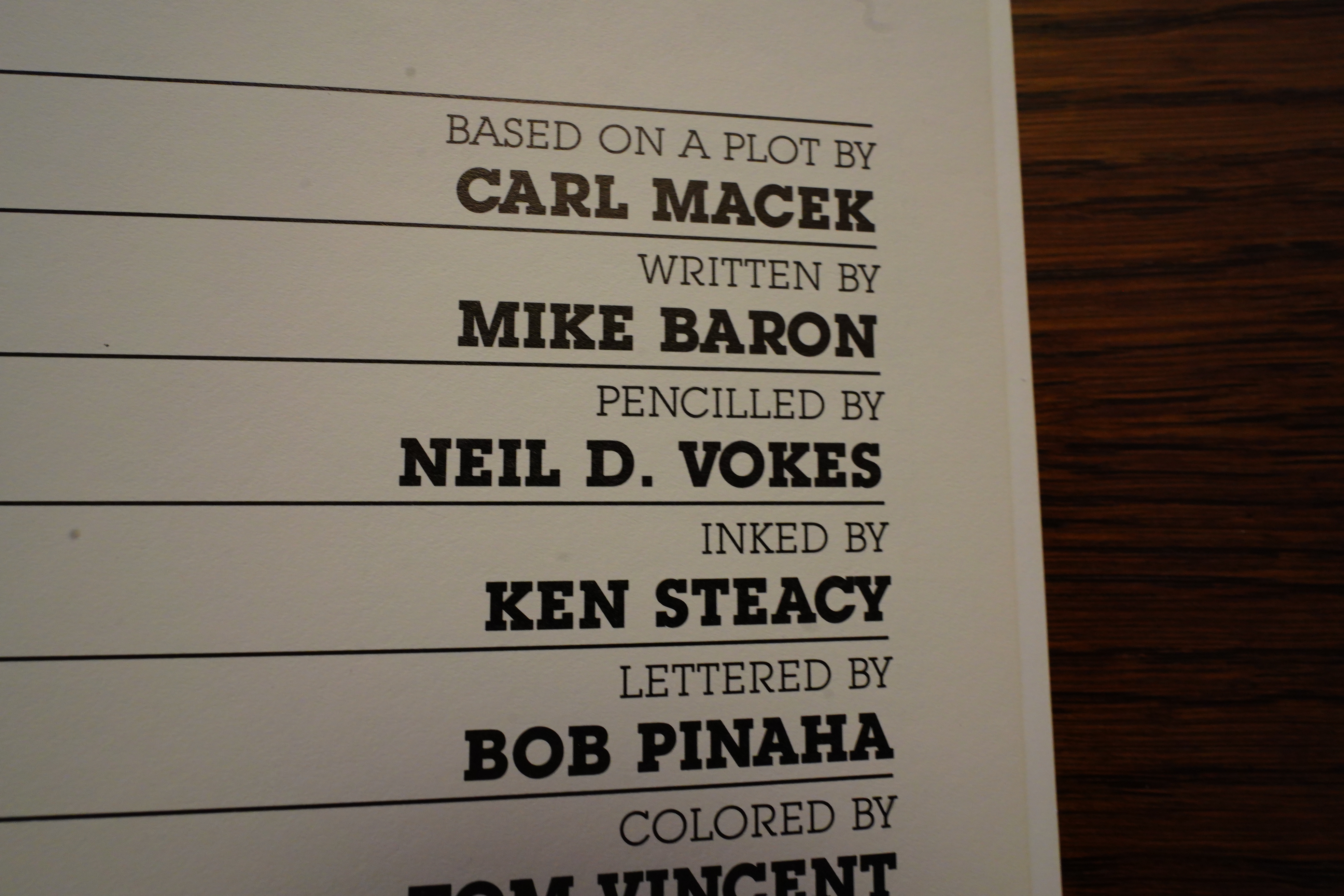
Oh no! Mike Baron wrote the decidedly worst of the three regular Robotech series, so why is he doing this? OK, he was the only “name” of the writers, but he totally phoned in his series — it was boring and it made little sense.
The plot is by the showrunner of the Robotech animated TV series, so perhaps it’ll be OK.
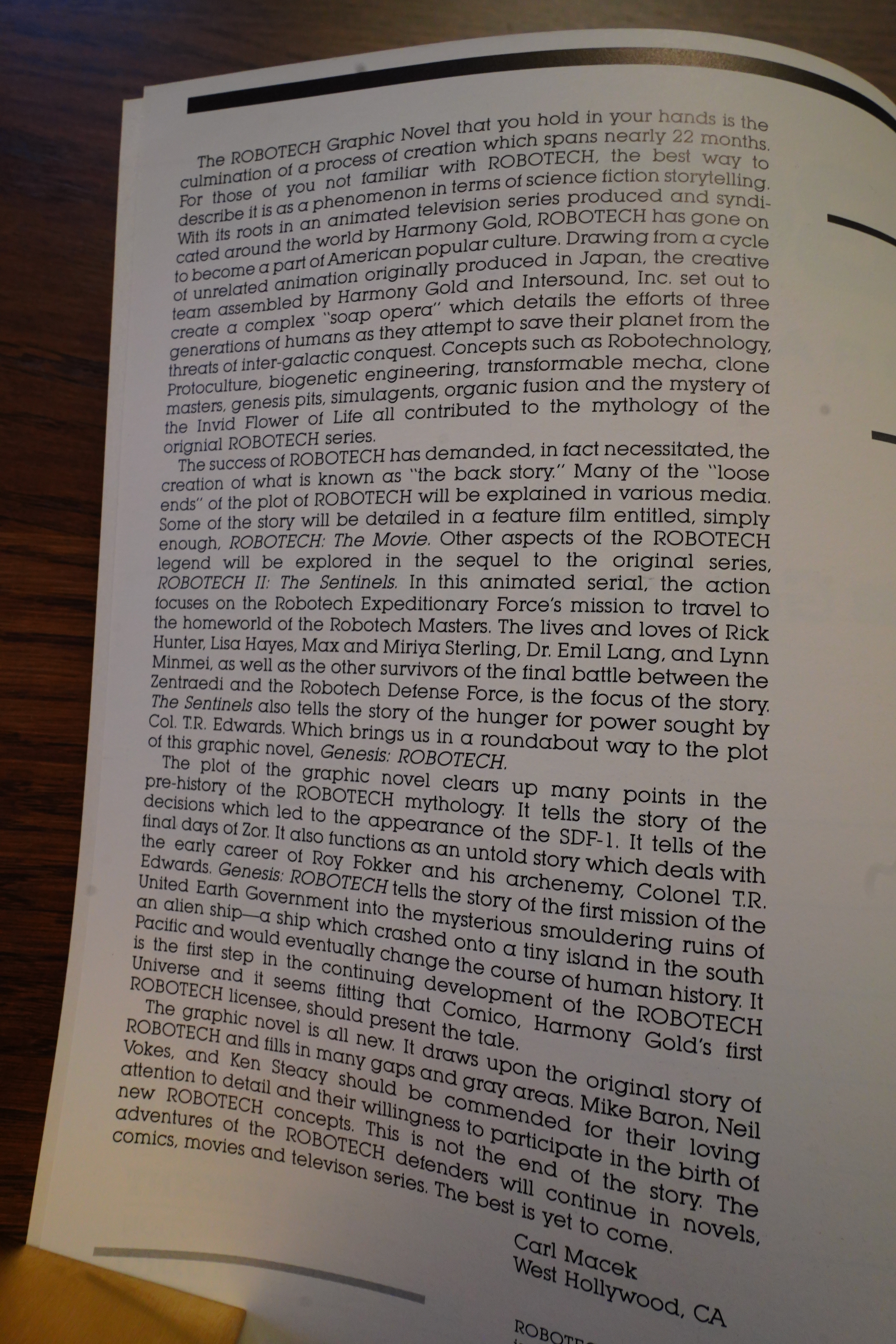
Macek explains that this graphic novel is where he’s going to infodump on the readers all the bullshit he’s made up to tie the three unrelated Japanese animated series into one “coherent” Robotech series. (I’m paraphrasing.)
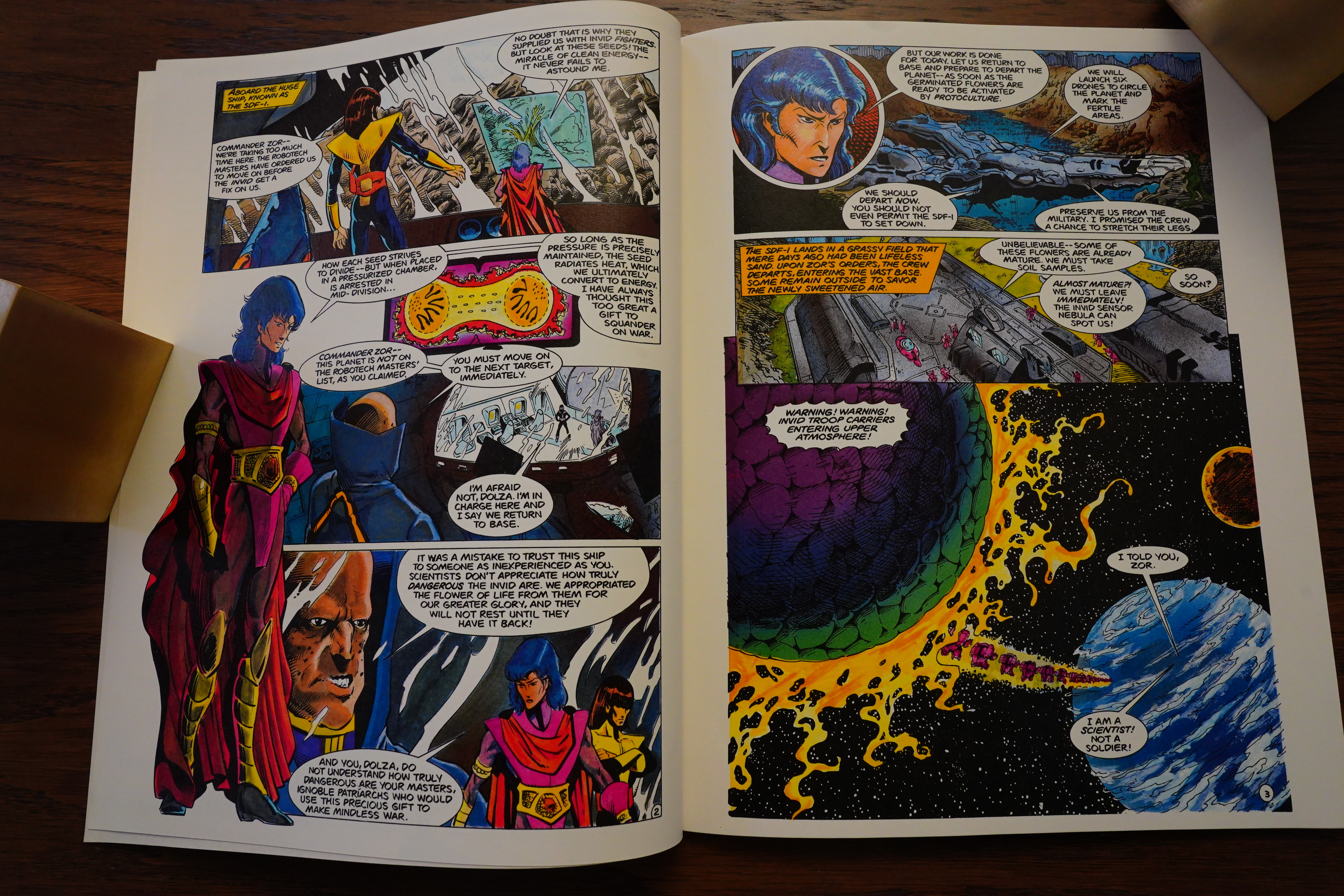
And indeed, we open with the mysterious guy from the Macross series talking about the flowers from the Mospeada series with some guys from the Southern Cross series, so… mash-up achieved.
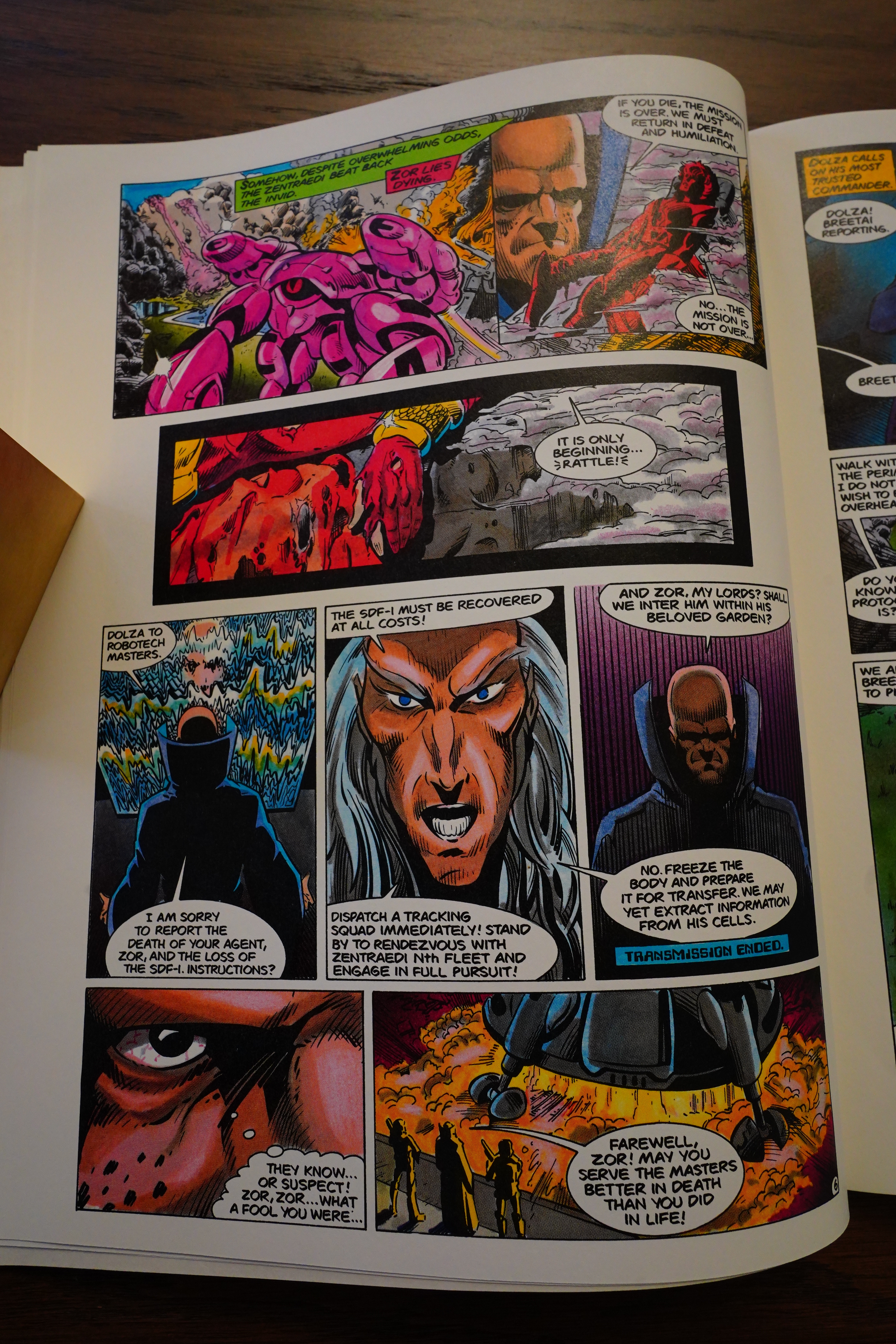
I can’t really say that it works — we don’t really learn more about Zor’s backstory than earlier, and things don’t really make more sense than before. So I guess Macek hadn’t really put all that much thought into the backstory, which was what I had assumed all the time.
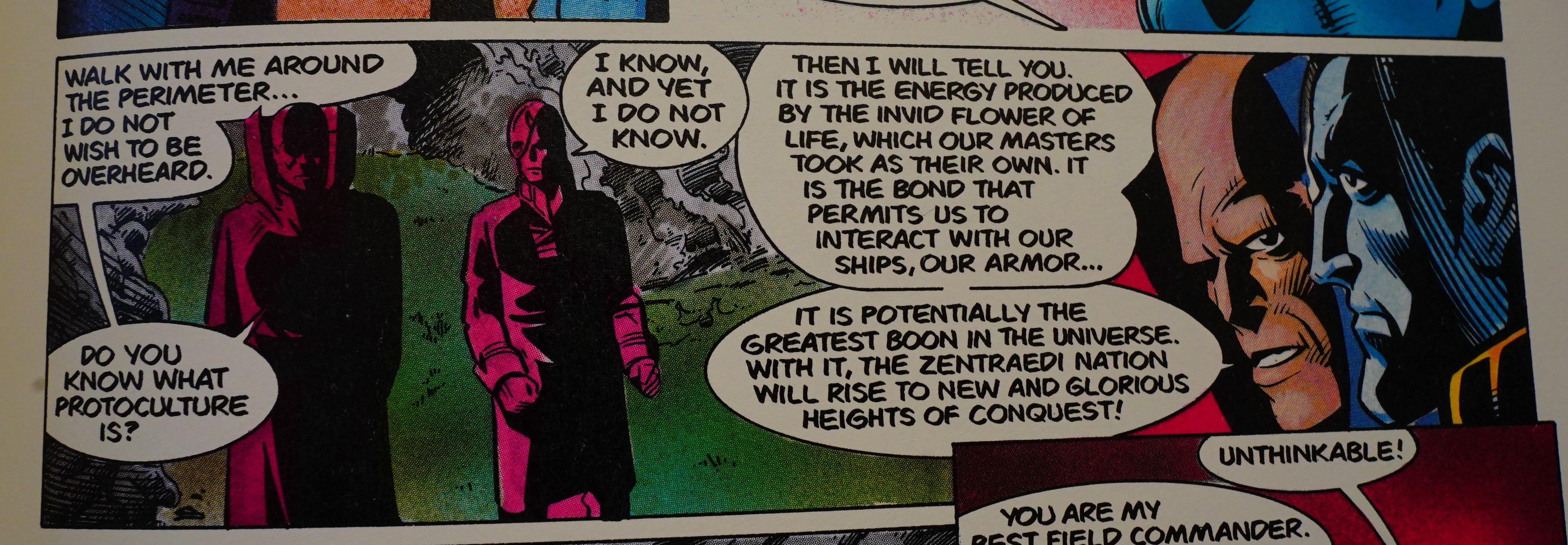
I suspect that Baron is making fun of Macek a bit here. “Do you know what protoculture is?” “I know, and yet I do not know.” — which is what viewers of the Robotech series would answer if you asked them, because protoculture didn’t really make all that much sense in the end.
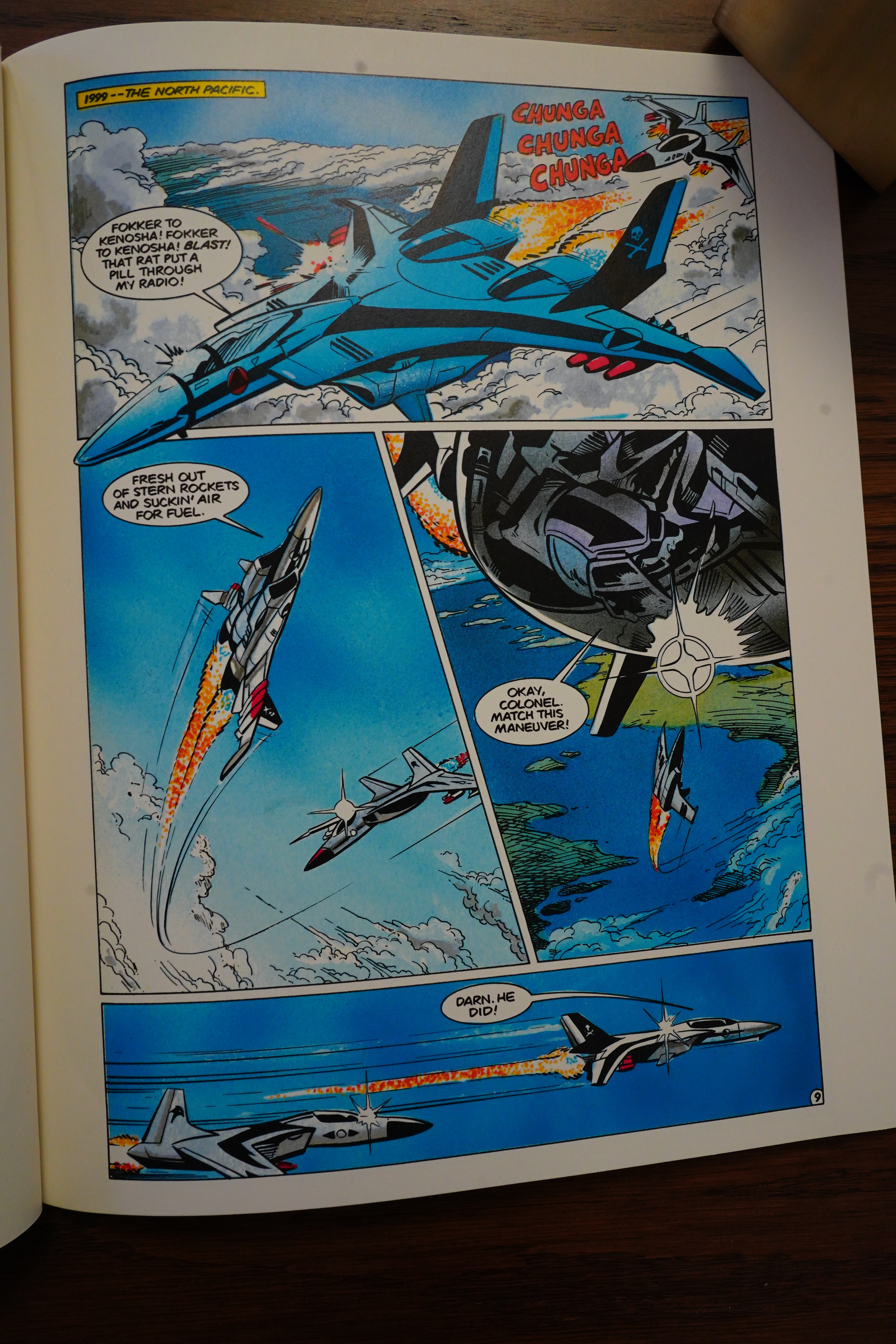
The artwork is a lot better here than what it was in the three Robotech comics, but it doesn’t look like the TV series at all. I suspect the positives are mostly down to Ken Steacy, who is a really talented artist.
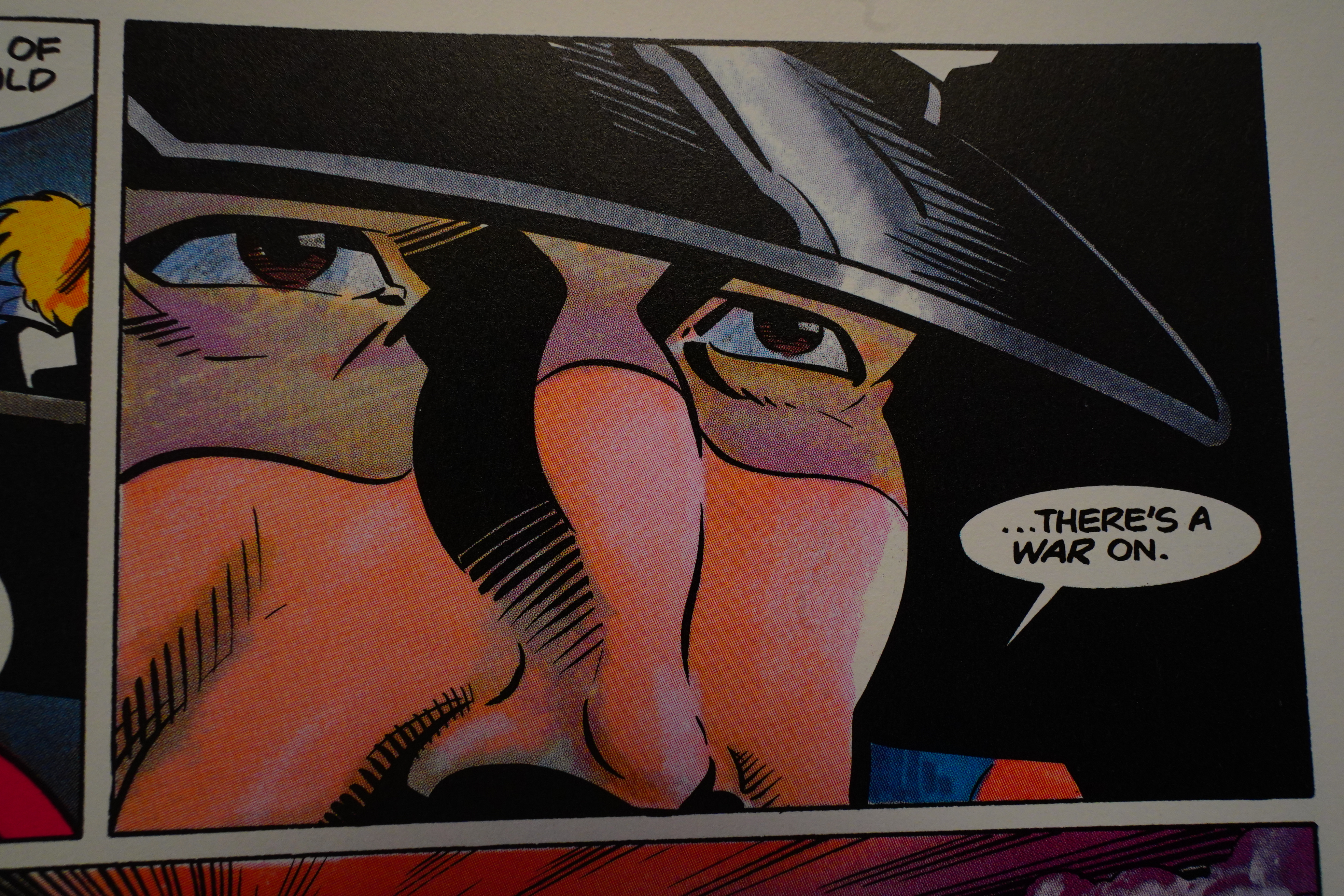
His rendering here gives a nod to Rand Holmes at points, perhaps? Really sharp.
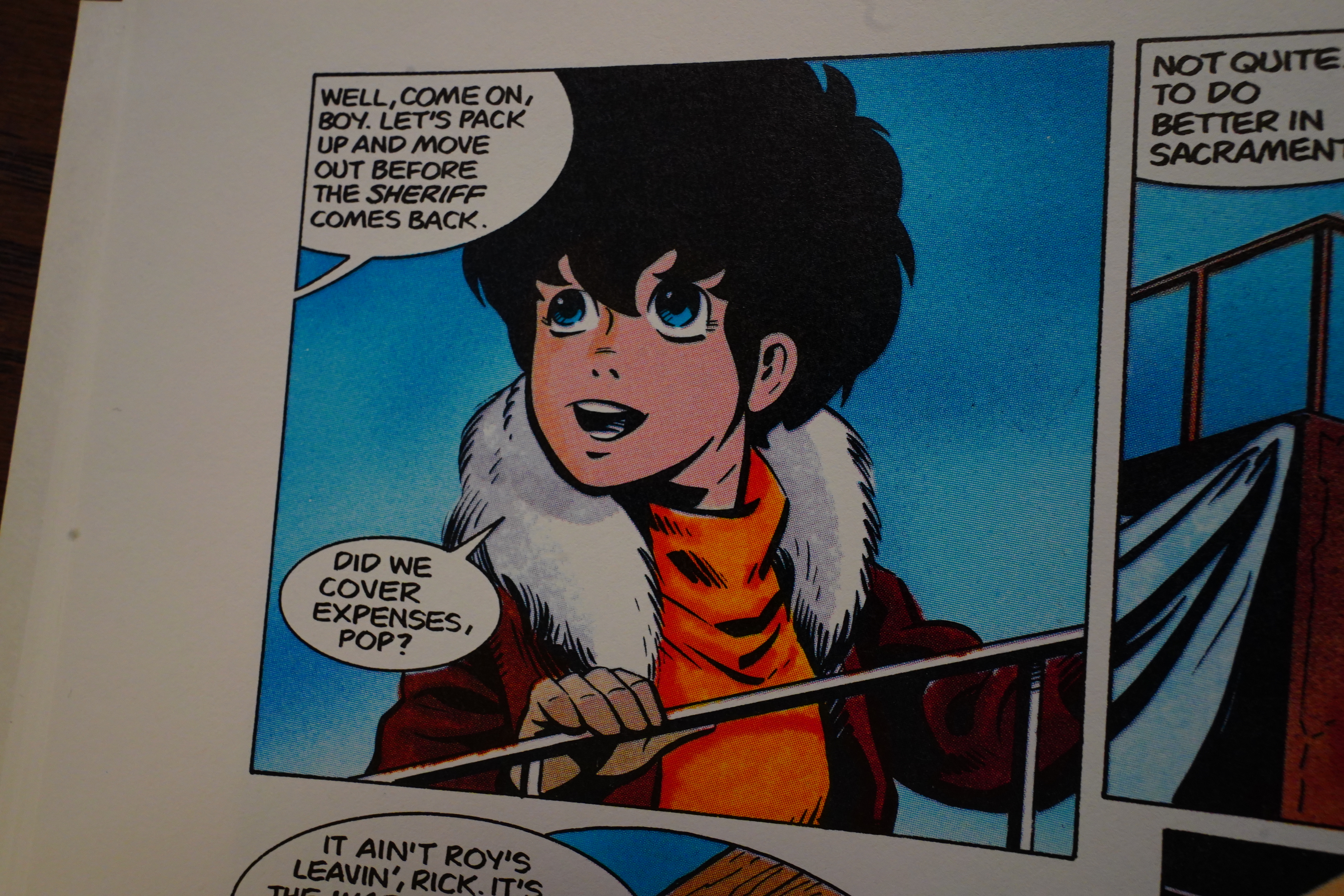
Rick! Where’s Minmei? That’s a pretty spiffy version, really.
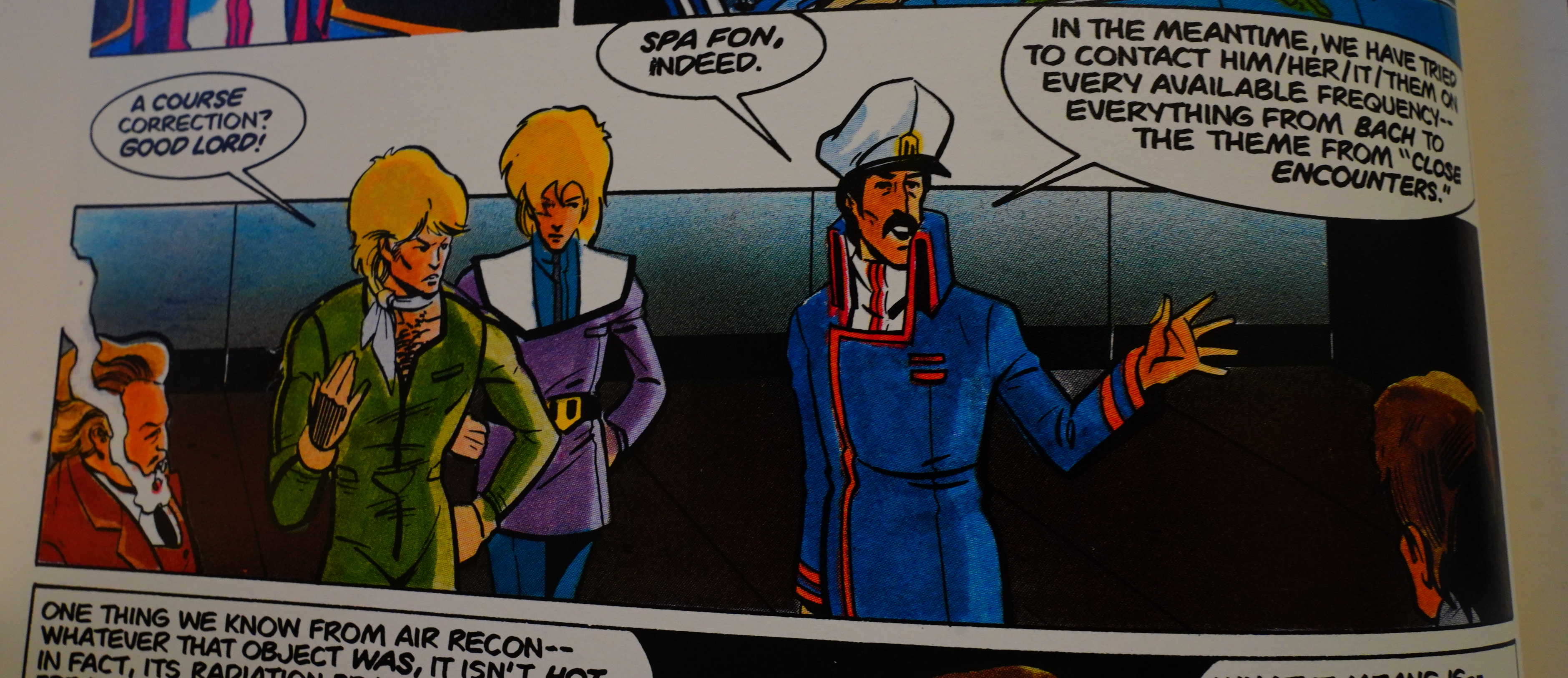
Heh — Baron drops some EC Comics references…
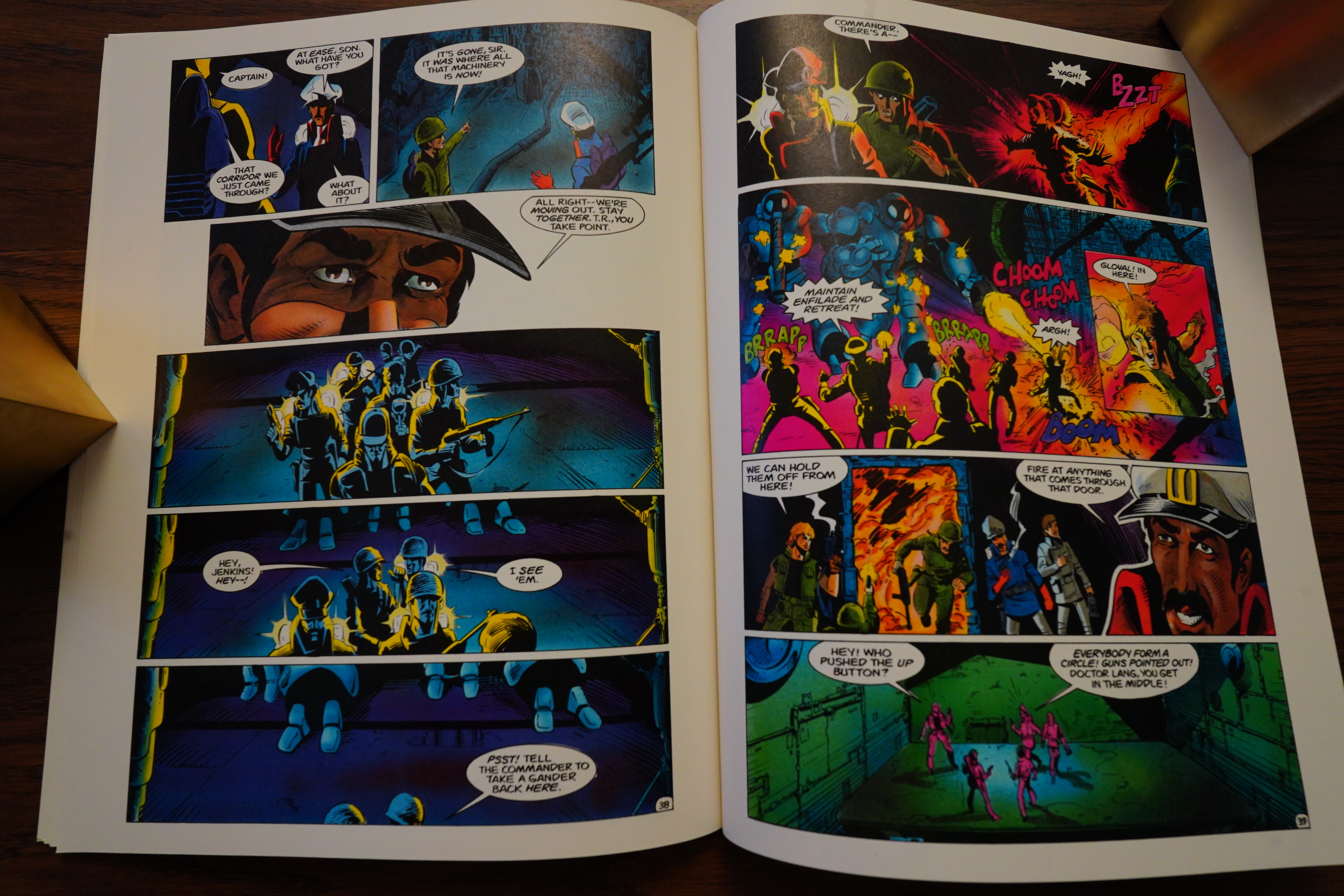
Oh, the plot — it doesn’t really make much sense. As we previously knew, the SDF-1 ship landed on Earth, and half the graphic novel is about humans exploring the ship. But the ship is like nothing we’re familiar with — it seems more like they’re exploring an Aliens ship or something, with slithering tentacles and self-organising mechanical creatures.
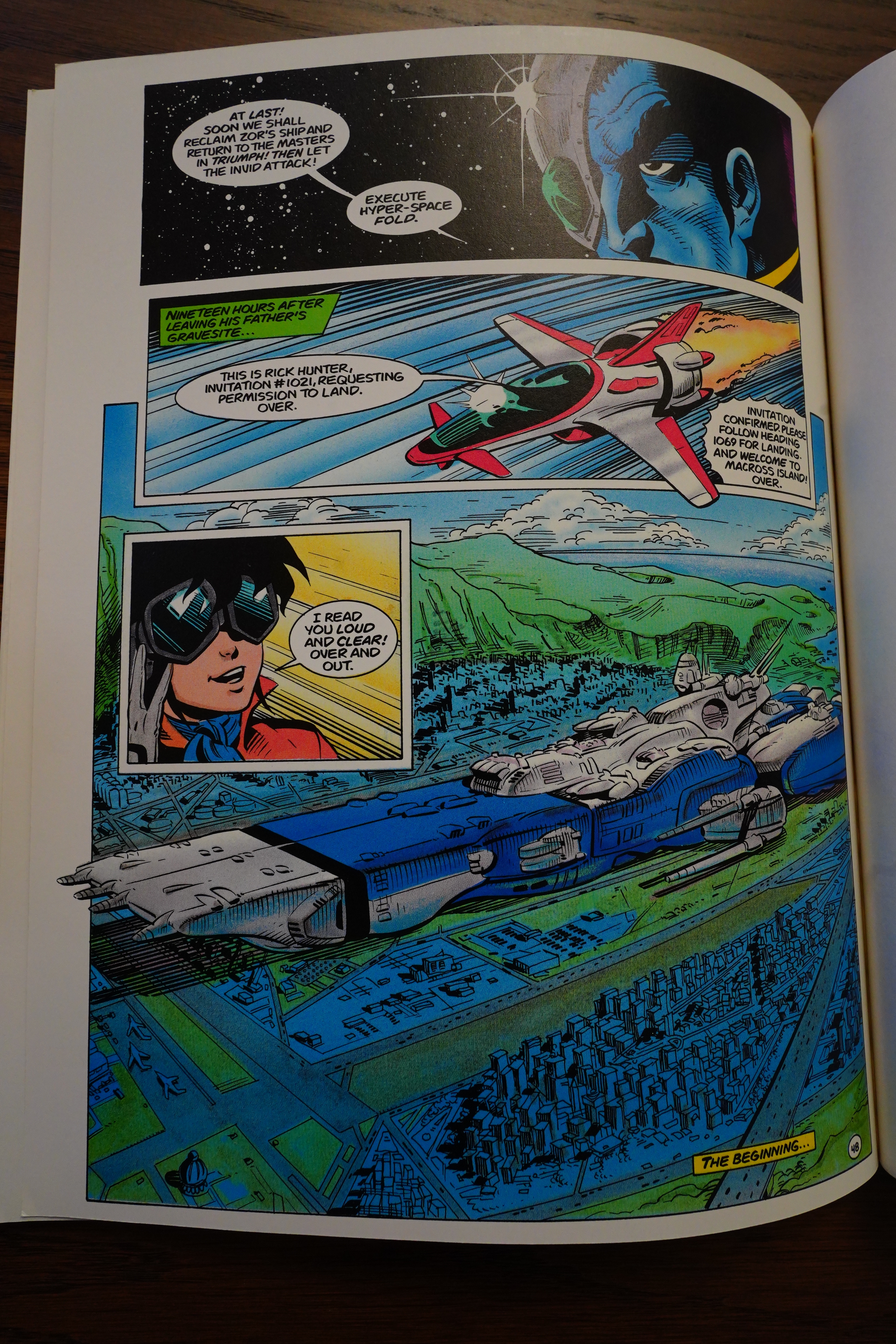
And it ends, of course, where Macross starts.
The artwork on this is surprisingly good, even if it’s mostly off model. The story isn’t very good, but Baron adds some jokes, so I guess it’s not all bad.
Protoculture Addicts #1, page #28:
Robotech: The Graphic Novel,
released in December 1986 by Comico,
is the answer to all the questions you
had about Robotech but were afraid to
ask… It is the UNTOLD STORY; the
WHAT, WHEN and WHY of Carl
Macek’s Robotech Saga.
The story begins on a planet of
the fourth quadrant of the known
universe. There, we meet Zor and the
original SDF-1. Then we learn why the
SDF-1 was sent to Earth and how Zor
dies. We also have a glance at Roy
Fokker as a fighter pilot in the Global
War. We also have a chance to actually
see what Rick Hunter looked like at the
age of 10… Many new characters are
introduced (some of them are back in
the Sentinels) and you will also learn
what the SDF-1 was like before the
“micronians” adapted it.
I appreciated a lot the artwork of
Neil D. Vokes which is a little different
from the japanese style but still very
good. The script is from Mike Baron
(based on the plot by Carl Macek) and,
as I said before, it answers almost all
the questions we had on Robotech.
There is a little problem, though: after
reading it, some new interrogations rise
up. But most of those new questions
are answered in The Sentinels.
I think that all true Robotech
fans should have one because it is not
only a comic book, it can also be used
as a reference manual. The retail price
is $5.95 ($7.95 CAN), and believe me,
it is worth the price. If you are a true
Robotech lover, Robotech the graphic
novel is a must!
Four Color Magazine #1, page #12:
Schreck also said that Robotech: The
Graphic Novel that was released in
September has sold out. Comico is
rushing the graphic novel back to
press to reach retailers in time for the
Christmas rush. Written by Mike
Baron from a Carl Macek plot, pencill-
ed by Neil Vokes and inked by Ken
Steacy, the 48 page full color novel
tells the story of the Robotech saga.
So it sold well… It’s been reprinted twice — once by DC in 2003, and then by Titan in 2018.
The Slings and Arrows Comic Guide #2, page #546:
The graphic novel is subtitled ‘Genesis: Robotech’, and
relates the events leading up to and immediately following
the crash of the Super Defence Fortress 1. Carl Macek, Mike
Baron, Neil Vokes and Ken Steacy create a readable tale that
can be enjoyed without a degree in Robotech History.
R. A. Jones in Amazing Heroes #105, page #73:
An island full of people is launched
into space aboard a giant folding
robot spaceship, chased across space
by inscrutable aliens, defending
themselves and escaping by using an
unfamiliar alien technology, some-
times badly. Of Comico’s three
Robotech titles, I’ve always con-
sidered Macross Saga to be the best
in several ways. The characters of
Masters and especially New Genera-
tion leave me cold, and the plots of
the latter two are less well-defined.
Perhaps it’s just that Macross has
presented such an intriguing concept
of humans adapting and building a
seemingly-normal city inside a
spaceship, much to the consternation
and confusion of the highly-
disciplined miltaristic aliens. The
other two series confine their bat-
tles to defending Earth.
I have never seen the Robotech
animateds on which all this is based,
although I hope to make their ac-
quaintance some day. Yet I checked
out the comics because of the good
things I’d heard about the shows. I
was attracted by the clean, car-
toonish artwork and the unusually
complex cast. Then, well, I’ve
always been too easy to sucker on
a soap opera, and that’s what
Robotech is, with the wide, unusual
crew of characters and their evolving
relationships. While retaining a
sense of humor and lightness (some-
times misplaced, it seems to me, but
I’ve never been in a war with aliens),
the characters act and react with
unexpected individuality and depth.
This is light entertainment, but not
cheap. The transforming robots
technology interests me least about
the series. No, that’s not true. The
songs interest me least about the
series. (Of all the aspects of the
animateds to be translated to comics,
singing seems to have fared the
worst.)
I also admit, as a comics fan, I
was attracted to the Robotech comics
just to see what this new company
Comico felt was so important.
Comico has all three comics on an
every-six-weeks publication sched-
ule, staggered so a new issue is out
every two weeks. Quite a publishing
commitment, I thought, no matter
how successful the cartoon series is.
The three comic titles are sequen-
tial rather than contemporary. That
is, Robotech is the earliest story,
with Masters and New Generation
beginning after the Robotech story
is finished. So one other aspect of
Macross which I appreciated was the
freshness of the story. In Macross
#1, the giant floating space fortress
SDF-1 crashes to Earth, interrupting
World War II and leading eventually
to war against the aliens. This is not
a simple story. Obvious care has
been taken to set up the background,
the direction, the look and feel of
the alien Zentraedi, and the Earth
cast. Not all is immediately revealed
in the first issue, either. There are
still questions lingering on the later
series.
As plotter Carl Macek writes in
the introduction, Genesis: Robotech
“clears up many points in the pre-
history of the Robotech mythology.”
Revealed in this book are the reasons
why the space fortress crashed,
background on the aliens, and some
early history of several Macross
characters. The seminal crash-
landing of the SDF-1, seen in.
Macross #1, is shown in expanded
detail. And more is learned about
the aliens, their minds and motiva-
tions, and their mysterious “proto-
culture”-based technology. The
capable script is by Mike Baron,
who has been writing the Robotech
Masters series. Baron’s dialogue is
lean but natural, for aliens or Earth-
men, always carrying the work
forward.
The highlight of this book is the
initial exploration into the SDF-1.
The human soldiers are trapped in
a violent and utterly alien world
within the still-active robot ship,
where walls move, robots evolve,
and time flows differently from out-
side the ship. This close encounter
is well-developed, and not for the
squeamish. Some of the tricks the
SDF-1 pulls in this issue have not
been seen in the Macross series,
indicating just how little of the
technology of their commandeered
ship the humans have grasped, and,
I hope, some of what we can look
forward to in the series.
The lowlight of this book is the
ending. It’s understandable that there
would be no solid ending, as this is
the “prequel” to the entire series.
But the last several pages dissolving
into the panorama of the months and
years that followed, leading up to
Macross #1, made for a kind of scat-
tered and disappointing epilogue.
There is little rounding-out to the
ending of this “novel.”
Neil Vokes was the penciller on
the first Macross issues I read, and
his pencils on this graphic novel are
still attractive. Ken Steacy inked the
interior and painted the cover. The
art is much the same as the Macross
series, although Tom Vincent’s
coloring is superior, giving a needed
complex quality to the simple
cartooning.
This is hardly the work I would
recommend to introduce a non-
comics reader to the world of
comics. And the casual reader may
have little interest in this pre-history.
But for those who are familiar with
the Robotech saga, the graphic novel
is one of the better contributions
from Comico. And, of course, a
must for the completist, as they say.
Dwight R. Decker in Amazing Heroes #118, page #64:
Then there’s Robotech: the
Graphic Novel, which Comico
published as a squarebound 48-page
volume in 1986. Its $5.95 price tag
is even reasonable as these things go.
Scripted by Mike Baron and drawn
by Neil D. Vokes and Ken Steacy in
a more traditional “Western” com-
ics style, the book presents what
amounts to the origin of the
Robotech universe. In the last years
of the 20th century, Earth is in the
throes of a several-cornered global
war, but the arrival of an enormous,
unmanned alien ship brings a quick
end to the conflict by alerting the
various factions to the fact that far
worse enemies are out in space and
presumably on their way. Earth
unites, begins building up its
defenses, and learns to exploit the
technology of the alien artifact.
There isn’t a whole lot of plot in this
book: it serves mainly as an intro-
duction to the series and some of the
characters, and it isn’t even close to
being a complete story in itself. For
readers curious about Robotech but
daunted by the sheer mass of mate-
rial available, this might be the best
place to start.
Robotech was a minor comics phenomenon of the 1980s based on some rather deft marketing of assorted Japanese fantasy exports. Whilst American TV company Harmony Gold was cobbling together and re-editing three separate weekly science fiction anime series (Super Dimension Fortress Macross, Super Dimension Cavalry Southern Cross and Genesis Climber MOSPEADA) US model-kit company Revell was selling Japanese mecha kits based on the aforementioned Fortress Macross, Super Dimension Century Orgus and Fang of the Sun Dougram as Robotech Defenders, complete with an all-new English language tie-in comic produced by DC Comics.
A copyright clash resulted in the DC title being killed after two issues after which TV produced Carl Macek and Revell went into limited partnership in a Macross co-licensing deal which saw three shows translated into an 85-episode generational saga wherein Earth was rocked by successive alien invasions decades apart and only saved from annihilation by a fortuitous spaceship crash which had allowed humans to master extraterrestrial Robotechnology.
[…]
Fun and adventure in the grand old space opera manner and superbly easy on the eye, it’s about time these 1980s epics were revisited by a more comics friendly readership.
OK, next up in this blog series is Johnny Quest, which is 31 issues long, so we may have another unscheduled pause here, but I guess we’ll see?