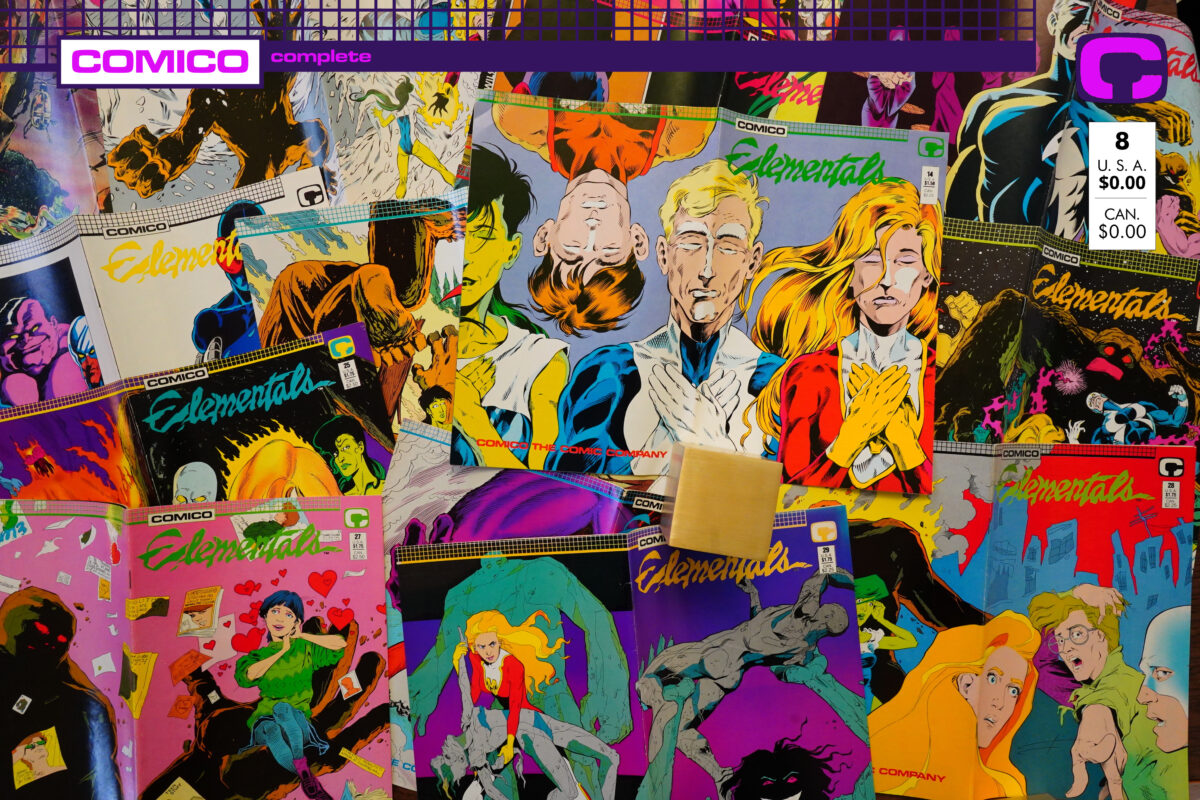
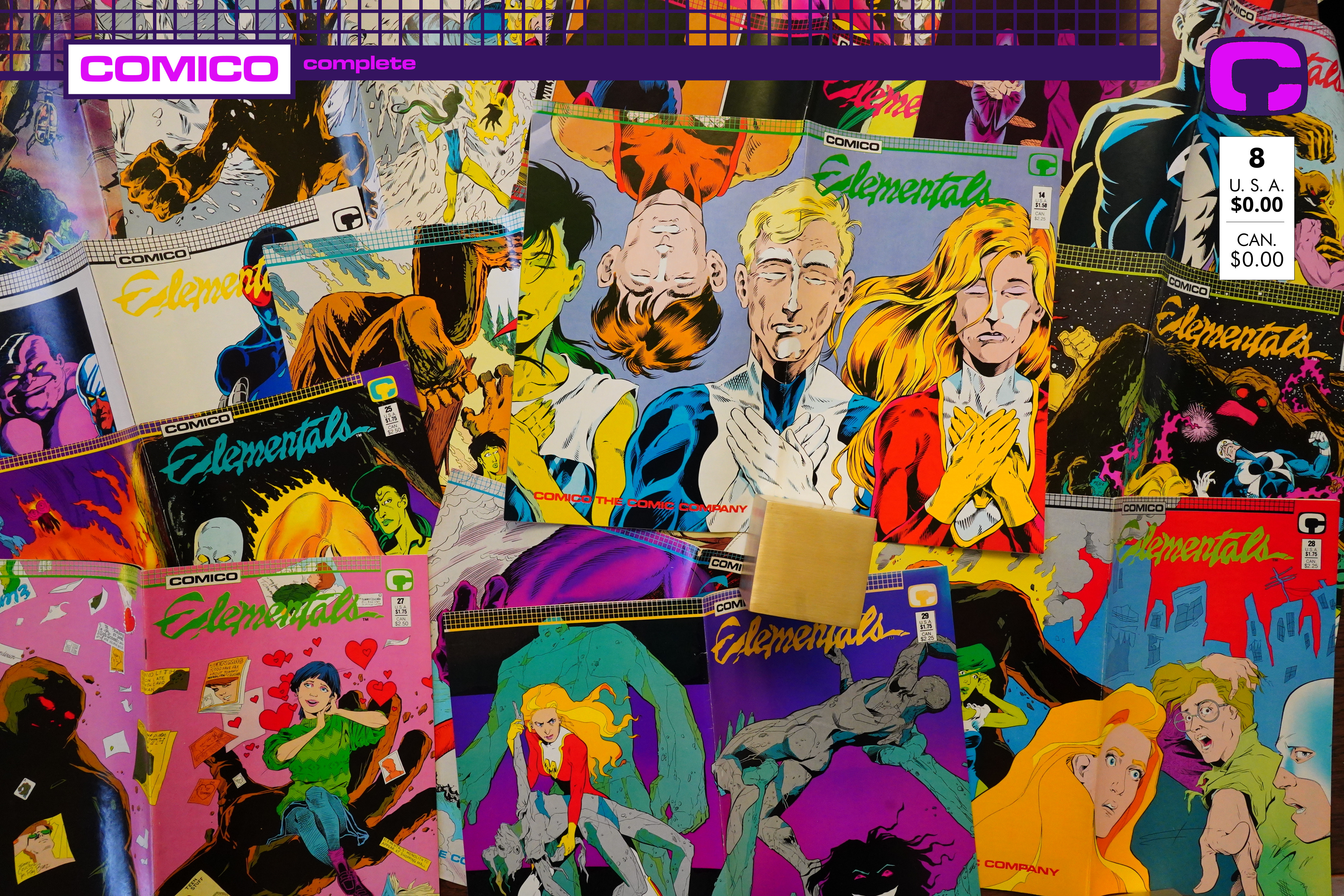
Elementals (1984) #1-29 by Bill Willingham and a cast of thousands
Elementals was, by far, the most commercially successful book at Comico. Or perhaps I should say property — after Comico went bankrupt and then rose from the grave, it was the thing propping up the company. (I guess Macross may have sold more? I don’t know.)
But I’m not quite sure how to approach Elementals for this blog. With Airboy over on the Eclipse blog, I did all the various series and spinoffs in one super duper long blog post. And I could do that with Elementals, too — heaven knows that there’s enough spinoffs — but I don’t think I have the stamina to read all those Elementals books without something else in between.
So I think I’ll do one post per series… Although I might change my mind later. And perhaps lump Elementals Sex Special, Elementals Sexy Lingerie Special, Elementals: Lingerie and Elementals Sex Special volume 2 into one post?
I guess we’ll find out when this blog series reaches the 90s.
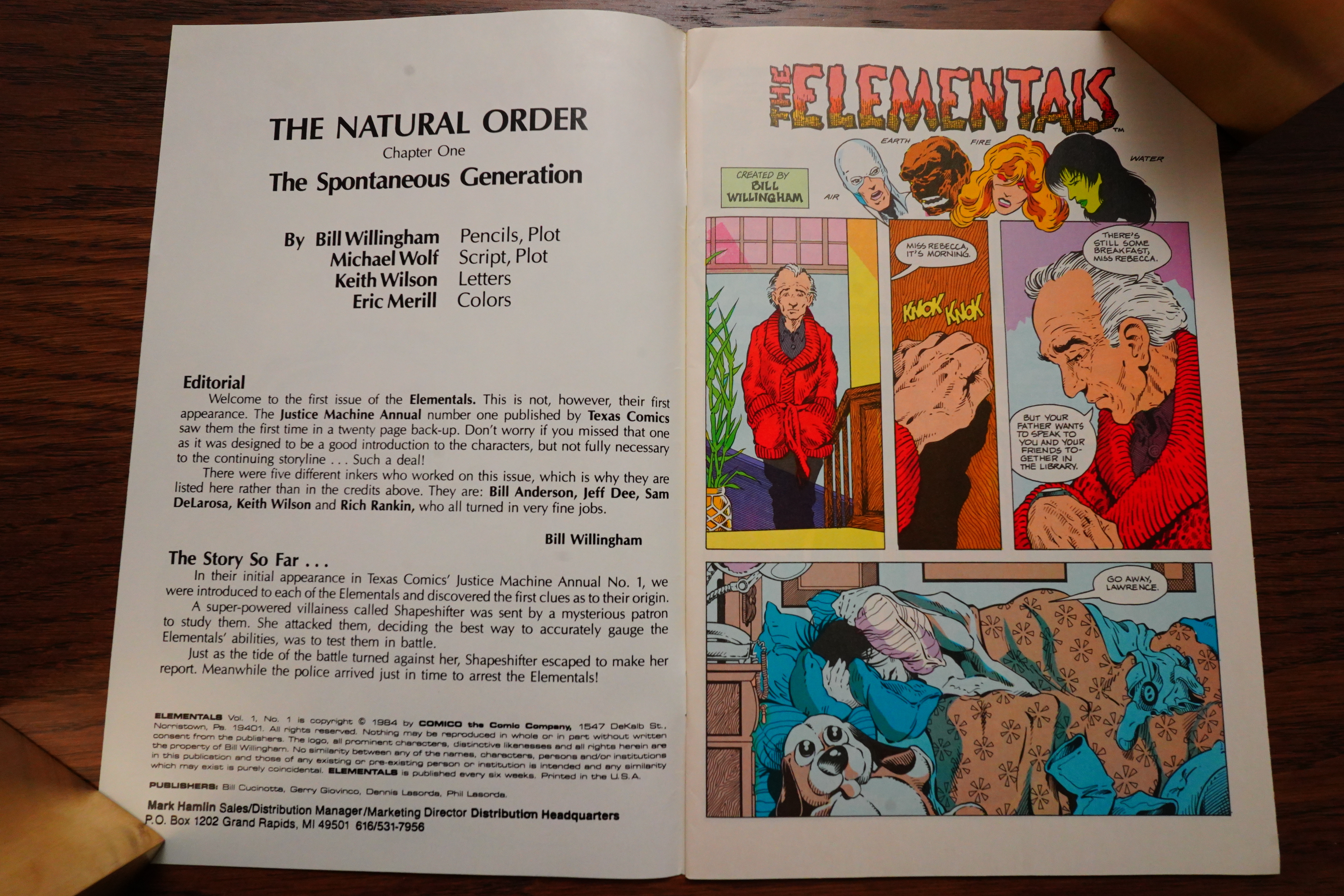
OK, so the Elementals were introduced in The Justice Machine Annual #1 published by Texas Comics. Hm… Texas Comics… that sounds familiar…

Nope. They only published one comic book, so I must be thinking of something else.
But if they were introduced in an “annual”, that sort of implies that there was a regular series?
Yes. From Noble Comics.
This sort of thing would go on to become a regular thing at Comico, I think — that is, Comico picking up a series that’s already been published somewhere else. And then not actually doing much of a recap of the previous issues.
The unusual thing here is, I think, that Elementals stayed with Comico to the bitter end (i.e., 1997). Many of the other series that flitted by (“flitted”? sounds wrong MUST REMEMBER TO CHECK BEFORE PUBLISHING BLOG) lasted for only a handful of issues before going on somewhere else.
Comico were very gung-ho about creators’ rights, so this makes sense in that context, in a way: The creators own everything about their comics, so why not move around? But it also makes one wonder why some people bounced off of Comico so quickly, and why Elementals remained at Comico even after the bankruptcy and the resurrection by the new (villainous) owners in the 90s…
Time will tell! I haven’t done any research into that yet.
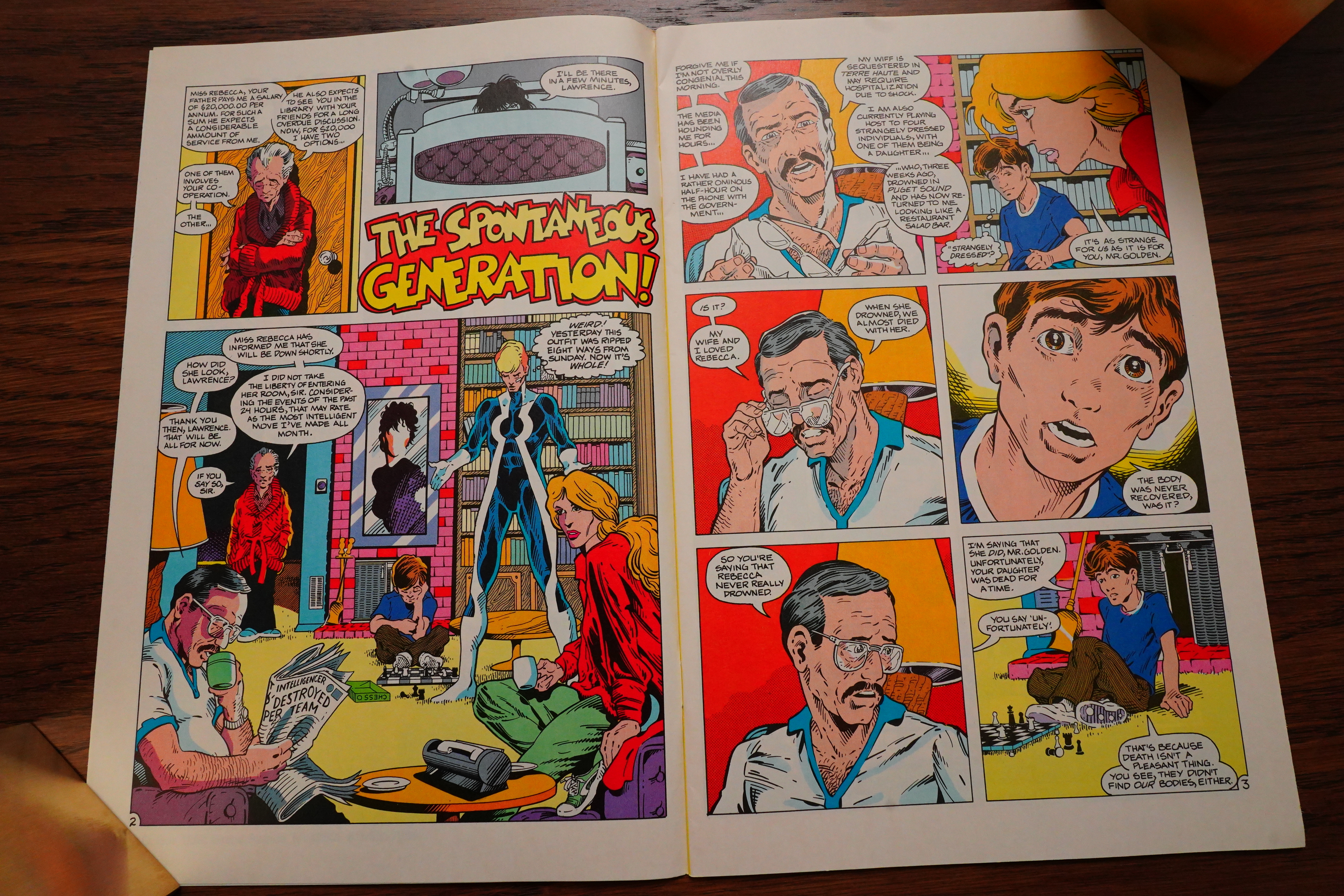
This reads very, very much like you’re supposed to have read that annual, though. We are, sort of, given an introduction of these characters, but nobody’s sitting down with the “as you know, Bob, after you died, you were given these powers by some Gods that we’ll talk more about later”. Which is a good thing! But there’s a wide chasm between infodumping and just assuming that the reader knows everything already, and this is more on the latter side of that gorge.
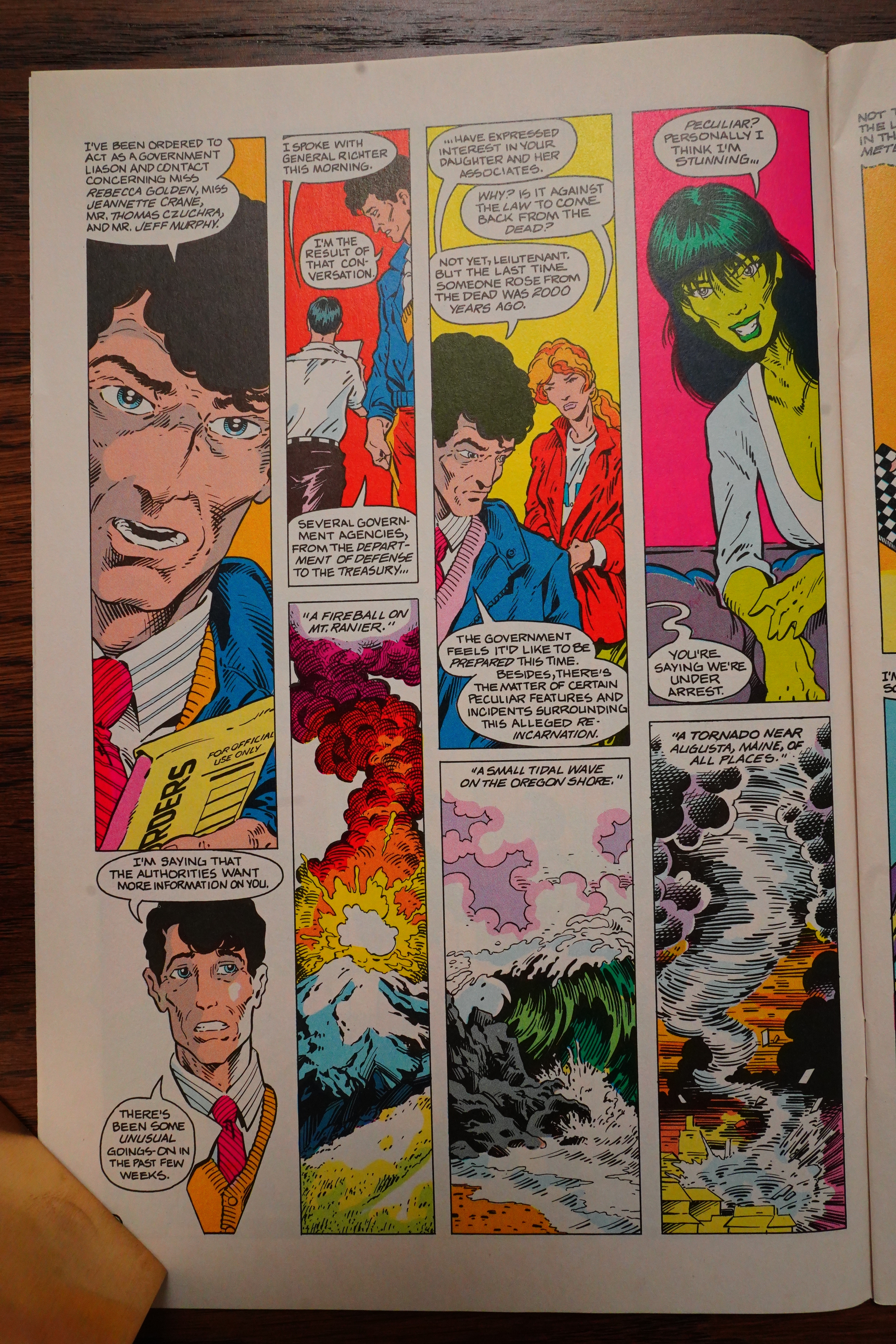
The storytelling is bumpy. There’s more than a few pages like this where it’s not very clear what reading order the panels (or speech balloons) are supposed to be in.
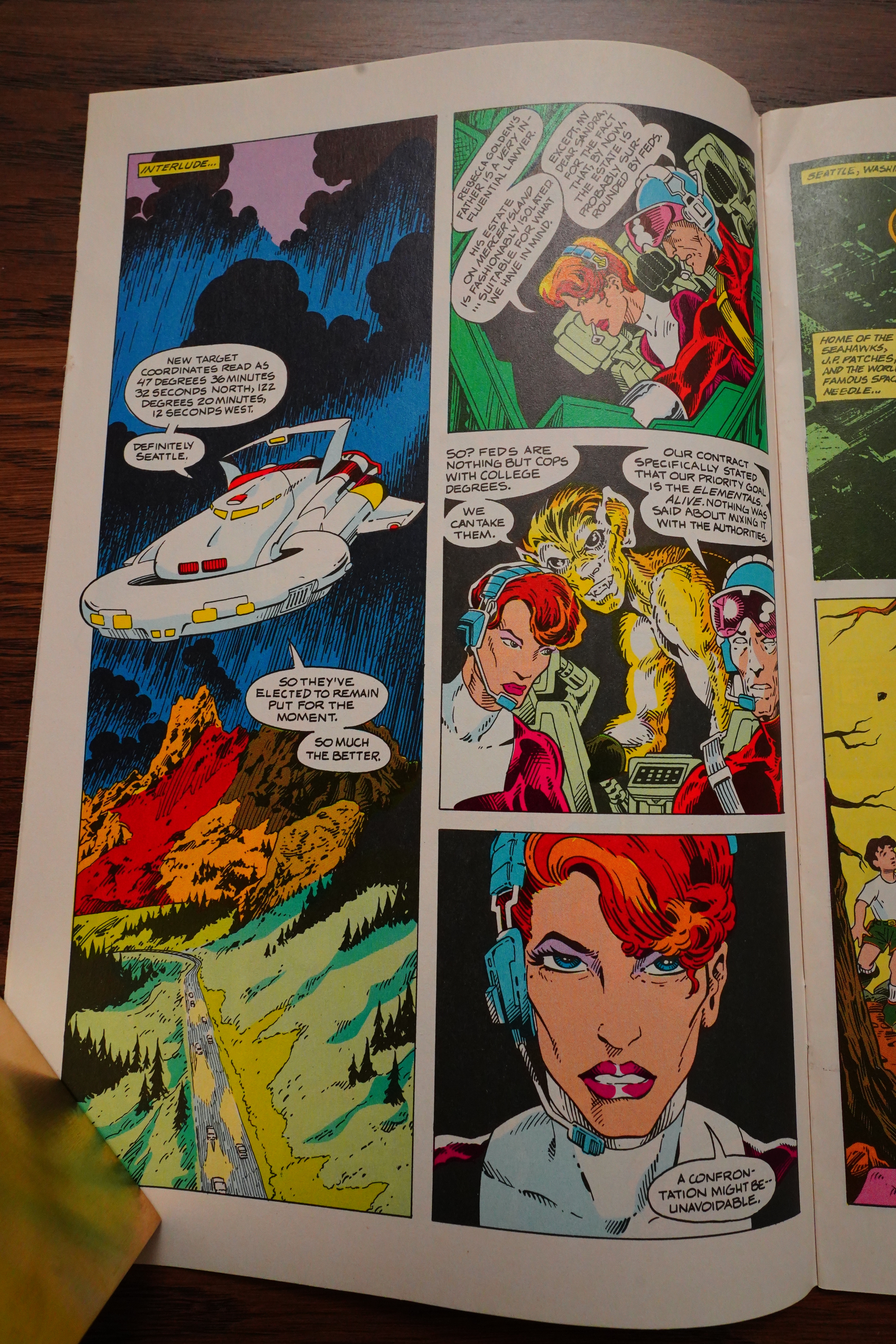
And strange things like the upper right panel there… OK, the er space ship is on a downward trajectory, so the speech balloons are, too? Well, OK?
In the Zombie Comico years in the 90s, many of the Elementals minis seem to be porn based (I haven’t actually read any of them yet, but names like “Elementals Sex Special” seem to, er, give a hint), and I wondered why a super-hero franchise would take that turn.
But… I think the fetishistic thing seems to be part and parcel of the series from the very start? I mean… just based on the line work here? Is it possible for a pencil line to be porny? I guess a little Michael Golden goes a long way… Hm…
Willingham, of course, went on to do porn himself (with Ironwood and Time Wankers, for instance) in the early 90s.
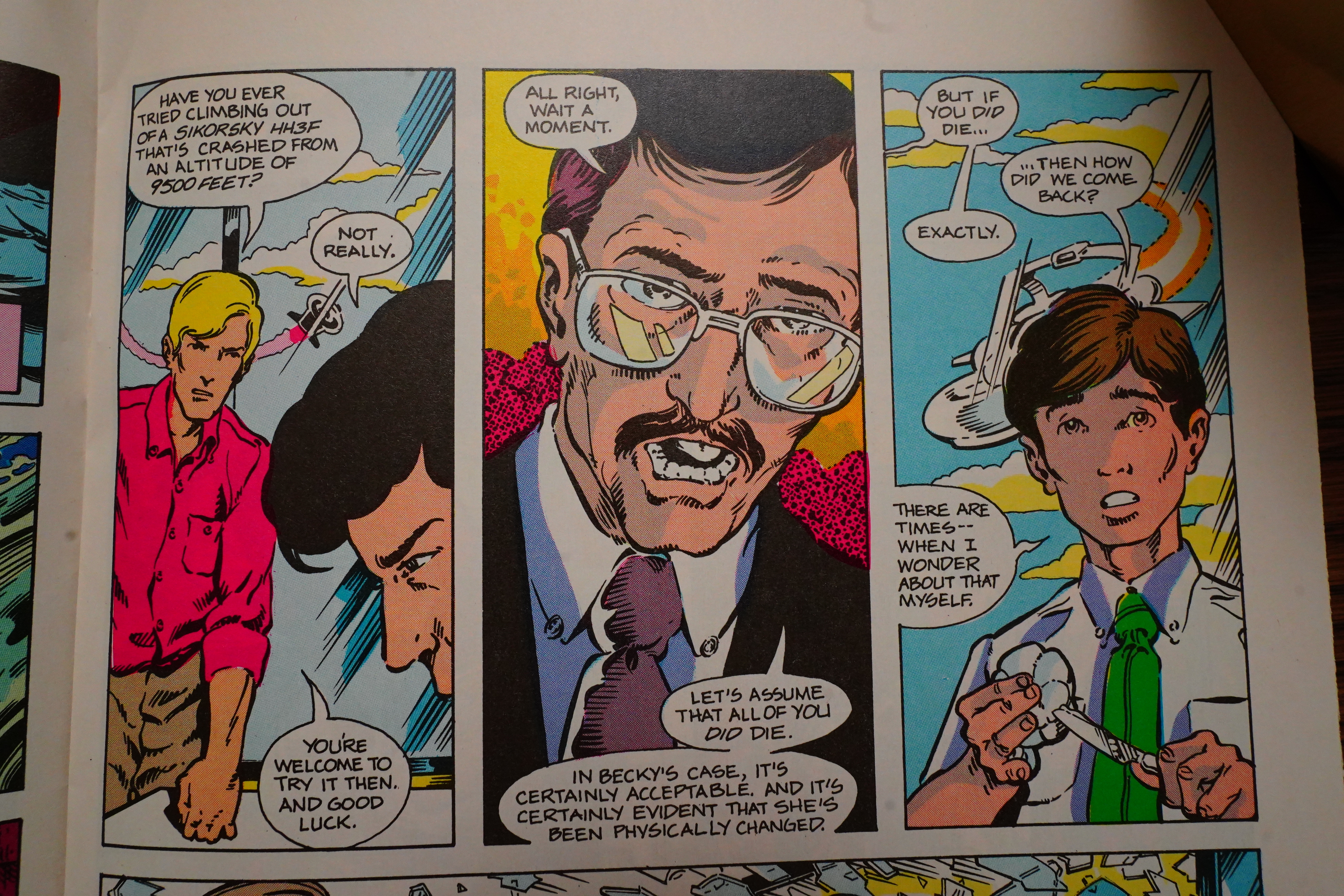
“Let’s assume that all of you did die.” “There are times — when I wonder about that myself.”
Yes, if I had died and been brought back as a super-hero, I would have wondered a bit about that myself, right?
Elementals is just so oddly put together! Reading this book is a pretty head scratching experience: Is the oddness because there’s stuff that’s going to be explained later, or just because Willingham isn’t a very good storyteller? (Spoilers: It’s the latter.)
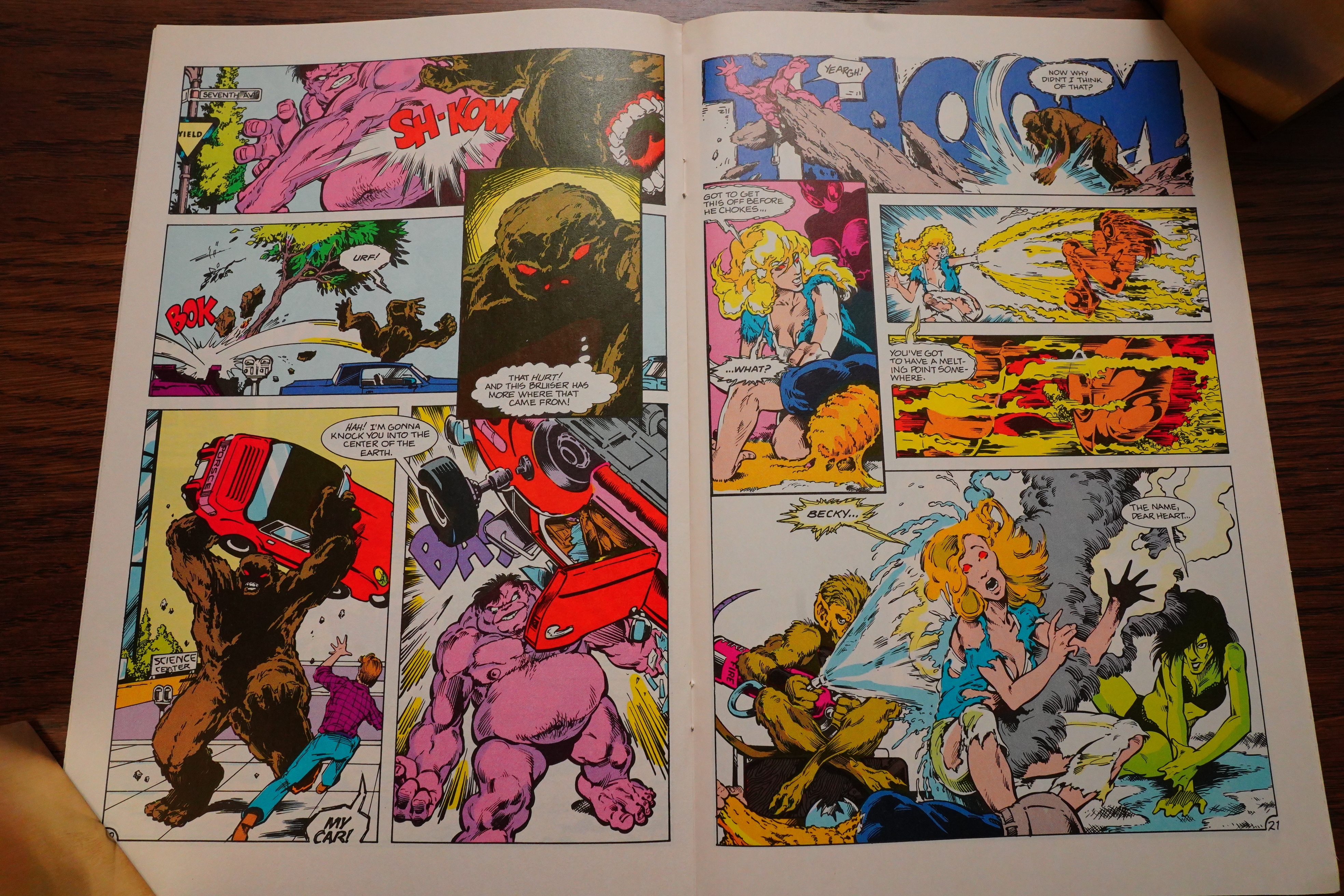
Speaking of fetishistic — one fat bad guy in a thong and one female hero in frilly lingerie are certainly choices…
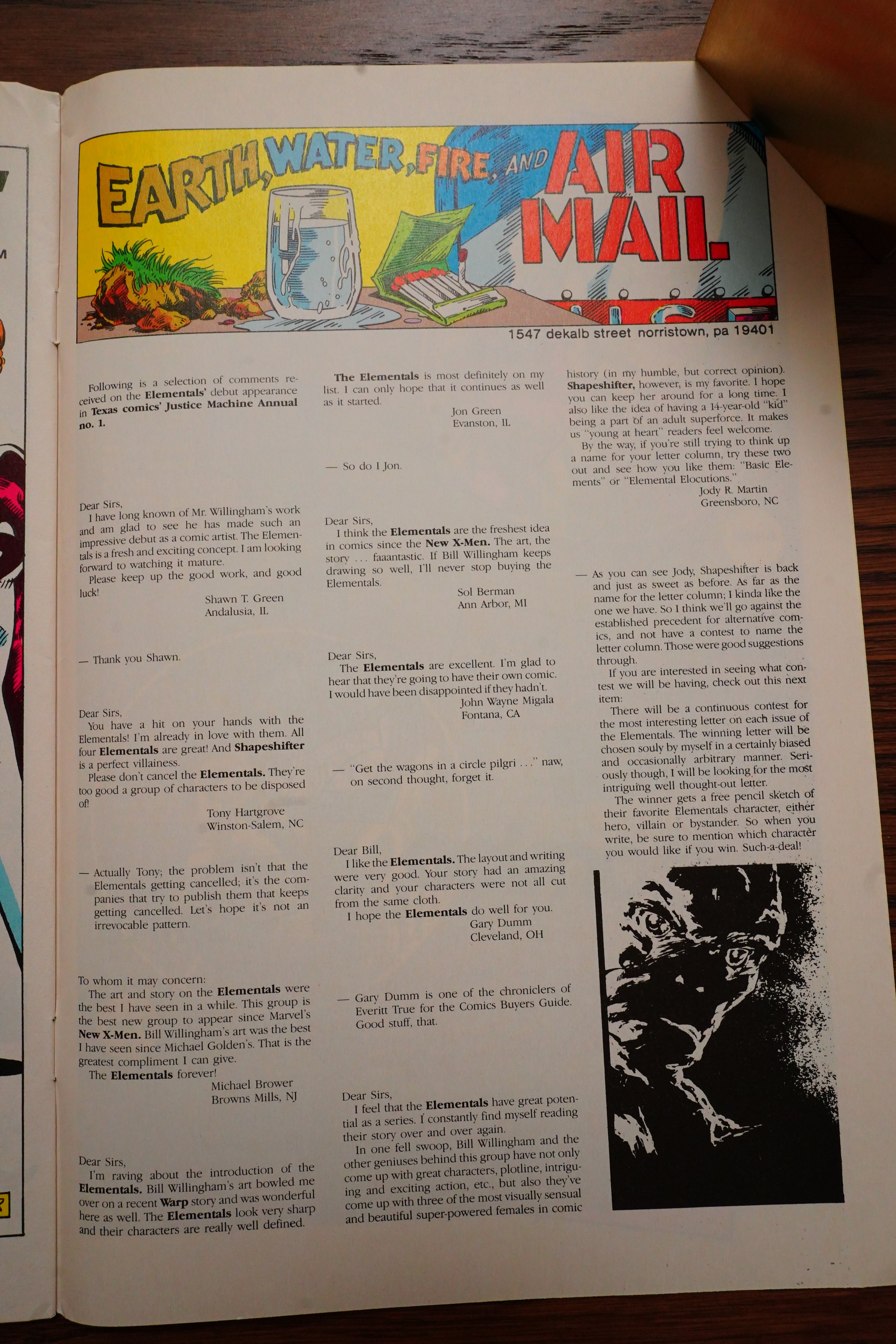
Since there’s been previous issues, we even have a letters column in the first issue.
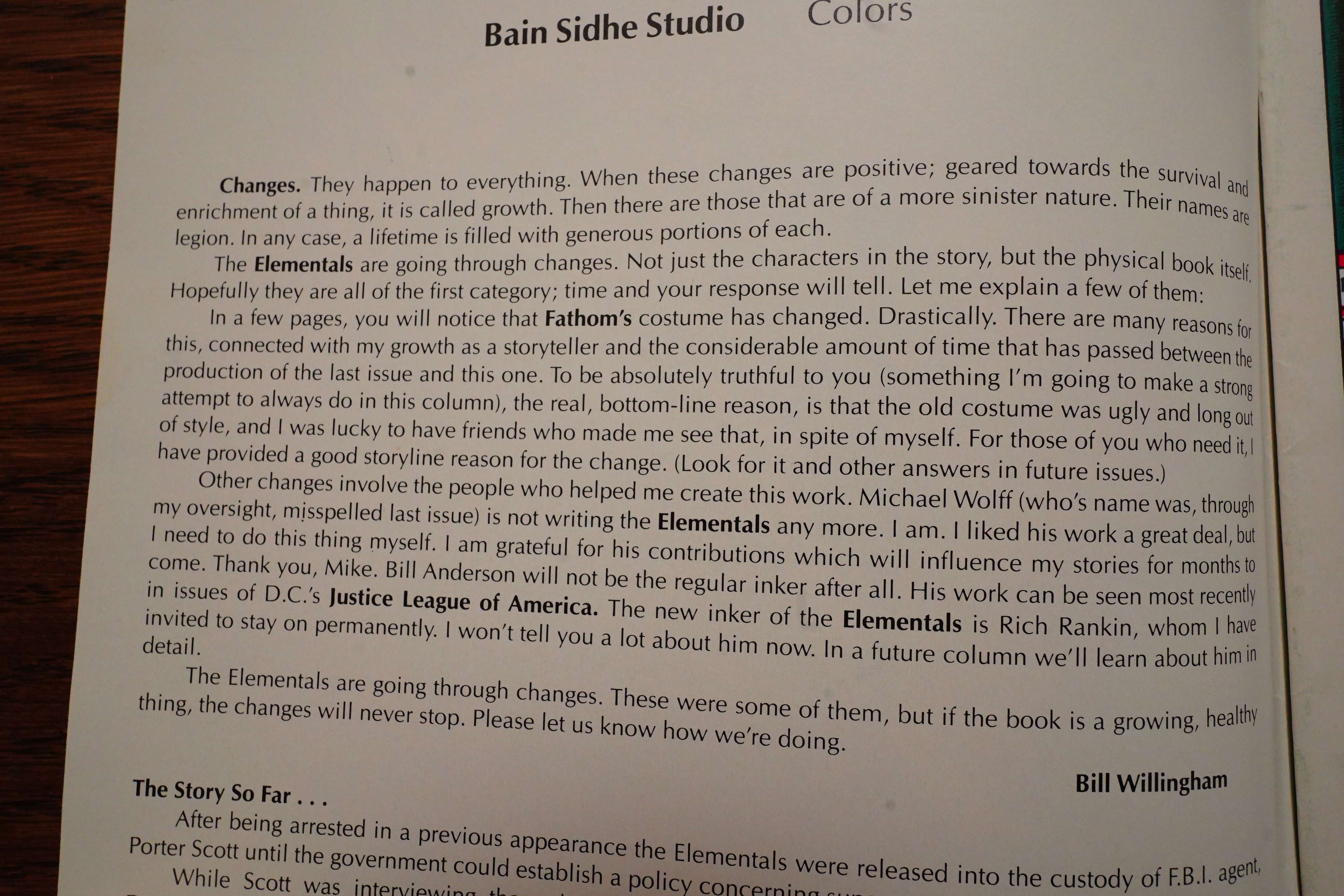
I surmise from the editorial in the second issue that somebody told Willingham that the lingerie costume (I assumed that wasn’t her costume but just what she happened to be wearing when she lost her dress) is a bit “eh”, so she’s getting a new one. “I was lucky to have friends who made me see that, in spite of myself.”
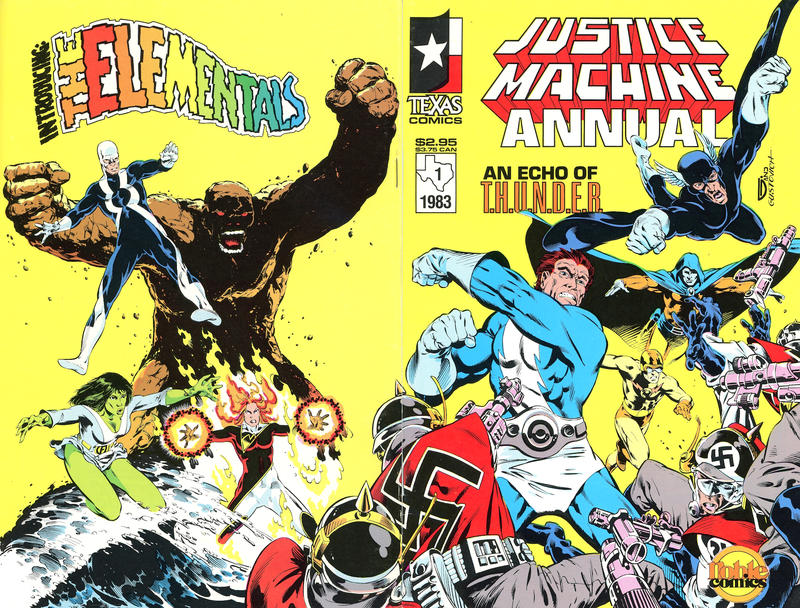
Oh, OK, the lingerie wasn’t her costume? It was that thing with the micro mini skirt, I guess.
And… we’re being informed that the first issue was done over a number of years, but from now on all the material is new. That could certainly help explain the weird storytelling.
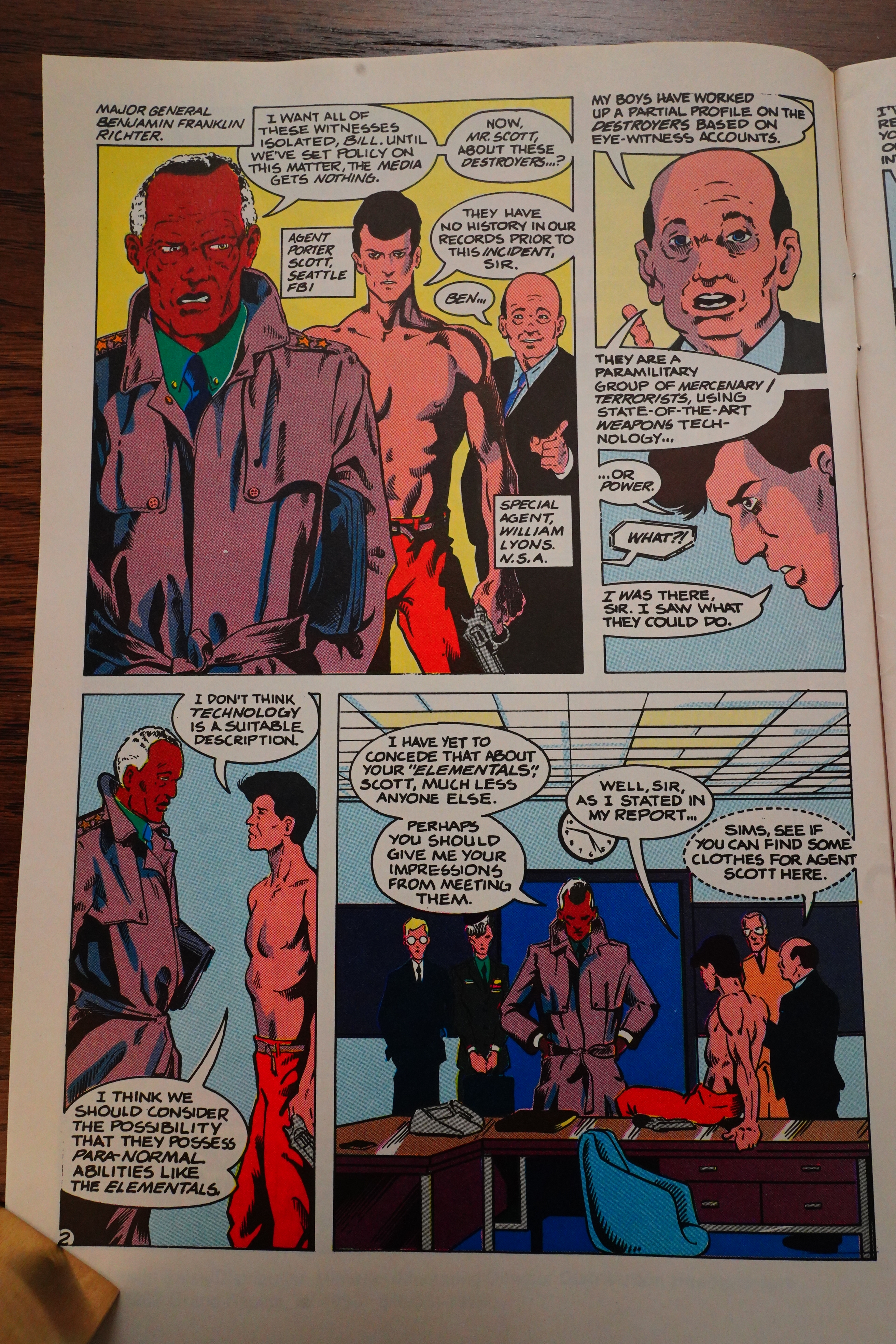
Professionalism, FBI agents. Professionalism in the office!
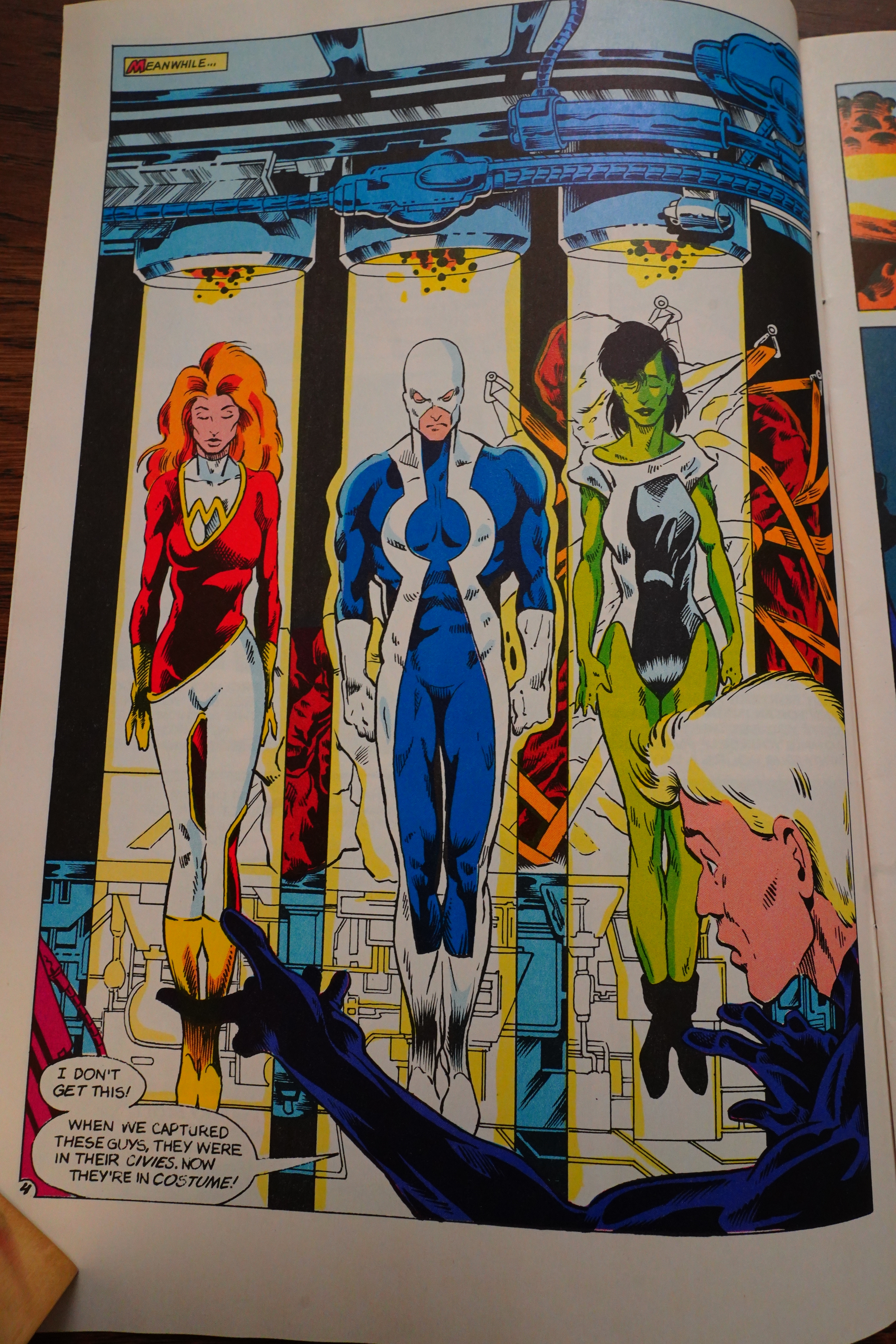
OK — here’s the in-story explanation for the new costume: “Now they’re in costume!” Well, OK then!
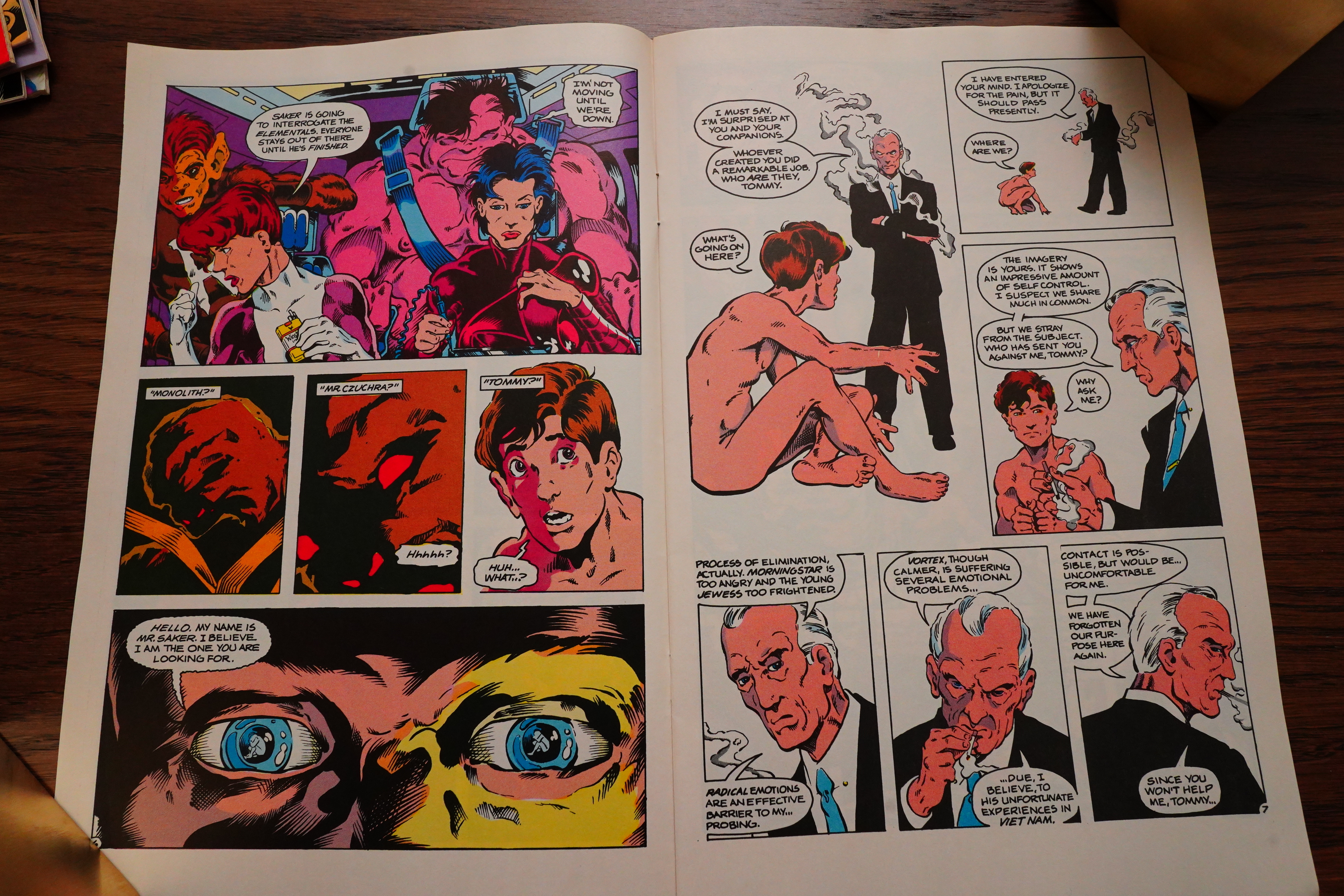
And, yeah, the er 12-year-old kid who turns into the big earth monster turns naked every time he shifts back into human form? Makes sense.
That’s the villain — and he knows the traumatic backstory of all of the different Elementals. One is a Vietnam vet, one is angry, and one is a frightened “Jewess” (I quote). The evil guy ends up giving Monolith a costume made of ectoplasm later, which isn’t very evil of him, I have to say.
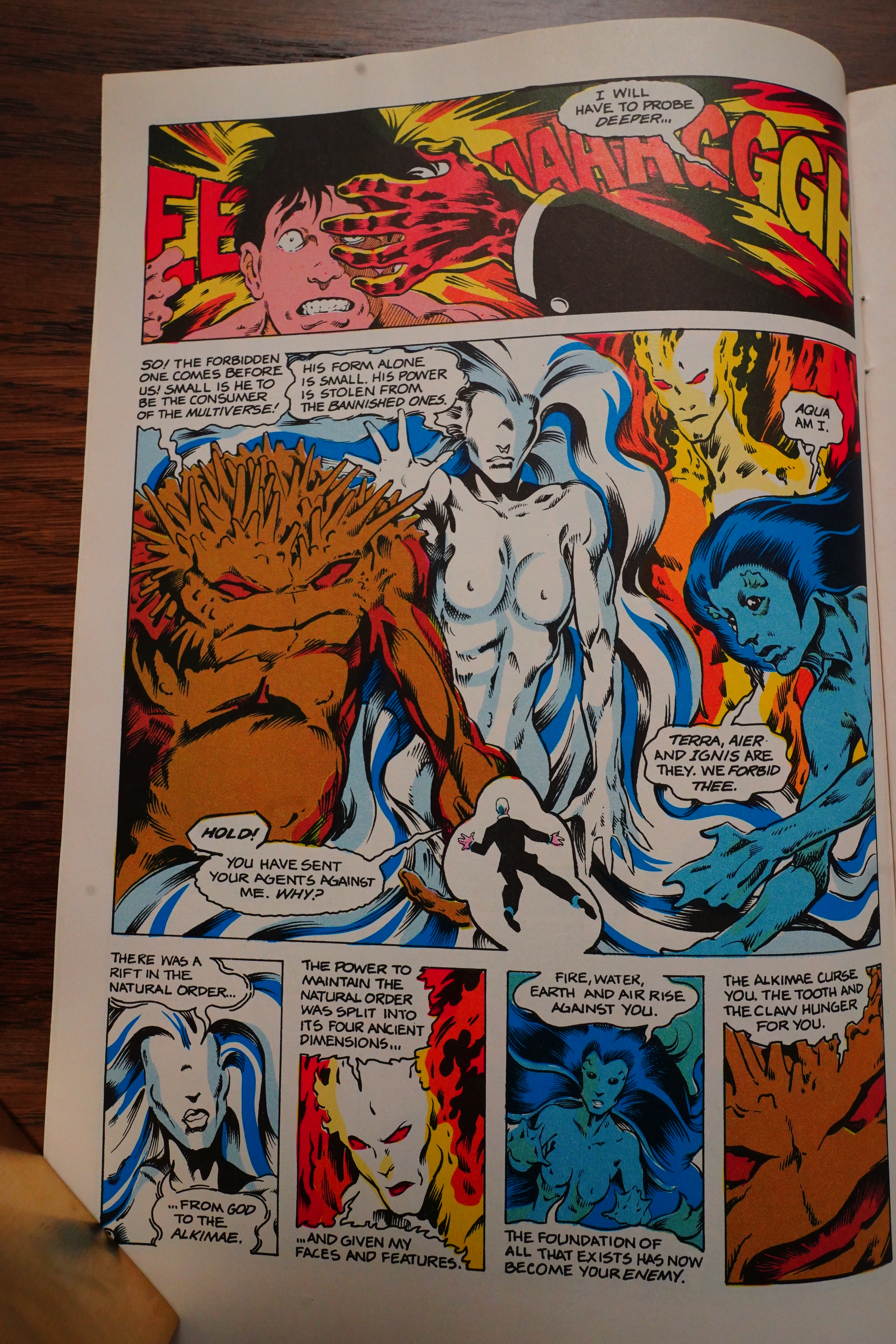
And then we get their origin stories all of a sudden! But again, it really feels like Willingham is reminding the reader of something the reader is supposed to have read before — it’s just weird. I don’t think that’s what’s going on, but that’s what it feels like when reading these pages.
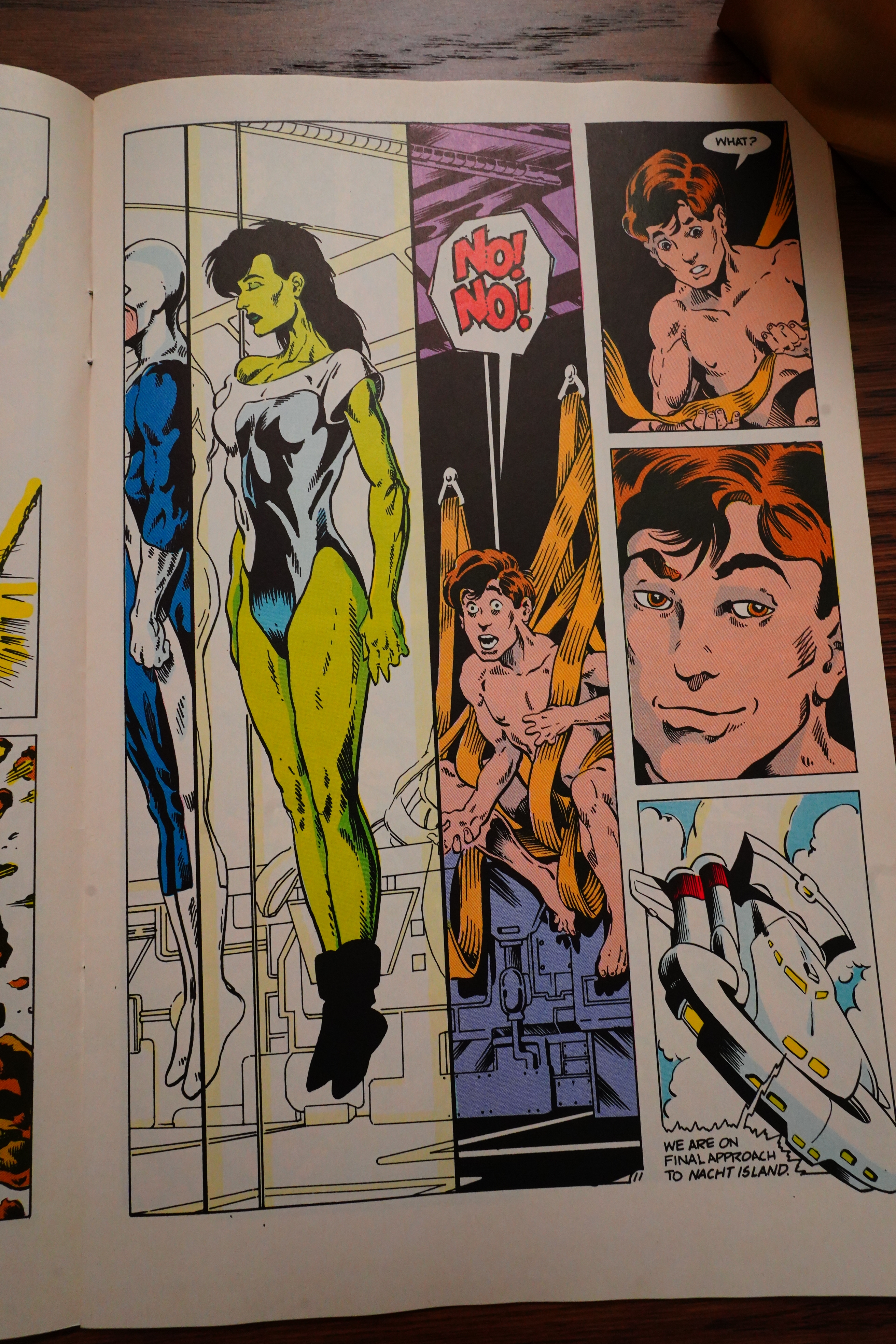
See, they had tied him up in his super-duper-strong big earthy form, but now that he’s a child again, he’s free! D’oh! Why didn’t the villains think of that!
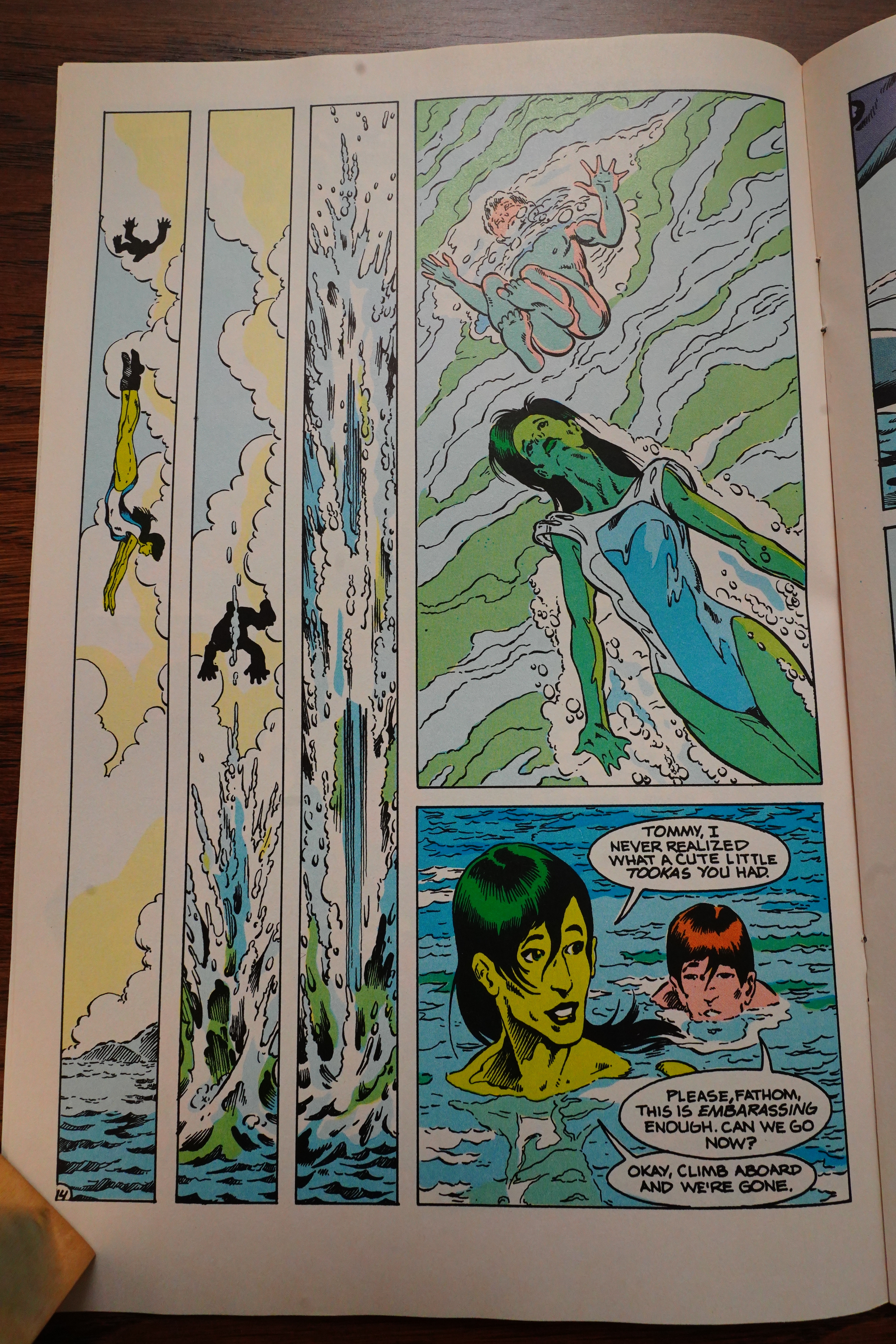
And viola! Here we get character building — her Jewish identity is shown by her use of Yiddish words like “tookas”, which is perhaps not the most common spelling of that word. And I think that is the only kinda-sorta Yiddish word we get? Perhaps Willingham just forgot…
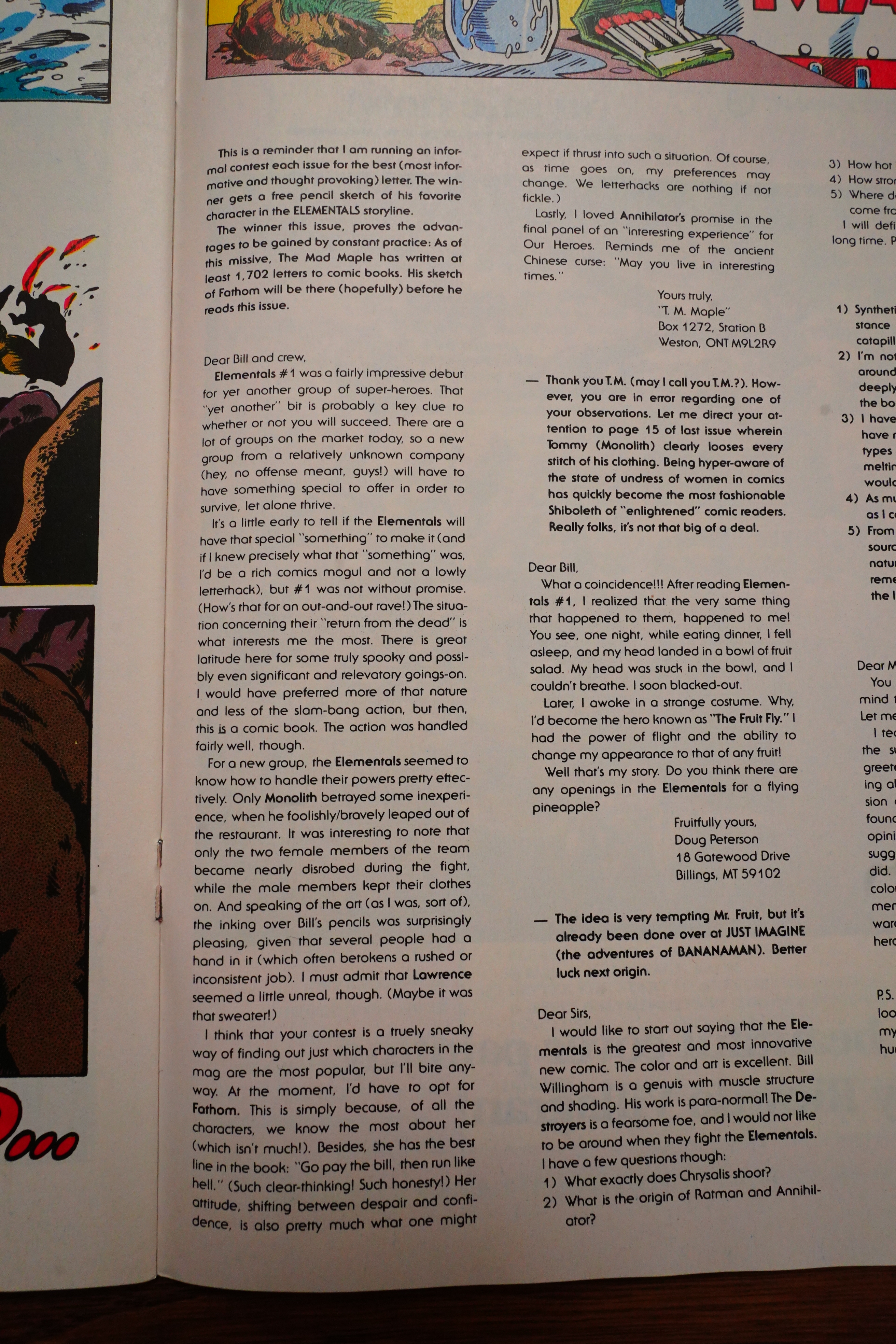
T. M. Maple writes in to say that he thinks the book is perhaps touching on looking a bit porny, but Willingham makes a striking defence by pointing out that he also has a naked boy in the book. And besides: “Being hyper-aware of the state of undress of women in comics has quickly become the most fashionable Shibolet [sic] of “enlightened” comic readers.”
Well, that’s an ad, certainly…
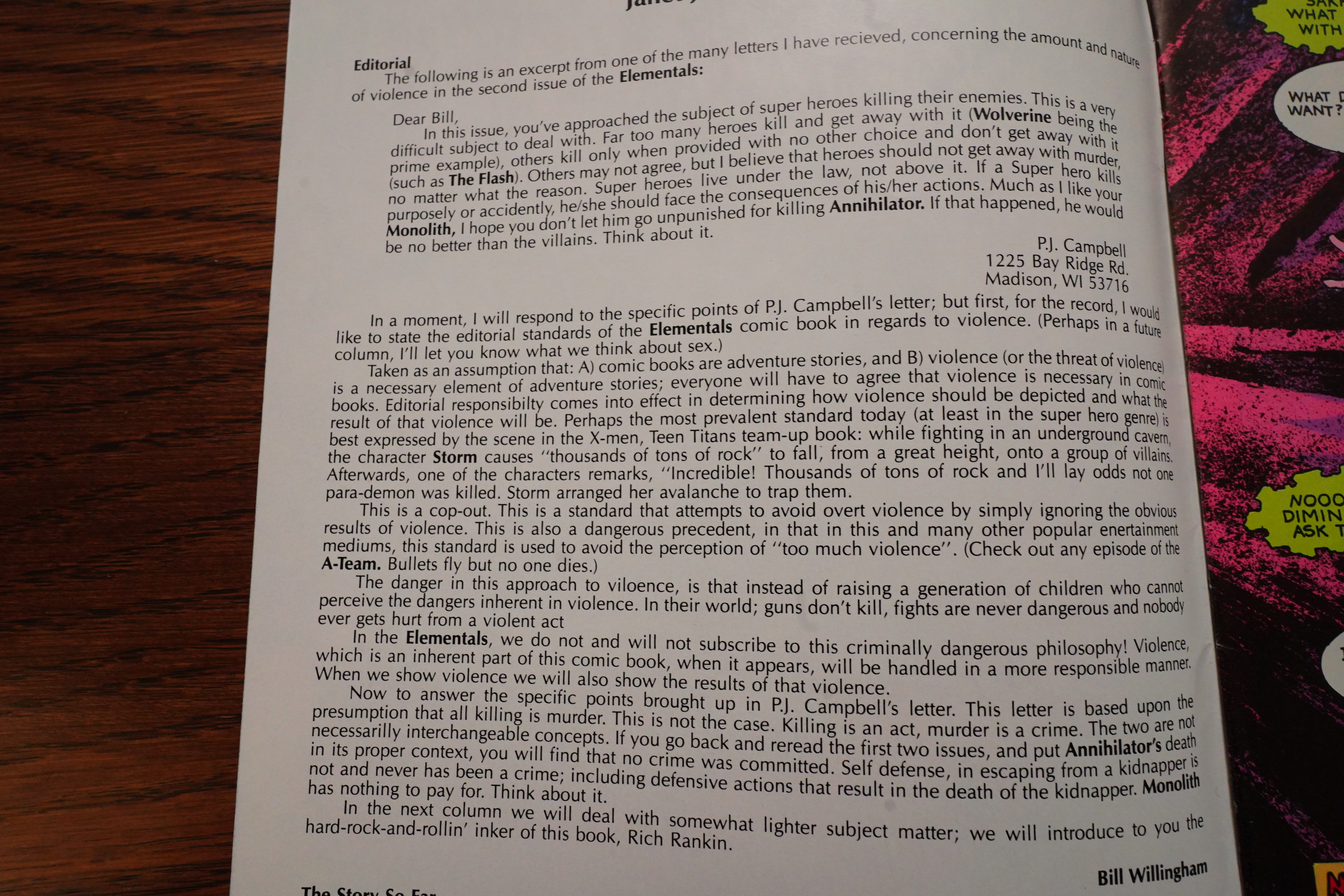
A writer needles Willingham by rolling his eyes at all the violence in the book — in particular the earthy guy (who’s really a twelve-year-old) squeezing people to death. Willingham offers the standard defence that the real problem is unrealistic violence where nobody dies.
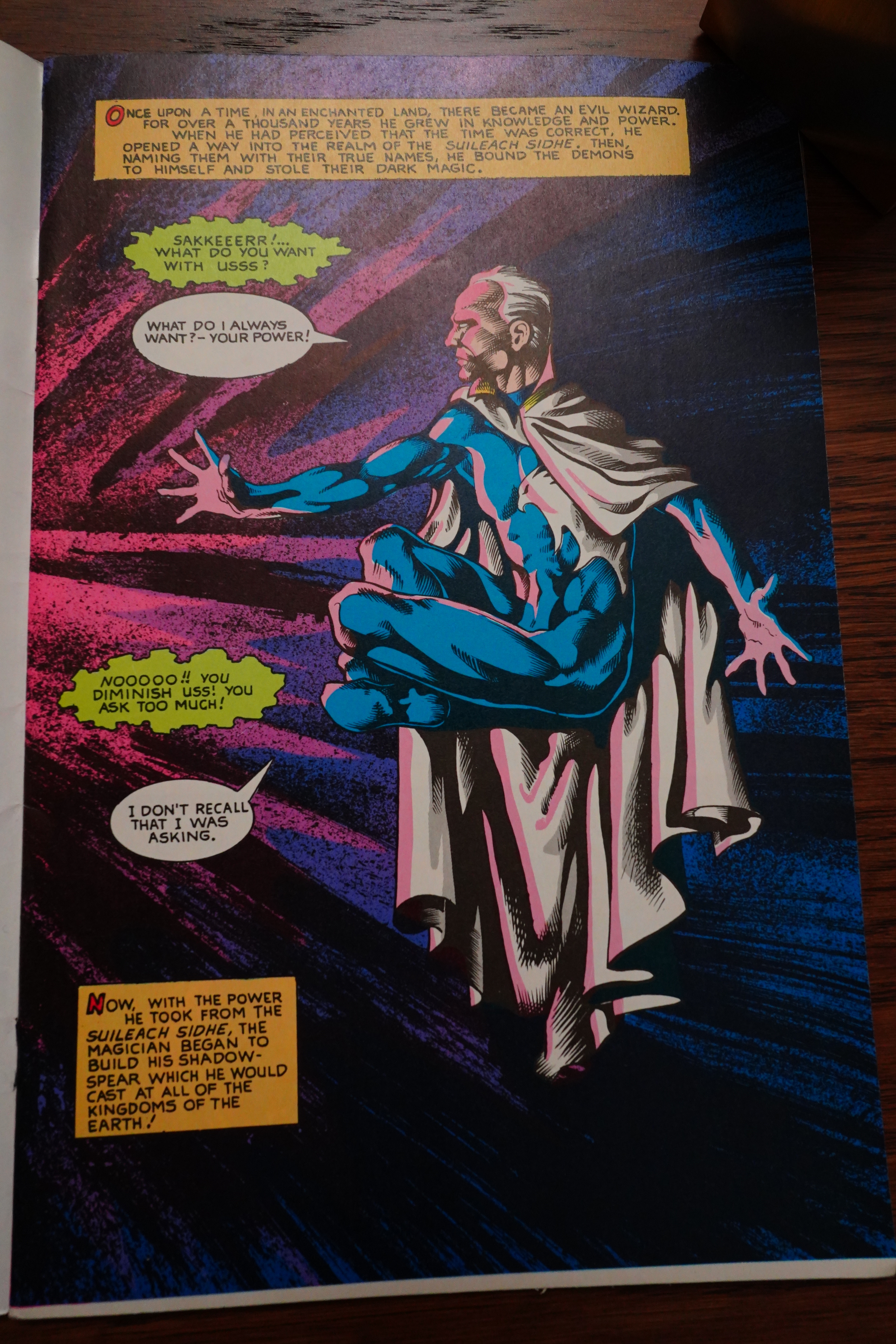
OK, we’re getting more background info on the evil bad guy, but I can’t express enough how this still reads like we’re being reminded of something we’re supposed to already know. It feels like having a mild brain aneurysm.
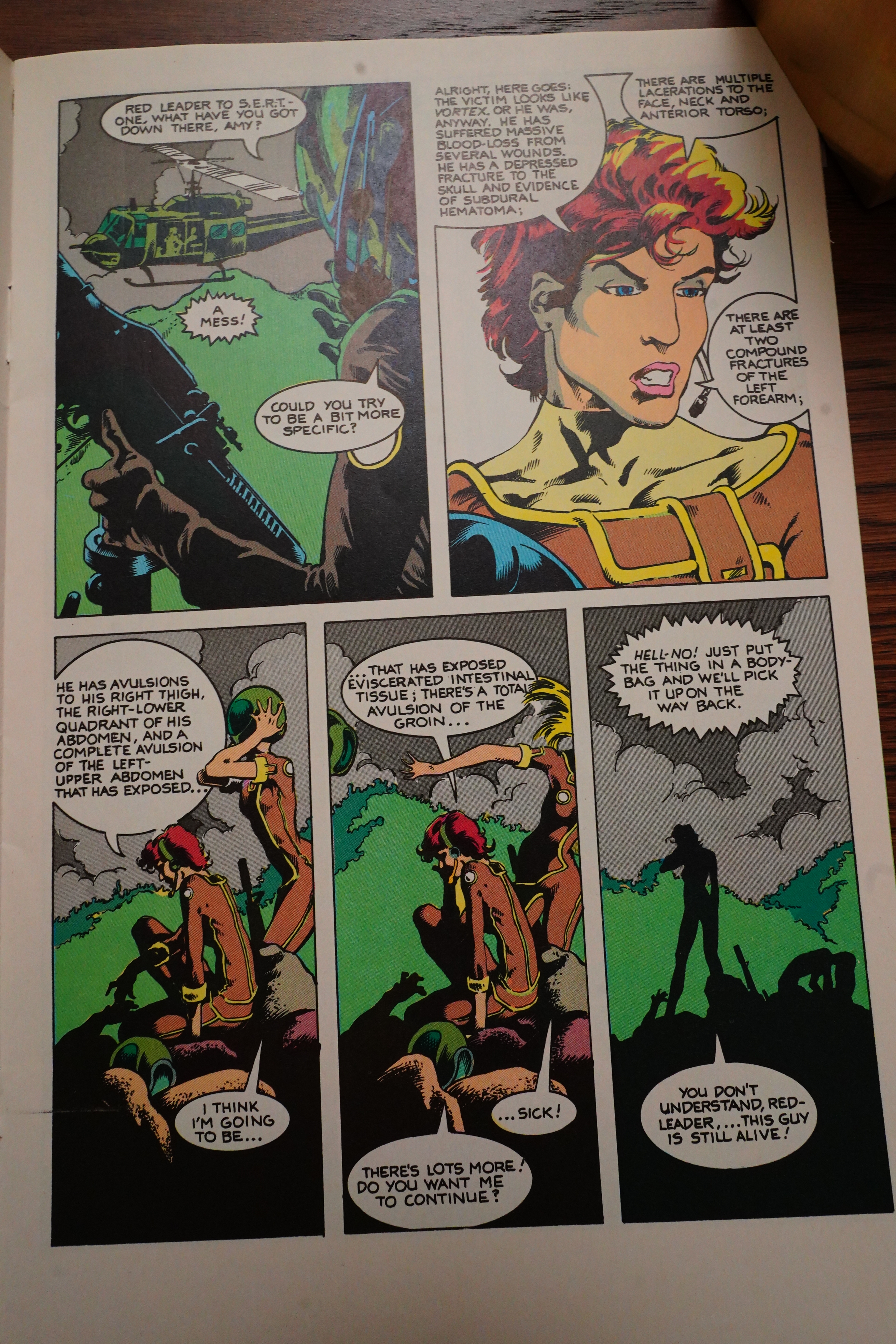
Yuck!
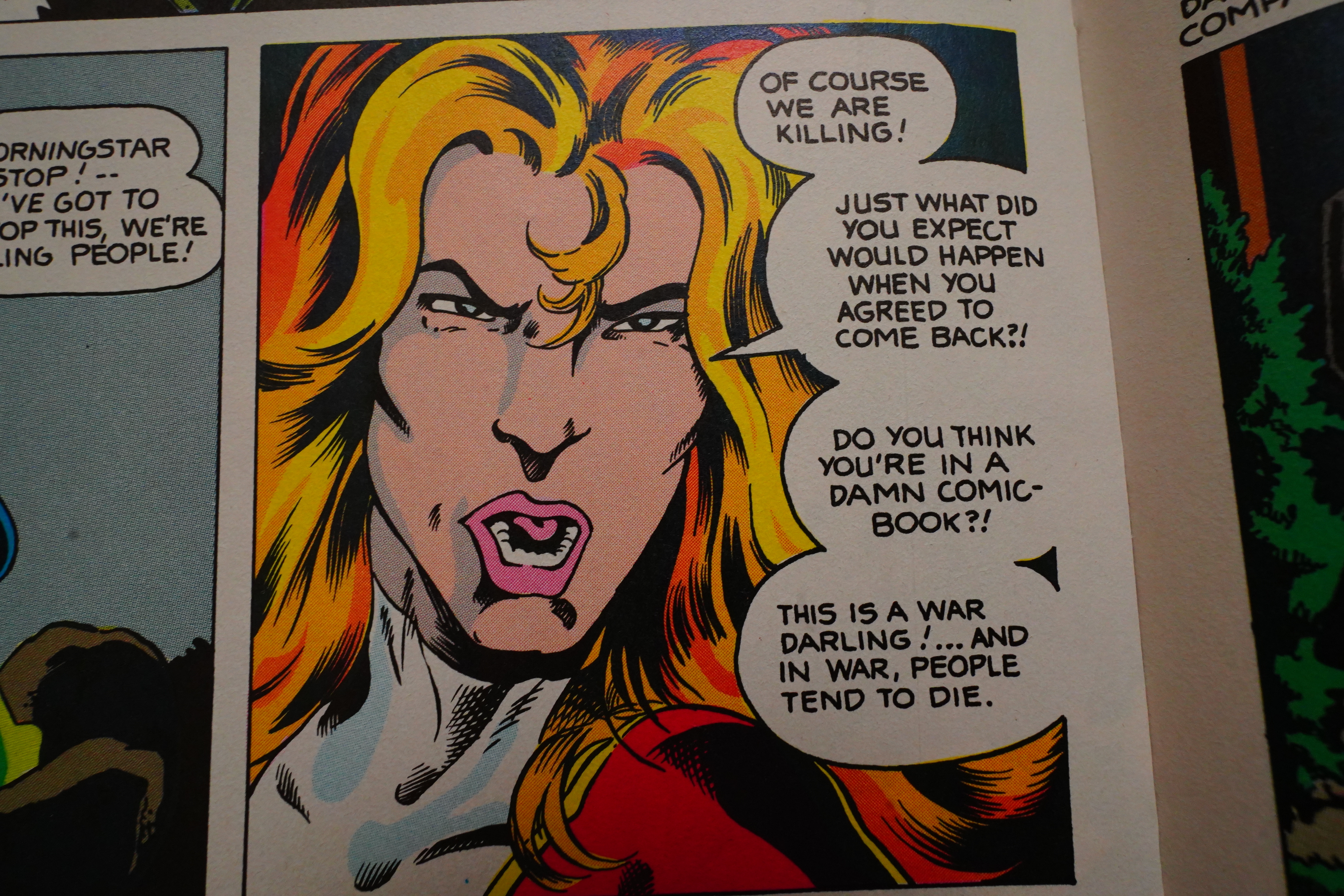
Hey, that letter must have really needled Willingham…
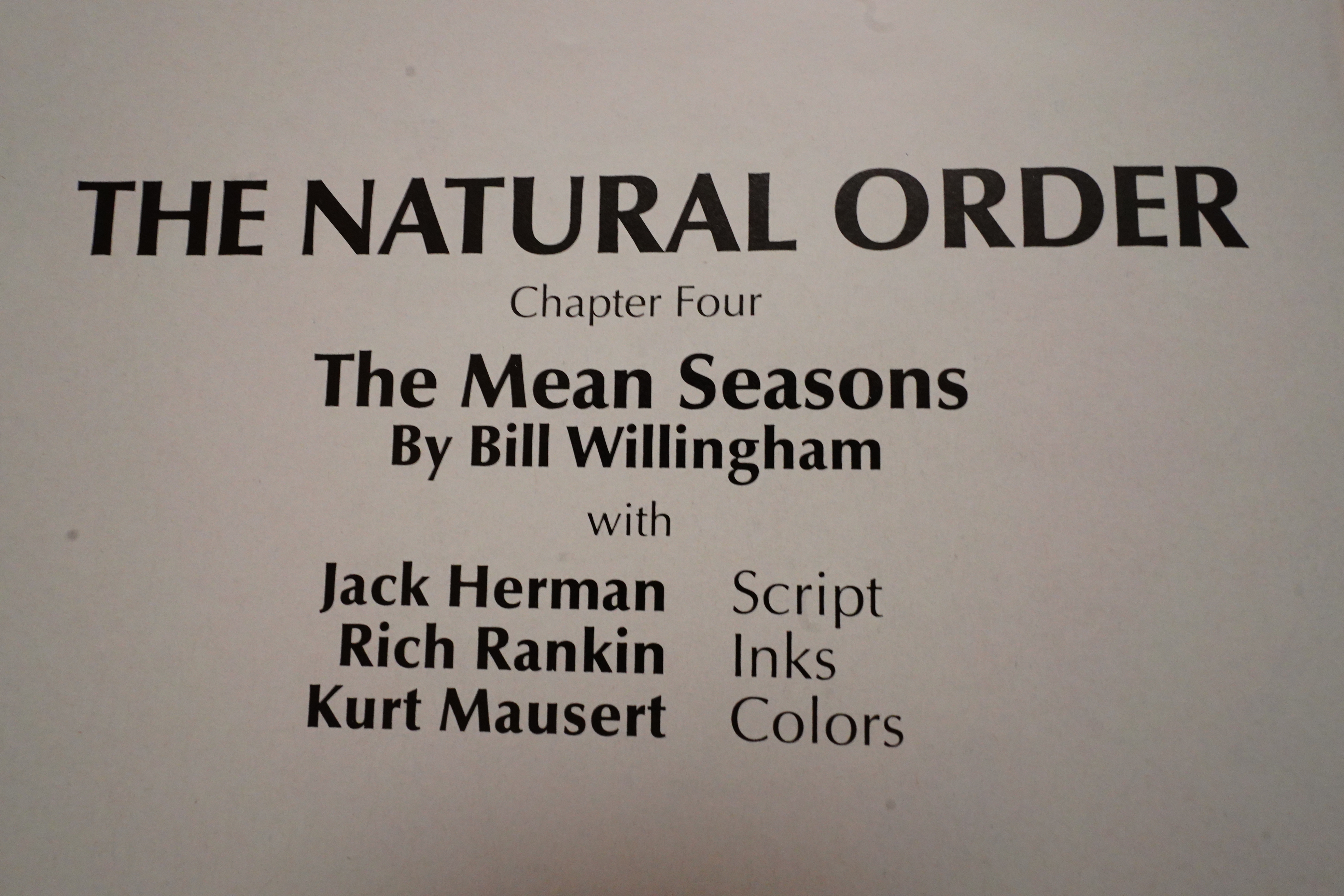
With the fourth issue, Willingham brings in a person on “script”, which I guess means that Jack Herman writes the words based on Willingham’s plot? That’s what it usually means, but people use these words differently sometimes…
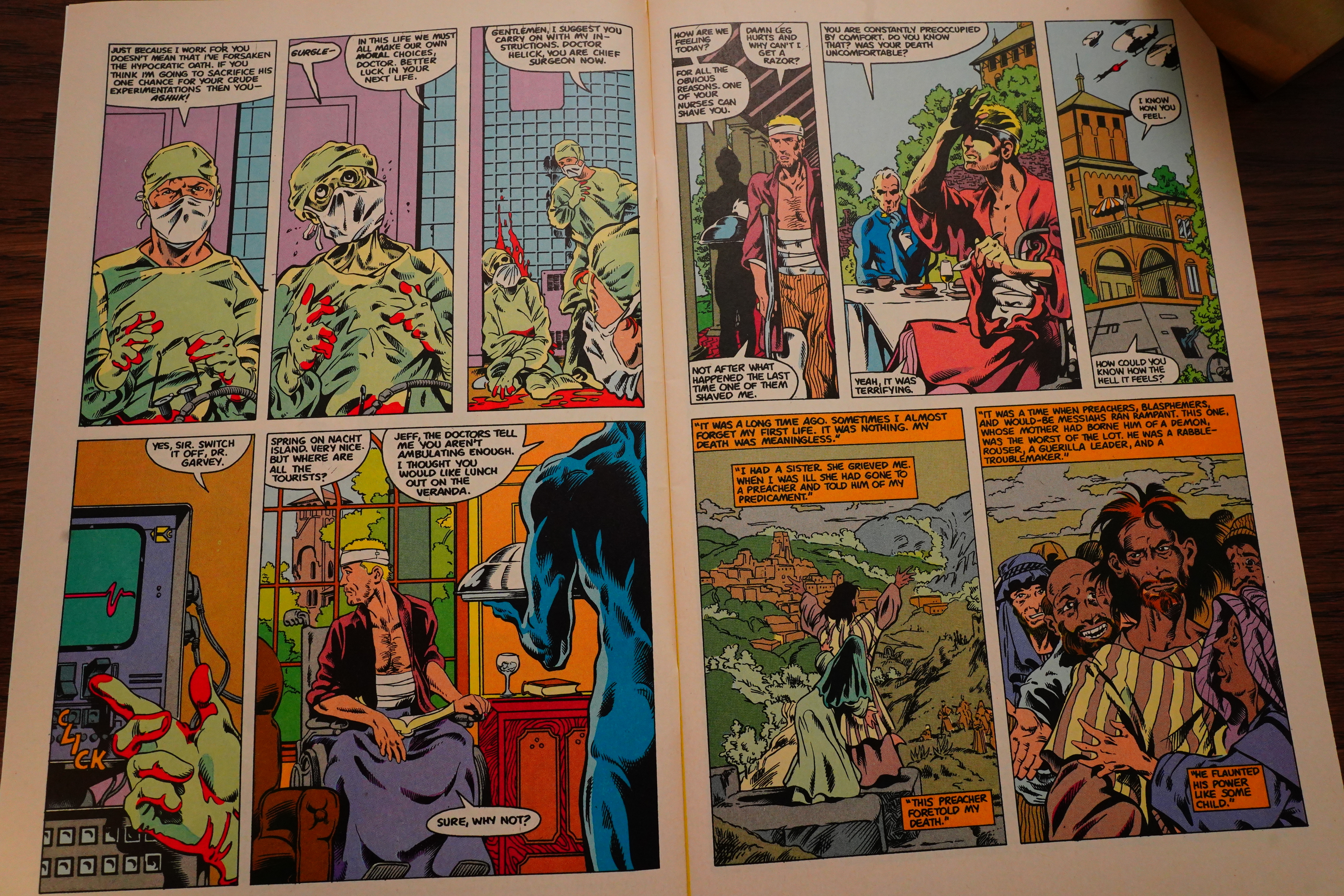
The bad guy is given a really elaborate background (he’s two thousand years old, and he, too, was dead at one point, but he was resurrected by the guy on the lower right hand panel, which I think is Jesus (no names mentioned)). Which is original — we know nothing about the main characters, but we get a lot on the villain…
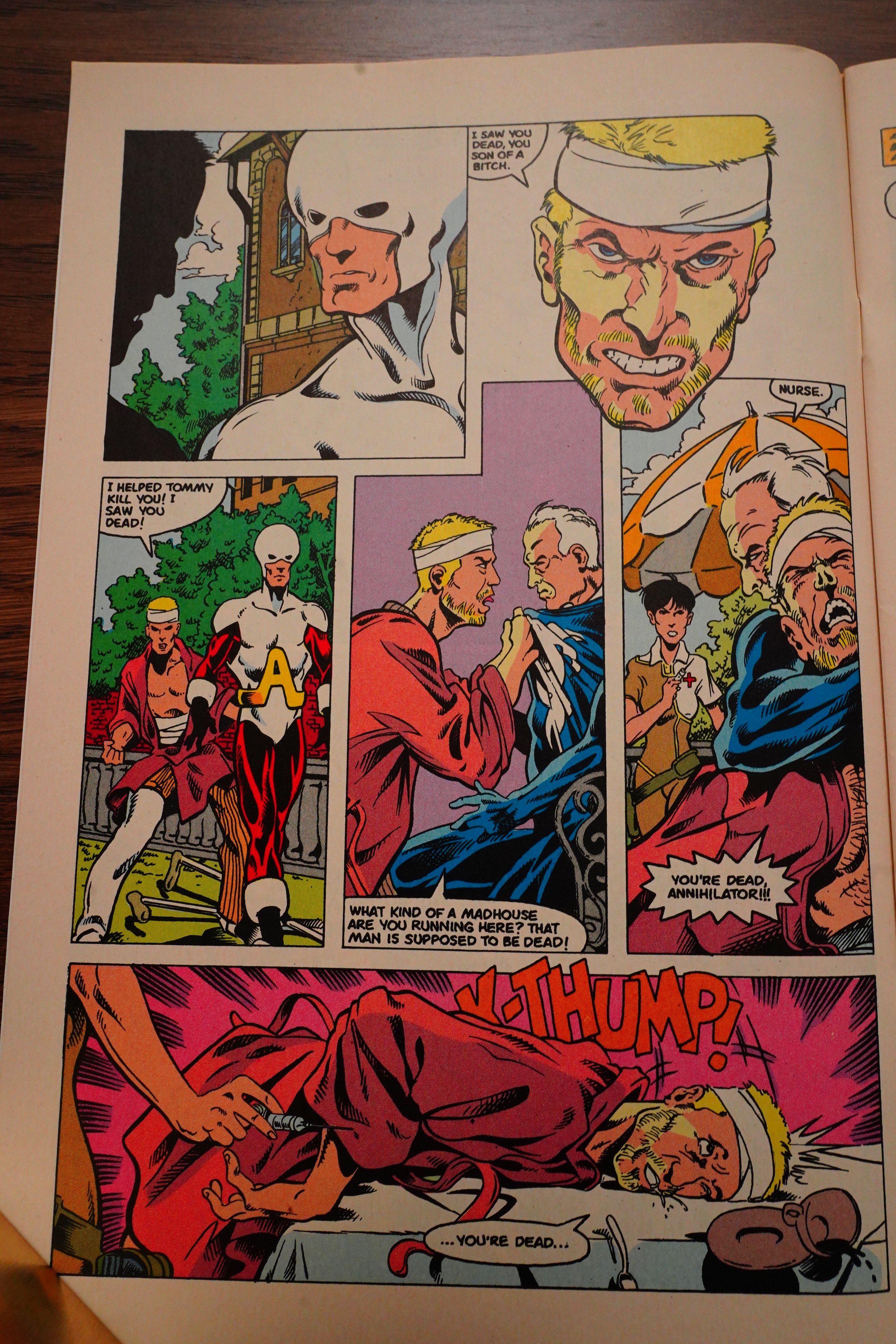
And… remember all that talk about this not being a comic book, and people die? All of a sudden the guy that the earthy kid squoshed to death is alive again!?
I don’t think there’s any followup of that, so I dunno…
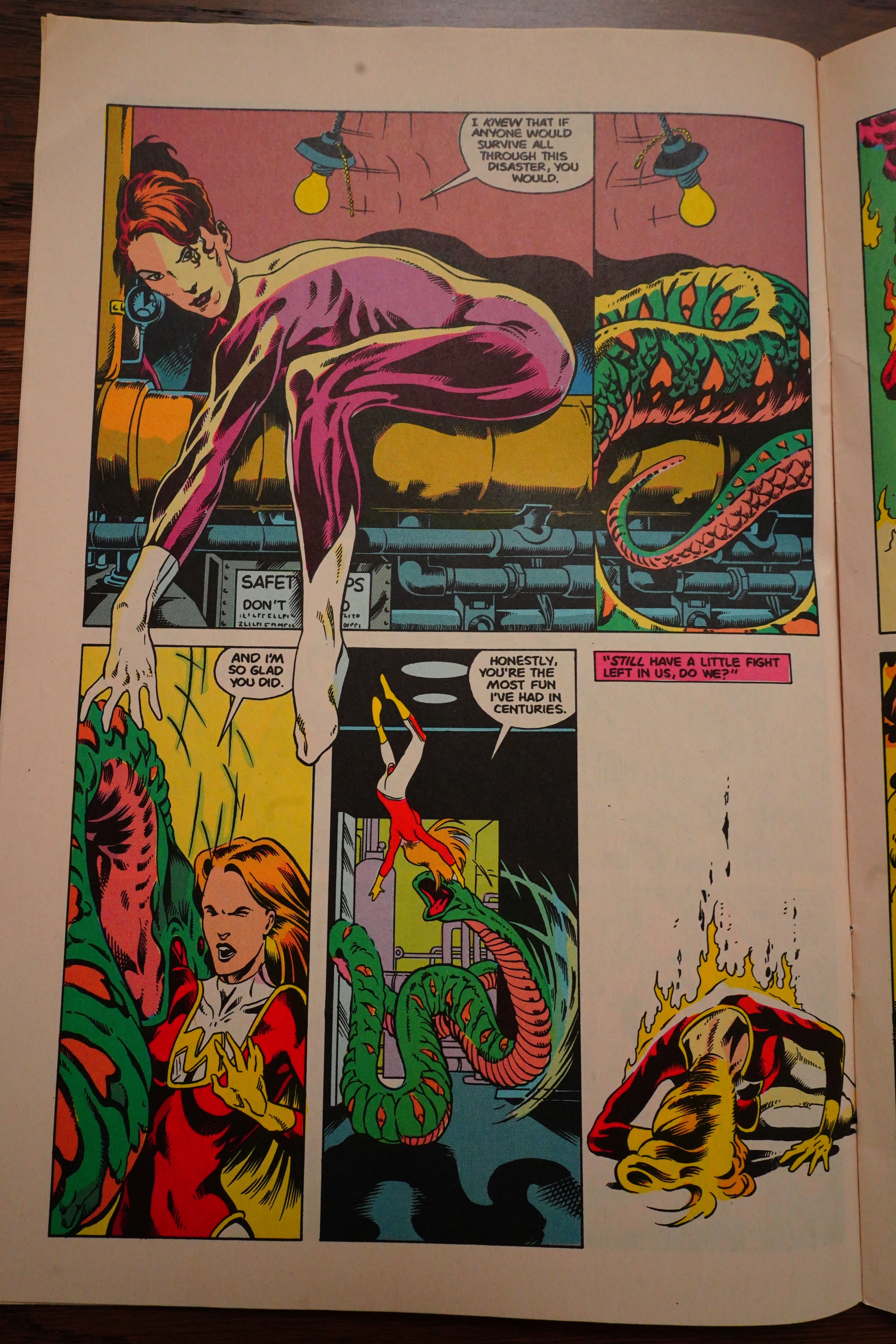
On pages like this, you can totally see what Willingham is going for. But again, it just doesn’t work — that “split panel” at the top there is supposed to be a dramatic shapeshifter scene, but it doesn’t really read that way.
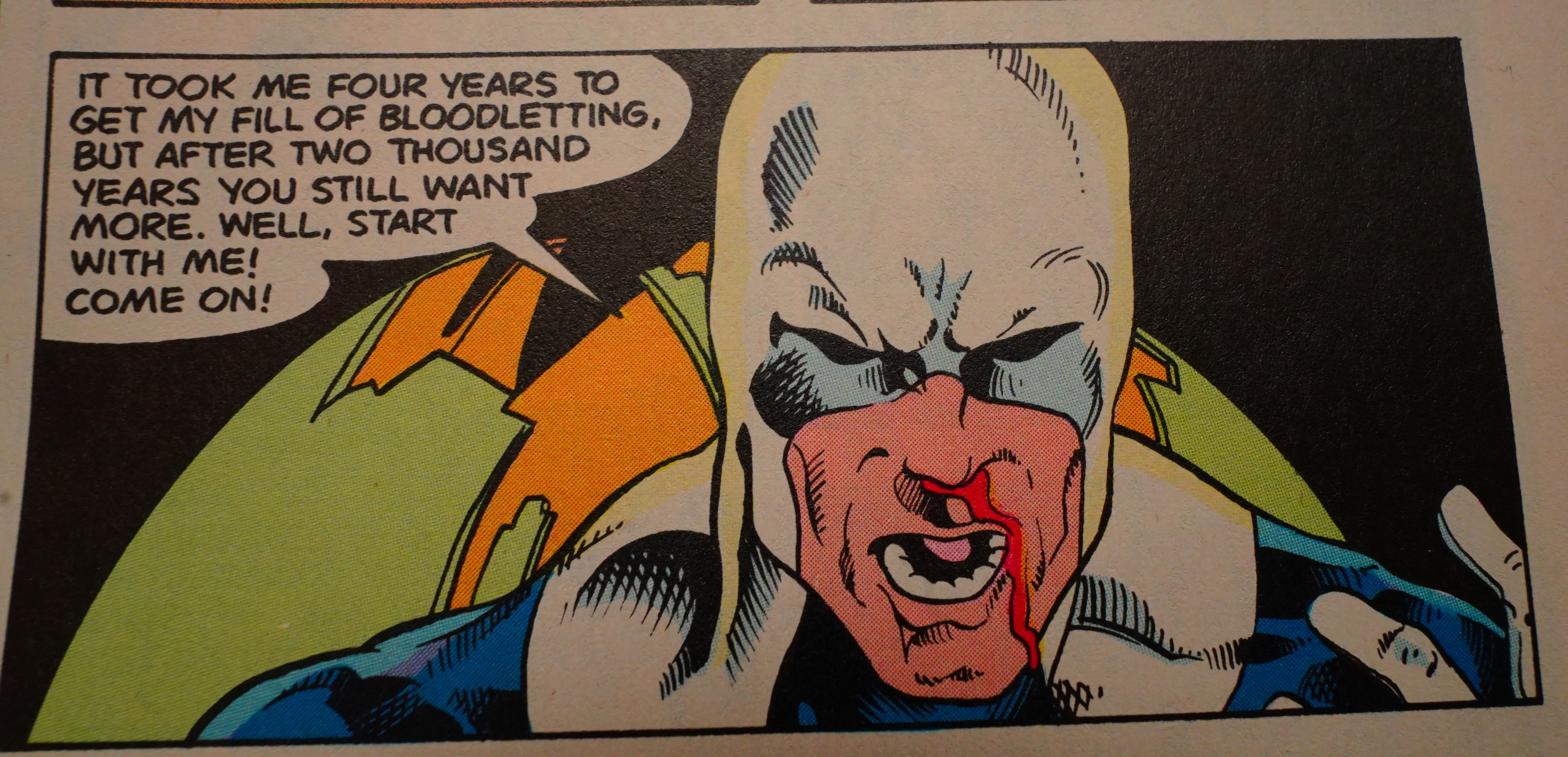
Four years!? I thought they’d just been reanimated!?
*sigh*
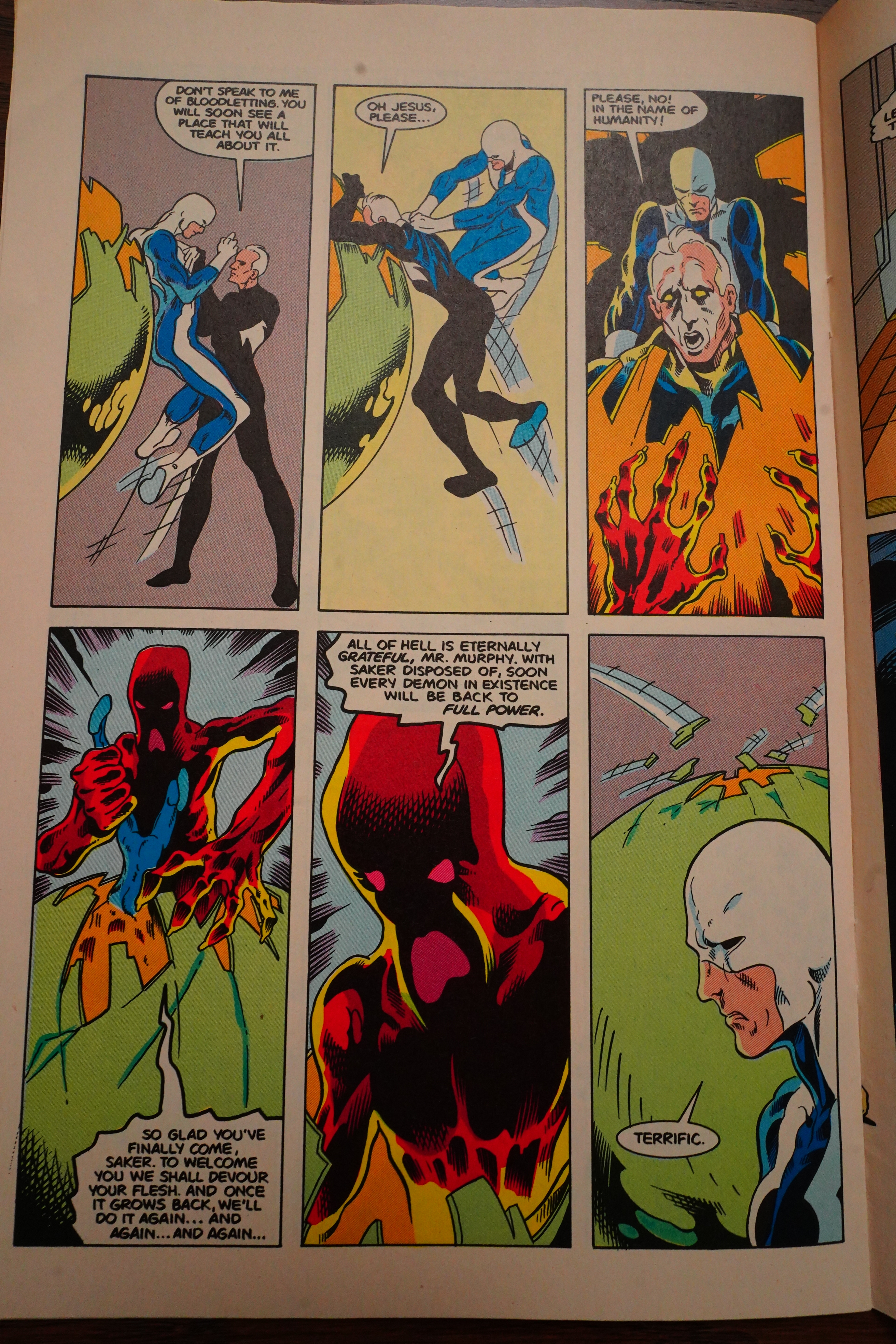
Again, a typical scene: You can certainly deduce what’s happening here, but so many of these pages read like “eh? oh”: There’s no flow or natural progression to the events.
And this is how the first storyline ends — with the villain that has been given all this build-up just being popped into a hell dimension egg. And he was presented as being super duper powerful. It’s just weird — like Willingham hadn’t quite achieved object permanence.
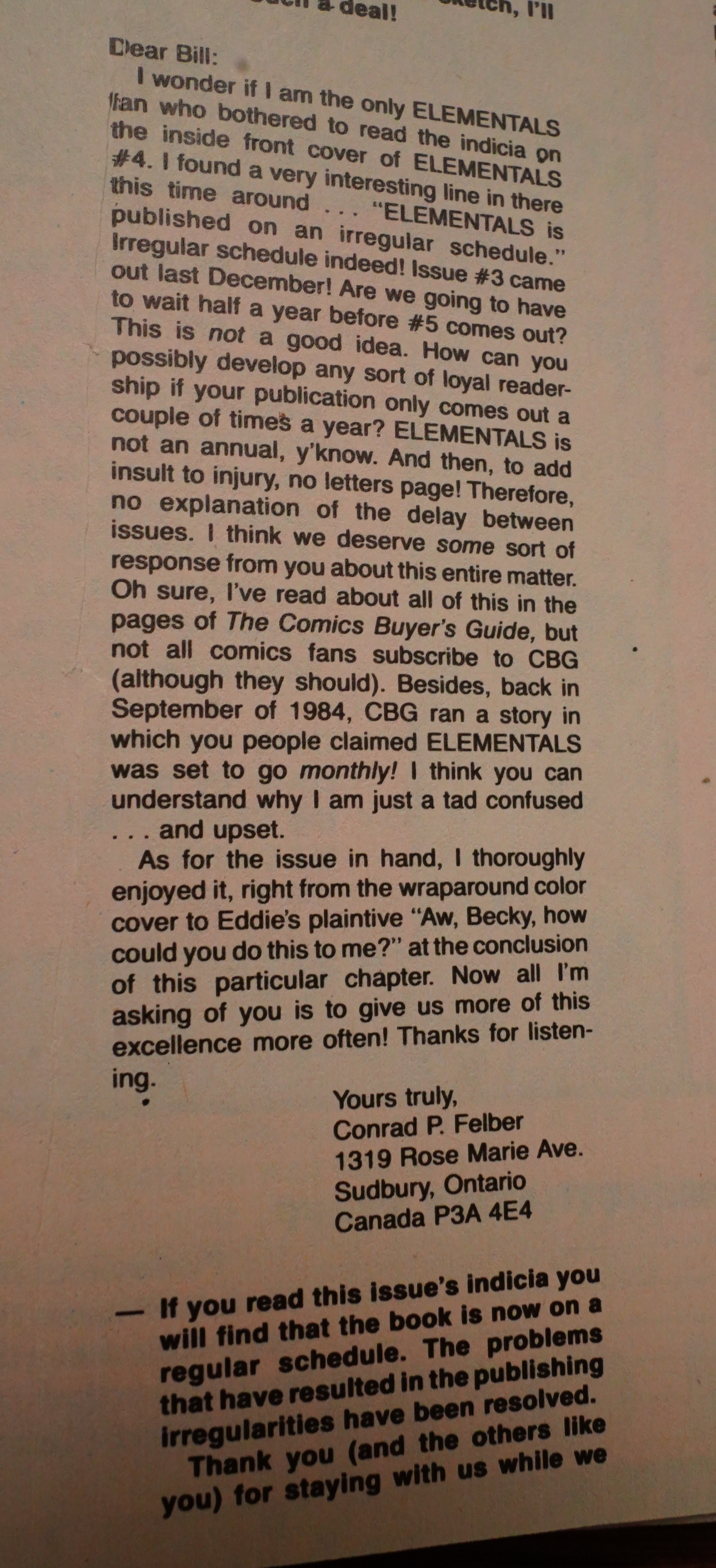
Apparently the first handful of issues were published very irregularly, but Willingham informs us that “the publishing irregularities have been resolved”. Diana Schutz was brought aboard as an editor and Bob Schreck took over as “director”, so perhaps that explains it. More research needed.
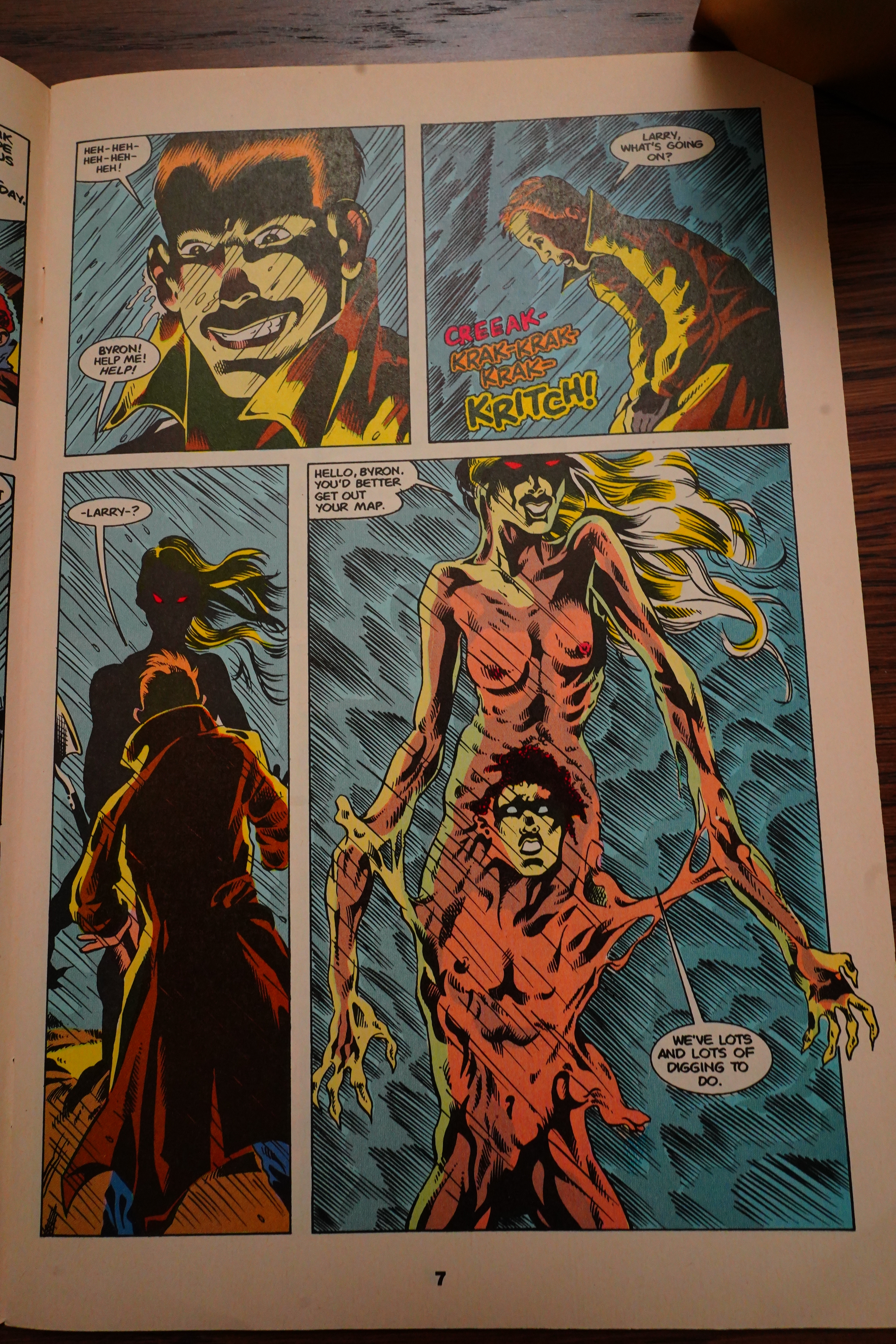
Eep! Willingham is really good at these creepy scenes…
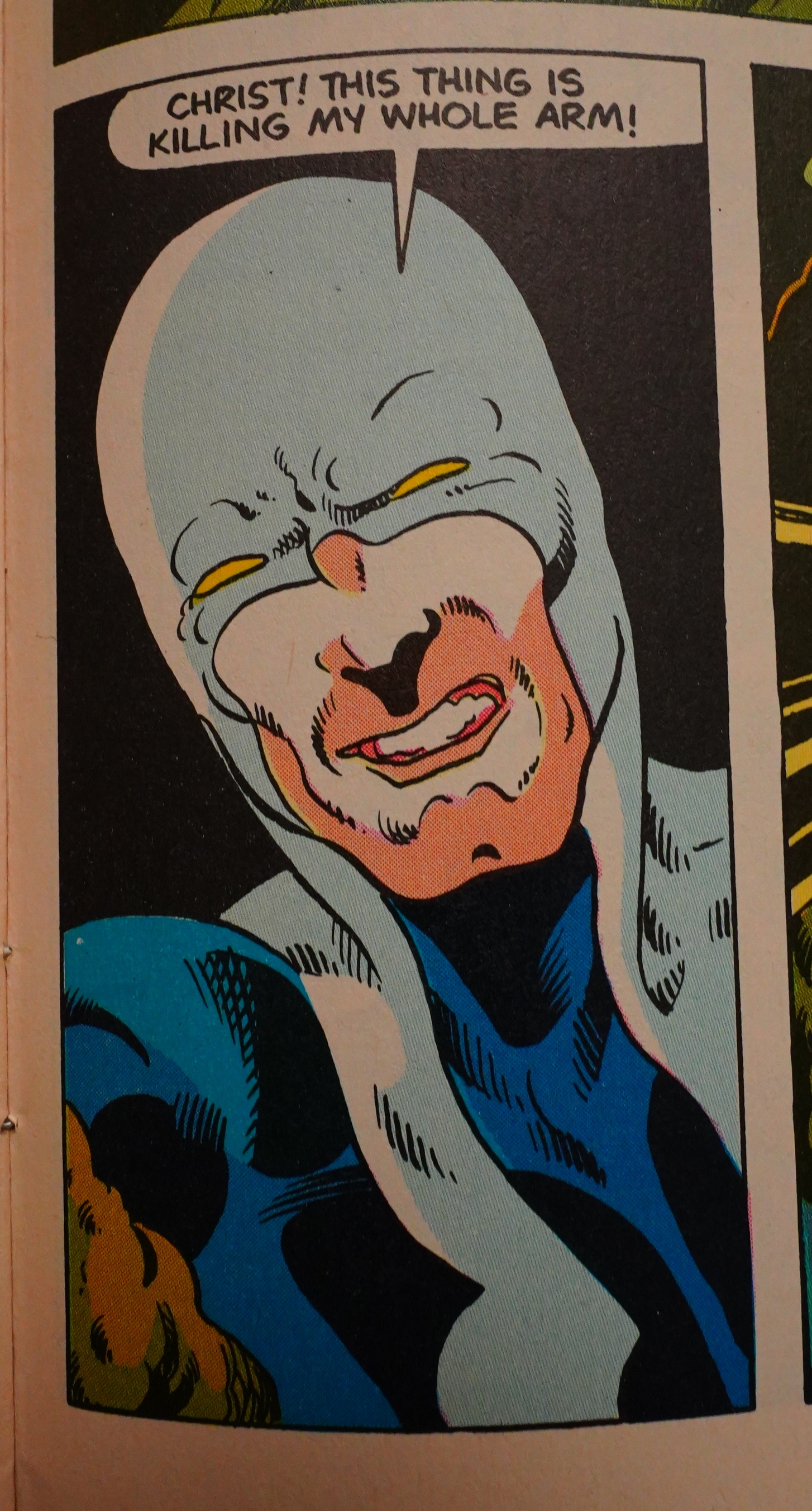
NOOO! NOT HIS WHOLE ARM!!!
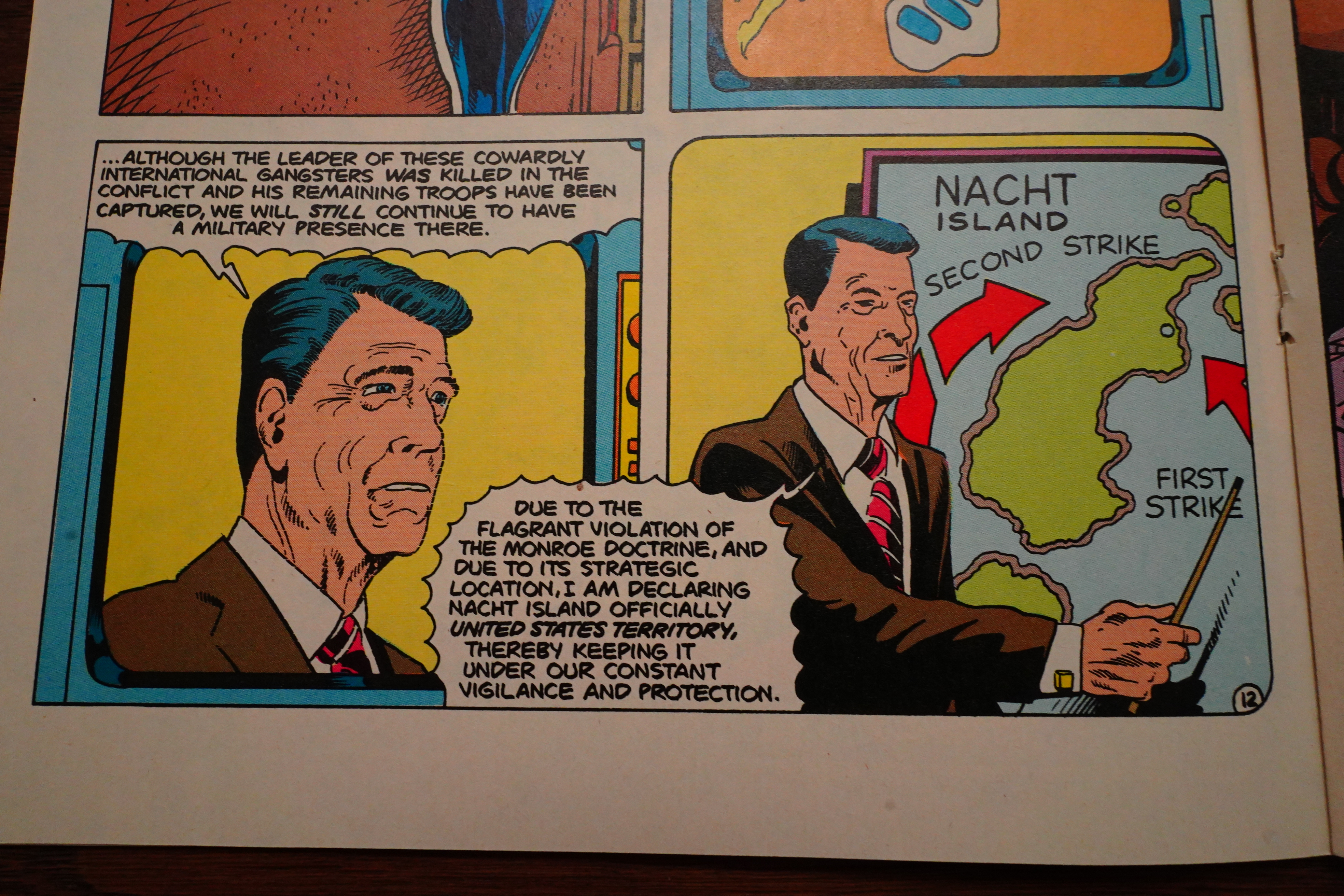
The more things change…
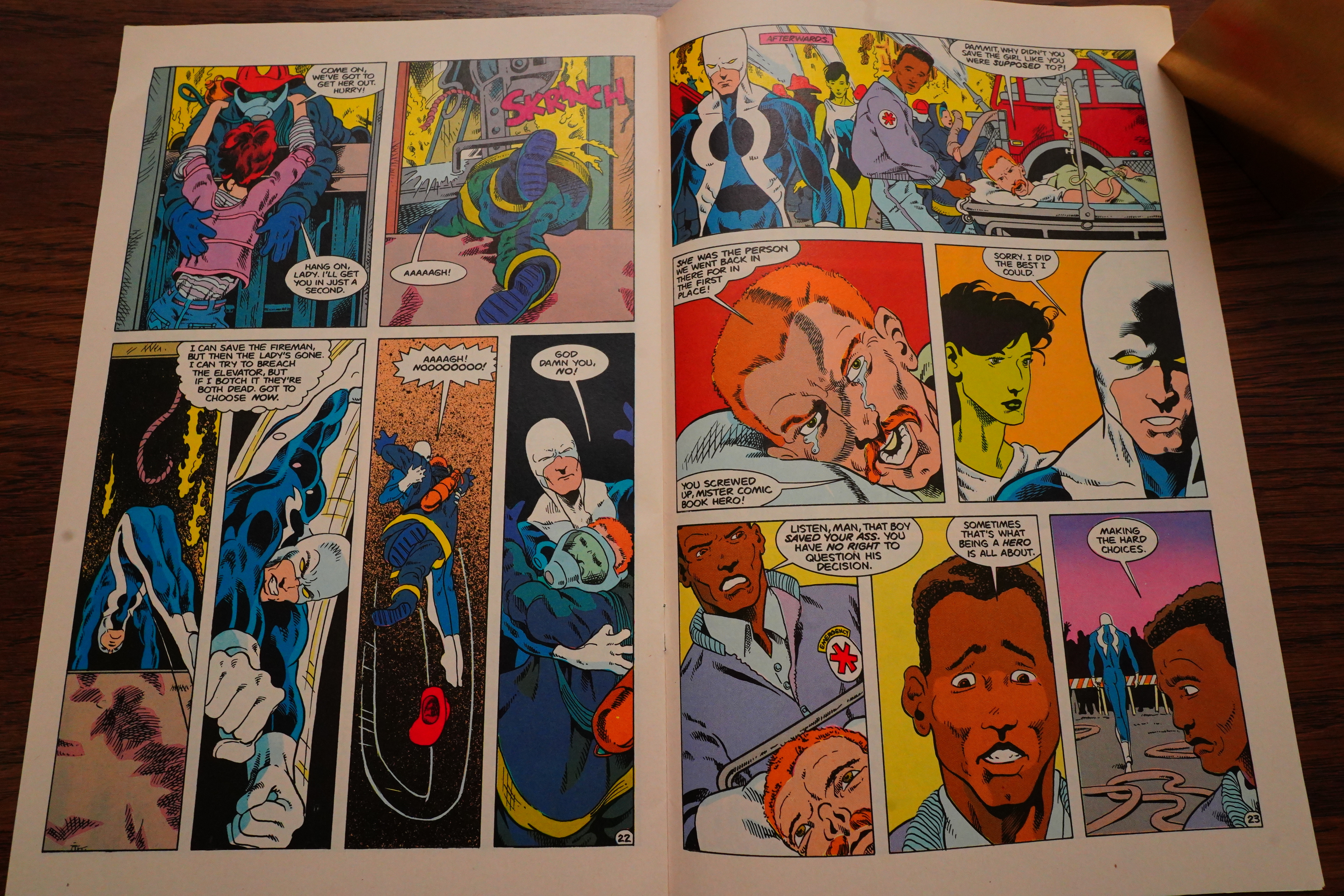
So with the villain gone, Elementals turns into more of a normal super-hero comic, with the heroes saving people from burning buildings, and Learning An Important Moral Lesson and stuff. Which is preferable to whatever that first sequence was, really.
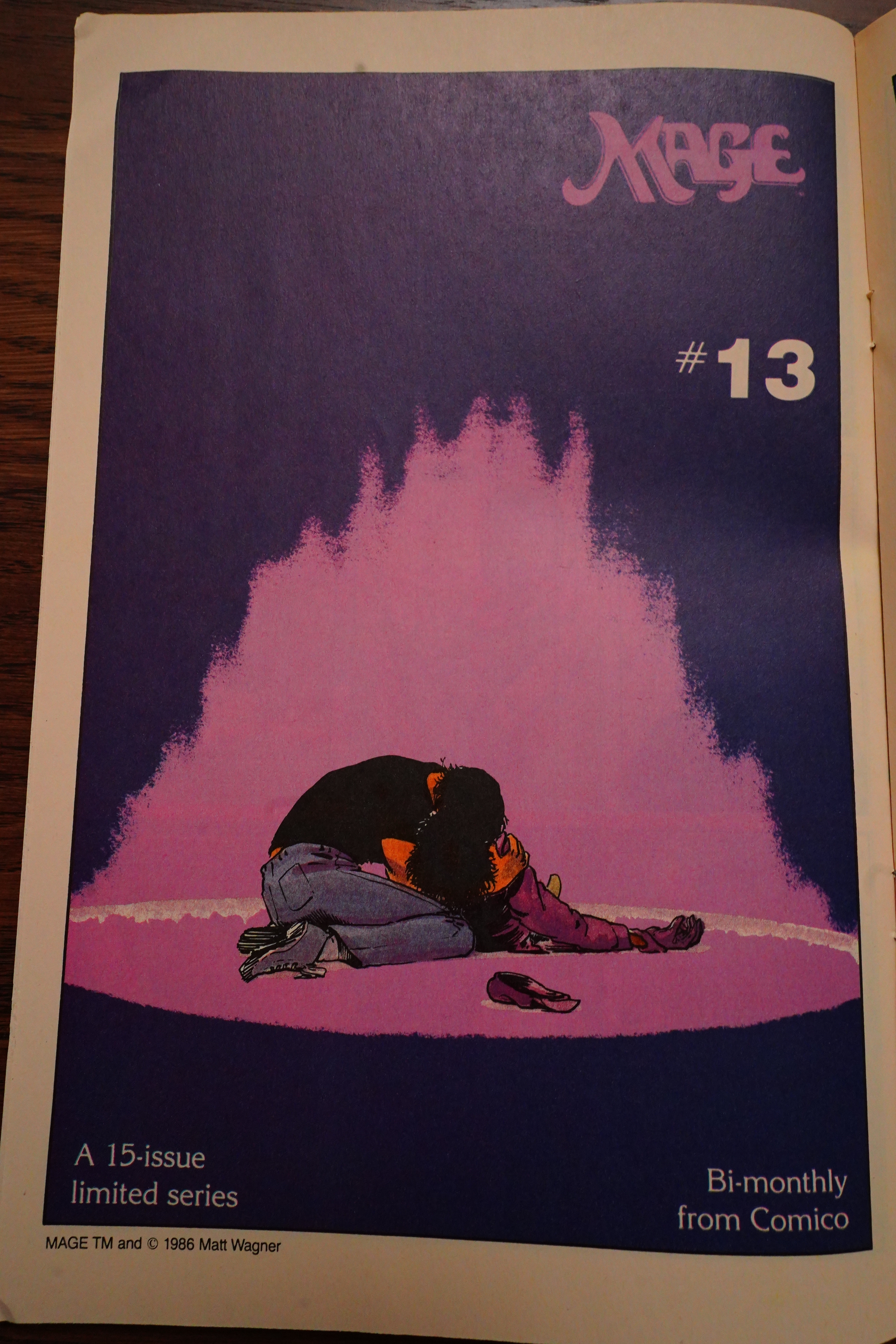
Hey, that’s a more stylish Mage ad.
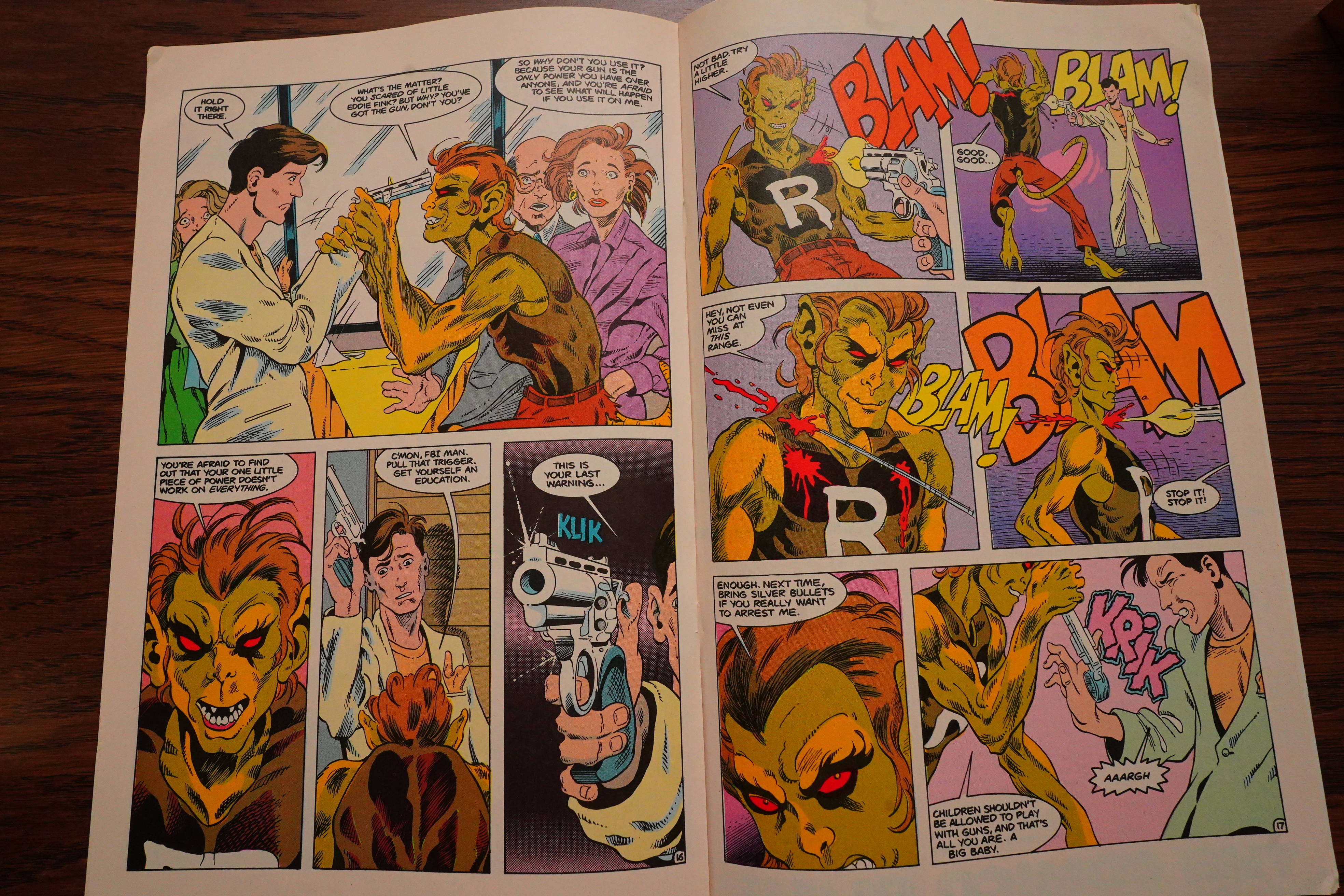
Willingham presents most of the cops and the military as somewhat bad people, but I think that FBI agent is supposed to be one of the good guys? And still he shoots that rat-faced guy just because he’s been double-dared to do so…
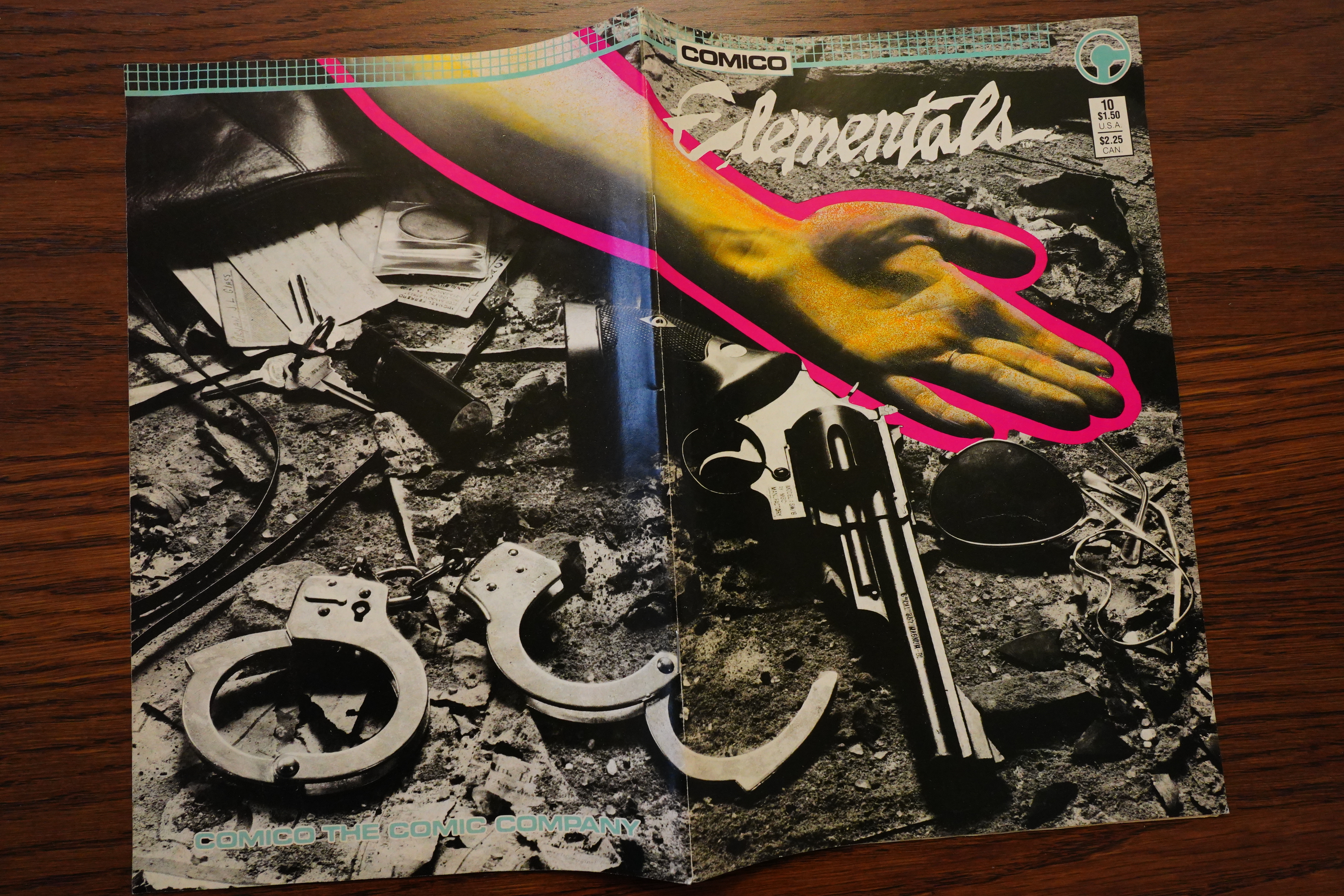
That’s a kinda striking wraparound cover… Quite a few of them are pretty good, really.
I’m not sure what I expected from this series. While reading other super hero/action series for various blog series, I’ve been pleasantly surprised by how entertaining they turned out to be (again, take Airboy as an example). This series attempts a lot… or perhaps, is just written by somebody with a low attention span. Some parts feel like a silly super hero team comic book, while other bits insist on being All Serious For Grown Ups, and these shifts don’t come off as intentional.
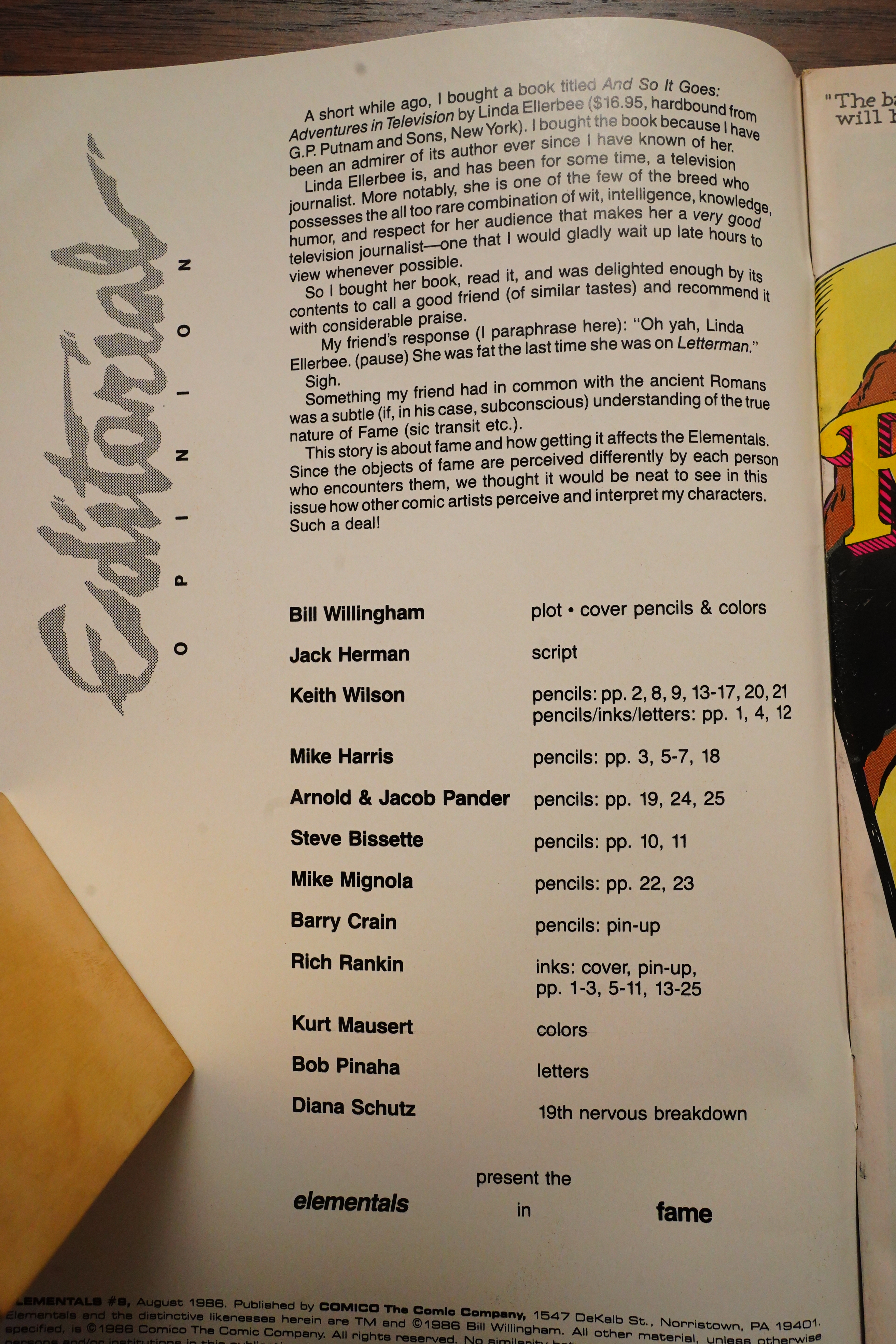
I think what he’s saying here is that he didn’t have time to pencil this issue, so we get a whole lot of people. Steve Bissette? Mike Mignola? The Pander bros? Huh! Sounds interesting.
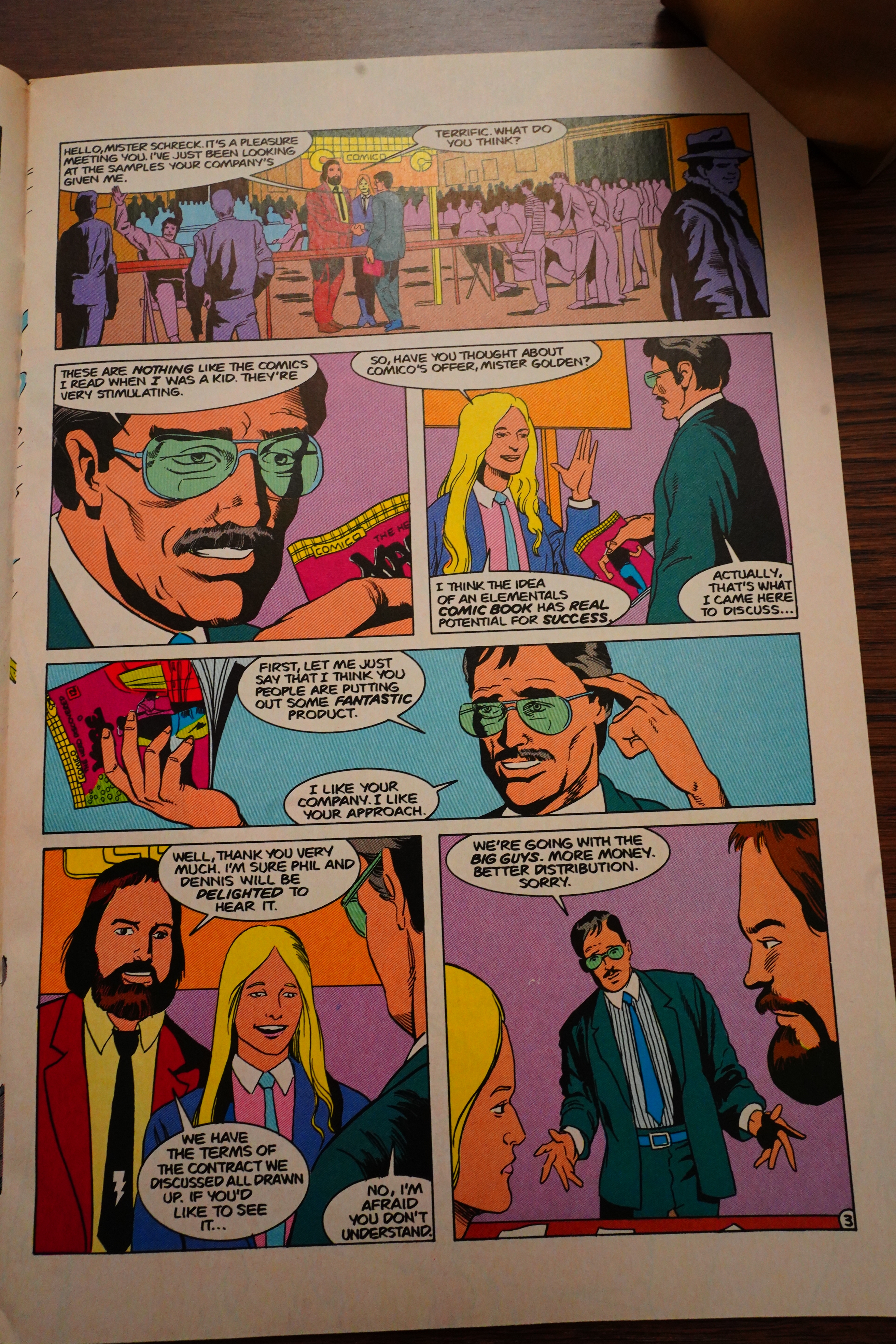
Heh, Schutz and Schreck show up, but are brushed off.
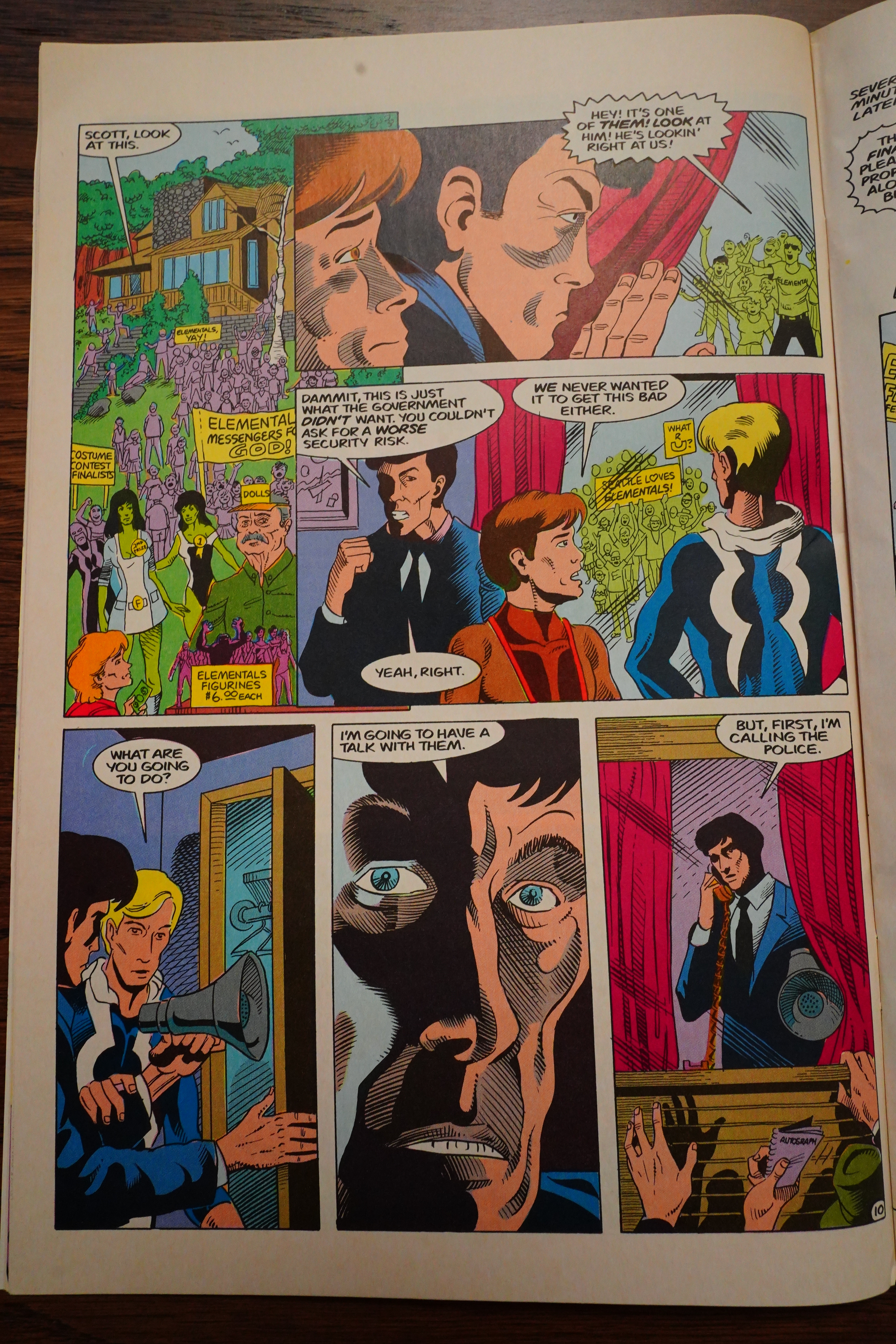
Oh deer. That’s a Bissette page. Not his finest work, but I guess the inker perhaps didn’t quite… er… do the right thing?
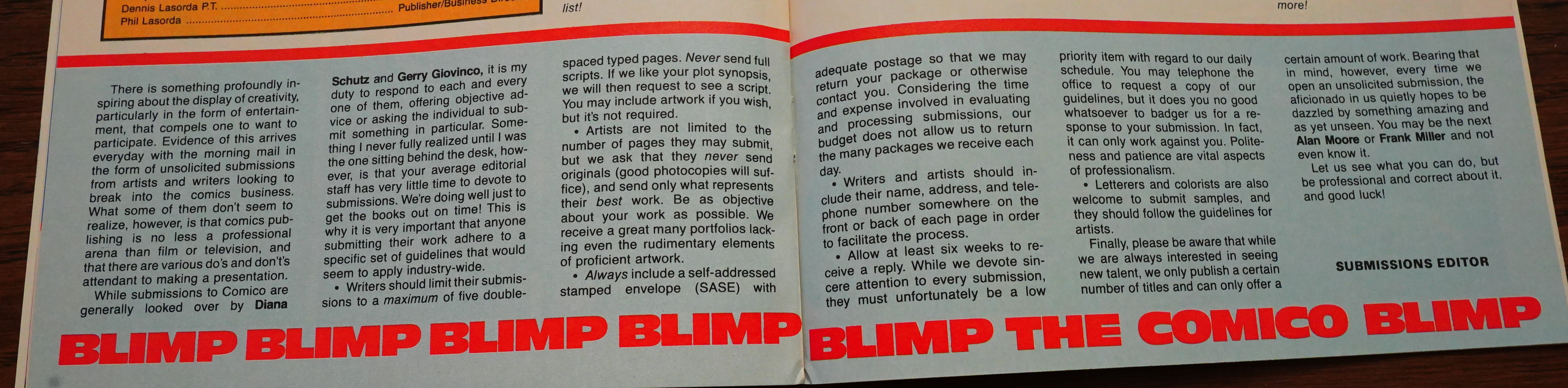
Huh, a submissions guide… I guess they wanted to expand the line?
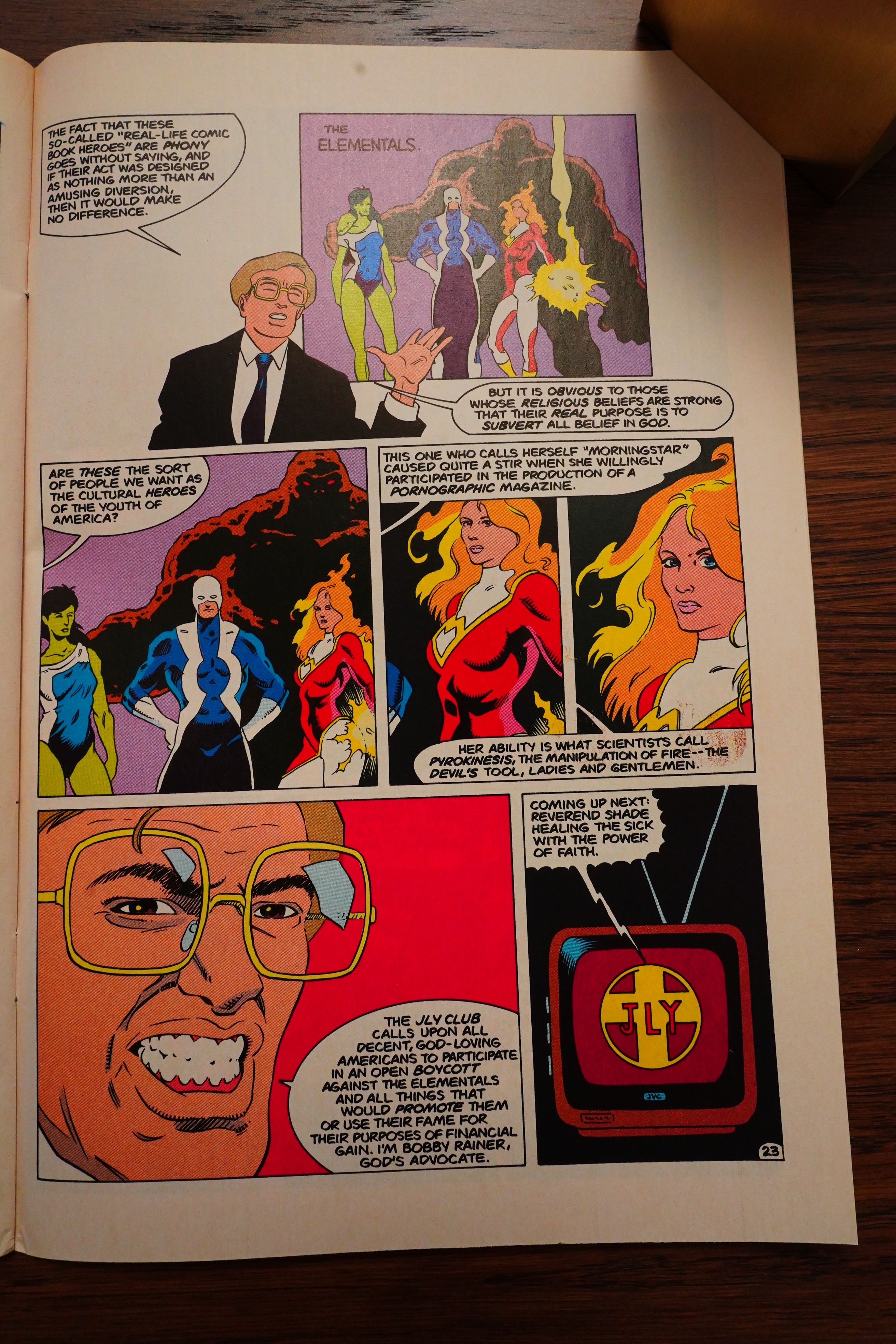
Here’s Mignola… I guess this was before he became famous?
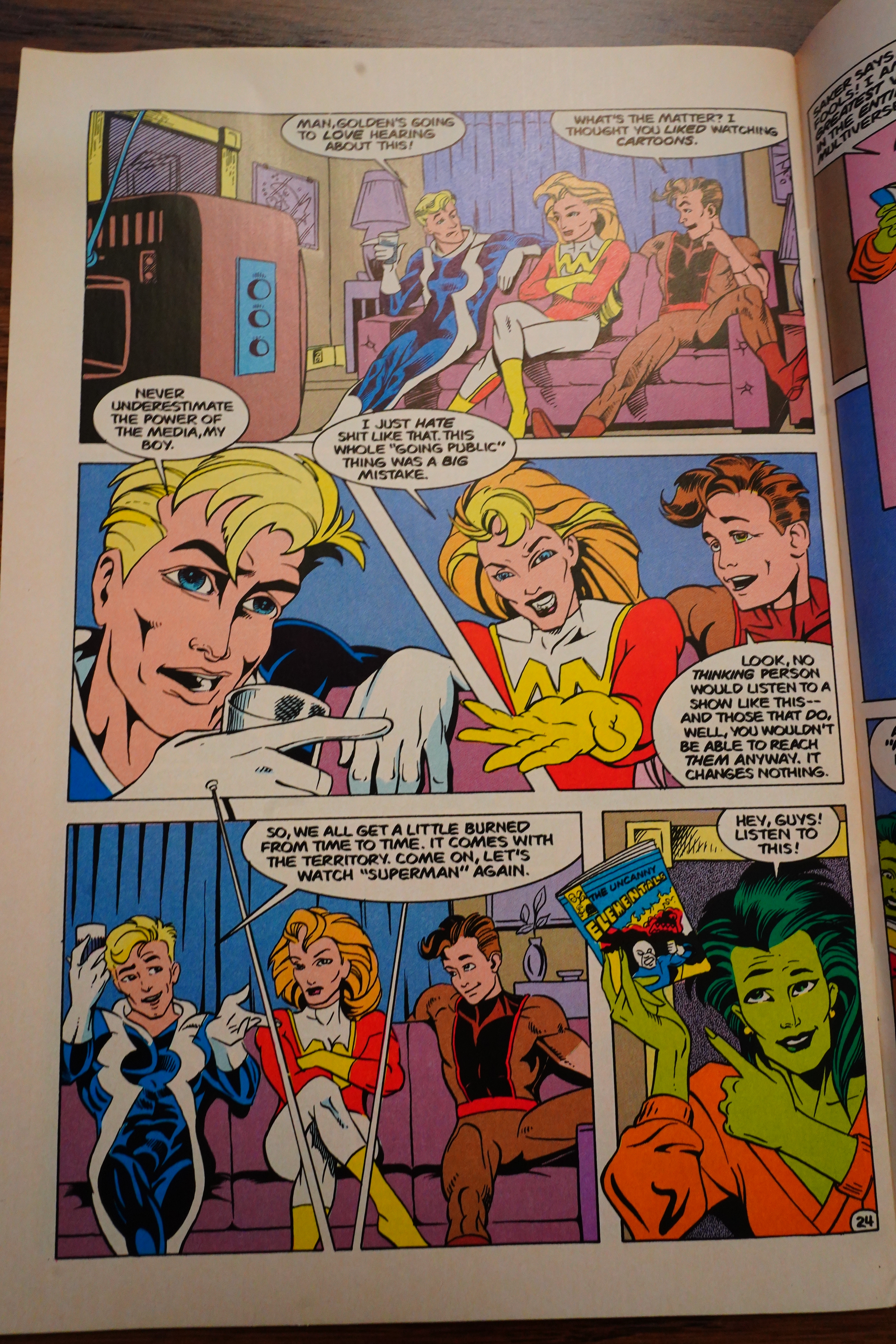
Nobody seems to have told the Pander brothers that Monolith (the guy in brown) was supposed to be twelve?
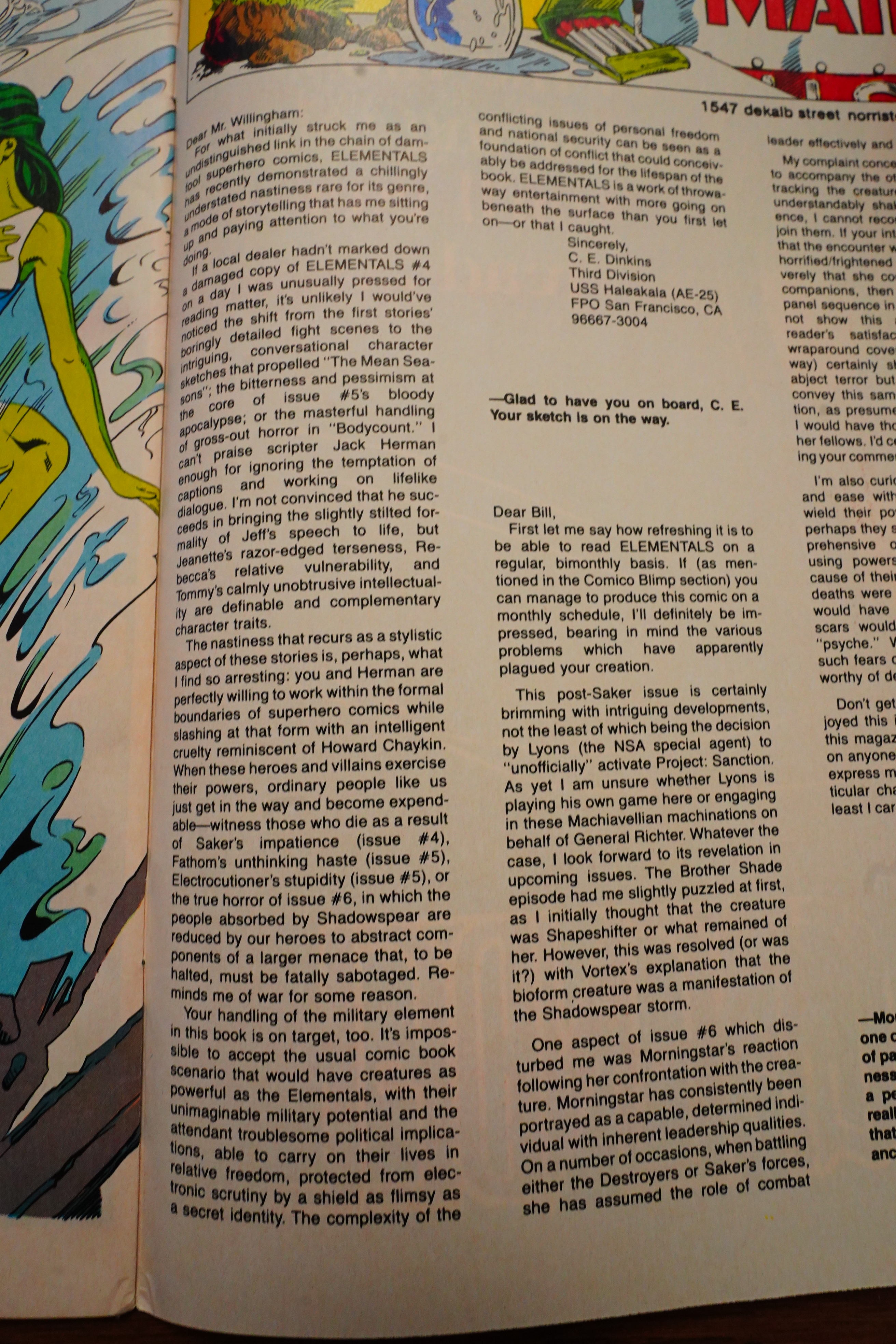
Here’s a reader that finds the recurring nastiness interesting.
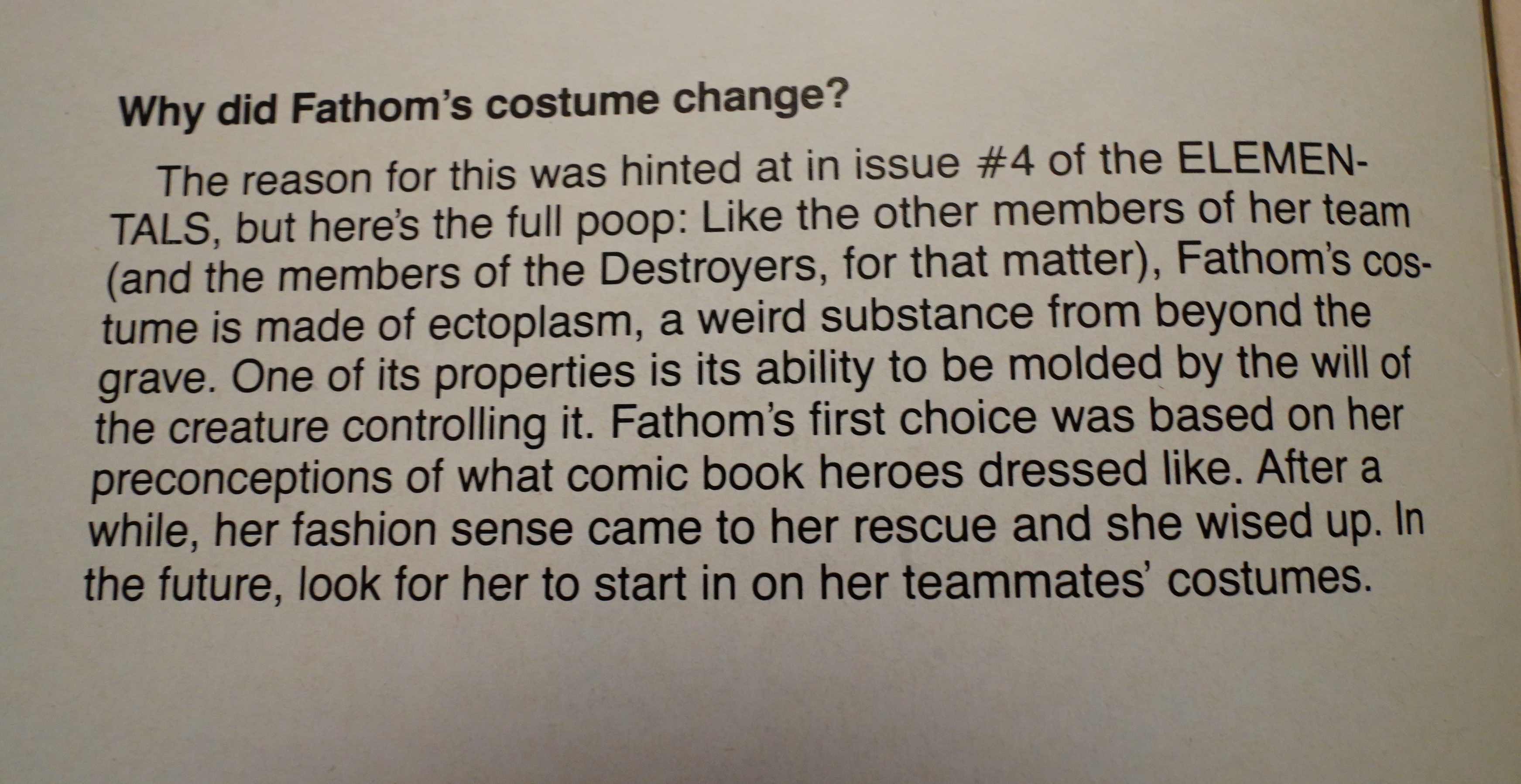
Oh, so that’s why her costume changed. Makes sense!
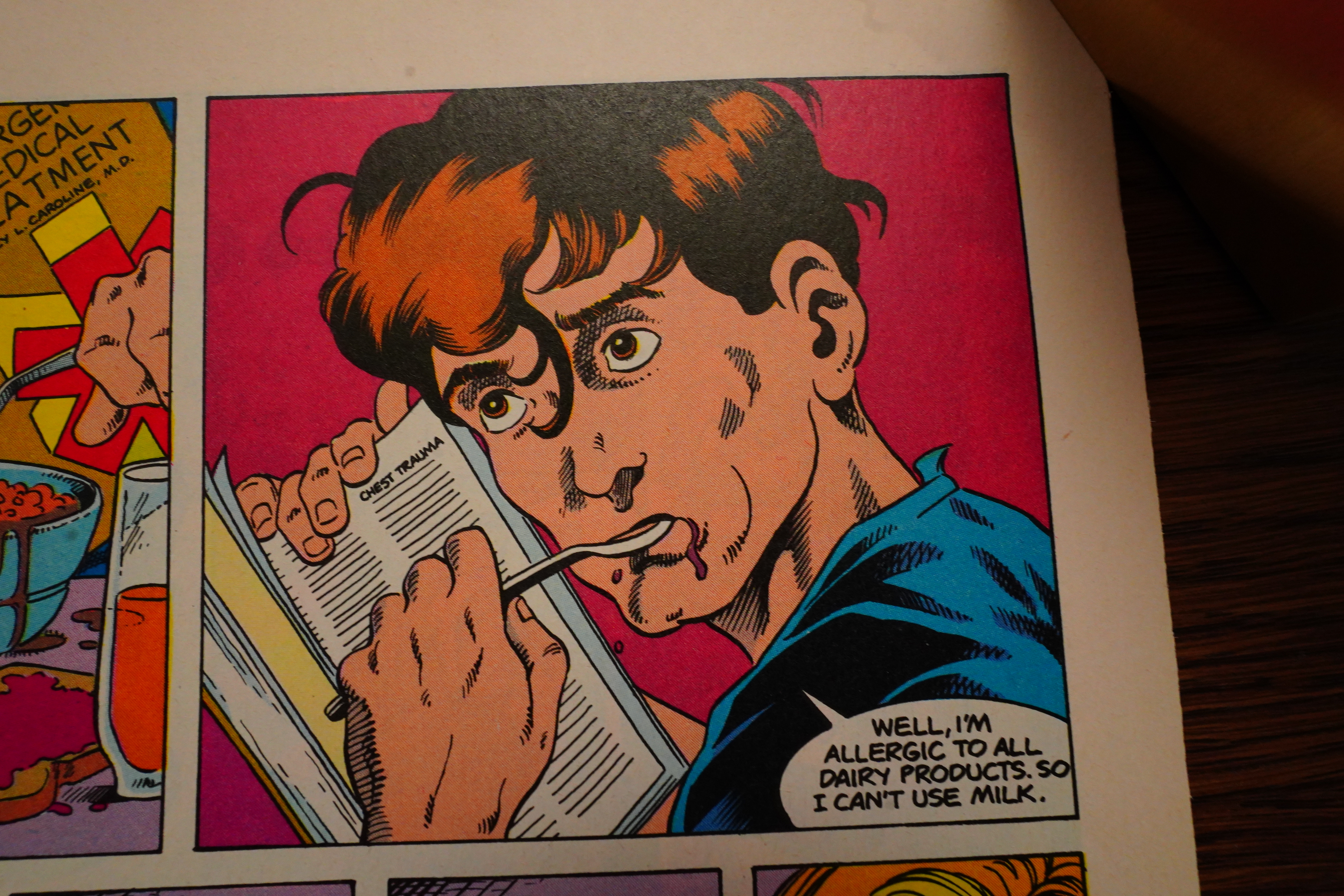
Willingham is frequently off model himself. Yes, that is indeed Monolith again.
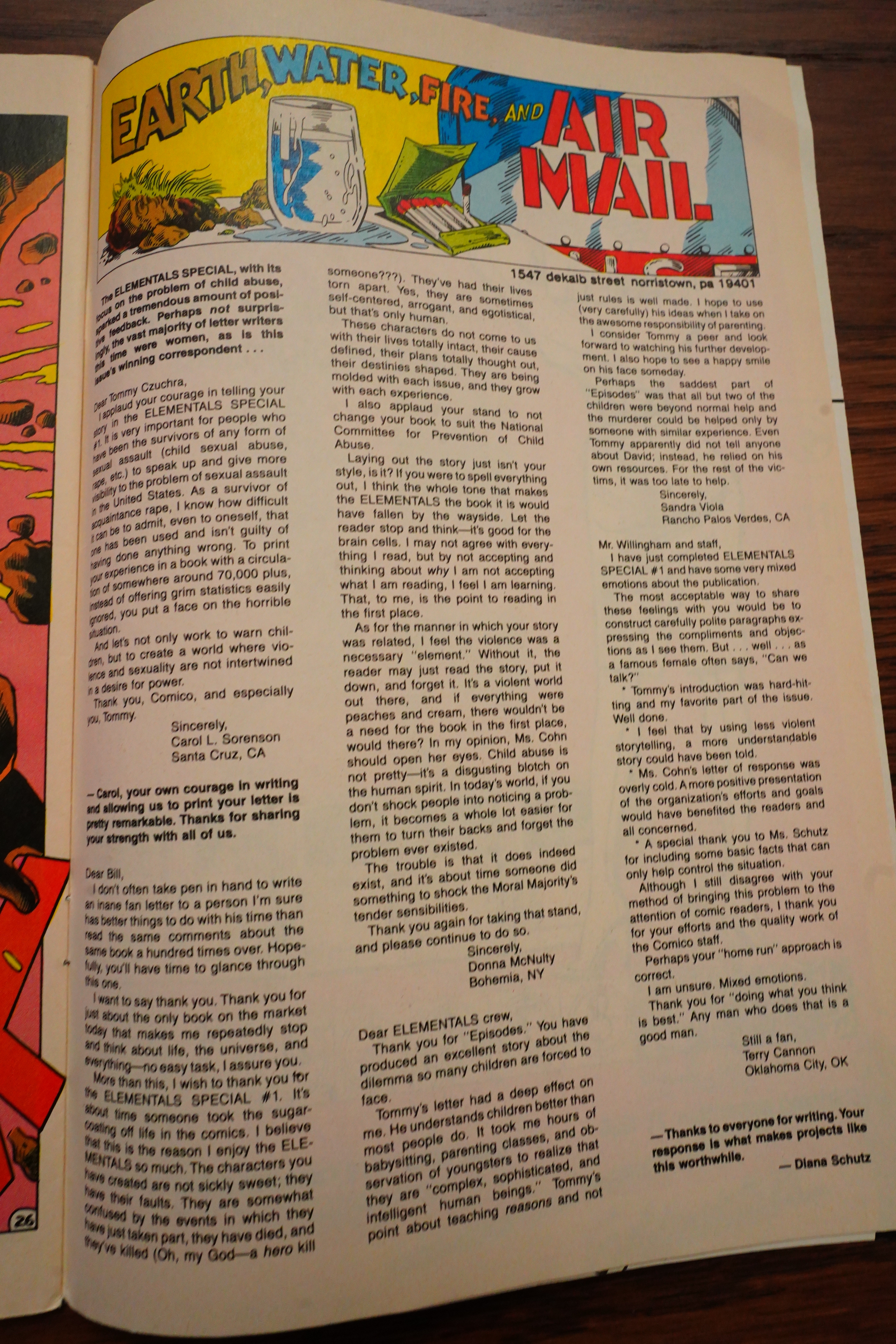
Oh, there was an Elementals Special published that dealt with child abuse? I guess we’ll see what that’s about when I get there… let’s see…
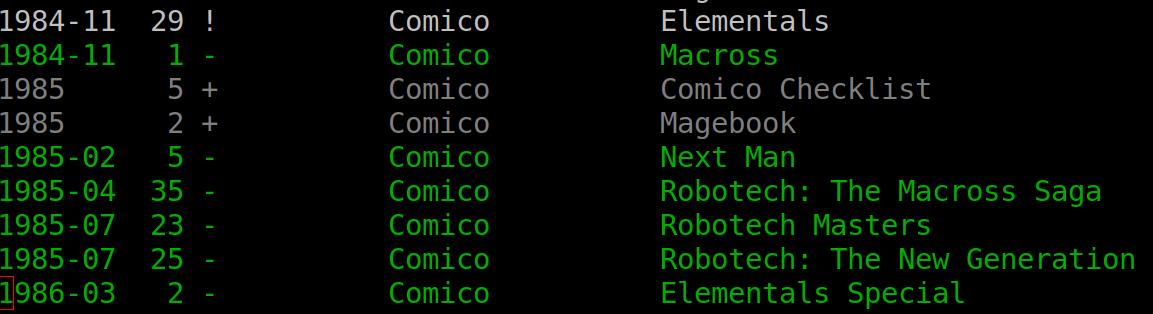
Yeah, in a week or two (or three), I guess? I do these blog posts “chronologically”, but depending on the date when the first issue of a series was published. For long-running series, I find myself peeking into the future a lot, so to speak.
I’ve done a few of these blog serieses (that’s a word) now, and at one point I started wondering whether it would be more fun to do a publisher strictly chronologically. That is, one post per issue, in the order they were published. Then I told myself not to be stupid, and then I got angry at myself for dismissing my ideas, and then I went to bed.
PROBABLY.
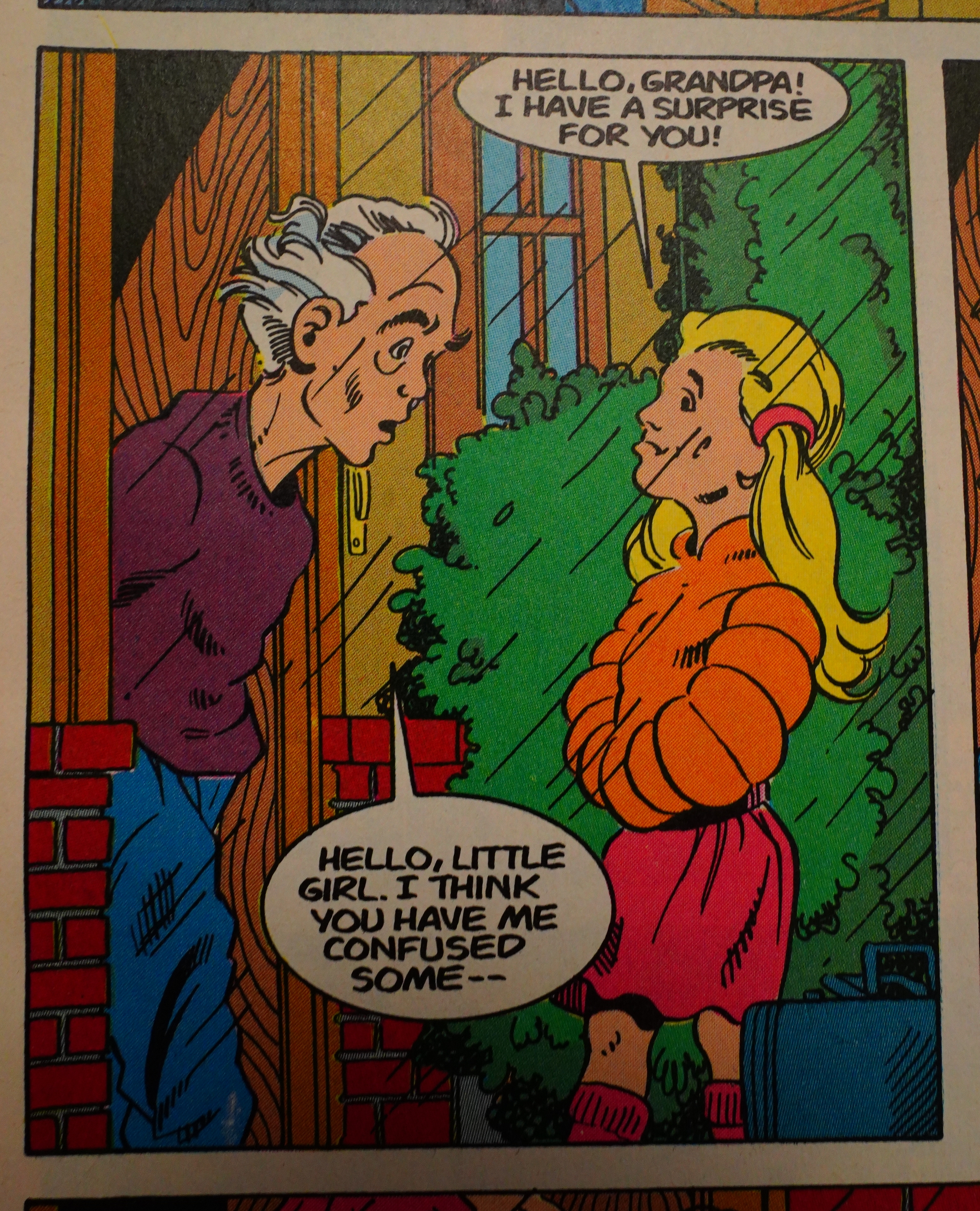
Eep. Willingham’s forté just isn’t drawing children…
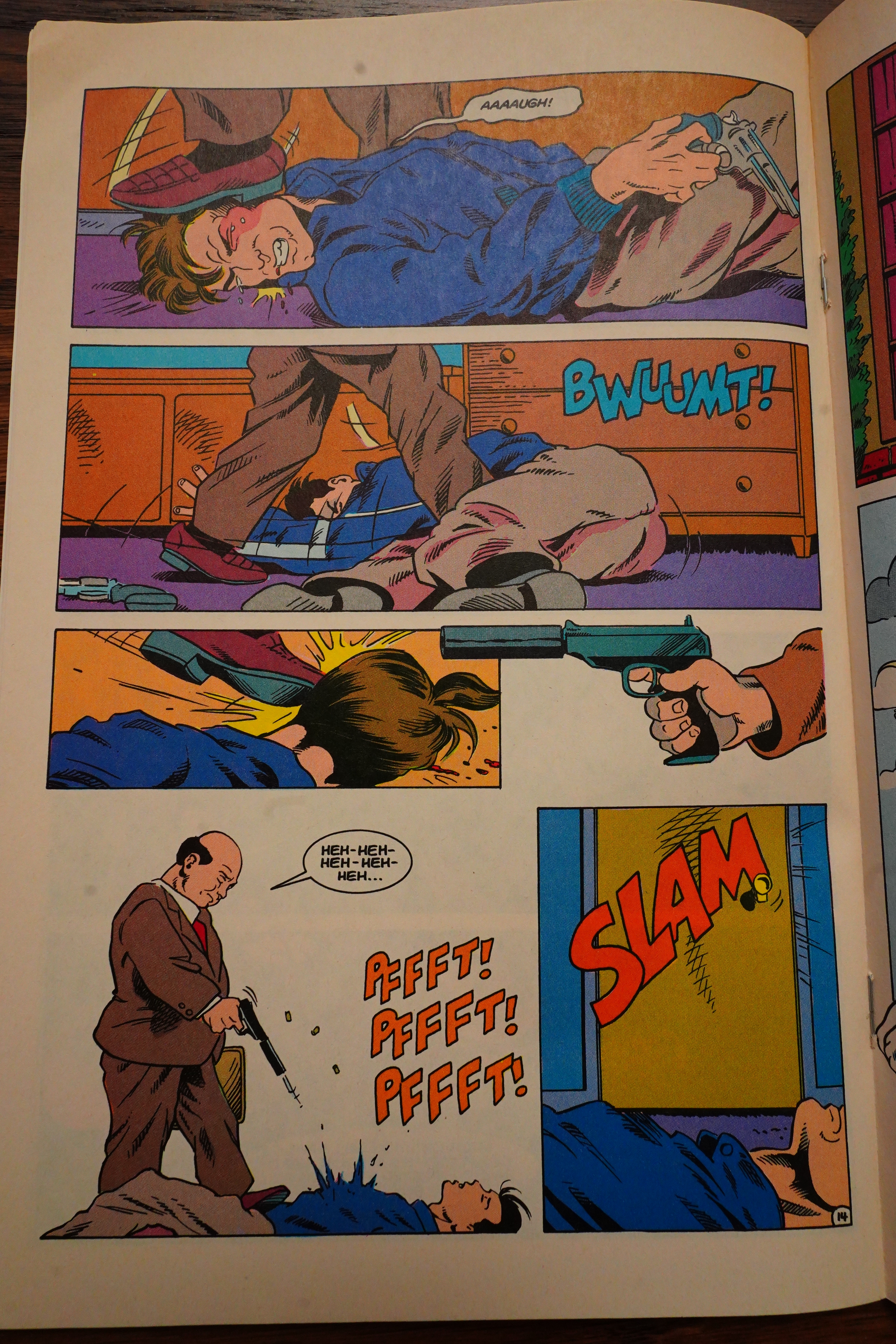
He’s getting quite good at this sort of stuff, though.
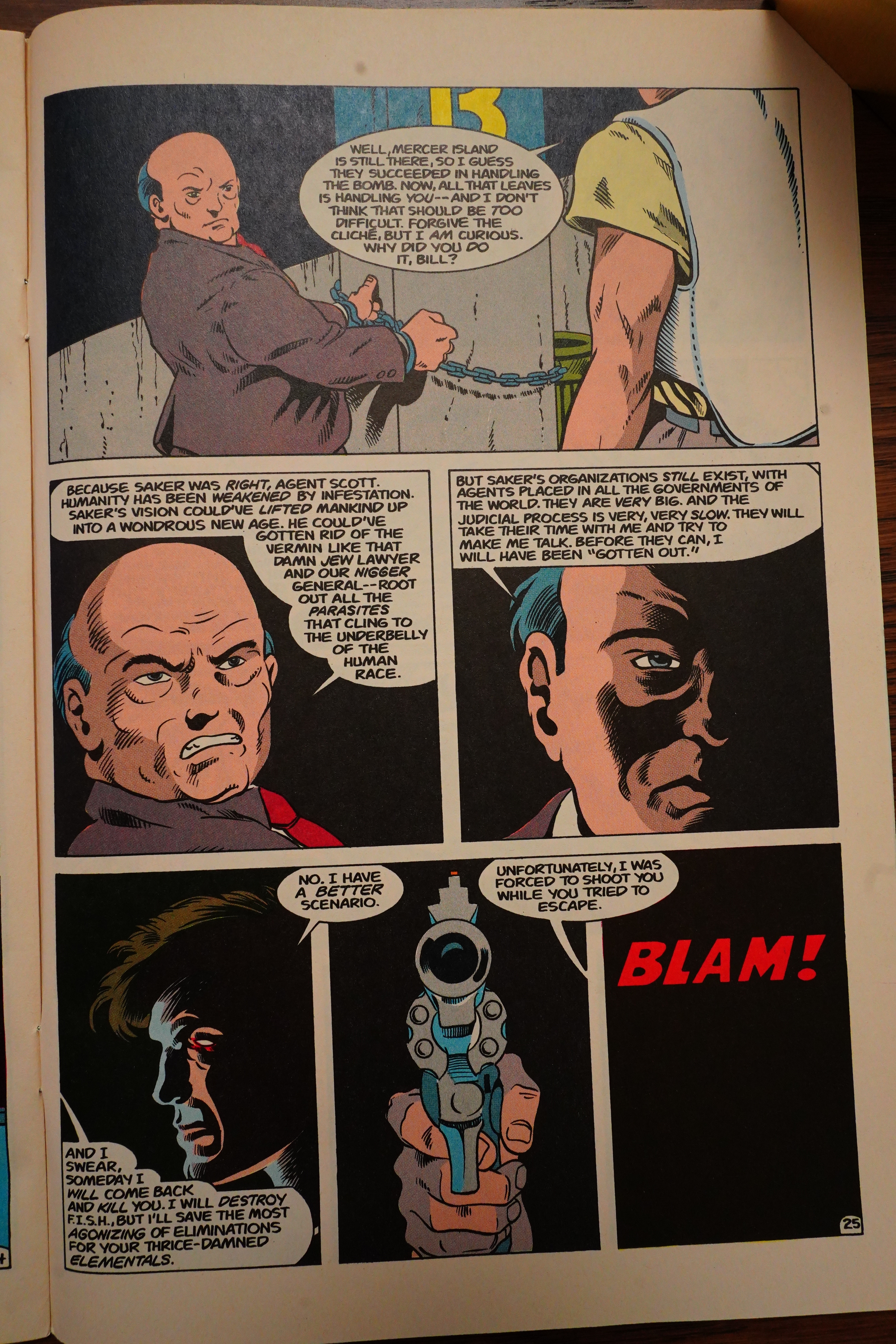
How the turntables!
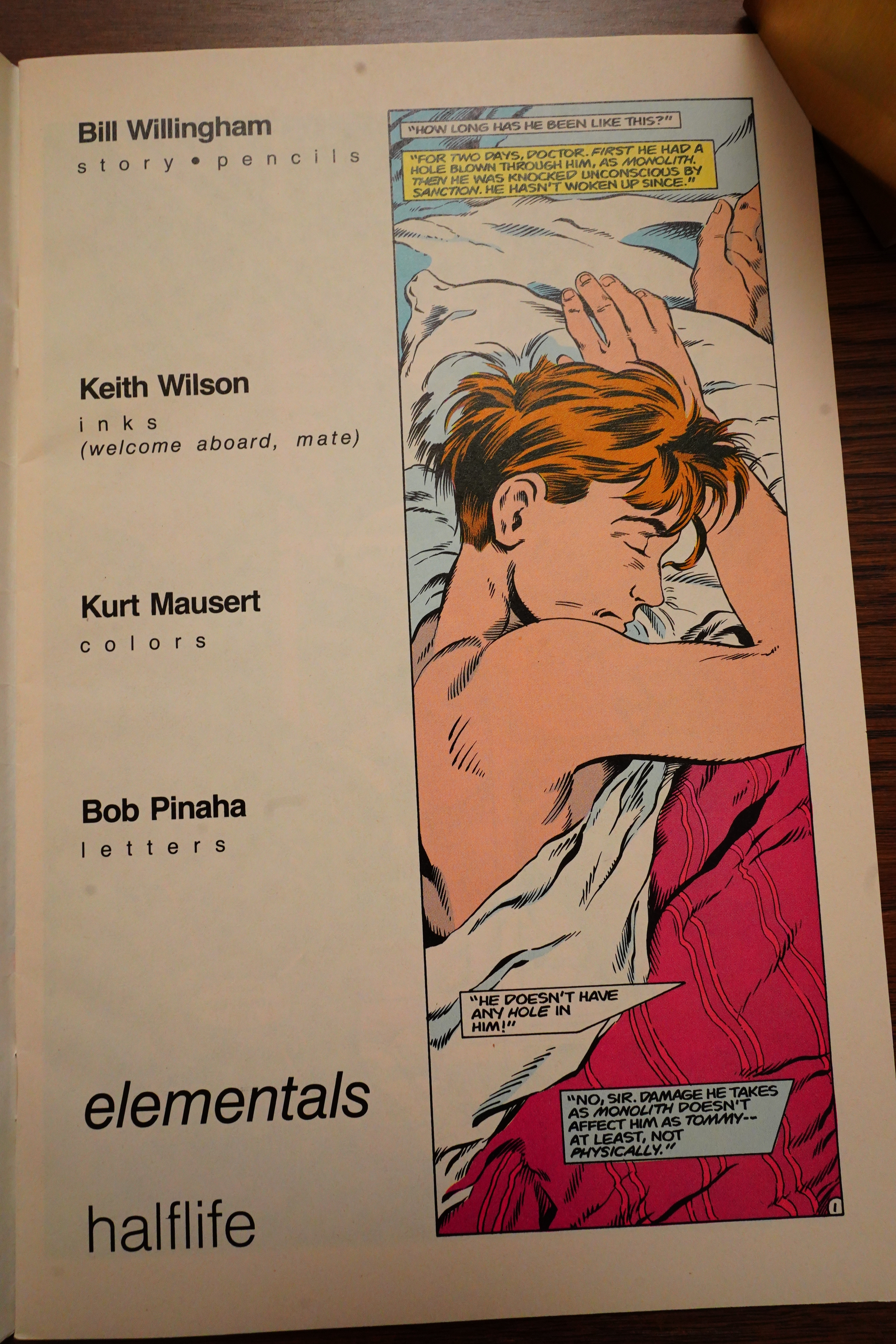
Keith Wilson comes aboard as inker (and Willingham apparently scripts this one himself).
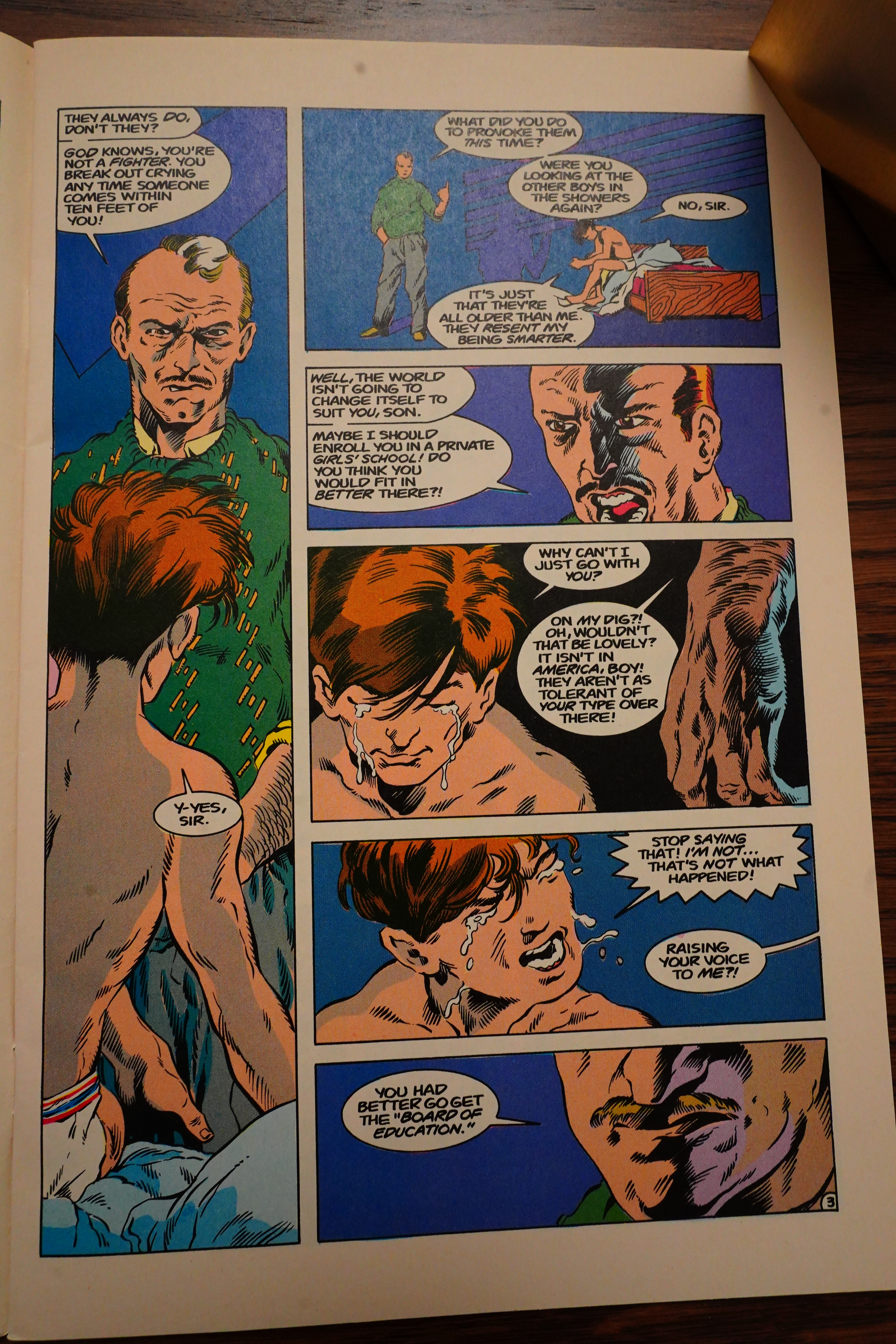
It’s a dream issue where we learn about Monolith’s childhood, which is very traumatic indeed and involves his father physically abusing him.
Wilson’s inks seem to work better for Willingham than the previous one, and it being a dream issue, Willingham can easily drop doing backgrounds. Which he doesn’t like to do, anyway.
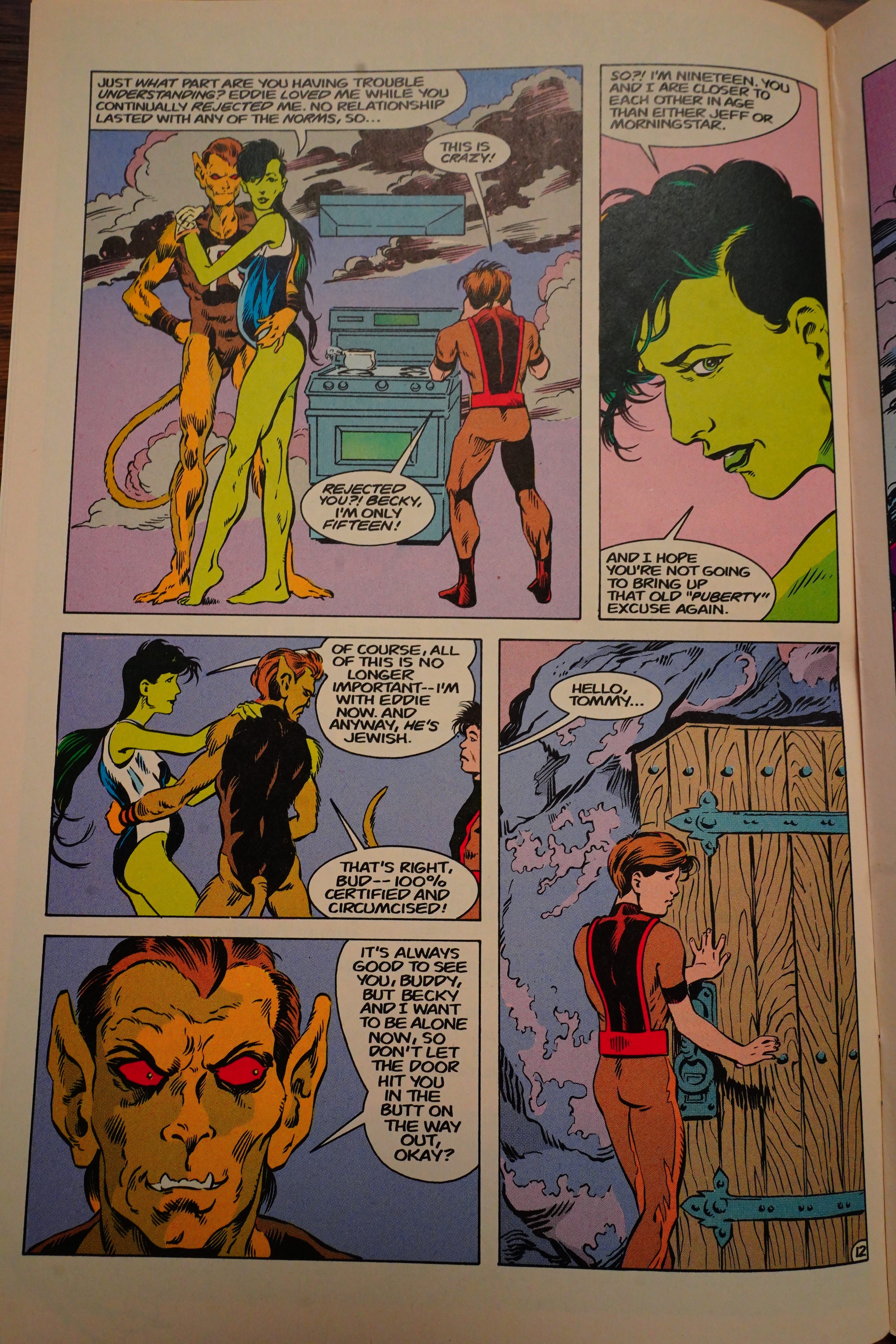
Even as dream issues go, it’s pretty weird. But… he’s fifteen now, or is that just in the dream? Oh, I guess… He was twelve when he died (I think it was stated somewhere; I may misremember), but it’s been a few years, and he’s now fifteen? But since they’re dead, they don’t age? I dunno.
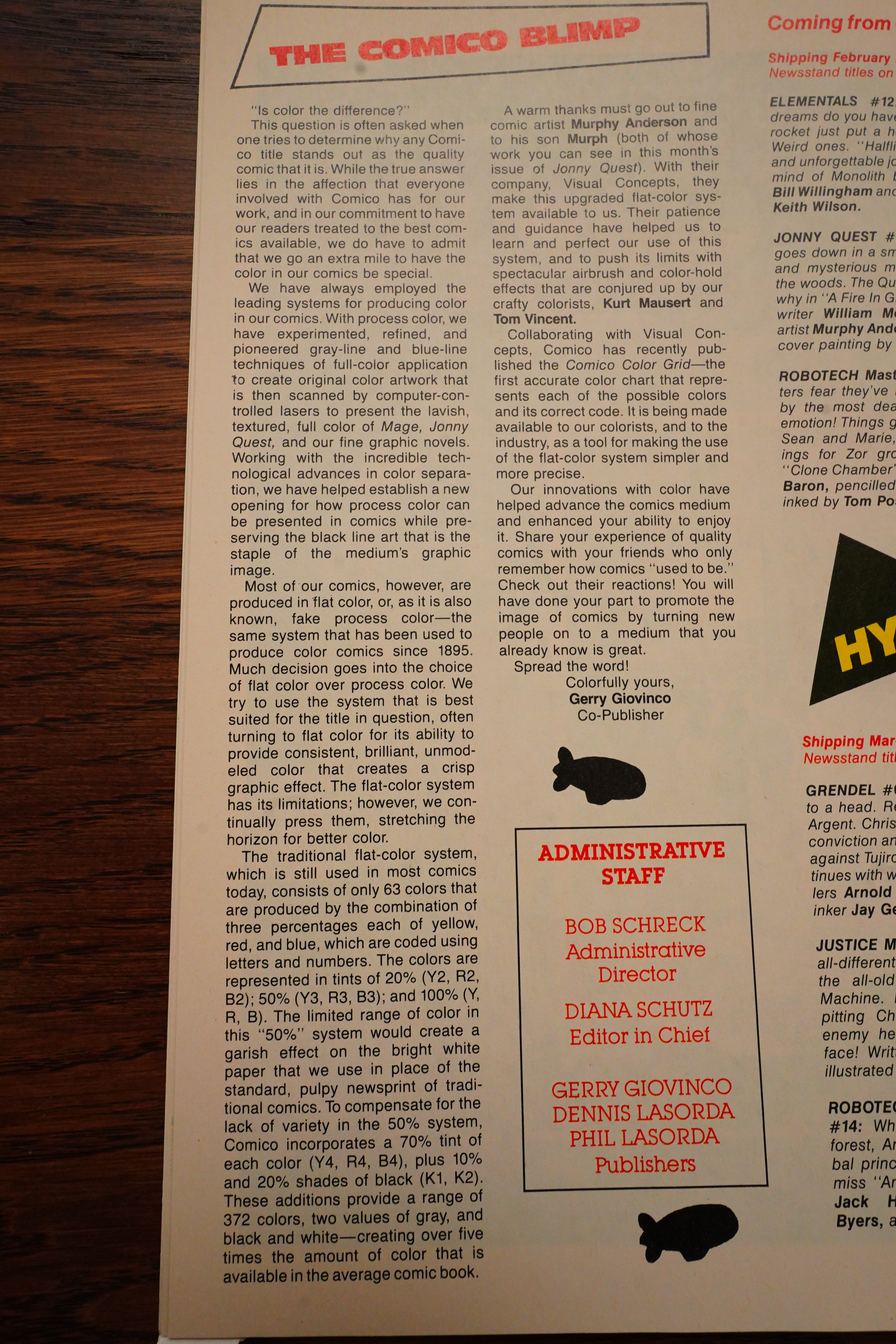
Oh yeah — I remember reading Giovinco’s blog post about this, which is pretty interesting.
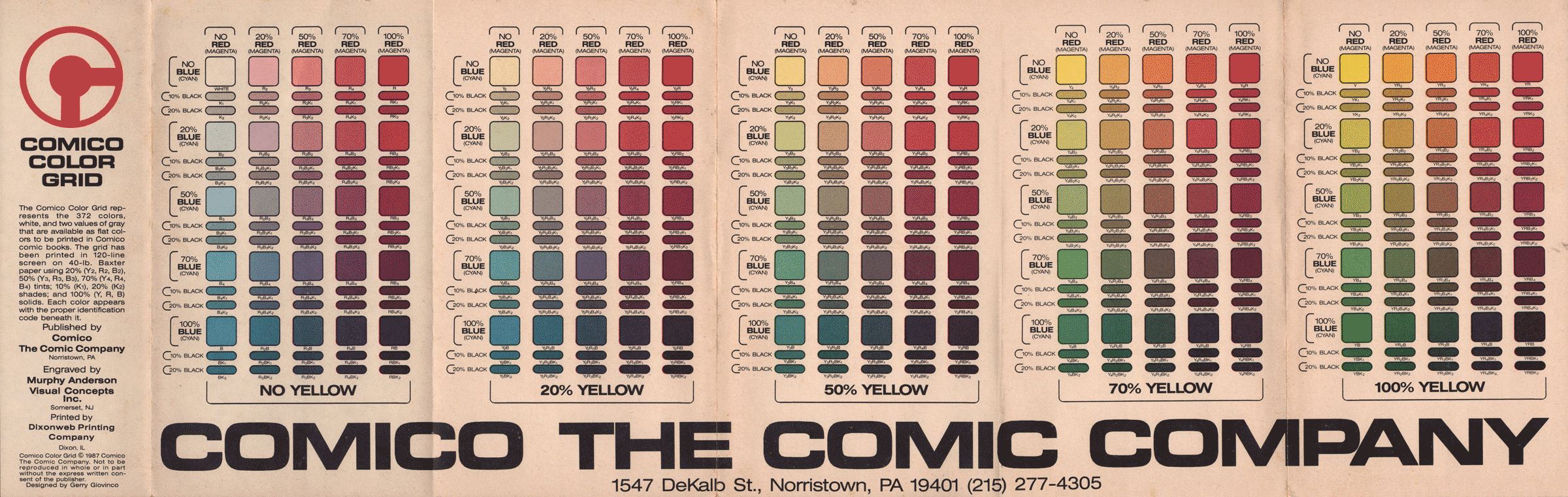
Read more here — Giovinco says that he came up with this colour chart that then became something of an industry standard…
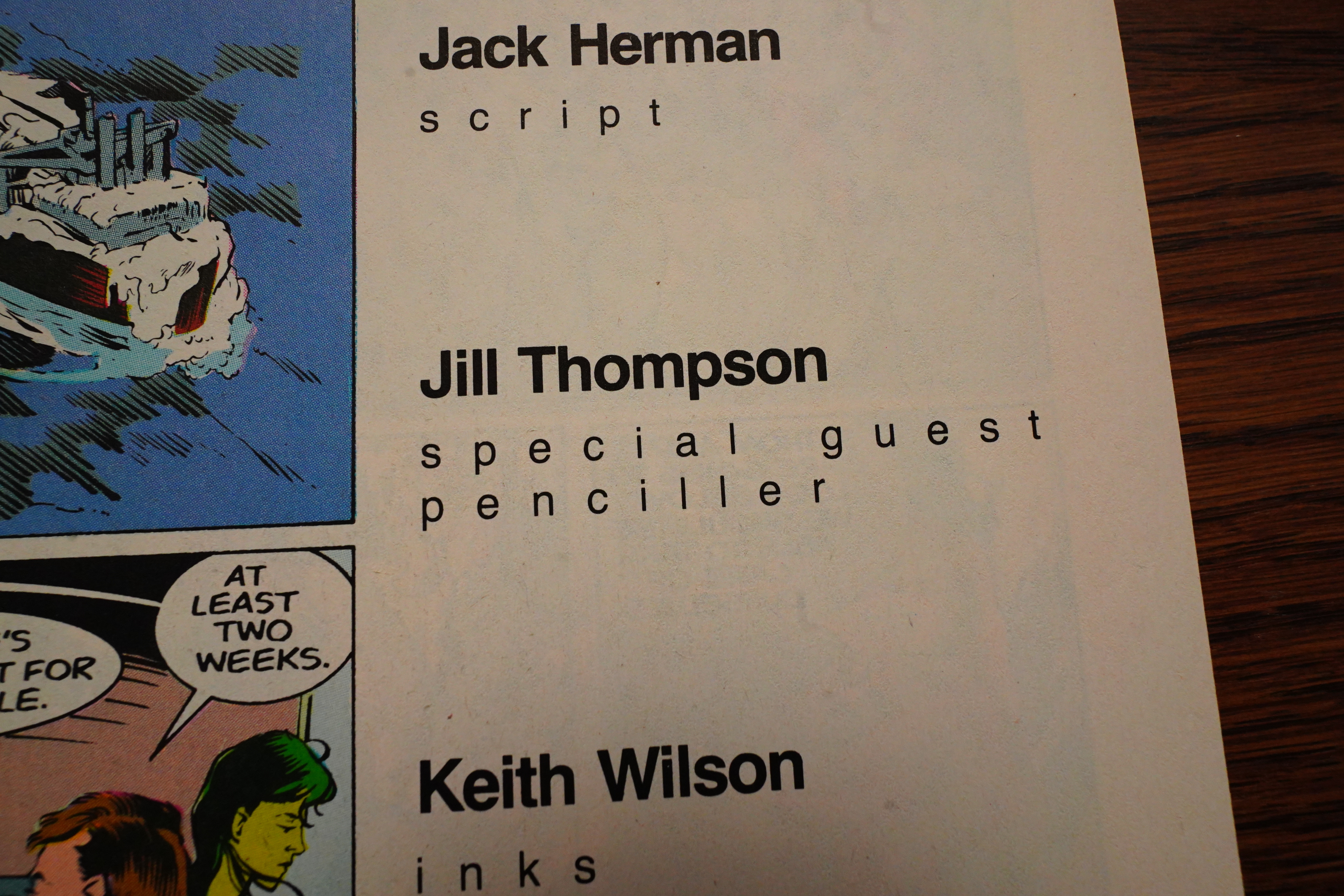
We then start getting special guest pencillers — I think Willingham drew less than half the issues from now on…
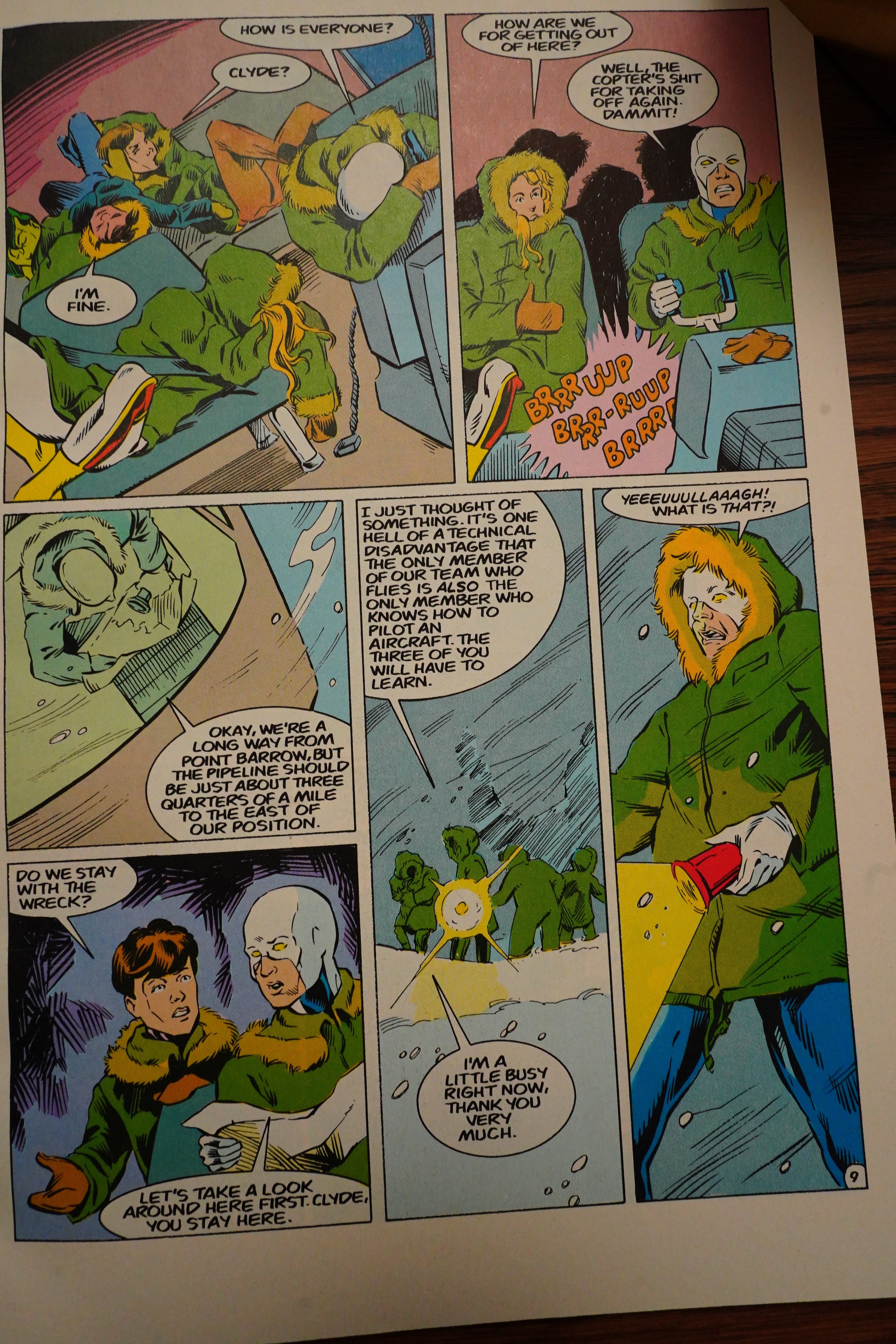
Jill Thompson is famous and stuff now, but back then, her artwork looked pretty basic.
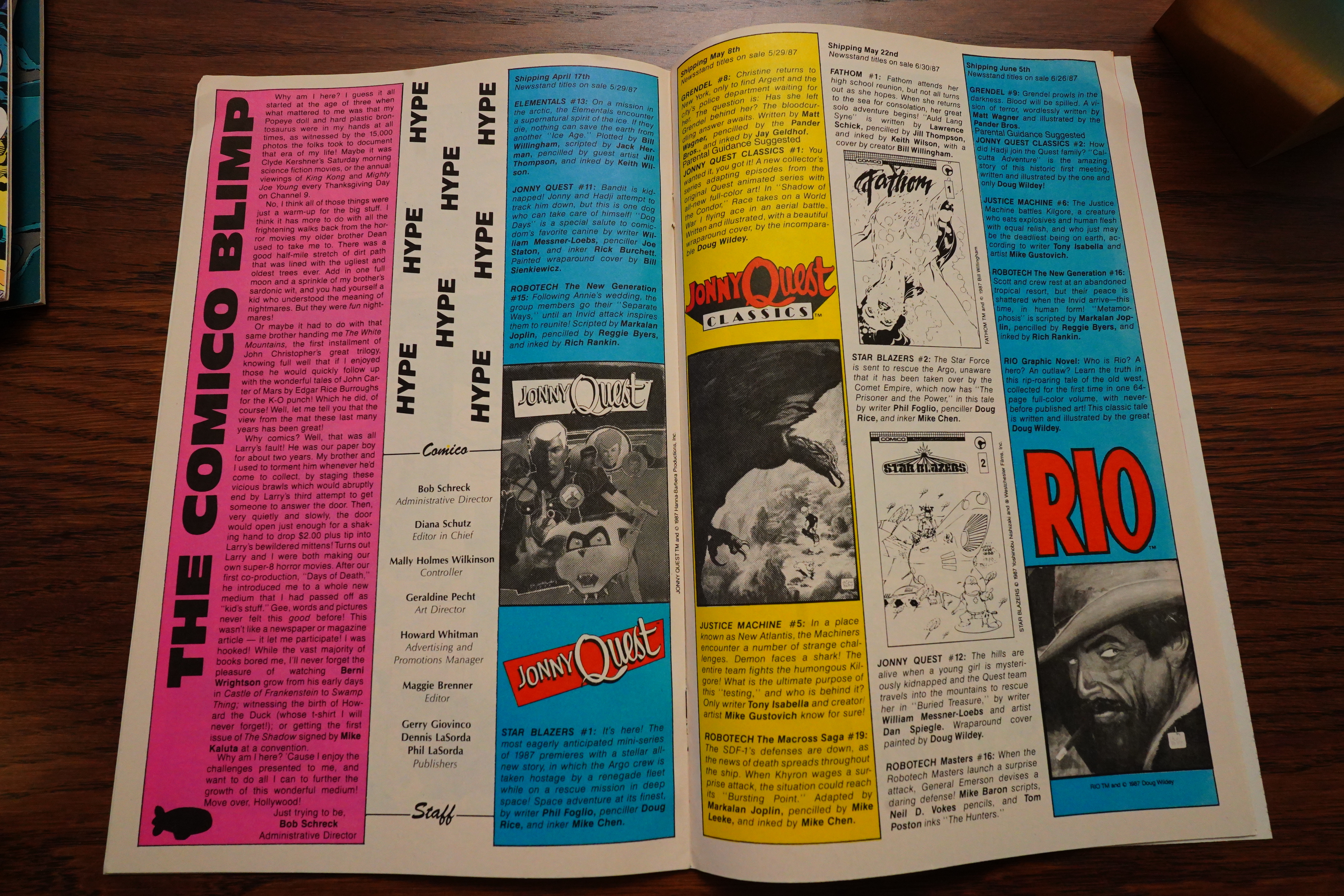
Wow, that’s a lot of comics. I guess 1987 was their Imperial Moment. They were pushing out a lot of stuff, most of it commercially successful, and some of it even pretty good, I think? I guess I’ll find out when I get there.
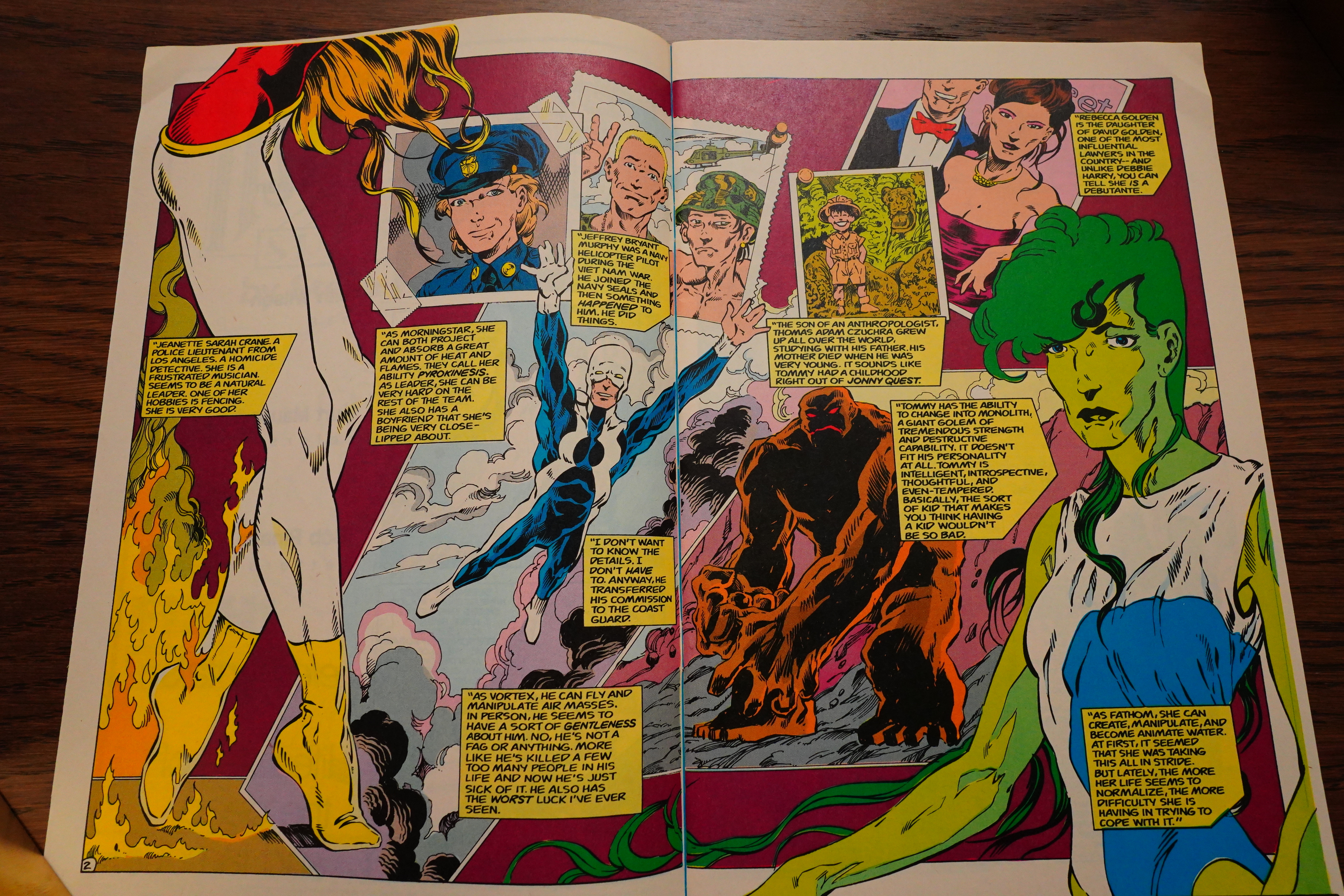
Then! Suddenly! Special recap issue! That explains everything.
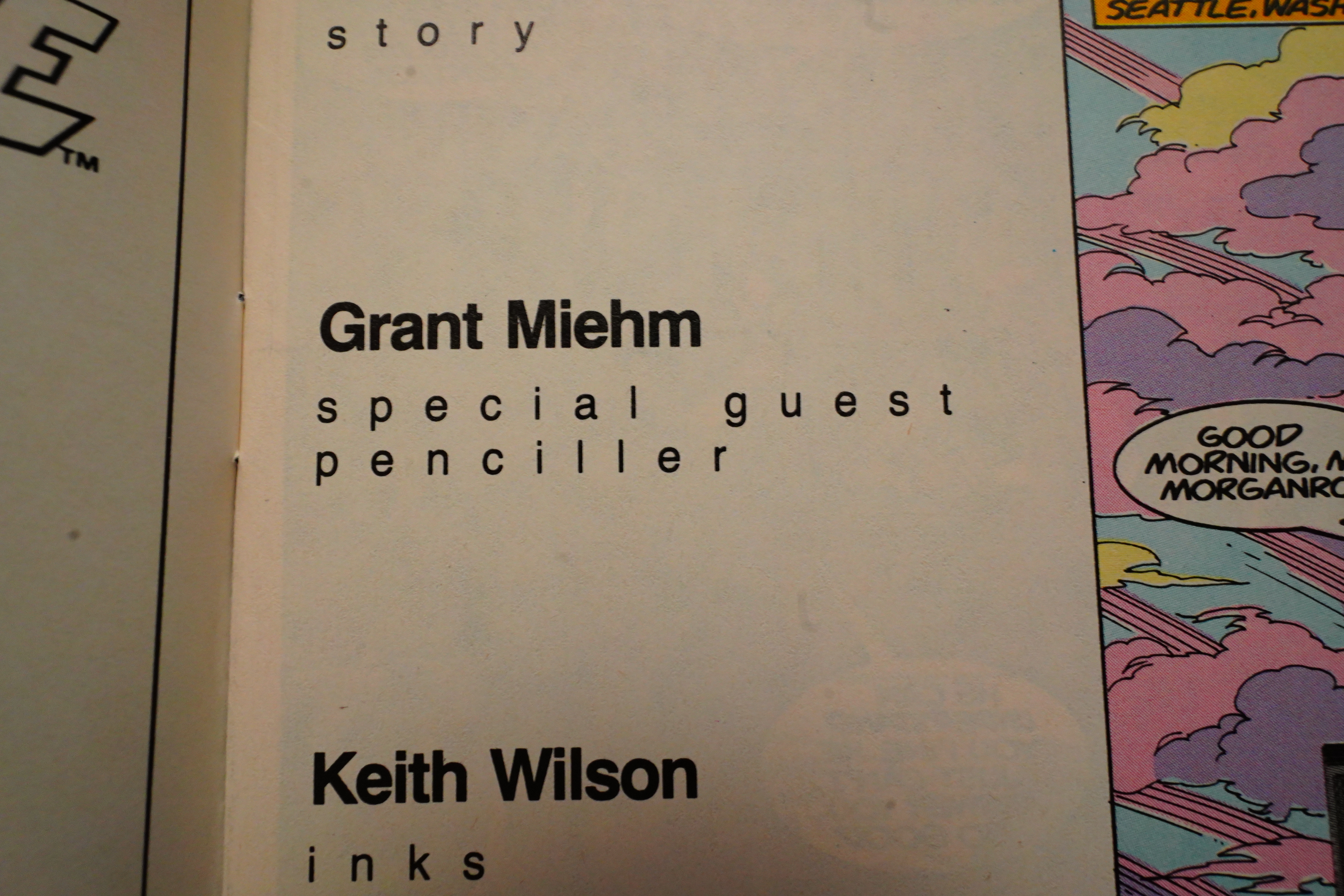
Grant Miehm started out as a special guest penciller, but would go on to be the regular penciller for a while…
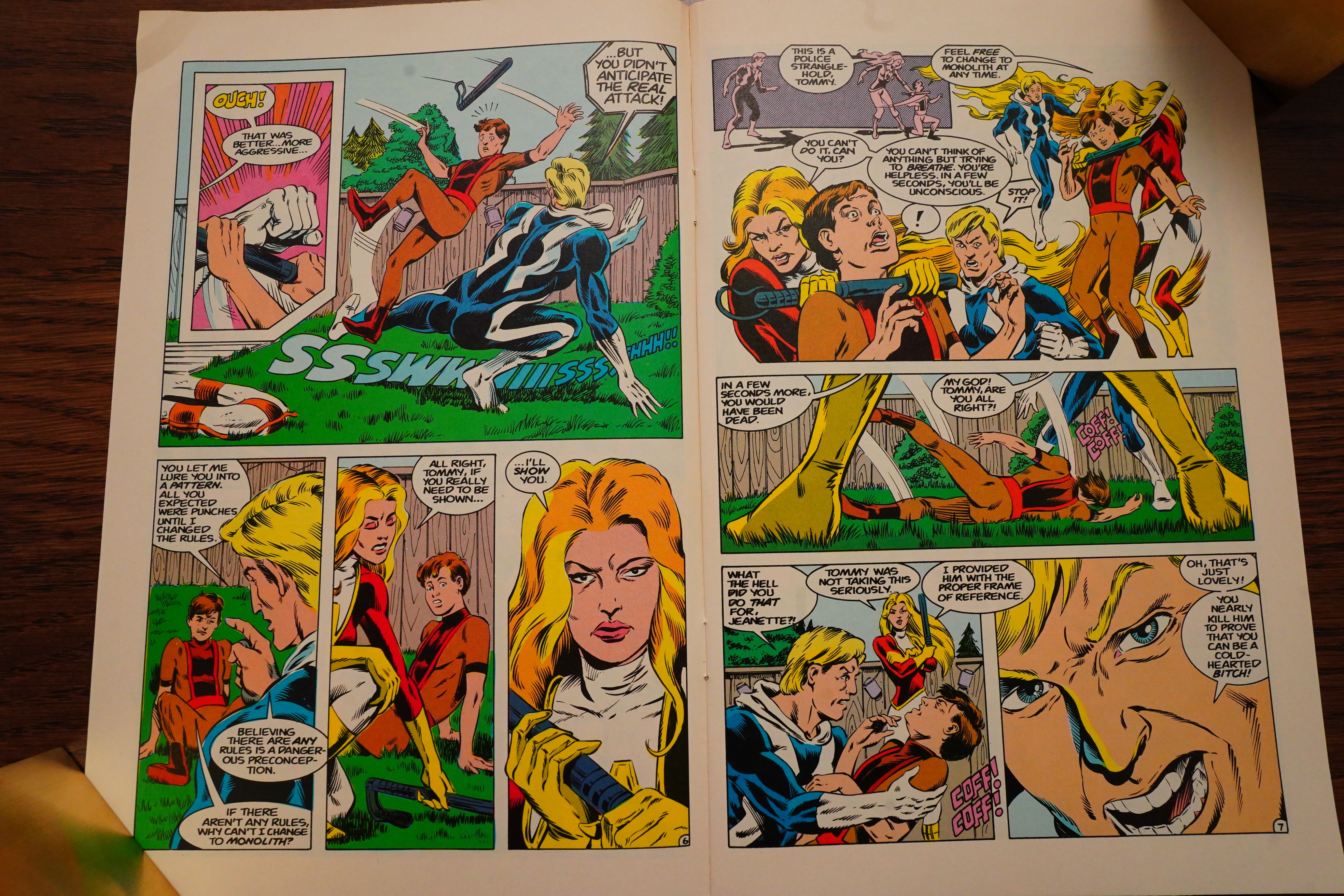
Oh, but what’s going on in the stories? Well, it’s still the same odd mix of team comics tropes, like Super Power Training Scenes That Turn Serious, and various conspiracies that seem to be brewing… but without really gelling. Which isn’t strange, because I guess you shouldn’t brew jello.
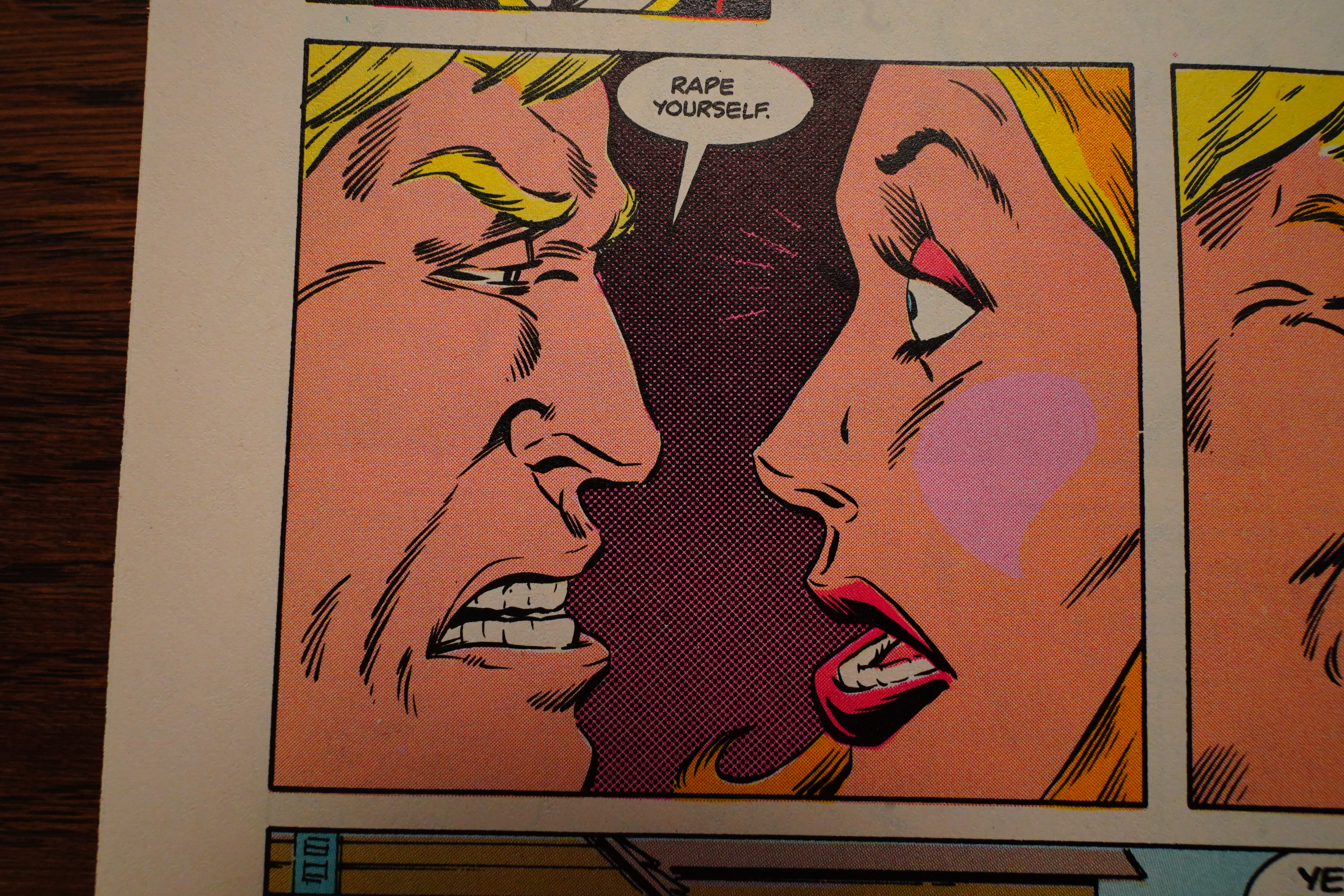
Things in general are just… off.
It’s not that these are boring or anything — they’re not — but it’s hard not to keep an eyebrow permanently arched.
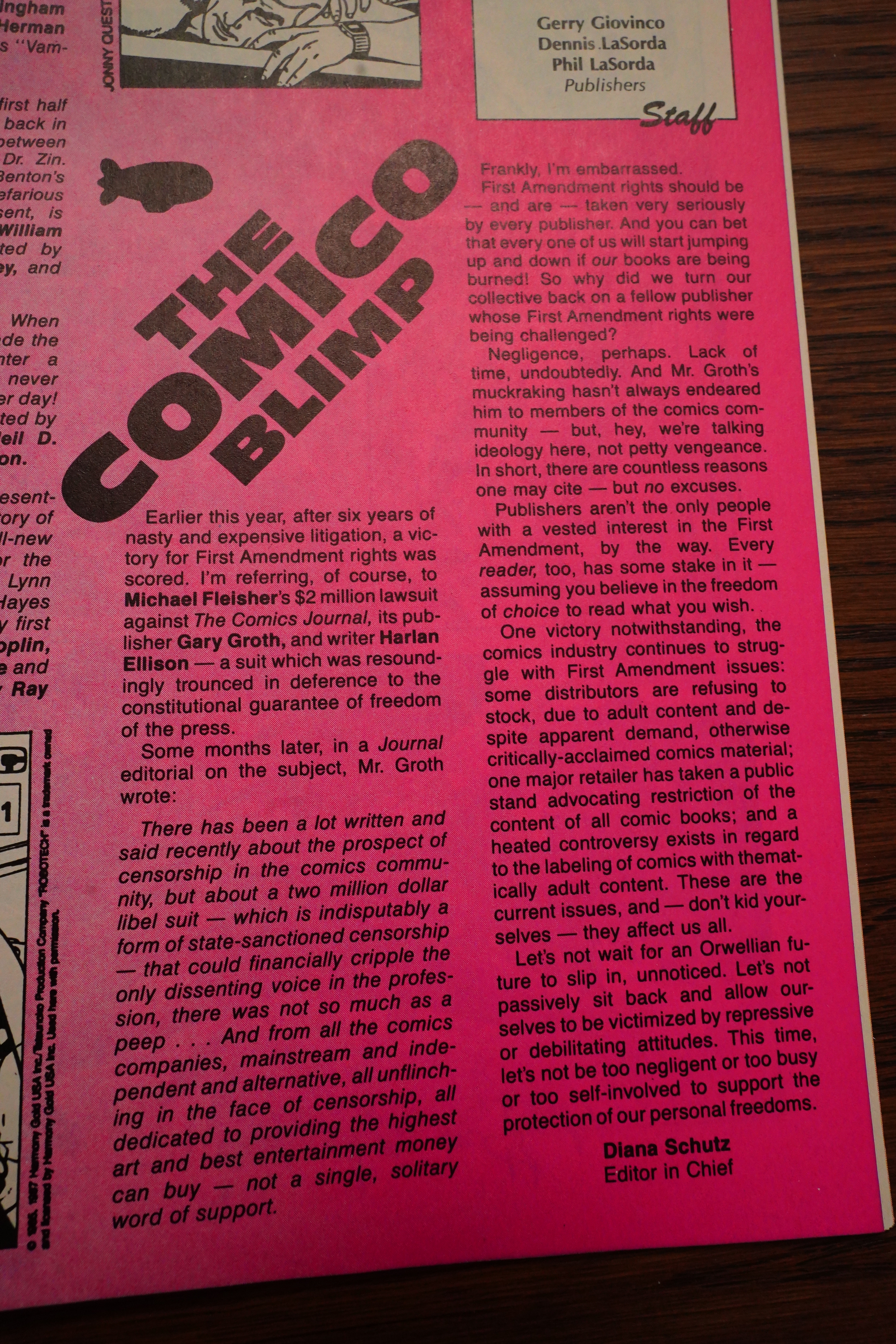
Diana Schutz writes an editorial explaining why they didn’t help Fantagraphics defending against the ridiculous suit by Michael Fleisher. And… it’s because they were busy, and besides, they felt Gary Groth was a “muckraker”. I’m paraphrasing slightly!
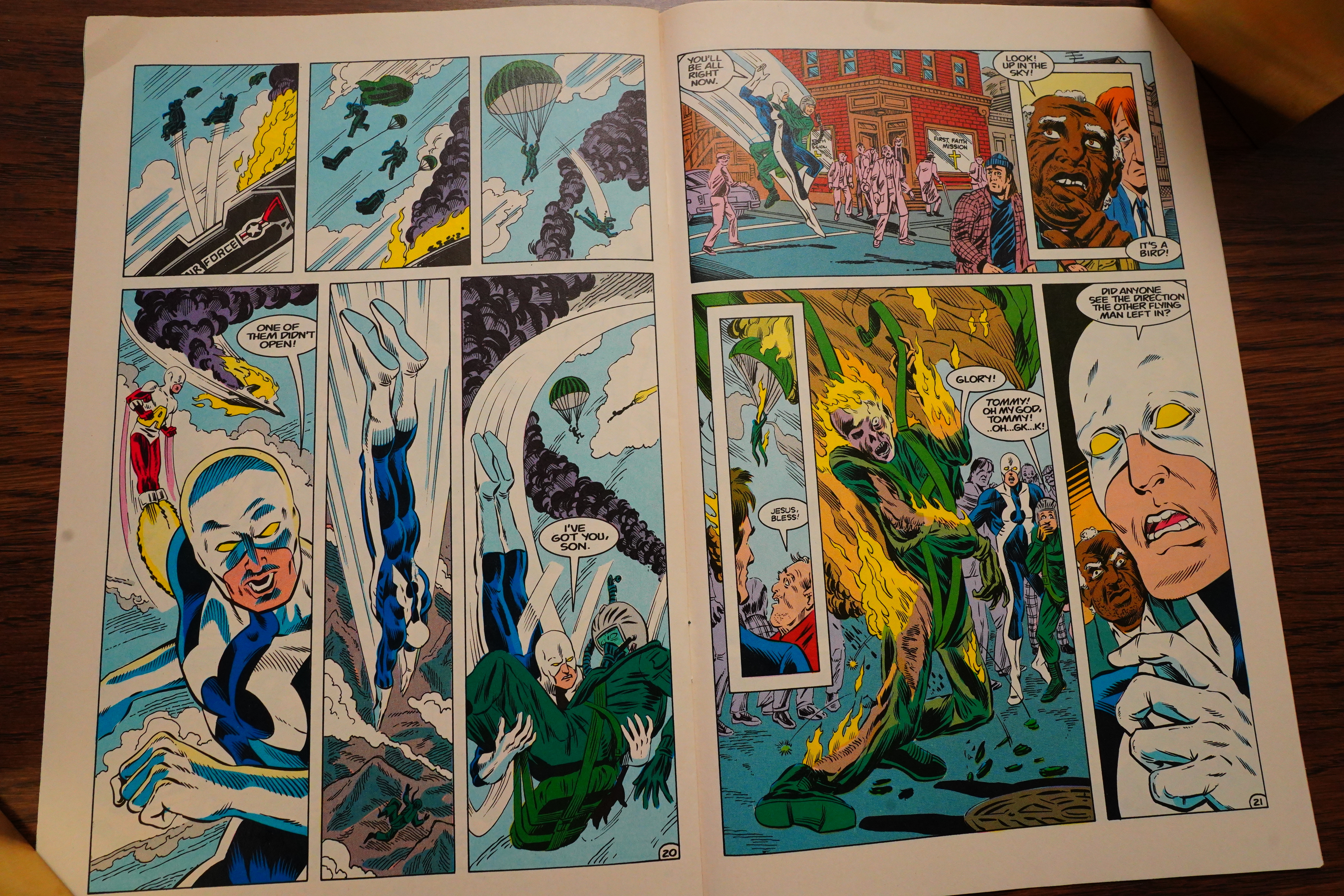
War is hell! I mean… Being a super hero is hard!
That’s a very mysterious ad… Oh! I guess it’s for the Comico Black Book? Which was something they released to celebrate their fifth anniversary. We’ll cover that much later.
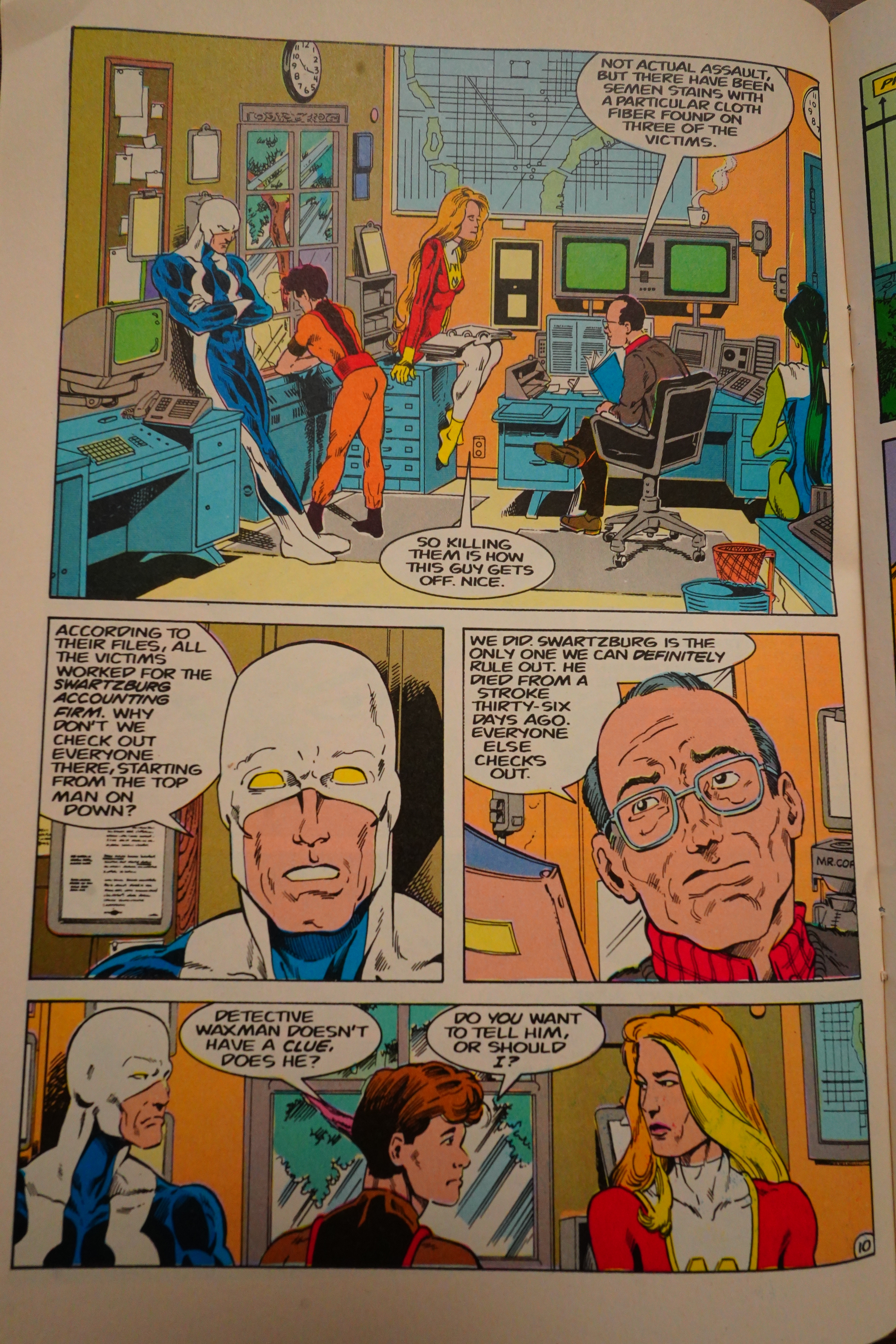
I think the issues that work best are when Willingham just lets them be regular super-heroes. This arc, where they fight a vampire, was pretty entertaining, for instance. In typical Willingham fashion, it’s a disgusting incel vampire; a parody on the Dracula trope: Not only does he kill women and drink their blood, but he gets sexually excited and ejaculates on them.
“Fun for the whole family”, I guess, but it’s different, at least…
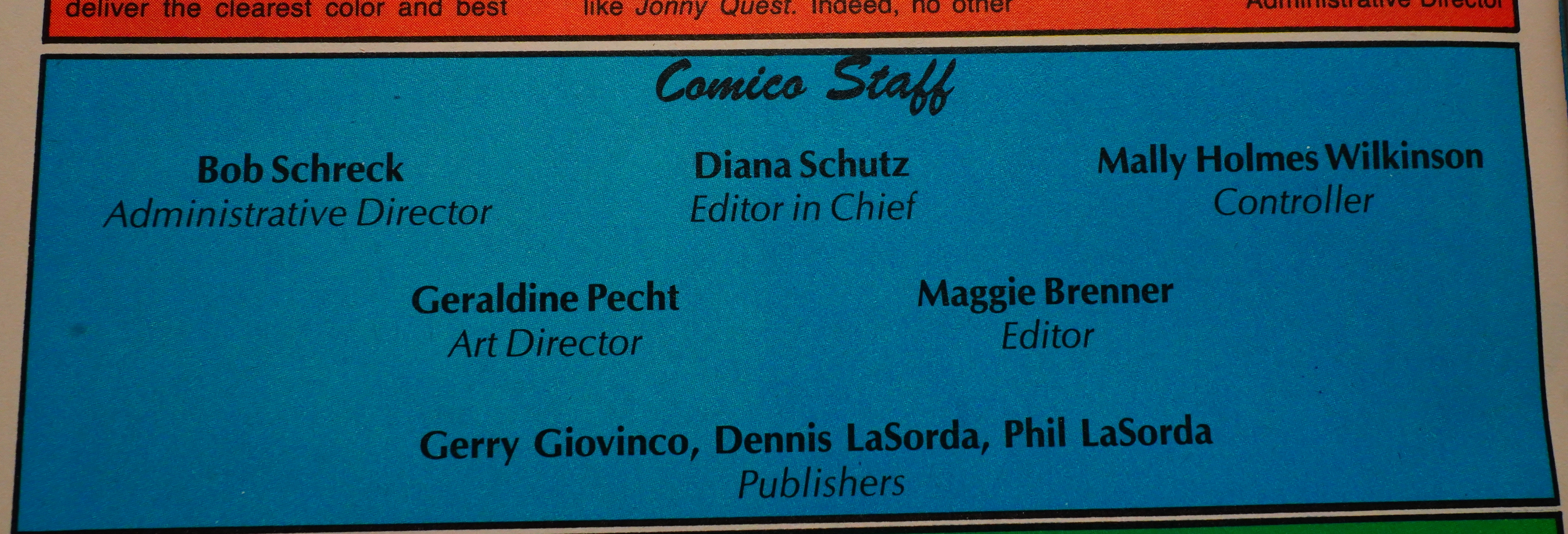
Is that an abnormally large staff for a company like this? Perhaps not? That’s a lot of publishers, at least, but perhaps they don’t actually work there.
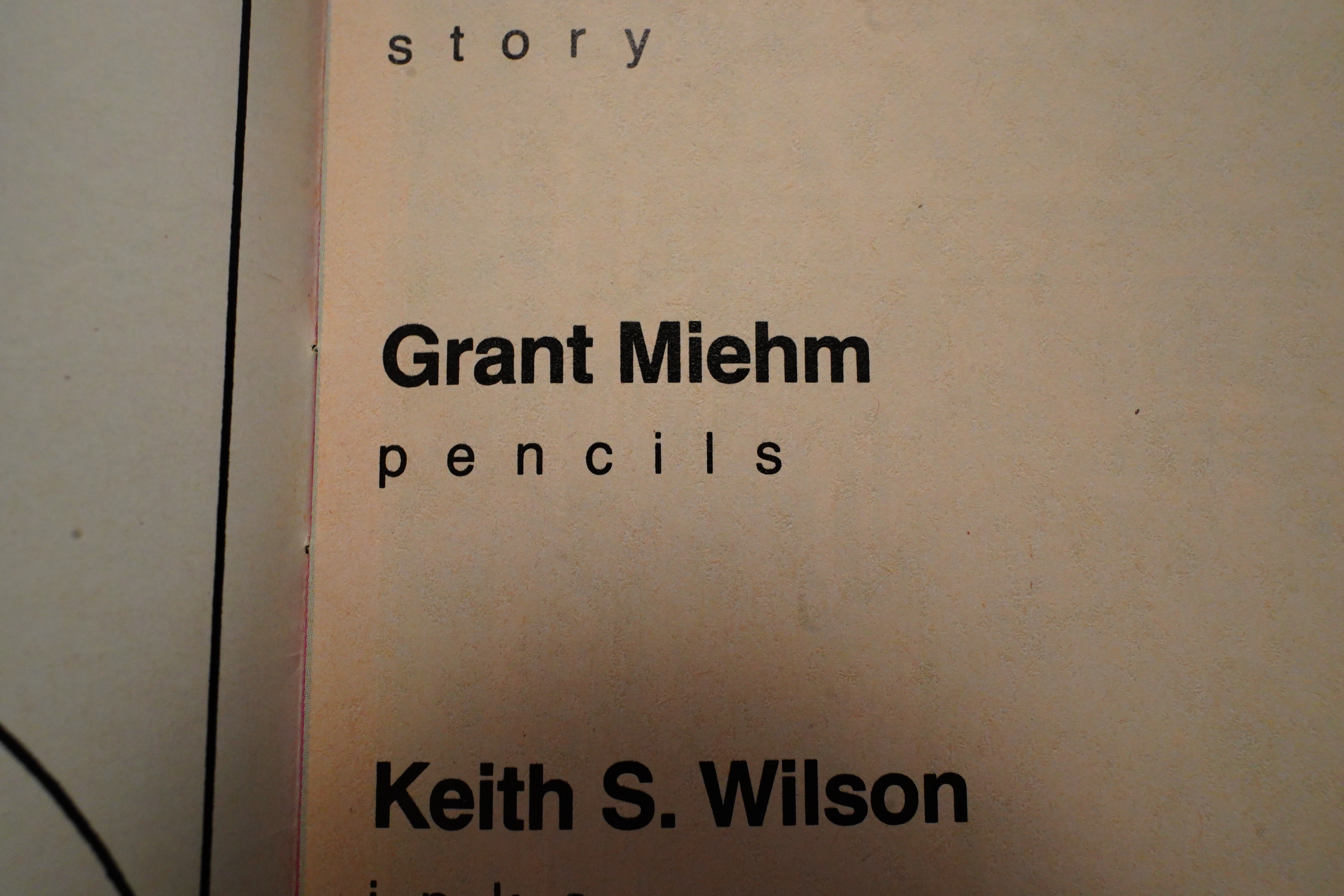
Grant Miehm takes over as penciller permanently, apparently.
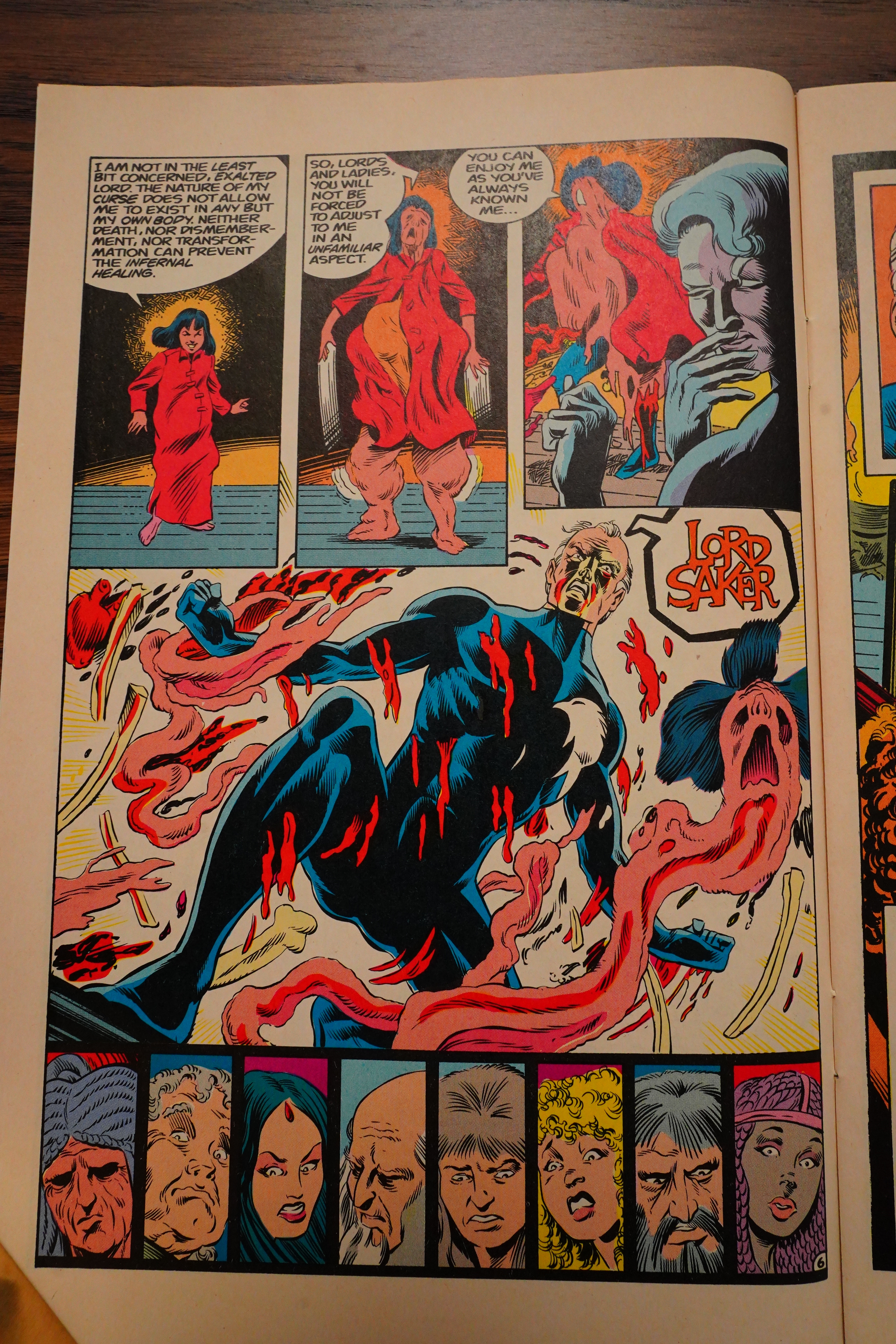
And remember that evil guy who was the main villain? He’s back all of a sudden! But then tells his co-conspirators that he’s not going to do anything until… a specific recently (prematurely) born baby dies, and then he’s gonna… do something… It’s unclear what.
So Willingham is setting up things that feel like are going to be long, complex story lines, but it’s hard to have much confidence: Perhaps this is going to pay off, and perhaps not?
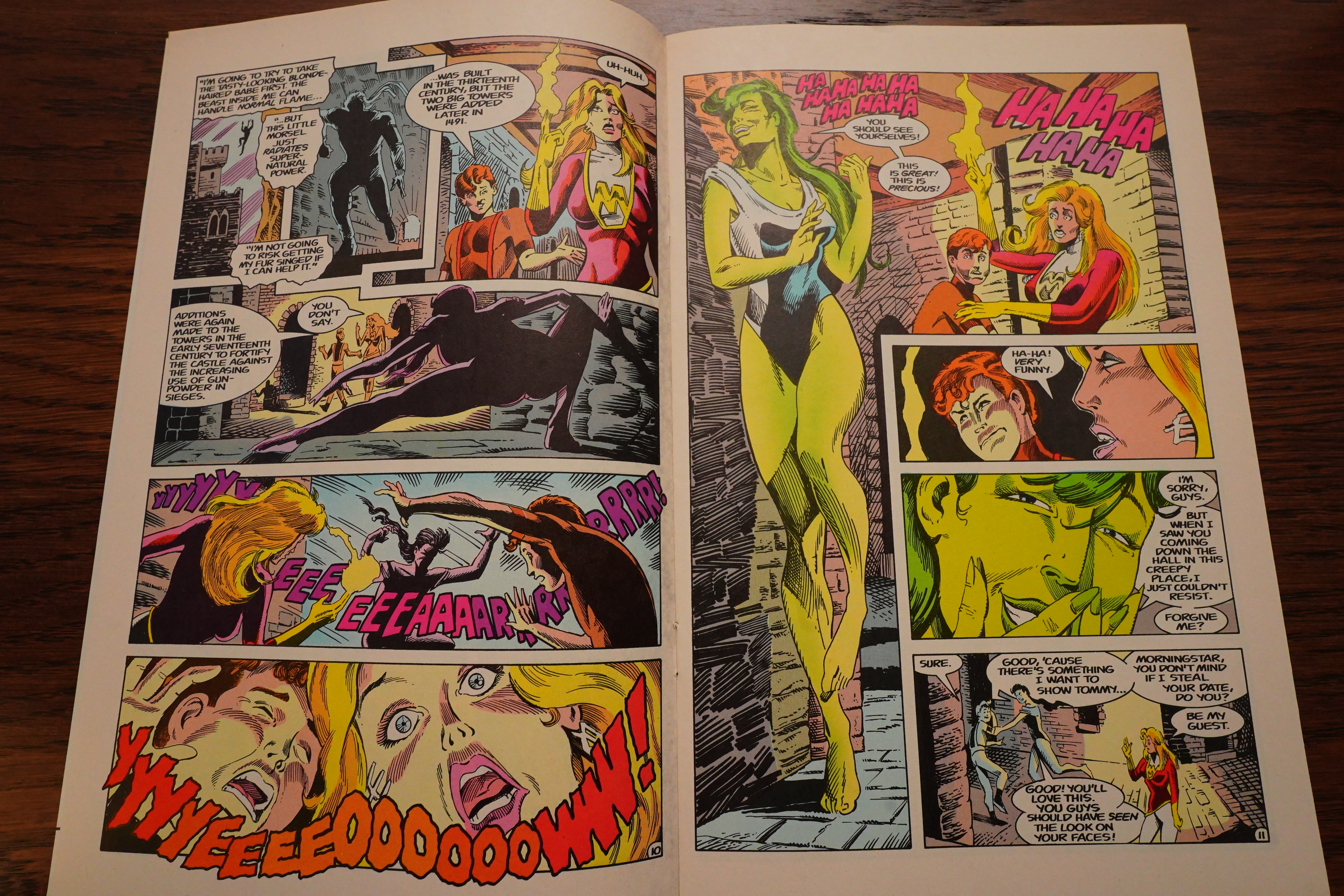
Oh, that Fathom!
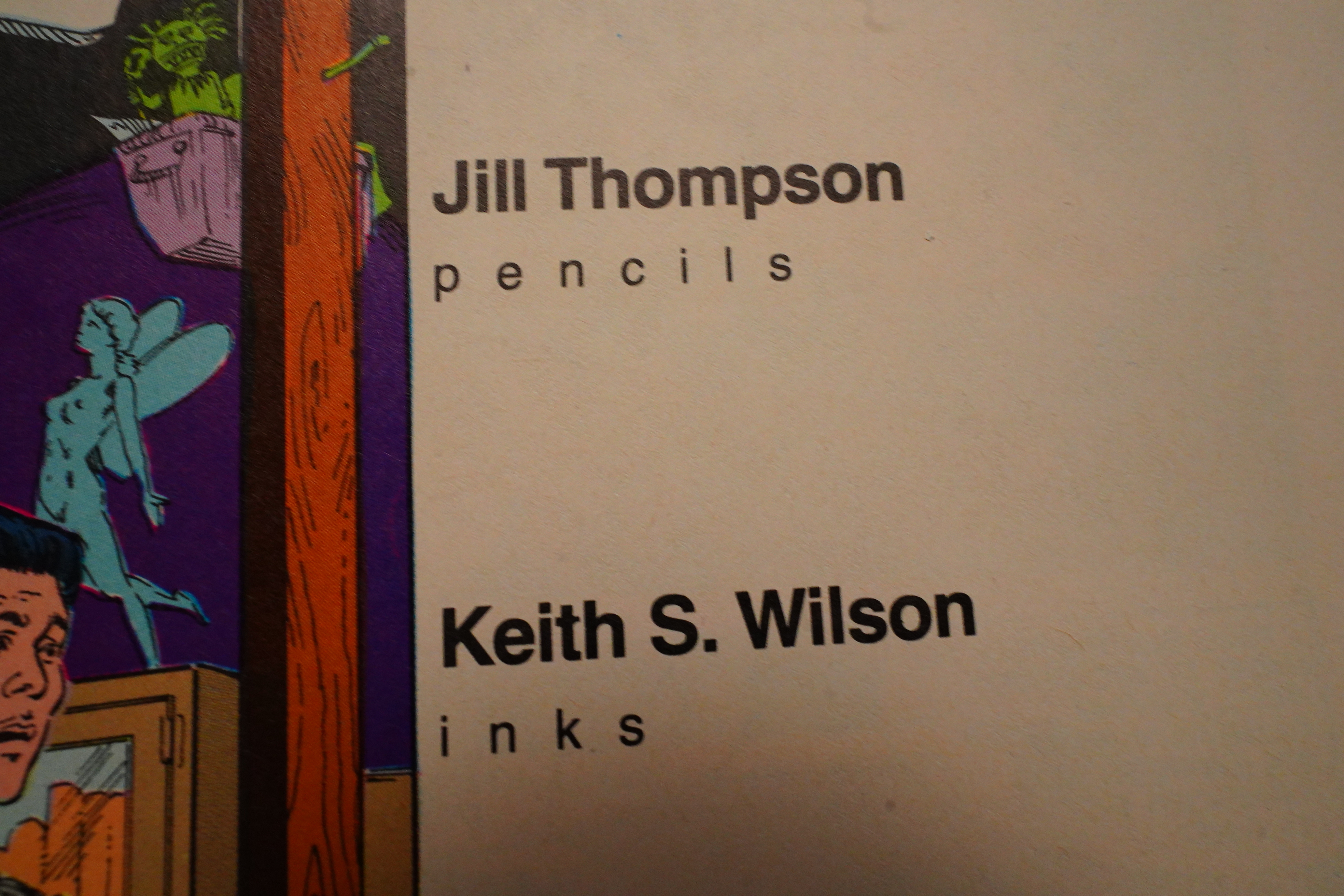
I guess the regular new penciller didn’t work out?
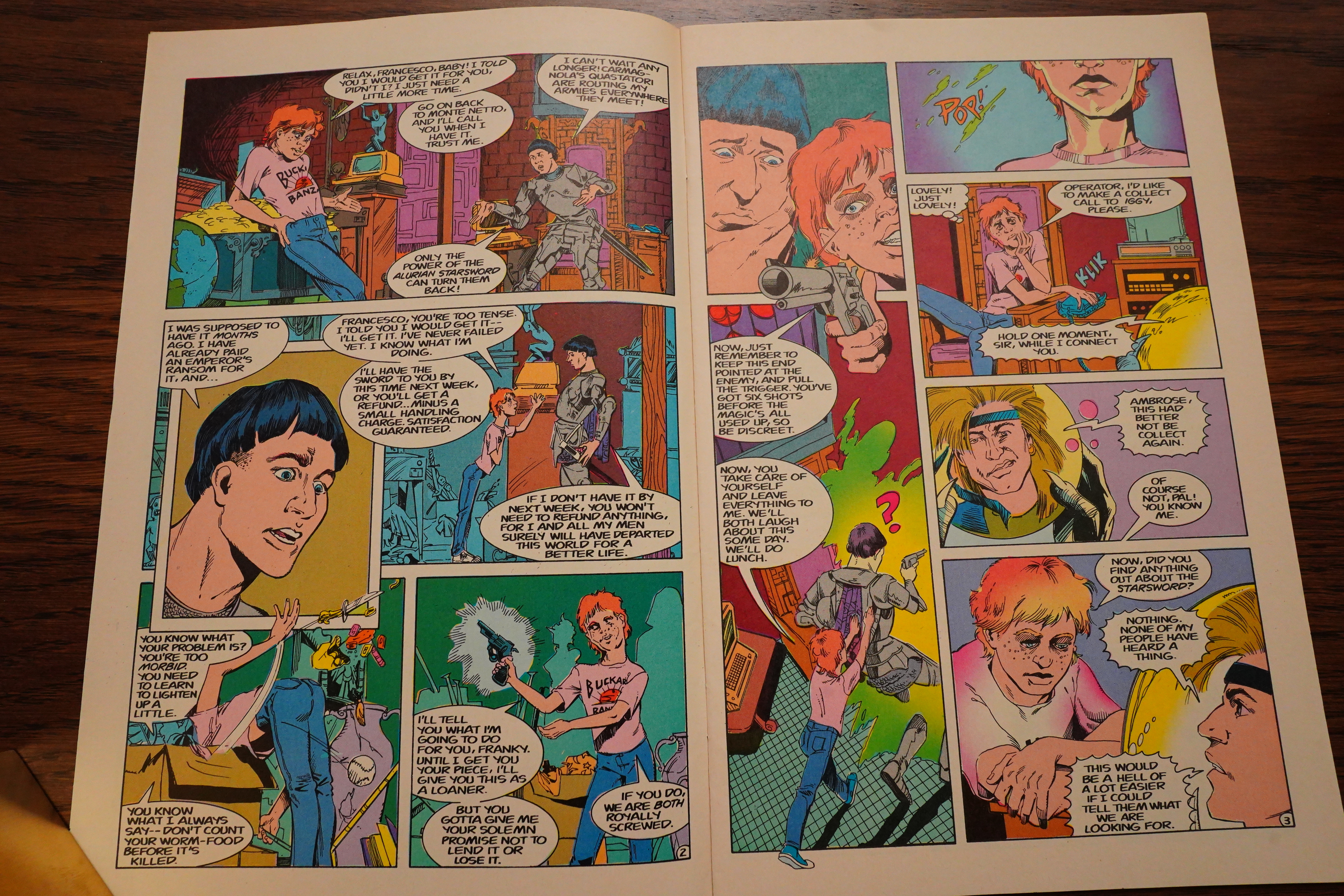
And we’re introduced to yet another cabal of characters — this time it’s a magician who’s also an assassin? Procurer? Is this going to go anywhere?
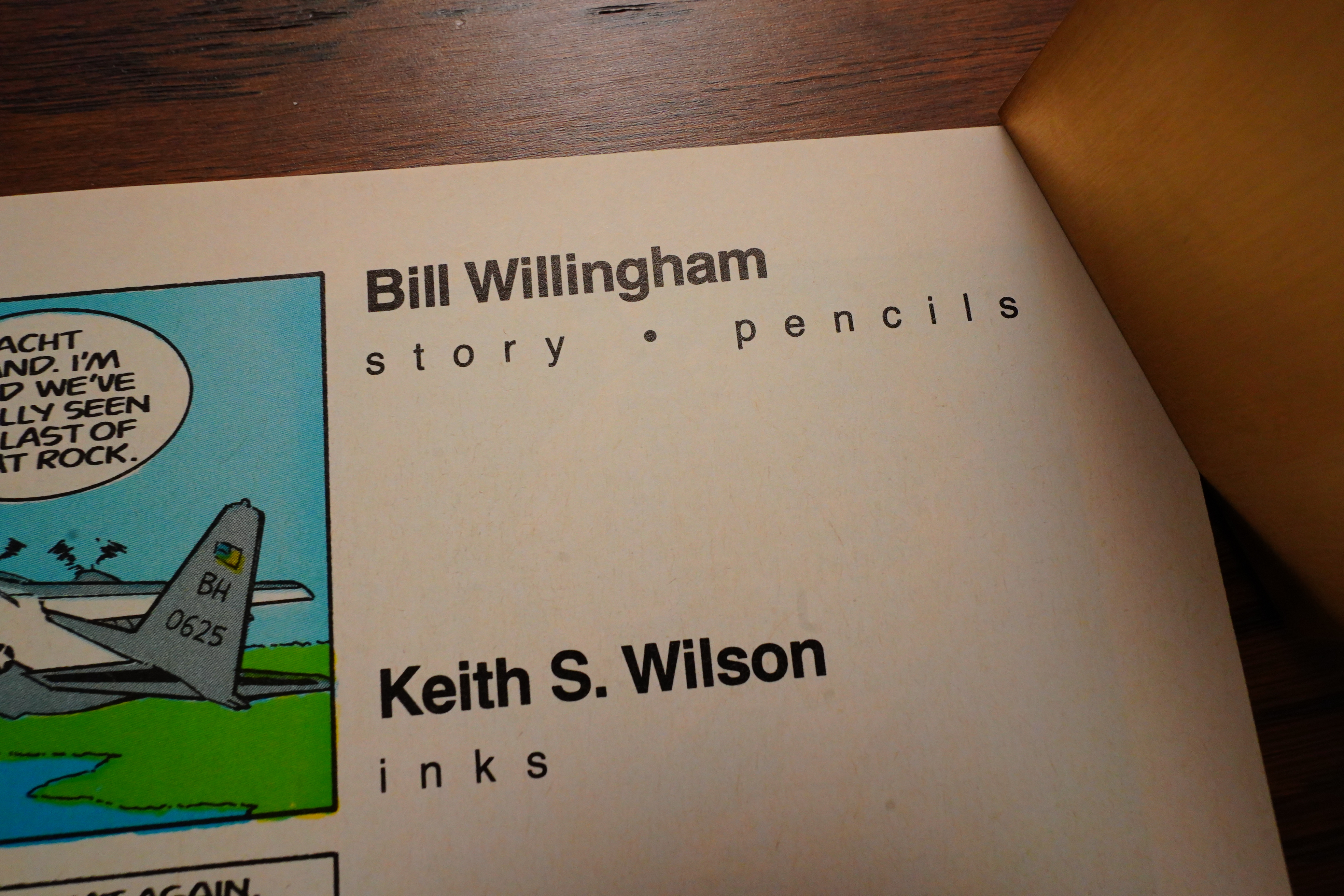
Well, Willingham is back on pencils…
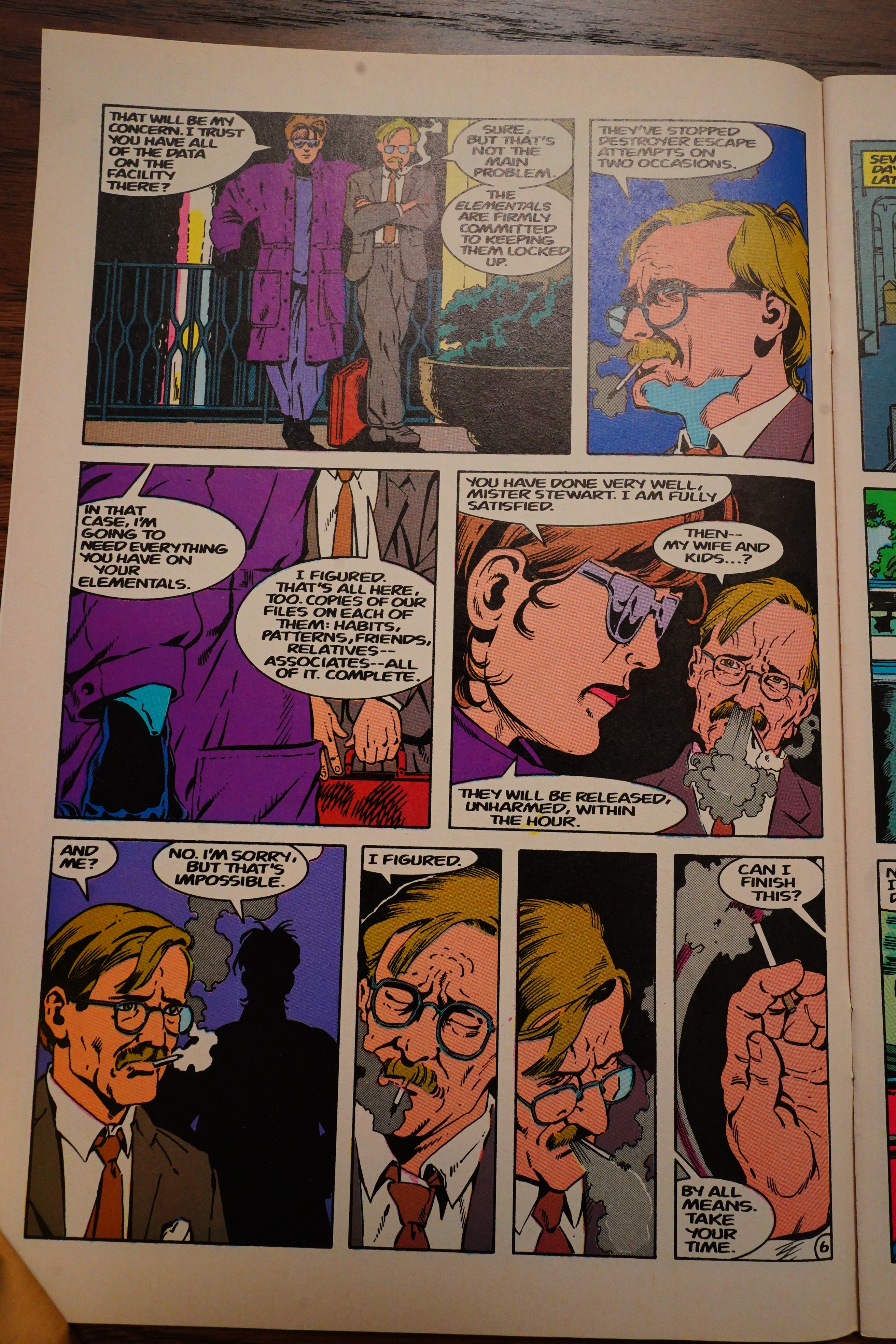
… and we get more mysterious conspiracies set up. I lost count — I think we’re up to at least four? five? more or less secret organisations setting up things?
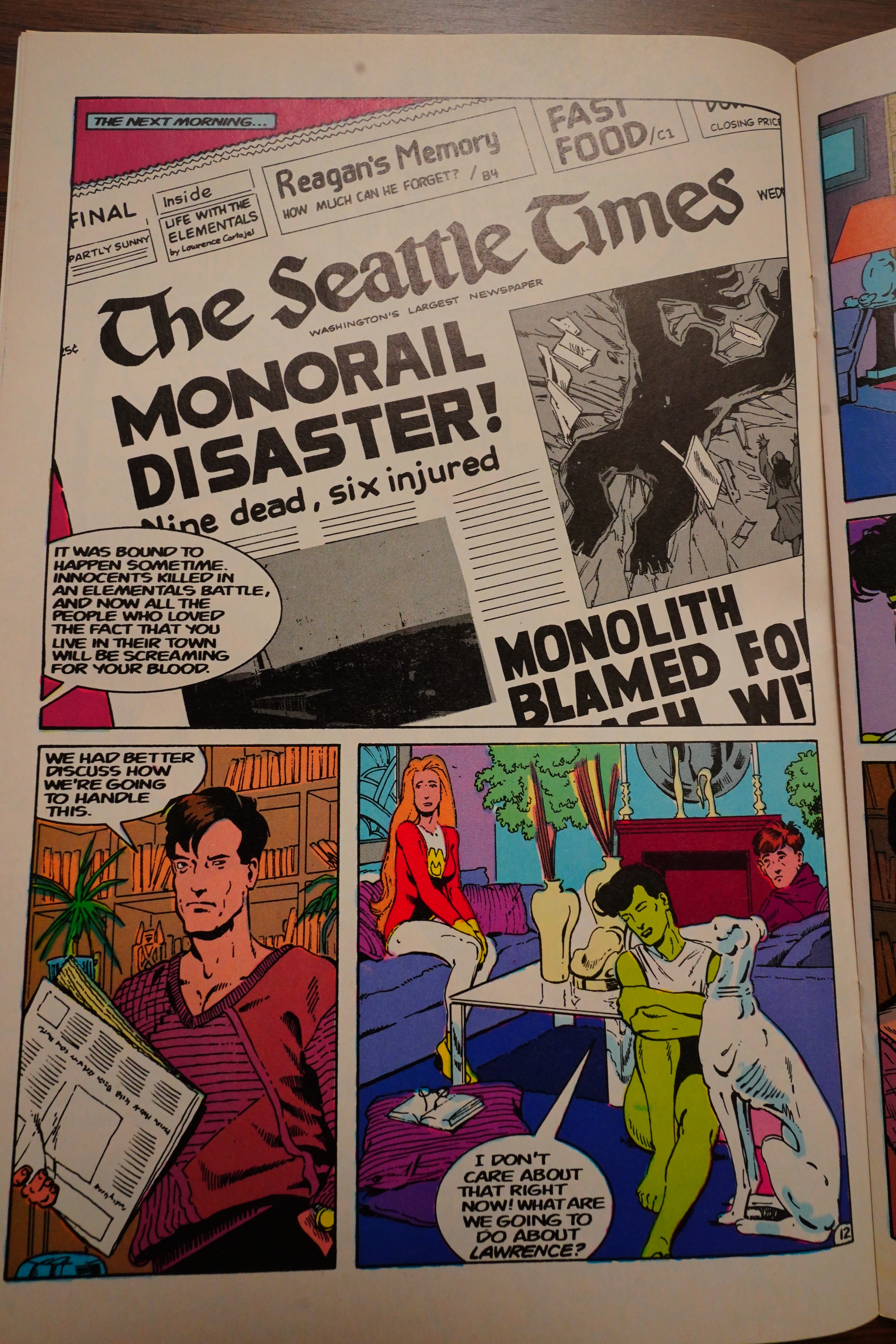
War is hell! I mean, being a super-hero is hard!
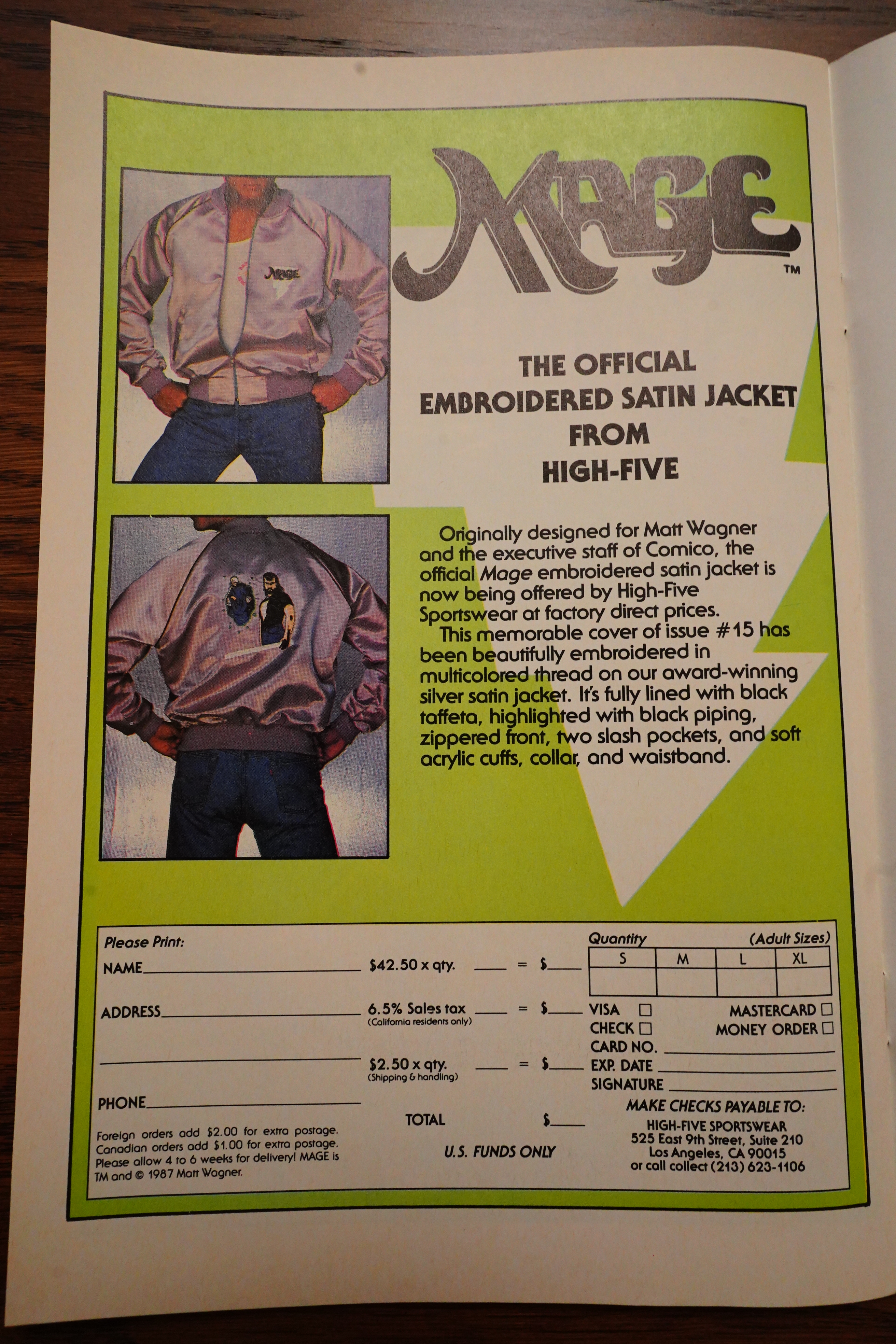
Oooh! An officially embroidered SATIN JACKET!!! Very cool, very cool.
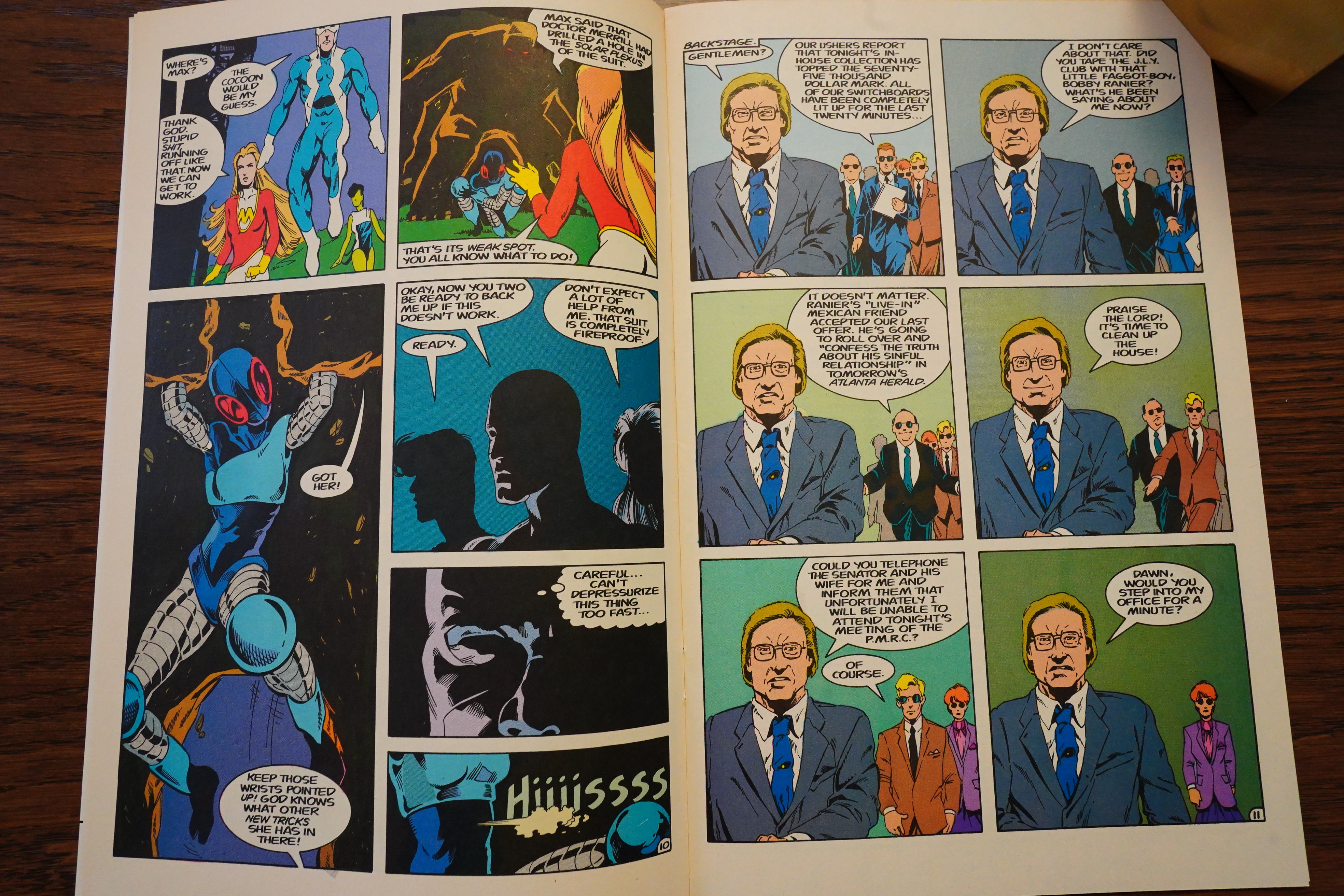
And then Willingham sets up yet another secret evil organisation, apparently — centred around an eeevil preacher, this time around. (Or did he already do that? It’s taken me several days to do this blog post, so I’ve already started to forget stuff.)
I wondered whether Willingham had xeroxed that guy… and I guess he might have, but the inking looks done by hand (i.e., differently each time).
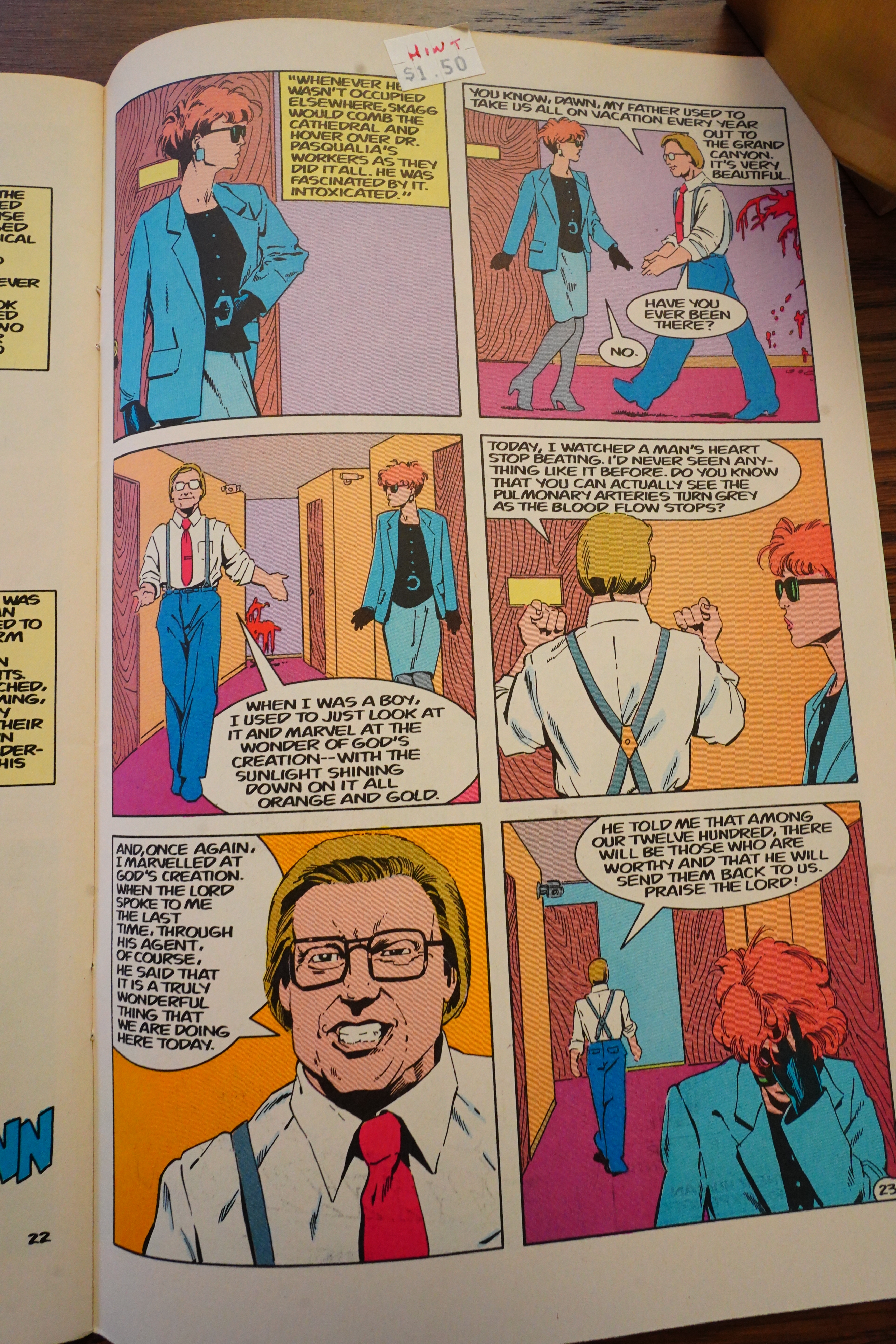
And the preacher’s plan was to torture 1,200 people to death in the most horrible way possible, and then count on God to resurrect the worthy ones. (We’re shown some of the tortures, but since this is a family oriented blog (I’m not saying which family) I’m not showing those bits.)
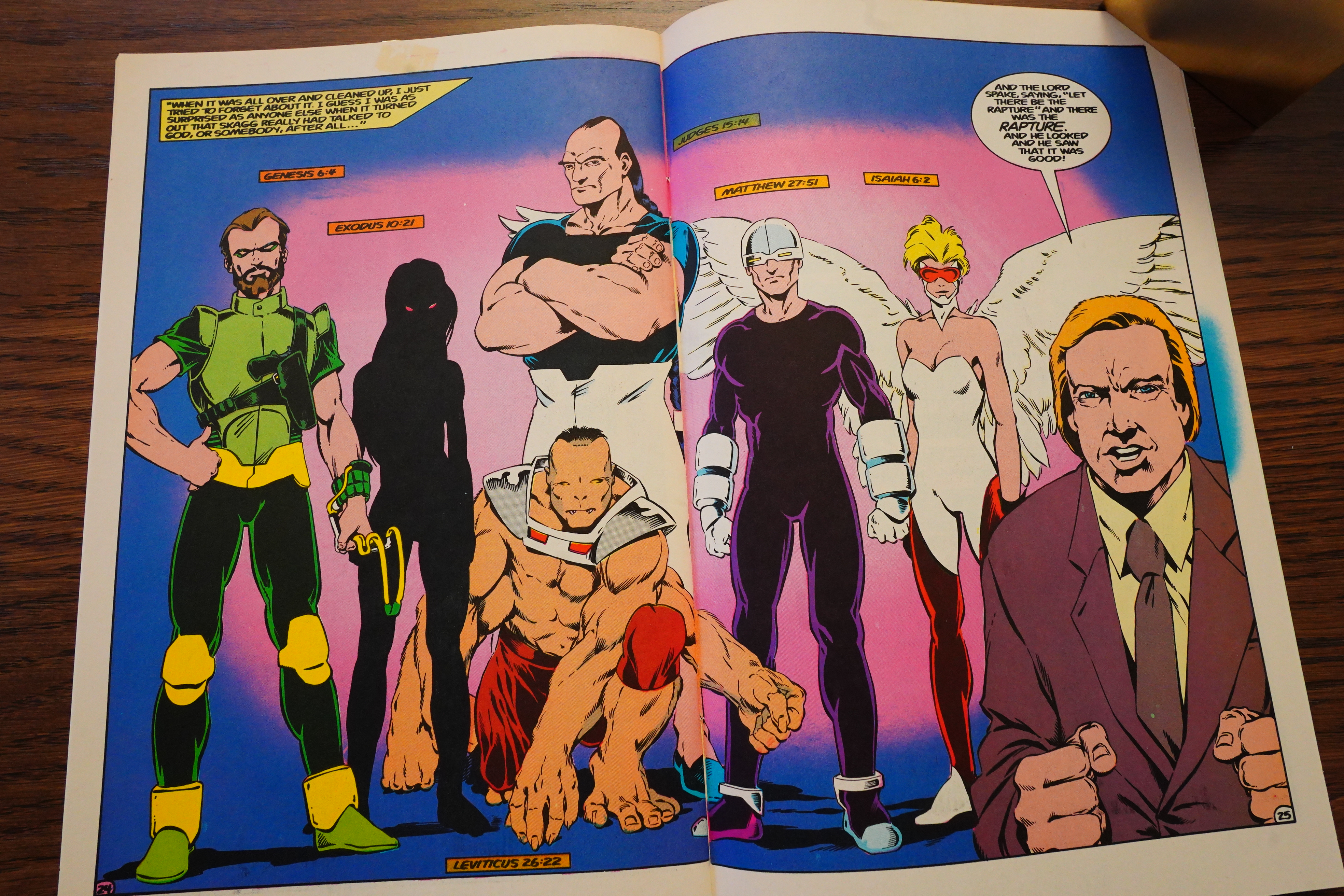
And it works! Now the next issue is going to be an epic fight sequence between these dorks and the Elementals? Nope — none of this is mentioned again. (At least not for the duration of the first Elementals series — perhaps they’ll show up in the next volume?)
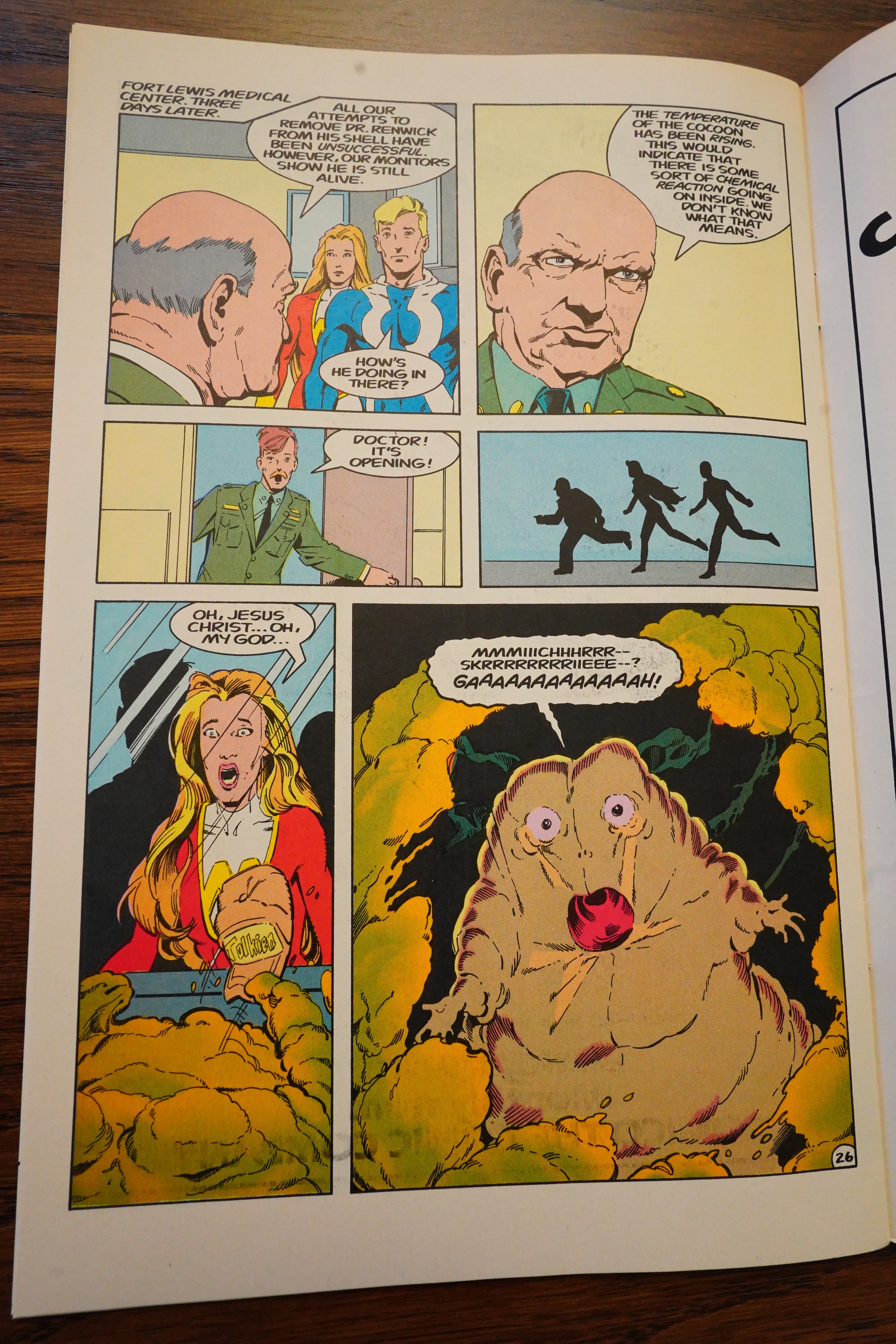
Similarly, a guy is covered in goo from a villain called Chrysalis, so he’s transformed into… something. Which also seems like a setup for a storyline, but apparently no?
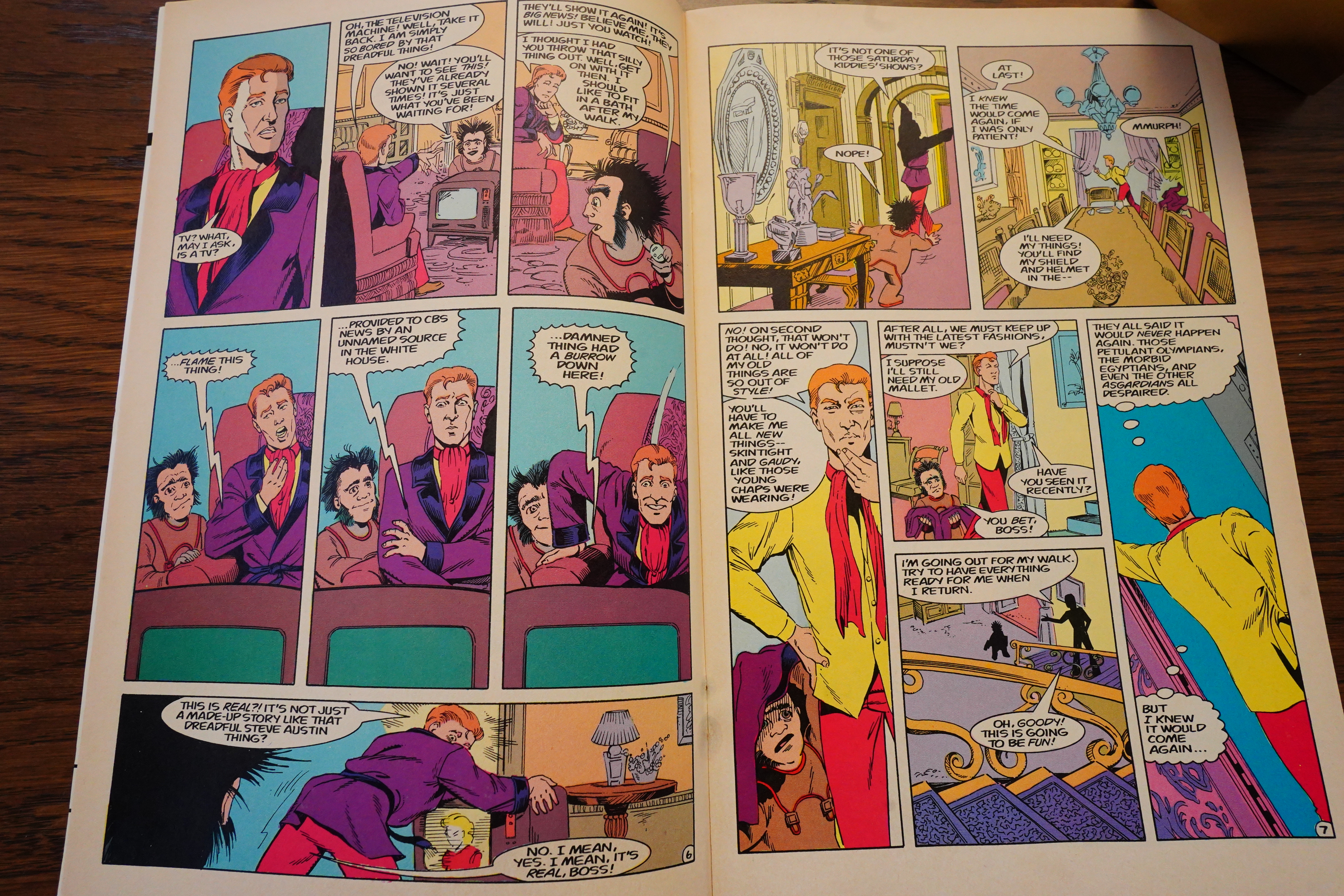
I guess you could read these issues as a totally normal Monster Of The Month series — it’s certainly not unusual to have lots of different villains to confront a super-hero team. It’s just the way Willingham introduces these things — it’s difficult to read this introduction of a Thor-like guy (even if he’s sort of a parody) as being the start of something bigger, but again — nope.
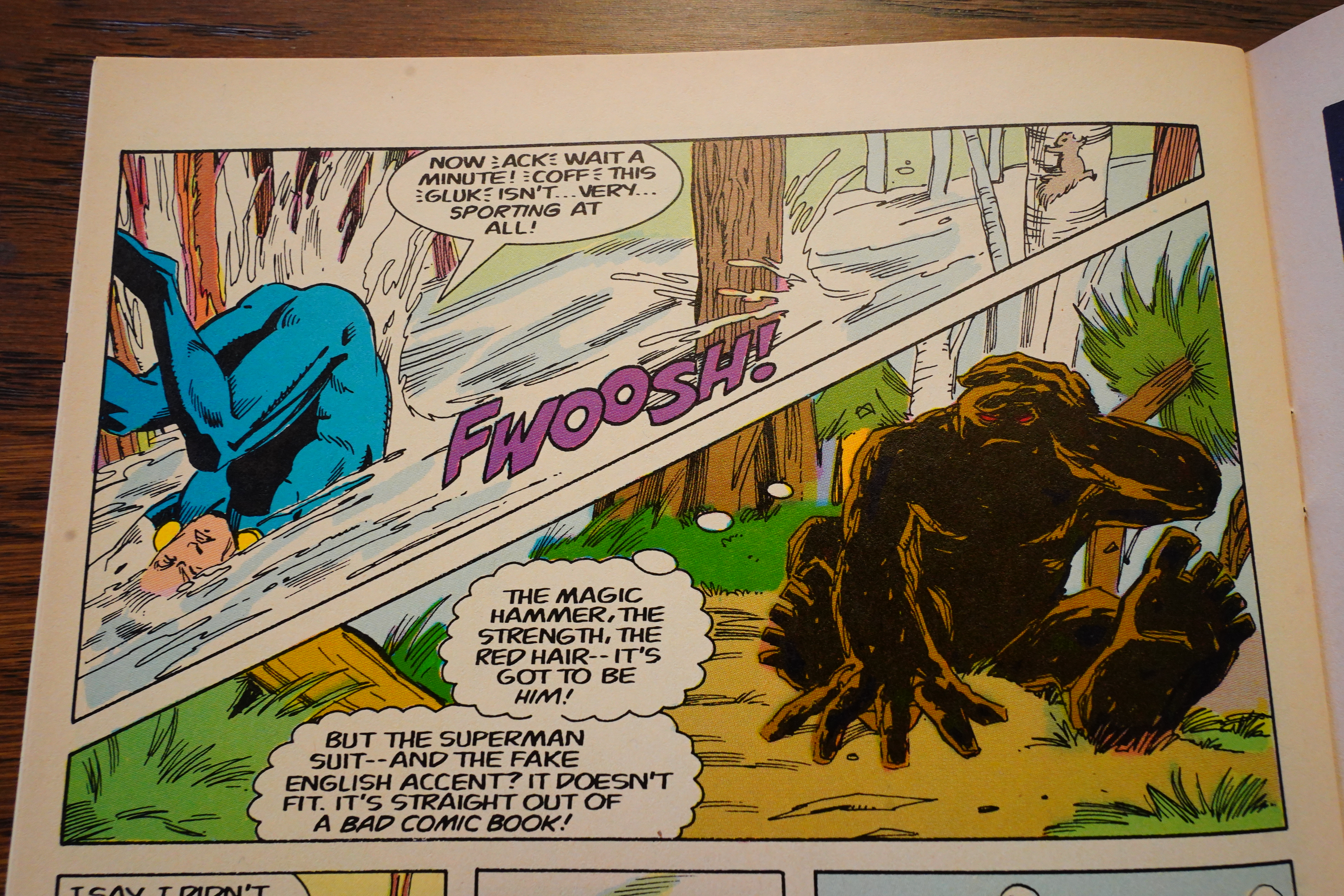
So meta!!!!1!
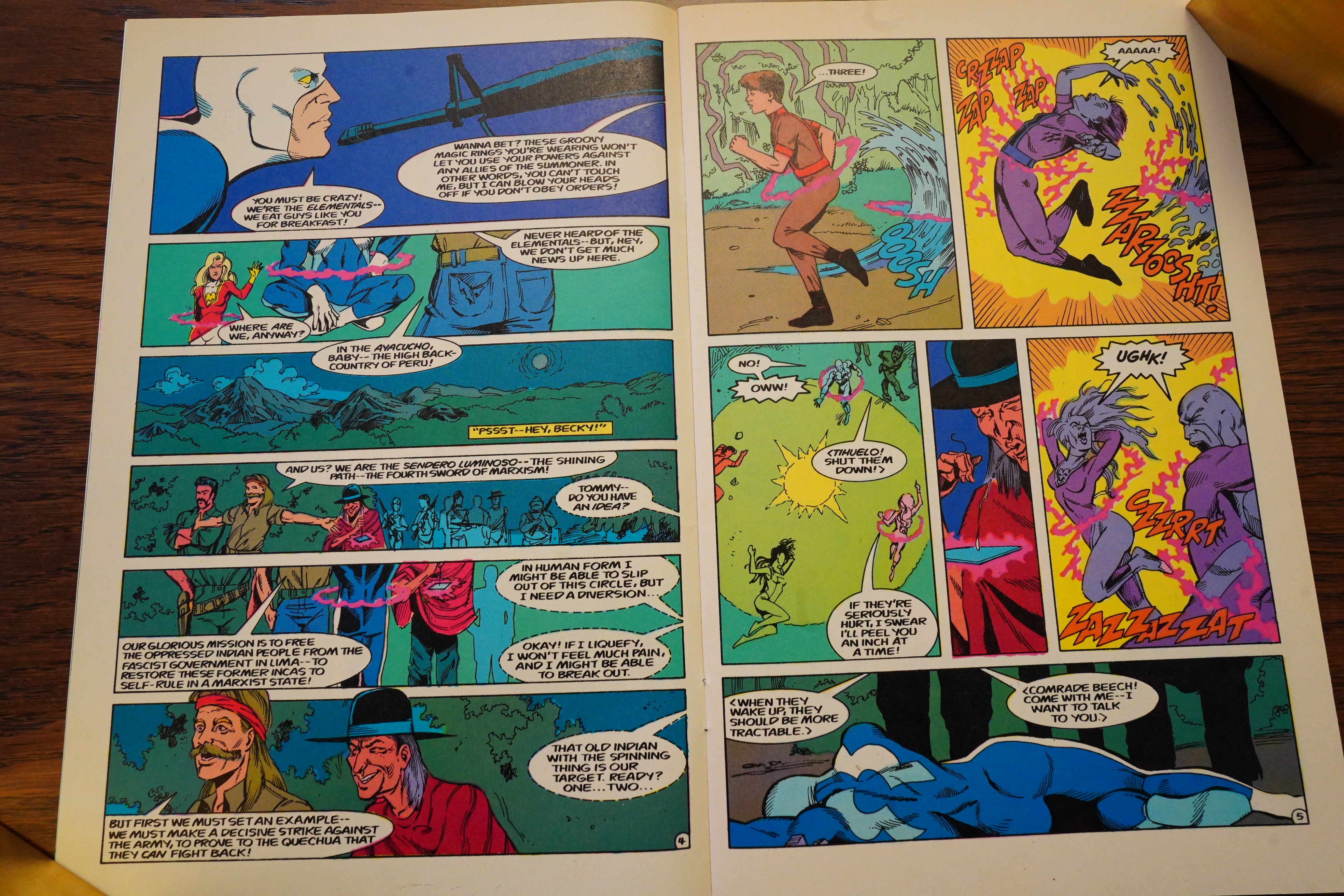
Instead of dealing with any of the millions of things that have apparently been set up, the Elementals are brought to Peru by some Marxist revolutionaries…
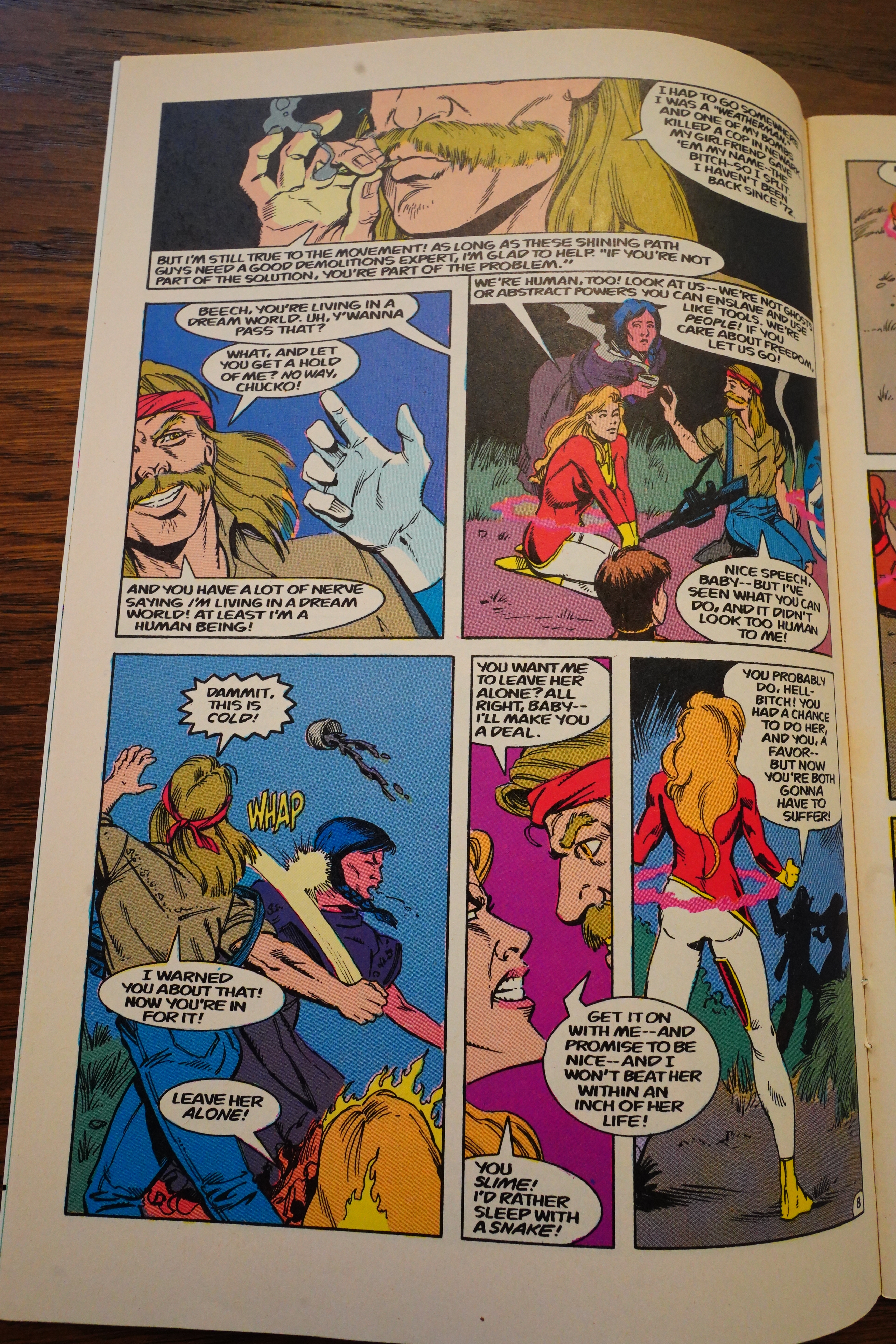
… that turn out to be misogynistic and stuff! Oh the irony!
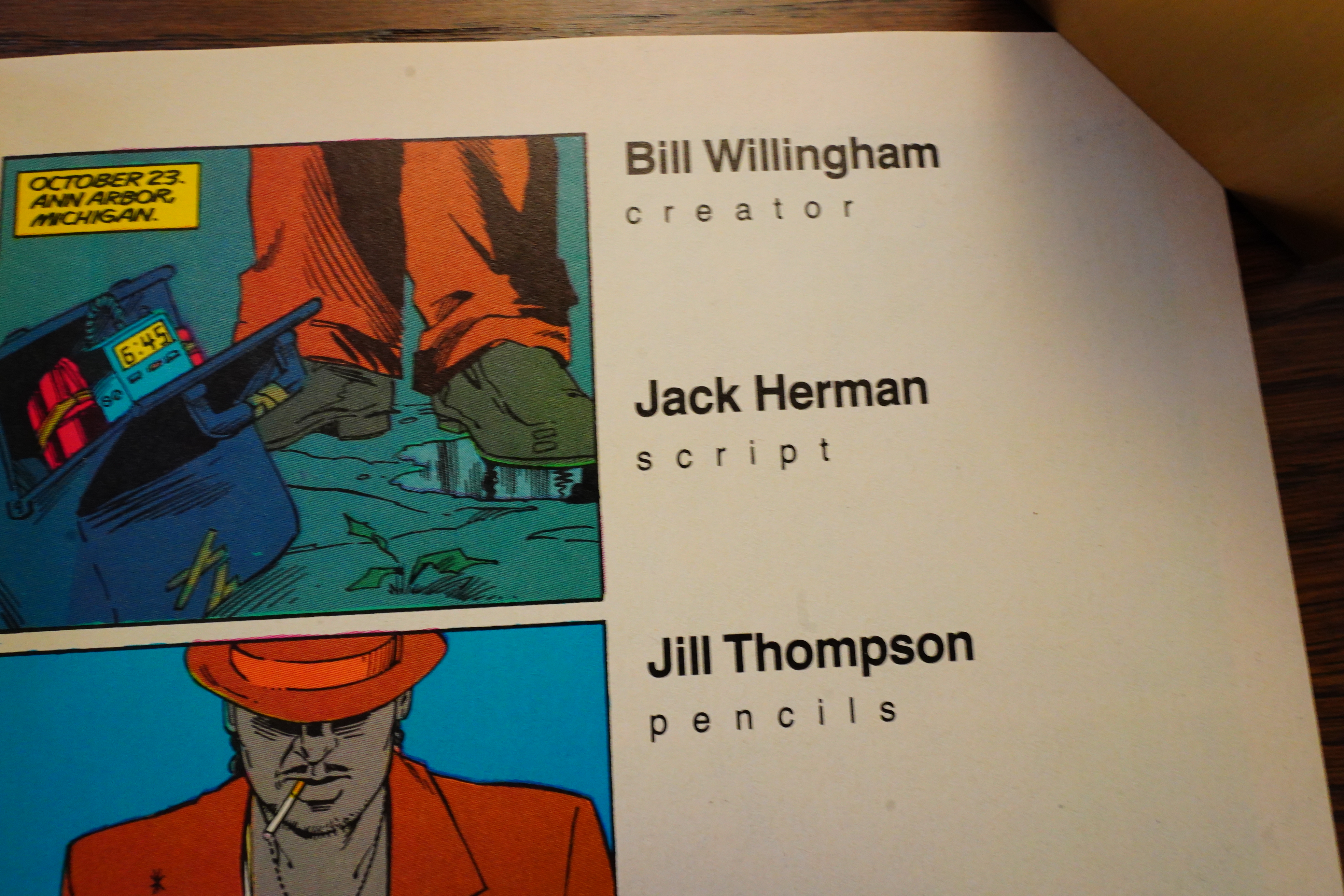
For the last few issues, Willingham is listed as “Creator” instead of “Plot” or something, so I don’t know what that means. Did he stop writing the book?
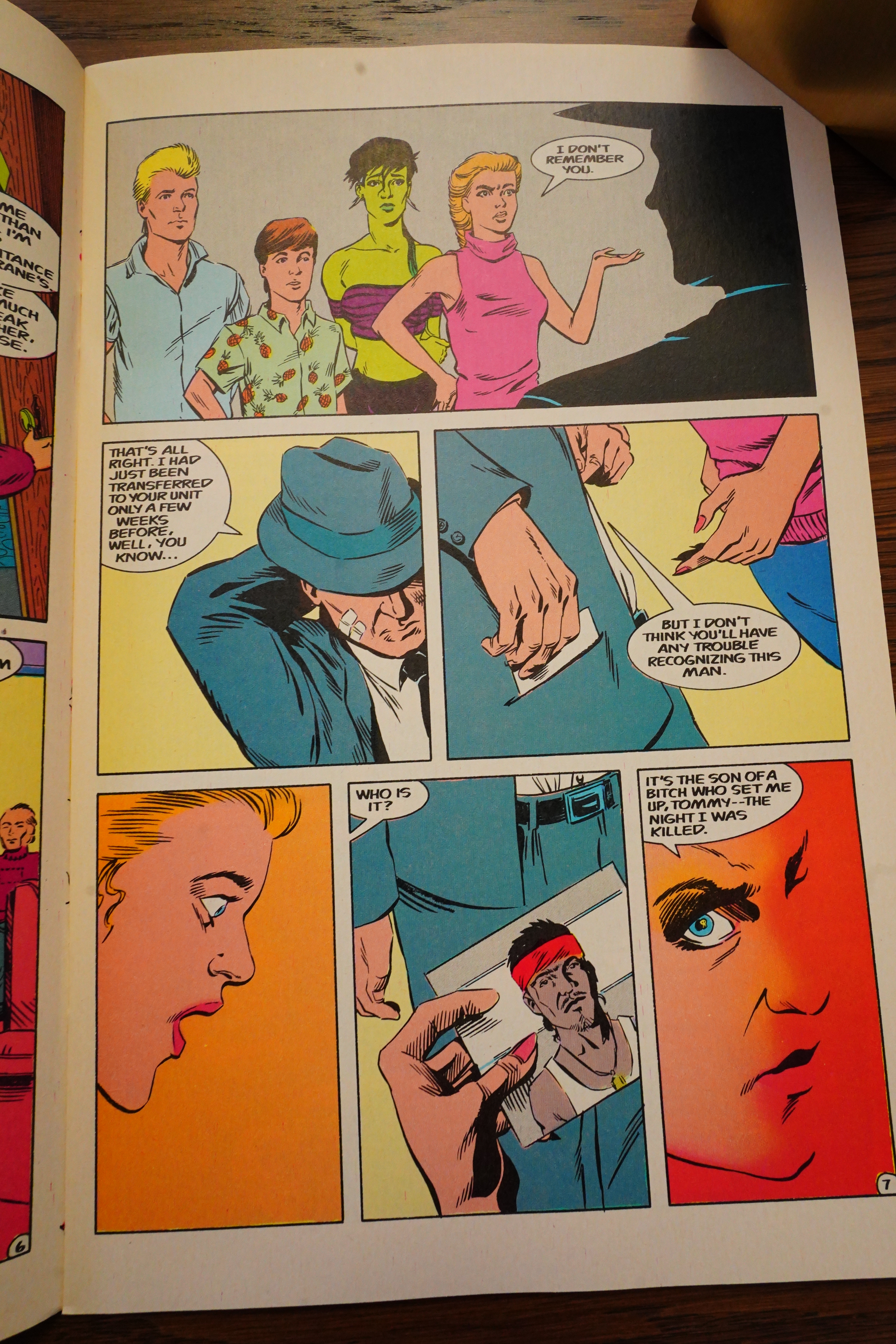
*gasp* Sudden backstory!
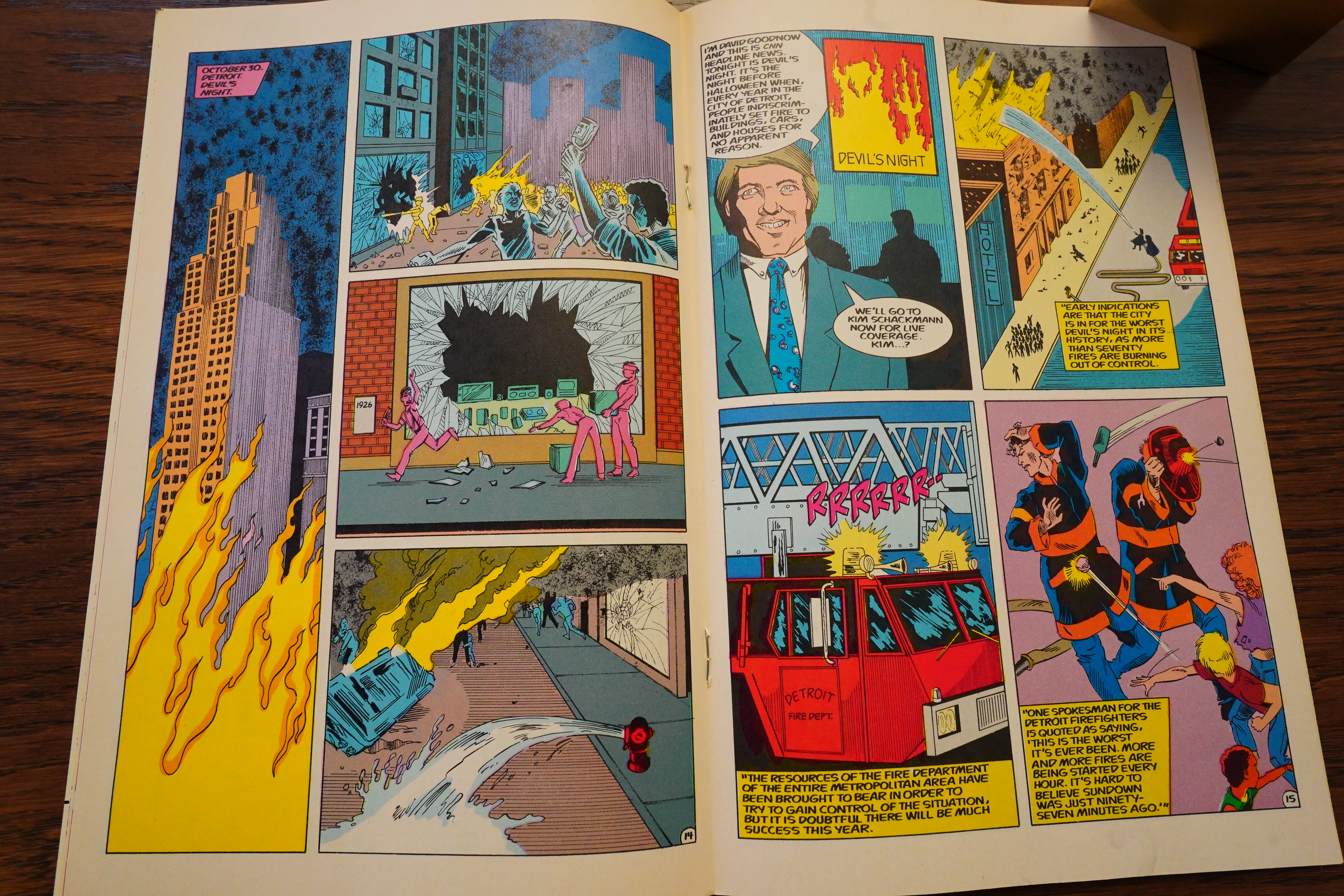
And in this world, Chicago has an annual night where they put everything to fire. Why not.
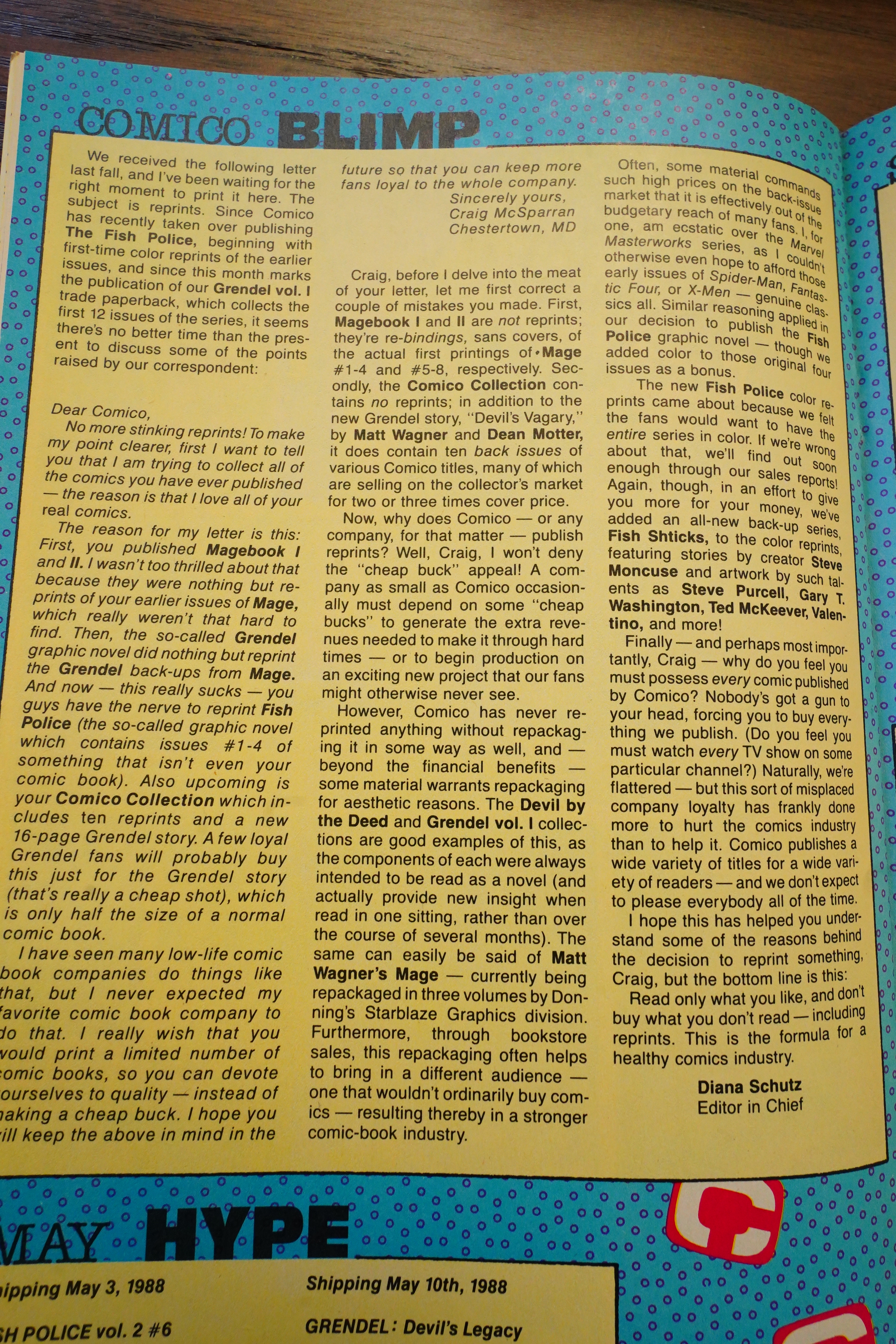
Now that’s a pretty bizarre complaint — a reader writes in to complain about Comico publishing collected editions of some of their comics. Because he collects everything Comico publishes, but he doesn’t want doubles! laughs in twelve variant editions forty years later
But I rather felt his pain while doing the shopping for this blog series. I mean, the gimmick here is to read “everything”, but what does that mean? I drew the line at collected editions, too, so I won’t be reading Magebook etc. And that hurts my CDO (that’s kinda like OCD, but with the letters in the correct order).
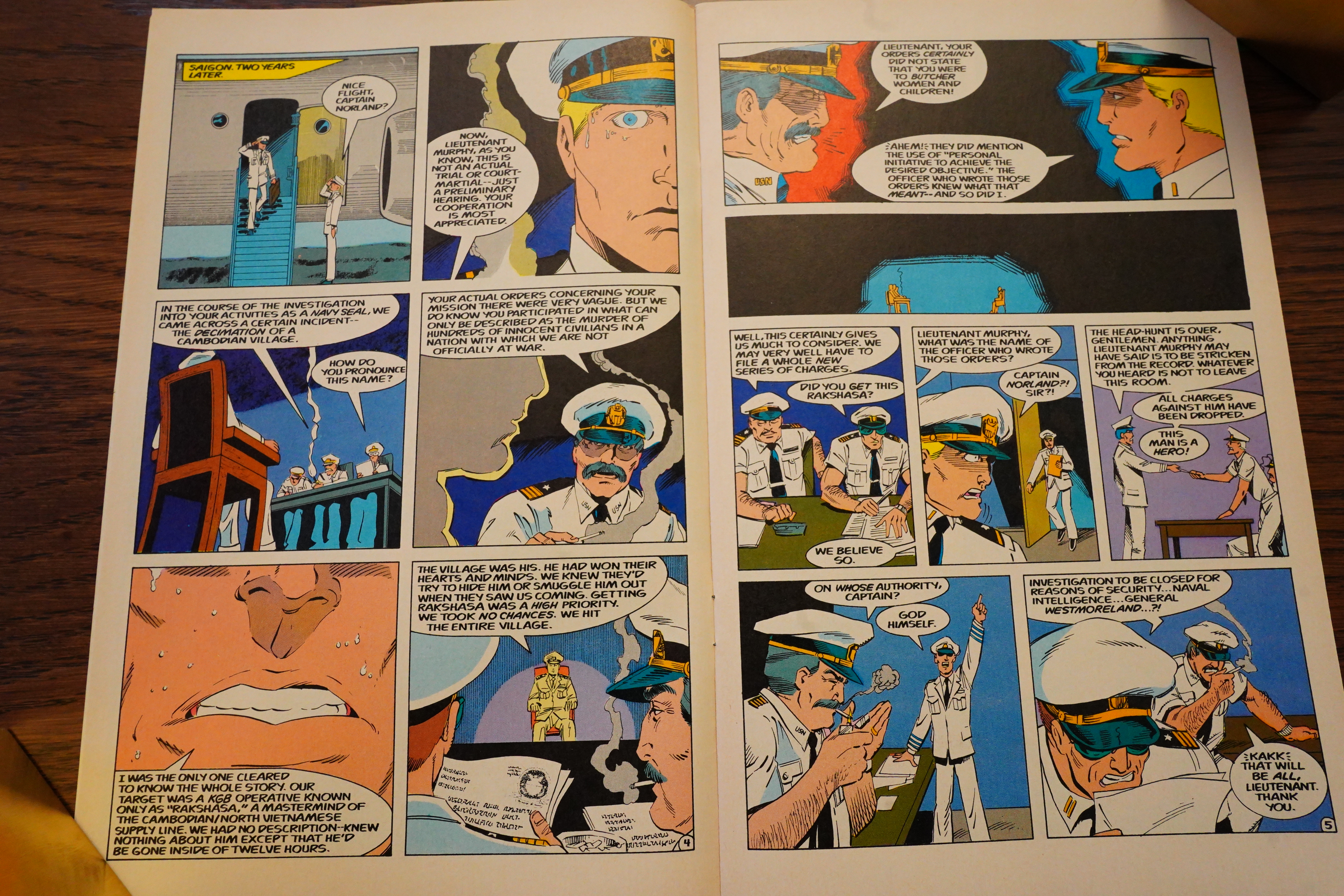
We finally learn something about the blond-haired one’s background… Er… Yeah, Vortex? He’s a Vietnam vet, and he apparently slaughtered an entire Cambodian village (children and all) because he’d been told there was a Russian agent there. Sure! The ironic twist is that he then learns (after this meeting) that the village had ejected the Russian agent before he arrived, so he killed an entire innocent village! Those children were innocent after all! Oh the irony!
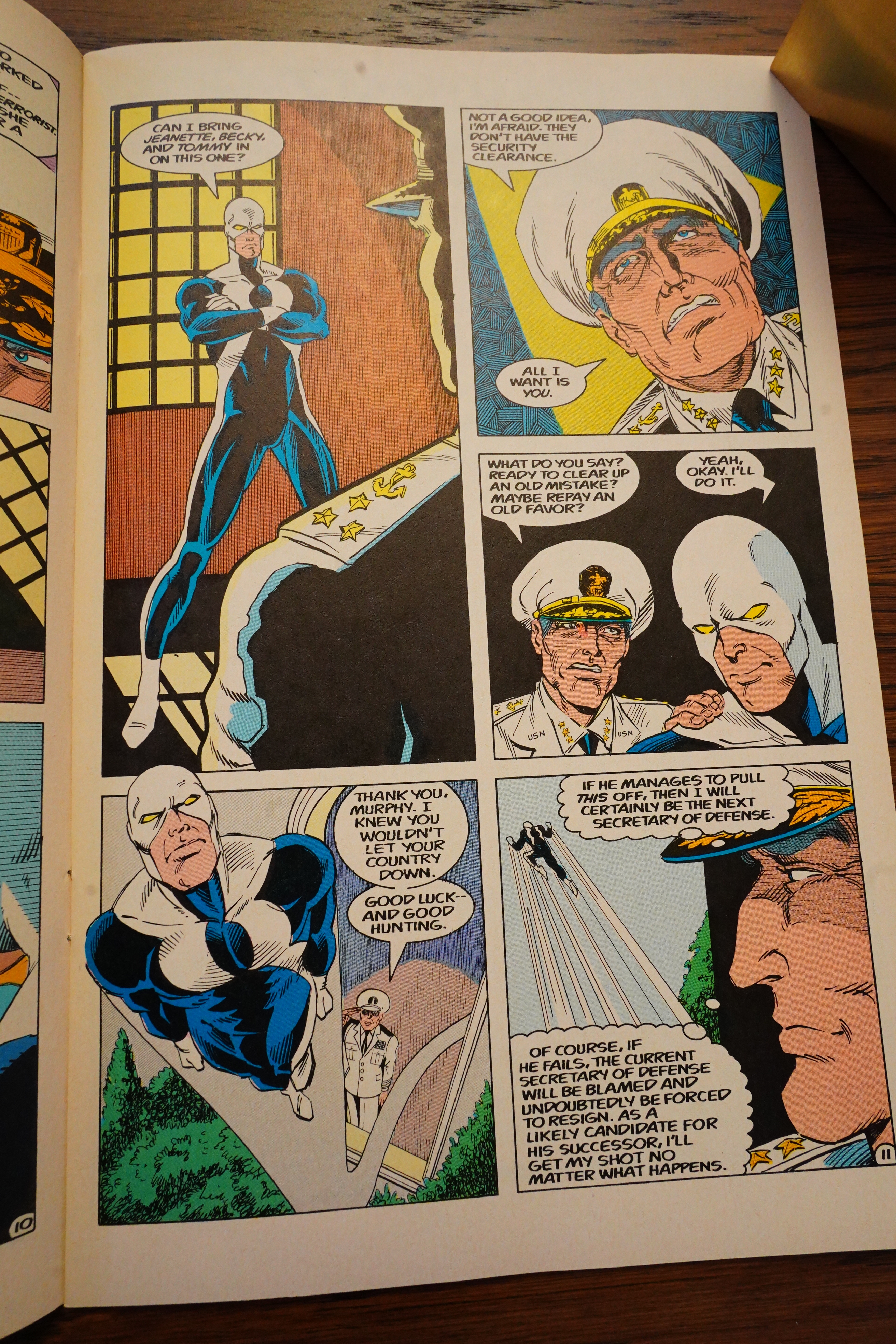
The military is dastardly as always.
Yeah!
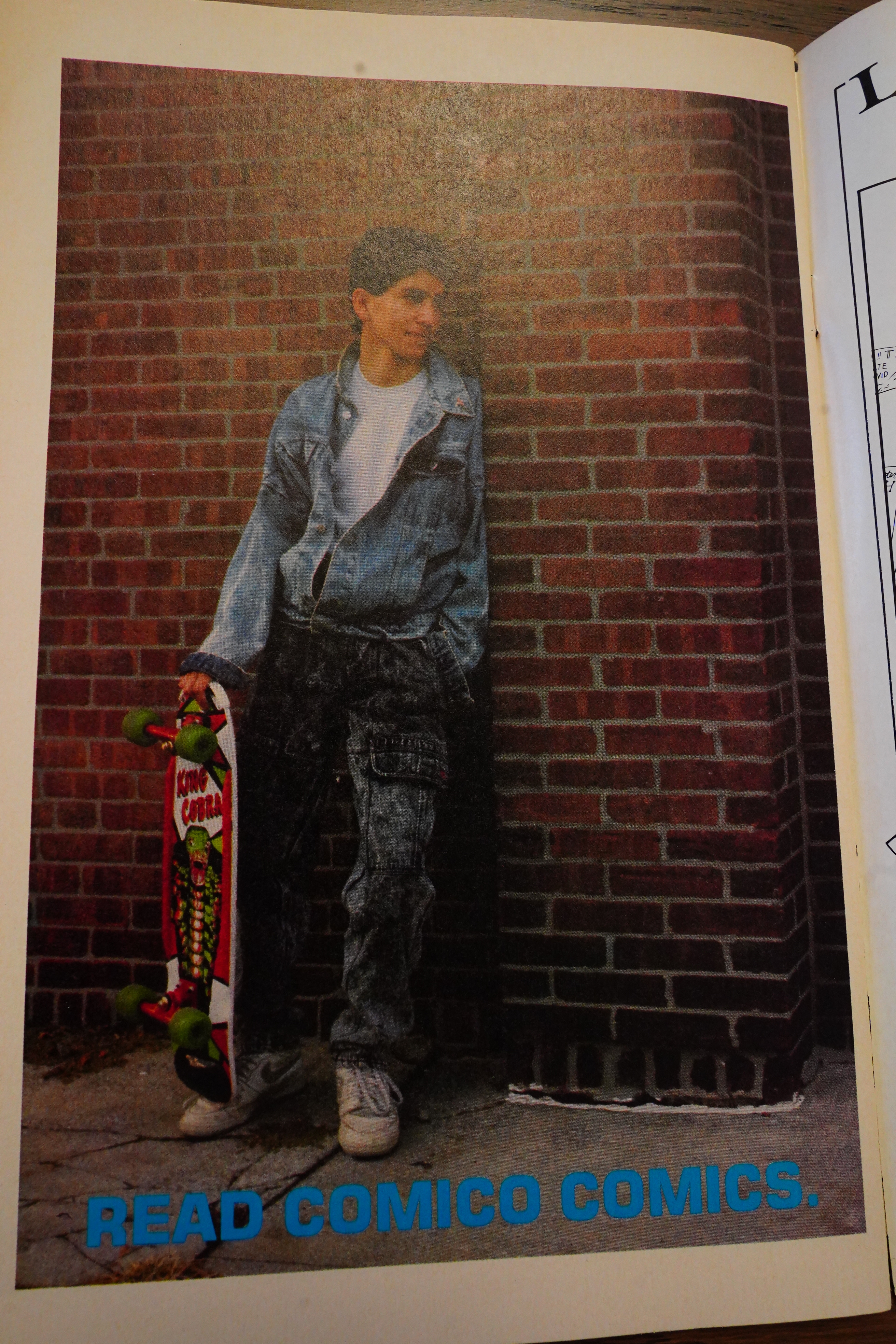
Heh heh…
They return to the old theme of it’s-hard-to-be-a-famous-super-hero, this time partly from the point-of-view of a girl who’s got a crush on Monolith.
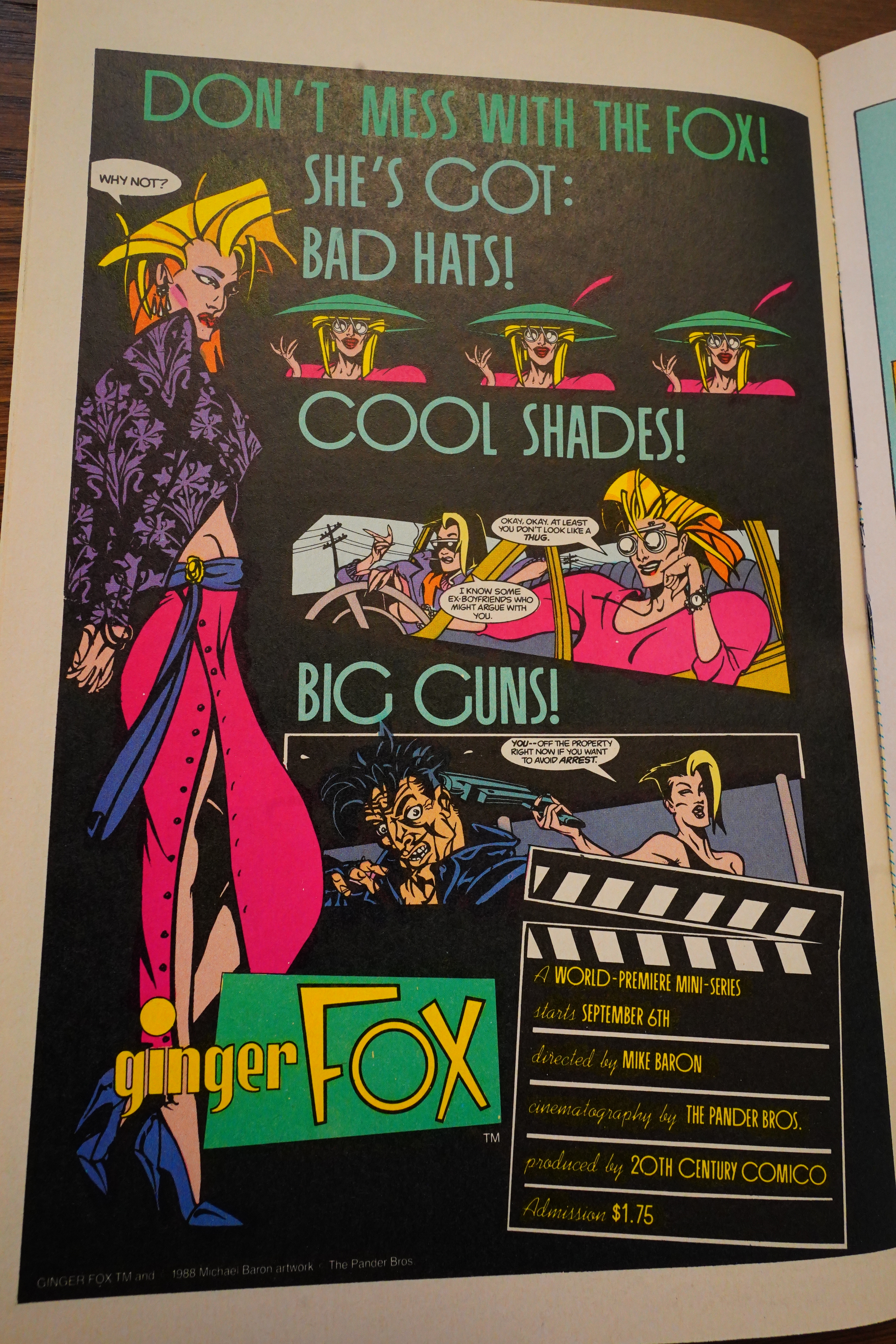
Hey! That book sounds fun… I’ll be reading it later…
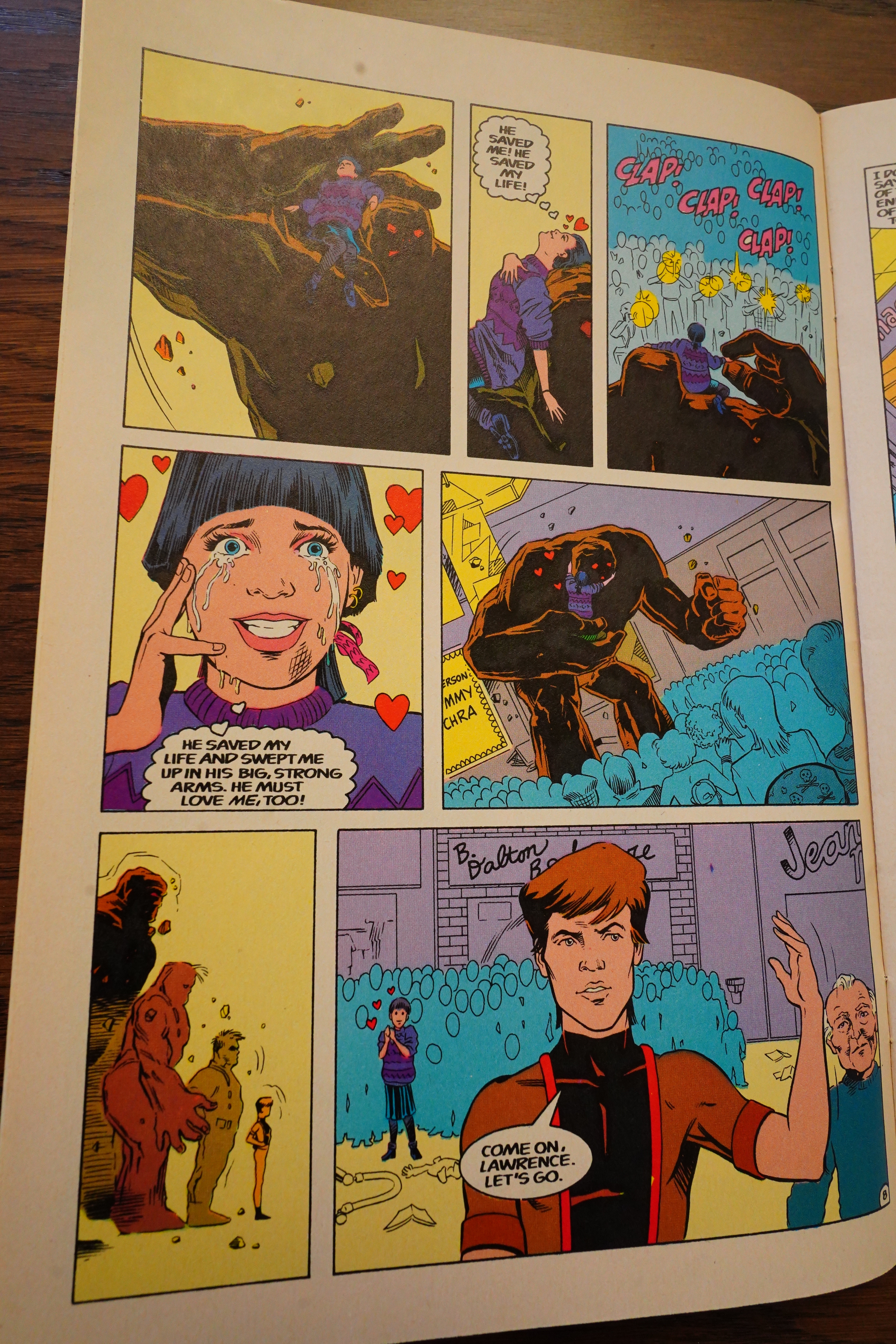
Oh yeah, the plot — she goes to Seattle to find Monolith, and she’s then immediately kidnapped by child pornographers… and then saved by Monolith after apparently having been abused. So above’s the immediate aftermath.
It’s like…
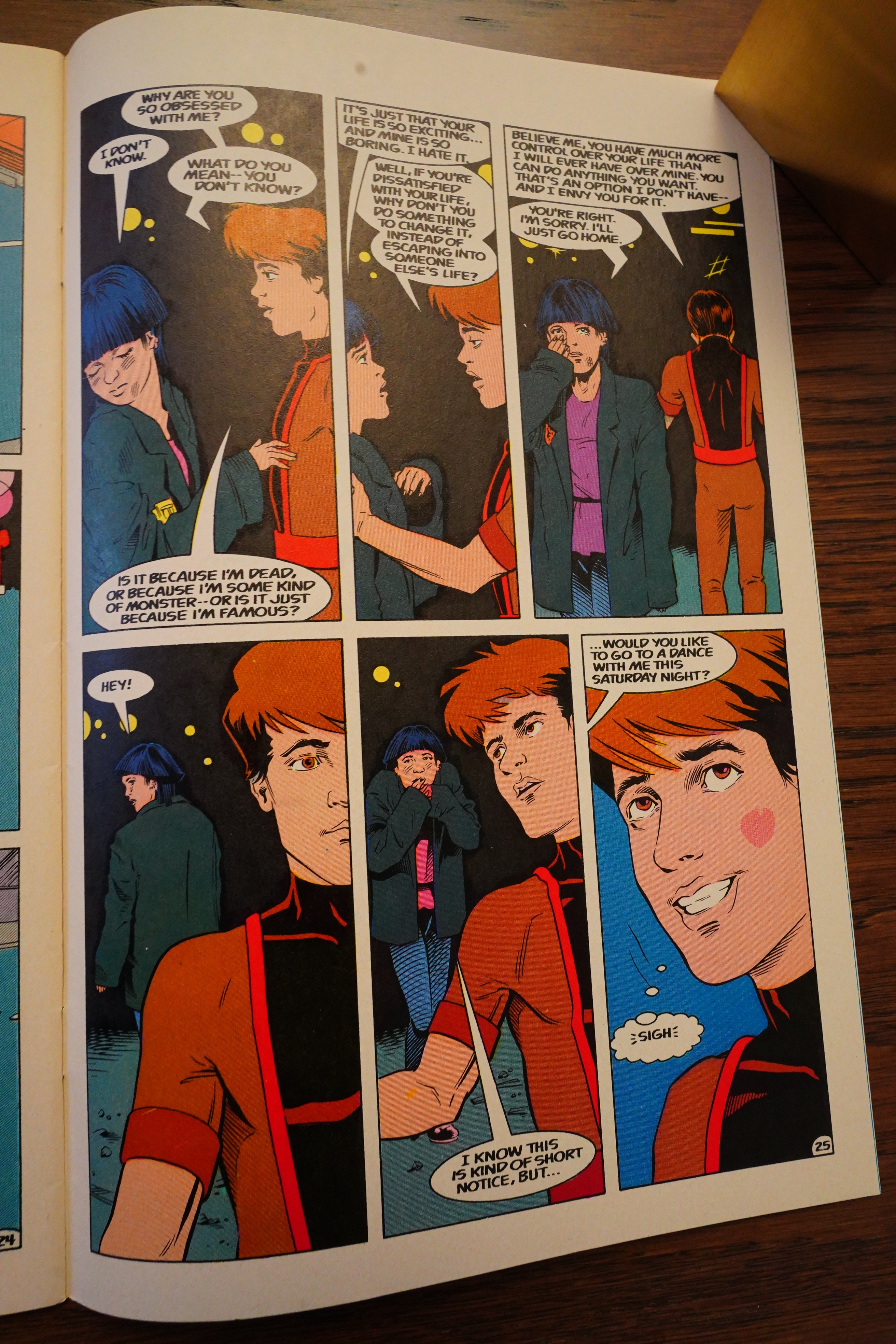
As meet-cutes go, that’s not a very cute one.
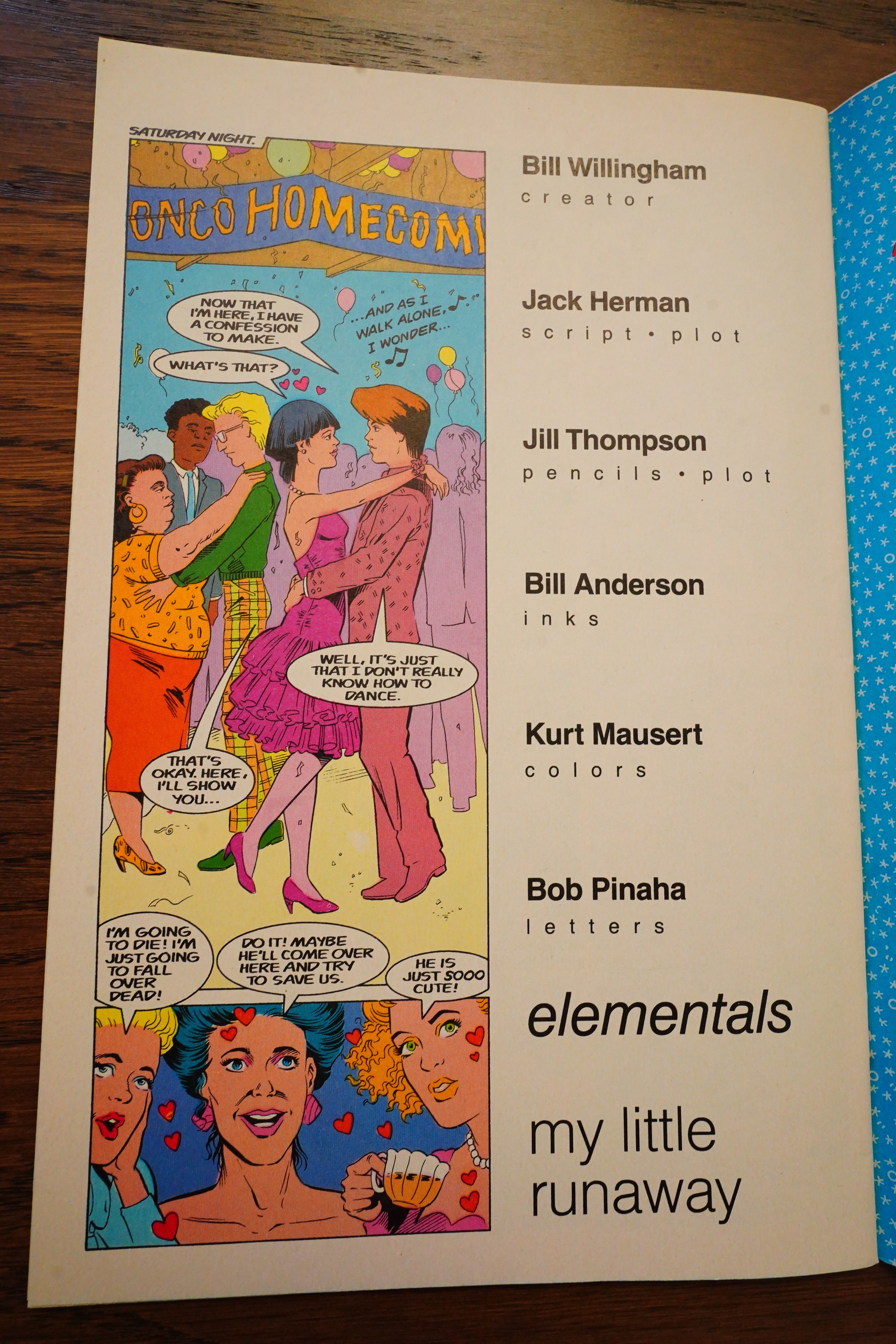
But apparently Willingham isn’t to blame for this one — Jack Herman is apparently solely responsible for writing this one?
Oh, and Willingham stopped doing any of the art several issues ago.
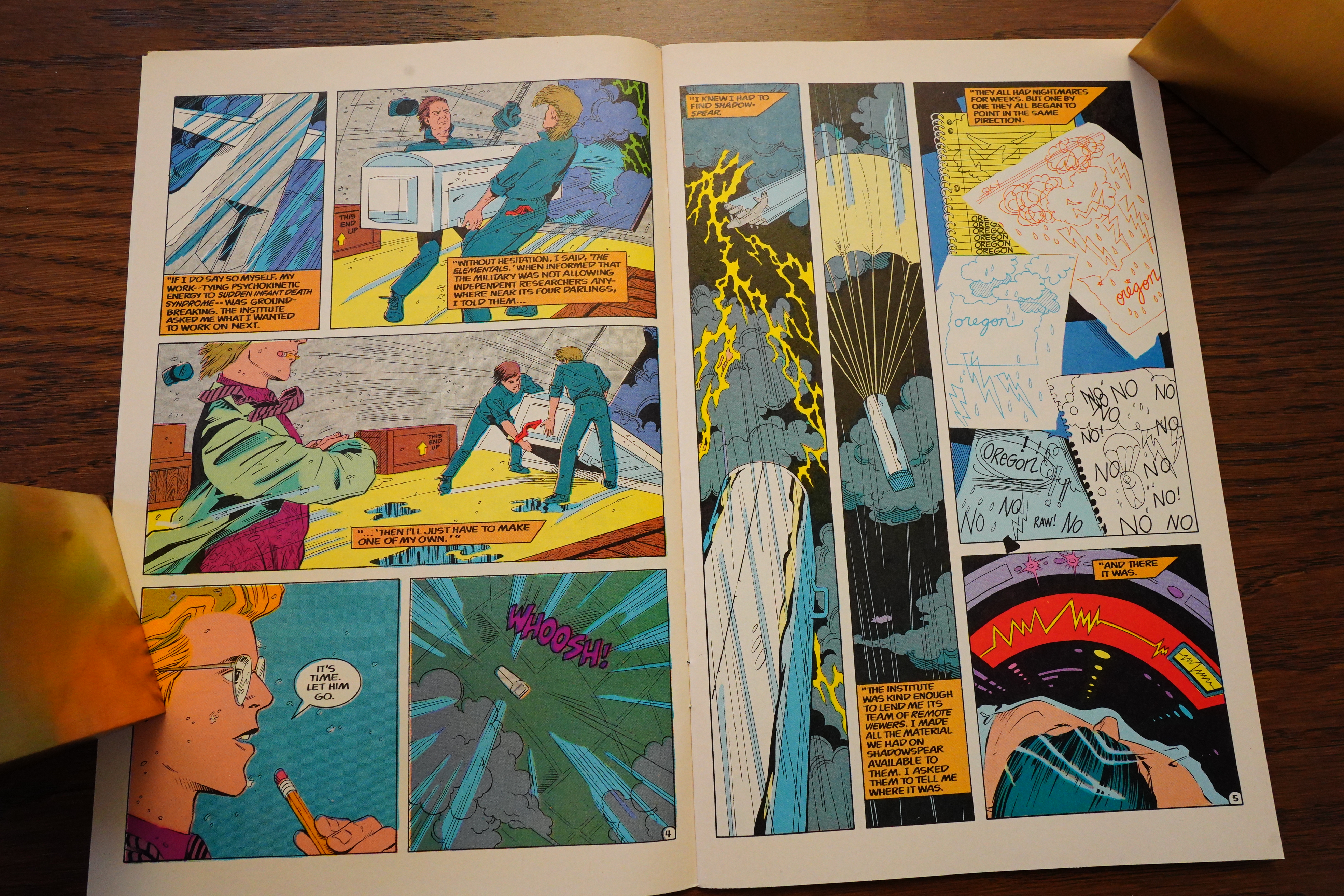
For the final two issues, we’re introduced (nooo!) to another conspiracy that’s trying to create their own elementals to do experiments with.
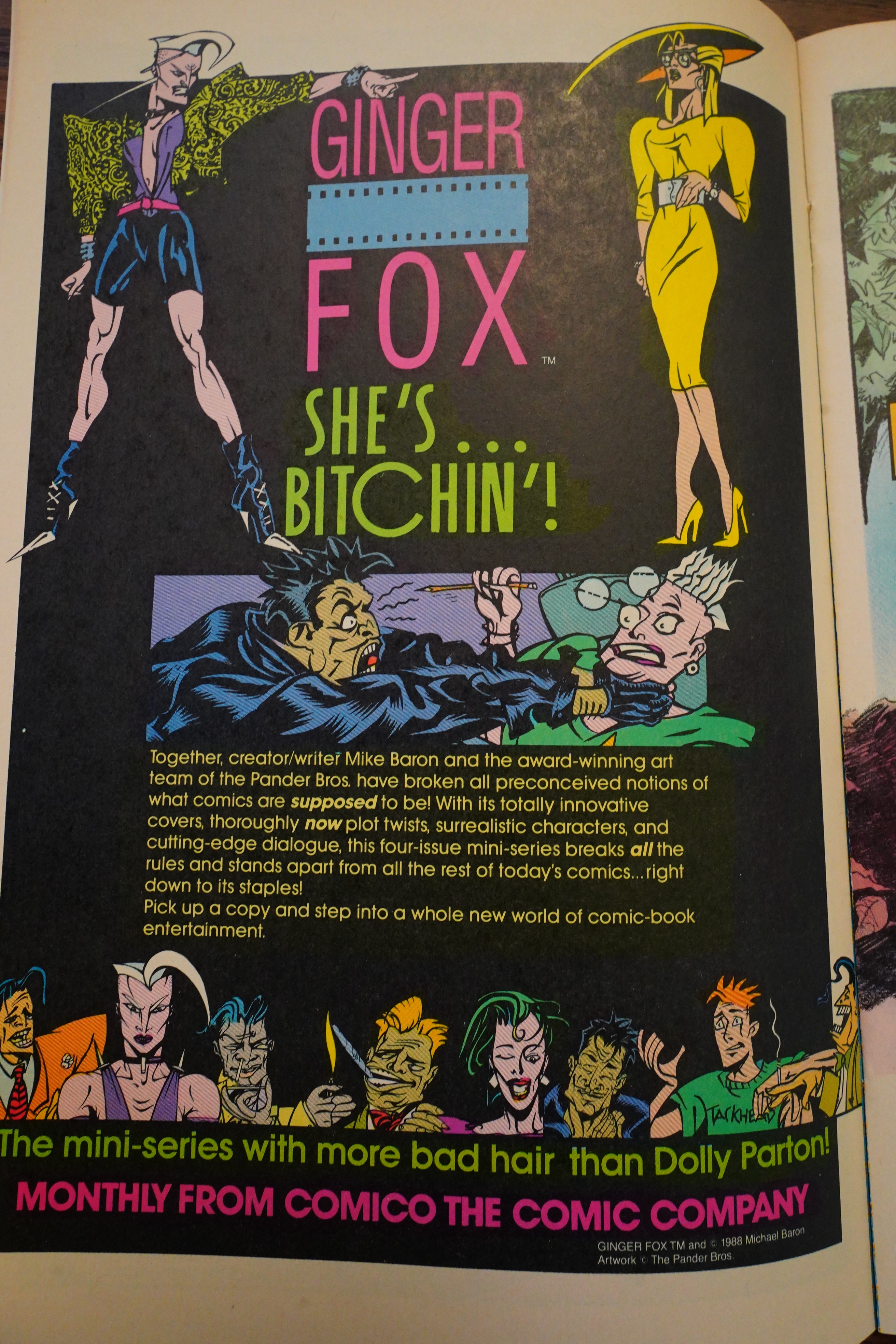
It breaks all the rules! Now I really want to read it.
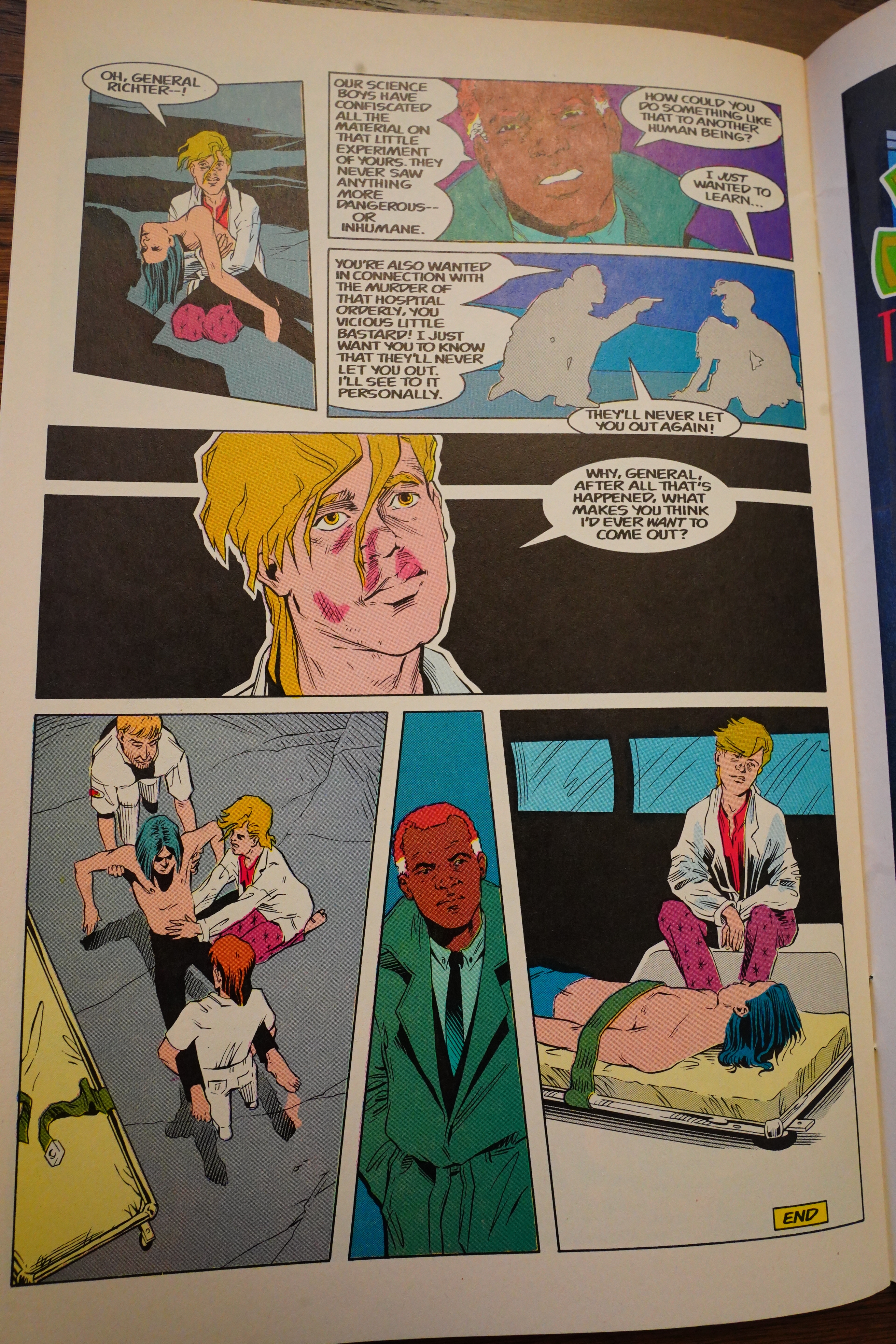
And this is how Elementals (volume 1) ends — no announcement that it’s ending or nothing. Just “End”.
So I wondered whether this meant that Willingham was leaving or something, but according to comics.org, he continues on. So I don’t know why they renumbered — perhaps they just wanted a new #1? I guess I’ll find out (perhaps) when I get there, but it’ll be a while.
Perhaps all the unresolved stuff in this series will be dealt with in volume two? I have no idea, but if you take this series separately, I feel some vindication for my scepticism throughout the series: So many conspiracies were introduced, and then none of them (if I counted correctly) had any followup.
Reading this book felt like somebody gaslighting you constantly. I think it’s just due to Willingham not being very good at what he was trying to do, but perhaps volume two will show me that I’m wrong? I’m not really looking forward to reading it, I must say.
But apart from the aneurysm inducing effects, I guess this series isn’t that bad, really? Lots of awkward artwork, sometimes risible storytelling, generally an icky feeling to the proceedings — but I’ve read worse, certainly.
It obviously had to have been a commercial success, considering how many issues of this stuff they would end up publishing. The appeal is rather elusive, though.
OK, what did the critics think?
It was a dark and stormy year for
Elementals. Contractual disagree-
ments between creator Bill Willing-
ham and Comico threatened to end
the series before its first storyline
could conclude. Fortunately for all
concerned, a mutual agreement has
been reached and the book is back
on the stands. Even better, there is
every indication the book will be ap-
pearing on a regular, possibly mon-
thly, basis.
Only three issues appeared over
the course of the past year, but they
were important in defining both the
Elementals and the world they in-
habit. Issue #3 revealed the demonic
source of the evil Lord Saker’s
powers. It also continued to show the
graphically realistic consequences of
violence-which is a trademark of
the book and the cause of some
controversy.
Issue #4 carried the “heroes in cap-
tivity” motif to its logical, yet seldom
seen, conclusion, as the Elementals
were held captive on Saker’s island
for a full year. A source of possible
new controversy appeared, in the
form of religious undertones. While
never explicitly stated, it is obvious
that Saker had been restored to life
by Jesus Christ, whom Saker consid-
ered to be an egomaniacal charlatan.
This issue also did the old Batman
stories one better by presenting the
most unusual and amusing escape
trick I’ve ever seen-in which Fathom
literally flushed herself to freedom
down a convenient toilet.
The climax to the “Natural Order”
story came in issue #5. Fathom again
took the spotlight, rescuing her
fellow Elementals with a giant tidal
wave that killed scores of Saker’s
mercenaries. Even as one plotline
ended, the threads of several more
were dangled before us.
There are some observers of the
comics scene who probably feel that
no book featuring super-heroes is en-
titled to be in any Top Ten. While I-
too am desirous of greater diversity
in comics, I feel that to simply
dismiss the entire super-hero genre
displays a snobbery that is every bit
as intolerant as that shown by those
who refuse to read anything that
doesn’t have a costumed character in
it.
Willingham is at least attempting
to tackle superheroics from a diffe-
rent angle, and take it in diverse
directions. I think that, for the most
part, he succeeds. I also agree with
his philosophy regarding the depic-
tion of violence. All of its deadly con-
sequences should be shown, rather
than glossed over. If we truly feel the
horror of death, perhaps we’ll final-
ly develop a respect for life.
Even with only three issues, Ele-
mentals is worthy of a spot in the Top
Ten, and if it truly succeeds in main-
taining a regular schedule I believe
it will become an enormous success
for Comico-possibly the rock on
which that company can grow and
flourish.
Well, it’s heartening to see R. A. Jones put Elementals on his top ten list of 1985 — I’ve never agreed with any of his reviews, I think?
ELEMENTALS #5
When last we saw the Elementals,
the heroine known as Fathom had
executed one of the most unusual
escapes ever seen. Now she returns,
in an equally unique manner.
Melding with the ocean and form-
ing a tsunami-a giant tidal wave-
she sweeps over Nacht Island, the
hideout of the evil Saker, where her
teammates are still held captive.
In the ensuing chaos, the other
heros make their individual bids for
freedom. Their villainous counter-
parts, the Destroyers, stand in their
way. Quarter is neither asked nor
given. In the island’s central tower,
Saker unleashes the rampant energy
cloud known as Shadow-Spear. He
has no time to savor his actions,
however, for he is then attacked by
the Elemental called Vortex.
The battle ends when Saker is
snatched by a demon he had inad-
vertently unleashed, and is pulled
into a dimensional netherworld.
Navy jets sweep over the island, cap-
ping off the victory. The story here
is ending, but-in the dark skies
above the island and in the dank tun-
nels beneath it-new stories are
beginning.
After a hiatus of several months,
1985 Bill Willingham
Elementals creator Bill Willingham
is back with a vengeance, bolstered
by a new contract and a restored
sense of enthusiasm. The story here
has some rough edges that may be
reflective of his extended absence.
Some scenes are simply not shown-
Fathom’s defeat of the Electrocu-
tioner, for example. Others are not
fully developed, and therefore not
fully understandable. The demon
that grabs Saker seems to come from
left field, its appearance as unex-
plained as it is unexpected (though
part of my disorientation here may
come from the long passage of time
since I read the last issue).
No, the storytelling just sucked.
By and large, though, Willingham
delivers a rousing finale to this multi-
part epic. He presents the dark side
of superheroics; people bleed and
die. (Remember those charming but
unbelievable days when superpow-
ered free-for-alls always convenient-
ly took place in neighborhoods that
were “due to be torn down anyway,”
and therefore deserted?)
Willingham gets strong support
from his writer, Jack Herman. The
script is lean and tight. In fact, it may
be too lean in spots; a little more
exposition may have shed much
needed light on the aforementioned
scenes that were left in the dark. This
is a minor complaint, offset by the
generally fine dialogue. The best
example of this comes when Rat-
man, standing in the path of the on-
coming tidal wave, says only “Becky!
You came back!” before a wall of
water engulfs him.
Likewise, Willingham’s art is of
high caliber. It is marred slightly by
occasional illustrations that seem
somewhat lacking in detail, but these
are the exception rather than the rule.
He seems to be at his strongest in the
application of shading, producing art
that is as impressive in black-and-
white as it is when it is fully colored.
Having Elementals back is good
news indeed. The book captured the
attention of fandom when the first
issue hit the stands. That attention
has been diminished somehwat by
the strip’s erratic schedule. When it
did appear, it brought with it an
added dimension of its depiction of
the superhero that is the staple of the
industry.
All parties concerned now seem
confident that the book will appear
on a regular, consistent basis. If this
proves to be the case, I feel certain
that Comico will have a bonafide hit
on its hands. If you have not yet
sampled Elementals, I heartily rec-
ommend that you do so now.
That’s R. A. Jones again…
Gene Phillips in The Comics Journal #116, page #56:
Bill Willingham’s Elementals
uses the dream-sequence concept
to better effect. Issue #12 journeys
through the mind of Tommy
(Monolith) Czuchra, a fifteen-year-
old whose dreams detail the abuses
he suffered at the hands of his
father, his ambiguous relationships
to the other Elementals, and a con-
voluted prophesy by an old enemy,
suggest that in the future the
Elementals may become corrupt
rulers of Earth. I still perceive a
looseness in Willingham’s line-
work, but, with the departure of
inker Rich Rankine, new inker
Keith Wilson gives a greater sense
of tone and weight to bodies and
finer delineation to backgrounds
(pages seven and 13 are particular
knockouts). At this point it’s dif-
ficult to say whether or not Will-
ingham’s cosmic scenario will
touch on any philosophical profun-
dities, but it sure looks nice.
That’s an unexpectedly positive review.
Fantasy Advertiser #87, page #4:
THE ELEMENTALS #1 sold its 50,000 print run within 3
weeks, to put it second only to AMERICAN FLAGG in the
independent comics sales charts. From #2, Rich Rankin
joins creator Bill Willingham as inker, with scripting
chores taken over by Bill; from #3, Bill Willingham is
taking over as letterer, as well.
Wow! 50K copies!
Andy Mangels in Amazing Heroes #137, page #89:
Elementals #23, ‘Mad Gods and
Englishmen’; Bill Willingham,
writer; Jill Thompson, penciller;
Keith Wilson, inker; Comico; $1.50The Elementals has always been one
of my favorite titles, ever since the
Comico guys gave me a free copy of
#1 at the 1984 San Diego Trade Show,
days before it was to hit the stands. It
still remains high on my list, although
it tends to fluctuate more lately.
This issue finds the Elementals in
Canada fighting giant bugs mutated by
the ShadowSpear (When is that plot
device going to end? Yawn.), while on
the moon, Thor watches a broadcast
about them on TV (?). He decides that
they herald the dawning of a new
heroic age, so of course, he must
engage them in battle. He heads for
Earth, engages them in battle, but
when they win, takes his toys and goes
home, leaving the Elementals in a very
precarious position.
A short plot, and a large amount of
the story is spent on fight scenes, but
what has always made the Elementals
so good is the character interaction.
All four of the heroes share something
basic in common (they’re all dead, for
starters), and interact like a family.
They usually realize the basic absur-
dity of the situations they face. For
instance, when Monolith figures out
who the man they’re fighting is, he
thinks: “The magic hammer, the
strength, the red hair—it’s got to be
him! But the Superman suit—and the
fake English accent? It doesn’t fit. It’s
straight out of a bad comic book!”
It is this self-aware humor that
makes this book so enjoyable. It seems
that the new Justice League Interna-
tional crew took their cues from
Elementals, because the two books are
traditionally so close in tone as to
seem to be by the same creative teams.
Still, Elementals has tackled some
fairly adult issues, and some “mature”
things as well (what do we call sex or
violence since they sometimes aren’t
adult or mature?).
The art this issue is by Jill Thomp-
son, whose work is not anywhere near
the level of regular penciller Bill Will-
ingham, but she manages to convey
the script well. She would do well to
work on her page design, panel lay-
outs, and storytelling though, as many
of the pages are confusing to read. Bill
Willingham’s script is (as usual) good,
with a few rib-nudging fanboy jokes
thrown in. This issue however would
probably not appeal to non-comics
readers as much as diehard super-hero
fans.
Elementals is almost always one of
the more entertaining books around.
It is not a suberb example of the craft,
but it is an enjoyable read. An a no-
risk way to spend $1.50.
What I really want to know is why
they don’t call Thor “Thor” anywhere
in the whole issue. Marvel may have
a copyright on the logo, but you can’t
copyright a myth. That’s why both DC
and Marvel can have a Hercules.
And why does he speak in a British
accent?
Grade: Mint
Fantasy Advertiser #92, page #7:
ELEMENTALS AND EVANGELINE CANCELLED
One of the best-selling of all independent comics,
The Elementals by Bill Willingham, will be cancelled
after #4, and Evangeline by Chuck Dixon and Judith
Hunt ends after #2. In both cases, disputes of unre-
vealed type has been given as the reason, but this
must be considered a very serious blow for Comico.
Hints and rumours suggest that First Comics, whom
Willingham has just joined as new penciller on Amer-
ican Flagg, may well take up the Elementals series,
but this is unconfirmed at present.
This must be about those “production issues” that Willingham was talking about. At one point they announced the cancellation of the series?
“Disputes of unrevealed types” — well, the Evangeline disputes were pretty clear, but I’ve yet to find any details about what problems Elementals had…
The Comics Journal #278, page #81:
DEPPEY: The Elementals also struck me as a
series that was very explicitly not written for
kids, which again, is standard almost today,
but for superhero comics at the time was al-
most unheard of. I mean, I suppose, aside from
the more thoughtful approach to superheroes
in general, there was also the addition of sex,
which … eventually culminated in “Sex Spe-
cials” in the book.
WILLINGHAM: If I’d known that that’s what they
were gonna do with it after I left, I probably
wouldn’t have laid those seeds early on, but
yeah.
DEPPEY: Can I assume then that those Sex Spe-
cials were not your idea?
WILLINGHAM: Well, yes and no. What ended up
being the first Sex Special was actually just
going to be one of the regular issues, I forget
which number it was, but it was just gonna
be put in the numbering along with every-
thing else. And there were people stretch-
ing the boundaries of comics then. I mean,
Chaykin had just come out with his Black
Kiss and stuff that said, “Here’s more things
you can do with comics than just what you’re
getting.” And, you know, that sort of inspires
the rest of us to see where we can go with the
same material. But Comico, when they got it
in, they said, “This is great. We might have to
bag this issue.” I said, “Fine.” But at the same
time, Comico was very visibly going out of
business without mentioning it to us, and the
fellow Andrew Rev, who took over Comico
and started it up again, this thing was already
completed. It was ready to be published,
printed. He was adamant that it not be just
part of the regular series numbering and
made the first Sex Special out of it, which
got some attention. I guess it sold more than
the regular issues, so that decreed that there
would be a second and a third and fourth
and so on. All of which I thought was pretty
ridiculous. It’s almost like they take one ele-
ment of the story, “Oh, it’s sex, so we’re hav-
ing a Sex Special.” And, you know, if there
were others that had, like, the kid Tommy’s
ugly cereal recipe for what he liked to eat in
the morning, it made as much sense to me to
just put that out as the first Elementals Food
Special, because there’s an actual recipe you
can follow in there if you wanted to.
The Comics Journal #103, page #11:
Negotiation, cancellation, and
arbitration have combined to
produce changes in Comico’s
publications. Bill Willingham,
creator of The Elementals, and
Comico have come to terms on a
new contract. Judy Hunt and
Chuck Dixon have won the right
to take Evangeline to a new
publisher, and Roger McKenzie
and Vince Argondezzi’s The Next
Man has been cancelled.
Transmuting contracts:
Publication of Willingham’s
Elementals was suspended after
the fifth issue because
Willingham and his lawyer were
no longer satisfied with the
contract he had signed, and he
wanted it renegotiated. According
to Gary Green, Willingham’s
lawyer, the original contract was
too vague, and it no longer
accurately reflected Willingham’s
currency in the comics market-
place. “The first contract was a
real boilerplate deal,” Green said,
adding that the contract appeared
to be an amalgamation of portions
of contracts that Comico liked.
The attorney also said that the
contract was outdated, because it
treated the high-selling Elementals
as a “speculative” property,
“and we all know that’s no longer
necessary,” as Green put it.
“It’s not necessary for Comico to
patronize Bill any more.’
As far as any dispute over
copyright that existed, Green said
that the only question was
whether Comico was being
vigilant enough in protecting
Willingham’s copyright, such as
timely in filing copyright papers
on Willingham’s behalf with the
Copyright Office. “And, in case
Dave Singer [publisher of the
embattled T.H.U.N.D.E.R.
Agents] is reading this, the
Elementals are not in the public
domain!” he said.
The new contract also gave
Willingham a better percentage of
royalties, although both Green
and Willingham declined to
discuss the actual figures.
Willingham also said that the
contract was not as well-written
as it should have been, calling it
a “cut-and-paste” job. “When it
came to the attention of my
lawyer, he had trouble decipher-
ing it,” he said. “But both
Comico and I were learning to be
businessmen back when it was
written, so it’s understandable.”
Both Green and Willingham
said the new contract is much
more professional, and it specifies
the duties of all the involved
parties much more clearly.
Willingham indicated that items
such as the payment schedule,
royalty reporting, and publishing
frequency were not specific in the
first contract. “But there’s no
room for misinterpretation in the
new contract,” he said.
As to the specifics of the
contract, Willingham, Green, and
Gerry Giovinco, co-publisher of
Comico, all declined comment,
saying that the contract contained
a confidentiality clause that
forbids discussion of figures in
the contract.
The next issue of the Elemen-
tals, issue #5, will be out toward
the end of the year, after a lapse
of nearly a year. Willingham said
he wasn’t working on the book
while negotiations were
proceeding, and it was during
this time that Willingham made his
abortive effort on First Comics’
American Flagg! [See Journal
#102]. Plans for the Elementals is
a bi-monthly frequency through
issue #8, due out around June
1986, and then monthly thereafter.
So they had a contractual dispute that led to Elementals not being published for a year…
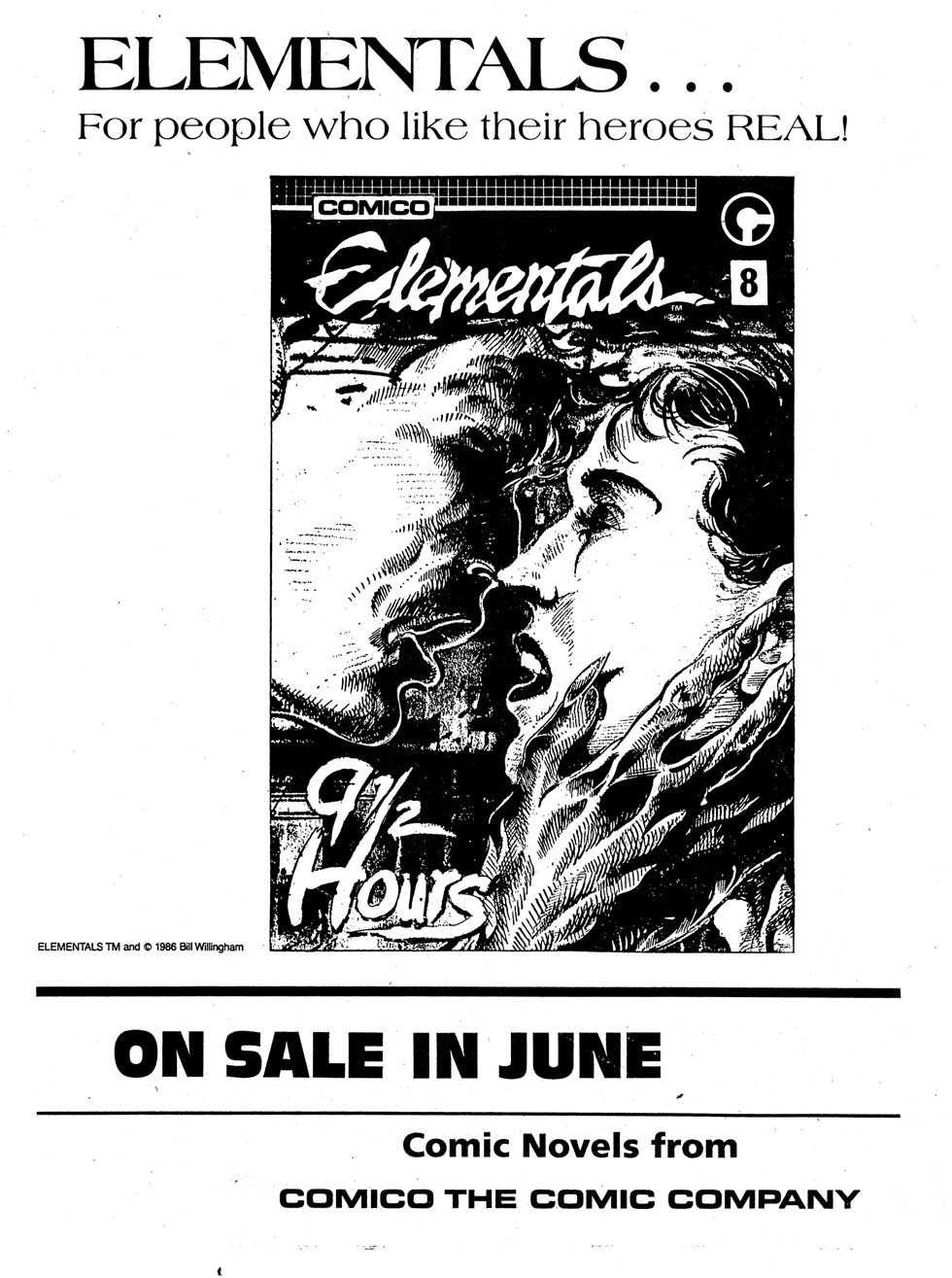
Amazing Heroes #161, page #30:
Bill Willingham’s Elementals. Ask any
seasoned comics fan about it, the gen-
eral consensus will be: “It was a great
series.” Published by Comico, this
series about four people who died and
returned to life with super-powers sur-
prised and impressed people with its
original approach to super-heroes.
In those pre-Watchmen days, the
Elementals lived in a real world where
their actions had real reactions. Most
notable was its graphic presentation of
violence. Bodies broke as buildings
did in those battles between super-
beings, just as we suspected they
should. Luckily, the Elementals could
heal from virtually any injury, given
time.
Readers responded favorably to
Fathom, Monolith, Morningstar and
Vortex and their respective mastery
over water, earth, fire and air. They
were taken by plotter/artist Willing-
ham’s and scripter Jack Herman’s tales
mixing hard-edged supernatural con-
flicts with some serio-comic situa-
tions. Fathom even received a solo
mini-series.
Then something happened. More
and more issues were drawn by guest
artists. Finally, after two rather in-
spired issues, Willingham’s involve-
ment seemed to end altogether. To
make matters worse, those last two
issues initiated a storyline that was
begging to be completed. Meanwhile,
Elementals continued for a few more
months with fill-in quality stories
which disenchanted readers until it
was eventually put on hiatus.What Happened?
Elementals suspended publication be-
cause, according to Willingham, he
and Comico were “kind of on the
outs.” But mostly, it was “just because
I was a little bit burned out on the
Elementals. I was not all that excited
about the book so I was thinking about
ending the contract with Comico” and
cancelling Elementals.
Instead, Willingham explained, he
and Comico discussed Elementals and
other projects and decided Elementals
would continue with Willingham writ-
ing, but not drawing it. Though he
doesn’t consider himself a slow artist,
drawing the comic regularly without
sufficient inspiration took too much
time.Finding A New Team
During the hiatus, Willingham re-
charged his creative batteries and
commenced plans for the new Ele-
mentals. Once the contract for the new
series was signed, a creative team had
to be assembled.
For the art, Willingham made a
short list of talent that he’d like to see
handle his creations. Among his “fan-
tasy choices” were Paul Smith and
Kevin Nowlan. His first “real” choice
was Adam Hughes, who was pegged
for Comico’s detective series, The
Maze Agency, before Willingham
could nab him. His second choice was
an old friend of his, Mike Leeke,
whom he knew when he lived in
Philadelphia.
OK, so that was why Elementals volume 1 ended? Willingham wanted a break? The final issue of v1 was in September 1988, and the first issue of v2 was in March 1989, according to comics.org, so it wasn’t a very long break.
You could easily tell that Willingham had lost interest in the book, though…
Independent publisher Comico the Comic Com-
pany picked up Willingham’s creator-owned
superteam shortly after the Texas Comics debut.
and issued Elementals #1 in 1984. Erratically
released at first, Elementals gamered a loyal fan
base, largely due to Willingham’s provocative cre-
ative voice. As a writer, he stretched with each
installment-over time, he addressed occultism,
child abuse, sexual identity, religious obsession,
immoral ministers, depression, and suicide, all
while delivering well-paced, solidly scripted super-
hero stories. A disciple of folklore, Willingham also
introduced fantasy themes into Elementals, with
storybook and mythological characters appearing,
territory he later continued to cover by writing the
critically acclaimed series Fables (2002-present)
for DC Comics’ Vertigo imprint. As an artist, Willing-
ham matured with each issue, starting as a compe-
tent copycat (while popular Batman and Micronauts
artist Michael Golden’s influence is quite obvious in
his early work, Willingham commands a firm grasp
of storytelling) but blossoming into a remarkably tal-
ented illustrator.
But Willingham came and went, and Elemen-
tals issues written and drawn by others lacked his
magic and verve. In early 1989, Comico devised a
“best of both worlds” scenario to keep Willingham
on the title and publish what had become a strong
seller for the company on a monthly schedule: Ele-
mentals was relaunched with vol. 2 issue #1, with
Willingham scripting and providing cover art, but
with Mike Leeke and Mike Chen on interior art.
(superstar artist Adam Hughes, then an up-and-
comer, guest-penciled Elementals #12). This plan
worked well-until bankruptcy forced Comico to
close its doors in the early 1990s.
Amazing Heroes #159, page #50:
“When is Bill Willingham coming back to do more Elementals
stories?” “When is Comico going to drop those fill-ins and put
continuity back into Elementals?”
Recently, Comico has been deluged with mail asking those
very questions, and, after months of preparation, we’re doing
something to answer them-something exciting!
Bill Willingham is back at the creative helm of comicdom’s
most provocative super-team, now as the writer and cover artist
(and interior artist of occasional Elementals Specials, like Special
#2, now on sale), reintroducing the much lamented issue-to-issue
continuity to the series.
OK, I’m not the only one noticing the lack of continuity…
Back Issue #24, page #83:
Writer/artist Willingham’s stories didn’t shy from
shining the spotlight on televangelistic hypocrisy,
transgenderism, the rewards and penalties of celebrity,
contemplated suicide, and other issues that would still
resonate with today’s reader. Team members fought over
both moral and business matters and they sometimes
worked for the public good, not just because it was the
right thing to do, but for the publicity. Death became
a very real component in the characters’ lives, sometimes
discussed not as something to be avoided, but as an
expeditious way to stop an un-imprisonable enemy.
Not every good deed met with success nor every evil
act met with punishment.
But by issue #23 (Mar. 1988), Willingham lost
interest in the series and stepped away from his creation,
leaving it to writer Jack Herman, who had worked as
intermittent scripter since issue #4, and artists Jill
Thompson and Keith Wilson, who guided the first volume
to its final issue, #29 (Sept. 1988). However, what father
could stay away from his child?
[Editor’s note: Despite numerous contact attempts,
BACK ISSUE could not reach Bill Willingham to procure an
interview for this article. We hope to schedule an interview
with Mr. Willingham in the future, at which time we will
afford the original run of Elementals a closer inspection.]
OK, so Willingham wasn’t involved with any of those issues where he’s listed as “Creator” only? Then things make more sense. But I mean, Jack Herman could have developed some of the plot lines anyway, and Willingham’s own storylines were already really disjointed…
The Comics Journal #102, page #19:
Bill Willingham off American
Flagg! due to missed deadlineBill Willingham, recently hired by
First Comics to pencil American
Flagg!, has been removed from
the book because he missed his
deadline. Because of the deadline
problem, American Flagg! #28
did not come out in September as
it was scheduled, making this the
first shipping date that First
Comics has missed in 179 issues.
Cause and effect: Flagg! #28 was
to be the first issue by the new
team of Chaykin and Willingham,
with Willingham pencilling from
Chaykin’s plot. According to
Willingham, problems started at
the plot stage: the plot was three
weeks late, and First Managing
Editor Mike Gold called him to
ask if he could pencil the entire
book in a week. “By the time I
was asked to take over the book,
someone should have already
been well into pencilling it.
Willingham said. Gold said that
the plot to the issue was late, but
he denied that it was three weeks
late, and would say only that it was
“a little late.” He also denied that he asked Willingham to draw
Flagg #28 in a week, saying that
he only asked Willingham to send
in one-third of the pages in a
week.[…]
Aftermath: Due to the production
snafu, Joe Staton will become the
new penciller on Flagg!,
beginning with issue #28, with
Barta remaining on as inker.
As for Willingham, he is still
negotiating to continue The
Elementals for Comico, and if the
negotiations turn out successfully,
he said he would like to continue
that book at Comico. He added,
though, that on the day he saw
the ad in CBG, he received a call
from Obadiah expressing an
interest in publishing the popular
Elementals. ‘I don’t think I
burned my bridges behind me at
First by being late,” Willingham
said. “But perhaps the bridges
were burned by them in pro-
ducing this fun advertisement.”
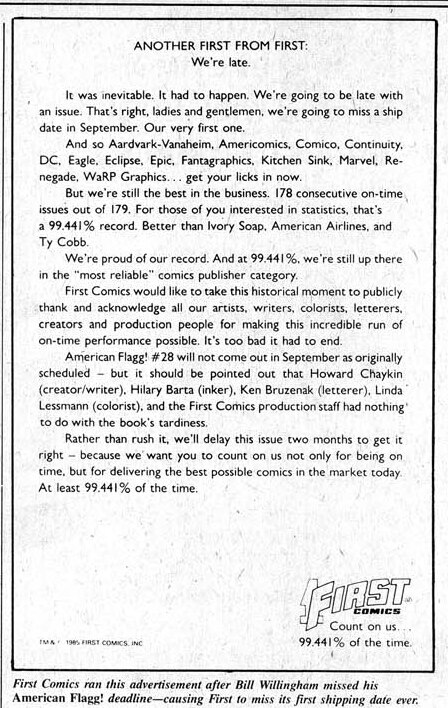
Wow. That’s some ad from First Comics.
SCHOLARSHIPS: Elementals creator BILL
WILLINGHAM and Comico the Company, in
association with the Joe Kubert School of Cartoon
and Graphic Art, have announced that they will
be awarding four annual thousand-dollar
scholarships to students at the school who are in
their second year. Two of the students will receive
the “Elementals Scholarship” based on their
pencilling skills, while two others will receive the
“Comico Sequential Art Scholarship” for their
storytelling skills.
Huh.
Hello? Hello? Anybody still here? Time to wrap this up…
Comico published collected editions of the earliest issues, but the rest have never been reprinted. So while it was commercially successful at the time, there isn’t any great clamouring these days to read these books? I guess it might also have to do with the rights situation — I don’t know who ended up owning it in the end…
Yeah, I’d need a citation for that:
Comico’s publisher, Andrew Rev, purchased the Elementals property from Willingham in the 1990s.[citation needed]
Willingham went on to produce a lot of books — first some porn stuff from Fantagraphics, as previously noted, but then a lot of stuff for DC. He hit the jackpot with Fables in 2002, which ran until recently:
He describes himself as “rabidly pro-Israel” and says that Fables “was intended from the beginning” as a metaphor for the Israeli–Palestinian conflict, although he argues that Fables is not “a political tract. It never will be, but at the same time, it’s not going to shy away from the fact that there are characters who have real moral and ethical centers, and we’re not going to apologize for it.”
[…]
In September 2023, Willingham put his Fables series into the public domain after a dispute with DC Comics over publishing and media rights for Fables. DC has since responded that Fables is wholly owned by them and the company will take appropriate action to protect its intellectual property
I’ve read a couple of Fables collections, but I don’t remember much about them.
OK, before I go, I should do some googling to see whether there’s any reviews out there:
A great series that is, sadly, hardly remembered.
Willingham—who today is probably best known as the writer of Vertigo’s Fables—draws and writes one of the best superhero books of the 1980s. It starts out strong here, and gets even better in the issues that follow (if you can find them.)
Oh, there’s a whole HobbyDrama thing devoted to its history:
As the comic continued, it quickly became clear that Elementals was more a horror story with Superhero elements rather than a traditional Superhero book. It contained scenes of violence and gore that were considered extreme for mainstream comics at the time, layered on top of some rather dark thematic elements. The first was establishing that the only way to get superpowers in the Elementals universe was to die traumatically, a fact that would inform the book going forwards.
[…]
It also introduced more and more magical and supernatural elements, including a council of wizards who aided in the rebirth of Saker as a part of a dark plan. This peaked with the introduction of Avalon, a parallel fantasy world filled with dragons, Elves, griffons, wizards and whatever else. Finally, the Elementals fought Thor, who was introduced as the literal Norse god of thunder.
And then it kind of stopped. Issues 23 to 29 of the first volume were all one-shot filler issues with little to no involvement from Willingham. While there were a bunch of ongoing plots; Saker, Avalon, the Faithful and so on, none of them were ever addressed.
[…]
Elementals survived the bloodbath, having been purchased by Rev. It was relaunched in 1989 with a second volume. Willingham was back at the helm, immediately picking up on many of those hanging plot points. At the same time, the events of issues 23-29 of volume 1 were basically ignored.
Ah, right.
Willingham’s pencils are beautiful, partly because he fills each panel with such detail. His fight scenes, particularly, do a very nice job accommodating all the characters while still managing to convey a sense of fluid motion. The battle scenes in issues #3 and 5 are especially stunning. When Shapeshifter changes into a snake to fight Morningstar, the transformation is almost erotic, due largely to Willingham’s clean lines and style. It’s not groundbreaking art, but he has such a good sense of composition that the art is elevated above standard superhero work. Although it’s detailed, it doesn’t feel cluttered, and his women are attractive while still managing to be anatomically to scale – they’re athletic, which is nice to see.
FINAL RATING: 8.0 (out of a possible 10) There are flaws, but the story is good, different from how fans of a mainstream super-hero comic would expect it to run.
Uhm:
Elementals #9 is a blast from the past that’s still relevant (and influential) today, and it’s easy to see this books’ themes and ideas in the comics of 2012, earning this one a lovely 4.5 out of 5 stars overall.
Yeah, I’m sure everybody doing comics today are using Elementals #9 as their template.
OK, now I’m done!!! What’s next? Eep! Robotech: The Macross Saga, 36 issues. I was aiming for a couple posts per week with this blog series, but it may take longer. Or perhaps there’s less to write about with Robotech, and I’ll have a post whipped up real quick? Stay tuned! If you can bear the excitement!
While it’s generally fine to not get the collected editions for these (Comico did publish a few collections for material from elsewhere- not sure if you’ll do them but we’ll see I guess), you might want the first Elementals collection, since it includes the Justice Machine Annual story.
Glad you’re looking forward to Ginger Fox- that was one of the reasons I suggested Comico, to see what you made of it. Do read the GN though- you won’t be lost without it but it does set up some stuff for the miniseries (that was one of Comico’s big things apparently- lots of miniseries).
Also glad you’re doing the Black Book, considering what it turned out to be (you’ll find out when you get there).
OK, I got the Elementals collection now — I’m curious to see how the series reads in that context.