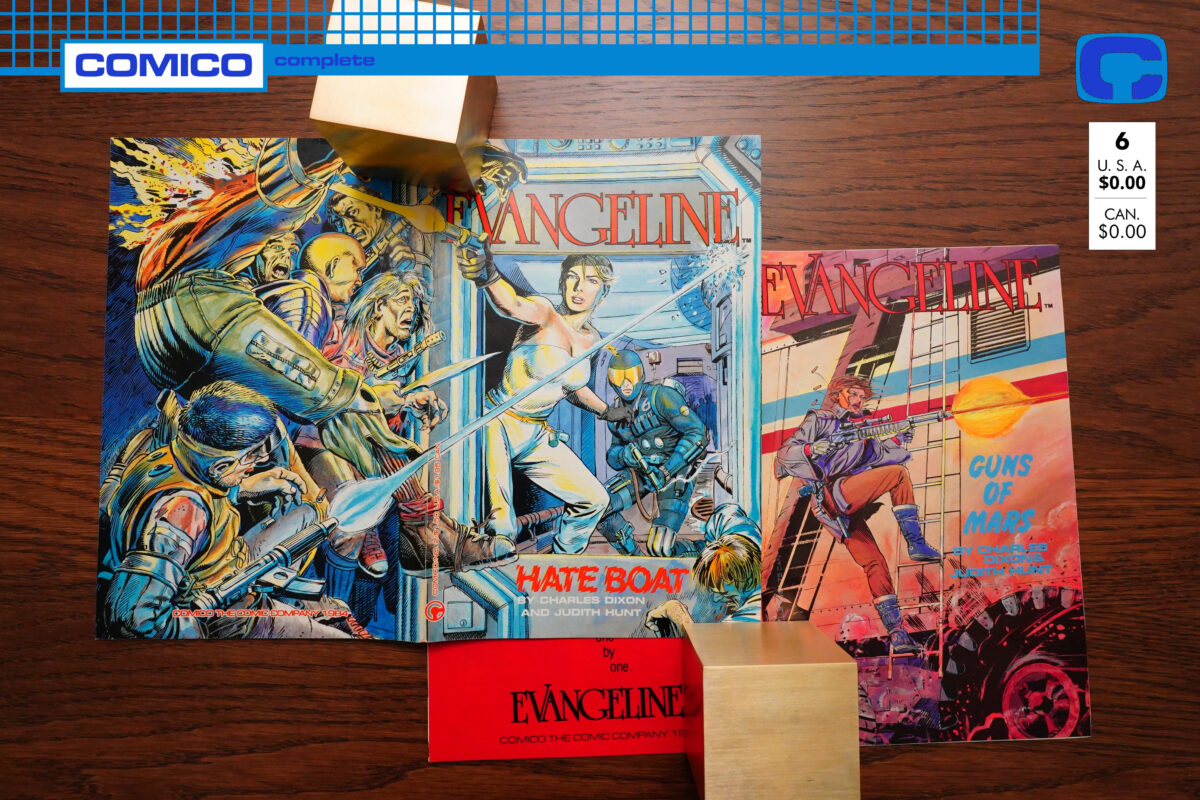
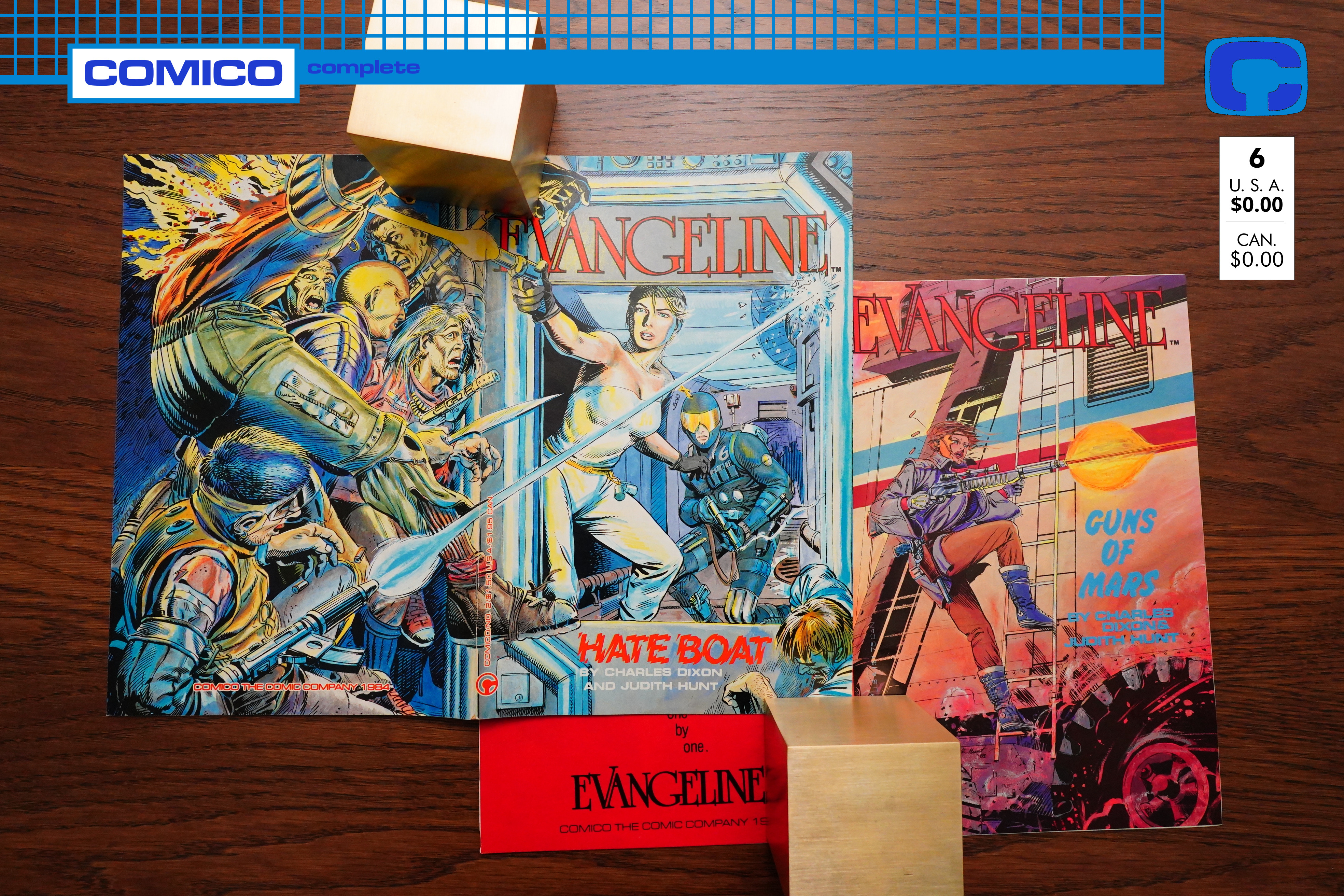
Evangeline (1984) #1-2 by Chuck Dixon, Judith Hunt and Ricardo Villagran
I was quite impressed by the Evangeline story in Primer, so I’m excited to read this book. I vaguely remember this being a book that got a bit of attention back then? And that it was a long-running series (after it moved to other companies)? But I’ve been wrong about that before — there are a few books that bounced from company to company, but never actually amassing a huge number of issues in total… Let’s see:
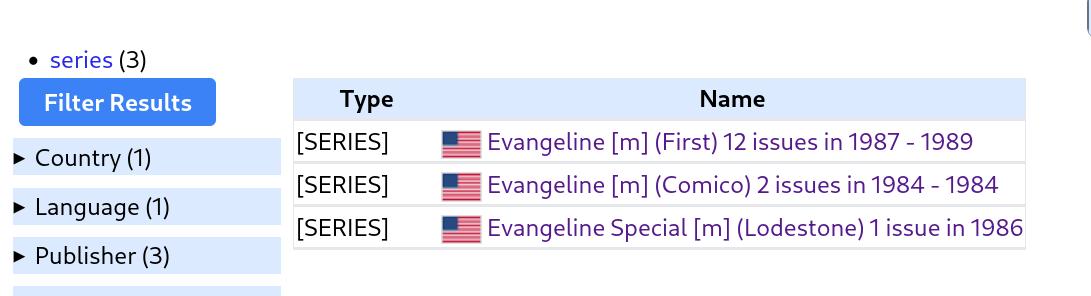
Hey! This is another one of those. Two issues at Comico, one with Lodestone (oh, I’d forgotten that name), and finally twelve with First Comics.
While I’m there… what was the Lodestone story?
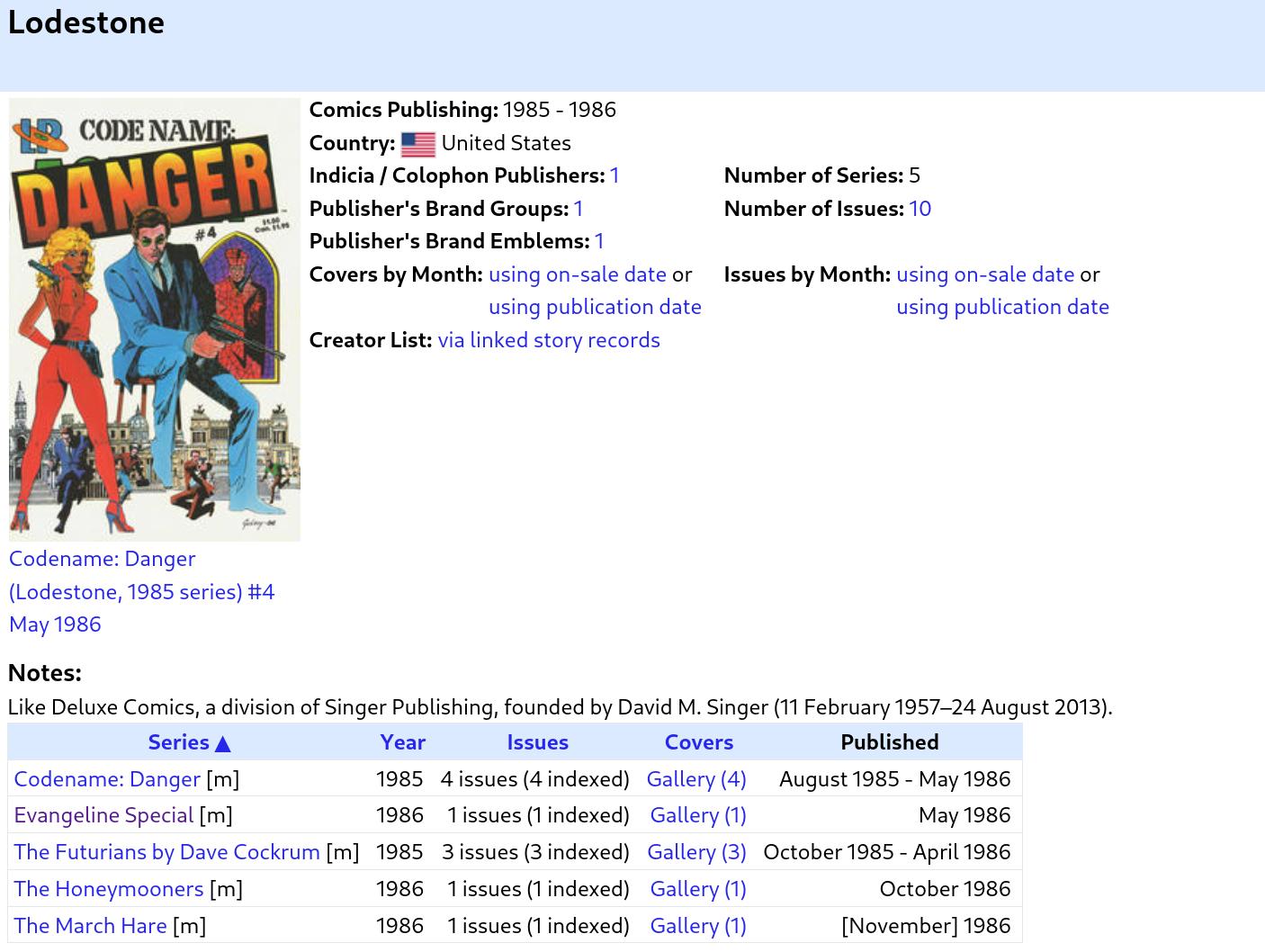
Oh yeah — The March Hare from Loren Fleming and Giffen, and the Futurians by Cockrum. It was one of those companies that went all in from the start, and then crumbled almost immediately.
And before we get started on reading Evangeline — this is Comico’s first colour comic book, and #2 is also the first (I think) that had a wraparound cover (which would become a common Comico design element).
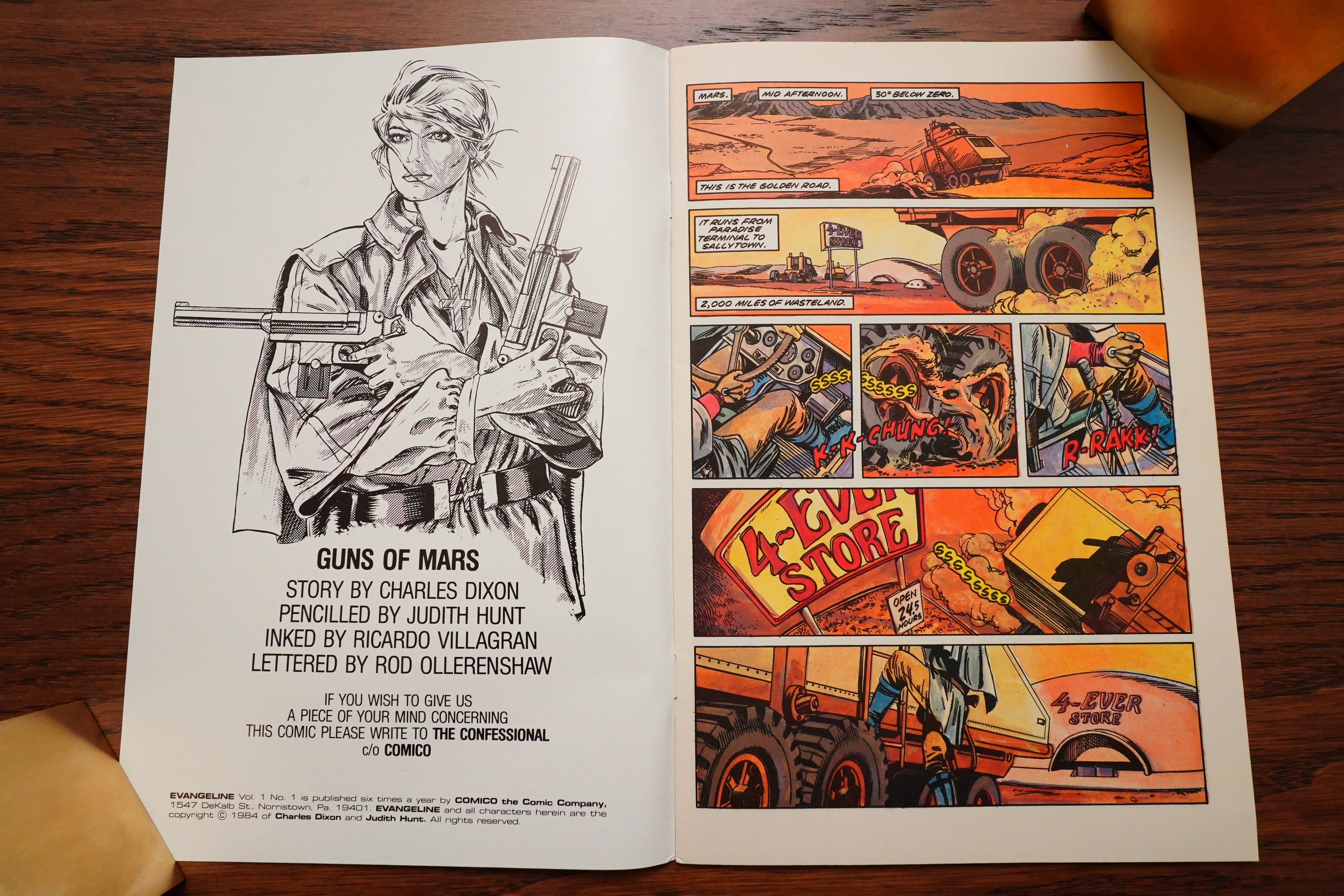
Hey! No editorial from the publishers (fortunately) — the one in the first batch of comics was pretty embarrassing.
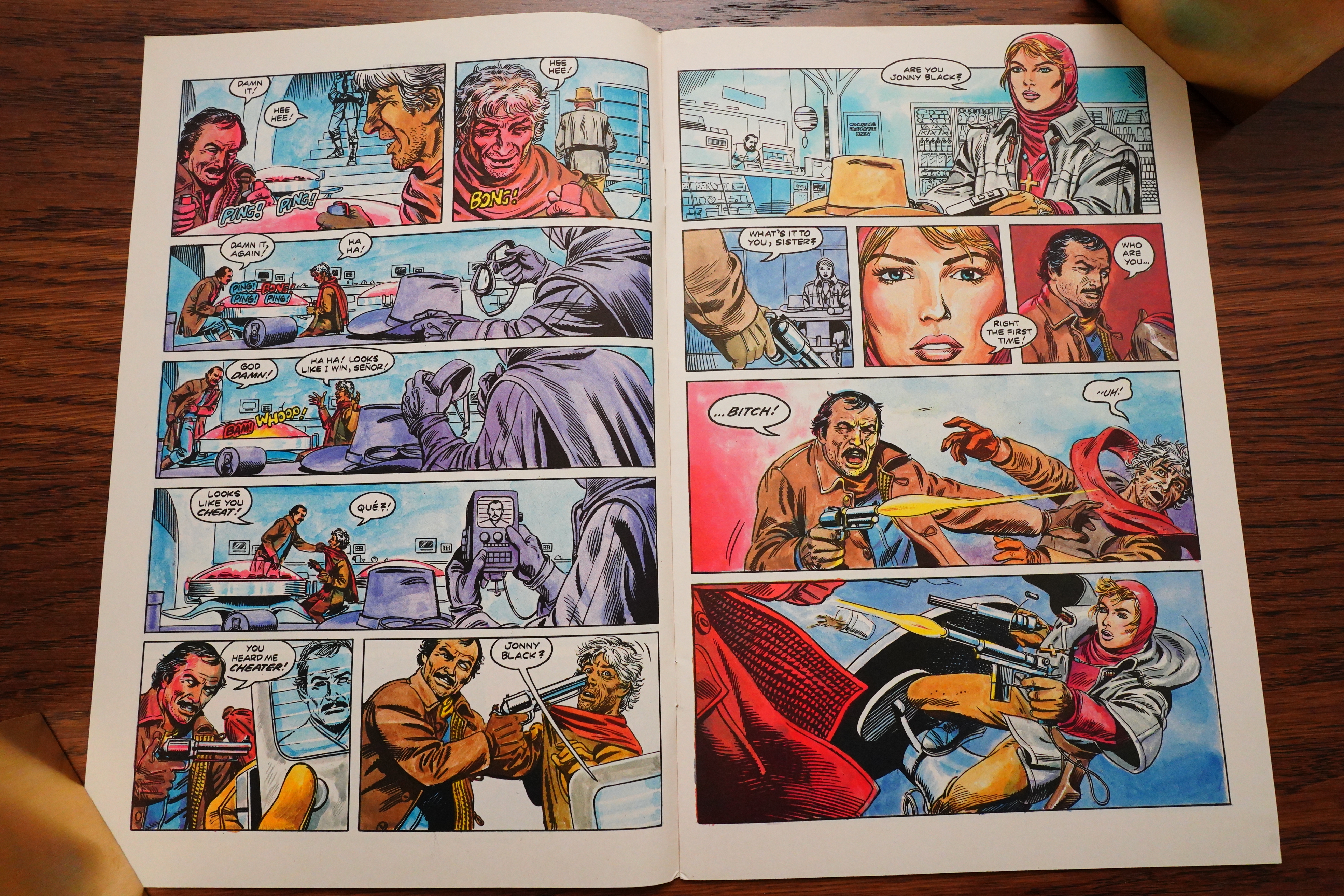
Well, that’s an OK way to start the series, I guess. The story in Primer seemed to say that she was part of the Pope’s secret assassin squad or something, and they’re not rehashing that. But I guess for new readers, the reveal (at the end of the book) that she’s *gasp* a nun might be a surprise.
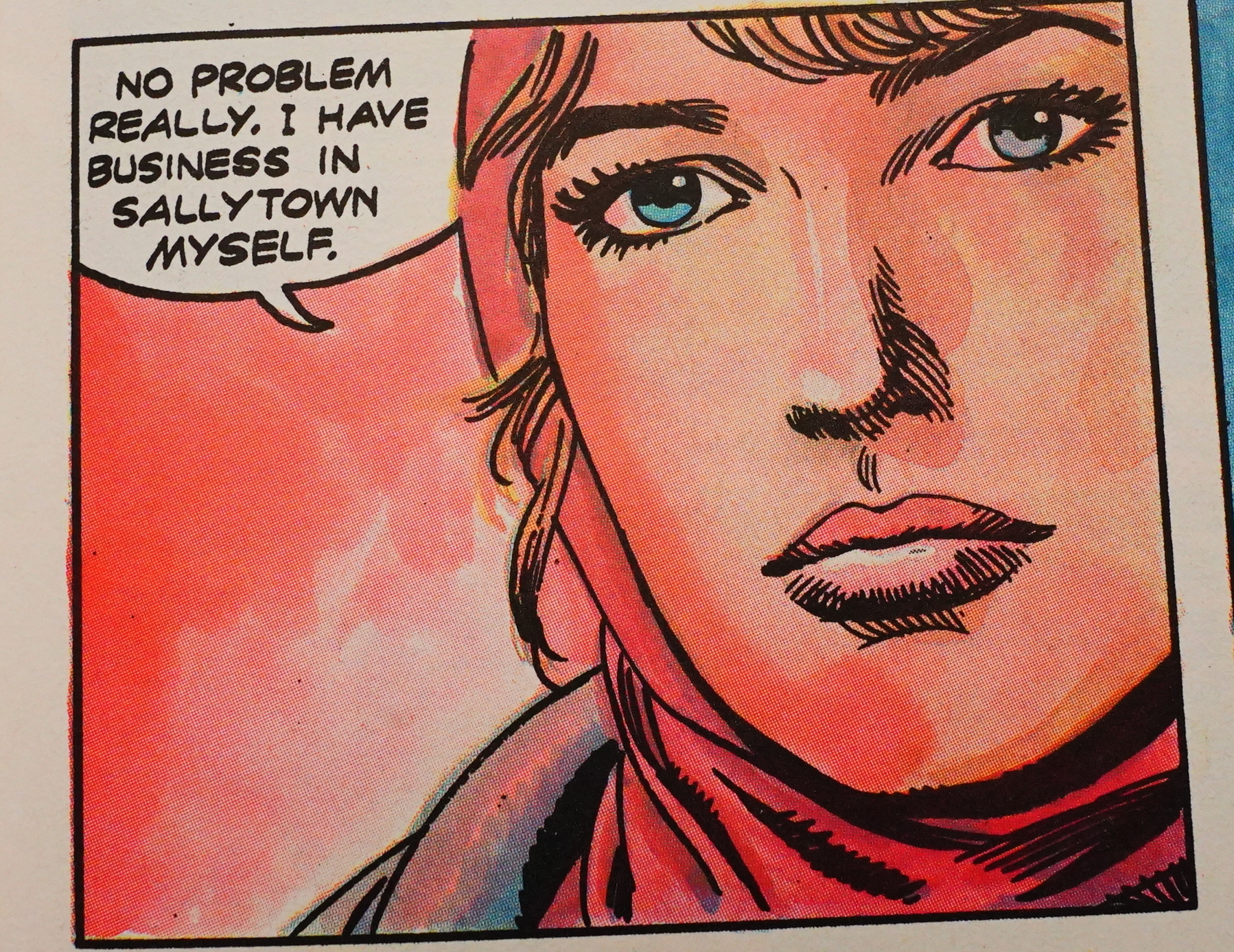
I like the way this is coloured. Back in the early 80s, colouring wasn’t a solved problem, and different companies tried lots of different things. Of course, for offset printing (i.e., glossy magazines) this wasn’t an issue, but that’s not how comics were printed.
Gerry Giovinco has written an in-depth overview of how they did the colouring here, and I find it fascinating. I’ve seen these terms being used before — “grey-line system” and “Fluorographics” — but I’ve never seen anybody actually explain it in detail before:
Initially we would coat a paper stock with the sensitizer, place the film positive on top then cover it with a plate of glass to keep it flat then take it outside to expose it to the sun then run in and develop the image. It didn’t take too many rainy days to convince us to purchase a UV sun lamp so that we could do all of this inside and avoid blowing deadlines.
The only problem with this system was that the paper stock was less stable than the photo paper and would shrink when the paint dried, often distorting the registration.
Matt solved the problem by using pre-stretched watercolor blocks of paper that were sealed on all four sides keeping the top layer “stretched” until it was dried and removed. Matt would buy large enough paper so that four pages could be exposed at once. He usually had two blocks set up so that while one block dried, he could be working on the other.
Go on, read the whole thing — I’ll wait for you here.
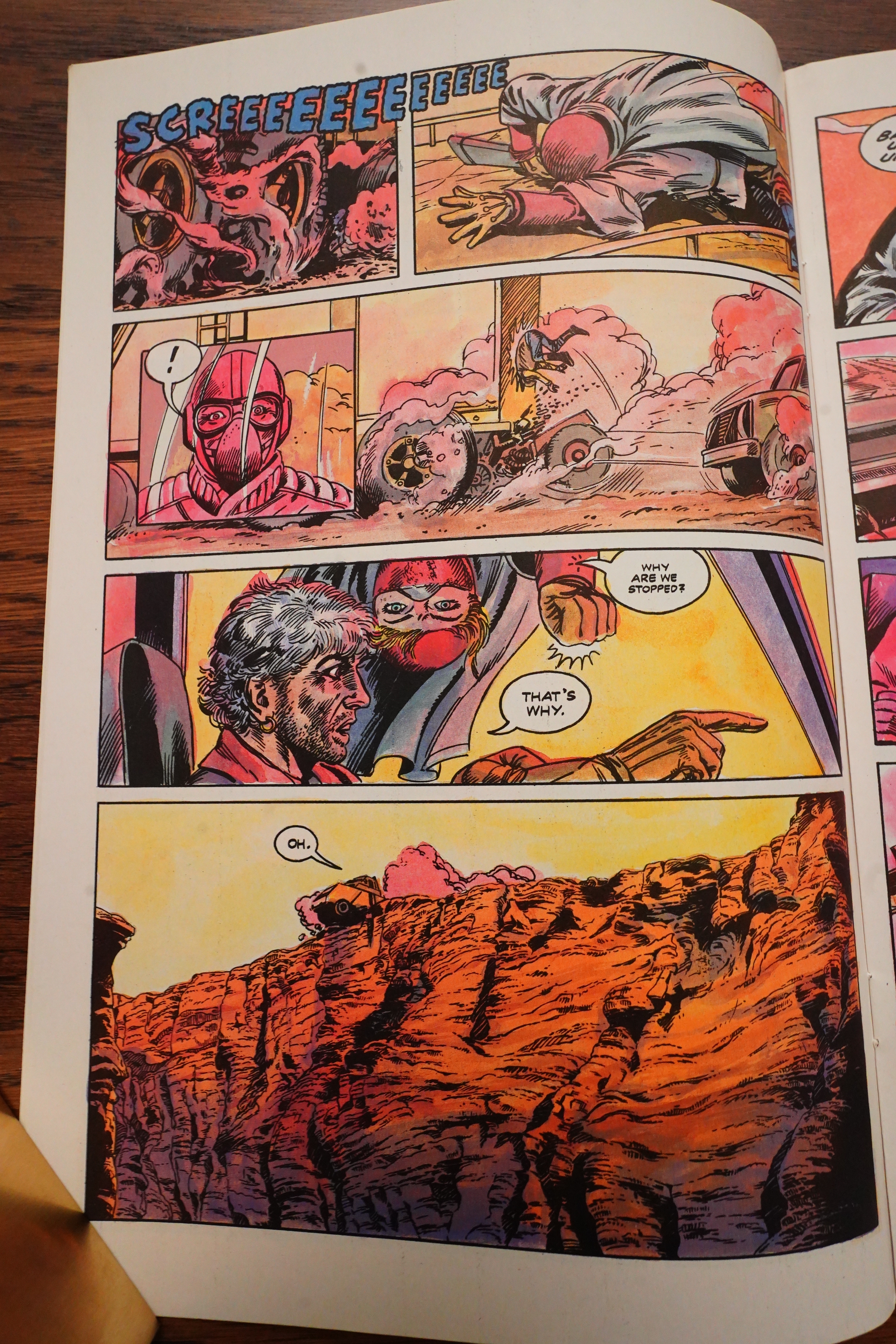
Back? OK, I’m not as impressed with these issues as I was with the original short story. Hunt’s artwork (inked by Villagran) is more than adequate, but the storytelling chops aren’t quite there. On the above page, the guy hits the brakes hard, and Evangeline is on the outside of the truck, being followed by another guy: It’s a familiar action scene. But determining what’s happening relies more on you knowing what’s going to happen than being able to read it from the page.
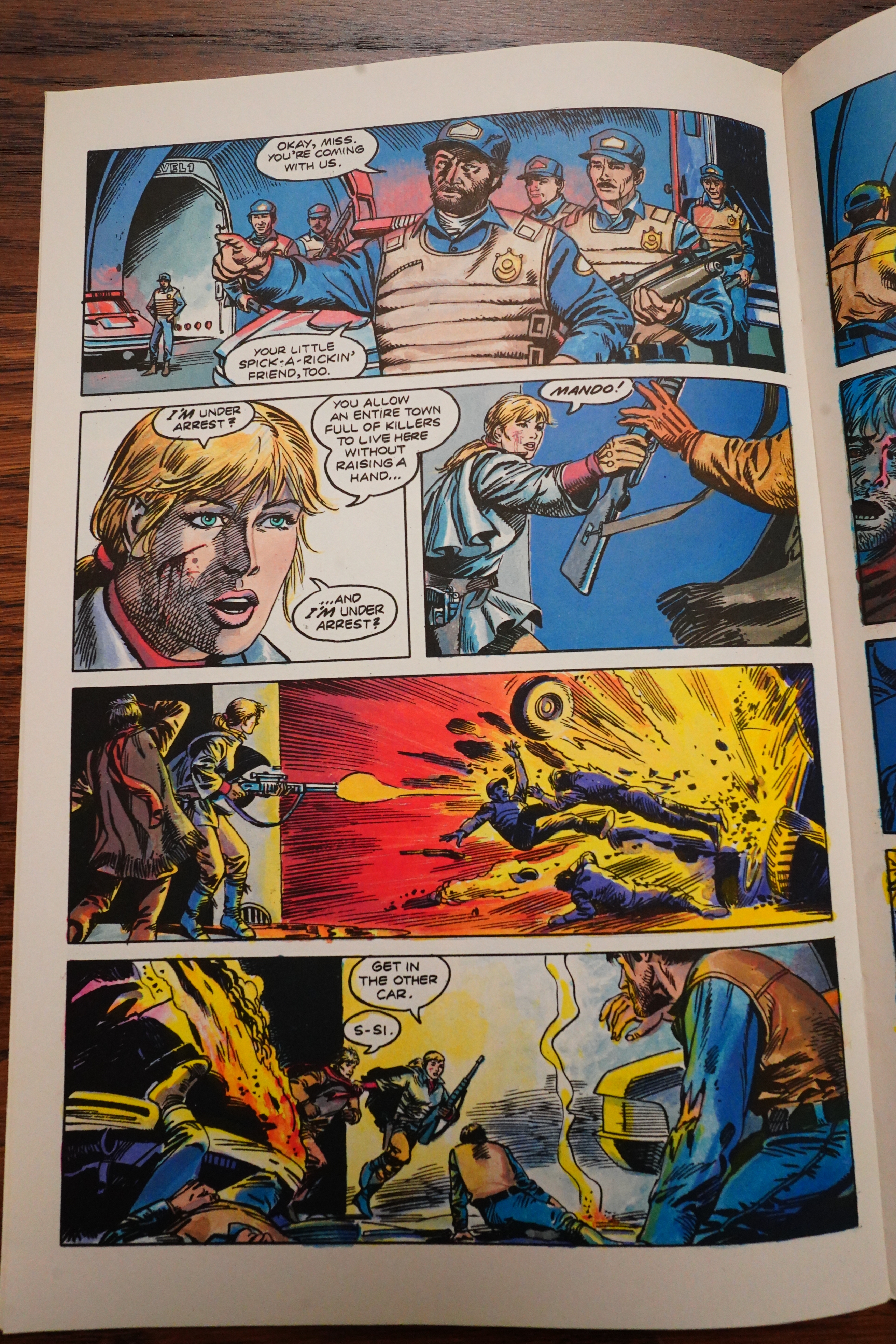
Chuck Dixon would go on to become a quite competent action comics writer, but that’s not much on display here. The first issue scene after scene of Evangeline entering a set, somebody yelling at somebody else, and then people shooting at each other. There’s no structure or story arc to speak of.
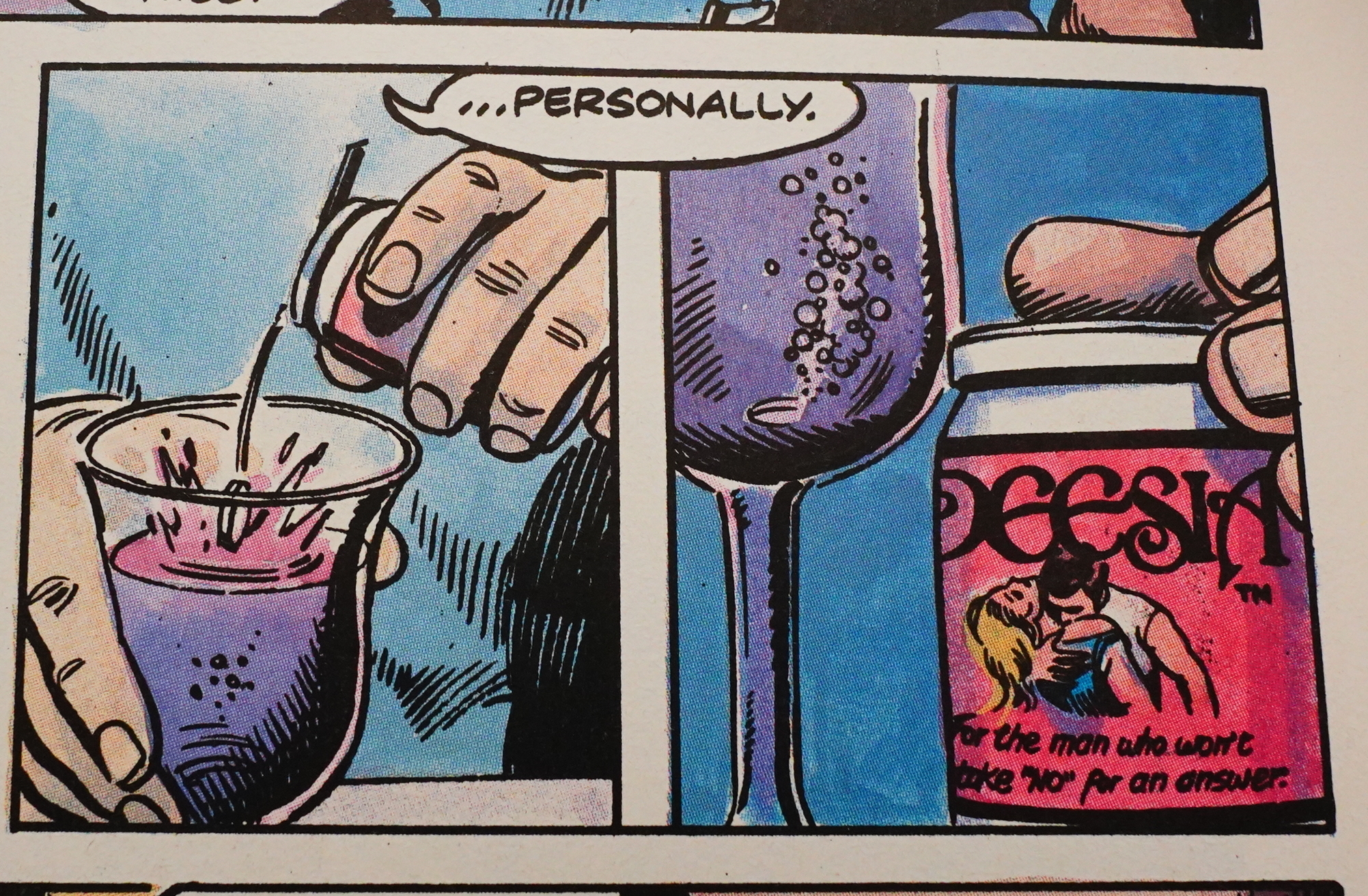
Good slogan for a rape drug.
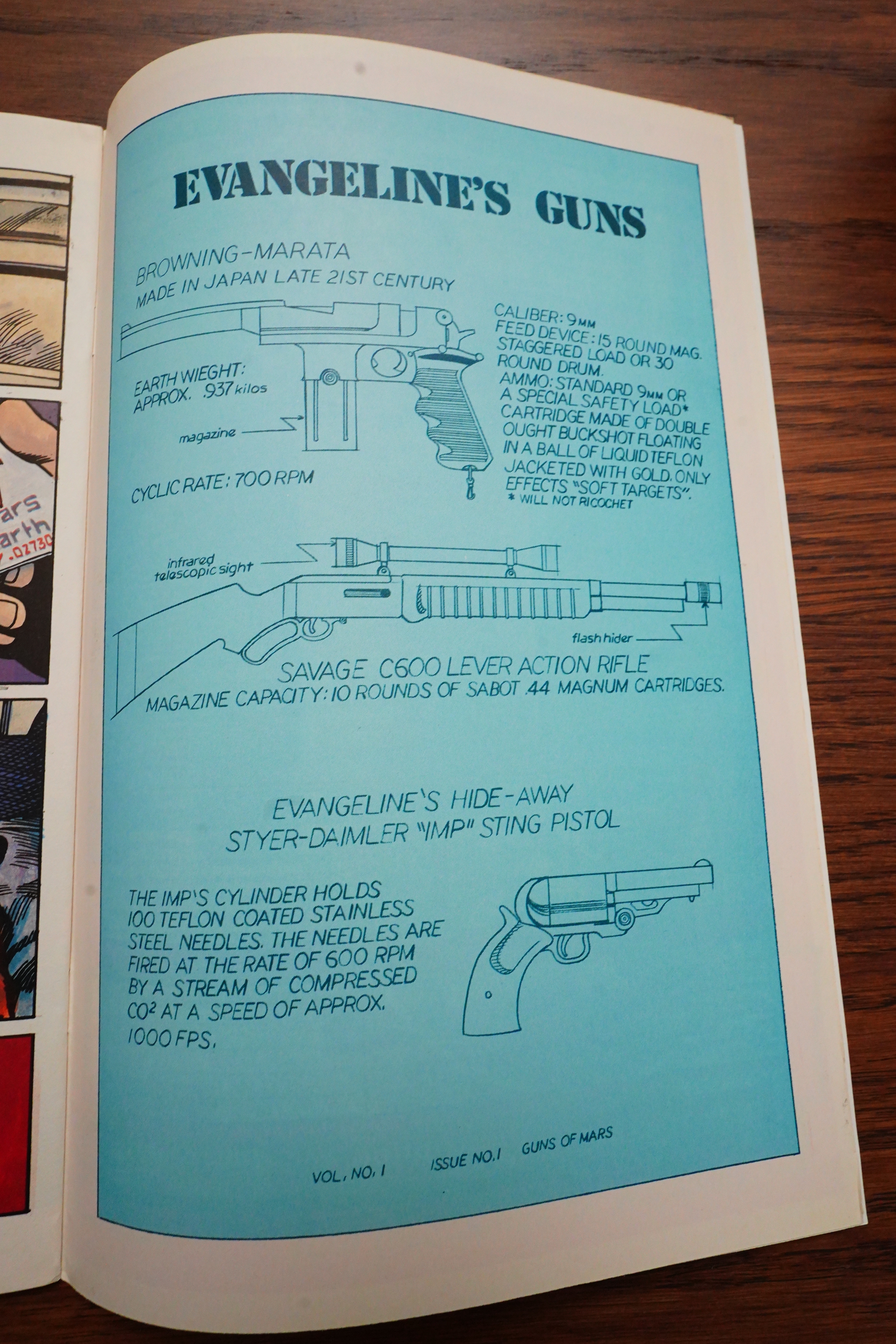
What all the fans have been wondering.
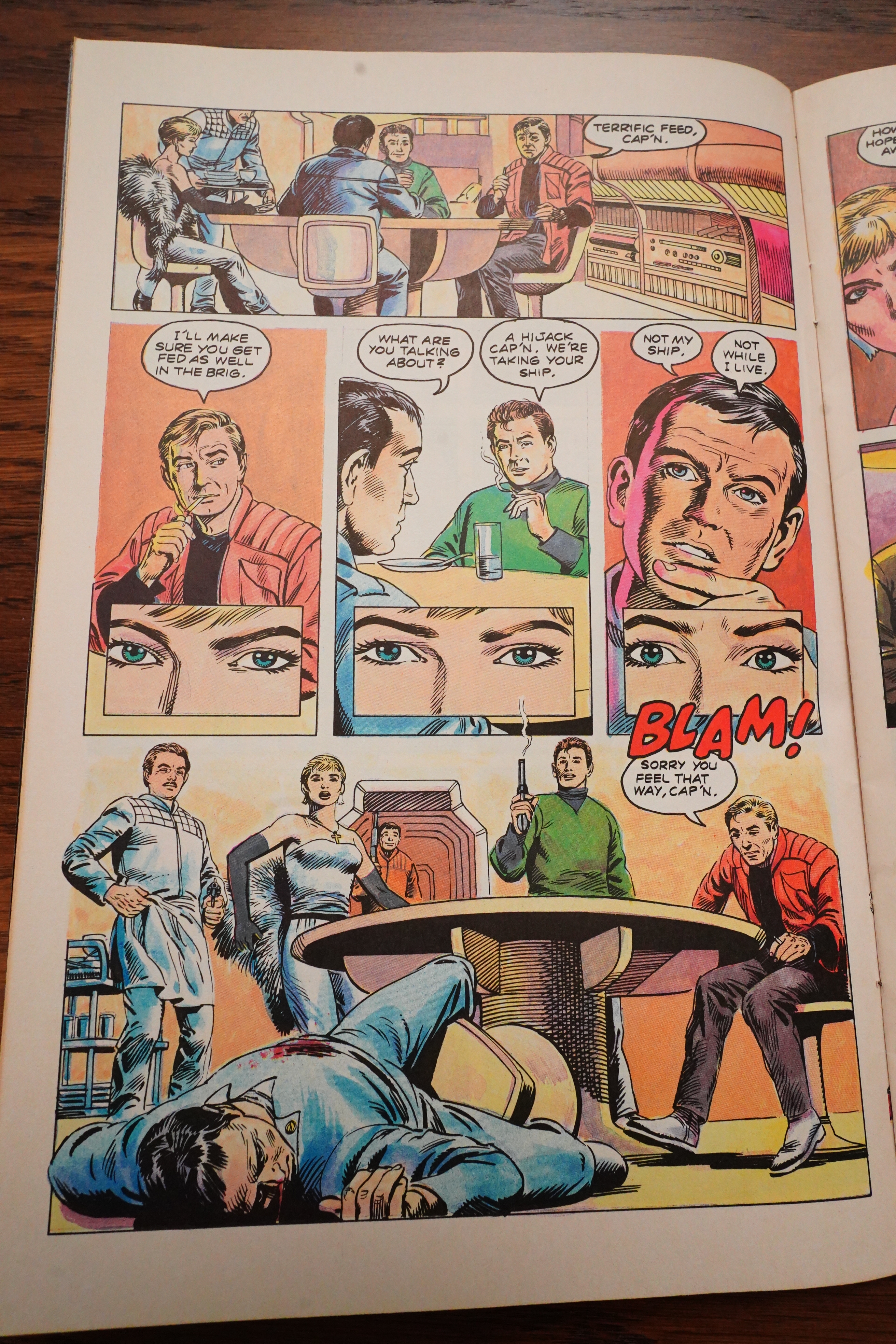
The second issue is perhaps even less satisfying than the first one — Hunt’s characters seem detached from what’s happening…
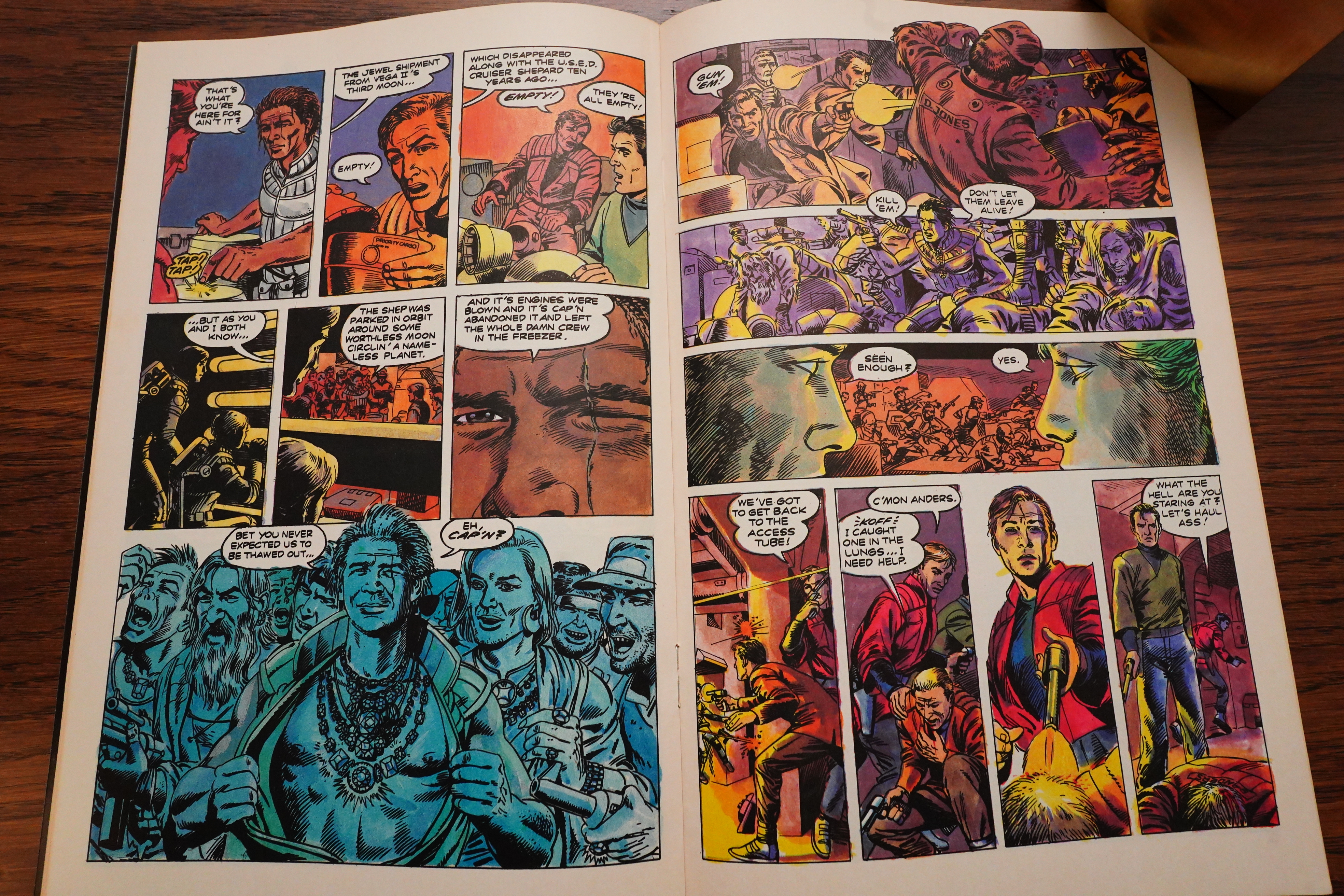
… and the story is a complete mess, with way too many characters happening upon each other (on a spaceship!) and then shooting each other. It was hard to keep paying attention.
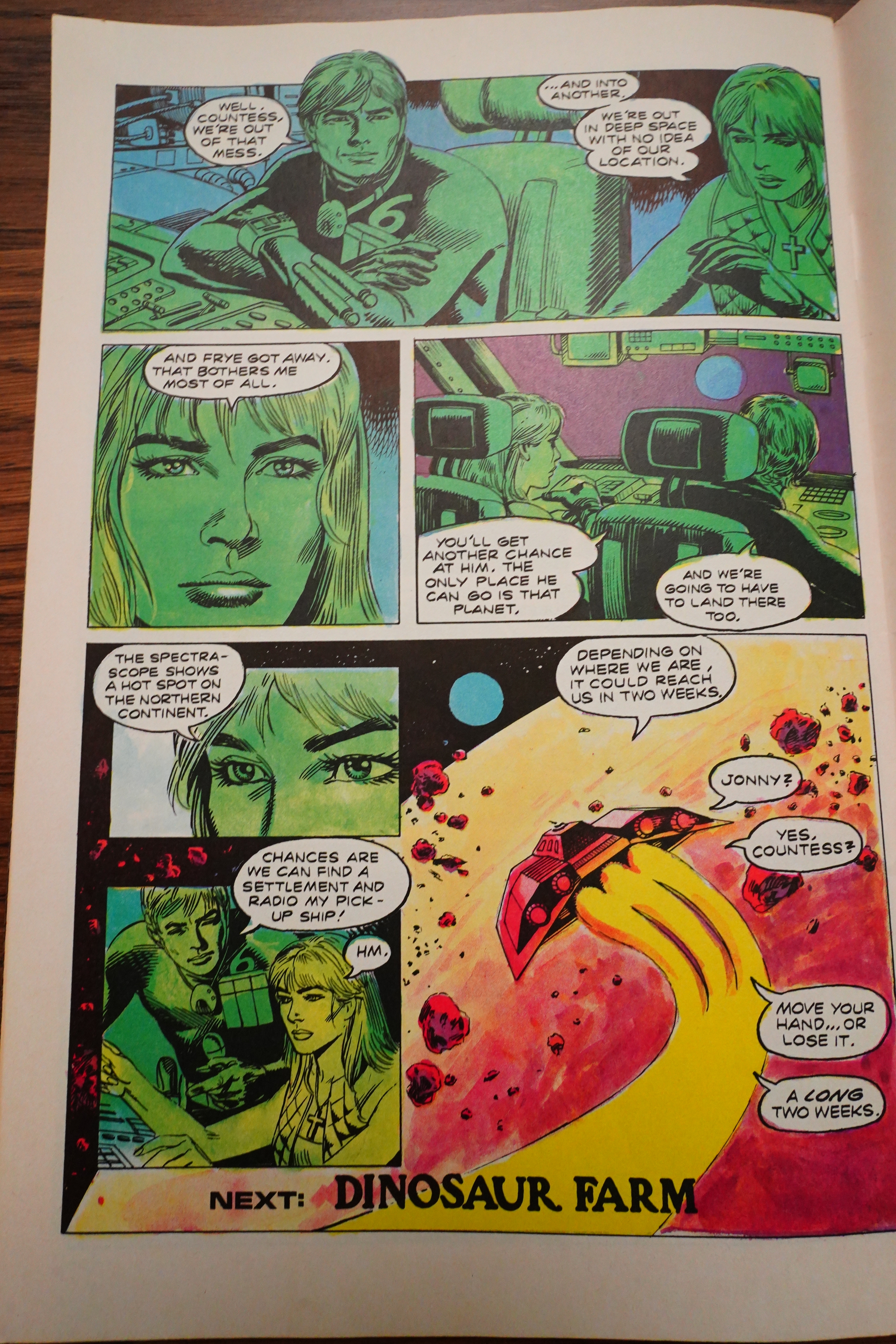
And then the series ends with “next”, as is traditional.
Well, that was a disappointment.
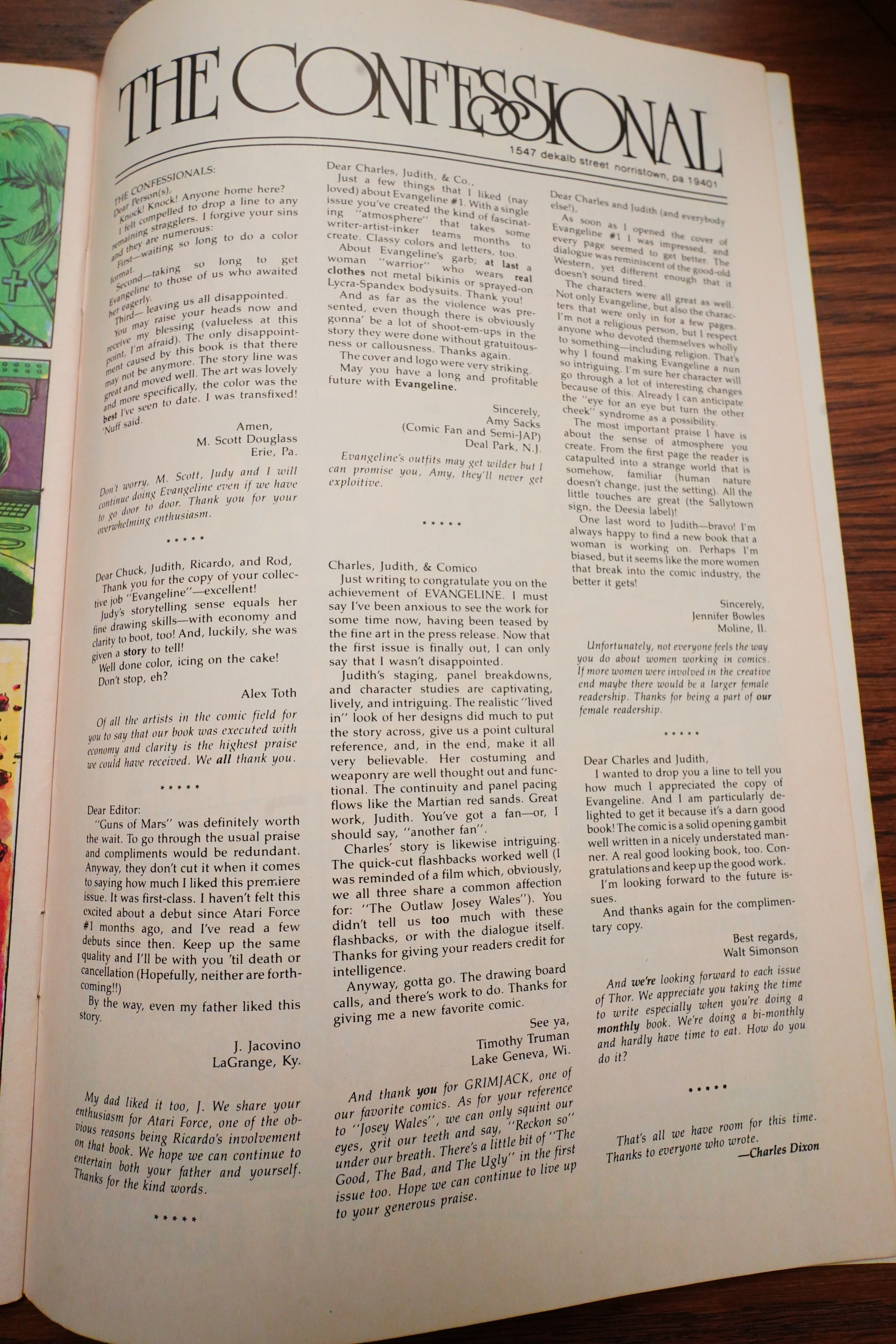
Looks like Comico sent out copies to lots of people in the business — Alex Toth and Walt Simonson write back to say that they liked the first issue. Perhaps more significantly, Timothy Truman does, too, and Dixon would later work with Truman over at Eclipse Comics.
The Comics Journal #97, page #13:
Evangeline caught in ownership dispute
Evangeline has become an
object of contention between its
publisher, Comico, and the
penciller and owner, Judith
Hunt. According to the
publisher, Hunt has been
derelict in turning in all of the
finished pages, while Hunt
contends that she will not allow
Comico to publish the third
issue of the book because they
owe her money.All done?: Comico co-
publishers Gerry Giovinco and
Phil Lasorda, and Hunt are at
complete odds as to whether all
of the artwork for the third
issue is finished. Lasorda and
Giovinco contend that Hunt has
handed in only eight pages out
of the 28 she should have
handed in, but Hunt said that
they were all finished, and
indeed, she also said that they
were all in the Comico offices at
one point.
‘If she’d hand in all of the
pages instead of eight of them,”
we’d publish the book,’
Lasorda said. He also added
that in the past, Comico has
printed each issue as it was
received. “The real reason the
third issue never came out is
that Judy never handed in the
art-her version of why it hasn’t
come out is very far away from
the way it exists.” Lasorda also
said tht Hunt has not finished
the book because she is too busy
with her pencilling commitments
at DC Comics, where she was
the penciller for Robotech
Defenders.
Hunt’s side of the story,
though, is diametrically opposed
to that put forth by the
publisher. According to her, all
of the pages were in the Comico
offices, and they languished
there while Evangeline went
unprinted. Eventually, Hunt
travelled to Comico’s
Norristown, Penn. offices to
take the pages away: Aside from
sheer frustration at what she
termed the publisher’s failure to
print the book, Hunt removed
the pages in protest to the
failure of Comico to pay all of
the money they owe her.
According to Hunt, Comico
owes her nearly $4,000 in
royalties on the first two issues
of Evangeline, not to mention
money owed to Gerald Forton,
Hunt’s inker, for inking 23 of
Hunt’s pages.
Did they change the inker for the third issue?
Also, Hunt said
Giovinco told her that the
reason the book wasn’t being
printed was because Comico’s
cash-flow was such that it was
unaffordable. Lasorda and
Giovinco denied that, Lasorda
pointing to the growing number
of books that Comico is putting
out.
Police action: Hunt said she
went to the Comico offices
shortly before Christmas to
retrieve the pages, and she was
accompanied by Reggie Byers,
Mike Manley, and her 3 1/2-year-
old son. “I asked for my
artwork and my fan mail, and it
was handed to me by Gerry
Giovinco in front of witnesses,’
she said. However, the matter
did not end there. On Jan. 2,
Hunt received a phone call from
the police chief in Norristown,
who told her that Giovinco and
Lasorda were toying with the
idea of having her arrested for
breaking and entering.
Hunt said she assumed the –
threat of arrest was designed to
cow her. “They were just trying
to intimidate me, and they did,
for about two seconds,” she
said. “They figured I’m just a
woman, and I’d go, ‘Oh my
God.’ The whole thing was just
incredibly stupid.’
Lasorda, however, denied
that he actually called the police
on Hunt, saying only that it
crossed their minds at Comico.
“She did break into my office
when I wasn’t here, after all,”
he said.
Despite Lasorda’s assertions
that he did not instigate police
involvement, Norristown Police
Chief William Bambi said that
he did call Hunt, although he
was extremely reticent to talk
about the extent of his
involvement. “The police only
got involved to help, and to try
to settle the matter,” the police
chief said.
Wow! I didn’t know that the Comico publishers were such scuzzballs.
Allegedly!
How long a contract?: While
Hunt asserted that Evangeline
was not under contract to
Comico after the third issue,
Lasorda and Giovinco contend
that Hunt signed a contract that
committed the book to Comico
for at least three years, or 18
issues. “She’s of the impression
that she can take a walk, but
that’s not so,” Giovinco said.
“If it has to go through the
courts, it will-we’re going to
try to retain the rights to
Evangeline for the duration of
the contract.” Hunt’s and
Comico’s lawyers are meeting in
the hopes of striking an out-of-
court settlement, but no final
solution has yet been reached.
Hunt said that her contract
originally stated that she had to
draw five issues of Evangeline,
but that they negotiated this
number down to three issues,
meaning that after the
publication of this embattled
issue of the book, Hunt would
in effect become a free agent.
As for the reasons Hunt wants
to cut bait from the publisher,
she cited what she perceived as
the failure of Comico to live up
to the complete spirit of the
contract. Hunt said that first of
all, the issues of the book have
to see print to fulfill the
contract, and secondly, Comico
has to pay her the royalties the
book has earned.
Lasorda denied that the book
ever earned any royalties. “We
owe her nothing in royalties
-the book just didn’t sell well
enough to do it,” he said. “It
was lucky if it sold 20,000.”
Well, 20K copies is very respectable…
Hunt, however, said she has
heard differently. According to
her, Mark Hamlin, who is in
charge of Comico’s distribution,
told her that each issue of the
book sold around 35,000, which
would entitle her to nearly
$4,000 in royalties. Confirming
Hunt’s story was Mark Hamlin,
Comico’s sales and distribution
agent, who said that the first
issue of Evangeline printed
around 35,000, and the second
one, around 30,000. However,
Hamlin stressed that the issues
have not completely sold out,
but that there probably aren’t
many left.
New publisher?: Lasorda said
that the thing that worried him.
the most about the whole affair
was that other publishers might
think that Evangeline was up for
grabs, but Hunt said that, at
this point, his fear was baseless.
However, she did go on to say
that she was determined that the
book would live on, “even if I
have to publish it myself. That’s
have to paths it in sent. how far I’d go.”
However, Lasorda added that he had
gotten a call from Eclipse
Comics, and Eclipse Publisher
Dean Mullaney told Lasorda
that he thought Evangeline was
up for grabs. Mullaney did say
that around the beginning of
January, Hunt called him with
the intent of discussing the
possible publication of Evange-
line. “I told her that if she
found out that if she really was
able to sell Evangeline, to call
me back,” he said. “So far, she
hasn’t gotten back in touch.
Lastly, Hunt also said she was
disenchanted with Comico
because of what she perceived as
shoddy promotional efforts put
forth by the company on behalf
of Evangeline. “They didn’t
promote it well. I had to do all
of the ad work, such as pasting
it up,” she said. “I really had a
difficult time trying to do that
and getting the book itself done,
too. All I’m trying to do is to
make some money to eat. I
mean, without the money they
owe me, I can’t live, and my kid
can’t eat.
“I really want to do Evange-
line, it’s important to me,”
Hunt added. “I don’t want to
have to do all this work for
Marvel and DC-I don’t dislike
doing it, but I want to work on
my own things.
Comic Fandom Quarterly #5, page #15:
So Comico in those days couldn’t really afford to sign
another outside talent, so it fell to one of the four initial core
group of creators to create this new book for color
distribution where we had been black and white before.
And I by default was the one who had the least amount of
negative fan mail on Grendel, so I got the golden ticket to
do up a new series in color and that turned out to be Mage.
I returned to this thought of kind of Arthurian legend
interpreted in modern day. At that time I considered
Grendel as kind of a failed experiment, like “All right, tried
that, didn’t quite take off, got this other opportunity. Let me
face forward and move ahead and approach that.” So we
started out and Evangeline was kind of a hit right off the
bat, that was the Chuck Dixon title, but Evangeline seemed
to be one of those titles that was concept heavy more than
story heavy you know? Great idea, where do you go with
it? After you see the Nun assassinate the first person in the
name of the Vatican, meh, you could see her assassinate a
hundred people it’s just not going to be quite the same.
Well… the nun could do other things…
The Comics Journal #103, page #12:
Born again: Judy Hunt and
Charles Dixon, the creators of
Evangeline, have won the
arbitration they were embroiled in
with Comico. In winning the
arbitration, the two creators also
won the right to take Evangeline
away from Comico and to any-
where they would like. The
decision came after months of
disputes between artist Hunt and
the publisher, at one point
resulting in Comico trying to
have Hunt arrested for breaking
and entering when she retrieved
her art from the Comico offices.
Each side’s version of events
differed completely: Hunt claimed
to have finished an entire issue,
while Comico claimed she had
finished only part of it. Hunt
claimed unpaid royalties in the
amount of $4,000 from the first
two issues of the book, and
Comico claimed that the book
failed to sell over 20,000, which,
co-publisher Lasorda said, is not
enough to warrant royalties.
(However, Comico’s sales mana-
ger, Mark Hamlin, told the
Journal that the first issues sold
in the neighborhood of 30,000.
which, he said, is enough to
generate royalties.)
Eventually the matter went to
arbitration, with Hunt and Dixon
coming out on top, in part due to
the court finding that Comico had
violated the contract in five
places, according to Hunt.
However, Hunt and Dixon will
not get the $4,000 in royalties that
Hunt claims they were owed, and
in addition, will have to pay back
the $4,000 advance that she and
Dixon got. According to Hunt,
this sum will be repaid to
Comico upon publication of the
third issue. Even though the sum
has to be paid back, Hunt said
she feels glad to have unshackled
herself from her former publisher.
“You don’t know what a relief it
is not to have to deal with them,”
she said. “They’re very under-
handed and very sneaky, and all
this trouble they gave me was just
total revenge on their part.’
However, Hunt has not heard
the last of Comico, according to
Giovinco. “There’s always a
higher court than the Arbitration
Association,” he said. “Evan-
geline is still in litigation.” He
added that the contract does not
specify that the arbitration is
binding upon the parties and that
the matter can still be pursued
through the courts. Hunt said she
has not yet heard of any further
legal action from Comico,
though, and their stories are again
at variance: Hunt said the
arbitration is indeed binding upon
them. “There’s no appeal process,”
she said. “They have
nowhere to go. It’s all done-it’s
over, finally.
Wow. I had no idea the Comico people were this contentious. Perhaps I should quickly edit the previous blog posts to make them say how much I love everything and that they’re the best comics ever published?
On the other hand, they were, like, 24 when all of this went down.
Evangeline by JUDITH HUNT and CHARLES
DIXON and Mage by Grendel creator MATT
WAGNER will constitute Comico’s initial color
line-up. Each of these will debut in January and
will feature 30 pages of story for $1.50. They
will be 32-page four-color Mando books, printed
out of World Color Press.
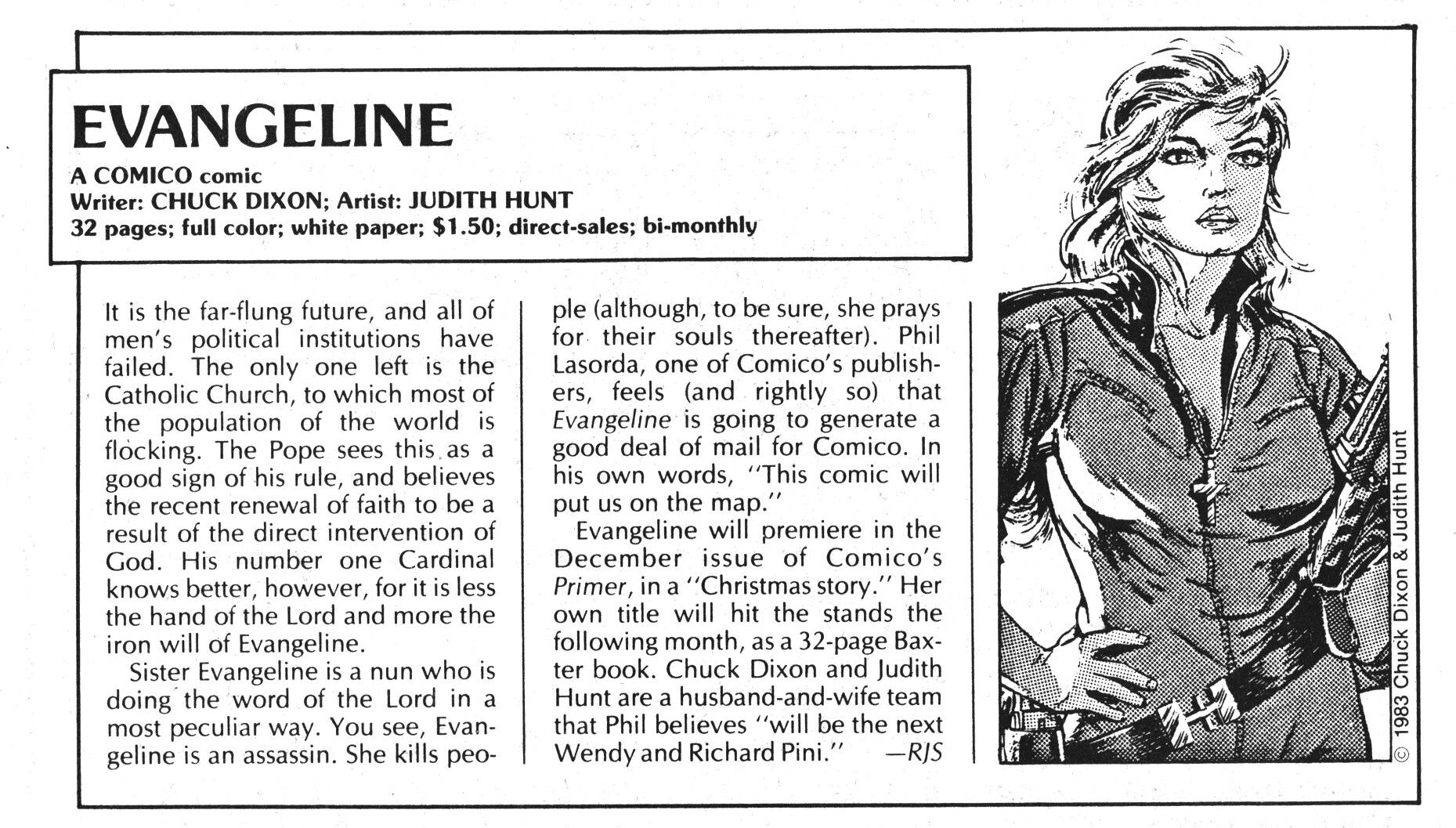
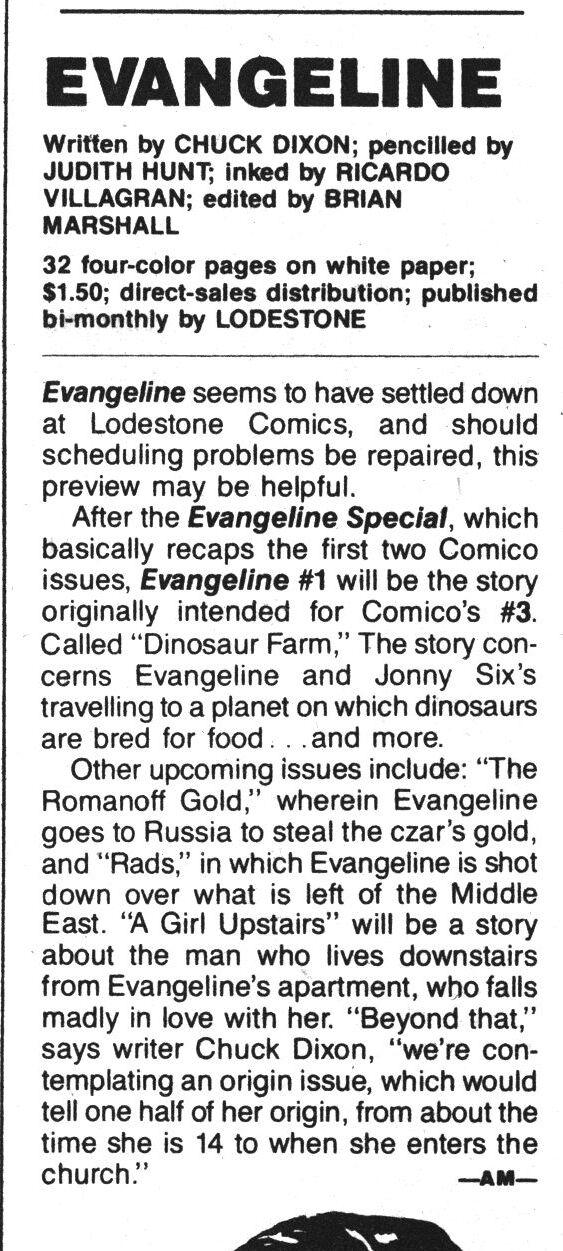
Oh, the Lodestone issue just recapped these two issues — so #3 remained unpublished until First picked up the series some years later.
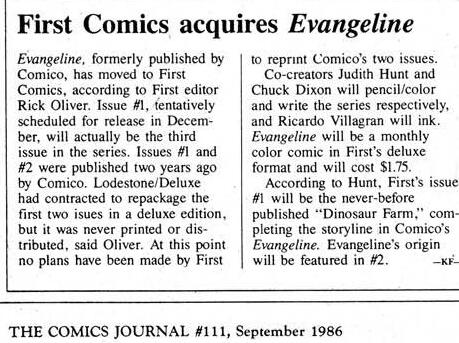
Yup.
The Slings and Arrows Comic Guide #2, page #229:
EVANGELINE
Comico: 2 issues 1984
Lodestone: 1 Special 1986
First: 12 issues 1987-1989
The concept of a sexy killer vigilante nun neatly
encompasses a variety of comic archetypes in a single
package, and should, therefore, have been enormously
successful. The scripts from Charles (more recently Chuck)
Dixon show he’s studied his action movies, and Judith
Hunt’s art, if a little static at times, moves the Comico issues
along nicely despite the shoddy colouring. They’re reprinted
with additional codas as the Lodestone special, and the First
series picks up from the conclusion. Evangeline’s
background is presented in 2 and 8. She works for the
Vatican, distressingly still wielding power and influence in
the 23rd century. The period is never well evoked, and with
Evangeline back on Earth for most of the series it might have
carried more punch with a contemporary setting. Dixon’s
plots hold up throughout, but Evangeline, despite her
background of inherent contradictions, rarely transcends a
blank slate. Hunt goes with 7 and the spirit of the title
departs with her. Never previously exploitatively handled,
the final issues by inferior artists have plenty of gratuitous
poses. As an undemanding action/adventure title this is
better than many.~WJ
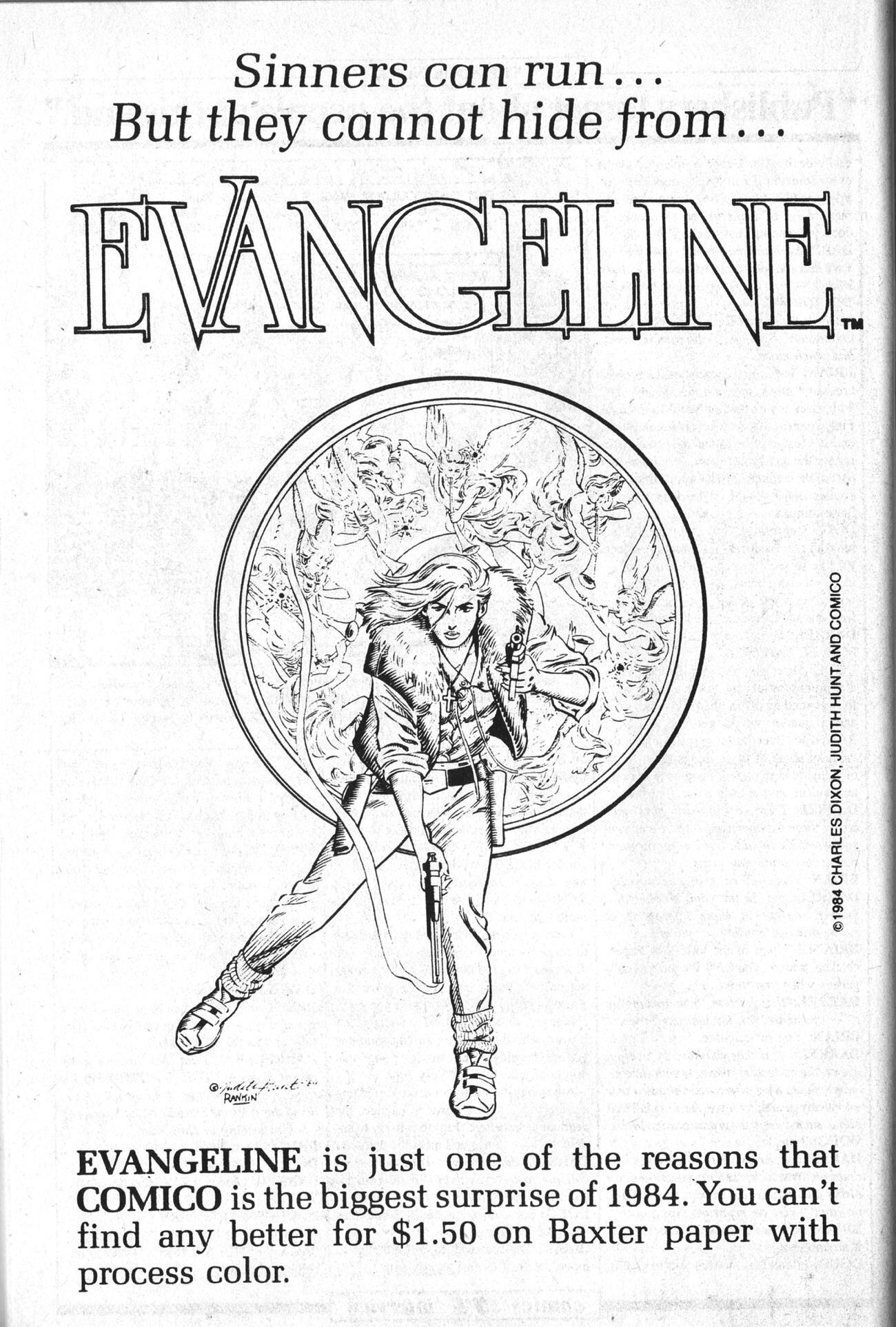
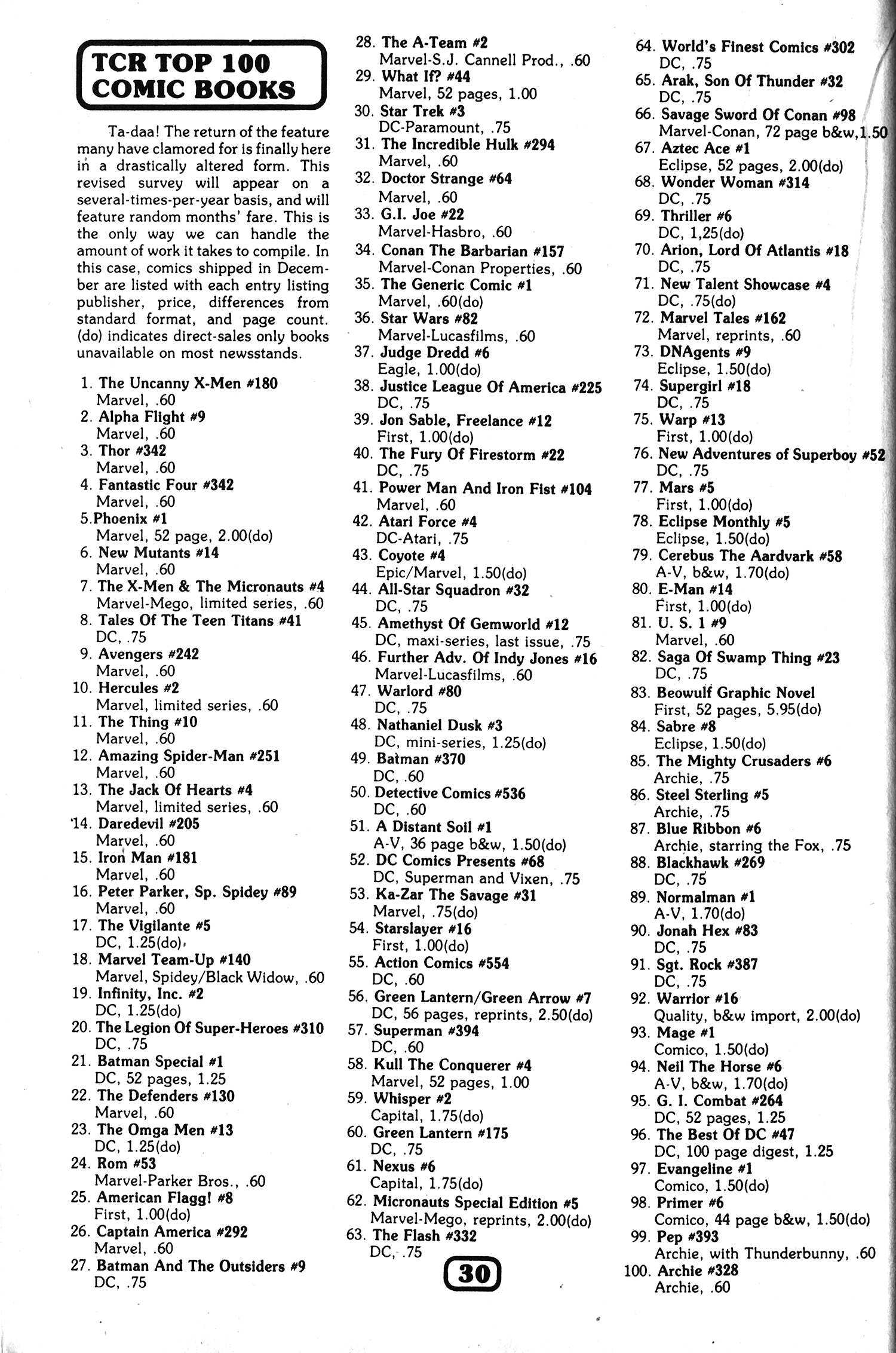
Hey, it made #97 on The Comic Reader’s Top 100.
Speakeasy #44, page #10:
Evangeline #3 will be the last issue published by
Comico, as other, larger companies have expressed
an interest in the title. This will be the final
issue inked by Ricardo Villagran, as of #4 (wher-
ever it is published) Gerald Forton takes over.
Issue #3 also features a back-up story, “Sonny 6”,
by Mike Manly and Forton.
How it Began
Dixon and Hunt may be new
names to most comics fans, but
they are not new to comics. In
fact, Evangeline first appeared
in a convention booklet in
England in 1978. “We always
thought that we’d put the char-
acter out on our own. We came
up with Evangeline a long time
ago, but we never considered it
that important. We did think it
was important enough to put a
world copyright on the story in
the British convention booklet
though,” Hunt says.
How did Evangeline make it
from the British convention
booklet to the pages of her own
color comic at Comico? Dixon
says, “Judy and I haven’t been
in comics for a long time. We
saw the advertisement in The
Comics Buyer’s Guide that
Comico needed new people
and I thought, “What the hell,
I’ll give it a shot.” So I photo-
copied some stuff and was about
to mail it out when I noticed that
Comico was in Norristown
(Pennsylvania).
“I just called them and found
out that one of the publishers
was going to the Philadelphia
College of Arts, while I was
there teaching a class in car-
tooning on the weekends,” says
Dixon.
After talking to the publishers
at Comico, creators Dixon and
Hunt decided that this was their
chance to get back into comics.
“It was a lot easier than I’ve got-
ten any other comics job. It is a
lot easier to get into Heaven
than it is to get hired at Marvel,”
Dixon says.
Rounding out the Evangeline
creative team is Ricardo Villa-
gran, who is also currently ink-
ing over Tom Sutton’s pencils
on DC’s Star Trek. Hunt feels
that Villagran’s contribution to
the book is very important.
“There’s a hell of a lot of creative
input on Ricardo’s part,” Hunt
says. “I’m not a very good inker.
I have a really hard time with
blacks, because I haven’t work-
ed with them much. I under-
stand it, but I don’t have the re-
fined ability that Villagran does.”
If anyone wonders why the
story in Primer looks different
from the first issue of Evange-
line, it mostly has to do with
Villagran’s absence. “On that
Primer piece,” Hunt says, “I
didn’t draw that, I basically
inked it, that’s why it looks so
bad. I just laid down break-
downs and then inked it.
“Villagran makes Evangeline
pretty,” Hunt says. “I try hard to
make her pretty, but he gives
her just a little bit more. He gives
her a shine. And that is exactly
what we want.
“He gives this comic a good
look. Readers are going to be
able to look at it and read it and
then look at it again. I hope we
can keep him,” Hunt says.
Four Color Magazine #1, page #8:
“Evangeline is an intergalactic pro-
tector of the downtrodden,” said Rick
Oliver, editor of the series. “Her basic
mission is to protect Catholics and
religiously downtrodden people
throughout the galaxy.” To do this,
she often employs methods that one
may not normally associate with a
member of the church. “You really
can’t get away from the fact that she is
a nun with a gun.”
Amazing Heroes #50, page #134:
Comico has been responsible for
several rather amateurish books
that have been justifiably ignored
by the readers. Their first attempt at
a full color comic, Mage, left me
cold. Quite frankly, I thought the
company was doomed to fold.
Now comes Evangeline-and it
looks like there’s hope for them
after all.
Evangeline is the brainchild of
the husband-and-wife team of
Charles Dixon and Judith Hunt.
The book is science fiction set very
much in the vein of Road Warrior
and several similar motion pic-
tures. The heroine is a Catholic
nun—who also happens to be a
gun-toting troubleshooter who
sends more than her fair share of
souls to heaven-or hell.
The action takes place on Mars,
both on its highways and in such
settlements as Sallytown-named
for the first (American) woman in
space (“Thank God not the last!”).
Evangeline hunts down the thugs
who, under the direction of an
interplanetary corporation, slaugh-
tered the innocent nuns and
orphans at a small Martian mission.
Dixon has crafted a taut story,
with a short, crisp style which
makes it read like an s.f. Western.
The dialogue is realistic in tone.
While giving us a good look at
Evangeline, he leaves you with
plenty of questions about the
woman.
Judith Hunt provides solid pen-
cils that aid in setting the mood of
the story, giving just the right
graphic feel to this gritty tale. She is
ably assisted by the fine inking style
of Ricardo Villagran. No colorist is
listed in the credits, but he/she
should have been, for the tones are
lush and vibrant, greatly enhancing
the art.
People with delicate stomachs
may be repelled by the explicit
violence to be found in this first
issue. I’m sure there will be many
who will be appalled by this depic-
tion of a nun who is also a hard-
ened killer-but it is a subject mat-
ter which holds endless potential if
handled properly.
Evangeline is far and away the
best thing I have seen from Comi-
co, exuding a professionalism lack-
ing in their other titles. It won’t suit
everyone’s taste, but I recommend
it. Sister Evangeline appears to be a
woman of many facets and I plan to
stick around to discover them all.
Evangeline is a youthful 22nd
Century nun who works as a
secret agent for Cardinal Szn of
the Vatican. The comic will
follow her on her missions for
the Cardinal and her life be-
tween assignments as well.
She is very different from the
nuns of the 20th Century. She’s
also very different from the nuns
of the 22nd Century. “She is the
only one of her kind,” Chuck
Dixon explains. “She is not a
nun in the regular sense. She
carries guns and she isn’t afraid
to use them. She also wears
various disguises, instead of
dressing in a habit. She doesn’t
spend time between missions in
the
a convent. She just isn’t that
kind of nun.”
Artist Judith Hunt adds, “She
is going to be different from
other female characters because
she’s isn’t a wimp. There are a
couple other heavies [female
characters] in comics, but they
tend to go back and lick their
wounds. Evangeline doesn’t.
There’s no thinking about or
justifying what she’s doing. It is
up to the reader.”
Four Color Magazine #3, page #39:
Ms. Hunt explains that there are many
levels and textures to the series, most of
which could not be discerned in those ear-
ly Comico issues. Though Evangeline is a
nun, sanctioned by the church and her im-
mediate superior, Cardinal Szn, to employ
violence in order to protect Catholics and
the religious downtrodden, Ms. Hunt says,
“She’s not a vigilante. She is being
manipulated. And she knows it’s not right
to have a license to kill.”
I can’t find many people talking about the book on the web, but:
It’s a real pity. Evangeline was never reprinted and is now very difficult to find. Anna’s Archive is your only real hope if you’re curious. I will say this, it was a bold first effort by a writer who would become a comic book legend that combined action, rebellion, and faith. It‘s well worth digging up.