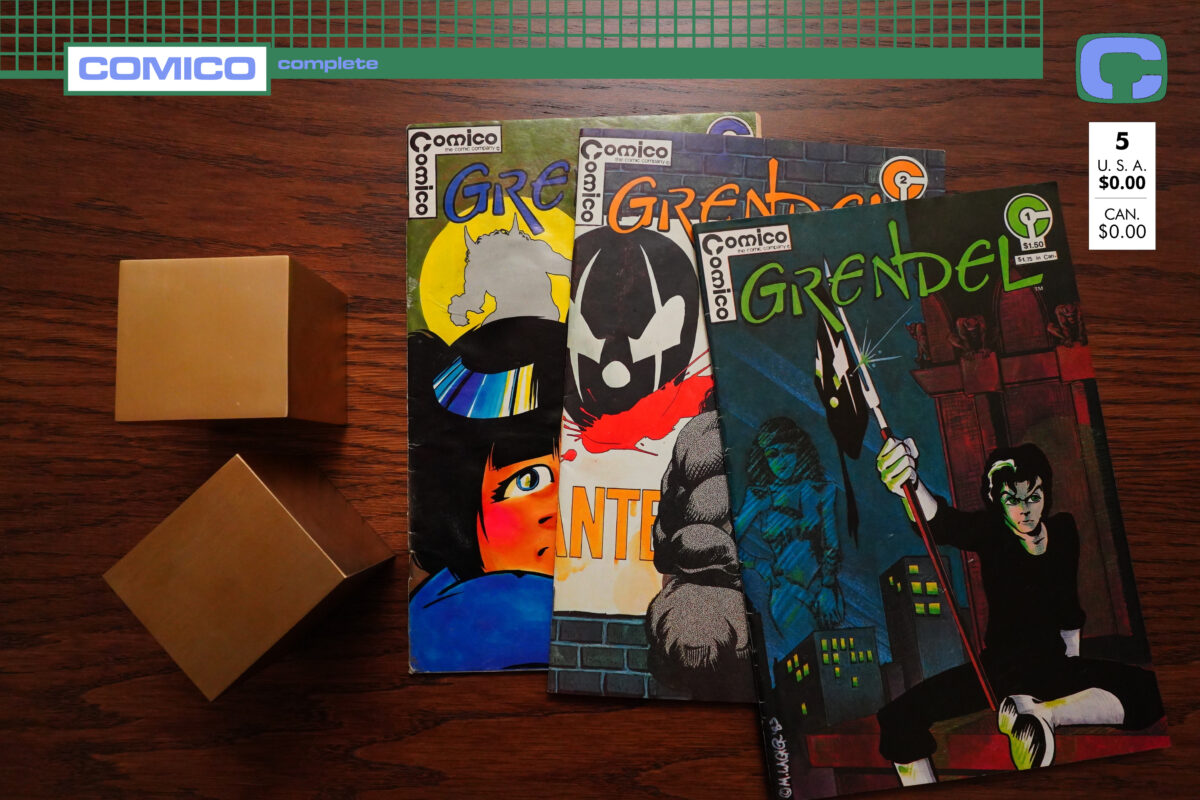
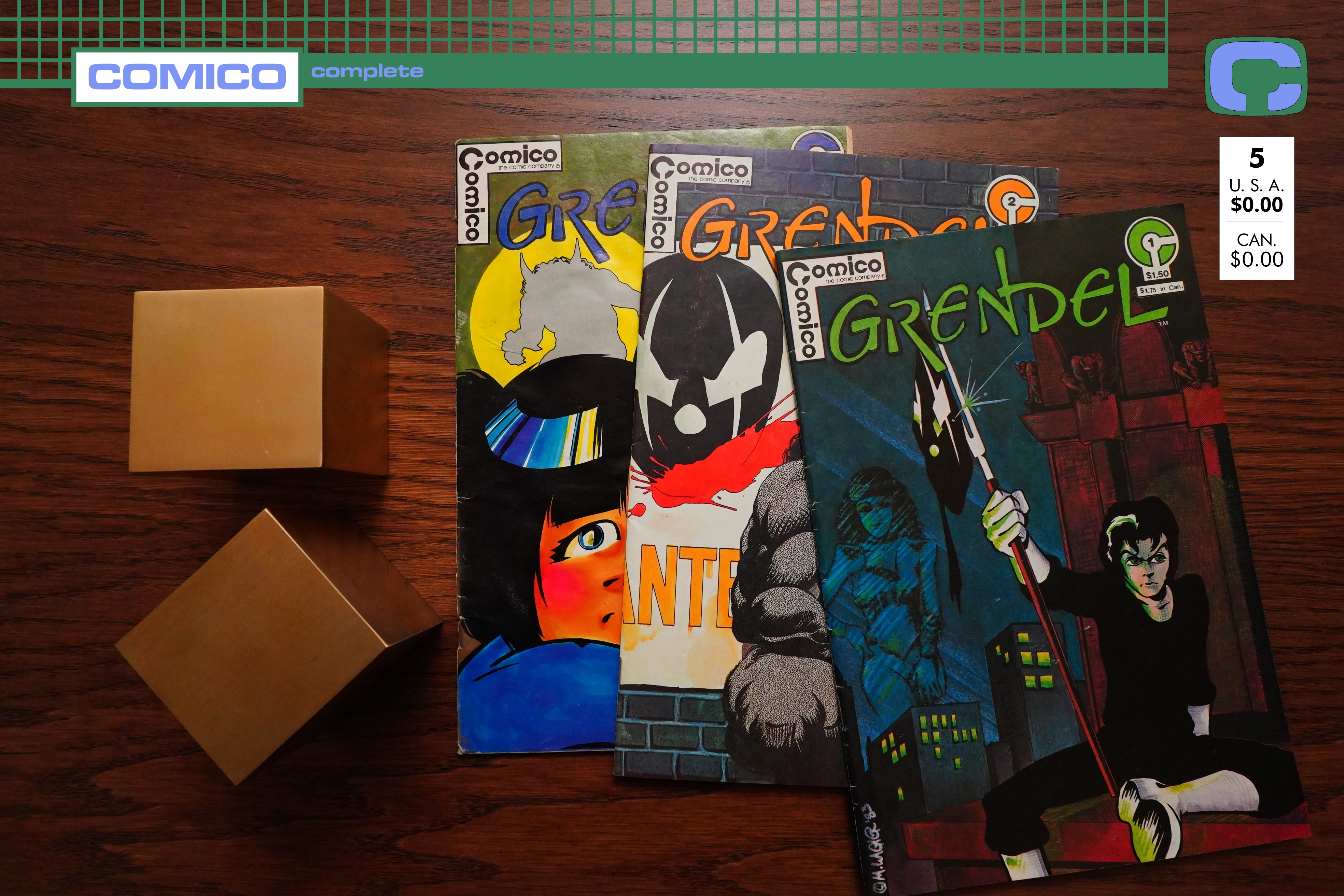
Grendel (1983) #1-3 by Matt Wagner
After publishing Slaughterman, Az and Skrog (all created by the Comico founders), here we get the first book by somebody else (and also the last of the black-and-white books), so I guess Grendel is both the start and end of something.
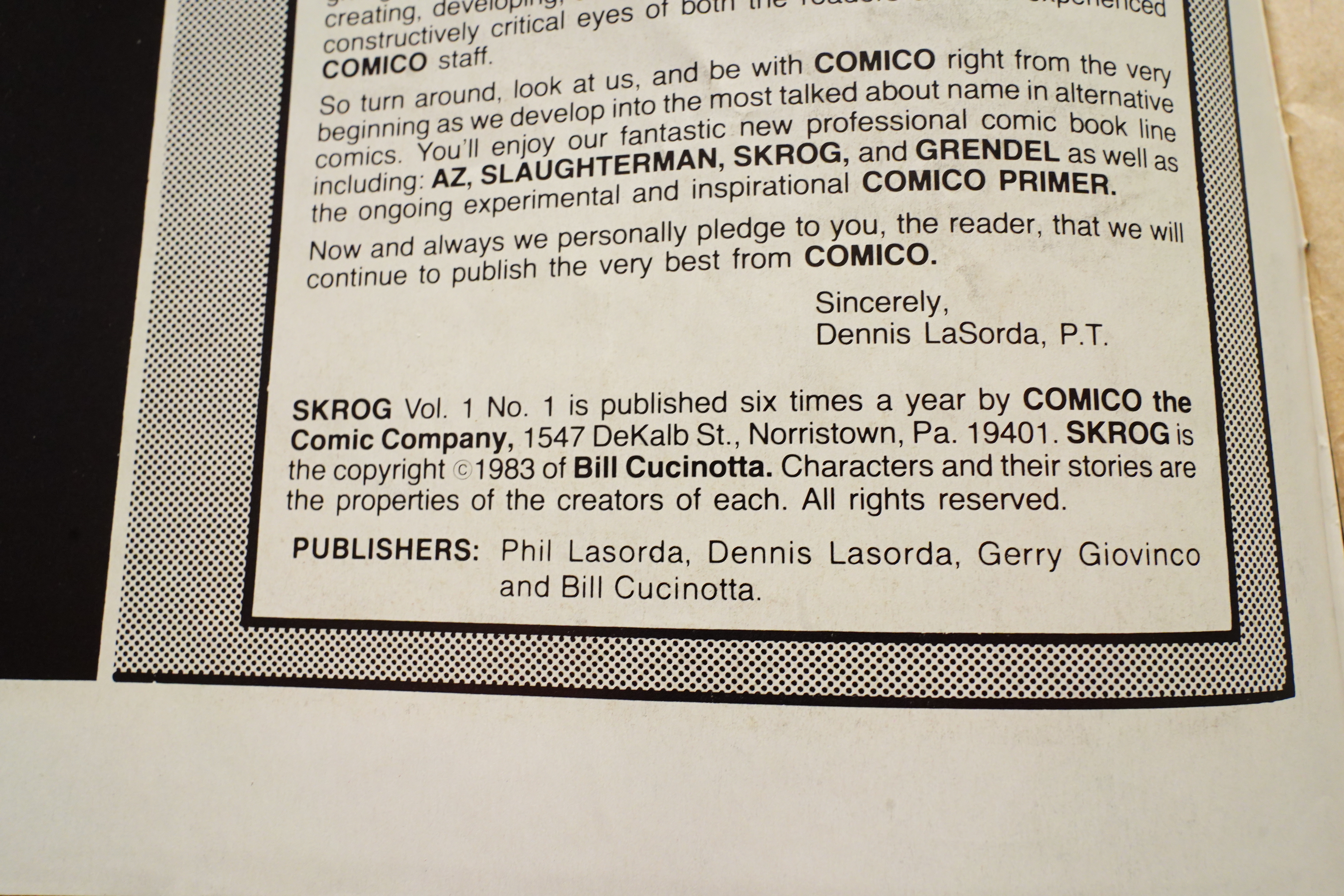
Oops! They ran the same (insufferable) editorial in all the four #1s, but they forgot to swap out the Skrog indicia. Anyway, here’s the first three pages:
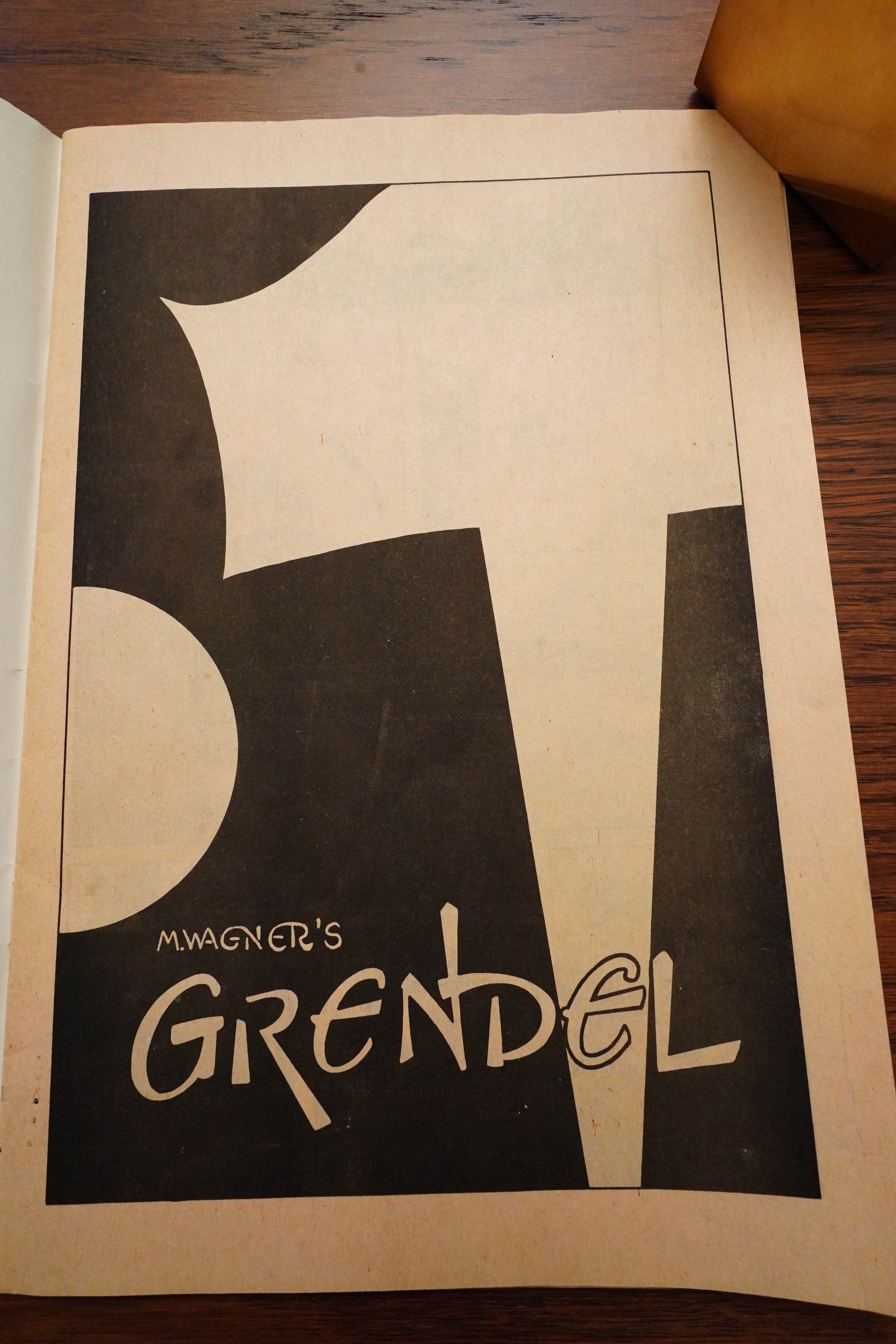
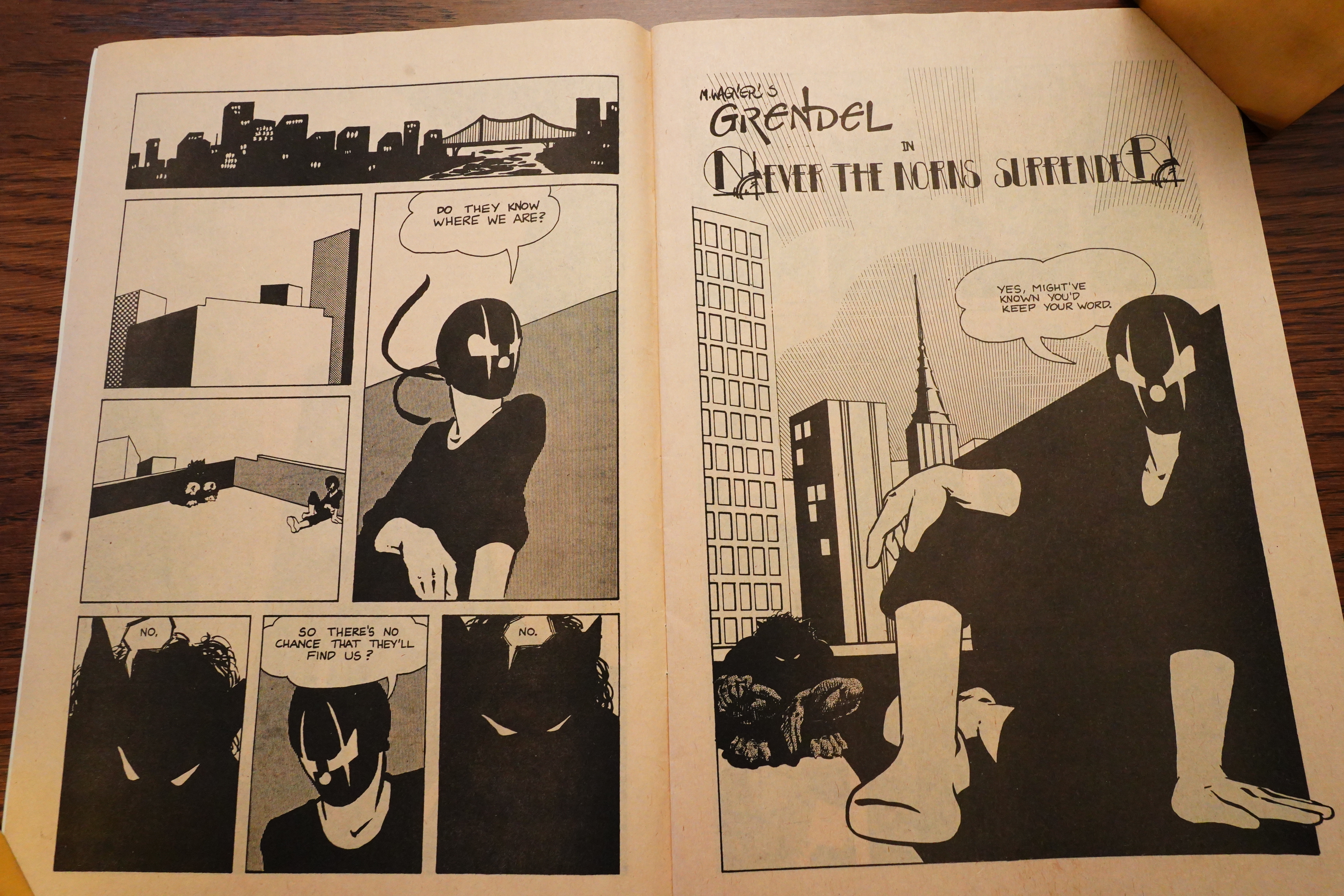
Pretty stylish!
There’s a really stark graphical quality to these pages.
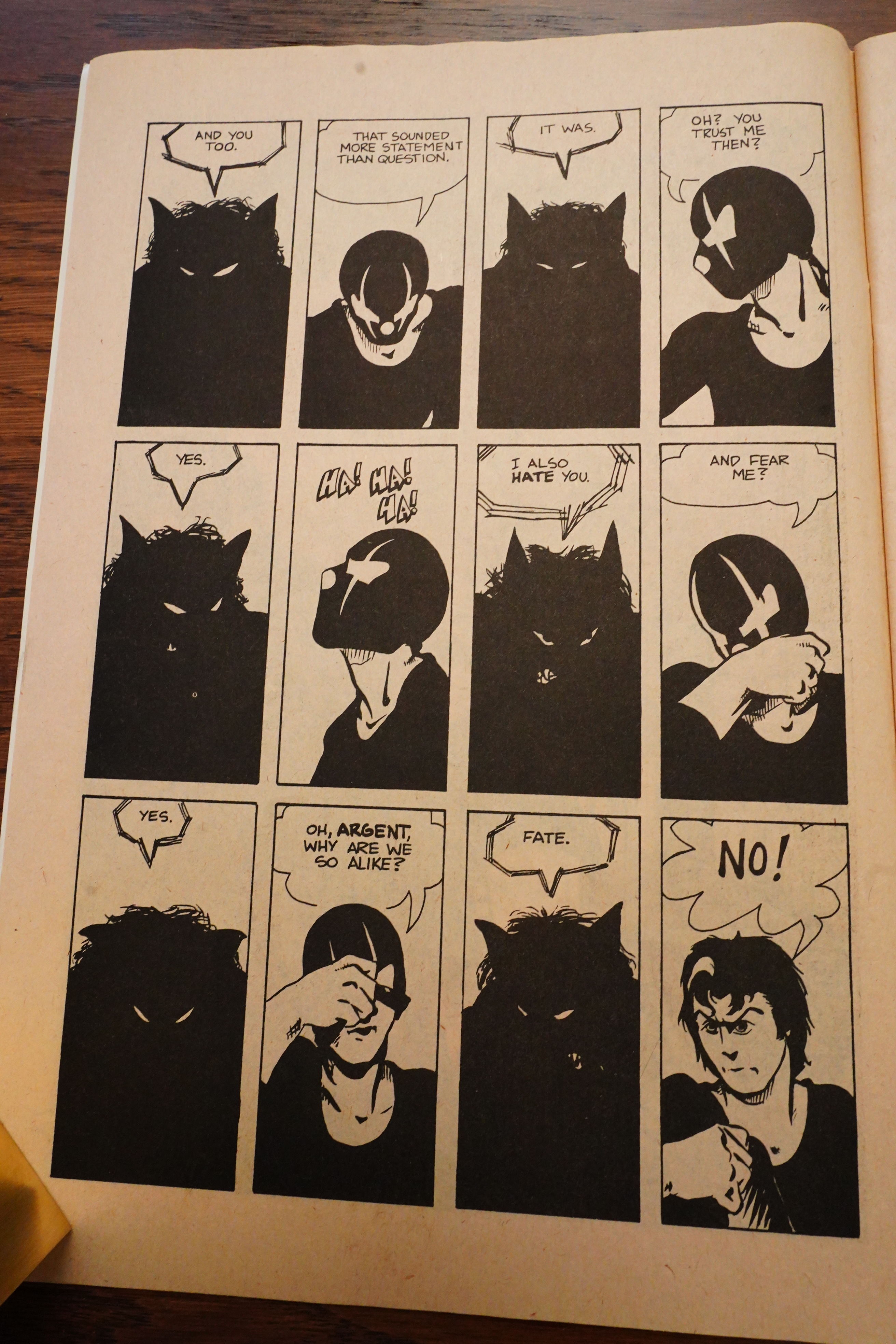
But it’s a pretty weird way to start a series. Grendel and Argent had been introduced in Primer #2, but it’s not like we have a long history of these characters. And here they are, sitting on a rooftop, reminiscing about old times.
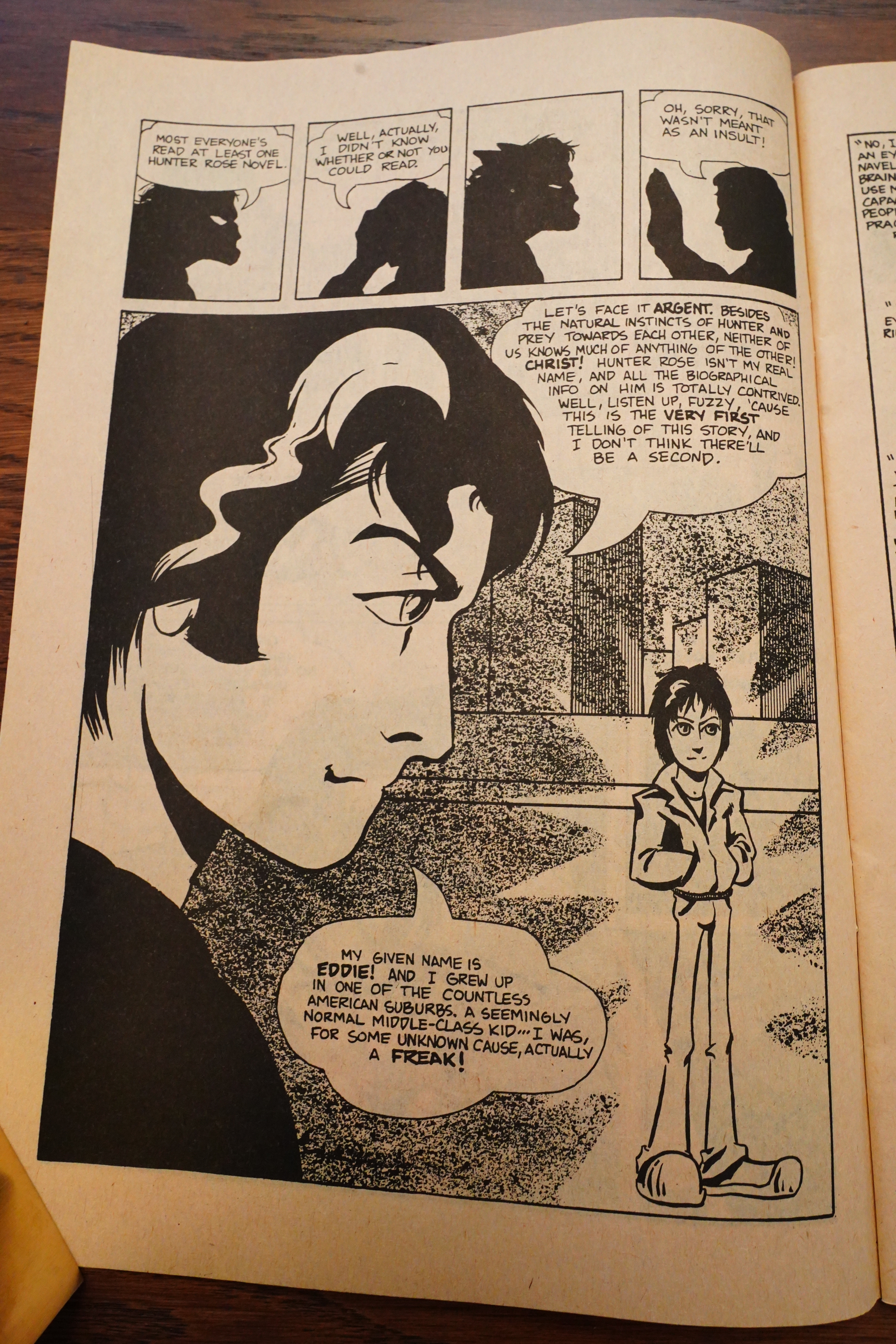
The entirety of the first issue is spent recounting Grendel’s backstory — which is economical, I guess, but it’s also like… does the reader really need to know all of this? I mean, origin stories are popular, but…
Did Wagner read Japanese comics at the time? Some of the artwork looks somewhat Japanese influenced, especially when he draws children. Perhaps he’d seen the Robotech animated series or something?
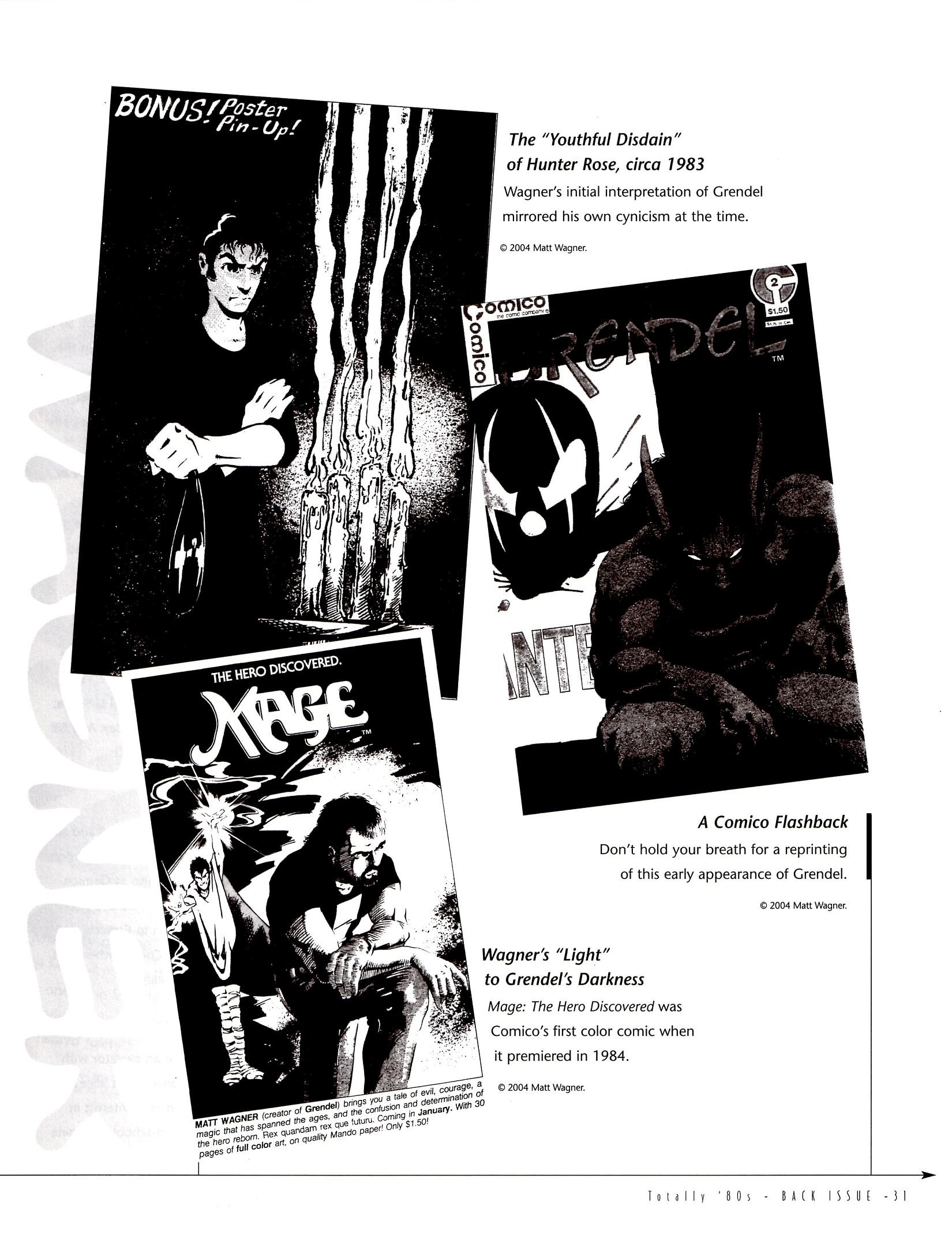
It’s a really interesting shift from the initial three issues you had done, not only in storytelling style, but in art. Those first three issues have an interesting combination of rounded, almost cartoonish forms, and noir-influenced very heavy blacks and shadows. How much of that was deliberate, and how much was just your early style?
It was deliberate in that I had just discovered anime, and anime was kind of a rarity at that point. Right. There weren’t many examples of it available here in the States. So it seemed intriguing to me, this style of big feet, and big eyes, and the little mouth, and I was kind of taking my cues from that. But at the same time, yeah, I was also influenced by noir comics. Frank Miller was in the thick of his upward trajectory at that point, and his style was really prevalent all over Marvel comics. So there was a huge, huge switch from those [issues] to what ended up becoming Devil by the Deed in the back of Mage. And part of that was, again, as I said, the limitations of space I had to work with. But also I was just growing up creatively. There’s an old adage in comics that everybody has a hundred pages of comic art that they have to poop out first before they get to anything that looks pretty good. And I was reaching that hundred page mark, finally.
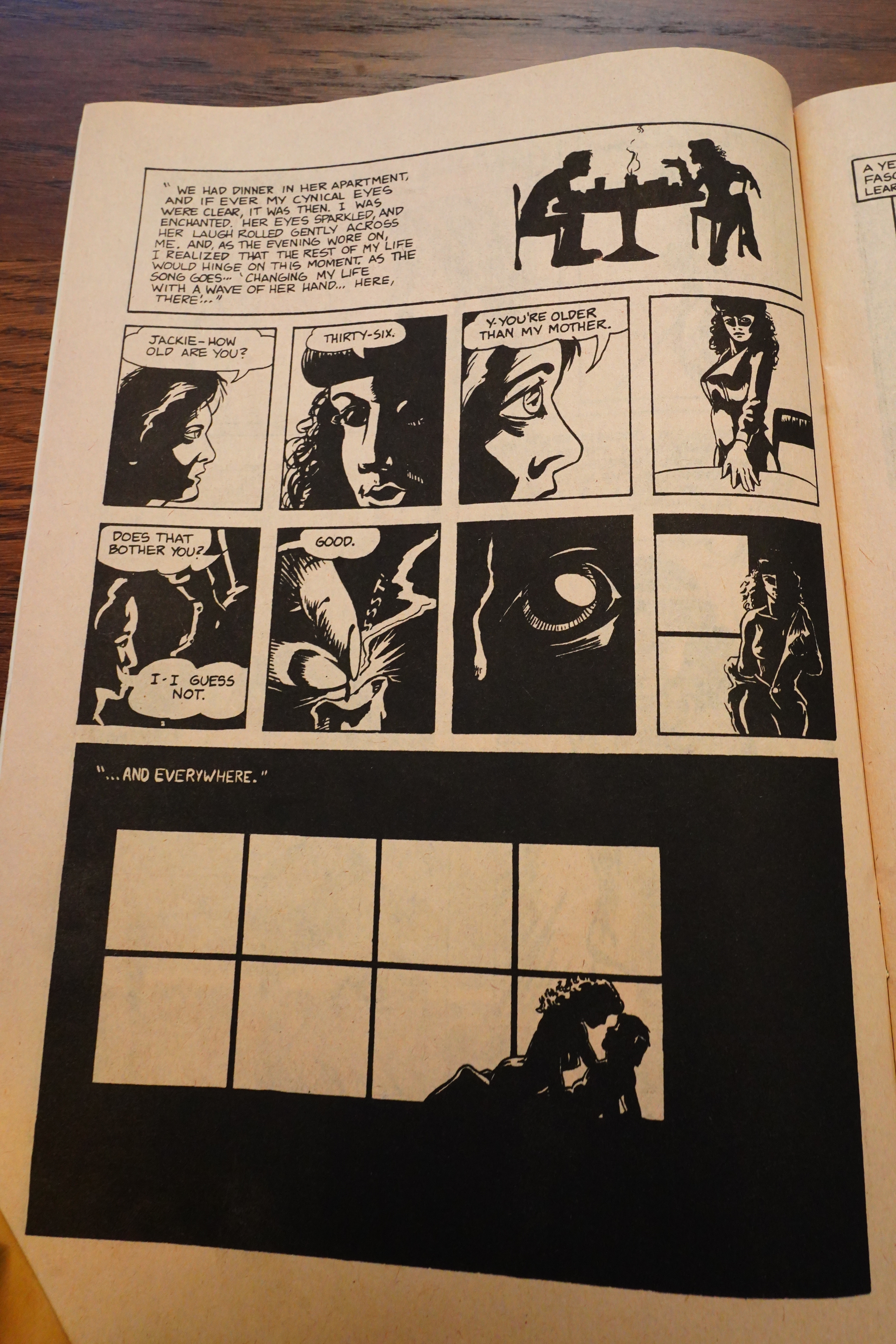
So his backstory is that when he was 14, he was seduced by this woman…
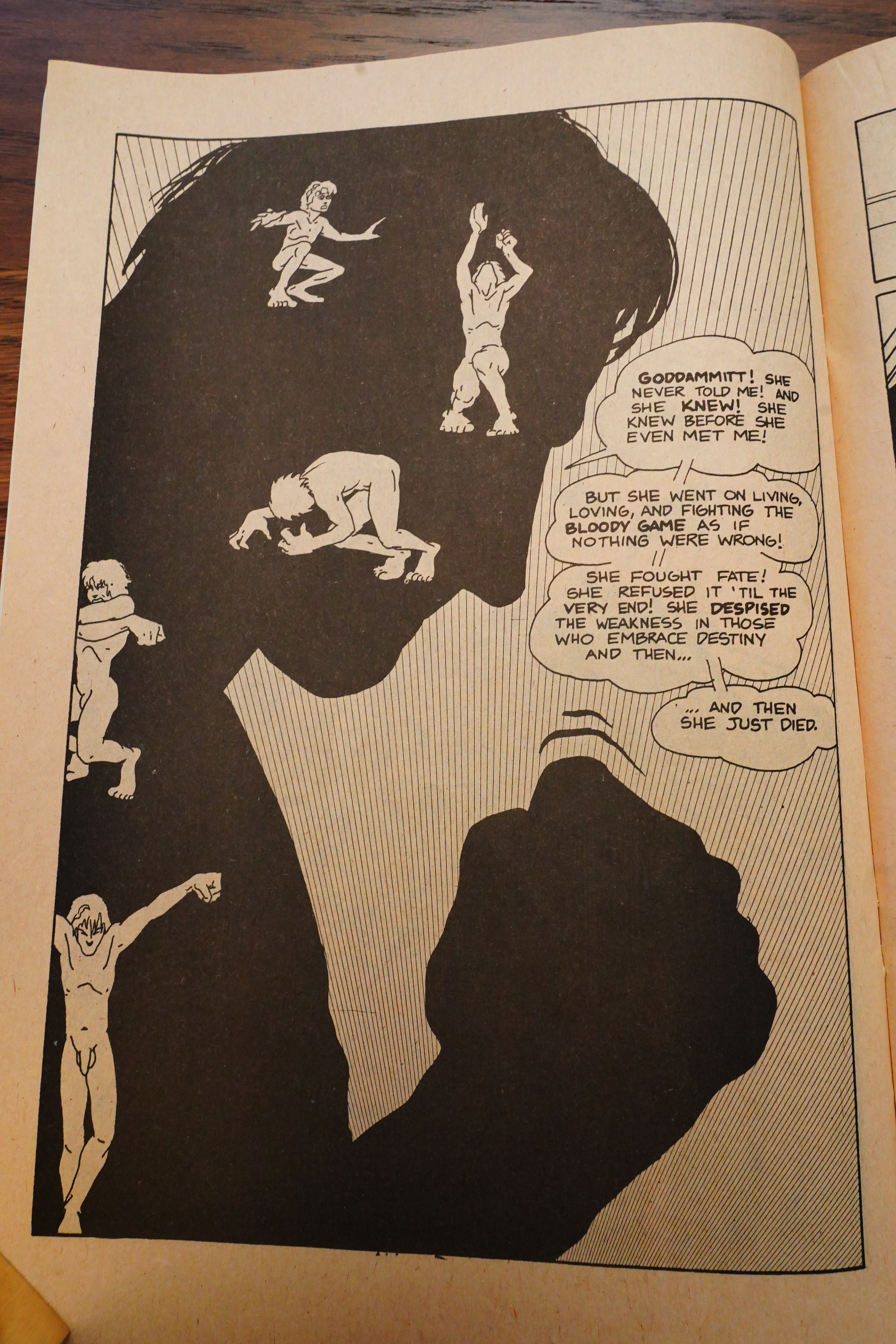
… and then he became a sociopath. Or something. So he took over as a crime boss in the big city, and killed dozens of people. But! He stopped child prostitution all over the city, so he’s not all bad.
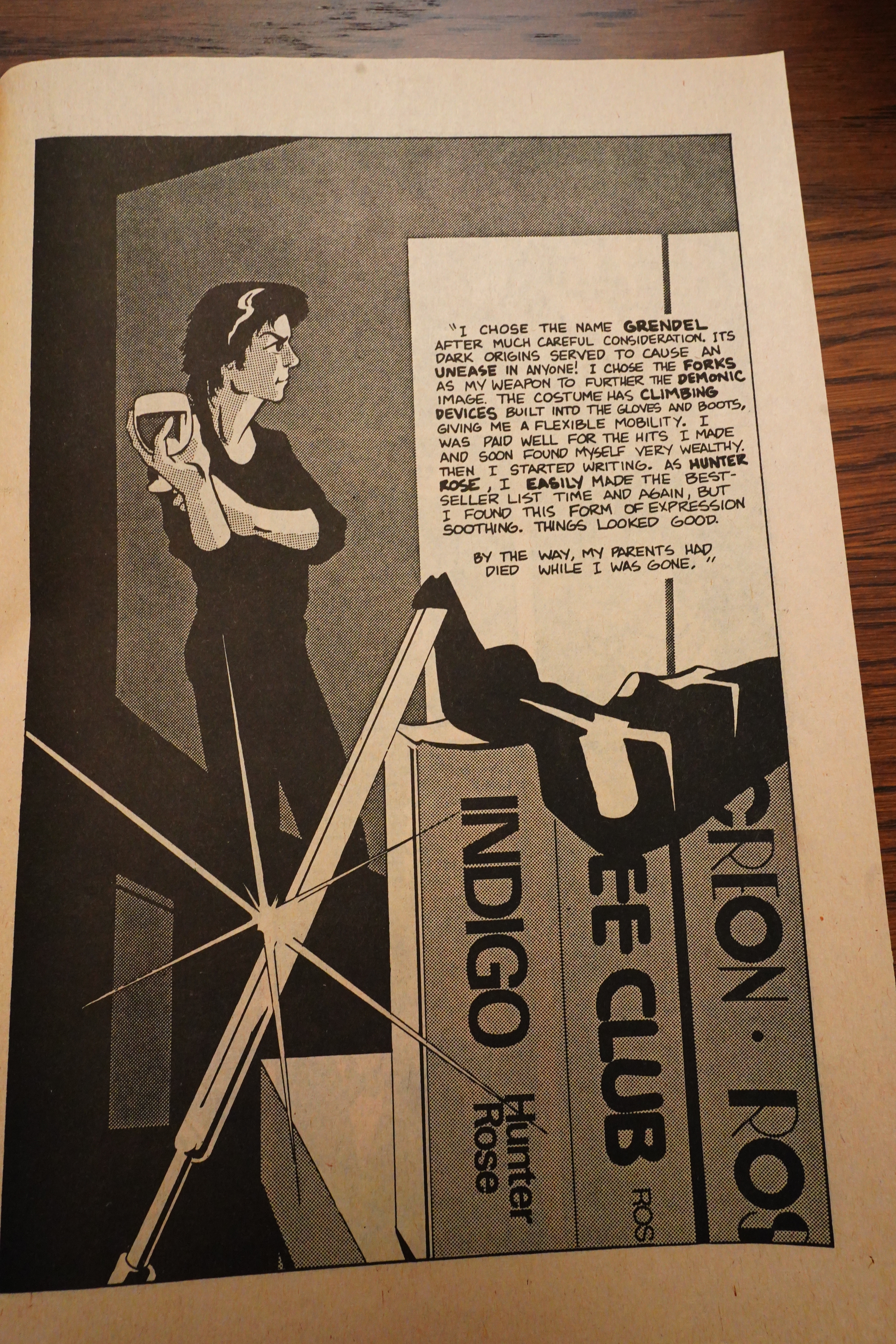
By the way. But he’s now a psycho, so he doesn’t care.
So what’s going to happen in issue two?
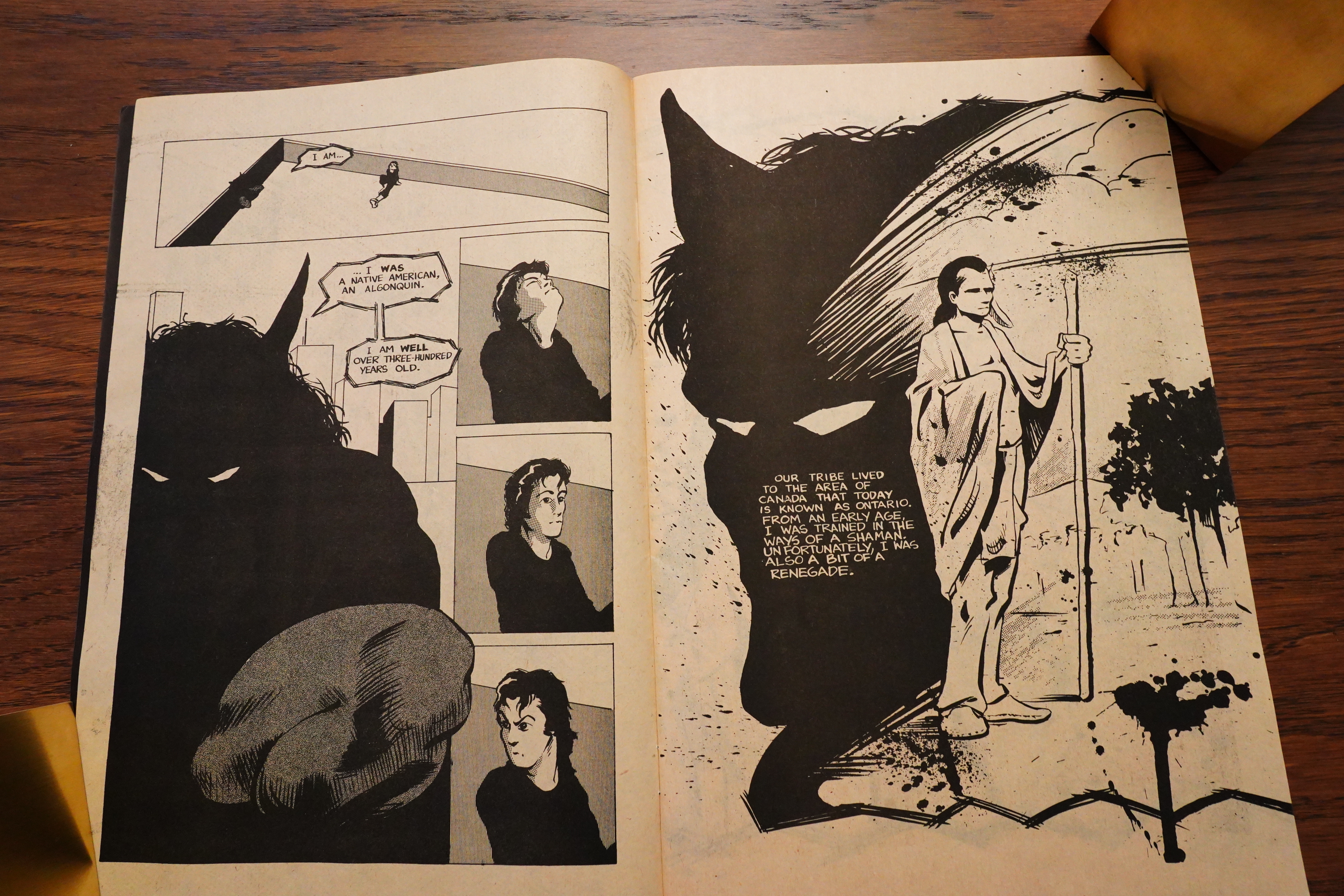
ANOTHER ORIGIN STORY! We get the origin story of the wolf guy, Argent.
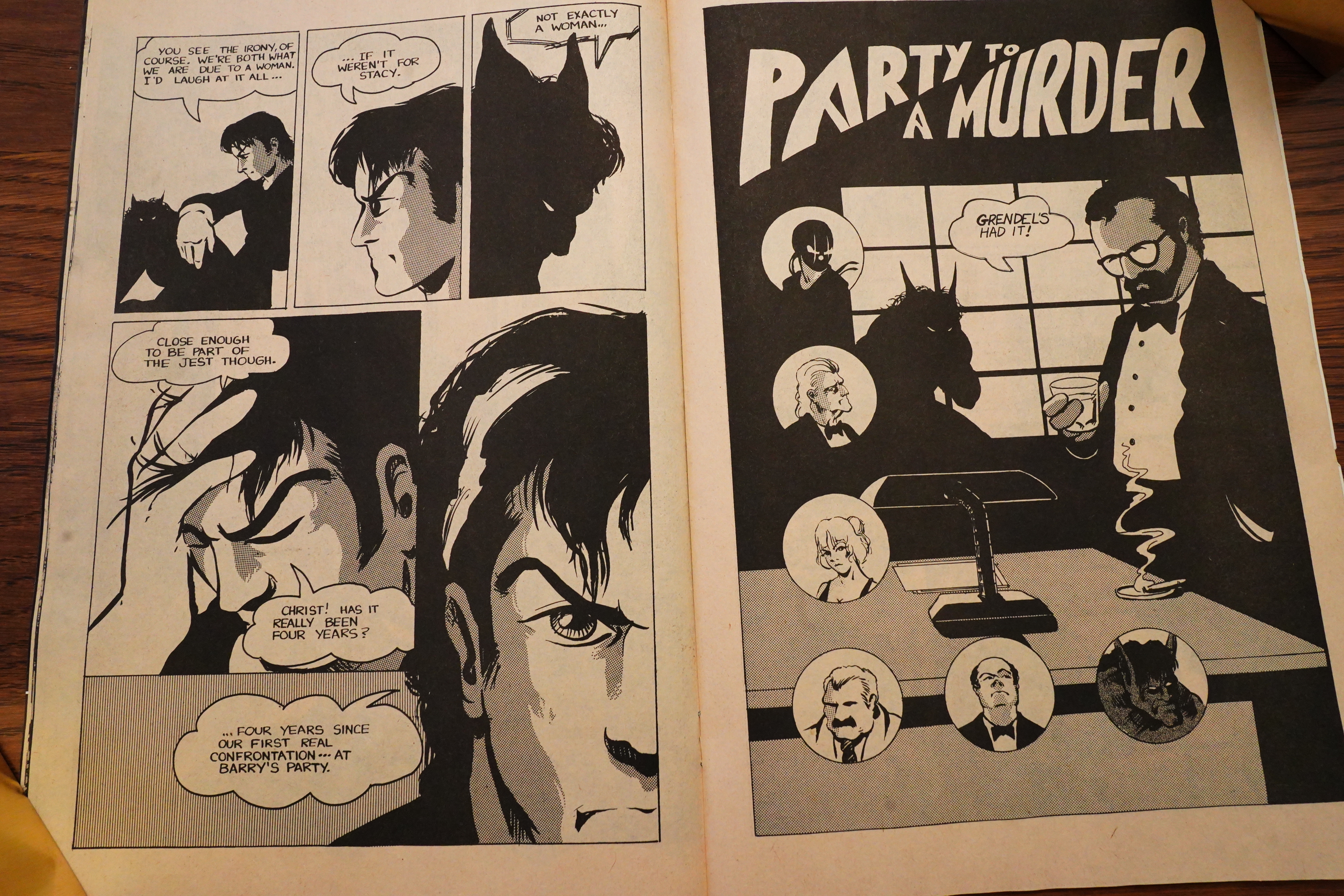
So I thought that was going to last the entire issue, but instead they start reminiscing about something that happened years ago — and this seems to be the real story that Wagner’s going to tell.
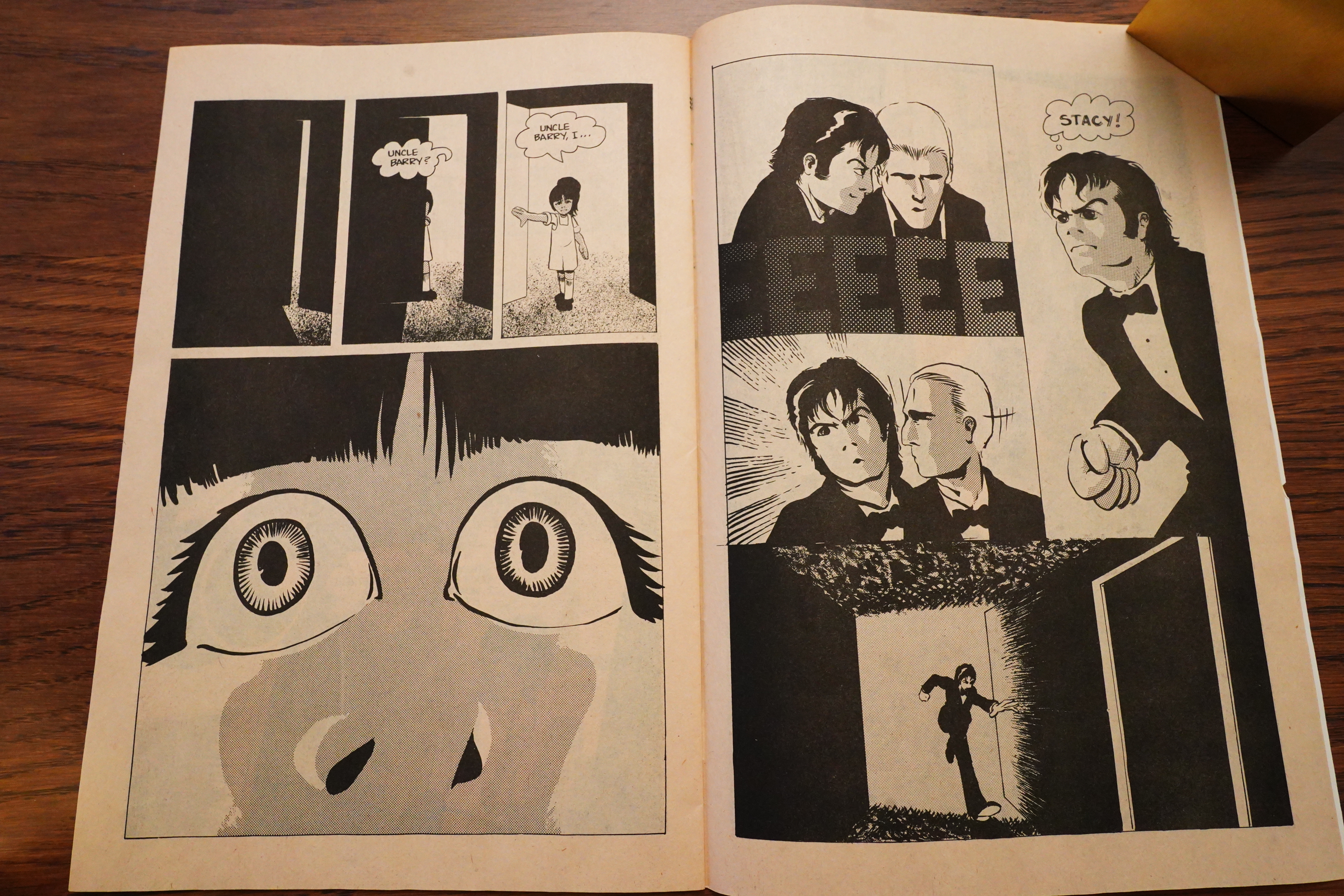
When I read this the first time, I was pretty confused — I thought the girl entered the room, finding Grendel and that guy, er, doing something… But nope; she discovers a dead body, and…
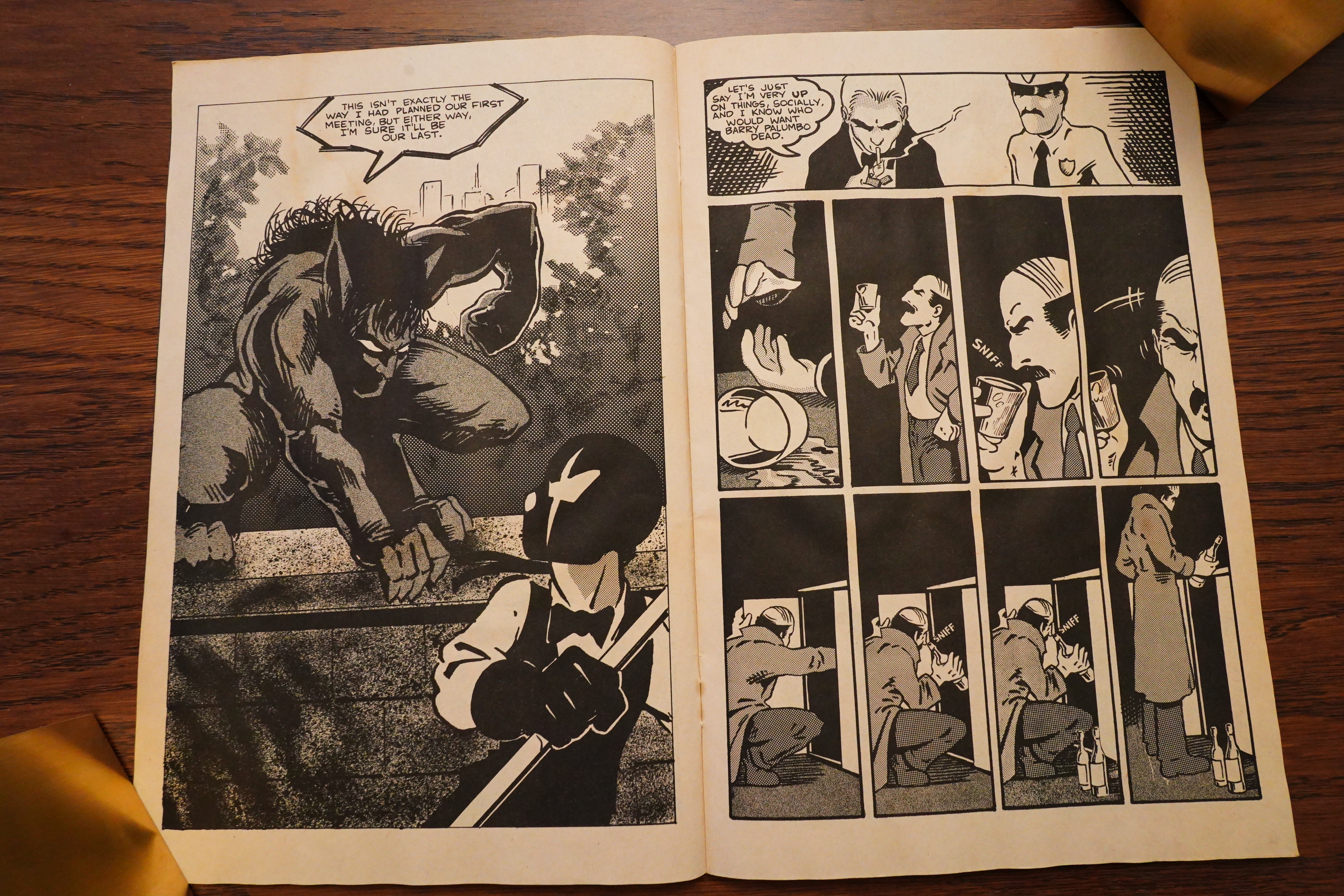
… then the rest of the issue is told in a kind of interesting way: We get a Grendel/Argent fight scene on half the pages…
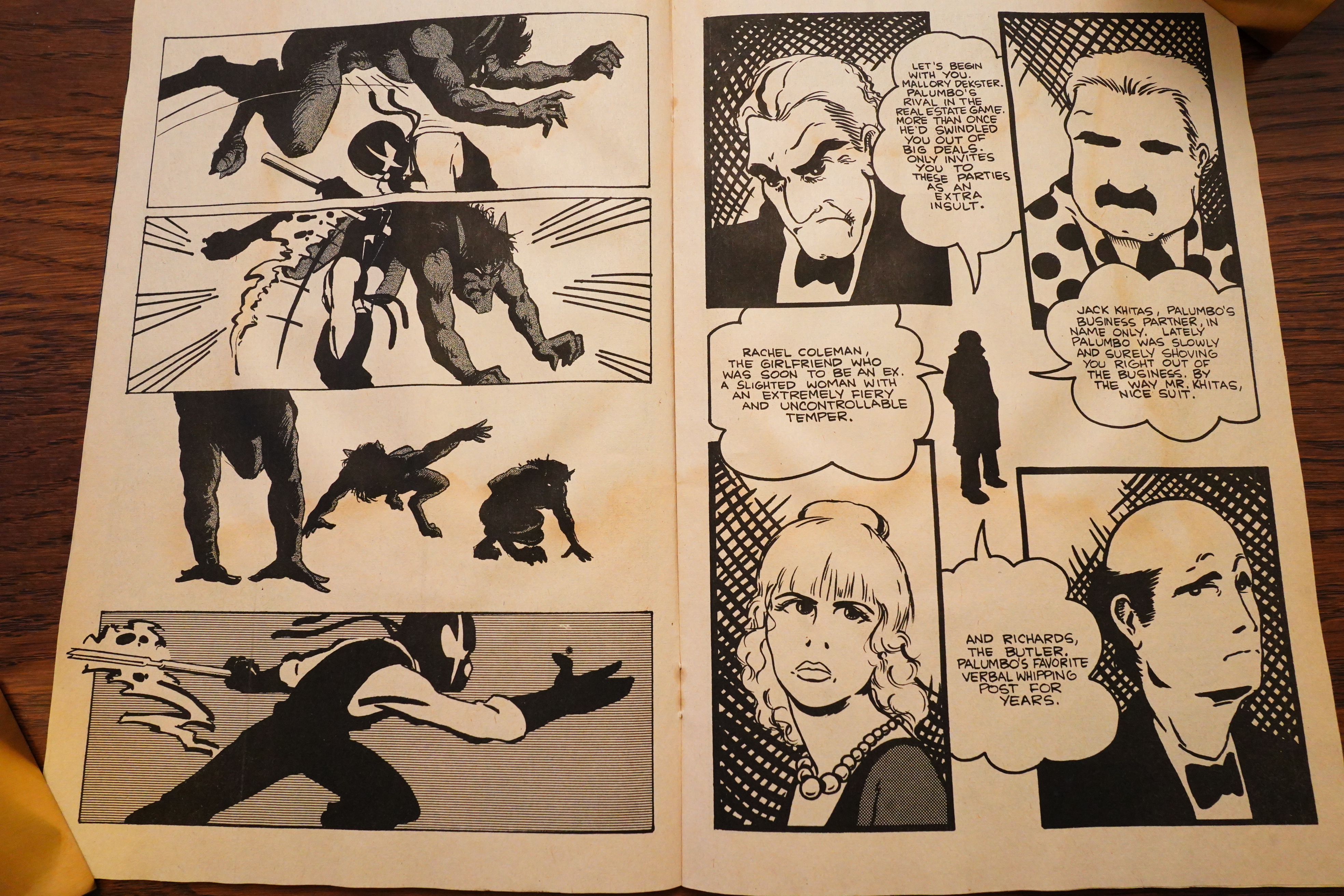
… and then a Poirot scene where a cop solves the crime. It’s not altogether successful, but it’s fun.
Reggie Byers does the inks in the third issue, and he has a line that’s more blunt. Not bad, but rather different…
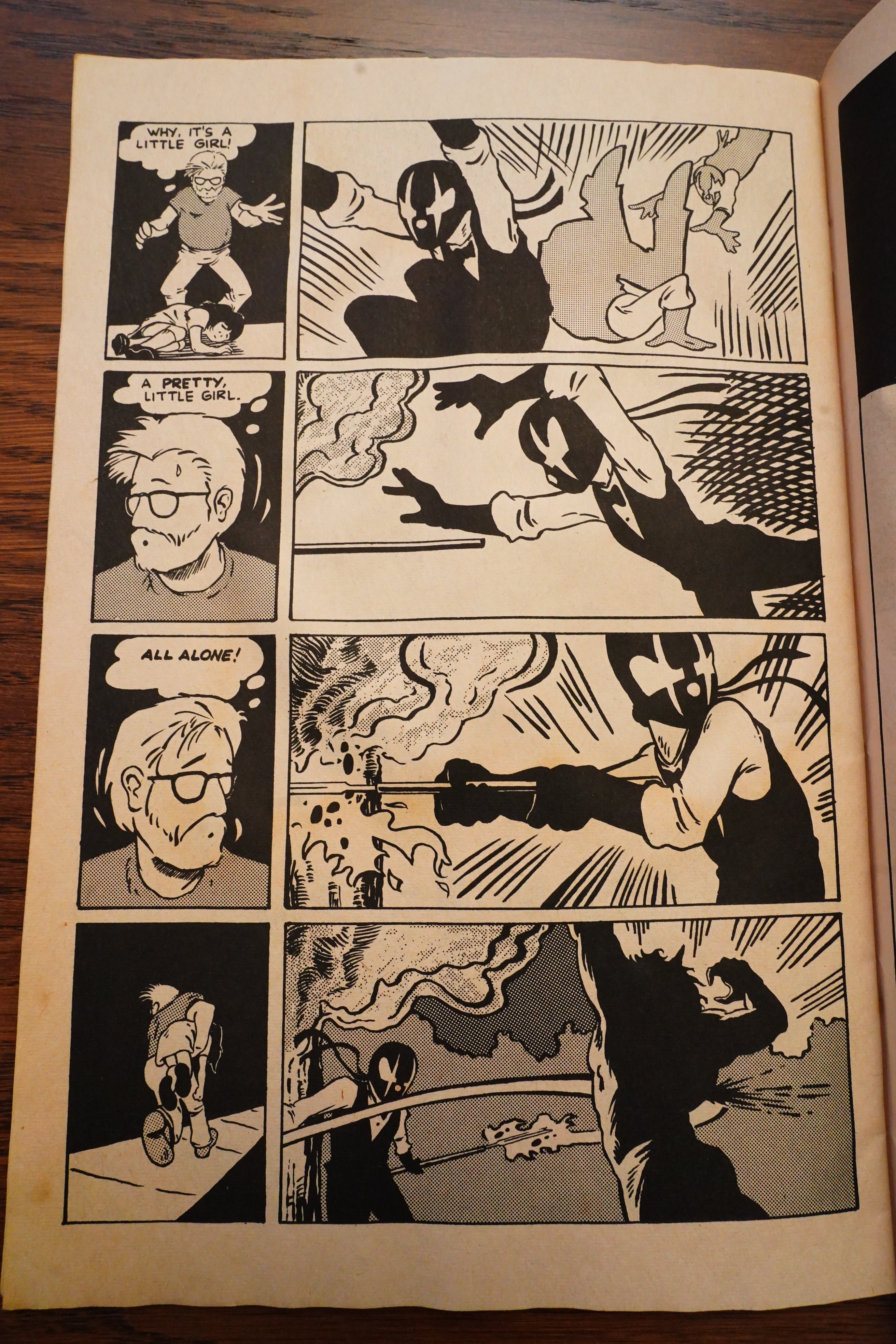
Oh, remember the girl? She totally fainted, and Grendel left her on the sidewalk for some reason, and a passing PDF kidnapped her. I’m guessing the rest of the series was supposed to have been a search for her?
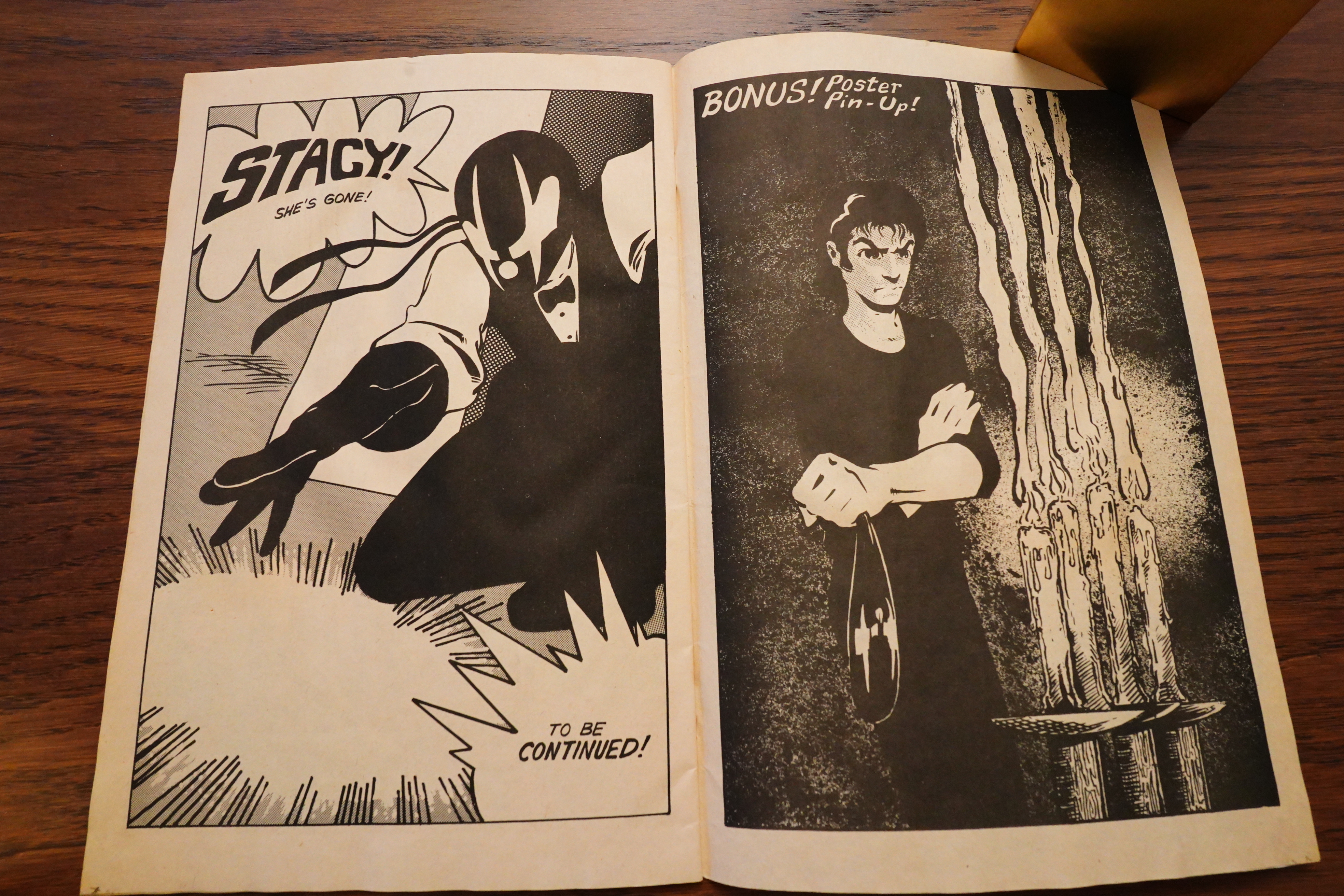
And then they announce the cancellation of the series in the time-honoured fashion of saying “To be continued”.
Wagner said in some interviews that he wasn’t keen on reprinting these issues, but it finally happened in 2007.
I’m not sure, but I think Wagner retooled this story in the Mage backups? I only vaguely recall — I guess I’ll find out when I get to Mage in a few days.
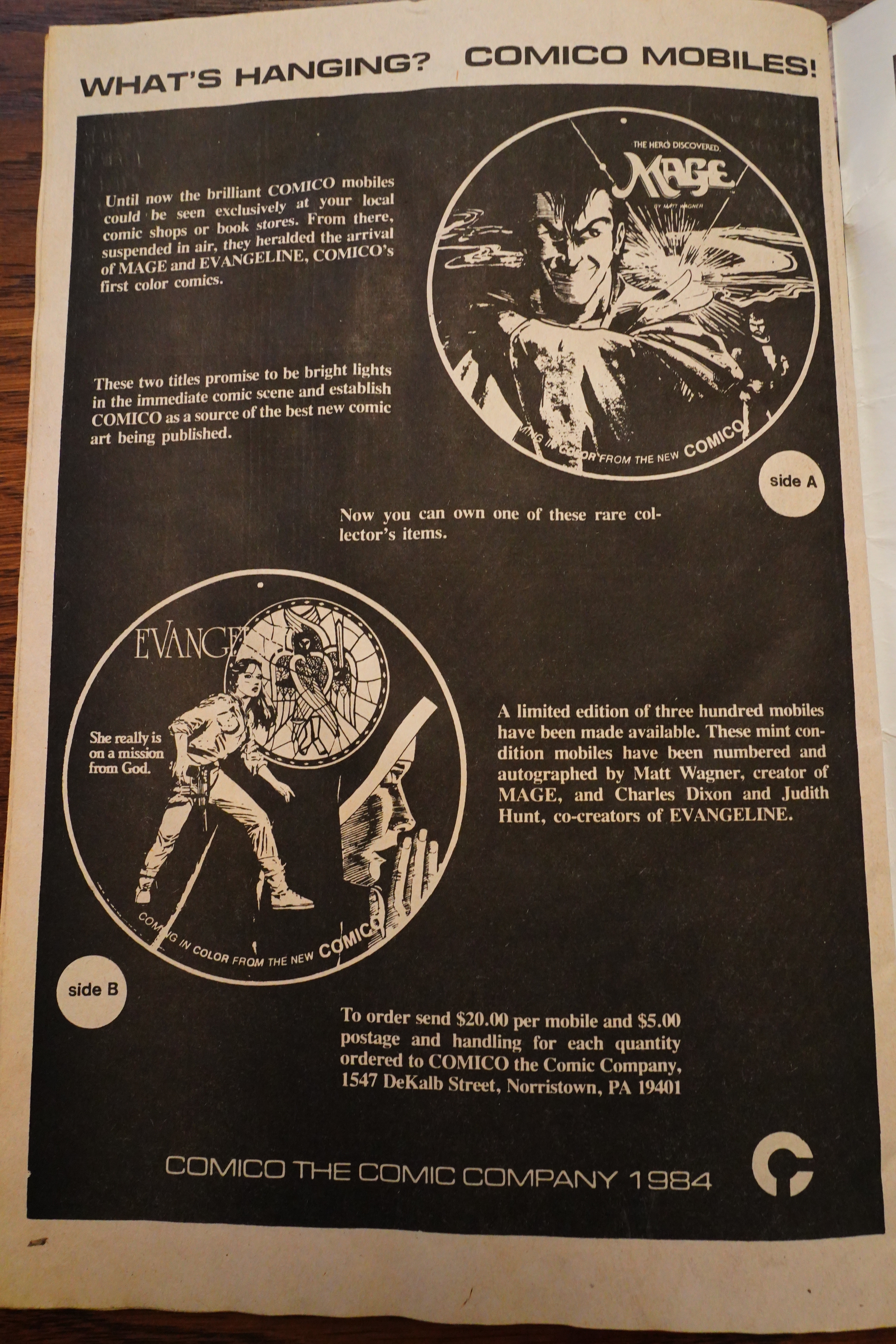
Oh, yeah, I read the blog about this:
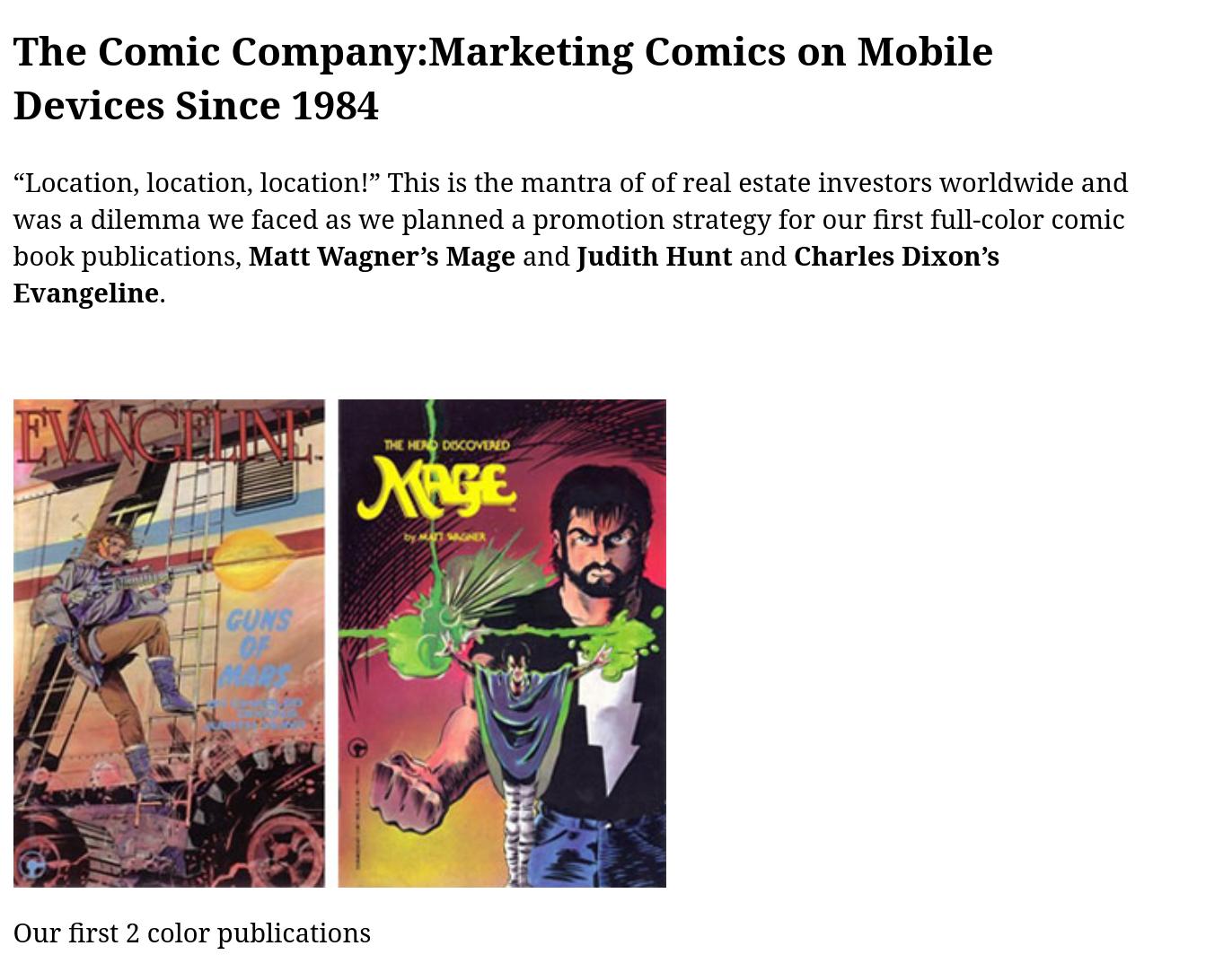
Looks pretty good:
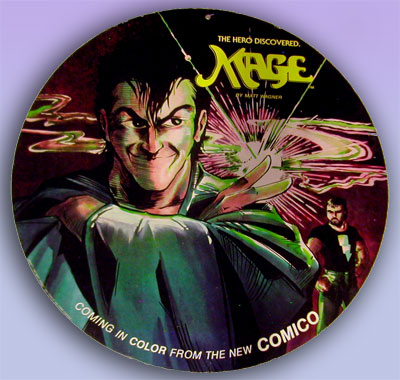
The Comico people were really into doing promos and stuff.
Anyway, Grendel is indeed what you’d call a promising series — even though it’s a bit clumsy here and there, the storytelling is on point, the artwork is interesting, and you want to know more about these characters.
Let’s see if we can find some reviews of/articles about the original series… It’s not that easy, because there’s been so many Grendel series, but…
Wizard Magazine #117, page #116:
The first three issues of the old Comico
1983 Grendel series by Matt Wagner have all
slipped a bit in price this month. That may be due to
Dark Horse’s recent reprinting of the series-recolored
and looking much better than the original, no less.
Back Issue #125, page #7:
POWERS: How did Grendel end up being published by Comico?
WAGNER: I always have people asking me how to get into comics, and I always
answer that I’m the wrong guy to ask since a large factor in how I got started was sheer
luck and happenstance.
In the early ’80s, I was attending an art school in Philadelphia, and I got on the
elevator one day and noticed a guy wearing a comic-book-themed T-shirt. We struck
up a conversation and that guy turned out to be Bill Cucinotta, one of the founders
of Comico. The core members of the earliest version of Comico were just a bunch of
college pals who had this dream of publishing independent comics—in a day when
there really weren’t so many of those yet. These guys were all “city-lads” and knew a
whole lot more about the business and production of comics than I ever had exposure
to, having grown up pretty rurally. At one point, we all dropped out of school to follow
that crazy dream, and Comico’s initial launch featured four black-and-white books, all
done by the three original guys in the group and me, Grendel being one of those titles.
Admittedly, our first efforts were crude, and the company was fairly disorganized,
but that eventually all turned around when Bob Schreck and Diana Schutz signed on
to the ranks. But that’s a whole different story in its own right.
POWERS: What are your thoughts on the early Grendel appearance in Comico Primer
#2 (1982) and the original three-issue run of Grendel (Mar. 1983–Feb. 1984)? In other
words, what did you learn from these energetic first efforts with the character?
WAGNER: Well, as I said, my initial efforts were admittedly crude but also, as you said,
energetic. Of the four premier Comico titles, only Grendel garnered much positive
response, and that’s what eventually led to me getting the chance to develop a color
title for them, which turned out to be Mage (again… a whole ‘nother story). And there’s
an old professional adage in the field that everyone has 100 pages of bad comic art that
they need to poop out first before they get to something credible and at least marginally
professional-looking.
Obviously, there were ideas in those initial Grendel issues that just wouldn’t die and
eventually led to a massive and lengthy publishing history for the character. As with
that 100-page maxim, I was definitely working through a lot of what I liked about other
people’s comics and honing in closer to what I eventually wanted my comics to be.
In effect, during those 100 pages, a comics creator learns what not to do, leaving the
excess baggage behind… most obviously in this case, the pseudo-anime style.
Still, when I look at those early issues, I can still see the elements that have defined
my art and my career ever since… the bold but clear approach to storytelling and layout,
the classic pulp-influenced scenarios, and, again, the simplicity of style. People often
assume I’m ashamed of these early efforts, and nothing could be further from the truth.
I recognize that these were the fledgling efforts of what has since proven to be a long and
continuing artistic journey.
POWERS: When you later brought back Grendel as a backup feature (Devil by the Deed)
that ran for nine parts in Mage #6-14 (Mar. 1985-Aug. 1986), you told the story in a
prose style. What inspired this radical storytelling approach to Hunter Rose’s tale?
WAGNER: After the launch of Comico’s initial black-and-white titles failed to gain much
success, either financially or critically, the company decided they needed to make the
move into producing color comics. This was just before the B&W boom of the mid-’80s,
and color seemed to be the only way to make it at that point.
As I said, of the four titles, only Grendel had gotten much positive response, and so the
company offered me the chance to develop a color title… which, again, turned out to be
Mage.
Back Issue #2, page #34:
DS: All right, and so for
everyone who continues to ask this question twenty-
one years later, are you ever going to reprint those
early black-and-white Grendels? Please say no!
MW: Yeah, I really see no reason to. It’s an unfinished
story. I later revamped that story and finished it in
Devil by the Deed. I’m too dedicated an artist to just
republish my unfinished work just for the sake of a quick
buck. Maybe when I’m 60 and there’s a necessity to
catalogue all my work in such a manner. But I get this bad
rep that I’m ashamed of that stuff and that’s why I don’t
republish it, and that couldn’t be further from the truth.
I know if that was the case, I’d never republish the early
Mages, and sure, I’ve done that over and over again.
But again, the first Mages came to fruition. That was
a complete story. Not so with those early Grendels. So I
just don’t feel a need to. Again, maybe later. In the
meantime, let them remain the collector’s items they are.
You know, if you’re such a Grendel completist that you
must have my early, unfinished work, well, that’s the path
that you chose for yourself. (laughs)
Comics Interview #14, page #45:
BILL: What led you to do comics?
MATT: One day I got on the elevator at the
Philadelphia College of Art, and there was
a guy standing there who had a Creation
Convention T-shirt on, and we struck up a
conversation. The guy was Bill Cucinotta,
now with Comico. I learned that with a cou-
ple of his friends he published an
underground newspaper at the college call-
ed DUCK WORK, which was all duck-
oriented cartoons – MY THREE DUCKS,
SPACE DUCK, PUNK DUCK, stuff like
that . So I went up and talked to them, and
then I started submitting things to them, do-
ing full-page movie take-offs, such as
RAIDERS OF THE LOST DUCK and
ROLLER DUCK. Eventually these guys
dropped out of school and formed Comico.
After they dropped out, I kind of lost con-
tact with them for about half a year, and they
called me and said, “We liked your work
and we want you to work on something for
us for the COMICO PRIMER.” That’s
when I had started developing a story bas-
ed on the Arthurian legends – and then DC
put out CAMELOT 3000. That shot my
balloon down. So then I came up with the
story of GRENDEL, and they gave Grendel
his own book. When they broke into the col-
or field, they said, “Do you have any idea
you want us to consider? We’re trying to
decide what to do for our first color book.”
And I had had this idea for MAGE kicking
around for a while, so I presented it to them,
and they liked it.
MATT WAGNER’S series Grendel
first appeared in 1982 in Comico
Primer #2, an anthology allowing
talented amateurs to gain exposure
within the comics industry. The
character of Grendel was a crime
lord with a line in snappy patter and
a moral sense that belied his
underworld position. In the story
Grendel kills a city councilman who
is using underage girls in his
prostitution ring. After this he
honours a prearranged meeting with
his nemesis, the man-wolf Argent
and, following a brief battle, makes
his escape.
This story led to Grendel being
granted its own series in a black and
white title less than a year later, at
the start of 1983. However, within
a further year and after only three
issues the title ended, its story
unfinished.
The Slings and Arrows Comic Guide #2, page #291:
After first appearing in Comico Primer 2, Matt Wagner’s
Grendel enjoyed cult success in black and white. Wagner’s
early artwork showed promise but lacked finish, and these
early strips remain more of a curiosity than an essential part
of what would become a significant tale. Wagner’s
commercial potential was fulfilled with Mage, which, from
6, contained a Grendel back-up. Christine Spar’s novel,
‘Devil by the Deed’ (reprinted by Dark Horse), is beautifully
designed and rendered by Wagner, falling somewhere
between comic strip and illustrated story.
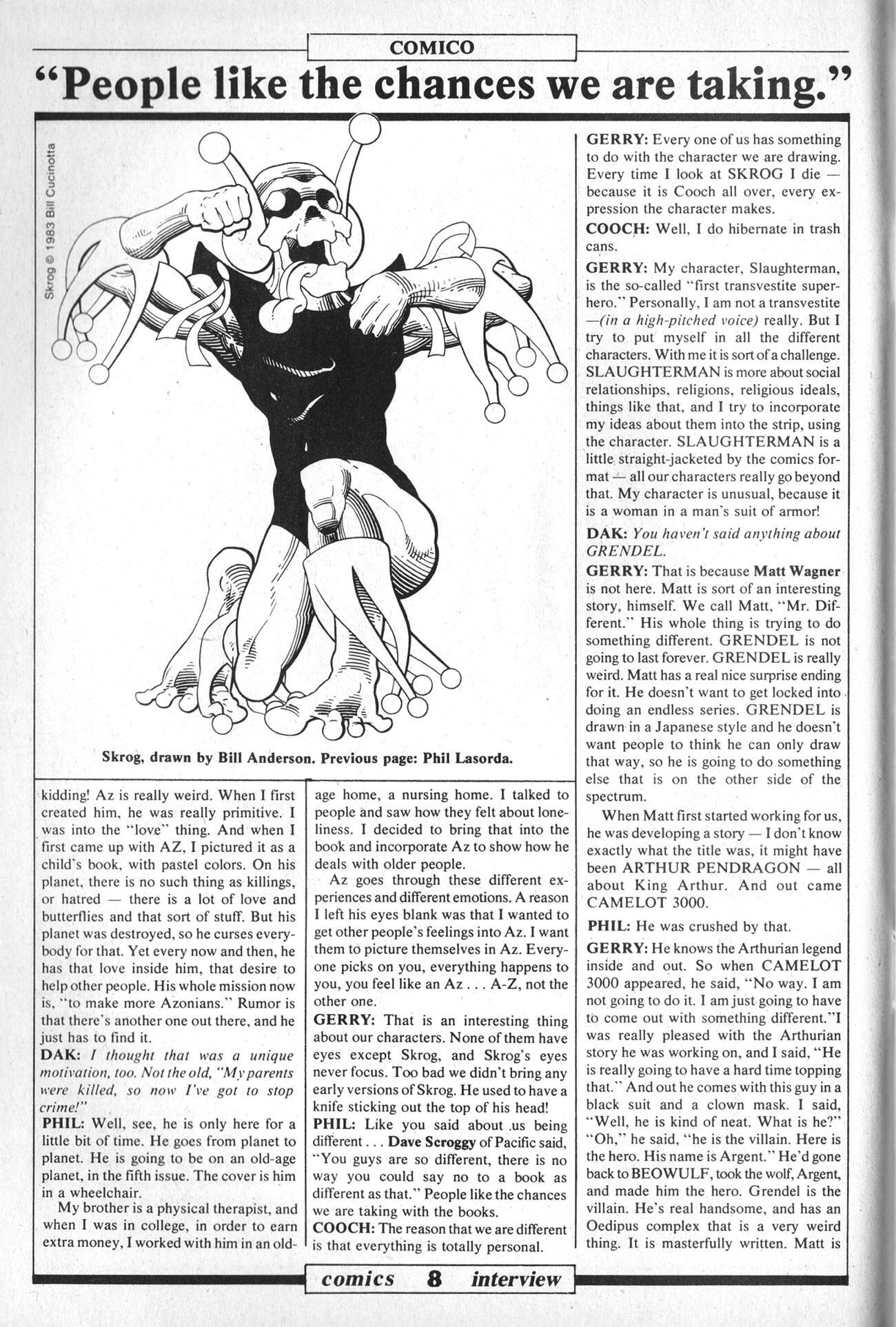
DAK: You haven’t said anything about
GRENDEL.
GERRY: That is because Matt Wagner
is not here. Matt is sort of an interesting
story, himself. We call Matt, “Mr. Dif-
ferent.” His whole thing is trying to do
something different. GRENDEL is not
going to last forever. GRENDEL is really
weird. Matt has a real nice surprise ending
for it. He doesn’t want to get locked into
doing an endless series. GRENDEL is
drawn in a Japanese style and he doesn’t
want people to think he can only draw
that way, so he is going to do something
else that is on the other side of the
spectrum.
When Matt first started working for us,
he was developing a story – I don’t know
exactly what the title was, it might have
been ARTHUR PENDRAGON – all
about King Arthur. And out came
CAMELOT 3000.
PHIL: He was crushed by that.
GERRY: He knows the Arthurian legend
inside and out. So when CAMELOT
3000 appeared, he said, “No way. I am
not going to do it. I am just going to have
to come out with something different.”I
was really pleased with the Arthurian
story he was working on, and I said, “He
is really going to have a hard time topping
that.” And out he comes with this guy in a
black suit and a clown mask. I said,
“Well, he is kind of neat. What is he?”
“Oh,” he said, “he is the villain. Here is
the hero. His name is Argent.” He’d gone
back to BEOWULF, took the wolf, Argent,
and made him the hero. Grendel is the
villain. He’s real handsome, and has an
Oedipus complex that is a very weird
thing. It is masterfully written. Matt is
twenty-one years old, and I think he is
going to be the next Frank Miller.
PHIL: Matt is that type of person. He
can really catch you with a story. When I
first read GRENDEL I really got emo-
tionally into it; I just couldn’t wait for the
second one.
Matt is very dramatic at staging his
characters. He loves drawing capes, as an
example. He makes a cape take a form
with the character. A lot of people draw
capes and just let them fall wherever.
Matt’s capes take a shape, and each one is
sculpted to fit the character. He did a
picture of Batman on a roof, looking
down, and a little part of the cape goes
over the ledge. Just a little tip, hanging
there.
GERRY: But it is so dynamic.
PHIL: It is the best part of the whole
picture. Batman looks so menacing . . . so
evil. When I look at Matt’s stuff I get
emotional and upset. I say, “God, why
can’t I ever think of something like that.”
We are speaking very highly of Matt,
because Matt is going to be very big.
There is no way that he can’t.
Well, they were right about that.
Amazing Heroes #108, page #61:
In Grendel’s original incarnation (in
Comico’s Primer #2 and three issues
of his own title), Wagner told a fairly
straightforward comics story. His art
was amateurish, but pleasing-a
combination of Japanese animation
and Frank Miller’s Daredevil.
The initial ten-page Primer story
did little more than introduce the
two main protagonists, a nobly-
motivated assassin, Grendel, and a
champion of good, the “wondrous
wolf” Argent. Once the series grad-
uated into its own book, Wagner
threw in a few twists.[…]
Unfortunately, the story ended
there, at least temporarily, as Com-
ico cancelled their black-and-white
line and Grendel #4 never appeared.
It’s sad to note that in the past
year, the original Grendel series has
become one of those hot, small
print-run independent phenomena,
with copies going for ridiculously
inflated prices. As result, many
comics readers will never see Wag-
ner’s original version of Grendel.
No, I’m just unable to find any reviews in contemporary magazines of the original Grendel series — there may be some, but there’s so much written about Grendel that it’s just hard to narrow down the searches. And the same is the case for the intertubes. *sigh*
Oh, boy, this is a rabbit hole.
“Did Wagner read Japanese comics at the time? Some of the artwork looks somewhat Japanese influenced, especially when he draws children. Perhaps he’d seen the Robotech animated series or something?”
It was the early 1980s.
The Philadelphia College of Art had a number of student housing units and dormitories sprinkled in and around the neighborhood of the school that was mainly situated at an office building at Broad and Spruce. Wagner lived in a tenement like building in the 1400 block of Spruce Street which some of the tenants referred to as “The Swamp” a la M*A*S*H*.
As I said before, it was the early ’80’s. Philadelphia did not get cable television until 1987, and trying to get a watchable signal with rabbit ears was nearly impossible. It seemed perfect for art students because they had no other choice but to hit the books or work on art projects. Otherwise there was reading, records or role playing games. If you had money, there were movies and arcades.
The comic book fiends all gravitated to one another and shared reading material. There were two guys in that same tenement building, both illustration majors who may have played a pivotal role in the Japanese influence. They were Mike Leeke and Dave “Crusher Dave” Johnson who lived and breathed Japanese animation. They were regulars at the Philadelphia branch of the C/FO or the Cartoon/Fantasy Organization and would scarf up anime books and any VHS cassettes they could lay hands on. Everybody knew Speed Racer and Astro Boy, but these guys were really tuned into the stuff that was unknown in the USA at the time. I remember them going on about Captain Harlock, Crusher Joe and Lupin III.
Ultimately, Leeke and Johnson worked on Robotech titles for Comico. They were and probably still are good draftsmen, but I think they won the Comico Japanese titles because they knew Japanimation as it was known back then inside and out.
I know these guys played role playing games together as well as trading reading materials. I think that is where the Japanese influence came in, and it was a smart move on his part. It was simple and it stood out.
I was in classes with Wagner, and his stuff back then looks more like it does now.
If you go to my site, do a search for DUCKWORK. You can see some of Wagner’s early works.