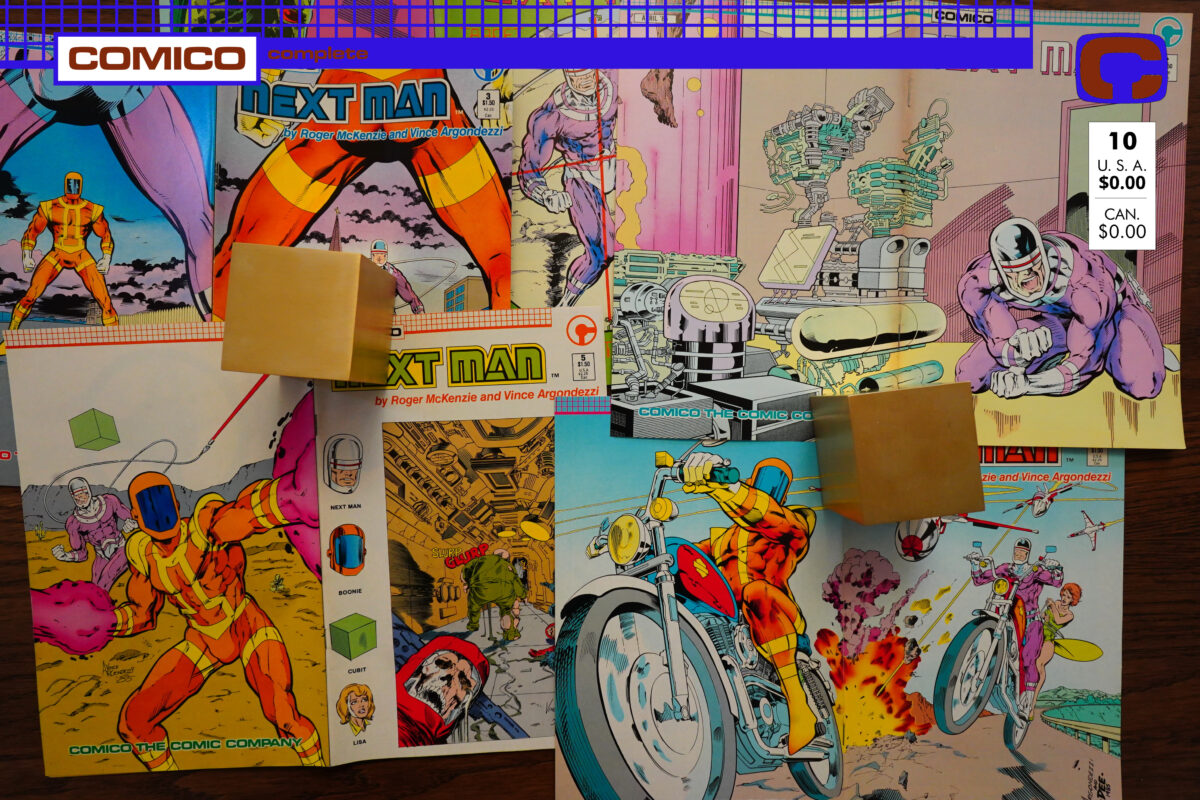
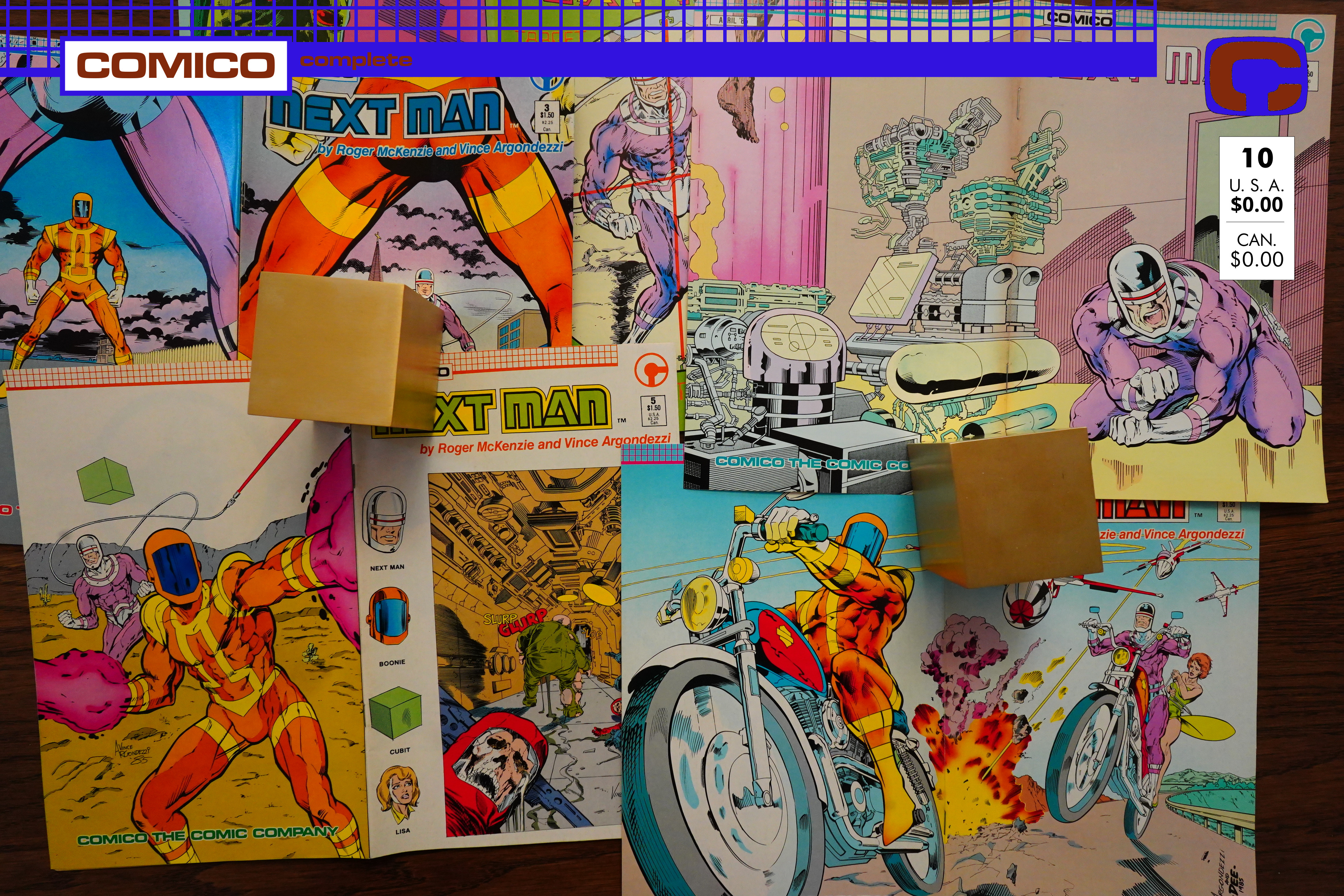
Next Man (1985) #1-5 by Roger McKenzie, Vince Argondezzi et al
Hm… Roger McKenzie… Oh, he wrote Sun Runners, which wasn’t very good. And it was creepy. But he’s mostly known for his work at Marvel in the early 80s, I think. Yup. And he left comics a couple years after this series.
And when I saw “Next Man”, I thought of John Byrne’s Next Men, but that was apparently done after this series?
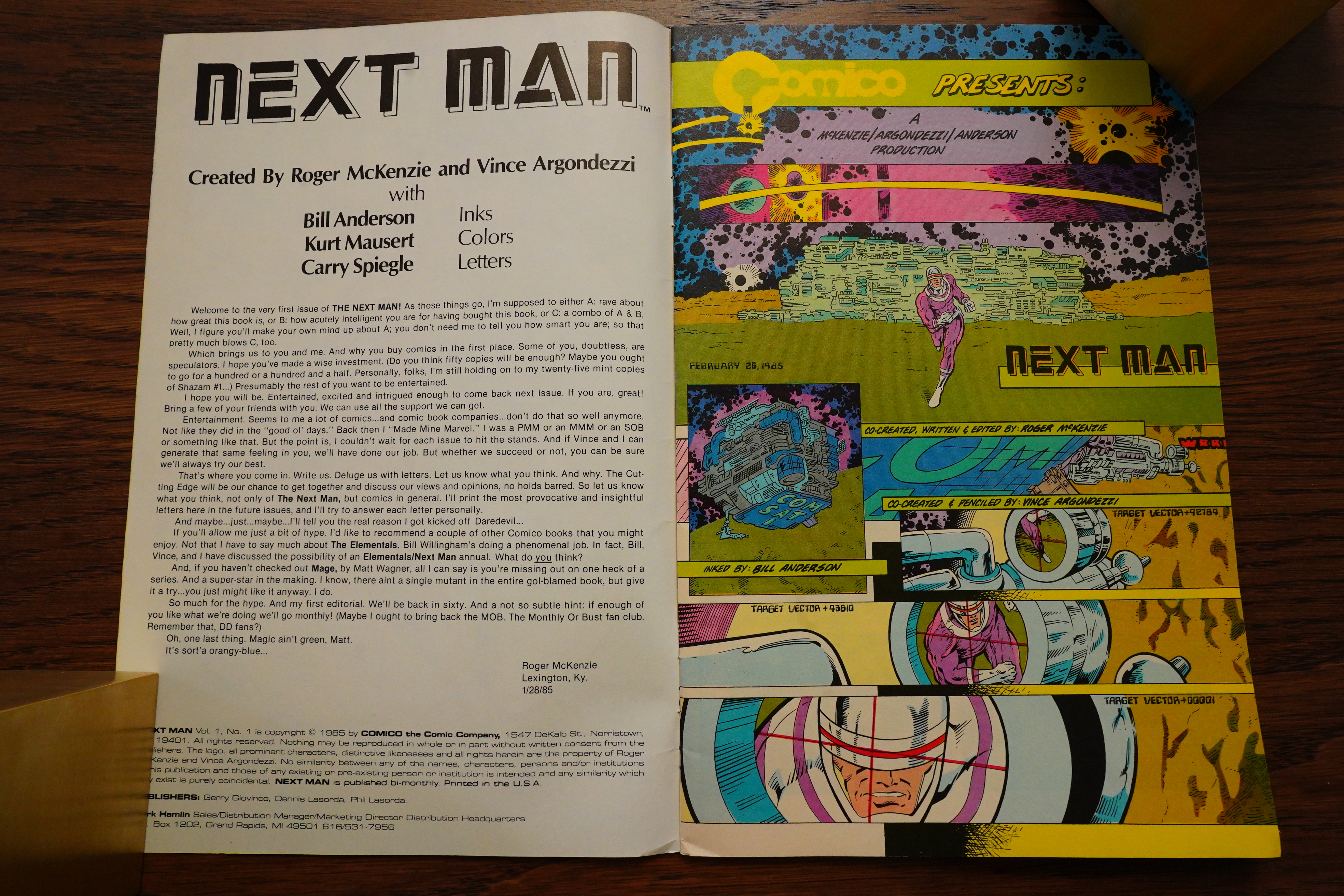
Oh, there’s apparently some story to be told of how he was booted from Marvel? I mean left.
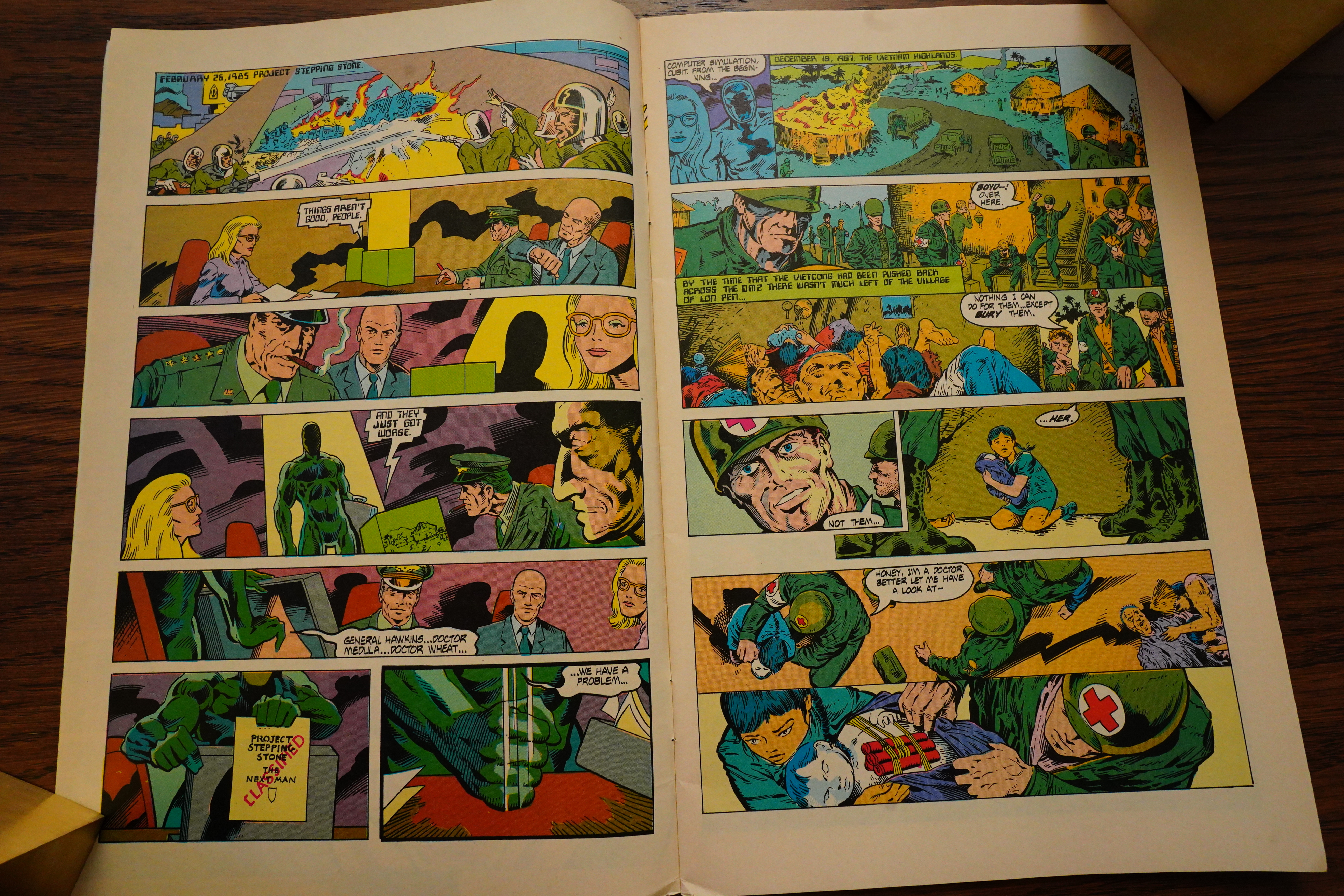
Well, OK, this seems extremely standard — some dastardly military organisation took a soldier semi-killed in Vietnam and made him into a super soldier. And Argondezzi seems like he’s a mega Kirby fan — I mean, at least as far as inking male faces go. It looks like he’s concentrated on copying that, and then just ignored things like “learn how to draw”.
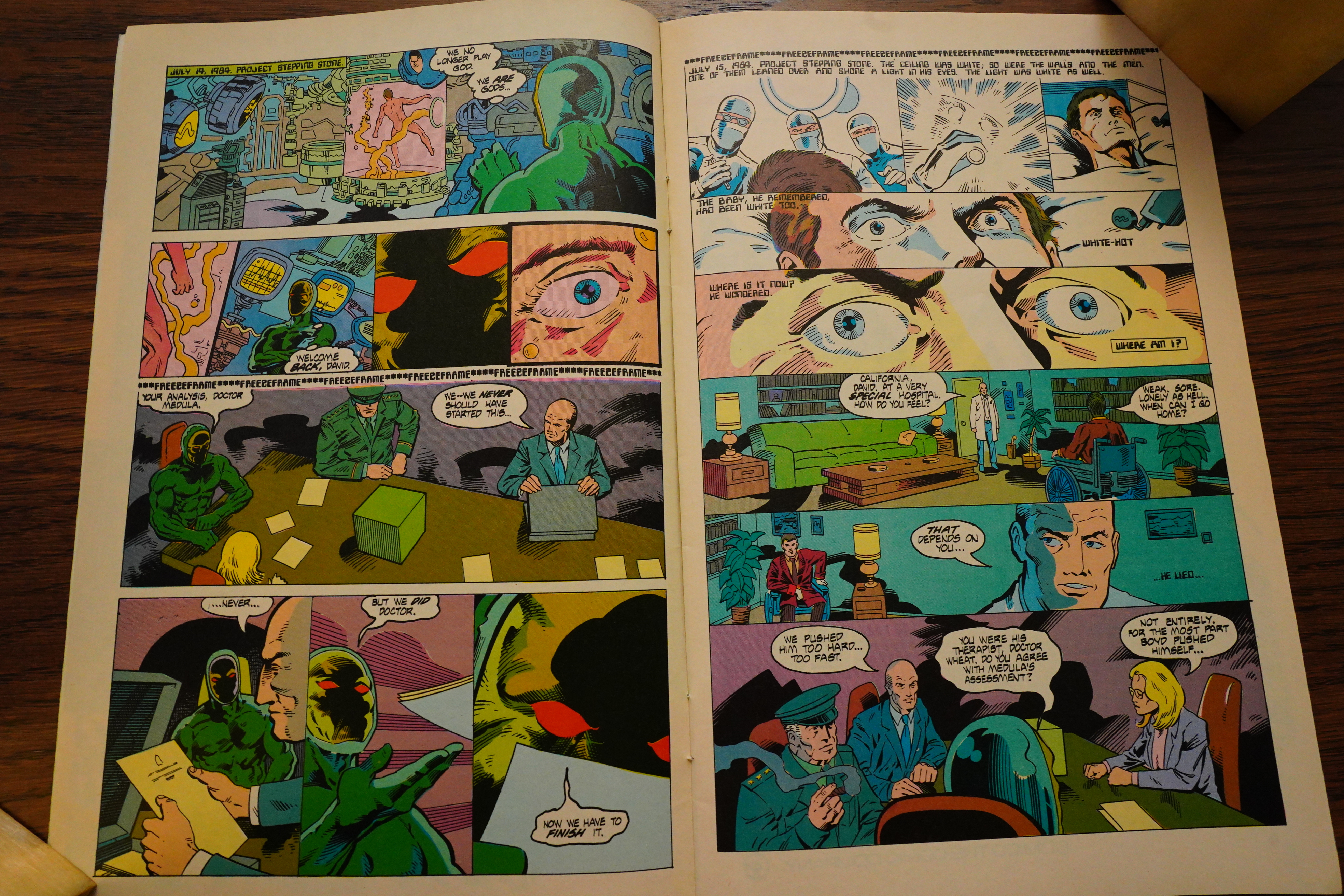
Well, OK, that’s original — there’s an… er… alien running the agency?
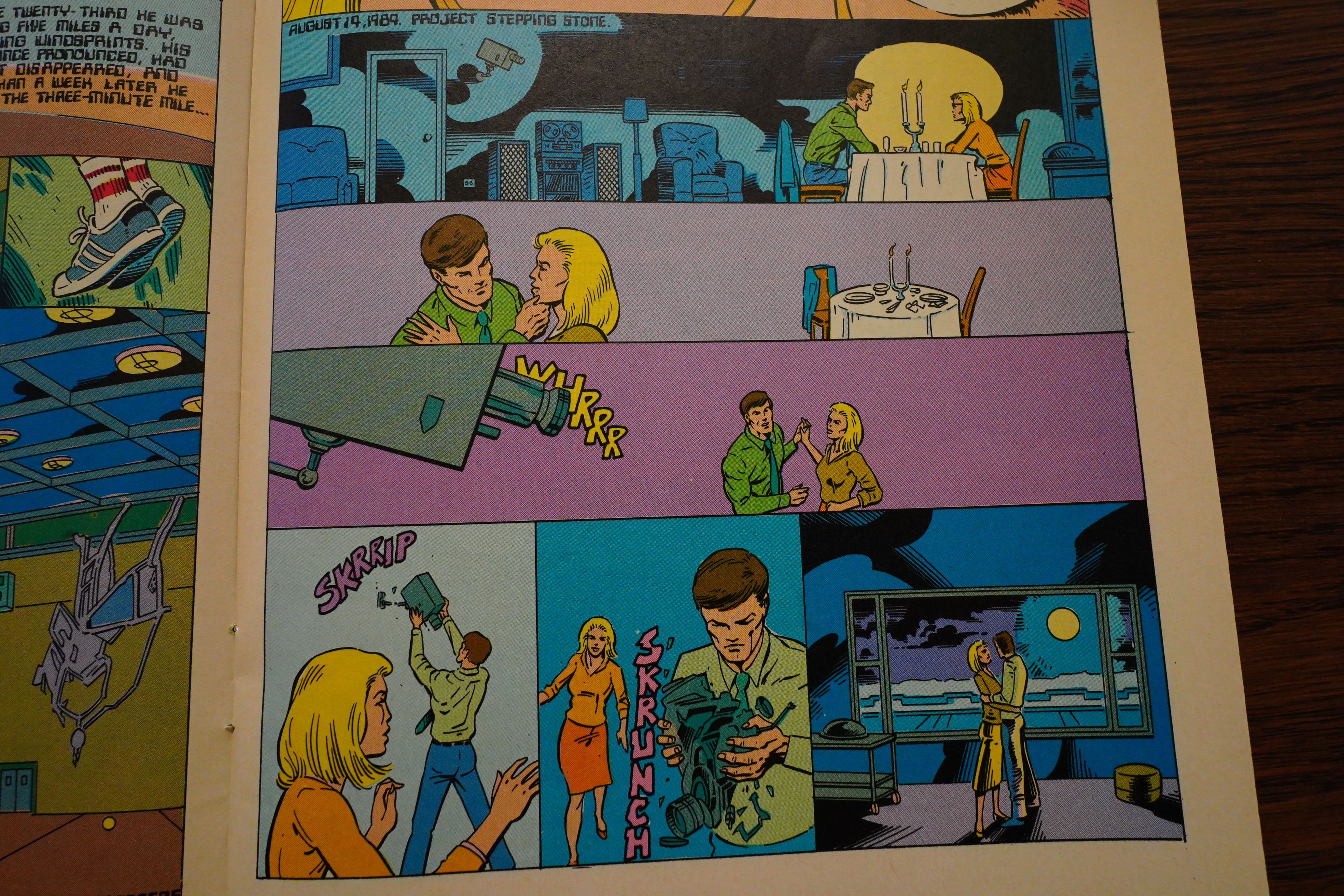
Oops! The dastardly organisation shouldn’t have used a camera that goes WHRRR whenever soldier/super guy is going SCHWING, I guess. I mean, is getting into a romantic mood! Live and learn! Use WHRRR-less cameras, dudes!
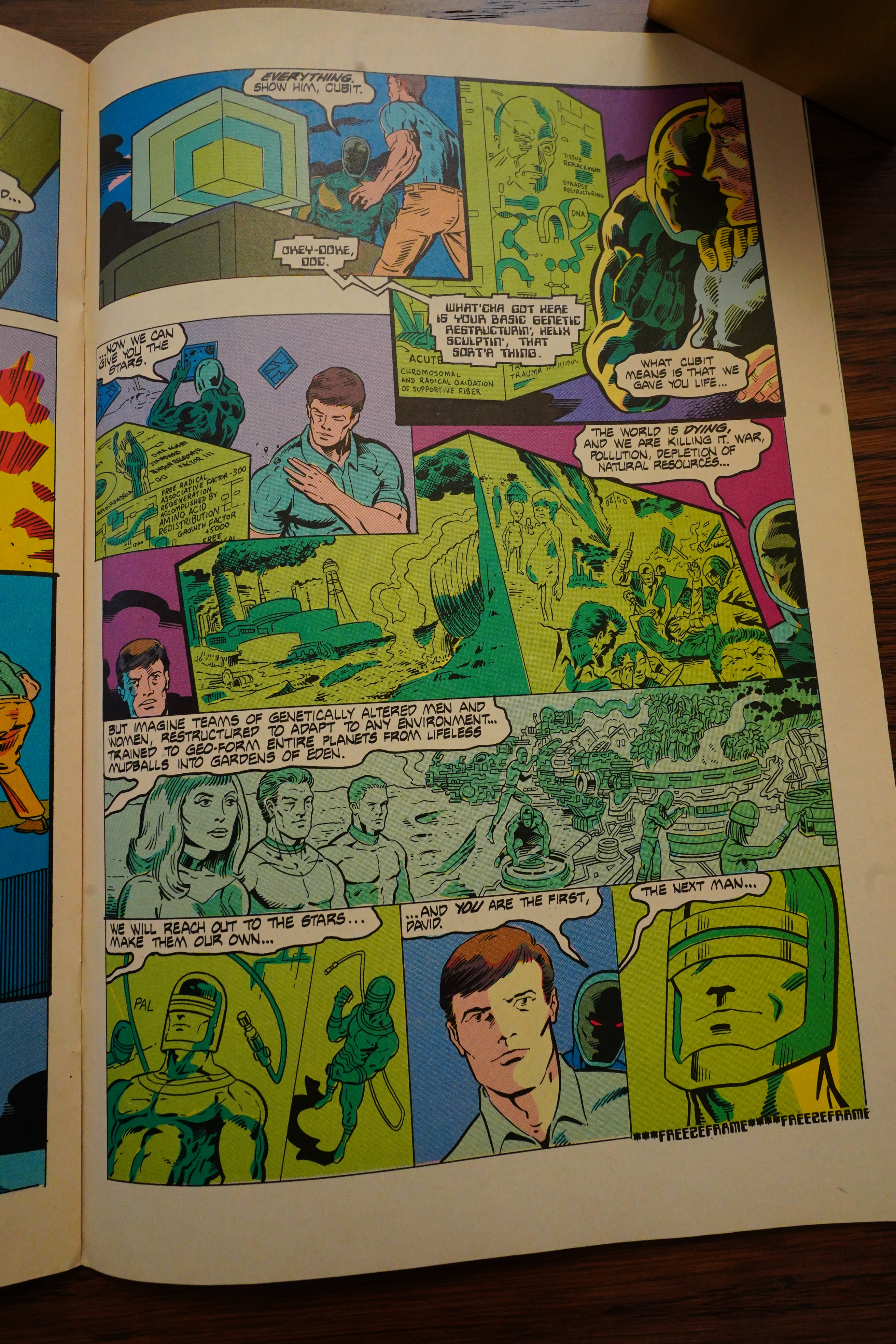
OK, they’re sending him to space? Makes sense.
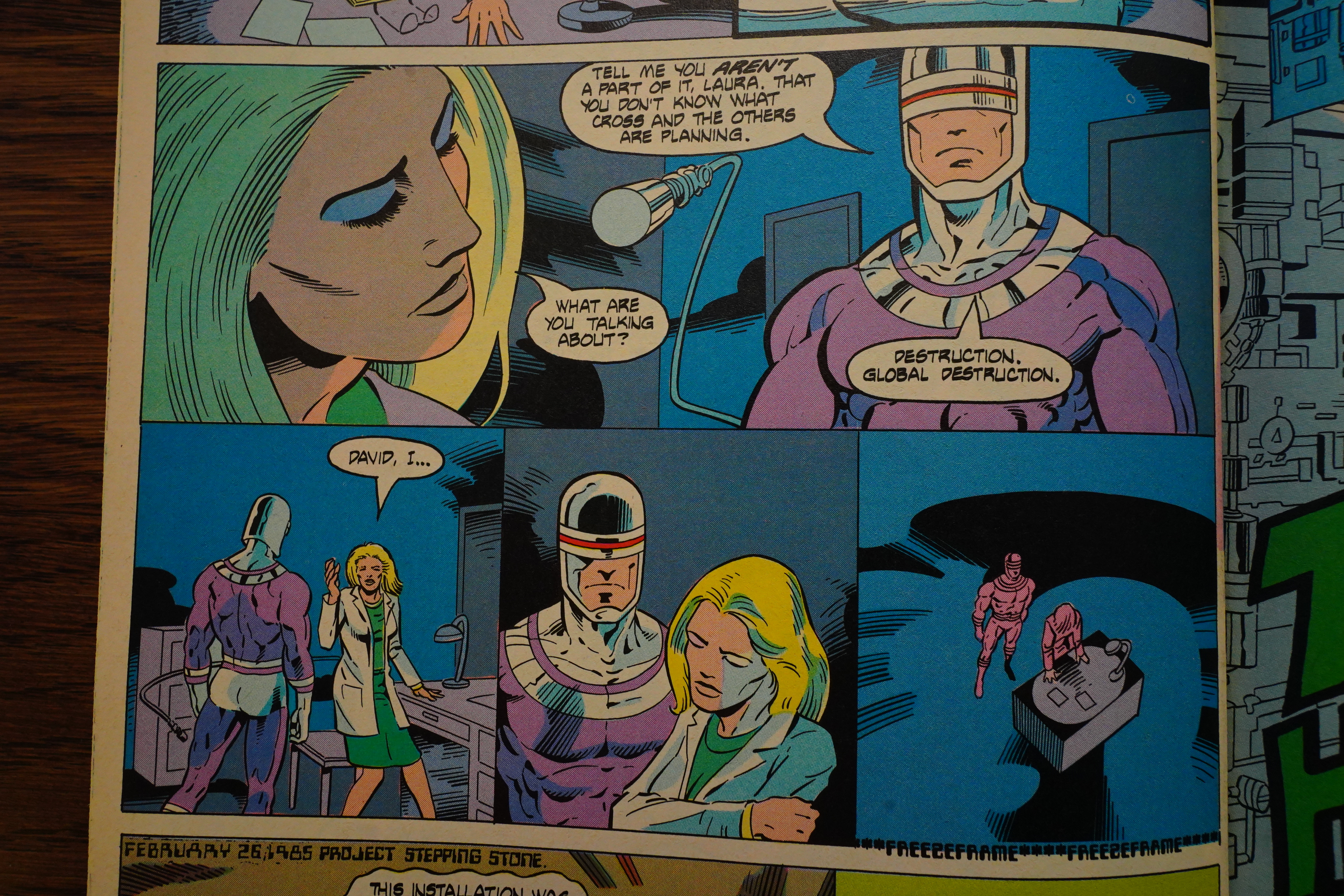
But the dastardly organisation is going to destroy the Earth first?! Because of reasons. And the science woman/love interest gets up in her feelings when confronted. Next Man is rude. No consideration.
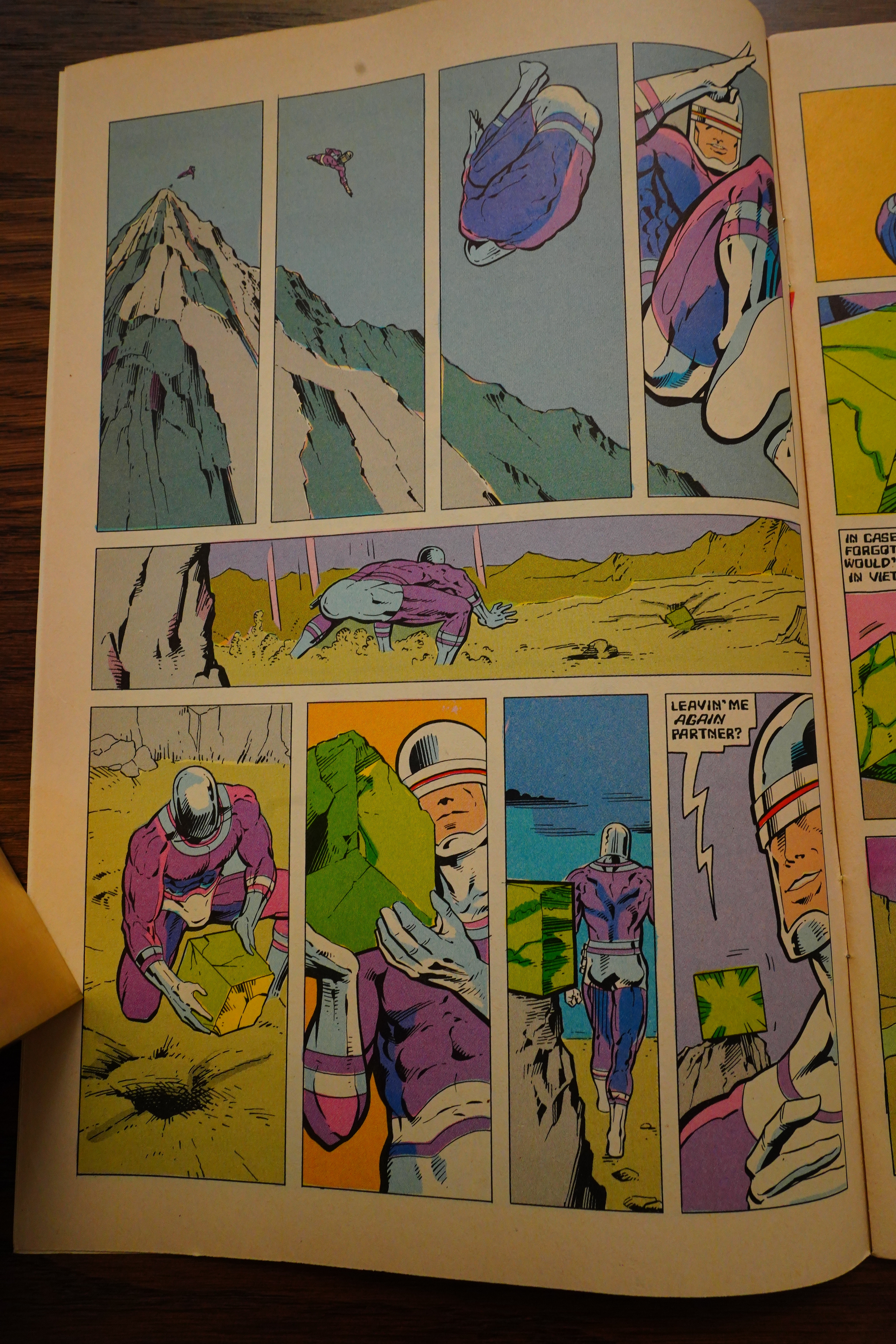
Fortunately there’s a comedy sidekick — a green floating computer cube.
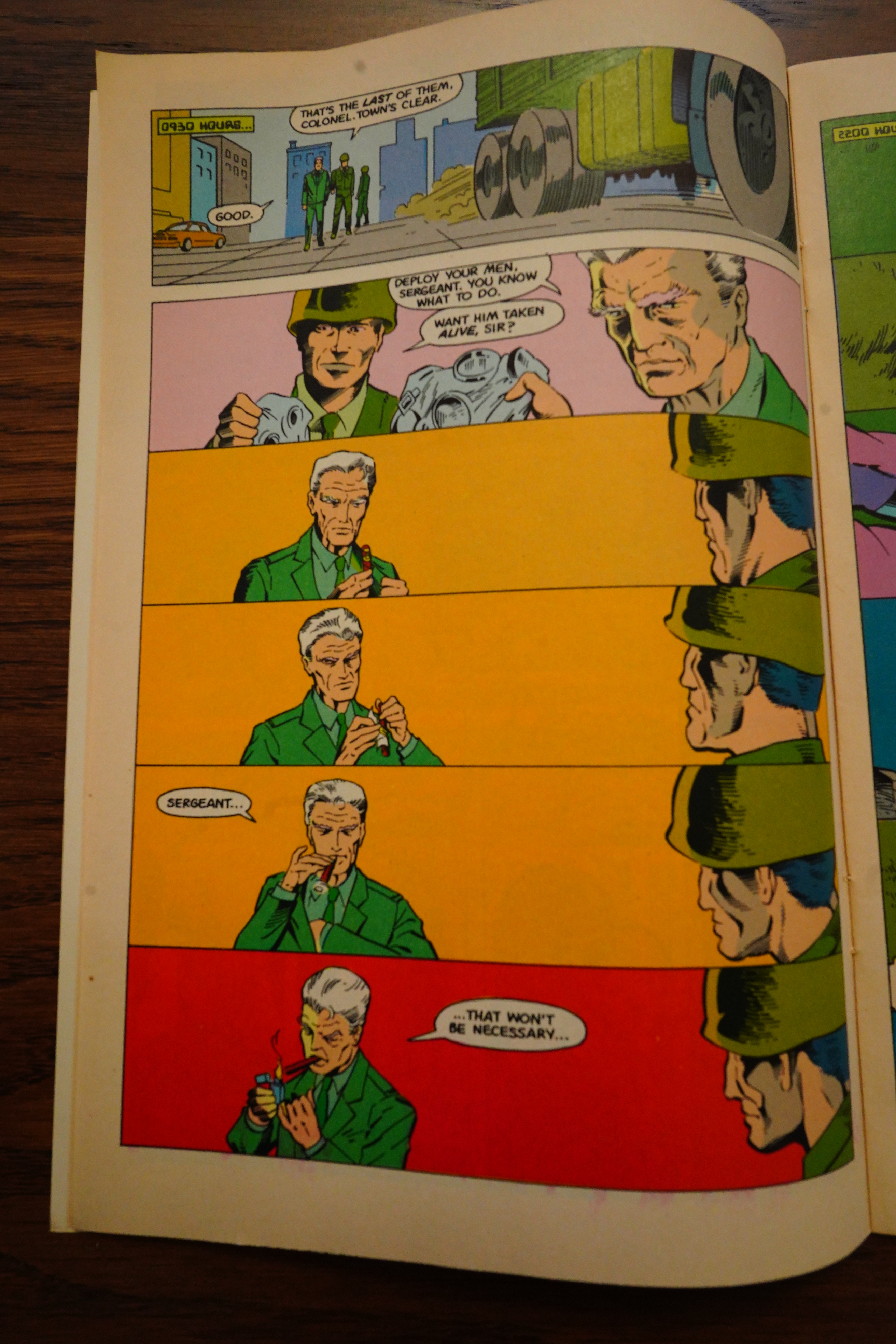
These issues are quick reads — I guess these days we’d call it “decompressed storytelling”, so McKenzie was ahead of the curve on that point. It’s just that these scenes lean so heavily on familiar scenes from movies that they read like if they’re parodies, really. A scene like this, where you take a beat for the hard-as-nails general to give a callous order, works in movies because you can enjoy the actor playing the general chewing up the scenery while lighting that cigar, but the artwork here is so basic that there’s basically nothing for the reader here to do but go “oh, I recognise the scene they’re trying to do; OK”.
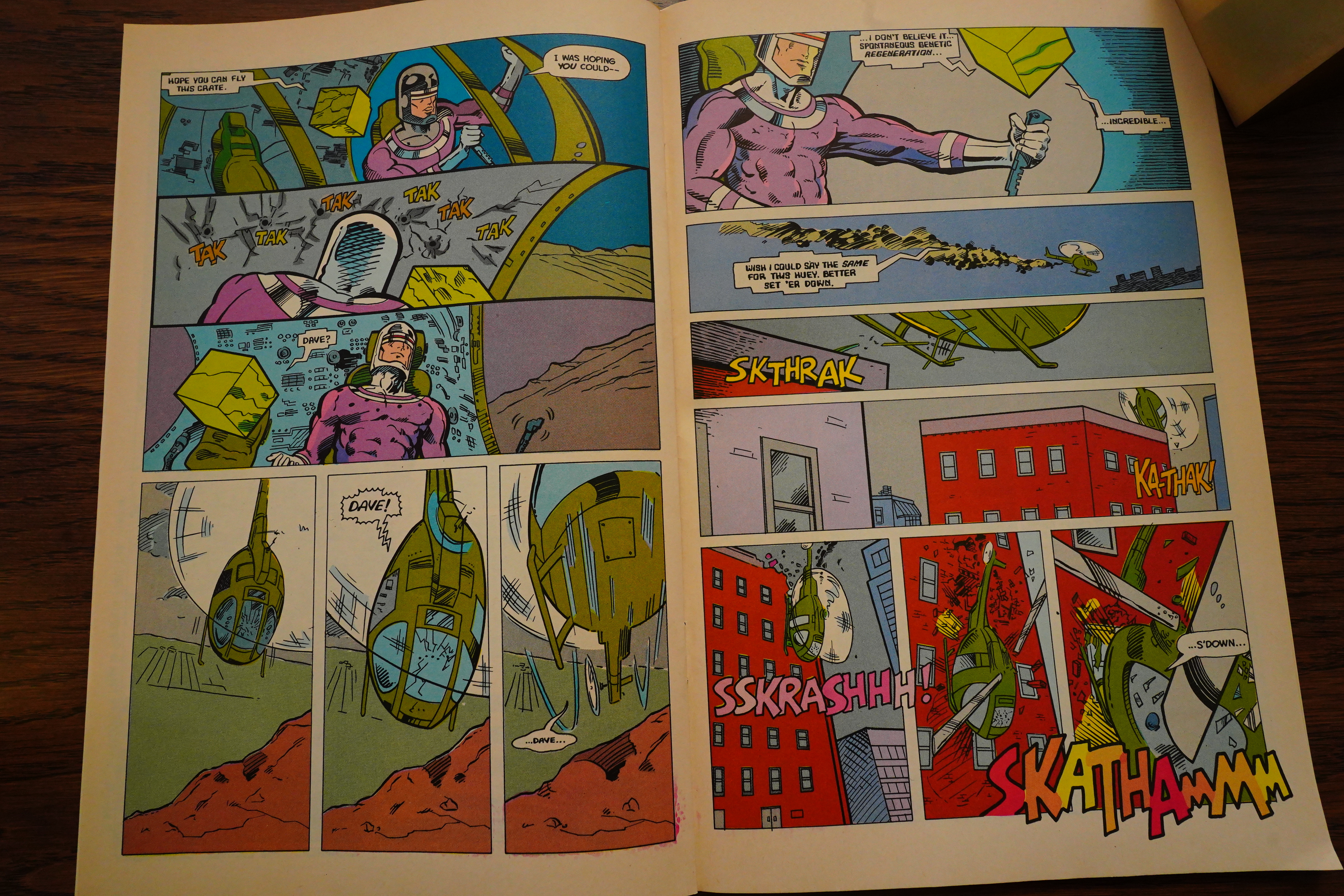
There’s page after page of… “thrilling action”… but the storytelling is inept, and the artwork takes some scrutiny to try to find out what’s supposed to be going on.
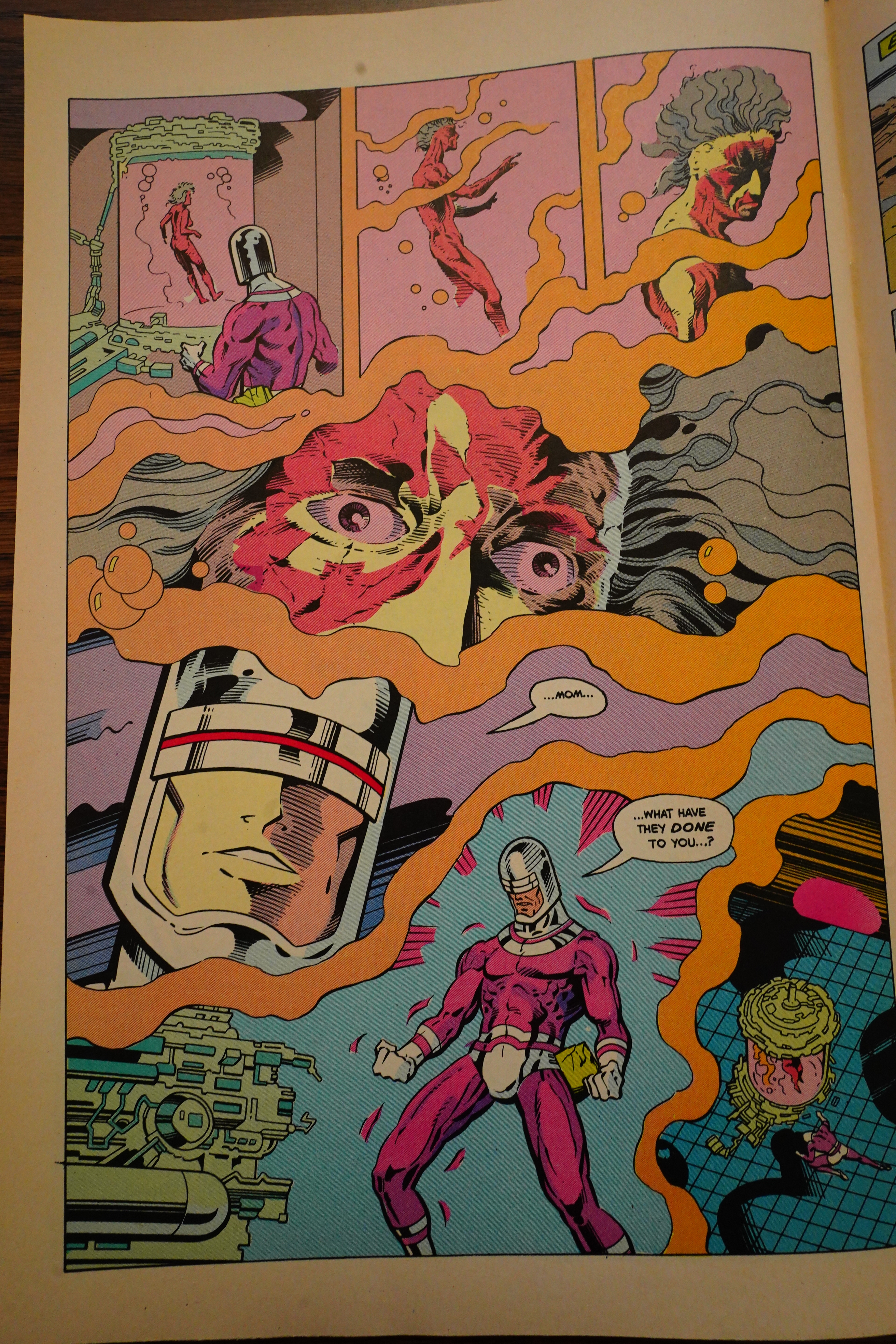
And, as with Sun Runners, it’s pretty creepy to boot.
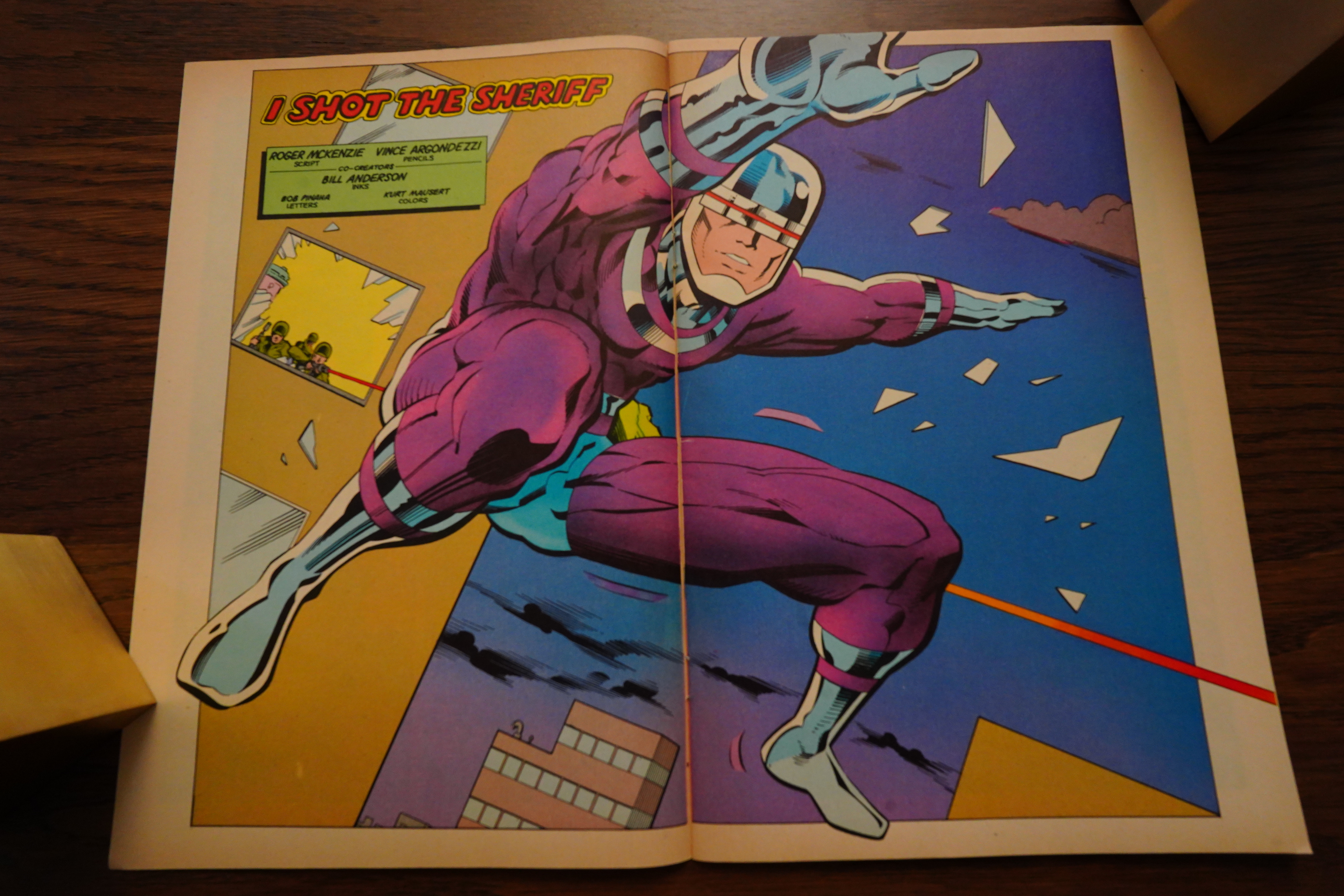
Hey, that’s a good Kirby pose. I assume that it’s been copied directly from some New Gods splash page?
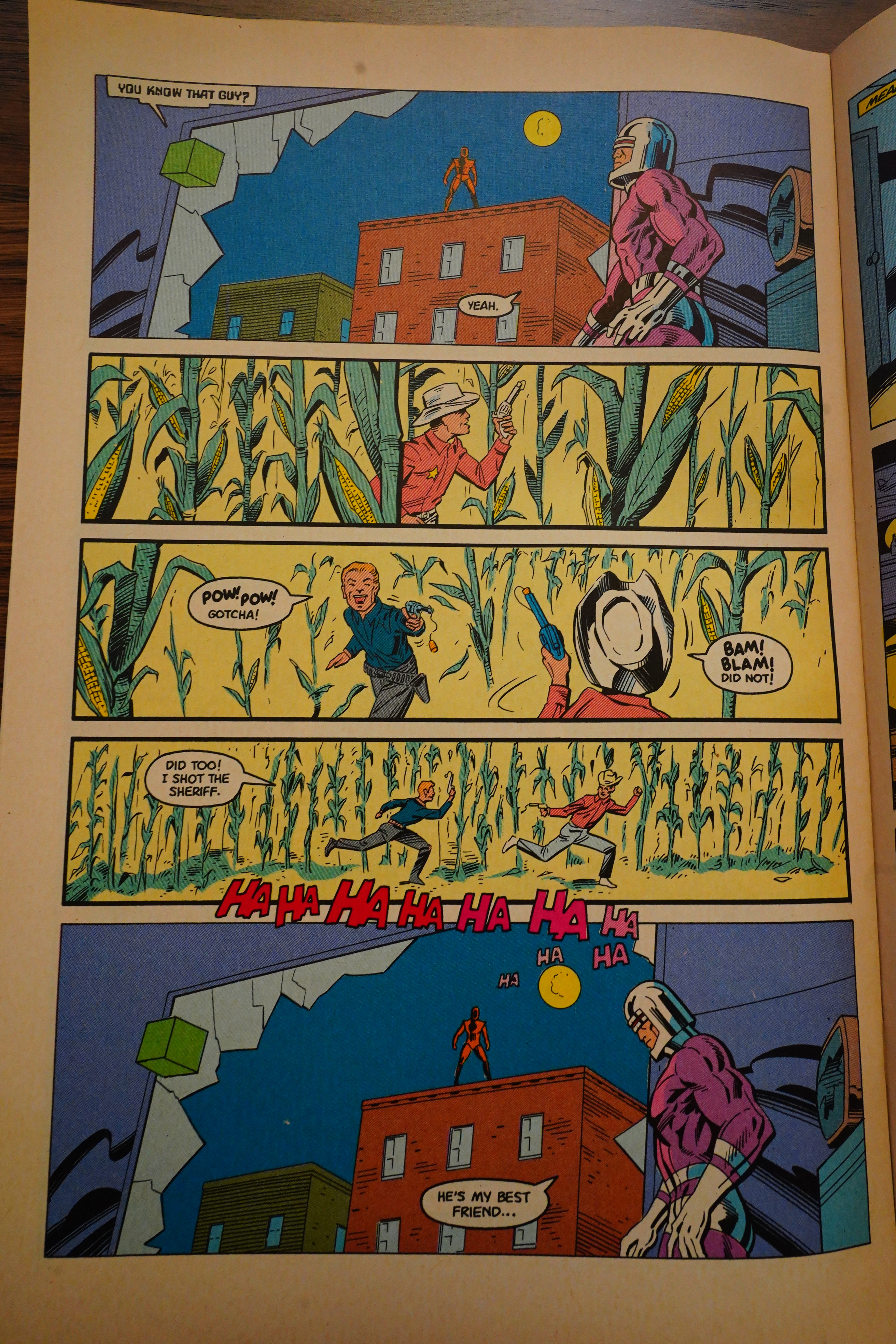
Scenes like this feel like they should work, but instead it reads like an oddly humour-less parody.
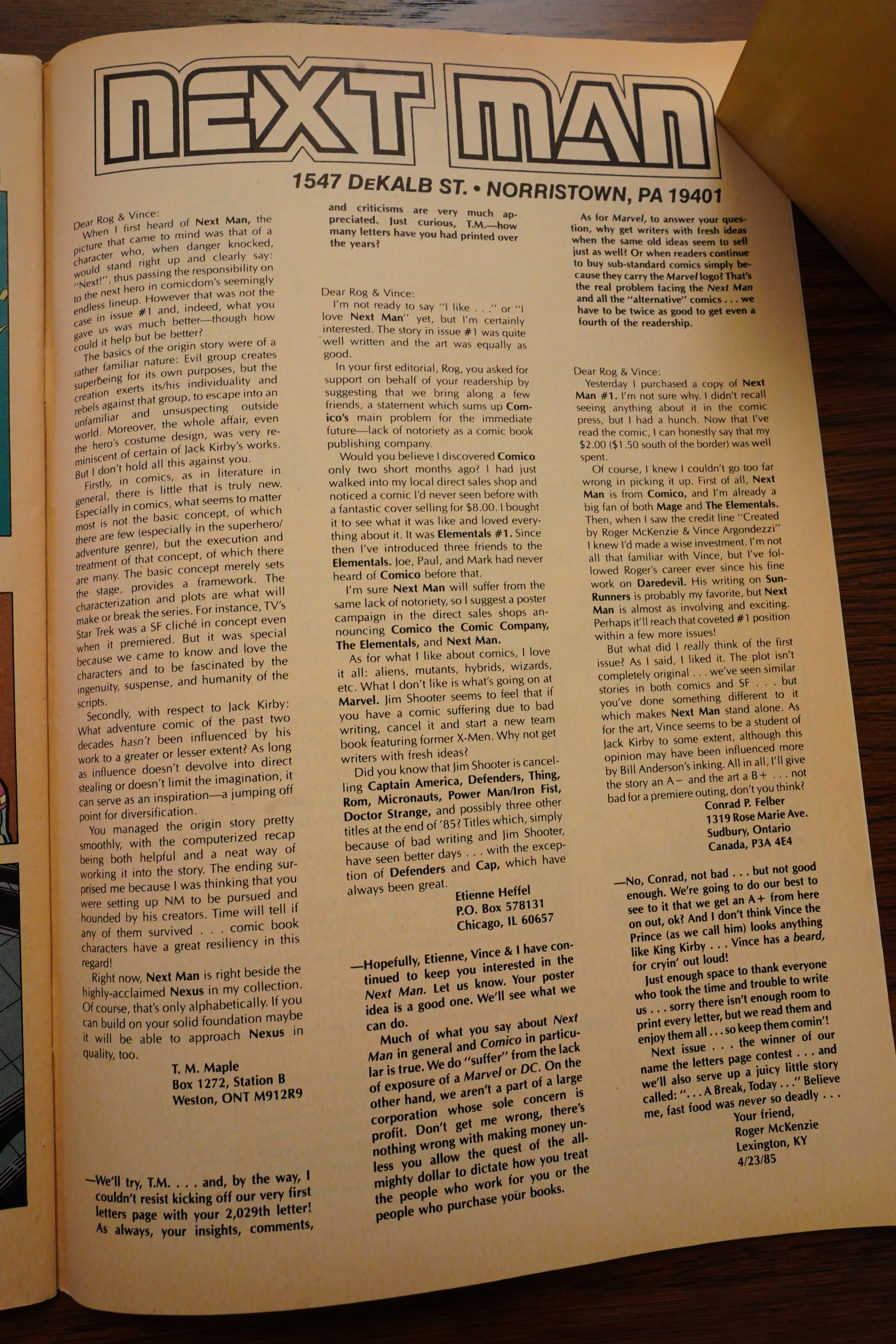
T. M. Maple writes in to note that the setup seems really familiar.
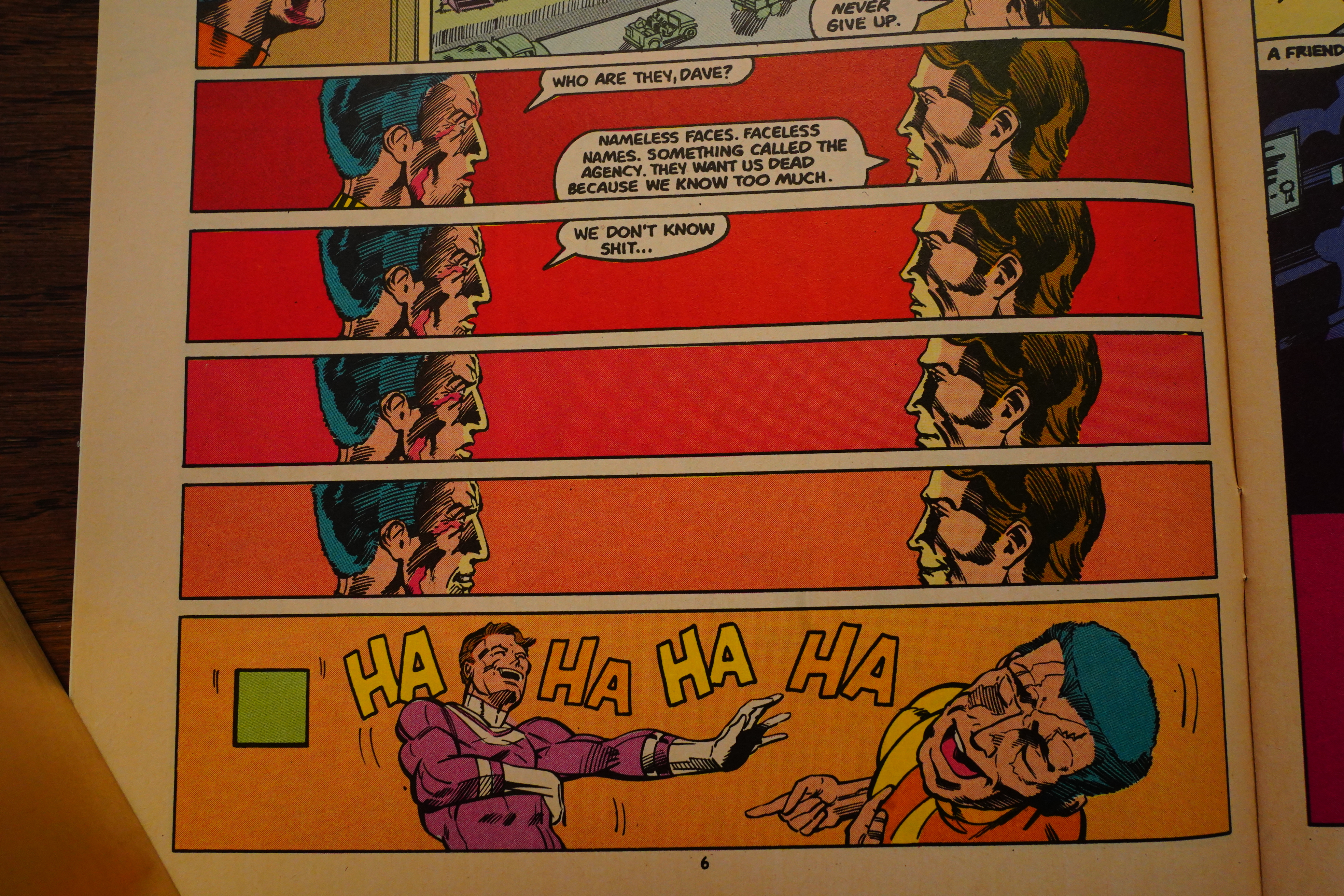
Beat beat beat.
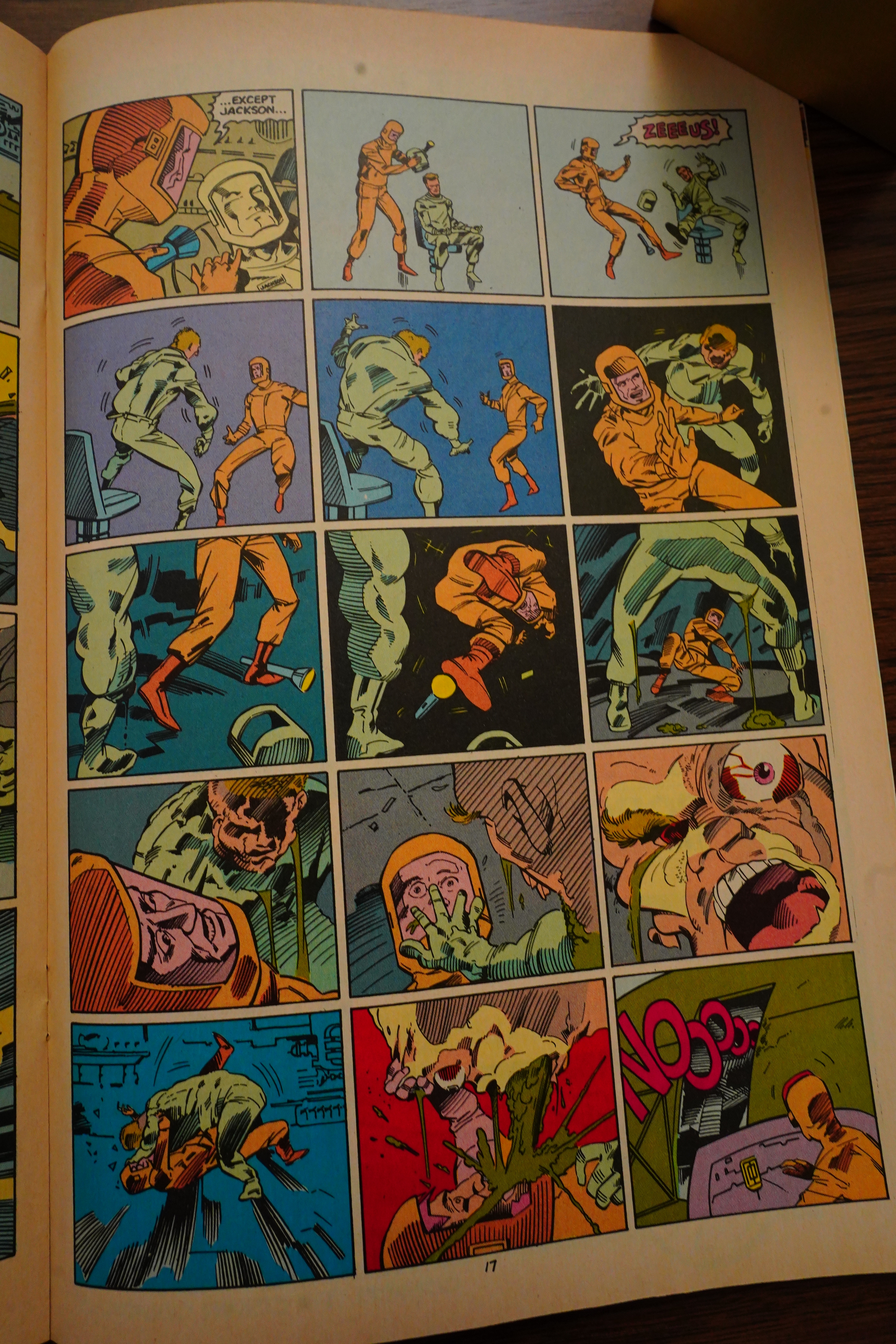
Well, OK — this page works, I think?
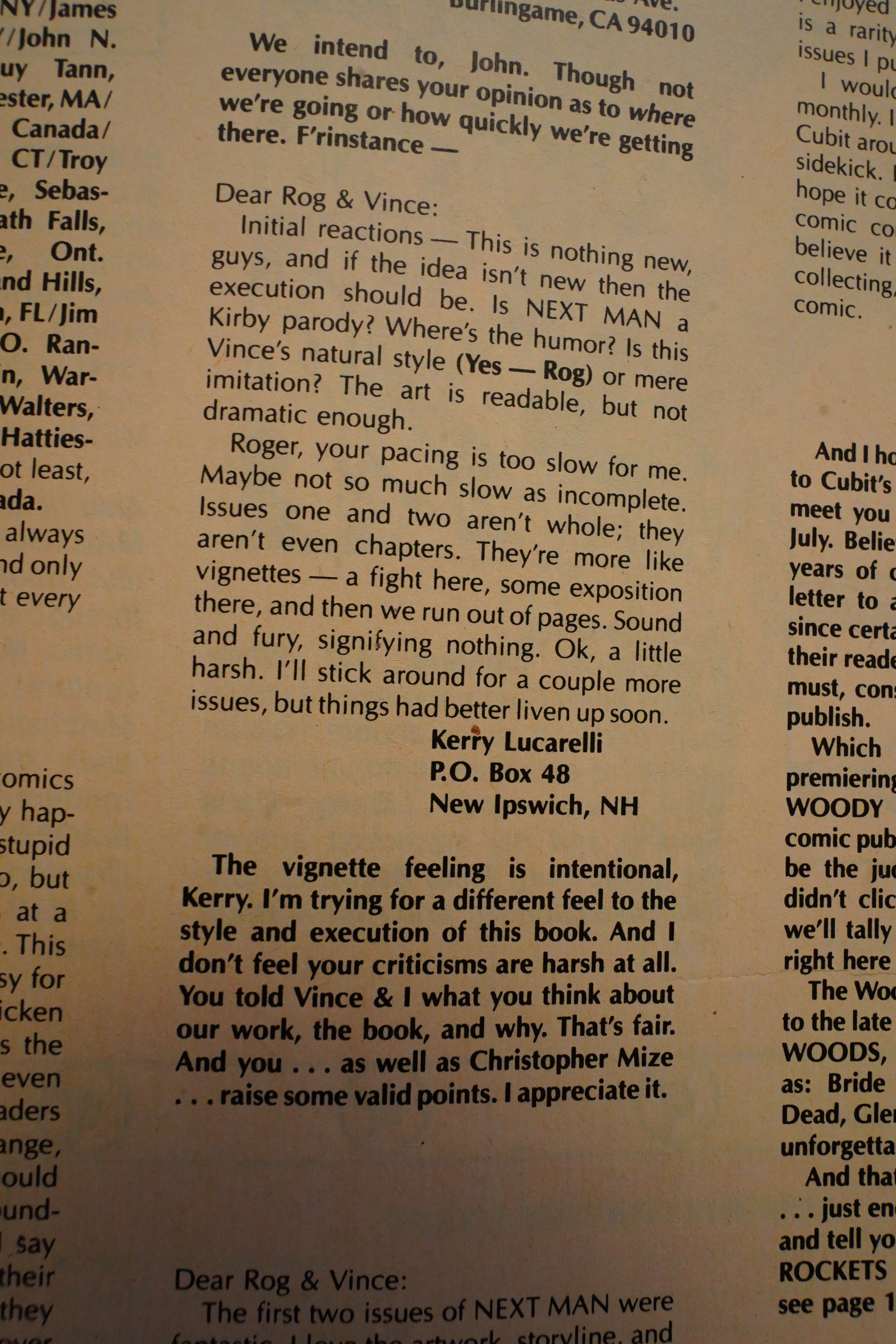
Hey! I’m not the only one that felt like the book seemed really off. “If the idea isn’t new, then the execution should be. Is Next Man a Kirby parody? Where’s the humour?”
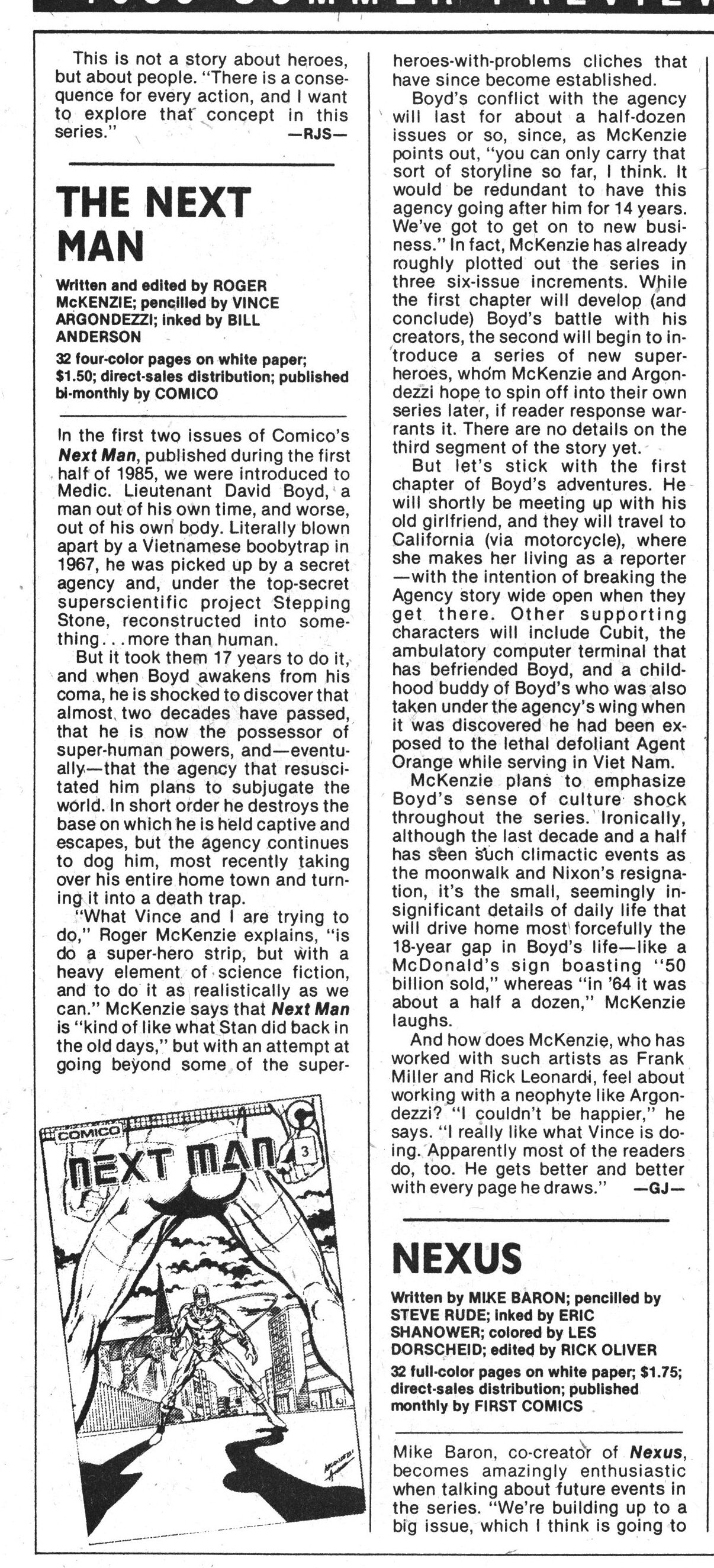
McKenzie says that the vignette feeling is intentional.
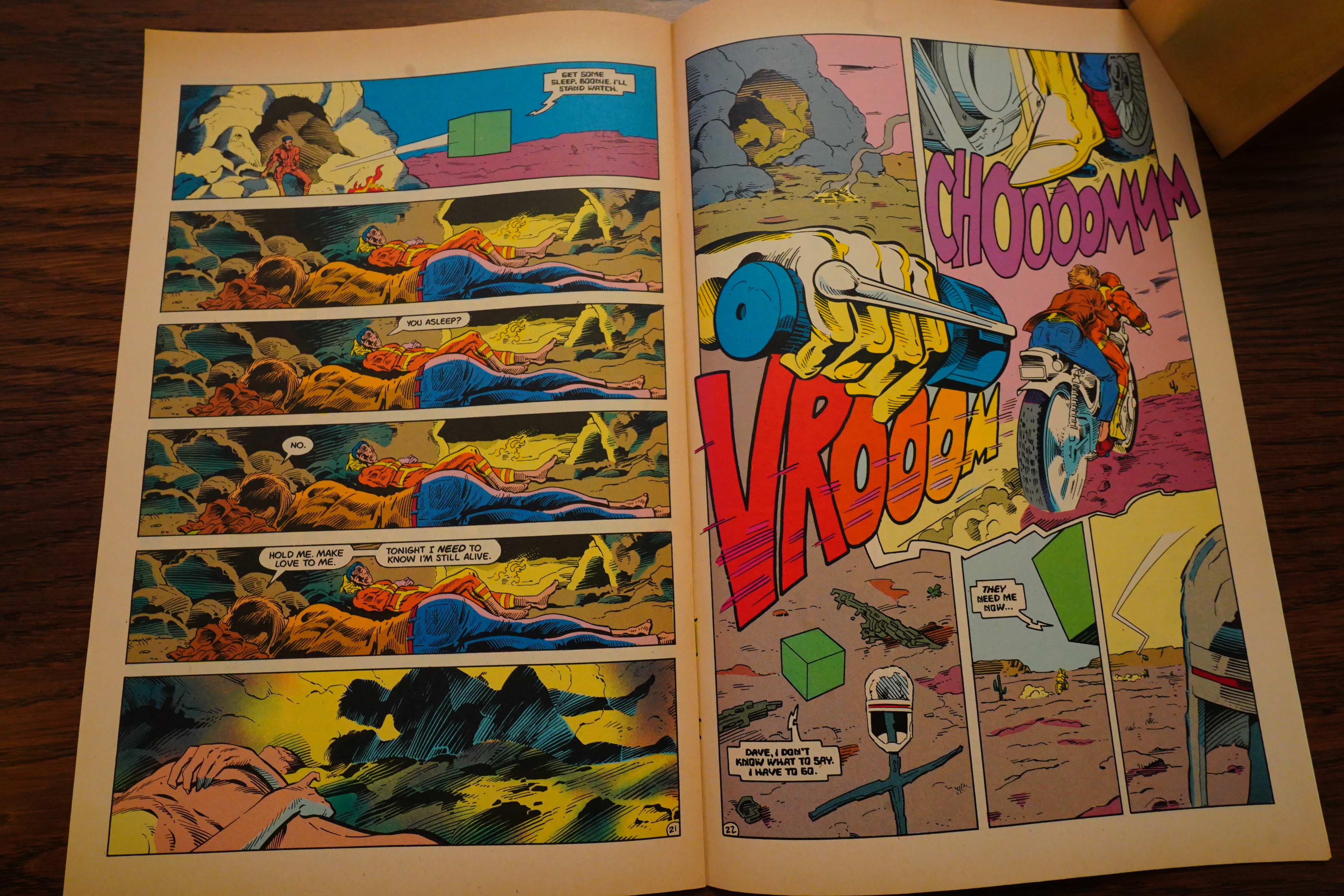
Next Man is apparently dead, so his friends take the change to get romantic.
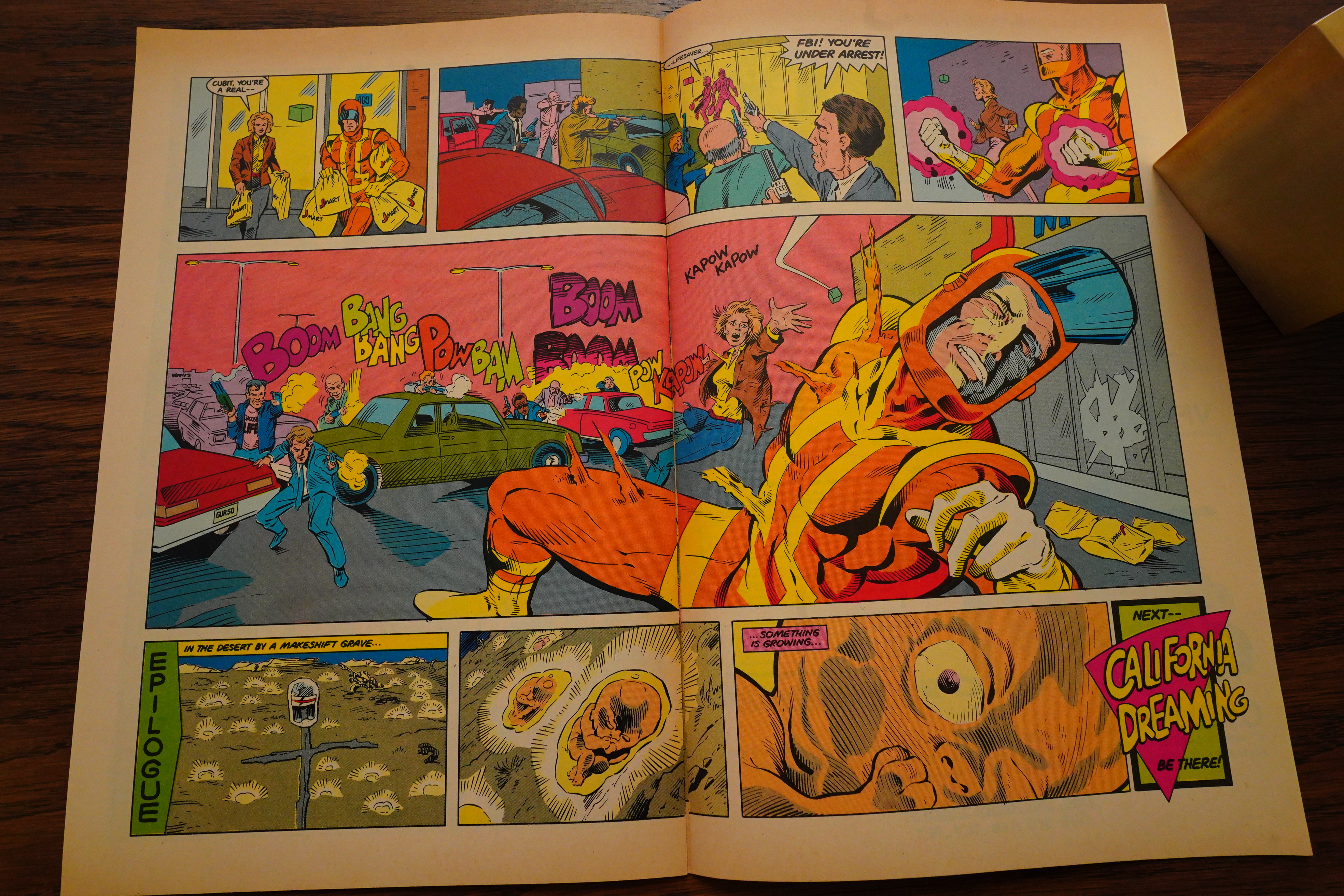
And then the series ends in the traditional way for indie comics: A panel saying “Next”. Man.
So… I’m not surprised that this book was cancelled, because it’s really bad, man. The artwork was getting better over the course of the run, but I see that Argondezzi left comics a few years later. I appreciate what they were trying to do, storytelling wise, but it just didn’t work: The decompressed style, along with material that was so familiar that it felt like a parody, made it hard to pay attention while reading these books. I’m surprised it lasted for five issues.
The Comics Journal #103, page #12:
The Next Man, one
of Comico’s newer books, will go
homeless with the publication of
the fifth issue. According to
Giovinco, the reason was poor
sales. “It was selling lower than
our other books, and it was
losing money,” he said. “If it had
been breaking even, we would
have stayed behind it.”
According to writer Roger
McKenzie, The Next Man did
have an erratic sales history. He
cited his royalty statement from
Comico, which said the first issue
sold 43,375, the second issue sold
18,480, the third issue sold 21,050,
and the fourth issue sold 20,860.
While McKenzie didn’t deny that
sales were low, he said he was
surprised at Comico’s decision,
because it came out of the blue.
We seemed to be going along
quite well,” he said. “They had
just commissioned Vince (Argon-
dezzi, the book’s artist) to do a
poster, and we never heard that
they were even thinking about
cancelling it.”
Both Argondezzi and McKenzie
were dissatisfied with the
promotion and publicity that the
book received. “They really
didn’t care about the book,
McKenzie said. He said that
Comico sent him and Argondezzi
to the 1985 Dallas Fantasy Fair,
but armed them with posters and
other promotional material for all
the books in Comico’s line except
for The Next Man. “They
shouldn’t have signed us if they
weren’t going to get behind us,
Argondezzi said. “If they had
told us the book was in danger of
cancellation, we could have tried
something to save it-but they
didn’t say anything to us until
they had made up their minds to
cancel it.” Giovinco disputed this,
though, saying that he had talked
with the creators about various
ways of pumping up sales, such
as changing the book’s frequency
from bi-monthly to monthly.
‘When we got the final cost-
analysis in for the book, though,
we decided it wasn’t worth it to
try to save the book,” he said. “It
was losing too much money for
us.” Giovinco declined to divulge
the amount Comico was losing on
the book
Both McKenzie and Argon-
dezzi, as well as Giovinco, said
that the creators wre originally
signed up to do 18 issues of The
Next Man. However, the creators
said they wouldn’t try to hold
Comico to the contract and the
remaining 13 issues. Even if they
did try to hold Comico to the
contract, Giovinco said it would
be futile. “Any publisher is smart
enough to leave himself an
“escape valve” if he gets stuck
with a complete dog,” he said.
However, Giovinco refused to
discuss the actual “escape valve’
he said the contract contained.
Argondezzi said that while he
wasn’t aware of a loophole
Comico could slip through, he
said it didn’t matter if there is
one. “We’re not going to try to
stay at Comico, that’s for sure,”
he said.
Although the final issue of The
Next Man will be issue #5, the
plotlines won’t be tied together
until the sixth issue. McKenzie
and Argondezzi are talking with
new publishers, but neither would
discuss possible new homes for
the book.
This didn’t happen, I think? But a weirder thing happened:
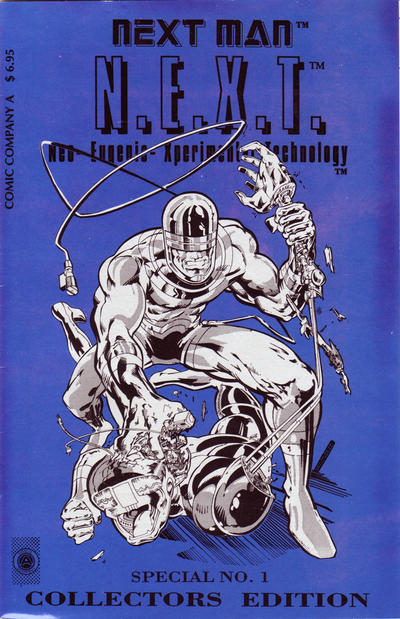
In 1993, Comic Company A released a special that reprinted issue #5! And then added some illustrations and an interview. Very odd.
The series has never been reprinted.
The Telegraph Wire #20, page #13:
On the other hand, NEXT MAN marks Vince
Argondezzi’s first regular comics series, but
the young artist has already begun to display
the kind of professionalism required by the
field. Heavily influenced by the “King of
Comics, ” Argondezzi brings a definite Kirby-
esque flair to the adventures of the Next Man.
This interview took place in December ’84
at the Comico offices in Norristown, Pennsyl-
vania. It was transcribed by Eric Yarber,
copy-edited by Roger McKenzie and Vince
Argondezzi, with final edits by yours truly.
Special thanks are due to Vince and to
Gerry Giovinco and Phil Lasorda of Comico
for all their help in coordinating the Next
Man cover for this issue of THE TELEGRAPH
WIRE.DIANA SCHUTZ: The first thing I’m interested in is
why you chose to bring NEXT MAN to Comico.
ROGER McKENZIE: Easy. Because nobody else would give
us the time of day. No, not really. I had originally
approached Pacific with this idea and they said, “Fine,
we like it, let’s do it.” A year and a half went by,
and we never did it.
VINCE ARGONDEZZI: At the time, I was just starting
to get a little foot into Pacific by doing two or
three VANGUARD stories for Dave Scroggy and I sent
Roger a sample page for NEXT MAN and he said, “Let’s
get together and do it.”
DIANA: When Pacific suspended operations, why did you
move specifically to Comico?
VINCE: We’d talked to other companies, but they were
dragging their feet. Comico was there and they really
wanted it.
ROGER: And I was ready to go with it, having waited
a year and a half already and having had this idea
originally back in high school–and we won’t even go
into how long that’s been!
VINCE: I think Comico has the best attitude. They
have the smarts to let the creators do what the crea-
tors want to do. What seems to be wrong with comics,
at least in the mainstream, is that the mainstream
companies keep the same feel to all their products.
And some of the other alternate publishers are good,
but they don’t have enough commercial sense. So, on
the one hand you’ve got really crass commercial stuff,
and on the other hand you’ve got nice material with
the alternatives, but it’s so far out that the com-
panies can’t survive because they’re too creative.
Comico’s right in the middle. They’ve got beautiful
commercial stuff like ELEMENTALS, they’ve got really
sharp creative stuff like MAGE, and they’ve got work
like NEXT MAN that’s kind of in the middle. Plus
they’re branching out into stuff like MACROSS and all.[…]
DIANA: So, what makes NEXT MAN different from all
the other superhero books that are already out on
the market?
ROGER: I think what makes it different is the way
we’re treating the concepts. We haven’t yet said,
“Here’s a superhero.” We haven’t yet said, “Here’s
a big bad villain who’s out to beat up the superhero
for no reason in the world.”
VINCE: That comes in issue #3! [Laughter]
ROGER: Yeah!
VINCE: The good thing about NEXT MAN is there’s so
much potential in the character. Basically you have
a guy who does not fit in. He has no real identity.
His father’s dead. He’s alienated.
ROGER: But he’s got so much going on that he won’t
realize it for several issues, although 1980s cul-
ture shock will start hitting him soon. But he has
found out more or less what’s going on, and he says,
“No way will I help you destroy the world.” As a
matter of fact, he destroys his creators at the end
of the first issue, or so he thinks.[…]
DIANA: What about the fact that there are words in
comic books, and fewer and fewer people are reading
at all these days?
ROGER: What I’ve tended to do to solve that situation
is not to write any words at all.
Diana Schutz did the interview here (for The Telegraph Wire), but she’d go on to work for Comico a couple months later, which is kinda interesting.
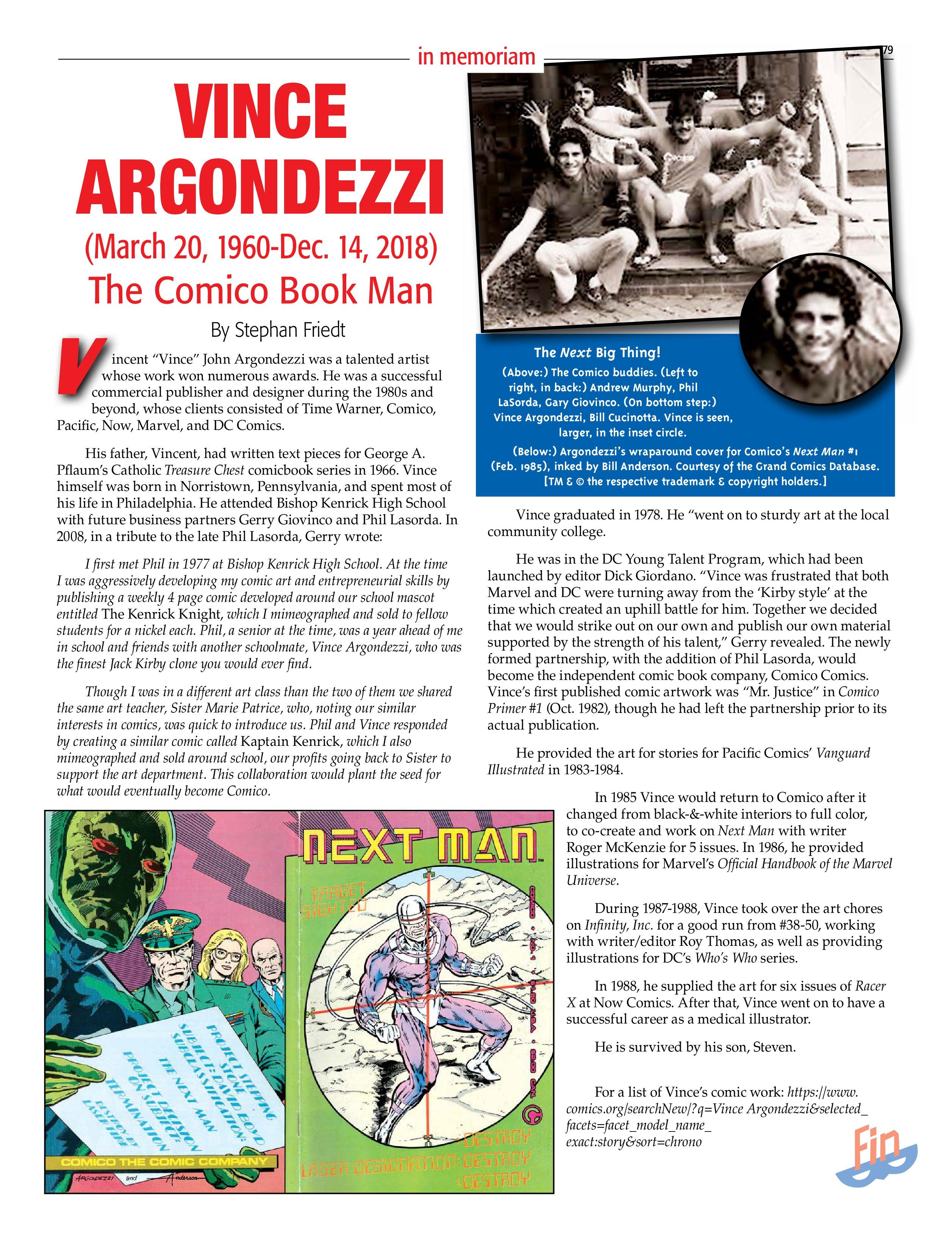
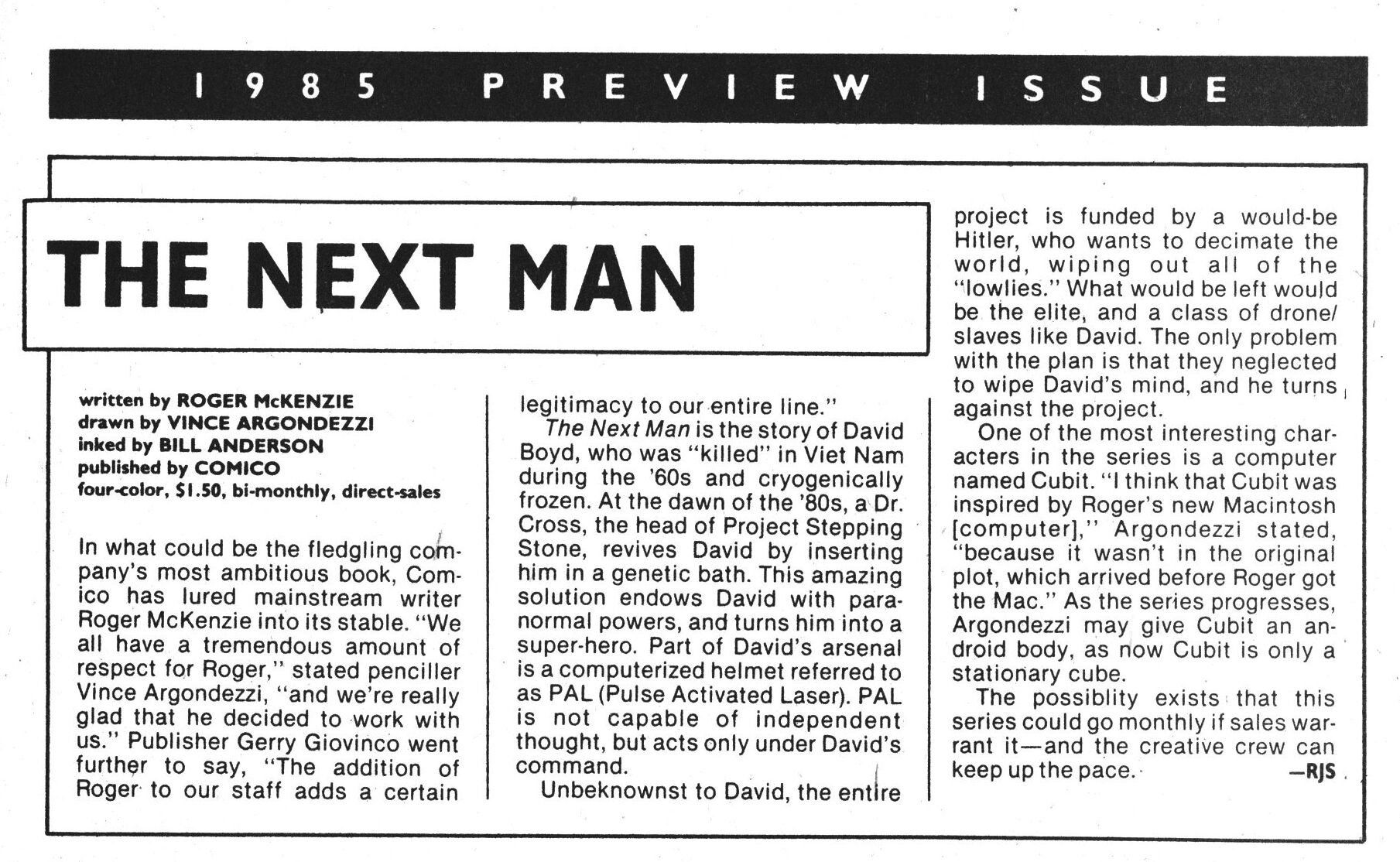
This newest title from Comico
(“the Comic Company”) has a lot
of rough edges…but I think it
shows a lot of potential as well.
One of the best things it has going
for is its scripter, Roger McKenzie.
McKenzie did an excellent job on
Daredevil several years ago, and
his Sunrunners is an enjoyable
book (whenever it appears).
He seems to have come up with
a fairly solid formula here, a com-
bination of science fiction and
super-hero fantasy. There are
weaknesses in this first issue, at
least partly due to the unavoidable
restrictions of an origin story. We
aren’t shown much of David
Boyd’s personality-the inner man.
This is ony a minor complaint, as
this will no doubt be fully explored
as the series progresses. The Next
Man should prove to be a strong
character, and in Dr. Cross he has a
worthy arch-rival comething every
hero needs.
1 think most of the gripes that this
first issue will elicit will focus on
the art, and not without some justi-
fication. One can point to ex-
amples of stiff figures, fuzzy im-
ages, simplistic layouts. But I’m not
going to give it a blanket condem-
nation.
Many will probably dismiss the
artwork as nothing more than a bad
imitation of Jack Kirby. Experience
has taught me to be cautious of
this; after all, such outstanding art-
ists as Barry Windsor-Smith and Jim
Steranko started out doing bad
Kirby. Also, I have an advantage
over some of you in that I have had
the chance to see more of Vince
Argondezzi’s pencils 4they are real-
ly quite good, and show every sign
of improving.
I think part of the problem here
has to do with the inking. That’s not
a rap against Bill Anderson; he’s a
good inker. It’s just that his style
doesn’t seem to be completely
compatible with that of Argondez-
zi. Thus, I don’t think the art seen
here is representational of what we
can expect from Vince. Future
issues should show a major up-
swing.
Comico itself has taken large
strides in improving its product.
While I personally don’t have
much interest in their upcoming
robot series, their other titles seem
to be growing stronger every issue.
If they can only solve the problem
facing every alternative publish-
er-that of getting their books out
on time every issue-Comico
could well join First and Eclipse in
the forefront of “downstream”
comics (no derogation in that
term-just coined to differentiate
them from the so-called “main-
stream” comics).
Next Man #1 shows enough
potential that I certainly intend to
give it a few issues to prove itself.
loin me.
– R. A. Jones
The Comics Journal #105, page #26:
The newest advertising campaign
by Lodestone Publishing has
raised the ire of three creators, all
of whom deny they are working
for Lodestone, despite the claims
of the ad, published in the
Comics Buyer’s Guide.
Co-owned: The ad claimed that
The Next Man, recently cancelled
by Comico, is surfacing at Lode-
stone. However, The Next Man is
copyrighted by both Roger
McKenzie and Vince Argondezzi,
respectively the writer and artist,
while the ad said the property
was copyrighted only by
McKenzie. Further, the text in the
ad said, “… we will boggle your
mind with the name of our super-
star artist who will be handling
the series with Roger.’
McKenzie said that while he
did discuss taking The Next Man
to Lodestone, one reason he
didn’t do it is Lodestone
Publisher Dave Singer’s resistance
to Agondezzi being the book’s
artist. “Way before Comico ever
saw the product, I showed it to
Dave, and he liked it very much,”
McKenzie said. “But Dave was
considering a new artist, and
that’s one of the problems I
had with him.” Eventually, though,
the legal problems that Singer
encountered with his T.H.U.N.-
D.E.R. Agents book at Deluxe
Comics (Lodestone’s sister
company) caused McKenzie and
Argondezzi to look for another
home for The Next Man.
The Encyclopedia of Superheroes, page #242:
Alter Ego: David Boyd.
First Appearance: 1985, The Next Man #1, Comico.
Occupation: None.
Costume: Purple bodysuit; silver helmet, gloves,
boots, trunks, bands on his wrist, legs, neck, and
shoulder.
Tools and Weapons: The Next Man’s belt is equipped
with a hose known as PAL (Pulse Activated
Laser), which is fired by mental commands; he is
frequently advised by a talking green cube known
as Cubit, a vastly superior computer.
Biography: Serving as a medic in Vietnam, Lt. Boyd
is caught in an explosion in the village of Lon
Pen. Airlifted to a hospital in Saigon, Boyd is near
death. Instead of putting him on life-support sys-
tems, the doctors ship the 25-year-old to Wash-
ington, where his is cryogenically frozen. Then,
in 1984, after being transferred to a facility in
California, he becomes a part of Project Stepping
Stone. Placed in a “heated silicon gene pool” and
subjected to “helix sculpting,” he is genetically
rebuilt and given super strength and reflexes.
Becoming a superhero, he turns on his creators
who, he learns, had planned to take over the world.
Quote: “You’re a madman, Cross. But the madness
ends here and now.”
Comment: This uninspired character is another of
the rebuilt-human school of superheroes pi-
oneered by Captain America.
Miaow!
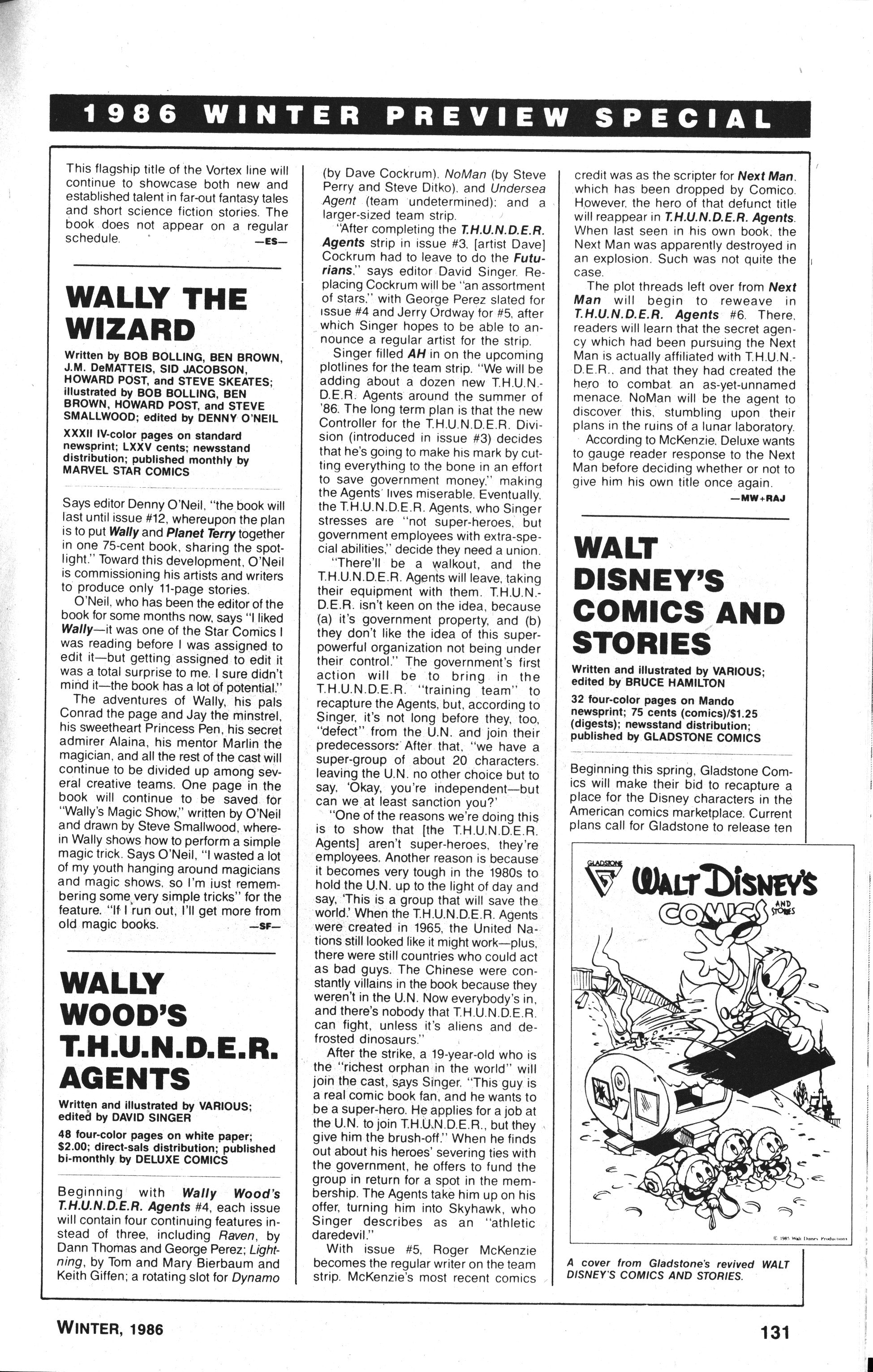
Ah, so McKenzie had planned on bringing Next Man back in THUNDARR A.G.E.N.T.S., but I don’t think that happened…
The Slings and Arrows Comic Guide #2, page #470:
NEXT MAN
Comico: 4 issues 1985
Comic Company A: 1 issue 1993
A Vietnam soldier preserved after a near-fatal explosion is
revived twenty years later, having been genetically altered.
Minimalist plotting and artwork. The Comic Company A
issue was to have been Comico’s fifth issue.~FP
Some confusion here…
There’s little written about Next Man on the intertubes. Here’s something:
Next Man was not a “hit” for Comico but it was still a good book. Though the art was a bit raw it had a very Jack Kirby feel to it, which I would have liked to seen grow with the series.
They published an ebook version of… the fifth issue:
Comic Company A was the only successful publishing and media house to survive from Comico to be carried officially by the worlds major comics distributors, with sellouts like the Next Man Collectors Edition series, and well as the studio’s award winning work in the realm of Health Care and Commercial art…making these new first steps now in to the environment of online media is fitting, and the first volly in what will be a wholesale emphasis for development towards the future of this now reinvigorated medium.
The nowadays commonplace subjects like Euthinasia, and the aftermath of the Vietnam war were not talked about too much in the mid eighties in comics.
Er, OK.
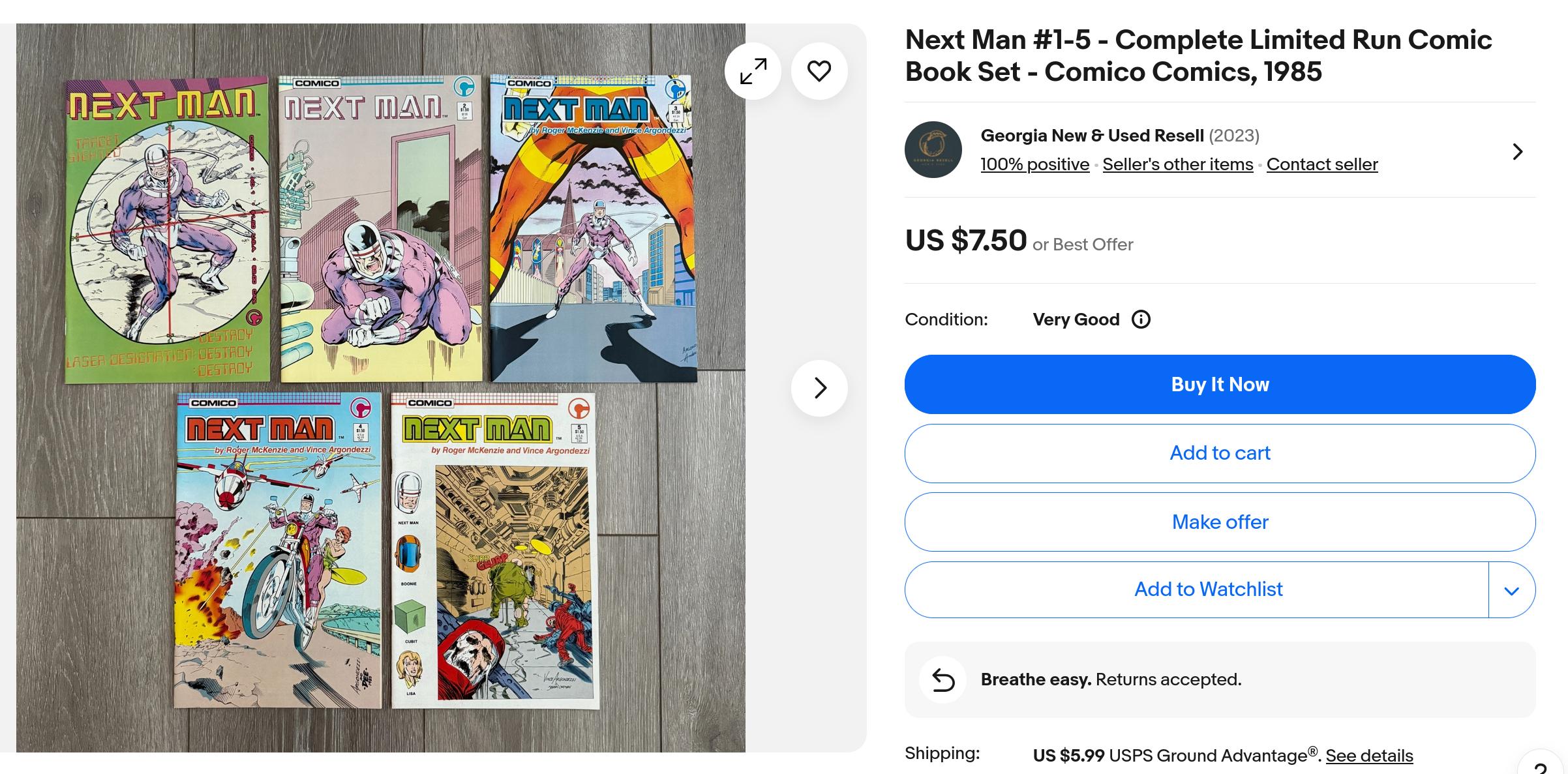
You can pick up copies of the book at cover price still.