
The so-called “vocal minority” in comics has been getting a lot of attention lately due to reactions generated by Raphael Albuquerque’s request to pull his controversial variant cover for Batgirl #41 and Image co-founder Eric Larson’s criticism of the newly designed Wonder Woman costume.
To be clear, the term “vocal minority” today’s current comic speak for the voice of feminists and their supporters who rally against sexual exploitation and violence against women in comics.
In the case of Albuquerque’s cover, the artist responded to threats of violence made towards critics of the cover. He respected and agreed with the concerns of the “vocal minority” that felt the image strongly implied rape and was not consistent with the current direction of the current Batgirl story line. DC honored his request and replaced the cover with a more appropriate variant.
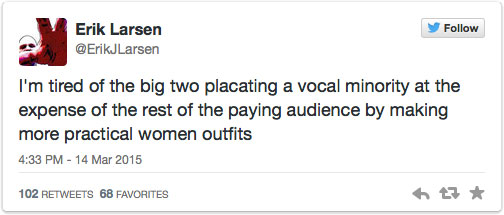
Regarding, Erik Larsen, well, he just had a meltdown. He lambasted the big two on twitter for “placating a vocal minority at the expense of the paying audience by making more practical women outfits.”
Janelle Asselin did a nice piece on the subject that should be read at Comics Alliance. Her conclusion that the comics industry is changing and fans and pros that have perpetuated a sexualized and violent comic market for decades need to realize that the industry is not just about them any more should be applauded for the sole purpose of pointing out that for too long the industry has been dictated by a “silent minority.”
This group’s intentions for publishing comic books over the last few decades is a lot different than what had gone before.
Many of the iconic comic characters that we enjoy today were created at a time when it was necessary to appeal to the widest audience possible. For this reason and later for the approval of the Comics Code Authority, comic publishers went out of their way to create wholesome, unoffensive characters with broad appeal. I was just good business for the market at the time.
 The costumes worn by superheroes were designed to emulate the exotic and powerful costumes of circus entertainers that inspired the imaginations of the young and old alike. The capes, tights and body suits came from strongmen, acrobats, aerialists and dancers because it was their costumes that the public equated with what was powerful and fantastic.
They were simple and much more innocent times.
The characters became powerful trademarks recognizable by people around the world. They were licensed and merchandised to promote tons of product all on the strength of the characters recognizability and good will.
The image of superhero on a product stood for “Truth Justice, and the American Way.”
This all changed in the late 1980′s and 1990′s. Comic book sales became relegated strictly to comic shops and the Comic Code lost its authority. A new crowd took over the reigns at the publishing houses. Comics were no longer being made for the largest audience. They were being made to appeal to a finite group of like-minded, adult, male fans and creators who wanted their comics mature, violent and sexual. This “silent minority” assumed the market and would control it entirely today if it were not for the success of Manga in American bookstores and the purchase of Marvel by Disney.
Manga with its attention to wide subject matter, strong character relationships and dominant female characters attracted women readers and eventually drove them into the comic shops shaking up the boys club that proliferates there.
Disney, with their solid focus on branding has capitalized on their merchandising machine and made Marvel characters household names like never before. The appeal of the superhero has not been this great since World War ll.
But DC continues to tarnish their established trademarks from the inside-out finding new ways to offend and alienate a wider market that includes women that respect themselves and a youth market that is not ready for stories about sex, rape, extreme violence and vulgar language.
The new fans are not discovering what they expect when they walk into comic shops because comic books have changed.
Our culture assumes that superheroes are for everyone. We like to consider them our modern mythology. Like it or not, this is what they have become. When they are used as a tool for exclusion, misogyny, or racism it should be expected that a discussion will occur. One that should remain peaceful and dignified. Anyone that invokes the use of violence to prove their point should not be tolerated.
Let’s be civilized.
Superheroes are just a small part of the ever growing comics industry. There is plenty of room for comics and graphic novels to be created to appeal to every minority group out there no matter how silent or vocal they are. But we will all be best served if the publishers, creators and fans encourage the creation of new characters to drive those stories so the old characters can retain the ideals intended by their original creators.
You see, I am a member of another minority. One that remembers when comics were fun colorful and exciting. The good guy always won. The women were beautiful and their clothes stayed on. I don’t remember cringing at violence because it was never extreme and I never worried about being offended by reading a story about my favorite character. I would like to see those characters that I grew up with, remain the pure icons that they were. But it is already too late. If I want to read those comics I have to pick up an omnibus collection.
 Alan Moore did it right when he created the Watchmen. He gave us something new for a more mature audience without corrupting classic characters.
And then he wrote The Killing Joke where Batgirl was stripped, mutilated, and permanently disabled which has now led us to the furor over Albuquerque’s cover.
Where is Yvonne Craig when we need her?
Gerry Giovinco

Tags: Batgirl, Batgirl #41, Comics Alliance, Comics Code, Comics Code Authority, Disney, Eric Larson, Image, Image Comics, Janelle Asselin, manga, Marvel, Raphael Albuquerque, The Killing Joke, Vocal minority, WATCHMEN, Wonder Woman, Yvonne Craig