 Remember the commercial where one person eating a chocolate bar collides with another eating peanut butter presumably inspiring Reese’s Peanut Butter Cups? The ad capitalized on a well known fact that some of the best ideas are the results of accidents.
Wouldn’t it be great if we could anticipate these unlikely turn of events and forecast an outcome accurately in advance? Scientists attempt this all the time and perform experiments to prove their hypothesis.
Well, I’m no scientist but I think I know a few things about comics and I have been witnessing some developments in technology, distribution and comic art production that lead me to believe that 3-D is the key to a bountiful future for the comics industry.
(Laughter?)
 I know this is a daring statement considering that 3-D has never been anything other than an eye-blurring, headache-inducing fad requiring optical accessories that defy all fashion sensibilities but the stars of fate are lining up like the reflection of lights in disco infinity mirror!
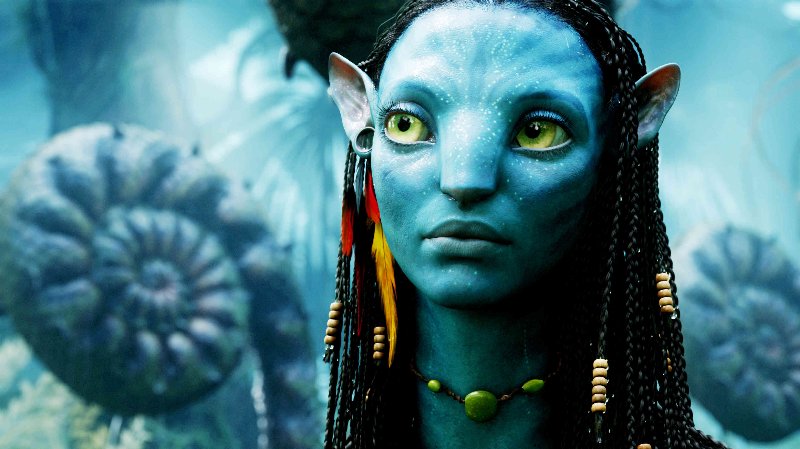
Ever since the incredible commercial success of AVATAR, Hollywood has been cramming 3-D films down the throats of audiences in theaters everywhere. Any film that can be remotely adapted to 3-D is going under the stereoscopic knife. Still, most audiences prefer the traditional 2-D versions so what is the rush?
There is a 3-D technological boom on the horizon.
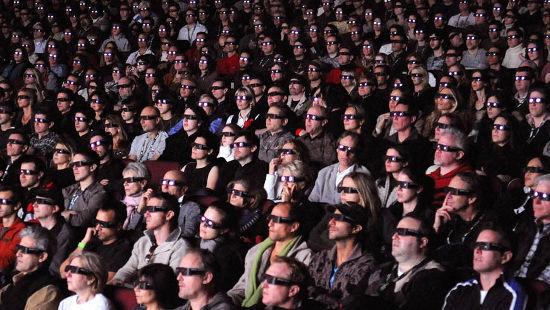
3-D has been steadily infiltrating our homes as more and more HD televisions are equipped with 3-D capability. Though these televisions still require the use of eyeglasses with polarized lenses or more the sophisticated shutter glasses, the 3-D effects, especially on large screens, are astounding.
Hand held mobile devices, however, are poised to overtake the market using a new technology called APB or Autostereoscopic Parallax Barrier. They are capable of displaying crystal clear 3-D on their small screens without the need for any special glasses. These gaming units, cell phones and, soon, tablets are also being equipped with 3-D cameras making them capable of capturing, sending and sharing photos and video of unique 3-D content.
Content is the magic word!

For these new 3-D devices to succeed there needs to be content. Lots of it. Hollywood is scrambling but it can’t make it fast enough. Video games, tapping into the already present 3-D CGI will be broad providers of material. Web developers will employ more and more 3-D imagery as the viewing devices become more readily available. Manufacturers are betting the house that users will become the biggest provider of 3-D content simply by sharing their images and video. Anaglyphic 3-D content that requires the use of the old red and blue lensed glasses is already proliferating on YouTube, paving the road for the more easily viewed autostereoscopic material.
I believe that no media can produce more dynamic 3-D content at an economical cost than comics. Comic art is a natural for 3-D with its traditional dependancy on line art and frequent use of dramatic forced perspective. The effects in 3-D comics are enhanced and the layers of depth are more clearly defined than traditional stereoscopic photography and even 3-D CGI. Comics also give the reader a greater opportunity to appreciate 3-D in each static image of a story while in a 3-D video the effects stream by quickly, offering little chance to digest the depth of the graphics.
Motion comics offer the best of both worlds. In fact it was my having watched DC’s commercial for the New 52 and noting its achievement of creating the illusion of depth with its graphics and motion of layers of art, combined with an ad for a newly released 3-D cell phone that includes a 3-D camera that pushed the chocolate into the peanut butter for me. I had already seen the trailer for Green Lantern displayed on a 3-D capable Nintendo 3DS and was quite impressed by the technology and the clarity of the image. The idea that any user could easily generate this type of 3-D photos and videos with their cell phone camera gave me hope that comic artists could do the same with simple ingenuity and the help of a program that could generate stereoscopic images from line art.

Click and Visit M2
I came across a 3-D motion comic made by the guys at M2 on Bleeding Cool that is a must see if you have an old pair of red and blue anaglyphic glasses on you. It will give you a chance to see the potential of motion comics in 3-D.
M2 : 3D Sizzle Reel 2011 from M2 on Vimeo.
If you are enjoying the motion comics please be sure to check out Bernie Mireault’s Jam motion comic right here at CO2 Comics. I’m sure you can easily imagine how great that would look in 3-D.

Check out Bernie Mireault's The JAM Motion Comic
I have always been intrigued by 3-D possibly because even though we live in a three dimensional reality it is so hard to capture. As an artist the biggest challenge is being forced to capture that third dimension on a two dimensional canvas.
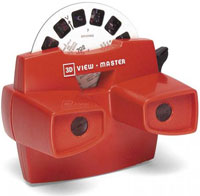 My first experience with simulated 3-D was with a Viewmaster. We all had them as kids, staring through those binocular-like viewers at a disc with a series of transparent slides. They were a toy adapted from basic stereoscopes that had been around since 1838.

Mighty_Mouse_3D
I was also a big fan of 3-D baseball cards that used lenticular graphics to create the illusion of depth. I at one time even owned a Nashika N8000 35mm 3-D camera that took photos that were processed and printed with this same lenticular process as the baseball cards.
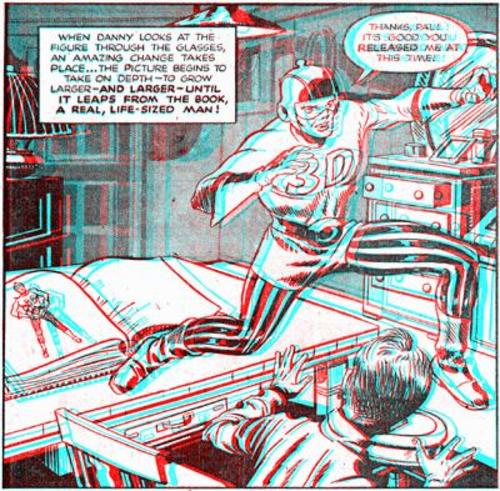
3-D Comics have been around for a long time. The first 3-D comic featured Mighty Mouse and was published by St. John Comics in 1953. The 3-D effect was created by none other than the legendary Joe Kubert along with Norman Maurer and his brother Lenny. The 3-D comic fad in the 50′s was short lived but 3-D comics enjoyed a comeback in the 80′s under the guiding hand of Ray Zone.

We published a ROBOTECH 3-D comic in 1987 while at Comico aond used Ray Zone’s expertise to produce it. Of course it contained pencils by CO2 Comics contributer Mike Leeke. Here are a couple of scans that you should be able to enjoy with a pair of 3-D specs.


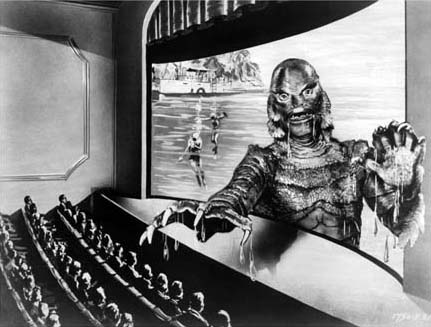 With all of these new viewing devices and autostereoscopic technology 3-D may be here to stay permanently and comics may benefit. Digital comics will have an opportunity to separate themselves from print entirely offering an eyeglass-free experience that cannot be had in book format. Will the added dimension create added value? More importantly will it create an interest in comics that attracts a broader audience? I’m betting that if it helps to sell more 3-D devices then the answer is yes. Only time will tell if my hypothesis is correct but right now I’m in the mood for a Reese’s Peanut Butter Cup.
Making Comics Because I Want To
Gerry Giovinco

Tags: 3-D, 3-D Comic, 3-D Comics, 3-D films, APB, Autostereoscopic Parallax Barrier, AVATAR, Bernie Mireault, Bernie Mireault's Jam, Bernie Mireault's Jam motion comic, Bleeding Cool, CGI, comic art, comico, comico the comic book company, comico the comic company, DC New 52, forced perspective, Green Lantern, HD televisions, Joe Kubert, lenticular, M2, Mighty Mouse, Mike Leeke, Motion comics, Nashika N8000, Nintendo 3DS, Norman Maurer, Ray Zone, Reese's, Reese's Peanut Butter Cups, Robotech, ROBOTECH 3-D, St. John Comics, stereoscopes, stereoscopic, Viewmaster