There is no doubt that when it comes to penciling for comics the first priority should be to learn to draw as best you can and to become an expert at visual storytelling. Once you have mastered these skills it is time to put the lead to the paper, remembering that comic art is made to be reproduced and that penciling is just one of several disciplines involved in making the finished comic page.
The penciler must be conscious of the script, the lettering, and the inking of the finished work. It is the penciler‘ to produce pencils that will enable the other work on the page to be executed properly. Everything from the type of paper to how final erasures will be made should come into consideration.
The tools are important too. Beginning cartoonists always want to know about the “magic pencil.” There is one but, like a baseball player’s favorite bat or glove, it is a very personal selection for each comic artist as are most of the other tools that will be used to create a comic page.
The space that the comic artist likes to work in has an effect on some of the tool decisions. Some artists like to be mobile and move around their home while they create, others like a studio built to the specifications of the Fortress of Solitude. Regardless of the preference, it is important to have a source of light, a smooth surface to work on and a comfortable place to sit.

The above image is reproduced from The Secrets of Professional Cartooning by Ken Muse-Prentice Hall-1981
Comic artists all begin as young doodlers drawing sprawled-out on the living room floor before graduating to the kitchen table. Those flat surfaces parallel to the ground ultimately cause distortion in the image. To prevent this the paper must be parallel to the eyes of the penciler. The penciler usually compensates for this by either hunching over the work or tilting the work surface.
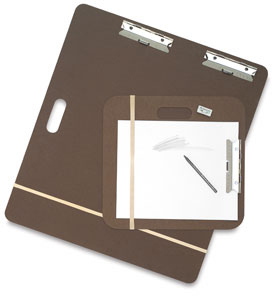
Lap Boards
The artist’s draft table is the best piece of furniture for the task and comes in many different styles but the beginning cartoonist may not have the space or the money to afford one. This is when a lapboard will come in handy. I’ve seen lapboards that look like small versions of actual drawing boards and I have seen smaller ones made out of masonite. Some artists like to use an oversized clipboard. The board rests in your lap and leans against a table in front of you offering a nice parallel view of your work.
Whichever drawing surface you choose you will want one with smooth strait edge on one side which will be important for ruling the page.
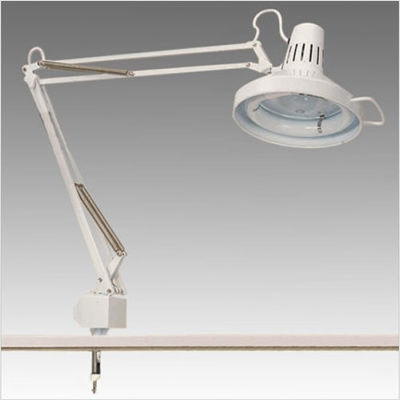 Be sure that wherever you choose to work there is enough light. Many artists like a swing lamp that they can attach to the drawing table. I think it helps your eyes if you can mix fluorescent and incandescent light. Some swing lamps have both types of bulbs just for this reason. It is easy to compensate for the mixed lighting if you can’t find one of these lamps. If your ceiling light is fluorescent you may want an incandescent bulb in your lamp and visa versa.
Take a look at artist studio’s on the web and you will find that they are all very different and very personal. If you plan to be a successful comic artist, expect to spend a ton of time in this space so insure that it is comfortable, inviting, efficient and productive.
In the coming weeks I will look at other tools and techniques that are valuable tip to comic pencilers, please feel free to chime in with your own personal preferences. I think it can become a fun discussion.
Making Comics Because I Want To
Gerry Giovinco

Tags: artist studio, Artists, Cartoonist, comic art, comic page, drawing boards, Fortress of Solitude, lapboard, penciler, Penciling for Comics, swing lamp, visual storytelling
It’s funny, but I never graduated up to the draft table. Growing up, my parents didn’t put much stock in my comicking, and while we weren’t poor, money was always a struggle, so they never got me a draft table.
Here’s what my setup looked like in 2008: http://dolari.deviantart.com/art/The-Home-Office-Annotated-78937271
I now work my comics out of a home office with two other professional artists and a computer programmer…25 years later, I’m still drawing at my computer desk.
My drawing table was my high school graduation present. It somehow solidified my commitment to becoming an illustrator. Having professional furniture made it seem so much more real. In 1979 drawing on a computer was not even an option and the Vic 20 we had cetainly didn’t require a desk. (Believe it or not I still have that digital relic!)
Very true. I have seen many different work space solutions. I have used a few different models myself. But the one common thing has been the lighting a smooth surface and a comfortable place to sit. The later has not always been a luxury to me. I have a lapboard that is easily transportable and allows me to work anywhere. That workspace there is a dream of mine. Still I can’t complain as I have a desk solely for the purpose of my art.